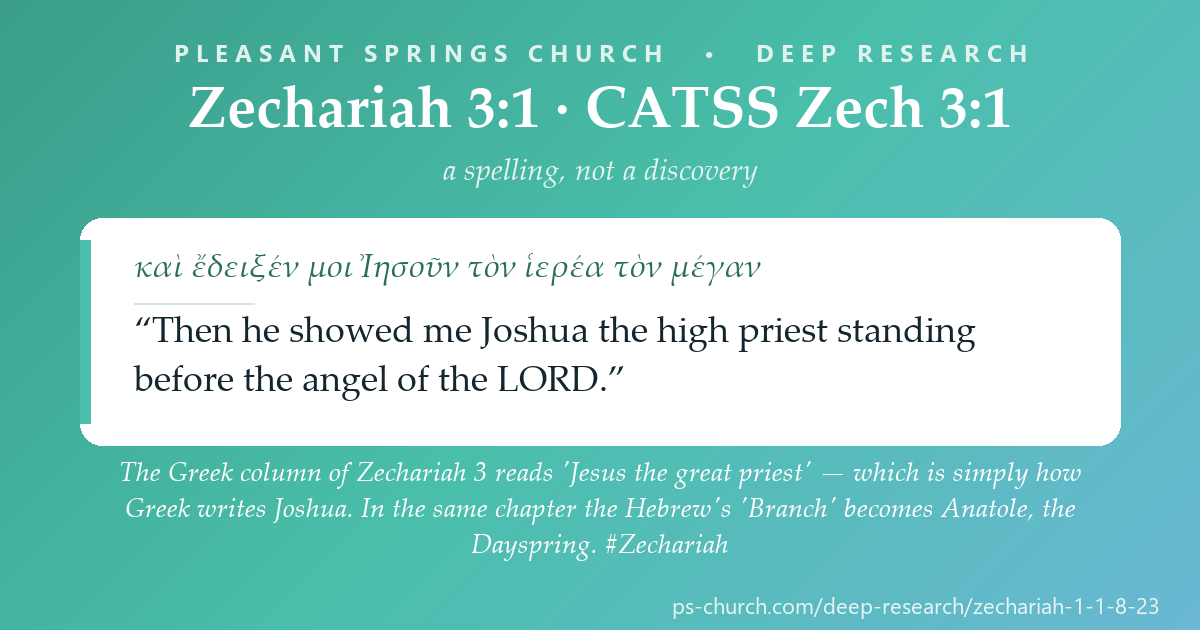
The Greek column of Zechariah 3 opens: καὶ ἔδειξέν μοι Ἰησοῦν τὸν ἱερέα τὸν μέγαν — and he showed me Jesus the great priest. That is arresting and it is also ordinary: Ἰησοῦς is simply how Greek writes יְהוֹשֻׁעַ, and the Greek Old Testament calls Joshua son of Nun the same thing hundreds of times. The page prints it, says exactly that, and moves on. What is less ordinary is what happens next in the same chapter. The Hebrew announces a servant named צֶמַח, a sprout; the Greek column names him Ἀνατολή, a dawn — and across the complete Greek Old Testament, all 64 CATSS files, that word carries the Branch as a title in three places: twice in this book, and once in Jeremiah 23:5. Meanwhile the measurement that runs under every page on this shelf produces, for these eight chapters, four deepest runs that are all coincidences, while the three places the New Testament really is looking at Zechariah 1–8 sit at one, two and three words. See the method →
Zechariah 1:1–8:23 (selections, Hebrew numbering)
Hebrew · Greek (CATSS, Rahlfs’ Septuaginta) · ESV⚠️ So the four-horns vision has two addresses. It is Zechariah 2:1–4 in a Hebrew Bible and Zechariah 1:18–21 in an English one, and “Zechariah 2:1” means the horns in one and the measuring line in the other.
The Shape of the Passage
Concentric — eight night visions around two anointed menZechariah is dated to the month. 1:1 is the eighth month of Darius’ second year; 1:7 is the twenty-fourth day of the eleventh month of the same year; 7:1 is the fourth day of the ninth month of his fourth year. Only Haggai and Ezekiel are dated this tightly anywhere in the prophets.
Author
A priest as well as a prophet. זְכַרְיָה means the Lord has remembered. He is son of Berechiah, son of Iddo (1:1), and Nehemiah 12:16 pairs a Zechariah with the priestly house of Iddo, which had come up with Zerubbabel — which is why he is usually taken to be of a priestly family. The book does not say so itself.
Working beside Haggai. Ezra 5:1 and 6:14 name the two together as the prophets who got the temple rebuilt. Their dated oracles interleave: Haggai’s run from the sixth to the ninth month of Darius’ second year, and Zechariah’s begin in the eighth. Haggai is on this shelf.
Audience
A small community rebuilding a small temple. The returned exiles had laid a foundation and stopped. 4:10 speaks of those who have despised the day of small things — which tells you what the mood was.
And a question about grief that had become a habit. Chapters 7–8 turn on a delegation asking whether to keep a fast they had kept for seventy years — mourning the temple that had been destroyed. The temple was being rebuilt in front of them, and they wanted to know whether to go on mourning it. The answer runs for two chapters.
Orient on the night visions, on the post-exilic community, and on a four-verse offset.
Search by topic: Zechariah, book of; night visions; Zerubbabel; Joshua the high priest; the Branch; Satan / the accuser; Darius; Second Temple, building of; chapter and verse divisions, history of.
Which articles are relevant?
- Anchor Bible Dictionary — “Zechariah, Book of,” “Zerubbabel,” “Joshua (son of Jehozadak),” “Branch,” “Satan.”
- Dictionary of the OT: Prophets (IVP) — “Zechariah, Book of,” “Visions, Prophetic,” “Angels, Messengers,” “Temple.”
- NIDOTTE — צֶמַח, שָׂטָן, יִצְהָר, כָּנָף.
- Dictionary of NT Use of the OT (Beale & Carson) — on Revelation 11:4 and Ephesians 4:25, the two clearest New Testament uses of these chapters.
Settle the numbering — four verses, and they move a whole vision
Zechariah’s offset is bigger than Nahum’s and it lands on a vision, not on a phrase.
| ch 1 | ch 2 | chs 3–14 | |
|---|---|---|---|
| Masoretic & CATSS | 17 | 17 | identical |
| ESV | 21 | 13 | identical |
English 1:18–21 = MT/LXX 2:1–4. English 2:1–13 = MT/LXX2:5–17. Everything from chapter 3 on is the same in all three. The Hebrew opens chapter 2 with the four horns; the English keeps the horns at the end of chapter 1 and opens chapter 2 with the man holding a measuring line. Established from content at the seam.
The practical hazard: a reference to “Zechariah 2:1” is the second vision in a Hebrew Bible and the third vision in an English one. Commentaries following the Hebrew and study Bibles following the English will therefore look as though they are discussing different passages when they are not.
A courtroom in the fourth vision, and a crown that goes on the wrong head.
Zechariah 3 is a lawsuit, and the defendant never speaks
The scene has all the furniture of a hearing. Someone stands accused (עֹמֵד, standing, three times in two verses). An accuser stands at his right hand — הַשָּׂטָן, the accuser, with the definite article, which is a role and not yet a proper name; the row has ὁ διάβολος. And the verb for what the accuser is doing, לְשִׂטְנוֹ, is built from the same root as his title.
Two things about the outcome are worth noticing. First, the accused says nothing at all — not one word of Joshua’s is recorded in the chapter. Second, the charge is not answered. It is not argued that the garments are clean; they are taken off.
On הַשָּׂטָן: in this chapter and in Job 1–2 the word carries the article and functions as a title, the accuser. The page reports that and does not use it to settle the larger question of how the term develops, which is a long discussion and not one a word count can enter.
The crown, and who ends up wearing it
6:9–15 has silver and gold brought from the returned exiles and made into a crown — and the crown goes on Joshua the priest, not on Zerubbabel the governor.
Zerubbabel is a descendant of David (1 Chronicles 3:19) and the natural head to crown. The oracle crowns the priest, announces the man whose name is the Branch, says he will build the temple, bear royal honor and sit and rule on his throne, and adds: And there shall be a priest on his throne, and the counsel of peace shall be between them both (6:13, ESV). Two offices, held together.
What the page will not do here. The scene invites a Christian reading and gets one everywhere. What is on the page is a crown, a priest, a named successor called Branch, and a sentence about two offices at peace. The book does not identify the Branch with Joshua — 3:8 has Joshua told about the Branch, as a man who is a sign — and this study reports the text and leaves the seeing to the reader, per the house position.
The fasting question, and the answer that changes the subject
7:3 asks a narrow ritual question: should we go on keeping the fast of the fifth month? The fast marked the burning of the temple. The temple was being rebuilt as they asked.
The answer takes two chapters and never says yes or no until 8:19, and when it comes it is not a ruling about fasting: the four fasts shall become seasons of joy and gladness and cheerful feasts — and then, immediately, therefore love truth and peace. The first thing the answer does, back in 7:9–10, is quote the older prophets on judgement, kindness, the widow, the fatherless, the sojourner and the poor.
A name, a sprout that becomes a dawn, and a fringe.
Zechariah 3:1, 3:8 and through chapter 6. It is the ordinary Greek spelling of יְהוֹשֻׁעַ — Joshua son of Nun is called it throughout the Greek Old Testament, and so is this high priest. So the Greek column of Zechariah 3 does read Jesus the great priest, and that sentence is a fact about Greek spelling before it is anything else. The page says so plainly rather than letting the coincidence do work it cannot do.
Zechariah 3:8 and 6:12, of a servant God will bring. The row does not translate it as a plant. It gives Ἀνατολή — a rising, the word for sunrise and for the east. Across the complete Greek Old Testament — all 64 CATSS files as of 30 August 2026 — it carries the Branch as a title in three places: these two, and Jeremiah 23:5 — ἀνατολὴν δικαίαν. Re-checked when the last twenty files landed: they add 54 occurrences of the word and every one is the compass east or the sunrise — except Odes 9:78, which is Luke 1:78 itself, because the Odes append the New Testament canticles to the Psalter. The title count did not move. ⚠️ THAT EXCEPTION IS NOW GONE FROM THE COUNT ALTOGETHER, AND THE OLD FIGURE IS PRINTED RATHER THAN QUIETLY REPLACED: the last twenty files add 53 occurrences, not 54. On 30 August 2026 the Odes came out of the screening corpus, because Ode 9 IS Luke 1 — the Magnificat and the Benedictus — and Ode 13 is Luke 2, the Nunc Dimittis. So the single hit this card had to except by hand was never an Old Testament occurrence of anything: it was this page’s own New Testament comparison verse, filed under a Greek Old Testament shelfmark. The card caught it by eye; the instrument now catches it, and all 53 remaining additions are the compass east or the sunrise with nothing left to except. The Branch-as-a-title count was three before and is three now — Zechariah 3:8, 6:12 and Jeremiah 23:5 — and it never depended on the Ode in either direction.
Luke 1:78 ends the Benedictus — sung by a different Zechariah — with ἀνατολὴ ἐξ ὕψους, a dawn from on high shall visit us. Measured against this book, Luke 1:78 and Zechariah 6:12 share exactly one word, and it is that one. Every other occurrence of the word in the Greek New Testament means the compass direction or the sunrise.
Zechariah 8:23, what ten men take hold of. The row has τοῦ κρασπέδου — the tassel, the same word Deuteronomy 22:12 uses for the four corners of the garment the tassels go on, and the same word four Gospel verses use for the fringe of Jesus’ garment.
Zechariah 4:14, the two sons of oil — the ESV’s two anointed ones. The row has υἱοὶ τῆς πιότητος, sons of fatness. The oil in question is the kind that feeds a lamp, which is what the vision is about.
Two additions the Greek column makes
| verse | Hebrew | CATSS Greek row |
|---|---|---|
| 2:4 (ESV 1:21) | the horns that scattered Judah | the horns that scattered Judah and Israel, and they are numbered τὰ τέσσαρα, the four |
| 4:6 | לֹא בְחַיִל — not by might | οὐκ ἐν δυνάμει μεγάλῃ — not by great power |
Each is printed as its file has it, and the page has no account of how either arose. Nothing here says one column added or the other dropped anything — that is a claim about history, and these two columns cannot make it.
Where the measurement and the allusions point in opposite directions.
The four deepest runs in Zechariah 1–8, and what they are
All 121 CATSS rows of Zechariah 1–8 were screened against all 7,927 verses of the Greek New Testament. Four rows reach five, which is the maximum, and each of the four has a tie band of one — and all four are accidents.
| row | NT partner | the shared words | what each sentence is about |
|---|---|---|---|
| 2:5 (ESV 2:1) | Revelation 14:14 | καὶ ἐν τῇ χειρὶ αὐτοῦ | a measuring line / a sharp sickle |
| 3:5 | Revelation 10:1 | ἐπὶ τὴν κεφαλὴν αὐτοῦ καί | a clean turban / a rainbow |
| 5:3 | Luke 21:35 | ἐπὶ πρόσωπον πάσης τῆς γῆς | a flying scroll / the day coming as a snare |
| 8:4 | Revelation 10:2 | ἔχων ἐν τῇ χειρὶ αὐτοῦ | old men with staffs / an angel with a scroll |
And one more, at four, that is worth printing because it is the funniest: Zechariah 4:14, these are the two sons of oil, has as its deepest New Testament partner Matthew 20:21 — οὗτοι οἱ δύο υἱοί, where the mother of James and John asks that these two sons of hers sit at his right and his left. Four words, a tie band of one, and no relationship at all.
Three places where the New Testament really is looking at these chapters
They sit at three words, two words and one.
| Zechariah | New Testament | run | note |
|---|---|---|---|
| 8:16 — speak the truth each to his neighbour | Ephesians 4:25 | 3 | λαλεῖτε ἀλήθειαν ἕκαστος — three words in the same order, and the run ties with four verses that merely share οὗτοι οἱ λόγοι |
| 4:3, 4:14 — the lampstand and the two olive trees | Revelation 11:4 | 2 | δύο ἐλαῖαι — Revelation calls its two witnesses the two olive trees and the two lampstands, which is this chapter and nothing else |
| 3:2 — the Lord rebuke you | Jude 9 | 1 | the row has ἐπιτιμήσαι κύριος ἐν σοί; Jude has Ἐπιτιμήσαι σοι κύριος — the same three words, one of them moved |
So on these eight chapters the screen is not merely weak; it is inverted. Its top four results are coincidences with tie bands of one, and its readings for the three real uses are 3, 2 and 1. This page prints that plainly, because it is the strongest evidence on this shelf for how the measurement should be read — as a way of finding verbatim contact, never as a way of finding meaning.
The fringe of the garment
Zechariah 8:23 in Greek has ten men from the nations taking hold of τοῦ κρασπέδου of one Jewish man.
| where κράσπεδον stands | what is happening |
|---|---|
| Numbers 15:38 (LXX) — twice in the verse | the tassel command: make yourselves κράσπεδα on the corners of your garments… and put on the fringes a cord of blue |
| Numbers 15:39 (LXX) | you shall have them for fringes, and you shall look on them and remember all the commandments |
| Deuteronomy 22:12 (LXX) | the command to make tassels on the four corners of the garment |
| Zechariah 8:23 (LXX) | ten men from every tongue take hold of it |
| Matthew 9:20; Mark 6:56; Luke 8:44 | sick people touch the fringe of Jesus’ garment and are healed |
| Matthew 14:36 | they beg to touch only the fringe of his garment |
| Matthew 23:5 | the Pharisees make their fringes long |
⚠️ THIS COUNT WAS CORRECTED ON 30 AUGUST 2026, AND THE OLD FIGURE IS PRINTED HERE RATHER THAN QUIETLY REPLACED. When this page first went up the Greek Old Testament on this disk was 44 files, and the count printed here read two — Deuteronomy 22:12 and Zechariah 8:23. The page said so and named the gap: the other Old Testament tassel command, Numbers 15:38–39, is not among the Greek files on this disk. On 30 August 2026 the remaining twenty CATSS files were fetched while the Revelation 9–11 study was being measured, taking the Greek Old Testament to 64 files and 30,637 verse units held, with no gaps in it. Re-running the same search returns five: the three new occurrences are all in Numbers 15, exactly where the old note said they would be. The Greek New Testament figure of five is unchanged.
So the corrected line reads: five occurrences across the complete Greek Old Testament, five in the Greek New Testament — and the Old Testament figure is now a count of the whole Septuagint as CATSS holds it, not a count of what could be searched.
⚠️ ONE MORE CORRECTION, MADE ON 30 AUGUST 2026, AND IT IS THE ONE WORTH READING: THE SHELF NOW HOLDS MORE THAN IT SCREENS, AND THIS PAGE IS WHERE THE REASON SHOWED UP FIRST. The Odes — the fourteen liturgical canticles bound after the Greek Psalter — arrived with those same last twenty files. They stay on disk, and they are no longer inside anything this shelf calls ‘the Greek Old Testament’ when it runs a screen, for two independent reasons.
(1) Two of them are New Testament text. Ode 9 is Luke 1 — the Magnificat and the Benedictus — and Ode 13 is Luke 2, the Nunc Dimittis. Screened, Ode 9:48 matches Luke 1:48 at eighteen consecutive words. That is not a contact between two Testaments; it is Luke matching Luke under an Old Testament shelfmark, and a page reporting it as a Gospel’s deepest Old Testament contact would be measuring its own text. ★ This page walked into that trap in Stage 3 and had to step over it by hand: the Ἀνατολή card found one occurrence it could not call an Old Testament occurrence — Odes 9:78 — and Odes 9:78 is Luke 1:78, the exact New Testament verse the card compares Zechariah 6:12 to. (2) Ten of them are second copies of passages already in the corpus — Ode 1 = Exodus 15, 2 = Deuteronomy 32, 3 = 1 Samuel 2, 4 = Habakkuk 3, 5 = Isaiah 26, 6 = Jonah 2, 7 and 8 = Daniel (Th) 3, 10 = Isaiah 5, 11 = Isaiah 38 — so a verse standing alone in Habakkuk appeared to stand twice, and any tie band touching a canticle was doubled for no textual reason.
HELD and SCREENED are therefore two different numbers, and every sentence on this page now uses the one it means. The shelf holds 30,637 verse units in 64 files; a screen sees 30,348, the difference being exactly the 289 Odes units. The tassel count above is unaffected — none of the five κράσπεδον occurrences stands in a canticle, and the figure is five either way. The one figure on this page the removal does move is in Stage 3, and it is printed there with its old value.
No Gospel verse is quoting Zechariah 8:23, and the page does not say one is. What it can say is that the word for what the nations take hold of in Zechariah is the word for what the sick take hold of in the Gospels, and that both are reaching for the edge of a garment because of what they had heard about the man wearing it.
Where this page is weakest, and what was not reached.
The limits
The concentric arrangement of the eight visions is a reading, not a measurement. Visions 1 and 8 share horses; 2 and 7 share the removal of what harms; 3 and 6 share a measured object; 4 and 5 are the two about living men. That is a standard analysis and it is well supported, but it rests on content, not on any count this page ran, and other arrangements are proposed.
The Greek column’s Ἰησοῦς is a spelling, and the page keeps saying so. It would be easy to let that sentence carry more than it can. It is what Greek does with the name Joshua.
And 6:9–15 has a textual problem this page does not touch. The Hebrew of 6:11 has עֲטָרוֹת, a plural, and sets it on one head; the ESV renders it a crown. Commentators have long discussed whether a second name has dropped out of the verse. The page reports what the columns say and does not reconstruct.
What could not be checked at all
No Hebrew or Greek critical apparatus. No Qumran material — Zechariah is present in the Minor Prophets finds, including the Greek scroll from Naḥal Ḥever, and none of it was consulted. No Targum, Syriac, Vulgate, Aquila, Symmachus or Theodotion. No Persian-period administrative or archaeological material bearing on Zerubbabel, on Darius’ second year, or on the rebuilding.
The Greek of Isaiah, Jeremiah, Lamentations, Ezekiel and Daniel was added to this shelf on 19 August 2026, and it changed one of this page’s findings. Until then the page could only say that Jeremiah 23:5 uses the same Hebrew word for the Branch and that its Greek could not be compared. It can now: LXX Jeremiah 23:5 reads ἀνατολὴν δικαίαν, so the title is not peculiar to Zechariah after all. The claim was corrected rather than quietly dropped. MT Jeremiah 33:14–26 has no counterpart in the Greek at all, so the second Branch verse still cannot be compared.
Reading list
- Carol L. Meyers and Eric M. Meyers, Haggai, Zechariah 1–8 (Anchor Bible 25B).
- Joyce G. Baldwin, Haggai, Zechariah, Malachi (Tyndale OT Commentaries).
- Mark J. Boda, The Book of Zechariah (NICOT).
- Anthony R. Petterson, Haggai, Zechariah & Malachi (Apollos OT Commentary).
- None of these were consulted for the measurements on this page, which were run on the text files named in the footer.
The accused who says nothing.
Filthy garments
The fourth vision is a courtroom, and it is the centre of the eight. A high priest stands before the angel of the Lord in filthy clothes — the word is a strong one — and the accuser stands at his right hand to accuse him. Joshua never speaks. The charge is never rebutted.
What happens instead is that someone else answers the accuser, and then the clothes come off: Behold, I have taken your iniquity away from you, and I will clothe you with pure vestments. And then a turban is called for, and it is the prophet watching who says it — let them put a clean turban on his head — and they do.
And then, still in the same chapter, the man in the clean clothes is told he is a sign of something else that is coming. Not that he is it — that he points to it. אַנְשֵׁי מוֹפֵת, men of a sign. What is coming is called צֶמַח in one column and Ἀνατολή in the other: a sprout, or a sunrise.
First half of Zechariah, the twelfth and last book of the Twelve to be taken whole on this shelf. Chapters 9–14, where the deepest runs in the book are, are at Zechariah 9:1–14:21.
Every Deep Research page traces its passage across the whole sweep — the Old Testament, the Second-Temple world between the testaments (historical witnesses, not Scripture), and the New Testament. Follow the thread:
Pleasant Springs Church — Deep Research
Research method after Michael S. Heiser’s Bible Research Method (examine dictionaries → ancient literature → important words → textual connections → academic publications → share), with the Pleasant Springs “Author & Audience” foundation. Scripture set in the Hebrew, the Greek editions named on each page and the ESV (Old Testament), and the Greek New Testament and the ESV (New Testament), per the practice of Pleasant Springs Church. Zechariah research grounded in Meyers & Meyers (Anchor 25B), Baldwin (TOTC), Boda (NICOT) and Petterson (Apollos). Text: Hebrew from the Masoretic text as printed in the editions consulted — Sefaria’s Miqra according to the Masorah; no critical apparatus was consulted for the Hebrew. Greek from Rahlfs’ Septuaginta as digitized by CATSS; Greek New Testament from the SBL edition. The standing caution for this shelf applies: these pages say “the CATSS Greek row reads…” and never call a Greek reading early or late. ⚠️ VERSE NUMBERING — a four-verse offset, in chapters 1 and 2 only. Masoretic and CATSS Zechariah run 17 / 17 in chapters 1–2; the ESV runs 21 / 13. English 1:18–21 = MT/LXX 2:1–4, and English 2:1–13 = MT/LXX 2:5–17. Chapters 3 through 14 carry identical numbers in all three columns. Established from content at the seam. ⚠️ Ἰησοῦς at 3:1 is a spelling, not a claim. It is the ordinary Greek form of יְהוֹשֻׁעַ, borne by Joshua son of Nun and by many others in the Greek Old Testament. The page prints the row’s wording and says exactly that, and makes no argument from the coincidence of spelling. ⚠️ The Greek measurement, in full. Greek against Greek. CATSS FORM column (cols 0–24), beta-code transliterated first; MorphGNT field 6, the normalised word (the column that already resolves elision and the movable nu). Both sides lowercased, accents and breathings dropped, final sigma folded, then filtered to Greek letters — the same filter applied to both corpora. Word forms, never lemmas. Corpus for this page: the 121 CATSS rows of Zechariah 1–8 against 7,927 verses across 27 MorphGNT files. Across those 121 rows: all 121 reach two, 105 reach three, 48 reach four, 4 reach five. Exhaustive and deterministic; nothing sampled, so no seed applies. ⚠️ On these chapters the measurement is inverted, and the page leads with that. All four rows that reach the maximum of five are coincidences with tie bands of one, while the three places the New Testament is actually using Zechariah 1–8 — Ephesians 4:25, Revelation 11:4 and Jude 9 — measure 3, 2 and 1. The screen finds verbatim contact. It does not find allusion, and this page is the clearest demonstration of that on the shelf. ⚠️ Word searches are searches of what is held here. The counts for κράσπεδον and for Ἀνατολή-as-a-title now cover the complete Greek Old Testament as CATSS holds it — 64 files, 30,637 verse units held and 30,348 of them screened, no gaps. ⚠️ That was not true when this page was written, and one figure on it has been corrected twice. Isaiah, Jeremiah, Lamentations, Ezekiel and both Greek Daniels were added on 19 August 2026, taking the shelf from 35 files to 44 and correcting the Ἀνατολή count from two to three. The remaining twenty files — Exodus, Leviticus, Numbers, both Joshuas and the deuterocanonical books — were fetched on 30 August 2026, taking it from 44 to 64, and the κράσπεδον count moved from two to five: Numbers 15:38–39, the other tassel command, is the verse this page had named as the one it could not reach. Both old figures are printed beside the new ones in the body of the page rather than replaced. See stage 2 and stage 5. ⚠️ And on 30 August 2026 the Odes came out of the screening corpus, which is why HELD and SCREENED are two numbers here. The canticles stay on disk. Two of them are New Testament text — Ode 9 is Luke 1, Ode 13 is Luke 2 — and ten more are second copies of passages already in the corpus (Exodus 15, Deuteronomy 32, 1 Samuel 2, Habakkuk 3, Isaiah 26, Jonah 2, Daniel Th 3 twice, Isaiah 5, Isaiah 38). This page found the first of those two problems on its own: the Ἀνατολή card had to except Odes 9:78 by hand, and Odes 9:78 is Luke 1:78 — the New Testament verse the card is comparing to. The count of occurrences the last twenty files add is therefore 53 and not 54, and that is the only figure on this page the removal moves. The κράσπεδον count (five) and the Branch-as-a-title count (three) are unchanged, and the 121-row screen of Zechariah 1–8 runs against the Greek New Testament, which the Odes never entered. ⚠️ Direction of influence is never asserted. Nothing here says any New Testament writer is quoting or adapting these chapters, or what produced any reading — including and Israel at 2:4, great power at 4:6, and Ἀνατολή at 3:8 and 6:12. Typology is handled per the house position: what the text says, what the New Testament itself draws, and what we see from this side of the cross — with the seeing left to the reader.
Scripture quotations marked ESV are from the ESV® Bible (The Holy Bible, English Standard Version®), © 2001 by Crossway, a publishing ministry of Good News Publishers. ESV Text Edition: 2016. Used by permission. All rights reserved. The ESV text may not be quoted in any publication made available to the public by a Creative Commons license, and the ESV may not be translated in whole or in part into any other language. www.esv.org
|
Did this study bless you today? 💚 Give to Support PS Church100% of gifts go to the General Fund — thank you. |