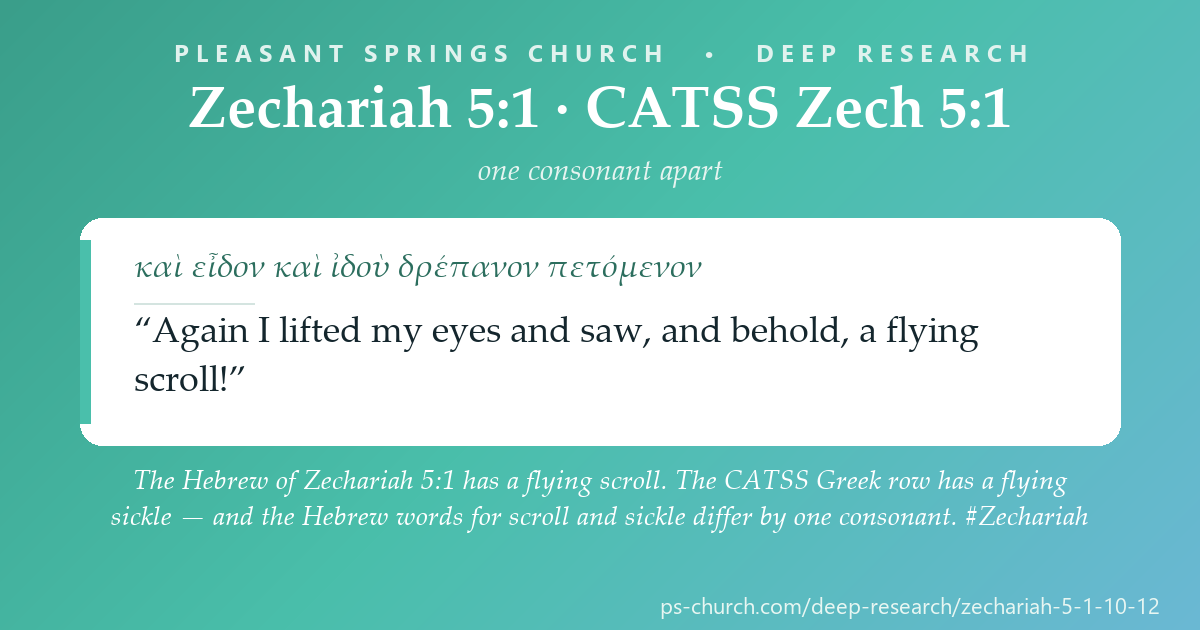
The sixth of Zechariah’s eight night visions is not the same object in the two columns. The Hebrew has מְגִלָּה עָפָה — a flying scroll. The CATSS Greek row has δρέπανον πετόμενον — a flying sickle. The Hebrew word for a sickle, מַגָּל, is one consonant away from the word for a scroll, and the page prints that fact and refuses to say what produced it. Two more things fell out of the screens. Zechariah 7:10 — the answer to a question about fasting — is the only verse in the whole Hebrew Bible that names the widow, the fatherless, the sojourner and the poor together; eighteen other verses name three of the four. And Zechariah 10:8, I will whistle for them and gather them in, shares no two consecutive words with any other verse in the Hebrew Bible, and its verb is the verb everyone else in the Bible uses to hiss at a ruin. See the method →
Zechariah 5:1–10:12 (selections)
Hebrew · Greek (CATSS, Rahlfs’ Septuaginta) · ESV⚠️ These are the last dark chapters of Zechariah on this shelf. Chapters 5, 7 and 10 are the three no page had quoted. Chapters 6, 8, 9 and 11–14 are covered by the two sibling studies, and this page deliberately does not repeat their verses.
The Shape of the Passage
A sequence — and the traffic runs one way, then the otherTwo of these three chapters are dated to the day, and the third is not. Zechariah 7:1 gives the fourth year of Darius, the fourth day of the ninth month — December 518 BC on the usual reckoning — and chapter 5 belongs to the night of visions dated at 1:7. Chapter 10 carries no date, no name and no angel. That difference runs right through the book and the page states it rather than settling it.
Author
Zechariah son of Berechiah son of Iddo, a priest among the returned exiles. The book names him at 1:1 and 1:7 and 7:1, and Ezra 5:1 and 6:14 put him beside Haggai as one of the two prophets whose preaching got the temple finished. Chapters 5 and 7 sit inside that dated frame.
Chapter 10 does not. It has no date, no interpreting angel, no Zerubbabel and no Joshua — the marks that make many scholars treat chapters 9–14 as a separate collection gathered under the same name. This page takes no position. It quotes 10:1–12 because those verses are part of its assigned span and because chapter 10 was one of the three chapters no page on this shelf had touched.
Audience
People who had been keeping a funeral for seventy years and wanted to know whether to stop. The fifth-month fast in 7:3 mourns the burning of the temple in 587 BC (2 Kings 25:8–9). By 518 the second temple is half built and a delegation arrives with a liturgical question: is the fast still on? The answer they get is not about the calendar.
And people with bad leaders and a scattered family. Chapter 10 addresses a community whose shepherds are the problem and whose relatives are still in Egypt and Assyria. The house of Joseph — the northern tribes, gone since 722 BC — is named at 10:6 alongside the house of Judah, which is a larger promise than anyone in Jerusalem in 518 could have measured.
Orient on the night visions, the exilic fasts, and the shepherd oracle.
Search by topic: Zechariah, night visions; scroll; curse (ālāh); ephah; Shinar; teraphim; fasting in the Second Temple period; fifth month fast; shepherd imagery in the prophets; Pantokrator.
Which articles are relevant?
- Anchor Bible Dictionary — “Zechariah, Book of,” “Fasting,” “Shinar,” “Teraphim,” “Weights and Measures” (for the ephah).
- Dictionary of the OT: Prophets (IVP) — “Zechariah, Book of,” “Visions,” “Shepherd,” “Fasting.”
- NIDOTTE — מְגִלָּה, אָלָה, אֵיפָה, שָׁמִיר, שָׁרַק.
- Dictionary of NT Use of the OT (Beale & Carson) — on Revelation 14:14–19 and on the divine title in Revelation 4:8. Neither entry claims Zechariah 5 or Zechariah 10 as a source, and neither does this page.
Settle the numbering first — and here there is nothing to settle
Zechariah’s offset is real, and it is nowhere near these chapters.
English 1:18–21 = MT and LXX 2:1–4; English 2:1–13 = MT and LXX 2:5–17. The table and the reasoning are on the first half of this study. From chapter 3 through 14:21 all three columns agree on every number, so no reference on this page needs converting. It is worth saying out loud even though the answer is nothing: a page that does not state its offset has not checked it.
A fast nobody commanded, a basket that is a unit of measure, and the country the tower was in.
The fasts of the fifth and seventh months are not in the law
Nothing in the Torah commands a fast in the fifth month or the seventh. The only fast the law commands is the Day of Atonement in the seventh month, and that is not what 7:5 is about.
These are memorial fasts, kept by the exiles for the disasters of 587 BC. Zechariah 8:19 — on the first half of this study — lists four of them, of the fourth, fifth, seventh and tenth months. The fifth is for the burning of the temple (2 Kings 25:8–9); the seventh is generally taken as the murder of Gedaliah (2 Kings 25:25; Jeremiah 41). So the delegation in 7:2–3 is asking about a custom the community invented in exile, now that the reason for it is being rebuilt.
⚠️ What was not checked. No Second-Temple liturgical source, no Mishnah tractate on fasts, no Qumran calendar text was consulted. The identification of the seventh-month fast with Gedaliah is the standard one and it is not measurable from the corpora on this disk. It is reported as an inference others have drawn.
An ephah is not a basket, it is a quantity
The container in 5:6–11 is an אֵיפָה — a dry measure of roughly 22 litres, the unit grain was sold in.
The row does not translate it as a container at all: it has τὸ μέτρον, the measure. The vision is therefore about a shop weight, and it follows a vision about thieves and perjurers — which is why commentators connect it to the false measures of Amos 8:5, Micah 6:10–11 and Deuteronomy 25:13–15. And the lid is a talent of lead — the Hebrew has כִּכַּר עֹפֶרֶת and the row τάλαντον μολίβου: the largest weight in the system, dropped on the mouth of a grain measure to keep what is inside from getting out.
Whether the woman in the ephah is a goddess figure, a personification of the community’s guilt, or something else is argued at length in the commentaries. The text calls her הָרִשְׁעָה, Wickedness, and the page stops there.
Shinar, and what the Greek column did with it
The basket is taken to אֶרֶץ שִׁנְעָר — the land of Shinar — and a house is built for it there.
Shinar is Genesis’ name for southern Mesopotamia. The word stands in eight verses of the Hebrew Bible: Genesis 10:10 (Nimrod’s kingdom, beginning with Babel), Genesis 11:2 (the plain where the tower was built), Genesis 14:1 and 14:9, Joshua 7:21, Isaiah 11:11, Daniel 1:2 and Zechariah 5:11. To send Wickedness to Shinar and build her a house on a pedestal is to send her back to the tower and give her a temple.
And here the two columns say different things. The transliteration Σεννααρ stands in six CATSS verse units held here — Genesis 10:10, 11:2, 14:1, 14:9 and Theodotion Daniel 1:2 for the country, and Genesis 14:2 for a king of that name — and Zechariah 5:11 is not among them, because the row there reads ἐν γῇ Βαβυλῶνος, in the land of Babylon. Of the eight Hebrew verses with Shinar, three do not carry the transliteration into the Greek column: Joshua 7:21, where the Greek has no place-name at all and Achan simply steals a fine embroidered mantle; Isaiah 11:11, which has Βαβυλωνίας; and this verse. Daniel 1:2 is held here in two Greek columns and they do not agree: Theodotion has Σεννααρ, the Old Greek has Βαβυλῶνα. ⚠️ The page does not say the Greek column is interpreting, or guessing, or reading a different Hebrew. It says the two columns differ, and it says where.
Teraphim, and what they were
Zechariah 10:2 is the last of the fifteen verses in the Hebrew Bible that mention תְּרָפִים.
They are household objects: Rachel steals her father’s and sits on them (Genesis 31:19, 34–35); Michal puts one in a bed to look like David (1 Samuel 19:13, 16); Josiah burns them (2 Kings 23:24); Samuel puts them beside divination as the equivalent of idolatry (1 Samuel 15:23); Hosea 3:4 says Israel will be without them for a long time. By the time Zechariah names them the household gods are a byword rather than a live practice, and the verse’s complaint is that they talk.
One consonant, one bird, one whistle, and a stone.
Zechariah 5:1 and 5:2. The Greek column has δρέπανον — a sickle — at both verses. The Hebrew for a sickle is מַגָּל, one consonant away. מְגִלָּה is the word for Jeremiah’s dictated roll (Jeremiah 36) and for the scroll Ezekiel is made to eat (Ezekiel 2:9); מַגָּל stands twice, at Jeremiah 50:16 and Joel 4:13 = English 3:13.
Twelve verse units in the CATSS Greek files held here, and two of them are Zechariah 5:1 and 5:2. The other ten are the swords-and-pruning-hooks verses (Isaiah 2:4; Micah 4:3; Joel 4:10 = English 3:10), the harvest laws (Deuteronomy 16:9 and 23:25), the reaping of Joel 4:13 = English 3:13 and Isaiah 18:5, the smiths of 1 Samuel 13:20–21, and Jeremiah 27:16 = English 50:16. In the Greek New Testament it stands in seven verses — Mark 4:29 and six verses of Revelation 14:14–19, eight occurrences in all, because 14:18 has it twice.
Zechariah 5:9. The row has ἔποψ, the hoopoe, which stands in only three verse units of the Greek files here: Leviticus 11:19, Deuteronomy 14:17 and this verse. The stork is in the same two forbidden-bird lists. Both columns give an unclean bird; they do not give the same one.
Zechariah 7:12, of what they made their hearts. In the sense of the hardest abrasive it stands in exactly three verses, and all three concern a heart or a forehead — Jeremiah 17:1 (sin engraved with a point of shāmîr on the tablet of the heart), Ezekiel 3:9 (a forehead made harder than flint), and this one. The row does not name a stone: καρδίαν… ἀπειθῆ.
Zechariah 10:8. Nineteen verses. Fifteen are a hiss of horror at a ruin (1 Kings 9:8; Jeremiah 19:8; 25:9; 49:17; 50:13; Lamentations 2:15–16; Zephaniah 2:15 and others); two are the Lord whistling for a foreign army (Isaiah 5:26; 7:18); one is shepherds piping for the flocks (Judges 5:16). Zechariah 10:8 is the only one where God whistles for his own people to come home.
The row’s standing rendering of צְבָאוֹת, hosts. The full five-word title κύριος ὁ θεὸς ὁ παντοκράτωρ stands in thirteen of the 30,348 CATSS verse units screened, and every one of the thirteen is in the Book of the Twelve — ten in Amos, one in Hosea, one in Nahum, and Zechariah 10:3. It is the name Revelation 4:8, 19:6 and 21:22 give God.
And two more places the columns part company
| verse | Hebrew | CATSS Greek row |
|---|---|---|
| 10:2 | הַתְּרָפִים — the teraphim, household objects; and אֵין רֹעֶה, no shepherd | οἱ ἀποφθεγγόμενοι, those who utter oracles — people; and οὐκ ἦν ἴασις, there was no healing |
| 10:4 | four nouns: פִּנָּה cornerstone, יָתֵד tent peg, קֶשֶׁת מִלְחָמָה battle bow, נוֹגֵשׂ ruler | verbs where the Hebrew has nouns: ἐπέβλεψεν he looked, ἔταξεν he arrayed, then τόξον ἐν θυμῷ and ὁ ἐξελαύνων |
Zechariah 10:4 is the cornerstone verse that later readers set beside Isaiah 28:16 and Psalm 118:22. The cornerstone is not in the Greek column. The page notes that and asserts nothing about why. No New Testament verse quotes Zechariah 10:4, and its deepest run into the Greek New Testament is three words — ἐν τῷ αὐτῷ — with a tie band of four.
Two runs of five, one of which is a stock phrase, and a sickle the measurement will not link.
Everything these three chapters reach in the Greek New Testament
All 37 CATSS rows of Zechariah 5, 7 and 10 were screened against all 7,927 verses of the Greek New Testament. All 37 reach two, 31 reach three, 14 reach four, 2 reach five, and nothing reaches six.
| row | NT partner | run | tie band | the shared words | what it is |
|---|---|---|---|---|---|
| Zech 10:3 | Rev 4:8; 19:6; 21:22 | 5 | 3 | κύριος ὁ θεὸς ὁ παντοκράτωρ | A title — and it stands in thirteen Greek Old Testament verses, all in the Twelve |
| Zech 5:3 | Luke 21:35 | 5 | 1 | ἐπὶ πρόσωπον πάσης τῆς γῆς | A stock phrase — seven Greek Old Testament verses carry it, two of them the tower of Babel |
| Zech 10:12 | John 20:31 | 4 | 1 | ἐν τῷ ὀνόματι αὐτοῦ | four ordinary words, one tie, no claim |
| Zech 5:1, 5:9 | Rev 6:2, 6:5, 6:8, 14:1, 14:14 | 4 | 5 | καὶ εἶδον καὶ ἰδού | The apocalyptic opening formula — see the row below |
| Zech 7:1 | Mark 4:4 and 15 others | 4 | 16 | καὶ ἐγένετο ἐν τῷ | Luke’s favourite narrative hinge; a formula |
| Zech 7:10 | Matt 9:4 and 8 others | 4 | 9 | ἐν ταῖς καρδίαις ὑμῶν | a formula |
Nothing in these three chapters is a New Testament citation. No evangelist and no apostle quotes Zechariah 5, 7 or 10, and the screen agrees with that: the two deepest runs are a divine title and a stock phrase.
The counter-example this page has to print
The most attractive connection on this page is one the measurement will not support, and it would be dishonest to leave it out.
| the clause | |
|---|---|
| CATSS Zech 5:1 | καὶ ἐπέστρεψα καὶ ἦρα τοὺς ὀφθαλμούς μου καὶ εἶδον καὶ ἰδοὺ δρέπανον πετόμενον |
| Revelation 14:14 | Καὶ εἶδον, καὶ ἰδοὺ νεφέλη λευκή… ἔχων… ἐν τῇ χειρὶ αὐτοῦ δρέπανον ὀξύ |
Both sentences say and I saw, and behold, and both of them have a δρέπανον in them. It is very tempting and the numbers say no. The run is four — καὶ εἶδον καὶ ἰδού — with a tie band of five, and the other four ties are Revelation 6:2, 6:5, 6:8 and 14:1, which have no sickle in them at all. The shared word δρέπανον is not part of the run; it sits one word after the run in the Zechariah row and twenty-two words after it in Revelation 14:14, and taken by itself it is a run of one. Zechariah 5:1 against Mark 4:29, the other New Testament sickle, measures 1.
So what does the page say about the scroll and the sickle? Only this. The Hebrew column of Zechariah 5:1–2 has a scroll and the Greek column has a sickle. The two Hebrew nouns differ by one consonant. Revelation 14 has a sharp sickle for a harvest, and the harvest text readers set beside it is Joel 4:13 = English 3:13, not Zechariah — and no citation is claimed there either: against the CATSS row of Joel 4:13 the six sickle verses of Revelation 14:14–19 measure a run of one at most. The page does not say the Greek column misread anything, does not say Revelation is reading Zechariah’s Greek, and does not say which reading is older. It says what stands in each column and prints the run that fails.
Where these chapters really are connected — inside their own book
The Hebrew-side screen puts the strongest ties not in the New Testament but a few chapters away.
| row | deepest Hebrew partner | run | tie band | the shared words |
|---|---|---|---|---|
| Zech 7:4 | Zechariah 8:18 | 6 | 1 | ויהי דבר יהוה צבאות אלי לאמר |
| Zech 5:2 | Zechariah 4:2 | 6 | 1 | ויאמר אלי מה אתה ראה ואמר |
| Zech 5:5 | Zechariah 4:5 | 5 | 1 | המלאך הדבר בי ויאמר אלי |
| Zech 5:10 | Zechariah 2:2; 4:4; 6:4 | 5 | 3 | ואמר אל המלאך הדבר בי |
| Zech 7:10 | Zechariah 8:17 | 3 | 1 | אל תחשבו בלבבכם |
Every one of those deepest partners is Zechariah itself. The vision-formula — and I said to the angel who talked with me, and he said to me, what do you see — is what holds the night visions together, and it is measurable: a run of six with a tie band of one, twice, both times inside the book. This is what internal composition looks like on a screen, and it is a good deal clearer here than any external connection is.
The verse with no neighbours
Zechariah 10:8 was screened against the other 23,203 verse units of the Masoretic corpus held here. It shares no two consecutive words with any of them.
אֶשְׁרְקָה לָהֶם וַאֲקַבְּצֵם כִּי פְדִיתִים וְרָבוּ כְּמוֹ רָבוּ
“I will whistle for them and gather them in, for I have redeemed them, and they shall be as many as they were before.”Zechariah 10:8 — Masoretic text; ESV
Eight words. Every one of them is common; not one adjacent pair of them occurs anywhere else in the Hebrew Bible. ⚠️ Say what the zero means. This is the Hebrew-side screen, which does not fall back to single words — so nought here means no two consecutive words shared, not no word shared. Against the Greek New Testament the same verse reaches a run of two with a tie band of sixty-one, which is what an ordinary sentence looks like.
The same verse is the only place in the Hebrew Bible where God whistles for his own people. The two facts are independent and the page is not fusing them — a verse can be lexically unique and unremarkable, and a rare verb can sit in a formulaic sentence. Here both happen to be true of the same eight words.
What this page could not check, and where it is thinnest.
The limits, named
The scroll-and-sickle divergence is reported and not explained, and that is the biggest hole on the page. Three explanations are standard in the literature — a different Hebrew text in front of the translator, a translator reading מגלה as מגל, or a deliberate rendering — and this page cannot distinguish them and does not try. Settling it needs a critical apparatus, Hebrew manuscript evidence and Septuagint text-critical work, none of which is on this disk.
No Qumran material was consulted. Zechariah is present in the Minor Prophets scrolls from Murabba‘at and in the Greek Minor Prophets scroll from Naḥal Ḥever, and the Greek scroll is exactly the kind of witness that would bear on the readings printed here. None of it was examined.
No Aquila, Symmachus or Theodotion of Zechariah is held here. The shelf carries the Theodotionic Greek of Daniel and nothing else from the later versions, so every divergence on this page — the sickle, the hoopoe, Babylon for Shinar, healing for shepherd — was compared against one Greek column only.
The date of chapters 9–14 is not addressed. Chapter 10 sits inside the most argued-over section of this book, and the page quotes it without entering the question. That is a real limitation on anything said about chapter 10 as Zechariah’s.
What the counts do and do not cover
The Greek Old Testament figures on this page were run over all 64 CATSS files held here, but the screening corpus is 30,348 verse units, not the 30,637 the files contain. The Odes are excluded from run screens, and they should be: Ode 9 is Luke 1 and Ode 13 is Luke 2 copied into a Greek Old Testament manuscript, and ten further Odes are second copies of Exodus 15, Deuteronomy 32, 1 Samuel 2, Habakkuk 3, Isaiah 26, Jonah 2, Daniel 3, Isaiah 5 and Isaiah 38. Leaving them in would have counted the same text twice and, worse, would have produced Greek-Old-Testament ‘matches’ for Luke that are Luke. Every “stands in N verse units” figure on this page is against 30,348.
Twenty of the sixty-four files are deuterocanonical — witnesses, not Scripture on this shelf, and named as such wherever one carries a hit. None of the counts printed on this page depends on one.
Nothing here is an argument from silence about Hebrew or Greek outside these corpora. “The only verse in the Hebrew Bible” means the 23,204 verse units of Sefaria’s Miqra according to the Masorah held on this disk, and nothing more.
Reading list
- Carol L. Meyers and Eric M. Meyers, Haggai, Zechariah 1–8 (Anchor Bible 25B) and Zechariah 9–14 (Anchor Bible 25C).
- Mark J. Boda, The Book of Zechariah (NICOT).
- Joyce G. Baldwin, Haggai, Zechariah, Malachi (Tyndale OT Commentaries).
- Al Wolters, Zechariah (Historical Commentary on the Old Testament) — unusually full on the Greek of chapter 5.
- None of these were consulted for the measurements on this page, which were run on the text files named in the footer.
A fast, and the answer that was not about fasting.
They asked about a fast and were given four people
A delegation walks up to the half-built temple in December 518 BC with a reasonable administrative question. We have been fasting in the fifth month for seventy years because the temple burned. The temple is going back up. Do we stop?
The answer is a counter-question — was it for me that you fasted? — and then a list: render true judgements, show kindness and mercy, and do not oppress the widow, the fatherless, the sojourner and the poor. Screened across the whole Hebrew Bible, that four-item list occurs in one verse and one verse only. Eighteen verses name three of the four; Zechariah 7:10 names all four. The question was about the calendar and the answer was about who was being crushed while the calendar was being kept.
And then chapter 7 says what happened the last time: they made their hearts as hard as the hardest stone anyone could name, and the hearing stopped, and the scattering followed. Two chapters earlier a written thing had flown out over the whole land looking for houses to lodge in. A text going out, and hearts made of shāmîr so that it cannot get in — the same book, four chapters apart.
And then the whistle. Everywhere else in the Hebrew Bible the verb שָׁרַק is what passers-by do at a ruin, or what God does to summon an army against you. Once, at Zechariah 10:8, it is what a shepherd does to bring the flock in. Eight Hebrew words that share no adjacent pair with any other verse in the Bible — I will whistle for them and gather them in, for I have redeemed them.
⭐ This page closes Zechariah on this shelf. Chapters 5, 7 and 10 were the last three no page had quoted; with them the book stands complete alongside the other eleven Minor Prophets.
Every Deep Research page traces its passage across the whole sweep — the Old Testament, the Second-Temple world between the testaments (historical witnesses, not Scripture), and the New Testament. Follow the thread:
Pleasant Springs Church — Deep Research
Research method after Michael S. Heiser’s Bible Research Method (examine dictionaries → ancient literature → important words → textual connections → academic publications → share), with the Pleasant Springs “Author & Audience” foundation. Scripture set in the Hebrew, the Greek editions named on each page and the ESV (Old Testament), and the Greek New Testament and the ESV (New Testament), per the practice of Pleasant Springs Church. Zechariah 5, 7 and 10 research grounded in Meyers & Meyers (Anchor 25B and 25C), Boda (NICOT), Baldwin (TOTC) and Wolters (HCOT). Text: Hebrew from the Masoretic text as printed in the edition consulted — Sefaria’s Miqra according to the Masorah, 23,204 verse units; no critical apparatus was consulted for the Hebrew. Greek from Rahlfs’ Septuaginta as digitized by CATSS; Greek New Testament from the SBL edition via MorphGNT. The standing caution for this shelf applies: these pages say “the CATSS Greek row reads…” and never call a Greek reading early or late. ⚠️ VERSE NUMBERING — there is no offset in these chapters. Zechariah’s four-verse offset falls in chapters 1 and 2 only (English 1:18–21 = MT and LXX 2:1–4; English 2:1–13 = MT and LXX 2:5–17). From chapter 3 through 14:21 the Masoretic text, the CATSS Greek and the ESV carry identical chapter and verse numbers, so nothing on this page needs converting. The offset is stated here even though the answer is nothing, because a page that does not state it has not checked it. ⚠️ The Greek measurement, in full. Greek against Greek. CATSS FORM column (cols 0–24), beta-code transliterated first; MorphGNT field 6, the normalised word. Both sides lowercased, accents and breathings dropped, final sigma folded, then filtered to Greek letters — the same filter applied to both corpora — and, since 30 August 2026, MorphGNT’s own spelling equivalences applied across the two editions (ου/ουκ/ουχ, εκ/εξ, the movable nu), so that a shared run is not cut at a word the two editions merely spell differently. Every figure on this page was measured after that change and none was copied from a sibling page. Contiguous runs of whole word FORMS, never lemmas. Corpus for the New Testament screen: the 37 CATSS rows of Zechariah 5, 7 and 10 against 7,927 verses across 27 MorphGNT files. Across those 37 rows: all 37 reach two, 31 reach three, 14 reach four, 2 reach five, and nothing reaches six. Exhaustive and deterministic; nothing sampled, so no seed applies. ⚠️ The Greek Old Testament screening corpus is 30,348 verse units, not 30,637. Sixty-four CATSS files are held here and they contain 30,637 verse units, but the Odes are excluded from run screens because they are not independent witnesses: Ode 9 is Luke 1 and Ode 13 is Luke 2, copied into a Greek Old Testament manuscript, and ten further Odes are second copies of Exodus 15, Deuteronomy 32, 1 Samuel 2, Habakkuk 3, Isaiah 26, Jonah 2, Daniel 3, Isaiah 5 and Isaiah 38. Every “stands in N verse units” count on this page — 13 for κύριος ὁ θεὸς ὁ παντοκράτωρ, 12 for δρέπανον, 65 for λέγει κύριος παντοκράτωρ, 7 for ἐπὶ πρόσωπον πάσης τῆς γῆς, 6 for Σεννααρ and 3 for ἔποψ — is against 30,348. Twenty of the sixty-four files are deuterocanonical: witnesses, not Scripture, and no count printed here depends on one. ⚠️ What a zero means on the Hebrew screen. The Hebrew-side screen runs with no single-word fallback, so the nought reported for Zechariah 10:8 means it shares no two consecutive words with any of the other 23,203 verse units — not that it shares no word. The Greek-side screens do fall back to single words, and a nought there would mean something different. ⚠️ The scroll and the sickle: what is claimed and what is not. Claimed: the Masoretic text of Zechariah 5:1–2 reads מְגִלָּה, scroll; the CATSS Greek row reads δρέπανον, sickle; the Hebrew noun for a sickle differs from the noun for a scroll by one consonant. Not claimed: that either column misread the other, that one is prior, or that Revelation 14 is reading this Greek row. The run between CATSS Zechariah 5:1 and Revelation 14:14 is four words — the formula καὶ εἶδον καὶ ἰδού — with a tie band of five, and the shared noun is not inside the run. The page prints that failure rather than hiding it. ⚠️ Direction of influence is never asserted. Nothing here says which text is prior, that any writer altered anything, or what produced any reading — including the sickle at 5:1, the hoopoe at 5:9, Babylon for Shinar at 5:11, the sanctuary at 7:3, the missing shepherd at 10:2 or the missing cornerstone at 10:4. ⚠️ ESV footprint. This page quotes fragments of 16 verses of Zechariah. Across the whole shelf the five Zechariah pages now touch 37 of the book’s 211 verses — 17.5%, well inside Crossway’s half-a-book limit. The English column is the ESV throughout; there is no second English column on this shelf. Typology is handled per the house position: what the text says, what the New Testament itself draws, and what we see from this side of the cross — with the seeing left to the reader.
Scripture quotations marked ESV are from the ESV® Bible (The Holy Bible, English Standard Version®), © 2001 by Crossway, a publishing ministry of Good News Publishers. ESV Text Edition: 2016. Used by permission. All rights reserved. The ESV text may not be quoted in any publication made available to the public by a Creative Commons license, and the ESV may not be translated in whole or in part into any other language. www.esv.org
|
Did this study bless you today? 💚 Give to Support PS Church100% of gifts go to the General Fund — thank you. |