Two rows of Haggai reach a run of nine words against the Greek New Testament — 2:6 and 2:21, each against both Acts 4:24 and Acts 14:15, a two-by-two block of four pairs all at the same depth. The shared nine words are τὸν οὐρανὸν καὶ τὴν γῆν καὶ τὴν θάλασσαν καί, and neither Acts verse has anything to do with Haggai: both are describing the God who made heaven, earth and sea. Meanwhile Hebrews 12:26, which quotes Haggai 2:6 explicitly, reaches four. And then the numbers turn over. The nine-word string stands in three CATSS verse units and two New Testament verses — it stood in two until Greek Exodus reached this disk on 30 August 2026 and Exodus 20:11 turned out to carry it. The four-word string — ἔτι ἅπαξ ἐγὼ σείσω — stands in exactly one of each. The shorter run is the rarer one, and it is the citation. See the method →
Haggai 1:1–2:23 (selections)
Hebrew · Greek (CATSS, Rahlfs’ Septuaginta) · ESV⚠️ And the book’s deepest run is not its quotation. Two Haggai rows reach nine words against the Greek New Testament, both against verses that are not quoting Haggai. The verse that is — Hebrews 12:26 — reaches four. Stage 2 shows why the short one is the rarer.
The Shape of the Passage
Sequence — four dated oracles in four monthsHaggai is the most precisely dated book in the Twelve and one of the shortest. Thirty-eight verses, four oracles, and every one of them carries a regnal year, a month and a day. The whole book covers about fifteen weeks.
Author
Haggai is named in the third person throughout and never speaks for himself. Even 2:1–2 has the word coming by the hand of Haggai the prophet rather than to him. Ezra 5:1 and 6:14 mention him alongside Zechariah.
The title κύριος παντοκράτωρ saturates the Greek column. It stands for יְהֹוָה צְבָאוֹת fourteen times in thirty-eight verses — the densest use of it anywhere on this shelf.
Audience
Two named men and a people who actually respond. Zerubbabel the governor and Joshua the high priest are addressed by name in every oracle but the last, which is Zerubbabel’s alone.
And 1:12–15 is unusual in the Twelve: the audience obeys. Twenty-three days after the first oracle they begin work. No other book on this shelf records a response like it.
Orient on Zerubbabel, the second temple, and a book with no offset.
Search by topic: Haggai, book of; Zerubbabel; Joshua son of Jehozadak; second temple; Darius I; signet ring; Lord of hosts.
Which articles are relevant?
- Anchor Bible Dictionary — “Haggai, Book of,” “Zerubbabel,” “Temple, Second,” “Darius.”
- Dictionary of the OT: Prophets (IVP) — “Haggai: Book of,” “Temple,” “Persian Period,” “Messiah.”
- Dictionary of NT Use of the OT (Beale & Carson) — on Hebrews 12:26–27.
- NIDOTTE — חֶמְדָּה, רָעַשׁ, חוֹתָם, צְבָאוֹת.
The numbering needs no table
Haggai carries no Hebrew/English verse offset. Masoretic, CATSS and the ESV all run 15 / 23 — 38 verses. Verified from content at the chapter seam rather than assumed. Of the twelve Minor Prophets, seven carry an offset somewhere and five do not; Haggai is one of the five, with Amos, Obadiah, Zephaniah and Habakkuk.
Nine words in four pairs, and four words in one.
The deepest runs in the book, and what they land on
Two Haggai rows reach nine, and each reaches the same two New Testament verses.
| CATSS row | New Testament verse | run |
|---|---|---|
| Haggai 2:6 | Acts 4:24 | 9 |
| Haggai 2:6 | Acts 14:15 | 9 |
| Haggai 2:21 | Acts 4:24 | 9 |
| Haggai 2:21 | Acts 14:15 | 9 |
Four pairs, all at the same depth, on the same nine words: τὸν οὐρανὸν καὶ τὴν γῆν καὶ τὴν θάλασσαν καί. From either Haggai row the maximum is held by two New Testament verses.
⚠️ THE OTHER DIRECTION NO LONGER READS THE SAME, AND THE OLD READING IS KEPT. This paragraph used to continue: “and from either Acts verse the maximum is held by two CATSS units” — true over the 44-file corpus this page was measured on. Over all 64 files it is false. Greek Exodus arrived on 30 August 2026, and from either Acts verse the maximum is now 13 words held by one CATSS unit, Exodus 20:11, not 9 held by two Haggai rows. The four pairs in the table above are still four pairs at nine; they are simply no longer the deepest thing either Acts verse can find. Stage 4 sets out what that does to the argument.
Acts 4:24 and Acts 14:15 both describe the God who made the heaven and the earth and the sea. Neither is quoting Haggai; the run is a list of created domains that several books give in the same order — and the larger corpus has now shown that they give it more like the fourth commandment than like Haggai.
The verse that does quote Haggai reaches four
Hebrews 12:26 introduces its quotation with λέγων and reproduces four words.
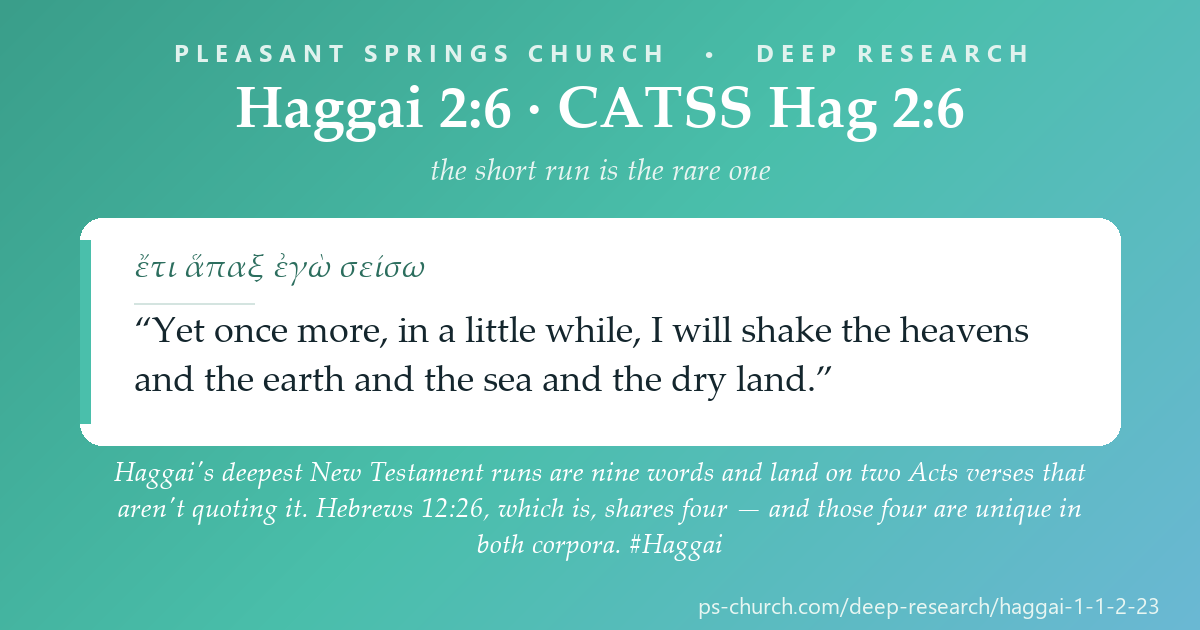
CATSS Haggai 2:6: …ἔτι ἅπαξ ἐγὼ σείσω τὸν οὐρανὸν καὶ τὴν γῆν καὶ τὴν θάλασσαν καὶ τὴν ξηράν
Hebrews 12:26: …λέγων Ἔτι ἅπαξ ἐγὼ σείσω οὐ μόνον τὴν γῆν ἀλλὰ καὶ τὸν οὐρανόν
The run stops after four because the row lists four domains joined by καί and Hebrews names two, in the other order, with οὐ μόνον…ἀλλὰ καί between them. Hebrews 12:26’s own deepest partner among all 30,348 screened CATSS verse units is Haggai 2:6 — a tie band of one. From that side the screen points straight at Haggai; it just does not point far.
Depth against rarity, and here they cross over
| string | run | CATSS verse units, all 64 files less the Odes — 30,348 | NT verses |
|---|---|---|---|
| τὸν οὐρανὸν καὶ τὴν γῆν καὶ τὴν θάλασσαν καί | 9 | 3 — Haggai 2:6, Haggai 2:21, Exodus 20:11 | 2 — Acts 4:24, Acts 14:15 |
| ἔτι ἅπαξ ἐγὼ σείσω | 4 | 1 — Haggai 2:6 | 1 — Hebrews 12:26 |
The longer run is the commoner string and the shorter run is unique in both corpora. On this shelf that has happened before — but this is the one case where the rare short string is also the one a New Testament writer explicitly introduces as a quotation. Reporting the maximum alone would have printed a creation formula and missed the citation entirely.
What the rest of the book returns: all 38 rows reach two, 32 reach three, 13 reach four, and then nothing until the two rows at nine. Nothing in Haggai sits between five and eight.
What the measurement is, and its scope. Contiguous runs of word forms, Greek against Greek: the CATSS FORM column (cols 0–24, beta-code transliterated) across 30,348 verse units screened — the 30,637 held in all 64 .mlxx files, less the 289 units of the Odes — against the MorphGNT surface-word column across 7,927 verses in 27 files. Both sides lowercased, accents and breathings dropped, final sigma folded, then filtered to Greek letters — the same filter on both corpora. Word forms, never lemmas. It says nothing about which text is prior and nothing about citation.
Where the columns count differently.
2:21 — two domains in one column and four in the other
Haggai says the same thing twice, fifteen verses apart, and the two columns do not keep the two statements the same length.
| 2:6 | 2:21 | |
|---|---|---|
| Hebrew | heavens, earth, sea, dry land — four | heavens, earth — two |
| CATSS row | οὐρανόν, γῆν, θάλασσαν, ξηράν — four | οὐρανόν, γῆν, θάλασσαν, ξηράν — four |
And the verb differs by a single letter between the two rows: σείσω at 2:6, σείω at 2:21. That one letter is why Hebrews 12:26 matches 2:6 and not 2:21, since Hebrews reads σείσω.
2:7 — singular or plural
The most discussed word in the book is a question of number.
The Hebrew has חֶמְדַּת כָּל־הַגּוֹיִם — a singular construct, the desire of all nations. The Greek row has τὰ ἐκλεκτὰ πάντων τῶν ἐθνῶν — a neuter plural, the choice things of all the nations. The verb agrees with the singular in the Hebrew and the row keeps a singular verb too (ἥξει), which is the detail commentators spend most time on.
The page reports both readings and does not resolve them. Why either stands as it does is not something these columns can settle.
Two more places the columns differ
| verse | Hebrew | CATSS Greek row |
|---|---|---|
| 1:1 | יְהוֹשֻׁעַ — Joshua | Ἰησοῦν |
| 1:4 | סְפוּנִים — panelled | κοιλοστάθμοις — coffered |
| 2:9 | ends at I will give peace | runs on thirteen words further |
Each is printed as its file has it. The thirteen extra words at 2:9 are καὶ εἰρήνην ψυχῆς εἰς περιποίησιν παντὶ τῷ κτίζοντι τοῦ ἀναστῆσαι τὸν ναὸν τοῦτον.
Hebrews 12, and the two Acts verses that are not quoting anything.
Hebrews 12:26–27 is the only New Testament use of Haggai
And the screen finds it — from the Hebrews side. Hebrews 12:26’s deepest partner among all 30,348 screened CATSS verse units is Haggai 2:6, a tie band of one. From the Haggai side the same verse ranks below two verses of Acts, because those two share a longer but commoner string. ⚠️ That figure was measured over 44 files when this page was written and has been re-run over 64: it did not move, in run, in partner or in band.
This is the clearest illustration on the shelf of why a maximum needs its direction stated. “Haggai 2:6’s deepest New Testament partner” and “Hebrews 12:26’s deepest Old Testament partner” give different answers, and both are correct.
Why the Acts verses reach further
Acts 4:24 and Acts 14:15 both describe God as the one who made the heaven and the earth and the sea. Haggai 2:6 and 2:21 both list the same domains in the same order, with the same connective.
Nine matching word forms, and nothing in either Acts verse suggests Haggai is in view. The page reports the run and draws nothing from it — a list of created things given in a conventional order is exactly the kind of material a contiguous-run test will find whether or not anything connects the two texts.
⚠️ THE PAGE PREDICTED THIS COUNT WOULD RISE, THEN PRINTED ‘IT DID NOT’, AND THE SECOND FETCH HAS NOW PROVED THE FIRST PREDICTION RIGHT. ALL THREE STATES ARE PRINTED.
| corpus | units | τὸν οὐρανὸν καὶ τὴν γῆν καὶ τὴν θάλασσαν καί stands in | what the page said |
|---|---|---|---|
| 35 CATSS files (as written) | 18,183 | 2 — Haggai 2:6, 2:21 | “the count would very likely rise” |
| 44 CATSS files (19 Aug 2026) | 23,061 | 2 — Haggai 2:6, 2:21 | “It did not.” |
| 64 CATSS files, less the Odes | 30,348 (30,637 held) | 3 — Haggai 2:6, Haggai 2:21, and Exodus 20:11 | It did rise. The original prediction was right and the interim verdict was premature. |
The verse that closed the gap is the fourth commandment. CATSS Exodus 20:11 reads ἐν γὰρ ἓξ ἡμέραις ἐποίησεν κύριος τὸν οὐρανὸν καὶ τὴν γῆν καὶ τὴν θάλασσαν καὶ πάντα τὰ ἐν αὐτοῖς — for in six days the Lord made the heaven and the earth and the sea and all that is in them. Greek Exodus was not on this disk until 30 August 2026.
⚠️ AND IT DOES NOT ONLY ADD A THIRD OCCURRENCE. IT TAKES THE ACTS VERSES AWAY FROM HAGGAI ENTIRELY.
| row | deepest Greek OT partner, 44 files | run | band | deepest Greek OT partner, 64 files | run | band |
|---|---|---|---|---|---|---|
| Acts 4:24 | Haggai 2:6 · Haggai 2:21 | 9 | 2 | Exodus 20:11 | 13 | 1 |
| Acts 14:15 | Haggai 2:6 · Haggai 2:21 | 9 | 2 | Exodus 20:11 | 13 | 1 |
| Hebrews 12:26 | Haggai 2:6 | 4 | 1 | Haggai 2:6 | 4 | 1 |
This is the best thing that has happened to this page. Its whole argument was that the nine-word run to Acts is a creation formula and not a citation, while the four-word run to Hebrews is a citation and not a formula. The larger corpus settles it from the outside. Given a bigger shelf to choose from, both Acts verses abandon Haggai and go to the Sabbath commandment — four words deeper, at a tie band of one instead of two — because heaven and earth and sea and all that is in them is what they were actually reaching for. Hebrews 12:26 does not move. Over 44 files and over 64, its deepest Old Testament partner in the whole corpus is Haggai 2:6, at a tie band of one. The coincidence was displaced by a better coincidence; the citation stayed exactly where it was.
And the shorter head grew too, which is the ordinary part. τὸν οὐρανὸν καὶ τὴν γῆν stood in 20 verse units across ten books over 44 files; over the 64-file shelf with the Odes set aside it stands in 26 across fifteen, the new ones being Exodus 20:11 and 31:17, and — as witnesses, not Scripture — 2 Maccabees 7:28, Judith 7:28, and Bel 1:5 in both the Old Greek and Theodotion columns. Outside Haggai the head now does run on into καὶ τὴν θάλασσαν exactly once, at Exodus 20:11 — the page previously said it never did, and that is corrected here.
⚠️ THAT FIGURE READ 27 ACROSS SIXTEEN FOR ONE DAY, AND THE TWENTY-SEVENTH WAS THE ODES. THE PAGE PRINTS THE HISTORY RATHER THAN THE NUMBER ALONE.
On 30 August 2026 this page reported the head standing in 27 verse units across sixteen books, the last of them Odes 12:2. The Odes have since been taken out of this shelf’s screening corpus, and the figure is 26 across fifteen. The Odes are the liturgical canticles bound after the Greek Psalter, and they are set aside for two reasons that have nothing to do with Haggai and everything to do with what a count of ‘the Greek Old Testament’ is allowed to mean. (1) Two of them are New Testament text. Ode 9 is Luke 1 — the Magnificat and the Benedictus — and Ode 13 is Luke 2, the Nunc Dimittis. Screened, Odes 9:48 matches Luke 1:48 at eighteen consecutive words: that is Luke matching Luke under an Old Testament shelfmark, and an instrument that can return it can be trusted about a Gospel’s deepest Old Testament contact only once the canticles are out. (2) Ten of them are second copies of passages already in the corpus — Ode 1 is Exodus 15, Ode 2 Deuteronomy 32, Ode 3 1 Samuel 2, Ode 4 Habakkuk 3, Ode 5 Isaiah 26, Ode 6 Jonah 2, Odes 7 and 8 Daniel (Th) 3, Ode 10 Isaiah 5, Ode 11 Isaiah 38 — so a verse standing once appears to stand twice and any tie band touching a canticle is doubled for no textual reason.
⚠️ And Odes 12:2 is neither of those things, which is worth saying plainly. Ode 12 is the Prayer of Manasseh, and it stands nowhere else on this shelf. Its hit was a real, non-duplicate occurrence of the head. It is dropped because the appendix is excluded as one book, not because this row was spurious — and the page would rather print that distinction than let a reader assume the removed hit was junk.
Nothing else on this page moved. The nine-word string still stands in three units — Haggai 2:6, Haggai 2:21, Exodus 20:11; the four-word string still stands in exactly one; both Acts verses still leave Haggai for Exodus 20:11 at a run of 13 and a tie band of 1; and Hebrews 12:26’s deepest Old Testament partner is still Haggai 2:6 at a tie band of one. No figure about Haggai on this page was ever measured against an Ode.
Where this page is weakest, and what was not reached.
The limits
A rarity figure is only as good as its corpus, and this page prints one that is visibly corpus-bound — and it has since been re-measured. Two CATSS verse units for the creation formula was a fact about 35 files, not about the Greek Old Testament. It was re-run twice, and the second re-run overturned the first. Across 44 files and 23,061 verse units on 2026-08-19 it was still two, and this page printed “it did not rise”. Across all 64 files and 30,348 screened verse units, because Greek Exodus arrived and Exodus 20:11 carries the string. The page’s original prediction was correct and its interim correction was wrong, and both are printed at the point of use rather than one of them being deleted. A negative held over a partial corpus can survive one fetch and still not be true.
Depth and direction both have to be stated. The same pair looks different depending on which corpus is being iterated over, and this study is the one where that matters most.
And 2:7 is a genuine crux this page does not enter. Whether חֶמְדַּת is a collective singular, and what to do with the singular verb, has a long literature. None of it was consulted; the page prints both columns.
What could not be checked at all
No Hebrew or Greek critical apparatus. No Qumran material — the Minor Prophets scroll from Nahal Hever bears on the Greek of these books and was not consulted. No Targum, Syriac, Vulgate, Aquila, Symmachus or Theodotion. No text-critical work on Hebrews 12:26.
And nothing on the history. What happened to Zerubbabel after 2:23, and how the second temple compared with the first, are questions a word count cannot touch.
Four words that are rarer than nine.
The citation is the short one
Haggai’s deepest runs into the New Testament are nine words long and land on two verses of Acts that are not thinking about Haggai at all — a list of heaven, earth and sea, given in the same order by both books.
The one New Testament verse that does take up Haggai, and says so, shares four words: ἔτι ἅπαξ ἐγὼ σείσω, yet once more I will shake. Those four words stand in exactly one verse unit of the complete Greek Old Testament — 30,348 screened, of the 30,637 held — and one New Testament verse of 7,927. The nine-word string stands in three Greek Old Testament units and two New Testament verses. ⚠️ When this page was written those figures were “one of eighteen thousand” and “two of each”; the Old Testament corpus has since grown from 18,183 units to 30,348 screened, and the four-word string held while the nine-word string did not.
Length and rarity came apart, and this time the shorter string was both the rarer one and the real connection. A page that reported only its maximum would have printed a creation formula and left the citation out.
Tenth study on the Minor Prophets shelf, and the whole of Haggai in one page. Seven books complete: Hosea, Joel, Amos, Jonah, Micah, Habakkuk, Haggai.
Every Deep Research page traces its passage across the whole sweep — the Old Testament, the Second-Temple world between the testaments (historical witnesses, not Scripture), and the New Testament. Follow the thread:
Pleasant Springs Church — Deep Research
Research method after Michael S. Heiser’s Bible Research Method (examine dictionaries → ancient literature → important words → textual connections → academic publications → share), with the Pleasant Springs “Author & Audience” foundation. Scripture set in the Hebrew, the Greek editions named on each page and the ESV (Old Testament), and the Greek New Testament and the ESV (New Testament), per the practice of Pleasant Springs Church. Haggai research grounded in Meyers & Meyers (Haggai, Zechariah 1–8, Anchor), Petersen (OTL), Verhoef (NICOT) and Wolff. Text: Hebrew from the Masoretic text as printed in the editions consulted — Sefaria’s Miqra according to the Masorah; no critical apparatus was consulted for the Hebrew. Greek from Rahlfs’ Septuaginta as digitized by CATSS; Greek New Testament from the SBL edition. The standing caution for this shelf applies: these pages say “the CATSS Greek row reads…” and never call a Greek reading early or late. ✅ VERSE NUMBERING — checked, and clean. Masoretic, CATSS and ESV all run 15 / 23 across Haggai, 38 verses. Verified against content, not assumed. ⚠️ The run measurement, in full. Greek against Greek. CATSS FORM column (cols 0–24), beta-code transliterated first; MorphGNT field 6, the normalised word (the column that already resolves elision and the movable nu). Both sides lowercased, accents and breathings dropped, final sigma folded, then filtered to Greek letters — the same filter applied to both corpora. Contiguous runs of whole word FORMS, never lemmas. Corpus: 30,348 CATSS verse units screened across 64 .mlxx files — the shelf holds 30,637, and the 289 units of the Odes are set aside because two of the canticles are New Testament text (Ode 9 is Luke 1, Ode 13 is Luke 2) and ten more are second copies of passages already in the corpus — and 7,927 verses across 27 MorphGNT files. Exhaustive and deterministic — nothing sampled, so no seed applies. ⚠️ Every maximum is printed with its tie band, checked on both sides — and here it is a two-by-two block. Haggai 2:6 and 2:21 each reach 9, and each reaches it with two New Testament verses (Acts 4:24, Acts 14:15); each of those verses reaches 9 with two CATSS units (Haggai 2:6, 2:21). Four pairs, all at the same depth. Hebrews 12:26 reaches 4 with Haggai 2:6, tie band one, and Haggai 2:6 is Hebrews 12:26’s own deepest partner among all 30,348 screened units. ⚠️ Depth and rarity cross over on this page, and both are printed. The 9-word string stands in 3 CATSS verse units and 2 New Testament verses; the 4-word string in exactly 1 of each. The shorter run is the rarer, and it is the one Hebrews introduces as a quotation. Reporting the maximum alone would have printed the creation formula and omitted the citation. ⚠️ THE CORPUS-BOUND RARITY FIGURE HAS BEEN RE-MEASURED TWICE, AND THE SECOND RE-MEASUREMENT REVERSED THE FIRST. Written over 35 files, 18,183 verse units, the page flagged “2 CATSS verse units” for the nine-word string as likely to rise. Re-run over 44 files, 23,061 verse units on 19 August 2026 it was still 2, and the page printed “it did not rise”. The last twenty CATSS files — Greek Exodus, Leviticus, Numbers, both Joshua recensions and the deuterocanonical books, which this shelf treats as witnesses, not Scripture and labels so every time — landed on 30 August 2026, taking the corpus to 64 files and 30,637 verse units held, 30,348 of them screened once the Odes were set aside. Re-run over all of it the count is 3: Haggai 2:6, Haggai 2:21 and Exodus 20:11, the fourth commandment. The prediction was right; the interim ‘it did not’ was premature. Both Acts verses now leave Haggai for Exodus 20:11 at a run of 13 and a tie band of 1, while Hebrews 12:26’s deepest Old Testament partner is still Haggai 2:6 at a tie band of 1. All three states are printed in Stages 4 and 5 at the point of use rather than in a footnote, and nothing was quietly replaced. ⚠️ Direction of influence is never asserted. Nothing here says which text is prior, that anyone quoted, adapted, followed or altered anything, or why any reading stands as it does — including the two domains against four at 2:21, the singular against plural at 2:7, and the thirteen words at 2:9 that stand in one column and not the other. Typology is handled per the house position: what the text says, what the New Testament itself draws, and what we see from this side of the cross — with the seeing left to the reader.
Scripture quotations marked ESV are from the ESV® Bible (The Holy Bible, English Standard Version®), © 2001 by Crossway, a publishing ministry of Good News Publishers. ESV Text Edition: 2016. Used by permission. All rights reserved. The ESV text may not be quoted in any publication made available to the public by a Creative Commons license, and the ESV may not be translated in whole or in part into any other language. www.esv.org
|
Did this study bless you today? 💚 Give to Support PS Church100% of gifts go to the General Fund — thank you. |