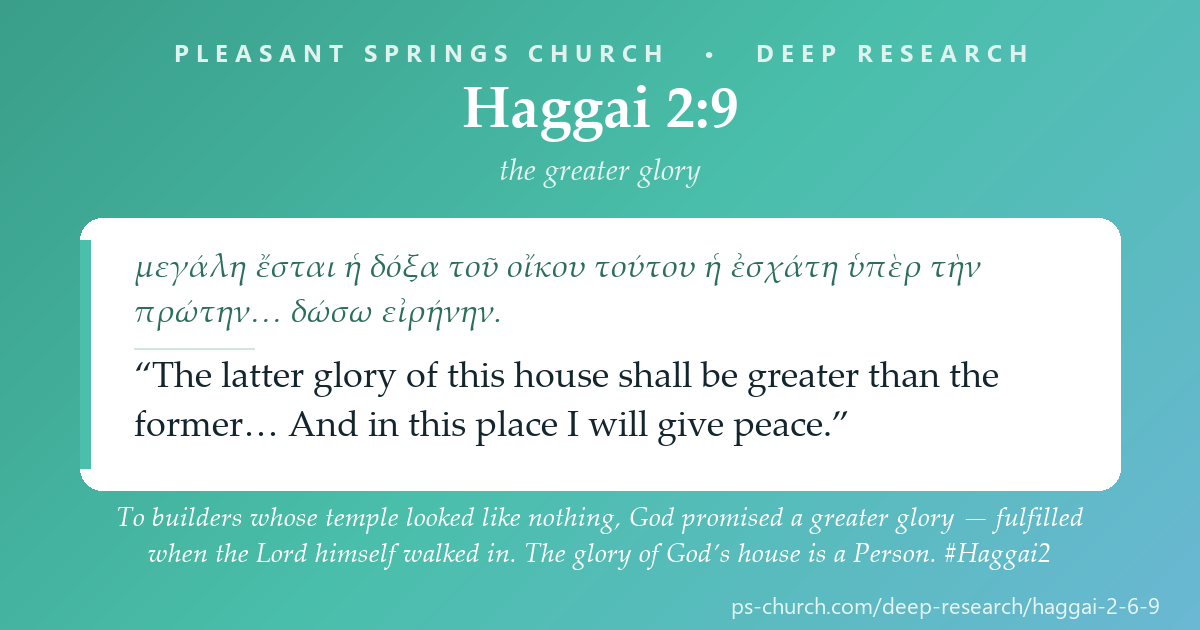
Yet once more I will shake the heavens and the earth.” To exiles rebuilding a temple that looked shabby beside Solomon’s — so plain the old men wept — God promised something staggering: he would shake the nations, draw in their treasures, and fill this house with a glory greater than the former, and give peace there. The famous phrase “the desire of all nations” has been read both as the nations’ treasures and as the Messiah himself; either way, the greater glory came when the Lord entered his temple. This study works Haggai 2:6–9 — the shaking, the glory, the peace — from the day of small things to the unshakeable kingdom. See the method →
Haggai 2:6–9 (same numbering in MT, LXX & English)
Hebrew · LXX · ESVThe Shape of the Passage
SequenceHaggai prophesied in 520 BC to the returned exiles rebuilding the temple under Zerubbabel and Joshua. The old men who remembered Solomon’s temple wept at how modest the new one was (Ezra 3:12; Hag 2:3); this oracle is God’s answer to their grief.
Author
Haggai stirs a discouraged community to finish the second temple. Some who had seen Solomon’s house asked, in effect, “Is this all?” (2:3) — the new building was smaller, poorer, without the ark or the visible glory-cloud. God’s reply reframes everything: the house’s worth is not its gold but his presence and his future. “Yet once more” he will shake heaven and earth and all nations, draw in their treasures, and fill this house with a glory that will outshine the first.
The silver and gold are his. To builders anxious about resources, God says, “The silver is mine, and the gold is mine” (2:8). He does not need their wealth; he will bring the nations’ own. And the “greater glory” is not architectural — it is the coming of the Lord to his temple (Mal 3:1), fulfilled when the child Jesus was carried into these very courts (Luke 2:22–38) and later taught in them.
Audience
A small, poor, post-exilic community tempted to despise “the day of small things” (Zech 4:10). To them Haggai promises that the modest house they were raising had a future they could not see — that God’s glory and peace would fill it beyond Solomon’s.
How it was fulfilled. The second temple, later expanded by Herod, was the temple the incarnate Lord entered. And the New Testament reaches past even that: Hebrews 12:26 quotes Haggai’s “yet once more I will shake” to announce a final shaking that removes all that can be shaken, leaving “a kingdom that cannot be shaken” (12:28). The peace promised “in this place” is the peace of the Prince of Peace, made “by the blood of his cross” (Col 1:20).
Orient on the second temple, glory, the shaking, and the desire of nations.
Search by topic: Haggai, second temple, glory (kavod), day of the LORD / shaking, Messiah.
Which articles are relevant?
- Anchor Bible Dictionary — “Haggai,” “Temple, Second,” “Glory of God,” “Zerubbabel.”
- Dictionary of the OT: Prophets — “Haggai, Book of,” “Temple,” “Glory,” “Nations.”
- NIDOTTE / TDOT — חֶמְדָּה (ḥemdâ, desire/treasure), כָּבוֹד (kāḇôḏ, glory), רָעַשׁ (rāʿaš, shake), שָׁלוֹם (šālôm, peace).
Bibliography surfaced:
- Pieter A. Verhoef (NICOT, Haggai and Malachi), Carol & Eric Meyers (Anchor Yale, Haggai, Zechariah 1–8), David Petersen (OTL), Joyce Baldwin (TOTC) on Haggai.
- Richard Taylor & E. Ray Clendenen (NAC); studies of the chemdat crux and the “greater glory.”
- F. F. Bruce (NICNT) and Peter O’Brien (PNTC) on Hebrews 12:26; Beale & Carson, NT Use of the OT.
The modest house, the desire of nations, and the shaking to come.
Weigh the chemdat crux honestly, then follow the “greater glory” to the Lord who entered his temple.
Which parallels shed light on religion and worldview?
A house that looked like nothing. The returned exiles were building on a shoestring. Compared to Solomon’s temple — overlaid with gold, filled at its dedication with the glory-cloud (1 Kgs 8:11) — the second temple was plain, and the old men wept (Ezra 3:12). Prophets like Zechariah call this “the day of small things” (Zech 4:10). Haggai’s oracle meets that discouragement head-on: do not measure this house by its gold.
‘The treasures of all nations’ — or ‘the Desire of all nations’? The famous phrase in 2:7 is grammatically knotted. Chemdat is a singular construct, “the desire of” — but the verb “shall come” (u-vaʾu) is plural. Read with the plural (agreeing with “all the nations”), the sense is collective: the desirable things — the treasures, the wealth — of the nations streaming into Zion (as in Isaiah 60:5–11). The Greek took it that way: “the choice things of all nations” (τὰ ἐκλεκτά). The old Latin (Vulgate) read a singular person — “the Desire of all nations shall come” — and the church heard the Messiah (the hymn “Come, Thou Long-Expected Jesus” sings it so). Honesty requires both notes: the plain grammar favors “treasures,” while the whole oracle is genuinely messianic — because the glory that fills the house is finally a Person.
- Isaiah 60:5–11; 66:12; Psalm 72:10–11 — the wealth of the nations brought to Zion; kings bearing tribute: the “treasures of the nations” picture.
- 1 Kings 8:10–11; Ezra 3:12–13 — the glory-cloud filling Solomon’s temple; the old men weeping at the modest second temple: the grief Haggai answers.
- Malachi 3:1 — “the Lord whom you seek will suddenly come to his temple”: the key to the “greater glory” (see Malachi 3).
- Josephus, Antiquities 11–15 (a Second-Temple-era witness, not Scripture) — the modest returned-exiles’ temple, later magnificently expanded by Herod: the house the Lord entered.
How could the second temple’s glory exceed Solomon’s? Not in gold — it never rivaled the first for splendor, and it lacked the ark and the visible glory-cloud. The answer is the one Malachi gives: “the Lord whom you seek will suddenly come to his temple” (Mal 3:1). The greater glory was a Person. Into these very courts the infant Jesus was carried, and Simeon took him up as “a light for revelation to the Gentiles, and for glory to your people Israel” (Luke 2:32); here the boy Jesus sat among the teachers, and here the Lord later taught and cleansed his Father’s house. The glory of the second temple was that God himself, in the flesh, walked in it. And Haggai’s “yet once more I will shake” reaches even beyond that: Hebrews quotes it to announce a final shaking — “the removal of things that are shaken… in order that the things that cannot be shaken may remain” — so that we who receive “a kingdom that cannot be shaken” give thanks and worship (Heb 12:26–28). The peace God promised “in this place” is the peace of the Prince of Peace. A note of care: the plain sense of 2:7 is the treasures of the nations, not a title of the Messiah; but the oracle’s heart — God filling his house with glory and giving peace — is fulfilled in Christ, who is himself the glory and the peace.
The vocabulary of the treasures, the glory, and the peace.
Watch the knotted “desire of the nations” — and the glory that is finally a Person.
“Desire, desirable things, treasure” — from ḥāmaḏ (“to desire,” as in the tenth commandment). Here the plural verb favors the collective “treasures of the nations”; the older “the Desire of all nations” (the Messiah) is a personal reading the grammar does not directly require.
“Glory” — weight, honor, splendor; the glory that filled the tabernacle and Solomon’s temple (Exod 40:34; 1 Kgs 8:11). Haggai promises it will fill this house — fulfilled in the presence of the incarnate Lord.
“To shake, quake” — a cosmic and national shaking of heavens, earth, sea, and all nations. The verb Hebrews 12:26 takes up (σείσω) for the final shaking that leaves only the unshakeable kingdom.
“Peace” — wholeness, flourishing. “In this place I will give peace” — pointing to the Prince of Peace (Isa 9:6) who “is our peace” (Eph 2:14) and made peace “by the blood of his cross” (Col 1:20).
How the New Testament uses Haggai:
- Hebrews 12:26–28 — quotes Haggai 2:6 (“Yet once more I will shake”): the final shaking that leaves “a kingdom that cannot be shaken.”
- Luke 2:22–38, 46–49; John 2:13–22 — the Lord carried into, and teaching in, and cleansing, the second temple: the “greater glory.”
- Malachi 3:1; Matthew 21:12–14 — “the Lord… will suddenly come to his temple” (see Malachi 3).
- Ephesians 2:14–17; Colossians 1:20 — Christ “is our peace”; peace made “by the blood of his cross”: the peace promised “in this place.”
From the modest house to the Lord who filled it with glory.
Trace the glory and the shaking from Haggai through the coming of Christ into the unshakeable kingdom.
Which cross-references matter?
- 1 Kings 8:10–11; Exodus 40:34–35; Ezra 3:12 — the glory that filled the first temple; the grief over the second (see the glory fills the tabernacle).
- Isaiah 60:1–11; Malachi 3:1 — the nations’ wealth streaming to Zion; the Lord coming to his temple.
- Luke 2:22–38; John 1:14; 2:19–21 — the Lord in the temple; the Word who “dwelt among us”; the temple of his body: the true glory.
- Hebrews 12:26–29 — the final shaking; the unshakeable kingdom; “our God is a consuming fire.”
- Isaiah 9:6–7; Ephesians 2:14; Revelation 21:22–26 — the Prince of Peace; “he himself is our peace”; the city with no temple, for the Lamb is its temple.
Haggai’s oracle works on two horizons at once, and the New Testament honors both. In its own day it comforted builders: the house you are raising has a future far beyond its modest present, for God will fill it with glory and give peace there. That began to be realized as the second temple stood at the center of Israel’s life for nearly six centuries and, above all, when the Lord himself entered it. But Hebrews shows the oracle was never exhausted by any building of stone: quoting “yet once more I will shake” (following the Greek), it reads Haggai’s shaking as the final, cosmic upheaval that removes everything temporary so that only the eternal kingdom remains. The two readings of 2:7 — “treasures of the nations” and “the Desire of all nations” — converge here: whether the nations bring their gold or their King, the point is that God’s house is filled with a glory the world streams toward, and that glory has a face. The discouraged builder’s question — “is this all?” — is answered not with a bigger building but with a coming Person, and finally with a kingdom that cannot be shaken.
The scholarship on Haggai 2:6-9.
The commentators on Haggai; the studies of the chemdat crux and Hebrews 12:26.
Commentaries & studies:
- Pieter A. Verhoef (NICOT), Carol L. & Eric M. Meyers (Anchor Yale), David L. Petersen (OTL), Joyce G. Baldwin (TOTC), Richard Taylor & E. Ray Clendenen (NAC) on Haggai.
- Studies of the chemdat kol-haggoyim (“treasures / Desire of all nations”) crux and the “greater glory.”
- F. F. Bruce (NICNT) and Peter T. O’Brien (PNTC) on Hebrews 12:26–28; Beale & Carson, eds., Commentary on the NT Use of the OT.
Interpretation notes worth keeping:
- The chemdat crux. Singular “desire of” + plural verb → the plain sense is the collective “treasures/desirable things of the nations” (so ESV/LXX τὰ ἐκλεκτά). “The Desire of all nations” (a personal Messiah) is the Vulgate-based reading — a fuller, typological hearing, not the plain grammar.
- Hebrews 12:26 text-form. Hebrews quotes the Greek of Haggai 2:6 (“Yet once more I will shake”) and adapts the objects to “not only the earth but also heaven” to set up its argument; it does not cite the Hebrew.
- The greater glory. Not gold but the presence of the Lord who enters his temple (Mal 3:1; Luke 2) — the glory the second temple actually had.
- The shaking, held humbly. The “shaking of heaven and earth” is read across eschatological systems (past, present, future); affirm the sure hope of the unshakeable kingdom without forcing a timetable.
From the day of small things to the glory that fills the house.
Name what you learned, why it matters, and one concrete response.
What should we carry away — and do?
- Do not despise small beginnings. The house that looked like nothing had a glory the builders could not yet see. God’s best work often starts in what looks unimpressive.
- The glory is a Person. What makes a place holy is not its gold but God’s presence — and in Christ that presence came in the flesh. Seek the glory that has a face.
- Only one kingdom cannot be shaken. Everything that can be shaken will be. Build your life on the one thing that will remain: the unshakeable kingdom of God.
Step in response: where you are tempted to despise “the day of small things” — a small church, a modest calling, an unglamorous obedience — keep building, trusting the God who fills houses with glory. And this week let one shakeable thing you have been clinging to loosen its grip, so your hands hold more firmly to the kingdom that cannot be shaken.
Haggai 2:9 · to share
ESVEvery Deep Research page traces its passage across the whole sweep — the Old Testament, the Second-Temple world between the testaments (historical witnesses, not Scripture), and the New Testament. Follow the thread:
Pleasant Springs Church — Deep Research
Research method after Michael S. Heiser’s Bible Research Method (examine dictionaries → ancient literature → important words → textual connections → academic publications → share), with the Pleasant Springs “Author & Audience” foundation. Scripture set in the Hebrew, the Greek editions named on each page and the ESV (Old Testament), and the Greek New Testament and the ESV (New Testament), per the practice of Pleasant Springs Church. Haggai 2:6–9 research grounded in Verhoef, the Meyers, Petersen, and Baldwin, with Bruce and O’Brien on Hebrews 12:26; the chemdat crux shown from the MT, LXX, and Vulgate traditions; Josephus as a Second-Temple-era witness to the temple.
Scripture quotations marked ESV are from the ESV® Bible (The Holy Bible, English Standard Version®), © 2001 by Crossway, a publishing ministry of Good News Publishers. ESV Text Edition: 2016. Used by permission. All rights reserved. The ESV text may not be quoted in any publication made available to the public by a Creative Commons license, and the ESV may not be translated in whole or in part into any other language. www.esv.org
|
Did this study bless you today? 💚 Give to Support PS Church100% of gifts go to the General Fund — thank you. |