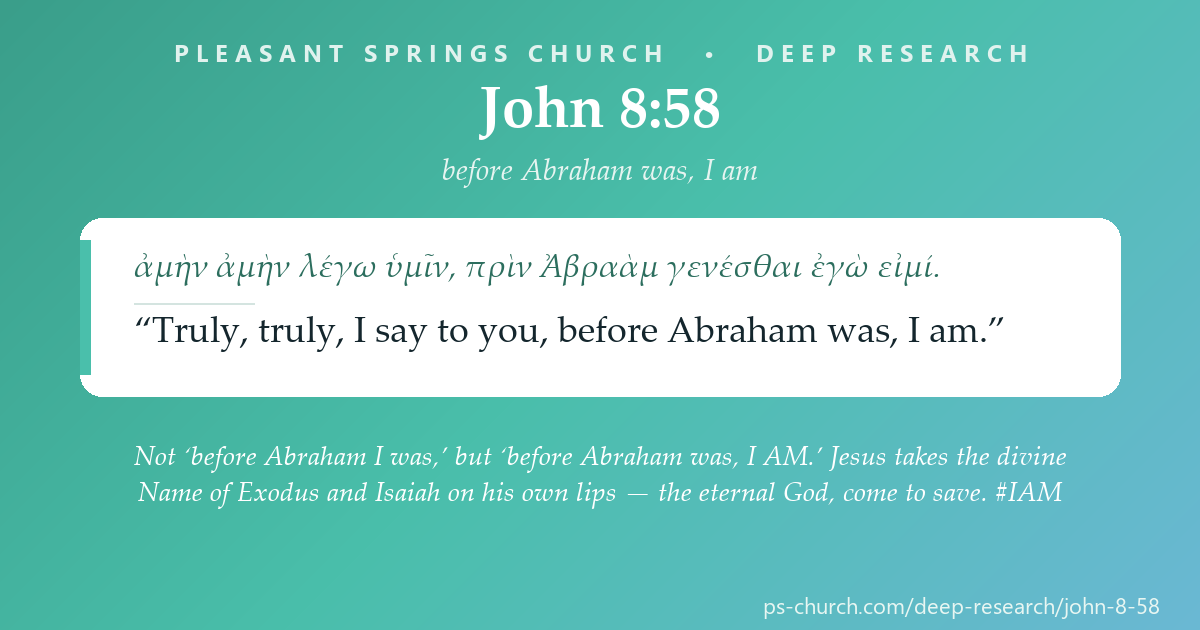
“Before Abraham was, I am.” In four words Jesus makes the most staggering claim in the Gospel. Not “before Abraham I was” — which would still be a beginning — but “before Abraham came to be, I am.” Abraham began; Jesus simply, timelessly is. That absolute “I am” is the very phrase the Old Testament puts in God’s mouth at the burning bush and in Isaiah — and the crowd knew it, for they picked up stones to kill him for blasphemy. This study works John 8:58 — the eternal “I am,” the deity of Christ — with care. See the method →
John 8:57–59
Greek NT · ESVThe Shape of the Passage
Parallel panelsJohn 8 is a fierce temple dispute about Jesus’ identity and origin. It climbs to this climax: Jesus says Abraham “rejoiced to see my day” (8:56); the crowd scoffs (“not yet fifty”); and Jesus answers with the eternal “I am.” The Word who “was in the beginning” (see John 1:1-5) here names himself with God’s own Name (see Exodus 3).
Author
John has built his Gospel toward this moment. The whole chapter argues about where Jesus is from and who he is; Jesus keeps saying “I am” (8:24, 28) in ways that hover over the divine Name. Here it becomes explicit. To the taunt “you are not yet fifty years old, and have you seen Abraham?” Jesus replies with a deliberate grammatical shock: not a past tense but a present one — “before Abraham came to be, I am.”
Being, not becoming. The contrast is exact and intentional. Abraham “came to be” (genesthai) — he entered existence at a point in time. Jesus does not say “I was” (which would still place him on a timeline); he says “I am” — timeless, unbounded existence. It is the same distinction John drew in his prologue, where all created things “came to be” (egeneto, 1:3) but the Word “was” (ēn, 1:1). Jesus is not the first or greatest thing that came to be; he simply is.
Audience
The temple crowd — and every reader deciding who Jesus is. There is no room here for “a great teacher” and nothing more: Jesus has spoken the words God spoke of himself, and his hearers know it. They reach for stones because, if he is not God, this is blasphemy worthy of death (Lev 24:16); and if he is, it is the truth that saves.
How to hear “I am.” The Greek ego eimi can be an ordinary “I am he” (as the healed blind man says, 9:9). But here it stands absolute — no predicate — set against Abraham’s origin, and it draws the stones. That is exactly how the Greek Old Testament renders the Lord’s own “I am he” (Hebrew ʾănî hûʾ) in Isaiah, his declaration that he alone is God. The crowd heard the Name; John means us to hear it too.
Orient on ‘I am,’ the divine Name, pre-existence, and blasphemy.
Search by topic: I am sayings, divine name / YHWH, pre-existence of Christ, deity of Christ, blasphemy.
Which articles are relevant?
- Anchor Bible Dictionary — “I Am,” “Names of God,” “Son of God,” “Blasphemy.”
- Dictionary of Jesus and the Gospels — “‘I Am’ Sayings,” “Christology,” “God,” “Preexistence.”
- NIDNTT / TDNT — ἐγώ εἰμι (egō eimi, I am), γίνομαι (ginomai, come to be), אֲנִי הוּא (ʾănî hûʾ, I am he), אֶהְיֶה (ʾehyeh, I AM).
Bibliography surfaced:
- D. A. Carson (Pillar), Craig Keener (2 vols.), Raymond Brown (Anchor Yale), Andreas Köstenberger (BECNT), C. K. Barrett on John.
- Catrin H. Williams, ‘I Am He’: The Interpretation of ʾAnî Hûʾ in Jewish and Early Christian Literature (the definitive study).
- Richard Bauckham, Jesus and the God of Israel; Murray J. Harris, Jesus as God; Beale & Carson, NT Use of the OT.
The absolute ‘I am,’ the divine Name, and the stones.
Weigh the grammar, the Isaiah background, and the crowd’s response — honestly and fully.
Which parallels shed light on religion and worldview?
Two kinds of ‘I am.’ John uses ego eimi in two ways. Most often it is predicated — “I am the bread of life” (6:35), “the light of the world” (8:12), “the good shepherd” (10:11) — a self-revelation of what Jesus is for his people. But several times it stands absolute, with no predicate at all (8:24, 28, 58; 13:19; and 18:5–6, where the soldiers fall to the ground). John 8:58 is the strongest case: the bare “I am,” set against Abraham’s beginning, provoking a stoning. This absolute use is exactly how the Greek Old Testament renders the Lord’s own self-declaration.
The Name behind the words. Two Old Testament streams flow into “I am.” At the burning bush God names himself “אֶהְיֶה אֲשֶׁר אֶהְיֶה,” “I AM WHO I AM,” which the Greek Old Testament renders “ἐγώ εἰμι ὁ ὤν,” “I am the One who is” (Exod 3:14). And through Isaiah the Lord repeatedly declares “אֲנִי הוּא,” “I am he” — “that you may know and believe me… before me no god was formed, nor shall there be any after me” (Isa 43:10) — the assertion that he alone is God, which the Greek renders with the same absolute ἐγώ εἰμι. On Jesus’ lips that phrase, unpredicated and set behind Abraham, is a claim to be the God who spoke those words.
The stones as commentary. We need not guess what the crowd heard: they “picked up stones to throw at him.” Stoning was the penalty for blasphemy — specifically for one who “names the Name” of the Lord (Lev 24:16). Their action is the narrative’s own verdict on what “before Abraham was, I am” meant: a claim to deity. (A note for the careful reader: scholars rightly caution that not every Johannine “I am he” is a claim to the Name — some are ordinary identification. But the absolute use here, with the Isaiah background and the stones, is as clear as it gets.)
- Exodus 3:14 (LXX ἐγώ εἰμι ὁ ὤν) — “I AM WHO I AM… I AM has sent me to you”: the divine self-naming at the bush (see Exodus 3).
- Isaiah 41:4; 43:10, 25; 46:4; 48:12 (Hebrew ʾănî hûʾ; LXX ἐγώ εἰμι) — the Lord’s “I am he,” his declaration of unique, exclusive deity: the phrase behind Jesus’ absolute “I am.”
- Leviticus 24:16; John 5:18; 10:31–33 — the death penalty for blaspheming the Name; the repeated charge that Jesus “made himself equal with God”: why they reached for stones.
- John 1:1–3; 8:24, 28; 13:19; 18:5–6 — the Word who “was”; the other absolute “I am” sayings; the soldiers who “drew back and fell to the ground” (see John 1).
John 8:58 is a hinge of Christian confession. Jesus does not merely claim to be old, or pre-existent in a general way; he takes the very words by which the Lord named himself — the absolute “I am” of Exodus and Isaiah — and speaks them of himself. And he does it with a grammar that resists every attempt to make him a creature: not “I was” (a long-ago beginning) but “I am” (no beginning at all). This is the sentence that answers the Arian question forever: the Son is not the highest of the things that “came to be” — there was never a “when” he was not; he simply is, as God is. That is why the crowd reached for stones, and why the church has always heard here the deity of Christ. Two cautions keep the reading faithful. First, the deity of the Son does not collapse the persons: the same Jesus who says “I am” also prays to the Father and does his will — fully God, and truly the Son, distinct from the Father and the Spirit. Second, the claim is not detached from grace: the God who says “I am he” in Isaiah says it precisely as the Savior — “I, I am he who blots out your transgressions” (43:25). The eternal “I am” came, in time, to be lifted up (8:28) — so that the God who has no beginning would bear our end, and we might live.
The vocabulary of being, becoming, and the Name.
Watch the being/becoming contrast — and the absolute “I am” behind the stones.
“I am” — here absolute (no predicate). John’s absolute “I am” (8:24, 28, 58; 13:19; 18:5–6) renders the Lord’s “I am he” of Isaiah — a claim to the divine Name. (Distinct from the predicated “I am the bread/light/shepherd.”)
“To come to be, be born” (aorist of ginomai) — entrance into existence at a point. Abraham came to be; Jesus does not use this verb of himself. The Prologue’s same contrast: created things “came to be” (1:3); the Word “was” (1:1).
“I AM / I WILL BE” — from hayah (“to be”); the divine self-naming at the bush, tied to the Tetragrammaton. The Greek renders it ἐγώ εἰμι ὁ ὤν, “I am the One who is.”
“I am he” — the Lord’s compact self-declaration of exclusive deity in Isaiah (41:4; 43:10, 25; 46:4; 48:12). The Greek renders it with the absolute ἐγώ εἰμι — the words Jesus speaks.
“Truly, truly, I say to you” — John’s solemn “double Amen” (25× in John), introducing a weighty, authoritative pronouncement — here the most startling in the chapter.
How the New Testament confirms the eternal Son:
- John 1:1–3; 17:5 — the Word who “was” God; “the glory that I had with you before the world existed” (see John 1).
- Colossians 1:17; Hebrews 1:8–12; 13:8 — “he is before all things”; “your throne, O God, is forever”; “the same yesterday and today and forever.”
- Revelation 1:8, 17; 22:13 — “I am the Alpha and the Omega… who is and who was and who is to come”: the eternal “I am” on the lips of the risen Christ.
- Isaiah 43:25; 44:6; Mark 14:62 — “I, I am he who blots out your transgressions”; before the council, Jesus’ own “I am.”
From the Name at the bush to the ‘I am’ on Jesus’ lips.
Trace the divine “I am” from Exodus and Isaiah into the Gospel and the Apocalypse.
Which cross-references matter?
- Exodus 3:13–15; Isaiah 41:4; 43:10–13; 48:12 — the divine self-naming and the “I am he” of exclusive deity (see Exodus 3).
- John 8:24, 28; 13:19; 18:5–6 — the other absolute “I am” sayings; “unless you believe that I am he, you will die in your sins.”
- John 1:1–3; 17:5; Philippians 2:6 — the Word who was in the beginning; the glory before the world; “in the form of God” (see the Word made flesh).
- Mark 14:61–64; John 5:18; 10:30–33 — the “I am” and the “I and the Father are one” that draw the charge of blasphemy.
- Revelation 1:8, 17–18; 22:13 — the first and the last, who is and was and is to come: the eternal “I am” glorified.
Scholarship on John 8:58 has sharpened, not softened, the traditional reading. Careful study of the Greek Old Testament shows that the absolute “I am” (ego eimi) is the standard rendering of Isaiah’s ʾănî hûʾ, “I am he” — the Lord’s own formula for his unique, incomparable deity. When John repeatedly places that absolute phrase on Jesus’ lips (8:24, 28, 58; 13:19; 18:6), and when its speaking draws either stones or a falling-back in awe, the evangelist is doing something deliberate: he is identifying Jesus with the one God of Israel. This is not a late church invention read back into the text; it is the plain thrust of John 8, and it coheres with the whole Gospel, which opens by calling the Word “God” (1:1) and closes with Thomas confessing the risen Jesus “my Lord and my God” (20:28). Good scholarship also keeps the necessary care: not every “I am he” is a Name-claim, and the case must be made from the absolute uses in their context, as here. But made honestly, the case is strong — and it means that the one who says “before Abraham was, I am” is the eternal God, who nonetheless stooped to be stoned at, lifted up, and slain, that the timeless One might give us his own unending life.
The scholarship on John 8:58.
The commentators on John; the studies of the ‘I am’ sayings and the divine Name.
Commentaries & studies:
- D. A. Carson (Pillar), Craig S. Keener (2 vols.), Raymond E. Brown (Anchor Yale), Andreas J. Köstenberger (BECNT), C. K. Barrett on John.
- Catrin H. Williams, ‘I Am He’; David Mark Ball, ‘I Am’ in John’s Gospel; Richard Bauckham, Jesus and the God of Israel; Murray J. Harris, Jesus as God.
- G. K. Beale & D. A. Carson, eds., Commentary on the NT Use of the OT.
Interpretation notes worth keeping:
- Being vs becoming. “Before Abraham came to be (genesthai), I am (eimi)” — not “I was.” The present tense asserts timeless existence, matching the Prologue’s egeneto/ēn (1:3, 1). A witness to eternal deity, against Arianism; the rendering “I have been” is grammatically strained.
- Absolute, not predicated. Here ego eimi has no complement; it renders the Lord’s “I am he” (Isa 43:10). Distinguish it from “I am the bread/light/shepherd.”
- The stones interpret it. The crowd’s move to stone (Lev 24:16) shows they heard a claim to the divine Name; present the scholarly range (not every “I am he” is a Name-claim) without weakening this clear case.
- Text of 8:59. The ESV/NA28 ends “went out of the temple”; the later Byzantine text adds “going through the midst of them” (a harmonization from Luke 4:30) — rightly omitted.
From the eternal ‘I am’ to your own confession.
Name what you learned, why it matters, and one concrete response.
What should we carry away — and do?
- Jesus is God. Not a great teacher only, not the first creature — the eternal “I am,” who spoke the divine Name of himself. The claim leaves no middle ground: worship or stones.
- He has no beginning — and no end. “Before Abraham was, I am.” The One who holds your life is not a passing figure but the timeless God; nothing that has a beginning can outlast him.
- The eternal One came to save. The God who says “I am he” in Isaiah says it as the Savior who blots out transgressions. The “I am” was lifted up on a cross for you.
Step in response: make Thomas’ confession your own — “my Lord and my God” — and let it settle a question people keep trying to blur: Jesus is not merely admirable, he is the eternal God. This week, when you are tempted to shrink him to a good example, remember the four words that drew the stones, and worship the One who is.
John 8:58 · to share
Greek NT + ESVEvery Deep Research page traces its passage across the whole sweep — the Old Testament, the Second-Temple world between the testaments (historical witnesses, not Scripture), and the New Testament. Follow the thread:
Pleasant Springs Church — Deep Research
Research method after Michael S. Heiser’s Bible Research Method (examine dictionaries → ancient literature → important words → textual connections → academic publications → share), with the Pleasant Springs “Author & Audience” foundation. Scripture set in the Hebrew, the Greek editions named on each page and the ESV (Old Testament), and the Greek New Testament and the ESV (New Testament), per the practice of Pleasant Springs Church. John 8:58 research grounded in Carson, Keener, Brown, and Barrett, with Catrin Williams’ ‘I Am He’, Ball, Bauckham, and Harris on the ‘I am’ sayings; the Exodus 3:14 and Isaiah ʾănî hûʾ backgrounds as canonical context; the ego-eimi divine-Name case presented with its scholarly range.
Scripture quotations marked ESV are from the ESV® Bible (The Holy Bible, English Standard Version®), © 2001 by Crossway, a publishing ministry of Good News Publishers. ESV Text Edition: 2016. Used by permission. All rights reserved. The ESV text may not be quoted in any publication made available to the public by a Creative Commons license, and the ESV may not be translated in whole or in part into any other language. www.esv.org
|
Did this study bless you today? 💚 Give to Support PS Church100% of gifts go to the General Fund — thank you. |