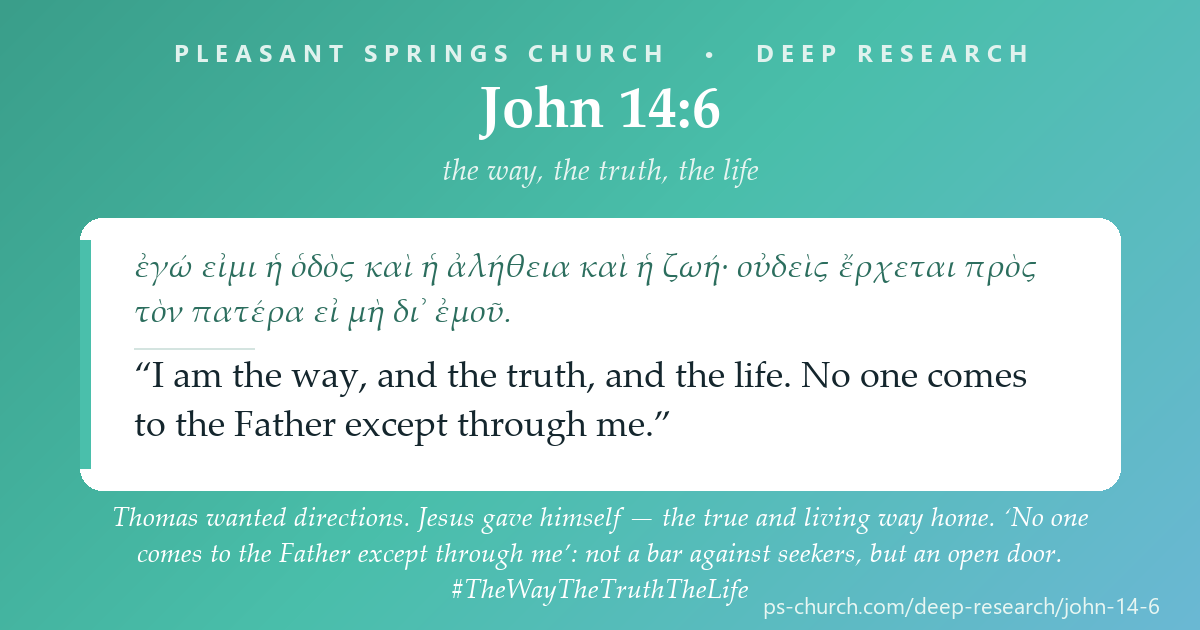
“I am the way, and the truth, and the life.” It is the night before the cross, and frightened disciples do not know where Jesus is going or how to follow. Thomas asks, “how can we know the way?” Jesus answers not with a map but with himself — the true and living road, and the destination is the Father: “no one comes to the Father except through me.” The hardest edge of the verse and its widest welcome are the same edge — a door thrown open. This study works John 14:6 — the sixth “I am” saying — holding its exclusivity truthfully and pastorally. See the method →
John 14:1, 6, 9
Greek NT · ESVThe Shape of the Passage
Parallel panelsIn the farewell discourse (John 13–17), Jesus prepares his disciples for his departure. To Thomas’ anxious question about the way, he gives the sixth of his “I am” sayings — and the most quoted and most contested. It is a word of comfort to frightened friends and a claim of breathtaking scope.
Author
John frames the saying as pastoral comfort before it is a doctrine of exclusivity. “Let not your hearts be troubled” (14:1) opens it; the promise of the Father’s house and Jesus’ return surrounds it. When Thomas says he does not know the way, Jesus does not hand him directions — he gives himself: “I am the way.” Many read “the truth” and “the life” as unfolding what kind of way he is: the true and living way (cf. “the new and living way… through his flesh,” Heb 10:20). The sentence’s goal-clause settles its meaning: he is the way to the Father.
A Trinitarian road. The verse does not stand alone; it is the doorway into 14:7–11, where Jesus says, “whoever has seen me has seen the Father” (14:9) and “I am in the Father and the Father is in me” (14:11). The way leads to the Father precisely because the Son perfectly reveals and indwells the Father. To arrive at Jesus is to arrive at God.
Audience
Eleven disciples about to watch their Lord be arrested and killed — and every reader who has asked, in the dark, “how can we know the way?” The first hearers are not being handed a slogan for winning arguments; they are being steadied for grief. The exclusivity of the saying is, for them, its comfort: there is a sure and only road home, and it is a Person who loves them.
How to hold the exclusivity. “No one comes to the Father except through me” is airtight in the Greek and echoed across the New Testament (“no other name,” Acts 4:12; “one mediator,” 1 Tim 2:5). It is to be held truthfully — not softened into “one path among many” — and pastorally: the accent falls on God’s gracious provision of access, offered to all who come (“whoever believes,” 3:16). It humbles the church (we too enter only through him) even as it refuses relativism.
Orient on the way, truth, life, mediation, and the Father.
Search by topic: way (hodos), truth (aletheia), life (zoe), mediator, Father (God as), I am sayings.
Which articles are relevant?
- Anchor Bible Dictionary — “Way,” “Truth,” “Life,” “Mediator,” “I Am.”
- Dictionary of Jesus and the Gospels — “‘I Am’ Sayings,” “Truth,” “Life,” “God (Father).”
- NIDNTT / TDNT — ὁδός (hodos, way), ἀλήθεια (alētheia, truth), ζωή (zōē, life).
Bibliography surfaced:
- D. A. Carson (Pillar), Craig Keener (2 vols.), Raymond Brown (Anchor Yale), Andreas Köstenberger (BECNT), George Beasley-Murray (WBC), Leon Morris (NICNT) on John.
- Studies of the farewell discourse (John 13–17); the “way” motif; the “I am” sayings.
- Beale & Carson, Commentary on the NT Use of the OT (John).
The way of the Lord in the Scriptures, and the one Person who is it.
Read “the way” and “the truth” as they run through the OT and Second-Temple Judaism, then hear Jesus locate all of it in himself.
Which parallels shed light on religion and worldview?
‘The way’ in the Old Testament. Long before John, “the way” (derek) was the great metaphor for the life God requires and the road he provides. Isaiah foresaw a highway home: “a Way of Holiness… the unclean shall not pass over it… even if they are fools, they shall not go astray” (Isa 35:8); a voice cries, “This is the way, walk in it” (Isa 30:21). The Psalms pray for it and bind it to truth: “Make me to know your ways, O Lord… lead me in your truth” (Ps 25:4–5); “Teach me your way, O Lord, that I may walk in your truth” (Ps 86:11). Israel could even call the Torah the way, the truth, and the light of life (Ps 119:1, 30, 105). Jesus gathers every strand of it into his person: he does not merely teach the way — he is it.
Two Ways, in the air of the age. The “two ways” framework — a way of life and a way of death — was alive in first-century Judaism. At Qumran the community mapped humanity onto a spirit of truth and a spirit of deceit (1QS III–IV), and the early Christian catechism opened, “There are two ways, one of life and one of death” (Didache 1). Second-Temple wisdom books, too, personified Wisdom as the guide who leads to God and gives life (Baruch 3:9–4:4; Sirach 24 — witnesses, not Scripture). Against that backdrop, “I am the way, and the truth, and the life” is a stunning concentration: the way of life is not a code or a community but the incarnate Son.
A note on 14:7. The next verse is a place where honest study matters. The critical Greek text of 14:7 reads an open condition — roughly, “if you have come to know me, you will know my Father also” — while a well-attested alternative (which the ESV follows) reads a contrary-to-fact condition: “if you had known me, you would have known my Father also.” The manuscripts are genuinely divided, and the translators’ committee was too. Either way the point holds and is the point of 14:6: to know Jesus is to know the Father, and there is no knowing the Father around him.
- Isaiah 35:8; 30:21; 40:3 — the Way of Holiness; “this is the way, walk in it”; “prepare the way of the Lord” (echoes behind “the way”).
- Deuteronomy 30:19–20; Psalm 25:4–5; 86:11; 119:1, 30, 105 — choose life, “he is your life”; the way and the truth paired as the path of covenant faithfulness (OT texts of YHWH).
- 1QS III–IV; Didache 1–6; Baruch 3:9–4:4; Sirach 24 — the Two Ways and Wisdom-as-the-way (Second-Temple and early-church witnesses, not Scripture).
Everything in the verse is controlled by its last phrase: “to the Father.” That goal-clause tells us how to read the three predicates. Jesus is not offering himself as a way to somewhere in general, nor cataloguing three separate spiritual benefits; he is the way, and the truth and the life describe the kind of way he is — the true and living road that actually arrives at God. Read like this, “truth” and “life” are not rival abstractions but the character of the one Person: he is the real way, over against every counterfeit road; the living way, over against every dead end. And the destination is not a state but a Person — the Father. That is why the exclusivity cannot be quarantined from the comfort. To a room of men about to lose him, Jesus says the most reassuring thing imaginable: there is a sure way home, it does not depend on their cleverness in finding it, and it is standing in front of them, loving them, about to die to open it. “No one comes to the Father except through me” is not first a bar against outsiders; it is a promise to insiders that the road is real and it holds.
The vocabulary of way, truth, life, and sole access.
Watch the definite article (the way), the three predicates as one Person, and the airtight “no one except.”
“I am the way” — the sixth predicated “I am,” distinct from the absolute divine-Name “I am” of 8:58. The article (the way) is exclusive, not one road among many; grammatically the leading predicate, with truth and life unfolding it.
“Way, road, path.” Renders Hebrew derek, the OT metaphor for covenant life. Jesus is not a teacher of the way (a rabbi’s halakhah, “walking”) but the road itself — and it is the road to the Father.
“Truth, reality, faithfulness” — a Johannine keyword (1:14, 17; 8:32; 18:37). Not merely accurate information but the reality of God embodied in the Son. He does not point to the truth; he is the truth — the true way, over against “the father of lies” (8:44).
“Life” — the eternal, God-kind of life already given in the Son (1:4; 5:26; 11:25; 20:31). The living way, the way that is life. Echoes “choose life… for he is your life” (Deut 30:19–20).
“No one… except.” Oudeis (“not even one”) is absolute; ei mē (“except”) admits exactly one way — “through me.” The construction is deliberately airtight; it cannot be softened to “hardly anyone” or “normally.”
“Through me… to the Father.” Dia + genitive = sole agency/means; pros + accusative = motion-toward the Father (the same “with God” of 1:1). The access is to a Person, the Father, through a Person, the Son — Trinitarian, not merely a technique of salvation.
How the New Testament fills out “the way”:
- Acts 9:2; 19:9, 23; 24:14 — “the Way” (ἡ ὁδός) is the earliest name for the Christian movement: to follow Jesus is to walk the Way.
- Hebrews 10:19–20 — “the new and living way that he opened for us… through his flesh”: Jesus’ body is the road of access to God.
- John 10:9; 1:17; 1 John 5:20 — “I am the door; if anyone enters by me”; “grace and truth came through Jesus Christ”; “he is the true God and eternal life.”
- Acts 4:12; 1 Timothy 2:5 — “no other name… by which we must be saved”; “one mediator between God and men, the man Christ Jesus”: the same exclusivity, apostolic and not merely Johannine.
From the way of holiness to the one Mediator.
Trace “the way” from Isaiah’s highway, through the farewell discourse, into the church’s earliest self-name.
Which cross-references matter?
- Isaiah 35:8; 30:21; Psalm 25:4–5; 86:11 — the way of holiness and the way/truth of the Lord: the OT road Jesus embodies.
- John 14:1–11; 10:9; 1:18 — the Father’s house, the door, “no one has seen God… the Son has made him known”: the way to the Father revealed.
- John 8:58; 6:35; 8:12; 10:11; 11:25; 15:1 — the “I am” sayings, absolute and predicated (see before Abraham was, I am and the resurrection and the life).
- Hebrews 10:19–22; Ephesians 2:18 — the new and living way through the curtain of his flesh; “through him we… have access in one Spirit to the Father”: the Trinitarian road.
- Acts 4:12; 1 Timothy 2:5; John 3:16–18 — no other name; one mediator; the open “whoever believes”: exclusivity and invitation together.
The hardest edge of John 14:6 and its widest welcome are the same edge. “No one comes to the Father except through me” will not be softened; the Greek is uncompromising, and the rest of the New Testament says the same thing in its own words — one name, one mediator. But notice what is being claimed. The verse does not say the Father is hard to reach, guarded by a narrow club; it says the Father is reachable, and names the road. The exclusivity is the flip side of a door thrown open. If Christ were merely one teacher among many, no one could be sure of arriving anywhere; because he is the one and living way, everyone who comes on him arrives for certain. So the claim is not weaponized against sincere seekers — it is offered to them: here is the way, and it is a Person who came looking for you. Held rightly, the verse humbles the church before it excludes anyone: we did not find the way by being clever or good; we too enter only “through him.” The right response to “no one except me” is not a boast but an invitation — and, for troubled hearts, relief.
The scholarship on John 14:6.
The commentators on John 14; the studies of the farewell discourse and the exclusivity of Christ.
Commentaries & studies:
- D. A. Carson (Pillar), Craig S. Keener (2 vols.), Raymond E. Brown (Anchor Yale), Andreas J. Köstenberger (BECNT), George R. Beasley-Murray (WBC), J. Ramsey Michaels (NICNT), Leon Morris (NICNT) on John.
- Studies of the “I am” sayings and Johannine christology (Schnackenburg); the farewell discourse (John 13–17).
- Bruce Metzger on the John 14:7 conditional variant.
Interpretation notes worth keeping:
- Predicated, not absolute. “I am the way” is a self-revelation metaphor (the sixth of seven), distinct from the absolute divine-Name “I am” of 8:58 — but grounded in it (only one who shares the Father’s being can be the sole way to him).
- The goal governs the grammar. Read “truth” and “life” as unfolding “the way” (the true and living way, cf. Heb 10:20); the whole clause aims “to the Father.”
- Do not soften the exclusivity — and do not weaponize it. Hold “no one except me” truthfully (Acts 4:12; 1 Tim 2:5) and pastorally (the accent is God’s gracious provision of access, offered to all who come).
- Trinitarian, not modalist or subordinationist. “Whoever has seen me has seen the Father” (14:9) means the Son reveals and indwells the Father (14:10–11), not that Son and Father are one person, nor that the Son is a lesser rung.
- 14:7 is a genuine variant. The critical text reads an open condition; the ESV follows the contrary-to-fact reading. The manuscripts and translators divide; the sense — to know Jesus is to know the Father — is not in doubt.
From a troubled heart to a sure road home.
Name what you learned, why it matters, and one concrete response.
What should we carry away — and do?
- The way is a Person. Thomas wanted directions; Jesus gave himself. You do not follow a system to God — you follow, and trust, a Person who loves you and came to find you.
- The destination is the Father. The road does not end in an experience or a moral code; it ends in God himself. “Whoever has seen me has seen the Father” — to arrive at Jesus is to arrive home.
- The one way is an open door. “No one except me” is not a boast to swing at others; it is the assurance that the road is real and holds, offered to whoever will come.
Step in response: if your heart is troubled, take Jesus at his opening word — “believe in God; believe also in me” — and this week walk the one way home rather than searching for another. And carry the invitation gently: the exclusivity of Christ is not a club to win arguments but an open door to hold out to someone who is lost.
John 14:6 · to share
Greek NT + ESVEvery Deep Research page traces its passage across the whole sweep — the Old Testament, the Second-Temple world between the testaments (historical witnesses, not Scripture), and the New Testament. Follow the thread:
Pleasant Springs Church — Deep Research
Research method after Michael S. Heiser’s Bible Research Method (examine dictionaries → ancient literature → important words → textual connections → academic publications → share), with the Pleasant Springs “Author & Audience” foundation. Scripture set in the Hebrew, the Greek editions named on each page and the ESV (Old Testament), and the Greek New Testament and the ESV (New Testament), per the practice of Pleasant Springs Church. John 14:6 research grounded in Carson, Keener, Brown, Köstenberger, Beasley-Murray, and Morris, with Beale & Carson on the OT “way” background; “truth” and “life” read as unfolding “the way” to the Father; the exclusivity held truthfully and pastorally; the 14:7 conditional variant noted honestly.
Scripture quotations marked ESV are from the ESV® Bible (The Holy Bible, English Standard Version®), © 2001 by Crossway, a publishing ministry of Good News Publishers. ESV Text Edition: 2016. Used by permission. All rights reserved. The ESV text may not be quoted in any publication made available to the public by a Creative Commons license, and the ESV may not be translated in whole or in part into any other language. www.esv.org
|
Did this study bless you today? 💚 Give to Support PS Church100% of gifts go to the General Fund — thank you. |