“I am the true vine.” On the last night, Jesus reaches for Israel’s oldest self-portrait. God had planted a vine and tended it for centuries, and it yielded wild grapes (Isaiah 5; Psalm 80). Jesus is the vine Israel failed to be — the true vine — and his disciples are branches in him, the Father the vinedresser. The one command is “abide,” for “apart from me you can do nothing.” Fruit is the evidence of union and the glory of the Father, and the whole life ends in joy made full. This study works John 15:1–11 — the last “I am” saying — and holds its hard verse with care. See the method →
John 15:1, 4, 5, 8, 11
Greek NT · ESVThe Shape of the Passage
LeitwortOn the last night, Jesus gives the seventh and final “I am” saying — a living picture drawn from Israel’s own Scriptures. The vine, the branches, the vinedresser, the fruit, the pruning, and the fire: every image comes from the prophets, and Jesus places himself at the center of all of it.
Author
John gives the vine its full OT weight. Israel was “a vine out of Egypt” that God planted (Ps 80:8), the “vineyard of the Lord of hosts” from which he looked for good grapes and got wild ones (Isa 5:1–7); “a choice vine” that turned degenerate (Jer 2:21). Against that long story of a failed vine, Jesus says, “I am the true vine” (15:1). The word “true” (alēthinē) means genuine, real, the archetype the old vine only foreshadowed: he succeeds where Israel-the-vine failed, and gathers a people into himself to bear the fruit God always sought.
Abide, and bear fruit. The one imperative of the passage is “abide” (menō, some ten times in vv.4–10) — remain in living union with Christ. Fruit is the result of that union, not its price: “apart from me you can do nothing” (15:5). The Father is the vinedresser, who prunes the fruit-bearing branch to make it bear more (15:2) — a purposeful refining, not a punishment. The end of it all is not strain but joy: “that your joy may be full” (15:11).
Audience
Eleven disciples about to be scattered — and every Christian who has wondered how to bear fruit and how to be sure of God. Jesus roots their whole life not in effort but in union: stay joined to me. The fruit will come as sap rises through a branch — naturally, from the vine, by grace.
The hard verse, held with care. “If anyone does not abide in me, he is thrown away like a branch… and burned” (15:6) has been read in different ways, and this study presents them fairly. In line with the church’s confidence that Christ loses none of his own (10:28–29), the fruitless “branch in me” is best read as a merely outward, never-living attachment — like Judas among the Twelve (13:10–11), or those who “went out from us… but were not of us” (1 John 2:19) — and the burning as a solemn warning God uses to keep his people, not as proof that a truly living branch is lost. The genuine branch is pruned (refined), never finally burned.
Orient on the vine and vineyard, abiding, fruit, and pruning.
Search by topic: vine / vineyard, branch, fruit (bearing), abide / remain, Israel as vine.
Which articles are relevant?
- Anchor Bible Dictionary — “Vine, Vineyard,” “Fruit,” “I Am,” “Abide.”
- Dictionary of Jesus and the Gospels — “‘I Am’ Sayings,” “Vine, Fruit,” “Discipleship.”
- NIDNTT / TDNT — ἄμπελος (ampelos, vine), κλῆμα (klēma, branch), μένω (menō, abide), καρπός (karpos, fruit).
Bibliography surfaced:
- D. A. Carson (Pillar), Craig Keener (2 vols.), Raymond Brown (Anchor Yale), Andreas Köstenberger (BECNT), George Beasley-Murray (WBC), C. K. Barrett on John.
- Studies of the vine allegory (mashal), its OT background (Ps 80; Isa 5), and Johannine “abiding.”
- Beale & Carson, Commentary on the NT Use of the OT (John).
Israel the vine, and the true vine who bears the fruit God sought.
Read the OT vine of Israel — planted, failed, and judged — then hear Jesus claim to be the vine that does not fail.
Which parallels shed light on religion and worldview?
Israel, the vine that failed. The vine was one of the OT’s standing images for Israel, and it is almost always a story of disappointment. “You brought a vine out of Egypt… and planted it” (Ps 80:8), but its walls are broken down and it is “burned with fire” (80:16). Isaiah’s Song of the Vineyard is the sharpest: “the vineyard of the Lord of hosts is the house of Israel… he looked for justice, but behold, bloodshed” (Isa 5:7). Jeremiah: “I planted you a choice vine… how then have you turned degenerate and become a wild vine?” (Jer 2:21). Ezekiel makes the vine-wood fit for nothing but fuel for the fire (Ezek 15:1–8; cf. 19:10–14). When Jesus says “I am the true vine,” every hearer steeped in Scripture would feel the weight: he is claiming to be what Israel was called to be and never was — the faithful vine, in whom the fruit God sought is finally borne.
Fulfillment, not erasure. This is a claim of fulfillment, not of scorn. Jesus does not announce that God has cast off his people; he presents himself as true Israel, gathering a people — Jew and Gentile — into union with himself. The New Testament keeps this balance: Paul warns Gentile believers grafted into God’s people, “do not be arrogant toward the branches… remember, it is not you who support the root” (Rom 11:18). The vine image is about union with Christ, not about the rejection of the Jewish people.
The fire, and the fear it stirs. The imagery of 15:6 — the branch thrown away, withered, gathered, burned — is drawn straight from Ezekiel’s useless vine-wood given “to the fire for fuel” (Ezek 15:4). Read within John’s own theology, it describes fruitlessness exposed for what it is: a branch that drew no life from the vine. It is a sober summons to self-examination (“am I truly abiding?”), not a threat that the Father carelessly loses those who are his. The same discourse that warns also assures: the branch that abides is pruned to bear more, its prayers are heard (15:7), and its joy is made full (15:11).
- Psalm 80:8–16; Isaiah 5:1–7; Jeremiah 2:21 — Israel the vine/vineyard, planted by the Lord and yielding wild grapes: the background Jesus fulfills as the true vine.
- Ezekiel 15:1–8; 19:10–14; Hosea 10:1 — the vine-wood given to the fire; the vine plucked up and withered; the luxuriant vine whose fruit fed idolatry (behind 15:6).
- Romans 11:16–24 — the olive tree (a related but distinct image, using tree-branches): fulfillment without arrogance toward Israel.
The famous difficulty of the passage is 15:2 and 15:6 — the “branch in me” that bears no fruit is “taken away” and finally “thrown into the fire.” Read carelessly, it seems to teach that a person truly united to Christ can be lost, and honest study must present the readings that Christians have offered. Some take the burning simply as vivid prophetic imagery of judgment on fruitlessness, drawn wholesale from Ezekiel, functioning as a real warning that God uses as one of his means of keeping his own — a warning that works, and so never actually falls on the elect. Others note that even the phrase “in me” can describe an outward, visible attachment that was never a living union — the Judas kind of nearness (13:10–11), the branch that hung on the vine but drew no sap. John’s own commentary points this way: “they went out from us, but they were not of us; for if they had been of us, they would have continued with us” (1 John 2:19). On either reading, the direction is the same, and it fits the whole Gospel: those the Father gives the Son, the Son keeps, and “no one will snatch them out of my hand” (10:28–29). The living branch is not burned; it is pruned — cut back, not cut off — so that it bears more. So the verse is meant to do in us exactly what a warning does: send us to examine whether we are truly abiding, and then drive us deeper into the vine, where the only safety and the only fruit are found.
The vocabulary of vine, branch, abiding, and fruit.
Watch “true” (the archetype), the prune/clean wordplay, the repeated “abide,” and the absolute “nothing.”
“The true vine” — the seventh and last predicated “I am.” Alēthinē = “true, genuine, real” (as against a copy or a failed counterpart), the same word as the “true light” (1:9) and “true bread” (6:32). Jesus is the reality the OT vine of Israel only foreshadowed — fulfillment, not mere replacement.
“Vine” (the stock/trunk). The very word the Greek OT uses of the “vine out of Egypt” (Ps 80:8, LXX 79:9). By taking it with the “I am” formula, Jesus claims to embody what Israel-the-vine was meant to be.
“Branch, shoot” of a vine — distinct from klados, the tree-branch of Romans 11’s olive tree. The branches are the disciples; keep John’s vine image separate from Paul’s olive tree.
“Abide, remain, dwell” — the keyword of the passage (about ten times). Mutual indwelling (“abide in me, and I in you”), the means of fruitfulness, not a work that earns it. The same “abiding” John’s letters make the mark of genuine, persevering faith (1 John 2:6; 3:24).
“Prunes; cleanses” — a deliberate wordplay with katharoi, “clean” (15:3). The Father prunes the fruit-bearing branch to make it bear more; the disciples are already “clean” through Jesus’ word. Purposeful refining of true branches, not destruction.
“Apart from me… nothing.” “Apart from me you can do nothing” — total dependence on Christ for any fruitful action. The grace foundation of the whole passage: the branch produces nothing of itself; this rules out works-righteousness.
How the New Testament fills out abiding and fruit:
- 1 John 2:6, 19, 24; 3:24; 4:15–16 — “abide in him” as the mark of genuine faith; “they went out from us, but they were not of us”: John’s own commentary on branches that do not abide.
- Galatians 5:22–23; Colossians 1:10; Philippians 1:11 — the fruit of the Spirit; “bearing fruit in every good work”; “the fruit of righteousness that comes through Jesus Christ”: fruit is Christ-sourced and evidential.
- Matthew 3:8, 10; 7:16–20 — “bear fruit in keeping with repentance”; “you will recognize them by their fruits”: fruitfulness as the mark of what is truly alive.
- John 13:10–11; 10:28–29 — the disciples “clean,” but not Judas; “no one will snatch them out of my hand”: the assurance behind the warning.
From the vine of Israel to the true vine and its branches.
Trace the vine from the prophets, through the true vine, into the fruit-bearing life of union with Christ.
Which cross-references matter?
- Psalm 80:8–17; Isaiah 5:1–7; Jeremiah 2:21; Ezekiel 15; 19; Hosea 10:1 — Israel the vine/vineyard, planted and failing: the story Jesus fulfills as the true vine.
- John 15:1–17; 8:31–32; 13:34–35 — abide in me, in my word, in my love; the fruit of love among the disciples: the shape of the abiding life.
- John 8:58; 6:35; 8:12; 10:11; 11:25; 14:6 — the “I am” sayings, absolute and predicated (see before Abraham was, I am, the bread of life, and the way, the truth, the life).
- Romans 11:16–24 — the olive tree (related but distinct): grafted-in branches warned not to boast; fulfillment without arrogance toward Israel.
- Galatians 5:22–23; John 16:24; 17:13 — the fruit of the Spirit; joy made full: the harvest and the gladness of abiding.
The single word that carries the passage is “true” — alēthinē, genuine, the real thing. It sets Jesus not against something evil but against something incomplete: the vine of Israel, lovingly planted, endlessly tended, and heartbreakingly barren. All through the prophets God comes to his vineyard looking for grapes and finds sour fruit or none; the story of the vine is the story of a vocation unfulfilled. Into that long disappointment Jesus says, “I am the true vine” — not a replacement that erases Israel but the fulfillment that Israel was always meant to reach, now embodied in one faithful Israelite in whom a whole people can at last bear fruit. This is why the branches matter so much. The fruit God sought for centuries is finally borne, but only in union: “whoever abides in me… bears much fruit, for apart from me you can do nothing.” The vine does the living; the branch does the bearing; and the fruit — love, obedience, joy, and a life that glorifies the Father — is simply the vine’s own life showing up in the branch. Nothing here is earned. Everything here is received, by staying joined to the one true vine.
The scholarship on John 15:1-11.
The commentators on John 15; the studies of the vine allegory and Johannine abiding.
Commentaries & studies:
- D. A. Carson (Pillar), Craig S. Keener (2 vols.), Raymond E. Brown (Anchor Yale), Andreas J. Köstenberger (BECNT), George R. Beasley-Murray (WBC), J. Ramsey Michaels (NICNT), C. K. Barrett, Herman Ridderbos on John.
- Studies of the vine mashal, its OT and Second-Temple background (Ps 80; Isa 5; Sirach 24), and the abiding/perseverance question.
- G. K. Beale & D. A. Carson, eds., Commentary on the NT Use of the OT.
Interpretation notes worth keeping:
- Fulfillment, not replacement. “True vine” (alēthinē) = the reality the OT vine foreshadowed; Jesus is true Israel who bears the fruit Israel failed to bear — balanced by Romans 11 against arrogance toward the Jewish people.
- Abiding is the means; fruit is the evidence; grace is the ground. “Apart from me you can do nothing” (15:5) and “already you are clean” (15:3) rule out works-righteousness: fruit demonstrates discipleship (15:8), it does not purchase it.
- 15:6, held with care. Present the options fairly. Consistent with the church’s eternal-security position (10:28–29; 1 John 2:19), read the fruitless “branch in me” as an outward, never-living attachment, and the burning as a warning God uses to keep his own — not a genuine believer lost. Note the “takes away” vs. “lifts up” lexical debate on airei without overclaiming.
- The vine, not the olive tree. John’s klēma (vine-branch, individual union with Christ) is a different image from Paul’s klados (Romans 11’s olive tree, Israel and the nations in salvation history) — do not collapse them.
- The end is joy. The abiding-and-fruit life is not grim duty but the path into Christ’s own joy, “that your joy may be full” (15:11).
From a barren vine to the true vine, and a branch made fruitful.
Name what you learned, why it matters, and one concrete response.
What should we carry away — and do?
- Fruit grows from union, not effort. The branch does not strain to produce grapes; it stays joined to the vine and bears them. “Apart from me you can do nothing” — so the first work is to abide.
- Pruning is love, not punishment. The Father cuts back the fruitful branch to make it bear more. The painful loss you are enduring may be the vinedresser’s knife, aimed at a greater harvest.
- Examine, then abide. The warning of the fruitless branch is not meant to torment the believer but to send us deeper into Christ. Ask honestly whether you are abiding — then abide.
Step in response: pick one concrete way to “abide” this week — his word abiding in you (15:7), his love kept by obedience (15:9–10), honest prayer — and stop trying to manufacture fruit by willpower. Stay joined to the true vine, and let his life bear its fruit through you, “that your joy may be full.”
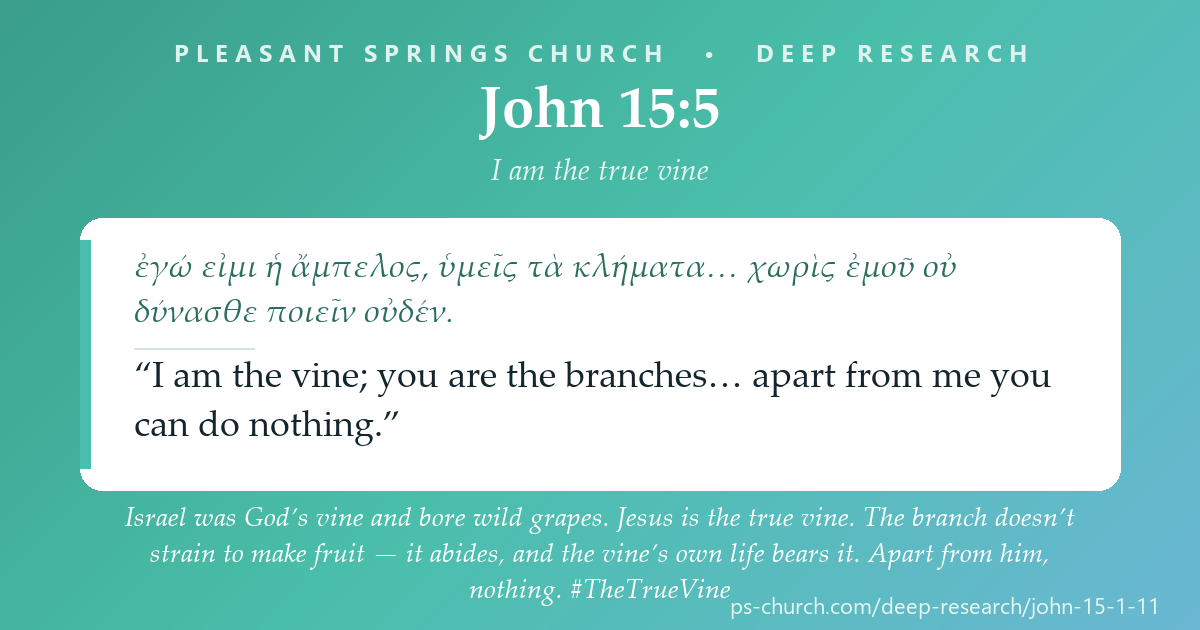
John 15:5 · to share
Greek NT + ESVEvery Deep Research page traces its passage across the whole sweep — the Old Testament, the Second-Temple world between the testaments (historical witnesses, not Scripture), and the New Testament. Follow the thread:
Pleasant Springs Church — Deep Research
Research method after Michael S. Heiser’s Bible Research Method (examine dictionaries → ancient literature → important words → textual connections → academic publications → share), with the Pleasant Springs “Author & Audience” foundation. Scripture set in the Hebrew, the Greek editions named on each page and the ESV (Old Testament), and the Greek New Testament and the ESV (New Testament), per the practice of Pleasant Springs Church. John 15:1–11 research grounded in Carson, Keener, Brown, Köstenberger, Beasley-Murray, and Barrett, with Beale & Carson on the OT vine background; “true vine” read as fulfillment of Israel (balanced by Romans 11), abiding as the God-enabled means of fruit, and 15:6 held consistently with the church’s eternal-security position while presenting the interpretive options fairly.
Scripture quotations marked ESV are from the ESV® Bible (The Holy Bible, English Standard Version®), © 2001 by Crossway, a publishing ministry of Good News Publishers. ESV Text Edition: 2016. Used by permission. All rights reserved. The ESV text may not be quoted in any publication made available to the public by a Creative Commons license, and the ESV may not be translated in whole or in part into any other language. www.esv.org
|
Did this study bless you today? 💚 Give to Support PS Church100% of gifts go to the General Fund — thank you. |