“It is finished.” John tells the crucifixion as a chain of Scriptures coming true — the King’s title, the gambled garments (Psalm 22), the thirst (Psalm 69), the unbroken bones of the Passover lamb, the pierced side of Zechariah 12. And the last word from the cross is not a groan of defeat but a shout of accomplishment: tetelestai, “paid in full.” Then, in perfect command even in dying, he bows his head and gives up his spirit — no one takes it from him. This study works John 19:16–30 — the cross, the finished work — from the Passover Lamb to the empty-tomb morning it makes possible. See the method →
John 19:18, 24, 28, 30, 37
Greek NT · ESVThe Shape of the Passage
InclusioJohn tells the death of Jesus not as a tragedy but as a triumph accomplished. Every detail — the title, the garments, the thirst, the unbroken bones, the pierced side — is Scripture reaching its goal, and the last word from the cross is a shout: “It is finished.”
Author
John writes the crucifixion as the hour of glory (12:23; 17:1), and he does it with a striking sovereignty. Jesus is not swept along by events; he is in command of them. He carries his own cross; he arranges for his mother’s care; he says “I thirst” “knowing that all was now finished, to fulfill the Scripture.” And his death is an act: he “bowed his head and gave up (παρέδωκεν) his spirit” — where the other Gospels say he “breathed his last,” John says he handed his spirit over, as one who has authority to lay down his life “of my own accord” (10:18).
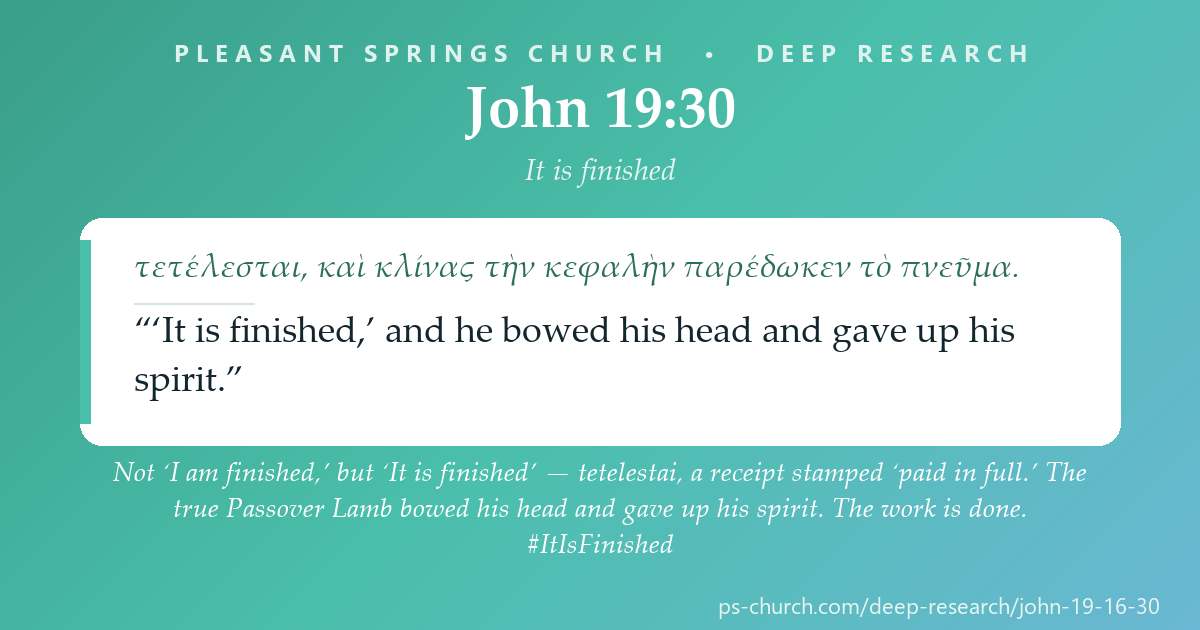
It is finished. The climactic word is one Greek word: τετέλεσται (tetelestai), the perfect tense of “to finish, complete, accomplish, pay in full.” The perfect means a completed action with lasting results: the work is done, and stays done. Merchants wrote this very word on paid bills — “paid in full.” It is not the whimper of a defeated man but the announcement of a finished work: the debt discharged, the Scriptures fulfilled, the will of the Father accomplished to the end.
Audience
“He who saw it has borne witness” (19:35) — John writes as an eyewitness so that his readers “also may believe.” The scene is aimed at faith. It shows a real death (the blood and water prove it, 19:34) and a purposeful one (Scripture after Scripture fulfilled), so that no one may think Jesus merely a victim of Rome or a martyr of a lost cause. He is the King on his throne, the Lamb at his slaughter, the Servant delivered up for the many.
The Passover Lamb and the pierced One. John dates the death to the hour the Passover lambs were slain (19:14), and he lingers on two fulfilled Scriptures at the end: “not one of his bones will be broken” (the Passover statute, Exod 12:46; Ps 34:20) and “they will look on him whom they have pierced” (Zech 12:10). In Zechariah it is the Lord who says, “they will look on me, on him whom they have pierced” — so the pierced Messiah is identified with God himself. The cross is where the true Lamb is slain and the deity of the Son is unveiled.
Orient on crucifixion, the Passover lamb, fulfillment quotations, and the death of Jesus.
Search by topic: crucifixion, Passover / lamb, atonement, fulfillment (John's citations), King of the Jews.
Which articles are relevant?
- Anchor Bible Dictionary — “Crucifixion,” “Passover,” “Atonement,” “Golgotha,” “Lamb of God.”
- Dictionary of Jesus and the Gospels — “Death of Jesus,” “Cross, Crucifixion,” “Passover,” “Old Testament in John.”
- NIDNTT / TDNT — τελέω (teleō, finish/accomplish), παραδίδωμι (paradidōmi, hand over), ἀμνός (amnos, lamb).
Bibliography surfaced:
- D. A. Carson (Pillar), Craig Keener (2 vols.), Raymond Brown (Anchor Yale + The Death of the Messiah), Andreas Köstenberger (BECNT), George Beasley-Murray (WBC) on John.
- Maarten Menken, Old Testament Quotations in the Fourth Gospel; Richard Bauckham on the beloved-disciple witness.
- Beale & Carson, Commentary on the NT Use of the OT (John).
The Scriptures fulfilled at the cross, and the finished work.
Read the crucifixion as John frames it — a chain of fulfilled Scriptures culminating in “It is finished” — and see what “finished” means.
Which parallels shed light on religion and worldview?
A death written in advance. John hangs the whole scene on fulfilled Scripture. The soldiers casting lots for the seamless tunic “fulfill the Scripture” word for word: “they divided my garments among them, and for my clothing they cast lots” (Ps 22:18 · LXX 21:19 — the psalm of the righteous sufferer; see Psalm 22). “I thirst” is spoken “to fulfill the Scripture” (Ps 69:21 · LXX 68:22, “for my thirst they gave me sour wine”). The offering of sour wine on a stalk of hyssop — the very plant used to daub the Passover blood on the doorposts (Exod 12:22) — is likely another Passover signal. And John dates the death to the hour the Passover lambs were killed (19:14), presenting Jesus as the true Lamb of God (1:29).
‘It is finished.’ The last word, tetelestai, is the perfect tense of a verb meaning to bring to completion, to accomplish, to pay in full. The perfect tense matters: it describes a finished action whose effect abides. The work is done — not merely stopped, but completed; not a life cut short, but a mission accomplished. Hebrews unpacks it: “by a single offering he has perfected for all time those who are being sanctified” (Heb 10:14), a sacrifice offered “once for all” that needs no repetition. Paul says God “cancelled the record of debt… nailing it to the cross” (Col 2:14). “It is finished” means there is nothing left to add to the work of Christ for our salvation.
The Lamb and the pierced One. John closes with two more Scriptures. First, “not one of his bones will be broken” (19:36) — the Passover statute (Exod 12:46; Num 9:12) fused with the psalm of the righteous man whose bones the Lord keeps (Ps 34:20 · LXX 33:21): Jesus dies as the true Passover lamb. Second, “they will look on him whom they have pierced” (Zech 12:10). Here John chooses his words with care: he writes ἐξεκέντησαν (“they pierced”), matching the Hebrew, rather than the Old Greek reading that mistook the word for “mocked” (see Zechariah 12). And in Zechariah the speaker who is pierced is the Lord himself — so the pierced Christ is God with us, wounded for us.
- Psalm 22:15, 18 (LXX 21:16, 19); 69:21 (LXX 68:22) — the garments divided and gambled for; the thirst and the sour wine: the righteous-sufferer psalms enacted (see Psalm 22).
- Exodus 12:22, 46; Numbers 9:12; Psalm 34:20 (LXX 33:21) — the hyssop; “you shall not break any of its bones”; “not one of them is broken”: Jesus the Passover lamb (see Passover).
- Zechariah 12:10; Isaiah 52:13–53:12 — “him whom they have pierced”; the Servant “delivered up… for our transgressions” (see Zechariah 12, the Suffering Servant).
Everything in John’s account of the cross bends toward that one word. Tetelestai is not the sigh of a man whose strength has finally run out; it is the announcement of a task brought to its appointed end. The perfect tense holds the two truths together: the action is complete, and it stays complete — there is a finished work here that will never need to be done again. What is finished? The Scriptures, which John has watched come true detail by detail; the will of the Father, which the Son took up in Gethsemane and carried to the end; and the work of atonement itself, the debt of sin discharged, the cup of wrath drained, the true Passover accomplished. This is why the church has always heard in “It is finished” the death of every attempt to add to Christ’s work. He does not say “I am finished,” as a defeated man might; he says “It is finished,” as a victor announcing that the thing he came to do is done. And then, in perfect command even in dying, he bows his head — the deliberate act of one laying down to rest — and hands over his spirit. No one took his life from him. He gave it. And on the far side of that finished work is an empty tomb.
The vocabulary of the finished work, the surrendered spirit, and the pierced side.
Watch the perfect tense of “finished,” the active “gave up” his spirit, and the Hebrew-faithful “pierced.”
“It is finished” — perfect passive of teleō (“bring to completion, accomplish, pay in full”). The perfect tense = a completed action with abiding results: the work is done and stays done. Written on receipts to mean “paid in full.” A shout of accomplishment, not a cry of defeat.
“He gave up / handed over his spirit” — not the Synoptics’ “breathed his last” but an active handing-over. A sovereign, voluntary death: “no one takes it from me, but I lay it down of my own accord” (10:18).
“I thirst” — the genuine thirst of the dying man, and the fulfillment of Ps 69:21 (LXX 68:22) / Ps 22:15 (LXX 21:16). John notes he said it “knowing that all was now finished… to fulfill the Scripture” — sovereign awareness, not mere reflex. An irony against 4:14; 7:37, where he gives living water.
“They pierced” — John’s rendering of Zech 12:10, matching the Hebrew daqaru (and the later revisers), NOT the Old Greek that mistook it for “mocked/danced.” In Zechariah the Lord is the one “pierced” — a witness to the deity of the Son (also Rev 1:7).
“A bone shall not be broken” — the Passover-lamb statute (Exod 12:46; Num 9:12) fused with Ps 34:20 (LXX 33:21, “he keeps all his bones”). Jesus dies as the true Passover lamb whose bones stay intact.
How the New Testament fills out the finished work:
- Hebrews 10:10–14; Colossians 2:14 — a single offering “once for all”; “perfected for all time”; the record of debt cancelled and nailed to the cross: what “It is finished” accomplished.
- John 10:17–18; 1:29, 36 — “no one takes it from me”; “behold, the Lamb of God who takes away the sin of the world”: the willed death of the true Lamb.
- 1 John 5:6–8; John 19:34–35 — “he came by water and blood”; the eyewitness testimony to real death: the blood and water from the pierced side.
- Zechariah 12:10; Revelation 1:7; 5:6–9 — “him whom they have pierced”; the Lamb standing “as though it had been slain”: the pierced One glorified.
From the Passover lamb and the pierced One to the finished work.
Trace the Scriptures John gathers at the cross — Passover, the righteous sufferer, the Servant, the pierced One — into the one finished work.
Which cross-references matter?
- Exodus 12; Psalm 22; Psalm 34:20; Zechariah 12:10 — the Passover lamb, the garments and thirst, the unbroken bones, the pierced side: the Scriptures fulfilled (see Passover, Psalm 22, Zechariah 12).
- Isaiah 52:13–53:12 — the Servant “delivered up… numbered with the transgressors… for our transgressions”: the death behind John’s scene (see the Suffering Servant).
- Matthew 26:26–29; 26:36–46 — the blood of the covenant poured out; the cup drunk to the dregs: the Supper and the garden fulfilled at the cross (see the blood of the covenant, Gethsemane).
- Hebrews 9–10; Colossians 2:14–15 — the once-for-all offering; the debt cancelled; the powers disarmed: the meaning of the finished work.
- Revelation 5:6–12; 21:1–4 — the Lamb who was slain, worthy to open the scroll; the wounds that ransom a people: the cross vindicated (see the coming Revelation studies).
John does not merely report the crucifixion; he reads it, and he wants us to read it with the Old Testament open. Four times in this passage he stops to say a Scripture is being fulfilled — the garments (Ps 22:18), the thirst (Ps 69:21), the unbroken bones (Exod 12/Ps 34), the pierced side (Zech 12:10) — and each citation is chosen and even worded with striking care. At the pierced side he deliberately follows the Hebrew wording (“pierced”) against the common Greek version that had misread the verb, because the exact word carries the point: the one they pierced is the one Zechariah calls the Lord. The effect of all this is to lift the cross out of the category of mere Roman execution and set it inside the whole sweep of God’s promises. Nothing here is an accident. The soldiers gambling, the sponge of sour wine, the spear thrust after death — the very details that would look like the random cruelty of an execution are shown to be the fulfillment of Scriptures written centuries before. And that is John’s pastoral aim (19:35): that seeing the Scriptures come true at the cross, we would believe that this death was no defeat but the finished work of the Lamb of God.
The scholarship on John 19:16-30.
The commentators on John 19; the studies of the fulfillment quotations, the Passover chronology, and tetelestai.
Commentaries & studies:
- D. A. Carson (Pillar), Craig S. Keener (2 vols.), Raymond E. Brown (Anchor Yale; The Death of the Messiah), Andreas J. Köstenberger (BECNT), George R. Beasley-Murray (WBC), J. Ramsey Michaels (NICNT) on John.
- Maarten J. J. Menken, Old Testament Quotations in the Fourth Gospel; Richard Bauckham on the eyewitness testimony of 19:35.
- G. K. Beale & D. A. Carson, eds., Commentary on the NT Use of the OT.
Interpretation notes worth keeping:
- “Finished” = accomplished. Tetelestai is the perfect of “complete / pay in full”: the atoning work is done and stays done (Heb 10:10–14; Col 2:14). It means nothing can be added to Christ’s work for salvation.
- Penal substitution, held with the whole. The finished work is substitutionary and sin-bearing (Isa 53:5–6; 2 Cor 5:21) — affirm penal substitution as the church holds it, without flattening the other biblical models the same texts carry (Passover-lamb sacrifice, Christus Victor, reconciling love).
- A willed death. “Gave up his spirit” (an active handing-over) portrays a sovereign, voluntary death (10:18), while the blood and water (19:34–35) prove it was a real death — against any docetic reading.
- The pierced One is the Lord. John’s exekentēsan follows the Hebrew of Zech 12:10, where the pierced one is identified with YHWH — a witness to the deity of the Son (without collapsing the persons: the incarnate Son is pierced, not the Father).
- How the eternal Son dies. By Chalcedon, the one person dies according to his human nature; the divine nature cannot die. Yet by the communion of natures the death is truly the Son’s (Acts 20:28).
From a Roman cross to a finished work.
Name what you learned, why it matters, and one concrete response.
What should we carry away — and do?
- It is finished — so stop adding. The last word from the cross is a receipt stamped “paid in full.” There is nothing you can add to Christ’s work to make yourself more accepted; there is only the finished work to receive.
- He gave up his life; it was not taken. Even in dying Jesus was in command. He laid his life down freely, for you — the true Passover Lamb, the pierced One who is the Lord himself.
- Look on the One they pierced. Zechariah’s word invites mourning that turns to grace. The cross is not a spectacle to glance at but a Person to behold — and to trust.
Step in response: rest this week in the finished work — when accusation or self-effort rises, answer it with one word, tetelestai, “it is finished.” And do what John wrote his whole account to move you to do (19:35): look on the One who was pierced for you, and believe.
John 19:30 · to share
Greek NT + ESVEvery Deep Research page traces its passage across the whole sweep — the Old Testament, the Second-Temple world between the testaments (historical witnesses, not Scripture), and the New Testament. Follow the thread:
Pleasant Springs Church — Deep Research
Research method after Michael S. Heiser’s Bible Research Method (examine dictionaries → ancient literature → important words → textual connections → academic publications → share), with the Pleasant Springs “Author & Audience” foundation. Scripture set in the Hebrew, the Greek editions named on each page and the ESV (Old Testament), and the Greek New Testament and the ESV (New Testament), per the practice of Pleasant Springs Church. John 19:16–30 research grounded in Carson, Keener, Brown, Köstenberger, and Beasley-Murray, with Menken on John’s fulfillment quotations and Bauckham on the eyewitness testimony; tetelestai read as the perfect of “accomplished / paid in full”; penal substitution affirmed without flattening the other biblical atonement models; the Zech 12:10 exekentēsan (Hebrew-faithful “pierced”) noted; the death held as real (against docetism) and sovereign (John 10:18).
Scripture quotations marked ESV are from the ESV® Bible (The Holy Bible, English Standard Version®), © 2001 by Crossway, a publishing ministry of Good News Publishers. ESV Text Edition: 2016. Used by permission. All rights reserved. The ESV text may not be quoted in any publication made available to the public by a Creative Commons license, and the ESV may not be translated in whole or in part into any other language. www.esv.org
|
Did this study bless you today? 💚 Give to Support PS Church100% of gifts go to the General Fund — thank you. |