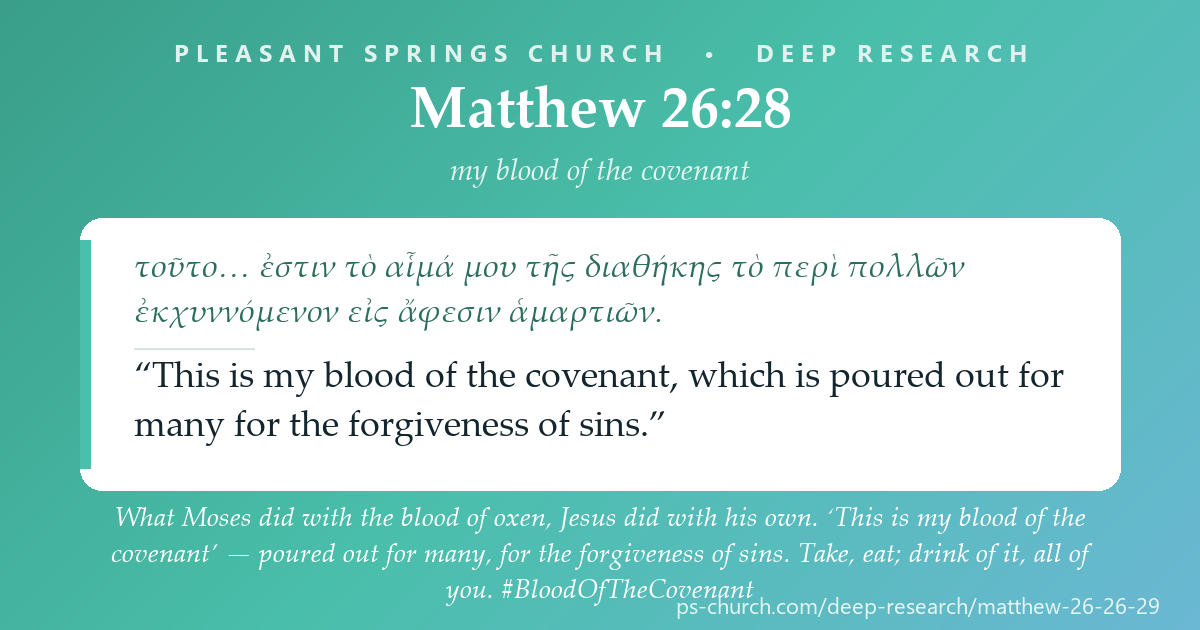
“This is my blood of the covenant.” At the Passover, on the night he is betrayed, Jesus takes the bread and the cup and makes them his own body and blood. He quotes Moses at Sinai (“the blood of the covenant”), reads his death off Isaiah’s Servant (“poured out for many”), and seals Jeremiah’s new-covenant promise (“for the forgiveness of sins”). Christians have long differed over how Christ is present in the Supper; this study holds what they share — that here the Lord gives his very self. This study works Matthew 26:26–29 — the Lord’s Supper — from Sinai to the coming feast. See the method →
Matthew 26:26–29
Greek NT · ESVText note: the earliest manuscripts read “my blood of the covenant” (26:28); some later copies add “new” (the ESV footnote), assimilating Matthew to Luke 22:20 / 1 Cor 11:25 — where “the new covenant” is made explicit.
The Shape of the Passage
Parallel panelsAt the Passover, on the night he is betrayed, Jesus institutes the meal his church has kept ever since. Matthew tells it with Sinai and Isaiah and Jeremiah in the background: the blood of the covenant, poured out for many, for the forgiveness of sins.
Author
Matthew sets the Supper inside the Passover and lets the old covenant interpret the new. “This is my blood of the covenant” quotes Moses at Sinai almost word for word (Exod 24:8, “the blood of the covenant that the Lord has made with you”). But Matthew adds a phrase found in none of the other accounts of the cup: “for the forgiveness of sins” — the exact promise of the new covenant (Jer 31:34, “I will forgive their iniquity”), and an echo of the angel’s word at the Gospel’s start, “he will save his people from their sins” (Matt 1:21). The bread and cup say, in the language of sacrifice, what the whole Gospel has promised.
Poured out for many. “Poured out” is cultic, sacrificial language, and “for many” is the word of Isaiah’s Servant, who “poured out his soul to death” and “bore the sin of many” (Isa 53:12). Jesus is reading his own death off the Servant Song: a covenant-inaugurating, sin-bearing death, given in the sinner’s place. The vow of 26:29 lifts the eyes forward — past the cross to the messianic banquet, the feast in the Father’s kingdom.
Audience
The Twelve at the table — and every congregation that has come to the Lord’s Table since. The command is plain and personal: “Take, eat”; “Drink of it, all of you.” The Supper is not watched but received; the body given and the blood poured out are given to them.
What this study holds, and leaves open. “This is my body… this is my blood” has been read in different ways by faithful Christians — Catholic, Lutheran, Reformed, and others — who differ, sincerely and sharply, over how Christ is present in the Supper. This study does not settle that debate. It holds the ground all of them share: that Christ himself is truly given to his people at the Table, that the bread and cup are his body and blood given and shed for them, and that the meal proclaims his atoning death until he comes (1 Cor 11:26).
Orient on the Passover, covenant, blood, and the Lord's Supper.
Search by topic: Passover, covenant (berit / diathēkē), blood, Lord's Supper / Eucharist, forgiveness of sins.
Which articles are relevant?
- Anchor Bible Dictionary — “Passover,” “Covenant,” “Lord’s Supper,” “Blood,” “Forgiveness.”
- Dictionary of Jesus and the Gospels — “Last Supper,” “Covenant,” “Death of Jesus,” “Passover.”
- NIDNTT / TDNT — διαθήκη (diathēkē, covenant), αἷμα (haima, blood), σῶμα (sōma, body).
Bibliography surfaced:
- R. T. France (NICNT), W. D. Davies & Dale Allison (ICC), Donald Hagner (WBC), John Nolland (NIGTC), Craig Blomberg (NAC) on Matthew.
- Joachim Jeremias, The Eucharistic Words of Jesus; I. Howard Marshall, Last Supper and Lord’s Supper.
- Beale & Carson, Commentary on the NT Use of the OT (Matthew).
The Passover, the blood of the covenant, and the Servant poured out for many.
Read the three OT streams that meet in the cup — Passover, Sinai covenant-blood, and the Suffering Servant — then receive the meal by faith.
Which parallels shed light on religion and worldview?
The Passover reframed. The setting is the Passover meal (26:17–19), the annual remembrance of the night the Lord passed over Israel when he saw the lamb’s blood (Exod 12). Into that meal Jesus places himself: he is the true Passover lamb (1 Cor 5:7, “Christ, our Passover lamb, has been sacrificed”), and the deliverance the feast remembered is now accomplished by his own blood. He does not abolish the Passover; he fills it to the brim.
The blood of the covenant. When Moses ratified the covenant at Sinai, he threw sacrificial blood on the people and said, “Behold the blood of the covenant” (Exod 24:8). Jesus takes that exact formula onto the cup (τὸ αἷμά μου τῆς διαθήκης) — but the blood is now his own, and it is given not to be sprinkled but to be drunk. Hebrews draws out the logic: “without the shedding of blood there is no forgiveness of sins” (Heb 9:22; the Exod 24:8 formula is quoted just above at Heb 9:20). And Matthew’s added phrase — “for the forgiveness of sins” — is the very heart of the new covenant Jeremiah promised: “I will forgive their iniquity, and I will remember their sin no more” (Jer 31:34; see the new covenant).
Poured out for many. “Poured out for many” is Servant language. Isaiah’s Servant “poured out his soul to death… and bore the sin of many” (Isa 53:12; see the Suffering Servant). “The many” (Hebrew rabbim) means a great multitude; the word itself neither restricts the atonement nor makes it automatic — it is the language of a death borne in the place of others. The blood is sacrificial, substitutionary, and covenant-making all at once; no single word or theory exhausts it.
- Exodus 24:8; Hebrews 9:18–22 — “the blood of the covenant” thrown on the people at Sinai; “without the shedding of blood there is no forgiveness” (see Exodus 24).
- Jeremiah 31:31–34 — the new covenant, “I will forgive their iniquity”: the forgiveness Matthew names at the cup (see Jeremiah 31).
- Exodus 12; Isaiah 53:11–12; 1 Corinthians 5:7 — the Passover lamb; the Servant “poured out… for many”; “Christ, our Passover lamb, has been sacrificed” (see Passover).
The words over the cup are among the most compressed in the New Testament, and almost every phrase is a quotation. “Blood of the covenant” is Moses at Sinai; “poured out for many” is Isaiah’s Servant; “for the forgiveness of sins” is Jeremiah’s new covenant. Jesus is not inventing a ritual but announcing that the whole story is coming to its point in his death. What Moses did with the blood of oxen, inaugurating a covenant between God and a people, Jesus will do with his own blood — only now the covenant is the promised new one, whose defining gift is the forgiveness of sins written on the heart. And the Servant who “bore the sin of many” is the interpreter of it all: this is a death for others, in their place. The church has argued long and hard about how the bread and cup convey Christ, and this study does not adjudicate that. But it will not let the argument obscure what the words plainly say: that here, in bread broken and a cup poured, the Son gives his very self — body and blood — to establish a covenant of forgiveness and to feed his people until the day he drinks it new with them in the kingdom. “Drink of it, all of you.”
The vocabulary of body, blood, covenant, and forgiveness.
Watch the Sinai formula (“blood of the covenant”), the Servant’s “poured out for many,” and Matthew’s own “for the forgiveness of sins.”
“This is my body.” The neuter touto (“this”) agrees with the neuter sōma; behind the Greek an Aramaic saying would have had no verb at all (“this — my body”). The force of “is” is the pivot of the centuries-old debate over Christ’s presence — which this study leaves un-adjudicated, holding the shared core.
“Blood of the covenant” — the exact phrase of Exod 24:8 (LXX). Blood is the seat of atoning life (Lev 17:11); Jesus inaugurates his covenant with his own blood. Matthew keeps the Sinai wording; Luke and Paul make the new-covenant meaning explicit (Jer 31).
“Being poured out” — sacrificial, cultic language for shedding blood. The present tense frames the imminent death as already begun in the cup. An echo of Isaiah 53:12, the Servant who “poured out his soul to death” — though in the Greek the firmer verbal link to the Servant Song runs through “for many” (peri pollōn).
“For many” — the Servant’s word (Isa 53:11–12, “he bore the sin of many”). “The many” (rabbim) is a great multitude; the phrase speaks of a death borne for others, and is not by itself a ruling on the extent of the atonement.
“For the forgiveness of sins” — found only in Matthew’s cup-word. It names the purpose of the poured-out blood and ties it to the new covenant (Jer 31:34) and to Matt 1:21 (“he will save his people from their sins”).
How the New Testament fills out the Supper:
- 1 Corinthians 11:23–26; Luke 22:19–20 — “the new covenant in my blood”; “do this in remembrance of me”; “you proclaim the Lord’s death until he comes.”
- Hebrews 9:11–22; 10:10–14; 13:20 — the blood of the covenant; “without the shedding of blood there is no forgiveness”; a single offering “once for all”; “the blood of the eternal covenant.”
- Matthew 1:21; 20:28 — “he will save his people from their sins”; the Son of Man gives his life “a ransom for many”: an inclusio around Matthew’s Gospel.
- Matthew 8:11; Revelation 19:9 — the messianic banquet, the marriage supper of the Lamb: the feast the vow of 26:29 anticipates.
From the blood of Sinai to the cup of the new covenant.
Trace the covenant blood from Moses at Sinai, through the Servant poured out, to the Table and the coming feast.
Which cross-references matter?
- Exodus 12; 24:8; Jeremiah 31:31–34 — Passover, the blood of the covenant, and the new covenant of forgiveness: the three streams that meet in the cup (see Exodus 24, Jeremiah 31).
- Isaiah 52:13–53:12 — the Servant “poured out… for many” who “bore the sin of many”: the death Jesus reads into the cup (see the Suffering Servant).
- Matthew 26:36–46; John 18:11 — the cup Jesus prays over in Gethsemane and resolves to drink: the same cup now poured out (see Gethsemane).
- John 6:53–58; 1 Corinthians 10:16–17 — the flesh and blood of the Son of Man; the cup and bread as a participation in Christ: the Supper’s depth (see the bread of life).
- John 19:16–30; Revelation 5:9 — the blood actually poured out at the cross; the Lamb who “ransomed people for God” by his blood (see It is finished).
The words over the bread and cup are the earliest and most carefully preserved words of Jesus in the church, handed down in four independent strands (Matthew, Mark, Luke, and Paul) that agree in substance while differing in detail. Matthew and Mark keep the Sinai phrase “blood of the covenant”; Luke and Paul spell out “the new covenant in my blood” and add the command “do this in remembrance of me.” The differences are not contradictions but complementary angles on one act: a covenant inaugurated in blood, a death interpreted before it happens, a meal given to be repeated until he comes. What holds them together is the astonishing thing Jesus does — he takes the Passover, the feast that looked back to the exodus, and makes it look at him, and forward to the kingdom. The bread is his body given; the cup is his blood poured out for the forgiveness of sins; and the vow not to drink again “until… my Father’s kingdom” turns every celebration of the Supper into an act of hope. Christians have divided over the mechanics of Christ’s presence; they have never divided over this — that at his Table the crucified and risen Lord gives himself to his people, and bids them come.
The scholarship on Matthew 26:26-29.
The commentators on Matthew 26; the studies of the words of institution and the covenant theology of the Supper.
Commentaries & studies:
- R. T. France (NICNT), W. D. Davies & Dale C. Allison (ICC), Donald A. Hagner (WBC), John Nolland (NIGTC), Craig L. Blomberg (NAC) on Matthew.
- Joachim Jeremias, The Eucharistic Words of Jesus; I. Howard Marshall, Last Supper and Lord’s Supper.
- Bruce Metzger on the “new covenant” insertion (26:28) and the Luke 22:19b–20 longer text.
Interpretation notes worth keeping:
- The covenant, not (originally) “new.” The earliest text of 26:28 reads “blood of the covenant” (Exod 24:8); “new” is a later scribal addition harmonizing to Luke/Paul, where the new-covenant meaning is explicit.
- Three OT streams. Passover (Exod 12), the Sinai blood of the covenant (Exod 24:8), and the Servant “poured out for many” (Isa 53:12) converge; the forgiveness clause is Jeremiah’s new covenant (Jer 31:34).
- The presence, un-adjudicated. Note the “this is my body/blood” debate (transubstantiation, sacramental union, spiritual presence, memorial) honestly, but hold the shared core — Christ truly given to his people at the Table — without settling the mode.
- “For many,” presented not settled. Peri pollōn is Isaianic “the many”; it speaks of a substitutionary death without by itself deciding the extent-of-atonement debate.
- Passover chronology. Present Matthew on its own terms — this is the Passover meal — without adjudicating the Synoptic/John chronology question here.
From the blood on the doorposts to the cup in your hands.
Name what you learned, why it matters, and one concrete response.
What should we carry away — and do?
- The Supper preaches the cross. Bread broken, a cup poured — the meal itself proclaims a body given and blood shed “for the forgiveness of sins.” It is the gospel you can hold in your hands.
- His blood makes the covenant. What Moses did with the blood of oxen, Jesus did with his own. The forgiveness Jeremiah promised is sealed in the cup — your sins remembered no more.
- Come to the Table. “Drink of it, all of you.” The Supper is not a spectacle to admire but a gift to receive — Christ himself, given for you.
Step in response: the next time you come to the Lord’s Table, come as one for whom the blood was poured out — “for you, for the forgiveness of your sins” — and let the meal both feed your faith and lift your hope to the feast Jesus promised “in my Father’s kingdom.” Take, eat; drink of it; and proclaim his death until he comes.
Matthew 26:28 · to share
Greek NT + ESVEvery Deep Research page traces its passage across the whole sweep — the Old Testament, the Second-Temple world between the testaments (historical witnesses, not Scripture), and the New Testament. Follow the thread:
Pleasant Springs Church — Deep Research
Research method after Michael S. Heiser’s Bible Research Method (examine dictionaries → ancient literature → important words → textual connections → academic publications → share), with the Pleasant Springs “Author & Audience” foundation. Scripture set in the Hebrew, the Greek editions named on each page and the ESV (Old Testament), and the Greek New Testament and the ESV (New Testament), per the practice of Pleasant Springs Church. Matthew 26:26–29 research grounded in France, Davies & Allison, Hagner, Nolland, and Blomberg, with Jeremias and Marshall on the words of institution and Beale & Carson on the OT background; the covenant blood read through Exodus 24, Jeremiah 31, and Isaiah 53; the mode of Christ’s presence in the Supper presented but left un-adjudicated among faithful Christians; the text-critical “new” variant at 26:28 noted.
Scripture quotations marked ESV are from the ESV® Bible (The Holy Bible, English Standard Version®), © 2001 by Crossway, a publishing ministry of Good News Publishers. ESV Text Edition: 2016. Used by permission. All rights reserved. The ESV text may not be quoted in any publication made available to the public by a Creative Commons license, and the ESV may not be translated in whole or in part into any other language. www.esv.org
|
Did this study bless you today? 💚 Give to Support PS Church100% of gifts go to the General Fund — thank you. |