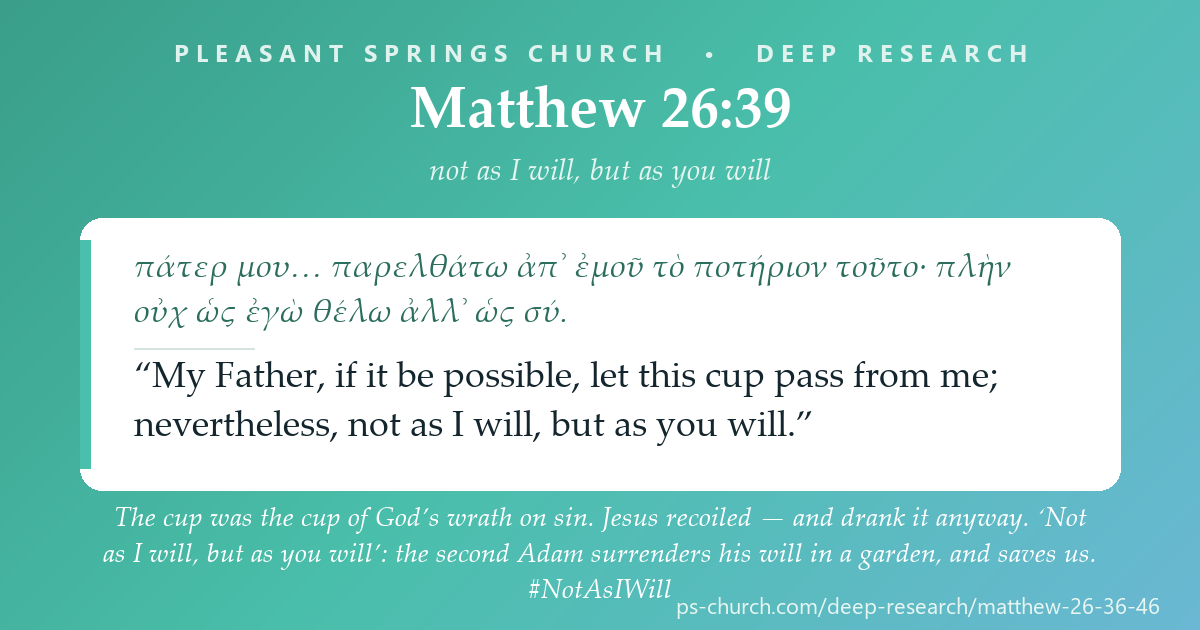
“Not as I will, but as you will.” In the garden the composure of the Supper gives way to anguish: Jesus is “sorrowful, even to death,” and falls on his face. He prays that “this cup” might pass — the cup that in the prophets is the cup of God’s wrath on sin. Here the two wills of the incarnate Son are laid bare: a true human will that recoils, and yet freely bows to the Father. This study works Matthew 26:36–46 — Gethsemane — the cup of wrath, the surrendered will, and real agony held with sinless obedience. See the method →
Matthew 26:38, 39, 41, 42
Greek NT · ESVThe Shape of the Passage
Parallel panelsBetween the Supper and the arrest, Jesus prays in Gethsemane. Matthew shows us the incarnate Son in real agony, praying three times the prayer he taught his disciples — “your will be done” — and freely taking up the cup his Father gives.
Author
Matthew does not soften the scene. Jesus “began to be sorrowful and troubled” and says, “My soul is very sorrowful, even to death” — the exact words of the downcast psalmist (Ps 42:5, 11; 43:5). This is genuine human anguish, not a performance. And the object of the dread is named: “this cup.” In the prophets the cup in God’s hand is the cup of his wrath poured out on sin (Ps 75:8; Isa 51:17; Jer 25:15; Ezek 23:31–34). What Jesus recoils from is not merely dying but drinking that cup — and he resolves to drink it: “if this cannot pass unless I drink it, your will be done.”
Two wills, one obedient Son. “Not as I will, but as you will” puts two distinct willings side by side: the Son’s own human will, and the Father’s will. The church confessed the meaning of this at the Sixth Council (Constantinople III, AD 681): the one person of the Son has two wills, divine and human. In Gethsemane his true human will genuinely shrinks from the cup, yet freely and without sin conforms itself to the Father’s will. This is not two persons at odds, nor a mere show of struggle — it is real human obedience, the very obedience by which he saves.
Audience
The three disciples — Peter, James, and John — asked to “watch” with him, and asleep instead. Matthew holds them up as a mirror: “the spirit indeed is willing, but the flesh is weak.” When testing came, their good intentions could not keep them awake. The remedy Jesus names is the one he is himself practicing: “Watch and pray that you may not enter into temptation.”
How to read the agony. The dread is real (against any hint that Jesus only seemed to suffer), yet it is sinless (Heb 4:15). Asking is not sinning: the request “let this cup pass” is conditioned from the first word (“if it be possible”) and surrendered in the same breath (“nevertheless not as I will”). And the Father is not cruel. The Son addresses him in love — “My Father” (Mark preserves the intimate “Abba”) — and freely lays down his life. Gethsemane is where the world’s salvation is won by a prayer.
Orient on the cup of wrath, the will of God, prayer, and the agony.
Search by topic: cup (of wrath), will of God, Gethsemane, prayer, temptation / testing, Christology (two natures/wills).
Which articles are relevant?
- Anchor Bible Dictionary — “Cup,” “Wrath of God,” “Gethsemane,” “Prayer,” “Will of God.”
- Dictionary of Jesus and the Gospels — “Gethsemane,” “Death of Jesus,” “Prayer,” “Temptation of Jesus.”
- NIDNTT / TDNT — ποτήριον (potērion, cup), θέλημα (thelēma, will), γρηγορέω (grēgoreō, watch).
Bibliography surfaced:
- R. T. France (NICNT), W. D. Davies & Dale Allison (ICC), Donald Hagner (WBC), John Nolland (NIGTC), Ulrich Luz (Hermeneia) on Matthew.
- On the two-wills doctrine: Maximus the Confessor and the Sixth Ecumenical Council (Constantinople III, 681).
- Beale & Carson, Commentary on the NT Use of the OT (Matthew).
The cup of wrath in the prophets, and the Son who drinks it.
Read “the cup” as the prophets use it — the cup of God’s judgment — then hear what it means that the Son asks to be spared it, and drinks it anyway.
Which parallels shed light on religion and worldview?
What is ‘the cup’? The word is the key to the whole scene. Again and again in the prophets, “the cup” in God’s hand is the cup of his wrath, which the guilty must drink to the dregs. “In the hand of the Lord there is a cup… and all the wicked of the earth shall drain it” (Ps 75:8). Jerusalem has “drunk from the hand of the Lord the cup of his wrath” (Isa 51:17). “Take from my hand this cup of the wine of wrath” (Jer 25:15). Ezekiel calls it “a cup of horror and desolation” (Ezek 23:33, the Lord God speaking). So Jesus’ prayer is far more than the natural fear of pain and death. He recoils before the cup of divine judgment on sin — and resolves to drink it in the place of sinners. In John he says it plainly: “Shall I not drink the cup that the Father has given me?” (John 18:11).
The two wills of the one Son. “Not as I will, but as you will” is one of the most precious sentences in Scripture for the church’s confession of who Christ is. It sets a human willing (“I will”) beside the divine will (“you”). The early church wrestled with this and, at the Sixth Ecumenical Council (Constantinople, 681), rejected the idea that Christ had only one will. The Son, being truly God and truly man, has two wills — and in Gethsemane his human will really does shrink from the cup, then freely and perfectly submits to the Father. This is our salvation in miniature: where the first Adam grasped his own will, the last Adam surrenders his, and by that obedience the many are made righteous (Rom 5:19; Phil 2:8, “obedient to the point of death”).
Real agony, sinless obedience. Hebrews looks straight at this scene: “In the days of his flesh, Jesus offered up prayers and supplications, with loud cries and tears… and he was heard because of his reverence… he learned obedience through what he suffered” (Heb 5:7–8). The anguish was total and the tears were real — and yet he was “without sin” (Heb 4:15). Asking the Father is not doubting the Father; the whole prayer is bracketed by trust. Gethsemane is not a lapse of faith but its highest exercise.
- Psalm 75:8 (LXX 74:9); Isaiah 51:17, 22; Jeremiah 25:15; Ezekiel 23:31–34; Habakkuk 2:16 — the cup of God’s wrath in the prophets: the cup Jesus contemplates (OT texts of YHWH; Ezek “Lord God” = Adonai YHWH).
- Psalm 42:5, 11; 43:5 — “why are you cast down, O my soul?”: the lament Jesus takes on his lips (“my soul is very sorrowful”).
- Hebrews 5:7–9; 4:15; Philippians 2:8 — the loud cries and tears; tempted yet without sin; obedient to death: the real agony and the sinless obedience of the Son.
It is worth pausing on why the church cared so much about a single clause. If Jesus had only a divine will, then his “not as I will” would be theater — God pretending to struggle with himself. If he were two persons, then the human Jesus and the divine Son would be two agents, and the incarnation would come apart. The Sixth Council held the harder, truer thing: one person, the eternal Son, willing in two natures. His human will is real — it genuinely recoils from the cup of wrath, as any sinless human soul would — and it is free, and it submits. That submission is not overridden by the divine will as if by force; it is drawn into harmony with it in love. This matters because our salvation hangs on it. It is as a man that the Son must obey where Adam disobeyed; a human will had to say “your will be done” and mean it, all the way to the cross. So Gethsemane is not an embarrassment to be explained away but the very place the obedience of the second Adam is forged. The prayer he taught us — “your will be done” (Matt 6:10) — he prays here in blood, and by praying it, saves us.
The vocabulary of the cup, the will, and the watch.
Watch the cup (of wrath), the two willings side by side, and the “your will be done” borrowed from the Lord’s Prayer.
“Cup” — the interpretive center. In the prophets the cup in God’s hand is the cup of his wrath/judgment (Ps 75:8 · LXX 74:9; Isa 51:17; Jer 25:15; Ezek 23:31–34). Jesus recoils before drinking the cup of divine wrath on sin — and resolves to drink it (John 18:11).
“Very sorrowful… to the point of death” — grief that encircles the whole self (peri-, “around,” + lypē, “grief”). The exact words of the lament psalms (Ps 42:5, 11; LXX Ps 41:6, 12). Real, not feigned, anguish — the genuine human agony of the incarnate Son.
“Not as I will, but as you (will).” Two distinct willings — the Son’s human will and the Father’s — the basis of the church’s confession of the two wills of Christ (Constantinople III, 681). The human will truly recoils, then freely submits; not two persons in conflict.
“Your will be done” — word for word the petition of the Lord’s Prayer (Matt 6:10). Jesus prays in the garden exactly what he taught his disciples to pray; the model prayer becomes his own act of surrender.
“Watch, stay awake, be vigilant.” “Watch with me”; “watch and pray.” The disciples’ failure to grēgorein dramatizes the weakness of the flesh when testing (peirasmos) comes; the remedy is the vigilant prayer Jesus is himself praying.
“The spirit… the flesh.” “The spirit is willing, but the flesh is weak” — not a Platonic body-is-evil dualism but the frailty of fallen human nature under testing. A pastoral diagnosis of the sleeping disciples, not a scorn of the body.
How the New Testament fills out Gethsemane:
- Mark 14:32–42; Luke 22:39–46 — the parallels; Mark keeps the Aramaic “Abba, Father” (14:36); Luke adds the strengthening angel and sweat like blood (22:43–44 — a textually disputed passage; see the notes).
- John 12:27; 18:11 — “Now is my soul troubled… but for this purpose I have come”; “Shall I not drink the cup that the Father has given me?”: the Johannine counterpart and the resolve to drink.
- Hebrews 5:7–9; 4:15 — the loud cries and tears; he learned obedience; tempted as we are, yet without sin: the theology of the agony.
- Matthew 6:10; Philippians 2:8; Romans 5:19 — “your will be done”; “obedient to the point of death”; by one man’s obedience the many made righteous.
From the cup of wrath to the cup he drinks for us.
Trace the cup from the prophets, through the garden, to the cross where it is drained.
Which cross-references matter?
- Psalm 75:8; Isaiah 51:17–22; Jeremiah 25:15; Ezekiel 23:31–34 — the cup of God’s wrath: what “this cup” means.
- Matthew 26:26–29; John 18:11 — the cup poured out at the Supper; the cup the Father gives, which the Son resolves to drink (see the blood of the covenant).
- Matthew 4:1–11; Hebrews 4:15 — the true Son tested in the wilderness and in the garden, yet without sin (see the temptation).
- Isaiah 52:13–53:12; John 19:16–30 — the Servant who bears the wrath; the cup drained at the cross, “It is finished” (see the Suffering Servant, It is finished).
- Genesis 3; Philippians 2:5–11; Romans 5:19 — the first Adam grasped his own will; the last Adam surrendered his: obedience unto death (see the fall).
Two things about Gethsemane resist every attempt to make Jesus smaller than he is. The first is the cup. If “this cup” were only the prospect of a painful death, then plenty of martyrs have faced their deaths with more visible calm than Jesus shows here — and the comparison would be to his discredit. But the cup is not death as such; it is the cup of God’s wrath against sin, the cup the prophets watched the guilty drink to the dregs. What presses Jesus to the ground is the horror of drinking, sinless, the judgment that belongs to sinners. The second is the obedience. “Not as I will, but as you will” is not resignation but the highest act of trust: a real human will, genuinely recoiling, freely choosing the Father’s way. It is the exact reverse of Eden, where a human will reached for its own way against God’s. Here the second Adam, in a garden, under the shadow of death, says “your will be done” and means it — and holds to it through betrayal, trial, and cross. Everything the Supper promised and everything the cross accomplishes turns on this prayer. He drank the cup so that we might drink the cup of salvation instead.
The scholarship on Matthew 26:36-46.
The commentators on the Gethsemane pericope; the studies of the cup, the two-wills doctrine, and the disputed Lukan verses.
Commentaries & studies:
- R. T. France (NICNT), W. D. Davies & Dale C. Allison (ICC), Donald A. Hagner (WBC), John Nolland (NIGTC), Ulrich Luz (Hermeneia) on Matthew.
- On dyothelitism: Maximus the Confessor, Opuscula; the acts of Constantinople III (681).
- Bruce Metzger on the Matt 26:42 variant and the disputed Luke 22:43–44.
Interpretation notes worth keeping:
- The cup is wrath. Read canonically with Ps 75:8; Isa 51:17; Jer 25:15; Ezek 23:31–34: “this cup” is the cup of God’s righteous judgment on sin, which the sinless Son bears in the sinner’s place (John 18:11) — not merely fear of dying.
- Two wills, one Son. “Not as I will, but as you will” grounds the church’s confession (Constantinople III, 681): the human will truly recoils yet freely submits to the divine will; not two persons, not one will, not play-acting.
- Real agony, sinless. Hold both: genuine human dread (Heb 5:7, “loud cries and tears”) and sinlessness (Heb 4:15). Asking “let this cup pass” — conditioned and surrendered — is not a lapse of faith.
- The Father is not cruel. The Son addresses him in love (“My Father”; Mark’s “Abba”) and freely lays down his life; guard against portraying the cross as an unwilling victim under a harsh Father.
- Luke 22:43–44, disputed. The strengthening angel and bloody sweat are absent from key early witnesses (P75, Vaticanus [B], A, W) and double-bracketed in the critical text; early and moving, but handle as textually uncertain, and note Matthew records no such detail.
From the garden of the surrendered will to the prayer on our own lips.
Name what you learned, why it matters, and one concrete response.
What should we carry away — and do?
- He drank the cup you deserved. The cup Jesus dreaded was the cup of God’s wrath on sin. He drank it to the dregs so that you might be handed the cup of salvation instead.
- ‘Your will be done’ is a prayer of trust. Surrender is not defeat. In the darkest hour, the Son’s freedom was to entrust himself to a Father he still called “my Father.”
- Watch and pray. The disciples meant well and slept anyway. Good intentions do not survive testing; vigilant prayer does. The remedy Jesus practiced he also commands.
Step in response: take the hardest thing you are facing into prayer this week and pray it Jesus’ way — honest about the dread (“let this cup pass”), and ending where he ended (“yet not as I will, but as you will”). And when your own flesh is weak, do not trust your resolve; “watch and pray” with the One who watched and prayed for you.
Matthew 26:39 · to share
Greek NT + ESVEvery Deep Research page traces its passage across the whole sweep — the Old Testament, the Second-Temple world between the testaments (historical witnesses, not Scripture), and the New Testament. Follow the thread:
Pleasant Springs Church — Deep Research
Research method after Michael S. Heiser’s Bible Research Method (examine dictionaries → ancient literature → important words → textual connections → academic publications → share), with the Pleasant Springs “Author & Audience” foundation. Scripture set in the Hebrew, the Greek editions named on each page and the ESV (Old Testament), and the Greek New Testament and the ESV (New Testament), per the practice of Pleasant Springs Church. Matthew 26:36–46 research grounded in France, Davies & Allison, Hagner, Nolland, and Luz, with Beale & Carson on the cup-of-wrath background; the “two wills” read with the Sixth Ecumenical Council (Constantinople III, 681); the agony held as real yet sinless (Heb 4:15; 5:7); the disputed Luke 22:43–44 noted as textually uncertain.
Scripture quotations marked ESV are from the ESV® Bible (The Holy Bible, English Standard Version®), © 2001 by Crossway, a publishing ministry of Good News Publishers. ESV Text Edition: 2016. Used by permission. All rights reserved. The ESV text may not be quoted in any publication made available to the public by a Creative Commons license, and the ESV may not be translated in whole or in part into any other language. www.esv.org
|
Did this study bless you today? 💚 Give to Support PS Church100% of gifts go to the General Fund — thank you. |