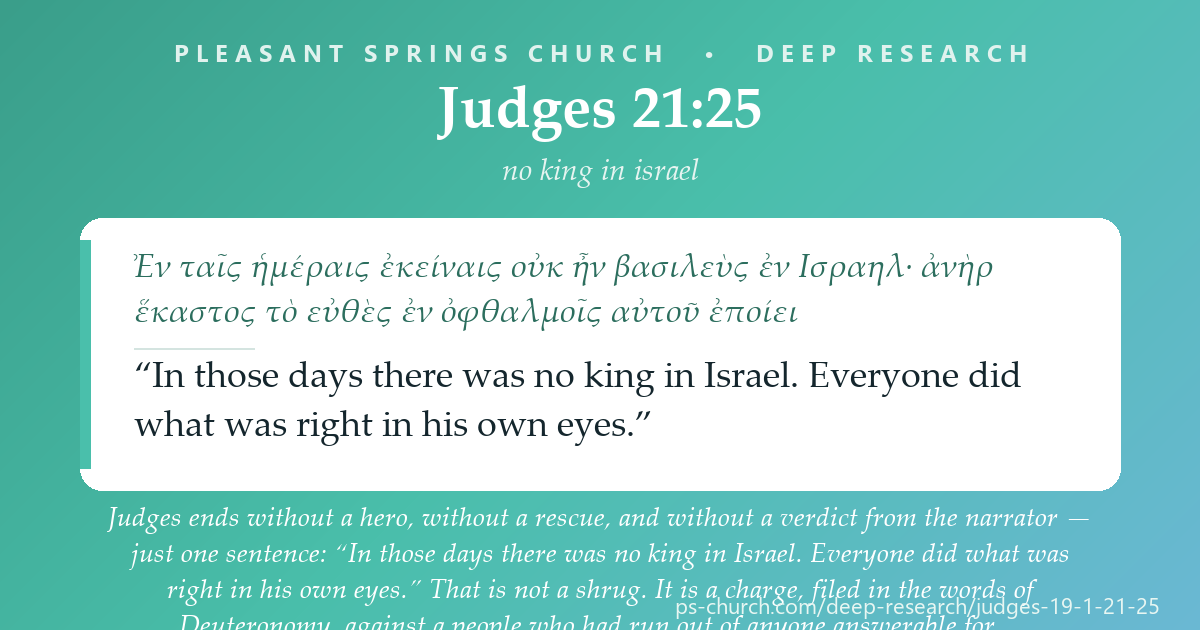
The last three chapters of Judges are the hardest text in the Old Testament, and this study handles them the way they ask to be handled: soberly, once, and without detail. A Levite living in the hill country of Ephraim goes down to Bethlehem to bring back his concubine. On the way home the light fails opposite Jebus — Jerusalem, still Canaanite — and his servant asks to stop there. He refuses: “We will not turn aside into the city of foreigners… but we will pass on to Gibeah” (19:12). They go on to an Israelite town because an Israelite town will be safe. Nobody there takes them in except an old man who is himself from Ephraim. That night the men of the city surround the house, demanding the guest in the exact words used at Sodom; the Levite puts his concubine outside; she is assaulted and by morning she is dead. She is never named. She is never given a word to say. Her body is cut into twelve pieces and sent through Israel, the tribes assemble at Mizpah, and the Levite tells the story himself — editing his own part as he goes. What follows is a war that nearly ends the tribe of Benjamin, and then an ending in which Israel, bound by an oath it swore in anger, destroys Jabesh-gilead for four hundred young women and tells the survivors to lie in wait at Shiloh and seize the rest. The narrator commends none of it, and never says so. He writes one more sentence instead, and it is the verdict the whole book has been building toward: “In those days there was no king in Israel. Everyone did what was right in his own eyes” (21:25). This study works Judges 19:1–21:25. See the method →
Judges 19:1–21:25 (selections)
Hebrew · LXX · ESVThe shape is this. A Levite living in Ephraim goes to Bethlehem to bring back his concubine (19:1–9). On the way home the day runs out opposite Jebus — Jerusalem, still Canaanite — and the servant asks to stop. His master refuses: “We will not turn aside into the city of foreigners… but we will pass on to Gibeah” (19:12). They press on to an Israelite town because an Israelite town will be safe. That sentence is the hinge of the whole passage, and the narrator knows exactly what he is doing with it. At Gibeah nobody takes them in (19:15) except an old man who is himself from Ephraim and only a resident alien there (19:16). That night the men of the city surround the house and demand the guest. The old man refuses and offers his own daughter and the concubine instead. The Levite puts his concubine outside. She is assaulted through the night and is dead in the morning (19:22–28). She is never named. She is given no words anywhere in the chapter. The Levite cuts her body into twelve pieces and sends them through Israel, and the tribes assemble (19:29–30). At Mizpah he tells the story himself (20:4–7) — and quietly edits it. Israel makes war on Benjamin, inquires of God three times and loses twice, and a tribe is cut down to six hundred men at the rock of Rimmon (20:35, 47). Then, having sworn at Mizpah not to give their daughters to Benjamin (21:1), Israel solves the problem it made: it destroys Jabesh-gilead and takes four hundred young women (21:8–14), and it tells the surviving Benjaminites to lie in wait in the vineyards and seize the daughters of Shiloh as they come out to dance (21:19–23). The narrator commends none of it. He does not condemn it in so many words either — and the absence of a verdict in the verse is not approval. The verdict is the last sentence of the book.
(Numbering & text. Judges survives in two substantially different Greek forms, conventionally A (associated with Codex Alexandrinus, and drawing also on the Origenic and Lucianic manuscript groups) and B (associated with Codex Vaticanus). They differ so widely — in vocabulary, in whole clauses, sometimes in sense — that Rahlfs prints both texts in parallel, one above the other, on the same page. There is no single “the LXX” for Judges, and NETS accordingly translates both. The Greek column above prints Rahlfs’s A text throughout, except at 19:30, where B is printed and labelled. Why: at 19:30 the A text has a long plus after “until this day” — καὶ ἐνετείλατο τοῖς ἀνδράσιν οἷς ἐξαπέστειλεν λέγων…, “and he commanded the men whom he sent, saying…” — which has no counterpart in the Hebrew or the ESV, while B runs with the Hebrew. Other places the two texts part company within the verses quoted: at 19:1 A puts the noun first, καὶ βασιλεὺς οὐκ ἦν, matching the Hebrew’s unusual וּמֶלֶךְ אֵין, where B has the ordinary καὶ οὐκ ἦν βασιλεύς; at 19:11 A has “while they were still near Jebus” and B “and they came as far as Jebus”; at 19:12 A has the master speak in the singular (“I will not turn aside”) and B in the plural; at 20:16 B adds ἐκ παντὸς λαοῦ, “from all the people,” and reads οὐκ ἐξαμαρτάνοντες for A’s οὐ διαμαρτάνοντες — and note that both Greek texts divide the verse differently from the Hebrew here, putting “seven hundred chosen men” at the end of 20:15, so that the Greek 20:16 begins abruptly with “ambidextrous,” which is why the Greek column above is shorter than the Hebrew at this line; and at 21:25 A ends ἐν ὀφθαλμοῖς αὐτοῦ, “in his eyes,” keeping the Hebrew idiom, where B has ἐνώπιον αὐτοῦ, “before him.” A also adds ἕκαστος, “each,” which the ESV’s “everyone” matches. One more worth seeing: the two texts count Benjamin differently at 20:15 — A twenty-five thousand, B twenty-three thousand, the Hebrew twenty-six thousand — besides the seven hundred of Gibeah, which all three have. Chapter and verse numbers run together through 19:1–21:25: Hebrew, both Greek texts and English agree throughout, with no offset at all. Greek from Rahlfs (word text after the CATSS morphological files of Judges A and Judges B); punctuation and capitalisation follow the printed editions. Hebrew from the Masoretic Text with the accents.)
The Shape of the Passage
InclusioThese three chapters are the second half of the book’s appendix. The first half is Micah’s idol and the Danites (chs 17–18), where the refrain first appears. Behind them stand the cycle stated in the abstract (2:11–19) and every judge from Othniel (ch 3) to Samson (chs 13–16). In front of them stands a book the canon puts next, and a king.
Author
A narrator who has stopped commenting, and means you to notice. Judges has one place where the storyteller steps forward and gives a verdict — 9:56–57, “thus God returned the evil of Abimelech.” He never does it again. Through chapters 19–21 he reports appalling things in flat, ordinary Hebrew and offers no assessment whatever. Robert Alter’s name for this technique is reticence: the narrator withholds motive and judgment and makes the reader do the work, and the gaps are where the reader is invited in. Here the reticence is total, and it is the argument. He is not neutral. He is holding your face to the glass.
He is also a very careful builder. Three things in chapter 19 are constructed, not accidental. First, the Sodom pattern: strangers in a city square at evening, an outsider who takes them in, the men of the city surrounding the house, the same demand in the same words (“bring out the man… that we may know him”), the host’s protest in almost the same words (“no, my brothers, do not act so wickedly”), the offer of a daughter. Set Genesis 19:4–8 beside Judges 19:22–24 and the sentences line up. The ESV’s own cross-references mark it. And the point of the echo is that here the Sodomites are Israelites — in a town the travellers chose because it was Israelite. Second, the refusal at Jebus (19:11–12) is placed there so that the irony has a name: the one city they will not trust is the one city that never harms them. Third, the woman is unnamed and silent. Pseudo-Philo, retelling this in the first century, gives the Levite a name (Beel) and the host a name (Bethac) and still does not name her. The text’s refusal to name her, and its refusal to let her speak, are among the things it is showing you about the men in this story.
And he lets one man indict himself. At Mizpah the Levite tells the assembly what happened (20:4–7). Read it against chapter 19 with a pencil. He says the men “meant to kill me” — which chapter 19 never says. He says “they violated my concubine, and she is dead” — and does not mention that he put her out the door himself (19:25). He says “I took hold of my concubine and cut her in pieces” without a word about the knife or the morning. The narrator prints the speech and says nothing. That is the method of this whole book in a single paragraph: he does not tell you the man is lying; he lets you check.
Audience
People who needed to know how bad it had got. Whoever first heard these chapters, they heard them as the end of a book that began with Israel asking the Lord who should go up first (1:1) and ends with Israel asking the same question about itself (20:18). The verbs are the same; the enemy has changed. Everything Joshua achieved — a people, a land, a covenant read aloud at Ebal (Joshua 8:30–35) — is unrecognisable by 21:25.
And people who lived near Gibeah. Gibeah is not a random town. It becomes Gibeah of Saul, the home town of Israel’s first king; the tribe nearly annihilated here is Saul’s tribe; and Jabesh-gilead, destroyed in chapter 21 to supply wives, is the town Saul will rescue in his first act as king and the town whose men will one day carry his body home (1 Samuel 11; 31:11–13 — the ESV cross-references at 21:8 point there). Many readers have concluded that these chapters are aimed, and aimed at a particular house. That is a reading, not a certainty, and the page names it without insisting on it.
A word to the reader this page will actually have. Some of you have lived a version of chapter 19. This study will not narrate it, will not linger on it, and will not use it to make a point about anybody else. Two things need saying plainly and then we go on. Nothing in this passage puts any fault on the woman. The narrator does not, and Israel’s own law does not: Deuteronomy 22:25–27 says of exactly this case, “you shall do nothing to the young woman; she has committed no offense punishable by death… and though the betrothed young woman cried for help there was no one to rescue her.” The law had already written down what Gibeah did wrong, and it is the last clause: there was no one to rescue her. And the silence of the narrator is not the silence of God. Hosea will name this town twice as the byword for what Israel became (Hosea 9:9; 10:9).
Orient on the concubine, the refrain, Gibeah and Benjamin, hospitality, the ban, and the two Greek texts.
Search by topic: Judges (Book of) — the appendices; king / kingship in Israel; concubine (pilegesh); Gibeah; Benjamin (tribe of); Jabesh-gilead; Shiloh; Mizpah; hospitality in the ancient Near East; Belial; herem / devote to destruction; Levite; Sodom and Gomorrah; Septuagint of Judges (texts A and B).
Which articles are relevant?
- Anchor Bible Dictionary — “Judges, Book of,” “Gibeah,” “Benjamin,” “Jabesh-gilead,” “Shiloh,” “Mizpah,” “Concubine,” “Hospitality,” “Belial,” “Levites.”
- Dictionary of the OT: Historical Books (IVP) — “Judges, Book of,” “Kingship,” “Violence,” “Women,” “Ethics,” “Hospitality,” “Framework of Judges,” “Text and Textual Criticism.”
- NIDOTTE / TDOT — אִישׁ (ʾîš, man), מֶלֶךְ (meleḵ, king), יָשָׁר (yāšār, right/straight), פִּילֶגֶשׁ (pîlegeš, concubine), נְבָלָה (nəbālāh, outrage), בְּלִיַּעַל (bəliyyaʿal), אָסַף (ʾāsap, gather in).
- For the Greek: the introduction to NETS Judges (which translates both the A and B texts) and Natalio Fernández Marcos, Judges (Biblia Hebraica Quinta) — the standard modern orientation to the A/B problem.
Bibliography surfaced:
- Barry G. Webb, The Book of Judges (NICOT); Daniel I. Block, Judges, Ruth (NAC); Trent C. Butler, Judges (WBC); Robert G. Boling, Judges (Anchor Bible); K. Lawson Younger Jr., Judges and Ruth (NIVAC); Susan Niditch, Judges (OTL); J. Clinton McCann, Judges (Interpretation); Tammi J. Schneider, Judges (Berit Olam).
- Robert Alter, The Art of Biblical Narrative — for reticence, the gap, and repetition-with-variation, which is what the Levite’s speech in 20:4–7 is doing.
- Studies of the two Greek texts of Judges and of the Qumran fragments (1QJudg, 4QJudgᵃ, 4QJudgᵇ) — see Stage 5.
What a king was for in the ancient Near East — and how the first readers of this story handled it.
Read the refrain against the ancient world’s own job description for a king; read the hospitality collapse against the ANE’s duty to the stranger; then read Josephus, Pseudo-Philo and the Talmud to see what early readers did with the parts that trouble us.
Which parallels shed light on religion and worldview?
“There was no king in Israel” meant something specific to the first hearers. In the ancient Near East the king’s defining function was not conquest or splendour; it was the protection of the people nobody else would protect. Hammurabi says he was named “to cause justice to prevail in the land, to destroy the wicked and the evil, that the strong might not oppress the weak” (prologue, ANET 164), and again at the end, “In order that the strong might not oppress the weak, that justice might be dealt the orphan (and) the widow” (epilogue, ANET 178). The Ugaritic legends say the same from the other direction: Keret’s own son tells him to abdicate — “Thou judgest not the cause of the widow, nor adjudicat’st the case of the wretched… Feed’st not the fatherless before thee, the widow behind thy back” (ANET 149) — and Danel is pictured sitting at the gate “judging the cause of the widow, adjudicating the case of the fatherless” (ANET 151, 153). Put that beside Judges 19 and the refrain stops sounding like a constitutional complaint. A woman is destroyed and nobody in the entire narrative is answerable for her. That is what “no king” means here. And note what the book does not then do: it does not say Israel needs a king like the nations. It says there was none of what a king was supposed to be — and Gideon had already said whose job it actually was (8:23).
Hospitality was not a courtesy; it was law. Across the ancient Near East and in Israel, a stranger in a town at nightfall had a claim on somebody, and the household that took him in became responsible for his safety. That is why 19:15 is written the way it is — “there was no אִישׁ gathering them into the house” — and why the old man who finally does it is himself a resident alien from Ephraim. Israel’s own law is more emphatic than its neighbours’: “You shall treat the stranger who sojourns with you as the native among you, and you shall love him as yourself” (Leviticus 19:34); God “loves the sojourner, giving him food and clothing” (Deuteronomy 10:18–19). Gibeah fails the ordinary ANE standard and Israel’s own commandment in the same evening.
- Code of Hammurabi, prologue (ANET 164) and epilogue (ANET 178) (Babylonian law — a witness, not Scripture) — the king exists “that the strong might not oppress the weak” and “that justice might be dealt the orphan (and) the widow.” The standing ANE job description that Judges 19–21 says nobody in Israel was filling.
- The Ugaritic Keret (ANET 149) and Aqhat (ANET 151, 153) (Canaanite epic — a witness, not Scripture) — a king is fit to rule only while he judges the widow’s cause; Danel does it sitting at the town gate. Same world, same expectation, and the same charge Judges 19 lays without ever stating it.
- Josephus, Antiquities 5.2.8–12 (Second-Temple — a witness, not Scripture) — and he changes it in revealing ways. He supplies the marriage trouble as an ordinary quarrel; he has the men of Gibeah demand the woman from the start, which quietly removes the Sodom echo altogether; he adds that she died of shame, a motive Scripture does not give; and he counts “five hundred” left-handed slingers where the Hebrew has seven hundred. Josephus is doing what retellers do with this chapter: making it manageable. (Whiston’s chapter-and-section numbering is used here; the Loeb/Niese continuous section numbers do not line up with it.)
- Pseudo-Philo, Liber Antiquitatum Biblicarum 45 (first century — a witness, not Scripture) — a Jewish retelling that moves the crime from Gibeah to Nob, names the Levite Beel and the host Bethac, and has Bethac say outright that God will “shut up their heart before us, as he shut up the men of Sodom before the face of Lot” — proof that a first-century reader heard the Genesis 19 echo exactly as we do. It also supplies a reason for her death, blaming her for an old sin. Scripture supplies no such reason, and neither does this page. The habit of explaining a victim is very old, and it was wrong when it started.
- b. Gittin 6b (rabbinic-era — a witness, not Scripture) — the Sages read 19:2 as “his concubine went away from him” and debate what trivial thing set her husband off (Rabbi Evyatar: a fly in his food; Rabbi Yonatan: a hair). Then Rav Ḥisda draws the moral, and it is not aimed at her: “A person should never impose excessive fear upon the members of his household, as the husband of the concubine of Gibeah imposed excessive fear upon her.” The oldest Jewish reading of this chapter puts the weight on the man.
- Sirach 46:11–12 (Second-Temple — a witness, not Scripture) — the praise of the judges whose hearts did not fall into idolatry, with the wish that their bones might send forth new life from where they lie. Worth reading beside chapters 19–21, which contain no judge at all.
Three chapters of the Bible describe a sexual assault, a war of extermination against a brother tribe, and the abduction of two groups of young women. Some rules for what follows, and this page keeps them.
Do not narrate it. The verses are there for anyone who wants them; a study page does not need to walk through them, and walking through them does harm. Report, once, plainly, and move.
Do not use it about somebody else. These chapters have been pressed into service against foreigners, against cities, against political opponents, against whole categories of people. Every one of those uses is a lie about the text, because the text’s entire structural irony is that the travellers avoided the foreign city and were destroyed in the Israelite one. A reader who finishes Judges 19 with a grievance against some other group has read it exactly backwards.
Do not supply the condemnation and call it the narrator’s. He withheld it on purpose. What we can say is what Scripture itself says: the law forbids all of it, the prophets name Gibeah as the low-water mark of the nation (Hosea 9:9; 10:9), and the book’s last sentence is a verdict on everyone in it. Report the text, name where it is silent, and let the silence work.
One noun that runs the whole descent, a refrain quoted out of Deuteronomy, and a left hand that changes sides.
Count ish from 19:15 to 21:25; hear the refrain as a quotation of Deuteronomy 12:8; and watch itter yad-yemino move from Ehud in chapter 3 to Gibeah in chapter 20.
“A man, each man” — the commonest noun in Hebrew, and the Leitwort of these chapters. At 19:15 there is no ʾîš who will take a stranger in. In chapter 20 Israel assembles “as one ʾîš” three times over (כְּאִישׁ אֶחָד, 20:1, 8, 11; Greek ὡς ἀνὴρ εἷς) — the only unity in the book, and it is for war on a brother. At 21:24 every ʾîš goes home to his own inheritance, and at 21:25 every ʾîš does what is right in his own eyes. One word carries the whole descent.
“No king” and “what was right in his own eyes.” The refrain: four times, but complete only at 17:6 and 21:25, where the Hebrew is identical letter for letter. The second half is not the narrator’s invention — it is quoted from the Torah. Deuteronomy 12:8: אִישׁ כָּל־הַיָּשָׁר בְּעֵינָיו, “you shall not do… everyone doing whatever is right in his own eyes.” Judges ends by reporting that Israel did precisely the thing Moses named and forbade. (The Greek texts diverge here: A ends ἐν ὀφθαλμοῖς αὐτοῦ, B ἐνώπιον αὐτοῦ.)
“Concubine” (LXX παλλακή) — a secondary wife, of lower status than a full wife but a wife nonetheless: her father is called the Levite’s father-in-law (חֹתֵן, 19:4), and at 20:4 the Levite is called her husband (אִישׁ הָאִשָּׁה). The text’s own vocabulary treats her as family and as a person owed protection. It never gives her a name, and it never lets her speak.
“Outrage” and “abomination” — not private vices but acts that tear the fabric of the covenant community; nəbālāh is the word used of Dinah (Gen 34:7), of Achan (Josh 7:15), of Amnon (2 Sam 13:12) and in Deuteronomy 22:21. This is one word the narrator does put in people’s mouths — the old man’s at 19:23 and the Levite’s at 20:6 — and it is as close as the chapter comes to a verdict. The Greek texts part company: A translates loosely (ἀφροσύνην, “folly”) while B gives up and transliterates the Hebrew — ζεμα καὶ ἀπόπτωμα (20:6).
“Sons of Belial” — ESV “worthless fellows.” Bəliyyaʿal is “worthlessness, ruin”; by the Second-Temple period it has hardened into a name for the adversary, which is how 2 Corinthians 6:15 uses it (Βελιάρ). Both Greek texts render it at 19:22 as υἱοὶ παρανόμων, “sons of lawless men”; at 20:13 A keeps the Hebrew word as a name, τοὺς υἱοὺς Βελιαλ, where B again translates.
“Restricted as to his right hand” — left-handed. The phrase occurs twice in the book and nowhere else in this exact form: of Ehud the Benjaminite deliverer (3:15) and of the seven hundred Benjaminite slingers here. Both Greek texts use the same rare word in both places, ἀμφοτεροδέξιος, “right-handed on both sides.” And the tribe’s own name is Binyamin, “son of the right hand.” What God once used to save Israel from Moab is now aimed at Israel — the book’s whole trajectory in one word.
“Gathering in” — from ʾāsap, to gather, take in, receive. Twice the narrator uses it in the negative: “there was no man gathering them into the house” (19:15), and the Levite repeats it to the old man (19:18). The Greek A text renders it ὁ συνάγων. It is the ordinary word for bringing in a harvest, used here of bringing in a person; and its absence, twice, is what makes the night at Gibeah possible.
Where this vocabulary surfaces later:
- Hosea 9:9; 10:9 — “They have deeply corrupted themselves as in the days of Gibeah”; “From the days of Gibeah, you have sinned, O Israel.” This is the canon supplying, out loud, the verdict the narrator of Judges withholds. If anyone wonders whether Scripture approves of chapters 19–21, Hosea has already answered.
- 1 Samuel 11; 31:11–13 — Jabesh-gilead, destroyed here to supply wives, is rescued by Saul in his first act as king, and its men later risk everything to bury him. The town in Judges 21 is not a footnote; it is a thread the canon keeps pulling.
- 1 Samuel 8:5, 20; 12:12 — “appoint for us a king to judge us like all the nations.” Judges says Israel had no king; Samuel shows what happened when it got one on its own terms. The two books are answering each other and they do not give the same answer.
- 2 Corinthians 6:15 — “What accord has Christ with Belial?” The word that names the men of Gibeah at 19:22 turns up in Paul as a name for the adversary himself.
- Romans 12:19–21 — “Beloved, never avenge yourselves… overcome evil with good.” Judges 20 is what avenging yourselves looks like when the cause is just and the method is your own (see Romans for where this letter is going).
Sodom, Deuteronomy’s own words, an averted civil war in Joshua — and the law that already knew.
Trace four: the Genesis 19 pattern and what the narrator does with it; the refrain as a quotation; Joshua 22 as the road not taken; and the laws that protect exactly the people these chapters destroy.
Which cross-references matter?
- Genesis 19:1–11 — the pattern the narrator is building on, point by point: evening, the city square, an outsider who takes strangers in, the men of the city surrounding the house, “bring them out to us, that we may know them” (19:5) beside Judges 19:22, “my brothers, do not act so wickedly” (19:7) beside Judges 19:23, and the offer of daughters (19:8). The ESV marks the parallel in its own cross-references. See Genesis 19. The single change is the address: Sodom was a Canaanite city under judgment; Gibeah is in Israel, and the travellers chose it because it was.
- Deuteronomy 12:8 — “You shall not do according to all that we are doing here today, everyone doing whatever is right in his own eyes.” The refrain of Judges is a quotation of this verse with the prohibition removed. See Deuteronomy 12.
- Deuteronomy 13:12–18 — the law about an Israelite city that has gone over to other gods: inquire and make search and ask diligently, and only then act. Judges 20 has the shape of that law and not its patience — Israel does send a delegation (20:12–13), and when Benjamin refuses, the response is a war of extermination the law never contemplated for this offence. See Deuteronomy 13.
- Deuteronomy 22:25–27 — the law for exactly the case of chapter 19: “only the man who lay with her shall die. But you shall do nothing to the young woman; she has committed no offense punishable by death… and though the betrothed young woman cried for help there was no one to rescue her.” Israel’s own law had already written down where the fault lies. See Deuteronomy 22.
- Joshua 22:10–34 — the road not taken. There too the tribes gather at one place to make war on their brothers over an outrage; there too a delegation goes first; and there they listen, and the altar is named Witness and nobody dies. Judges 20 is the same scene run again with the listening removed. See Joshua 20–22.
- Leviticus 19:33–34; Deuteronomy 10:18–19 — “you shall love him as yourself”; God “loves the sojourner.” The commandments that Gibeah broke before anything else happened. See Leviticus 19 and Deuteronomy 10.
- Judges 1:1 and 20:18 — the same question at both ends of the book. “Who shall go up first for us against the Canaanites?” — “Judah shall go up.” Then: “Who shall go up first for us to fight against the people of Benjamin?” — “Judah shall go up first.” Identical formula, and in twenty chapters the enemy has become the family. See Judges 1–2.
- Judges 11:30–40 — the other rash vow, and the other daughter. Jephthah swore and would not take it back; Israel swears at 21:1 and will not take it back, and both times someone else pays for it. See Judges 10–12.
The last words of chapter 19 are an imperative addressed to Israel: śîmū lāḵem ʿālêhā, ʿuṣū wəḏabbērū — “set it upon yourselves concerning her, take counsel, and speak.” Three verbs: look at it, deliberate, say something. It is the only instruction anyone in these chapters is given, and the book then shows Israel obeying two of the three. They assembled, they took counsel, they spoke — four hundred thousand of them, at Mizpah, immediately. What nobody does is the first verb. Nobody looks at her. She is never named, never quoted, never mourned; the assembly’s question at 20:3 is “how did this evil happen?” and the Levite’s answer begins “I came to Gibeah.”
That is not a modern complaint imported into the text. It is what the text does. The command was to consider her — the Hebrew pronoun is feminine singular — and everything that follows is about Benjamin. Tens of thousands of men die on both sides, four hundred young women are carried off from one town and an unknown number from another, and the woman the war was fought over has still not been given a name.
The reader is the last person left who can obey the verse. That is what a page like this one is for: not to relive it, and not to explain it away, but to consider it — and to notice that Scripture put the instruction in the text and then showed you a nation that skipped it.
The commentaries, the two Greek texts, a Qumran scroll of these very chapters — and what stays hard.
Webb, Block, Butler, Boling, Younger, Niditch, McCann and Schneider on Judges; Fernández Marcos and NETS on the A and B texts; Trebolle Barrera and Rezetko on 4QJudgᵇ; and then the questions this page will not pretend to close.
Commentaries & studies:
- Barry G. Webb, The Book of Judges (NICOT, 2012) — the fullest recent literary-theological treatment, and the most careful about the narrator’s silences.
- Daniel I. Block, Judges, Ruth (NAC); Trent C. Butler, Judges (WBC); Robert G. Boling, Judges (Anchor Bible); K. Lawson Younger Jr., Judges and Ruth (NIVAC).
- Susan Niditch, Judges (OTL); J. Clinton McCann, Judges (Interpretation); Tammi J. Schneider, Judges (Berit Olam) — three readings especially attentive to the women in the book.
- Natalio Fernández Marcos, Judges (Biblia Hebraica Quinta) — the standard critical orientation to the text of Judges, Hebrew and Greek; and the NETS Judges introduction, which explains why Rahlfs printed A and B as two texts.
- J. Trebolle Barrera, “4QJudgᵃ” and “4QJudgᵇ,” in Qumran Cave 4: IX (DJD 14, 1995), 161–164 + Plate XXXVI (4QJudgᵃ) and 165–169 + Plate XXXVI (4QJudgᵇ) — the editio princeps of the Cave 4 Judges scrolls.
- Robert Rezetko, “The Qumran Scrolls of the Book of Judges: Literary Formation, Textual Criticism, and Historical Linguistics,” Journal of Hebrew Scriptures 13, art. 2 (2013) — a careful survey, and the source of the 4QJudgᵇ readings noted below.
- Robert Alter, The Art of Biblical Narrative — on reticence and on repetition with variation, which is the technique of 20:4–7.
Interpretation notes worth keeping:
- The two Greek texts are the signature textual problem of this book. Brooke and McLean’s Cambridge Septuagint is a diplomatic edition whose main text is basically Codex Vaticanus, and the Göttingen critical edition of Judges had not appeared when NETS was prepared (the Göttingen series is still in progress; check its current volume list before citing it). So the working presentation is Rahlfs’s. He judged the manuscript traditions so divergent that he printed two texts — A (Codex Alexandrinus plus the Origenic and Lucianic groups) and B (Codex Vaticanus) — in parallel on the page, and NETS translates both. Later work sorts the Greek witnesses into four principal groups — GB (with manuscript B), GL (the Antiochene or Lucianic text), GM (manuscripts M and N), and GO (with manuscript A; the Origenic or Hexaplaric recension). Fernández Marcos’ own summary in the Biblia Hebraica Quinta introduction (7*–8*) is worth quoting, because it is candid: “In Judges it is very difficult to restore the Old Greek. The text history has been exposed to a strong influence of the Origenian or Hexaplaric recension… All scholars agree in emphasizing the importance of the group GL… for the restoration of the Old Greek of Judges,” with the agreements between the Antiochene text and the Old Latin taking us back behind the Hexaplaric contamination. None of this is a threat to anything. It means Judges was translated and re-translated early and often, and we can watch it happening.
- There is a Qumran scroll of these chapters, and it is close to the Masoretic Text. 4QJudgᵇ (4Q50, c. 30–1 BC) preserves parts of Judges 19 and 21. Trebolle Barrera’s assessment is that “the preserved readings of 4QJudgᵇ are very close to” the MT, though the reconstructed line-lengths may point to a shorter text or a different arrangement. The published variants in our passage are three, all in the last seven verses of the book, and all minor: at 21:19 the scroll lacks the directive -āh of MT מִזְרְחָה הַשֶּׁמֶשׁ; at 21:22 it reads a longer form of “their fathers”; at 21:23 a variant preposition with “the dancers.” That is the whole apparatus, and it is reported here rather than inflated. (The other Judges scrolls — 1QJudg and 4QJudgᵃ — do not cover these chapters.)
- What the narrator approves, what he reports, and what he condemns are three different things, and this book keeps them separate. In chapters 19–21 the first category is empty. There is no divine call, no Spirit rushing on anyone, no deliverer, and no “the land had rest.” The judge-cycle of 2:11–19 — did evil / sold them / cried out / raised up a deliverer / the land had rest — has broken down completely: Israel does evil and Israel is the enemy, Israel cries out (21:2–3) and God raises up nobody, and the book simply stops. That absence is the commentary.
- God’s answers in chapter 20 are the hardest theological knot here, and we will not tie it. Israel inquires three times (20:18, 23, 28). Twice God says go up and Israel is routed — twenty-two thousand dead, then eighteen thousand. The third time God adds a promise and Israel wins. The text gives no explanation whatever, and the honest readings are several: that God answered the question asked (“shall we go up?”) and not the one they should have asked; that Israel too was under judgment and the war was chastening on both sides; that the narrative is showing a nation using the oracle as a tactical instrument, with Phinehas standing before the ark of a God they consult but do not obey. Scripture gives no reason, so we do not give one. What the passage does say, twice over, is that Israel wept before the Lord and fasted, and that this made no difference to the outcome the first two times.
- 21:15 says what it says. “And the people had compassion on Benjamin because the Lord had made a breach (פֶּרֶץ) in the tribes of Israel.” The narrator lets Israel attribute the tribe’s near-destruction to God — in the middle of a chapter in which Israel is patching that breach by destroying a town and abducting two sets of young women. He does not say whether the attribution is right. Note also 21:3, where they ask God why this has happened, as though the oath at 21:1 were somebody else’s doing. Reported, not resolved.
- The two “solutions” of chapter 21 are the worst part and must not be skipped. Israel had sworn at Mizpah, so no Israelite may give a daughter to Benjamin. First they find a town that had not come to the assembly and destroy it, keeping four hundred young women (21:8–14). It is not enough (21:14). Then they instruct the remaining Benjaminites to hide in the vineyards at Shiloh and seize the young women as they come out to the feast to dance (21:19–23), with a prepared speech for the fathers afterwards. The narrator commends none of it and offers no verdict. Nothing in the passage suggests these are righteous acts; every one of them violates Israel’s own law; and the elaborate legal reasoning by which Israel arrives at them (21:16–22) is itself part of what the chapter is exhibiting — a people who will keep a rash oath at any cost to somebody else, and who can no longer tell obedience from ingenuity.
- Say plainly what the rest of Scripture says about the people these chapters destroy. The law says the assaulted woman bears no fault and that the sin is that no one rescued her (Deut 22:25–27). It commands love of the sojourner as of yourself (Lev 19:34) and says God himself loves him. It forbids the abduction of a person outright (Exodus 21:16; Deut 24:7). The prophets make Gibeah the name for national corruption (Hosea 9:9; 10:9). And Jesus makes a man attacked on a road, and the strangers who did or did not stop for him, the whole test of who a neighbour is (Luke 10:25–37). The canon values exactly the people chapters 19–21 destroy. That is why the book ends the way it does.
- And do not tidy the ending. There is no repentance in chapter 21, no prophet, no altar call, no restoration. Israel goes home, “every man to his tribe and family” (21:24), and the narrator writes one more sentence and stops.
Judges 3 tells you about a left-handed Benjaminite. ʾiṭṭēr yaḏ-yəmînō — “restricted as to his right hand” — is a strange, specific phrase, and the book uses it exactly twice. The first is Ehud, whom God raised up to save Israel from Moab (3:15); a left-handed man carrying a weapon on the wrong side got past the guards because nobody thought to look there. The second is here: “Among all these were 700 chosen men who were left-handed; every one could sling a stone at a hair and not miss” (20:16). Same phrase, same tribe, same tribal pun — Binyamin means “son of the right hand” — and both Greek texts even use the same rare word, ἀμφοτεροδέξιος, in both places.
What changed is the target. In chapter 3 that hand delivered Israel. In chapter 20 it is drawn up against Israel, and within three days the tribe is down to six hundred men. The book does not comment. It simply repeats a phrase from seventeen chapters earlier and lets you feel where it has ended up.
That, in miniature, is what Judges is doing from beginning to end. Nothing new goes wrong at Gibeah. The same gifts, the same courage, the same tribe, the same God who raised up deliverers “and saved them” (2:16) — and no king, and no one asking anymore what is right in anybody’s eyes but his own.
What a book like this is for — and how to carry a text you cannot fix.
Name what you learned, why it matters, and one concrete response.
What should we carry away — and do?
- The Bible tells the truth about the people of God. No ancient nation wrote its own history like this. Judges ends with Israel at its worst, told in detail, with no defence offered and no hero to change the subject. A book willing to end here is not propaganda, and the God who let it stand in the canon is not managing his reputation.
- Silence is not approval. The narrator gives no verdict on Gibeah, on the war, or on chapter 21. He does not need to: the whole book is the verdict, the law had already spoken, and the prophets say it out loud (Hosea 9:9; 10:9). Learning to read a silence is a skill, and this is the book that teaches it.
- The irony is the point, so do not aim it outward. They passed by the foreign city because it was foreign, and went to the Israelite city because it was safe. Any reading of Judges 19 that ends with a suspicion of outsiders has read the chapter exactly backwards.
- Consider her. The command at 19:30 is “consider it, take counsel, and speak,” and the “it” in Hebrew is her. Israel took counsel and spoke and never once looked. Reading her carefully, refusing to explain her, and refusing to move past her quickly is not sentiment; it is obedience to the only imperative in the passage.
- “Right in his own eyes” is a quotation. Moses named it and forbade it before Israel ever crossed the Jordan (Deuteronomy 12:8). The book’s last line is not a shrug about anarchy; it is a charge, filed in the words of the covenant itself.
- You are allowed to find this unbearable. A study that leaves you settled about Judges 19–21 has done something wrong. The right response to these chapters is the one the book itself models at 21:2 — sitting down before God until evening and weeping bitterly — not a lesson learned and filed.
Step in response: two things. First, read Judges 19–21 straight through, slowly, once, and then read Deuteronomy 22:25–27 and Hosea 9:9 and stop. Let the canon say what the narrator would not. Second, find out who in your church or town is the person nobody is answerable for — and be the אִישׁ who gathers them in. Judges 19:15 is one sentence long: no one took them into his house. That is the sentence this book asks you not to be.
Judges 21:25 · to share
LXX (Judges A) + ESVEvery Deep Research page traces its passage across the whole sweep — the Old Testament, the Second-Temple world between the testaments (historical witnesses, not Scripture), and the New Testament. Follow the thread:
Pleasant Springs Church — Deep Research
Research method after Michael S. Heiser’s Bible Research Method (examine dictionaries → ancient literature → important words → textual connections → academic publications → share), with the Pleasant Springs “Author & Audience” foundation. Scripture set in the Hebrew, the Greek editions named on each page and the ESV (Old Testament), and the Greek New Testament and the ESV (New Testament), per the practice of Pleasant Springs Church. Judges 19–21 research grounded in Webb (NICOT), Block (NAC), Butler (WBC), Boling (Anchor), Younger (NIVAC), Niditch (OTL), McCann (Interpretation) and Schneider (Berit Olam), with Alter on narrative reticence. ANE background from the Code of Hammurabi prologue and epilogue (ANET 164, 178) and the Ugaritic Keret and Aqhat (ANET 149, 151, 153) on what a king was for; Second-Temple and rabbinic witnesses (Josephus, Ant. 5.2.8–12, Whiston’s numbering, which does not line up with Loeb/Niese; Pseudo-Philo, LAB 45; b. Gittin 6b; Sirach 46:11–12), all read as witnesses, never leveled with Scripture. Qumran data from Trebolle Barrera, DJD 14, and Rezetko, JHS 13.2 (2013): 4QJudgᵇ (4Q50) preserves parts of Judges 19 and 21, is very close to the MT, and carries three minor published variants in this passage (21:19, 21:22, 21:23). Numbering & text: Judges 19:1–21:25 carries no chapter- or verse-offset — Hebrew, Greek and English agree throughout. Judges survives in two substantially different Greek forms, A (Codex Alexandrinus, plus the Origenic and Lucianic groups) and B (Codex Vaticanus), which Rahlfs prints in parallel on the same page; the Greek column on this page is Rahlfs’s A text throughout except at 19:30, where B is printed and labelled because A carries a long plus there, and the material A/B divergences within the verses quoted (19:1, 19:11, 19:12, 20:16, 21:25, and the count at 20:15) are named in the codex note. Greek word text follows Rahlfs via the CATSS morphological files of Judges A and Judges B, checked line by line against NETS, which translates both; punctuation and capitalisation follow the printed editions. Pastoral note: the sexual violence of chapter 19 and the abductions of chapter 21 are reported once, plainly and without detail, and are never narrated, illustrated, or used rhetorically; the woman of chapter 19 is unnamed and silent in the text and no fault is attributed to her here or anywhere in Scripture (Deut 22:25–27); the narrator’s refusal to condemn is reported as the book’s own rhetoric and not as approval; and none of this material is applied to any modern person or group.
Scripture quotations marked ESV are from the ESV® Bible (The Holy Bible, English Standard Version®), © 2001 by Crossway, a publishing ministry of Good News Publishers. ESV Text Edition: 2016. Used by permission. All rights reserved. The ESV text may not be quoted in any publication made available to the public by a Creative Commons license, and the ESV may not be translated in whole or in part into any other language. www.esv.org
|
Did this study bless you today? 💚 Give to Support PS Church100% of gifts go to the General Fund — thank you. |