Chapter 2 told you the rule. Chapter 3 starts applying it. The nations are still in the land, and the narrator gives two reasons in two verses without reconciling them — they are there “to test Israel… to know whether Israel would obey the commandments of the Lord” (3:1, 4), and they are there so a generation that had known no war might learn it (3:2). The test is failed in one sentence, and nobody draws a weapon: “their daughters they took to themselves for wives… and they served their gods” (3:6). Then three deliverers of wildly different sizes. Othniel gets five verses and the cycle complete — did evil, sold into the hand of Cushan-rishathaim, cried out, a deliverer raised up, the Spirit of the Lord was upon him, forty years of rest — and he is the only judge in the book about whom nothing bad is reported. He is the ruler; everyone after him is measured with him, and the measuring is this book’s method. Ehud gets nineteen verses of deliberate, grotesque comedy: a Benjaminite — ben-yāmîn, “son of the right hand” — who is bound in his right hand; a two-edged sword on the right thigh, where nobody frisks; a king who is “a very fat man”; fat that closes over the blade; and two servants outside a locked door, waiting until they are embarrassed, because they assume the king “is relieving himself in the closet of the cool chamber.” Then eighty years of rest, the longest in Judges. And Shamgar gets one verse, six hundred Philistines and an oxgoad — with no formula at all. This study works Judges 3:1–31: it reports the humour honestly without reveling in the killing, and it keeps what the text approves, what it merely reports, and what it condemns as three different things. See the method →
Judges 3:1–31 (selections)
Hebrew · LXX (A text) · ESVThe Shape of the Passage
Parallel panelsThis chapter stands immediately after the book’s own interpretive key — the unfinished conquest, the angel at Bochim and the cycle stated in the abstract (Judges 1:1–2:23). Behind it stand Joshua’s summaries of a land taken (Josh 11–12) and his farewell warning about intermarriage (Josh 23:12–13), and the law those verses depend on (Deuteronomy 7:1–5). Othniel has already appeared once, winning Achsah in Joshua 15:16–19. In front of it stand Deborah and Barak (Judges 4–5).
Author
A narrator who has just told you the rule, and now starts breaking it in front of you. Judges names no author, and the book has never needed one named. What it has is a storyteller with an unusual discipline: he states his thesis once, in the abstract, at 2:11–19, and then almost never comments again. From chapter 3 to the end he simply reports — and the reporting is the argument. Othniel is given the formula complete and unbroken. Ehud is given the formula with a piece missing (no Spirit) and nineteen verses of physical comedy in the gap. Shamgar is given a single sentence with no formula at all. Nobody is praised and nobody is scolded. You are expected to notice.
And he is a genuinely funny writer, which readers are often too reverent to admit. The Ehud episode is built out of jokes: the tribe of the right hand produces a man who cannot use his right hand; the weapon goes on the side no bodyguard pats down; the king who is called “a very fat man” is so fat that the fat swallows the hilt; and the scene ends with two courtiers outside a locked door, dying of embarrassment, waiting for a dead man to finish in the bathroom. Robert Alter’s reading notices further that Eglon’s name sits close to ʿēgel, “calf” — the tribute is brought to a fatted calf — and that the sword Ehud carries is announced as a “secret dāḇār” (3:19), a word that means both thing and word, so that “I have a word from God for you” (3:20) is fulfilled by an object. The comedy is real and this page reports it. It is also comedy about a killing, and the page will not linger there or invite you to enjoy it: the narrator describes the wound in one clause and moves the camera outside the door.
A note on how this page handles the Greek. Judges is the Old Testament book with two Greek editions rather than one (see the codex note). Every Greek line above is the A text; every place B changes the sense is named. Nothing on this page depends on preferring one over the other, and where they disagree the disagreement is printed rather than tidied.
Audience
People who already knew how the story ended, and needed to know why. Whoever first heard this, they heard it as an explanation. The land was supposed to be theirs and finished. Instead 3:1–6 says the nations are still there — and gives two different reasons in two verses, without harmonizing them: they are left to test whether Israel will obey (3:1, 4), and they are left so that a generation with no memory of war can learn war (3:2). Both stand. The narrator does not tell you how they fit.
The failure in 3:6 is domestic, not military. Nobody loses a battle in these verses. Sons and daughters are married, households are joined, and “they served their gods.” That is the whole collapse, in one sentence, exactly where Moses said it would be (Deut 7:3–4) and exactly where Joshua said it would be (Josh 23:12–13). A book about deliverers begins by showing you that the thing being delivered from was arranged at weddings.
And they were expected to keep score. The audience has just been handed the formula in chapter 2; here they get to watch it applied. Othniel checks every box — and he is from Judah, the tribe the book put first at 1:1–2, and he is the only judge whose account contains no fault. Then Ehud, whose deliverance is real and whose method is never assessed. Then Shamgar, whose entire career is one verse. By the end of the chapter a careful listener already knows how to read the rest of the book: watch what is missing.
Orient on the cycle, the judge-deliverer, the Spirit in Judges, Moab, Benjamin and the left hand.
Search by topic: judge (shōpēṭ) and deliverer (mōshîaʿ), the cycle / pattern of Judges, Spirit of the Lord in the Old Testament, Othniel, Kenaz and the Kenizzites, Cushan-rishathaim, Aram-naharaim / Mesopotamia, Moab, Eglon, Benjamin, left-handedness, tribute (minchah), Jericho / city of palms, fords of the Jordan, Shamgar, Anath, Philistines, oxgoad.
Which articles are relevant?
- Anchor Bible Dictionary — “Judges, Book of,” “Judge,” “Othniel,” “Kenaz,” “Cushan-rishathaim,” “Aram-naharaim,” “Ehud,” “Eglon,” “Moab,” “Benjamin,” “Shamgar,” “Anath.”
- Dictionary of the OT: Historical Books (IVP) — “Judges, Book of,” “Judges (office),” “Spirit of God,” “Canaanite Gods and Religion,” “Warfare,” “Moab,” “Humor and Irony,” “Chronology.”
- NIDOTTE / TDOT — יָד (yāḏ, hand), יָשַׁע (yāshaʿ, save) and מוֹשִׁיעַ (mōshîaʿ), שָׁפַט (shāphaṭ, judge), שָׁקַט (shāqaṭ, be quiet / have rest), נָסָה (nāsāh, test), זָעַק (zāʿaq, cry out), חֵלֶב (ḥēleḇ, fat), רוּחַ (rûaḥ, spirit).
- Lexicons for the hard words — אִטֵּר (ʾiṭṭēr, 3:15; only here and 20:16), גֹּמֶד (gōmeḏ, 3:16, a hapax), מִסְדְּרוֹן (misdərōn, 3:23, a hapax; the ESV footnotes it “the meaning of the Hebrew word is uncertain”), פַּרְשְׁדֹן (parshəḏōn, 3:22, a hapax), מַלְמָד (malmāḏ, 3:31, a hapax).
Bibliography surfaced:
- Barry G. Webb, The Book of Judges (NICOT); Daniel I. Block, Judges, Ruth (NAC); Trent C. Butler, Judges (WBC); Robert G. Boling, Judges (Anchor Bible); K. Lawson Younger Jr., Judges and Ruth (NIVAC); Susan Niditch, Judges (OTL); J. Clinton McCann, Judges (Interpretation); Tammi J. Schneider, Judges (Berit Olam).
- Natalio Fernández Marcos, Judges (Biblia Hebraica Quinta, vol. 7) — the standard entry point for the double Greek text and the Qumran evidence.
- Robert Alter, The Art of Biblical Narrative — for the Ehud episode as a worked example of biblical narrative craft.
- Studies of the “cycle” or framework of Judges and of its progressive degradation, and of the Spirit-endowment formulae (3:10; 6:34; 11:29; 13:25; 14:6, 19; 15:14).
A Moabite king who explains defeat exactly the way Israel does, a warrior-goddess called Anath — and a first-century reader who could not bring himself to repeat the joke.
Read the chapter against Moab’s own royal voice, then against the Ugaritic Anath after whom Shamgar’s father is named, and finally against the Second-Temple retellings — where you can watch early readers already deciding what to do with a story like this.
Which parallels shed light on religion and worldview?
Moab explains its own defeats the way Judges explains Israel’s. The one substantial thing we have from a Moabite king is the Mesha Stele (c. 830 BC, ANET 320–321, Albright’s translation), and its logic is uncannily familiar. Mesha says Omri “humbled Moab many years, for Chemosh was angry at his land” — a defeat caused not by superior chariots but by an offended god — and then reports Chemosh telling him, “Go, take Nebo from Israel!” Judges 3:12 says the same kind of sentence with a different subject: “the Lord strengthened Eglon the king of Moab against Israel, because they had done what was evil.” The grammar of history is shared across the border; what is not shared is the content. Mesha’s god is angry about territory and honour, and there is no law behind it. Israel’s account is covenantal and moral: the nation broke a stipulated relationship, and the God who judges them is the God who then raises up deliverers for them. Reading the two side by side is a good way to see both the family resemblance and the difference — and the stele is a witness, never on a level with Scripture.
Shamgar’s father is named after a goddess. “Shamgar the son of Anath” (3:31; and again at 5:6) puts a Canaanite divine name inside an Israelite deliverer’s patronymic, and the name itself is not Hebrew. Anath is well known from the Ugaritic tablets as the warrior-goddess who stands beside Baal (ANET 129–155; the battle scene is at ANET 136, where Pritchard’s translator remarks that her character as a war-goddess “is nowhere in oriental literature illustrated as graphically”). What that means for Shamgar is genuinely disputed: some read “son of Anath” as a plain patronymic, some as a place-name (Beth-anath), some as a warrior title. The text does not say, and we do not decide. What the verse itself does is smaller and stranger: it gives one line to a man with a foreign-sounding name and a farm implement, says he struck six hundred Philistines, and adds “and he also saved Israel” — the same verb the book used of the judges in general at 2:16.
And the earliest retellings show you what readers do with a story like this. Josephus keeps the assassination and drops the joke: in his version the servants stay quiet outside “as supposing that the king had composed himself to sleep” (Ant. 5.4.2), which is not what the Hebrew says at all. He also promotes Eglon into a builder of a royal palace at Jericho, moves Cushan’s kingdom to Assyria, and gives Othniel forty years of rule. Pseudo-Philo goes the other way and inflates: he devotes four whole chapters to Kenaz as the first leader after Joshua (LAB 25–28), where the Bible gives Othniel son of Kenaz five verses. And Ben Sira, blessing the judges as a group, cannot do it without a qualifier: “and the judges, each by his name — as many as did not commit fornication in their heart, and as many as did not turn away from the Lord — may their memory be blessed” (Sirach 46:11). Even the man writing the praise poem knows the book he is praising from.
- The Mesha Stele / Moabite Stone, c. 830 BC (ANET 320–321) (a Moabite royal inscription — a witness, not Scripture) — Moab in its own words: “Chemosh was angry at his land” as the cause of national defeat, and “Chemosh said to me, ‘Go, take Nebo from Israel!’” The same explanatory grammar as Judges 3:12, with a different God and no covenant behind it.
- The Ugaritic Baal and Anath cycle (ANET 129–155; the battle passage at ANET 136) (Canaanite myth — a witness, not Scripture) — the warrior-goddess whose name stands in Shamgar’s patronymic. Read to know what the name meant to the neighbours, not to explain the man.
- Josephus, Antiquities 5.180–184 (Second-Temple — a witness, not Scripture) — Othniel’s war, with Cushan relocated to Assyria and the enemy driven back across the Euphrates; Othniel “ruled over them forty years.” (Whiston numbers this 5.3.3.)
- Josephus, Antiquities 5.185–197 (Second-Temple — a witness, not Scripture) — Ehud, “best skilled in using his left hand,” who wins Eglon’s favour with gifts, hides the dagger on his right thigh, and strikes at midday when the guards are slack. Josephus keeps the locked room and replaces the Bible’s euphemism: the attendants suppose the king “had composed himself to sleep” (Whiston 5.4.2). He ends the chapter with a single line for Shamgar, “elected for their governour; but died in the first year of his government.”
- Pseudo-Philo, Liber Antiquitatum Biblicarum 25–28 (first century AD — a witness, not Scripture) — four chapters on Kenaz as the first judge after Joshua, complete with a lot-casting inquest, a confession of hidden idolatry and a visionary testament. How the biblical Othniel son of Kenaz relates to this figure is debated. The point for us is the contrast: where Scripture is spare, the retellers fill in.
- Sirach 46:11–12 (Second-Temple — a witness, not Scripture) — καὶ οἱ κριταί, ἕκαστος τῷ αὐτοῦ ὀνόματι, ὅσων οὐκ ἐξεπόρνευσεν ἡ καρδία… εἴη τὸ μνημόσυνον αὐτῶν ἐν εὐλογίαις — a blessing on the judges with the qualifier built into it, and a prayer that their bones might “send up new growth from where they lie.”
This page has to do two things at once and they pull in opposite directions. The first is honesty: Judges 3:15–25 is comic writing, and pretending otherwise is a failure of reading. The Hebrew piles up the incongruities on purpose — the tribe of the right hand, the man bound in his right hand, the sword on the unsearched side, the very fat king, the fat swallowing the hilt, the courtiers too polite to open the door. Preachers who sand this down into a solemn tale of covert operations are removing something the author put there.
The second is restraint. A man is stabbed to death in a locked room, and ten thousand more die at the fords. The narrator gives the wound one clause and then leaves the room; he does not describe a death agony, he does not gloat, and he does not tell you to. The joke in verse 24 is not aimed at the corpse — it is aimed at the servants, standing outside a door being extremely correct while history happens on the other side of it. That is where the comedy actually lives, and that is where a study of this chapter should leave it.
So: report the humour, name what is funny and why, and stop at the same place the text stops. Do not linger over the blade, do not aestheticize the fat, and do not turn a tyrant’s death into entertainment. The book is laughing at the machinery of power — a locked door, a protocol, a tribute train — and not at a body on the floor.
The hand, the bound right hand, a one-off word for a sword, and the fat that closes.
Follow yad through both panels; hear the pun the Greek could not carry; count the hapax legomena in the Ehud scene; and watch shaqat, “the land had rest,” ring four times in the book and then fall silent.
“Hand” — the key word of the chapter, nine times in thirty-one verses, and the joint on which both panels turn. The commandments come by the hand of Moses (3:4); Israel is sold into the hand of Cushan (3:8); Cushan is given into his hand and Othniel’s hand prevailed (3:10); Ehud is bound in his right hand and the tribute goes by his hand (3:15); he reaches with his left hand (3:21); Moab is given into your hand (3:28) and subdued under the hand of Israel (3:30). The Greek carries it with χείρ at every one of those points except 3:15, where Ehud’s bound right hand disappears into ἀμφοτεροδέξιον.
ESV “a left-handed man” — but the Hebrew is not a word for left-handed. It says he was bound, shut up, restricted as to his right hand. The adjective occurs only twice in the Bible, here and at Judges 20:16, where seven hundred Benjaminites are described the same way. And the joke is in his tribe: Ehud is a Benjaminite, בֶּן־הַיְמִינִי — ben-yāmîn, “son of the right hand.” Both Greek texts miss the pun and reach for a compliment instead: ἄνδρα ἀμφοτεροδέξιον, “a man ambidextrous” — literally “right-handed on both sides.”
The length of Ehud’s sword — and a hapax legomenon, a word that occurs exactly once in the Hebrew Bible, so its value is inferred rather than known. The ESV renders “a cubit” and footnotes that a cubit is about eighteen inches; both Greek texts read σπιθαμή, “a span” — roughly half that. Either way the point is the same: short enough to strap under a cloak, long enough to be fatal, and made to order (“Ehud made for himself”).
“Fat” — a word used of well-fed livestock (the plump cows of Pharaoh’s dream in Gen 41:2 are bərîʾōt bāśār, “fat of flesh”). Applied to a king it is not a courtesy. Both Greek texts decline to say it and substitute ἀστεῖος, “elegant, refined, well-favoured” — which is the very word the Greek Bible uses of the infant Moses, “ἰδόντες δὲ αὐτὸ ἀστεῖον” (Exod 2:2). Somewhere between Jerusalem and Alexandria, Eglon got a makeover.
“The fat closed over the blade.” This is the ordinary word for fat, and it is also the priestly term for the fat of a sacrifice — the portion reserved for God, “all the fat is the Lord’s” (Lev 3:16). Readers have long noticed the resonance with a fatted king receiving tribute; the narrator does not draw the line, so neither will we. At 3:29 a different word rounds the panel off: the ten thousand who fall are כָּל־שָׁמֵן, “every fat one” (ESV “all strong”) — and the B text keeps it, πᾶν λιπαρόν, where A does not.
One verb, two uses, twenty lines apart: Ehud thrusts the sword into Eglon’s belly (3:21) and then blows the ram’s horn in the hill country of Ephraim (3:27). English has to use two words; Hebrew uses one, and the repetition ties the private killing to the public muster. Alter draws attention to it.
“Deliverer, saviour” — a participle of yāshaʿ, “to save,” and the word the formula uses for what God raises up. It is not the word judge; the book uses both, and the raising up is always God’s act (“the Lord raised up…”). Shamgar is never called one — but 3:31 still says וַיּוֹשַׁע גַּם־הוּא, “and he also saved Israel,” the same verb the summary at 2:16 used of judges in general. The Greek has σωτήρ.
“And the land had rest” — the formula’s closing chord, and the only place in Judges where anything good lasts. It sounds four times in the book: forty years after Othniel (3:11), eighty after Ehud (3:30) — the longest stretch of peace anywhere in Judges — forty after Deborah (5:31), forty after Gideon (8:28). Then it stops. The Greek renders it ἡσύχασεν ἡ γῆ, “the land was quiet.”
“To test” — the frame word of the chapter and the reason the nations are still there. It is the same verb used of God testing Israel in the wilderness (Deut 8:2, “that he might humble you, testing you to know what was in your heart”), and it is the verb Judges 2:22 used first. The Greek is πειράσαι. Note that 3:2 supplies a second and quite different reason — so that a generation who had known no war might learn it — and the narrator makes no attempt to reconcile the two.
Where this vocabulary surfaces later:
- Judges 20:16 — “700 chosen men who were left-handed; every one could sling a stone at a hair and not miss.” The identical Hebrew phrase as 3:15, and identically Benjaminite. Left-handedness in this tribe is a running motif, not a one-off (see Judges 19–21).
- 1 Chronicles 12:2 — Benjaminite warriors who “could shoot arrows and sling stones with either the right or the left hand.” The Chronicler remembers the same tribal speciality, which is roughly what both Greek texts of Judges 3:15 assumed.
- 1 Samuel 24:3 — Saul goes into the cave “to relieve himself,” where the Hebrew literally says to cover his feet. It is the same idiom the servants use at Judges 3:24, and the only other place in Scripture where it appears — both times with a king, a private moment, and a man with a blade nearby who chooses differently.
- The Spirit-endowment notices in Judges — 3:10 is the first of them, and the series runs 6:34 (Gideon), 11:29 (Jephthah), 13:25 and 14:6, 19 and 15:14 (Samson). Reading them together is uncomfortable in the right way: the same clause stands over the model judge and over men whose conduct the book will not commend.
- Hebrews 11:32 — the New Testament’s roll of the judges names Gideon, Barak, Samson and Jephthah. Othniel, Ehud and Shamgar are not on the list, and neither is anyone in Judges commended there for his methods; what is commended is faith.
- Habakkuk 3:7 — “the tents of Cushan” in parallel with Midian, the only other appearance of the name in the Hebrew Bible. Cross-referenced to Judges 3:8 in the ESV, though nobody has shown the two are the same Cushan.
- Amos 3:15 — “the winter house along with the summer house.” Eglon’s “cool roof chamber” (3:20, 24) is that kind of room, and the ESV cross-references it here.
The formula that this chapter is measured against — and the marriages that started it.
Trace four: the cycle formula from 2:11–19; the intermarriage prohibition from Deuteronomy 7 through Joshua 23 into Judges 3:6; Othniel’s earlier appearance in the conquest narrative; and the Spirit, from Othniel forward.
Which cross-references matter?
- Judges 2:11–19 — the formula, stated once in the abstract and then never restated: did evil → the anger of the Lord → sold them / gave them over → they cried out → the Lord raised up judges, who saved them → the land had rest → when the judge died they turned back and were more corrupt than their fathers. Judges 3:7–11 is that paragraph turned into a story with no piece missing (see Judges 1:1–2:23).
- Deuteronomy 7:1–5 — “You shall not intermarry with them… for they would turn away your sons from following me, to serve other gods.” Judges 3:5–6 is that sentence happening, in the order Moses gave it: marriage first, then service of their gods (see Deuteronomy 7).
- Joshua 23:12–13 — Joshua’s last warning, that if Israel clings to the remnant of these nations and makes marriages with them, the nations will be “a snare and a trap for you, a whip on your sides and thorns in your eyes.” The next book opens by reporting exactly that (see Joshua 23–24).
- Joshua 15:16–19 and Judges 1:12–15 — Othniel’s first appearance, taking Kiriath-sepher and marrying Caleb’s daughter Achsah, who asks her father for springs of water. The same paragraph stands in both books (see Joshua 13–19 and Judges 1). The first judge is a man the reader has already met, from the tribe of Judah, and connected by marriage to the best of the conquest generation.
- Deuteronomy 8:2 — “testing you to know what was in your heart, whether you would keep his commandments or not.” The same verb and nearly the same clause as Judges 3:4, which is one reason the frame of this chapter reads like Deuteronomy talking (see Deuteronomy 8).
- Judges 3:19, 26 and Joshua 4:20 — Ehud turns back at “the idols” (הַפְּסִילִים, Greek τὰ γλυπτά) near Gilgal, which is where Joshua set up the twelve stones from the Jordan. The ESV brackets the cross-reference, which is the right amount of confidence: the text does not say the carved things are those stones, and nobody can show it (see Joshua 3–4).
- Judges 3:13 — “the city of palms” — that is Jericho, which Joshua 6 destroyed and cursed. A Moabite king is now holding it and collecting tribute from the far side of the Jordan.
- Deuteronomy 32:8–9, 16–17 — the framework behind “they served their gods”: the nations and their allotted powers, and Israel’s portion in the Lord alone. See Deuteronomy 32 and the study of the Deuteronomy 32 worldview.
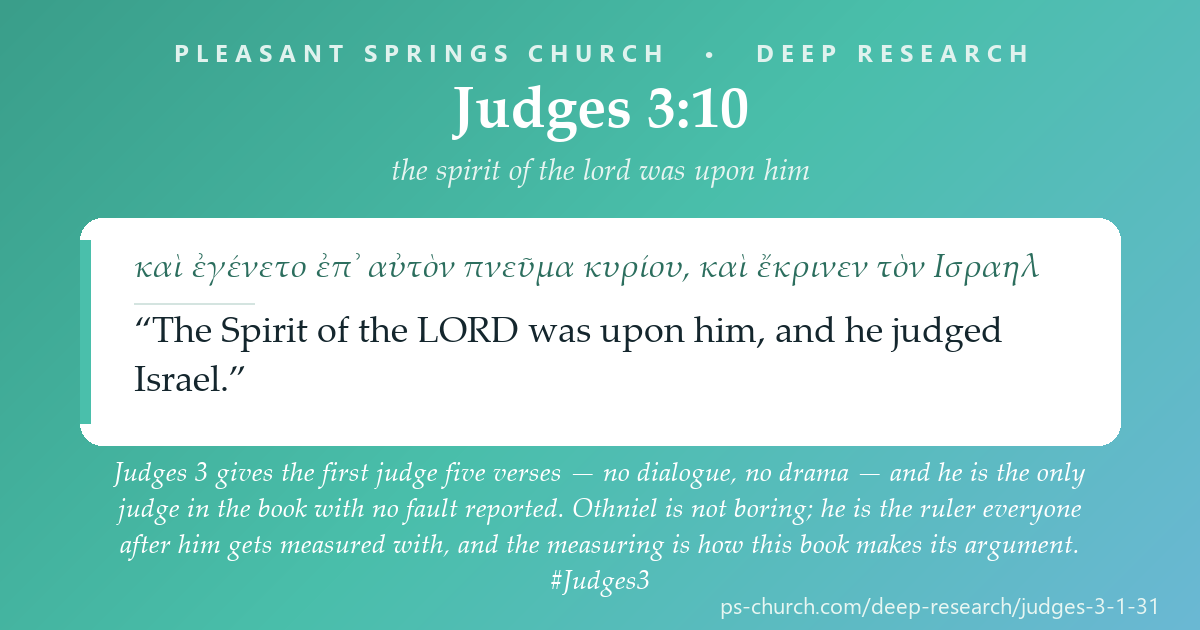
Five verses, no dialogue, no scene, no detail. Othniel does not speak; nobody speaks to him; there is no ambush, no locked door, no bon mot. It is the least interesting deliverance in the book, and that is precisely the job it is doing.
Look at what is in it. He is from Judah, the tribe the book put first when Israel asked who should go up (1:1–2). He is already known to the reader as a soldier of the conquest generation, married to Caleb’s daughter (Josh 15:16–19). Israel cries out and God raises up — the two verbs of the formula. The Spirit of the Lord is on him, and the sentence order matters: the Spirit comes, then he judges, then he goes to war. God gives the enemy into his hand. The land rests forty years. He dies. And nothing else is said about him — no idol, no vow, no ephod, no concubine, no riddle, no vengeance. He is the only judge in the book with no fault reported.
Now hold every later account up against those five verses. Ehud delivers, but no Spirit is mentioned and his method is a deception the narrator never assesses. Gideon delivers, refuses the crown magnificently, and then makes an ephod that all Israel whores after. Jephthah delivers under the Spirit and makes a vow that destroys his household. Samson has the Spirit rush upon him repeatedly while breaking his Nazirite vow piece by piece. Abimelech has no Spirit, no call, and no deliverance at all.
The measuring is the method. Judges does not editorialize, because it does not have to: it hands you a ruler in chapter 3 and then lays every subsequent man beside it. If a study of this chapter has to choose one thing to make sure a reader carries away, it is this — Othniel is not boring, he is the control.
The commentaries, the double Greek text, and three things this page will not do.
Webb, Block, Butler, Boling, Younger, Niditch, McCann and Schneider on Judges; Fernández Marcos on the A and B texts; Alter and Halpern on the Ehud narrative; and a plain statement of where the page stops.
Commentaries & studies:
- Barry G. Webb, The Book of Judges (NICOT, 2012) — the fullest recent evangelical treatment, and the one most attentive to the book as a designed whole rather than a folder of episodes.
- Daniel I. Block, Judges, Ruth (New American Commentary, 1999); Trent C. Butler, Judges (Word Biblical Commentary, 2009); Robert G. Boling, Judges (Anchor Bible, 1975); K. Lawson Younger Jr., Judges and Ruth (NIV Application Commentary, 2002).
- Susan Niditch, Judges (Old Testament Library, 2008); J. Clinton McCann, Judges (Interpretation, 2002); Tammi J. Schneider, Judges (Berit Olam, 2000) — three quite different readings, useful precisely because they disagree.
- Natalio Fernández Marcos, Judges (Biblia Hebraica Quinta 7, 2011) — on the A and B Greek texts of Judges and on the Qumran fragments; his summary is that the Qumran material is scarce and mostly secondary to the Masoretic Text.
- Robert Alter, The Art of Biblical Narrative — the Ehud episode as a set-piece of narrative craft: the ʿeglon/ʿēgel (“calf”) association, the “secret dāḇār” that is both a word and a thing, and the single verb tāqaʿ that thrusts the blade and sounds the horn.
- Baruch Halpern, “The Assassination of Eglon — The First Locked-Room Murder Mystery,” Bible Review 4/6 (1988), developed at length in The First Historians: The Hebrew Bible and History (1988) — a close reading of the architecture of the scene. Halpern’s wider historical conclusions are contested; the analysis of the room is the part everyone uses.
- J. Trebolle Barrera, “4QJudgᵃ” and “4QJudgᵇ,” in Qumran Cave 4: IX (DJD 14, 1995) — the publication of the Judges scrolls, for readers who want to check what is and is not there.
Interpretation notes worth keeping:
- Othniel is the benchmark, and the benchmark is the argument. Five verses, every element of 2:11–19 present and in order, the Spirit named, and not a single fault reported. Every judge after him is described by a narrator who has already shown you what a whole one looks like. Commentators across the theological spectrum read the Othniel paragraph this way — as a paradigm placed first on purpose — and it is the single most useful key a reader can carry into the rest of the book.
- Keep three categories apart: what the text approves, what it reports without approving, and what it condemns. Judges 3 approves the deliverance — God raised up both men, and the Spirit is expressly named on Othniel. It reports without comment Ehud’s stratagem: the false errand, the words “I have a message from God for you” used as cover, the assassination, the escape. And it condemns nothing in this chapter except by the flat statement of 3:7 and 3:12 that Israel did evil. Collapsing those three is how this book gets misread in both directions.
- So: does the Bible approve of the deception? It does not say. That is not evasion; it is the answer. Scripture reports that God raised Ehud up as a deliverer (3:15) and that Moab was subdued and the land rested eighty years (3:30). It offers no assessment whatever of the lie, the concealed weapon, or the killing of a head of state at a private audience. Where Scripture gives no reason, this page says so and stops — and a reader who wants to know what God thinks about deception should go where God speaks about it, not mine a silence.
- Do not turn any of it into technique. There is a long tradition of preaching Ehud as a lesson in courage, boldness, or using the gifts God gave you (“God uses left-handed people!”). The observation is not false — God does deliver through the unlikely, the restricted and the barely-mentioned, and that is a real theme of the chapter — but it becomes false the moment the method becomes the model. The book is not a manual of covert operations, and the New Testament closes that door: our weapons are not of the flesh (2 Corinthians 10:4), and “all who take the sword will perish by the sword” (Matthew 26:52).
- The one verse where the humour is unmistakable is 3:24, and it is aimed at the servants. They see a locked door and infer a bathroom; they stand there “till they were embarrassed” (3:25) rather than knock. The Hebrew idiom is the same one used of Saul in the cave (1 Samuel 24:3), and both Greek texts felt obliged to paraphrase it — differently. Josephus removed it altogether. That trail of squeamishness is itself evidence of what the Hebrew is doing.
- Shamgar’s one verse is doing something the length disguises. No “did evil,” no oppression, no crying out, no raising up, no rest for the land, no death notice, and he is never called a judge. He gets an implement, a number, and the clause “and he also saved Israel.” Some read the verse as an early note attached here because 5:6 mentions him; others as a deliberate compression. What is certain is the effect on a reader working through the book in order: the formula that filled five verses for Othniel and nineteen for Ehud has now shrunk to nothing, and the Philistines — who will still be there at the end of the book — have appeared for the first time.
- The chronology is contested and this page does not adjudicate it. Judges gives eight years, forty years, eighteen years, eighty years, and so on; 1 Kings 6:1 gives 480 years from the exodus to Solomon’s temple; and the judges’ totals do not add up to it unless some of the judgeships overlap or some of the numbers are schematic. Serious readers hold all of those positions. No article of the Christian faith depends on the outcome, and it would be dishonest to pretend the question is closed in either direction.
- Cushan-rishathaim cannot be identified. The name reads in Hebrew like “Cushan of double wickedness” (rishʿātayim is the dual of “wickedness”) — which is very likely a nickname rather than a throne name — and he is otherwise unknown outside this chapter. Proposals have been made and none has carried the field. The honest report is: we do not know who he was.
- The two Greek texts are a feature of this book, not a threat to it. Judges is the clearest case in the Old Testament of a book surviving in two substantially different Greek editions, printed in parallel by Rahlfs. That is a fact about transmission, and nothing on this page turns on choosing between them: where A and B differ materially, both are given.
It is worth stopping on 3:10, because it is the first time in Judges that this is said, and because of the company it will later keep.
What the verse actually claims is modest and enormous at once. It does not say Othniel became a better man. It says the Spirit came upon him, and he judged Israel, and he went out to war, and the Lord gave Cushan-rishathaim into his hand. The victory is credited twice over to God in a single sentence — the Spirit at the front, the giving in the middle — and Othniel’s own hand is mentioned only as the place the enemy is put. Even in the cleanest case, the deliverer is not the point.
And then the same clause goes on to appear over Gideon, over Jephthah, and over Samson — men whose conduct this book declines to commend. That combination is uncomfortable and it should be. It is not a claim that God endorsed everything those men did; it is a claim about who does the delivering. God is not waiting for a qualified nation or a flawless instrument. He works through the ones there are, and the book will keep saying so as the men get worse. That is not a consolation about human potential. It is a statement about mercy that Israel had done nothing to deserve — “the Lord raised up judges, who saved them” (2:16) — and it is the theological spine holding up a book that otherwise only goes downhill.
From a ruler laid down in chapter three to everything the book will measure with it.
Name what you learned, why it matters, and one concrete response.
What should we carry away — and do?
- The most important judge in the book is the one nobody preaches. Othniel gets five verses, no scene and no dialogue — and he is the only one with no fault reported. He is the ruler. Everything after him is measured, and the measuring is how a narrator who refuses to editorialize makes an argument.
- The collapse happened at weddings, not battles. Judges 3:5–6 loses the country in one sentence, and no one draws a sword. Moses had named the sequence four centuries earlier: marriage, then their gods (Deut 7:3–4). What forms a household forms a nation.
- God delivers through the restricted. A man from the tribe of the right hand who cannot use his right hand; a farmer with an ox prod. Neither is a hero of capability. The chapter is not saying “your limitation is secretly your superpower” — it is saying that the deliverance is God’s and he is not shopping for impressive material.
- The Bible is allowed to be funny, and you are allowed to notice. Judges 3:24 is a joke, at the expense of two courtiers too correct to open a door. Reading Scripture well includes reading its comedy as comedy — and then stopping where the narrator stops, without lingering over the killing or enjoying it.
- Report the silence instead of filling it. The text never says whether Ehud’s deception was right. Saying “the text does not say” out loud is a skill, and it is the skill this whole book will demand of you — from here to the vow in chapter 11 and the horror in chapter 19.
- Eighty years is the best it ever gets. The longest peace in Judges comes right here, in chapter 3, and the book has nineteen chapters left. That is the shape of the thing: the argument is that Israel needed something it did not yet have.
Step in response: two things this week. First, read Judges 2:11–19 and Judges 3:7–11 side by side, with a pen, and mark the five formula elements in each — then keep that list beside you for the rest of the book and note what goes missing. Second, pick one silence in Scripture that you have been quietly filling in with an opinion, and stop filling it. Write down what the text actually says, and what it does not, and let the second list stay a list.
Judges 3:10 · to share
LXX (A text) + ESVEvery Deep Research page traces its passage across the whole sweep — the Old Testament, the Second-Temple world between the testaments (historical witnesses, not Scripture), and the New Testament. Follow the thread:
Pleasant Springs Church — Deep Research
Research method after Michael S. Heiser’s Bible Research Method (examine dictionaries → ancient literature → important words → textual connections → academic publications → share), with the Pleasant Springs “Author & Audience” foundation. Scripture set in the Hebrew, the Greek editions named on each page and the ESV (Old Testament), and the Greek New Testament and the ESV (New Testament), per the practice of Pleasant Springs Church. Judges 3 research grounded in Webb (NICOT), Block (NAC), Butler (WBC), Boling (Anchor), Younger (NIVAC), Niditch (OTL), McCann (Interpretation) and Schneider (Berit Olam), with Fernández Marcos (BHQ 7) on the double Greek text, Alter (The Art of Biblical Narrative) and Halpern (Bible Review 4/6, 1988; The First Historians) on the Ehud narrative, and Trebolle Barrera (DJD 14) on the Qumran fragments. ANE background from the Mesha Stele (ANET 320–321) and the Ugaritic Baal-and-Anath cycle (ANET 129–155, battle scene 136); Second-Temple witnesses from Sirach 46:11–12, Josephus Ant. 5.180–197 (Whiston 5.3.3–5.4.3) and Pseudo-Philo LAB 25–28 — all read as witnesses, never leveled with Scripture. Text & numbering: Judges survives in two substantially different Greek forms, A (Alexandrinus) and B (Vaticanus), which Rahlfs prints in parallel on the same page; the Greek printed on this page is the A text throughout, with B named wherever it changes the sense (3:1, 3:11, 3:24, 3:29, 3:31 especially). Chapter and verse numbers carry no offset here — Hebrew, both Greek texts and English all read 3:1–31 alike — the only seam being at 22/23, where B ends v. 22 with a clause MT and A begin v. 23 with. No Qumran fragment preserves any part of Judges 3. The chronology of the judges (the 480 years of 1 Kings 6:1 against the sum of the judgeships) and the identity of Cushan-rishathaim are reported as open questions and not adjudicated. The comedy of the Ehud episode is reported rather than sanitized, and the killing is neither dwelt on nor enjoyed; what the text approves, what it reports without approving, and what it condemns are kept as three distinct categories, and where the narrator is silent this page says so and stops.
Scripture quotations marked ESV are from the ESV® Bible (The Holy Bible, English Standard Version®), © 2001 by Crossway, a publishing ministry of Good News Publishers. ESV Text Edition: 2016. Used by permission. All rights reserved. The ESV text may not be quoted in any publication made available to the public by a Creative Commons license, and the ESV may not be translated in whole or in part into any other language. www.esv.org
|
Did this study bless you today? 💚 Give to Support PS Church100% of gifts go to the General Fund — thank you. |