Twice. That is the first thing to notice about this passage: the same battle is given to us twice, once as a report and once as a song, and the differences between them are not a problem to be solved — they are the reason both are here. Chapter 4 opens with the cycle turning again and Israel sold into the hand of a king with nine hundred chariots of iron. Then, without a word about God raising anybody up, we simply find Deborah — “a prophetess, the wife of Lappidoth… She used to sit under the palm of Deborah… and the people of Israel came up to her for judgment” (4:4–5). She is the only figure in the whole book who is actually judging. She summons Barak; he answers with a condition — “if you will go with me, I will go” — and she answers him: “I will surely go with you. Nevertheless, the road on which you are going will not lead to your glory, for the Lord will sell Sisera into the hand of a woman” (4:9). The army breaks, Sisera runs, and in one flat sentence a woman named Jael kills him with a tent peg while he sleeps — and the narrator says nothing at all about it. Then chapter 5 sings the whole thing again: the Lord marching up from Seir with the mountains shaking, the stars fighting from their courses, the torrent Kishon, the tribes who came and the tribes who sat still, a village called Meroz cursed for staying home, Jael called most blessed of women — and then, astonishingly, a window in an enemy’s house where Sisera’s mother is asking why his chariot is so long in coming. This study works Judges 4:1–5:31 in Hebrew, in both Greek texts of Judges, and in the ESV — and where the ancient Hebrew is genuinely uncertain, it says so instead of smoothing it. See the method →
Judges 4:1–5:31 (selections)
Hebrew · Greek (A / B) · ESVB … τὸ πονηρὸν ἐνώπιον κυρίου καὶ Αωδ ἀπέθανεν. (B keeps the notice of Ehud’s death here, with the Hebrew; A has already given it at the end of ch. 3.)4:1–3“And the people of Israel again did what was evil in the sight of the Lord after Ehud died. And the Lord sold them into the hand of Jabin king of Canaan, who reigned in Hazor. The commander of his army was Sisera, who lived in Harosheth-hagoyim. Then the people of Israel cried out to the Lord for help, for he had 900 chariots of iron and he oppressed the people of Israel cruelly for twenty years.”
B … ὅτι οὐκ οἶδα τὴν ἡμέραν ἐν ᾗ εὐοδοῖ τὸν ἄγγελον κύριος μετ᾿ ἐμοῦ … ἐπορεύθη μετὰ Βαρακ ἐκ Καδης.4:8–9“Barak said to her, ‘If you will go with me, I will go, but if you will not go with me, I will not go.’ And she said, ‘I will surely go with you. Nevertheless, the road on which you are going will not lead to your glory, for the Lord will sell Sisera into the hand of a woman.’ Then Deborah arose and went with Barak to Kedesh.” (Both Greek texts have a clause the Hebrew does not: “for I do not know the day on which the Lord prospers the angel with me.” Underlined above.)
B … καὶ εἰσῆλθεν πρὸς αὐτὸν ἐν κρυφῇ καὶ ἔπηξεν τὸν πάσσαλον ἐν τῷ κροτάφῳ αὐτοῦ καὶ διεξῆλθεν ἐν τῇ γῇ, καὶ αὐτὸς ἐξεστὼς ἐσκοτώθη καὶ ἀπέθανεν.4:21“But Jael the wife of Heber took a tent peg, and took a hammer in her hand. Then she went softly to him and drove the peg into his temple until it went down into the ground while he was lying fast asleep from weariness. So he died.” (A says jaw, B says temple — and each keeps its own word at 4:22 and 5:26. The Hebrew רַקָּה is the temple of the head.)
B … ἐν τῇ ἐξόδῳ σου ἐν Σηιρ … καὶ ὁ οὐρανὸς ἔσταξεν δρόσους … ἀπὸ προσώπου κυρίου Ελωι, τοῦτο Σινα …5:4–5“Lord, when you went out from Seir, when you marched from the region of Edom, the earth trembled and the heavens dropped, yes, the clouds dropped water. The mountains quaked before the Lord, even Sinai before the Lord, the God of Israel.”
B ἐξελέξαντο θεοὺς καινούς· τότε ἐπολέμησαν πόλεις ἀρχόντων· θυρεὸς ἐὰν ὀφθῇ καὶ λόγχη ἐν τεσσαράκοντα χιλιάσιν ἐν Ισραηλ.5:8“When new gods were chosen, then war was in the gates. Was shield or spear to be seen among forty thousand in Israel?” (A: “they chose new gods, like barley bread.” B: “they chose new gods; then the cities of the rulers fought.” The Hebrew here is genuinely hard, and the two Greek translators guessed differently. See the codex note.)
B ἐξ ἐμοῦ Εφραιμ ἐξερρίζωσεν αὐτοὺς ἐν τῷ Αμαληκ· ὀπίσω σου Βενιαμιν ἐν τοῖς λαοῖς σου· ἐν ἐμοὶ Μαχιρ κατέβησαν ἐξερευνῶντες, καὶ ἀπὸ Ζαβουλων ἕλκοντες ἐν ῥάβδῳ διηγήσεως γραμματέως.5:14“From Ephraim their root they marched down into the valley, following you, Benjamin, with your kinsmen; from Machir marched down the commanders, and from Zebulun those who bear the lieutenant’s staff;” (The ESV footnote at this verse reads “Septuagint; Hebrew in Amalek.” It is following the A text — ἐν κοιλάδι, “in the valley” — while the B text agrees with the Hebrew, ἐν τῷ Αμαληκ.)
B εἰς τί ἐκάθισαν ἀνὰ μέσον τῆς διγομίας τοῦ ἀκοῦσαι συρισμοῦ ἀγγέλων; εἰς διαιρέσεις Ρουβην μεγάλοι ἐξετασμοὶ καρδίας.5:16“Why did you sit still among the sheepfolds, to hear the whistling for the flocks? Among the clans of Reuben there were great searchings of heart.” (A gave up on the Hebrew word for “sheepfolds” and simply spelled it out in Greek letters, mosphathaim; B guessed “a double load.”)
B καταρᾶσθε Μηρωζ … ὅτι οὐκ ἤλθοσαν εἰς βοήθειαν κυρίου, εἰς βοήθειαν ἐν δυνατοῖς.5:23“Curse Meroz, says the angel of the Lord, curse its inhabitants thoroughly, because they did not come to the help of the Lord, to the help of the Lord against the mighty.”
B εὐλογηθείη ἐν γυναιξὶν Ιαηλ … ἀπὸ γυναικῶν ἐν σκηναῖς εὐλογηθείη.5:24“Most blessed of women be Jael, the wife of Heber the Kenite, of tent-dwelling women most blessed.”
B διὰ τῆς θυρίδος παρέκυψεν μήτηρ Σισαρα ἐκτὸς τοῦ τοξικοῦ, διότι ᾐσχύνθη ἅρμα αὐτοῦ, διότι ἐχρόνισαν πόδες ἁρμάτων αὐτοῦ.5:28“Out of the window she peered, the mother of Sisera wailed through the lattice: ‘Why is his chariot so long in coming? Why tarry the hoofbeats of his chariots?’” (A adds a line the Hebrew does not have: she is watching for those returning with Sisera. B read the Hebrew verb “delay” as if it were “be ashamed” — “because his chariot is ashamed.”)
B … οἰκτίρμων οἰκτιρήσει εἰς κεφαλὴν ἀνδρός …5:29–30“Her wisest princesses answer, indeed, she answers herself, ‘Have they not found and divided the spoil?—A womb or two for every man; spoil of dyed materials for Sisera, spoil of dyed materials embroidered, two pieces of dyed work embroidered for the neck as spoil?’”
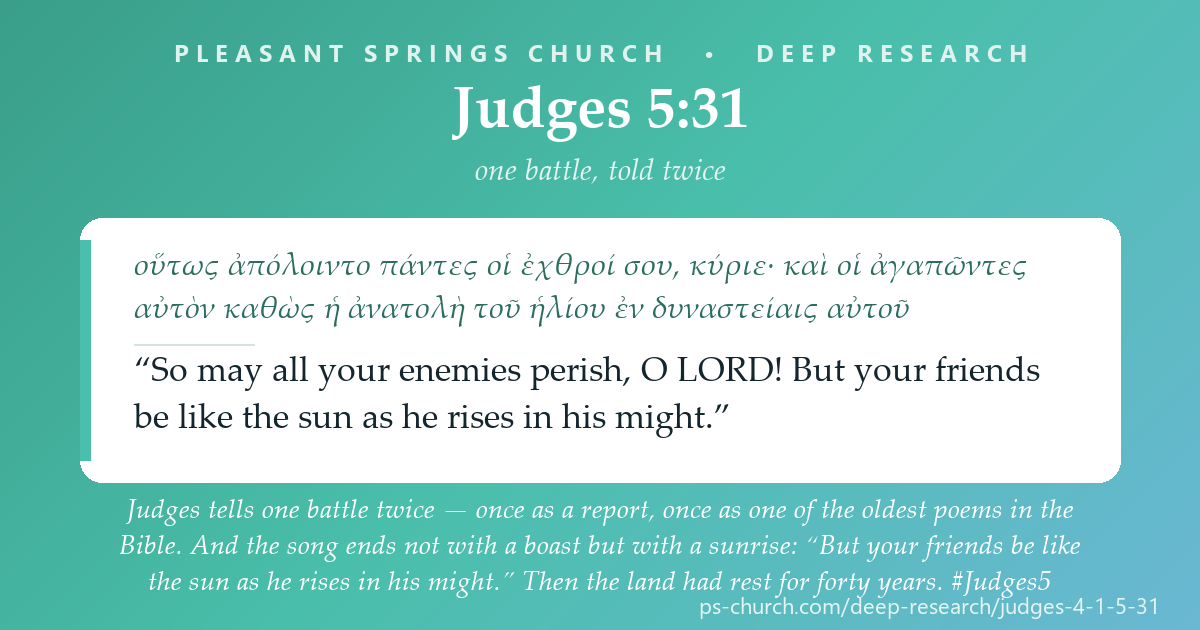
B … ὡς ἔξοδος ἡλίου ἐν δυνάμει αὐτοῦ. καὶ ἡσύχασεν ἡ γῆ τεσσαράκοντα ἔτη.5:31“So may all your enemies perish, O Lord! But your friends be like the sun as he rises in his might.” And the land had rest for forty years.
The Shape of the Passage
Parallel panelsThese two chapters stand fourth in the book’s sequence of deliverers, after Othniel, Ehud and Shamgar (ch 3) and before Gideon (chs 6–8). Behind them is the interpretive key laid down at 2:11–19 and the unfinished conquest of chapter 1; behind that is Hazor, burned in Joshua 11.
Author
A narrator who tells you the same thing twice and refuses to referee between the two tellings. There are only two places in the Old Testament where a deliverance is narrated in prose and then immediately sung — this one and Exodus 14–15 — and here the two accounts do not simply agree. The prose has Sisera come down from his chariot and flee on foot; the poem has the stars fight from their courses and the torrent Kishon sweep the army away. The prose gives Jael a hammer and a tent peg and one sentence; the poem gives her four lines and a benediction. Neither is a correction of the other. A reader who wants to know “what really happened” is being handed two instruments, not one — a report and a song — and the book plainly expects you to use both.
And in the prose he withholds every comment you want. This is the governing habit of Judges, and it is loudest here. Chapter 4 tells you that Jael drove a tent peg through the temple of a sleeping man whose king was at peace with her husband’s house (4:17), and then says nothing — no praise, no blame, no adverb. Robert Alter’s name for this technique is reticence: the narrator’s silences are craft, and the gaps are where the reader is made to work. It would be easy to fill the gap in either direction, and both fillings are wrong. What we can say is what the text says: the Song praises her (5:24), the prose says nothing at all, and those are two different facts. Holding them apart is the whole discipline of reading this book.
The cycle is running — with one part missing. Judges 2:11–19 lays down the formula the rest of the book varies: did evil → the Lord sold them → they cried out → the Lord raised up a deliverer → the land had rest. Here you get four of the five, exactly: evil (4:1), sold (4:2), cried out (4:3), rest (5:31). The one that is missing is the one about God acting: nowhere does this account say the Lord raised up Deborah or Barak. Compare 3:9 of Othniel and 3:15 of Ehud, where the phrase is explicit. Deborah is simply there, already judging when the chapter opens, and Barak has to be sent for. It is the first crack in the formula, and the book will go on widening it.
Audience
People who could hear their own tribe’s name called out. The heart of the Song is a roll-call (5:14–18), and it is not decoration — it is a public reckoning. Ephraim, Benjamin, Machir, Zebulun, Issachar and Naphtali came. Reuben debated it: “among the clans of Reuben there were great searchings of heart,” a line so good it is said twice, and it means they had a very thorough meeting and stayed home with the flocks. Gilead stayed beyond the Jordan. Dan stayed with the ships. Asher “sat still at the coast of the sea.” And a place called Meroz, which has never been securely located and which appears nowhere else in Scripture, is cursed by the angel of the Lord for exactly one offence: it “did not come to the help of the Lord” (5:23). An audience singing this knew which line was about them.
They also knew what nine hundred chariots meant. The Israel of this chapter is hill-country infantry facing the iron-fitted chariot corps of the plain — the same problem 1:19 had already named. The poem’s answer is not a better army: “From heaven the stars fought, from their courses they fought against Sisera. The torrent Kishon swept them away” (5:20–21). A wadi in flood is the one thing on earth that turns a chariot corps into a liability. The song does not say “it rained”; it says heaven fought. That is not a substitute for the history. It is the history, sung by people who knew who had done it.
A note on how this page handles the hard parts. Three of them. Jael is reported, not sanitized and not celebrated. The Song’s obscurities are flagged rather than smoothed — the ESV itself footnotes three verses in this chapter as uncertain. And the last thing the enemy’s mother’s ladies say (5:30) is stated once, plainly, and not dwelt on: they are talking about captured women. The poem lets them say it and then stops.
Orient on a prophetess who judges, a general who bargains, a woman in a tent, and a battle sung twice.
Search by topic: Deborah; Barak; Jael; Kenites; Heber; Jabin; Hazor; Sisera; Harosheth-hagoyim; chariotry and iron in the Late Bronze / Iron I transition; Kishon; Taanach; Megiddo; Mount Tabor; prophetess; judge (shophet) and judging; Meroz; Song of Deborah; archaic Hebrew poetry; Judges, Greek texts of (A and B).
Which articles are relevant?
- Anchor Bible Dictionary — “Deborah,” “Barak,” “Jael,” “Sisera,” “Jabin,” “Hazor,” “Kenites,” “Kishon,” “Taanach,” “Megiddo,” “Meroz,” “Judges, Book of,” “Poetry, Hebrew.”
- Dictionary of the OT: Historical Books (IVP) — “Judges, Book of,” “Deborah,” “Women,” “Warfare,” “Chariots,” “Prophets and Prophecy,” “Poetry,” “Tribes of Israel.”
- NIDOTTE / TDOT — יָד (yāḏ, hand), שָׁפַט (šāpaṭ, judge), נָבִיא (nāḇîʾ, prophet), תִּפְאֶרֶת (tipʾeret, glory), יָתֵד (yātēḏ, tent peg), בָּרַךְ (bāraḵ, bless), אָרַר (ārar, curse), רֶחֶם (reḥem, womb).
- For the Greek — any dictionary article on the Septuagint of Judges should name the two texts. If it speaks of “the LXX of Judges” in the singular without qualification, treat it with care: this is the classic double-text book of the Greek Old Testament, alongside Esther, Tobit and Daniel.
Bibliography surfaced:
- Barry G. Webb, The Book of Judges (NICOT); Daniel I. Block, Judges, Ruth (NAC); Trent C. Butler, Judges (WBC); Robert G. Boling, Judges (Anchor Bible); K. Lawson Younger Jr., Judges and Ruth (NIVAC).
- Susan Niditch, Judges (OTL); J. Clinton McCann, Judges (Interpretation); Tammi J. Schneider, Judges (Berit Olam).
- Natalio Fernández Marcos, Judges (Biblia Hebraica Quinta, 2011) — the current critical edition of the Hebrew, with a full account of the Greek witnesses.
- Philip E. Satterthwaite, “To the Reader of Judges,” in A New English Translation of the Septuagint — the clearest short statement in English of why there are two Greek texts and what each is.
A storm god who cracks the clouds, a pharaoh who counted 924 captured chariots, and the retellings that could not leave Jael silent.
Read the theophany of 5:4–5 against the storm-god language of Ugarit; read “900 chariots of iron” against an Egyptian quartermaster’s inventory taken at Megiddo; then watch what Josephus and Pseudo-Philo do with the parts of the story the biblical narrator leaves bare.
Which parallels shed light on religion and worldview?
The storm-theophany of 5:4–5 speaks a language the whole region spoke. In the Ugaritic Baal cycle, when Baal finally has his palace, the text says: “Baal op[ens] rifts in [the cloud]s. Ba[al gives] forth his holy voice… the mountains quake, A-tremble are… East and west, earth’s high places reel” (ANET 134–135, Ginsberg’s translation). Judges 5 uses the same furniture — the earth trembling, the clouds dropping water, the mountains quaking — and puts it to a use no Canaanite poem does. The difference is the direction of the march. Baal’s thunder announces a god who has just won a palace on his own mountain. Israel’s poem has the L' + SC[1:] + ' arriving from somewhere else — “when you went out from Seir, when you marched from the region of Edom” — to fight for a people who cannot fight for themselves. The shared vocabulary is not a problem to be explained away. It is how you say “God came” in the twelfth century BC, and the point is who came, and for whom.
Nine hundred chariots of iron is not a round number invented to impress. Centuries before this, Thut-mose III took Megiddo — the very ground of Judges 5:19, “at Taanach, by the waters of Megiddo” — and his scribes itemised the haul: “1 chariot worked with gold, with a body of gold, belonging to that enemy, [1] fine chariot worked with gold belonging to the Prince of [Megiddo]… and 892 chariots of his wretched army — total: 924” (Annals of Thut-mose III, ANET 237). A Canaanite coalition in that plain fielding a chariot corps in the high hundreds is exactly what the Egyptian records describe. Judges 4:3 is reporting a recognisable order of battle, and 1:19 had already told you Israel had no answer to it.
Dating and archaeology are contested, and this page names the positions without settling them. Three live questions touch these chapters. (1) Jabin and Hazor. Joshua 11 has Joshua kill a Jabin king of Hazor and burn the city; Judges 4 has a Jabin king of Canaan reigning in Hazor. Some read Jabin as a dynastic throne-name (as Abimelech functions in Genesis); some posit a rebuilt Hazor under a later ruler; some regard the two accounts as independent traditions of one conflict. Hazor’s excavated Late Bronze destruction is real and large, and its date and cause are argued about in print. (2) The chronology. The 480 years of 1 Kings 6:1 will not add up with the summed years of the judges unless some judgeships overlap — which many think they plainly do, since several are explicitly regional. (3) Iron I settlement. The highland villages of Iron I are the archaeological horizon in which these events are usually placed, and what they prove is disputed. We do not adjudicate any of these, and nothing in the Christian faith rests on the outcome. The Merneptah Stele (c. 1207 BC) is worth knowing as the first mention of “Israel” outside the Bible — a people, not a city, already in Canaan; and the frequently repeated equation of the Amarna letters’ ʿApiru with the Hebrews is a contested proposal, never an established result, and this page does not lean on it.
- The Baal cycle, II AB (the building of Baal’s house), Ugarit, c. 14th–13th c. BC (ANET 134–135) (a Canaanite myth — a witness, not Scripture) — “Baal op[ens] rifts in [the cloud]s… the mountains quake… earth’s high places reel.” The nearest thing we have to the idiom of Judges 5:4–5.
- Annals of Thut-mose III, the Megiddo campaign, fifteenth century BC (ANET 237) (an Egyptian royal record — a witness, not Scripture) — the captured-chariot inventory, “892 chariots of his wretched army — total: 924,” taken on the same plain the Song names.
- Merneptah Stele, c. 1207 BC (an Egyptian victory hymn — a witness, not Scripture) — the earliest extra-biblical naming of Israel, as a people in Canaan. (ANET prints it in the 370s, past the range of our local scan; the page number is therefore not given here.)
- Josephus, Antiquities 5.198–209 (= Whiston 5.5.1–4) (Second-Temple — a witness, not Scripture) — he keeps Deborah’s rebuke and sharpens it into direct speech: “Thou, O Barak, deliverest up meanly that authority which God hath given thee into the hand of a woman, and I do not reject it!” He turns the milk into an explanation — Jael “gave him sour milk, of which he drank so unmeasurably that he fell asleep” — and has her drive the nail “through his temples into the floor.” And then, tellingly, he omits the Song of chapter 5 entirely, closing instead with Barak commanding Israel forty years.
- Pseudo-Philo, Liber Antiquitatum Biblicarum 30–33 (first century AD — a witness, not Scripture) — a retelling that expands Judges enormously, gives Deborah a “new song” of her own (ch. 32) and a farewell speech in which she is called mother (ch. 33). At 31:7 Jael, who in Scripture never speaks before the act, prays: “Strengthen my arm this day, O Lord, for your sake and for your people’s sake, and for those who put their trust in you.” Note what has happened: the retelling supplies exactly the moral commentary the biblical narrator withholds. That is a witness to how early readers felt the silence — not a licence for us to fill it.
- b. Megillah 14a (rabbinic-era — a witness, not Scripture) — Deborah is counted among the seven prophetesses (“Sarah, Miriam, Deborah, Hannah, Abigail, Huldah, and Esther”), and the palm tree of 4:5 is explained practically: since men came to her for judgment, “she established for herself a place out in the open and visible to all.” The same folio reads “wife of Lappidoth” as “woman of flames,” from the wicks she made for the sanctuary — a homily on the name, not a translation of it.
- Sirach 46:11–12 (Second-Temple — a witness, not Scripture) — the judges remembered together, “may their memory be blessed,” under one general clause about those “whose hearts did not fall into idolatry.” No judge is named and none is examined. It is the earliest surviving example of the flattening this page is trying to avoid.
The book of Judges reports things it does not commend, and this is the first place a reader will feel it. So keep three columns and do not let them run together.
What the text approves. The Song — a poem the book presents as sung by Deborah and Barak “on that day” — says: “Most blessed of women be Jael… of tent-dwelling women most blessed” (5:24). That is praise, in Scripture, and it should not be explained away.
What the text reports without approving. The prose of 4:17–22. Sisera runs to that tent because “there was peace between Jabin the king of Hazor and the house of Heber the Kenite” (4:17). Jael goes out to meet him and says “do not be afraid.” He asks for water; she gives milk. He asks her to stand at the door and say no one is there. Then she takes a tent peg and a hammer and kills him in his sleep. The narrator offers not one word of evaluation — not praise, not blame, not so much as an adverb. Say that, and stop. Supplying the condemnation the narrator withholds is as much a misreading as supplying an approval.
What the text condemns. Not Jael — anywhere. What the passage condemns is Meroz, for staying home (5:23).
So the honest summary is: the poem blesses her; the prose declines to comment; the book never censures her; and none of that adds up to a rule for anybody’s conduct. Judges is not a manual of ethics with worked examples. It is the record of a period the book itself will end by calling a time when “everyone did what was right in his own eyes.” God delivered Israel through this. The text does not tell you to imitate it, and neither will we.
Hand, judgment, glory, a tent peg — and the one word both Greek translators would not write.
Follow yad (“hand”) through both chapters and you have the argument; watch shaphat mean something in 4:4–5 that it means nowhere else in the book; and watch raqqah split the two Greek texts in half.
“Hand” — the key word of both chapters and the plainest noun in the language. Israel is sold into Jabin’s hand; Sisera is given into Barak’s hand; he will be sold into the hand of a woman; Jael puts a hammer in her hand; Israel’s hand presses harder; and the poem sings “her hand to the tent peg, her right hand to the workmen’s mallet.” Both Greek texts follow it faithfully with χείρ — and at 5:26 both specify a detail the Hebrew leaves open: τὴν χεῖρα αὐτῆς τὴν ἀριστεράν, “her left hand.” Pseudo-Philo says left-handed too.
“Judge” and “judgment.” The book’s title word usually means something closer to deliver or govern — the judges are war-leaders, not magistrates. Deborah is the exception, and the text goes out of its way to say so twice in one breath: she was judging (שֹׁפְטָה) Israel, and the people came up to her for judgment (לַמִּשְׁפָּט). She is the only figure in the book actually holding court. The Greek keeps the doubling: ἔκρινεν… τοῦ κρίνεσθαι in A; B says εἰς κρίσιν, “for a decision.”
“Prophetess” (LXX προφῆτις, both texts). The word is used of only a handful of women in the Old Testament — Miriam (Exod 15:20), Deborah, Huldah (2 Kgs 22:14), Noadiah (Neh 6:14), and Isaiah’s wife (Isa 8:3). It is the first thing said about Deborah, before “wife” and before “judging”: her authority in the chapter is the authority of someone who has heard from God, which is why Barak obeys a summons she sends.
“Glory, splendour, ornament.” Deborah’s answer to Barak’s condition is not that he will fail but that “the road on which you are going will not lead to your tipʾeret.” The Greek chose a strikingly plain word for it: τὸ προτέρημά σου (both texts), roughly “your advantage” or “the credit that would have been yours first.” The victory is not in doubt. Only the name attached to it is.
“Tent peg” (LXX πάσσαλος). Not a weapon — a piece of a woman’s working equipment in a nomadic camp, along with the מַקֶּבֶת (maqqeḇet, mallet). The same noun is used in Exodus for the pegs of the tabernacle. The detail is domestic, and it is exactly why the poem can put it beside “the workmen’s mallet”: the tools of setting up a tent, used once for something else.
“Temple” (of the head). This is the clearest single place to see the two Greek texts part company. B renders it κρόταφος, “temple” — which is what the Hebrew means. A renders it γνάθος, “jaw” or “cheek” — and does so consistently, at 4:21, 4:22 and 5:26. Two translators, one Hebrew word, two different answers, carried right through the book. That is what “Judges has two Greek texts” looks like on the page.
“Bless.” The Song opens and closes its first movement with “bless the Lord” (5:2, 9) and then turns the same verb on a person: “most blessed of women be Jael… of tent-dwelling women most blessed” (5:24, תְּבֹרַךְ… תְּבֹרָךְ) — a bracket around the line. A caution against a pun that is often heard and is not there: Barak is בָּרָק, “lightning,” with a qoph; “bless” is בָּרַךְ, with a kaph. They sound alike and are unrelated roots, and this page will not build anything on the resemblance.
“Womb” — and, from the same three consonants, “compassion.” In 5:30 the ladies of Sisera’s court use it of the women who would be taken as spoil; the ESV renders it exactly, “a womb or two for every man,” and this page reports that once and does not linger. What is worth seeing is that both Greek translators went the other way with the root and produced something almost unreadable rather than write it: A has φιλιάζων φίλοις (“showing friendship to friends”), B has οἰκτίρμων οἰκτιρήσει (“being compassionate he will show compassion”). Ancient readers flinched here too.
A place name that occurs once in the Bible and nowhere else, and which has never been identified on the ground. It is cursed — “curse its inhabitants thoroughly” — for one thing only: not coming. The Greek is unsure even of the spelling (A Μαρωζ, B Μηρωζ). It is the sharpest word in the Song, and it is not aimed at Sisera.
Where this vocabulary surfaces later:
- Judges 9:53–54 — the second woman in the book to kill a commander, and this time the narrator makes the point out loud: Abimelech, dying of a millstone dropped by “a certain woman,” asks his armour-bearer to finish him “lest they say of me, ‘A woman killed him’” — after the narrator has already told you her aim was true. Deborah’s “into the hand of a woman” (4:9) is the first half of that pair (see Judges 9).
- 1 Samuel 12:9–11 — Samuel’s recital of the cycle names “Sisera, commander of the army of Hazor” and lists the deliverers God sent. It is the Old Testament’s own summary of the book, and it treats the whole period as a single argument about forgetting and being rescued anyway.
- Psalm 83:9–10 — “Do to them as you did to Midian, as to Sisera and Jabin at the river Kishon.” Centuries later this battle is still the standard example of a deliverance nobody engineered.
- Hebrews 11:32 — “Gideon, Barak, Samson, Jephthah.” The New Testament names among the faithful the man who said “if you will not go with me, I will not go” — and does not name Deborah. That is worth sitting with rather than tidying: the list is a list of people who acted in faith, not a ranking, and its most striking feature is how much it forgives.
- Exodus 15:20–21 — “Miriam the prophetess… took a tambourine in her hand” and sang the victory. Judges 5 is the second of these, and the resemblance is deliberate (see Exodus 15).
The cycle it half-keeps, the theophany it shares with Moses, and the prose-then-poem shape it inherits from the sea.
Trace four: the cycle formula of 2:11–19 and the piece that is missing here; the Seir/Edom theophany that Deuteronomy 33 and Habakkuk 3 also sing; the Exodus 14–15 pattern of a battle told twice; and the two Jabins of Hazor.
Which cross-references matter?
- Judges 2:11–19 — the formula, stated in the abstract, that every account in the book then varies: did evil → sold them → cried out → raised up a deliverer → the land had rest. Judges 4–5 keeps four of the five and drops the fourth: this is the first deliverance in the book of which it is never said that the Lord raised up the deliverer. Compare 3:9 (“the Lord raised up a deliverer… Othniel”) and 3:15 (“the Lord raised up for them a deliverer, Ehud”) with 4:4, where Deborah is simply already there (see Judges 1–2 and Judges 3).
- Deuteronomy 33:2 — “The Lord came from Sinai and dawned from Seir upon us; he shone forth from Mount Paran.” Judges 5:4–5 sings the same march from the same direction, and 5:5’s “this Sinai” is close enough to Moses’ blessing that the ESV footnotes an alternative rendering, “the One of Sinai” (see Deuteronomy 33). The same theophany recurs at Psalm 68:7–8 and Habakkuk 3:3–6: four poems, one memory.
- Exodus 14 and 15 — the pattern this passage is built on. A deliverance narrated in prose, then sung; water doing what an army could not; and a prophetess with an instrument leading the singing (see Exodus 14 and Exodus 15). Judges 5:21, “the torrent Kishon swept them away,” is the Song of the Sea in a Galilean wadi.
- Joshua 11:1–13 — Jabin king of Hazor, the northern coalition, and Hazor burned, “for Hazor formerly was the head of all those kingdoms.” Judges 4 has a Jabin king of Canaan reigning in Hazor again. Report both and do not silently harmonise them — the readings (throne-name, rebuilt city, parallel traditions) are laid out at Stage 2, and this page picks none (see Joshua 11).
- Judges 1:19 — “he could not drive out the inhabitants of the plain, because they had chariots of iron.” The problem of Judges 4:3 is set up one chapter into the book, and the Song’s answer is that the plain belongs to whoever controls the weather (see Judges 1).
- Genesis 35:8 — “And Deborah, Rebekah’s nurse, died, and she was buried under an oak below Bethel; so he called its name Allon-bacuth.” Judges 4:5 puts its Deborah under a named tree “between Ramah and Bethel.” The names and the neighbourhood coincide; Scripture draws no connection between the two women and neither will we — but it is a real echo, and readers notice it (see Genesis 35).
- Numbers 10:29–32; Judges 1:16; 4:11 — the Kenites, descended from Moses’ father-in-law’s people, living inside Israel without being Israel. Jael is a woman on a boundary in every sense, and the text tells you so before it tells you what she does.
Set the two chapters side by side and the gains are countable.
It gives you heaven. The prose says the Lord routed Sisera (4:15) and leaves the mechanism alone. The poem says the stars fought from their courses and the Kishon carried them off (5:20–21). Same event, and the poem is not decorating it — it is telling you who else was in the field.
It names the absent. Chapter 4 mentions two tribes, Zebulun and Naphtali. Chapter 5 calls the register: six who came, four who did not, and a village cursed for staying home. A poem can shame people a battle report cannot.
It gives the enemy a mother. This is the extraordinary thing, and it is a rare move in ancient victory poetry of any nation. At 5:28 the camera leaves the battlefield entirely and goes to a window in a house we have never seen, where a woman is watching a road. She is not named. She is not mocked for being wrong. She asks a perfectly ordinary question — why is his chariot so long in coming? — and her ladies, and then she herself, produce the answer she wants: they must be dividing the spoil. And then the poem lets one of them say the ugly thing out loud, about the women in that spoil, and stops.
What does that do to a reader? It does not soften the victory; the very next line is “so may all your enemies perish.” But it makes triumph cost something to look at. For four verses the poem has made you stand next to a woman waiting for a son who is already dead, and it has let her household reveal, in their own mouths, precisely what they expected him to be doing. You are not asked to pity her and you are not asked to gloat. You are asked to see her. Very few war songs in any language do that, and the ones that do are the ones still worth reading three thousand years later.
The commentaries, the two Greek texts, the archaic poetry — and the questions this page leaves open.
Webb, Block, Butler, Boling, Younger, Niditch, McCann and Schneider on Judges; Fernández Marcos and Satterthwaite on the Greek; Cross and Freedman, Coogan and Halpern on the Song; Rezetko on the Qumran fragments.
Commentaries & studies:
- Barry G. Webb, The Book of Judges (NICOT, 2012) — the fullest recent evangelical commentary, and unusually careful about what the narrator does and does not say.
- Daniel I. Block, Judges, Ruth (NAC); Trent C. Butler, Judges (WBC); Robert G. Boling, Judges (Anchor Bible); K. Lawson Younger Jr., Judges and Ruth (NIVAC).
- Susan Niditch, Judges (OTL); J. Clinton McCann, Judges (Interpretation); Tammi J. Schneider, Judges (Berit Olam) — three quite different readings, all attentive to the women in these chapters.
- Robert Alter, The Art of Biblical Narrative and The Art of Biblical Poetry — for reticence and the gap in chapter 4, and for reading chapter 5’s parallelism as intensification rather than repetition. (Cited for the literary observation only; the theological frame here is the church’s, not his.)
- Frank Moore Cross and David Noel Freedman, Studies in Ancient Yahwistic Poetry — the standard entry point for the argument that Judges 5, Exodus 15 and Deuteronomy 33 preserve the oldest Hebrew verse we have.
- Michael D. Coogan, “A Structural and Literary Analysis of the Song of Deborah,” CBQ 40 (1978); Baruch Halpern, “The Resourceful Israelite Historian: The Song of Deborah and Israelite Historiography,” HTR 76 (1983) — on the poem’s shape, and on the relationship between the poem and the prose.
- Natalio Fernández Marcos, Judges (BHQ, 2011), and Philip E. Satterthwaite, “To the Reader of Judges” (NETS) — the two texts, the manuscript groups behind them, and the kaige question. Dominique Barthélemy, Les devanciers d’Aquila (1963), is the study that put kaige on the map.
- Robert Rezetko, “The Qumran Scrolls of the Book of Judges,” Journal of Hebrew Scriptures 13 (2013) — a full inventory of what Qumran actually preserves of this book.
Interpretation notes worth keeping:
- The Song’s Hebrew is genuinely hard, and pretending otherwise is not piety. Judges 5 is widely held to be among the oldest poetry in the Bible, and its language shows it: rare words, archaic forms, and several lines nobody can render with confidence. You do not have to take a scholar’s word for this — the ESV flags the difficulty three times in this one chapter: at 5:5 (“Or before the Lord, the One of Sinai”), at 5:10 (“The meaning of the Hebrew word is uncertain”), and at 5:11 (“Or archers; the meaning of the Hebrew word is uncertain”) — and at 5:14 it tells you outright that it has followed the Septuagint against the Hebrew. Then look at 5:8, 5:13–14 and 5:15–16 in the codex above and watch the two Greek translators produce, from the same consonants, sentences that are not about the same subject. Where the text is uncertain, this page says so.
- “Into the hand of a woman” — a rebuke, or simply a fact? Both are argued. On the first reading, 4:9 is a mild judgment on Barak’s condition: he asked for a prophetess as insurance and forfeited the credit. On the second, Deborah is announcing a divine method, not a penalty — God repeatedly wins by means the culture would not have picked (Ehud left-handed, Gideon with three hundred, a millstone dropped by a woman in ch 9). The text supports the first mildly and the second strongly, and it does not despise Barak either way: he goes, he wins, and Hebrews 11:32 puts him among the faithful. What it will not support is the sermon that makes Barak a coward and Deborah a reproach to him — the chapter never says either thing.
- The prose and the poem differ, and that is a feature. The prose has Sisera abandon the chariot and flee on foot; the poem has him fall at Jael’s feet in a fourfold cascade (5:27). The prose has him asleep; the poem’s picture is famously harder to reconstruct. Readers who require a single reconciled film reel will find the two accounts irritating. Readers who have ever heard a soldier’s report and then a nation’s song about the same day will not.
- The two Greek texts are the book’s signature problem, and they are not a threat to it. There was still no Göttingen critical edition of Greek Judges when NETS was prepared. Rahlfs printed A and B in parallel because he judged them separate recensions; Brooke–McLean printed a diplomatic text whose base is essentially Vaticanus. Most now think A and B descend from one archetype at different degrees of revision, and that the Old Greek is best sought in the Lucianic subgroup within the A tradition. What varies is the Greek, not the story: both texts have Deborah judging, Barak bargaining, Jael acting, the mother at the window and the land at rest. Where they change the sense of a line we print both, above.
- Qumran does not help here, and it is worth knowing why. The Judges scrolls are few and fragmentary: 1QJudg (1Q6) preserves parts of chapters 6 and 9 (and, less certainly, 8); 4QJudgᵃ (4Q49) preserves part of chapter 6 and is famous for lacking 6:7–10; 4QJudgᵇ (4Q50) preserves parts of chapters 19 and 21. None of them preserves any part of chapters 4–5. For the Song of Deborah we have the Masoretic Hebrew and the two Greek texts and nothing older, and a page that implied otherwise would be inventing evidence.
- Josephus is a witness to reception, not to the event. He keeps Deborah’s rebuke, explains the milk, and drops the Song entirely (Ant. 5.198–209). Pseudo-Philo goes the other way and gives Deborah a whole new song plus a farewell (LAB 32–33) and puts a prayer in Jael’s mouth (31:7). Both are doing what readers always do with a narrator who will not comment: they comment. Noting that is not a criticism of them; it is a warning to us.
- What this page deliberately does not do. It does not decide between the two Jabins. It does not date the battle. It does not turn Jael into a heroine or a villain. And it does not use the Song’s curse on Meroz as a stick for anyone alive: the verse is about a village that would not come to a battle in the twelfth century BC, and the only legitimate use of it is the one the Song itself makes — a question about whether you showed up.
One quiet clause in 4:5 deserves more attention than it usually gets. Every other judge in this book is a rescuer: God raises up a man, the man kills somebody important, the land has rest, and the man mostly disappears again. Deborah is doing something else entirely when we meet her. She is sitting in one fixed place under a named tree in the hill country of Ephraim, and people are walking uphill to her with disputes. Nobody else in the book of Judges is doing that.
It matters because of what the book is finally about. Judges ends with a nation in which “everyone did what was right in his own eyes” — a collapse of shared judgment before it is a collapse of morals. And at the start of the decline the text shows us a woman under a palm tree, in the open where everyone can see, doing the thing that keeps a people a people: hearing both sides and saying what is right. She is a prophetess before she is a judge, which means the standard she is applying is not her own.
The rest of the chapter is chariots and iron and a tent peg, and it is the part that gets preached. But the sentence that quietly names what Israel is about to lose is the one about the queue of people walking up the hill.
From a woman under a palm tree to a woman at a window — and a song that ends with the sunrise.
Name what you learned, why it matters, and one concrete response.
What should we carry away — and do?
- Read the report and the song. God gave this event to us twice on purpose. The prose tells you what happened; the poem tells you what it meant, who was missing, and what it cost the other side. Most of us were trained to read only one of those and to distrust the other. Both are Scripture.
- The formula is already breaking. Evil, sold, cried out, rest — but nobody is raised up. Deborah is simply already there. Small crack, early in the book; by the end there is no judge left at all, only a refrain about everyone doing what was right in his own eyes.
- Keep ‘approved,’ ‘reported,’ and ‘condemned’ in separate columns. The Song blesses Jael. The prose says nothing about her. The book condemns Meroz. Merge those and you will either turn Judges into a hero cycle or into a lecture, and it is neither.
- Where the text is uncertain, say so. Three ESV footnotes and two wildly different Greek translations in one chapter are not a crisis. They are what an ancient poem looks like when you are honest about it — and a faith that can only survive on smoothed edges is being trained to flinch.
- Meroz is the verse for churchgoers. The Song curses no Canaanite by name. It curses a village that stayed home — “because they did not come to the help of the Lord.” Reuben had a very thorough discussion about it first. That is the line most likely to be about us.
- And the poem ends by looking at the enemy’s mother. Before the last line of praise, four verses at a window with a woman waiting for a son who is not coming. Whatever else victory is in Scripture, it is never allowed to be simple.
Step in response: two things this week. First, read Judges 4 and Judges 5 aloud, back to back, in one sitting — it takes about eight minutes — and write down three things the poem tells you that the prose does not. Second, ask the Meroz question about one specific thing: where is help currently needed that you have had a great searching of heart about and not yet gone to?
Judges 5:31 · Greek A · to share
LXX (A) + ESVEvery Deep Research page traces its passage across the whole sweep — the Old Testament, the Second-Temple world between the testaments (historical witnesses, not Scripture), and the New Testament. Follow the thread:
Pleasant Springs Church — Deep Research
Research method after Michael S. Heiser’s Bible Research Method (examine dictionaries → ancient literature → important words → textual connections → academic publications → share), with the Pleasant Springs “Author & Audience” foundation. Scripture set in the Hebrew, the Greek editions named on each page and the ESV (Old Testament), and the Greek New Testament and the ESV (New Testament), per the practice of Pleasant Springs Church. Judges 4–5 research grounded in Webb (NICOT), Block (NAC), Butler (WBC), Boling (Anchor), Younger (NIVAC), Niditch (OTL), McCann (Interpretation) and Schneider (Berit Olam), with Alter on narrative reticence and on parallelism as intensification, and Cross–Freedman, Coogan (CBQ 40) and Halpern (HTR 76) on the archaic poetry of the Song. ⚠️ The Greek. Judges survives in two substantially different Greek forms, A (Codex Alexandrinus plus the Origenic and Lucianic groups) and B (Codex Vaticanus), which Rahlfs printed in parallel on the same page; there is no single “the LXX” for this book. The Greek column above prints Rahlfs’s A text, with B shown wherever it changes the sense — most often in chapter 5, where the archaic Hebrew defeated both translators in different ways (5:8, 5:13–14, 5:15–16, 5:28, 5:30), and at רַקָּה (4:21, 22; 5:26), which A consistently renders “jaw” and B “temple.” Text and word division follow the CATSS digitization of Rahlfs; punctuation is editorial; proper names are left unaccented. On the two texts and the kaige question: Fernández Marcos (BHQ Judges, 2011), Satterthwaite (NETS, “To the Reader of Judges”) and Barthélemy, Les devanciers d’Aquila. Numbering: there is no chapter- or verse-offset in this passage — MT, Greek A, Greek B and English all read 4:1–24 and 5:1–31 alike. ANE background from the Ugaritic Baal cycle (ANET 134–135) for the storm-theophany of 5:4–5 and the Annals of Thut-mose III (ANET 237) for the Megiddo chariot inventory; the Merneptah Stele is cited without a page number, being past our local scan; the ʿApiru/Hebrew equation is named as contested and not used. Second-Temple and rabbinic witnesses (Josephus, Ant. 5.198–209 = Whiston 5.5.1–4; Pseudo-Philo, LAB 30–33, esp. 31:7; b. Megillah 14a; Sirach 46:11–12) are read as witnesses, not Scripture. Qumran inventory per Rezetko, JHS 13 (2013): 1QJudg, 4QJudgᵃ and 4QJudgᵇ preserve nothing of chapters 4–5. The Jabin/Hazor relation to Joshua 11, the chronology of 1 Kings 6:1, and the Iron I settlement debate are reported as open and not adjudicated. Jael is reported and neither sanitized nor celebrated; the Song’s praise of her (5:24) and the prose narrator’s complete silence are kept as two distinct facts; and 5:30 is stated once, plainly, without elaboration.
Scripture quotations marked ESV are from the ESV® Bible (The Holy Bible, English Standard Version®), © 2001 by Crossway, a publishing ministry of Good News Publishers. ESV Text Edition: 2016. Used by permission. All rights reserved. The ESV text may not be quoted in any publication made available to the public by a Creative Commons license, and the ESV may not be translated in whole or in part into any other language. www.esv.org
|
Did this study bless you today? 💚 Give to Support PS Church100% of gifts go to the General Fund — thank you. |