Joshua ended with a monument and a covenant. This book opens with an inventory. It starts well — Israel asks God who should go up first, God answers, Judah goes, Judah and Simeon go together, Caleb keeps his promise and his daughter asks for springs and gets them. And then, about halfway through the first chapter, the sentence starts repeating and does not stop: did not drive out… did not drive out… did not drive out. Judah “could not drive out the inhabitants of the plain because they had chariots of iron” (1:19). Benjamin did not drive out the Jebusites. Manasseh, Ephraim, Zebulun, Asher, Naphtali — and “the Canaanites persisted in dwelling in that land.” By the end of the chapter the Amorites are pressing Dan back into the hills. The book Joshua closed had said “Joshua took the whole land” and “not one word of all the good promises had failed”; this study quotes both sides and smooths neither. Then a messenger comes up from Gilgal and asks one question — “What is this you have done?” — and the people weep, and the place is named Weepers, and nothing changes. Then Joshua is buried a second time, and the sentence that explains everything else arrives: “there arose another generation after them who did not know the Lord or the work that he had done for Israel” (2:10). And then 2:11–19 stops telling stories and hands you the formula the rest of the book will run: they did evil, he gave them over, they were in terrible distress, the Lord raised up judges who saved them — “for the Lord was moved to pity by their groaning” — and when the judge died they went back and were worse than their fathers. Not a circle. A spiral, going down. This study works Judges 1:1–2:23. See the method →
Judges 1:1–2:23 (selections)
Hebrew · LXX (Rahlfs A) · ESVThe Shape of the Passage
Descending sequenceThese two chapters are the doorway to the book. Behind them stand the whole conquest narrative — Joshua 11–12, the allotments, Joshua 21:43–45 and the covenant at Shechem — and, further back, the command that was supposed to keep this from happening: Deuteronomy 6. In front of them stands everything else in Judges: Othniel, Ehud and Shamgar first.
Author
A narrator who reports and refuses to comment. This is the single most important thing to know about the book that begins here, and it is on display already. Judges 1 lists eight tribes that failed and never once says “and this was sin.” It just keeps writing the sentence: did not drive out… did not drive out… did not drive out. The judgment is not withheld because the writer is indifferent; it is withheld because he has decided that the list itself is the argument, and because he is going to make you watch what grows out of it for twenty more chapters. Robert Alter’s name for this technique is reticence — the narrator’s silences are craft, not carelessness — and Judges is its most sustained use in Scripture.
He also has two doorways, and the second one is a deliberate rewind. The book opens “after the death of Joshua” (1:1) and then, at 2:6, backs up to before it: “when Joshua dismissed the people…” The paragraph that follows (2:6–9) is Joshua 24:28–31 told over again — and the retelling is not identical. Joshua 24:31 says the elders had known (יָדְעוּ) all the work of the " + SC + "; Judges 2:7 says they had seen (רָאוּ) all his great work. The swap is not decoration. It leaves the verb know free, and three verses later the writer spends it: “another generation… who did not know the " + SC + "” (2:10). Judges 2:9 also spells the burial place Timnath-heres where Joshua 24:30 has Timnath-serah — the same three consonants in a different order, and both Greek texts of Judges read Θαμναθαρες.
And he is quoting his own Bible. The angel’s speech at Bochim is not new material; it is Torah, read back to the people who broke it. “You shall make no covenant with the inhabitants of this land” is Exodus 23:32–33 and Deuteronomy 7:2–5; “you shall break down their altars” is the same passages; “their gods shall be a snare to you” is Exodus 23:33 word for word. The indictment does not need a new revelation. It needs a reader.
Audience
People who live next door to the problem. Whoever first heard this, they were not being told about a distant country. They were being told why the town on the next ridge speaks another language and worships something else, and why nobody ever finished the job. Chapter 1 reads like a land registry with the losses circled. The audience could check it. That is why the writer keeps saying to this day (1:21, 1:26).
People who had been handed two true sentences and had to hold both. Their Scripture said God gave the whole land and not one promise failed. Their fields said otherwise. The book does not resolve that for them and it does not resolve it for us; what it does is move the question. Joshua’s summaries are statements about God’s promise. Judges 1 is a statement about Israel’s follow-through. Stage 4 lays the verses side by side and says which part stays hard.
And parents. Judges 2:10 is not a verse about an invasion. It is a verse about a handover that did not happen — one generation, and the knowledge was gone. Deuteronomy 6 is precisely the countermeasure: bind them on your hand, write them on your doorposts, and when your son asks you what this means, tell him the story (Deut 6:20–25). So is Joshua 4, where twelve stones are set up for no other reason than to make a child ask a question (Josh 4:6, 21). Judges 2:10 is what it looks like when nobody asked and nobody told.
Orient on driving out, forced labour, the angel of the Lord, Bochim, and what a “judge” actually was.
Search by topic: Judges (Book of), Deuteronomistic History, yarash / dispossession, herem, mas (corvee, forced labour), Canaanites, Amorites, Jebusites, Perizzites, chariotry and iron, Bochim, angel of the Lord (malak YHWH), judge / shophet, Baal and Ashtaroth (Astarte), Gilgal, Bethel and Luz, Kenites, Iron Age I settlement, catechesis and the transmission of faith.
Which articles are relevant?
- Anchor Bible Dictionary — “Judges, Book of,” “Judge,” “Bochim,” “Angel of the Lord,” “Canaan, Canaanites,” “Jebus, Jebusites,” “Corvee,” “Chariots,” “Iron,” “Baal,” “Astarte.”
- Dictionary of the OT: Historical Books (IVP) — “Judges, Book of,” “Judges (the office),” “Canaan, Canaanites,” “Conquest and Settlement,” “Deuteronomistic History,” “Land,” “Idolatry,” “Warfare.”
- NIDOTTE / TDOT — יָרַשׁ (yāraš, dispossess/inherit), מַס (mas, forced labour), שָׁפַט (šāpaṭ, judge/govern), יָדַע (yāḏaʿ, know), נָחַם (nāḥam, be moved to pity/relent), נְאָקָה (nəʾāqāh, groaning), מוֹקֵשׁ (mōqēš, snare).
- On the Greek — any Septuagint handbook article on Judges will open with the A/B problem; the standard short orientation in English is Philip E. Satterthwaite’s “Judges: To the Reader” in NETS, which is where the description in the codex note above comes from.
Bibliography surfaced:
- Barry G. Webb, The Book of Judges (NICOT); Daniel I. Block, Judges, Ruth (NAC); Trent C. Butler, Judges (WBC); Robert G. Boling, Judges (Anchor Bible); K. Lawson Younger Jr., Judges and Ruth (NIVAC); Susan Niditch, Judges: A Commentary (OTL); J. Clinton McCann, Judges (Interpretation); Tammi J. Schneider, Judges (Berit Olam).
- Robert Alter, The Art of Biblical Narrative — for reticence, the gap, and the Leitwort; the tools this page uses in the structure block.
- On the Greek: Walter Ray Bodine, The Greek Text of Judges: Recensional Developments; Natalio Fernández Marcos, Judges (Biblia Hebraica Quinta); Brooke and McLean’s diplomatic Cambridge Septuagint (its main text is Vaticanus); Paul Harlé, Les Juges (La Bible d’Alexandrie).
Chariots in the flatlands, a corvee, a land of city-states — and how the ancient retellings could not leave the silence alone.
Read 1:19 against what chariot warfare actually was; read 1:28 against the ancient Near East’s ordinary way of absorbing a conquered population; then read how Josephus, the Targum and the rabbis handled precisely the verses that trouble us — because what they added tells you what they felt was missing.
Which parallels shed light on the world of this chapter?
Chariots decided the flatlands and were useless in the hills, and the text says exactly that. Judah takes the hill country and stops at the valley. The scale of the thing is documented rather than guessed: after Thut-mose III’s victory at Megiddo — the same Megiddo Manasseh fails to take in 1:27 — the Egyptian booty list records “2,041 horses, 191 foals, 6 stallions” and, of chariots, “892 chariots of his wretched army—total: 924” (ANET 237). That is a Canaanite coalition’s armour, counted. “Chariots of iron” almost certainly means chariots with iron fittings rather than chariots made of iron; either way the point in the verse is a technology gap in open country. What makes 1:19 sting is not the military fact but the fact that Joshua 17:18 had already answered it in advance, to these very tribes: “you shall drive out the Canaanites, though they have chariots of iron, and though they are strong.” And Deuteronomy 20:1 had answered it before that: “when you… see horses and chariots and an army larger than your own, you shall not be afraid of them.”
Forced labour was the normal ancient solution, which is exactly the problem. “They put the Canaanites to mas” (1:28, 30, 33, 35) is not a war crime and not a mercy; it is administration. Conquering states across the region absorbed defeated populations as a labour levy rather than removing them, and the Amarna correspondence — the fourteenth-century letters from Canaanite city rulers to Egypt — shows the political landscape this chapter presupposes: not a country, but dozens of walled towns with their own kings, quarrelling, appealing to a distant overlord, and drafting labour. (The Amarna archive falls outside the pages of ANET we can check locally, so no page number is given here. And the old equation of the Amarna ʿApiru with the biblical Hebrews is a contested proposal, not a result — it has been argued and disputed for a century and this page does not lean on it.) The tribes did the sensible thing. The book’s whole point is that the sensible thing was the disobedient thing, and that they got rich enough on it not to care.
Israel is in Canaan by the end of the thirteenth century — and after that the reconstructions diverge sharply. The Merneptah Stele (c. 1207 BC) names “Israel” as a people in Canaan; it is in ANET but past the range of the scan we can verify here, so we cite it without a page number. Beyond that, the history of the settlement is genuinely contested and the honest posture is to name the positions and stop: Albright’s military-conquest model; Alt and Noth’s peaceful-infiltration model; Mendenhall and Gottwald’s peasant-revolt model; and the highland-survey work associated with Finkelstein, which documents a wave of small unwalled Iron I villages in the central hills. We do not adjudicate this, in either direction. Nor the chronology: the 480 years of 1 Kings 6:1 do not line up straightforwardly with the sum of the judges’ year-figures, and the two main ways of handling that — treating the judgeships as partly overlapping and regional, or treating the figures as schematic — are both held by careful believers. No article of the faith rests on the outcome.
- The Megiddo booty list of Thut-mose III, fifteenth century BC (ANET 237) (an Egyptian royal inscription — a witness, not Scripture) — horses and chariots counted by the hundred out of one Canaanite coalition. Background for “because they had chariots of iron.”
- The Amarna letters, fourteenth century BC (cited without page numbers — outside our verifiable scan) (Egyptian diplomatic correspondence — a witness, not Scripture) — Canaan as a patchwork of squabbling city-states under nominal Egyptian control. The ʿApiru/Hebrew equation is contested and is not used here.
- Josephus, Antiquities 5.2.1–7 (Whiston’s numbering; the Loeb/Niese sections differ) (Second-Temple — a witness, not Scripture) — his retelling is fascinating precisely because he cannot leave the silence alone. He adds a prophecy of Phinehas before 1:1–2; his Adoni-bezek speaks of seventy-two kings, not seventy; he reverses 1:18, having Judah take Ashkelon and Ashdod while “Gaza and Ekron escaped them, for they, lying in a flat country, and having a great number of chariots”; and where the Bible reports forced labour without comment, Josephus explains it — the tribes “contenting themselves with the tributes that were paid them, permitted the Canaanites to live in peace.” Then he supplies the motive the narrator withholds: the Israelites “grew effeminate as to fighting,” got rich, “indulged themselves in luxury and pleasures,” and God “put them in mind, first, how, contrary to his directions, they had spared the Canaanites.” That is a first-century commentary, and a good one — but it is commentary, and the Bible does not have it.
- Targum Jonathan, Judges 1:19 (rabbinic-era Aramaic — a witness, not Scripture) — the same instinct. The Targum makes the subject plainly plural and then inserts a reason the Hebrew never gives: “and they drove out the inhabitants of the hill country, and afterward, when they had sinned, they were not able to drive out the inhabitants of the plain, for they had chariots of iron.” Rashi quotes it at this verse.
- Targum Jonathan and Rashi, Judges 2:1 (rabbinic-era — witnesses, not Scripture) — who is the “angel of the Lord”? The Targum renders him “a prophet on a mission from before the Lord.” Rashi is more specific: “We learn in Seder Olam that this was Phinehas.” Both are attempts to close a gap the Hebrew leaves open, and both Greek texts do the same in their own way (see the codex note).
- Radak (David Kimchi) on Judges 1:19 (medieval Jewish — a witness, not Scripture) — reads the subject as Judah, not the Lord, and then makes the connection the book itself makes at 2:22: “and the true cause is that the Holy One left them in order to test Israel by them, as it says.”
- Sirach 46:11–12 (Second-Temple — a witness, not Scripture) — the judges get two verses of blessing between Joshua and Samuel: “the judges, each by his name,” those whose heart did not go astray and who did not turn away from the Lord — may their memory be blessed and their names pass to their children. Ben Sira remembers them warmly and briefly, and does not retell a single story.
This page opens a book that narrates appalling things without commenting on them, so it is worth saying at the start how the whole series will read it. There are three categories in Judges and collapsing them is the commonest way to misread it.
(1) What the text approves. Judges 2:16 and 2:18 are not neutral reporting: “the Lord raised up judges, who saved them… for the Lord was moved to pity by their groaning.” God’s action is commended. The deliverances are real. Hebrews 11:32 names Gideon, Barak, Samson and Jephthah among the faithful, and that is Scripture’s own verdict, not a concession.
(2) What the text reports without approving. This is most of the book, and it starts here. Judges 1 records eight failures and calls none of them sin. Later chapters will record a fleece, an ephod, a vow, a massacre and a marriage, and call none of them anything. The absence of a verdict in the verse is not approval — the book as a whole is the verdict — and it is also not a licence for us to supply the verdict as though the narrator had written it. Where the text is silent, this study says it is silent.
(3) What the text condemns outright. There is some of this, and it matters that there is: 2:11–13 and 2:17 and 2:20 name the sin without flinching, and 9:56–57 will step forward and say plainly that God repaid Abimelech’s evil.
Two errors follow from mixing these up. The first is the Sunday-school flattening that turns the judges into heroes and their methods into models; the book is not commending Samson’s appetites or Jephthah’s vow by including them. The second is moralizing past the silence — lecturing the characters, or handing the reader the condemnation the narrator deliberately withheld. Josephus and the Targum, above, both do the second one; they are useful precisely because you can watch them doing it. The rule for these pages is simple: report what is approved, report what is only reported, report what is condemned, and let the gaps stay open. That is not evasion. It is reading.
One verb that measures the fall, one that measures the mercy, and the two pairs of eyes the book is arguing about.
Follow horish (“dispossess”) down the tribal list until God takes it over at 2:21; watch yada (“know”) be set aside at 2:7 so it can be spent at 2:10; and notice that the only sound Israel makes in the cycle-formula is a groan.
The causative of יָרַשׁ (yāraš): to dispossess, put someone out of a holding so that another can take it. This is the key word of the whole passage (see the shape of the passage, above). Nine tribal notices in one chapter use it in the negative, and 1:28 doubles it with an infinitive absolute — וְהוֹרֵישׁ לֹא הוֹרִישׁוֹ, “dispossessing, he did not dispossess him.” Then God says it: “I also will no longer dispossess” (2:21). The A text renders the one Hebrew verb now with κληρονομέω, “inherit” (1:18, 1:19, 1:27), and now with ἐξαίρω, “remove” (1:21, 1:28–33; 2:21, 23) — one small window onto why the Greek of this book is such a tangle.
“Forced labour, a labour levy, corvee” (LXX φόρος, “tribute”). It is the word for what Egypt did to Israel — שָׂרֵי מִסִּים, “taskmasters,” Exodus 1:11 — and here it is what Israel does to the Canaanites the moment it “grew strong.” The book does not comment. It simply lets you notice that the delivered nation has learned the vocabulary of the house of slavery, and that the arrangement is what makes not finishing the job profitable. Later 1 Kings 9:20–21 will use the same word of Solomon’s levy over the same peoples.
“Chariotry of iron.” רֶכֶב is a collective — chariot force, not one vehicle. The clause is the reason given for the one failure in the chapter that says “could not,” and the Bible has already refused the excuse twice: Deuteronomy 20:1 and Joshua 17:18, the second addressed to the house of Joseph in these very words. Neither Greek text of Judges saw a chariot here at all: A and B both take רֶכֶב as a person, Ρηχαβ, and say he “gave orders” about the valley — a translator’s dead end, and a reminder that the Greek of Judges is a translation with a history of its own.
“The Weepers.” Israel names a place for what it did there, as it did at Achor and Massah and Meribah. Both Greek texts translate rather than transliterate: A calls it Κλαυθμών and B Κλαυθμῶνες, “Weeping” and “Weepings.” Note what the chapter does and does not say happened there: they lifted up their voices, they wept, they sacrificed. It does not say they tore down a single altar. The very next thing in the book is 2:11.
“Know” — not information but acquaintance, the knowing of a person. The writer sets it up deliberately: Joshua 24:31 says the elders had known the work of the Lord; Judges 2:7 changes the verb to had seen; and then 2:10 spends the word that was being saved — “another generation… who did not know the Lord or the work.” The Greek loses the Hebrew’s distinction (A renders 2:7 ὅσοι ἔγνωσαν, “as many as knew,” not “saw”) but keeps the sting at 2:10: ὅσοι οὐκ ἔγνωσαν τὸν κύριον. One generation is all it took.
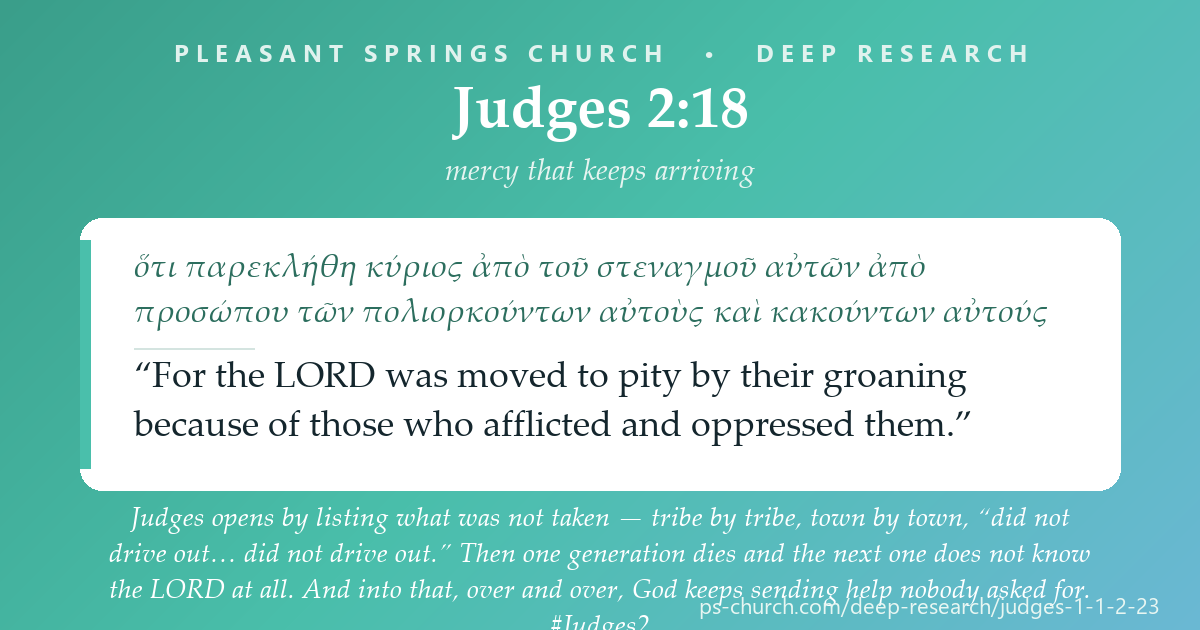
“Groaning” — the wordless noise of people under a weight (LXX στεναγμός). It is the Exodus word: “God heard their groaning, and God remembered his covenant” (Exod 2:24; cf. Exod 6:5). And here is the detail that should stop a reader: in the paradigm of 2:11–19 Israel never repents and never prays. They do not cry out. The verb “cry out” (זָעַק) belongs to the individual accounts — 3:9, 3:15, 4:3, 6:6, 10:10 — and not to the summary at all. In the summary they simply groan, and God is moved. Whatever else the cycle is, its hinge is not Israel’s contrition.
From נָחַם (nāḥam) — to be moved, to relent, to change course out of compassion; the ESV’s “was moved to pity.” Both Greek texts render it παρεκλήθη, “was entreated, was comforted” — the passive of the verb behind Paraclete. The same root is used of God at Genesis 6:6 and Exodus 32:14, and Psalm 106:45 (LXX 105:45) uses the whole idea to sum up this book: “he remembered his covenant, and relented according to the abundance of his steadfast love.”
A judge in this book is not a magistrate in a courtroom but a deliverer and ruler raised up for a crisis; the Greek is κριτής, and the same Semitic root shows up across the coast as a title of office — the chief magistrates of Carthage were the sufetes. The verb in 2:16 and 2:18 is הֵקִים, “raise up, stand someone up” — God stands a person up in the middle of a mess, and the man’s title is his function. Nothing in the word implies the man was good.
“In the eyes of.” The book’s whole argument is carried by this phrase and by whose eyes are in it. Here at the top: “the people of Israel did the evil in the eyes of the Lord” (2:11) — the refrain that will open every cycle (3:7, 3:12, 4:1, 6:1, 10:6, 13:1). At the bottom, twice, the last words of the book: “there was no king in Israel; everyone did what was right in his own eyes” (17:6; 21:25). Same idiom, different eyes, and everything between them is the distance travelled.
Where this vocabulary surfaces later:
- Psalm 106:34–46 (LXX 105:34–46, checked in a Greek Psalter; the psalm number runs one behind the Hebrew, the verse numbers agree) — this whole passage set to music. “They did not destroy the peoples, as the Lord commanded them, but they mixed with the nations… They served their idols, which became a snare to them” (106:34–36) — the same word as Judges 2:3. And then the ending Judges 2:18 gives in prose: “Many times he delivered them… Nevertheless, he looked upon their distress… and relented according to the abundance of his steadfast love” (106:43–45).
- Nehemiah 9:26–28 — the cycle prayed back as confession, centuries later: “you gave them into the hand of their enemies… and in the time of their suffering they cried out to you and you heard them from heaven, and according to your great mercies you gave them saviors who saved them… But after they had rest they did evil again before you.” That is Judges 2:14–19, recited by people who had been through it and knew it about themselves.
- Deuteronomy 31:16–21 — Moses is told in advance, almost word for word, what Judges 2 reports: this people will “whore after the foreign gods among them… and forsake me and break my covenant,” and God’s anger will be kindled and he will hide his face (see Deuteronomy 31). Judges 2:11–15 is not a surprise ending; it is a prediction being logged.
- Deuteronomy 32:30 — “unless their Rock had sold them”: the verb of Judges 2:14, “he sold them into the hand of their surrounding enemies” (see Deuteronomy 32). And Leviticus 26:37, “you shall have no power to stand before your enemies,” is what 2:14 says happened.
- Acts 13:19–20 — Paul, preaching in a synagogue, tells this stretch of history in one breath: God destroyed seven nations in Canaan and gave them the land as an inheritance, “and after that he gave them judges until Samuel the prophet.” The judges are a chapter in a story that is going somewhere.
- Hebrews 11:32–34 — “time would fail me to tell of Gideon, Barak, Samson, Jephthah… who through faith conquered kingdoms… were made strong out of weakness.” The New Testament’s own reading of the deliverers this passage introduces — and it is worth noticing that made strong out of weakness is exactly what the book shows and not at all what the book flatters.
The summary and the inventory, the Torah quoted back at Bochim, and the stones that were meant to make children ask.
Trace four threads: Joshua’s summaries against Judges’ catalogue; the Torah commands the angel quotes; the transmission of faith from Deuteronomy 6 and Joshua 4 to Judges 2:10; and the cycle-formula against the accounts that will vary it.
Which cross-references matter?
- Joshua 11:23; 21:43–45; 23:14 — the summaries. “So Joshua took the whole land… And the land had rest from war” (11:23); “Not one word of all the good promises… had failed; all came to pass” (21:45); “not one word has failed of all the good things” (23:14). Read them. Then read Judges 1. The insight below sets them side by side.
- Joshua 13:1; 15:63; 16:10; 17:12–13 — and Joshua’s own counter-notices, which means the tension is inside Joshua before Judges ever opens: “there remains yet very much land to possess”; the Jebusites Judah “could not drive out… to this day”; Gezer; Manasseh’s cities and the Canaanites put to forced labour (see Joshua 13–19). Judges 1 is not contradicting Joshua so much as finishing a sentence Joshua had already started.
- Joshua 15:15–19 // Judges 1:11–15 — Caleb, Othniel and Achsah, told twice, almost word for word. The differences are small and worth seeing: Judges adds that Othniel was Caleb’s younger brother, adds the article to the field, has Achsah say “give me” with a different verb, and names Caleb again as the giver. Repeating a story is not padding; here it does two jobs at once — it certifies that this book is continuous with that one, and it plants Othniel, who will be the first and cleanest judge (3:7–11). One more thing the repetition does: in a chapter where nobody drives anyone out, the reader is made to watch, twice, a man who did — and a daughter who asked for more than she was given and got it.
- Exodus 23:32–33; 34:12–13; Deuteronomy 7:2–5 — the commands the angel quotes at Bochim: make no covenant with them, tear down their altars, and “it will surely be a snare to you” (see Exodus 23 and Deuteronomy 7). Judges 2:2–3 is a prosecution built entirely out of quotations.
- Numbers 33:55; Joshua 23:13 — and the specific threatened penalty, which 2:3 now enacts: those left in the land will be “barbs in your eyes and thorns in your sides” (see Numbers 33). The sentence at Bochim is not improvised; it is the clause being invoked.
- Deuteronomy 6:4–9, 20–25 — the countermeasure to Judges 2:10, written a generation earlier: teach them diligently to your children, and when your son asks what this means, tell him we were Pharaoh’s slaves in Egypt, and the Lord brought us out (see Deuteronomy 6). Judges 2:10 is the audit result.
- Joshua 4:6, 21 — twelve stones set up for the sole purpose of provoking a question: “when your children ask in time to come, ‘What do those stones mean to you?’” (see Joshua 3–4). The monuments were built. The conversation was not had.
- Numbers 27:21 — “inquired of the Lord” (1:1) is the procedure Moses established for Joshua through Eleazar and the Urim (see Numbers 27). Judges 1:1 does it right. Which is worth noticing, because the book will stop doing it right.
- Judges 3:1–6; 20:18; 21:25 — forward, into the book. The “nations left to test Israel” of 2:20–23 is picked up and expanded at 3:1–6. And the question of 1:1 comes back at 20:18 in the same words — “Who shall go up first for us…?” — with the same answer, “Judah shall go up first.” Only now the enemy is Benjamin. That is the arc of the book in two verses, and its last sentence names the cause: “there was no king in Israel. Everyone did what was right in his own eyes” (21:25).
These are the sentences, and the honest thing is to set them beside each other before doing anything with them. “So Joshua took the whole land, according to all that the Lord had spoken to Moses… And the land had rest from war” (Josh 11:23). “Not one word of all the good promises that the Lord had made to the house of Israel had failed; all came to pass” (Josh 21:45). And now: Judah could not (Judg 1:19). Benjamin did not (1:21). Manasseh did not, and “the Canaanites persisted in dwelling in that land” (1:27). Ephraim, Zebulun, Asher, Naphtali (1:29–33). The Amorites pressed Dan back into the hills (1:34). Do not let anyone hand you one of these and call it the Bible’s position. Both are.
Three readings are on the table and each carries real weight. (1) “All” as summary, not inventory. Ancient conquest reports characteristically speak in sweeping totals; on this reading 11:23 claims the campaign was decisive, not that every settlement changed hands. (2) The gift is complete; the possession is progressive. This is the Bible’s own idiom — God says “I have given” and in the same breath “you shall drive out” (Josh 1:3; 13:6). The deed is signed and the moving is unfinished. (3) The two sets of sentences answer different questions. Joshua 11:23 and 21:45 are claims about God’s promise — it held, nothing failed. Judges 1 is a claim about Israel’s follow-through — it lapsed. Both can be true of the same hillside.
And here is what stays hard. Joshua 11:23 does not read like a partial claim, and 21:44 adds “not one of all their enemies had withstood them,” which is a difficult sentence to hold, flatly, beside “he could not drive out the inhabitants of the plain.” The three readings relieve the pressure; none of them dissolves it, and a page that told you otherwise would be selling you something. What Scripture has actually done is put the summary and the inventory a few columns apart and leave them there — which is what a book does when it is more interested in being true than in being tidy. (Our Joshua 11–12 and Joshua 20–22 pages work the same tension from the other side; read them together and do not let either page harmonise the other.)
The commentaries, the two Greek texts, the pronoun in 1:19, and the formula that runs the rest of the book.
Webb, Block, Butler, Boling, Younger, Niditch, McCann and Schneider on Judges; Satterthwaite, Bodine and Fernández Marcos on the Greek; and then the two live exegetical questions this passage raises — who “he” is at 1:19, and what exactly 2:11–19 is for.
Commentaries & studies:
- Barry G. Webb, The Book of Judges (NICOT) — the fullest recent evangelical treatment, and the most attentive to the book as a literary whole; Daniel I. Block, Judges, Ruth (NAC); Trent C. Butler, Judges (WBC); Robert G. Boling, Judges (Anchor Bible); K. Lawson Younger Jr., Judges and Ruth (NIVAC).
- Susan Niditch, Judges: A Commentary (OTL); J. Clinton McCann, Judges (Interpretation); Tammi J. Schneider, Judges (Berit Olam) — three very different readings, all worth having in the room.
- Philip E. Satterthwaite, “Judges: To the Reader,” in A New English Translation of the Septuagint — the clearest short account in English of the A and B texts, the kaige revision, and why NETS translates both. Walter Ray Bodine, The Greek Text of Judges: Recensional Developments, for the manuscript groups behind them.
- Natalio Fernández Marcos, Judges (Biblia Hebraica Quinta) — the current critical Hebrew edition with a full account of the versions. The Göttingen critical edition of Greek Judges has been long in preparation (José Manuel Cañas Reíllo) and had not appeared when NETS was made; until it does, Rahlfs’s parallel A and B texts remain what most readers have.
- Robert Alter, The Art of Biblical Narrative — for reticence and the Leitwort. (Alter reads these texts as literature and does not share the church’s confession; we take the tools, not the metaphysics.)
Interpretation notes worth keeping:
- The pronoun in 1:19 is a real question and the versions disagree about it. The Hebrew reads, flatly, “And the Lord was with Judah, and he took possession of the hill country, for not to dispossess the inhabitants of the valley, for they had chariots of iron” — with no verb ‘could’ in the sentence at all (כִּי לֹא לְהוֹרִישׁ, an infinitive with a negative) and no expressed subject. Every English version supplies both. Since the nearest named subject is the Lord, some readers have asked whether the verse says God could not — and the ancient witnesses can be seen wrestling with it: Rahlfs’s A reads a singular (οὐκ ἐδύνατο), B a plural (οὐκ ἠδυνάσθησαν), and Targum Jonathan goes plural and adds a cause the Hebrew withholds (“afterward, when they had sinned”). Radak reads it of Judah and points forward to 2:22.
- What this page will and will not say about that verse. It will say that the grammar is genuinely open, that the versions split, and that the reading which takes Judah as the subject is the one nearly all translations and commentators adopt and is the one that fits the chapter, whose whole subject is what the tribes did not do. It will not say that the text teaches a God who is beaten by chariots — the same book has already said “you shall drive out the Canaanites, though they have chariots of iron” (Josh 17:18), and the same chapter has just said the Lord was with Judah. And it will not pretend the sentence is smoother than it is.
- 2:11–19 is a formula, and reading the rest of the book means reading the variations. Laid out, the pattern is: (1) Israel did what was evil in the sight of the Lord and served the Baals (2:11–13); (2) the anger of the Lord was kindled and he gave them over and sold them (2:14); (3) they were in terrible distress (2:15); (4) the Lord raised up judges, who saved them (2:16, 18); (5) and when the judge died, they turned back and were more corrupt than their fathers (2:19). Each later account will run this pattern and change something, and the changes are the message. Two elements that the summary notably lacks, and both are worth counting: Israel does not cry out here — that verb belongs to the accounts (3:9, 3:15, 4:3, 6:6, 10:10) — and the land does not have rest here. That clause belongs to the accounts too, and it occurs exactly four times in the whole book: forty years (3:11), eighty years (3:30), forty years (5:31), forty years (8:28). After Gideon it never appears again. The book runs out of rest before it runs out of judges.
- It is a spiral, not a circle, and 2:19 says so. A wheel returns to where it was; this does not. “They turned back and were more corrupt than their fathers” (וְהִשְׁחִיתוּ מֵאֲבוֹתָם). Each loop starts lower. That is why the book can begin with tribes failing to take towns and end with tribes at war with each other, and why the last five chapters need no judge at all to make their point.
- The hinge of the cycle is not Israel’s repentance. This is worth stating plainly because it is often preached the other way. In 2:11–19 nobody repents, nobody prays, and nobody promises anything. What moves God is a sound: “the Lord was moved to pity by their groaning” (2:18) — the Exodus word, the noise of people being crushed. The mercy in this book is not a reward for a turnaround. It arrives before the turnaround, and often instead of it.
- The “test” of 2:22 is not God learning something. The verse says the nations were left “in order to test Israel by them, whether they will take care to walk in the way of the Lord.” Read alongside 2:20–21, the leaving of the nations is stated as judgment (“because this people have transgressed my covenant… I will no longer drive out”) and as test in the same breath, and 3:1–2 adds a third reason — so that a generation with no experience of war would learn it. Scripture gives three reasons and does not rank them. Neither will we.
- On sources and composition, we report and do not litigate. Judges 1:1–2:5 and 2:6–3:6 are widely described as a double introduction, and the book’s framework is commonly read as part of a larger Deuteronomistic History running from Deuteronomy to 2 Kings — a proposal associated with Martin Noth and refined and disputed ever since. Naming that is not conceding anything: the vocabulary of Judges 2 really is the vocabulary of Deuteronomy 31, whoever arranged the paragraphs. Nothing on this page depends on a compositional theory.
God asks this question at the hinges of the story, and it is worth hearing them together. He asks it in Eden — “What is this that you have done?” (Gen 3:13). He asks it of Cain, in a different form — “What have you done?” (Gen 4:10). And he asks it here, at Bochim, of a whole nation that has not committed a single dramatic crime. Judges 2:2 is the only one of the three where the answer is a shrug: nothing was done. Altars were not torn down. Towns were not taken. Nobody decided to apostatise; they just found it easier to leave things standing and collect the labour tax.
And then look at what happens next, because it is the most quietly devastating sequence in the chapter. The people weep. They lift up their voices; they sacrifice; they name the place after their tears. It is a genuine religious response and it is put on the record without a word of praise or blame. Then 2:6 rewinds, 2:10 buries a generation, and 2:11 opens: “And the people of Israel did what was evil in the sight of the Lord.” The narrator does not say the weeping was fake. He does not say it was worthless. He just tells you what happened afterward and lets you do the arithmetic. That is how this book will talk to you for twenty more chapters, and learning to read it is most of what these pages are for.
One more thing, and it is the thing to carry out of the chapter. Immediately after the sentence about the generation who did not know, and immediately after the sentence about a people more corrupt than their fathers, stands this: “Then the Lord raised up judges, who saved them” (2:16). Nobody asked. Nobody deserved it. Nobody had even repented. He heard them groan, and he sent help, and then he did it again, and again, into a decline that got worse every time he did. That is not a footnote to the book of Judges. That is the book of Judges.
From a list of towns nobody took to a mercy nobody asked for.
Name what you learned, why it matters, and one concrete response.
What should we carry away — and do?
- Read the two books together and refuse to pick one. “Joshua took the whole land” and “Judah could not drive out the inhabitants of the plain” are both Scripture. A faith that can only survive by quietly deleting one of them is not being protected; it is being trained to flinch.
- Watch the verbs go downhill. Could not → did not → put them to forced labour → the Canaanites persisted → and finally Israel is the one living in somebody else’s midst, and Dan is pressed back into the hills. Nobody ever decided to lose the country. They just kept not finishing.
- Judges 2:10 is one generation. Not four. One. The people who saw died, and the people who came next did not know. Deuteronomy 6 and Joshua 4 exist because God knew exactly how fast this happens, and both of them work the same way: an ordinary adult telling a child what a stone or a supper means.
- Weeping is not the same as tearing down an altar. Bochim is a real moment of feeling and it changed nothing, and the narrator declines to tell you off about it. He just writes the next paragraph.
- The mercy in this book does not wait to be earned. “The Lord was moved to pity by their groaning” (2:18). Nobody in the formula repents. God is moved by the sound of people being crushed, which is the same reason he moved in Exodus 2:24, and the same reason he keeps moving through a book where every rescue is followed by something worse.
- And the book is going somewhere. It ends by saying there was no king — and it is not finally arguing for a monarchy, because 1 Samuel onward will show how that goes too. It is showing you the size of the gap, and the canon takes twelve more centuries to close it.
Step in response: two things this week. First, find the one thing you have decided to live alongside rather than deal with — the arrangement that is working, that is profitable, and that you know you were told to end. Name it out loud to one person. Second, do a Deuteronomy 6: tell somebody younger than you, in your own words, one thing God actually did — not a principle, an event. Judges 2:10 happened because that conversation did not.
Judges 2:18b · to share
LXX (Rahlfs A) + ESVEvery Deep Research page traces its passage across the whole sweep — the Old Testament, the Second-Temple world between the testaments (historical witnesses, not Scripture), and the New Testament. Follow the thread:
Pleasant Springs Church — Deep Research
Research method after Michael S. Heiser’s Bible Research Method (examine dictionaries → ancient literature → important words → textual connections → academic publications → share), with the Pleasant Springs “Author & Audience” foundation. Scripture set in the Hebrew, the Greek editions named on each page and the ESV (Old Testament), and the Greek New Testament and the ESV (New Testament), per the practice of Pleasant Springs Church. Judges 1–2 research grounded in Webb (NICOT), Block (NAC), Butler (WBC), Boling (Anchor), Younger (NIVAC), Niditch (OTL), McCann (Interpretation) and Schneider (Berit Olam), with Robert Alter for the narrative tools used in the structure block. Text & numbering: Judges survives in two substantially different Greek forms — A (Codex Alexandrinus plus the Origenic and Lucianic groups) and B (Codex Vaticanus) — which Rahlfs judged distinct enough to print in parallel, one above the other; NETS translates both. The Greek column on this page is Rahlfs’s A text throughout, verified verse by verse against the morphologically analysed Rahlfs text rather than back-translated, with B quoted and labelled wherever it differs materially (1:14; 1:19; 2:1; 2:5; 2:15; 2:17; 2:18). The A/B description follows Philip E. Satterthwaite’s “Judges: To the Reader” in NETS; Bodine and Fernández Marcos stand behind it. There is no chapter- or verse-offset anywhere in this passage: Hebrew, Greek A, Greek B and English number Judges 1:1–2:23 identically, and this is stated rather than assumed; the one psalm cited does diverge and is given both ways (Ps 106 = LXX Ps 105, verse numbers agreeing, checked in an actual Greek Psalter). Two Greek divergences are reported rather than smoothed: at 1:18 both A and B negate the Hebrew (“Judah did not inherit Gaza”) and add Ashdod, and at 1:19 neither text has iron chariots, both reading רֶכֶב as the name Ρηχαβ. No Qumran manuscript preserves any part of Judges 1–2 (1QJudg has chs 6, 8?, 9; 4QJudgᵃ ch 6; 4QJudgᵇ chs 19 and 21), and no claim is made from the scrolls here. ANE background verified against the local scan: the Megiddo booty list of Thut-mose III (ANET 237). The Merneptah Stele and the Amarna letters are cited without page numbers, which fall outside the scan we can check, and the ʿApiru/Hebrew equation is treated as a contested proposal, not a result. The Iron I settlement models and the chronology of the judges against 1 Kings 6:1 are reported with the positions named and deliberately not adjudicated. Second-Temple, Targumic and rabbinic witnesses (Sirach 46:11–12; Josephus, Ant. 5.2.1–7 in Whiston’s numbering; Targum Jonathan at Judg 1:19 and 2:1; Rashi at 1:19, 1:21 and 2:1, citing Seder Olam; Radak at 1:19) are read as witnesses, never leveled with Scripture. The tension between Joshua 11:23 / 21:43–45 and Judges 1 is quoted from both sides, given three fair readings, and then explicitly left in tension; the pronoun question at 1:19 is laid out with the versions’ disagreement shown and not settled by slogan. Above all, this page keeps the book’s three categories distinct — what the text approves, what it reports without approving, and what it condemns — and does not supply verdicts the narrator withheld.
Scripture quotations marked ESV are from the ESV® Bible (The Holy Bible, English Standard Version®), © 2001 by Crossway, a publishing ministry of Good News Publishers. ESV Text Edition: 2016. Used by permission. All rights reserved. The ESV text may not be quoted in any publication made available to the public by a Creative Commons license, and the ESV may not be translated in whole or in part into any other language. www.esv.org
|
Did this study bless you today? 💚 Give to Support PS Church100% of gifts go to the General Fund — thank you. |