God calls Jacob back to Bethel to finish an old vow: “Arise, go up… make an altar.” He answers with consecration — “put away the foreign gods” — and buries the household idols under the oak before he goes up to worship. There God appears again and speaks the new name not from a wrestling-match but freely from heaven: “no longer Jacob, but Israel,” renewing the covenant as God Almighty. Then sorrow and hope are braided: Rachel dies bearing Benjamin near Bethlehem — “son of my sorrow” renamed “son of the right hand” — and Isaac dies old and full of days, buried by Esau and Jacob, reconciled at last. This study works Genesis 35:1–29. See the method →
Genesis 35:1, 2, 3, 10, 11, 18, 29
Hebrew · LXX · ESVThe Shape of the Passage
Parallel panelsGenesis 35 is the chapter of homecoming and consecration — where the name Israel, wrestled for in the dark at Peniel, is now spoken plainly from heaven; and where the covenant passes forward through a death and a birth, and a father buried by reconciled sons.
Author
Moses sets this chapter as the deliberate resolution of everything left unfinished. Jacob had vowed at Bethel, some thirty years before (the twenty years with Laban plus the return and the Shechem sojourn), that if God brought him home in peace “then the Lord shall be my God” (28:20–22) — and then he had lingered at Shechem, bought land, and reaped catastrophe (ch. 34). So God’s word here is a summons to finish the vow: “Arise, go up to Bethel… and make an altar” (35:1). The pointed contrast with 34 is the whole point: there, a settling that would not move toward God; here, a return that puts God first.
Consecration before worship. Jacob’s response is the pattern of every genuine return: “Put away the foreign gods that are among you and purify yourselves and change your garments” (35:2). Before the altar can be built, the household’s idols — and even the pagan amulet-earrings — are surrendered and buried under the oak at Shechem (35:4). Only a cleansed people goes up to worship; and as they go, “a terror from God” falls on the surrounding cities so that none pursues them (35:5) — the same divine escort that guarded Jacob all along, now shielding a consecrated caravan. At the altar he calls the place El-bethel, “God of the house of God” (35:7), naming not the place but the God who met him there.
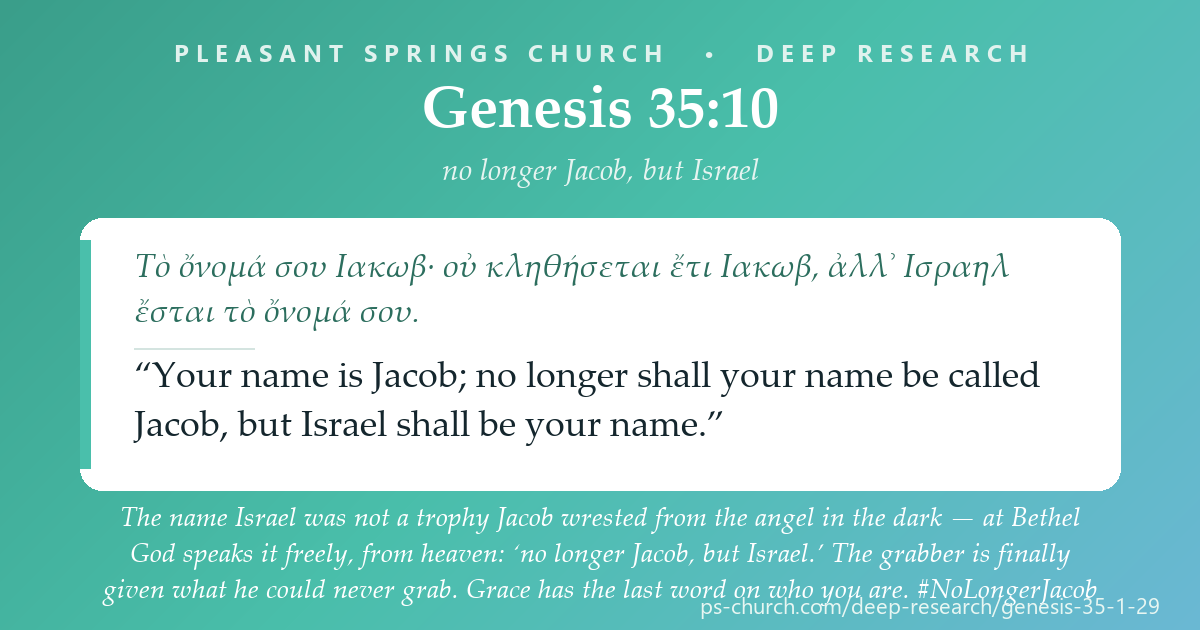
The name spoken from heaven. Then comes the theological center: “God appeared to Jacob again… and blessed him” (35:9), and confirmed the new name — “no longer shall your name be called Jacob, but Israel shall be your name” (35:10). This matters. At Peniel the name had come in a night of wrestling, won as if by struggle (32:28); here it is declared, freely, from heaven, by God who identifies himself as El Shaddai, God Almighty (35:11) and renews the Abrahamic covenant word for word — be fruitful and multiply, a nation and a company of nations, kings from your own body, the land to your offspring (35:11–12; cf. 17:1–8). The name is not a trophy Jacob seized from Esau or wrenched from the angel; it is a gift the covenant God speaks over him. Grace has the last word on his identity.
Sorrow and hope, braided. And then, immediately, death. Rachel — the beloved wife, long barren, who had cried “Give me children, or I shall die” (30:1) — dies in hard labor near Ephrath, bearing the twelfth son. With her last breath she names him Ben-oni, “son of my sorrow”; but the father renames him Benjamin, “son of the right hand” — refusing to let the boy carry his mother’s grief as his name, calling him instead a place of strength and favor (35:18). A pillar marks her grave (35:20). The chapter records Reuben’s sin with Bilhah in a single, terse, unsparing line (35:22 — it will forfeit his birthright, 49:3–4), lists the twelve sons, and closes with Jacob’s homecoming to Isaac at Mamre. Isaac dies at 180, “old and full of days,” and Esau and Jacob — the brothers once bent on murder, now reconciled — bury their father together, as Isaac and Ishmael had buried Abraham (25:9). The generations pass; the covenant goes on.
Audience
Israel — the nation that bore this very name — heard in Genesis 35 the story of its own christening. The name they carried was not earned in the night at Peniel alone; it was spoken over their father a second time, at Bethel, by God Almighty, and bound to the promise: a company of nations, kings, and a land. Every time they said “Israel,” they were confessing a gift. And they heard the discipline that goes with the name: the covenant people must “put away the foreign gods” before they worship (35:2) — a word that would echo through Joshua’s Shechem (Josh 24:14–23), Samuel’s Mizpah (1 Sam 7:3), and every reformation after. Homecoming to God is always by way of consecration.
The church reads this chapter as the shape of return. When God calls us back to himself, the first work is not the altar but the burying of idols — the foreign gods among us laid down at the oak before we go up to worship (2 Cor 6:16–7:1). And here the church finds its truest comfort in the braid of grief and hope: at Bethlehem’s edge a mother dies and a son is born; a name of sorrow is answered by a name of strength. Rachel’s tomb near Bethlehem will weep again when Herod’s sword falls (Jer 31:15; Matt 2:18) — and the same Bethlehem will give the world the true “son of the right hand,” the King from Jacob’s body who sits at the Father’s right hand (Ps 110:1; held as the covenant’s far horizon, not the text’s literal sense). And in Isaac’s grave, dug by two reconciled brothers, the church sees that the God who renews names also heals families: those who buried a father together had once been sworn enemies. Grace renames; grace reconciles; grace carries the promise through every death to the next generation.
Orient on Bethel, El-bethel, El Shaddai, teraphim, Rachel’s death, and the covenant name.
Search by topic: Bethel, El Shaddai / God Almighty, teraphim and household gods, purification, Israel (the name), Ephrath / Bethlehem, Benjamin, Rachel, gathered to his people.
Which articles are relevant?
- Anchor Bible Dictionary — “Bethel,” “Shaddai,” “Teraphim,” “Israel (Name),” “Rachel,” “Benjamin,” “Ephrath / Bethlehem.”
- Dictionary of the OT: Pentateuch — “Bethel,” “God, Names of,” “Idolatry,” “Covenant,” “Death and Burial,” “Jacob.”
- NIDOTTE / TDOT — shadday (Almighty), sur/hesir (put away/remove), taher (purify), ’on (sorrow/strength), yamin (right hand), ’asaf (gather).
Bibliography surfaced:
- Gordon Wenham (WBC), Victor Hamilton (NICOT), Kenneth Mathews (NAC), Bruce Waltke, Nahum Sarna (JPS) on Genesis.
- Studies of the divine name El Shaddai and of the patriarchal cult at Bethel; treatments of teraphim / household gods (cf. 31:19, 34).
- Studies of the Rachel traditions and of Benjamin’s naming; the “gathered to his people” formula and patriarchal burial.
Household gods buried under the oak, the God who answers in distress, and the good death.
Read the consecration, the covenant renewal, and the two deaths against ancient religion, naming custom, and the theology of a life “full of days.”
Which parallels shed light on religion and worldview?
The foreign gods, and the reform under the oak. Ancient households kept teraphim — small figurines of ancestral or fertility deities, guarantors of luck, inheritance, and blessing (the very things Rachel had stolen from Laban, 31:19, 34). Jacob’s command — “put away the foreign gods… and purify yourselves and change your garments” (35:2) — is the Bible’s first great act of household reformation: idols surrendered, persons washed, garments changed, the whole camp made clean before it dares approach God. That the idols and amulet-earrings are buried under the oak at Shechem (35:4), not merely discarded, marks a decisive break; and the pattern — renounce the rival gods, then worship — becomes the template for every covenant renewal in Israel (Josh 24:14–23; 1 Sam 7:3–4; 2 Kgs 23). Worship that has not first buried its idols is not yet worship.
El Shaddai and the God who answers in the day of distress. Twice the chapter names God with the patriarchal covenant title El Shaddai, “God Almighty” (35:11) — the same name by which he had sealed the covenant with Abraham (17:1) and by which Isaac had blessed Jacob (28:3). It is the name of the God who makes the barren fruitful and keeps impossible promises; here it undergirds the renewed word, “be fruitful and multiply” (35:11). And Jacob’s own confession names God by what he has done: “the God who answers me in the day of my distress and has been with me wherever I have gone” (35:3). This is covenant faith looking back over twenty hard years — the flight from Esau, the servitude to Laban, the terror at the Jabbok, the horror at Shechem — and confessing that through all of it, God was present and answering. (The Greek renders El Shaddai here simply as “your God,” ὁ θεός σου — the Septuagint’s habitual, reverent flattening of the ancient title.)
Ben-oni, Benjamin, and a father’s renaming. In the ancient world a name spoken at birth carried destiny, and a mother’s dying name for her son would ordinarily stand. Rachel names him Ben-oni — the word ’on can mean both “sorrow” and “strength/vigor,” so even her grief-name holds a shadow of hope. But Jacob, with a father’s authority and a father’s love, will not let the child be defined by the hour of his mother’s death: he renames him Benjamin, “son of the right hand” — the side of favor, honor, and strength (35:18). It is one of Scripture’s tenderest acts: turning a name of sorrow into a name of blessing without ever denying the sorrow. Rachel’s pillar still stands (35:20); her grief is real and marked. And yet the last word over the child is hope. So the covenant learns to bury its dead with honor and to bless its living with courage.
- Genesis 31:19, 34–35; Joshua 24:14–23; 1 Samuel 7:3–4 — teraphim and the “put away the foreign gods” reform: Jacob’s Bethel becomes Israel’s pattern (see Jacob leaves Laban).
- Genesis 17:1; 28:3; 48:3 — El Shaddai, the covenant title binding Abraham, Isaac, Jacob, and the blessing of the sons: one Almighty God across the generations.
- Genesis 25:8–9; 35:29; 49:29–33 — “gathered to his people,” the good death “full of days,” and burial by reconciled sons: the patriarchal way of dying in hope (see Abraham’s death).
Genesis 35 is the chapter where Jacob finally becomes, in the open, what God had already declared him to be in the dark. Some thirty years earlier at this very place he had struck a bargain with a God he barely knew: if you keep me and bring me home, then you will be my God. God kept every clause — and then let Jacob wander, settle at Shechem, and stumble into disaster, before summoning him back to close the account: ‘Arise, go up to Bethel.’ The genius of the chapter is that Jacob’s obedience begins not with the altar but with the idols. He knows that you cannot go up to the God of Bethel with the gods of the nations still in the baggage, so he buries them under the oak and washes his house clean. Only then does God appear ‘again’ — and this time the new name is not wrested from a wrestling angel but spoken freely from heaven, sealed with the covenant title El Shaddai and the ancient promise of a nation and kings. The man who once seized his brother’s heel and stole his blessing is given his true identity as a gift he could never grab. And notice how mercy and sorrow travel together to the end: no sooner is the name confirmed than Rachel dies in childbirth, and the beloved wife’s grave becomes a pillar beside the road to Bethlehem. Jacob does not pretend the loss away — he marks it — but neither does he let it name the child; Ben-oni, ‘son of my sorrow,’ becomes Benjamin, ‘son of the right hand.’ This is how the covenant God carries his people: he renames the grabber by grace, he buries the idols before he blesses, and he braids every sorrow with a stubborn, forward-facing hope. The chapter ends where all the patriarchal stories end — at a grave, with reconciled brothers, and the promise still moving on.
The vocabulary of return: idols buried, the answering God, the confirmed name, sorrow renamed.
Watch the foreign gods “put away,” the God who “answers,” the name Israel spoken from heaven, El Shaddai, and Ben-oni turned to Benjamin.
“Put away… the foreign gods” — consecration before worship. The household’s idols and pagan earrings are surrendered and buried under the oak (35:4). Every true return begins here: bury the rival gods, then build the altar (Josh 24:14; 1 Sam 7:3).
“The God who answers me” — Jacob names God by what he has done across twenty hard years: “in the day of my distress… with me wherever I have gone.” Covenant faith looking back and confessing a present, answering God.
“Israel” — the new name, confirmed. At Peniel it came through wrestling (32:28); here it is spoken freely from heaven. Not a trophy seized from Esau or the angel, but a gift declared by God: grace has the last word on his identity.
“God Almighty” — the patriarchal covenant title (17:1; 28:3), the God who makes the barren fruitful and keeps impossible promises. Undergirds the renewed word: be fruitful, a company of nations, kings from your body. (LXX simply: “your God.”)
“Son of my sorrow” renamed “son of the right hand.” Rachel’s dying grief-name is answered by a father’s name of strength and favor — sorrow marked and honored (35:20), yet not permitted to be the child’s destiny. Hope has the last word.
“And full of days” — Isaac dies old, satisfied, “gathered to his people,” and buried by Esau and Jacob together. The good death of covenant hope; and the reconciled brothers at the grave answer the old enmity of chapters 27 and 33.
How the rest of Scripture fills out the scene:
- Joshua 24:14–23; 1 Samuel 7:3–4; 2 Kings 23:4–25 — “put away the foreign gods”: Jacob’s Bethel reform becomes the template for every covenant renewal in Israel.
- Genesis 17:1–8; 28:3–4; 48:3–4 — El Shaddai and the renewed covenant word (“a company of nations… kings”): the promise carried Abraham → Isaac → Jacob (see the ladder at Bethel).
- Genesis 32:22–32 — the name won at Peniel in the night of wrestling, here declared again from heaven: struggle and gift, both true (see Jacob wrestles at Peniel).
- Ruth 4:11; Jeremiah 31:15; Micah 5:2; Matthew 2:18 — Rachel and Ephrath/Bethlehem: the mother who weeps by the road, and the town that gives the world its King.
From an oak at Shechem to a weeping at Ramah and a King at God’s right hand.
Trace the buried idols, the confirmed name, and Rachel’s Bethlehem grave toward their later fulfillment.
Which cross-references matter?
- Genesis 28:10–22; 31:13; 35:1–7 — the vow at Bethel kept and closed: “the God of Bethel… where you made a vow” brings Jacob home to finish it (see Jacob’s ladder).
- Genesis 34:1–31 → 35:5 — after the sword of Simeon and Levi, “a terror from God” falls on the cities so none pursue: the consecrated caravan divinely shielded (see Dinah and the sword).
- Genesis 35:22; 49:3–4 — Reuben’s sin recorded in one terse line, its verdict deferred to the deathbed: the firstborn forfeits his birthright. Sin noted, never sanctioned.
- Jeremiah 31:15–17; Matthew 2:16–18 — Rachel weeping for her children near Bethlehem: her roadside grave becomes the image of Israel’s grief — answered by God’s “there is hope for your future.”
- Micah 5:2; Psalm 110:1; Hebrews 11:21 — from Bethlehem-Ephrath the King from Jacob’s body; the true “son of the right hand” at the Father’s right hand; Jacob dying in faith, worshiping (see the ruler from Bethlehem).
The whole arc of the Jacob story bends toward this moment, and its meaning is hidden in a single repetition. Jacob has been a grabber from the womb — his very name means ‘he grasps the heel,’ and he lived up to it: he grasped the birthright with a bowl of stew, the blessing with a disguise and a lie, the flocks of Laban with cunning, and at last the divine name itself in a wrestling-hold in the dark, refusing to let go until he was blessed. At Peniel God gave him the name Israel, but he gave it, as it were, through the struggle — as though Jacob had wrested even this. And now, at Bethel, God says it again — and this time there is no wrestling, no night, no grip that will not loosen. God simply appears, blesses, and declares: ‘Your name shall no longer be Jacob, but Israel.’ The grabber is finally given what he could never grab. This is the deepest logic of grace running underneath the whole patriarchal narrative: everything Jacob schemed and stole and struggled to seize, God had meant to give him all along as a gift — and until Jacob learns to receive it as gift rather than seize it as prize, he has not really understood who he is. The new name spoken freely from heaven is the sign that the striving is over and the sonship is settled. And it is no accident that this same chapter buries the household idols first: you cannot receive the name of the true God with your hands still full of the false ones. Open hands to drop the idols; open hands to receive the name. That is the posture of everyone whom grace renames.
The scholarship on Genesis 35:1-29.
The commentators on the Bethel return; the studies of El Shaddai, teraphim, the covenant name, and the Rachel traditions.
Commentaries & studies:
- Gordon J. Wenham (WBC), Victor P. Hamilton (NICOT), Kenneth A. Mathews (NAC), Bruce K. Waltke, Nahum M. Sarna (JPS) on Genesis.
- Studies of the divine name El Shaddai (its etymology and covenant use), of teraphim / household gods, and of the “name-change” motif (Abram/Abraham; Jacob/Israel).
- Treatments of the Rachel traditions, Benjamin’s naming, and Ephrath/Bethlehem geography; the “gathered to his people” death formula.
Interpretation notes worth keeping:
- “God appeared… again” (35:9). The word marks Bethel as a second confirmation of the name and covenant (after 28:13–15 and 32:28). The narrator wants the name Israel heard as declared by God, not merely won in the struggle — grace, not conquest, has the final say.
- The buried earrings (35:4). These were most likely amulets — charms bearing pagan symbols — not mere ornament; burying them under the oak signals a real renunciation, the household’s idols decisively put out of reach. Consecration is concrete.
- Ben-oni / Benjamin (35:18). The Hebrew ’on bears both “sorrow” and “vigor/strength”; Rachel’s dying name is grief, Jacob’s renaming is hope, and the two are not made to cancel — the pillar still marks her grave. Read the tenderness, not a mere etymology game.
- Reuben and Bilhah (35:22). The terseness is the point: no comment, no scene — only “and Israel heard of it.” The verdict waits for 49:3–4. Sin recorded with sober restraint, and judged in its time; never endorsed.
- The devotional resonances. “Son of the right hand” toward Bethlehem, the King from Jacob’s body, Rachel’s weeping answered at the Nativity — these are rich and venerable, but hold them as canonical resonance built on real textual links (Micah 5:2; Matt 2:18), not as Genesis 35’s literal sense. The house discipline for typology throughout this library.
From an oak full of buried idols to a name spoken by grace, and hope on the far side of grief.
Name what you learned, why it matters, and one concrete response.
What should we carry away — and do?
- Bury the idols before you build the altar. Jacob’s return began with “put away the foreign gods” (35:2). Homecoming to God is by way of consecration — the rival gods laid down at the oak before we go up to worship.
- Your name is a gift, not a trophy. The name Israel was spoken from heaven, freely (35:10). Whatever you have schemed to seize, grace means to give. Stop grabbing; open your hands to drop the idols and to receive the name.
- Let hope have the last word over grief. Rachel’s “son of my sorrow” became a father’s “son of the right hand” — grief marked and honored, never denied, yet never allowed to be the final name. Braid your sorrows with a stubborn, forward-facing hope.
Step in response: before your next act of worship, do the buried-idols work first — name honestly the “foreign gods” still in your baggage (a habit, an idol of security or approval, a hidden compromise), and put them out of reach as decisively as Jacob buried them under the oak. Then receive, with open hands, the identity God gives you in Christ — not seized, but spoken over you by grace. And wherever you carry a grief, mark it honestly (Rachel’s pillar still stands) and then, like Jacob, refuse to let sorrow have the last word: name the hope. If you are estranged from a brother, remember the two who buried Isaac together — the God who renames also reconciles.
Genesis 35:10 · to share
LXX + ESVEvery Deep Research page traces its passage across the whole sweep — the Old Testament, the Second-Temple world between the testaments (historical witnesses, not Scripture), and the New Testament. Follow the thread:
Pleasant Springs Church — Deep Research
Research method after Michael S. Heiser’s Bible Research Method (examine dictionaries → ancient literature → important words → textual connections → academic publications → share), with the Pleasant Springs “Author & Audience” foundation. Scripture set in the Hebrew, the Greek editions named on each page and the ESV (Old Testament), and the Greek New Testament and the ESV (New Testament), per the practice of Pleasant Springs Church. Genesis 35:1–29 research grounded in Wenham, Hamilton, Mathews, Waltke, and Sarna; the chapter read as homecoming and consecration — the vow of Bethel (28:20–22) closed at God’s summons, the household “foreign gods” and amulet-earrings buried under the oak before worship (35:2–4; the pattern of Josh 24:14–23; 1 Sam 7:3–4), a “terror from God” shielding the consecrated caravan (35:5); the name Israel declared freely from heaven (35:10), no longer merely won at Peniel (32:28), and the Abrahamic covenant renewed as El Shaddai, God Almighty (35:11–12; cf. 17:1; the LXX flattening the title to “your God”); Rachel’s death and the tender renaming of Ben-oni (“son of my sorrow”) to Benjamin (“son of the right hand”) with grief marked but not made final (35:18–20; Jer 31:15; Matt 2:18); Reuben’s sin recorded tersely and judged only at 49:3–4 — noted, never sanctioned; and Isaac’s good death “full of days,” buried by the reconciled Esau and Jacob (35:29). The “son of the right hand” and Bethlehem-King resonances held as canonical analogy on real textual links (Micah 5:2; Ps 110:1; Matt 2:18), not the literal sense — per the house discipline for typology. No Tetragrammaton appears in Genesis 35; all divine references are Elohim/El, set here as “God” and “God Almighty.”
Scripture quotations marked ESV are from the ESV® Bible (The Holy Bible, English Standard Version®), © 2001 by Crossway, a publishing ministry of Good News Publishers. ESV Text Edition: 2016. Used by permission. All rights reserved. The ESV text may not be quoted in any publication made available to the public by a Creative Commons license, and the ESV may not be translated in whole or in part into any other language. www.esv.org
|
Did this study bless you today? 💚 Give to Support PS Church100% of gifts go to the General Fund — thank you. |