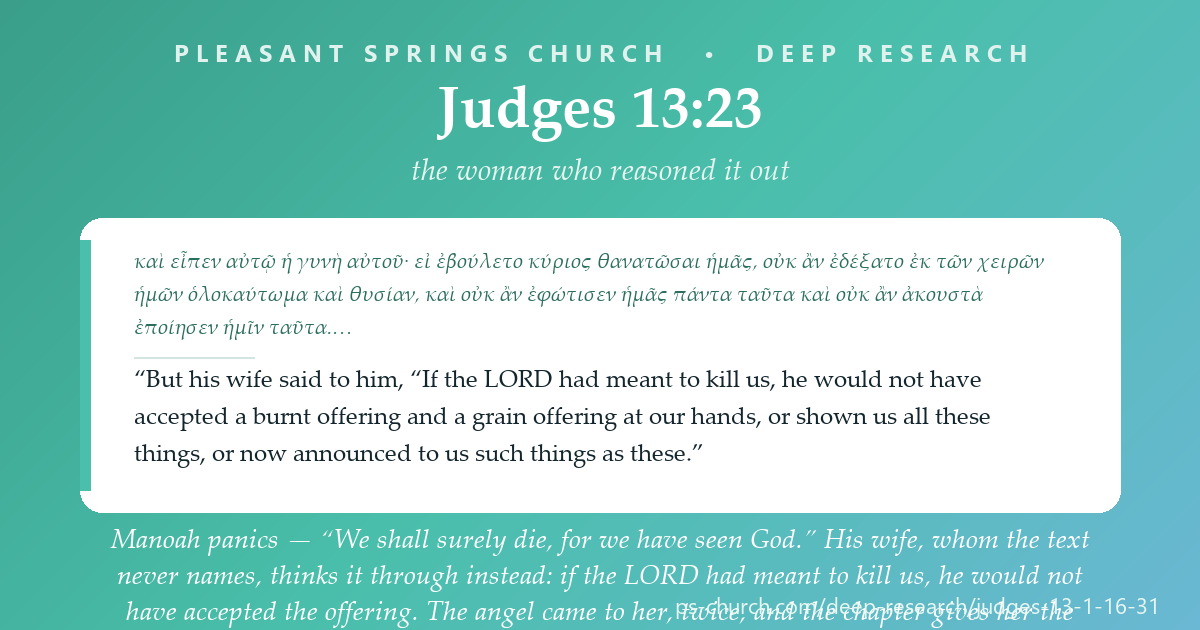
Forty years under the Philistines, and this time nobody cries out. Every other deliverance in Judges turns on that cry; here the verse just stops at “forty years,” and God sends a rescuer to people who never asked. The angel goes to a woman the text never names. She gets the message; when her husband asks for a repeat visit, the angel comes back to her; and at the end, when Manoah says “we shall surely die, for we have seen God,” it is she who reasons it out — “If the Lord had meant to kill us, he would not have accepted a burnt offering…” (13:23). Her son is a Nazirite from the womb, and the promise is capped in advance: he shall begin to save Israel. Then comes the combination this study holds rather than resolves. The vow comes apart piece by piece — honey scraped out of a lion’s carcass, a seven-day drinking-feast, and finally the hair — and three times in between, “the Spirit of the Lord rushed upon him.” A riddle, three hundred foxes, a jawbone, the gates of Gaza carried up a hill. Delilah asks four times, “pressed him hard with her words day after day,” and he tells her all his heart. And then 16:20, the coldest verse in the book: “But he did not know that the Lord had left him.” The eyes, the bronze shackles, the mill — and one quiet line: the hair began to grow again. The last prayer asks for personal revenge, and God answers it; the text does not tidy that up either. Hebrews 11:32 names him among the faithful. Both are true, and both are reported here. This study works Judges 13:1–16:31. See the method →
Judges 13:1–16:31 (selections)
Hebrew · LXX (Rahlfs A) · ESVThe Shape of the Passage
LeitwortThese four chapters are the last judge in the book. Behind them stand the cycle stated in the abstract (2:11–19), Deborah (chs 4–5), Gideon and the ephod (chs 6–8), Abimelech (ch 9) and Jephthah (chs 10–12). In front of them stands the collapse: Micah and the Danites and chapters 19–21. The vow itself is legislated in Numbers 6.
Author
A narrator who almost never comments — and who breaks his own rule twice here, which is how you know the silence is deliberate. Judges tells appalling things without evaluating them. Samson burns a countryside, sleeps with a prostitute in Gaza, and dies asking for revenge, and the book never once says “this was wicked.” But it is not that the narrator cannot speak. At 14:4 he interrupts to tell you something no character knows: “His father and mother did not know that it was from the Lord, for he was seeking an opportunity against the Philistines.” And at 16:20 he tells you the thing Samson himself does not know. Two asides in four chapters, and both of them are about God. Everywhere else the reader is left to do the work. That is Robert Alter’s reticence and the gap: the withholding is technique, and the gaps are where you are invited in.
He is also working a type-scene, and the deviations are the message. The annunciation of a birth to a barren woman is a fixed form in Hebrew narrative — Genesis 18, Judges 13, 1 Samuel 1 — and a reader who knows the convention notices immediately what this one does differently. The messenger comes to the woman, alone, in a field. She is never given a name — while her husband’s name is supplied in the second verse and then repeated, over and over, right through the chapter. Manoah asks for the man of God to be sent again “to us” (13:8); God answers, and the angel arrives to her, again, with Manoah still in the house (13:9). She is the accurate reporter (13:6–7); she is the one who runs (13:10); and when the fire goes up off the rock and Manoah concludes they are going to die, she gives the argument (13:23). Whatever else the chapter is doing, it is putting the theology in the mouth of an unnamed woman and the panic in the mouth of the man with the name.
A note on how this page handles the text. Judges has two Greek Bibles, not one (see the codex note). Everything in the Greek column is Rahlfs’s A text; where B says something materially different it is quoted and labelled, because a reader looking at a Greek column deserves to know which Greek. Nothing on this page depends on preferring one over the other.
Audience
A people who had stopped asking. Forty years is the longest oppression in the book, and it is the only one that produces no prayer. Look at what the formula normally does: Israel does evil, God hands them over, they cry out, God raises up a deliverer, and the land has rest. Here the third element is simply gone, and so is the fifth. 2:18 had said the Lord “was moved to pity by their groaning.” In chapter 13 there is no groaning to be moved by, and he acts anyway. That is the first thing this account is about, and it is easy to miss because the man is so loud: God sends a rescuer to people who did not want rescuing.
And they were told in advance not to expect a finish. “He shall begin to save Israel” (13:5) is a strange thing for an angel to promise, and it is exactly what happens. The Philistines are not driven out. Samson never leads an army; he never summons a tribe; the only Israelites who come to him in force are three thousand men of Judah who come to hand him over (15:11–13). And when it is over, the sentence the book has used four times — “and the land had rest” (3:11, 30; 5:31; 8:28) — is not written. It is never written again after Gideon. What we get instead is a burial and a bare notice: “He had judged Israel twenty years” (16:31), the same line already given at 15:20.
Then the judges stop. Samson is the last one. After 16:31 there is no deliverer at all, only Israel — a man with a private shrine, a tribe that takes a city, and the horror of chapters 19–21. The audience is being walked to a conclusion, and the conclusion is the sentence that arrives in the very next chapter: “In those days there was no king in Israel. Everyone did what was right in his own eyes” (17:6).
Orient on the Nazirite vow, the Philistines and their lords, Dagon, the tribe of Dan, and the Spirit of the Lord in Judges.
Search by topic: Nazirite / nazir, vow, hair (in the ancient world), Philistines, Sea Peoples, seren (lord of the Philistines), Dagon, Gaza, Timnah, Zorah and Eshtaol, Dan (tribe of), Spirit of the LORD (in Judges), riddle, judge (shophet), Samson, Delilah, honey and bees, lion.
Which articles are relevant?
- Anchor Bible Dictionary — “Samson,” “Nazirite,” “Delilah,” “Manoah,” “Philistines,” “Dagon,” “Gaza,” “Timnah,” “Zorah,” “Eshtaol,” “Dan (Tribe),” “Judges, Book of.”
- Dictionary of the OT: Historical Books (IVP) — “Judges, Book of,” “Samson,” “Nazirite,” “Spirit of the Lord,” “Philistines,” “Women,” “Humor and Irony,” “Deliverer/Judge.”
- NIDOTTE / TDOT — נָזִיר (nāzîr, consecrated one), צָלַח (ṣālaḥ, rush upon), נָגַד hiphil (higgîd, tell), מִשְׁתֶּה (mišteh, drinking-feast), סוּר (sūr, turn aside, depart), סֶרֶן (seren, Philistine lord), יָשָׁר (yāšār, right, straight), גְּוִיָּה (gəwiyyāh, body, corpse).
- Dictionary of Deities and Demons in the Bible (DDD) — “Dagon,” for the god named at 16:23 and attested in Mesopotamian and Ugaritic sources long before the Philistines arrive in Canaan.
Bibliography surfaced:
- Barry G. Webb, The Book of Judges (NICOT); Daniel I. Block, Judges, Ruth (NAC); Trent C. Butler, Judges (WBC); Robert G. Boling, Judges (Anchor Bible); K. Lawson Younger Jr., Judges and Ruth (NIVAC); Susan Niditch, Judges (OTL); J. Clinton McCann, Judges (Interpretation); Tammi J. Schneider, Judges (Berit Olam).
- Natalio Fernández Marcos and Julio Trebolle Barrera on the Greek of Judges — the standard entry point for the A/B problem and the absence of a Göttingen edition.
- Robert Alter, The Art of Biblical Narrative — for the annunciation type-scene and for reading a narrator who refuses to evaluate.
- Studies of the Nazirite vow (Numbers 6) and of the Philistines in Iron Age archaeology — Ashkelon, Ekron (Tel Miqne), Ashdod and Gath (Tell es-Safi).
Where the Philistines came from, who Dagon was — and how the earliest readers handled a hero they could not tidy up.
Read the account against Egypt’s record of the Sea Peoples, against the pre-Philistine history of the god named at 16:23, and then against the Second-Temple and rabbinic writers who read these chapters long before we did.
Which parallels shed light on religion and worldview?
The Philistines arrive in Egypt’s records before they arrive in Samson’s. In the eighth year of Ramses III (about 1188 BC) a coalition of displaced peoples moved down the eastern Mediterranean coast, and the pharaoh recorded the collision on the walls of his temple at Medinet Habu. The Peleset — the Philistines — are named there: “The northern countries quivered in their bodies, the Philistines, Tjekk[er, and…]. They cut off their (own) land and were coming, their soul finished” (ANET 263). The same monument’s summary of the northern wars boasts that “the Tjeker and the Philistines were made ashes” (ANET 262). These are royal victory texts and they exaggerate; what they establish is not a battle count but a date and a direction. Judges 13–16 is set among a people newly planted on the coastal plain, organized under five city rulers, with a technological and political edge over the hill-country tribes — which is exactly the situation the text assumes when it says flatly, “At that time the Philistines ruled over Israel” (14:4).
And Dagon was old. When the Philistine lords gather “to offer a great sacrifice to Dagon their god” (16:23), they are not worshipping something they brought with them from the Aegean; they have taken over a West Semitic deity already ancient in Canaan and Mesopotamia. He appears in the Ugaritic Baal cycle, where Baal’s standing epithet is Dagon’s Son — “Dagon’s Son is thy captive” (ANET 130), “Dagon’s Son!—What of the masses?” (ANET 139), “Yea receive, O Son of Dagon” (ANET 142) — and he is named in the prologue of the Code of Hammurabi, where Hammurabi conquers the Euphrates settlements “with the help of Dagan, his creator” (ANET 165, with the editor’s note: “the Dagon of the Bible; a west Semitic grain-god”). The line the Philistines sing in 16:24 — “Our god has given our enemy into our hand” — is standard ancient Near Eastern victory theology, and the book lets it stand unanswered for seven verses.
- Medinet Habu inscriptions of Ramses III, c. 1188 BC (ANET 262–263) (Egyptian royal texts — a witness, not Scripture) — the earliest firm reference to the Peleset/Philistines, in the context of the Sea Peoples’ movement into the eastern Mediterranean.
- The Ugaritic Baal cycle (ANET 130, 139–144) (Canaanite myth — a witness, not Scripture) — Baal repeatedly called “Dagon’s Son,” which puts the god of Judges 16:23 in Canaan centuries before the Philistines got there. Cf. Code of Hammurabi, prologue (ANET 165).
- Josephus, Antiquities 5.276–317 (Loeb/Niese numbering; = Whiston 5.8.1–12) (Second-Temple — a witness, not Scripture) — his retelling. He makes Manoah “the principal person of his country” (5.276) and then adds a motive the Bible does not: “he was fond of his wife to a degree of madness, and on that account was unmeasurably jealous of her” (5.277). He also keeps the detail this page is pressing — that it is she who steadies him: “his wife bade him be of good courage” (5.284). His verdict at the end is admiration with one eye closed: “this man deserves to be admired for his courage and strength, and magnanimity at his death.”
- Pseudo-Philo, Liber Antiquitatum Biblicarum 42–43 (first century — a witness, not Scripture) — the most interesting ancient reader of these chapters. He names the unnamed woman: “he had a wife whose name was Eluma, the daughter of Remac” (42:1), and gives her a prayer of her own before the angel comes. And he supplies the verdict Judges withholds, in God’s own voice: “Behold, now Samson is led astray by his eyes… and I will deliver him to his enemies and they shall blind him. Yet in the hour of his death will I remember him” (43:5). Both halves, in one sentence — which is roughly where this page lands too.
- m. Sotah 1:8 (rabbinic-era — a witness, not Scripture) — the measure-for-measure reading: “Samson followed his eyes, therefore… the Philistines gouged out his eyes, as it is stated: ‘And the Philistines laid hold on him, and put out his eyes’ (Judges 16:21).” The eyes thread on this page is at least this old.
- b. Sotah 9b–10a (rabbinic-era — a witness, not Scripture) — the discussion that follows, including a gentler reading of the last prayer: Rav has Samson saying, in effect, remember on my behalf the years I judged Israel without ever asking anything of them. It is a real attempt to hear 16:28 as more than revenge, and it is offered here as an ancient reading, not as the sense of the Hebrew.
- Sirach 46:11–12 (Second-Temple — a witness, not Scripture) — the judges praised together and anonymously: “the judges, each man by his name… may their memories be blessed.” Ben Sira does not single Samson out, and does not narrate a thing he did.
Almost every bad reading of Judges comes from collapsing three different things into one. What the text approves is small and explicit: God gives a son to a barren woman; the Spirit of the Lord comes on Samson; God answers him when he prays at 15:18 and again at 16:28; the narrator himself says the marriage at Timnah “was from the Lord” (14:4). What the text reports without approving is most of the account: the demand for the Philistine woman over his parents’ objection, the corpse-honey he feeds to his parents without telling them, the burning of a harvest, the night in Gaza, and a last prayer that asks for personal revenge. And what the text condemns in these four chapters is… nothing, out loud. Not one verse says Samson sinned.
The temptation is to fill that in from either direction. One way is the Sunday-school flattening: Samson as the strong man of God, his methods a model, his appetites a footnote. The book will not support it — a man who tells nobody the truth, breaks every part of a vow he did not choose but did accept, and ends up grinding grain in an enemy prison is not being held up for imitation. The other way is to supply the condemnation the narrator withholds and then deliver it as though it were his. That is not more honest; it is just louder. The silence is doing something. It is showing you a man who is exactly like the Israel around him — doing what is right in his own eyes — and letting you notice the resemblance yourself. Where the text is silent, this page says that it is silent and stops.
And the New Testament complicates any tidy verdict on purpose. Hebrews 11:32 lists him: “time would fail me to tell of Gideon, Barak, Samson, Jephthah…” — and the description that follows includes “were made strong out of weakness” (11:34). Whatever else that means, it means the church has never been free to write Samson off. Hold both, and let the discomfort stay.
The vow he never chose, the Spirit that rushed, the feast that was a drinking-party, and the verb that departs.
Watch nazir against Numbers 6; tsalach arrive three times and change nothing; higgid track what Samson will and will not say; and sur carry the strength out of him at 16:19 and the Lord out of him at 16:20, in the same word.
“Consecrated one, one set apart” — the vow of Numbers 6: no wine or anything from the vine, no razor, no going near a corpse (Num 6:3–7). Samson’s is unlike every other: it is lifelong, it is from the womb, and he never takes it — God imposes it before he exists, and the angel puts the food-and-drink rules on his mother (13:4, 13–14). Note what the angel actually specifies for the boy: only the razor. The Greek is a good place to watch translators think. In Numbers 6 the LXX translates the word (εὐχή, “vow”; ἁγνισμός, “purification”). Judges B simply transliterates it at 13:5, ναζιρ θεοῦ, and then translates it at 16:17, ἅγιος θεοῦ, “a holy one of God.” Judges A does both at once: ἡγιασμένον ναζιραῖον… τῷ θεῷ.
“Rush upon, come powerfully upon.” Three times, always suddenly, always attached to violence, and never to a change of character. The Greek texts split: A reads κατηύθυνεν ἐπ’ αὐτόν, “made straight for him”; B reads ἥλατο ἐπ’ αὐτόν, “leapt on him” — which is the more physical and probably the better ear for the Hebrew. Earlier, at 13:25, a gentler verb: the Spirit “began to stir him” (לְפַעֲמוֹ). This is the vocabulary of empowerment for a task, not of sanctification, and the page will not blur the two.
A drinking-feast: the noun is built on שָׁתָה, “to drink,” and both Greek texts render it πότος, a drinking-party, lasting seven days. For a Nazirite this is at minimum the wrong room to be in. But precision matters: the narrator never says Samson drank. He says Samson made a mishteh, “for so the young men used to do” — the one explanation offered in the whole account, and it is peer custom. Report the word, report the silence, and do not manufacture the sin the text declines to name.
“Body, carcass.” Twice in two verses, and the repetition is the point: the honey is not merely near a dead lion, it is in it, and Samson reaches in. Numbers 6:6–7 forbids a Nazirite to go near a dead body at all, “not even for his father or for his mother” — and Samson hands the honey to his father and mother and says nothing. The Greek texts differ again: B has him take it “from the mouth of the lion” (ἀπὸ τοῦ στόματος), A from its ἕξις, its “condition” or carcass.
“Tell, make known.” The account is built out of what Samson will not say. He does not tell his parents about the lion (14:6) or the honey (14:9); he tells his wife the riddle only when she has wept seven days (14:17); and at the end — the same verb, now with everything attached to it — “he told her all his heart” (16:17), which Delilah repeats back verbatim to the Philistine lords (16:18). A man who never told the truth to anyone who loved him told all of it to the one person being paid for it.
“Turn aside, depart.” The hinge of chapter 16, and it is one verb doing three jobs. Samson warns that if he is shaved, “my strength will leave me” (16:17); the narrator reports that “his strength left him” (16:19); and then, one verse later, in the same words: “he did not know that the Lord had left him” (16:20, יְהוָה סָר מֵעָלָיו). The verse is chilling precisely because the vocabulary does not escalate. What departed was never the hair.
“Lord” — a title used in the Old Testament only of Philistine rulers, of whom there are always five, and widely thought to be a non-Semitic loanword the Hebrew simply borrowed. The Greek translators had to guess: A makes them σατράπαι, satraps (a Persian word), B makes them ἄρχοντες, rulers. It is a small window on translation under pressure, and on a people whose political vocabulary Israel had no word for.
“Eye” and “right, straight.” The Leitwort diagrammed above. Israel does evil in the eyes of the Lord (13:1); Samson wants a woman because she is right in my eyes (14:3); the Philistines take his eyes (16:21); he prays for vengeance for my two eyes (16:28); and the book’s last line convicts everyone in the same two words, “everyone did what was right in his own eyes” (17:6; 21:25). Both the Mishnah (m. Sotah 1:8) and Pseudo-Philo (LAB 43:5) read it this way.
Where this vocabulary surfaces later:
- Numbers 6:1–21 — the Nazirite law itself: no wine or vinegar or grapes or raisins, no razor, no corpse, and a whole procedure for starting over if someone dies suddenly beside you (Num 6:9). Read it beside Judges 13–16 and the shape of the account is visible at once (see Numbers 6).
- Genesis 49:16–17 — “Dan shall judge his people as one of the tribes of Israel. Dan shall be a serpent in the way, a viper by the path, that bites the horse’s heels so that his rider falls backward.” Jacob’s blessing on the tribe Samson comes from — a fighter who works by ambush rather than by battle line (see Genesis 49).
- 1 Samuel 1 — the same type-scene one book later: a barren woman, a promise, a son given to God with a vow about his hair — and this time the woman is named, she does the vowing, and she prays. The comparison is the point (no page here yet; cited in bold).
- 1 Samuel 7:13; 2 Samuel 5:17–25 — the Philistines subdued at last, long after Samson. He was told he would only begin, and that is exactly how the canon reports it.
- Hebrews 11:32–34 — “time would fail me to tell of Gideon, Barak, Samson, Jephthah… who through faith conquered kingdoms… were made strong out of weakness.” The New Testament’s verdict, and it is not a character reference; it is a statement about faith working in people who were a mess.
- 1 Corinthians 10:12 — “let anyone who thinks that he stands take heed lest he fall.” The nearest apostolic sentence to 16:20, and the one the church has usually read alongside it.
The cycle with two parts missing, the vow from Numbers 6, and the refrain waiting in chapter 17.
Trace four: the cycle formula of 2:11–19 against this account; Numbers 6 against a vow imposed rather than chosen; the annunciation type-scene; and the “right in his own eyes” refrain that the Samson vocabulary has been feeding all along.
Which cross-references matter?
- Judges 2:11–19 — the cycle stated in the abstract, and the template every account afterwards varies: they did evil / the Lord gave them into the hand of X / they cried out / the Lord raised up a deliverer who saved them / the land had rest (see Judges 1–2).
- Judges 3:9, 15; 4:3; 6:7; 10:10 — five times “the people of Israel cried out to the Lord.” The phrase does not appear in chapter 13 (see Judges 3 and Judges 10–12).
- Judges 3:11, 30; 5:31; 8:28 — “and the land had rest.” Four times, and then never again in the book. Not for Jephthah, not for the minor judges, and not for Samson (see Judges 6–8).
- Numbers 6:1–21 — the vow, its three prohibitions, and the fact that it is normally voluntary and temporary (see Numbers 6).
- Genesis 18:1–15 — the annunciation type-scene at its origin: visitors, a promise of a son, a barren woman listening. Compare who is addressed, and who laughs (see Genesis 18).
- Judges 1:34; 18:1–31 — Dan “pressed back into the hill country” and later abandoning its allotment altogether. Samson is the tribe’s one great fighter and he never leads it anywhere (see Judges 1 and Judges 17–18). The territory itself is assigned in Joshua 19:40–48.
- Judges 17:6; 21:25 — “In those days there was no king in Israel. Everyone did what was right in his own eyes.” The sentence Samson has been illustrating for four chapters (see Judges 19–21).
- Judges 8:22–27; 11:30–40 — Gideon’s ephod and Jephthah’s vow. Three consecutive major judges whose accounts end in something the narrator refuses to evaluate. The pattern is the argument (see Judges 6–8, Judges 10–12).
Lay the Samson account over the formula of 2:11–19 and the missing parts are easy to see, and they are the message.
1. They did evil. Present — 13:1, word for word. 2. The Lord gave them into the hand of the Philistines. Present — forty years, the longest oppression in the book. 3. They cried out. Absent. The verse ends at “forty years.” This is the only major oppression in Judges with no cry, and the book has trained you for five chapters to expect one. 4. The Lord raised up a deliverer. Present, but altered past recognition: God moves first, unprompted, and announces the deliverer before he is conceived — and the promise is capped in advance at “he shall begin to save.” 5. And the land had rest. Absent. Instead: “He had judged Israel twenty years” (16:31), and a grave.
Two conclusions, and they pull in opposite directions on purpose. The first is bleak: a people so far gone that they no longer even complain, and a deliverance that delivers nothing permanent. The second is not bleak at all. 2:18 said the Lord “was moved to pity by their groaning.” In chapter 13 there is no groaning, and he moves anyway. The most degraded moment in the cycle is also the one place where grace arrives with no request attached to it. The book does not say that out loud either. It just removes the cry and sends the angel.
The commentaries, the two Greek Bibles, the one place the Hebrew is short — and the verdict this page will not hand you.
Webb, Block, Butler, Boling, Younger, Niditch, McCann and Schneider on Judges; Fernández Marcos and Trebolle Barrera on the A and B texts; Satterthwaite’s NETS introduction on what Rahlfs actually did; and, at length, the question of what kind of man the text is showing us.
Commentaries & studies:
- Barry G. Webb, The Book of Judges (NICOT, 2012) — the fullest recent literary-theological reading, and the one most careful about the narrator’s restraint.
- Daniel I. Block, Judges, Ruth (NAC); Trent C. Butler, Judges (WBC); Robert G. Boling, Judges (Anchor Bible); K. Lawson Younger Jr., Judges and Ruth (NIVAC); Susan Niditch, Judges (OTL); J. Clinton McCann, Judges (Interpretation); Tammi J. Schneider, Judges (Berit Olam).
- Philip E. Satterthwaite, introduction to Judges in A New English Translation of the Septuagint (NETS, 2007) — the clearest short account of the A/B problem in English, and NETS prints translations of both texts in parallel columns, exactly as Rahlfs printed the Greek.
- Natalio Fernández Marcos and Julio Trebolle Barrera on Greek Judges; J. Schreiner, Septuaginta–Massora des Buches der Richter (1957); Barnabas Lindars, “A Commentary on the Greek Judges?” (VI Congress of the IOSCS, 1986); W. R. Bodine on the Greek text of Judges.
- Robert Rezetko, “The Qumran Scrolls of the Book of Judges” (Journal of Hebrew Scriptures) — on 1QJudg, 4QJudgᵃ and 4QJudgᵇ, and on how little of the book Qumran actually preserves.
- Robert Alter, The Art of Biblical Narrative — the type-scene, the gap, and the discipline of reading a narrator who will not tell you what he thinks.
Interpretation notes worth keeping:
- Judges has two Greek Bibles, and this page says which one it is printing. Rahlfs judged the two traditions so divergent that he printed them as separate texts, A and B, in parallel — A resting on Codex Alexandrinus plus the Origenic and Lucianic groups, B on Codex Vaticanus. There is still no Göttingen edition. Neither text is simply “the Old Greek”: the scholarly consensus reported by Satterthwaite is that the Old Greek is best sought inside the Lucianic subgroup of the A-type manuscripts, and that both A and B carry kaige revision (the pull of the Greek back toward a proto-Masoretic Hebrew) and Hexaplaric contamination. The Greek column here is A; every material B reading in a quoted verse is printed and labelled.
- The one textual difference in these chapters that changes what you read in English. At 16:13–14 the Masoretic Text is short: a scribe’s eye jumped from one identical ending to the next (homoioteleuton) and a clause dropped out. Both Greek texts have it. That is why the ESV reads “and fasten it tight with the pin… and wove them into the web” with a footnote: “Compare Septuagint; Hebrew lacks…” This is what textual criticism looks like when it is working normally — a small, explicable, recoverable loss, recovered.
- Qumran does not help here, and it is worth saying so. The Judaean Desert manuscripts of Judges are few and fragmentary: 1QJudg preserves parts of chapters 6, 8(?) and 9; 4QJudgᵃ preserves 6:2–6 and 6:11–13 and is famous for being the one witness that lacks 6:7–10; 4QJudgᵇ is close to the Masoretic Text in the portions it preserves (chs 19 and 21); XJudges is identical to the MT but for one spelling. So far as the published fragments go, none of them preserves any part of chapters 13–16. Where there is no evidence, this page reports that there is none.
- The Spirit and the character are not the same subject, and the text keeps them apart. “The Spirit of the Lord rushed upon him” is language for empowerment to a task. The Spirit is “upon” Othniel (3:10), “clothes” Gideon (6:34), is “upon” Jephthah (11:29), and three times “rushes upon” Samson — different verbs, one grammar — and in none of those cases does the text claim it made the man good. Reading these verses as a statement about Samson’s holiness is a category error, and reading his failures as evidence that the Spirit was not really there is the same error inverted.
- The last prayer is a prayer for revenge, and God answers it. 16:28 asks to be avenged “for my two eyes.” There is no confession in it, no mention of Israel, no mention of the covenant — only remember me, strengthen me, and my eyes. Ancient readers felt this: b. Sotah 10a supplies a nobler motive, and Pseudo-Philo has Samson add “this sight of the eyes which they have taken from me was freely given unto me by thee” (LAB 43:7). Those are readings, and good ones to know; they are not what the Hebrew says. What the Hebrew says is that a blinded man asked for one more push and got it. The text does not tidy that up, and neither will this page.
- Do not make him a role model; do not make him only a cautionary tale. Both are ways of not reading. The account says the Spirit came upon him and that God answered both of his recorded prayers (15:18; 16:28); it also says he told the truth to no one, ate out of a corpse, kept a vow he did not choose only by accident, and lost every gift he had been given — strength, sight, freedom, and finally the knowledge that God had gone. Hebrews 11:32 puts him among the faithful. Both things are in the Bible. A study that resolves the tension has removed the passage.
- Chronology and archaeology are contested, and nothing here rides on them. The 480 years of 1 Kings 6:1 sits awkwardly against the summed years of the judges; whether the judgeships overlap is debated; and the archaeology of Philistine settlement (Ashkelon, Ekron, Ashdod, Gath) is a live and productive field with real disagreements about dates. Name the positions, do not adjudicate them, and never suggest that Christian faith is waiting on the outcome.
16:20 is the verse to sit with, because of what it does not say. It does not say Samson felt anything. It does not say the room went cold. He wakes up, says the line he has said three times already — “I will go out as at other times and shake myself free” — and the narrator adds seven words that Samson cannot hear: but he did not know that the Lord had left him.
The horror is the ordinariness. The verb is סָר, sūr, the same plain word used one verse earlier of his strength and two verses earlier of his own warning. Nothing dramatic happened. A man who had spent his life assuming that whatever he had would still be there in the morning found out, in public, that it was not — and he found out after everyone else in the room already knew.
And then, six verses later, one of the quietest sentences in Scripture: “But the hair of his head began to grow again after it had been shaved” (16:22). The narrator does not explain it, does not promise anything with it, and does not connect it to God. He just puts it there, in a prison, in a sentence of its own, while a blind man turns a millstone. It is not a happy ending and the book does not offer one. It is a note that the story is not over, dropped by an author who has never once told you what to feel.
From a woman with no name who got the theology right, to a man who did not notice God leaving.
Name what you learned, why it matters, and one concrete response.
What should we carry away — and do?
- Nobody cried out, and God came anyway. Forty years, no prayer in the record, and an angel sent to a barren woman in a field. Before this account is about Samson at all, it is about a God who is not waiting to be asked. If you have been assuming that God moves only when you get the request right, 13:1 quietly disagrees.
- The text gives the woman the theology. She receives the revelation, she receives it twice, she reports it accurately, and when her husband concludes they are about to die she reasons it out from what God has already done: he accepted the offering; he showed us this; he told us that; he is not killing us. She is never named. Notice who in your own church is doing that work without a title.
- “Begin to save” was the whole promise. Samson was never told he would finish, and he did not. Some assignments are a beginning that someone else completes, and the announcement said so from the start. That is not failure; it is the job description.
- Gifting is not character, and the Spirit is not a verdict. The Spirit rushed on him three times and he was the same man afterwards. The New Testament says the same in different words: gifts are given, fruit is grown, and the two can come apart badly (1 Cor 13:1–3; Gal 5:22–23).
- He told everyone but the people who loved him. Watch the verb: not his father, not his mother, not his wife — and then all of it, to the one person being paid. Secrecy toward the people who are for you and disclosure to the people who are not is a recognisable pattern, and it is a warning.
- 16:20 is the sentence to keep. “And he did not know that the Lord had left him.” Not that God had left — that he did not know. Whatever else is true of us, it should be possible for someone to tell us.
Step in response: two things this week. First, give one person standing permission to tell you something you will not want to hear, and then ask them for it, out loud, by name. Second, read Numbers 6:1–21 straight through and then Judges 13–16 straight through, in one sitting, without commentary — and write down the places where you wanted the narrator to say something and he would not. That list is the beginning of reading this book properly.
Judges 13:23 · to share
LXX (Rahlfs A) + ESVEvery Deep Research page traces its passage across the whole sweep — the Old Testament, the Second-Temple world between the testaments (historical witnesses, not Scripture), and the New Testament. Follow the thread:
Pleasant Springs Church — Deep Research
Research method after Michael S. Heiser’s Bible Research Method (examine dictionaries → ancient literature → important words → textual connections → academic publications → share), with the Pleasant Springs “Author & Audience” foundation. Scripture set in the Hebrew, the Greek editions named on each page and the ESV (Old Testament), and the Greek New Testament and the ESV (New Testament), per the practice of Pleasant Springs Church. Judges 13–16 research grounded in Webb (NICOT), Block (NAC), Butler (WBC), Boling (Anchor), Younger (NIVAC), Niditch (OTL), McCann (Interpretation) and Schneider (Berit Olam), with Alter on the type-scene and the narrator’s reticence. Greek text: Judges survives in two substantially different Greek forms, which Rahlfs printed in parallel as A (Codex Alexandrinus plus the Origenic and Lucianic groups) and B (Codex Vaticanus); there is no Göttingen edition, and Brooke–McLean follows B. The Greek column on this page is Rahlfs’s A text, taken word for word from the CATSS/Rahlfs morphological edition with light punctuation supplied editorially; every material B variant in a quoted verse is printed and labelled. Description of the A/B situation follows Satterthwaite’s introduction to Judges in NETS, which translates both texts in parallel; see also Fernández Marcos, Trebolle Barrera, Schreiner and Lindars. Numbering: there is no chapter- or verse-offset anywhere in Judges 13–16 — the Masoretic Text, both Greek texts and the English run alike, verse for verse (13:1–25, 14:1–20, 15:1–20, 16:1–31). The one substantive textual difference in this passage is at 16:13–14, where the MT has lost a clause by homoioteleuton and both Greek texts preserve it (so the ESV footnote). Qumran preserves no part of chapters 13–16 (1QJudg: chs 6, 8?, 9; 4QJudgᵃ: 6:2–13; 4QJudgᵇ: chs 19, 21; XJudges), and the page says so rather than implying more. ANE background from the Medinet Habu inscriptions of Ramses III (ANET 262–263) on the Peleset, and from the Ugaritic Baal cycle (ANET 130, 139–144) and the Code of Hammurabi prologue (ANET 165) on Dagan/Dagon. Second-Temple and rabbinic witnesses (Sirach 46:11–12; Josephus, Ant. 5.276–317 = Whiston 5.8; Pseudo-Philo, LAB 42–43; m. Sotah 1:8; b. Sotah 9b–10a) are read as witnesses, never leveled with Scripture. Chronology and Philistine archaeology are reported as contested and are not adjudicated. Throughout, the page keeps three categories distinct — what the text approves, what it reports without approving, and what it condemns — and where the narrator is silent it says so rather than supplying a verdict.
Scripture quotations marked ESV are from the ESV® Bible (The Holy Bible, English Standard Version®), © 2001 by Crossway, a publishing ministry of Good News Publishers. ESV Text Edition: 2016. Used by permission. All rights reserved. The ESV text may not be quoted in any publication made available to the public by a Creative Commons license, and the ESV may not be translated in whole or in part into any other language. www.esv.org
|
Did this study bless you today? 💚 Give to Support PS Church100% of gifts go to the General Fund — thank you. |