Judges ended with “there was no king in Israel.” Israel has now asked for one, and this is the first thing that happens. A king named Nahash camps against Jabesh-gilead and offers the city a treaty on one condition: every right eye. And right here, before the first verse of chapter 11, sits the single best illustration in the Old Testament of why this library prints the manuscripts. A Dead Sea scroll of Samuel carries a whole paragraph at this point that neither the Hebrew Bible nor the Greek has — Nahash gouging out the right eyes of Gad and Reuben, seven thousand men escaping to Jabesh — and Josephus appears to know it. The NRSV prints it; most Bibles do not; scholars are genuinely divided over whether it dropped out of our text or was added to that one. We will show you the evidence and we will not decide it for you. Then the story: the Spirit of God rushes on a farmer coming in behind his oxen, the oxen are cut in pieces and sent through Israel — the sentence of Judges 19:29 almost word for word, and this time it saves a city instead of destroying one — Jabesh is rescued, and Saul has the finest hour of his life: “Not a man shall be put to death this day, for today the Lord has worked salvation in Israel” (11:13). The kingdom is renewed at Gilgal. Samuel gives his farewell — “Whose ox have I taken?… Testify against me” — thunder and rain out of season at wheat harvest, and then “far be it from me that I should sin against the Lord by ceasing to pray for you” (12:23). And then chapter 13, where the regnal formula has not come down to us whole, and Gilgal again, and seven days, and a burnt offering, and “your kingdom shall not continue.” This study works 1 Samuel 11:1–13:23 line by line in Hebrew, Septuagint and ESV, with the differences between the columns reported rather than smoothed. See the method →
1 Samuel 11:1–13:23 (selections)
Hebrew (MT) · LXX / 1 Kingdoms (Rahlfs) · ESV⚠ THE PARAGRAPH BEFORE 11:1. Among the Dead Sea Scrolls is a copy of Samuel called 4QSamuela (4Q51), copied in the first century BC. At the point where our Bibles move from 10:27 to 11:1, that scroll carries a paragraph that is in neither the Masoretic Hebrew nor the Greek. In the published translations it runs substantially like this: “Now Nahash king of the Ammonites had been oppressing the Gadites and the Reubenites severely. He would gouge out the right eye of every one of them, and there was no one to save Israel. Not a man was left of the Israelites beyond the Jordan whose right eye Nahash king of the Ammonites had not gouged out — except seven thousand men who escaped from the Ammonites and came to Jabesh-gilead. And it was about a month later…” The scroll is fragmentary and parts of that are restored; the transcription is in DJD XVII (Cross, Parry, Saley and Ulrich, 2005) and that, not a summary, is where a reader should check it. What can be said without any hedging: (1) The paragraph is not in the Masoretic Text and it is not in Rahlfs. (2) The NRSV prints it (as 10:27b); the ESV, NIV, NASB, CSB and KJV do not. (3) Josephus appears to know something very like it: at Antiquities 6.68–71 (a witness, not Scripture) he says Nahash had “done a great deal of mischief to the Jews that lived beyond Jordan” and “put out the right eyes of those that either delivered themselves to him upon terms, or were taken by him in war” — and he explains the tactic: with the left eye covered by the shield, a blinded man is useless in battle. None of that is in the Bible as we print it. (4) The Greek and the scroll agree against the Hebrew on one clause that is in your Bible: both begin 11:1 “about a month later” (ὡς μετὰ μῆνα), where the Masoretic Text ends 10:27 with וַיְהִי כְּמַחֲרִישׁ, wayəhî kəmaḥărîš, “but he held his peace” — two Hebrew phrases that look very much alike in unpointed script (כמחריש / כמו חדש).
And here is the debate, laid out fairly and left open. Reading one: it is original and the Masoretic Text lost it. On this view a scribe’s eye slipped — the paragraph begins and ends near similar words — and a genuine piece of the book dropped out, leaving the Hebrew with the odd, dangling kəmaḥărîš where the transition used to be. It would explain why Nahash’s terms in 11:2 are so savage and so unexplained, why Jabesh-gilead in particular, and what Josephus was reading. Frank Moore Cross, who edited the scroll, argued this, and Emanuel Tov and others have been open to it; the NRSV committee printed it. Reading two: it is a later expansion. On this view the paragraph is exactly the kind of thing a later scribe writes — it answers the questions the story leaves open, in language built out of phrases already in the chapter, which is the signature of an explanatory addition rather than of an original. Dominique Barthélemy argued against its originality, and Alexander Rofé has argued at length that 4QSama shows midrashic traits generally (“The Acts of Nahash according to 4QSama,” IEJ 32 [1982]; “4QMidrash Samuel?” Textus 19 [1998]). This page does not adjudicate. The evidence is genuinely balanced, the question is genuinely open, and no article of the Christian faith moves either way. What we will not do is leave you unaware that the paragraph exists.
⚠ And 13:1. The regnal formula at the head of chapter 13 has not come down to us whole. The Hebrew says “a son of a year was Saul when he became king, and two years he reigned”; Rahlfs prints no such verse at all; later Greek manuscripts supply “thirty” for the age; the ESV footnotes the Hebrew and the Greek both. Elsewhere Acts 13:21 says Saul reigned forty years, and Josephus says forty in one place (Ant. 6.378: eighteen years while Samuel lived and twenty-two after) and twenty in another (Ant. 10.143). We print the Hebrew as it stands and no reconstructed number. A gap in a regnal note is a gap; it is not a crisis, and pretending it is not there would be the only real danger.
Now the divergences — every one in the verses printed above, plus the others in these three chapters that a reader should know about — named for what they are. Pluses in the Greek (present in Rahlfs, absent in the Hebrew): at 11:1 “about a month later”; at 11:6 “against them”; at 12:3 “Testify against me” before “and I will restore it to you” (the ESV adopts this one and footnotes it); at 12:23 “and I will serve the Lord”; at 13:8 “as Samuel said”; at 13:15 a whole sentence — “The rest of the people went up after Saul to meet the army; they went up from Gilgal to Gibeah of Benjamin” — which the ESV also prints, footnoted “Septuagint; Hebrew lacks The rest of the people … from Gilgal”; and at 13:16 “and they were weeping.” Minuses in the Greek: 13:1 entire; and at 12:13 the Hebrew’s doubled “whom you have chosen, for whom you have asked” is only “whom you chose” in Rahlfs — so the Greek drops one of the three plays on Saul’s own name in this chapter. Different names and readings: at 11:8 “at Bezek” becomes “Abiezek in Bama,” and the muster is 600,000 / 70,000 against the Hebrew’s 300,000 / 30,000; at 11:15 “they made Saul king” becomes “Samuel anointed Saul king,” and “Saul… rejoiced” becomes “Samuel… rejoiced”; at 12:3 “ox” becomes “calf” and “a ransom, and I hid my eyes with it” becomes “a ransom and a sandal”; at 12:11 Hebrew Bedan is Greek Barak (and the ESVprints Barak); at 13:3 the Hebrew’s “Let the Hebrews hear” is “ἠθετήκασιν οἱ δοῦλοι — the slaves have revolted”; at 13:13 “the commandment of the Lord your God” is “my commandment, which the Lord commanded you.” Renderings that are only renderings: 11:7 צֶמֶד “yoke” as “two”; 11:7 פַּחַד “dread” as ἔκστασις; 12:17 “voices” for thunder in both; 13:14 נָגִיד as ἄρχων. Where the two columns simply agree, and it is worth saying so: 11:2 (the terms, word for word), 11:13 (the verse this page shares), 12:17–18, 12:22, 13:11–12, 13:14, and 13:5, where Rahlfs reads “thirty thousand chariots” exactly as the Hebrew does.
From the Judean Desert: of this passage 4QSama (4Q51) preserves parts of 11:1–2 and 11:7–12 along with the paragraph above; where it is legible at 11:8 it is reported to side with the Greek on the number for Judah (seventy thousand) while keeping the Hebrew’s three hundred thousand for Israel — check DJD XVII, not a summary. 4QSamb (4Q52), one of the oldest biblical manuscripts known to us at roughly 250 BC, preserves nothing from these chapters (it covers parts of 1 Samuel 16, 19, 20, 21, 23), and 4QSamc (4Q53) touches 1 Samuel 25 and 2 Samuel, not this. This page builds no textual argument on the scrolls beyond reporting what they contain.)
The Shape of the Passage
InclusioBehind these chapters stand the whole book of Judges — the cycle, the Ammonite oppression Jephthah faced, and the horrors of chapters 19–21, which is where Jabesh-gilead was last mentioned — and the law of the king in Deuteronomy 17:14–20. In front of them stand a cave at Michmash, a giant in a valley, and a king who will die on Gilboa and be carried home by the men of Jabesh.
Author
A narrator who reports and does not editorialize. He tells you Saul was behind the oxen when the news came (11:5) and does not say whether that is humility or obscurity. He tells you Saul spared his critics and gives the reason in Saul’s own mouth (11:13) without a word of praise. He gives Saul three clauses of self-defence at the Gilgal altar (13:11–12) and does not answer one of them; Samuel answers them, and Samuel is a character in the story, not the narrator. Every verdict in these chapters is spoken by somebody inside the story. That is a deliberate technique, and it is the same reticence that runs through Judges.
He builds with repeated words and expects you to hear them. The root yāšaʿ, “save,” is asked as a sneer in 10:27 and answered in 11:13. The place-name Gilgal is used eight times and never once idly. And the name Saul (שָׁאוּל, Šāʾûl) means “asked for” — which is why Samuel keeps saying the word: “the king whom you have chosen, for whom you have asked” (12:13), “in asking for yourselves a king” (12:17), “in asking for ourselves a king” (12:19). Three times in one chapter, and the man’s name is the pun.
And he is writing about a real problem, not a moral. Israel asked for a king; God said the request was a rejection of him and gave them one anyway (8:7–9). Chapter 11 shows the king working. Chapter 12 says the asking was still a sin and that God will not forsake them for it. Chapter 13 shows the king failing. The author holds all three at once and does not resolve them for you, and any reading that flattens the sequence into either “monarchy was a mistake” or “monarchy was the plan” has lost something the text is keeping.
Audience
People who already knew how it ended. An Israelite hearing 13:14 — “the Lord has sought out a man after his own heart” — knew the name, and knew that the man was not yet born into the story. Which means chapter 11 is heard the way you watch the first act of a tragedy whose last act you have seen: this is Saul at his best, and it is not going to hold. The dignity of that is worth guarding. The audience is not being invited to enjoy his fall.
People who lived where the Philistines were. 13:19–22 is not colour; it is an occupation. No blacksmith in all Israel, every plough and mattock sharpened in Philistine territory at Philistine prices, and on the day of battle two swords in the whole army. A first audience did not need that explained. It is why Michmash matters, and why a boy with a sling in chapter 17 is not a charming detail.
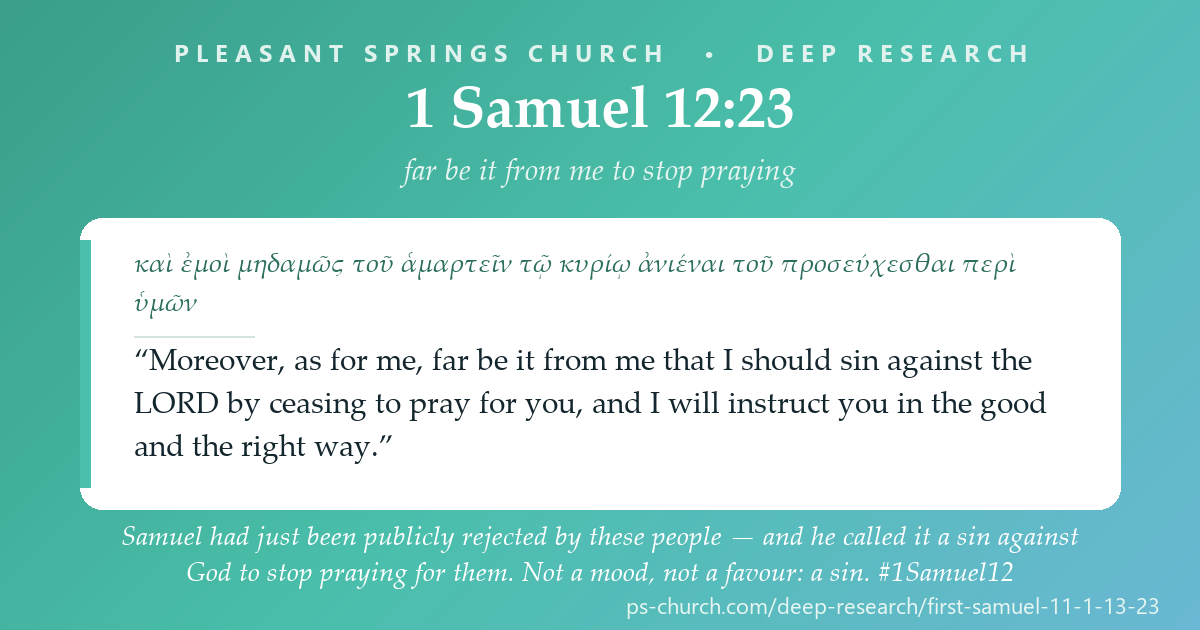
And people who needed to know somebody was praying. 12:23 is addressed to a congregation that has just been told, publicly, that it sinned in asking for what it now has. Samuel does not withdraw, does not resign, does not curse them. He says that stopping would be the sin. Whatever else this passage was for, it was for people who had done something they could not undo and needed to hear that the prophet was not finished with them.
Orient on Ammon and Nahash, Jabesh-gilead, Gilgal, the Philistines, the covenant lawsuit, and — on this page especially — the text of Samuel.
Search by topic: Ammon, Ammonites; Nahash; Jabesh-gilead; Gilead; Gilgal; Bezek; Michmash; Geba and Gibeah; Philistines; Sea Peoples; Saul; Samuel; kingship and monarchy in Israel; nagid; anointing; burnt offering (olah) and peace offering (shelamim); covenant lawsuit (rib); prophet and king; Spirit of God in Judges–Samuel; regnal formulae; and — do not skip these — Samuel, Books of: Text; Dead Sea Scrolls, Biblical; 4QSamuel-a; Septuagint of Samuel–Kings; kaige recension.
Which articles are relevant?
- Anchor Bible Dictionary — “Samuel, Books of” (including the text-critical section), “Saul,” “Samuel (person),” “Nahash,” “Ammon, Ammonites,” “Jabesh-gilead,” “Gilgal,” “Michmash,” “Philistines,” “Nagid,” “Anointing,” “Kingship (Israelite),” “Textual Criticism (OT).”
- Dictionary of the OT: Historical Books (IVP) — “Samuel, Books of,” “Saul and Saul’s Family,” “Kingship,” “Prophets and Prophecy,” “Ammon, Ammonites,” “Philistines,” “Sacrifice and Offerings,” “Text and Textual Criticism.”
- NIDOTTE / TDOT — יָשַׁע (yāšaʿ, save) and תְּשׁוּעָה (təšûʿāh); שָׁאַל (šāʾal, ask); צָלַח (ṣālaḥ, rush upon); נָתַח (nāṯaḥ, cut in pieces); נָגִיד (nāgîd); עֹלָה (ʿōlāh); כֹּפֶר (kōper, ransom); סָכַל (sāḵal, act foolishly).
- On the text of this book specifically — Emanuel Tov, Textual Criticism of the Hebrew Bible (3rd ed.), which uses Samuel repeatedly as its worked example; Eugene Ulrich, The Qumran Text of Samuel and Josephus (1978), the study that first laid out how often Josephus agrees with the scroll and the Greek against the Masoretic Text; and the critical edition itself, DJD XVII (F. M. Cross, D. W. Parry, R. J. Saley, E. Ulrich, Qumran Cave 4.XII: 1–2 Samuel, 2005). Read the codex note above with one of these open.
Bibliography surfaced:
- P. Kyle McCarter Jr., I Samuel (Anchor Bible) — the standard text-critical commentary on this book in English; Ralph W. Klein, 1 Samuel (Word Biblical Commentary); David Toshio Tsumura, The First Book of Samuel (NICOT), which argues consistently for the Masoretic Text where McCarter emends.
- Robert D. Bergen, 1, 2 Samuel (New American Commentary); Bill T. Arnold, 1 & 2 Samuel (NIV Application Commentary); V. Philips Long, The Reign and Rejection of King Saul; Walter Brueggemann, First and Second Samuel (Interpretation).
- Robert Alter, The David Story — a translation and commentary on Samuel, and the place to go for the narrative craft (he reads these texts as literature and does not share the church’s confession; we take the tools, not the metaphysics).
Ammon as a real kingdom, mutilation as a term of surrender, the treaty form under Samuel’s farewell, and what the ancient retellings did with Saul.
First the world: who the Ammonites were outside the Bible, what “cut a covenant’” meant at a city gate, and why a covenant lawsuit sounds the way chapter 12 sounds. Then the witnesses — Josephus, Ben Sira, the rabbis — and watch what each of them does with Saul.
Which parallels shed light on the world of these chapters?
Ammon was a real kingdom with real kings, and we can hear them named by their enemies. The Assyrian royal annals list Ammon among the tribute-paying states of the Levant, alongside Moab, Edom, Judah, Ashkelon and Tyre: Sanipu of Bit-Ammon in the tribute list of Tiglath-pileser III (ANET 282), Buduili of Beth-Ammon under Sennacherib (ANET 287–288), Puduil, king of Beth-Ammon under Esarhaddon (ANET 291), and a battle fought in Beth-Ammon in Ashurbanipal’s Arabian campaign (ANET 298). Those are centuries after Nahash, and that is the point: the Bible is not writing about a legend. Ammon sat on the Transjordanian plateau around modern Amman, on the same side of the river as Gad and Reuben — which is exactly the territory the Qumran paragraph says Nahash had been working through.
“Make a treaty with us” is a technical request, and Nahash’s answer is a technical reply. The Hebrew of 11:1 is כְּרׇת־לָנוּ בְרִית, “cut a covenant for us” — the men of Jabesh are offering to become a vassal state, which was an ordinary and survivable arrangement. What is not ordinary is the stipulation. Ancient treaties carry conditions; this one carries a mutilation, and the text says why: “and thus bring disgrace on all Israel” (11:2). It is a political act aimed past Jabesh at everyone watching. Mutilation as a contractual penalty is attested in the ordinary legal documents of the period — a Nuzi contract printed in ANET 220 provides that if a servant defaults, her master “shall pluck out the eyes” of her and sell her. The world of these chapters is one in which that sentence could be written into a document by a scribe on a normal afternoon.
Chapter 12 is not a sermon; it is a legal form. Samuel stands the nation up before two witnesses (“the Lord is witness against you, and his anointed is witness,” 12:5), rehearses the history from Jacob down to Nahash (12:6–12), states the stipulations (12:14), and names the blessing and the curse (12:14–15, 25). That is the shape of a suzerainty treaty, the same form that stands under the Sinai covenant and under Deuteronomy — preamble, historical prologue, stipulations, witnesses, blessings and curses. The Hittite treaties printed in ANET 199–206 are the standard comparison. So chapter 12 is a covenant renewal at the installation of a king, conducted by the prophet, and the king is inside the covenant, not above it — which is precisely what Deuteronomy 17:14–20 had legislated.
- Assyrian royal annals naming Ammon (royal inscriptions — witnesses, not Scripture) — Tiglath-pileser III (ANET 282); Sennacherib (ANET 287–288); Esarhaddon (ANET 291); Ashurbanipal (ANET 298). Ammon appears as Bit-Ammon, “the house of Ammon,” with named kings paying tribute.
- Nuzi family-law tablet, the “Hebrew Slave Document” (ANET 220) (a legal document — a witness, not Scripture) — blinding written into a contract as the penalty for default. Cited here only to show that Nahash’s clause belongs to a real legal world, not to a storyteller’s imagination.
- Hittite suzerainty treaties (ANET 199–206) (treaty texts — witnesses, not Scripture) — the form behind 1 Samuel 12: preamble, historical prologue, stipulations, deposit, witnesses, blessings and curses.
- Josephus, Antiquities 6.68–71, 6.78, 6.378 (Second-Temple — a witness, not Scripture) — three things worth having. At 6.68–71 he supplies Nahash’s prior campaign east of the Jordan and the blinding of prisoners, with a tactical explanation the Bible never gives: the shield covers the left eye, so a man without a right eye cannot fight. That is the material the Qumran paragraph has and our Bibles do not, and it is the strongest single reason to take the scroll seriously. At 6.78 his muster figures are 700,000 and 70,000, agreeing with the Greek against the Hebrew on Judah and with neither on Israel. At 6.378 he closes Saul’s life with “eighteen years while Samuel was alive, and after his death two [and twenty]” — forty in total, as Acts 13:21 also says, though elsewhere (Ant. 10.143) he says twenty. Josephus is evidence about the text he was reading, not a court of appeal above it.
- Ben Sira (Sirach) 46:13–20 (Second-Temple, c. 180 BC; non-canonical — the Apocrypha and Deuterocanon are read here as witnesses, never as Scripture) — and it is a real find for this page. Ben Sira’s praise of Samuel ends: καὶ πρὸ καιροῦ κοιμήσεως αἰῶνος ἐπεμαρτύρατο ἔναντι Κυρίου καὶ χριστοῦ αὐτοῦ· χρήματα καὶ ἕως ὑποδημάτων ἀπὸ πάσης σαρκὸς οὐκ εἴληφα — “before his everlasting sleep he testified before the Lord and his anointed: money, and even sandals, I have taken from no one.” That is 1 Samuel 12:3–5 quoted, with the Septuagint’s “sandal” and not the Masoretic Text’s “and I hid my eyes” — which means the Greek reading of 12:3 was already the reading somebody knew in the second century BC. This is what evidence for a variant looks like when you can actually see it.
- b. Yoma 22b (rabbinic-era — a witness, not Scripture) — one folio, three things. On 11:8 the rabbis debate whether bezek is the town of Judges 1:5 or the word for potsherds, i.e. that Saul counted the army with broken pottery. On 13:1 Rav Huna reads “a son of a year” morally: Saul came to the throne “like a one-year-old, in that he had never tasted the taste of sin.” And then something few readers know: Rav Naḥman bar Yiṣḥak mocked that reading — a one-year-old is also filthy — was troubled by dreams that night, and apologised: “I humbly submit myself to you, O bones of Saul, son of Kish.” The Talmud is not soft on Saul, but it will not let him be a joke. Neither will this page.
Set the ancient witnesses side by side and a pattern appears, and it is the same pattern that runs through the manuscripts.
(1) Why Nahash was so cruel. The Hebrew and the Greek simply drop him into 11:1 with no introduction and no motive. Josephus supplies a whole prior campaign. 4QSama has a paragraph that does the same work. That agreement is either two witnesses to something the Masoretic Text lost, or two witnesses to how badly ancient readers wanted the gap filled — and honest scholarship is divided over which. See Stage 5.
(2) How old Saul was. The Hebrew has a hole. The Greek of Rahlfs has no verse. Later Greek manuscripts write “thirty.” The rabbis at b. Yoma 22b turn the impossible “one year” into a character reference. Every one of those is a way of not leaving a blank on the page, and the blank is what we actually have.
(3) Whether Saul had a case. The Bible lets him make it (13:11–12) and does not rebut it clause by clause; Samuel simply pronounces. Later readers on both sides could not bear the silence — some prosecuting Saul harder than the text does, others (like Rav Huna) defending him harder than the text does.
The rule for these pages: report what the text approves, report what it merely reports, report what it condemns, and leave the gaps open. The witnesses are worth reading precisely because you can watch them closing gaps — which is the permanent temptation of anyone who cares about a story.
One root that carries chapter 11, one pun that carries chapter 12, one verb borrowed from the worst page in Judges, and one place-name used eight times.
Count yasha yourself — three in these chapters, four with 10:27. Then hear shaal under Saul’s own name three times in chapter 12; watch natah carry Judges 19 into 1 Samuel 11; and hold the Hebrew “I hid my eyes” beside the Greek “and a sandal” without choosing between the columns.
“Save; salvation, victory, deliverance.” The key word of the rescue, and the whole argument of chapter 11 is carried on it. Worthless men sneer, “How can this man save us?” (10:27). The elders of Jabesh say, “if there is no one to save us” (11:3). Saul’s messengers promise, “tomorrow you shall have salvation” (11:9). And Saul himself refuses the credit: “today the Lord has worked salvation in Israel” (11:13). The question is asked about a man and answered about God, by the man. The Greek keeps the thread: ὁ σῴζων at 11:3, σωτηρία at 11:9 and 11:13. It is also the root behind the names Joshua and Jesus.
“To ask, to request.” Israel asked for a king (1 Sam 8), and the king they were given is named שָׁאוּל, Šāʾûl — a passive participle meaning “asked for” or “requested.” Samuel plays on it three times in chapter 12: “the king whom you have asked for” (12:13), “in asking for yourselves a king” (12:17), “in asking for ourselves a king” (12:19). The Greek cannot carry it, and it loses one of the three: Rahlfs has αἰτήσαντες at 12:17 and 12:19, transliterates the name as Σαουλ, and at 12:13 reads only “the king ὃν ἐξελέξασθε — whom you chose,” with no equivalent of the Hebrew’s “for whom you have asked.” That is a minus, and it is worth naming: a Greek reader gets the accusation and not the pun.
“Rush upon, break through.” Not a gentle word. It is what the Spirit does to Samson (Judg 14:6, 19; 15:14), to Saul at 10:6 and 10:10, and to David at 16:13 — and, in the most sobering use in the book, it is the verb used of the harmful spirit that comes on Saul at 18:10. The same verb for both. Here in 11:6 it is the last time in Saul’s life that the reader is told the Spirit of God rushed on him, and what follows is the only unambiguous victory of his reign. Rahlfs has ἐφήλατο, “leapt upon,” which keeps the violence of it — and reads “Spirit of the Lord” where the Hebrew has “Spirit of God.”
“Cut in pieces, dismember.” The verb of butchering a sacrifice (Lev 1:6, 12) — and of Judges 19:29, where a Levite does it to a woman’s body and sends the pieces “throughout all the territory of Israel.” Saul does it to a yoke of oxen and sends them with the same words. The echo is verbatim in Hebrew and it is not decoration: Judges’ act of horror, which summoned Israel to civil war and ended with the slaughter of Jabesh-gilead itself (Judg 21:8–12), is here reused to summon Israel to rescue Jabesh-gilead. And the Greek keeps it: ἐμέλισεν stands in both places, so the echo survives in Greek too — what does not survive identically is the second clause, where Judges sends the pieces “to all the tribes of Israel” and 1 Kingdoms “into all the territory of Israel,” though the Hebrew of the two verses is the same phrase.
The place, eight times in three chapters. Gilgal is where Israel first camped in the land, where the twelve stones were set up and the reproach of Egypt rolled away (Joshua 4; Joshua 5) — the nation’s beginning. It is where the kingdom is renewed (11:14) and where it is refused (13:13–14). Samuel had named it in advance: “go down before me to Gilgal… seven days you shall wait” (10:8). Note that chapter 12 does not mention it once; the two Gilgal scenes stand at the ends of this passage with the covenant renewal between them.
“A ransom” — and, in the Greek, “a sandal.” The Masoretic Text reads כֹפֶר וְאַעְלִים עֵינַי בּוֹ, “a ransom, and I hid my eyes with it”; the Septuagint reads ἐξίλασμα καὶ ὑπόδημα, “a ransom and a sandal,” reflecting a Hebrew וְנַעֲלַיִם. The two are close in unpointed script. And the reading is old: Ben Sira, about 180 BC, quotes Samuel’s speech with “money and even sandals” (Sirach 46:19 — non-canonical, a witness only). Taking “a pair of sandals” as the very smallest bribe is the same idiom as Amos 2:6 and 8:6, “the needy for a pair of sandals.” This page prints the Hebrew in the English column, as the ESV does, and shows you the Greek beside it.
“Designate, leader, prince” — and deliberately not מֶלֶךְ (meleḵ, “king”). It is the word God uses of Saul when Samuel anoints him privately (9:16; 10:1) and the word used here of the man who will replace him. The ESV renders it “prince”; the Greek has ἄρχων, “ruler.” The distinction matters: Israel asked for a meleḵ like the nations, and God keeps appointing a nāgîd — someone whose office is derivative, a man placed over God’s people by God’s word rather than by his own standing.
“A man according to his own heart.” The most quoted phrase in these chapters and one of the most misread. It is not obviously a compliment about David’s piety; the plainest sense of the Hebrew is “a man of his own choosing” — the contrast being with a king the people chose (12:13). Many commentators read it that way; others hear a genuine moral claim, and Acts 13:22 quotes it in a form that leans that direction (“a man after my heart, who will do all my will”). The Greek is exactly the Hebrew: ἄνθρωπον κατὰ τὴν καρδίαν αὐτοῦ. Both readings are live; this page names them and does not settle it.
Two oddities in the Hebrew of these chapters, reported rather than tidied:
- The ketiv and qere at 11:6 and 13:8. At 11:6 the consonants written are בשמעו (“when he heard” with a bet); the Masoretic reading tradition says כְּשׇׁמְעוֹ (with a kaph). The sense is barely affected and the Greek ὡς ἤκουσεν agrees with the reading tradition. At 13:8 the written form is וייחל and the read form וַיּוֹחֶל, “and he waited.” These are printed above rather than silently normalised, because a reader is entitled to know that the Hebrew Bible itself preserves two forms and tells you so in the margin.
- An elliptical clause at 13:8 and a genuinely obscure one at 13:21. 13:8 reads, word for word, “to the appointed time which Samuel” — the verb is simply missing, which is why every translation supplies something (“appointed by Samuel”), and why the Greek went a different way entirely (“for the testimony, as Samuel said”). And 13:21 contains פִים, pîm, a word nobody could translate with confidence until excavation turned up small stone weights inscribed pym — about two-thirds of a shekel. That is a genuine case where archaeology solved a lexical puzzle, and it is worth telling: the verse is about what the Philistines charged Israelite farmers to sharpen their tools.
The book behind this one, the law of the king, Gilgal from Joshua to Saul, and the town that buries him.
Trace five threads: Judges, quoted in Samuel’s own list and in Saul’s oxen; Deuteronomy 17, the law that governs any Israelite king; Gilgal, from Joshua’s twelve stones to Saul’s burnt offering; Jabesh-gilead, from Judges 21 to 1 Samuel 31; and the “man after his own heart,” forward.
Which cross-references matter?
- Judges 19–21 — read this before you read 1 Samuel 11. The verbal echo at 11:7 is exact: a body cut in pieces (נתח) and sent through all the territory of Israel (וישלח בכל גבול ישראל). And the target of Saul’s rescue is Jabesh-gilead — the town Israel massacred in Judges 21:8–12 for failing to muster, and from which four hundred young women were taken to repopulate the tribe of Benjamin. Saul is a Benjaminite. His first act as a working king is to save the city his own tribe was rebuilt from. The narrator never says any of this out loud.
- Deuteronomy 17:14–20 — the law of the king. Israel may have a king; he must be one the Lord chooses; he must not multiply horses, wives or silver; and he must write out a copy of the law and read it all his life, “that his heart may not be lifted up above his brothers.” Chapter 12 is the public reading of those terms at the installation, and chapter 13 is the first test of whether the king is under them. Read 12:14–15 and 13:13 with Deuteronomy 17 open.
- 1 Samuel 8–10 — the request, the warning and the private command. Three things carry directly into this passage: the verdict “they have rejected me from being king over them” (8:7), which chapter 12 restates without withdrawing the king; the sneer of 10:27, which chapter 11 answers; and above all 10:8 — “go down before me to Gilgal… seven days you shall wait” — which is the command Samuel says Saul broke at 13:13.
- Joshua 3–4 and Joshua 5 — what Gilgal was before it was this. The twelve stones out of the Jordan, the circumcision of the new generation, the first Passover in the land, and “today I have rolled away the reproach of Egypt from you.” Gilgal is the place where Israel began. Setting the renewal and the ruin of the first monarchy there is not an accident of geography.
- Judges 6–8, Judges 4–5 and Judges 10–12 — Samuel’s own list. In 12:9–11 Samuel names Sisera (Judges 4), the Philistines, the king of Moab (Judges 3), then Jerubbaal (Gideon), Bedan/Barak, Jephthah and himself. Two things follow. First, Judges is being read as a single argument by a character inside 1 Samuel. Second, Gideon is on the list — the man who said, “I will not rule over you… the Lord will rule over you” (Judg 8:23), which is exactly Samuel’s point at 12:12.
- Jabesh-gilead, forward. The men Saul rescued here are the men who, at the very end, take his body and his sons’ bodies down from the wall of Beth-shan, carry them home, burn them, bury the bones under a tamarisk and fast seven days (1 Samuel 31:11–13). The last act of loyalty in Saul’s story is done by the town he saved in his first. It is one of the quietest and best things in the book.
- The burnt offering, and what the issue actually was. 13:9–12 has been used for centuries to argue that Saul’s sin was performing a priestly act. Handle that carefully: Samuel’s own charge in 13:13 is not “you are not a priest” but “you have not kept the command of the Lord your God, with which he commanded you” — the seven days of 10:8. David and Solomon both offer sacrifice without rebuke (2 Sam 6:17–18; 1 Kgs 3:4). The text names disobedience, not liturgical trespass, and a study should name what the text names. Compare Leviticus 10 for what an actual priestly trespass looks like when Scripture wants to say so.
- “A man after his own heart,” forward. 2 Samuel 7 is where the kingdom that will continue is promised: “your throne shall be established forever.” Set 13:13–14 beside it — the same vocabulary of a kingdom established (הֵכִין) and standing (קוּם), granted to one house and refused to another. And Acts 13:21–22 quotes this very verse in a sermon: “he gave them Saul… for forty years… and he raised up David to be their king… ‘a man after my heart.’”
- Psalm 2 and Psalm 110 — where the office ends up. The word for Samuel’s witness in 12:3, 5 is מְשִׁיחוֹ, “his anointed” (Greek χριστοῦ αὐτοῦ). This is the first stretch of Scripture in which an Israelite king can be called that, and the psalms of the anointed king are where the vocabulary is developed.
Everything is set up for an execution. The men of 10:27 are named as troublemakers by the narrator himself. They insulted the king in public and brought him no gift. Saul has just won a total victory with three hundred thousand men at his back, and the people — not Saul — propose the killing and ask Samuel to authorise it. In the ancient world this is the ordinary next scene. In the book of Judges it would have been.
And Saul says no, and gives a reason that is not about himself. “Not a man shall be put to death this day, for today the Lord has worked salvation in Israel.” He does not say “I forgive them” or “I am above this.” He says the victory was God’s, and therefore the day is not available for settling his scores. That is a genuinely theological sentence, and it comes out of the mouth of the man this book is going to spend twenty chapters watching fall apart.
Two disciplines follow. First, do not read Saul backwards. A great deal of preaching on 1 Samuel treats every early scene as evidence for the later collapse, so that even his mercy becomes a symptom. The narrator does not do that. He gives Saul this line clean, and he gives it to him alone — Samuel does not prompt it and the people do not want it. Second, do not read it as mere niceness. Saul’s clemency here is exactly the same instinct that will be called disobedience in chapter 15, when he spares what he was told to destroy. The Bible does not hand us a simple rule that sparing is always right; it hands us a man, and two days, and asks us to notice that the difference between them was whether God had spoken.
Where Scripture gives a reason, we may give it. Here it gives one, and Saul gives it himself, and we should let him keep it.
The commentaries, the Qumran paragraph, the damaged verse, and the question of what exactly Saul did wrong.
McCarter, Klein, Tsumura, Bergen, Arnold, Long, Brueggemann and Alter on the book; Cross, Ulrich, Tov, Rofe and Barthelemy on the text. Then the four live questions in this passage, with the positions named and — where Scripture and the evidence do not settle them — deliberately left open.
Commentaries & studies:
- P. Kyle McCarter Jr., I Samuel (Anchor Bible, 1980) — the standard text-critical commentary; he works constantly with the Greek, Josephus and 4QSama, and he prints and discusses the Nahash paragraph. Ralph W. Klein, 1 Samuel (WBC), similar in method and more compact.
- David Toshio Tsumura, The First Book of Samuel (NICOT) — the best counterweight, arguing case by case that the Masoretic Text can stand where others emend. Read McCarter and Tsumura together; between them you will see the whole method rather than one side of it.
- Robert D. Bergen, 1, 2 Samuel (NAC); Bill T. Arnold, 1 & 2 Samuel (NIVAC); V. Philips Long, The Reign and Rejection of King Saul, which is the monograph to read on 13:7–15; Walter Brueggemann, First and Second Samuel (Interpretation), for the theological reading of chapter 12.
- Robert Alter, The David Story — for the narrative craft: the reticence, the type-scene, the way a character’s speech does the characterising. (Read as literature by a scholar who does not share the church’s confession; we take the tools, not the metaphysics.)
- On the text: DJD XVII, Qumran Cave 4.XII: 1–2 Samuel (Cross, Parry, Saley, Ulrich, 2005) — the edition; Eugene Ulrich, The Qumran Text of Samuel and Josephus (1978); Emanuel Tov, Textual Criticism of the Hebrew Bible; Alexander Rofé, “The Acts of Nahash according to 4QSama,” IEJ 32 (1982) and “4QMidrash Samuel? Observations Concerning the Character of 4QSama,” Textus 19 (1998).
Interpretation notes worth keeping:
- The Nahash paragraph: the case on both sides, and why we do not decide. For originality: the paragraph explains what the received text leaves unexplained (why these terms, why this city); it accounts for Josephus, who otherwise invented the same material independently; the Greek and the scroll agree on “about a month later” against the Masoretic Text’s odd kəmaḥărîš, which looks like a corruption of the same consonants; and loss by a scribe’s eye slipping between similar words is an ordinary, documented accident. Frank Moore Cross argued this, the NRSV committee printed it, and Emanuel Tov and others have treated it as a serious candidate for the original text. Against originality: the paragraph reads exactly like the kind of thing later scribes add — it answers the reader’s questions, and it is built largely out of words already in the chapter, which is the fingerprint of an expansion rather than of an original; and 4QSama shows other expansionist features. Dominique Barthélemy argued against it, and Alexander Rofé has made the fullest case that this scroll has midrashic traits. The honest position is that this is unresolved, and that is not a weakness in the evidence but a description of it. What is not in doubt is that the paragraph exists and that most Bibles do not tell their readers so. See the texts we print.
- 13:1, and how to talk about a damaged verse in church. The regnal formula is incomplete in the Hebrew; the Greek of Rahlfs has no such verse; some later Greek manuscripts write “thirty”; Acts 13:21 gives Saul forty years. Translations handle it four different ways and every one of them footnotes what it has done. The pastoral point is worth making plainly: this is what a genuinely uncertain text looks like, and it is a regnal note. Nothing anyone believes is at stake. Readers who have been taught that admitting a textual problem is the first step to losing everything deserve to be shown a real one and to see for themselves how small the ground is that actually shifts — and how faithfully the translations tell them about it in the margin.
- What exactly was Saul’s sin at Gilgal? Genuinely debated. (1) He usurped a priestly function. The oldest and most common reading, and it has the weight of the scene behind it. (2) He disobeyed a specific command — 10:8, the seven days — which is what Samuel actually says in 13:13. (3) He failed a test of faith, acting to hold the army together instead of trusting the word he had been given. (4) A minority reading notes that the Hebrew of 13:8 says he waited seven days and Samuel came “as soon as he had finished” (13:10), and asks whether the seven days had in fact expired — on which the text is not as clear as sermons usually assume. These are not equally strong, and reading (2) is what the verse says; but the others are real readings held by serious people, and the page names them rather than pretending the question was never asked.
- “A man after his own heart” — two readings, both defensible. Either “a man of his own choosing” (the contrast being with the king the people chose, 12:13; this is the plainest sense of the Hebrew and is widely held), or “a man whose heart is like God’s” (the traditional reading, and the direction Acts 13:22 leans, adding “who will do all my will”). Two things are worth saying either way. The phrase is spoken before David has done anything at all, so it cannot be a report card on his behaviour. And the book that says it will, in due course, tell you about Uriah — so whatever it means, it does not mean “a better man.”
- 12:11 — Bedan or Barak, and what your Bible did about it. The Masoretic Text has Bedan, a name found nowhere else. The Septuagint and the Syriac have Barak, who fits Samuel’s list of deliverers perfectly. Some have connected Bedan with a name in 1 Chronicles 7:17, or read it as “son of Dan,” i.e. Samson. The ESV, NIV, NRSV and most modern versions print Barak and footnote the Hebrew. Notice what that means: on this page your English Bible follows the Greek in two places (12:3 and 12:11) and the Hebrew everywhere else, and it tells you so both times. That is the ordinary, honest practice of translation, and it is exactly what this library tries to make visible instead of leaving in six-point type.
- The muster figures at 11:8, and large numbers generally. 300,000 / 30,000 (Hebrew), 600,000 / 70,000 (Rahlfs), 700,000 / 70,000 (Josephus), and 4QSama reported as siding with the Greek on Judah only. Proposals about the Hebrew אֶלֶף (ʾelep) meaning “unit” or “contingent” rather than “thousand” have been made for a century and are neither established nor refuted. We report the figures and do not harmonise them, and we note that the point the narrator is making — all Israel came out as one man — is not affected by which figure is right.
A rescued city, a king’s best hour, a prophet who would not stop praying, and a verse we do not have whole.
Name what you learned, why it matters, and one concrete response.
What should we carry away — and do?
- The manuscripts are a gift, not a threat. A scroll from a cave near the Dead Sea carries a paragraph our Bibles do not print; Josephus seems to have known it; scholars are divided about it; and after all of that, nothing you believe has moved an inch. That is the actual shape of the evidence, and it is worth knowing before somebody tries to frighten you with it. Every difference on this page is printed in the footnotes of ordinary study Bibles. The church has always had these witnesses and has always known.
- Saul’s best moment is his mercy, and he gets to keep it. “Not a man shall be put to death this day, for today the Lord has worked salvation in Israel.” He had the men, the victory and the grievance, and he refused all three. Read that without hurrying on to what he becomes.
- “Whose ox have I taken?” is a question every leader should be able to ask out loud. Samuel stands in front of the whole nation, invites accusation, names the specific categories — theft, extortion, oppression, bribery — and offers restitution before anyone has complained. Nobody accuses him. That is what integrity looks like when it is auditable rather than asserted.
- It is a sin to stop praying for people who have wronged you. That is not a devotional flourish; it is 12:23, spoken by a man these people had just publicly rejected, about those same people. Far be it from me that I should sin against the Lord by ceasing to pray for you. If you are still keeping a list of people you have quietly stopped praying for, this verse is about that list.
- God’s faithfulness is not a reward for asking rightly. Israel asked for a king and was told it was a rejection of God. Then, in the same speech: “the Lord will not forsake his people, for his great name’s sake, because it has pleased the Lord to make you a people for himself” (12:22). The reason given is his name, not their record.
- And there is a verse here we do not have whole. 13:1 is broken, and every honest Bible says so in the margin. A faith that cannot survive a damaged regnal note was never resting on the note. Let it teach you where your confidence actually sits.
A word about violence, said plainly. These chapters contain a mutilation, a slaughter, and a proposed execution. Two of them are reported and one is refused. Nothing here licenses any violence, coercion or hostility toward any people today — not toward Ammonites’ descendants, not toward anyone. The New Testament is explicit that the church’s weapons are not of this kind (2 Corinthians 10:4; Ephesians 6:12), that Jesus rebuked his own disciples for wanting to call down fire (Luke 9:54–55), and that those who take the sword perish by it (Matthew 26:52). Texts like these have been misused; we say so, and we do not linger over the killing. The line this page carries away is Saul’s refusal, not the battle.
A word about typology, clearly labelled. Samuel’s “far be it from me… by ceasing to pray for you” has been heard by Christians alongside the New Testament’s own statements that Christ “always lives to make intercession” for those who come to God through him (Hebrews 7:25; cf. Romans 8:34). Hold that as a labelled devotional analogy, not as an argument from the text. The New Testament nowhere calls Samuel a figure of Christ, and 1 Samuel 12 is not making that claim. What it is doing is showing you what an intercessor looks like when he has every human reason to walk away — and that is enough to sit with on its own.
Step in response: two things this week. First, take the list of people you have stopped praying for — you know whether you have one — and put one name back on it. Second, find a study Bible with textual footnotes and read the notes on 1 Samuel 12:3, 12:11 and 13:1 for yourself. Not to be unsettled; to see that somebody has been telling you the truth in small type all along.
1 Samuel 12:23 · to share
Hebrew · LXX (Rahlfs) + ESVEvery Deep Research page traces its passage across the whole sweep — the Old Testament, the Second-Temple world between the testaments (historical witnesses, not Scripture), and the New Testament. Follow the thread:
Pleasant Springs Church — Deep Research
Research method after Michael S. Heiser’s Bible Research Method (examine dictionaries → ancient literature → important words → textual connections → academic publications → share), with the Pleasant Springs “Author & Audience” foundation. Scripture set in the Hebrew, the Greek editions named on each page and the ESV (Old Testament), and the Greek New Testament and the ESV (New Testament), per the practice of Pleasant Springs Church. 1 Samuel 11–13 research grounded in McCarter (Anchor Bible), Klein (WBC), Tsumura (NICOT), Bergen (NAC), Arnold (NIVAC), Long, Brueggemann (Interpretation) and Alter’s The David Story, with Alter also supplying the literary tools used in the structure block. Text & editions: Hebrew from the Masoretic Text, with the qere printed and the ketiv reported at 11:6 and 13:8; Greek from Rahlfs’s Septuaginta, verified verse by verse against the Rahlfs text rather than back-translated and printed without editorial punctuation; English ESV (2016), quoted exactly. The Greek calls this book 1 Kingdoms (Βασιλειῶν Αʹ), and 1 Kingdoms lies in Barthélemy’s section α, outside the kaige revision. Numbering: there is no chapter- or verse-offset between the Hebrew and Rahlfs in these three chapters, with one exception which falls inside this passage — Rahlfs prints no 13:1, and Greek chapter 13 begins at verse 2; this was counted, not assumed, and is stated at the verse. Divergences: 1 Samuel is the book in which the Greek and Hebrew differ most, and this page enumerates every difference in the verses it prints rather than a selection — pluses in the Greek at 11:1 (“about a month later”), 11:6, 12:3, 12:23, 13:8, 13:15 and 13:16; the minus of 13:1 entire and of “for whom you have asked” at 12:13; different readings at 11:8 (Bezek/Abiezek, and 300,000/30,000 against 600,000/70,000), 11:15 (“they made king” against “Samuel anointed,” and Saul against Samuel rejoicing), 12:3 (“I hid my eyes” against “and a sandal”), 12:11 (Bedan against Barak), 13:3 and 13:13 (“the command of the Lord your God” against “my command”); and it states explicitly where the columns agree, including at 11:2, 11:13, 12:17–18, 12:22, 13:5, 13:11–12 and 13:14. Pluses and minuses are named as such and never described as rendering differences. Where the page argues from a Hebrew word — the yāšaʿ Leitwort, šāʾal/Saul, nāṯaḥ, the Gilgal frame — what the Greek column actually does with it is stated in the same breath. Qumran: 4QSama (4Q51) preserves parts of 11:1–2 and 11:7–12 together with the Nahash paragraph; 4QSamb (4Q52) and 4QSamc (4Q53) preserve nothing from these chapters. The Nahash paragraph before 11:1 is reported in full, with its absence from both the Masoretic Text and Rahlfs stated plainly, the NRSV’s decision to print it noted, Josephus (Ant. 6.68–71) named as an apparently independent witness to the substance, the shared “about a month later” of the Greek and the scroll set against the Masoretic kəmaḥărîš, and the debate laid out on both sides — Cross, Tov and the NRSV committee on one side, Barthélemy and Rofé on the other — and deliberately left unadjudicated. 1 Samuel 13:1 is reported as a place where the text has not come down whole; the Hebrew is printed as it stands, Rahlfs’s omission of the verse is stated, the later Greek “thirty” and the ESV’s footnote are quoted, Acts 13:21 and Josephus (Ant. 6.378; 10.143) are given, and no reconstructed number is printed as though it were the text. Second-Temple and rabbinic witnesses (4QSama; Josephus, Ant. 6.68–71, 6.78, 6.378; Sirach 46:13–20, tagged non-canonical at first mention; b. Yoma 22b) are read as witnesses and never levelled with Scripture. ANE parallels are cited only where verifiable in the local scan of ANET: the Assyrian tribute lists naming Bit-Ammon (282, 287–288, 291, 298), the Nuzi contract with blinding as a penalty (220), and the Hittite suzerainty treaties behind the form of 1 Samuel 12 (199–206). Saul is treated as a tragedy and not a villain: his mercy at 11:13 is given to him without qualification, his three clauses of self-defence at 13:11–12 are printed and not mocked, the four readings of what he did wrong at Gilgal are named with the strongest identified, and b. Yoma 22b’s apology to “the bones of Saul, son of Kish” is quoted for the same reason. The violence in these chapters is reported without relish and explicitly licenses nothing today (2 Cor 10:4; Eph 6:12; Luke 9:54–55; Matt 26:52). Samuel’s intercession is offered Christ-ward only as an explicitly labelled devotional analogy; the ambiguity of “a man after his own heart” is named and left open.
Scripture quotations marked ESV are from the ESV® Bible (The Holy Bible, English Standard Version®), © 2001 by Crossway, a publishing ministry of Good News Publishers. ESV Text Edition: 2016. Used by permission. All rights reserved. The ESV text may not be quoted in any publication made available to the public by a Creative Commons license, and the ESV may not be translated in whole or in part into any other language. www.esv.org
|
Did this study bless you today? 💚 Give to Support PS Church100% of gifts go to the General Fund — thank you. |