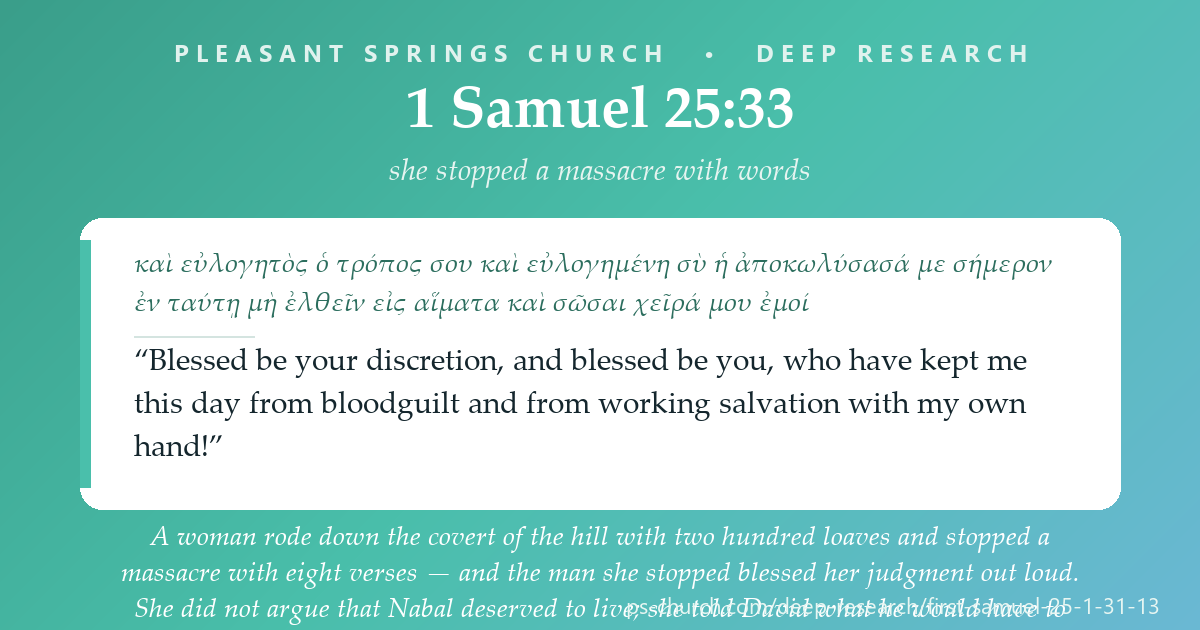
Samuel dies in the first line, and the book has seven chapters left. In them a rich man insults a hungry captain, and a woman named Abigail loads two hundred loaves and a hundred clusters of raisins onto donkeys and rides down under cover of the mountain to meet four hundred men with swords on. What she says to David is eight verses long and it is one of the best speeches in Scripture: she takes the blame, she names her husband exactly — “as his name is, so is he” — and then she puts his own vengeance to him as a weight he would have to carry: “my lord shall have no cause of grief or pangs of conscience for having shed blood without cause” (25:31). And David says out loud that she was right: “Blessed be your discretion, and blessed be you, who have kept me this day from bloodguilt” (25:33). Then a spear and a jar of water lifted from beside a sleeping king, and “the Lord forbid that I should put out my hand against the Lord’s anointed” (26:11). Then sixteen months among the Philistines, raids and a lie, reported without a word of approval. Then chapter 28, at night, at En-dor — the thing Deuteronomy 18 forbids by name and Saul himself had outlawed — reported here soberly, with the readings laid out and no verdict handed down. Then Ziklag burned, and one clause that holds up the whole chapter: “but David strengthened himself in the Lord his God” (30:6). And then Gilboa, plainly and without relish — and the last paragraph of the book, which is not about the king who failed but about the men of Jabesh-gilead, who walked all night to take his body off a wall, because he had saved them in chapter 11. This study works 1 Samuel 25:1–31:13 line by line, in Hebrew, Septuagint and ESV, with the differences between the columns reported rather than smoothed. See the method →
1 Samuel 25:1–31:13 (selections)
Hebrew (MT) · Greek (Rahlfs, 1 Kingdoms) · ESVNow the divergences in these seven chapters, in order. These are the ones that change the sense; smaller ones — a name spelled differently, a pronoun supplied — run to dozens more and are not listed. 25:1 the wilderness of Paran in Hebrew, Maan (Maon) in Greek. 25:3 Nabal is a Calebite in Hebrew and doglike (κυνικός) in Greek. 25:22 the curse falls on the enemies of David in Hebrew and on David in Greek — the ESVfootnotes it. 25:29 “the Lord your God” becomes “the Lord God.” 25:31 “a staggering and a stumbling of heart” becomes “an abomination and a stumbling-block.” 25:44 Palti is of Gallim in Hebrew and of Romma in Greek. 26:4 the Greek adds that Saul had come ready from Keilah. 26:5, 7 Saul sleeps in the encampment (מַעְגָּל) in Hebrew and in a covered wagon (λαμπήνη) in Greek. 26:12 a deep sleep from the Lord becomes an astonishment (θάμβος). 26:18 “what evil is in my hand” becomes “what wrong has been found in me” — the one place in these chapters where the Greek drops the hand. 26:20 the Hebrew’s “a single flea … as one hunts a partridge” has no flea at all in Greek, and the bird is a night-raven (νυκτικόραξ). 27:8 David raids three peoples in Hebrew and two in Greek — no Girzites. 27:10 Achish asks “where” in Hebrew and “against whom” in Greek. 28:13 a god becomes gods. 28:14 an old man becomes an upright man. 28:19 “you and your sons shall be with me” becomes “you and your sons with you shall fall.” 28:24 a fattened calf becomes a grazing heifer. 29:1 Israel camps by the spring that is in Jezreel in Hebrew and at En-dor which is in Jezreel in Greek — the Greek reads the place-name where the Hebrew reads the common noun. 30:2 the ESV follows the Greek here and says so: “Septuagint; Hebrew lacks and all.” 30:8, 15, 23 the raiding band (גְּדוּד) is not translated at all but spelled out in Greek letters, γεδδουρ. 30:20 the ESV footnotes the Hebrew as uncertain, and the Greek reads it differently. 30:27–31 the towns David sends spoil to are not the same list: the Hebrew names three in v. 28 and the Greek names eight; Hebrew Racal is Greek Carmel; Hormah, Bor-ashan and Athach are Ierimouth, Bersabee and Noo. 31:3 the Greek adds that Saul was wounded in the abdomen. 31:9 the Greek has no beheading — where the Hebrew says “they cut off his head,” the Greek says only “they turned him over.” 31:12 “the bodies of his sons” becomes “the body of Jonathan his son.” 31:13 the tamarisk becomes ploughed ground. None of that is hidden here, and none of it has been invented.
The Hebrew tradition is candid too. The Masoretes preserved seven written/read (ketiv/qere) pairs in these seven chapters — at 25:3, 25:18 (twice), 25:34, 26:22, 27:4, 27:8 and 28:8 — instead of choosing and erasing. Two of them are in the codex above. Manuscripts. From the Judean Desert, 4QSama (4Q51, Herodian, c. 50–25 B.C.) covers exactly this stretch — the preliminary edition by Donald W. Parry is titled “4QSama (4Q51): A Preliminary Edition of 1 Samuel 25:3–31:4” — and it is the scroll famous for agreeing with the Greek against the Masoretic Text more often than any other biblical manuscript. This page makes no argument from its readings in these verses. It is fragmentary, the official edition is DJD 17 (Cross, Parry, Saley, Ulrich, 2005), and that, not a summary, is where a reader should check it. Numbering. There is no chapter- or verse-offset anywhere here: Hebrew, Greek and English all run 25:1–44, 26:1–25, 27:1–12, 28:1–25, 29:1–11, 30:1–31 and 31:1–13, with identical verse counts in all seven chapters. That was counted, not assumed.
The Shape of the Passage
Parallel panelsBehind these seven chapters stand the whole book — the request for a king, the rejection over Amalek, the anointing of David and the long chase — and behind that, the refrain Judges ended on: “there was no king in Israel.” In front of them stands a lament in the next book, which is where the text says its own last word about Saul.
Author
A narrator who tells you almost nothing and shows you everything. He will not say whether David was right to go to Gath, whether the raids in chapter 27 were defensible, or what exactly came up out of the ground at En-dor. He reports speech at length and motive almost never. What he does instead is arrange: he puts Abigail’s speech between two chapters in which David spares Saul, and he cuts back and forth between Saul’s last night and David’s last raid so that the two endings land on the same days.
He also works by repetition you can count. The name Nabal and its noun nəḇālāh, “folly,” stand nineteen times in chapter 25 alone — the man is his name, exactly as his wife says. (Do not make it twenty: נִבְלֵי־יַיִן in 25:18 is nēḇel, a wineskin, a different word that only looks alike.) “The Lord’s anointed” comes four times in chapter 26. And yāḏ, “hand,” runs twenty times through the whole block. If you can name the repeated word, you have the theme.
And he refuses to gloat. Chapter 31 is thirteen verses long. There is no speech in it, no verdict, no “thus perished the man who…” The last paragraph of the book is not about the king who failed; it is about a town in Gilead that remembered.
Audience
People who already knew that David became king — and had heard it said that he climbed over Saul’s body to do it. That charge is the pressure these chapters are written under, and it explains why the narrator is so careful. David is out of the country when Saul dies (ch. 29), sent home by the Philistines against his will, and busy two days’ ride away (ch. 30). Twice he could have killed Saul and did not (chs. 24, 26). Once he set out to kill a man and a woman talked him out of it, and he blessed her for it (ch. 25). An audience with a rumour to weigh is being handed the evidence.
People under the law of Deuteronomy 18. Chapter 28 is not exotic to its first readers; it is illegal. Deuteronomy 18:10–11 forbids the medium and the one who inquires of the dead by name, Leviticus 19:31 and 20:6, 27 forbid them again, and Saul himself had cleared them out of the land (28:3, 9). The audience needs no explanation of what is wrong. They need to be told what it cost.
And people who buried their own. The book ends with a night march, a wall in Beth-shan, a fire, a tree in Jabesh and a seven-day fast. Whoever first heard this knew what it was to want a body back.
Orient on Nabal and Abigail, Carmel and Maon, the Philistine cities, Ziklag, mediums and necromancy, herem and spoil, and Jabesh-gilead.
Search by topic: Abigail; Nabal; Caleb and the Calebites; Maon; Carmel (in Judah); Ziph and Jeshimon; Achish; Gath; Ziklag; the Philistines and the Sea Peoples; the lords of the Philistines (seranim); necromancy; ob and yiddeoni; Urim and Thummim; Endor; Shunem; Gilboa; Beth-shan; Ashtaroth; Jabesh-gilead; Amalek; spoil and its division; anointing and ‘the LORD’s anointed’.
Which articles are relevant?
- Anchor Bible Dictionary — “Abigail,” “Nabal,” “Caleb,” “Maon,” “Carmel (Place),” “Ziklag,” “Achish,” “Gath,” “Philistines,” “Endor,” “Beth-shean,” “Gilboa,” “Jabesh-gilead,” “Necromancy,” “Magic (OT),” “Urim and Thummim,” “Anointing,” “Amalek.”
- Dictionary of the OT: Historical Books (IVP) — “Samuel, Books of,” “David,” “Saul,” “Philistines,” “Divination and Magic,” “Death and Afterlife,” “Women,” “Warfare,” “Text and Textual Criticism.” The last of those is not optional in this book.
- NIDOTTE / TDOT — יָד (yāḏ, hand), שָׁאַל (šāʾal, ask), נָבָל (nāḇāl, fool), טַעַם (ṭaʿam, discernment), מָשִׁיחַ (māšîaḥ, anointed), אוֹב (ʾōḇ, medium), חָזַק (ḥāzaq, be strong), כְּלִי (kəlî, vessel/gear).
- On the Greek — Bernard A. Taylor, “1 Reigns: To the Reader,” in NETS, on the character of Greek 1 Kingdoms; and Emanuel Tov, Textual Criticism of the Hebrew Bible, whose chapters on Samuel are where the divergences catalogued in the codex note above are set in order.
Bibliography surfaced:
- P. Kyle McCarter Jr., I Samuel (Anchor Bible) — the standard text-critical commentary on this book, and the one to have open when the columns disagree; Ralph W. Klein, 1 Samuel (WBC); David Toshio Tsumura, The First Book of Samuel (NICOT), which defends the Masoretic Text more often than McCarter does and should be read beside him.
- Robert Alter, The David Story (translation and commentary on 1 and 2 Samuel); Walter Brueggemann, First and Second Samuel (Interpretation); Robert D. Bergen, 1, 2 Samuel (NAC); Bill T. Arnold, 1 & 2 Samuel (NIVAC); V. Philips Long on the historical questions.
- J. P. Fokkelman, Narrative Art and Poetry in the Books of Samuel, vol. 2 — the fullest close reading of these chapters in English. (Alter and Fokkelman read these texts as literature and do not share the church’s confession; we take the tools, not the metaphysics.)
Sheep-shearing and protection money, the Philistine cities, necromancy in the ancient Near East — and what the ancient retellings do with chapter 28.
First the world: what a shearing feast was, why David’s men had a claim on it, who the Philistines were, and what everyone around Israel did about the dead. Then watch Sirach, Josephus and the early church all arrive at chapter 28 and give three different answers — because the passage has been argued over from the beginning, and pretending otherwise would be dishonest.
Which parallels shed light on this world?
Sheep-shearing was a feast, and a feast is when you ask. Shearing gathered the flocks, the hired hands and the surplus in one place; it is a harvest festival with wool instead of grain (compare Judah at Timnah, Genesis 38:12–13, and Absalom’s shearing party in 2 Samuel 13:23–29). David’s claim is not extortion in the modern sense and not quite wages either: his four hundred men had in fact stood between Nabal’s shepherds and the raiders of the Negeb, and Nabal’s own servant says so unprompted — “they were a wall to us both by night and by day” (25:16). The narrator lets the servant establish the facts so that the reader is not left guessing. What David then proposes to do about it is a different question, and the narrator does not defend that either.
The Philistines were newcomers with better cities and better iron. They are the Sea Peoples of the Egyptian records: Ramses III’s Medinet Habu inscriptions name the Peleset among the peoples who came by land and sea and were fought off in the eighth year of his reign (the relevant Egyptian historical texts are collected in ANET, section III). They settled the coastal plain in five city-states — Gath, Gaza, Ashkelon, Ashdod, Ekron — each under a seren, a title the Bible uses only of them (29:2, 6, 7). Achish of Gath is a real political figure in a real system, and David’s sixteen months as his vassal (27:7) are exactly the kind of arrangement the Amarna-era archives show around Canaan: a landless armed band hires itself to a city king and raids on his behalf.
And consulting the dead was normal everywhere except in Israel’s law. Mesopotamian ritual texts prescribe procedures for calling up and questioning a ghost (eṭemmu), and the great literary descent-texts — the Descent of Ishtar (ANET 106–109) and the appendix to the Epic of Gilgamesh in which Enkidu’s spirit comes up to report what the underworld is like (ANET 97–99) — show how ordinary the traffic between the living and the dead was assumed to be. That is the background against which Deuteronomy 18:10–11 is startling: Israel is forbidden the one comfort every neighbouring culture allowed itself. Saul is not doing something unheard of. He is doing the ordinary thing, which for Israel was the forbidden thing.
- Josephus, Antiquities 6.13–14 (Whiston’s numbering) (Second-Temple — a witness, not Scripture) — he retells all of this as plain history. On chapter 28 he takes the apparition as genuinely Samuel’s soul, “called out of Hades.” Then he does something no other ancient retelling does: at 6.14.4 he stops the history to praise the woman — she had “no other possession but that one calf,” she killed it for a man who had outlawed her trade, she knew he would be dead by morning and could repay nothing, and Josephus concludes, “It would be well therefore to imitate the example, and to do kindnesses to all such as are in want.” He also praises Saul’s courage in going out to a battle he had been told he would lose. Josephus regularly follows a Greek text of Samuel, so where his details differ from the Masoretic Text that is itself evidence, not carelessness.
- Sirach 46:13–20 (Second-Temple — non-canonical; the Apocrypha and Deuterocanon are read here as witnesses, never levelled with Scripture) — the praise of Samuel in the Hymn of the Fathers, and its last verse is about this chapter: καὶ μετὰ τὸ ὑπνῶσαι αὐτὸν προεφήτευσεν καὶ ὑπέδειξεν βασιλεῖ τὴν τελευτὴν αὐτοῦ καὶ ἀνύψωσεν ἐκ γῆς τὴν φωνὴν αὐτοῦ ἐν προφητείᾳ — “and after he fell asleep he prophesied, and showed the king his end, and lifted up his voice out of the earth in prophecy” (Rahlfs). That is a Second-Temple reader taking 1 Samuel 28 as real prophecy, two centuries before any Christian wrote about it, and it is why the question was live long before the church took it up.
- Tertullian, On the Soul 57 (early Christian — a witness, not Scripture) — the other ancient answer, and he states it flatly: it was “permitted to the Pythonic spirit… to represent the soul of Samuel,” and “God forbid… that we should suppose that the soul of any saint, much less of a prophet, can be dragged out of its resting-place by a demon.” His argument is 2 Corinthians 11:14 — Satan disguises himself.
- Origen, Homily on 1 Kingdoms 28 (De engastrimytho), and Eustathius of Antioch, De engastrimytho contra Origenem (early Christian — witnesses, not Scripture) — the fourth-century argument, and it is worth knowing that the title of both treatises is the Septuagint’s word, ἐγγαστρίμυθος, “belly-speaker,” which is the word in 28:7–9 above and in the Greek of Deuteronomy 18:11. Origen argued that the text says Samuel and means Samuel; Eustathius wrote a book against him arguing it was a phantasm. Both texts, with six other early writers, are translated in Rowan A. Greer and Margaret M. Mitchell, The “Belly-Myther” of Endor: Interpretations of 1 Kingdoms 28 in the Early Church (SBL, 2007).
- The Egyptian Sea Peoples records and Mesopotamian necromantic and descent texts in ANET — Ramses III on the Peleset (section III, Egyptian historical texts); the Descent of Ishtar (ANET 106–109); Enkidu’s spirit brought up from the underworld, Gilgamesh XII (ANET 97–99). Ancient witnesses to the world these chapters happen in, cited as parallels and not as Scripture.
Line up the ancient readers and you get three answers, all of them old.
(1) It really was Samuel, and God permitted it. Sirach 46:20 says so plainly in the second century B.C.; Josephus says so; Origen argued it from the text — the narrator writes “Samuel said” without qualification, the message is a true prophecy, and it comes true the next day. On this reading the woman is not in control of anything: something happens that terrifies her (28:12), and the message is judgment, not comfort.
(2) It was a deceiving spirit impersonating Samuel. Tertullian states it in On the Soul 57 and Eustathius of Antioch wrote a treatise for it. The argument is that God does not put his prophets at the disposal of a banned art, and that Satan can appear as an angel of light.
(3) A third line takes the narrative as reporting what the woman and Saul perceived, without the text committing itself to the metaphysics — noting that the narrator gives us her sight and Saul’s recognition (“Saul knew that it was Samuel”) before he adopts the name himself.
What can be said without deciding: the narrator, from v. 15 on, simply writes “Samuel.” He offers no explanation of the mechanism. He does not tell us where Samuel was or how he came. He gives no warrant whatever for anyone to try this. And the one verdict Scripture itself pronounces on the episode is not about metaphysics at all: 1 Chronicles 10:13–14 says Saul died “because he broke faith with the Lord… and also consulted a medium, seeking guidance. He did not seek guidance from the Lord.” The Chronicler’s complaint is not that it did not work. It is whom Saul asked.
So: report the readings, name them, and stop. There is no sensational lesson here and no technique to be learned. There is a forbidden door, a king who had shut it and then opened it, and a word he did not want. And there is a woman who fed him.
One noun that measures every character, one verb that is the king’s own name, and a word for good judgment that David blesses out loud.
Count yad yourself — twenty, and almost every one is about restraint or gift. Then hear sha'al as the first readers heard it, with Saul’s name inside it. Then notice that the thing David praises in Abigail is her ta'am, her judgment, and that the word for the baggage in chapter 30 is the word for the armour in chapter 31.
“Hand.” Twenty occurrences in sixteen verses, and this whole stretch of the book is an argument about them. The idiom that matters is šālaḥ yāḏ, “to send out a hand” — what David three times refuses to do to Saul (26:9, 11, 23). Set beside it Abigail’s phrase, hōšîaʿ yāḏ, “to save with one’s own hand” (25:26, 33), which is what she stops. And then the hands God fills: “the Lord gave you into my hand today” (26:23), “the Lord… gave into our hand the band that came against us” (30:23) — and, twice in one sentence, Israel “into the hand of the Philistines” (28:19). Note the Greek honestly: nineteen of the twenty are χείρ, so the thread very nearly holds — the exception is 26:18, where the Hebrew’s “what evil is in my hand?” becomes “what wrong has been found in me?” and the hand is gone. And the Hebrew’s send out becomes ἐπιφέρω, bring upon.
“Ask, inquire, request.” This is the verb Saul’s name is made of — Šāʾûl, “asked for” — and Hannah puts it in the book’s mouth in its first chapter (1 Samuel 1:20, 27–28). Here it returns at the end: Saul asks the Lord and hears nothing (28:6); Samuel asks him back, “why do you ask me?” (28:16); and David asks and is answered in one line (30:8). It is also the verb of the law: Deuteronomy 18:11 forbids the šōʾēl ʾōḇ, “the one who asks of a medium,” and 1 Chronicles 10:13 uses exactly that phrase of Saul. In Greek: ἐπερωτάω at 28:6 and 30:8, so the pairing survives — and the pun on the king’s name does not, because Σαουλ is only a transliteration.
The name, and the word. Nineteen times in chapter 25, eighteen of them the man and one of them the noun nəḇālāh, “folly,” in Abigail’s own sentence (25:25). The ESV footnotes it: “Nabal means fool.” But the biblical nāḇāl is not a simpleton — he is the man of Psalm 14:1 and the wisdom books who has decided there is no reckoning, and nəḇālāh in Judges 19–20 is the word for outrage. (Do not count 25:18 as a twentieth: נִבְלֵי־יַיִן, “skins of wine,” is nēḇel, a different word that only looks alike.) In Greek the name is transliterated Ναβαλ and the folly translated ἀφροσύνη — so a Greek reader gets half the pun and has to be told the other half.
“Taste,” and so judgment, discernment, the faculty that tells one thing from another. It is the word for good sense in Proverbs and for the reason a person can be relied on. David blesses it: bārûḵ ṭaʿmēḵ, “blessed be your discretion.” Not her beauty, which the narrator mentioned first (25:3), and not her boldness — her judgment. In Greek: εὐλογητὸς ὁ τρόπος σου, “blessed be your way,” which keeps the praise and loses the precision.
“Anointed one” — christos in Greek, and four times in chapter 26 alone (twice more in ch. 24). It is David’s whole argument: not “Saul is a good man” and not “killing is wrong,” but the Lord put oil on this man’s head and it is not mine to undo. Note what that costs him — David has been anointed too (1 Samuel 16), and he is refusing to take by hand the thing he has already been promised. In Greek: χριστὸς κυρίου, in exactly the words the New Testament will later use of Jesus. That is a fact about vocabulary, and this page leaves it as one.
The word behind “medium.” Its sense is disputed — a spirit, a ghost, the practitioner, or the pit or skin-bottle used in the rite — and the honest lexicons say so. It is always paired with יִדְּעֹנִי (yiddəʿōnî, “knowing one”), and the pair is banned at Leviticus 19:31, 20:6 and 20:27, and Deuteronomy 18:11. In Greek it is ἐγγαστρίμυθος, “belly-speaker” — the same word in Deuteronomy 18:11 and in 1 Kingdoms 28, which is why the ancient Christian treatises on this chapter are called De engastrimytho. ✅ And the Greek of the Leviticus laws can now be printed here. Greek Leviticus was not on this shelf when this page was written; it arrived on 30 August 2026 with Exodus, Numbers, both Joshua recensions and the deuterocanon, taking the Greek Old Testament here from 44 files and 23,061 verse units to 64 files and 30,637. Screened across all of it, ἐγγαστρίμυθος stands in fourteen verses — and three of the fourteen are exactly the laws named above: Leviticus 19:31, 20:6 and 20:27. They also expose a seam the Hebrew does not have. Where 1 Kingdoms 28:3 and 28:9 pair the belly-speaker with γνώστης, the knowing one, Greek Leviticus pairs it three times with ἐπαοιδός, the enchanter — a different second noun for the same Hebrew יִדְּעֹנִי, and a difference this page could not have reported a week ago. Leviticus 20:27 is where the death penalty stands: θανάτῳ θανατούσθωσαν ἀμφότεροι — let them both be put to death. And Greek Deuteronomy 18:11 pairs the belly-speaker with τερατοσκόπος, a third noun again, which stands in only two verses of all 30,637.
“Be strong.” The form is reflexive — wayyiṯḥazzēq, “he strengthened himself” — and it is the only occurrence of the root in these seven chapters, which is part of why the sentence lands. Everything has been taken, his own men are talking about stoning him, and the narrator gives one clause: “but David strengthened himself in the Lord his God.” It is not a feeling. The next thing he does is send for the ephod and ask (30:7–8). In Greek: ἐκραταιώθη.
“Gear” — vessels, equipment, kit, and so both baggage and armour. It is the same word in all three places, and the run is worth following: two hundred men “remained with the kēlîm” (25:13); David rules that the man who “stays by the kēlîm” shares alike (30:24); Saul’s armour-bearer is literally the “bearer of his kēlîm” (31:4–6); and the Philistines hang Saul’s kēlîm in the temple of Ashtaroth (31:9–10). In Greek, σκεύη throughout, so this one thread comes through whole.
Two things in the Hebrew of these chapters, reported rather than tidied:
- Seven ketiv/qere pairs in seven chapters. At 25:3 the consonants written are כלבו and the reading tradition says כָּלִבִּי, “a Calebite”; at 25:18 Abigail’s name is written one way and read another, and so is “prepared”; and there are further pairs at 25:34, 26:22, 27:4, 27:8 and 28:8. The Masoretes could have chosen and erased. They wrote down both. That is the same discipline this page is trying to keep, and it is worth saying to anyone who has been told that preserving variants is a modern loss of nerve: the men who gave us the Hebrew Bible did it on every page.
- Two places where the Hebrew is hard and everybody knows it. At 30:20 the ESV footnotes the clause outright — “the meaning of the Hebrew clause is uncertain” — and the Greek reads it differently. At 27:8 the phrase the ESV renders “from of old” is rendered by something else entirely in Greek (ἀπὸ ἀνηκόντων), the second people in the list carries a ketiv/qere, and the Greek has no second people at all. Neither of these bears on anything the page teaches, and that is exactly why they are printed: a reader should be able to see the difficult places from someone who is not selling anything.
The law Saul broke, the promise Abigail makes before God does, the town that owed him, and the refrain Judges left open.
Trace four threads: the necromancy laws from Leviticus and Deuteronomy into chapter 28; the “sure house” from Eli’s doom through Abigail’s mouth to the covenant with David; Amalek from Exodus 17 to chapter 30; and Jabesh-gilead, from Judges 21 through 1 Samuel 11 to the last paragraph of the book.
Which cross-references matter?
- Deuteronomy 18:9–14; Leviticus 19:31; Leviticus 20:6, 27 — the law behind chapter 28, and it is not vague. Deuteronomy forbids by name “a medium or a necromancer or one who inquires of the dead,” using both of the verbs the story uses. Leviticus attaches the death penalty. Saul had enforced this law himself (28:3, 9), which is why the woman is frightened of him and why he has to go in disguise, at night, to a place outside his own lines. ✅ The Greek of those Leviticus verses is now on this shelf and can be quoted — it could not be when this page was written. All three of them carry the very word 1 Kingdoms 28 uses for the woman, ἐγγαστρίμυθος, the belly-speaker, and Leviticus 20:27 pronounces the sentence: θανάτῳ θανατούσθωσαν ἀμφότεροι, let them both be put to death, by stoning. So the Greek Saul’s story is told in and the Greek the law is written in use one and the same word, and a reader of the Greek Old Testament would hear the law in the description of the woman before Saul ever reaches En-dor. The same chapter of Deuteronomy that forbids the medium promises a prophet instead (Deut 18:15–19) — and Saul has just been told there is no answer “by prophets” either.
- 1 Samuel 2:35 → 1 Samuel 25:28 → 2 Samuel 7:16 — follow “a sure house” (בַּיִת נֶאֱמָן) through the book. It is spoken against Eli’s house at the start, it is put in Abigail’s mouth in the middle — “the Lord will certainly make my lord a sure house” — and it becomes the covenant with David at the end. A woman on a hillside says the covenant sentence before God says it. The book gives that line to her.
- 1 Samuel 24 beside 1 Samuel 26 — the two sparings, and the standing question. Are these two accounts of one event, or two events? Commentators divide, and the case for each is real: the settings, the Ziphite informers and the speeches echo closely, and yet the differences are specific and the second is not a retelling that improves the first. We name the debate and do not adjudicate. What is not in doubt is the arrangement: chapter 25 was put between them, and Abigail’s argument — leave the vengeance to God, do not carry it yourself — is exactly what David then says to Abishai in 26:10.
- Exodus 17:8–16; Deuteronomy 25:17–19; 1 Samuel 15 — Amalek, and the shape of the ending. Saul lost the kingdom over Amalek; and while Saul is dying, David is off recovering his families from an Amalekite raiding party (ch. 30). 2 Samuel 1 will then bring an Amalekite to David claiming to have finished Saul off. The narrator does not comment. He does not have to. (On the hard command of chapter 15 and how this church handles it, see that page: it is reported plainly, located precisely, and fenced — it licenses no violence, coercion or ethnic hostility today, and it has in fact been misused.)
- Judges 21:8–14 → 1 Samuel 11:1–11 → 1 Samuel 31:11–13 — the thread this book ends on. Jabesh-gilead is the town Israel devastated at the end of Judges. It is the town Nahash the Ammonite besieged and threatened to blind, and the town a young farmer from Gibeah saved by marching all night (11:11). And it is the town whose valiant men now march all night the other way, to take a mutilated body off a Philistine wall and bury it at home. The first thing Saul ever did as king is the reason anybody comes for his body at the last. The book does not say that out loud. It just puts the two night marches at the two ends and lets you find them.
- Deuteronomy 17:14–20 and Judges 21:25 — the two texts the whole book is standing between. Judges ends “there was no king in Israel; everyone did what was right in his own eyes.” Deuteronomy had already legislated for a king, and said what he must be. 1 Samuel closes with the first king dead on a mountain and the second not yet crowned, and the reader is meant to be holding both texts at once.
- 1 Samuel 31 beside 1 Chronicles 10 — the same battle told twice inside the Hebrew Bible, and the differences are instructive and not hidden: Chronicles buries them under an oak rather than a tamarisk, does not mention the burning, adds that Saul’s head was fastened in the temple of Dagon, and then supplies the theological verdict 1 Samuel withholds (1 Chron 10:13–14). Scripture itself gives us two tellings. That is worth remembering the next time someone is alarmed that the Greek and the Hebrew differ.
- Psalms with these chapters in their superscriptions — Psalm 54 (“when the Ziphites went and told Saul…”, cf. 26:1) and Psalm 63 (“in the wilderness of Judah”). The superscriptions are part of the received text and are read here as ancient tradition about setting, not as narrative from the historian. Read them alongside and hear the same weeks from inside.
Count the verses. Abigail speaks from 25:24 to 25:31 — eight verses without interruption, one of the longest speeches given to any woman in Scripture, and by common consent one of the best-built. Here is what is in it, in order, because the order is the argument.
She takes the blame that is not hers. “On me alone, my lord, be the guilt” (25:24) — the first words out of her mouth, said about a decision she was not told about, to a man with four hundred swords behind him.
She names her husband exactly and does not exaggerate. “As his name is, so is he” (25:25). She does not defend Nabal and she does not slander him; she says he is a fool, which the narrator has already told us and which the servants had already said. Then she adds the one fact that changes the case: she never saw the young men.
She hands him a way to be right without being obeyed. The gift is already on the road (25:18–19) before she says a word about it; she does not bargain.
She tells him what God is doing, and puts his own future to him. “The Lord will certainly make my lord a sure house… my lord is fighting the battles of the Lord” (25:28). She is not flattering him. She is telling him that a man with that ahead of him cannot afford this.
And then the sentence the whole speech is built to reach. “My lord shall have no cause of grief or pangs of conscience for having shed blood without cause” (25:31). She does not argue that Nabal deserves to live. She argues that David will have to live with it. That is a completely different kind of appeal, and it is the one that works.
And David says she was right. Not the narrator’s aside — David’s own words, three blessings deep: “Blessed be the Lord… blessed be your discretion, and blessed be you, who have kept me this day from bloodguilt” (25:32–33). He had sworn an oath to kill every male in that household by morning (25:22). He breaks the oath and blesses the woman who made him break it. Nothing later in the book takes it back. Ten days later the Lord strikes Nabal, and David’s comment is not that he was cheated of the killing but that he was kept from it: the Lord “has kept back his servant from wrongdoing” (25:39).
Two things follow for a church. First, this is what wisdom looks like when it is doing something — not a proverb but a woman on a donkey with two hundred loaves and eight verses. Second, the argument that stopped a massacre was about the killer, not the victim. She spoke to the man who was about to become someone he could not be. If you have ever been the one riding down the hill, that is the speech to learn.
The commentaries, the text-critical situation, the chapter 24/26 question, and the two things this page deliberately leaves open.
McCarter, Klein, Tsumura, Alter, Fokkelman, Bergen, Brueggemann and Arnold on the chapters; Tov and Ulrich on the text; Greer and Mitchell on the ancient argument over chapter 28. Then the live questions — and where this page stops.
Commentaries & studies:
- P. Kyle McCarter Jr., I Samuel (Anchor Bible) — the standard text-critical treatment; he reconstructs freely from the Greek and Qumran, which is exactly why he should be read with a second opinion open beside him.
- David Toshio Tsumura, The First Book of Samuel (NICOT) — the fullest recent defence of the Masoretic Text’s readings on linguistic grounds; Ralph W. Klein, 1 Samuel (WBC), between the two.
- Robert Alter, The David Story; J. P. Fokkelman, Narrative Art and Poetry in the Books of Samuel, vol. 2 — for the literary architecture used in the structure block above. Robert D. Bergen, 1, 2 Samuel (NAC); Bill T. Arnold, 1 & 2 Samuel (NIVAC); Walter Brueggemann, First and Second Samuel (Interpretation).
- Emanuel Tov, Textual Criticism of the Hebrew Bible; Eugene Ulrich, The Qumran Text of Samuel and Josephus — on why Samuel is the standard example in this field, and on Josephus as a witness to a Greek text of Samuel. The official edition of the scrolls is DJD 17 (Cross, Parry, Saley, Ulrich, 2005).
- Rowan A. Greer and Margaret M. Mitchell, The “Belly-Myther” of Endor: Interpretations of 1 Kingdoms 28 in the Early Church (SBL, 2007) — Origen, Eustathius and six others in Greek and English. The place to go before saying anything confident about chapter 28.
- Robert P. Gordon, “David’s Rise and Saul’s Demise: Narrative Analogy in 1 Samuel 24–26,” Tyndale Bulletin 31 (1980): 37–64; David G. Firth, “The Accession Narrative (1 Samuel 27–2 Samuel 1),” Tyndale Bulletin.
Interpretation notes worth keeping:
- Chapter 28 is genuinely debated, and this page lays out the readings without choosing. The three ancient answers are set out in Stage 2 with their sources. What should be said here is what the text does and does not do. It does not describe a technique. It does not say where Samuel was. It does not say whether God permitted it, compelled it, or overruled it. It reports that the woman screamed, that Saul recognised him, that from v. 15 the narrator writes “Samuel,” and that the message was judgment which came true the next day. Anyone who tells you the passage settles the question of the state of the dead is reading past it. And the plain warning stands whichever reading is right: Israel was forbidden this door, Saul had shut it himself, and opening it got him a word he could not survive.
- Chapter 27 is not held up for imitation, and the narrator does not pretend otherwise. David lies to Achish about whom he is raiding, and kills the survivors so the lie cannot be checked (27:9–12). Commentators divide on how far he is being quietly criticised — the absence of any inquiry of the Lord in 27:1 is often read as the signal, and the sixteen months in Philistia are the one stretch of his exile with no psalm and no prophet in it. The discipline is the one this library uses everywhere: report what the text approves, report what it merely reports, and do not supply a verdict the narrator withheld. The text reports this.
- Are chapters 24 and 26 two events or one? A real question with real arguments on both sides, and it does not move anything doctrinal. Those who see one event in two tellings point to the Ziphites, the cave/camp setting, the “my son David” exchange and Saul’s confession in both. Those who see two point to the specific and non-duplicated details, and to the fact that Saul’s confession the first time is exactly what makes the second time a tragedy rather than a repetition. We name the positions and do not adjudicate.
- The share-the-spoil ruling (30:21–25) is law, and it entered Israel’s law from a bad day. Two hundred men were too exhausted to cross a brook; the fighters wanted them cut out; David’s ruling is that what was recovered was given and therefore not the fighters’ to withhold, and that the man at the baggage shares alike. The narrator says it “became a statute and a rule for Israel from that day forward” (30:25). It is the one piece of legislation in the book, it comes from a man with no throne yet, and it is about the people who could not keep up.
- Josephus is a textual witness, not just a retelling. He follows a Greek text of Samuel closely enough that where his details differ from the Masoretic Text, the difference is evidence about the state of the text in the first century — which is Ulrich’s whole argument. Two examples from these chapters: he harmonises Saul’s death with the Amalekite’s report in 2 Samuel 1, and (like 1 Chronicles 10:12) he says nothing about the bodies being burned.
- And a word about how this page reads the differences at all. The Hebrew and the Greek of Samuel are not two competing bids for a prize. They are two ancient forms of a text that was carried by real communities in real languages, and 4QSama shows that the Greek translator often had a Hebrew text in front of him that really did read that way. No article of the Christian faith in this passage rests on a disputed reading. David’s restraint, Abigail’s wisdom, Saul’s fall and the kindness of Jabesh-gilead are in every witness we have. See the texts we print.
A woman with two hundred loaves, a spear left in the ground, a night that should not have happened, and a town that walked all night for a body.
Name what you learned, why it matters, and one concrete response.
What should we carry away — and do?
- Abigail stopped a massacre with a speech, and the man she stopped said she was right. Eight verses, no threat, no flattery, no appeal to Nabal’s merits — just the truth about her husband, the truth about David’s future, and the weight he would have had to carry. “Blessed be your discretion” (25:33). Wisdom in this book is not a mood. It is a woman on a road doing something difficult, quickly, before anyone can stop her.
- The argument that worked was about the killer. She did not tell David that Nabal deserved to live. She told him he would have to live with it: “no cause of grief or pangs of conscience” (25:31). If you have someone to talk down this week, that is the door.
- David’s discipline was about his hand. Twenty times in seven chapters, and three times in one chapter he says it: I will not put out my hand. He had been anointed. He had the man asleep in front of him. He took the spear and the jar of water and walked away and shouted across a valley instead. Restraint is not passivity. It is the hardest thing anyone does in this book.
- Chapter 27 is in the Bible too. Sixteen months of raids and a lie, told without a word of praise. Scripture is not embarrassed to report its heroes at their worst, and a church that can only preach the good chapters is not preaching this book.
- Chapter 28 is a warning and not a wonder. Saul had shut that door himself and then went to it at night in disguise, because silence was more than he could bear. There is no technique here to learn and nothing to be curious about. What there is: a man who could get no answer, and who went looking for one anywhere. The remedy Deuteronomy 18 offers is not a better medium; it is a prophet, and finally the Prophet.
- And do not miss the bread. The last kindness anybody does Saul in this book is done by a woman he had outlawed. She had no reason, no reward and no future in it — she knew he would be dead by morning — and she killed the only animal she had and baked and put it in front of him and made him eat. Josephus stopped his whole history to say so.
- “David strengthened himself in the Lord his God.” Everything gone, the town burned, his own men talking about stoning him. One clause — and then he sends for the ephod and asks. That is what the strengthening was for.
- The last word of the book is Jabesh-gilead. Saul’s first act as king was to march all night to save that town (11:11). At the end, its valiant men march all night to bring his body off a wall, and burn and bury and fast for him. The one good thing he ever did came back for him when there was nothing left to gain by it. The book will not gloat over Saul, and neither will we.
A word about typology, clearly labelled: David is the Lord’s anointed refusing to seize what he has been promised, and Christians have long heard something of Christ in that restraint. Hold it carefully and label it for what it is — a devotional analogy, not a claim the text makes. The New Testament does not read 1 Samuel 26 that way. What the New Testament does do is call Jesus χριστός, the same word the Greek of these chapters uses of Saul, and set him in David’s line. That is the canon’s own move, and it is enough to stand on. This passage, for its part, is not about us. It is about two men, one of whom would not touch the other.
Step in response: two things this week. First, find the conversation you have been rehearsing in anger and go and have it the way Abigail did — taking the blame you can carry, telling the truth without exaggeration, and speaking to the person’s future rather than their fault. Second, do one kindness with no possible return in it. The woman at En-dor is in the Bible partly so that we know God notices those.
1 Samuel 25:33 · to share
LXX (Rahlfs, 1 Kingdoms) + ESVEvery Deep Research page traces its passage across the whole sweep — the Old Testament, the Second-Temple world between the testaments (historical witnesses, not Scripture), and the New Testament. Follow the thread:
Pleasant Springs Church — Deep Research
Research method after Michael S. Heiser’s Bible Research Method (examine dictionaries → ancient literature → important words → textual connections → academic publications → share), with the Pleasant Springs “Author & Audience” foundation. Scripture set in the Hebrew, the Greek editions named on each page and the ESV (Old Testament), and the Greek New Testament and the ESV (New Testament), per the practice of Pleasant Springs Church. 1 Samuel 25–31 research grounded in McCarter (Anchor Bible), Tsumura (NICOT), Klein (WBC), Alter (The David Story), Fokkelman (Narrative Art and Poetry in the Books of Samuel, vol. 2), Bergen (NAC), Arnold (NIVAC) and Brueggemann (Interpretation), with Tov and Ulrich on the text and Greer & Mitchell on the early-church argument over 1 Kingdoms 28. Text & editions: Hebrew from the Masoretic Text; Greek from Rahlfs’s Septuaginta (1935; 9th ed. 1971) in the CATSS digitization, printed without editorial punctuation and with proper names unaccented as Rahlfs leaves them; English ESV (2016), quoted exactly. In Greek this book is 1 Kingdoms (Βασιλειῶν Αʹ), not 1 Samuel — Samuel and Kings are one four-book series in the Septuagint. Numbering: there is no chapter- or verse-offset in this passage — Hebrew, Greek and English all run 25:1–44, 26:1–25, 27:1–12, 28:1–25, 29:1–11, 30:1–31 and 31:1–13, with identical verse counts in all seven chapters, and this was counted rather than assumed. Divergences: Samuel is the book where the Hebrew and Greek differ most, and the codex note above enumerates the sense-changing differences in these seven chapters in order rather than sampling them — Paran/Maan (25:1), Calebite/doglike (25:3), “the enemies of David”/“David” (25:22, footnoted by the ESV itself), 25:29, 25:31, 25:44, the Greek plus at 26:4, the encampment/covered wagon at 26:5 and 26:7, deep sleep/astonishment (26:12), the missing flea and the night-raven (26:20), three peoples/two (27:8), where/against whom (27:10), a god/gods (28:13), old/upright (28:14), “with me”/“shall fall” (28:19), calf/heifer (28:24), the spring in Jezreel/En-dor in Jezreel (29:1), the ESV following the Greek at 30:2, the untranslated γεδδουρ (30:8, 15, 23), the town lists at 30:27–31, the added wound at 31:3, the absence of the beheading at 31:9, the sons/Jonathan at 31:12 and the tamarisk/ploughed ground at 31:13. Pluses and minuses are named as such and not described as rendering differences. Two book-level facts are stated because a reader deserves them: Rahlfs’s 1 Kingdoms 17–18 lacks 17:12–31, 17:41, 17:50, 17:55–18:5, 18:10–11, 18:17–19 and 18:30 (checked in the Greek text itself, and the shorter/longer question is reported as unsettled), and the Greek has no 13:1, where the Hebrew regnal formula is damaged. The seven Masoretic ketiv/qere pairs in these chapters (25:3, 25:18 twice, 25:34, 26:22, 27:4, 27:8, 28:8) and the two places the ESV itself flags the Hebrew as uncertain (27:8, 30:20) are printed rather than tidied. Qumran: 4QSama (4Q51) covers this stretch — the preliminary edition is titled “A Preliminary Edition of 1 Samuel 25:3–31:4” — and its extent is reported while no textual argument is built on its readings, because that would require DJD 17 rather than a summary. 1 Samuel 28 is reported soberly and left open: Deuteronomy 18:10–11 and Leviticus 19:31; 20:6, 27 are named, Saul’s own expulsion of the mediums is named, the three ancient readings (Sirach 46:20 and Josephus and Origen for a genuine appearance; Tertullian, On the Soul 57, and Eustathius for a deceiving spirit; a third reporting-of-perception reading) are laid out with their sources, the narrator’s plain “Samuel” is noted, and no verdict is handed down. There is no sensationalism, no occult speculation and no modern application beyond the plain warning. ⚠️ Corpus growth, 30 August 2026. The Greek Old Testament held on this shelf went from 44 CATSS files and 23,061 verse units to 64 files and 30,637 when Exodus, Leviticus, Numbers, both Joshua recensions and the deuterocanon arrived. Greek Leviticus is what this page had been missing: the necromancy laws at Leviticus 19:31, 20:6 and 20:27 were cited here in English and could not be quoted in Greek, and they can now. Screened across all 30,637 verse units, ἐγγαστρίμυθος stands in fourteen verses (fifteen occurrences — 1 Kingdoms 28:7 carries it twice): 1 Kingdoms 28:3, 28:7, 28:8 and 28:9; Leviticus 19:31, 20:6 and 20:27; Deuteronomy 18:11; 1 Chronicles 10:13; 2 Chronicles 33:6 and 35:19a; and Isaiah 8:19, 19:3 and 44:25. Three of the fourteen were unreachable before 30 August 2026. One further note, and it is a coincidence of vocabulary rather than an argument: γνώστης, the knowing one banned beside the belly-speaker at 1 Kingdoms 28:3 and 28:9, now stands a fifth time in the corpus — at Susanna (Theodotion) 1:42 (a WITNESS, not Scripture), where Susanna calls on the eternal God, the knower of secrets. The same noun that names a forbidden practitioner in Saul’s story names God in a Hellenistic-Jewish addition to Daniel. That is reported as a word-count and nothing is built on it. Second-Temple and later witnesses (Sirach — non-canonical; Josephus, Ant. 6.13–14 in Whiston’s numbering; Tertullian; Origen; Eustathius) are read as witnesses and never levelled with Scripture. Chapter 27 is reported without commendation and without a supplied verdict; the chapter 24/26 doublet question is named and not adjudicated; and Saul is treated with dignity throughout — his end is reported plainly, briefly and without relish, and the book’s own last paragraph, the men of Jabesh-gilead, is where the page ends. Any Christ-ward reading of David’s restraint is offered only as an explicitly labelled devotional analogy.
Scripture quotations marked ESV are from the ESV® Bible (The Holy Bible, English Standard Version®), © 2001 by Crossway, a publishing ministry of Good News Publishers. ESV Text Edition: 2016. Used by permission. All rights reserved. The ESV text may not be quoted in any publication made available to the public by a Creative Commons license, and the ESV may not be translated in whole or in part into any other language. www.esv.org
|
Did this study bless you today? 💚 Give to Support PS Church100% of gifts go to the General Fund — thank you. |