The Library Explainer · Deep Research
The Texts Behind Your Bible
Someone reads a verse aloud from their Bible and it does not match the words in yours. It is a small moment, and it can be an unsettling one — and almost nobody is ever told why it happens. This page is the answer, and it is meant to be a relief rather than a worry. There is a reason, the reason is history rather than mischief, the evidence is public, and it is printed in the footnotes of the Bible on your shelf.
We will lay out the ancient witnesses to the text — Hebrew, Greek, the Dead Sea Scrolls, and the old translations — and show how they produced the different Bibles read around the world today. We will walk one real difference through from beginning to end. We will speak with respect to readers who were taught that one translation alone is God’s word, because that conviction comes from people who loved them. And we will state, once and plainly, what this library prints and why — so every study can point here, and so we can be held to it.
Deuteronomy 32:43 — and Hebrews 1:6
Hebrew · LXX · ESVBefore any argument: the plain mechanics of how an ancient book reaches a modern shelf.
Two questions get tangled together and should be kept apart. Which words did the author write? is a question about manuscripts. How should those words be said in English? is a question about translation. Most differences between English Bibles are the second kind. A few — the interesting ones — are the first.
What actually happened between the prophet’s pen and your Bible?
Nobody has the original of any book of the Bible. Nobody has the original of any book from the ancient world at all — not Homer, not Plato, not Caesar. What we have instead are copies, and copies of copies, made by hand for well over a thousand years before printing. Scribes were careful; scribes were also human. A word gets written twice. A line whose neighbor ends the same way gets skipped. A helpful margin note gets pulled into the text by the next copyist. An unfamiliar spelling gets modernized.
Alongside the Hebrew copies there ran, from the third century BC onward, translations — into Greek, then Aramaic, Syriac, Latin, Coptic, Armenian, Ethiopic, Georgian, Gothic. A translation is a witness too: when a Greek translator wrote a word, he was looking at a Hebrew manuscript, and sometimes his Greek lets us see a Hebrew manuscript that no longer exists.
So the raw material of an English Old Testament is not one object but a family of witnesses: Hebrew manuscripts, Greek translations, Aramaic paraphrases, a Syriac version, a Latin version, and — since 1947 — Hebrew scrolls a thousand years older than anything previously known. Translators must decide, verse by verse, which witness preserves the older wording. Different committees sometimes decide differently. That is where most of the real differences between Bibles come from.
It would be dishonest to leave the impression that the Bible is a heap of uncertainty, and it would be equally dishonest to pretend the differences are nothing. Here is the honest size of it. The overwhelming majority of variations are spelling, word order, and obvious slips that no translator would follow. A much smaller set changes the sense of a clause. A very small set — you could list them on a few pages — changes the sense of a paragraph. And every one of those is already printed in the footnotes of an ordinary study Bible. Nothing on this page is a secret. Nothing on this page was kept from you.
The classic summary of the situation was written by Frederic Kenyon — later Sir Frederic, and Director of the British Museum — in 1895: “no fundamental doctrine of the Christian faith rests on a disputed reading.” Well over a century of further discovery — the papyri, the Dead Sea Scrolls, the critical editions — has not overturned that sentence. It has confirmed it.
What each one is, when it was made, and what it is good for.
A “witness” is any ancient copy or translation that testifies to what the text said. Witnesses are not rivals to Scripture; they are how Scripture reaches us. Weighing them is not doubting the Bible — it is reading the Bible with your eyes open.
The Masoretic Text — the Hebrew Bible as the Masoretes fixed it
The Hebrew of your Old Testament comes from the Masoretic Text. The name belongs to the Masoretes (from מָסוֹרָה, māsōrā, “tradition”) — families of Jewish scribes working mainly at Tiberias in Galilee from roughly the sixth to the tenth centuries AD. They did not compose the text. They inherited a consonantal Hebrew text already very old and very stable, and they built around it an apparatus of extraordinary discipline:
- Vowel points (נִקּוּד, niqqūd) — written Hebrew had recorded consonants; the reading tradition lived in the mouth. The Masoretes wrote the vowels down in dots and dashes above and below the letters, so the pronunciation could no longer be lost.
- Accents (טְעָמִים, ṭeʿāmîm) — cantillation marks that also function as punctuation, showing how a verse divides.
- The Masorah — marginal notes counting words and letters, flagging every unusual form, recording where a word occurs only once in the Bible. A checksum system, centuries before anyone had the word.
- Ketiv / Qere — “what is written” against “what is read.” Where they judged the written text should be read differently, they did not change it. They wrote the correction in the margin and left the consonants alone. That instinct — preserve, annotate, never overwrite — is the reason we can trust them.
Two manuscripts carry the tradition. The Aleppo Codex (c. AD 930, Tiberias) is the finest: consonants written by Shlomo ben Buya’a, the pointing and Masorah added by Aaron ben Asher, last of the great Masoretic family. Most of its Torah has been missing since 1947. The Leningrad Codex (B19a, dated AD 1008) is the oldest complete Hebrew Bible in existence, and it is the base text of the standard printed editions (Biblia Hebraica Stuttgartensia, and now Biblia Hebraica Quinta) and of the freely available Westminster Leningrad Codex this library quotes.
What the Masoretic Text is: a magnificently disciplined edition of one Hebrew text-tradition, the one that became standard in Judaism after the first century. What it is not: the autograph. Our oldest complete copy of it is a thousand years younger than Jesus. That is not an accusation; it is a date.
The Septuagint — the Greek Old Testament the apostles used
In the third century BC, in Alexandria, the Torah was translated into Greek. Over the next two centuries the rest of the Hebrew Scriptures followed, done by different hands with very different habits — some translators woodenly literal, others free and elegant. So the first thing to say about the Septuagint (Latin septuaginta, “seventy”; hence LXX) is that it is not a book. It is a library, produced over more than two hundred years.
The Letter of Aristeas is our earliest account of how it began. It presents itself as a letter from a Greek courtier of Ptolemy II Philadelphus (reigned 285–246 BC), telling how Demetrius of Phalerum proposed the translation for the royal library, and how seventy-two elders, six from each tribe, came from Jerusalem and produced it. It is worth being exact about what that document is worth:
- What it is not. It is not by a Greek courtier and not an eyewitness report. It is a Jewish work written in Greek, pseudonymously, around the mid-second century BC — a century or more after the events it narrates. Humphrey Hody demonstrated this in 1684 (reissued 1685); Isaac Vossius fought back in 1686 and Hody answered him again in 1705, and the question has been settled against Aristeas ever since. Later retellings made it more miraculous still — Aristeas already has the seventy-two finishing in seventy-two days, and Philo and later writers add that they worked in separate cells and agreed word for word. Those embellishments are legend, and we do not repeat them.
- What it is worth. It is still the earliest testimony we have that the Torah was translated into Greek in Alexandria under Ptolemaic patronage, and it shows that by the second century BC Greek-speaking Jews already held that translation in reverence. Both of those are historically valuable. And note what even the legend does not claim: it covers only the Torah. The rest of the books came later, by other hands.
Then the revisions began — because Jews and, later, Christians noticed that the Greek did not always match the Hebrew in front of them, and tried to close the gap:
- kaige (first century BC to first century AD) — an early Hebraizing revision, named for its stereotyped rendering of Hebrew גַּם (“also”) by Greek καίγε. Dominique Barthélemy identified it in 1963 from the Greek Minor Prophets scroll from Naḥal Ḥever (8ḤevXIIgr), a leather scroll of Greek Scripture already being corrected toward the Hebrew before the New Testament was written.
- Aquila (c. AD 130) — a new Greek version so relentlessly literal it reproduces Hebrew grammar at the cost of Greek sense. Symmachus (late second century) — the opposite: idiomatic, readable Greek. Theodotion (traditionally late second century, though his text is bound up with the earlier kaige tradition) — whose version of Daniel the church adopted so completely that the older Greek Daniel survives in only a handful of manuscripts.
- Origen’s Hexapla (Caesarea, c. AD 235–245) — the greatest scholarly project of the ancient church: six parallel columns — the Hebrew, the Hebrew transliterated into Greek letters, Aquila, Symmachus, the Septuagint, Theodotion — with the fifth column marked by signs showing where the Greek had more or less than the Hebrew. Origen built it because he knew the witnesses differed. The complete work is lost; its influence is everywhere.
- Lucian of Antioch (died AD 312) — the recension associated with his name, the “Antiochene” text, later read by Chrysostom and much of the Greek East.
The great complete copies are Christian codices: Vaticanus (B, c. AD 325–350), Sinaiticus (ℵ, mid-fourth century), and Alexandrinus (A, fifth century). The edition this library quotes is Rahlfs (1935; revised by Hanhart, 2006) — a manual edition resting chiefly on those three. The full critical edition, the Göttingen Septuaginta, is still being published volume by volume; where it bears on a reading, a page will name it.
One consequence matters enough to state as a rule. For a few books the Greek traditions diverged so far that Rahlfs would not merge them: in Judges he prints two texts, A and B (broadly, the Alexandrinus-type and the Vaticanus-type), one above the other on the page, each with its own apparatus. Tobit and Daniel are printed doubled as well. So “the Septuagint of Judges” is not a single sentence one can quote; a page must say which text it is quoting. This library does.
The Dead Sea Scrolls — the thousand-year jump
In 1947 a Bedouin shepherd found jars in a cave above the Dead Sea at Qumran. Over the next decade eleven caves gave up the remains of some nine hundred manuscripts, among them copies of every book of the Hebrew Bible except Esther, most of them written between roughly 250 BC and AD 70.
The single most famous is 1QIsaa, the Great Isaiah Scroll — a complete copy of Isaiah, twenty-four feet of leather, written about 125 BC. Set that beside the Leningrad Codex of AD 1008 and the arithmetic is the whole point: this manuscript is roughly eleven hundred years older than our best complete Hebrew codex — and it is recognizably, closely, the same book.
We will not put a percentage on that, because the honest figures depend entirely on what you agree to count as a difference, and the round numbers that circulate are usually quoted without their footnotes. The careful statement is this: the Great Isaiah Scroll carries well over two thousand variations from the Masoretic Text, and they are overwhelmingly spelling (fuller vowel-letters), grammatical form, and ordinary scribal slips, many corrected by the scribes themselves between the lines. A small number affect sense. Almost none affect doctrine. Millar Burrows, who edited the scroll for publication, judged it a matter of wonder that across something like a thousand years the text underwent so little alteration (The Dead Sea Scrolls, 1955, p. 304).
But the scrolls said a second thing too, and a library that reported only the first would be telling half the truth. The Qumran biblical manuscripts are not all alike. Alongside texts nearly identical to the later Masoretic Text there are Hebrew manuscripts of other kinds — some close to the Samaritan tradition, some agreeing with readings previously known only from the Greek, some belonging to no known family at all.
- 4QDeutq (4Q44) preserves a Hebrew text of Deuteronomy 32:43 longer than the Masoretic Text — with the heavens, and with the heavenly beings, that the Masoretic Text does not have there. First published by Patrick Skehan in 1954.
- 4QDeutj (4Q37) reads “sons of God” at Deuteronomy 32:8 where the Masoretic Text reads “sons of Israel” — the reading the Greek also presupposes, and the one the ESV (“sons of God”) and NRSV (“the gods”) now follow.
- 4QJerb and 4QJerd preserve a short Hebrew Jeremiah, matching the Septuagint’s Jeremiah, which is around an eighth shorter than the Masoretic Jeremiah and puts the oracles against the nations in a different place. Before 1947 that shorter Greek Jeremiah was often assumed to be the translator abbreviating. It was not. He was translating a Hebrew book that really existed.
- 4QSama repeatedly agrees with the Greek of Samuel against the Masoretic Text — the same lesson in another book.
- 4QExodb reads seventy-five at Exodus 1:5 where the Masoretic Text reads seventy — the number Stephen uses in Acts 7:14.
Both halves at once, and they are not in tension. First: the Masoretic Text is old and it was transmitted with astonishing fidelity — the medieval Hebrew scribes were doing exactly what they claimed to be doing. Second: in the centuries before the New Testament there was more than one Hebrew text-form in circulation, and the Greek translators were often faithfully rendering a real Hebrew manuscript that simply was not the one the Masoretes later standardized.
For readers who had been told that the Septuagint was a sloppy paraphrase and that any difference from the Hebrew proved carelessness, this was the decisive news — and it came from Hebrew scrolls, out of the ground, in Israel. It is the single strongest reason this library prints the Greek alongside the Hebrew rather than in an appendix.
The Samaritan Pentateuch, the Targums, the Peshitta, the Vulgate
The Samaritan Pentateuch. The Samaritan community preserved its own Hebrew text of the five books of Moses, written in a script descended from the old Hebrew alphabet. It differs from the Masoretic Text in roughly six thousand places — and in about a third of those it agrees with the Septuagint against the Masoretic Text, which is a striking fact about two witnesses that had no contact with one another. Most of the differences are harmonizing: a command in one book is filled out to match its fulfillment in another. A thin layer on top is frankly sectarian, centered on Mount Gerizim as the chosen place of worship (see John 4:20). Qumran turned up Hebrew manuscripts with the harmonizing features but without the sectarian layer — so-called “pre-Samaritan” texts — which means the Samaritan text-type is an ancient Jewish form of the Torah with a later Samaritan edition laid over it. That said, not every Gerizim reading belongs to that layer. At Deuteronomy 27:4 the Samaritan text reads Gerizim where the Masoretic Text reads Ebal — and a Qumran fragment and the Old Latin read Gerizim too, so the direction of the change is genuinely disputed. We report that debate and do not settle it.
The Targums. Aramaic renderings of the Hebrew Bible made for synagogues where Aramaic had become the spoken language: Onqelos on the Torah and Jonathan on the Prophets (Babylonian, revised into their present shape by around the fourth or fifth century AD), and the Palestinian Targums (Neofiti, Pseudo-Jonathan, the Fragment Targums), Pseudo-Jonathan in its present form later still. They paraphrase freely, so they are second-rate witnesses to wording and first-rate witnesses to interpretation — often showing how a verse was being understood in a synagogue near the time of the New Testament.
The Peshitta. The Syriac Bible. Its Old Testament was translated from Hebrew, most likely in the early second century AD, and it remains the Bible of the Syriac-speaking churches. Because it is a Semitic language rendering a Semitic original, it can be quietly decisive where the Hebrew is hard.
The Vulgate. Jerome’s Latin Bible, begun in AD 382 with the Gospels at the request of Pope Damasus and finished, for the Old Testament from the Hebrew, by about 405. It became the Bible of the Latin West for a thousand years — and the story of how it was received is the next section, because it is the single best illustration of everything on this page.
Not a conspiracy. A history — with names, letters, dates, and reasons on every side.
The question “why does their Bible say something else?” almost always has a historical answer, and the answer is almost always which witness that church inherited. Learn the history and the differences stop being sinister.
Jerome turns to the Hebrew — and Augustine writes to him about it
Through the first four Christian centuries, the Old Testament of the Greek-speaking church was the Septuagint, and the Old Testament of the Latin-speaking church was a Latin translation of the Septuagint. Then Jerome, working in Bethlehem, learned Hebrew and changed his mind. He came to hold that the Old Testament should be translated from what he called the hebraica veritas — “the Hebrew truth.” In the preface to Samuel and Kings (c. 391–392), the so-called Prologus Galeatus or “helmeted prologue,” he set out the Hebrew canon and said plainly that the extra books of the Greek collection stood outside it.
This was not received quietly. Augustine wrote to him about it — more than once — and his objection was pastoral, which is exactly why it belongs on this page. In Letter 28 (AD 394 or 395) he asked Jerome to show his working:
“I beseech you not to devote your labour to the work of translating into Latin the sacred canonical books, unless you follow the method in which you have translated Job, viz. with the addition of notes, to let it be seen plainly what differences there are between this version of yours and that of the LXX., whose authority is worthy of highest esteem.”Augustine to Jerome, Letter 28.2 (AD 394/395)
Nine years later, in Letter 71 (AD 403), he had a real story to tell. A bishop at Oea in North Africa had Jerome’s new version read in church, and the congregation heard something different at Jonah 4:6 — Jerome’s hedera, ivy, where generations had heard cucurbita, gourd. Augustine reports that “thereupon arose such a tumult in the congregation, especially among the Greeks, correcting what had been read, and denouncing the translation as false,” and that the bishop “was compelled to correct your version in that passage as if it had been falsely translated, as he desired not to be left without a congregation.” Jewish residents of the town were consulted, and they backed the older reading — though Augustine reports their answer with a suspicious aside (“whether from ignorance or from spite”), and Jerome replied that they were simply wrong about the Hebrew word. In the same letter Augustine had already named the practical problem: if a reader objects to the new rendering, “it will be found difficult, if not impossible, to get at the Hebrew documents by which the version to which exception is taken may be defended” (Letter 71.4).
Augustine’s request was that Jerome give the Latin church a careful translation of the Greek Septuagint instead, for two stated reasons: because the existing Latin copies varied intolerably among themselves, and because the Septuagint was “the one which the apostles used.” Jerome answered (Letter 75 in Augustine’s numbering) that at Jonah 4 the Septuagint had “gourd,” Aquila and others had “ivy,” and the Hebrew word was ciceion — a shrub, he says, with no Latin name; transliterate it and no Latin reader would know what it meant, call it a gourd and he would be printing what the Hebrew does not say. He chose “ivy” so as not to differ from every other translator. The exchange runs on through Letter 82 (AD 405) and never quite resolves.
Notice that neither man is the villain. Jerome wanted the oldest recoverable wording and went to the Hebrew to get it. Augustine wanted the church not to be shaken and pointed out that the apostles themselves had quoted the Greek. Those are both Christian instincts, and the tension between them is permanent. Every translation committee since has had to hold them together, and so does this library: Jerome’s rigor about the evidence, Augustine’s care for the congregation. If you have ever felt both pulls at once — wanting the truth about the text and not wanting anyone unsettled — you are in very old and very good company.
Why the Eastern churches still read the Septuagint
The Latin West followed Jerome. The Greek East never made that turn — and for a reason that is easy to state and hard to dismiss: the Septuagint was already their Bible, and it had been the church’s Bible from the beginning. The apostles quote it. The Greek Fathers preached from it. The liturgy was built on its wording. To the Orthodox churches, changing the Old Testament to match a Hebrew edition standardized after the apostolic age would have been the innovation, not the correction.
So to this day the Old Testament of the Greek Orthodox Church is the Septuagint, and the daughter versions made for other Orthodox peoples were largely made from it. With the Greek Old Testament came its wider collection of books; the Synod of Jerusalem in 1672 affirmed that wider canon for the Orthodox East. A believer in Athens and a believer in Nashville can open their Old Testaments to the same psalm and find different words — and neither of them has been deceived. They have inherited different witnesses.
The King James Version, the Textus Receptus, and why modern versions differ
The King James Version of 1611 is one of the great achievements of the English language, and everything said here should be read as taking that for granted. Its translators worked from the best texts available to them:
- Old Testament: the Masoretic Hebrew, in the printed rabbinic Bibles then in use — the tradition of the Ben Asher Masoretes described above. Solid ground, and largely the same ground the ESV stands on.
- New Testament: the printed Greek text that grew out of the editions of Erasmus (first published 1516), Robert Estienne “Stephanus” (1550) and Theodore Beza (1598). It acquired its nickname later, from an Elzevir printers’ preface of 1633 that told the buyer he now held “the text received by all” — textus receptus. The name came from a publisher’s commendation and hardened, over time, into a technical term.
- And the Apocrypha. The 1611 King James Bible printed the fourteen books of the Apocrypha between the Testaments, as the English Bibles before it had done. Their removal from most printings came later, and was a publishing decision, not a translation one.
So why do modern versions differ? Almost entirely because of what has been found since. Erasmus assembled his Greek New Testament from a handful of late medieval manuscripts; today editors work from thousands, including papyrus copies from the second and third centuries that no one in 1516 knew existed. Where those older witnesses agree against the later ones, modern editors generally follow them. That is the whole mechanism. It is not hostility to the King James Version. Its own translators would have used those manuscripts gladly — they said as much in their preface, The Translators to the Reader, which defends revision and marginal alternatives at length.
The best-known consequences are few and are footnoted in every modern Bible: the ending of Mark (Mark 16:9–20), the account of the woman caught in adultery (John 7:53–8:11), and the Trinitarian sentence at 1 John 5:7–8 sometimes called the Johannine Comma. Modern Bibles still print the first two, with a note. As for the third: the doctrine of the Trinity was confessed, argued and defined for centuries before that sentence ever appeared in a Greek manuscript — Nicaea is AD 325 — and it rests on John 1, John 10, Matthew 28:19, 2 Corinthians 13:14 and much else that no one disputes. Nothing in the Christian faith stands or falls there.
Why Catholic and Protestant and Orthodox Bibles hold different books
This one is often assumed to be a Reformation quarrel about doctrine. It is really the same manuscript story again, one level up.
- The Greek collections that Greek-speaking Jews and then Christians used contained books that the Hebrew collection did not — Tobit, Judith, Wisdom, Sirach, Baruch, 1–2 Maccabees and others. They were read, quoted and loved in the church for centuries.
- Jerome flagged the difference in his prologues: valuable for edification, he said, but outside the canon the Hebrews received. Augustine disagreed and kept them in. The Western church went on reading them either way.
- The Council of Trent (1546) settled the matter for Rome by defining them as canonical, and declared the Latin Vulgate the authentic edition for the Latin church.
- The Reformers followed Jerome, printing them in a separate section headed “Apocrypha” — which is exactly what the 1611 King James Bible did.
- The Orthodox churches keep a wider collection still (adding, for example, 3 Maccabees, Psalm 151, and the Prayer of Manasseh), and the Ethiopian tradition is wider again.
The house practice here: we read those books, and the Second-Temple literature beside them, as witnesses, not Scripture — historically valuable, often illuminating, never leveled with the canonical books. That is why the Deep Research hub carries a Second-Temple shelf (you can see the practice at work on Jubilees 1) and labels it exactly that way.
The differences between the world’s Bibles are mostly the differences between these witnesses. Where a church’s Old Testament came through the Greek, it reads the Greek. Where it came through the Hebrew, it reads the Hebrew. Where a translation was made in 1611 it reflects the manuscripts available in 1611; where it was made in 2001 it reflects the manuscripts available in 2001. That is a fact of history, and history is not a scandal. It is the ordinary way God has let his word come down to us — through real people, in real languages, copied by hand, carried across the world, and kept.
One verse, three witnesses, and a New Testament quotation — walked through slowly.
Read the codex above before this section. The point is not to win an argument but to watch, once, in slow motion, what actually happens when the witnesses disagree — and what an honest translation does about it.
Step one: three lengths of the same verse
Deuteronomy 32 is the Song of Moses, taught to Israel as a witness against them (31:19–21). Its last verse survives at three different lengths:
- Masoretic Text — four poetic lines. הַרְנִינוּ גוֹיִם עַמּוֹ — “Rejoice, O nations, [with] his people.” No heavens. No heavenly beings.
- 4QDeutq (4Q44) — six lines. A Qumran scroll containing only this Song, in Hebrew, with the heavens and with the divine beings that the Masoretic Text lacks here. Published by Patrick Skehan in BASOR 136 (1954). Its wording is close to, but not identical with, what the Greek presupposes.
- Septuagint (Rahlfs) — eight lines. Both the heavens and the nations; both “sons of God” and “angels of God.”
Before 1947 you could have argued that the Greek translator padded the verse. After 1947 you cannot: a Hebrew manuscript from the Judean desert has a longer text too. The Greek was translating something.
Step two: what the ESV does with it
The ESV prints the longer text — and shows its working in the margin, footnoting each step: “Dead Sea Scroll, Septuagint; Masoretic Text Rejoice his people, O nations… Masoretic Text lacks bow down to him, all gods… Masoretic Text lacks He repays those who hate him.”
Take a moment over that. A translation committee reached a hard place, made a decision, and then told you what it had done and what the alternative was, in your own Bible, on the page. That is not a committee hiding something. That is a committee handing you the evidence.
Step three: and then the New Testament quotes the long version
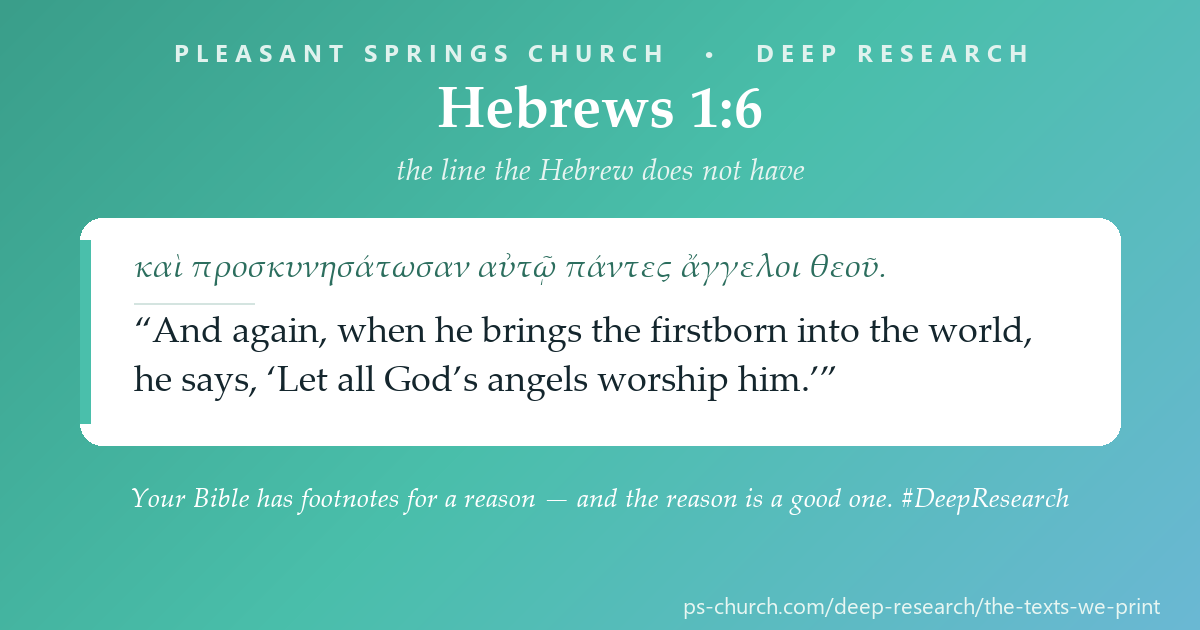
Hebrews 1 is arguing that the Son is greater than the angels. At verse 6 the writer clinches it: καὶ προσκυνησάτωσαν αὐτῷ πάντες ἄγγελοι θεοῦ — “Let all God’s angels worship him.” That line comes from the Greek tradition of Deuteronomy 32:43 (in the form the Song took as the second Ode appended to the Greek Psalter; some commentators prefer Greek Psalm 96:7, MT/English 97:7, which is very close). Either way the conclusion is the same, and it should be said without flinching: the sentence quoted as Scripture in Hebrews 1:6 is not in the Hebrew text most English Bibles translate from.
The full argument, with the Greek of both candidates set out, is on the Deuteronomy 32 page, and the New Testament side is at Hebrews 1:1–4.
Because it is the shape of every case on this page, and because seeing it once removes the fear. A difference appeared; it was not hidden; the evidence was laid out; the older reading was identified with reasons; a translation followed it and said so; and the New Testament had been quoting that reading for two thousand years already. Nothing was lost. Something was found — in a cave, in 1947 — and it confirmed the Greek text the apostles had been using all along.
The most important section on this page — and the one written most carefully.
Read this section slowly if it is about you. It is not an argument aimed at you. It is an attempt to hand you the rest of the evidence, and to say clearly what you are not being asked to give up.
First: the conviction has a real reason behind it, and the people who taught it loved you
Many sincere Christians have been taught that one translation, and only that one, is the word of God in English. If that is your background, here is where this page starts: with what is right in it.
The conviction rests on a good instinct and a real fear. The instinct is a very high view of Scripture — that God would not inspire a book and then let it slip through his fingers, and that a Bible you cannot trust entirely is a Bible you cannot rest your soul on. The fear is the one that follows: if the text is uncertain, then nothing is certain — and once you start choosing between readings, who decides, and where does it stop? That is somebody taking the Bible seriously and trying to protect his people from a real danger.
And it is worth saying plainly that the people who taught it were, in most cases, pastors and parents and Sunday school teachers who had watched the culture erode one certainty after another and did not intend to lose this one too. They were guarding something precious. Whatever else is said below, that should not be forgotten.
Second: the church has always had these witnesses, and always knew it
The one thing this page can offer that may genuinely help is the news that none of this is new. The differences between the Hebrew and the Greek were not discovered by modern scholars with an axe to grind. The church has known about them, argued about them, and lived with them from the second century:
- Justin Martyr, writing about AD 160, spends several chapters of his Dialogue with Trypho (71–73) arguing with a Jewish interlocutor about places where the Greek and the Hebrew read differently. The first generation after the apostles already knew.
- Origen built the six-column Hexapla at Caesarea in the 230s and 240s for no other reason than that the witnesses disagreed and he wanted them side by side where he could see them.
- Jerome and Augustine wrote each other letters about it — quoted above — and disagreed, and stayed brothers.
- The Reformers and the King James translators printed alternative readings in their margins as a matter of course. The 1611 preface, The Translators to the Reader, defends that practice at length and says a translation may be revised.
In other words: a Christian who learns that there is more than one witness to the text has not left the historic faith. He has arrived where the historic faith has always been standing.
Third: the apostles themselves quote the Greek Old Testament — including where it differs
This is the argument that carries the most weight, because it is not an argument from scholarship. It is an argument from the New Testament. Here are four cases, and each can be checked in any study Bible:
- Hebrews 1:6 ← Deuteronomy 32:43. “Let all God’s angels worship him” — a line in the Greek tradition (and supported in Hebrew by 4QDeutq) that the Masoretic Text does not contain. Walked through in full in Section 4 above.
- Acts 15:16–18 ← Amos 9:11–12. At the Jerusalem Council, deciding whether Gentiles must become Jews, James settles it from Scripture: “that the remnant of mankind may seek the Lord, and all the Gentiles who are called by my name.” That is the Greek. The Hebrew reads “that they may possess the remnant of Edom, and all the nations who are called by my name” — because אֱדוֹם (ʾEdōm) and אָדָם (ʾādām, “mankind”) look nearly alike, and “possess” differs from “seek” by one letter. The last clause is the same in both, and it is the one James presses; but the clause before it is not, and the form James quotes is the Greek. See Amos 9:11–12.
- Hebrews 10:5 ← Psalm 40:6 (Greek Psalm 39:7). Hebrews reads σῶμα δὲ κατηρτίσω μοι, “but a body have you prepared for me,” and builds the whole argument of the chapter on it. The Hebrew reads אָזְנַיִם כָּרִיתָ לִּי — literally “ears you have dug for me” (the ESV renders it “but you have given me an open ear,” and footnotes the Hebrew). This one is genuinely unresolved and we will not pretend otherwise. Rahlfs prints ὠτία, “ears,” at Greek Psalm 39:7, on the judgment that σῶμα is secondary — a Christian reading drawn back into the Psalter from Hebrews. Martin Karrer has argued at length that Rahlfs was wrong: on his account σῶμα is what the surviving Greek Psalter manuscripts read, and ὠτία surfaces only in the later Greek revisions, the Fathers and the Latin. We do not know which way it went. Saying so is part of the job.
- Acts 7:14 ← Exodus 1:5. Stephen says Jacob’s household numbered “seventy-five persons.” The Masoretic Text says seventy. The Septuagint says seventy-five — and so does the Hebrew of 4QExodb from Qumran.
The apostles read, quoted and preached from a Greek Old Testament, and did so at the very places where it differs from the Hebrew that later became standard. That is simply what the New Testament shows them doing. It is sometimes answered — and it is a fair answer, worth stating in full — that the apostles were inspired men, so their choice of a Greek wording is Scripture rather than a precedent for editors. Grant that entirely, and one thing still follows: the God who inspired them was content for his word to reach his church through a translation, and through more than one form of the text. So reading the Hebrew and the Greek together, and saying honestly where they differ, is not a modern liberty taken with Scripture. It is apostolic practice. It is the reason this church prints the Hebrew, the Greek and the ESV side by side.
Fourth: how big are the differences, really?
Small, knowable, and already in your footnotes. To put numbers on the shape of it without overstating: the vast majority of manuscript variations are spelling and word order and slips that no translator would follow. The ones that touch the sense of a sentence are a small fraction of a small fraction. The ones large enough for an English Bible to footnote — a dozen or two in the Old Testament of the kind we have discussed, and the handful in the New Testament named in Section 3 — are printed openly in every study Bible, in the King James included, which carried marginal alternatives from 1611.
And here is the test worth doing yourself. Take the Apostles’ Creed, or our own statement of beliefs, and go clause by clause: God the Father almighty, maker of heaven and earth; Jesus Christ his only Son our Lord; conceived, born, suffered, crucified, died, buried; the third day he rose again; he ascended; he shall come to judge; the Holy Spirit; the holy catholic church; the forgiveness of sins; the resurrection of the body; the life everlasting. Not one of those clauses depends on a disputed reading. Not one. Every clause is carried by passages no witness quarrels over. That is not the same as saying no verse touching them has a variant — some do, and we have named several on this page. The claim is the narrower one, and it is the one that matters: strike every disputed reading in the Bible and the Creed still stands, word for word.
Fifth: what you are not being asked to give up
Let this be as plain as it can be made.
If you love the King James Version, you are holding a magnificent translation of a real text. Its Old Testament is the Masoretic Hebrew — the same tradition this library quotes for the Hebrew column, the same tradition the ESV translates. Its New Testament is a printed Greek text with a genuine manuscript pedigree, differing from modern editions in a small number of identifiable places. Its English is the work of scholars of formidable ability, and it has carried the gospel to more people than any book in the language. Nobody here is asking you to put it down.
What this page offers is not a replacement. It is the rest of the evidence — evidence that has existed the whole time, that Justin and Origen and Jerome and Augustine and the King James translators all knew about, and that a shepherd’s discovery in 1947 dramatically enlarged. You have lost nothing by learning where the other witnesses stand. You have gained the ability to read a footnote without fear.
And if you finish this page unpersuaded — if you read it all and still hold your conviction — then you are still our brother, still our sister, and still welcome at this table. We are not going to divide over which faithful translation you carry to church. “All Scripture is breathed out by God and profitable for teaching, for reproof, for correction, and for training in righteousness” (2 Timothy 3:16) — and it is doing that in your hands right now.
The house position, stated once here so that every other page can point back to it.
Every Deep Research page follows these rules. They are printed here rather than restated on each study, so that a reader can check what we do, hold us to it, and see at a glance that we do the same thing every time.
The rules
- Hebrew — the Masoretic Text. We quote the Leningrad Codex tradition (via the freely available Westminster Leningrad Codex), pointing kept, cantillation accents omitted for legibility. Where Qumran, the Samaritan Pentateuch, or the ancient versions bear on a reading, they are cited by name and siglum.
- Greek Old Testament — Rahlfs. Rahlfs–Hanhart, Septuaginta, unless a page names another edition (usually the Göttingen Septuaginta where the reading is contested). Where a book survives in parallel recensions, the page says which one it is quoting — this matters above all in Judges, where Rahlfs prints the A and B texts in parallel, and also in Tobit and Daniel.
- Greek New Testament. The standard modern critical text, with any significant variant named on the page where it matters rather than smoothed over.
- English — the ESV (2016 text edition), quoted exactly, including its punctuation and its small-capital Lord for the divine name. The ESV is copyrighted, and quoting it carries obligations we intend to keep: Scripture quotations are from the ESV® Bible (The Holy Bible, English Standard Version®), © 2001 by Crossway, a publishing ministry of Good News Publishers. ESV Text Edition: 2016. Used by permission. All rights reserved. That notice stands in the footer of every page in this library, and Crossway’s permissions terms are public at crossway.org/permissions.
- One English column, and how a contested rendering is handled. The ESV is the English column on every verse-by-verse row, and it is the only one. Where translations legitimately differ, the page does not settle it by standing a second English version next to the first — two English versions disagreeing is not evidence, and the reader still cannot see why. The row prints the Hebrew or the Greek the choice actually turns on, and says what each witness reads. At Deuteronomy 32:8 the ESV reads sons of God, with the Qumran scroll and the Greek, where the Masoretic Hebrew reads sons of Israel — so the page prints all three and names them. At Ecclesiastes 1:2 the English word chosen for הֶבֶל — vanity, futility, breath, vapour — is a decision about one Hebrew noun, and the row says so rather than leaving the reader to guess which English is wrong.
- Numbering. Where the Septuagint’s chapter or verse differs from the English, both are printed — e.g. “Ps 40:6 · MT 40:7 · LXX Ps 39:7” — and where there is no difference we say so, so that silence is never ambiguous. The Psalter is the usual offender: from Psalm 9/10 through 147 the Greek psalm number runs one behind the Hebrew, and the verse numbers shift separately, because a psalm’s superscription is verse 1 in Hebrew and Greek but not in English. Every reference is looked up, never calculated.
- Second-Temple, rabbinic and patristic writings are witnesses, not Scripture, and are labeled that way every time.
- Literary structure. Every passage study carries a diagram of the passage’s own shape — chiasm, inclusio, panels. A teaching page like this one carries none, because it has no single passage; inventing a structure to satisfy a template would be the same fabrication this page warns against.
And the rule that follows from all of it
Stated as flatly as we know how:
Where the witnesses differ, we print the difference and say why we follow what we follow. We do not hide the other reading — and we do not invent differences that are not there.The house rule — Pleasant Springs Deep Research
Both halves are load-bearing. The first half is the obvious one: a study that quietly picks a reading and conceals the alternative is training its readers to feel betrayed the day they find out. The second half is the one that gets forgotten: it is just as dishonest to manufacture a variant for effect, to describe a difference as bigger than it is, or to imply that a translation is hiding something when it is simply translating. On a page about textual honesty, an invented citation would be the worst possible failure. If we cannot verify a claim, it does not go up; and where the evidence genuinely does not settle a question — Psalm 40:6 in Section 5 is the live example — we say we do not know.
Why we hold the same position on every page
Because a study library that decided each question afresh, page by page, would be unstable, and instability is not honesty. It only looks like honesty. If Genesis followed the Hebrew because the Hebrew suited the point, and Deuteronomy followed the Greek because the Greek suited that one, and nobody said which or why, a reader would have no way to check us — and no way to tell scholarship from convenience.
Fixed rules do the opposite. They can be checked. They can be argued with. They can be held against us. When a page departs from them — and occasionally the evidence requires it — the departure is named in the same sentence that makes it, with the reason attached. Consistency is not stubbornness; it is what makes disagreement possible.
Scripture puts the danger sharply. Paul wants the church “no longer... children, tossed to and fro by the waves and carried about by every wind of doctrine” (Ephesians 4:14) — he is describing teaching that will not stand still, not readers who ask questions; questions are how anyone checks us. A church that changed its text-critical practice to suit each week’s argument would be exactly the instability he has in view. We would rather write the rules down, print them where you can see them, and keep them.
If you want to see the rules at work, start with The Research Method, which lays out the six stages every study follows, or with the page that produced the worked example above, Deuteronomy 32. For the church’s wider practice of reading the Greek and the English side by side, see the LXX + ESV Bible study. And the whole library, book by book, is at Deep Research.
Every Deep Research page traces its passage across the whole sweep — the Old Testament, the Second-Temple world between the testaments (historical witnesses, not Scripture), and the New Testament. Follow the thread:
Pleasant Springs Church — Deep Research
Research method after Michael S. Heiser’s Bible Research Method (examine dictionaries → ancient literature → important words → textual connections → academic publications → share), with the Pleasant Springs “Author & Audience” foundation. Scripture set in the Hebrew, the Greek editions named on each page and the ESV (Old Testament), and the Greek New Testament and the ESV (New Testament), per the practice of Pleasant Springs Church. This page is the library’s standing explainer on the biblical text; it is a teaching page rather than a passage study, and carries no literary-structure diagram because it has no single passage to diagram. Manuscript description follows the standard handbooks — Emanuel Tov, Textual Criticism of the Hebrew Bible; Jobes & Silva, Invitation to the Septuagint; Natalio Fernández Marcos, The Septuagint in Context; Bruce Metzger and Bart Ehrman, The Text of the New Testament; and the introductions to Biblia Hebraica Stuttgartensia and Rahlfs–Hanhart. Dominique Barthélemy, Les Devanciers d’Aquila (1963) for the kaige revision and 8ḤevXIIgr; Patrick W. Skehan, BASOR 136 (1954) for 4QDeutq; Millar Burrows, The Dead Sea Scrolls (1955) cited at p. 304; Frederic G. Kenyon, Our Bible and the Ancient Manuscripts (1895) for the sentence on disputed readings; Martin Karrer on σῶμα at Greek Psalm 39:7. Augustine’s letters to Jerome are cited by Augustine’s numbering (Letters 28, 71 and 82, with Jerome’s reply at 75; the Oea incident and the “Hebrew documents” sentence are both Letter 71) and quoted from the standard English translation. Where a claim could not be verified it was left out, and where the evidence does not settle a question the page says so.
Scripture quotations marked ESV are from the ESV® Bible (The Holy Bible, English Standard Version®), © 2001 by Crossway, a publishing ministry of Good News Publishers. ESV Text Edition: 2016. Used by permission. All rights reserved. The ESV text may not be quoted in any publication made available to the public by a Creative Commons license, and the ESV may not be translated in whole or in part into any other language. www.esv.org
|
Did this study bless you today? 💚 Give to Support PS Church100% of gifts go to the General Fund — thank you. |