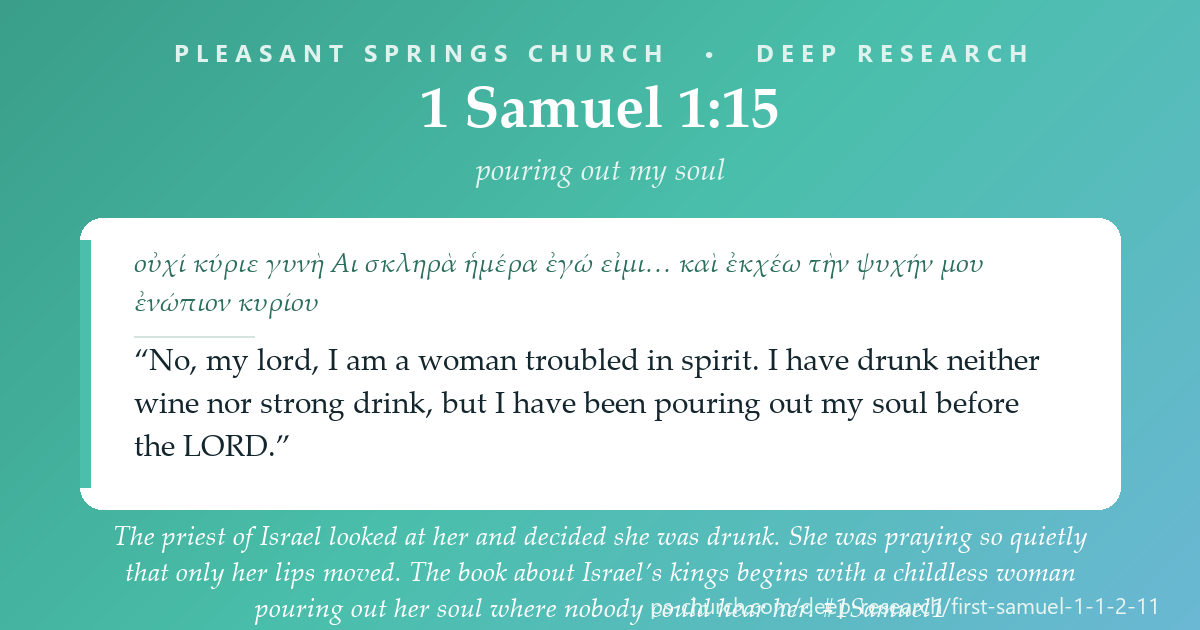
Judges ended four times over with “there was no king in Israel.” This is the book that answers that sentence — and it opens on a woman who cannot have a child. A man named Elkanah, two wives, and the flat line the narrator writes twice in two verses and never explains: “the Lord had closed her womb” (1:5, 1:6). Every year the family walks up to Shiloh to sacrifice to “the Lord of hosts” — a title that appears here for the first time in the Bible — and every year the same thing does not happen. Then Hannah gets up from a meal she has not eaten, goes to the sanctuary, and prays so quietly that only her lips move; and the priest of Israel looks at her and concludes she is drunk. Her answer is one of the great sentences ever written about prayer: “No, my lord, I am a woman troubled in spirit… I have been pouring out my soul before the Lord” (1:15). She is heard. She names the boy Samuel because “I have asked for him from the Lord” — and that verb, sha’al, runs seven times through twelve verses and will end up attached to a king this book has not introduced yet. Then the weaning, and the handing over: “as long as he lives, he is lent to the Lord” (1:28). And then she sings — about bows broken and the feeble armed, about the full hiring themselves out for bread and the barren bearing seven, about a God who kills and brings to life and raises the poor from the dust — and she ends on “the horn of his anointed,” in a book with no king in it. This study works 1 Samuel 1:1–2:11 line by line, in Hebrew, Septuagint and ESV, with the Hebrew/Greek differences and the Dead Sea Scroll evidence reported rather than smoothed. See the method →
1 Samuel 1:1–2:11 (selections)
Hebrew · LXX (Rahlfs, 1 Kingdoms) · ESVThe Shape of the Passage
ConcentricBehind this chapter stands the whole book of Judges — the cycle that never breaks and the four-times-repeated verdict that there was no king — and beside it stands Ruth, set in the same years and ending in David. In front of it stand a tabernacle at Shiloh, a priesthood about to fall, an ark about to be captured, and two kings.
Author
A writer who knows exactly how to begin. He has a national crisis to narrate — a failed priesthood, a lost ark, a demand for a king, a first king who breaks, a second who is given the promise. He starts with a woman crying at a festival meal. That is a choice, and it is the same choice the book will make again at 16:7: what looks decisive is not, and what looks like nothing is where God is working.
He reports and does not explain. Twice in two verses he writes that the Lord closed her womb, and he never says why — no sin named, no lesson drawn, no comfort offered. He tells you Peninnah provoked her and does not tell you what Hannah felt about Peninnah. He lets Eli be badly wrong out loud. This is the reticence that runs through Judges and Genesis alike: the narrator withholds motive and makes you infer, and the gaps are where the reader is invited in, not where the text has failed.
And he is building a pun that will take ten chapters to land. Seven times in twelve verses the root šāʾal, “ask.” A boy is named for it — even though his name does not actually mean it. And in chapter 8 a nation will ask for a king, and get a man whose name is the word: šāʾūl, Saul, “asked for.” The writer is not being clever. He is telling you, before anything has gone wrong, that there are two ways to ask God for something.
Audience
People who had a king, and had opinions about kings. This book was preserved and read in Israel by people who lived under the monarchy or remembered it, and 2:10 tells you so out loud: a song sung before there was a king ends “he will give strength to his king and exalt the horn of his anointed.” The first hearers knew whose horn that turned out to be. They were being told, at the outset, that the kingdom did not begin in a palace.
People who knew Shiloh was gone. The sanctuary in this chapter is the one Jeremiah later points at as a warning: “Go now to my place that was in Shiloh… and see what I did to it” (Jeremiah 7:12). Every reader of chapter 1 after about 1050 BC read the words “at Shiloh” knowing how that ended, and knowing that the two priests named in 1:3 are the reason.
And people who had prayed for something and not received it. This is not a sentimental reading; it is the plain shape of the passage. Hannah goes up every year and it is refused every year, and the text gives no reason for the years and no reason for the change. Whatever else the first audience was, it was an audience that included the childless, the provoked and the publicly misjudged — and the book handed them a woman who said the true thing out loud in the wrong place and was heard.
Orient on Samuel and the Kingdoms books, Shiloh, the Lord of hosts, vows and the Nazirite, barrenness, and the text of Samuel.
Search by topic: Samuel, Books of; Kingdoms (books of); Hannah; Elkanah; Eli; Shiloh; Ramah / Ramathaim; Ephraim, hill country of; Lord of hosts (Yahweh Sebaoth); vow (neder); Nazirite; barrenness and infertility; annunciation type-scene; horn (qeren); anointed (mashiah); Sheol; Dead Sea Scrolls — 4QSamuel.
Which articles are relevant?
- Anchor Bible Dictionary — “Samuel, Books of,” “Samuel (person),” “Hannah,” “Elkanah,” “Eli,” “Shiloh,” “Ramah,” “Zuph,” “Hosts, Lord of,” “Nazirite,” “Vow,” “Barrenness,” “Horn,” “Messiah.”
- Dictionary of the OT: Historical Books (IVP) — “Samuel, Books of,” “Hannah’s Song,” “Text and Textual Criticism,” “Sanctuary,” “Priests and Levites,” “Women.” The article on the text of Samuel is the one to read first, because no other historical book needs it as badly.
- NIDOTTE / TDOT — שָׁאַל (šāʾal, ask), פָּלַל (pālal, pray/intercede), זָכַר (zāḵar, remember), צָבָא (ṣāḇāʾ, host/army), נֶדֶר (neḏer, vow), נָזִיר (nāzîr), קֶרֶן (qeren, horn), מָשִׁיחַ (māšîaḥ, anointed), עָקָר (ʿāqār, barren).
- On the Greek — Bernard A. Taylor, “1 Reigns: To the Reader,” in A New English Translation of the Septuagint. Short, and the place to learn why the Greek of this book is called 1 Reigns / 1 Kingdoms, what the kaige sections are, and why the Greek of Samuel is treated as a witness to a different Hebrew text rather than a loose translation.
Bibliography surfaced:
- P. Kyle McCarter Jr., I Samuel (Anchor Bible) — the standard text-critical commentary on this book in English; Ralph W. Klein, 1 Samuel (Word Biblical Commentary); David Toshio Tsumura, The First Book of Samuel (NICOT), which argues the Masoretic Text is in better shape than McCarter allows and is worth reading precisely because it disagrees.
- Robert Alter, The David Story: A Translation with Commentary on 1 and 2 Samuel, and his The Art of Biblical Narrative for the type-scene and Leitwort tools used in the structure block above. (Alter reads these texts as literature and does not share the church’s confession; we take the tools, not the metaphysics.)
- Robert D. Bergen, 1, 2 Samuel (NAC); Bill T. Arnold, 1 & 2 Samuel (NIVAC); V. Philips Long, 1 & 2 Samuel (Tyndale); Walter Brueggemann, First and Second Samuel (Interpretation).
- Emanuel Tov, Textual Criticism of the Hebrew Bible; Eugene Ulrich, The Qumran Text of Samuel and Josephus; Frank Moore Cross, Donald W. Parry, Richard J. Saley and Eugene Ulrich, Qumran Cave 4. XII: 1–2 Samuel (DJD XVII) — the edition, and the only responsible place to check a 4QSama reading.
Shiloh and the yearly pilgrimage, vows, the annunciation type-scene — and what the ancient retellings did with Hannah.
First the world: what a pilgrimage sanctuary was, what a vow legally was, and what a childless woman’s position actually was. Then the type-scene — and then watch Josephus and the rabbis, because what they add to this chapter tells you which silences they could not bear.
Which parallels shed light on the world of this chapter?
Shiloh was the sanctuary before Jerusalem, and everybody reading knew how it ended. The tent of meeting was set up there when the land was divided (Joshua 18:1), and the yearly festival at Shiloh is the setting of the last, ugliest scene of Judges (Judges 21:19–23). Deuteronomy had commanded a single place “that the Lord your God will choose” and a household journey to it (Deut 12:5–7; 16:16), and 1 Samuel 1:3 shows one ordinary family actually doing it. The site — Khirbet Seilun, in the hill country north of Bethel — has been excavated repeatedly since the 1920s, and there is a substantial destruction layer in the Iron I horizon; the excavators’ datings and interpretations differ, and this page will not settle them. What is not in doubt is that Israel remembered Shiloh as a ruin: Jeremiah 7:12–14 and 26:6 use it as the standing warning that a sanctuary is no protection.
A vow was a legal instrument, not a mood. Israel’s law treats the neḏer as binding and enforceable — “you shall not delay to fulfil it” (Deut 23:21–23) — and it has a whole chapter on when a husband or father may annul a woman’s vow and when his silence ratifies it (Numbers 30). Read Elkanah’s reply in 1:23 with Numbers 30 open and it stops being a shrug: he is the one man who could have cancelled this, and he does not. And the shape of what Hannah promises — no razor, and in the Greek and at Qumran no wine either — is the shape of the Nazirite vow of Numbers 6, except for one thing: the Nazirite vows himself, and Hannah vows somebody else, for life, before he exists.
This is a type-scene, and the deviations are the point. The Bible has a recurring, conventional scene: a barren woman, a divine promise, an extraordinary son — Sarah (Gen 18; 21), Rebekah (Gen 25:21), Rachel (Gen 30:22), Samson’s mother (Judges 13). Line them up and 1 Samuel 1 has changed the convention in one decisive way: there is no annunciation. No angel comes to Hannah. No one tells her she will conceive. She is not visited; she goes, and prays, and is answered by an ordinary priest’s ordinary blessing. Alter’s rule for type-scenes is that the meaning sits in the deviation — and the deviation here is that the initiative is hers.
- Josephus, Antiquities 5.10.1–3 (Whiston’s numbering; the Niese sections of Book 5 that follow Ruth, beginning at §338) (Second-Temple — a witness, not Scripture) — and his version is full of evidence. He calls Elkanah “a Levite… one of a middle condition,” which the Hebrew of 1:1 does not say and 1 Chronicles 6 does. He has Hannah answer Eli that she had drunk water. He says Samuel “may be styled one that was asked of God” — the šāʾal etymology, in Greek, in the first century. He reports that the boy’s “hair was suffered to grow long; and his drink was water” — that is the Nazirite clause the Masoretic Text does not have and the Greek and 4QSama do, showing up in a retelling. He gives Hannah “other sons… and three daughters” where the Hebrew and Greek both have three sons and two daughters. And he leaves out the song entirely.
- b. Berakhot 31a–31b (rabbinic-era — a witness, not Scripture) — the single most consequential piece of ancient interpretation of this chapter, and the reason Jewish prayer looks the way it does. From 1:13 the Gemara derives that one who prays must direct the heart (“she spoke in her heart”), must move the lips, and must not raise the voice; from 1:15 that a person wrongly suspected must clear himself, and that the suspicious party must then bless him, as Eli does in 1:17. At 31b R. Elazar says something worth weighing against the note on 1:3 above: “from the day that the Holy One… created His world, there was no person who called Him Lord of Hosts until Hannah came and called Him Lord of Hosts” — the narrator uses the title first, at 1:3, but Hannah is the first person in Scripture recorded praying it. The same folio also preserves a much bolder Hannah, who argues with God and is read as threatening him; that is midrash, not the text, and it is reported here rather than borrowed.
- Sirach 46:13–20 (Second-Temple; non-canonical in this church’s reckoning — a witness, not Scripture) — the earliest surviving Jewish praise of Samuel: “Samuel was beloved by his Lord; a prophet of the Lord, he established the kingdom and anointed rulers over his people.” Eight verses on Samuel, and not one word about his mother. Ben Sira’s Samuel begins as a prophet and judge; the birth narrative is simply not part of what he thinks worth praising. Set that beside the fact that 1 Samuel itself gives Hannah the first fifty-two verses of the book.
- 4QSama (4Q51) and the rest of the Cave 4 Samuel material, in DJD XVII (Cross, Parry, Saley, Ulrich) — the manuscript evidence itself. Its bearing on chapters 1–2 is set out in the codex note above and it is not paraphrased twice; what matters here is the pattern the scholars keep pointing to: 4QSama repeatedly agrees with the Greek against the Masoretic Text, which means the Greek translator was often reading a genuinely different Hebrew scroll and not inventing.
- ANE background — handled carefully. Vows to a deity in exchange for a child, and the dedication of a child to a temple, are attested across the ancient Near East; that is standard background in the commentaries. This page cites no specific tablet, because the local scan of Pritchard’s ANET we can actually check does not yield one for this scene, and a parallel we have not read is not a parallel.
Set the ancient versions of this chapter side by side and a pattern shows up immediately, exactly as it did in Ruth 1.
(1) They could not leave the Nazirite vow half-said. The Masoretic Text has only “no razor shall touch his head.” The Greek adds the wine. 4QSama adds the word nazirite outright. Josephus has both the long hair and the water. Four witnesses, four lengths, all moving the same direction — toward completing the vow into the recognisable form of Numbers 6. That direction of travel is itself a piece of evidence, and it does not tell you which text is original.
(2) They could not leave Eli badly wrong. The Hebrew has the high priest of Israel look at a praying woman and call her a drunk. The Greek gives the line to his servant boy instead. It is a small change and it protects a large man.
(3) They could not leave the song where it was. Josephus drops 2:1–10 completely — the way he dropped Ruth’s oath and Naomi’s accusation. A Roman audience gets the birth of a prophet; it does not get a woman singing that God empties the full and fills the hungry.
(4) And nobody could leave the closed womb alone except the Bible. Neither the Hebrew nor the Greek offers a reason, an excuse, a lesson or a comfort for the years of 1:5–7. The retellings supply motive everywhere else and not here. The discipline this page keeps is the one the text keeps: report what it approves, report what it merely reports, and where it gives no reason, say so and stop.
One verb that names a boy and will misname a king, one verb that shapes the whole unit, and a title that starts here.
Count sha'al yourself — seven, in twelve verses. Then count hitpallel — five, and the fifth is 2:1. Then look hard at 1:20, where the name and the reason do not actually match, and decide for yourself whether that is a problem or the point.
“Ask, request, borrow.” Seven occurrences in twelve verses, and the passage is an argument about asking. Eli blesses her request that she asked (1:17); she names the boy because she asked him (1:20); she reports that the Lord gave her the request she asked (1:27); and then the causative and the passive participle together: “I have lent him… he is šāʾūl to the Lord” (1:28). That last word is spelled exactly like the name Saul. Note the Greek honestly: it holds the pun with αἰτέω / αἴτημα for the first five, and then at 1:28 — the one verse that contains the name-word — it switches to κιχρῶ / χρῆσιν, “I lend / a loan.” The thread that runs to Saul in Hebrew simply does not exist in Greek.
“To pray” — in Hebrew a reflexive form of a root having to do with mediating or arbitrating, which is why it can shade toward interceding. Five occurrences, and they are the skeleton of the passage: she prays (1:10), she goes on praying (1:12), she was praying (1:26), for this child I prayed (1:27), and Hannah prayed and said (2:1). The last one is the reason 2:1–10 is called a prayer and not a poem, and the reason this study runs to 2:11 rather than stopping at the end of chapter 1. Note the Greek honestly: it has προσεύχομαι at the first four — προσηύξατο, προσευχομένη, προσεύξασθαι, προσηυξάμην — and at 2:1 it has no praying verb at all, only “and she said.” The five-fold frame is a feature of the Hebrew text, and this page prints the loss instead of quietly arguing past it.
“Hosts, armies.” “The Lord of hosts” appears here for the first time in the Bible — we checked Genesis through Ruth and the title is not there. (Exodus 12:41 has “all the hosts of the Lord,” a different construction, of Israel.) What the “hosts” are is genuinely disputed: Israel’s armies, the heavenly armies, the stars, or all of them at once. What is not disputed is where it turns up first: in a sanctuary, on the lips of a childless woman, and the book that begins with it will be full of armies. The Greek does not translate it at all — σαβαωθ is simply the Hebrew word in Greek letters, which is how it reaches Romans 9:29 and James 5:4 unchanged.
“Remember.” She asks him to remember her (1:11); he remembers her (1:19). Biblical remembering is not recollection — God does not forget and then think of you — it is acting on a commitment: he remembered Noah (Gen 8:1), he remembered his covenant (Exod 2:24), he remembered Rachel (Gen 30:22). The Greek keeps the pair exactly, μνησθῇς… ἐμνήσθη, and the same verb turns up in the Magnificat’s last lines (Luke 1:54).
Samuel — and the etymology the text gives is not the etymology the name has. The form is most naturally “name of God” (šēm + ʾēl) or “God has heard” (šāmaʿ); the ESV footnotes the second. Hannah’s reason is built on šāʾal instead. Three explanations circulate and all three are held by serious people: that biblical name-explanations regularly work by sound and association rather than derivation; that the sentence explains the naming rather than parsing the name; and that the narrator is deliberately attaching the “asked” word to Samuel because he intends to hand it to Saul. We report the three and do not adjudicate.
“Horn” — the frame of Hannah’s song. It opens “my horn is exalted” (2:1) and closes “he will exalt the horn of his anointed” (2:10), the same noun and the same verb, first of a woman and then of a king. The image is an animal’s strength, not a trumpet. In Greek both are κέρας — which is the word Zechariah reaches for in Luke 1:69, “a horn of salvation for us in the house of his servant David.”
“Barren.” It is the word used of Sarai (Gen 11:30), Rebekah (Gen 25:21), Rachel (Gen 29:31) and Samson’s mother (Judg 13:2), and Hannah puts it in a song about God overturning things: “the barren has borne seven.” She herself will have six children in all (2:21). Seven is completeness, not arithmetic — and the line is sung by a woman who was not, at the moment the years were passing, being told any of this.
“Sheol” — the realm of the dead, rendered ᾅδης in Greek. “He brings down to Sheol and raises up” is, in its own setting, a statement about God’s absolute reach: no one is beyond him, in either direction, and Israel’s poetry can say “raised up” of rescue from the edge of death. Christians have long heard more in it; the honest thing is to say that the line’s first sense is God’s sovereignty over life and death, and that the New Testament’s resurrection hope does not depend on this verse and is not established by it.
Two things in the Hebrew of these chapters, reported rather than tidied:
- 1:5 is genuinely obscure, and every English Bible is making a decision there. מָנָה אַחַת אַפָּיִם is literally something like “one portion — nostrils / faces / anger.” The ESV prints “a double portion” and footnotes it as Syriac; the meaning of the Hebrew is uncertain. Others read “a worthy portion,” or take it as one portion given with a downcast face. The Greek has none of it and supplies a reason instead: one portion, because she had no child. There is no reading of this half-verse that is not a judgement call, and a study that prints one without saying so has hidden the work.
- The ketiv and qere at 2:3, and two more in the song. At 2:3 the consonants written are ולא (“and not”); the Masoretic reading tradition says וְלוֹ (“and by him”) — the difference between “actions are not weighed” and “by him actions are weighed.” The ESV follows the reading tradition, as does the Greek (καὶ θεὸς ἑτοιμάζων ἐπιτηδεύματα αὐτοῦ, which is different again). At 2:9 and 2:10 the written forms חֲסִידָו and מְרִיבָו carry the ordinary plural qere. These are small, and they are printed here because the alternative is to let a reader think the Hebrew is smoother than it is.
The book this one answers, the barren women before her, the law of the vow, and the song at the other end of the corpus.
Trace four threads: Judges’ refrain, which this book is the answer to; the barren-woman scenes in Genesis and Judges, which set the convention Hannah breaks; the law of vows and Nazirites, which she is invoking; and the horn of the anointed in 2:10, which runs to 2 Samuel 22 and beyond.
Which cross-references matter?
- Judges 17–18 and Judges 19–21 — the refrain this book exists to answer: “In those days there was no king in Israel; everyone did what was right in his own eyes.” Judges ends with a Levite, a dismembered woman, a civil war and a mass abduction of girls at the yearly feast at Shiloh (21:19–23). 1 Samuel 1 opens at the yearly feast at Shiloh. Same festival, same sanctuary, same priesthood — and this time a woman goes home with a blessing.
- Genesis 18; 21:1–7; 25:21; 29:31–30:24; Judges 13 — the barren-woman scenes. Sarah laughs behind a tent flap; Rebekah is prayed for by her husband; Rachel says “give me children or I shall die” and is remembered; Samson’s mother is visited by the angel of the Lord and told what her son will be, and told not to drink wine. Hannah gets none of that. No angel, no announcement, no name given from heaven. She initiates it, she names him, and she sets the terms of his life herself.
- Numbers 6:1–21 and Numbers 30 — the law behind the vow. Numbers 6 gives the Nazirite’s three abstentions: wine, the razor, and corpse-contact. Hannah names the razor; the Greek and 4QSama add the wine; the Nazirite in Numbers vows for a set term and vows himself. Numbers 30 gives the husband his right of annulment — which makes Elkanah’s “do what seems best to you” (1:23) a legal act.
- Deuteronomy 12:5–7; 16:16; Joshua 18:1 — the single chosen place and the pilgrimage that 1:3 shows a family actually keeping. The tent of meeting stands at Shiloh from the conquest to the disaster of chapter 4.
- Deuteronomy 32 and Exodus 15 — the company Hannah’s song keeps. Israel’s narrative books plant poems at their hinges, and this one is the hinge of the Samuel corpus. Note especially the rock (ṣūr) of Deuteronomy 32:4, 15, 18, 30–31, which is the title Hannah uses in 2:2 — and which the Greek of both passages regularly declines to translate.
- 2 Samuel 7 and 2 Samuel 22 — where 2:10 is going. Hannah sings of “his king… his anointed” before Israel has either; 2 Samuel 7 gives the promise of an everlasting house to David; and 2 Samuel 22, David’s song, closes the corpus with the same vocabulary Hannah opened it with — horn, rock, salvation, and “his anointed” in its last line. Two songs, at the two ends, and the whole story of Israel’s kings between them.
- Psalm 2; Psalm 110 — the anointed king in Israel’s psalter, which is where the language of 2:10 goes next and where the New Testament will pick it up.
- Forward, inside this book: 1 Samuel 2:12–36; 8; 16. The song is immediately followed by the sons of Eli, who are its counter-example: the full will be emptied, and 2:12–36 shows you exactly who. Chapter 8 will put Hannah’s verb in the mouth of a nation — “give us a king… we asked” — and chapter 16 will say the line this whole opening has been demonstrating: “man looks on the outward appearance, but the Lord looks on the heart.”
It is in 1:5 and again in 1:6, in the narrator’s own voice, in both the Hebrew and the Greek. Not Peninnah’s theory. Not Hannah’s fear. The narrator’s report. And there is no explanation attached to it anywhere in the chapter. No sin is named. No purpose is stated. No character offers a reason and no reason is given later; even after Samuel is born, nobody in the text says “so that was why.”
That silence is deliberate and it is not cruelty. The same narrator will tell you plainly why Eli’s house falls (2:29), why Saul loses the kingdom (15:23), why the ark was captured (2:12–17; 4:11). He is perfectly willing to explain. Here he does not — which means the years of 1:5–7 are years with no available explanation, and Scripture has left them that way on purpose.
Three things follow, and a church that skips them will hurt somebody.
First, do not supply a reason. Not “God was preparing her,” not “there must have been sin,” not “he was waiting for the right time.” The first is a guess dressed as doctrine; the second is Job’s friends; the third is a sentence you can only say afterwards, and Hannah is not afterwards. Where Scripture gives a reason for suffering we may give it. Here it gives none. So we say so, and stop.
Second, do not turn her prayer into a technique. The text does not say she prayed hard enough, or long enough, or with the right words, or that the vow purchased the child. It says she prayed and wept and vowed, and it says the Lord remembered her, and it leaves the join between those two facts exactly as unexplained as the closed womb. Every year she went up and prayed and it did not happen, and one year it did. Anyone who tells a childless couple that Hannah shows you the method has read past the first six verses.
Third, notice what she is actually allowed to do. She weeps at the feast in front of everyone. She refuses to eat. She tells her husband nothing. She goes to the sanctuary and pours out her soul, and when the priest of Israel gets it wrong to her face, she corrects him, and he blesses her, and she goes and eats and her face is no longer sad — before anything has changed. The Bible put a woman’s unanswered grief in the first ten verses of the book about kings. That is where it belongs, and that is where the church should be willing to sit with it.
And keep 2:1–10 in its place. The song comes after, in the text and in her life; it is not the answer to the years, it is what she sang when the years were over. Do not hand it to somebody who is still in 1:7.
The commentaries, the text of Samuel, the date and origin of Hannah's song, and the Magnificat question.
McCarter, Klein, Tsumura, Bergen, Long, Arnold, Brueggemann and Alter on the book; Tov, Ulrich and DJD XVII on the text. Then the three live questions this passage raises — the shape of the Hebrew text of Samuel, where Hannah’s song came from, and what exactly the Magnificat is doing.
Commentaries & studies:
- P. Kyle McCarter Jr., I Samuel (Anchor Bible) — the standard text-critical treatment, and the commentary most willing to reconstruct a Hebrew text behind the Greek. Read alongside David Toshio Tsumura, The First Book of Samuel (NICOT), who defends the Masoretic Text at many of the same points. The disagreement between them is the state of the question, and neither is a fringe position.
- Ralph W. Klein, 1 Samuel (WBC); Robert D. Bergen, 1, 2 Samuel (NAC); V. Philips Long, 1 & 2 Samuel (Tyndale); Bill T. Arnold, 1 & 2 Samuel (NIVAC) for the preaching questions; Walter Brueggemann, First and Second Samuel (Interpretation) for the theological reading, and to be argued with.
- Robert Alter, The David Story, and The Art of Biblical Narrative — for the annunciation type-scene, the Leitwort, and the reticence of the narrator, all of which this page has used by name.
- Emanuel Tov, Textual Criticism of the Hebrew Bible; Eugene Ulrich, The Qumran Text of Samuel and Josephus; Cross, Parry, Saley and Ulrich, DJD XVII. Bernard A. Taylor, “1 Reigns: To the Reader,” in NETS, for the Greek.
Interpretation notes worth keeping:
- The text of Samuel is the hardest in the Old Testament, and this is the book where that has to be said out loud. The Greek of 1 Kingdoms diverges from the Masoretic Text more than in any book we have handled — and the divergence is not evenly spread. In these two chapters it is a steady drip of pluses, minuses and different readings. Further on it becomes structural: Rahlfs has no 13:1 at all (the regnal formula “Saul was … years old when he began to reign”, where the Hebrew numbers are damaged and the ESV footnotes the gap), and the Greek of chapters 17–18 is roughly half the length of the Hebrew — we counted: 32 of the 58 verses of chapter 17 and 19 of the 30 verses of chapter 18, lacking 17:12–31, 17:41, 17:50, 17:55–58, 18:1–5, 18:10–11, 18:17–19 and 18:30. Whether the shorter Greek reflects a shorter Hebrew original or the longer Hebrew preserves a fuller one is genuinely and actively debated, with major scholars on both sides, and this page does not adjudicate it. What can be said plainly is that 4QSama repeatedly agrees with the Greek against the Masoretic Text, which is why the old assumption that the Greek translator was simply paraphrasing cannot be held any more.
- Where Hannah’s song came from is debated, and the arguments are worth knowing. Many scholars judge 2:1–10 to be an older independent poem placed here by the writer, pointing to its archaic-looking language, its royal ending in a chapter with no king, and the fact that a woman thanking God for a son sings mostly about armies, the earth’s pillars and the ends of the earth. Others argue it is composed for its setting, pointing to “the barren has borne seven” in 2:5 and the horn-frame that ties 2:1 to 2:10. Both readings are held by careful people and neither is a threat to anything. What is not in dispute is the effect: the song is placed here, and the book expects you to read the whole reign of Saul and David through it.
- Hannah’s song and the Magnificat: report the connection as the church has long read it, and be exact about what it is. Luke 1:46–55 has been heard against 1 Samuel 2 since antiquity, and the verbal contact is real and is clearest in the Greek. The closest single line is not in the song at all: Mary’s ἐπέβλεψεν ἐπὶ τὴν ταπείνωσιν τῆς δούλης αὐτοῦ (Luke 1:48) stands word for word against Hannah’s vow in 1 Kingdoms 1:11, ἐπιβλέψῃς ἐπὶ τὴν ταπείνωσιν τῆς δούλης σου. Then the reversals: Luke’s καθεῖλεν δυνάστας ἀπὸ θρόνων καὶ ὕψωσεν ταπεινούς… πεινῶντας ἐνέπλησεν ἀγαθῶν καὶ πλουτοῦντας ἐξαπέστειλεν κενούς (1:52–53) against 1 Kingdoms 2:5, 7, 8 — πλήρεις ἄρτων ἠλαττώθησαν… πτωχίζει καὶ πλουτίζει ταπεινοῖ καὶ ἀνυψοῖ… καθίσαι μετὰ δυναστῶν. And Luke 1:54’s μνησθῆναι against Hannah’s μνησθῇς. Luke never quotes 1 Samuel and never says he is doing this, so it is allusion rather than citation; the honest description is that Mary sings in Hannah’s idiom, in the Greek Bible Luke’s readers used. Two women, both told they were nothing much, both singing about a God who reverses the order of the world.
- The name and the pun: state the problem, name the options, and leave it. “Samuel” does not come from “ask”; the ESV’s own footnote says the name sounds like the Hebrew for heard of God. Some read the etymology as loose and associative, in the ordinary manner of biblical name-explanations. Some read the sentence as explaining the naming rather than the name. And some read the whole thing as deliberate: that the writer is attaching the word šāʾūl to a boy who is not Saul, precisely so that when Israel asks for a king in chapter 8 and gets one whose name is that word, you already know that the asking began with a woman who asked rightly. All three are defensible; the third is the most interesting and the least provable; we name them and stop.
- What the passage does not license. It does not teach that vows obtain children, that grief must be silent, or that Hannah’s outcome is anyone’s promise. It does not make Peninnah a stock villain — the Hebrew tells us what she did and nothing about why, and the Greek does not even tell us that. And it does not make Eli one either: he is wrong, he is corrected, he blesses her, and his own catastrophe in chapter 2 has a different cause entirely. Saul is not in this passage; but the same discipline will be owed to him when he arrives.
A closed womb, a silent prayer, a name that does not quite fit, and a song about a king.
Name what you learned, why it matters, and one concrete response.
What should we carry away — and do?
- The book about kings begins with a woman nobody was watching. Judges said four times that there was no king. The answer, when it starts, is a household walking up a hill to a tent, and a wife who could not eat. The kingdom of Israel begins in a childless woman’s prayer, and the book is not embarrassed about that.
- “I have been pouring out my soul before the Lord.” Not a formula, not a technique, not even words anyone could hear. Her lips moved and her voice did not carry, and the one professional religious observer in the room concluded she was drunk. She was doing the thing the Bible thinks prayer is.
- Two verses say God closed her womb and neither says why. Keep that. It is one of the places Scripture most clearly declines to explain itself, and the church’s job there is not to fill the silence but to keep somebody company inside it.
- Count the word “ask.” Seven times in twelve verses, and it lands on a boy whose name does not even mean it — because the book is saving the word for a king a nation will demand in chapter 8. There is a way of asking God for something that is faith, and a way that is a rejection, and 1 Samuel is going to show you both.
- She gave him back. “As long as he lives, he is lent to the Lord.” The text does not tell us what that cost, and we should not pretend to know; it simply reports that she went up every year afterwards with a little robe she had made (2:19). That detail is in the Bible for a reason.
- And then she sang about a king. Bows broken, the feeble armed, the full hiring themselves out for bread, the poor lifted from the ash heap, and the horn of an anointed one exalted — sung in a country that had none. David’s song at the far end of the corpus (2 Samuel 22) will use the same words. Hannah got there first.
A word about the Magnificat, clearly labelled: the resemblance between 2:1–10 and Luke 1:46–55 is real, ancient and worth teaching — and it is allusion, not citation. Luke never says he is quoting 1 Samuel. What the Greek shows (Stage 5) is that Mary sings in Hannah’s vocabulary, most exactly at Luke 1:48, which echoes Hannah’s vow. That is enough, and it is better than more: two women at the beginning of two kingdoms, singing that God pulls down and lifts up. Any further Christ-ward reading of Hannah herself is a devotional analogy and is labelled as such here; the text of 1 Samuel 2 is about the God of Israel and his anointed king, and that is a large enough thing to preach.
Step in response: two things this week. First, pray something you have not said out loud, in words nobody else will hear, and do not tidy it up first — that is what 1:13 is doing in the Bible. Second, find the person in your church who is in 1:7 and not in 2:1 — the one whose thing has not happened, and may not — and sit with them without explaining it. You are not required to have a reason. Scripture didn’t give one either.
1 Samuel 1:15 · to share
LXX (Rahlfs, 1 Kingdoms) + ESVEvery Deep Research page traces its passage across the whole sweep — the Old Testament, the Second-Temple world between the testaments (historical witnesses, not Scripture), and the New Testament. Follow the thread:
Pleasant Springs Church — Deep Research
Research method after Michael S. Heiser’s Bible Research Method (examine dictionaries → ancient literature → important words → textual connections → academic publications → share), with the Pleasant Springs “Author & Audience” foundation. Scripture set in the Hebrew, the Greek editions named on each page and the ESV (Old Testament), and the Greek New Testament and the ESV (New Testament), per the practice of Pleasant Springs Church. 1 Samuel 1 research grounded in McCarter (Anchor), Tsumura (NICOT), Klein (WBC), Bergen (NAC), Long (Tyndale), Arnold (NIVAC) and Brueggemann (Interpretation), with Alter (The David Story; The Art of Biblical Narrative) for the type-scene and Leitwort tools used in the structure block, and Tov, Ulrich and DJD XVII for the text. The name of the book: in Greek this is not “1 Samuel” but 1 Kingdoms (Βασιλειῶν Αʹ), the first of four scrolls covering what English Bibles call 1–2 Samuel and 1–2 Kings; that is stated on every page of this set. Text & numbering: Hebrew from the Masoretic Text (Miqra according to the Masorah), with pointing and accents; Greek from Rahlfs’s Septuaginta, verified verse by verse against the morphologically analysed CATSS/Rahlfs text rather than back-translated from an English Septuagint, cross-checked for 2:1–11 against the Apostoliki Diakonia text, and printed without editorial punctuation; English ESV (2016). Chapter and verse run parallel between the Hebrew and the Greek in these chapters — 28 verses in chapter 1 and 36 in chapter 2 in both — and this was counted rather than assumed, so no double reference was needed anywhere on this page; the English falls one verse behind the Hebrew and Greek in chapter 21 only. Hebrew/Greek differences are enumerated in full in the codex note and are named for what they are rather than described as “rendering differences” when they are pluses or minuses: pluses at 1:5, 1:8, 1:9, 1:11, 1:14, 1:18, 1:21, 1:24, 1:25 and a two-verse boasting-oracle at 2:10; minuses at 1:1 (the opening formula and the ancestor Zuph), 1:9, 1:28, 2:1 (“and Hannah prayed,” name and verb) and the whole “pillars of the earth” sentence at 2:8; and genuinely different readings at 1:6–7 (no rival provoking her in the Greek), 1:14 (Eli’s servant, not Eli), 1:23 (“your word” for “his word”), 1:24 (one three-year-old bull for three bulls), 2:2 (“righteous” for “rock”), 2:9 (two entirely different cola), 2:10 (“our kings” for “his king”) and 2:11. Qumran: 4QSama (4Q51) bears on 1:22 (a Nazirite clause in neither the Hebrew nor the Greek), 1:23 and 1:24, and its agreements with the Greek are reported as such; 4QSamb (4Q52) does not touch these chapters and no argument is built on it. Readings are attributed to the witness that carries them, and DJD XVII is named as where a reader should check the transcriptions. The larger divergences later in this book are stated rather than hidden — Rahlfs has no 13:1, and the Greek of chapters 17–18 preserves 32 of 58 and 19 of 30 verses respectively — and whether the shorter Greek reflects a shorter Hebrew original or the longer Hebrew a fuller one is reported as an open, live debate and deliberately not adjudicated. See the texts we print. Second-Temple and rabbinic witnesses (Josephus, Ant. 5.10.1–3; Sirach 46:13–20, tagged non-canonical in this church’s reckoning; b. Berakhot 31a–31b) are read as witnesses and never leveled with Scripture, and where they supply what the narrator withheld, that is pointed out rather than borrowed. The two statements that the Lord closed Hannah’s womb (1:5, 1:6) are printed uncorrected and unexplained, because the text gives no reason and this house does not invent one. The relationship between Hannah’s song and the Magnificat (Luke 1:46–55) is reported as the long-noted allusion it is, with the Greek contact points named and with the plain statement that Luke never cites 1 Samuel; any further Christ-ward reading is offered only as an explicitly labelled devotional analogy. The origin and date of 2:1–10, and the mismatch between the name “Samuel” and the etymology the narrative gives it, are reported with the positions named and not settled.
Scripture quotations marked ESV are from the ESV® Bible (The Holy Bible, English Standard Version®), © 2001 by Crossway, a publishing ministry of Good News Publishers. ESV Text Edition: 2016. Used by permission. All rights reserved. The ESV text may not be quoted in any publication made available to the public by a Creative Commons license, and the ESV may not be translated in whole or in part into any other language. www.esv.org
|
Did this study bless you today? 💚 Give to Support PS Church100% of gifts go to the General Fund — thank you. |