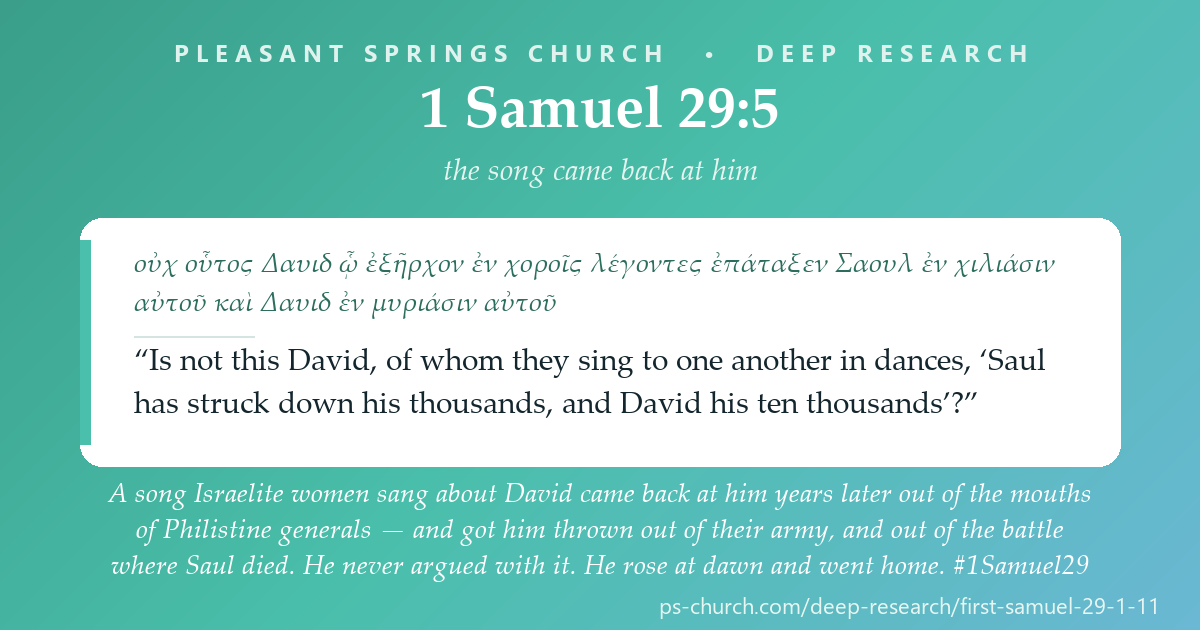
David has been living in Philistine territory for sixteen months, raiding desert tribes and telling his patron he has been raiding Judah (27:8–12). Now the armies muster, and he is marching in the rear of the Philistine column with the king of Gath. The Philistine commanders will not have it. Their argument is a quotation, and it is Israel’s own: “Is not this David, of whom they sing to one another in dances, “Saul has struck down his thousands, and David his ten thousands”?” (29:5). Measure that. Against every other verse of the Hebrew Bible, the four consecutive words the lords share with the earlier quotation at 21:11 occur nowhere else — tie band 1 — while 29:5 shares only two with the women who first sang it at 18:7 — the earlier Philistine quotation at 21:11 still shares four with them, and the single word that separates 29:5 from both is באלפיו for באלפו. The enemy has a fixed form of the song. And “Is not this David?” occurs three times in the whole Hebrew Bible, all three in Philistine mouths, two of them two verses apart on opposite sides of the argument. Around that turn three acquittals in one formula — “I have found nothing in him, from the day he came to this day” (29:3, 29:6), and then the same words from David asking to be convicted (29:8) — a council that calls him a שָׂטָן (29:4) and a king who calls him an angel of God (29:9), and the only mention of God in the chapter: a Philistine swearing “As the Lord lives” (29:6). Then David rises at dawn and walks south, and the Philistines go up to Jezreel. This study works 1 Samuel 29:1–11 in Hebrew, Septuagint and ESV, with the Greek’s En-dor at 29:1, its missing “angel of God” at 29:9 and its large plus at 29:10 all reported rather than smoothed — and with four of its own measurements printed against it. See the method →
1 Samuel 29:1–11 (complete)
Hebrew · LXX (CATSS/Rahlfs, 1 Kingdoms) · ESVThe Shape of the Passage
An inclusio around a hearing — a sequence, not a mirrorBehind this chapter stand David’s sixteen months as a Philistine vassal at Ziklag (1 Samuel 27) and the night at En-dor (28:3–25); ahead of it stand Ziklag burned (30) and Saul dead on Gilboa (31). Until this page it was the last chapter in 1 Samuel with no verse of it on this shelf, and it is the hinge on which David’s alibi turns.
Author
An anonymous narrator inside the Deuteronomistic History (Joshua–Kings), telling the rise of David with a restraint that is easy to mistake for indifference. Many scholars locate 1 Samuel 16–2 Samuel 5 in a source they call the History of David’s Rise. That is a hypothesis about how the book came together, not a finding, and this page names it without leaning on it.
He will not tell you what David meant to do. This is the whole difficulty of the chapter and it is deliberate. David is marching in the rear of a Philistine army towards the battle in which his own king and his own people will be destroyed. He protests when he is sent home. And the narrator — who is perfectly capable of saying “and David said in his heart” when he wants to (27:1) — says nothing at all about what was in his heart here. Not in chapter 29, not in chapter 30, not ever. Compare 27:1, where we are told exactly what David was thinking; the silence at 29:8 is a choice.
What he does instead is arrange the exits. Three times in eleven verses somebody says the acquittal formula, and the third time it is David asking to be convicted. Then a pagan council overrules a pagan king, and David is out of the battle before it starts. The narrator does not say “and God delivered him.” He does not say “and it was of the " + SC + ".” He reports a committee. Whether that is providence is a conclusion the reader is left to draw, and it is worth noticing how much more powerful the chapter is for the text never drawing it.
Audience
Israelites who had heard the accusation. The charge that David was in Philistine pay when Saul died is not a modern invention; it is the obvious thing to say, and 27:1–12 concedes most of it. So a story that has the Philistine high command themselves refuse David’s services, in public, on the record, over the objection of their own king, is doing something for its first hearers. The alibi is supplied by the enemy.
People who knew the song. “Saul has struck down his thousands” is quoted three times in 1 Samuel, and by the third time everybody in the book has heard it — the women who sang it, Saul who was enraged by it (18:8), the servants of Achish who threw it at David in Gath (21:11), and now the Philistine general staff. A first audience did not need the reference explained. They needed to hear it come out of a Philistine mouth.
And readers who already knew chapter 31. That changes everything about how 29:11 lands. “David set out… But the Philistines went up to Jezreel” is a hinge sentence for a reader who knows what is at Jezreel: Gilboa, and Saul, and Jonathan. The chapter is quiet, procedural, almost bureaucratic — and it is the last calm page before the disaster.
Orient on the Philistines and their five lords, Achish and Gath, Aphek and Jezreel, mercenary vassals, and the Greek of Kingdoms.
Search by topic: Philistines; Sea Peoples; seren / lords of the Philistines; Gath; Ekron; Achish; Aphek; Jezreel; En-dor; Ziklag; Hebrews (ʿibrîm) and ʿApiru; mercenary and vassal service; satan / adversary; angel of God (malʾak ʾəlōhîm); Kingdoms, Books of; kaige recension.
Which articles are relevant?
- Anchor Bible Dictionary — “Philistines,” “Sea Peoples,” “Gath,” “Ekron,” “Achish,” “Aphek,” “Jezreel,” “En-dor,” “Ziklag,” “Samuel, Books of,” “Satan,” “Angel of the Lord,” “Hebrews,” “Habiru/Apiru.”
- Dictionary of the OT: Historical Books (IVP) — “David,” “Philistines,” “Samuel, Books of,” “Warfare,” “Non-Israelite Written Sources.”
- NIDOTTE / TDOT — סֶרֶן (seren, Philistine lord), שַׂר (śar, commander), שָׂטָן (śāṭān, adversary), מָלְאָךְ (malʾāk, messenger/angel), מָצָא (māṣāʾ, find), עַיִן (ʿayin, eye/spring).
- On the Greek of these books — Bernard A. Taylor, “1 and 2 Reigns: To the Reader,” in NETS; Natalio Fernández Marcos, The Septuagint in Context. Read these before anyone says “the Septuagint says” about Samuel: the section divisions used on this page come from them.
Bibliography surfaced:
- P. Kyle McCarter Jr., I Samuel (Anchor Bible) — the standard technical commentary in English on the Hebrew, the Greek and the Qumran evidence; Ralph W. Klein, 1 Samuel (WBC); A. Graeme Auld, I & II Samuel (OTL); Walter Brueggemann, First and Second Samuel (Interpretation).
- Robert Alter, The David Story; Robert D. Bergen, 1, 2 Samuel (NAC); Joyce Baldwin, 1 and 2 Samuel (TOTC); David G. Firth, 1 & 2 Samuel (Apollos); V. Philips Long, The Reign and Rejection of King Saul. (Alter reads these texts as literature and does not share the church’s confession; we take the tools, not the metaphysics.)
- On the Philistines: Trude Dothan, The Philistines and Their Material Culture; Trude and Moshe Dothan, People of the Sea; Seymour Gitin, Trude Dothan and Joseph Naveh, “A Royal Dedicatory Inscription from Ekron,” IEJ 47 (1997) — the inscription that names a seventh-century king of Ekron Ikausu. We have not seen that edition; it is named here as a lead, not as evidence this page uses.
- Emanuel Tov, Textual Criticism of the Hebrew Bible; Dominique Barthélemy, Les Devanciers d’Aquila (1963); Cross, Parry, Saley and Ulrich, Qumran Cave 4. XII: 1–2 Samuel (DJD XVII, 2005).
Who the Philistines were in the records, what a seren was, and what it meant to be a foreign king’s hired sword.
First the outside evidence for the people David is marching with — and it is real, datable evidence, checked in our own scan of Pritchard. Then the political structure the chapter turns on: a king who wants David and a college of lords who can overrule him. Then the honest gap, which is that we hold no Josephus and therefore say nothing about what he did with this chapter.
Which parallels shed light on the world of this chapter?
The Philistines enter recorded history as one of a coalition, and we can read the sentence. On the walls of Ramses III’s temple at Medinet Habu, in the pharaoh’s eighth year (about 1188 BC), the summary of the northern wars reads: “I slew the Denyen in their islands, while the Tjeker and the Philistines were made ashes.” The Peleset of that inscription are the Philistines of this chapter, and the same texts describe a mass migration across the eastern Mediterranean that “wiped out the Hittite Empire, thrust the Philistines into Canaan, and washed up on the shores of Egypt.” About a century later the Egyptian Report of Wen-Amon finds the related Tjeker settled and running the harbour at Dor on the Palestinian coast. Both texts are in our local scan of Pritchard and both are quoted above from it. The people arguing about David at Aphek are, on the outside evidence, a population of that migration roughly two centuries into settlement on the coastal plain.
They were governed by a council, and the Bible knows the council’s own word for itself. סֶרֶן (seren, plural sərānîm) is not Hebrew for a ruler; it is a foreign title, and the Hebrew Bible never applies it to anyone but Philistines. Joshua 13:3 counts them and names the cities — five סרני, one each for Gaza, Ashdod, Ashkelon, Gath and Ekron (the Hebrew lists them as gentilics; that rendering is ours, not the ESV’s) — five cities, five lords, a standing coalition rather than a kingdom. That is the political fact the chapter runs on. Achish is a king — he can hire David, house him at Ziklag, and swear by David’s God — and he cannot keep him, because in the Philistine constitution a lord of Gath is one of five. A monarch overruled by his peers is the machinery that gets David out of the battle. (Some scholars connect seren to Greek τύραννος, which would fit an Aegean origin. It is a proposal, not a demonstration, and this page does not build on it.)
And a mercenary band was exactly as trusted then as the commanders here say. David has six hundred men, a foreign patron, a frontier town, and a habit of raiding. The word the commanders use for him at 29:3 is not “David” and not “Israelite” but הָעִבְרִים, “these Hebrews” — a term that in Samuel is very largely put in the mouths of Philistines about Israelites, and which many scholars have connected to the ʿApiru of the Amarna letters, displaced and stateless people who hired themselves out. That connection is contested and this page does not assume it. What is not contested is the military logic on the page: the last thing you want on your left flank is a professional with a grievance against you and a former master in the opposing line. The commanders are not paranoid. They are right about everything except which way he would have turned, and the text never tells us that either.
- Medinet Habu, Ramses III, Summary of the Northern Wars and “The War Against the Peoples of the Sea”, c. 1188 BC (ANET 262–263, verified in our local scan) — a witness, not Scripture. The earliest datable mention of the Philistines (Peleset) in any text, in an Egyptian victory inscription that lists them beside the Tjeker, Denyen, Sherden and Weshesh.
- The Report of Wen-Amon, Egyptian, c. 1100 BC (ANET 25–29, verified in our local scan) — a witness, not Scripture. “I reached Dor, a town of the Tjeker”: one of the Sea Peoples running a Levantine port a century before Saul, told from the point of view of an Egyptian who cannot get anything done there.
- The Amarna letters (ANET 483–490) — a witness, not Scripture. The ʿApiru of the fourteenth-century Canaanite correspondence: bands outside the city-state system, sometimes hired, always a nuisance to whoever is writing. The philological equation ʿApiru = ʿibrî is disputed and is not assumed here; it is named because every commentary on 29:3 raises it.
- The Ekron royal dedicatory inscription (7th century BC; Gitin, Dothan and Naveh, IEJ 47 [1997]) — which names a king of Ekron Ikausu, the same name as Achish. Not held here and not verified by us. It is listed because a reader should know it exists and should go to the published edition rather than to us for it.
- Josephus on this chapter — NOT VERIFIABLE FROM LOCAL CORPORA. Josephus retells the end of Saul’s reign in Antiquities Book 6, and on other pages of this shelf his retelling has been genuine evidence for which Greek text he was reading. We hold no text of Josephus locally, so this page makes no claim at all about what he did with 1 Samuel 29. That is a real gap and Stage 5 lists it as one.
A pagan king wanted David in the battle; a pagan council would not have him; and because the council outranked the king, David was a hundred miles away when Saul died. That is the whole plot, and it is worth saying plainly because of how often it gets improved.
What the text does not say. It does not say God arranged it. There is no “and the Lord put it into the heart of the commanders,” no prophet, no oracle, no ephod — and this is a book that uses all of those freely when it wants to. The only reference to God in the whole chapter is Achish’s oath at 29:6, and Achish is swearing to keep David in the army. Every sentence on this page that reads like providence has been added by a reader.
What the text does say. That the men who saved David from the worst position of his life did it because they did not trust him, and told him so to his face with his own people’s song. That is a harder and better thing to preach than a tidy deliverance, and it is what is actually written. The Bible is quite capable of naming God as the agent of a rescue; here it declines to, and the honest response is to notice the declining rather than to paper over it.
The only satan in the book, two titles for one council, a head that appears three times, and the oath a Philistine swears.
Every count below can be reproduced with a concordance in an afternoon, and where a count depends on our own screens the corpus and its size are named. Two of them — the three heads of 28:2 / 29:4 / 31:9 and the three angel of God sayings — are the kind of observation that changes how the chapter reads and that no translation can show you.
“Adversary” — and it is the word we transliterate as Satan. In 1 Samuel it occurs exactly once, in the mouths of Philistine commanders, about David: lest he become a שָׂטָן to us in the battle. It is an ordinary noun before it is ever a name — a legal or military opponent, a person who stands in your way. The Angel of the Lord stands in Balaam’s road לְשָׂטָן (Numbers 22:22, 32), David himself calls Abishai one (2 Samuel 19:22, Hebrew 19:23), and Solomon says God has given him no שָׂטָן (1 Kings 5:4, Hebrew 5:18). In Greek the Kingdoms translator does not write σατάν or διάβολος but ἐπίβουλος, “a plotter, one lying in wait” — and he uses that word for this Hebrew word three times in the whole of Kingdoms: here, at 2 Kingdoms 19:23 and at 3 Kingdoms 5:18.
Two different titles for the same men, eight times in eleven verses, and the English prints them as “lords” and “commanders.” סֶרֶן is the Philistines’ own word, used of no one else in the Bible — the five who govern Gaza, Ashdod, Ashkelon, Gath and Ekron (Joshua 13:3); the noun stands twenty-one times in the Masoretic corpus and every one is a Philistine lord — Joshua once, Judges eight times, 1 Samuel eleven (three of them in this chapter, 29:2, 6, 7) and 1 Chronicles once (Hebrew 12:20 = ESV 12:19, the council of Stage 4); a twenty-second token spelled the same way, 1 Kings 7:30, is a different word meaning the axles of a stand. שַׂר is the ordinary Hebrew word for an officer. In Greek the chapter has σατράπης five times and στρατηγός twice — and they do not line up with the Hebrew: σατράπαι stands over śar at 29:3 and 29:9, and both στρατηγοί stand over śar as well, while the Greek collapses the doubled subject of 29:4 into one. Worth its own line: στρατηγός occurs twice in the whole of Greek 1 Kingdoms and both times are in this chapter.
“The other-tribed” — the Greek of 1 Kingdoms never transliterates “Philistines.” It translates: ἀλλόφυλοι, foreigners, people of another stock. The count in the files held here is 133 occurrences in Greek 1 Kingdoms alone, nine of them in this chapter, and not one Φυλιστιιμ anywhere in the book. Across the 30,348 Greek Old Testament verse units screened here there are 320 of ἀλλόφυλ- against 23 of the transliteration Φυλιστιιμ — and the transliteration is confined to Genesis, Exodus, Joshua B, Judges B, Sirach and 1 Maccabees. Two Greek books in the same collection call the same nation by two different names. And ἀλλόφυλος appears in the Greek New Testament exactly once: Acts 10:28. See Stage 4.
The formula of acquittal, three times in eleven verses. “I have found nothing in him… from the day… to this day” (29:3); “I have found nothing wrong in you… to this day” (29:6); “what have you found in your servant… to this day?” (29:8 — that third rendering is ours, straight from the Hebrew: the ESV prints “until now” there, so an English reader cannot see that the third sentence is the same sentence, while the Greek does keep it, ἕως τῆς ἡμέρας ταύτης, exactly as at 29:3). It is legal language, and the third speaker is the defendant asking for the charge. The tail alone, עַד־הַיּוֹם הַזֶּה, occurs 76 times in the Masoretic corpus — a stock phrase, and the strongest reason not to make anything of the fact that its Greek turns up in Romans 11:8 (see Stage 4). In Greek, and this is checkable in the columns above: the translator renders the identical Hebrew two different ways inside one chapter — ἕως τῆς ἡμέρας ταύτης at 29:3 and 29:8, but ἕως τῆς σήμερον ἡμέρας at 29:6.
“Like an angel of God.” The noun malʾāk under the prefix כְּ occurs five times in the Masoretic corpus (here; 2 Samuel 14:17; 2 Samuel 19:27, Hebrew 19:28; Isaiah 42:19, where the form is כְּמַלְאָכִי; Zechariah 12:8), and the three in Samuel are all said to David, and this one is first — by a Philistine, about a man who has been lying to him for sixteen months. The woman of Tekoa will use it of King David’s discernment (2 Samuel 14:17) and Mephibosheth of his mercy (19:27); Achish uses it of a mercenary’s good conduct. In Greek: there is no equivalent at all in the text held here. The clause stops at “good in my eyes.”
“Head” — and it occurs three times in 1 Samuel 28–31, and only three. Count them and watch where they land. (1) 28:2, Achish to David: “I will make you שֹׁמֵר לְרֹאשִׁי” — literally keeper of my head, which the ESV renders “my bodyguard.” (2) 29:4, the commanders: what would reconcile him to his lord but בְּרָאשֵׁי הָאֲנָשִׁים הָהֵם, the heads of these men. (3) 31:9, the Philistines over Saul’s body: “they cut off אֶת־רֹאשׁוֹ.” Three heads in four chapters, and the last one is the king’s. The narrator does not point at it. And neither the Greek nor the English keeps the thread — the Greek has ἀρχισωματοφύλακα at 28:2, the ESV has “bodyguard,” and in both the first head disappears. It is visible only in Hebrew, and it can be checked in an hour.
“As the Lord lives.” The oath sounds eleven times in 1 Samuel — 14:39, 45; 19:6; 20:3, 21; 25:26, 34; 26:10, 16; 28:10; 29:6 — on the lips of Saul, the people, Jonathan, David and Abigail. 29:6 is the last of the eleven and the only one spoken by a foreigner. Set it beside the one immediately before it: at 28:10 Saul swears by the Lord to a woman he had outlawed for consulting the dead. The two chapters on either side of the En-dor night each contain one oath in the name of God, and one is sworn by a king who has lost him and the other by a king who never had him. In Greek: ζῇ κύριος.
“At the spring” and “in the eyes of.” These are the same three consonants, עין, and the chapter opens on one and then says the other four times: good in my eyes, not good in the eyes of the lords, evil in the eyes of the lords, good in my eyes. Whether the narrator heard that is not measurable and this page does not claim it; what is measurable is that the words are identical in the consonantal text and that the Greek loses the possibility twice over — it reads a place-name, Αενδωρ, at 29:1, and ὀφθαλμοῖς afterwards. Print it as an observation, not as an argument.
“These Hebrews” — the only ethnic label used of David’s men in the chapter, and it is a Philistine word for them, not their own. In Samuel the term clusters in Philistine mouths and in Israelite speech to Philistines; Israelites among themselves say “Israel.” It carries a whiff of the outsider and possibly of the landless. In Greek the translator does not even render it as an ethnic term here: τίνες οἱ διαπορευόμενοι οὗτοι, “who are these people passing by?” — a real difference, and the sneer goes with it.
Three things about the Greek of this chapter, reported rather than tidied:
- A minus and a plus in adjacent verses. At 29:9 the Greek held here has no equivalent for “as an angel of God.” At 29:10 it has a block of twenty-two consecutive words the Hebrew has no equivalent for, in a verse that runs 48 Greek words to 13 Hebrew. The ratio makes it visible: across the chapter the Greek runs 361 words to the Hebrew’s 218, about 1.66 to 1, which is normal for a language without Hebrew’s prefixes; at 29:10 alone it runs 48 to 13. Neither is called an error on this page. Kingdoms is the place in the Greek Bible where the two textual traditions differ most, and 4QSamuel has made that harder to explain, not easier.
- The same Hebrew, two Greek renderings, one chapter. עַד־הַיּוֹם הַזֶּה stands three times (29:3, 6, 8) and the Greek gives ἕως τῆς ἡμέρας ταύτης twice and ἕως τῆς σήμερον ἡμέρας once. This is the sort of small inconsistency that argues for a translator working sentence by sentence rather than by a glossary — and it is also the reason the run reported at Stage 4 against Romans 11:8 is worthless as evidence, because it depends on which of the two renderings happens to stand in the verse.
- Two names for one enemy, across the Greek Old Testament. ἀλλόφυλ- (translation) 320 times in the 30,348 verse units screened here, Φυλιστιιμ (transliteration) 23 times, and the two hardly ever meet: 1 Kingdoms is ἀλλόφυλοι 133 times and Φυλιστιιμ never, while Sirach 47:7, praising David for wiping out “the Philistines his adversaries,” writes Φυλιστιιμ. Same Greek collection, same nation, two policies. Why we print what we print →
The song in all three of its places, the seam at 28:1, the Chronicler’s single sentence, and four runs this page refuses to make anything of.
The Hebrew screen here is 1 Samuel 29 against the other 23,193 verse units of the 39-book Masoretic corpus; the Greek screen is the CATSS text of this chapter against all 7,927 verses of the Greek New Testament, with MorphGNT’s own spelling equivalences applied. Every run below is printed with its tie band, because a run without a band is not a finding. And four of them are printed precisely so that the others are not read as more than they are.
The song, measured — and it does not go where you expect
The refrain occurs three times in 1 Samuel. Here they are, and here is what the measurement says about them.
18:7 — the women, after Goliath: וַתַּעֲנֶינָה הַנָּשִׁים הַמְשַׂחֲקוֹת וַתֹּאמַרְןָ הִכָּה שָׁאוּל בַּאֲלָפָיו וְדָוִד בְּרִבְבֹתָיו — “the women sang to one another as they celebrated, ‘Saul has struck down his thousands, and David his ten thousands.’”
21:11 (Hebrew 21:12) — the servants of Achish, at Gath: “Is not this David the king of the land? Did they not sing to one another of him in dances, ‘Saul has struck down…’?”
29:5 — the lords of the Philistines, at Aphek: “Is not this David, of whom they sing to one another in dances, ‘Saul has struck down…’?”
Now the numbers. Screened against every other verse of the Masoretic corpus, 29:5’s deepest run is four consecutive words — במחלות לאמר הכה שאול, “in dances, saying, ‘Saul has struck…’” — with a tie band of one. One other verse in the Hebrew Bible has them, and it is 21:11. Measure 29:5 against 18:7, where the song was actually sung, and the shared run collapses to two: הכה שאול. And the word “in dances” is in both Philistine versions and in neither the women’s: this exact form, בַּמְּחֹלוֹת, occurs three times in the whole Masoretic corpus — Judges 21:21, 1 Samuel 21:12, 1 Samuel 29:5 — so two of the three are the two Philistine quotations.
What that licenses us to say, and what it does not. It licenses this: 29:5 is verbally closer to the Gath quotation at 21:11 (four) than to the occasion the narrator gives for the song at 18:7 (two). It does not license the tidier version of that sentence, and we checked: 21:11 measures four against 18:7 as well, so only one of the two Philistine quotations has moved away from the women, and it moved by one letter. It does not license “the Philistines at Aphek were quoting the servants at Gath,” because we do not know that and the measurement cannot tell us — a shared four-word run establishes contact between texts, never direction between people. What we can say is that the narrator has given the enemy a fixed form of the song, twice, and that both times the man it is quoted at is standing in Philistine territory pretending to be someone else.
And one more count, because it is the sharpest thing in the chapter. הֲלוֹא־זֶה דָוִד, “Is not this David?”, occurs three times in the entire Hebrew Bible: 21:11, 29:3 and 29:5. All three are Philistines, and two of them are two verses apart arguing opposite sides. At 29:3 Achish says it to acquit him. At 29:5 the commanders say it to convict him. Same three words; opposite verdicts.
Which cross-references matter?
- 1 Samuel 18:6–9 and 21:10–15 — the song, and the first time David stood in Gath. He got out of that one by feigning madness and scrabbling at the gate. This time he gets out because the enemy’s general staff will not have him. Two escapes from Gath, and neither is a victory.
- 1 Samuel 27:1–12 — the chapter this one settles the bill for. David says in his heart “I shall now perish one day by the hand of Saul” and defects; he asks for a town and is given Ziklag; he raids the Geshurites, Girzites and Amalekites and leaves no survivor “lest they should tell about us”; and he tells Achish he has been raiding Judah. The narrator reports all of it without one word of approval or condemnation. 29:6 is Achish saying he has found nothing wrong in a man who has been lying to him for sixteen months.
- 1 Samuel 28:1–2 → 29:1 — the seam, and it is measurable. The Hebrew screen puts 29:1’s deepest run at three words shared with 28:1 and no other verse in the Hebrew Bible (tie band 1): ויקבצו פלשתים את. Between those two sentences stands the night at En-dor. Whether 28:3–25 was always there, and whether it is chronologically displaced, is one of the oldest questions in the criticism of Samuel — see Stage 5, which names the positions and adjudicates none.
- 1 Chronicles 12:19 (Hebrew 12:20) — and this deserves a paragraph of its own. The Chronicler skips the entire Philistine period of David’s life — no Ziklag defection, no Achish, no raids — and keeps exactly one sentence of it, and it is this council: “Yet he did not help them, for the rulers of the Philistines took counsel and sent him away, saying, ‘At peril to our heads he will desert to his master Saul.’” Now the honest measurement, which is small. Against 1 Samuel 29:4 the shared run is two words, אל אדניו, “to his lord” — a phrase found in seven verses of the Hebrew Bible. The Chronicler is not quoting; he is retelling. The idea is unmistakably the same (heads, desertion, his lord) and the words are almost entirely different, and this page prints both facts rather than the flattering one.
- Numbers 22:22 — one clause where both of this chapter’s verdicts on David stand together: “the angel of the Lord took his stand in the way as his adversary” (לְשָׂטָן). The Philistine council calls David a שָׂטָן at 29:4 and Achish calls him a מַלְאַךְ אֱלֹהִים at 29:9. That is a fact about vocabulary and this page claims nothing more from it — there is no shared run, no citation, and no reason to think the narrator had Balaam in mind. It is printed because it is true and because a reader will hear it.
- 2 Samuel 14:17; 19:27 — the only other two “like an angel of God” sayings, both to David, both by Israelites, both years later and both about his judgement. The compliment enters Scripture in a Philistine camp.
- 1 Samuel 17:51, 54; 31:9; 2 Samuel 4:8; 20:22 — the heads. David cuts off Goliath’s and carries it to Jerusalem; the commanders fear he will buy his way home with Philistine ones; the Philistines cut off Saul’s; Rechab and Baanah bring Ish-bosheth’s to Hebron; Sheba’s is thrown over a wall to Joab. A severed head is currency in these books, and 29:4 is the one place where somebody says so out loud before it happens.
- Acts 10:28 — the one place in the Greek New Testament where the Greek Old Testament’s word for “Philistine” occurs. Peter, standing in a Gentile house: ἀθέμιτόν ἐστιν ἀνδρὶ Ἰουδαίῳ κολλᾶσθαι ἢ προσέρχεσθαι ἀλλοφύλῳ — “how unlawful it is for a Jew to associate with or to visit anyone of another nation.” One occurrence, out of 320 in the 30,348 Greek Old Testament verse units screened here. No shared run with this chapter, no citation, no dependence claimed. What is claimed is only this: the word a Greek reader of 1 Samuel had met 133 times as the name of the enemy is the word Peter uses about Cornelius one sentence before he says God has shown him to call no person common or unclean.
A shelf that only prints the runs that flatter it is not measuring anything. Here are the four in this chapter that look like findings and are not.
(1) The deepest New Testament run in the chapter is worthless. Screened against all 7,927 verses of the Greek New Testament, the deepest run from 1 Samuel 29 is four, at 29:6, against Romans 11:8 — ἕως τῆς σήμερον ἡμέρας — and its tie band is one, meaning no other New Testament verse shares it. That looks like a signal and it is noise. The phrase occurs twenty times in the Greek Old Testament files held here; Romans 11:8 is Paul making a composite quotation of Deuteronomy and Isaiah; and the Greek of Deuteronomy 29:3 held here does not end with Paul’s four words but with ἕως τῆς ἡμέρας ταύτης — which is what 1 Samuel 29:3 and 29:8 say. A tie band of one against the New Testament does not mean a phrase is rare. It means it is rare in the New Testament.
(2) The one that will tempt every preacher. The Greek of 29:3 and 29:5 opens οὐχ οὗτος Δαυιδ, “Is not this David?” And the crowd at Nazareth says οὐχ οὗτός ἐστιν ὁ τοῦ τέκτονος υἱός (Matthew 13:55), οὐχ οὗτός ἐστιν ὁ τέκτων (Mark 6:3), οὐχ οὗτός ἐστιν Ἰησοῦς ὁ υἱὸς Ἰωσήφ (John 6:42). The anointed man dismissed by the people who think they know where he came from — it is irresistible. The measurement says: run of two, tie band 179. One hundred and seventy-nine New Testament verses tie at that depth. It is the commonest Greek idiom of dismissal there is, and it is not evidence of anything. Hear the echo if you like; do not preach it as a link.
(3) A tie band of one can be pure noise on the Hebrew side too. 29:4’s deepest run is three words with a tie band of one — the same band as the two loaded findings on this page — and its single partner is 1 Chronicles 15:3, where David assembles Israel to bring the ark “to its place, which he had prepared for it.” אל מקומו אשר. The two verses have nothing whatever to do with each other. The band tells you how distinctive a string is. It does not tell you whether it matters. You still have to look.
(4) And “go in peace” is not a Gospel allusion. Achish’s πορεύου εἰς εἰρήνην at 29:7 is word for word what Jesus says to the woman who anointed his feet (Luke 7:50) and to the woman healed of the flow of blood (Luke 8:48). It is also the standard Septuagintal dismissal, and the screen puts the verse’s deepest run at three with a band of sixteen. A Philistine sending a mercenary home and Jesus sending a forgiven woman home are using the same three words because that is how the language says goodbye.
The question the chapter raises and never answers, the En-dor problem, and a frank list of what this page could not check.
McCarter, Klein, Auld, Brueggemann, Alter, Bergen, Firth, Baldwin and Long on the text; Barthélemy, Tov, Ulrich and Fernández Marcos on the Greek and the scrolls. Then four live questions — what David intended, whether chapter 28 sits where it belongs, whether “En-dor” at 29:1 is a reading or a mistake, and how far the geography holds — and then the honest inventory of what we did not consult.
Commentaries & studies:
- P. Kyle McCarter Jr., I Samuel (Anchor Bible) — the fullest English treatment of the text-critical questions here, and the source of the “apology of David” reading that these chapters keep inviting; his “The Apology of David,” JBL 99 (1980), is the short version.
- Ralph W. Klein, 1 Samuel (WBC); A. Graeme Auld, I & II Samuel (OTL); Walter Brueggemann, First and Second Samuel (Interpretation); V. Philips Long, The Reign and Rejection of King Saul — four very different readings of what the narrator is doing with Saul’s last days.
- Robert Alter, The David Story; Robert D. Bergen (NAC), David G. Firth (Apollos) and Joyce Baldwin (TOTC) for evangelical commentary engaging the same evidence; Baruch Halpern, David’s Secret Demons, and Steven McKenzie, King David: A Biography, for the sceptical reading of exactly this chapter.
- Dominique Barthélemy, Les Devanciers d’Aquila (1963); Natalio Fernández Marcos, The Septuagint in Context; Emanuel Tov, Textual Criticism of the Hebrew Bible; Cross, Parry, Saley and Ulrich, DJD XVII (2005) — the edition of the Samuel scrolls, and the place to check anything anyone tells you about 4QSamuel.
Interpretation notes worth keeping:
- What would David have done? The text does not say, and this page will not. Two readings are old and both are serious. (a) David was bluffing: his protest at 29:8 is the loyal noise a vassal has to make, and the ambiguity of “my lord the king” is deliberate cover; he would have turned on the Philistines in the line, as the commanders feared. (b) David was trapped: he had painted himself into a corner in chapter 27 and was about to have to fight Israel, and the dismissal saved him from a choice he could not make. Ancient readers noticed the problem too; so has every commentator since. The narrator, who is happy to tell us David’s inner reasoning at 27:1, tells us nothing at all here. This page reports that the question is open and refuses to close it. It is worth asking why we find that so hard to live with.
- Chapter 28 and the order of events. 28:1–2 sets up the muster; 29:1 resumes it verbatim (a three-word run, tie band 1). In between stands En-dor. Many scholars therefore read 28:3–25 as an episode inserted into a continuous narrative, chronologically later than the events of 29 (Saul’s camp is at Gilboa in 28:4 and Israel’s at the spring in Jezreel in 29:1; the Philistines are at Shunem in 28:4 and at Aphek in 29:1). Others read the sequence as it stands and take the movements as ordinary staging over several days. We name both and adopt neither. What we can measure is only the seam, and we have printed it.
- “At the spring” or “at En-dor”? The Greek text held here reads Αενδωρ at 29:1 where the Hebrew has בַּעַיִן. Three explanations are on offer in the literature: the Greek translator’s Hebrew said ʿên dōr and ours has lost a word; the translator supplied the famous local spring’s full name; or the Greek is contaminated from 28:7. We do not know, we cannot test it on what we hold, and we do not say “the translator misread.” What we report is the reading and the fact that Αενδωρ occurs exactly three times in the 30,348 Greek verse units held here.
- The geography is a real difficulty and pretending otherwise helps nobody. The Aphek best known in Samuel is on the coastal plain near the sources of the Yarkon — the Aphek of 1 Samuel 4:1 — and Jezreel is a long way north of it. Either the muster at Aphek is a staging point before a march north, or a different Aphek is meant (there is one in the Sharon and at least one in the north). Commentaries divide; nothing on this page depends on the answer; and a study that quietly picks one and does not tell you has made a decision on your behalf.
- The composition of Samuel is debated and nothing here rests on it. The History of David’s Rise, the extent of Deuteronomistic editing, and the relation of the Greek to a different Hebrew edition are all live arguments, and the Qumran Samuel scrolls have made the last of them livelier than it was in 1950. We name the positions and do not adjudicate. What the chapter claims on a reader — that God’s people are sometimes rescued by the contempt of strangers, and that Scripture declines to call it a rescue — does not move with any of them.
What this page could not check — the honest inventory:
- We hold one Greek text of Kingdoms and no apparatus. Every Greek statement above is a statement about the CATSS/Rahlfs text held here. Whether Codex Alexandrinus, the Antiochene (Lucianic) manuscripts or the Old Latin supply “as an angel of God” at 29:9, or read Αενδωρ at 29:1, we could not check and do not say. On the Kingdoms pages of this shelf the Antiochene text has repeatedly turned out to matter; here it is simply a gap.
- We hold no text of Josephus. Elsewhere on this shelf Josephus has been real evidence for which Greek text was circulating in the first century. For this chapter we have nothing, and we have said nothing.
- We could not check the Qumran evidence for this chapter. Whether 4QSamuela or 4QSamuelb preserves any of 1 Samuel 29, and what it reads at 29:1 or 29:9, requires DJD XVII. We have not consulted it and this page therefore makes no claim about the scrolls here at all — which is a real weakness, because Samuel is the book where the scrolls matter most.
- We could not check the ESV’s own footnotes. No ESV API key has ever been issued to this site; the English column is typed from the printed text and the marginal apparatus is not reproduced. Where this page says the Greek differs, it is our measurement talking, not the ESV’s margin.
- A defect in our own instrument, stated because it affected this page. The Masoretic corpus held here still carries the Masoretic section markers ({פ}, {ס}) inside the verse text, and the normaliser counts the bare letter as a word: 3,446 of the 23,204 verse units carry one. A Hebrew run that ends at a paragraph break is therefore reported one word too deep. The shipped screen reported 29:3 as a run of four; with the markers stripped it is a run of three, and its tie band moves from 14 to 79. Every Hebrew figure printed on this page was re-derived with the markers removed. The normaliser is frozen — every published number on this shelf depends on it — so the fix is not ours to make here; naming it is.
- And no acrostic or letter screen was run, because this is narrative prose and there is nothing for one to find. Saying so is cheaper than leaving a reader to wonder.
Rescued by people who despised him, and a chapter that never says God did it.
Name what you learned, why it matters, and one concrete response.
What should we carry away — and do?
- The song came back. Sung once by women who meant it as praise, it made Saul jealous (18:8), it nearly got David killed at Gath (21:11), and here it gets him thrown out of an army. A true thing said about you in public does not stay where it was said. David never asked for that song and could not undo it.
- Three times someone says “I have found nothing in him.” And the third time it is David, asking Achish to produce a charge — while the reader knows exactly what has been going on since chapter 27. An acquittal is only as good as the evidence the judge has. Achish had none, believed everything, and was wrong; the commanders had nothing but a song, mistrusted everything, and got the right answer.
- God is named once in this chapter, by a Philistine, in an oath. There is no prophet, no ephod, no “and the Lord said.” The people who get David out of the worst position of his life do it because they do not trust him. If you need a chapter to say “this was God” before you can believe he was in it, this chapter will not say it.
- The rescue does not feel like one. David is dismissed, insulted by implication, and sent home at dawn with his six hundred men — to find Ziklag burned and his family gone (chapter 30). Deliverance in Scripture regularly arrives disguised as humiliation and is followed immediately by disaster. Anyone selling a smoother version is not selling you the Bible.
- And the enemy pays him the compliment. “You are as blameless in my sight as an angel of God” — the first of only three times that is said to David in Scripture, and it is said by a foreign king about a man who has been lying to him. The Bible is unembarrassed to record a true sentence spoken about a false situation.
A word about typology, clearly labelled — all three parts. What the text says: 1 Samuel 29 is about David, Achish and a Philistine war council; it makes no messianic claim, and its own interest is in getting David out of the battle in which Saul will die. What the New Testament draws from it: nothing — no New Testament writer quotes this chapter, and our screen against all 7,927 Greek New Testament verses finds nothing deeper than two formulaic runs of four. It would be dishonest to say otherwise. What we may see from this side of the cross: a rejection scene in which the Greek asks οὐχ οὗτος…; — “Is not this…?” — and a man is refused by people who thought they knew what he was. The Gospels put that question in the mouths of a crowd at Nazareth. The measurement says that resemblance is a common idiom and not a link (tie band 179), and we have printed the number against ourselves. What remains, and it is not nothing, is the shape: the anointed man is put out of the camp by a council, over the objection of the one man who wanted him, and walks away at dawn. The text does not say that is a picture of Christ. Read it again next year and see what else is there.
Step in response: two things this week. First, think of the time you were kept out of something you wanted to be in — by people who did not like you, or did not trust you, or simply outvoted you — and ask honestly what it saved you from. Do not force the answer; David did not get one either. Second, find the sentence someone said about you years ago that keeps coming back, and notice that David’s came back in the mouths of his enemies twice and he never once argued with it. He let it be quoted and he went home.
1 Samuel 29:5 · to share
Hebrew · LXX (CATSS/Rahlfs, 1 Kingdoms) + ESVEvery Deep Research page traces its passage across the whole sweep — the Old Testament, the Second-Temple world between the testaments (historical witnesses, not Scripture), and the New Testament. Follow the thread:
Pleasant Springs Church — Deep Research
Research method after Michael S. Heiser’s Bible Research Method (examine dictionaries → ancient literature → important words → textual connections → academic publications → share), with the Pleasant Springs “Author & Audience” foundation. Scripture set in the Hebrew, the Greek editions named on each page and the ESV (Old Testament), and the Greek New Testament and the ESV (New Testament), per the practice of Pleasant Springs Church. 1 Samuel 29 research grounded in McCarter (Anchor), Klein (WBC), Auld (OTL), Brueggemann (Interpretation), Alter (The David Story), Bergen (NAC), Firth (Apollos), Baldwin (TOTC) and Long, with Barthélemy, Tov, Ulrich and Fernández Marcos on the Greek and the scrolls. Book name: in the Septuagint this book is 1 Kingdoms (Basileiōn A) — 1–2 Samuel and 1–2 Kings are one continuous work in Greek, 1–4 Kingdoms. Which Greek: on Thackeray’s standard division the whole of 1 Kingdoms is section α, which is Old Greek and not kaige; the first kaige section (βγ) begins at 2 Samuel 11:2. That is stated because “the LXX reads X” is an ambiguous claim in Kingdoms. We hold one Greek text of Kingdoms and no apparatus, and the page says so wherever a variant would matter. Text & numbering: Hebrew from the Masoretic Text (Miqra according to the Masorah), qere read, Masoretic section markers removed; Greek from the CATSS/Rahlfs files held here, printed without editorial punctuation and checked verse by verse rather than back-translated; English ESV. There is no offset in this chapter: Hebrew and Greek both have eleven verses in 1 Samuel 29, counted rather than assumed — and the counting mattered, because the Greek files held here carry a 30:28a in the next chapter that the Hebrew has no equivalent for. The divergences in the printed verses are reported individually and are not called “rendering differences” when they are pluses or minuses: Αενδωρ for בַּעַיִן at 29:1; “this second year” for “these days or these years” at 29:3; the minus of “as an angel of God” at 29:9; the large plus at 29:10 (48 Greek words to 13 Hebrew, against a chapter ratio of 1.66 to 1); and φυλάσσειν, “to guard,” for “to return” at 29:11. Measurements: the Hebrew screen is this chapter against the other 23,193 verse units of the 39-book Masoretic corpus; the Greek screen is the CATSS text of this chapter against all 7,927 verses of the Greek New Testament, with MorphGNT’s own spelling equivalences (ou/ouk/ouch, ek/ex, the movable nu) applied, so the figures are higher than an unfolded screen would give; corpus-wide Greek counts are over the 30,348 verse units screened here (the Odes are held but excluded from screening, because Ode 9 is Luke 1, Ode 13 is Luke 2, and ten more Odes are second copies of passages already in the corpus). Every run is printed with its tie band, and four runs are printed against the page’s own thesis: the run of four at 29:6 against Romans 11:8 (band 1, and worthless — a Septuagintal formula occurring twenty times in the Greek Old Testament held here); the οὐχ οὗτος resemblance to Matthew 13:55 / Mark 6:3 / John 6:42 (run 2, band 179); the run of three at 29:4 with a band of 1 whose sole partner, 1 Chronicles 15:3, is meaningless; and the two-word overlap between 29:4 and 1 Chronicles 12:19, which is a retelling and not a quotation. Direction of influence is never asserted. A defect in our own instrument is disclosed in Stage 5: the Masoretic corpus held here carries the section markers inside the verse text and the frozen normaliser counts them as words, so 3,446 of 23,204 verse units can report a run one word too deep; the shipped screen gave 29:3 as a run of four and it is three, and every Hebrew figure on this page was re-derived with the markers stripped. ANE background from Medinet Habu (ANET 262–263) and the Report of Wen-Amon (ANET 25–29), both verified in our local scan of Pritchard and both read as witnesses, never levelled with Scripture; the Ekron inscription and Josephus are named as leads we did not verify. The question the chapter raises — what David would have done in that line — is left open, because the narrator leaves it open, and both the loyalist and the sceptical readings are laid out without adoption. The typology is labelled in all three parts per the house position: what the Old Testament text says, what the New Testament draws (nothing, here), and what we may rightly see from this side of the cross.
Scripture quotations marked ESV are from the ESV® Bible (The Holy Bible, English Standard Version®), © 2001 by Crossway, a publishing ministry of Good News Publishers. ESV Text Edition: 2016. Used by permission. All rights reserved. The ESV text may not be quoted in any publication made available to the public by a Creative Commons license, and the ESV may not be translated in whole or in part into any other language. www.esv.org
|
Did this study bless you today? 💚 Give to Support PS Church100% of gifts go to the General Fund — thank you. |