The ark of God has been captured, Eli is dead, and a woman dying in childbirth has named her son Ichabod — the glory has departed. Then come three chapters in which Israel does nothing at all. The Philistines set their trophy beside Dagon in his temple at Ashdod, and in the morning the god is face down on the floor before it. They stand him up. The next morning he is down again, “and the head of Dagon and both his hands were lying cut off on the threshold” (5:4). Then the hand of the Lord grows heavy on the city, and the ark is passed from Ashdod to Gath to Ekron like a problem nobody wants, until five rulers meet in council and their own priests design a way to send it home — a new cart, two milk cows that have never worn a yoke, their calves shut up behind them, and gold in a box at its side: five golden tumors and five golden mice. If the cows climb east to Beth-shemesh, they say, it was his hand; if not, it was chance. The cows go straight up the highway, lowing as they went, and turn neither to the right nor to the left (6:12). And then, in the wheat field where the ark comes to rest, something happens that this study will not hurry past — men of Beth-shemesh are struck for looking, the number is one of the genuine textual cruxes of the Old Testament, and we will print the readings rather than pick one quietly. Twenty years pass on a hill at Kiriath-jearim. Then Samuel speaks: put away the foreign gods. Israel gathers at Mizpah, pours water out on the ground, fasts, and says one sentence — we have sinned. The Lord answers with thunder. And Samuel takes a stone and sets it up and calls it Ebenezer, stone of help: “Till now the Lord has helped us” (7:12). This study works 1 Samuel 5:1–7:17 line by line, in Hebrew, Septuagint (the Greek calls this book 1 Kingdoms) and ESV, with every difference between the columns reported rather than smoothed. See the method →
1 Samuel 5:1–7:17 (selections)
Hebrew · LXX / 1 Kingdoms (Rahlfs) · ESVThe Shape of the Passage
InclusioBehind these chapters stands the disaster of 1 Samuel 4 — the ark taken, Eli dead, Ichabod named — and behind that the whole book of Judges, which ended saying there was no king in Israel (Judges 21:25). In front of them stands 1 Samuel 8, where the elders come to Samuel and ask for one.
Author
A narrator who tells two chapters from inside the enemy camp. This is the most striking compositional fact about 1 Samuel 5–6 and it is easy to read past. From 5:1 to 6:18 there is no Israelite in the story. The camera sits with the Philistines: their morning walk to the temple, their council of five rulers, their embarrassment, their priests and diviners, their carefully designed experiment, their five lords walking behind a cart as far as the border and then turning round. The God of Israel does not speak once in these chapters, and does not need to. The whole argument is made by things falling over and people getting sick and animals walking the wrong way.
He works by repetition, and he expects you to count. Eight times a hand — the hand of the Lord, of God, his hand (5:6, 7, 9, 11; 6:3, 5, 9; 7:13). Twice at dawn the same scene at Dagon’s house, the second time worse than the first. Three cities in a row, the same result each time. Five lords, five golden objects, five cities named one by one in 6:17. This is Leitwort technique — Buber and Rosenzweig’s name for a key word threaded deliberately through a passage — and Robert Alter’s point about it holds: if you can name the repeated word, you have the theme.
And he refuses to explain the hardest thing he reports. At 6:19 men die at Beth-shemesh for looking, and the narrator gives no speech, no oracle, no moral and no defence — one clause of cause (“because they looked upon the ark”) and then straight on to the mourning. That reticence is the same technique as the withheld verdicts of Judges, and it is not indifference; it is a narrator who will not tell you more than he knows. This study will not fill the gap either.
Audience
People who had lost a war and wanted to know whether they had lost their God. That is the question chapter 4 leaves in the air, and it was not an abstract one in the ancient world: when a city fell, its god’s image was carried off, and everyone understood what that meant. These chapters answer it in the only way that would have carried: the captured ark wrecks the temple it is stored in, empties the cities that hold it, and comes home under its own escort with the enemy’s gold in the box beside it. Nobody rescued it. That is the point.
People who lived within sight of Philistine territory. Ashdod, Gath, Ashkelon, Gaza and Ekron were real towns on a real coastal plain, and Beth-shemesh is a Judean village a few miles up the Sorek valley from Philistine Ekron. An Israelite audience knew the road. They also knew what a seren was — a Philistine ruler, a title Hebrew never uses of anyone else — and they would have caught the joke in a war-council of five men solemnly commissioning goldwork.
And people who needed to know what to do next. Chapter 7 is the answer, and it is deliberately unglamorous: twenty years of nothing, then put away the foreign gods, then gather and fast and confess, and then the Lord does the fighting with weather while Samuel is still holding a lamb. The audience is being told, before the book turns to the question of a king, exactly how Israel wins when it wins — which is worth remembering three chapters later.
Orient on the ark, Dagon, the Philistines and their five cities, the guilt offering, and the places — Beth-shemesh, Kiriath-jearim, Mizpah, Ebenezer.
Search by topic: Ark of the Covenant; Dagon / Dagan; Philistines; Sea Peoples; Ashdod; Gath; Ashkelon; Gaza; Ekron; seren (lords of the Philistines); tumors / hemorrhoids; mice and plague; asham (guilt offering); Beth-shemesh; Kiriath-jearim; Mizpah; Ebenezer; Samuel; divination; memorial stone / massebah.
Which articles are relevant?
- Anchor Bible Dictionary — “Ark of the Covenant,” “Dagon,” “Philistines,” “Sea Peoples,” “Ashdod,” “Ekron,” “Gath,” “Ashkelon,” “Gaza,” “Beth-shemesh,” “Kiriath-jearim,” “Mizpah,” “Ebenezer,” “Guilt Offering,” “Plague,” “Divination.”
- Dictionary of the OT: Historical Books (IVP) — “Ark of the Covenant,” “Samuel, Books of,” “Philistines,” “Non-Israelite Written Sources,” “Text and Textual Criticism” (the last one is not optional for this book).
- NIDOTTE / TDOT — אָרוֹן (ʾārōn, ark/chest), יָד (yāḏ, hand), כָּבֵד (kāḇēḏ, heavy — and behind it kāḇôḏ, glory), אֶבֶן (ʾeḇen, stone), אָשָׁם (ʾāšām, guilt offering), סֶרֶן (seren), עָזַר (ʿāzar, help), שׁוּב (šûḇ, return).
- On the Greek — Bernard A. Taylor, “1 Reigns: To the Reader,” in A New English Translation of the Septuagint, on the character of Greek 1 Kingdoms and on which Greek text an English reader is actually being handed. And on the whole problem, Emanuel Tov, Textual Criticism of the Hebrew Bible — Samuel is one of his standing examples.
Bibliography surfaced:
- P. Kyle McCarter Jr., I Samuel (Anchor Bible) — the standard text-critical commentary on this book in English, and the one to have open at 6:19; Ralph W. Klein, 1 Samuel (Word Biblical Commentary); David Toshio Tsumura, The First Book of Samuel (NICOT), who defends the Masoretic Text more often than McCarter does and is worth reading against him.
- Robert D. Bergen, 1, 2 Samuel (NAC); Bill T. Arnold, 1 & 2 Samuel (NIVAC); V. Philips Long, 1 & 2 Samuel (Tyndale); Walter Brueggemann, First and Second Samuel (Interpretation); Robert Alter, The David Story, for the translation and the narrative eye.
- P. D. Miller Jr. and J. J. M. Roberts, The Hand of the Lord: A Reassessment of the “Ark Narrative” of 1 Samuel (Johns Hopkins, 1977; SBL reprint 2008) — a whole book on this passage, named for its Leitwort.
- Eugene Ulrich, The Qumran Text of Samuel and Josephus; Frank Moore Cross, Donald W. Parry, Richard J. Saley and Eugene Ulrich, Qumran Cave 4.XII: 1–2 Samuel (DJD XVII, 2005) — the actual transcriptions of 4QSama,b,c. Nothing on this page about the scrolls should be believed on our say-so; it is checkable there.
Who the Philistines were, who Dagan was, what an ancient reader heard in “the hand of the god” — and how Josephus retold all of it.
First the world: the Sea Peoples and the coastal cities, the god in whose house the ark was parked, and the ancient idiom that made a plague a divine hand. Then Josephus, whose retelling of these very chapters is itself textual evidence, because he is following a Greek-type text and you can watch him do it.
Which parallels shed light on the world of these chapters?
The Philistines arrive in the historical record as one of the “Peoples of the Sea.” The fullest ancient account is Egyptian: the reliefs and inscriptions of Ramesses III at Medinet Habu, recording his eighth year (about 1188 BC), which name the Peleset among the peoples who came by land and sea and were checked at the Nile mouths. The texts are printed in ANET 262–263, with the summary of the northern wars at 262. They are a pharaoh’s victory monument and should be read as one — but the movement they describe is real, and it is how a people with a non-Semitic ruling title, distinctive pottery, and five allied cities on the Canaanite coast came to be Israel’s neighbour and problem for two hundred years.
Dagon was not a fish god, and the mistake is worth correcting carefully. The idea that the idol at Ashdod had a fish’s tail comes from the medieval commentators — Rashi on this chapter, then David Kimhi — reasoning from the Hebrew word דָּג (dāḡ), “fish.” The ancient evidence points elsewhere: Dagan is a major West Semitic deity attested at Mari and Ebla in the third millennium and at Ugarit in the Late Bronze Age, where he is the father of Baal; the name is generally connected with dāḡān, grain. So the Philistines had adopted an old Syrian grain god along with the rest of the local religion. Two things follow for this chapter, and both are better than the fish. A grain god is a god of provision, and the plague that follows in the Greek text ruins the crops with mice. And the Bible itself never describes the statue’s shape — it tells you only which parts of it ended up on the floor.
“The hand of the god” was ordinary ancient language for an epidemic. In Mesopotamian diagnostic and prayer texts a sickness is regularly attributed to the “hand” of a named deity; the phrase is technical, not poetic. That is the idiom the Philistine diviners are using at 6:9 — if the cows go up to Beth-shemesh, it was his hand; if not, it was chance — and it is the phrase Miller and Roberts made the title of their study of these chapters. Alongside it sits the equally ordinary ancient assumption that a defeated city’s god had abandoned it and could be carried off; the Hittite Plague Prayers of Mursilis (ANET 394–396) show a king reasoning his way through exactly this kind of situation — a plague, an offended god, an inherited guilt, a search for what to give back. The Philistines are behaving like sensible ancient people throughout. That is what makes the story work.
- Ramesses III, Medinet Habu — “The War Against the Peoples of the Sea” (ANET 262–263; a royal victory inscription — a witness, not Scripture): “the Philistines were made ashes… the northern countries quivered in their bodies, the Philistines, Tjekk[er, and…]. They cut off their (own) land and were coming.” Pritchard’s editorial note dates the campaign to about 1188 BC and describes the migrations that “thrust the Philistines into Canaan.”
- Plague Prayers of Mursilis (Hittite, ANET 394–396; a royal prayer — a witness, not Scripture) — a king in the middle of an epidemic, looking for the offence, consulting oracles, offering restitution. Read it beside 1 Samuel 6:2–9 and the Philistine council stops sounding exotic.
- Dagan at Mari, Ebla and Ugarit — the god’s own dossier, and the reason no serious reference work now calls him a fish god. Also Judges 16:23 (Samson dies in Dagon’s temple at Gaza) and 1 Chronicles 10:10 (Saul’s head fastened up in the house of Dagon) — the same god, and the second one is the mirror image of this chapter.
- Josephus, Antiquities 6.1.1–4 (Whiston’s numbering; the seventy at §16) (Second-Temple — a witness, not Scripture) — and here Josephus is evidence, not just commentary. Three of his details do not come from the Hebrew text at all. He has mice devastating the crops at Ashdod in chapter 5, where only the Greek has them. He sends the ark from Ashdod to Ashkelon, where the Hebrew says Ekron and only the Greek says Ashkelon. And at Beth-shemesh he says God “struck seventy persons… of the village of Bethshemesh,” with no fifty thousand anywhere. He also adds things nobody else has — that the disease was dysentery, that the men struck were guilty because they were “not being priests, and so not worthy to touch the ark,” that the ark was with the Philistines four months rather than seven, and that Abinadab was a Levite. Take the first three as textual witness and the rest as Josephus explaining things to Romans.
- Sirach 46:13–20 (a non-canonical Second-Temple book — a witness, not Scripture) — the praise of Samuel: he “judged… and called upon the Lord” and the Lord “thundered from heaven,” which is 7:9–10 remembered as the thing Samuel was famous for. Worth knowing that this is how a Jewish writer around 180 BC summed him up.
- The Dead Sea Scrolls — 4QSama (4Q51), mid-first-century BC, the great Samuel scroll: in this passage it preserves 5:8–12; 6:1–13, 16–18, 20–21; 7:1, and where legible it repeatedly agrees with the Greek against the Masoretic Text. Its companions 4QSamb (one of the oldest biblical manuscripts known, third century BC) and 4QSamc do not cover these chapters. Transcriptions in DJD XVII.
These chapters contain a humiliated statue, an epidemic of painful swellings, and a field infestation of mice, and a certain kind of sermon has always found that funny. It is worth saying why this page will not.
First, because the text is not joking. The Hebrew word for the affliction is spared even by the scribes: what is written is ʿŏpālîm and what is read aloud in synagogue is ṭăḥōrîm — a permanent instruction, built into the Masoretic apparatus, to say this out loud with more dignity than the consonants require. When the tradition that copied the verse has taken the trouble to make it decent, a preacher who makes it indecent has gone backwards.
Second, because people died. 5:11 says so: “a deathly panic throughout the whole city,” and 5:12 distinguishes those who died from those who only suffered. A comic reading has to skip both verses.
Third, because the point is not the disease. The point is the question the Ashdodites themselves ask in 5:7 — whose hand is this? — and the answer they reach in 6:9, which is a genuine piece of reasoning, not a punchline. The narrative is settling which God is God, in a temple belonging to the other one, without a single Israelite in the room. That is the joke, if there is one, and it is not at anybody’s body.
(On the disease itself: the pairing of swellings with a mouse plague has led many modern readers to suspect bubonic plague, whose vector is rodent-borne. It is a reasonable suggestion and it is only a suggestion — a retrospective diagnosis from two words in an ancient text. The commentaries that offer it say so, and so do we.)
One stone-name that opens and closes the unit, one hand that runs through it, a word that is both “heavy” and “glory,” and a verb the cows do.
Count the hands yourself — eight in the Hebrew, seven in the Greek, and the missing one is at 5:11. Then hold kāḇēḏ beside Ichabod; watch pagan priests use a Levitical word correctly; and notice that the loudest thing in the whole passage is two cows.
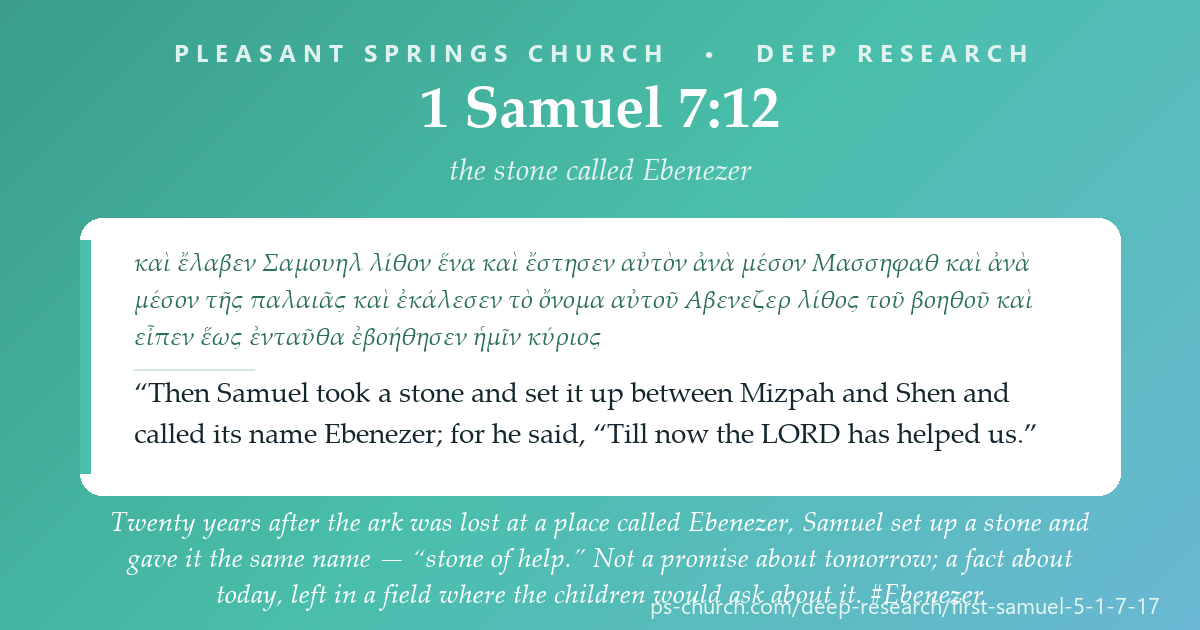
Ebenezer — “stone of help.” Two words: ʾeḇen, stone, and ʿēzer, help, from the verb ʿāzar that Samuel then uses in the same breath: ʿăzārānû, “he has helped us” (7:12). It is a place-name before it is a monument — the army camped there and lost the ark there (4:1), and 5:1 says the ark was carried away from Ebenezer. So when Samuel names a new stone with the old name he is not inventing a word; he is taking back a place. The Greek both transliterates and translates it: Αβενεζερ λίθος τοῦ βοηθοῦ, “Abenezer, stone of the helper” — a plus over the Hebrew, and the only reason a Greek reader can hear the pun at all.
“The hand of the Lord.” Eight times in three chapters, counting “his hand” and “the hand of God” — and it is the phrase that carries the whole argument. It is heavy (5:6, 11), it is hard (5:7), it does not turn away (6:3), it may be lightened (6:5), it either touched them or did not (6:9), and at the end it is against the Philistines all the days of Samuel (7:13). The ancient reader heard a technical phrase: in Mesopotamian texts an epidemic is the “hand” of a named god. Note the Greek honestly: seven of the eight are χείρ and the thread holds — but 5:11 is not in Rahlfs, so the Greek column has seven, not eight.
“Heavy” — and it is the same root as “glory.” The hand of the Lord is heavy on Ashdod (5:6) and very heavy at Ekron (5:11); the Philistines are told not to make their hearts heavy (6:6, twice, of themselves and of Egypt — the ESV rightly translates it “harden”); and they are told to give the God of Israel kāḇôḏ, glory (6:5), which is heaviness as honour. Five occurrences of one root. And it is the root of the name a dying woman gave her son one chapter earlier: ʾî-ḵāḇôḏ, Ichabod, “no glory” (4:21). The glory that left Israel turns up in Ashdod as a weight nobody can carry. Greek: ἐβαρύνθη and βαρύνετε keep the “heavy” thread, but 6:5’s “glory” is δόξαν, a different word — so the link between the weight and the glory is audible in Hebrew only.
The affliction — and a standing instruction to say it decently. Every time this word appears the Masoretes attach a qere: the consonants written are עפלים (ʿŏpālîm, “swellings, mounds”), the word to be read aloud is טְחֹרִים (ṭăḥōrîm). Both mean a swelling of the body; the substitution is a matter of decorum, and it is one of the clearest cases in the Bible of the reading tradition softening a public reading. The ESV translates “tumors” and does not speculate further, which is the right amount of confidence. The Greek renders it ἕδρας, “seats,” which is its own euphemism, in a different language, reaching for the same modesty.
“Lord” of the Philistines — and Hebrew never uses it of anyone else. It is not the ordinary word for a ruler (śar, melek, nāśîʾ); it is a title reserved in the Old Testament for the five heads of the Philistine cities, and it is generally reckoned a loanword from the Philistines’ own language — often compared with Greek τύραννος, though the comparison is not proven and honest lexicons say so. Its survival is a small piece of evidence in the text itself that these people came from somewhere else. The Greek reaches for a Persian-derived word instead: σατράπης, satrap.
“Guilt offering” — in the mouths of Philistine priests. This is a technical term of Israel’s own sacrificial law: the reparation offering of Leviticus 5:14–6:7, which covers an offence against holy things and requires restitution plus a fifth. The Philistine diviners use it correctly: don’t send it back empty, send it back with compensation. Nobody tells them this and the narrator does not say where they learned it. The Greek does not use the sacrificial vocabulary at all — it is τῆς βασάνου, payment “for the torment” — so a Greek reader sees compensation where a Hebrew reader sees a Levitical category.
“Lowing as they went.” Literally “they went, going and bellowing” — two infinitives absolute, the Hebrew way of stretching an action out so you feel its length. Gāʿāh is the noise cattle make; the verb occurs in only one other verse in the whole Bible (Job 6:5, of an ox over its fodder). The animals are walking away from their calves and calling for them the whole way, and they do not turn. It is the most economical piece of writing in the chapter. And the Greek does not have it: Rahlfs reads ἐκοπίων, “they laboured, they grew weary” — so this page prints the loss rather than arguing from a Hebrew sound its own Greek column does not make.
“Return” — done to the ark, and then done by Israel. One root runs the logistics of these chapters: let the ark return to its place (5:11), by all means return him a guilt offering (6:3, 4), bring back the calves (6:7), what you are returning to him (6:8), the lords returned (6:16), the Philistines have returned the ark (6:21). Then Samuel turns the same word on Israel: “if you are returning to the Lord with all your heart” (7:3, šāḇîm) — and the chapter ends with the towns restored to Israel (7:14). The Greek uses ἀποδίδωμι for the offering and ἐπιστρέφω for the repentance, so the single Hebrew word becomes two Greek ideas: the pun survives in Hebrew and not in Greek.
Two features of the Hebrew here, reported rather than tidied:
- The ketiv and qere on the affliction, seven times over. This is not an obscure technicality; it is the single most consistent scribal intervention in these chapters, and it tells you something about how the text was used — aloud, in public, before mixed congregations. The written consonants stay. The reading changes. Both are printed in any critical Hebrew Bible and in the margins of many study Bibles, and neither is hidden.
- Two words in chapter 7 whose meaning is not settled. At 7:2 וַיִּנָּהוּ occurs in this form nowhere else; “lamented” (ESV), “yearned,” “were gathered” and “turned” have all been proposed, and the Greek translator read something that produced ἐπέβλεψεν, “looked.” At 7:12 הַשֵּׁן, “Shen,” is otherwise unknown as a place; the Greek and Syriac support Jeshanah, and the ESV footnotes it. A translation that reads smoothly at both points is smoothing something, and the honest thing is to say which of the two words your sermon is standing on. Neither of ours is.
Egypt and the plagues, the Kohathites and the holy things, the stones Israel keeps setting up, and the gods Israel keeps having to put away.
Trace four threads: the Philistines are made to re-run the Exodus and the text says so out loud (6:6); the striking at Beth-shemesh belongs with the other “do not touch, do not look” texts; the Ebenezer stone belongs with Joshua’s twelve and Jacob’s pillar; and Samuel’s sermon at 7:3 is a quotation of Judges and of Genesis.
Which cross-references matter?
- Exodus 9 and Exodus 8 — and 1 Samuel 6:6 makes the connection itself. “Why should you harden your hearts as the Egyptians and Pharaoh hardened their hearts? After he had dealt severely with them, did they not send the people away?” The Philistine diviners have heard the Exodus story and are using it as a risk assessment. Then look at what the narrative does with it: a heavy hand (Exod 9:3, “the hand of the Lord will fall”), plagues on a foreign power, a hardening of hearts warned against, a people finally “sent away” loaded with the foreigners’ gold. The ark goes through its own exodus, and the enemy’s own priests write the script.
- Numbers 4:15, 20 — the closest legal text to 6:19. The Kohathites carry the holy things but “must not touch the holy things, lest they die”; and “they shall not go in to look on the holy things even for a moment, lest they die.” Whatever exactly happened at Beth-shemesh, the category is not new and the danger is stated in the law. Compare also Leviticus 10:1–3, Nadab and Abihu — “among those who are near me I will be sanctified” — and 2 Samuel 6:6–8, Uzzah and the ark on a cart, which is the same problem again and is met with the same silence.
- Joshua 3–4 — the twelve stones, and the reason for them. “These stones shall be to the people of Israel a memorial forever” (Josh 4:7), set up so that “when your children ask… you shall let your children know.” Samuel’s Ebenezer is the same instinct in a single stone: a rock in a field whose only job is to make somebody ask a question. Compare Joshua 24:26–27, where Joshua sets a great stone under the oak at Shechem and says “this stone shall be a witness against us”; and Genesis 28:18–22 and 35:14, where Jacob sets up the stone he slept on. Israel marks the places where God met it, and the marks outlive the memory.
- Judges 10:16 and Genesis 35:2–4 — Samuel’s sermon is a quotation. “Put away the foreign gods that are among you” is what Jacob says to his household at Bethel and what Israel finally does in Judges 10 — the same verb, the same object. 1 Samuel 7:3–4 is not a new idea; it is the oldest instruction in the book being given again, and the fact that it still needs giving after twenty years is the comment.
- 1 Samuel 4 — the chapter these three are answering. The ark was fetched from Shiloh as a weapon, the army was beaten anyway, Hophni and Phinehas died, Eli fell backward, and a woman in labour named her son Ichabod: “the glory has departed from Israel, for the ark of God has been captured” (4:22). Everything in chapters 5–7 is the reply, and the reply is not that she was wrong. It is that the glory was never Israel’s to lose.
- 1 Samuel 8 — and the reason 7:15–17 is where the chapter ends. Samuel judges Israel all the days of his life, on a circuit, and builds an altar at Ramah. The very next verse of the book is “when Samuel became old…” and then the elders ask for a king. Chapter 7 is the exhibit the reader is supposed to have in mind when chapter 8 begins — a victory won by confession and thunder while a prophet held a lamb. It does not settle the question of the monarchy; it frames it.
- 2 Samuel 7 — where the ark’s homelessness finally gets answered. The ark stays at Kiriath-jearim for twenty years here and a great deal longer in fact; David brings it up to Jerusalem, proposes to build it a house, and is told that God will build him one instead. The line that runs from a cart in a wheat field to a throne promise runs through these chapters.
- “Who is able to stand?” — and an honest note about which column the echo is in. The men of Beth-shemesh ask מִי יוּכַל לַעֲמֹד, “who is able to stand…?” (6:20), and readers have long heard it again in Malachi 3:2 (“who can stand when he appears?”), Psalm 130:3 and Revelation 6:17 (“the great day of their wrath has come, and who can stand?”). It is a real thread and it runs through the Hebrew verb: the Greek of 1 Kingdoms 6:20 does not say “stand” — it says διελθεῖν, “pass through.” So the connection is with the Hebrew text, not with the Greek column printed above, and this page says so rather than letting a good link go unexamined.
Men went out to look at the ark and men died. The narrator gives one clause of explanation — “because they looked upon the ark of the Lord” — and then nothing: no oracle, no rebuke, no defence of God, no assurance. And immediately afterwards the survivors ask the question the text does want you to ask: “Who is able to stand before the Lord, this holy God?”
Three things can be said, and then we stop.
(1) The category is not invented here. Numbers 4:20 already forbids looking at the holy things “even for a moment”; Leviticus 10 has already happened; 2 Samuel 6 will happen again. Israel’s own law says that the presence of God is not safe in the way we would like it to be, and it says so in advance, in writing, to the people whose job it was to carry the thing.
(2) Even the Hebrew phrase is not certain. רָאוּ בַּאֲרוֹן can be read “looked at” or “looked into”; the ESV takes the first, the KJV the second, and the difference is a preposition. Josephus, characteristically, supplies a reason the text does not give — that the men were not priests and so had no business touching it. That is his inference, not Scripture’s, and we should not adopt it just because it makes us comfortable.
(3) And the number is genuinely disputed. The Hebrew as it stands says “seventy men, fifty thousand men.” Some Hebrew manuscripts have only the seventy. The Greek has both. Josephus has only the seventy. The ESV prints seventy and footnotes the rest; the KJV and NASB print fifty thousand and seventy. This page prints the ESV, prints the Hebrew above it so you can see the two numbers sitting there unjoined, prints the Greek beside it, and does not adjudicate. Stage 5 lays out the evidence. See the texts we print.
What we will not do is any of the three things this verse usually gets. We will not shrink it — it is not a minor incident. We will not explain it — the narrator declines to, and where Scripture gives no reason, we say so and stop. And we will not use it to frighten anybody. The men of Beth-shemesh asked the right question, and the book’s answer to it is a long way off: a holy God who cannot be handled came, in the end, to be handled — and that is the New Testament’s claim, not this chapter’s.
The commentaries, the “ark narrative” question, the water at Mizpah — and the number at 6:19, laid out in full.
McCarter, Klein, Tsumura, Bergen, Long, Brueggemann and Alter on the text; Miller and Roberts on the whole unit; Cross–Parry–Saley–Ulrich and Tov on the manuscripts. Then the three live questions these chapters raise — the number, the shape of the unit, and the rite at Mizpah — with the positions named and not adjudicated.
Commentaries & studies:
- P. Kyle McCarter Jr., I Samuel (Anchor Bible, 1980) — the standard text-critical treatment; he reconstructs freely from the Greek and Qumran and shows his working, which is exactly why he is useful even where you decline to follow him. Ralph W. Klein, 1 Samuel (WBC) is close to him and clearer for a non-specialist.
- David Toshio Tsumura, The First Book of Samuel (NICOT) — deliberately more conservative about emending the Masoretic Text, and strong on the Hebrew itself. Read him against McCarter and you have the whole live argument about this book in two volumes.
- Robert D. Bergen, 1, 2 Samuel (NAC); Bill T. Arnold, 1 & 2 Samuel (NIVAC); V. Philips Long, 1 & 2 Samuel (Tyndale); Walter Brueggemann, First and Second Samuel (Interpretation); Robert Alter, The David Story.
- P. D. Miller Jr. and J. J. M. Roberts, The Hand of the Lord (1977) — the ANE background of the divine hand, the captured-god motif, and a sustained argument about what these chapters are for.
- Emanuel Tov, Textual Criticism of the Hebrew Bible; Eugene Ulrich, The Qumran Text of Samuel and Josephus; DJD XVII (Cross, Parry, Saley, Ulrich, 2005). Bernard A. Taylor, “1 Reigns: To the Reader,” in NETS, for the Greek.
Interpretation notes worth keeping:
- 1 Samuel 6:19 — the evidence, all of it, and no verdict from us. What the Hebrew says: וַיַּךְ בָּעָם שִׁבְעִים אִישׁ חֲמִשִּׁים אֶלֶף אִישׁ — “and he struck among the people seventy men, fifty thousand men.” Two numbers, no conjunction, and the smaller first, which is against normal Hebrew usage; it is the awkwardness of the phrase, not the size of the figure, that first put commentators on the scent. What the manuscripts do: a small number of medieval Hebrew manuscripts omit “fifty thousand men” and read only the seventy; the ESV and CSB follow them and footnote the majority reading (“Most Hebrew manuscripts struck of the people seventy men, fifty thousand men”), while the KJV, NASB and NIV render the combined 50,070. What the Greek does: Rahlfs keeps both numbers — ἑβδομήκοντα ἄνδρας καὶ πεντήκοντα χιλιάδας ἀνδρῶν — and also opens the verse quite differently, “And the sons of Jechonias were not glad among the men of Beth-shemesh, because they saw the ark of the Lord,” which has no counterpart in the Hebrew at all. What Josephus does: Ant. 6.1.4 has “seventy persons” and no fifty thousand, which is evidence about the text in front of him. What Qumran does: nothing — 4QSama preserves 6:16–18 and 6:20–21 and breaks off exactly across this verse. What the ancient translators and the rabbis do: the Syriac reads a different figure again, and the Targum distinguishes seventy elders from fifty thousand of the people — that is, they too found the phrase difficult and each resolved it differently. What is proposed: that “fifty thousand” is an early marginal gloss that entered the text; that the phrase means “seventy men, [that is,] fifty out of a thousand”; that ʾelep here means a military unit rather than the number one thousand; that two numeral signs were confused. None of these is Scripture’s own statement, and no reading has carried the field. The honest summary is the one every serious commentary gives: the text at this point has not come down to us in a single form, the difference is a number and not a doctrine, and the reader is entitled to see all of it. That is what the texts we print is for.
- The “ark narrative” question — a real scholarly debate, and nothing here depends on it. Since Leonhard Rost (1926) many have argued that 1 Samuel 4:1b–7:1 (with 2 Samuel 6) once circulated as a separate composition about the ark, told largely without Israel and without Samuel — which would explain why Samuel vanishes for three chapters and reappears at 7:3 as if he had never left. Miller and Roberts reassessed the case in 1977 and argued for a somewhat different scope and purpose; Tsumura and others have questioned whether an independent “ark narrative” ever existed. We name the positions and do not adjudicate. The received book runs 4:1 to 7:17 in one sweep, that is how it is read here, and the observation that drives the whole discussion — that Israel is simply absent from chapters 5 and 6 — is worth having whatever you conclude about its origins.
- The water poured out at Mizpah (7:6) is unexplained, and every account of it is a guess. No text in the Old Testament says what this rite meant. The suggestions on offer: a sign of self-emptying or contrition (“poured out like water”); a libation of the sort that accompanies fasting; a self-imprecation — may we be poured out if we go back on this; a purification rite; simply an act of thirst in a national fast. The Greek adds “on the ground” (ἐπὶ τὴν γῆν), which is the nearest thing to an ancient interpretation we have, and it does not decide the question. Where Scripture gives no reason, we say so and stop. What the verse itself joins the water to is not mysterious at all: fasting, and the words “we have sinned against the Lord.”
- The seven months, the twenty years, and the shape of the chronology. The ark is with the Philistines seven months (6:1 — Josephus says four), then at Kiriath-jearim “some twenty years” before 7:2–3, and in fact it is still there in David’s day, which is a good deal more than twenty. The twenty years therefore measure the interval to the repentance, not the ark’s whole stay, and the text is not confused; it is counting to a different event. Commentators differ on how 7:13–14 (“the Philistines were subdued and did not again enter the territory of Israel”) relates to the Philistine wars that fill the rest of the book. The plain reading is that 7:13 describes Samuel’s lifetime as a judge, and the later wars begin under Saul.
- What Beth-shemesh and Kiriath-jearim were. Beth-shemesh (“house of the sun”) sits in the Sorek valley on the boundary between Judah and Philistine territory and is listed as a levitical city (Josh 21:16), which is why 6:15 has Levites taking the ark down. Kiriath-jearim (“city of forests”) is up in the hills toward Jerusalem, originally a Gibeonite town (Joshua 9:17). Both are real places with real excavation histories, and the geography of chapter 6 — a cart climbing east out of the plain, a wheat harvest in the valley, five lords watching from the border and going home — is the geography of a genuine frontier.
- On Rahlfs, Vaticanus and the shape of Greek Samuel. Rahlfs’s text of 1 Kingdoms rests chiefly on Vaticanus, and for chapters 5–7 there is no separate parallel recension printed, as there is for Judges. That changes later in the book: in the David and Goliath material the Greek is dramatically shorter than the Hebrew, and whether that reflects a shorter Hebrew original or a Greek abbreviation of a fuller one is genuinely and actively debated. It is not our passage, but it is the same book and the same question, and a reader who meets the pluses and minuses above should know where they are going.
A statue on a threshold, two cows on a road, and a stone with a date on it.
Name what you learned, why it matters, and one concrete response.
What should we carry away — and do?
- Nobody rescued the ark. For two chapters Israel does not appear: no army, no prophet, not even a prayer. The ark is a trophy in an enemy temple and it comes home anyway, on a cart the enemy built, with the enemy’s gold in a box beside it. The glory Israel thought it had lost was never Israel’s to lose.
- The Philistines reasoned carefully and were right. Their priests designed the one test that could not be a coincidence — unbroken cows, calves shut up at home — and then they followed the cart to the border to see. That is not superstition; it is evidence-gathering, and the text respects it. It is worth noticing which characters in this story ask honest questions and which ones assume they already know.
- The hardest verse is the one we are least allowed to smooth. Seventy men — or more — died at Beth-shemesh for looking, the narrator explains nothing, and the survivors ask “who is able to stand?” A study that hurries past that has changed the subject. So has one that dwells on it. Report it, sit with the question, and let the rest of the Bible answer it in its own time.
- The differences between the Hebrew and the Greek are not a threat; they are the receipts. This book has the widest divergence of any we have worked through, and a Dead Sea scroll that sides with the Greek at 6:2, 6:3, 6:4 and 6:20. None of it touches an article of the faith. All of it shows you a text that was copied, carried, translated and argued over by people who cared enough to keep every version. Here is why we print what we print.
- Repentance came before the victory, and it looked like housework. “Put away the foreign gods… and serve him only” (7:3). No strategy, no muster, no weapons named. Israel takes the idols out of the houses, gathers, fasts, and says one sentence out loud: we have sinned. The thunder is God’s part, and it comes while Samuel is still holding the lamb.
- And the stone says “till now.” Not “from now on.” Samuel does not promise the future; he marks the ground where help had actually arrived, and leaves it there for people who would need it later. Ebenezer is a memorial, not a guarantee — and it was set up on the same soil where the ark had been lost twenty years before.
A word about typology, clearly labelled: readers have long heard something Christ-ward in a captured ark that wrecks the house it is imprisoned in and comes out under its own power, and in an idol found face down before the presence of God. Hold it as a devotional analogy and label it as one. The New Testament nowhere reads 1 Samuel 5 that way; it does not make Dagon a figure of anything, and it does not comment on these chapters at all. What Scripture itself says here is smaller and harder: that the God of Israel is not a regional deity who can be captured, that his holiness is genuinely dangerous, and that Israel’s only recorded contribution to the whole rescue was to put its idols in a heap twenty years later.
Step in response: two things this week. First, set up a stone — write down, with a date, one place where help actually arrived. Not a promise about the future; a fact about the past, in a form your children could find. Second, do the 7:3 part before you ask for the 7:10 part. Whatever in your house has quietly become a god, take it out and put it down. Israel waited twenty years to do that, and the twenty years are in the text so that we can notice how long it took.
1 Samuel 7:12 · to share
LXX / 1 Kingdoms (Rahlfs) + ESVEvery Deep Research page traces its passage across the whole sweep — the Old Testament, the Second-Temple world between the testaments (historical witnesses, not Scripture), and the New Testament. Follow the thread:
Pleasant Springs Church — Deep Research
Research method after Michael S. Heiser’s Bible Research Method (examine dictionaries → ancient literature → important words → textual connections → academic publications → share), with the Pleasant Springs “Author & Audience” foundation. Scripture set in the Hebrew, the Greek editions named on each page and the ESV (Old Testament), and the Greek New Testament and the ESV (New Testament), per the practice of Pleasant Springs Church. 1 Samuel 5–7 research grounded in McCarter (Anchor Bible), Klein (WBC), Tsumura (NICOT), Bergen (NAC), Arnold (NIVAC), Long (Tyndale), Brueggemann (Interpretation) and Alter, with Miller and Roberts, The Hand of the Lord, on the unit as a whole and Alter’s narrative tools behind the structure block. Name: in Greek this book is 1 Kingdoms (Βασιλειῶν Αʹ), not 1 Samuel, and the page says so. Text & numbering: Hebrew from the Masoretic Text; Greek from Rahlfs’s Septuaginta, verified verse by verse and printed without editorial punctuation; English ESV (2016), quoted exactly. There is no chapter- or verse-offset in this passage: Rahlfs has 12, 21 and 17 verses in chapters 5, 6 and 7 exactly as the Hebrew does, and this was counted rather than assumed; it is noted that another printed Greek divides 5:11–12 differently while carrying the same words. Divergences: Greek 1 Kingdoms differs from the Masoretic Text more than any book previously covered in this library, and the differences in these chapters are enumerated in full in the codex note rather than described as “rendering differences” when they are pluses or minuses — pluses at 5:3 (a whole plague clause), 5:4, 5:6 and 6:1 (the mice), 6:2, 6:3, 6:20, 7:6 and 7:12; minuses at 5:11 (“the hand of God was very heavy there”) and 6:4 (“five golden mice”); different names and places at 5:10, 6:14, 6:16, 6:18, 7:1 and 7:14; differences of sense at 6:12, 6:20, 7:2 and 7:3. Where the page argues from a Hebrew word — the yaḏ Leitwort, the kāḇēḏ/kāḇôḏ link to Ichabod, the “lowing” of 6:12, the “stand” of 6:20 — what the Greek column actually does with it is stated in the same breath, including the fact that the eighth “hand” is absent from the Greek. The sevenfold ketiv/qere on the affliction is printed and discussed. Qumran: 4QSama (4Q51) preserves 5:8–12; 6:1–13, 16–18, 20–21 and 7:1 in this passage and agrees with the Greek against the Masoretic Text at 5:8, 6:2, 6:3, 6:4 and 6:20; it does not preserve 6:19, and that is reported rather than glossed. Transcriptions in DJD XVII; no argument is built beyond what is there. 1 Samuel 6:19 is treated as a genuine textual crux: the Hebrew’s unjoined “seventy men, fifty thousand men,” the medieval Hebrew manuscripts that omit the larger figure and that the ESV and CSB follow, the ESV’s own footnote, Rahlfs’s retention of both figures together with its unparalleled opening about “the sons of Jechonias,” Josephus’s seventy, the Syriac and Targumic resolutions, and the several modern proposals are all reported, and no reading is adjudicated. Second-Temple and later witnesses (Josephus, Ant. 6.1.1–4; Sirach 46:13–20; the Targum; Rashi and Kimhi on Dagon) are read as witnesses and never leveled with Scripture; the Apocrypha and Deuterocanon are marked non-canonical at first mention. Ancient Near Eastern material is cited from the local scan of ANET (Medinet Habu, 262–263; the Plague Prayers of Mursilis, 394–396). The “ark narrative” hypothesis and the meaning of the water poured out at Mizpah are reported with the positions named and deliberately not adjudicated. Christ-ward readings of the fall of Dagon and of the ark’s return are offered only as explicitly labelled devotional analogy.
Scripture quotations marked ESV are from the ESV® Bible (The Holy Bible, English Standard Version®), © 2001 by Crossway, a publishing ministry of Good News Publishers. ESV Text Edition: 2016. Used by permission. All rights reserved. The ESV text may not be quoted in any publication made available to the public by a Creative Commons license, and the ESV may not be translated in whole or in part into any other language. www.esv.org
|
Did this study bless you today? 💚 Give to Support PS Church100% of gifts go to the General Fund — thank you. |