Judges ended four times over on one sentence — “in those days there was no king in Israel” — and here is Israel answering it. Samuel is old, his sons are taking bribes exactly as Eli’s sons took meat, and the elders say the thing Moses had written down before they crossed the Jordan: “Now appoint for us a king to judge us like all the nations” (8:5). And the Lord’s answer has to be held in both hands, because the chapter will not let you have half of it: “they have not rejected you, but they have rejected me from being king over them” (8:7) — and, fifteen verses later, “Obey their voice and make them a king” (8:22). It is a rejection, and God grants it. Between the two stands the warning, built on one verb repeated until it is unbearable: he will take — your sons, your daughters, your fields, your vineyards, your servants, a tenth, a tenth — “and you shall be his slaves. And in that day you will cry out because of your king… but the Lord will not answer you in that day” (8:17–18). Then the camera drops to a farm. Some donkeys go missing, a young man and a servant go looking, and a seer at a high place pours a flask of oil on his head and kisses him (10:1). The Spirit rushes on him among a band of prophets and the neighbours say, “Is Saul also among the prophets?” And when the lots are cast at Mizpah and the whole nation is waiting, the tallest man in Israel is nowhere to be found — until God says: “Behold, he has hidden himself among the baggage” (10:22). This study works 1 Samuel 8:1–10:27 line by line in Hebrew, Septuagint and ESV, with the differences between the columns reported rather than smoothed — and in this book there are a great many of them. See the method →
1 Samuel 8:1–10:27 (selections)
Hebrew · LXX (Rahlfs, 1 Kingdoms) · ESVThe Shape of the Passage
InclusioBehind this passage stand two books. Judges ends with the refrain “there was no king in Israel; everyone did what was right in his own eyes,” and Deuteronomy 17:14–20 had already written down the sentence Israel would one day say and the rules for the king they would one day have. In front of it stand Saul’s reign, David’s, and the covenant of 2 Samuel 7. Read the chapter with all four in the room.
Author
A narrator who will not tell you what to think, and who is not being careless about it. He reports that the request is a rejection of God (8:7) and that God grants it (8:22) and offers no sentence reconciling the two. He reports that Saul hid among the baggage (10:22) and does not say whether that was modesty, fear, or something else. He reports that “worthless fellows” despised the new king (10:27) and does not say they were wrong to doubt. This is the technique Robert Alter calls reticence — the withheld motive, the gap the reader is invited into — and on this page it is doing theological work: the text is holding two true things at once and declining to collapse them.
He works by repetition and expects you to count. Six “he will take”s in seven verses. “Obey their voice” three times from God (8:7, 8:9, 8:22) against one “the people refused to obey the voice of Samuel” (8:19). “Set a king over us” at both ends (8:5; 10:19). The seer-word rōʾeh five times in one chapter (9:9 twice, 9:11, 9:18, 9:19) and then Samuel’s “Do you see him whom the Lord has chosen?” (10:24). And he puns on the new king’s name: Sha’ul means “asked for,” and the people are “the ones asking for a king” (8:10) and then have to ask the Lord where he has gone (10:22).
The tradition about who wrote it is old and the tradition itself admits its problem. b. Bava Batra 14b–15a says “Samuel wrote his own book, the book of Judges, and the book of Ruth” — and the Gemara immediately objects that Samuel dies in 1 Samuel 25, and answers that Gad the seer and Nathan the prophet finished it, citing 1 Chronicles 29:29. That is a tradition, not a colophon, and this page treats it as one. What the book itself shows is a writer working with older material and keeping it usable: 9:9 stops the story to explain to a later reader that “seer” is what “prophet” used to be called.
Audience
People who had lived under kings, and knew how it went. This is not a warning to a people who have never seen a monarchy. Whoever first read 8:11–18 knew about conscription, corvée, royal estates and the tenth, because they had paid them. That is part of why the passage lands: it is not a prediction that came true, it is a description they could check against their own harvest.
People who also had 2 Samuel 7 and the Psalms. The same canon that calls the request a rejection puts God’s own promise to David three books later — “your throne shall be established forever” (2 Samuel 7:16) — and sings “I have set my King on Zion” (Psalm 2:6). An audience holding both is not confused; it is being taught something about how God works with what his people insist on. Note that Hannah has already sung about “his king… his anointed” before any king exists (2:10).
And people tempted to read this as a verdict on their own government. It is not one. The passage is about Israel under covenant asking to be governed the way the nations were governed, and the sin named is not a form of administration but a transfer of trust. This study will not be turned into a lesson about modern politics, in any direction; anyone who wants that from the text has to add something the text does not say.
Orient on kingship in Israel, nagid and melek, anointing, the seer and the prophet, the lot, and the Philistine pressure behind the whole request.
Search by topic: kingship (Israel); king, law of the (Deut 17); nagid / prince; anointing and messiah; judge (shophet); elder; Philistines and the Sea Peoples; Ramah; Mizpah; Gibeah; Beersheba; high place (bamah); seer; prophet and prophetic bands; Spirit of the LORD; lot / Urim and Thummim; bribe (shohad); corvée and forced labour; Benjamin; Saul.
Which articles are relevant?
- Anchor Bible Dictionary — “King and Kingship,” “Samuel, Books of,” “Saul,” “Samuel (person),” “Nagid,” “Anointing,” “Messiah,” “Prophecy (Pre-Exilic Hebrew),” “Seer,” “Philistines,” “Mizpah,” “Gibeah,” “High Place,” “Lots, Casting of,” “Corvée.”
- Dictionary of the OT: Historical Books (IVP) — “Samuel, Books of,” “Kingship and Monarchy,” “Saul and Saul’s Family,” “Prophets and Prophecy,” “Philistines,” “Divination and Magic,” “State Officials.”
- NIDOTTE / TDOT — מֶלֶךְ (meleḵ, king), נָגִיד (nāgîḏ, prince/leader-designate), מָשַׁח (māšaḥ, anoint), מָאַס (māʾas, reject), לָקַח (lāqaḥ, take), מִשְׁפָּט (mišpāṭ, justice/custom/claim), שָׁאַל (šāʾal, ask), רֹאֶה (rōʾeh, seer), שׂים (śîm, set/appoint).
- On the Greek — Bernard A. Taylor, “1 Reigns: To the Reader,” in A New English Translation of the Septuagint. Short, and the place to start on what kind of translation 1 Kingdoms is and where its text stands in relation to the Hebrew.
Bibliography surfaced:
- P. Kyle McCarter Jr., I Samuel (Anchor Bible) — the standard text-critical commentary on this book in English, and the one to have open when the columns differ; Ralph W. Klein, 1 Samuel (WBC); David Toshio Tsumura, The First Book of Samuel (NICOT); Robert D. Bergen, 1, 2 Samuel (NAC); Bill T. Arnold, 1 & 2 Samuel (NIVAC); V. Philips Long, 1 & 2 Samuel; Walter Brueggemann, First and Second Samuel (Interpretation).
- Robert Alter, The David Story (translation and commentary on 1–2 Samuel) and The Art of Biblical Narrative, for reticence, Leitwort and the shape of the scenes. (Alter reads these texts as literature and does not share the church’s confession; we take the tools, not the metaphysics.)
- Emanuel Tov, Textual Criticism of the Hebrew Bible; Eugene Ulrich, The Qumran Text of Samuel and Josephus; F. M. Cross et al., Qumran Cave 4.XII: 1–2 Samuel (DJD XVII, 2005) — the scroll itself.
What a king actually cost in the ancient Near East, who the Philistines were, and how Josephus and the rabbis handled the same tension this page has to hold.
First the world: what kingship was in the second and first millennia BC, and why 8:11–18 reads like an inventory rather than a rant. Then the Philistine pressure that stands behind 9:16. Then watch the ancient retellings — Josephus, and the rabbis at one folio of the Talmud — take the same two facts this chapter states and pull in opposite directions.
Which parallels shed light on the world of these chapters?
The king’s job description, as the ancient world wrote it down. The prologue to the Code of Hammurabi says why Babylon has a king at all: Anum and Enlil named him “to cause justice to prevail in the land, to destroy the wicked and the evil, that the strong might not oppress the weak” (ANET 164). That is exactly what the elders ask for — a king “to judge us” (8:5, 8:6, 8:20) — and it is the honest half of their request. Israel had no functioning judiciary left: Samuel was old, and his sons were taking bribes and perverting justice (8:3), which is the one thing a judge must not do (Deuteronomy 16:19). The request is not stupid. It is what any reasonable person in the ancient Near East would have said.
And the king’s bill, as the ancient world also wrote it down. The list in 8:11–18 — conscripted sons, requisitioned daughters, the best fields taken and granted out to royal servants, a tenth of grain and vintage, a tenth of the flocks, the best labour and draught animals seized for the crown — is not satire. Every item of it is documented practice in the Akkadian administrative texts from Ugarit: royal land grants to officials, corvée obligations, and standing levies. Isaac Mendelsohn made the case in a short and much-cited article (“Samuel’s Denunciation of Kingship in the Light of the Akkadian Documents from Ugarit,” BASOR 143 [1956] 17–22), arguing that the speech “does not constitute a rewriting of history by a late opponent of kingship” but reflects the actual Canaanite institution. Not everyone follows him on the dating conclusion, and it does not need to be settled: the point that survives every disagreement is that Samuel is reading them an invoice, and it is a real one.
The Philistines are the pressure under the whole request. They are not a stray tribe; they belong to the wave of movement across the eastern Mediterranean at the end of the Late Bronze Age, and Egypt has left us its own account of meeting them. Ramses III’s inscriptions at Medinet Habu name them among the Sea Peoples: “The northern countries quivered in their bodies, the Philistines, Tjekk[er, and…]… They cut off their (own) land and were coming” (ANET 262–263). They settled the coastal plain with iron, chariots and organised cities, and by 1 Samuel they had already taken the ark (chapters 4–6). When the Lord says “he shall save my people from the hand of the Philistines” (9:16), that is the concrete thing everyone in the story is afraid of.
- Code of Hammurabi, Prologue (ANET 164; c. 1750 BC) (a royal law-collection — a witness, not Scripture) — the king exists “to cause justice to prevail in the land… that the strong might not oppress the weak.” Read it beside 8:5 and you can see why the elders wanted one.
- Ramses III on the Sea Peoples, Medinet Habu, year 8 (c. 1188 BC) (ANET 262–263) (an Egyptian royal inscription — a witness, not Scripture) — the Philistines named in an Egyptian king’s account of the migrations that put them on Israel’s coast.
- Isaac Mendelsohn, “Samuel’s Denunciation of Kingship in the Light of the Akkadian Documents from Ugarit,” BASOR 143 (1956) 17–22 — the article behind almost every modern comment on 8:11–18; the Ugaritic and Akkadian texts themselves are in PRU and Ugaritica, outside the range of the ANET scan we can verify locally, so no ANET page is claimed for them.
- Josephus, Antiquities 6.31–67 (Second-Temple — a witness, not Scripture) — he retells all three chapters, and his additions are revealing. He says Samuel had “an innate love of justice, and his hatred to kingly government, for he was very fond of an aristocracy” (6.36); he has the people ask for a king who will “avenge them of the Philistines”; and at 6.63 he supplies the motive the Bible withholds — Saul hid, Josephus says, out of modesty, “because he would not have it thought that he willingly took the government upon him.” He also counts seventy guests at the meal (6.52), with the Greek, where the Hebrew has thirty.
- Josephus, Antiquities 6.68–71 — his next section opens “After one month, the war which Saul had with Nahash” and then gives the Ammonite oppression of the Transjordanian tribes and the gouging out of right eyes — substantially the paragraph that stands in 4QSama and in no Bible most readers own. Josephus is evidence, and this is one of the places where he is very good evidence.
- Sirach 46:13–20 (Second-Temple, non-canonical in this church’s reckoning — a witness, never leveled with Scripture) — the earliest surviving portrait of Samuel outside the Bible: “beloved by his Lord… a prophet of the Lord, he established a kingdom and anointed rulers over his people” (46:13). Note what Ben Sira does not say: nothing about a rejection. He remembers Samuel as the man who set up the monarchy, full stop.
- b. Sanhedrin 20b (rabbinic-era — a witness, not Scripture) — the single most useful ancient discussion of this chapter, because the rabbis put every option on the table and do not agree. Is 8:11–17 a description of what a king may lawfully do, or a threat meant only to frighten? Both are argued at that folio. Is appointing a king a commandment? R. Yehuda lists it as one of three commandments given on entering the land; R. Nehorai answers that the passage “was stated only in response to the Jewish people’s complaint” and is no commandment at all. And R. Eliezer splits the difference exactly where the text does: “The elders of Samuel’s generation asked appropriately” — “give us a king to judge us” (8:6) — “but the ignoramuses among them ruined it,” quoting 8:19–20, “that we also may be like all the nations.”
- b. Bava Batra 14b–15a (rabbinic-era — a witness, not Scripture) — the tradition that Samuel wrote his own book, with the Gemara’s own objection and answer.
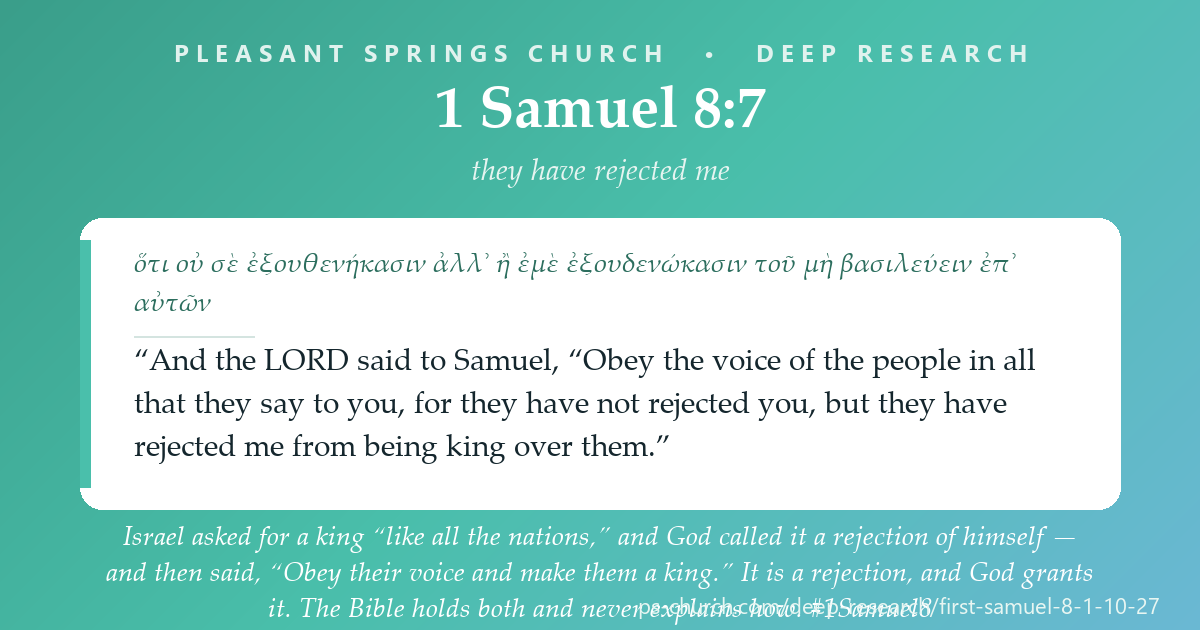
“They have not rejected you, but they have rejected me from being king over them” (8:7). And: “Obey their voice and make them a king” (8:22). Same speaker. Same chapter. No explanation.
There are two ways to make that comfortable and the text supports neither. The first is to say the monarchy was always the plan — that 8:7 is Samuel’s bruised feelings dressed up, or a passing mood. It is not: God says it, twice over, and says it again through Samuel at Mizpah (10:19), and Hosea will say it again generations later — “I gave you a king in my anger, and I took him away in my wrath” (Hosea 13:11). The second is to say the monarchy was purely sin — a wrong turn God tolerated and later worked around. It is not that either: Deuteronomy 17:14–20 legislated for a king before Israel crossed the Jordan; the Lord personally chooses this man and sends his Spirit on him (9:16–17; 10:6, 10:9); Samuel anoints him and calls the crowd to look at God’s own choice (10:24); and the same God will bind himself by oath to a king’s house forever (2 Samuel 7) and set his King on Zion (Psalm 2).
So the text says both, and it does not tell us how. What it does show is where the wrong lies. It is not in wanting justice — the elders’ complaint in 8:3–5 is completely accurate. It is in the phrase they cannot stop saying: “like all the nations” (8:5, 8:20). They are not asking for a better judge. They are asking to be a normal country, with a normal king who goes out before them and fights their battles — which is precisely the thing God had been doing (7:10–13). The rejection is a transfer of trust, and the granting of it is God letting them have what they insisted on and staying with them in it. Where Scripture gives no reason, we do not supply one. We report both sentences, keep them in the same breath, and stop.
One verb that builds a tyranny and then an anointing, one that names the sin, one title heaven uses that the crowd does not, and a pun on a man’s name.
Count laqach yourself — nine, and the ESV keeps six of them audible. Then watch ma’as land three times at both ends of the frame; notice that God says nagid where the people say melek; and hear the name Saul inside the ordinary verb “ask.”
“Take.” Nine occurrences, and the passage is an argument about who takes what. The first is a crime: Samuel’s sons “took bribes” (8:3). Four are the king’s, and with the two “he will take a tenth”s (yaʿśōr, 8:15, 17) they make six takings in seven verses: sons, daughters, fields and vineyards and olive orchards, a tenth of the grain, servants and livestock, a tenth of the flocks — and then the sentence the list was built for, “and you shall be his slaves” (8:17). Four more belong to the second half and run the other way: Samuel took Saul in to the meal (9:22), took the flask of oil (10:1), Saul took the loaves (10:4), and they took him out from among the baggage (10:23). The Greek keeps the drumbeat: λήμψεται four times and ἀποδεκατώσει three — one more than the Hebrew, because at 8:16 Rahlfs reads a tithe where the Hebrew has “put them to his work.”
“Reject, refuse, treat as worthless.” The verb of Samuel’s own hardest lesson in 16:1, 16:7, and here it is aimed at God: “they have not rejected you, but me they have rejected from being king over them.” Three occurrences in these chapters, and the third (10:19) is Samuel repeating the charge in public at Mizpah, so nobody can say it was said only in private. The Greek says something slightly different and it is worth hearing: not “reject” but ἐξουθενέω / ἐξουδενόω, “to count as nothing, to treat with contempt” — the verb the New Testament uses of the stone the builders rejected. Same event, a shade more personal.
“Prince, leader, designate.” Notice what God does not call Saul. The people ask for a meleḵ, a king; when God speaks privately to Samuel and when Samuel anoints him, the word is nāgîḏ — a leader appointed over God’s people, not a monarch in his own right, and the same title God will use of David (2 Samuel 7:8). The public crowd shouts “Long live the king” (10:24); heaven has been saying “prince.” The Greek renders it ἄρχων, “ruler,” keeping it distinct from βασιλεύς. Commentators differ on how much weight the distinction carries; the distinction itself is simply there in both columns.
“Ask, request, enquire.” This is the root of the name Shāʾūl — Saul, “asked for.” The people are “the ones asking him for a king” (8:10); the strangers at the oak will “ask after your welfare” (10:4); and when the lot has fallen and the man cannot be found, they have to ask the Lord where he is (10:22) — they ask for the Asked-for. It is the same verb Hannah used of Samuel himself (“I have asked him of the Lord,” 1:20, 27), which is one of the oddities of this book: the name-play that fits Saul best is attached to Samuel first. The Greek cannot carry the pun at all — Σαουλ is only a name in Greek.
“The ways of the king” (ESV), literally “the justice of the king” — and mišpāṭ can mean a right, a custom, a claim, or a verdict. The ambiguity is the point and the ancient readers felt it: is 8:11–17 the king’s lawful entitlement, or a description of what he will get away with? b. Sanhedrin 20b preserves both answers side by side. At 10:25 the Hebrew shifts to mišpaṭ hamməluḵāh, “the ordinance of the kingship” — a slightly different phrase, and possibly a different thing: the constitution Samuel writes down and lays up before the Lord. In Greek the distinction disappears: Rahlfs has τὸ δικαίωμα τοῦ βασιλέως in all three places, so a Greek reader is told that what Samuel wrote in the book is the very thing he had warned them about.
“Seer.” Five times in one chapter, and the narrator stops the story to gloss it: “for today’s prophet (nāḇîʾ) was formerly called a seer” (9:9). Then the root does its work: the Lord saw his people (9:16), Samuel saw Saul (9:17), and at the end Samuel turns to the crowd and asks, “Do you see him whom the Lord has chosen?” (10:24). Hold that question loosely: seven chapters later the same prophet will be told, in the same root, “man looks on the outward appearance, but the Lord looks on the heart” (16:7). Here everyone is looking at a very tall man.
“Cry out.” Three occurrences and they do not agree with each other, which is the interesting part. In Judges this is the cycle verb: the people cry out and the Lord raises up a deliverer (Judges 3:9, 3:15, 6:6, 10:10). At 8:18 the cycle is cancelled in advance: “you will cry out because of your king… but the Lord will not answer you in that day.” And then, one chapter later, God says of the very same people, “their cry has come to me” (9:16, the noun ṣəʿāqāh) — and sends them the king. Finally at 10:17 the causative of the second root is what Samuel does: he “called the people together.” The Greek plus at 9:16 sharpens it: “I have looked on the affliction of my people” is the sentence of Exodus 3:7.
“Baggage, gear, equipment” — the ordinary word for kit and vessels. “Behold, he has hidden himself among the baggage” (ἐν τοῖς σκεύεσιν). It is worth noticing that the same noun stands twice in 8:12: the king will conscript men “to make his implements of war and the equipment of his chariots.” The narrator reports the hiding and gives no motive whatever. Josephus supplies modesty (Ant. 6.63); others have read fear, or reluctance, or a piece of political theatre. The text says only where he was. That silence is deliberate, and this page keeps it.
Two features of the Hebrew here, reported rather than tidied:
- The ketiv and qere at 8:3. The consonants written are בדרכו, “in his way”; the Masoretic reading tradition says בִּדְרָכָיו, “in his ways,” which is what the ESV prints. Rahlfs has the singular, ἐν ὁδῷ αὐτοῦ, with the written consonants. Nothing turns on it; it is simply an honest example of the two layers inside the Hebrew text itself, and the ESV footnote apparatus does not mention every one of them.
- Two “justice” phrases that English levels and Greek levels differently. 8:9 and 8:11 have מִשְׁפַּט הַמֶּלֶךְ; 10:25 has מִשְׁפַּט הַמְּלֻכָה. The ESV distinguishes them (“the ways of the king” / “the rights and duties of the kingship”); Rahlfs does not (τὸ δικαίωμα τοῦ βασιλέως for both). Which means that a reader in Greek and a reader in Hebrew come away with different impressions of what Samuel deposited in the sanctuary — and neither of them is being deceived. This is what translation does, and it is why this church prints the columns side by side rather than choosing one and hiding the rest. See the texts we print.
The law that wrote the request down first, the refrain that set it up, the judge who refused a crown, and the promise that comes anyway.
Trace four threads: Deuteronomy 17, quoted almost verbatim; the end of Judges, both its refrain and its cycle of crying out; Gideon and Abimelech, the two earlier answers to “rule over us”; and forward, to the throne God binds himself to.
Which cross-references matter?
- Deuteronomy 17:14–20 — start here, because Moses wrote their sentence down before they said it. “When you come to the land… and then say, ‘I will set a king over me, like all the nations that are around me’” (17:14). Compare 8:5: “set for us a king… like all the nations” — the same verb (śîm), the same object, the same comparison; and in the Greek the phrase is identical, καθὰ καὶ τὰ λοιπὰ ἔθνη. Deuteronomy then does two things at once: it permits the king (“you may indeed set a king over you whom the Lord your God will choose”) and it limits him — no multiplying horses, wives, silver and gold, and he must write out a copy of the law and read it all his life. Samuel’s warning is the mirror image of that law. Deuteronomy says what the king must not accumulate; Samuel says what he will accumulate anyway.
- Judges 17:6; 18:1 and Judges 19:1; 21:25 — the refrain this passage answers. Four times: “In those days there was no king in Israel” — twice with “everyone did what was right in his own eyes.” Judges leaves you wanting a king. 1 Samuel 8 gives you one and tells you what it costs. The two books are not disagreeing; they are the two halves of one honest account.
- Judges 3:9, 3:15; 6:6; 10:10 — and then 8:18. In Judges, crying out (zāʿaq) is always the hinge: they cry, and God raises up a deliverer. Samuel takes the one reliable thing in the whole book of Judges and says it will stop working: “you will cry out because of your king… but the Lord will not answer you in that day.” And yet one chapter later, “their cry has come to me” (9:16). Hold both.
- Judges 8:22–23 — the same offer, refused. Israel says to Gideon, “Rule over us, you and your son and your grandson also,” and Gideon answers, “I will not rule over you, and my son will not rule over you; the Lord will rule over you.” That is the theology of 8:7, stated by a judge two hundred years earlier — and Gideon then makes an ephod that becomes a snare, and his son Abimelech murders seventy brothers to make himself king anyway, with Jotham’s fable of the bramble as the commentary. Israel has tried this before. The narrator knows the reader knows.
- 1 Samuel 2:12–17, 2:22–25 — the pattern repeating in the prophet’s own house. Eli’s sons were “worthless men” who took what was not theirs from the sacrifices; Samuel’s sons “turned aside after gain… took bribes and perverted justice.” The book has now shown the same failure twice, in the two best houses in Israel, and it makes the elders’ complaint in 8:5 impossible to dismiss. This is not a story about good leaders being unfairly rejected.
- 1 Samuel 2:10 — Hannah got there first. Before there is a king, before there is a request, a woman sings that the Lord “will give strength to his king and exalt the horn of his anointed.” The book’s opening poem already knows where it is going, which is why the request in chapter 8 is not a surprise to the narrative — only to the elders.
- 1 Samuel 7:10–13 — the chapter immediately before. At Mizpah — the same place as 10:17 — “the Lord thundered with a mighty sound that day against the Philistines and threw them into confusion,” and Samuel set up a stone and called it Ebenezer, “Till now the Lord has helped us.” The request for a king who will “go out before us and fight our battles” (8:20) is made by people who had watched God do exactly that, on that exact ground, in the previous chapter.
- Deuteronomy 18:9–22 — the prophet, and the way you find things out. Israel is forbidden the divination of the nations and given prophets instead. Chapter 9 is a case study: two men who cannot find their donkeys go to a seer, and what they get is not a location but a kingdom. Note also that Saul’s ruin will come at the point where he goes back to the forbidden way (1 Samuel 28).
- 2 Samuel 7:8–16 and Psalm 2 — where this ends up. The God who called the request a rejection takes a shepherd, calls him nāgîḏ — the same word he used of Saul — and swears to establish his house and his throne forever; and Israel sings, “As for me, I have set my King on Zion, my holy hill.” Neither text cancels the other. That is the shape of the whole Old Testament on this subject.
- Hosea 13:11 and Acts 13:21 — two later readings, both short and both blunt. Hosea: “I gave you a king in my anger, and I took him away in my wrath.” Paul at Pisidian Antioch, telling Israel’s story to a synagogue: “Then they asked for a king, and God gave them Saul the son of Kish, a man of the tribe of Benjamin, for forty years.” Paul says it without a word of blame — and then, in the next verse, moves straight to David.
It is one of the strangest sentences in the Old Testament, and it is God who says it. The lot has narrowed from tribe to clan to man, the whole nation is standing at Mizpah waiting, and the Lord’s answer to “is there a man still to come?” is: look behind the luggage.
Report it plainly; it is the narrator’s own characterisation and it is not cruel. It is not a joke at Saul’s expense, and it is not a proof that he was a coward. The text gives no motive at all. Josephus read it as modesty and said so (Ant. 6.63); readers since have proposed fear, reluctance, humility, or calculation, and every one of those is a guess. What the passage does put next to it is the physical detail it has already given twice: he is the tallest man in Israel (9:2), and when they pull him out he still stands head and shoulders above everyone (10:23). The tallest man in the country is the one they cannot find. Alter’s word for this technique is reticence — the withheld interior, the gap you are invited into — and a study that fills the gap has taken something from the reader.
And a rule for how this church talks about Saul, on this page and every page after it. He is a tragedy, not a villain to be enjoyed. He did not ask for this; the request was made over his head while he was out looking for livestock. The first words he speaks to the prophet are that he is from the smallest tribe and the least family in it (9:21). The Spirit of God comes on him and he prophesies (10:10). Men whose hearts God had touched go home with him (10:26). And on the day he is made king, men in his own country say “how can this man save us?” and bring him no gift — and he holds his peace. Whatever comes later, that is where he starts, and it will not be reported here with any pleasure.
The commentaries, the two-text problem, the “pro-monarchic and anti-monarchic sources” debate, and the questions this page deliberately leaves open.
McCarter, Klein, Tsumura, Bergen, Arnold, Long, Brueggemann and Alter on the chapters; Taylor on the Greek; Tov, Ulrich and DJD XVII on the scroll. Then the live questions — and this page names the positions and does not adjudicate.
Commentaries & studies:
- P. Kyle McCarter Jr., I Samuel (Anchor Bible) — the fullest text-critical treatment in English; it is where to go for the 10:1 plus, the 8:16 “cattle” reading and the 4QSama paragraph, and it argues positions this page reports without adopting.
- Ralph W. Klein, 1 Samuel (WBC); David Toshio Tsumura, The First Book of Samuel (NICOT), which is markedly more conservative than McCarter about departing from the Masoretic Text and is worth reading precisely for that; Robert D. Bergen, 1, 2 Samuel (NAC); Bill T. Arnold, 1 & 2 Samuel (NIVAC); V. Philips Long, 1 & 2 Samuel.
- Walter Brueggemann, First and Second Samuel (Interpretation) — the sharpest theological reading of chapter 8 in the standard series, and one to argue with; Robert Alter, The David Story, for the narrative art and a translation that keeps the repetitions audible.
- J. P. Fokkelman, Narrative Art and Poetry in the Books of Samuel, vol. IV (1 Samuel 1–12) — exhaustive on the structure of exactly these chapters.
- Emanuel Tov, Textual Criticism of the Hebrew Bible; Eugene Ulrich, The Qumran Text of Samuel and Josephus and The Biblical Qumran Scrolls (the source of the 4QSama extents given above); F. M. Cross, D. W. Parry, R. J. Saley and E. Ulrich, Qumran Cave 4.XII: 1–2 Samuel (DJD XVII, 2005).
- Isaac Mendelsohn, BASOR 143 (1956) 17–22, on 8:11–18 and the Ugarit documents; Bernard A. Taylor, “1 Reigns: To the Reader,” in NETS.
Interpretation notes worth keeping:
- Is the monarchy commanded, permitted, or conceded? The question is old, and the sources named answer it differently. Deuteronomy 17:14–15 reads as permission with limits (“you may indeed set a king over you”) inside a prediction of the request. 1 Samuel 8:7 reads as rejection. 1 Samuel 8:22 reads as divine grant. b. Sanhedrin 20b preserves all three readings as a live dispute — R. Yehuda (a commandment), R. Nehorai (a concession to complaint), R. Eliezer (the elders asked rightly, the crowd spoiled it). Christian readers have divided along nearly identical lines. We name the positions and do not adjudicate, because Scripture states both the rejection and the grant and never states the relation between them.
- The “two sources” question, described accurately. Since Wellhausen it has been common to divide these chapters into an early, favourable account of Saul’s rise (9:1–10:16; 11) and a later, hostile one (8; 10:17–27; 12), on the grounds that they give the monarchy opposite valuations and Saul is made king more than once. Many recent scholars — including several in the list above — read the chapters instead as a single deliberately double-sided composition, and point out that ancient Near Eastern accessions regularly involved designation, acclamation and confirmation as separate acts (which is what 9:1–10:16, 10:17–27 and 11:14–15 actually look like). Nothing on this page depends on the outcome, and the doubleness the theory was invented to explain is, on any view, really there in the text.
- The longer Greek at 10:1 is the passage’s most consequential textual decision, and your English Bible has already made it for you. The ESV and NRSV print the Greek and footnote the Hebrew; the KJV, NKJV, NIV and JPS print the shorter Hebrew and footnote the Greek. Checked, not assumed. The mechanism usually proposed is homoioteleuton — a scribe’s eye jumping from the first “to be prince” to the second and dropping everything between — which would mean the Greek preserves what the Hebrew lost. The alternative is that the Greek (or its Hebrew parent) filled out a terse verse. Both are seriously held. What matters pastorally is that no doctrine moves either way, and that the difference is printed openly in the footnotes of nearly every study Bible. See the texts we print.
- 4QSama, Josephus and the Nahash paragraph: a genuinely instructive case, and one to state carefully. The scroll has, before 11:1, a paragraph about Nahash of Ammon gouging out right eyes in Gilead; Josephus has substantially the same material (Ant. 6.68–71); the MT and Rahlfs have neither, and the MT instead ends 10:27 “but he held his peace,” where the scroll and the Greek have “about a month later.” The NRSV prints the paragraph; the ESV and most others do not. Frank Cross, Eugene Ulrich and McCarter argued it is original and fell out; others hold it is a later expansion that the scroll and Josephus share. The evidence is real, the disagreement is real, and this page reports both without deciding. Note what it is not: it is not a case of the Greek against the Hebrew, since here the Greek and the Hebrew agree in lacking it.
- Saul’s hiding, and the discipline of saying less than the tradition. The narrator gives no motive (10:22). Josephus gives modesty (6.63). Preachers have given cowardice, false humility, and prophetic irony. All of those are additions. What can be said is what the text says: the lot fell on him, he was not there, God told them where he was, they ran and fetched him, and he was still the tallest man in the country. If a study needs Saul to be contemptible in chapter 10 in order to make chapter 15 land, the study is doing the work the text declined to do.
- What 8:11–18 is not. It is not a general biblical verdict on forms of government, and it is not a description of taxation as such (Israel already tithed, to God). It is a description of what happens when a people transfers to a man the trust that belonged to God, told in the concrete currency of the ancient world: bodies, land, labour and a tenth. Preaching that turns it into commentary on a modern administration — any modern administration — has changed the subject. The subject is 8:7, and the audience is the church.
A rejection that God granted, a warning nobody wanted, and a very tall man behind the luggage.
Name what you learned, why it matters, and one concrete response.
What should we carry away — and do?
- The complaint was true and the request was still a rejection. Samuel’s sons really were taking bribes. The elders were not lying and they were not stupid, and God does not tell them they were. He tells them what they were actually doing underneath a reasonable request: transferring their trust. You can be completely right about the problem and still be reaching for the wrong thing.
- Three words did the damage: “like all the nations.” It is the only phrase they repeat (8:5, 8:20), and it is the phrase Deuteronomy had already predicted. Not “give us justice” — that God would have answered. “Make us normal.”
- Count the takings. Six “he will take”s in seven verses, and the list is bodies, daughters, land, harvest, workers, animals, a tenth, a tenth. Then: “and you shall be his slaves.” Israel had been slaves once and been brought out (10:18). The warning is that they are asking to walk back into it with their eyes open, and the narrator does not have to say so.
- God said no and then said yes, and the Bible never explains it. He calls it a rejection of himself, and in the same conversation tells Samuel to do it. He gave them what they insisted on and then went with them into it — chose the man, sent his Spirit on him, and eventually bound himself by oath to a king’s house forever. That is not God changing his mind about the sin. It is God refusing to leave.
- The one thing 8:18 takes away is the thing Judges never withheld. “You will cry out… but the Lord will not answer you in that day.” And then 9:16: “their cry has come to me.” Do not flatten either sentence. Sin has consequences that prayer does not simply undo, and God hears his people anyway, and both of those are in the same three chapters.
- Leave Saul his dignity. He is out looking for donkeys when this lands on him; he says he is from the least family of the least tribe; and on his coronation day some of his own countrymen ask what use he is, and he says nothing. Whatever you know about how his story ends, do not read it back into chapter 10. The text has not said it yet, and neither should we.
- And notice what Samuel does after the shouting. He writes the constitution down, and lays it up before the Lord (10:25). The nation now has a king and a document that outranks him. That is not a small thing, and it is the last thing the prophet does before going home.
A word about typology, clearly labelled: it is tempting to run straight from “they have rejected me from being king over them” to “we have no king but Caesar” (John 19:15), and Christians have often done it. Hold it carefully. The New Testament does not make that link; what it does do is far more restrained and far more interesting — Acts 13:21 tells the story straight, without reproach, on the way to David and then to Jesus, and the whole New Testament calls Jesus Christ, the Anointed, using the word Samuel’s flask made possible. If you want a Christ-ward reading of this passage, take that one: the office Israel asked for wrongly was the office God filled rightly, in his own time, with his own Son. Offered here as a devotional analogy, clearly labelled as one, and not as what 1 Samuel 8 is about.
Step in response: two things this week. First, find the place where your own request is reasonable and your trust has quietly moved — the arrangement, the person, the plan that has started doing the work God was doing. Name it out loud to somebody. Second, if you are the one who has been asked to hand over what only God should hold, notice what Samuel does with the request: he is offended, he prays about it, he tells them the truth in full, and then he obeys and blesses the outcome anyway. That order is worth copying.
1 Samuel 8:7 · to share
LXX (Rahlfs, 1 Kingdoms) + ESVEvery Deep Research page traces its passage across the whole sweep — the Old Testament, the Second-Temple world between the testaments (historical witnesses, not Scripture), and the New Testament. Follow the thread:
Pleasant Springs Church — Deep Research
Research method after Michael S. Heiser’s Bible Research Method (examine dictionaries → ancient literature → important words → textual connections → academic publications → share), with the Pleasant Springs “Author & Audience” foundation. Scripture set in the Hebrew, the Greek editions named on each page and the ESV (Old Testament), and the Greek New Testament and the ESV (New Testament), per the practice of Pleasant Springs Church. 1 Samuel 8–10 research grounded in McCarter (Anchor Bible), Klein (WBC), Tsumura (NICOT), Bergen (NAC), Arnold (NIVAC), Long, Brueggemann (Interpretation) and Alter (The David Story), with Fokkelman for the structure of chapters 1–12 and Tov, Ulrich and DJD XVII for the text. Name: in the Greek Bible this book is 1 Kingdoms (Βασιλειῶν Αʹ), not 1 Samuel. Text & numbering: Hebrew from the Masoretic Text; Greek from Rahlfs’s Septuaginta, verified verse by verse against the morphologically analysed Rahlfs text rather than back-translated from an English version, and printed without editorial punctuation; English ESV (2016), quoted exactly. There is no chapter- or verse-offset in these three chapters: Rahlfs has 22, 27 and 27 verses in 1 Kingdoms 8, 9 and 10 exactly as the Hebrew does, and this was counted rather than assumed. The book as a whole diverges more sharply than any other in this library, and that is stated rather than buried: counted in the Rahlfs text, 1 Kingdoms 17 lacks vv. 12–31, 41, 50 and 55–58 and chapter 18 lacks vv. 1–5, 10–11, 17–19 and 30 — roughly half the David-and-Goliath narrative — and whether that reflects a shorter Hebrew original or a fuller Masoretic one is genuinely debated and is not settled here or on the chapters 16–17 page. The divergences in this passage are enumerated in full in the codex note and are named for what they are rather than called “rendering differences”: the large plus at 10:1 (which the ESV prints, with a footnote); pluses at 8:18, 9:16 (ESV footnote), 10:18, 10:21 (ESV footnote) and 10:22, and the doublet at 10:5; minuses at 8:4 and at the end of 10:27; different readings of the same consonants at 8:16 (“young men” / “cattle,” ESV footnote), 9:2, 10:12 and 10:24, and at 9:25–26 where the ESV follows the Greek at both verses with footnotes; and differences of sense at 8:3, 8:7, 8:9/10:25 and 9:22 (thirty guests in Hebrew, seventy in Greek — and Josephus, Ant. 6.52, counts seventy). Where this page argues from a Hebrew word — the lāqaḥ Leitwort, the śîm frame, the šāʾal pun on Saul’s name — what the Greek column does with it is stated in the same breath, and the counts are our own and can be checked against the Hebrew printed here. The ketiv/qere at 8:3 is printed and discussed. Qumran: 4QSama (4Q51) is extant for 1 Samuel 8:7, 9–14, 16–20; 9:6–8, 10–12, 16–24; 10:3–12, 14, 16, 18, 24–27 (extents per Ulrich, The Biblical Qumran Scrolls); 4QSamb and 4QSamc do not cover these chapters. No textual argument is built on the scroll except the reading it is famous for at the 10:27/11:1 seam, where it agrees with the Greek against the Masoretic Text and carries in addition a paragraph about Nahash found also in Josephus (Ant. 6.68–71) and printed by the NRSV; the direction of that change is debated and is not decided here. Second-Temple and rabbinic witnesses (Sirach 46:13–20, tagged non-canonical; Josephus, Ant. 6.31–71; b. Sanhedrin 20b; b. Bava Batra 14b–15a) are read as witnesses and never leveled with Scripture, and where they supply a motive the narrator withheld — Josephus on why Saul hid — that is pointed out rather than borrowed. The tension between 8:7 and 8:22 is printed in full, in the same breath, and deliberately not resolved in either direction; the ancient dispute at b. Sanhedrin 20b is reported with all three rabbinic positions named and none adopted. The “two sources” theory of these chapters is described accurately, with the alternative unified reading, and not adjudicated. This passage is not applied to modern politics, and any Christ-ward reading is offered only as an explicitly labelled devotional analogy grounded in the New Testament’s own move at Acts 13:21. Saul is reported with dignity throughout.
Scripture quotations marked ESV are from the ESV® Bible (The Holy Bible, English Standard Version®), © 2001 by Crossway, a publishing ministry of Good News Publishers. ESV Text Edition: 2016. Used by permission. All rights reserved. The ESV text may not be quoted in any publication made available to the public by a Creative Commons license, and the ESV may not be translated in whole or in part into any other language. www.esv.org
|
Did this study bless you today? 💚 Give to Support PS Church100% of gifts go to the General Fund — thank you. |