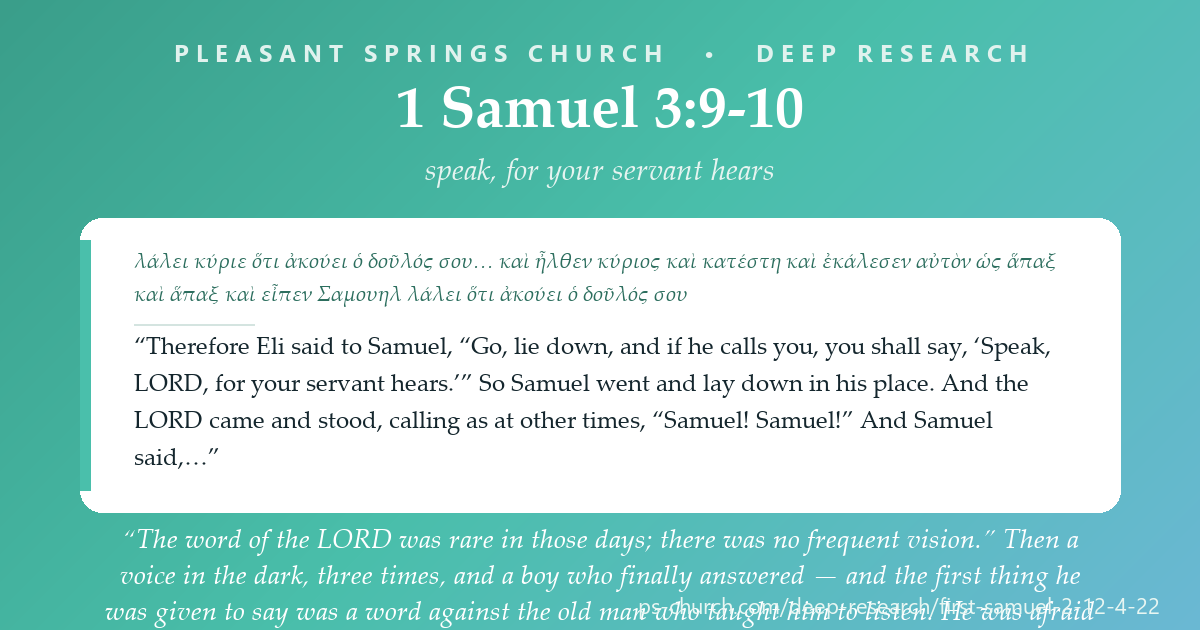
Judges ended with “everyone did what was right in his own eyes.” Ruth showed you three people keeping covenant in that same generation. Now the camera turns to the one institution that was supposed to be holding the line — and finds the sons of the high priest described in six words the previous book used of the generation after Joshua: “they did not know the Lord” (2:12). They come with a three-pronged fork and take whatever it hooks; they demand the meat before the fat is burned, which is the one portion no human being may touch; and when a worshipper objects they say, “I will take it by force.” The verdict is blunt: “the men treated the offering of the Lord with contempt.” Eli rebukes them so feebly that a man of God has to finish the sentence for him — “those who honor me I will honor, and those who despise me shall be lightly esteemed” (2:30). Then the hinge of the whole passage, and it is a description rather than an accusation: “the word of the Lord was rare in those days; there was no frequent vision” (3:1). In that silence: a lamp not yet gone out, a voice three times, an old blind man who finally works out what is happening, and a boy who says “Speak, for your servant hears.” What he is given to say is a word against the man who taught him to listen — and he lies there until morning afraid to say it, and then says all of it. Then chapter 4: the ark fetched from Shiloh and carried into battle as a talisman, the rout, both of Eli’s sons dead in one day exactly as promised, Eli falling backward at the gate, and a dying woman naming her son — Ichabod. The glory has departed from Israel. This study works 1 Samuel 2:12–4:22 line by line in Hebrew, Septuagint and ESV, and this is the book where those two part company more than anywhere else in the Bible, so every difference between the columns is reported rather than smoothed. See the method →
1 Samuel 2:12–4:22 (selections)
Hebrew · LXX (Rahlfs) · ESVText, edition and numbering — and every difference between the columns, set out in full. This is the book in which the Hebrew and the Greek part company more than in any book this library has done, and we print both and tell you where they differ rather than quietly choosing one. First, the name: in a Greek Bible this book is not called 1 Samuel. It is 1 Kingdoms (Βασιλειῶν Αʹ), the first of four books of Kingdoms, and a reader hunting for “Samuel” in the Septuagint will not find it. Numbering: in these three chapters there is no offset at all. The Greek has 36, 21 and 22 verses in chapters 2, 3 and 4, exactly as the Hebrew does; this was counted rather than assumed, and nothing above needed a double reference. (That is not true everywhere in this book, and later pages in this set will say so where it matters.) Edition: the Greek column is Rahlfs’s Septuaginta, reconstructed verse by verse from the morphologically analysed Rahlfs text rather than back-translated, and then checked at every reading printed above against Swete’s edition of Codex Vaticanus. In this passage the two agree at every point printed here — including the big ones — and the only place they part in these chapters is 4:19, where Rahlfs has ὤκλασεν (“she crouched”) and Swete ἔκλαυσεν (“she wept”). Where a difference below is a plus or a minus it is named as one; a missing clause is not a “rendering difference.”
The minuses (in the Greek, against the Hebrew). 2:22 — the clause “and how they lay with the women who were serving at the entrance to the tent of meeting” is simply not there; the Greek verse ends at “to the sons of Israel.” 2:29 — no equivalent of the difficult מָעוֹן. 2:31 — no “so that there will not be an old man in your house” (the Greek carries that clause only once, at 2:32). 2:32 — the entire first half of the Hebrew verse (“then in distress you will look… on all the prosperity that shall be bestowed on Israel”) is absent, and what remains reads “in my house,” not “in your house.” 4:1a — “and the word of Samuel came to all Israel” is not in the Greek at all. 4:4 — neither “covenant” nor “of hosts”: just “the ark of the Lord who sits upon the cherubim.” 4:21 — the explanation “saying, The glory has departed from Israel” is absent.
The pluses (in the Greek, beyond the Hebrew). 3:21 — the largest one on this page: after “the Lord revealed himself to Samuel at Shiloh” the Greek runs straight on, “καὶ ἐπιστεύθη Σαμουηλ προφήτης γενέσθαι τῷ κυρίῳ εἰς πάντα Ισραηλ ἀπ’ ἄκρων τῆς γῆς καὶ ἕως ἄκρων· καὶ Ηλι πρεσβύτης σφόδρα, καὶ οἱ υἱοὶ αὐτοῦ πορευόμενοι ἐπορεύοντο καὶ πονηρὰ ἡ ὁδὸς αὐτῶν ἐνώπιον κυρίου” — “and Samuel was confirmed as a prophet to the Lord for all Israel from one end of the earth to the other; and Eli was very old, and his sons kept going on, and their way was evil before the Lord.” Two whole sentences the Hebrew does not have, one of which relocates material the Hebrew put back at 2:22. 4:1 — the Greek chapter opens instead with “καὶ ἐγενήθη ἐν ταῖς ἡμέραις ἐκείναις καὶ συναθροίζονται ἀλλόφυλοι εἰς πόλεμον ἐπὶ Ισραηλ,” “and it happened in those days that the foreigners gathered for war against Israel.” So the Hebrew and the Greek do not divide chapters 3 and 4 in the same place — that is a seam, not a scribal slip, and it is the sort of thing worth showing a congregation. 2:24 — a whole added clause, “do not do so, for the reports I hear are not good, so that the people do not serve God.” 3:4 — the name is doubled at the first call (“Samuel, Samuel”), where the Hebrew doubles it only at 3:10. 3:6 — “the second time.” 3:9 — “child.” 3:13 — “and not even so.” 3:15 — “and he rose early in the morning.” 3:17 — “in your ears.” 4:7 — the Philistines add a prayer: “deliver us, O Lord, today.” 4:15 — a whole sentence, “and Eli said to the men standing round him, What is the sound of this noise?”
Different readings of the same place. 2:11 — the Hebrew has Elkanah going home to Ramah; the Greek has “and they left him there before the Lord and went away to Armathaim.” 2:14 — the Hebrew names four cooking vessels, the Greek three. 2:20 — the Hebrew blesses Elkanah “in place of the petition she asked of the Lord”; the Greek reads “in place of the loan you lent to the Lord” (ἀντὶ τοῦ χρέους οὗ ἔχρησας). 2:23 — “your evil dealings” becomes “from the mouth of all the people of the Lord.” 2:25 — “God will mediate” becomes “they shall pray… to the Lord.” 2:27 — a Hebrew question becomes a Greek statement, and the Greek adds that they were slaves in Egypt. 2:31 — “I will cut off your arm” becomes “I will destroy your seed.” 2:33 — the Hebrew has “your eyes… your heart” and ends “shall die as men”; the Greek has “his eyes… his heart” and “shall fall by the sword of men” — and the ESV prints the Greek at both points and footnotes the Hebrew, which is worth seeing with your own eyes. 3:1 — rare against precious (see the line above). 3:3 — “had not yet gone out” against “before it was tended.” 3:13 — “blaspheming for themselves” against “blaspheming God,” and again the ESV prints the Greek. 4:13 — the Hebrew has a ketiv/qere and reads “beside the road”; the Greek reads “beside the gate.” 4:15 — Eli is ninety-eight in the Hebrew and ninety in the Greek. 4:17 — “the messenger” becomes “the young man.” 4:18 — forty years against twenty, and “neck” against “back.” 4:22 — “she said” against “they said,” and “departed” against “carried off into exile.”
From the Judean Desert. 4QSama (4Q51), copied in the first century BC, is the fullest Samuel manuscript from Qumran and is the standard exhibit for this book, because it repeatedly agrees with the Greek against the Masoretic Text and so shows that many Greek divergences rest on a real Hebrew text rather than on a translator’s licence. In our chapters the scroll is reported to preserve 2:16–36, 3:1–4 and 3:18–21, and in chapter 4 only 4:3–4, 9–10, 12. Two readings matter here and both are widely reported: at 2:22 the scroll, like the Greek, does not have the clause about the women; and at 2:33 it supports the “sword” reading the ESV prints. We have not handled the plates. The transcriptions are in DJD XVII (Cross, Parry, Saley and Ulrich) and in Ulrich’s The Biblical Qumran Scrolls, and that, not a summary and not this page, is where a reader who wants certainty should check them.
The Shape of the Passage
Parallel panelsBehind these chapters stand the tabernacle laws that the sons are breaking (Leviticus 3, Leviticus 7, Numbers 18), the sanctuary at Shiloh where Joshua set up the tent of meeting, and the whole book of Judges — including a private shrine with a bought priest (Judges 17–18) and “worthless fellows” at Gibeah (Judges 19:22). In front of them stand a captured ark, a request for a king, and a house at Bethlehem.
Author
A narrator who reports and refuses to editorialise, and who tells you what he thinks by cutting. He never writes “meanwhile,” and he never writes “unlike Eli’s sons.” He simply sets a paragraph about priests stealing fat beside one sentence about a boy in a linen ephod, and then does it again, and again. By 2:26 you have been told three times that Samuel is growing and three times that the house of Eli is rotting, and the writer has not once told you what to conclude.
He works by key words, and he expects you to count. Hear twelve times; know five (2:12; 3:7, 13, 20; 4:6); faithful (neʾămān) three (2:35 twice, 3:20). And under all of it the pair the section turns on, kāḇēḏ and qālal — weight and lightness, honour and contempt — which is why the last word of chapter 4 is a name. This is Leitwort technique, Buber and Rosenzweig’s name for a key word threaded deliberately through a narrative; Robert Alter’s rule holds here exactly — name the repeated word and you have the theme.
He is also unsentimental about his hero. Samuel is not brave in chapter 3. He is asleep, he is confused, he needs an old man to tell him what is happening, and when the word finally comes he is afraid to repeat it and lies there until morning. The writer had every opportunity to make him magnificent and declined. That reticence — the withheld verdict, the withheld motive — is the same technique that runs through Judges, and it is why these chapters can be preached without being tidied.
Audience
People who already knew Shiloh was gone. This story is being told to Israelites for whom the ruin of the Shiloh sanctuary was a settled national memory — Psalm 78:60–64 sings about it (“he forsook his dwelling at Shiloh… and delivered his power to captivity, his glory to the hand of the foe”) and Jeremiah 7:12–14 uses it as a threat against the temple itself: “go now to my place that was in Shiloh… and see what I did to it.” So chapter 4 is not a surprise ending for its first audience. It is the explanation of a hole in the ground they had all seen.
People who knew how the priesthood story finished. “I will raise up for myself a faithful priest” (2:35) and the picture in 2:36 of Eli’s survivors begging for a place at somebody else’s altar land on readers who knew that Abiathar was eventually expelled from Jerusalem “thus fulfilling the word of the Lord which he had spoken concerning the house of Eli in Shiloh” (1 Kings 2:27). The oracle of 2:27–36 is written for people who could already check it.
And people who were tempted to do exactly what the elders do in 4:3. An audience that owned a temple, a ritual and a set of holy objects needed this chapter more than most. The elders ask the right question — “why has the Lord defeated us?” — and then answer it themselves without repenting of anything and without consulting the prophet they had just recognised. The ark goes out; the ark is captured; and the God of Israel is not captured at all, as the next chapters will make embarrassingly clear.
Orient on Eli and the Shiloh priesthood, the offerings and the priest’s portions, prophecy and the word of the Lord, the ark, and the Philistines.
Search by topic: Eli; Hophni and Phinehas; Shiloh; Samuel; Zadok and Abiathar; priesthood (OT); Belial; peace offering and the fat; priests’ dues; ephod; tent of meeting; ark of the covenant; glory (kabod); prophecy and the prophet; Philistines; Sea Peoples; Ebenezer; Aphek.
Which articles are relevant?
- Anchor Bible Dictionary — “Samuel, Books of,” “Samuel (person),” “Eli,” “Hophni,” “Phinehas,” “Shiloh,” “Ark of the Covenant,” “Belial,” “Ephod,” “Priests and Levites,” “Glory (OT),” “Philistines,” “Sea Peoples,” “Ebenezer,” “Aphek.”
- Dictionary of the OT: Historical Books (IVP) — “Samuel, Books of,” “Ark of the Covenant,” “Priests and Levites,” “Prophets and Prophecy,” “Philistines,” “Shiloh,” “Word of God.”
- NIDOTTE / TDOT — כָּבֵד (kāḇēḏ, be heavy / honour / glory), קָלַל (qālal, be light, slight, curse), שָׁמַע (šāmaʿ, hear, obey), יָקָר (yāqār, rare / precious), נָאַץ (nāʾaṣ, treat with contempt), בְּלִיַּעַל (băliyyaʿal), אָמַן (ʾāman, be faithful, established), צָבָא (ṣāḇāʾ, muster, serve — and “hosts”).
- On the Greek — Bernard A. Taylor, “1 Reigns: To the Reader,” in A New English Translation of the Septuagint, on the character of Greek 1 Kingdoms and on the fact that its Hebrew parent text was frequently not the Masoretic one. This is the short piece to read before reading anyone’s argument about 1 Samuel 17.
Bibliography surfaced:
- P. Kyle McCarter Jr., I Samuel (Anchor Bible) — the standard text-critical commentary on this book, and the place to go for the Greek and Qumran evidence verse by verse; Ralph W. Klein, 1 Samuel (WBC); David Toshio Tsumura, The First Book of Samuel (NICOT), which argues a much more conservative line on the Masoretic Text and is worth reading precisely as a counterweight to McCarter.
- Robert Alter, The David Story (translation and commentary) and The Art of Biblical Narrative; Robert D. Bergen, 1, 2 Samuel (NAC); Bill T. Arnold, 1 & 2 Samuel (NIVAC); V. Philips Long, 1 & 2 Samuel (TOTC); Walter Brueggemann, First and Second Samuel (Interpretation). (Several of these read the narratives as literature and do not share the church’s confession; we take the tools, not the metaphysics.)
Priests’ portions and how they were stolen, a portable god carried into danger, the Philistines in Egyptian records — and what the ancient retellings could not leave alone.
First the world: what a priest was actually owed, what it meant to carry a divine presence out of its shrine, and who the Philistines were in the records of the people who fought them. Then watch Josephus and the rabbis handle chapter 2 — because what they add, and what they refuse to add, tells you which silences they could not bear.
Which parallels shed light on the world of these chapters?
The theft is specific, and the law it breaks is specific. A peace offering was shared: God’s portion was the fat and the kidneys, burned first (Leviticus 3:3–5, 16–17); the priest’s portion was the breast and the right thigh, and it came to him afterwards and by grant, not by grab (Leviticus 7:28–36; Numbers 18:8–19). What the sons do is not greed at the edges. They send a servant with a fork before the burning and take whatever it hooks — which means the portion they are eating is God’s. That is why 2:17 does not say they were rude to worshippers; it says they “treated the offering of the Lord with contempt.”
Carrying a god into danger was a recognisable thing to do, and it was recognisably risky. The Egyptian tale of Wen-Amon (about 1100 BC, and so almost exactly contemporary with these chapters) turns on an envoy travelling the Levantine coast with a portable image called “Amon-of-the-Road,” and on the prince of Byblos being told that this time the Egyptian has brought “an actual god” with him. Divine images went on campaign all over the ancient Near East, were captured, and were carried off — and their capture was read as their god’s defeat. 1 Samuel 4 lets Israel behave exactly like everybody else, and then spends chapters 5–6 dismantling the assumption. The elders’ sentence in 4:3 is worth reading slowly: the subject of “come among us and save us” is the ark.
The Philistines are not a Bible invention. They appear in Egyptian records as the Peleset, one of a group of peoples who came at Egypt by sea and land in the early twelfth century BC. Ramesses III’s summary of his northern wars names them in a list: “I slew the Denyen in their islands, while the Tjeker and the Philistines were made ashes. The Sherden and the Weshesh of the Sea were made nonexistent” (ANET 262). They settled the southern coastal plain, and Aphek — where they camp in 4:1 — sits at the head of the pass where the coastal road meets the hill country. This is a border war over the edge of the highlands, fought by people whose iron-age towns archaeologists can walk through.
- Ramesses III on the Sea Peoples, from the Papyrus Harris (ANET 262) — a royal Egyptian summary naming the Peleset (Philistines) among the peoples defeated and settled “in strongholds” (a royal inscription — a witness, not Scripture). Verified in the copy of Pritchard held locally.
- The Journey of Wen-Amon to Phoenicia (ANET 25–29) — an Egyptian narrative of about 1100 BC; the traveller carries the portable image “Amon-of-the-Road,” and the Tjeker, described in Pritchard’s own note as “one of the Sea Peoples associated with the Philistines,” hold the coast at Dor. The nearest thing we have to a contemporary photograph of the world of 1 Samuel 4 (a witness, not Scripture).
- Josephus, Antiquities 5.338–362 (Second-Temple — a witness, not Scripture) — and he is more interesting here than usual, because he does not follow the Greek at the points where it matters. He keeps the accusation the Septuagint lacks, reporting that the sons were “guilty of impurity with the women that came to worship God at the tabernacle” (5.339). He tells us Samuel “was twelve years old” when he began to prophesy and that God called him “thrice” (5.348) — both additions. And at Eli’s death (5.359) he gives the Hebrew numbers, not the Greek ones: Eli died “having in all lived ninety-eight years, and of them retained the government forty.” So the easy generalisation — Josephus follows a Greek text — will not survive contact with this chapter, and that is exactly why he is worth checking rather than quoting from memory.
- Sirach 46:13–20 (Second-Temple, and non-canonical for this church — a witness, not Scripture) — Ben Sira’s praise of Samuel, and it reaches for the very word chapter 3 ends on: “By his faithfulness he was proved to be a prophet, and by his words he became known as a trustworthy seer” (46:15). Read beside 3:19–20 it shows how early “Samuel was established as a prophet” had become the standard summary of his life.
- b. Shabbat 55b (rabbinic-era — a witness, not Scripture) — a sustained argument that the sins of 2:22 should not be taken at face value — “anyone who says that the sons of Eli sinned is nothing other than mistaken.” The reasoning is that they delayed the bird-offerings of women who had given birth, so that the women could not return to their husbands in time, “and the verse ascribes to Hophni and Pinehas liability as if they had lain with them.” Whatever one makes of the exegesis, it is a very old attempt to soften a verse that the Greek and the Qumran scroll simply do not have.
- The tiqqunē sōpərîm (rabbinic-era lists — witnesses, not Scripture) — the traditional lists of the scribes’ reverent adjustments name 1 Samuel 3:13: the received Hebrew’s “blaspheming for themselves” is explained as standing where the text once read “God” — which is what the Septuagint has, and what the ESV prints. The tradition preserved the memory of its own editing, which is a remarkable thing for a tradition to do.
Three silences in these chapters, and every ancient reader reached for at least one of them.
(1) Whether Eli was a bad man or only a weak one. The Bible says he rebuked his sons, that they would not listen, that he “did not restrain them,” and that when the sentence came he said “It is the Lord. Let him do what seems good to him.” It never calls him wicked. Josephus makes him grieving and largely helpless; the later tradition makes him culpable; sermons routinely make him a warning about parenting. The narrator writes both his failure and his submission and does not rank them.
(2) What actually happened at the entrance to the tent of meeting. The Hebrew says the sons “lay with the women who were serving” there. The Greek does not have the clause; the Qumran scroll is reported not to have it; Josephus does; the Talmud argues it down to a delay in offerings. This page prints the Hebrew, because that is what the ESV prints, and tells you plainly that the two oldest witnesses to the verse do not have it. Two further things are worth saying and then stopping. The word for those women is הַצֹּבְאוֹת (haṣṣōḇăʾōṯ), from the root for mustering — the same root as “the Lord of hosts” three verses into chapter 4 — and the only other place in Scripture it describes women at that door is Exodus 38:8, where they give up their bronze mirrors for the laver. They are not described as prostitutes anywhere in the Bible, and the long interpretive habit of assuming they were is an addition to the text. The sin in this verse belongs to the sons.
(3) Why God “desired” to put them to death. 2:25 sets a human refusal and a divine will in one sentence and offers no bridge. Every generation has built one. See Stage 5, where this page declines to.
Weight and lightness, hearing and not hearing, a word that means both rare and precious.
Count shama yourself — twelve, and the name Samuel is not one of them. Then hold kaved against qalal from 2:29 to 4:22 and watch the section land on a name; and let yaqar in 3:1 keep both its meanings, because the Hebrew and the Greek each kept one.
One root, and the whole section hangs on it. The verb means to be heavy; the noun means weight, and therefore honour, and therefore glory. Eli “made his sons heavy” above God (2:29). God answers: “those who make me heavy I will make heavy” (2:30). The old man was heavy and the chair could not hold him (4:18). And a woman dying in childbirth names her son ʾî-kāḇōḏ — the weight is gone (4:21–22). The Greek cannot keep this and does not try: δοξάζω for the honouring, βαρύς for the heavy man, δόξα for the glory — three words where the Hebrew has one, and this page says so rather than arguing from a Hebrew pun over the top of its own Greek column.
The exact opposite: to be light, hence to slight, hence to curse. Twice, and both times it is aimed at God. “Those who despise me shall be made light” (2:30, yēqāllû), and the sons were making light of God (3:13, măqalălîm — the verse where the Hebrew reads “for themselves” and the Greek and the ESV read “God”). Contempt in Hebrew is not hatred; it is treating something as weightless. Which is precisely what a man does who takes the fat off the altar with a fork.
“Hear” — and in Hebrew, when a person is the object, obey. Twelve occurrences, and they sort themselves into a judgement. Eli hears everything his sons do (2:22) and produces a question. The sons “would not hear the voice of their father” (2:25). Then a boy: “your servant hears” (3:9, 10), and “the two ears of everyone who hears it will tingle” (3:11). Then the Philistines hear the shouting (4:6), the old man hears the outcry (4:14), and a woman hears the report and goes into labour (4:19). Every character in these chapters hears something. Exactly one of them answers.
The word the page turns on, and it is a single Hebrew word with two English faces: rare and precious. They are the same fact. A thing is costly because there is little of it. The ESV chooses “rare” and the Septuagint chose τίμιον, “precious” — and the second half of the verse settles the sense without settling the translation: אֵין חָזוֹן נִפְרָץ, “there was no vision breaking through” (niprāṣ, from the verb for bursting out or spreading widely). Set the two columns side by side and the verse says both things at once: God had gone quiet, and every word he did give was worth the earth.
“Treat with contempt, spurn.” The narrator’s own verdict, and it is a heavy word: it is what Israel does to God in the wilderness (Numbers 14:11, 23) and what David’s sin gives the enemies of the Lord occasion to do (2 Samuel 12:14). Note carefully what it is aimed at — not the worshippers, and not even the priesthood, but the offering of the Lord. The Greek chooses ἠθέτουν, “they were setting aside / nullifying,” which is a legal word rather than an emotional one: they treated the sacrifice as void.
“Worthlessness” — etymology genuinely uncertain, often explained as bălî + yaʿal, “without profit,” and the honest lexicons hedge. What can be said is the company the phrase keeps: “worthless fellows” who draw a city into idolatry (Deuteronomy 13:13), the men of Gibeah (Judges 19:22), and — two chapters before this — what Hannah insists she is not (1 Samuel 1:16). By the Second Temple period the word has become a name for the great adversary, which is how Paul can use it of a person (2 Corinthians 6:15). Here the Greek does not treat it as a name at all: υἱοὶ λοιμοί, “pestilent sons.”
“Faithful, reliable, established” — the passive of ʾāman, the root behind amen. Three occurrences and they are a single argument. God will raise up a faithful priest and build him a sure house (2:35); and then, without comment, all Israel from Dan to Beersheba knows that Samuel is established as a prophet (3:20). The word for the promised priest lands on the boy who is not a priest. The Greek keeps the thread with πιστός in all three places, which is worth noting because it does not always keep them.
One root, two very different sights, three chapters apart. In 2:22 it is a participle describing the women who were ‘serving’ at the entrance to the tent of meeting — the same word and the same doorway as Exodus 38:8, and the only two places in Scripture where it is used of women. Its basic sense is to muster, to serve in a company. In 4:4 the same root is the divine title Israel carries into battle: “the ark of the covenant of the Lord of hosts (ṣăḇāʾōṯ), who is enthroned on the cherubim.” They mustered the God of musters, and lost thirty thousand men. And the Greek of 4:4 has neither the title nor the word “covenant” — simply “the ark of the Lord who sits upon the cherubim.”
Three places in the Hebrew of these chapters reported rather than tidied:
- The ketiv and qere at 2:16. The consonants written are לו (“to him”); the Masoretic reading tradition is לֹא (“no”). The difference is between “and he said to him, you must give it now” and “and he said, No — you must give it now.” The Greek οὐχί agrees with the reading tradition, and so does the ESV. A second ketiv/qere stands at 4:13 (written יך, read יַד), where the Greek reads “gate” rather than “road” — and the gate is where Eli falls five verses later.
- 2:29 is hard, and the translations are covering for it. The verse contains מָעוֹן (“dwelling”) in a construction that will not parse comfortably; the ESV supplies “for my dwelling,” other versions emend, and the Septuagint has nothing corresponding to the word at all, reading instead “why did you look on my incense and my sacrifice with a shameless eye?” The ESV also footnotes its own softening of the first verb: Hebrew kick at. That is the verb of Deuteronomy 32:15 — “Jeshurun grew fat, and kicked” — and the Song of Moses is very likely being quoted at a priest who has grown fat on the offerings.
- 2:31–33 is where the Hebrew of Samuel is visibly in poor repair. The Hebrew’s “I will cut off your arm” is the Greek’s “I will destroy your seed”; the Hebrew’s whole clause about looking in distress on Israel’s prosperity is missing from the Greek; the Hebrew’s “your eyes… your heart” is the Greek’s “his… his”; and the Hebrew’s “shall die as men” is the Greek’s “shall fall by the sword of men.” The ESV follows the Greek at the last two, and prints footnotes saying so. This is not a scandal and it is not a secret: it is what an honest modern translation looks like when the received Hebrew of a verse is damaged and an older witness is available. Our policy on exactly this is published.
The book behind it, the laws being broken, the other calls in the dark, the priesthood that replaces this one, and Shiloh remembered.
Trace five threads: Judges, quoted in the first sentence about Eli’s sons; the sacrificial law, which tells you exactly what the fork was stealing; the call type-scene, from Abraham to Moses to Isaiah; the oracle of 2:27–36 and where it is finally discharged; and Shiloh, which the rest of the Bible remembers as a ruin.
Which cross-references matter?
- Judges 2:10 and Judges 19–21 — the sentence “they did not know the Lord” is Judges’ diagnosis of the generation after Joshua, and here it is applied to the sons of the high priest. “Worthless fellows” (bănê băliyyaʿal) is what the men of Gibeah were. The narrator never draws the line. He just re-uses the words, and anyone who has read the previous book hears it.
- Judges 17–18 — the nearest thing in Scripture to a companion piece: a private shrine, a homemade ephod, a Levite hired at ten shekels a year, and a priesthood used as an appliance. Judges shows you a corrupt priesthood in a village; 1 Samuel 2 shows you the same disease at the national sanctuary.
- Leviticus 3:16–17; Leviticus 7:28–36; Numbers 18:8–19 — read these and 2:13–16 stops being a story about rude clergy. “All fat is the Lord’s”; the priest’s share is the breast and the right thigh, given after the burning. The fork takes God’s portion first and takes it by force.
- Exodus 27:20–21; Leviticus 24:2–3; Exodus 38:8 — the lamp that burns from evening until morning (so 3:3 is telling you the hour), and the women who “served” at the entrance to the tent of meeting, whose bronze mirrors became the laver. Both details in chapter 3 and chapter 2 assume a reader who knows the tabernacle furniture.
- Genesis 22:1, 11; Exodus 3:4; Genesis 46:2 — “Abraham, Abraham… hinnēnî, here I am”; “Moses, Moses… here I am”; “Jacob, Jacob… here I am.” The doubled name and the one-word answer are a recognised shape, and 3:10 is unmistakably in it. And the deviation is the point: in every earlier case the man knows who is calling. Samuel does not, three times, and the narrator says why — “Samuel did not yet know the Lord” (3:7).
- Deuteronomy 18:15–19 and Deuteronomy 18:21–22 — the prophet like Moses, and the test by which a prophet is known: does the word come to pass? Then read 3:19: “the Lord was with him and let none of his words fall to the ground.” That is the Deuteronomic test, passed, and it is why 3:20 can say Israel knew.
- The oracle of 2:27–36 and where it is discharged. The sign given in 2:34 — both sons dead in one day — falls in 4:11; the slaughter of the priests of Nob at Saul’s order in 1 Samuel 22:18–19 takes the house of Eli further down; and it ends when Solomon expels Abiathar, “thus fulfilling the word of the Lord which he had spoken concerning the house of Eli in Shiloh” (1 Kings 2:27), with Zadok put in his place (1 Kings 2:35). The “sure house” language of 2:35 will be picked up and given to a king in 2 Samuel 7.
- Shiloh, afterwards. The Bible never narrates the destruction of Shiloh — but it remembers it. Psalm 78:60–64: “he forsook his dwelling at Shiloh, the tent where he dwelt among mankind, and delivered his power to captivity, his glory to the hand of the foe… their priests fell by the sword.” And Jeremiah 7:12–14 turns it into the sharpest sermon illustration in the Old Testament: “go now to my place that was in Shiloh… and see what I did to it because of the evil of my people Israel… therefore I will do to the house that is called by my name… as I did to Shiloh.” A building is not a guarantee. That is the point of chapter 4, and Jeremiah preaches it four hundred years later to people standing in the temple.
- Judges 13 and Ruth 1 — the neighbours. Judges 13:1 has Israel in the hand of the Philistines forty years, which is the political weather of 1 Samuel 4; and Ruth is set in these same years and is about people who kept faith in them. Three books, one generation, three completely different pictures — and all three are true at once.
- Forward, into the rest of the book. The ark is not finished: 1 Samuel 5–7 is the answer to chapter 4, and it is not the answer anyone in chapter 4 was expecting. And when Israel finally says “give us a king” (1 Samuel 8), it is this Samuel they say it to, and one of the reasons they give is that his own sons did not walk in his ways (8:3–5). The book is quite deliberate about that echo, and it is worth having in view before anyone preaches chapter 2 as a sermon about other people’s children.
2:25 is one sentence with two halves that most of us would prefer in separate paragraphs. They would not listen to the voice of their father — that is a refusal, and the narrator has spent thirteen verses showing you what they refused. For it was the will of the Lord to put them to death — and the Greek is, if anything, blunter: “the Lord willed to destroy them.”
The text does not join the halves for you, and this page will not either. It is the same shape as the hardening of Pharaoh’s heart in Exodus 7–14, where the Hebrew is equally careful to say both that Pharaoh hardened his own heart and that God hardened it, and equally careless of our need for a diagram. This house holds both truths without collapsing either: real human refusal, really culpable, and a sovereign God whose purposes are not hostage to it. Where Scripture supplies a mechanism, we may teach the mechanism. Here it supplies none, and we stop.
Two disciplines follow. First, do not use this verse to describe anyone alive. It is a narrator’s statement, after the fact, about two named men whose case was closed; it is not a lens for sorting your neighbours, and the New Testament’s posture toward the living is the one in 2 Peter 3:9 — God is “not wishing that any should perish.” Second, do not soften it either. A God who can be leaned on to overlook contempt at his own altar is not the God of this chapter, and a church that quietly assumes he is has made itself very hard to warn.
The commentaries, the text of Samuel, the shape of the ark narrative, and the questions this page leaves open.
McCarter, Klein, Tsumura, Alter, Bergen, Arnold, Long and Brueggemann on the book; Tov and Ulrich on the text. Then the live questions: how much of the Greek reflects a different Hebrew, whether there was ever a separate “ark narrative,” what happened at Shiloh, and 2:25.
Commentaries & studies:
- P. Kyle McCarter Jr., I Samuel (Anchor Bible) — the standard text-critical treatment; he adopts Greek and Qumran readings often, and he shows his working, which is what makes him usable even where one disagrees. Ralph W. Klein, 1 Samuel (WBC) — similar ground, more compact, excellent on the oracle of 2:27–36.
- David Toshio Tsumura, The First Book of Samuel (NICOT) — the sustained argument on the other side: that the Masoretic Text of Samuel is in far better condition than the text-critical consensus allows and that many alleged corruptions are unrecognised Hebrew idiom. Read him against McCarter deliberately. The disagreement is real, it is between serious people, and this page does not settle it.
- Robert Alter, The David Story; Robert D. Bergen, 1, 2 Samuel (NAC); Bill T. Arnold, 1 & 2 Samuel (NIVAC); V. Philips Long, 1 & 2 Samuel (TOTC); Walter Brueggemann, First and Second Samuel (Interpretation).
- Emanuel Tov, Textual Criticism of the Hebrew Bible — the standard handbook, and the place to understand what a tiqqun sōpərîm is and how much weight the lists will bear. Eugene Ulrich, The Qumran Text of Samuel and Josephus — the monograph that put the three-way comparison (Masoretic Text, Septuagint, 4QSama) on its present footing, and the reason Josephus is treated on this page as evidence rather than decoration. Frank Moore Cross, Donald Parry, Richard Saley and Eugene Ulrich, Qumran Cave 4: XII, 1–2 Samuel (DJD XVII) — the edition itself.
- Bernard A. Taylor, “1 Reigns: To the Reader,” in NETS — four pages on Greek 1 Kingdoms, its name, its character, and the sections where its parent Hebrew text clearly differed.
Interpretation notes worth keeping:
- How much of the Greek of Samuel reflects a different Hebrew? That question is live, and it is the most important one in the book. The evidence that at least some of it does is not speculative: 4QSama is a Hebrew manuscript that repeatedly agrees with the Greek against the Masoretic Text, which means a translator’s freedom cannot be the whole explanation. But it does not follow that every Greek divergence had a Hebrew parent, and Tsumura in particular argues that a good many did not. The honest position, and the one this page takes, is that the answer is reading by reading and that no slogan — in either direction — will do the work. What we can do, and do above, is print both columns and name every difference.
- Was there once a separate “Ark Narrative”? Since Rost’s study in 1926 many scholars have treated 1 Samuel 4:1b–7:1 (with 2 Samuel 6) as a once-independent composition about the ark, on the grounds that Samuel disappears from it entirely and the ark becomes the acting subject. Others deny it, pointing out that the whole point of chapters 4–6 depends on the oracle in chapter 2 and that the “independence” is a modern reconstruction. We name the debate and do not adjudicate it. What is worth noticing whatever one concludes is the literary fact behind it: for three chapters the prophet is offstage and the ark is the protagonist, which is exactly the mistake Israel makes in 4:3 — and exactly the mistake chapters 5–6 undo.
- Shiloh and the spade. The site (Khirbet Seilun) has been excavated repeatedly, most fully by the Danish expeditions and then by Israel Finkelstein’s team, whose report (Shiloh: The Archaeology of a Biblical Site, 1993) describes a substantial Iron Age I settlement ending in destruction. Dating that destruction, and connecting it to this battle, is contested — excavation dates in this period are argued about fiercely, and no inscription says “Philistines were here.” So: the Bible never narrates Shiloh’s destruction; Psalm 78 and Jeremiah 7 assume it; and there is a burnt layer of roughly the right period at the right place. That is what can be said. Anyone who tells you more than that is selling something.
- Eli’s age and years, and what to do with a number that differs. The Hebrew has Eli ninety-eight and judging Israel forty years; the Greek has ninety and twenty; Josephus has ninety-eight and forty. There is no way to have all three, and no doctrine rides on the outcome. The reason to print the difference rather than bury it is that a reader who later discovers it on their own should not have to wonder what else was left out. That is this library’s standing policy and it is published.
- On 2:22 the discipline is to say less than either side wants. One tradition treats the women as cult prostitutes; another treats the clause as a late addition because the Greek and the scroll lack it; a third argues it down to a technicality. The text as the ESV prints it says the sons lay with women who were serving at the door. It does not say the women consented, and it does not say they were prostitutes; the only other biblical use of that participle is of the women who gave their mirrors for the laver. A study that turns those women into the sin has misread the sentence.
- “A faithful priest” (2:35) — where it lands and where it does not. Within the Old Testament’s own narrative the promise is discharged on Zadok (1 Kings 2:27, 35), and that is the reading the text itself supplies. Christian readers have long heard Christ in it, and the New Testament does describe him as “a merciful and faithful high priest” (Hebrews 2:17; cf. Hebrews 4:14–16). But the New Testament nowhere quotes 1 Samuel 2:35, and this page will not pretend it does. Any Christ-ward reading here is a labelled devotional analogy, offered as such, and the ground it stands on is the New Testament’s own priesthood argument, not a link this text makes.
- The dating and composition of Samuel are debated and nothing above depends on it. The old rabbinic attribution (b. Bava Batra 14b: “Samuel wrote his own book, the book of Judges, and the book of Ruth”) is a tradition, not a colophon — and Samuel dies in 1 Samuel 25. Positions on the book’s formation range from an early court history to a late Deuteronomistic composition. We name the positions and decline to adjudicate.
A rotting priesthood, a lamp not yet out, a voice in the dark, and a name that means the weight is gone.
Name what you learned, why it matters, and one concrete response.
What should we carry away — and do?
- The rot was inside, and it wore the right clothes. The Philistines are not the problem in these chapters. The problem is two ordained men with a fork, and a father who heard about it and said something mild. Israel’s worst hour in this book begins at the altar, not at the border.
- Contempt is a weight problem. The Hebrew does not say the sons hated God; it says they made him light. And God’s answer is in the same currency: “those who honor me I will honor.” Ask the question the words ask — not do I believe in God, but what does he weigh here, against my family, my income, my convenience. Eli’s sin is named exactly: he made his sons weigh more.
- “The word of the Lord was rare in those days.” That is a description, not an accusation, and it comes before the call, not after it. There are seasons when heaven is quiet; Scripture says so plainly and does not apologise for it. And the Greek heard the other half of the same word — when it is rare it is precious.
- The lamp had not yet gone out. Six words of setting, and the writer knew what he was doing with them. It was late, and it was not over. If you take one image out of this study, take that one.
- Samuel’s first word from God was a hard word about someone he loved, and he was afraid to say it. He said it anyway, in the morning, when he was asked, and he did not soften it. That is what the text means by a prophet — not thrilling experiences, but telling the truth to the person it will cost you the most to tell it to.
- The ark is not a lever. The elders asked exactly the right question, refused to sit with the answer, and reached for the holy object instead of repenting. Everything Israel did that day was religious. Do not confuse the presence of God with the possession of his furniture — the sacrament, the building, the heritage, the reputation. Jeremiah preached this in the temple courts and it nearly got him killed.
- And the last word belongs to a woman nobody names. She is Phinehas’s wife, she is dying, they tell her she has a son, and she does not answer or pay attention. What she does is name him truthfully: Ichabod — the glory has departed. Scripture does not correct her and does not comfort her, and it gives her the closing line of the whole section. A Bible that can hold that verse can hold your worst day.
A word about typology, clearly labelled: the “faithful priest” of 2:35 is discharged in the Old Testament’s own storyline on Zadok (1 Kings 2:35), and any hearing of Christ in it is a devotional analogy and is labelled here as one. The New Testament never quotes this verse. What it does do is call Jesus “a merciful and faithful high priest” (Hebrews 2:17) and build an entire argument on a priesthood that cannot be corrupted or inherited badly (Hebrews 4:14–16) — and that is more than enough to stand on without borrowing a link the canon does not make. Nor should Samuel be flattened into a lesson about “hearing God’s voice.” He is a boy who did not know who was speaking, needed an old failure to tell him, and was frightened of the message. The text is not about technique.
Step in response: two things this week. First, take the honour question somewhere concrete: name one place where you have quietly made something weigh more than God — and change one calendar entry or one line of a budget, not one opinion. Second, if there is a true thing you owe somebody and have been afraid to say, say it the way Samuel did: in the morning, when asked, all of it, without softening — and having lain awake about it first, because he did too.
1 Samuel 3:9–10 · to share
LXX (Rahlfs) + ESVEvery Deep Research page traces its passage across the whole sweep — the Old Testament, the Second-Temple world between the testaments (historical witnesses, not Scripture), and the New Testament. Follow the thread:
Pleasant Springs Church — Deep Research
Research method after Michael S. Heiser’s Bible Research Method (examine dictionaries → ancient literature → important words → textual connections → academic publications → share), with the Pleasant Springs “Author & Audience” foundation. Scripture set in the Hebrew, the Greek editions named on each page and the ESV (Old Testament), and the Greek New Testament and the ESV (New Testament), per the practice of Pleasant Springs Church. 1 Samuel 2:12–4:22 research grounded in McCarter (Anchor Bible), Klein (WBC), Tsumura (NICOT), Alter (The David Story), Bergen (NAC), Arnold (NIVAC), Long (TOTC) and Brueggemann (Interpretation), with Tov and Ulrich on the text and Alter for the narrative tools used in the structure block. The Greek name of this book: in the Septuagint it is 1 Kingdoms (Βασιλειῶν Αʹ), not 1 Samuel — stated once on every page of this set. Text & numbering: Hebrew from the Masoretic Text; Greek from Rahlfs’s Septuaginta, reconstructed verse by verse from the morphologically analysed Rahlfs text rather than back-translated, and checked at every printed reading against Swete’s Codex Vaticanus — which agrees with Rahlfs at every reading printed here; the only divergence between the two editions in these chapters is at 4:19 (ὤκλασεν / ἔκλαυσεν), and it is stated. English ESV (2016), with its own textual footnotes reproduced where they bear on the columns. There is no chapter- or verse-offset in 1 Samuel 2–4: the Greek has 36, 21 and 22 verses in these chapters exactly as the Hebrew does, counted rather than assumed. Hebrew/Greek divergence: this is the book with the largest Hebrew/Greek divergence in the library, and the codex note above enumerates every difference in this passage in full — minuses (2:22 the whole clause about the women; 2:29; 2:31; 2:32 the first half of the verse; 4:1a; 4:4 “covenant” and “of hosts”; 4:21 the explanation of the name), pluses (3:21, two whole sentences, which also moves the chapter seam; 4:1; 2:24; 3:4, 3:6, 3:9, 3:13, 3:15, 3:17; 4:7; 4:15) and differences of reading (2:11, 2:14, 2:20, 2:23, 2:25, 2:27, 2:31, 2:33, 3:1, 3:3, 3:13, 4:13, 4:15, 4:17, 4:18, 4:22), with pluses and minuses named as such and never described as “rendering differences.” Where the page argues from a Hebrew word — the kāḇēḏ/qālal pair, the šāmaʿ Leitwort, yāqār, ṣāḇāʾ — what the Greek column actually does with it is stated in the same breath. The ketiv/qere at 2:16 and 4:13 are printed and discussed, and the tiqqun sōpərîm tradition about 3:13 is reported as a tradition. Qumran: 4QSama (4Q51) is reported to preserve 2:16–36; 3:1–4, 18–21; and 4:3–4, 9–10, 12; its readings at 2:22 and 2:33 are reported as they are reported in the editions and commentaries, with an explicit statement that this page has not handled the plates and that DJD XVII and Ulrich’s The Biblical Qumran Scrolls are where a reader should verify them. Where the ESV itself follows the Greek — 2:33 twice and 3:13 — that is pointed out rather than passed over, with the ESV’s own footnote wording quoted. Second-Temple and rabbinic witnesses (Josephus, Ant. 5.338–362, with 5.339, 5.348 and 5.359 cited specifically; Sirach 46:13–20, tagged non-canonical; b. Shabbat 55b; b. Bava Batra 14b; the tiqqun lists) are read as witnesses and never levelled with Scripture. ANE parallels are cited only where verified in the local copy of Pritchard’s ANET: Ramesses III on the Sea Peoples (ANET 262) and the Journey of Wen-Amon (ANET 25–29). 2:25 is reported with both halves in the same breath and deliberately left unresolved, as this house handles the Exodus hardening texts. The women of 2:22 are reported as the text reports them, and the tradition that makes them the sin is named and declined. Eli is treated as the tragedy the narrator makes him, including his submission in 3:18. The “faithful priest” of 2:35 is discharged on Zadok within the Old Testament’s own storyline (1 Kings 2:27, 35); any Christ-ward reading is offered as an explicitly labelled devotional analogy, with the plain statement that the New Testament never quotes the verse. The Ark-Narrative hypothesis, the date and composition of Samuel, and the archaeology of Shiloh are reported with the positions named and not adjudicated.
Scripture quotations marked ESV are from the ESV® Bible (The Holy Bible, English Standard Version®), © 2001 by Crossway, a publishing ministry of Good News Publishers. ESV Text Edition: 2016. Used by permission. All rights reserved. The ESV text may not be quoted in any publication made available to the public by a Creative Commons license, and the ESV may not be translated in whole or in part into any other language. www.esv.org
|
Did this study bless you today? 💚 Give to Support PS Church100% of gifts go to the General Fund — thank you. |