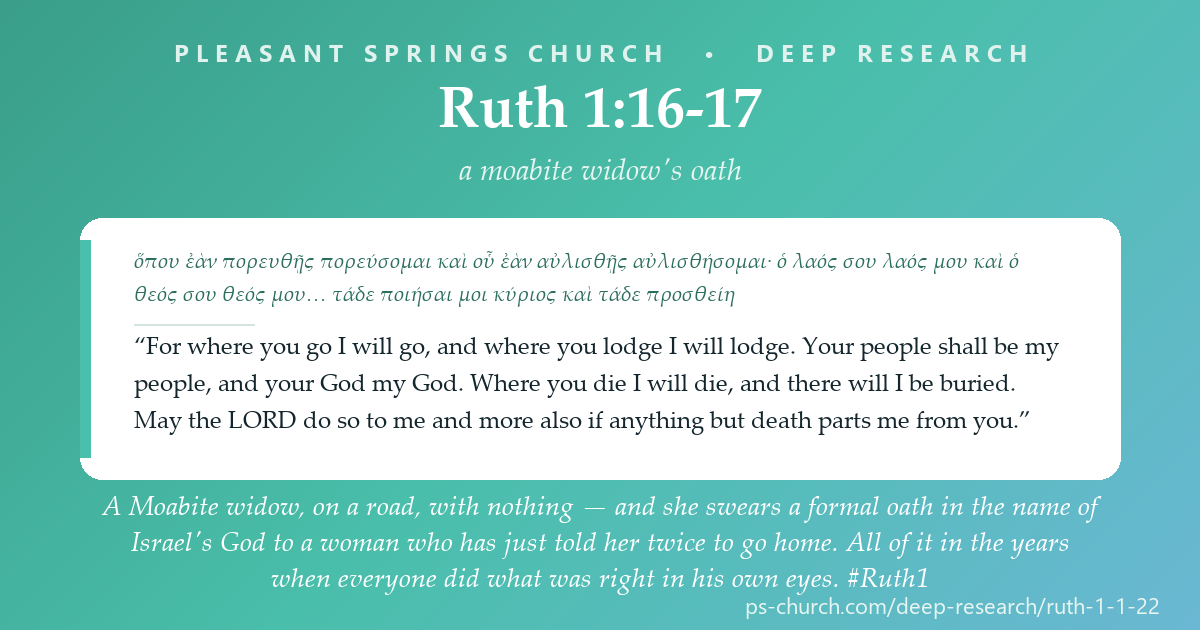
Judges ended with a nation at war with itself and the words “everyone did what was right in his own eyes.” This book opens in the same years: “In the days when the judges ruled there was a famine in the land” — and then tells the opposite kind of story. A man of Bethlehem, house of bread, leaves because there is no bread, and goes to Moab of all places. Ten years, three funerals, and by verse five every man in the family is dead. Then the road home: Naomi has heard “that the Lord had visited his people and given them food,” and she turns both daughters-in-law back with a blessing built on the word this book is about — “may the Lord deal kindly with you” (1:8). Orpah does exactly what she is twice told to do, and weeps, and goes; the narrator does not blame her for it and neither will we. Ruth does not go, and what she says is not a sentiment but a sworn oath: “For where you go I will go, and where you lodge I will lodge. Your people shall be my people, and your God my God… may the Lord do so to me and more also if anything but death parts me from you” (1:16–17). And then Bethlehem, and a homecoming this study will not soften: “Call me Mara, for the Almighty has dealt very bitterly with me. I went away full, and the Lord has brought me back empty” — and nobody corrects her. The book will answer her in chapter 4, and it makes her wait. The last six words of the chapter are the first hint of anything at all: at the beginning of barley harvest. This study works Ruth 1:1–22 line by line, in Hebrew, Septuagint and ESV, with the differences between the columns reported rather than smoothed. See the method →
Ruth 1:1–22 (selections)
Hebrew · LXX (Rahlfs) · ESVThe Shape of the Passage
InclusioBehind this chapter stands the whole book of Judges — the failures and the cycle at one end and the horrors of chapters 19–21 at the other — and behind that, the law that says a Moabite shall not enter the assembly (Deuteronomy 23:3–6) and the night that produced Moab in the first place (Genesis 19:30–38). In front of it stand a barley field, a threshing floor, a gate, and a genealogy.
Author
A miniaturist, and one of the best writers in the Bible. Eighty-five verses, four chapters, no battle, no miracle, no prophet, and God speaks exactly never. He acts twice in the narrator’s own voice — he gives bread (1:6) and he gives conception (4:13) — and everything in between is done by people. That is a deliberate choice by a writer who could have done otherwise, and it is why this book reads so differently from the one before it.
He works by repetition, and he expects you to count. Twelve times in this chapter one root: šûḇ, “turn back.” Three “turn backs” from Naomi (1:8, 11, 12), one departure, and one oath. Full and empty in 1:21 come back as “You must not go back empty-handed to your mother-in-law” in 3:17. ḥeseḏ appears three times in the book (1:8; 2:20; 3:10) and each time a human being is the one doing it. This is Leitwort technique — Buber and Rosenzweig’s name for a key word threaded through a passage — and Robert Alter’s point about it holds here: if you can name the repeated word, you have the theme.
And he is answering the book before him. Judges gives us unnamed women who are used and discarded (Judges 19), men who take what they want, and a nation with no loyalty left in it. Ruth is set in the same years and is about the opposite: a foreign widow who will not leave, a landowner who does more than the law requires, an old woman who is allowed to be bitter out loud. The narrator never says “unlike the judges.” He just tells you when it happened, in his first clause, and lets you do the comparing.
Audience
People who knew the last verse before they read the first. “Obed… the father of Jesse, the father of David” (4:17) is where this is going, and an Israelite audience knew it. Which means they read chapter 1 the way you watch a film whose ending you have been told: the Moabite widow on that road is David’s great-grandmother. Every hard thing in this chapter — the famine, the emigration, the three graves, the bitterness — is being told to people who already know it ends in a king.
People with a real legal problem. Deuteronomy says no Moabite may enter the assembly of the Lord “even to the tenth generation” (Deut 23:3). This book calls its heroine “Ruth the Moabite” five times, as if daring you to forget, and puts her in the royal line. Whatever the first audience was, it was not an audience for whom that was a non-issue. Stage 5 lays out how the tension has been read and says plainly what stays unresolved.
And people who had buried somebody. Chapter 1 gives a widow the microphone and lets her say that God did this to her, twice, without a single narrative correction. That is not an accident of composition; it is pastoral care of a kind most of us are too nervous to offer. The book will answer Naomi — in 4:14–17, in the mouths of the same women who asked “Is this Naomi?” — but it makes her wait three chapters for it, and so does this study.
Orient on Ruth and the Megilloth, Moab, famine and migration, hesed, levirate and redemption, and gleaning law.
Search by topic: Ruth (Book of); Megilloth; Shavuot / Weeks; Moab and the Moabites; Bethlehem; Ephrathah; famine; sojourner and ger; widow; hesed; levirate marriage; goel / kinsman-redeemer; gleaning; barley harvest; genealogy of David; conversion and the foreigner in Israel.
Which articles are relevant?
- Anchor Bible Dictionary — “Ruth, Book of,” “Ruth (person),” “Naomi,” “Orpah,” “Elimelech,” “Moab,” “Bethlehem,” “Ephrathah,” “Levirate Marriage,” “Redemption (OT),” “Gleaning,” “Widow,” “Famine.”
- Dictionary of the OT: Historical Books (IVP) — “Ruth, Book of,” “Hesed,” “Kinsman-Redeemer and Levirate,” “Moab, Moabites,” “Women.” And in the same series, Dictionary of the OT: Wisdom, Poetry & Writings files Ruth among the Writings, which is itself the point of the note above.
- NIDOTTE / TDOT — חֶסֶד (ḥeseḏ, covenant kindness), שׁוּב (šûḇ, return), דָּבַק (dāḇaq, cling), גָּאַל (gāʾal, redeem), מְנוּחָה (mănûḥāh, rest), שַׁדַּי (Šadday), מַר (mar, bitter), יָבָם (yāḇām, brother-in-law).
- On the Greek — Frederick W. Knobloch, “Routh: To the Reader,” in NETS. Four pages, and it is where the description of Greek Ruth in the codex note above comes from — the kaige profile, the Abimelech question, and the specific minuses at 1:1 and 1:12.
Bibliography surfaced:
- Robert L. Hubbard Jr., The Book of Ruth (NICOT); Daniel I. Block, Judges, Ruth (NAC); Frederic W. Bush, Ruth, Esther (WBC); Edward F. Campbell Jr., Ruth (Anchor Bible); Kirsten Nielsen, Ruth (OTL); Jeremy Schipper, Ruth (Anchor Yale); Peter H. W. Lau, The Book of Ruth (NICOT, the replacement volume).
- Phyllis Trible, God and the Rhetoric of Sexuality, ch. 6, on the narrative art of Ruth 1; Robert Alter, The Art of Biblical Narrative, for Leitwort, type-scene and reticence. (Both read these texts as literature and do not share the church’s confession; we take the tools, not the metaphysics.)
Famine and migration, Moab, a widow’s legal position — and how the ancient retellings could not leave chapter 1 alone.
First the world: what a famine did to a highland farming family, why Moab was both close and unthinkable, and what it actually meant to be a widow with no sons. Then watch what Josephus, the Targum and the midrash add to this chapter — because what they add tells you exactly which silences they could not bear.
Which parallels shed light on the world of this chapter?
Famine drove migration, and this is not the first time in Scripture a household from this region has moved because of one. Abram went down to Egypt (Gen 12:10), Isaac was told not to and went to Gerar instead (Gen 26:1–3), Jacob’s sons went to Egypt for grain (Gen 42). The Judean hill country farmed rain-fed barley and wheat on terraces; two dry winters in a row and a smallholding family had no reserve. Moab, across the Dead Sea on the tableland east of the rift, is barely fifty miles away and sits high enough to catch rain when the western slopes fail. Going there was not exotic. It was the obvious thing to do, which is part of why the narrator does not moralize about it — and part of why later readers could not resist doing so for him.
Moab was close kin and long trouble, and both halves matter. Moab is Lot’s son by his elder daughter (Gen 19:37) — so a cousin nation, and one whose origin story the Bible tells without any softening. Moab hired Balaam (Numbers 22–24), and Moabite women drew Israel into Baal of Peor (Numbers 25). Yet Israel was forbidden to attack Moab, because the land was Lot’s by grant (Deut 2:9), and Moses himself is buried in Moabite territory (Deut 34:5–6). In Judges, Eglon king of Moab oppressed Israel eighteen years (Judges 3:12–30). Outside the Bible, the ninth-century Mesha Stele gives Moab’s own voice on the same relationship — a Moabite king, his god Chemosh, and a war with Israel — and it is worth reading precisely because it is not written by us.
A widow with no son was not merely sad; she was legally exposed. Land in Israel was held by household, and a woman’s access to it ran through a husband or a son. Naomi has neither, in a foreign country, in a famine generation. This is why 1:9 is not a pious wish but a survival plan: “that you may find rest (מְנוּחָה), each of you in the house of her husband.” And it is why Naomi’s speech in 1:11–13 is a lawyer’s argument, not self-pity: she is walking her daughters-in-law through the levirate provision (Deut 25:5–10) and demonstrating that she cannot supply it. Whatever comfort she has to offer, she will not offer them a fiction.
- The Mesha Stele (Moabite Stone), c. 840 BC (a royal inscription — a witness, not Scripture) — Moab in its own words, with its own god and its own account of a war with Israel. The nearest thing we have to hearing Ruth’s people speak for themselves. (It is printed in ANET, past the range of the scan we can verify locally, so no page number is given.)
- Josephus, Antiquities 5.9.1–4 (Whiston’s numbering; = §§318–337) (Second-Temple — a witness, not Scripture) — he retells Ruth as plain history and files it in the Judges sequence, under Eli the High Priest, straight after Samson’s death. What he leaves out of chapter 1 is astonishing. There is no oath: Naomi simply “took Ruth along with her, as not to be persuaded to stay behind her.” There is no ḥeseḏ, no “your God my God,” and above all no accusation of God — Josephus keeps only the change of name, glossing it for a Roman reader: “Now Naomi signifies in the Hebrew tongue, Happiness: and Mara, Sorrow.” The full-and-empty speech is gone. And he tells you why he included the story at all: “I was therefore obliged to relate this history of Ruth because I had a mind to demonstrate the power of God: who, without difficulty, can raise those that are of ordinary parentage to dignity and splendour.”
- Targum of Ruth 1 (rabbinic-era Aramaic — a witness, not Scripture; quoted in Samson H. Levey’s translation) — a translation that expands enormously. At 1:1 it stops the story cold to list ten famines decreed on the world from Adam to the Messiah. At 1:4–5 it supplies the verdict the Hebrew withholds: the sons “transgressed the decree of the Word of the Lord and took unto themselves foreign wives,” and therefore “their days were cut short.” At 1:16–17 it turns Ruth’s oath into a conversion catechism, Naomi stating a commandment and Ruth answering with the next line of the verse. And at 1:21 it will not let her say what she says: “my guilt has been testified to before the Lord.” The Bible does not have any of this.
- Ruth Rabbah 1:1; 2:9, 2:14, 2:16, 2:20 (rabbinic-era midrash — a witness, not Scripture) — on 1:1, “Woe to the generation that judged their judges”; on 1:4, R. Meir’s frank admission that the sons “did not convert them, they did not immerse them”; on 1:8, R. Ḥanina bar Ada noticing the very ketiv/qere printed in the codex above; on 1:8–12, the reading of Naomi’s three “turn backs” as the rule that a would-be convert is refused three times and then accepted; and on 1:14, a chain of traditions making Orpah the ancestress of Goliath and worse. That last one is worth knowing about and worth declining — see the note below.
- b. Bava Batra 14b–15a (rabbinic-era — a witness, not Scripture) — two things at one folio: the order of the Writings, which begins with Ruth, ahead of Psalms; and the attribution, “Samuel wrote his own book, the book of Judges, and the book of Ruth” — a tradition, not a colophon, and one that at least shows how early Judges and Ruth were felt to belong together.
- Tractate Soferim 14 (post-Talmudic — a witness, not Scripture) — the earliest explicit list of the five scrolls read at festivals, Ruth among them for Weeks. The Megilloth as a liturgical set is a Jewish arrangement of later date than the book, and this page says so rather than implying the practice is as old as the text.
Line them up and the pattern is unmistakable. The Hebrew of chapter 1 withholds three things, and every ancient retelling supplies at least one of them.
(1) Why the family left, and whether it was wrong. The Bible says there was a famine and a man went. The Targum and the midrash make it a sin and the deaths a punishment; Josephus makes it prudent economics, “not able to support his family under so sore a distress.” The narrator says neither.
(2) Why Orpah went back. The Bible says Naomi told her to, twice, and she wept, and she kissed her mother-in-law, and she went. That is all it says. Ruth Rabbah 2:20 fills the silence with slander — Orpah as the ancestress of Goliath, and worse besides — and it does so for a reason: a story with a heroine wants a foil. This page will not take it. Orpah obeys her mother-in-law, mourns her husband, and goes home to a mother’s house exactly as she was told; the narrator gives her a kiss and a name and no blame at all, and a study that turns her into a warning has added something to the word of God. What the text contrasts is not two women’s characters but two roads, and only one of them had to be taken for there to be a story.
(3) Whether Naomi was right about God. She says the Almighty dealt bitterly with her, that the hand of the Lord went out against her, that she was sent home empty. Not one of these sentences is corrected, in the verse, in the chapter, or in the book. The Targum could not stand it and inserted her guilt; Josephus deleted the speech. See Stage 5.
The rule for these pages, as in Judges: report what the text approves, report what it merely reports, report what it condemns, and leave the gaps open. The ancient witnesses are worth reading precisely because you can watch them closing gaps — which is the temptation, in every century, of anyone who loves a story too much to let it stay quiet.
One verb that measures the whole chapter, one word the book is named for, and the two names of a woman.
Count shuv yourself — twelve, and 1:4 is not one of them. Then watch hesed enter the book in Naomi’s mouth and land on two foreigners; watch dabaq do to Naomi what Genesis 2 does to a marriage; and hold the Hebrew Shaddai beside the Greek ho hikanos without choosing between the columns.
“Turn back, return.” Twelve occurrences in twenty-two verses, and the whole chapter is an argument about who is going which way. Naomi commands it three times (šōḇnāh, 1:8, 11, 12); the daughters-in-law first refuse it in the plural (1:10) and then Orpah performs it (1:15); Ruth refuses it in her own mouth (1:16); and the last two are the narrator’s, in one sentence about two women who did come back (1:22). One use is the hardest in the book: Naomi says the Lord “has brought me back” empty (1:21, the causative hĕšîḇanî) — she does not say she returned; she says she was returned. Note the Greek honestly: all twelve are στρέφω compounds, but with three different prefixes, so the Septuagint keeps the drumbeat and loses the single word.
The book’s key word, and Naomi is the one who introduces it — addressed, of all people, to two Moabite women. It is the loyalty that keeps faith beyond what can be enforced: covenant kindness, the word of Exodus 34:6 and of Rahab’s bargain (Joshua 2:12). Three times in the book, and each time it is done by a person and recognised as coming from God: Naomi asks God for it because the women have already shown it (1:8); Naomi blesses Boaz as one “whose kindness (ḥeseḏ) has not forsaken the living or the dead” (2:20); Boaz tells Ruth she has “made this last kindness (ḥeseḏ) greater than the first” (3:10). The LXX renders all three ἔλεος, so the Greek thread holds where others do not.
“Cling, cleave, stick fast.” The narrator’s one-word verdict on Ruth, and it is not a neutral word: it is the verb of “a man shall leave his father and his mother and hold fast to his wife” (Gen 2:24) and of Israel commanded to hold fast to the Lord (Deut 10:20; 11:22; 30:20). What Ruth does to Naomi is what a covenant partner does. And the Greek does not say it: Rahlfs has ἠκολούθησεν, “she followed” — true, but the covenant echo is gone, and this page prints the loss rather than quietly arguing from a Hebrew word its own Greek column does not have.
“The Almighty” — the patriarchal name for God (Gen 17:1; 28:3; 49:25) and the name that dominates the book of Job, which is where Naomi’s speech otherwise belongs. Its etymology is genuinely uncertain and the honest lexicons say so. The Greek does not render it “almighty” here at all: ὁ ἱκανός, “the Sufficient One,” twice, apparently reading the name as še-day, “the one who is enough.” Set the two columns side by side and the sentence turns over: “the Almighty has dealt bitterly with me,” and “the One who is enough has dealt bitterly with me.” Neither column is softening anything. They are two ancient readings of one name, and both are in front of you.
“Bitter.” Naomi (Noʿomî) means something like “my pleasantness”; Mārāʾ is its opposite, and the verb of the same root follows immediately — hēmar, “he has made bitter.” The ESV footnotes both names, which is right. In Greek only half survives: Rahlfs transliterates Νωεμιν but translates Πικράν, “Bitter” — so the Greek reader hears the new name and not the old one. It is also worth noticing that nobody in the book ever calls her Mara. She asks for it once; the narrator goes on calling her Naomi in the very next verse.
“Full” and “empty,” the pair the whole book turns on. She went out full — a husband, two sons — and came back rêqām, the same word used of not sending a freed slave away empty-handed (Deut 15:13) and of not appearing before the Lord empty-handed (Exod 23:15). The answer, when it comes, is deliberately quiet: Boaz sends her home with six measures of barley and the message “You must not go back empty-handed to your mother-in-law” (3:17). The Greek keeps the link exactly — κενήν at 1:21 and κενή at 3:17.
“Your sister-in-law” — but the word is the feminine of יָבָם (yāḇām), the technical term for the brother-in-law who owes a levirate duty (Deut 25:5–10), and it is the noun behind Naomi’s whole argument in 1:11–13. Its use here is one of several things about Ruth’s Hebrew that stand slightly apart from ordinary narrative prose. The Greek reaches for a rare word of its own, σύννυμφος, “fellow daughter-in-law,” and drops the legal overtone entirely.
“Hope” — the same form that means a twisted cord, which is why Rahab’s scarlet line is tiqwaṯ ḥūṭ (Joshua 2:18). Here it is Naomi’s word for what she does not have: “if I should say I have hope…” The Greek is unexpected and worth seeing — not ἐλπίς but ὑπόστασις, “ground, substance, standing” — the noun that will later stand in the first line of Hebrews 11:1. The link is a fact about vocabulary, not an argument, and this page leaves it there.
Two oddities in the Hebrew of this chapter, reported rather than tidied:
- The ketiv and qere at 1:8. The consonants written are יעשה (yaʿăśeh, “he will do”); the Masoretic reading tradition says יַעַשׂ (yaʿaś), the short jussive, “may he do.” The difference is a wish rather than a prediction, and the Greek optative ποιήσαι agrees with the reading tradition. This is not an obscure technicality: Ruth Rabbah 2:14 is already discussing it, defending Naomi’s blessing against the charge of being half-hearted precisely because of the spelling.
- Forms that stand slightly apart from ordinary Hebrew narrative. Naomi addresses two women with masculine plural forms — “with you” and “to you” in 1:8–9 (עִמָּכֶם, לָכֶם) and “the two of them” in 1:19 (שְׁתֵּיהֶם); three feminine imperatives take an unusual long ending, וּמְצֶאןָ (1:9), לֵכְןָ (1:12), קְרֶאןָ (1:20); and 1:13 twice uses הֲלָהֵן, a form with no secure parallel, alongside תֵּעָגֵנָה, a verb that occurs nowhere else in the Bible. Commentators divide over whether these are archaic survivals, dialect, or deliberate colouring, and the honest answer is that it is not settled. What can be said is that the writer’s Hebrew is not flat, and that a translation which reads smoothly is smoothing something.
The book Ruth is answering, the law that bars her, the road that goes to Bethlehem, and a genealogy.
Trace four threads: Judges, quoted in the first clause; Moab, from Genesis 19 through Numbers 25 to Deuteronomy 23; Bethlehem, from Rachel’s grave to a manger; and the oath of 1:16–17 against every other covenant formula in the Old Testament.
Which cross-references matter?
- Judges 1:1–2:23 and Judges 19–21 — the book this one answers, named in the first six words. Judges opens with tribes failing to take towns and closes with tribes at war with each other and the verdict “there was no king in Israel; everyone did what was right in his own eyes” (21:25). Read Judges 19 — a Levite, a concubine, Bethlehem, a night in a strange town, a woman used up and discarded — and then read Ruth 1, which has the same setting, the same road, the same Bethlehem, and three people behaving well. The narrator never draws the comparison. He simply sets the date.
- Deuteronomy 23:3–6 — the hard one. “No Ammonite or Moabite may enter the assembly of the Lord. Even to the tenth generation… forever, because they did not meet you with bread and with water on the way… and because they hired against you Balaam the son of Beor… to curse you.” And here is a Moabite swearing by the Lord on a road, and the book will not stop calling her “Ruth the Moabite.” See Stage 5; this page reports the tension and does not dissolve it.
- Genesis 19:30–38; Numbers 22–24; Numbers 25; Deuteronomy 2:9; Judges 3:12–30 — the whole Moab file, and it is not one-sided. Moab is born of Lot’s daughters; Moab hires Balaam; Moabite women lead Israel into Peor; but Israel is forbidden to take Moabite land, and Moses is buried in Moab. Do not let anyone hand you half of this.
- Genesis 35:19 — “So Rachel died, and she was buried on the way to Ephrath (that is, Bethlehem).” Ruth 1:2 calls this family Ephrathites of Bethlehem, and Ruth 4:11 will bless Ruth with the names of Rachel and Leah on that very ground. The one place in the Bible where a woman is said to have died in childbirth on that road is the place where a childless Moabite widow is going to be given a son.
- Genesis 38 — Tamar, a childless daughter-in-law, a father-in-law who withholds the levirate, and the birth of Perez. Ruth 4:12 quotes it out loud: “may your house be like the house of Perez, whom Tamar bore to Judah.” The genealogy that ends this book begins at Perez. Two irregular women, four generations apart, in the same line.
- Joshua 2 — the closest thing in Scripture to a companion piece. A foreign woman, in a doomed situation, uses Israel’s covenant vocabulary correctly (ḥeseḏ, Josh 2:12) and is brought inside; and Matthew 1:5 puts Rahab and Ruth in consecutive clauses. Read the two chapters together.
- The oath formula — Judges 19 aside, this is the company Ruth 1:17 keeps. “May the Lord do so to me and more also” is a set legal formula used by Eli to Samuel (1 Sam 3:17), David (1 Sam 25:22), Abner (2 Sam 3:9), Jonathan, Solomon (1 Kgs 2:23) and Jezebel (1 Kgs 19:2). It is sworn by kings and princes and prophets’ households — and here by a destitute Moabite widow on a road, with nothing to lose but the thing she is swearing to keep.
- Leviticus 19:9–10; Leviticus 23:22; Deuteronomy 24:19–22 — forward, to what “the beginning of barley harvest” in 1:22 actually means. Israel’s law required the corners and the gleanings to be left “for the poor and for the sojourner,” and the reason given in Deuteronomy is memory: “you shall remember that you were a slave in Egypt.” Chapter 1 ends on the exact day that law becomes food. Chapter 2 will show a man who does considerably more than it requires — which is worth noticing, because it means the law is the floor and not the ceiling.
- Deuteronomy 10:18–19 — the counter-text that sits in the same book as the ban: God “executes justice for the fatherless and the widow, and loves the sojourner, giving him food and clothing. Love the sojourner, therefore, for you were sojourners in the land of Egypt.” A widow and a sojourner walk into Bethlehem in 1:22. Deuteronomy has already said whose they are.
Read 1:20–21 slowly, because most of us have been trained to hurry through it. She says four things about God in two verses. The Almighty has dealt very bitterly with me. The Lord has brought me back empty. The Lord has testified against me. The Almighty has brought calamity upon me. Add 1:13: the hand of the Lord has gone out against me. Five sentences, all of them attributing her losses directly to God, all of them spoken in public, in front of the whole town, by a woman the book plainly admires.
And the narrator says nothing. No “but she was wrong.” No “in her grief she forgot.” No pious voice from the crowd. The next sentence is 1:22, about barley. That silence is not an oversight and it is not indifference; it is the same reticence that runs through Judges, put to a completely different use. In Judges the withheld verdict lets you watch a nation fall. Here it lets a woman say the true thing about how she feels without anyone tidying it up.
Three warnings, then. First, do not tell the congregation Naomi lacked faith. The text does not say it, and a woman who walks back to the covenant people because she has heard that the Lord gave them bread is not a woman without faith; she is a woman with faith and no comfort, which is a different thing. Second, do not settle it with a doctrine of secondary causes and move on — the theology may be fine and the timing is cruel. Third, do not skip ahead. The answer is coming, and it comes from the same women who asked “Is this Naomi?”: “Blessed be the Lord, who has not left you this day without a redeemer… He shall be to you a restorer of life and a nourisher of your old age” (4:14–15), and then “Naomi took the child… and became his nurse” (4:16). The book answers her. It just does not do it for three chapters, and if we do it for her in ten seconds we have taken the answer away from her.
Where Scripture gives a reason for suffering, we may give it. Here it gives none — not one word in this chapter explains why Elimelech and Mahlon and Chilion died. So we say so, and stop, and sit down next to her.
The commentaries, the Moabite problem, the date question, and what to do with a chapter that never explains itself.
Hubbard, Block, Bush, Campbell, Nielsen, Schipper and Lau on Ruth; Knobloch on the Greek; Trible and Alter on the narrative art. Then the two live questions this chapter raises — Deuteronomy 23 against Ruth 4, and what a narrator is doing when he declines to explain a death.
Commentaries & studies:
- Robert L. Hubbard Jr., The Book of Ruth (NICOT) — still the fullest evangelical treatment in English, and the most careful on the legal background; Peter H. W. Lau, The Book of Ruth (NICOT), the newer replacement volume; Daniel I. Block, Judges, Ruth (NAC), which reads the two books together as this page does.
- Frederic W. Bush, Ruth, Esther (WBC) — the place to go for the grammar, including the unusual forms in 1:8–13 and 1:19–20; Edward F. Campbell Jr., Ruth (Anchor Bible), for philology and the “archaisms” debate.
- Kirsten Nielsen, Ruth (OTL); Jeremy Schipper, Ruth (Anchor Yale) — two very different readings, both worth having in the room and neither to be adopted whole.
- Frederick W. Knobloch, “Routh: To the Reader,” in A New English Translation of the Septuagint — the source for the description of Greek Ruth in the codex note: Rahlfs as the base text, the kaige profile, the “days of” minus at 1:1, the “tonight” minus at 1:12, and the Abimelech/Elimelech question.
- Phyllis Trible, God and the Rhetoric of Sexuality; Robert Alter, The Art of Biblical Narrative — for the reading tools used in the structure block above.
Interpretation notes worth keeping:
- Deuteronomy 23:3–6 and Ruth the Moabite: the tension is real, and this page will not dissolve it. The law says no Moabite may enter the assembly of the Lord, even to the tenth generation, forever. The book puts a Moabite in David’s direct line and Matthew 1:5 puts her in Christ’s. Four readings are on the table and each carries weight. (1) The ban is on the male line. This is the ancient Jewish resolution — Mishnah Yevamot 8:3: Ammonite and Moabite converts are barred forever, “however, their female counterparts… are permitted immediately,” a ruling the Talmud grounds in the masculine forms of Deuteronomy 23:4 and which Ruth Rabbah 2:9 applies to this very verse. (2) The ban addresses hostility, and the text says so. Deuteronomy 23:4 gives the reason: “because they did not meet you with bread and with water on the way… and because they hired against you Balaam the son of Beor… to curse you.” Ruth’s whole story is the reverse of that reason. (3) The book is deliberately answering Deuteronomy. On this reading it is not an exception smuggled past the law but a case argued in public, and the genealogy is the verdict. (4) The ten names. Ruth 4:18–22 lists exactly ten generations, Perez to David — and Deuteronomy said “even to the tenth generation.” Many readers have found that too neat to be accidental. And here is what stays unresolved: Deuteronomy also says “forever” (23:3, 6), the book never once cites the law or claims an exemption, and no biblical writer ever explains how the two stand together. The readings above relieve the pressure; none of them is Scripture’s own statement, because Scripture does not make one. We report that, and stop.
- “Your God my God” is an oath, not a feeling — and it is the most far-reaching sentence in the book. 1:17 uses the standard self-imprecation formula (“may the Lord do so to me and more also”), which means 1:16–17 is legally binding speech sworn in the divine name Ruth is adopting. She is not saying she likes Naomi’s religion. She is invoking the God of Israel as the enforcer of a commitment to an old woman with nothing. Notice also how far it goes: covenant formulas in the Old Testament say “I will be your God and you shall be my people” — the standard shape. Ruth says people first and God second, adds burial to the list, and makes death the only permitted terminus. Nothing else in Ruth is put this strongly.
- On Orpah, the discipline is to say less than the tradition. Naomi tells the two of them to go home twice (1:8, 1:11–13); Orpah weeps, kisses her mother-in-law, and obeys. The narrator does not blame her, does not follow her, and does not mention her again. Later Jewish tradition supplied a villain (Ruth Rabbah 2:20 makes her Goliath’s ancestress) and Christian preaching has often supplied a moral (Orpah as the almost-disciple). Both are additions. What the chapter actually contrasts is one road taken and one road refused, and if Orpah had done anything wrong, a narrator this careful had two clauses in which to say so.
- The date and setting are debated, and nothing here depends on the outcome. The book is set “in the days when the judges ruled” and ends with David, so it was written at the earliest in David’s time; some argue an early monarchic date from the language, others a post-exilic date from the “now this was the custom in former times” explanation at 4:7 and from the Aramaic-looking forms in chapter 1, and the case for reading it against the mixed-marriage crisis of Ezra–Nehemiah is a real argument that has been made and answered many times. We name the positions and do not adjudicate. The book’s claim on us does not move with the date.
- The narrator’s reticence is the technique, and it operates in both directions. He does not say the emigration to Moab was a sin, and he does not say it was fine. He does not say the marriages to Moabite women were wrong, and he does not say they were right. He does not explain the three deaths. He does not correct Naomi. A reader trained on Judges will recognise the method exactly — and the discipline is the same one: the absence of a verdict is not a verdict. The commentaries divide sharply on whether the family is being quietly blamed in 1:1–5, and the division is itself the evidence that the text does not say.
- God acts twice in this book, and both times through ordinary provision. The narrator attributes exactly two things to the Lord in his own voice: “the Lord had visited his people and given them food” (1:6) and “the Lord gave her conception” (4:13). Everything else is done by people — and the people keep saying it is God (1:8, 1:20–21; 2:12, 2:20; 3:10, 3:13; 4:11–12, 4:14). That is not God’s absence from the book. It is a very precise account of how he is usually present.
A famine, a road, an oath, and a woman who was allowed to say it out loud.
Name what you learned, why it matters, and one concrete response.
What should we carry away — and do?
- The counter-story is set in the same years as the disaster. “In the days when the judges ruled” is not scene-setting; it is the whole argument. The generation in which everyone did what was right in his own eyes is also the generation that produced Ruth, Naomi and Boaz. There has never yet been an era too far gone for ordinary covenant loyalty.
- Loyalty here is a word you can count. ḥeseḏ — three times in the book, and every time it is a human being doing it and somebody else naming God as its source. Nobody in Ruth waits to be moved. They keep faith beyond what anyone could enforce, and the book calls that God at work.
- Let Orpah go without a sermon. She did what she was told, she wept doing it, and Scripture never says a word against her. If you cannot preach Ruth’s faithfulness without inventing somebody’s failure to set beside it, the problem is with the sermon.
- Ruth swore an oath. Not a warm feeling — a formal self-imprecation in the name of a God she is claiming as her own in the same breath, promising to stay until death, made to a woman who had just told her twice to go away. It is the most quoted sentence in the book because it is the most costly.
- Naomi was allowed to say it. “The Almighty has dealt very bitterly with me.” She said it in the street, in front of everyone, and God did not strike her and the narrator did not correct her. A church that cannot hold that verse cannot hold its own grieving people. Do not answer it too fast. The book takes three chapters.
- And the first hope is six words long and easy to miss. “At the beginning of barley harvest.” No angel, no sign, no promise — just the fact that they arrived on the day the gleaning laws start to feed somebody. That is very often what the answer looks like when it first shows up.
A word about typology, clearly labelled: Boaz will be called a gōʾēl, a redeemer, and Christians have long heard Christ in that. Hold it carefully. The New Testament nowhere makes Boaz a figure of Christ, and readings that turn Ruth into “the church” and Boaz into her bridegroom are telling you a story the text is not telling. What the New Testament does do is put Ruth’s name in the genealogy — “Boaz the father of Obed by Ruth” (Matthew 1:5) — and that is the canon’s own move, and it is more than enough to stand on. This chapter, at any rate, has no redeemer in it yet. It has a famine, a road, and two widows arriving in a town at harvest time.
Step in response: two things this week. First, find the person whose situation you cannot fix — and go anyway, and stay. Ruth had no plan, no money and no standing; what she had was a decision not to leave. Second, if you are Naomi this week, say it out loud to somebody. Not the tidy version. The book of Ruth is in the Bible partly so that you know you are allowed.
Ruth 1:16–17 · to share
LXX (Rahlfs) + ESVEvery Deep Research page traces its passage across the whole sweep — the Old Testament, the Second-Temple world between the testaments (historical witnesses, not Scripture), and the New Testament. Follow the thread:
Pleasant Springs Church — Deep Research
Research method after Michael S. Heiser’s Bible Research Method (examine dictionaries → ancient literature → important words → textual connections → academic publications → share), with the Pleasant Springs “Author & Audience” foundation. Scripture set in the Hebrew, the Greek editions named on each page and the ESV (Old Testament), and the Greek New Testament and the ESV (New Testament), per the practice of Pleasant Springs Church. Ruth 1 research grounded in Hubbard (NICOT), Lau (NICOT), Block (NAC), Bush (WBC), Campbell (Anchor), Nielsen (OTL) and Schipper (Anchor Yale), with Trible and Alter for the narrative tools used in the structure block. Canon: in the Hebrew Bible Ruth stands in the Writings and is one of the five Megilloth, read at Shavuot; in the Greek and Christian order it stands after Judges, as history — the single largest Hebrew/Greek difference in the book, and it is stated on every page of this set. The old rabbinic order at b. Bava Batra 14b puts Ruth first in the Writings, ahead of Psalms; the festival readings are first listed explicitly in the post-Talmudic tractate Soferim, which is later than the book and is described that way here. Text & numbering: Hebrew from the Masoretic Text; Greek from Rahlfs’s Septuaginta (the edition NETS follows for Routh), verified verse by verse against the morphologically analysed Rahlfs text rather than back-translated, and printed without editorial punctuation; English ESV. There is no chapter- or verse-offset anywhere in Ruth: Rahlfs has 22, 23, 18 and 22 verses in the four chapters exactly as the Hebrew does, and this was counted rather than assumed. Greek Ruth is a very literal, Hebraizing translation of the kaige type, so divergences are fewer than in Joshua or Judges — which is itself reported rather than glossed over. Those that do occur in this chapter are enumerated in full in the codex note and are not described as “rendering differences” when they are pluses or minuses: the name Αβιμελεχ for Elimelech (1:2, 1:3 and four more times, most likely a difference in the translator’s Hebrew text, per NETS); minuses at 1:1 (“in the days of”; “two”), 1:12 (“this night”) and 1:19 (the second “when they came to Bethlehem”); pluses at 1:8 (δή), 1:14 (“and she returned to her people”) and 1:15 (the two names); and differences of sense at 1:5, 1:13, 1:14 (clung → followed), 1:20–21 (Shaddai → ὁ ἱκανός) and 1:21 (testified → humbled). Where the page argues from a Hebrew word — the šûḇ Leitwort, dāḇaq, the Bethlehem/bread pun, the Naomi/Mara pun — what the Greek column actually does with it is stated in the same breath. The ketiv/qere at 1:8 is printed and discussed. Qumran: 4QRutha (4Q104) preserves Ruth 1:1–12 and 4QRuthb (4Q105) Ruth 1:1–6, 12–15; 2QRutha (2Q16) and 2QRuthb (2Q17) do not touch this chapter. Their extents are reported; no textual argument is built on them, because that would require the critical editions rather than a summary. Second-Temple and rabbinic witnesses (Josephus, Ant. 5.318–337; the Targum of Ruth in Levey’s translation; Ruth Rabbah 1:1 and 2:9, 2:14, 2:16, 2:20; b. Bava Batra 14b–15a; m. Yevamot 8:3; Soferim 14) are read as witnesses and never leveled with Scripture — and where they supply verdicts the narrator withheld, that is pointed out rather than borrowed. The Deuteronomy 23:3–6 tension is reported, given four fair readings, and then explicitly left unresolved. Orpah is reported as the text reports her — obedient, weeping, unblamed — and the later tradition that vilifies her is named and declined. Naomi’s five accusations of God (1:13, 20–21) are printed in full, uncorrected, and not moralized, because the narrator does not correct them and the book answers her in 4:14–17. Boaz as gōʾēl is offered Christ-ward only as an explicitly labelled devotional analogy; Matthew 1:5 is the canon’s own move and is the ground this page stands on. The date and setting of the book, and the archaisms of its Hebrew, are reported with the positions named and deliberately not adjudicated.
Scripture quotations marked ESV are from the ESV® Bible (The Holy Bible, English Standard Version®), © 2001 by Crossway, a publishing ministry of Good News Publishers. ESV Text Edition: 2016. Used by permission. All rights reserved. The ESV text may not be quoted in any publication made available to the public by a Creative Commons license, and the ESV may not be translated in whole or in part into any other language. www.esv.org
|
Did this study bless you today? 💚 Give to Support PS Church100% of gifts go to the General Fund — thank you. |