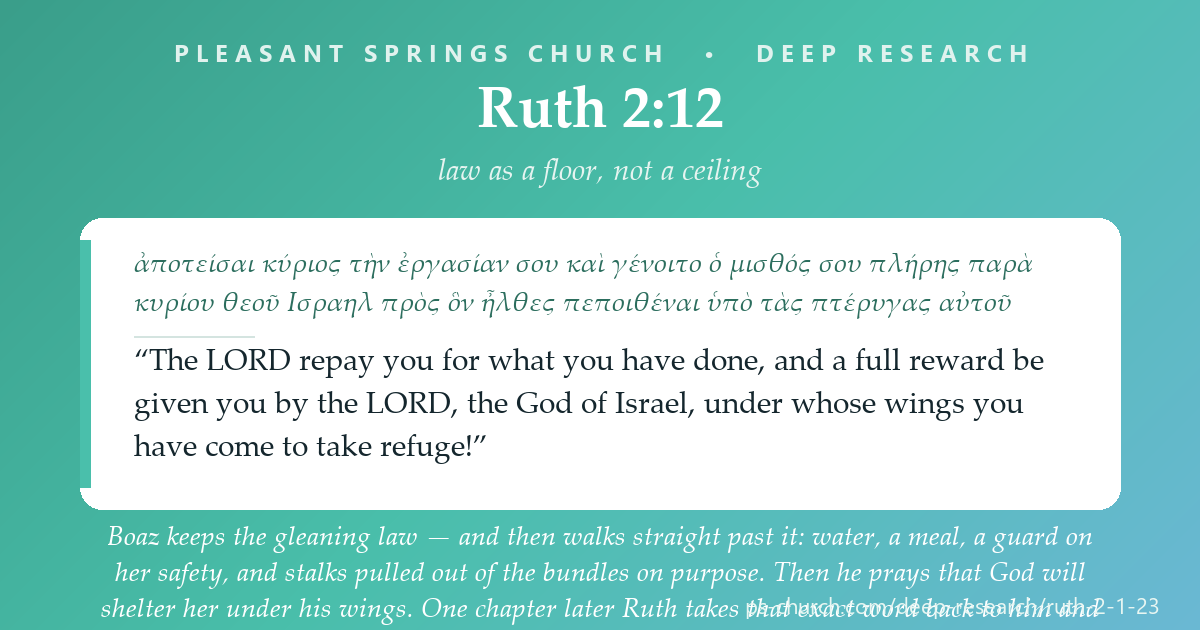
Two widows are in Bethlehem with nothing, and it is barley harvest. One of them is a Moabite, and she goes out to do the only thing a destitute foreigner in Israel could legally do: walk behind the reapers and pick up what they drop. The gleaning law is real law — Leviticus 19:9–10, 23:22, Deuteronomy 24:19–22 — and this study quotes it, because you cannot see what Boaz does until you know what he was obliged to do. He keeps all of it. Then he tells her to stay in his field all season, puts her with his own young women, orders his men not to touch her, gives her the water they drew, seats her at the meal and hands her roasted grain “until she was satisfied, and she had some left over,” and finally tells his men — out of her hearing — to pull stalks out of the bundles on purpose so she will find them. The law is the floor; חֶסֶד is what happens above it. And in the middle of it stands the sentence the whole book turns on: “a full reward be given you by the Lord, the God of Israel, under whose wings you have come to take refuge” (2:12) — a word Ruth will carry to a threshing floor in chapter 3 and hand straight back to him. This study works Ruth 2:1–23 line by line: the man introduced by his character, the chance that the narrator refuses to call anything else, the law, the meal, the staged accident, and Naomi’s first blessing since the road out of Moab — and the word that changes everything, “one of our redeemers.” See the method →
Ruth 2:1–23 (selections)
Hebrew · LXX (Rahlfs) · ESVThe Shape of the Passage
ConcentricRuth opens “in the days when the judges ruled” and is the counter-story to the book it follows in our Bibles. Judges ends with a Levite, a concubine, a butchered body and a civil war, and its last line is “everyone did what was right in his own eyes.” Ruth is about three people doing right when nobody had to. Chapter 1 brought a Moabite widow to Bethlehem with an empty-handed mother-in-law (Ruth 1); chapter 2 puts her in a field.
Author
Anonymous, and one of the finest narrators in Scripture. The book never names its writer. The Talmudic tradition assigns it to Samuel — “Samuel wrote his own book, the book of Judges, and the book of Ruth” (b. Bava Batra 14b, a rabbinic witness, not Scripture) — and the book’s own aside at 4:7, which stops to explain a custom that had already fallen out of use, tells you the writing is later than the events. How much later is genuinely disputed: the case for an early monarchic date rests on the David genealogy and the book’s classical prose; the case for a much later one rests on a handful of Aramaic-looking forms and on 4:7. We report the debate and do not settle it, because nothing in the book depends on the answer.
What is not disputed is the craft. Ruth is roughly half direct speech, which for Hebrew narrative is very high, and the plot moves almost entirely through conversation: two women at a road, a man and a foreman, a man and a woman in a field, two women at a doorway. The narrator withholds motive relentlessly — Robert Alter’s word for the technique is reticence — and where a modern writer would tell you what Boaz was thinking when he first saw her, this one gives you a question to a servant.
And here is the thing to notice about this author above all. In four chapters there is no miracle. No angel, no prophet, no sign, no voice from heaven, no plague and no fire. God acts twice in the whole book by direct narrated statement (1:6 and 4:13) and otherwise is spoken about in blessings. So when the narrator has to say that Ruth walked into the one field in Bethlehem that would save her, he does not write “and the Lord led her.” He writes wayyiqer miqrehā — “her chance chanced” — which is the flattest, most accidental phrasing Hebrew can produce, and he expects you to hear it as the loudest theological sentence in the chapter. That is not coyness. That is a writer telling you where providence usually lives.
Audience
People who knew what a field looked like in June. Everything in this chapter assumes a reader who has stood in one: that barley comes in before wheat, that reapers cut with a sickle and leave the standing edge, that gleaners follow behind and that gleaning is a legal right and a miserable living, that water is carried out to the field in jars, that grain is beaten out with a stick at the end of the day. The narrator explains none of it. He does not have to.
People who knew the law and could check him. The gleaning provisions of Leviticus 19:9–10, 23:22 and Deuteronomy 24:19–22 are the floor under this whole scene, and the first audience would have known exactly where the floor was — which is the only way to feel how far above it Boaz is standing by verse 16. A reader who does not know the law reads this chapter as a nice man being nice. A reader who knows it watches a man decide, repeatedly, that the minimum is not the point.
And people who knew who David was. The book ends on his name, and the last verse of this chapter — “until the end of the barley and wheat harvests” — is the narrator quietly running the clock. An honest note about who first heard this and when: we do not know. But whoever they were, they were being handed a story in which the ancestress of Israel’s greatest king is a Moabite woman gleaning for scraps, and in which the hero’s heroism consists of obeying a farming statute and then going past it. That is a strange thing to build a royal pedigree on, and the strangeness is the message.
Orient on gleaning, the goʾel, hesed, hayil, Boaz, Bethlehem — and on where this book actually sits in the Bible.
Search by topic: Ruth (Book of); Boaz; gleaning; goel / kinsman-redeemer; levirate marriage; hesed; hayil; Megilloth; Shavuot / Feast of Weeks; Bethlehem; Moab and the Moabites; widow, orphan and sojourner; barley and wheat harvest; ephah; canon of the Hebrew Bible.
Which articles are relevant?
- Anchor Bible Dictionary — “Ruth, Book of,” “Boaz,” “Gleaning,” “Redemption (OT),” “Levirate Marriage,” “Moab,” “Bethlehem,” “Agriculture,” “Weights and Measures.”
- Dictionary of the OT: Historical Books (IVP) — “Ruth, Book of,” “Hesed,” “Kinsman-Redeemer and Levirate,” “Agriculture and Animal Husbandry,” “Women.” The IVP Dictionary of the OT: Wisdom, Poetry & Writings also carries a “Ruth” article — because in the Hebrew canon that is where the book lives (see below).
- NIDOTTE / TDOT — לָקַט (lāqaṭ, glean), גָּאַל (gāʾal, redeem), חֶסֶד (ḥeseḏ, covenant kindness), חַיִל (ḥayil, strength/worth), כָּנָף (kānāp̄, wing/corner), חָסָה (ḥāsāh, take refuge), חֵן (ḥēn, favour), נׇכְרִי (noḵrî, foreigner).
- On the Greek — any Septuagint handbook article on Ruth will tell you the same two things: the translation is extremely literal, and it is usually placed with the kaige group. The short orientation in English is the “Routh: To the Reader” introduction in NETS.
Bibliography surfaced:
- Robert L. Hubbard Jr., The Book of Ruth (NICOT); Daniel I. Block, Judges, Ruth (NAC); Frederic W. Bush, Ruth, Esther (WBC); Edward F. Campbell Jr., Ruth (Anchor Bible); Kirsten Nielsen, Ruth (OTL); Jeremy Schipper, Ruth (Anchor Yale); Peter H. W. Lau, The Book of Ruth (NICOT, new edition).
- Robert Alter, The Art of Biblical Narrative, and Phyllis Trible, God and the Rhetoric of Sexuality (ch. 3), on the narrative art. (Both read these texts as literature and do not share the church’s confession; we take the tools, not the metaphysics.)
Before a single word of the text: the Hebrew Bible and the Greek Bible do not put this book in the same place, and the two placements are two different answers to the question of what it is for.
In the Hebrew canon Ruth stands in the Writings (Ketuvim), not in the histories. The oldest list we have — the baraita in b. Bava Batra 14b — runs the Prophets “Joshua and Judges, Samuel and Kings, Jeremiah and Ezekiel, and Isaiah and the Twelve,” with no Ruth anywhere in it; then it lists the Writings and puts Ruth first, ahead of Psalms. The Gemara even asks why a book about bereavement should open the Writings, and answers: “this is suffering which has a future of hope and redemption.” The great Masoretic codices place Ruth in the Writings too, though at a different point (in the Leningrad Codex it stands after Proverbs and before the Song of Songs), and later printed Hebrew Bibles gather it with the five Megilloth — the scrolls read at the festivals. That liturgical use is already presupposed in the post-Talmudic tractate Soferim 14, which groups “Ruth, the Song of Songs, Ecclesiastes, Lamentations and Esther” as scrolls needing the Megillah benediction; the festivals they are read at are, respectively, Pentecost (Shavuot), Passover, Tabernacles, the Fast of Ab and Purim. So in Jewish practice Ruth is the harvest-feast scroll, read at the wheat harvest the book ends in.
In the Greek Bible — and therefore in every Christian Bible — Ruth stands after Judges, as history. That is where the Septuagint manuscripts put it, and it is what the earliest Christian canon list says: Melito of Sardis, writing about AD 170 after a research trip to Palestine and preserved by Eusebius (Hist. eccl. 4.26.14), lists “Jesus Nave, Judges, Ruth” in that order. Josephus does the same thing narratively — he retells Ruth in Antiquities Book 5, immediately after the death of Samson and immediately before Samuel, as a chapter of national history.
Neither placement is a mistake, and each one teaches you to read differently. Put Ruth after Judges and it becomes the answer to Judges: in the very years when “everyone did what was right in his own eyes,” here is a Moabite, a landowner and an old woman doing covenant loyalty to each other with nobody watching, and out of it comes David. Put Ruth in the Writings and read it at the wheat harvest and it becomes something else — a scroll about grain and kindness and belonging, held up on the day Israel brings in the crop. This page keeps both. But the difference is real, it is the largest single Hebrew/Greek difference in the book, and a study that printed three columns and never mentioned it would be hiding something.
A barley field in June, a labour law nobody else wrote, and how the ancient retellings handled Boaz.
First the field itself — the harvest calendar, the sickle and the standing edge, the water jars, the ephah. Then the sharpest comparison this chapter offers: what the surrounding cultures said about justice for the poor, and who they said had to do it. Then Josephus, the Targum and the midrash, watched carefully, because what they add tells you what they felt was missing.
Which parallels shed light on the world of this chapter?
The agricultural clock in this chapter is exact and it is short. Ruth 1:22 lands the women in Bethlehem “at the beginning of barley harvest”; 2:23 carries her through “the end of the barley and wheat harvests.” In the southern Levant that is roughly seven weeks, from barley in the spring to wheat at the start of summer — which is precisely the interval the Torah counts out between Passover and the Feast of Weeks (Leviticus 23:9–22). The book has been running a festival calendar under the story the whole time, and it is very hard to believe the writer did not know it: the gleaning law of Leviticus 23:22 is the last verse of the Feast-of-Weeks paragraph. Reaping was done with a sickle, low or high depending on whether you wanted the straw; the pēʾāh, the “corner” or edge of the field, was left standing by law; what fell from the reapers’ hands was left where it fell. At evening the day’s gleanings were beaten out with a stick rather than threshed on the floor — exactly what 2:17 describes — and Ruth’s haul came to about an ephah, which by any reckoning is an extraordinary day for a gleaner and is the narrator’s way of telling you what verse 16 actually cost Boaz.
Now the comparison that matters, and it cuts one way. The ancient Near East had a long and genuine tradition of royal concern for the poor. Hammurabi’s epilogue says it as clearly as anyone ever said it: he wrote his laws “in order that the strong might not oppress the weak, that justice might be dealt the orphan (and) the widow” (ANET 178). His code regulates the harvest in detail — hire for a cultivator, hire for a herdsman, hire for an ox to thresh, penalties for stolen seed-grain (§§253–271, ANET 176–177). But notice who is doing the justice and who is not. In the Mesopotamian material, care for the widow is the king’s boast, engraved on his stela, and the harvest laws are about property and contracts. In Israel it is the farmer’s obligation, it is written into the annual routine of every field in the country, and it gives the poor a standing claim on somebody else’s standing crop. That is not a small difference of emphasis. It is a different location for mercy: not at the top of the state, but at the edge of your own field, every year, whether or not anyone is watching. (This is a comparison drawn from the published collections; it is not a claim that no other ancient text anywhere ever said anything like it.)
And here is a real Judahite harvest worker, in his own words, complaining about exactly this world. The Meṣad Ḥashavyahu ostracon (also called the Yavneh-Yam ostracon), found in 1960 on the coast and dated to the last decades of the seventh century BC, is a letter to a local governor from a man who says: “Your servant is a reaper… your servant reaped, and he finished, and he was storing up the grain… and Hoshayahu son of Shobai came and took your servant’s garment” — and asks for it back. It is the earliest extra-biblical Hebrew reference to the Sabbath, and, more to our purpose, it is a field labourer appealing to law about a seized cloak — which is the very statute standing three verses above the gleaning law: “you shall not… take a widow’s garment in pledge” (Deuteronomy 24:17; cf. Exodus 22:26–27). Ruth 2 is not describing an ideal. It is describing a system that real people really used, and really got cheated by. (This inscription falls outside the pages of the ANET scan we can verify locally, so no page number is given for it.)
- Code of Hammurabi, epilogue (ANET 178) and §§253–271 (ANET 176–177) (Babylonian, eighteenth century BC — a witness, not Scripture) — harvest labour regulated in detail, and justice for widow and orphan claimed as the king’s achievement. Verified against the local scan.
- The Meṣad Ḥashavyahu (Yavneh-Yam) ostracon, c. 630 BC (Hebrew, a witness, not Scripture) — a reaper’s written appeal over a confiscated garment at the end of harvest. Cited without a page number, which we cannot check here.
- Josephus, Antiquities 5.318–337 (= 5.9.1–4 in Whiston) (Second-Temple — a witness, not Scripture) — the whole book retold in about four paragraphs, in the Judges sequence, and it is instructive for what it drops and what it adds. Josephus never mentions the gleaning law, never mentions the blessing about wings, and has Boaz tell Ruth not to glean at all but “to reap what she was able” — which is generous, and which quietly erases the point that the law was the floor. He also supplies the moral the Bible leaves you to find: “I was therefore obliged to relate this history of Ruth, because I had a mind to demonstrate the power of God, who, without difficulty, can raise those that are of ordinary parentage to dignity and splendor.”
- Targum of Ruth 2:11–12 (rabbinic-era Aramaic — a witness, not Scripture; and it expands enormously) — where the Hebrew Boaz says eleven words, the Targum’s Boaz delivers a paragraph. He has heard “on the authority of the sages” that when the Lord decreed against Moab “He did not decree against the women, but against the men”; he knows “through prophecy” that kings and prophets will descend from her; she has “gone to become a proselyte”; the wings become “the shadow of His Glorious Presence”; and the reward becomes the world to come, deliverance from Gehinnom, and a portion “with Sarah and Rebecca and Rachel and Leah” (Levey’s translation). Every one of those is an answer to a question the Hebrew text leaves open — and the first one is the Deuteronomy 23 problem, solved in Boaz’s own mouth. Watch the Targum work and you learn what the ancient readers found hard.
- Ruth Rabbah 5:6 (rabbinic-era midrash — a witness, not Scripture) — R. Yoḥanan reads the single verse Ruth 2:14 “with six approaches,” applying “come here” (hălōm) to David, Solomon, Hezekiah, Manasseh, and finally to the Messiah, and taking “she ate, was sated, and there was some left over” to mean eating “in this world… in messianic days… and in the future.” The hook is real Hebrew — hălōm is the word David uses in 2 Samuel 7:18, “that you have brought me thus far” — and the reading is still a reading, not the verse’s own meaning. Label it and enjoy it; do not preach it as exegesis.
- b. Bava Batra 14b (rabbinic-era — a witness, not Scripture) — the canon list that puts Ruth first among the Writings, the answer that Ruth’s suffering “has a future of hope and redemption,” and the attribution of the book to Samuel.
It is worth laying the statute and the story side by side, because the gap between them is the chapter. The law requires: do not reap to the very edge of your field; do not go back over it; do not pick up what falls; leave it for the poor and the sojourner (Lev 19:9–10; Lev 23:22; Deut 24:19–22). That is the whole obligation. It is passive: a landowner keeps it by not doing something.
Boaz keeps all of it, and then does eight things the law never asked of him. He greets his workers with a blessing (2:4). He asks who she is (2:5). He tells her not to glean anywhere else — that is, he takes responsibility for her whole season (2:8). He assigns her to his young women, which is a place in a group rather than a solitary scavenge (2:8). He puts a standing order on his men not to touch her (2:9) — the law does not require a landowner to police his own labour force for a foreign woman’s safety, and 2:22 tells you plainly that this was a real danger. He gives her access to the water his own men have drawn (2:9). He seats her at the meal and hands her food himself, and she eats until she is full and has some left (2:14). And then, privately, out of her hearing, he tells his men to pull stalks out of the bundles and drop them (2:16) — which is not gleaning at all. It is a staged accident. It is charity disguised as harvest, arranged so that the woman receiving it never has to know she is receiving it.
That last one is the give-away, because it costs him money and buys him no credit. The law tells you the least a righteous man may do. It cannot tell you what a righteous man will think of. And this is not a New Testament improvement on an Old Testament minimum — the man doing it is an Israelite farmer in the period of the judges, doing what his own Torah was aiming at all along. The commandment sets a floor precisely so that חֶסֶד has somewhere to stand.
Two people paired by one noun, a chance that is not one, and the wing that turns the book.
Count rather than assert: laqat (glean) twelve times, all here; hen (favour) three times, all here; kanaf (wing) twice in the whole book; hesed three times; hayil three times, one each for Boaz, Ruth and their marriage. Then watch what the Greek keeps and what it loses.
Strength, capacity, substance, worth — the word covers an army, a fortune and a character, and English has to pick one. Boaz is ʾîš gibbōr ḥayil (2:1), which the ESV renders “a worthy man.” Count the word: it occurs three times in Ruth, and only three. At 2:1 it is Boaz. At 3:11 Boaz says it of Ruth — ʾēšeṯ ḥayil, “a worthy woman,” the phrase of Proverbs 31:10. At 4:11 the town says it over the marriage: “may you act worthily (ḥayil) in Ephrathah.” The narrator pairs these two people by vocabulary before they have exchanged a word, and then lets the town pronounce the same word over them at the end. And the Greek keeps the pairing — with a different word than the Hebrew, but consistently: δυνατὸς ἰσχύι at 2:1, γυνὴ δυνάμεως at 3:11.
“Her chance chanced” — a verb with its own noun jammed against it, the Hebrew way of saying purely by accident. The root קרה is the ordinary word for a thing happening to you with no cause you can name. This is the sentence the whole doctrine of providence in this book hangs on, and the narrator writes it in the language of coincidence on purpose, because he is not going to tell you what he is doing. The Septuagint saw the figure and matched it, cognate for cognate: περιέπεσεν περιπτώματι. Both translations of the ESV’s modest “she happened to come” are right; the flatness is the point.
“To glean” — to pick up, one stalk at a time, what the reapers left. Twelve occurrences in the book of Ruth; all twelve in this chapter. That is what a Leitwort looks like when you actually count it. It is a poor person’s verb: Leviticus uses it of what you must not do (“you shall not glean your vineyard”) so that somebody else may. The Greek keeps the thread with συλλέγω — eleven times out of the twelve; only at 2:2 does it reach for συνάγω, “gather.”
“Favour, grace” — unearned goodwill from someone who did not owe you any. Three occurrences in the book, all in this chapter, and they trace the chapter’s movement exactly: Ruth hopes to find favour with a stranger she cannot name (2:2); she asks why she has found it, “since I am a foreigner” (2:10); and she says she has found it (2:13). The Greek is χάρις at all three — the same word the New Testament will spend on the doctrine.
“Wing” — and also the corner or skirt of a garment, which is why the ESV footnotes it at 3:9. It occurs exactly twice in Ruth. Here Boaz prays that God will reward the woman “under whose wings you have come to take refuge”; at 3:9 Ruth says to Boaz, “spread your wing over your servant, for you are a redeemer” — taking his own word out of his own prayer and handing it back to him. The image of sheltering wings is God’s in Deuteronomy 32:11 and all through the Psalms (Ps 17:8; 36:7; 57:1; 91:4). The Greek keeps the link with one root: πτέρυγας here, the diminutive πτερύγιον there.
Covenant loyalty — kindness that goes past obligation and keeps going when the obligation has lapsed. Three occurrences in Ruth: 1:8, 2:20, 3:10, and they are the spine of the book. Watch what the three do together: at 1:8 Naomi asks God for ḥeseḏ on her daughters-in-law, and then says nothing but bitterness for the rest of the chapter; at 2:20 she names it as having arrived — her first blessing since that roadside, and the first hopeful word out of her since she told the town to call her Mara; and at 3:10 Boaz says it of Ruth. The 2:20 sentence is grammatically ambiguous in a way that is almost certainly deliberate — see Stage 5. The Septuagint renders all three with ἔλεος, “mercy,” the word the Greek Bible normally uses for ḥeseḏ and the word behind the New Testament’s vocabulary of mercy.
The redeemer — a family member with the legal standing, and the legal duty, to buy back what a relative has lost: land sold in poverty (Leviticus 25:25), a relative sold into servitude (Lev 25:47–49), and in Numbers 35 the avenger of blood. It is a legal office, not a sentiment. Naomi says the word once here, at the very end of the chapter’s conversation, and it turns the book: everything before it is survival, everything after it is redemption. The Greek uses the participle ἀγχιστεύων, “one who acts as next of kin.” The root will cluster more than twenty times in chapters 3 and 4.
“And he passed / heaped out (to her)” — צָבַט occurs nowhere else in the Hebrew Bible, and its precise sense has to be guessed from context and from later Hebrew: he reached her a portion of roasted grain with his own hand. Ruth is full of these — the “bundles” of 2:16 (ṣeḇāṯîm) is another rare word, and the 2fs verbs at 2:8 and 2:21 (tiḏbāqîn) carry an old paragogic nun. The Greek guesses too, with ἐβούνισεν, “he heaped up” — a rare Greek verb for a rare Hebrew one, and it uses the same root again at 2:16 for the “bundles.”
“To cling, stick fast” — the word of Genesis 2:24, “a man shall hold fast to his wife.” Four occurrences in Ruth: Ruth clings to Naomi on the road (1:14), Boaz tells her to cling to his young women (2:8), she reports it back with the men in place of the women (2:21), and the chapter ends with her clinging to them (2:23). An honest note on the Greek: the chain is broken at its first link. The Septuagint renders 1:14 with ἠκολούθησεν, “she followed her,” and only afterwards switches to κολλάομαι / προσκολλάομαι — so a Greek reader can see three-quarters of a thread the Hebrew reader sees whole.
Where this vocabulary goes:
- Ruth 3:9 — the word from 2:12 comes back in Ruth’s own mouth: “Spread your wings over your servant, for you are a redeemer.” The ESV footnotes it “Compare 2:12.” See Ruth 3.
- Ruth 3:11 — and the word from 2:1 comes back on Ruth: “all my fellow townsmen know that you are a worthy woman” (ʾēšeṯ ḥayil). Two verses, two words handed across.
- Ruth 4:14–17 — where the gōʾēl of 2:20 arrives: the women bless the Lord, “who has not left you this day without a redeemer,” and Naomi, who came back empty, takes a child on her lap. See Ruth 4.
- Psalm 17:8; 36:7; 57:1; 91:4 — the wings Boaz is praying about. “Hide me in the shadow of your wings”; “the children of mankind take refuge in the shadow of your wings.” The image is God’s before it is Boaz’s, and Boaz knows it.
- Deuteronomy 32:11 — the eagle that “spreads its wings… and bears them on its pinions,” of God carrying Israel through the wilderness (see Deuteronomy 32). This is the picture Ruth has come under.
- Proverbs 31:10 — “An excellent wife who can find?” is ʾēšeṯ ḥayil, the phrase applied to Ruth at 3:11. In the Leningrad Codex’s order of the Writings, Proverbs stands immediately before Ruth — so a reader met the question and then, on the next page, the woman.
The law behind the field, Abraham’s call in a Moabite’s biography, and the ban in Deuteronomy 23.
Three threads and one hard question. First the harvest law, quoted rather than summarized. Second the verbal echo of Genesis 12 in Boaz’s description of Ruth — shown from the Hebrew, so you can check it. Third the redeemer. And then Deuteronomy 23:3, which says a Moabite may not enter the assembly, laid out fairly and left unresolved.
Which cross-references matter?
- Leviticus 19:9–10 — “When you reap the harvest of your land, you shall not reap your field right up to its edge, neither shall you gather the gleanings after your harvest… You shall leave them for the poor and for the sojourner: I am the Lord your God.” The law sits in the Holiness Code between “you shall be holy” and “you shall love your neighbour as yourself,” which tells you what the writer thought it was.
- Leviticus 23:22 — the same law again, and where it is placed is the point: it is the closing verse of the paragraph on the Feast of Weeks. Israel is told how to celebrate the wheat harvest and the last instruction is about who gets to eat from it. Ruth 2 happens between barley and wheat.
- Deuteronomy 24:19–22 — the third statement, and the one closest to this chapter: “When you reap your harvest in your field and forget a sheaf in the field, you shall not go back to get it. It shall be for the sojourner, the fatherless, and the widow…” Ruth is all three at once. And the ground given is memory: “You shall remember that you were a slave in the land of Egypt.” The immediately preceding verses forbid perverting justice for the sojourner and taking a widow’s garment in pledge — the very complaint of the Meṣad Ḥashavyahu ostracon above.
- Genesis 12:1 and Genesis 24:7 — the echo, shown rather than asserted. God to Abram: לֶךְ־לְךָ מֵאַרְצְךָ וּמִמּוֹלַדְתְּךָ וּמִבֵּית אָבִיךָ — “go from your land and your kindred (mōleḏeṯ) and your father’s house.” Abraham later says it of himself as מִבֵּית אָבִי וּמֵאֶרֶץ מוֹלַדְתִּי, “from my father’s house and the land of my kindred.” Boaz to Ruth: וַתַּעַזְבִי אָבִיךְ וְאִמֵּךְ וְאֶרֶץ מוֹלַדְתֵּךְ — “you left your father and your mother and the land of your kindred.” The nouns are the same nouns, and ʾereṣ mōlaḏtēḵ is Abraham’s own phrase. An honest qualification: the echo is strongest in Hebrew; the Greek uses different words in the two places (συγγενείας in Genesis 12, γῆν γενέσεώς σου here), so a reader of the Septuagint alone would feel it less. Ruth is the only person in the Bible described in these terms who is not in Abraham’s family — she leaves the same three things he left, in the opposite direction.
- Leviticus 25:25 — “If your brother becomes poor and sells part of his property, then his nearest redeemer (gōʾalō) shall come and redeem what his brother has sold.” This is the law standing behind Naomi’s single word at 2:20, and it is about land. How it comes to be joined to a marriage in chapter 4, and how that relates to the levirate rule of Deuteronomy 25:5–10, is genuinely debated — the nearer kinsman of Ruth 4 is not a brother, and the sandal rite there is not the rite of Deuteronomy 25:9. We report the connection and the debate and leave the adjudicating to people with better arguments; see Ruth 4.
- Judges 19–21 — the contrast the canon builds by putting these books next to each other. Judges ends with a woman abused to death by men in a town, tribes at war, and “everyone did what was right in his own eyes.” Ruth 2:9 and 2:22 tell you that the danger in this chapter is exactly that danger; the difference is a man who gives an order about it. (See Judges 19–21.)
- Joshua 2 — the other outsider woman brought inside, and the other one who ends up in the genealogy. Matthew 1:5 puts them in the same verse: “Salmon the father of Boaz by Rahab, and Boaz the father of Obed by Ruth.” A Canaanite and a Moabite, mother and daughter-in-law by marriage, two generations of the same line.
Here is the sentence, and we are not going to soften it. “No Ammonite or Moabite may enter the assembly of the Lord. Even to the tenth generation, none of them may enter the assembly of the Lord forever, because they did not meet you with bread and with water on the way, when you came out of Egypt, and because they hired against you Balaam the son of Beor… to curse you” (Deuteronomy 23:3–4). And the narrator of Ruth will not let you forget which nation she is from: he calls her “the Moabite” six times (1:22; 2:2, 6, 21; 4:5, 10), and three of those six are in this chapter — once by Ruth’s own narrator (2:2), once in the mouth of Boaz’s foreman (2:6), and once again at 2:21. This is not an oversight the book is trying to slip past you. It is the thing the book keeps pointing at.
Four readings are on the table, and each carries real weight. (1) The ban is on Moab as a nation and a male line, not on an individual who comes over. This is the reading of the rabbis — the Targum has Boaz say it in so many words at 2:11, “He did not decree against the women, but against the men” — and it became settled halakhah. It fits the grammar (the terms are masculine) but it is an inference, and the Hebrew does not spell it out. (2) The ban addresses a specific act of hostility. Deuteronomy 23:4 gives the reason: they refused bread and water and they hired Balaam (see Numbers 22–24). Ruth’s entire biography is the photographic negative of that — she brings food to an Israelite widow and blesses instead of cursing. (3) The book is deliberately answering Deuteronomy. On this reading Ruth is not an exception smuggled in but a case study in what covenant loyalty does to a legal category. (4) The genealogy may be the reply. Ruth 4:18–22 lists ten names, Perez to David, and Deuteronomy said “to the tenth generation.” That may be a deliberate answer; it may equally be a coincidence of a standard ten-name form, and the book never says.
And here is what stays unresolved, said plainly. Deuteronomy 23:3 says “even to the tenth generation… forever,” and Ruth 4 and Matthew 1:5 put a Moabite four generations from David and in the ancestry of Jesus Christ. Reading (1) relieves the pressure; it does not dissolve it, and neither do the others. What Scripture has actually done is print the statute and print the woman, some way apart, and decline to reconcile them for us. A page that told you the tension was easy would be lying to you. What the canon does instead of an explanation is far more interesting: it puts her name in the family tree and leaves you to think about it.
The commentaries, the crux at 2:7, the pronoun at 2:20, and what “chance” is doing in a book about God.
Hubbard, Block, Bush, Campbell, Nielsen, Schipper and Lau on Ruth; Alter and Trible on the narrative art; and then four live exegetical questions this chapter raises — the broken half-verse at 2:7, whose kindness is meant at 2:20, why Ruth says “young men” at 2:21, and how a book with no miracles talks about God.
Commentaries & studies:
- Robert L. Hubbard Jr., The Book of Ruth (NICOT) — the standard full-dress evangelical commentary, especially good on the legal background; Frederic W. Bush, Ruth, Esther (WBC) — the most rigorous on the Hebrew and on 2:7; Edward F. Campbell Jr., Ruth (Anchor Bible) — the classic on the book as artful storytelling; Daniel I. Block, Judges, Ruth (NAC).
- Kirsten Nielsen, Ruth (OTL); Jeremy Schipper, Ruth (Anchor Yale); Peter H. W. Lau, The Book of Ruth (NICOT) — three more recent readings, differing sharply from one another and worth having in the room.
- Robert Alter, The Art of Biblical Narrative, for reticence and the Leitwort; Phyllis Trible, God and the Rhetoric of Sexuality, ch. 3, for the reading of Ruth’s literary shape that most later work argues with.
- On the Greek: the introduction to Routh in A New English Translation of the Septuagint; and behind it, Dominique Barthélemy, Les Devanciers d’Aquila, which is where the kaige group (and Greek Ruth’s place in it) was first set out. Maurice Baillet’s edition of 2QRutha,b in DJD III (1962); the Cave 4 Ruth manuscripts in DJD XVI (2000).
Interpretation notes worth keeping:
- 2:7 is a genuine textual crux and the honest answer is that we do not know. The Hebrew ends זֶה שִׁבְתָּהּ הַבַּיִת מְעָט — word for word, “this her sitting/dwelling the house a little.” It has been read as “she has rested only a little in the shelter,” as “she has been on her feet since morning and has only just now sat down,” and as a reference to a hut at the edge of the field. The Greek does something else again: “until evening… she did not rest in the field a little.” The ESV picks a reading (“except for a short rest”) and footnotes its own uncertainty. Nothing in the chapter turns on it, and it is worth having one place on the page where a study says simply: this line is broken, and here is what the witnesses do with it.
- 2:20 — ‘whose kindness’ is ambiguous in the Hebrew, and the ambiguity is probably deliberate. Naomi says בָּרוּךְ הוּא לַיהוָה אֲשֶׁר לֹא־עָזַב חַסְדּוֹ: “blessed be he to the Lord, who has not forsaken his kindness.” The relative can attach to Boaz (the nearer noun) or to the Lord (the more natural subject of covenant ḥeseḏ toward “the living and the dead”). Commentators split, and the ESV, NIV and most modern versions take it of the Lord while noting the other. This page reports it and does not resolve it — and suggests you notice that a book which has spent a chapter and a half showing you human kindness and divine providence running down the same channel is exactly the book that would leave that pronoun open. The Greek does not settle it either: it replaces the relative with ὅτι, “because,” and still leaves the subject unnamed.
- 2:21 — Ruth quotes Boaz saying ‘young men’ when he said ‘young women’. Boaz’s instruction at 2:8 is עִם־נַעֲרֹתָי, “with my young women”; Ruth reports it at 2:21 as עִם־הַנְּעָרִים אֲשֶׁר־לִי, “with my young men”; and Naomi immediately puts it back: “it is good… that you go out with his young women” (2:22). Three readings are current — that Ruth, a foreigner, is using the masculine plural loosely for “his workers”; that she is repeating an instruction she has partly misheard; or that the narrator is showing us a young widow who does not yet grasp how exposed she is, so that Naomi has to say it. The narrator does not tell us, and the Greek preserves the switch exactly (κορασίων at 2:8 and 2:22, παιδαρίων at 2:21), so it is not a translation accident. Where the text gives no verdict, we do not manufacture one.
- The theology of ‘chance’ in 2:3 — and why the narrator is not being evasive. Ruth reports no miracle. There is no burning bush, no angel, no oracle. What the book does instead is put the word for sheer accident at the exact hinge of its plot and then spend two more chapters showing you what came of it. Hubbard and Campbell both read the phrase as ironic understatement, and the church has generally read it the same way: the writer knows perfectly well who is running the field, and declines to say it, because the whole point is that from inside the day it looked like luck. That is a doctrine of providence built for ordinary people — for readers who will never be handed a miracle and have to decide whether God is in an ordinary Tuesday. It is also worth saying what the text does not claim: it does not say that every accident is a blessing, and Naomi’s speeches in chapter 1 (“the hand of the Lord has gone out against me… the Almighty has dealt very bitterly with me”) are still standing, uncorrected, on the page behind this one.
- An ephah is the narrator shouting. Estimates of the volume vary and this page will not pretend to a precision the evidence does not support — the ESV footnotes it “about 3/5 bushel or 22 liters.” However you calculate it, it is somewhere between one and two weeks’ food for two women, gathered in a single day by a woman working alone with her hands. The number is how we are told what verse 16 cost.
- On the Greek Ruth generally. The translation is so literal that it will reproduce Hebrew word order and even Hebrew idiom at the cost of Greek style (ἀπαγγελίᾳ ἀπηγγέλη at 2:11 for the Hebrew infinitive absolute; καί γε for וְגַם at 2:15, 2:21 — the very marker that gives the kaige group its name). That is why the divergences in this chapter are so few and so worth noticing when they come.
There is a way of preaching this chapter that makes Boaz look generous instead of obedient, as though the law were a mean thing he rose above. That reading gets the book backwards. The gleaning statutes are not a grudging minimum extracted from a reluctant God; they are a standing, annual, national arrangement to make sure that the poorest person in Israel could eat by working, with dignity, without asking anyone’s permission and without being anyone’s dependent. Ruth does not beg in this chapter. She works. That is the law’s doing, and it is a magnificent piece of legislation.
What the law cannot do is the rest of it. No statute can require a man to greet his workers with a blessing, or to notice a stranger at the edge of the field, or to think ahead to whether she will be safe among his men, or to hand her food himself in front of everybody so that the whole crew understands where she stands, or to arrange for grain to fall in her path in a way she will never trace back to him. Law can set a floor under a society. It cannot make anybody kind. And the book knows this, which is why it has taken the trouble to introduce Boaz in verse 1 with a word about his character before it ever shows us his conduct.
So hold both. Keep the floor — and it is worth asking, soberly, what the floor is in your own economy and whether you are anywhere near it. And then notice that everything this chapter actually celebrates happens above the line, in the space the commandment cleared and could not fill.
A day’s gleaning, a staged accident, and the prayer that gets answered by the man who prayed it.
Name what you learned, why it matters, and one concrete response.
What should we carry away — and do?
- The law is the floor. Boaz keeps every clause of the gleaning statutes and then does eight things they never asked. If your obedience is a list you can finish, you have found the floor and mistaken it for the roof.
- Do good in a way that costs you and does not credit you. Verse 16 is the most beautiful thing in the chapter and it happens out of Ruth’s hearing. Boaz tells his men to drop grain on purpose, so that a woman who would not take charity can gather what she thinks she found. Arrange the accident. Do not sign it.
- “She happened to come.” There is no miracle anywhere in this book, and the sentence at its hinge is written in the flattest language for coincidence that Hebrew has. That is how providence usually reaches people — not as a sign, but as a Tuesday you can only read backwards. Which also means you may be somebody else’s coincidence this week and never know it.
- Say the blessing out loud. Boaz’s first recorded words are “the Lord be with you” to his farm hands (2:4). His second speech puts a stranger under God’s wings. Naomi, who has not blessed a soul since the roadside in 1:8 and has spent every speech since calling herself empty, blesses somebody again at 2:20 — and that is where her coming back begins. Speaking well of people to God, and to their faces, is not decoration.
- Notice who was in danger, and act like Boaz about it. “I have charged the young men not to touch you” (2:9); “lest in another field you be assaulted” (2:22). The book of Judges tells you what happened to women in this period when nobody gave that order. Boaz used his authority to make one specific woman safe in one specific place. That is what authority is for.
- And do not rush Naomi. She is still the woman who said “the Almighty has dealt very bitterly with me… I went away full, and the Lord has brought me back empty” (1:20–21). Nothing in chapter 2 tells her she was wrong. What happens is that somebody feeds her, and she says a blessing, and that is where the turn begins. Grief is not answered by correction. It is answered by an ephah of barley on the table and a word about a redeemer.
A devotional analogy, clearly labelled as one: Christians have long looked at Boaz — the kinsman with the right and the willingness to redeem — and thought of Christ. Hold that loosely and honestly. Ruth 2 does not say it, and the New Testament never makes the comparison. What the New Testament does with this chapter is smaller and far more startling: it writes the names down. “Salmon the father of Boaz by Rahab, and Boaz the father of Obed by Ruth” (Matthew 1:5). The canon’s own move is not to turn Boaz into a symbol; it is to put him, and the Moabite woman gleaning in his field, into the ancestry of Jesus Christ as actual people. That is firmer ground than any allegory, and it is more than enough.
Step in response: two things this week. First, find the floor — the minimum you actually owe somebody (a wage, a debt, a duty of care, an apology) — and pay it, exactly, this week. Then do one thing above it that nobody will be able to trace to you. Second, ask who is gleaning at the edge of your field: the person picking up what falls from your abundance and hoping not to be noticed. Give them a place among your own people, and a jar of water, and a seat at the meal.
Ruth 2:12 · to share
LXX (Rahlfs) + ESVEvery Deep Research page traces its passage across the whole sweep — the Old Testament, the Second-Temple world between the testaments (historical witnesses, not Scripture), and the New Testament. Follow the thread:
Pleasant Springs Church — Deep Research
Research method after Michael S. Heiser’s Bible Research Method (examine dictionaries → ancient literature → important words → textual connections → academic publications → share), with the Pleasant Springs “Author & Audience” foundation. Scripture set in the Hebrew, the Greek editions named on each page and the ESV (Old Testament), and the Greek New Testament and the ESV (New Testament), per the practice of Pleasant Springs Church. Ruth 2 research grounded in Hubbard (NICOT), Bush (WBC), Campbell (Anchor), Block (NAC), Nielsen (OTL), Schipper (Anchor Yale) and Lau, with Alter and Trible for the narrative tools used in the structure block. Texts: Hebrew from the Masoretic Text, pointed and accented, with the chapter’s single ketiv/qere (2:1) reported rather than silently resolved; Greek from Rahlfs’s Septuaginta (1935), verified word by word against the Rahlfs text and printed without the printed edition’s editorial punctuation, with Swete’s diplomatic Vaticanus text named wherever the two editions differ (2:16); English ESV (2016), exact. Numbering: Ruth has 22, 23, 18 and 22 verses in the Hebrew and in Rahlfs alike — checked, not assumed — so there is no chapter or verse offset anywhere in this book and every reference is one number in all three columns. Hebrew/Greek differences reported rather than smoothed: the Greek reads Abimelech for Elimelech throughout (2:1, 2:3); the end of 2:7 is read three ways by the Greek where the Hebrew is broken, as the ESV’s own footnote concedes; 2:13 lacks the Hebrew’s negative לֹא, which reverses Ruth’s sentence; 2:16 carries a Greek plus (“and carrying, carry for her”) with no Masoretic counterpart, and the two printed Greek editions disagree in the same verse; the שׁלם wordplay of 2:12 and the first link of the dāḇaq chain (1:14) are lost in Greek, while the doubled verb of 2:3, the “wing” of 2:12 ↔ 3:9 and the Boaz/Ruth strength-pairing are kept. Because the Greek Ruth is a very literal, Hebraizing translation of the kaige type (Barthélemy), the divergences are genuinely few, and that is stated rather than padded. Canonical placement — Ruth in the Writings and among the Megilloth read at Shavuot in the Hebrew Bible (b. Bava Batra 14b; Leningrad Codex; Soferim 14) against Ruth after Judges in the Greek and Christian order (LXX manuscripts; Melito of Sardis in Eusebius, Hist. eccl. 4.26.14; Josephus) — is set out at Stage 1 as the largest Hebrew/Greek difference in the book. Qumran: Ruth 2:1–12 has no manuscript witness from the Judean Desert; 2QRutha (2Q16, DJD III) begins at 2:13 and agrees with the Masoretic consonants in this chapter apart from spelling; no argument on this page rests on the scrolls. ANE background verified against the local scan (Code of Hammurabi epilogue, ANET 178; §§253–271, ANET 176–177); the Meṣad Ḥashavyahu ostracon is cited without a page number, which falls outside it. Josephus, the Targum of Ruth, Ruth Rabbah and the Talmud are read as witnesses, never leveled with Scripture, and the Targum’s enormous expansions are labelled as expansions. The tension between Deuteronomy 23:3–6 and Ruth the Moabite is laid out with four fair readings and then explicitly left unresolved; the ambiguity of “whose kindness” at 2:20 is reported and not settled; the crux at 2:7 and the “young men” of 2:21 are left where Scripture leaves them; and Boaz as gōʾēl is offered Christ-ward only as an explicitly labelled devotional analogy, with Matthew 1:5 named as the canon’s own move.
Scripture quotations marked ESV are from the ESV® Bible (The Holy Bible, English Standard Version®), © 2001 by Crossway, a publishing ministry of Good News Publishers. ESV Text Edition: 2016. Used by permission. All rights reserved. The ESV text may not be quoted in any publication made available to the public by a Creative Commons license, and the ESV may not be translated in whole or in part into any other language. www.esv.org
|
Did this study bless you today? 💚 Give to Support PS Church100% of gifts go to the General Fund — thank you. |