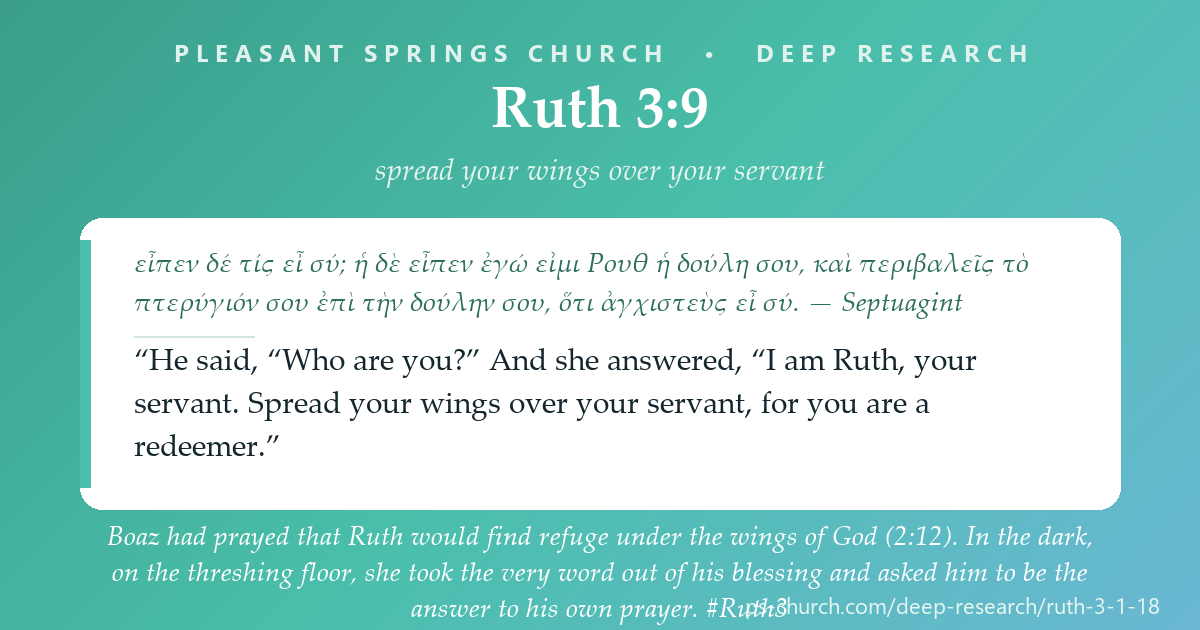
Naomi’s plan is four verbs and a risk: wash, anoint, dress, go down — and then, when the man has eaten and drunk and lain down, “uncover his feet and lie down, and he will tell you what to do” (3:3–4). It is night. It is a threshing floor. The Hebrew is deliberately charged and deliberately ambiguous, and this study says so plainly rather than being coy about it. But what the chapter actually asserts is the opposite of scandal. At midnight Boaz wakes, startled, and asks the best question in the book — “Who are you?” — and gets an answer that changes everything: “I am Ruth, your servant. Spread your wings over your servant, for you are a redeemer” (3:9). She has taken the very word out of the blessing he prayed over her in 2:12 and asked him to be the answer to his own prayer. He calls her “my daughter” and “a worthy woman,” guards her name, and names the one thing standing in the way: “there is a redeemer nearer than I.” This study works Ruth 3:1–18 line by line in Hebrew, Greek and English — and reports every difference between them. See the method →
Ruth 3:1–18
Hebrew · LXX · ESVThe Shape of the Passage
ConcentricBehind this chapter stand Ruth 1 (the road back from Moab, and Naomi’s “I went away full, and the Lord has brought me back empty”) and Ruth 2 (the barley field, the gleaning laws, and Boaz’s blessing about wings). In front of it stands Ruth 4 — the gate, the sandal, the child, and the genealogy. And underneath the whole book lies Judges, the book Ruth is answering.
Author
Where this book stands is itself the biggest Hebrew–Greek difference in it, and every page of this study says so once. In the Hebrew Bible Ruth is not history at all in the filing sense: it stands in the Writings (Ketuvim), one of the five Megilloth, the little scrolls read at the festivals — and Ruth is read at Shavuot, the harvest feast this book is set in. The baraita at b. Bava Batra 14b puts it first in the list: “The order of the Writings is: Ruth and the book of Psalms, and Job and Proverbs…” In the Greek order — and therefore in every Christian Bible — Ruth stands immediately after Judges, as history. Same book, two placements, two different answers to the question what is this for? One says: a scroll for a feast, about loyalty and harvest and the God who hides in ordinary kindness. The other says: a chapter of the national story, and the point is the last word of it — David.
The craft here is deliberate and it is not decorative. The narrator reports action sparely and speech at length, and he tells you almost nothing about what anyone is feeling. He does not tell you what Naomi hoped. He does not tell you what Ruth intended. He does not tell you what Boaz thought when he woke. He builds a scene at night, on a threshing floor, after food and drink, with a man asleep and a woman coming “softly” — and then he fills it with the most careful and honourable speech in the book. The risk is the author’s doing; so is the restraint. He wants you to feel both.
Audience
Readers who had just come through the book of Judges. Ruth opens “in the days when the judges ruled” — the period whose refrain is “everyone did what was right in his own eyes” and whose last four chapters are a catalogue of what men do to women in the dark (Judges 19–21). Then comes a chapter with all the same ingredients — night, a journey, a woman alone, a man, a house of bread — and nothing bad happens. That is not an accident of subject matter. It is the point. Ruth is the counter-story, and chapter 3 is where the counter-story is most exposed.
And readers who knew the law. A first audience would hear the legal vocabulary firing on every line: gōʾēl, the kinsman with the right and duty of redemption (Leviticus 25); the widow’s claim on the family of the dead (Deuteronomy 25:5–10); the “gate” where such things are settled. They would also hear the problem: this woman is a Moabite, and Deuteronomy has something to say about that. The book knows. It says “the Moabite” over and over, on purpose.
Orient on the threshing floor, the gōʾēl, the garment-corner, and the Megilloth.
Search by topic: Ruth, Book of; Boaz; threshing floor; winnowing; kinsman-redeemer / go'el; redemption; levirate marriage; Megilloth; Shavuot / Weeks; garment, skirt, corner; hesed; woman of valour; Moab and the Moabites.
Which articles are relevant?
- Anchor Bible Dictionary — “Ruth, Book of,” “Boaz,” “Redemption (OT),” “Marriage (OT),” “Levirate Law,” “Threshing Floor,” “Agriculture,” “Moab.”
- Dictionary of the OT: Historical Books — “Ruth: Book of,” “Kinsman-Redeemer and Levirate,” “Women.” Dictionary of the OT: Wisdom, Poetry & Writings is worth pairing with it precisely because it files Ruth the other way — among the Writings, with the Megilloth.
- NIDOTTE / TDOT — גָּאַל (gāʾal, redeem), כָּנָף (kānāp̄, wing / corner of a garment), חֶסֶד (ḥeseḏ, covenant kindness), חַיִל (ḥayil, strength / worth), שָׁכַב (šāḵaḇ, lie down), גֹּרֶן (gōren, threshing floor), אָמָה (ʾāmāh) and שִׁפְחָה (šip̄ḥāh) — two words for a female servant, and Ruth changes from one to the other between 2:13 and 3:9.
- Encyclopaedia Judaica / Jewish Study Bible — on the Megilloth and the festival readings, for the canonical question above.
Bibliography surfaced:
- Robert L. Hubbard Jr., The Book of Ruth (NICOT); Daniel I. Block, Judges, Ruth (NAC); Frederic W. Bush, Ruth, Esther (WBC); Edward F. Campbell Jr., Ruth (Anchor Bible); Kirsten Nielsen, Ruth (OTL); Jeremy Schipper, Ruth (Anchor Yale); Peter H. W. Lau on Ruth.
- Robert Alter, The Art of Biblical Narrative, and Phyllis Trible on the narrative art of Ruth.
- Dominique Barthélemy, Les devanciers d’Aquila, for the kaige tradition to which the Greek Ruth belongs; Frederick W. Knobloch’s translation and introduction to Routh in NETS.
Why a man sleeps on a threshing floor, and how ancient readers handled this night.
First the working world of the scene — winnowing in the evening breeze, sleeping by the heap, the floor as a public place. Then how Second-Temple, rabbinic and early Christian readers handled a chapter they clearly found delicate.
Which parallels shed light on religion and worldview?
Everything physical in this chapter is ordinary and exact. Winnowing is done in the evening, when the breeze comes up off the hills and can carry the chaff away — which is why Boaz is at the floor at night and not at home. Owners and workers slept beside the heaped grain because a threshing floor full of the year’s barley was the most stealable thing in the district. The narrator does not explain any of this, because his first readers did not need it explained. Neither does he explain that a woman coming there at night was doing something a village would talk about; that is the whole reason 3:14 exists.
And the threshing floor was not only a work site. It was a flat, open, public space beside the town, and in the ancient Levant it functioned as a place of assembly, of judgment, and sometimes of the holy. The Bible itself shows the range — kings hold court “at the threshing floor at the entrance of the gate of Samaria” (1 Kings 22:10), and the temple mount itself is bought as a threshing floor (2 Samuel 24:18–25). The Ugaritic Tale of Aqhat puts the same picture in a Canaanite frame, and it is worth reading beside Ruth 3–4 precisely because of what the righteous man is doing there.
- The Tale of Aqhat, Ugaritic, 14th–13th c. BC (ANET 151, repeated at 153) — an ancient witness, not Scripture. Daniel the Rapha-man “is upright, sitting before the gate, / Beneath a mighty tree on the threshing floor, / Judging the cause of the widow, / Adjudicating the case of the fatherless.” Hold that beside the shape of this book: the widow’s case is raised on a threshing floor (ch. 3) and settled at the gate (ch. 4). The two locations are not scenery. They are the ancient courthouse.
- Josephus, Antiquities 5.318–337 (= 5.9.1–4), c. AD 93 — a Second-Temple witness, not Scripture. He retells Ruth as history and sets it under Eli the high priest, a dating the book itself never gives. On this chapter (5.9.3) he says Boaz woke her before the workers stirred and sent her off “before any body there should see that she had lain down by him: because it was but prudent to avoid any reproach that might arise on that account: especially when there had been nothing done that was ill.” A first-century Jewish reader states it flatly: nothing improper happened.
- Targum of Ruth 3 (rabbinic-era Aramaic — a witness, not Scripture; and it expands enormously) — at 3:8 it says the man “shuddered and trembled… Though he perceived a woman sleeping at his feet, he subdued his evil inclination and did not draw nigh unto her, just like the righteous Joseph… and just like the pious Paltiel.” At 3:9 it turns the wing-idiom into an explicit proposal — “Let your name be called over your maidservant, by taking me to wife” — and at 3:11 it keeps the Hebrew’s gate and reads it as “the Great Sanhedrin.” At 3:15 it settles the ambiguity the Hebrew leaves by naming him: “Then Boaz went into the city.”
- Ruth Rabbah (rabbinic-era midrash — a witness, not Scripture) — on 3:3 it reads “put on your cloak” as Shabbat garments (“Was she naked? Rather, these are the Shabbat garments”), and on 3:6 it notices, correctly, that Ruth changed the order of Naomi’s instructions. It also stops to record a scribal fact: at 3:5 “‘To me’ is read, but it is not written.” That is the same qere this page prints, noted by a rabbinic reader a very long time ago.
- b. Bava Batra 14b (rabbinic-era — a witness, not Scripture) — the baraita on the shape of the canon: “The order of the Writings is: Ruth and the book of Psalms, and Job and Proverbs…”, and, on authorship, “Samuel wrote his own book, the book of Judges, and the book of Ruth.” Whatever one makes of the attribution, note what it takes for granted: Ruth belongs with Judges as a matter of subject and with the Writings as a matter of place.
The ambiguity is real, and it is the author’s. Naomi tells Ruth to “uncover his feet” — gālāh margəlōṯāyw — and רֶגֶל, “foot,” can function as a euphemism elsewhere in the Hebrew Bible (Isaiah 7:20 is the standard example). She tells her to “lie down,” šāḵaḇ, a verb that carries the same double register and carries it in this very book’s neighbourhood. It is night. There has been drinking. She “comes softly.” A reader who does not feel the charge in the scene is not reading it. So do not be coy about the ambiguity.
And do not manufacture impropriety, because the text asserts the opposite. What is actually said in these eighteen verses is this: Boaz calls her bittî, “my daughter” (3:10, 3:11), the word he already used in 2:8; he calls her an ʾēšeṯ ḥayil, “a worthy woman” (3:11), which is what the narrator called him in 2:1; he says “all my fellow townsmen know” that this is what she is; he swears by the Lord rather than acting (3:13); and he takes deliberate trouble over her reputation — “let it not be known that the woman came to the threshing floor” (3:14). The narrator writes a scene loaded with risk in order to show two people who do not take it.
Beyond that the text is silent, and speculation past the silence is not exegesis. Whole libraries have been written filling this gap in both directions — making it a seduction, or making it so chaste that nothing is at stake. Both are additions. The honest report is: the author chose an ambiguous scene and then chose to record only honourable words in it, and the ancient readers closest to him (Josephus, the Targum) took the same view of what happened. Where Scripture does not say, we do not say.
Wing, feet, lying down, redeemer, worth, kindness — and one changed self-description.
Watch kanaph (the hinge of the book, 2:12 ↔ 3:9); margeloth and shakab, the two charged words; goel, seven times from the pivot on; eshet hayil, which links Ruth to Boaz and to Proverbs 31 in Hebrew only; hesed, three times in the book; and Ruth's shift from shiphchah to amah.
“Wing” — and also the corner, edge or skirt of a garment. That double sense is not a pun the preacher invents; it is the ordinary range of the word, and the ESV footnotes it here in so many words. In 2:12 Boaz prays that Ruth will be rewarded by the God of Israel “under whose wings you have come to take refuge” — כְּנָפָיו, plural. In 3:9 she says וּפָרַשְׂתָּ כְנָפֶךָ, “spread your kānāp̄ over your servant” — and the Masoretic form here is singular, one corner of one garment. The Greek makes exactly the same move: τὰς πτέρυγας, plural, at 2:12; τὸ πτερύγιον, the singular diminutive, at 3:9. She has narrowed his cosmic word to something a man can actually do tonight.
“The place of the feet” — not simply “feet,” but a formation meaning the foot-end, and it occurs in the Hebrew Bible only here (four times) and in Daniel 10:6. The Greek renders it with the same care: τὰ πρὸς ποδῶν αὐτοῦ, “the parts toward his feet.” רֶגֶל, “foot,” can be a euphemism elsewhere in Scripture, and the word choice here is part of what makes the scene deliberately charged. The chapter never resolves the ambiguity, and neither should we.
“To lie down” — eight occurrences in eighteen verses, which is the single loudest word in the chapter. Like the English “sleep with,” the verb covers both plain sleeping and sexual union, and the author knows it. Count where they fall: three of them in Naomi’s instructions (3:4), two as Ruth carries them out (3:7), one in the narrator’s startled “behold, a woman lying at his feet” (3:8), and then two in Boaz’s mouth and the narrator’s — “lie down until the morning” (3:13) and “so she lay at his feet until the morning” (3:14). The word that could have meant the other thing is used, at the end, to say that they slept.
“Redeemer” — the family member with the right and the obligation to buy back what a relative has lost: land (Leviticus 25:25), a person sold into servitude (Lev 25:47–49), the blood of a murdered kinsman (Numbers 35). It is a legal word before it is a theological one, and Ruth uses it first. Seven occurrences in this chapter — and none at all before 3:9, though Naomi has already used the noun once, of Boaz, at 2:20. The Greek renders it with the ἀγχιστεύς word-group, “next of kin” — also seven times, in the same seven places.
“A worthy woman” — and the Hebrew ties three passages together with a single word. חַיִל means strength, capability, substance, worth. The narrator introduced Boaz at 2:1 as an אִישׁ גִּבּוֹר חַיִל, which the ESV renders “a worthy man”; here Boaz gives Ruth the feminine of the same word, and the same phrase stands at the head of the poem in Proverbs 31:10 and again at Proverbs 12:4. An honest note about the Greek: that link is a Hebrew link and does not survive translation. The LXX has ἀνὴρ δυνατὸς ἰσχύι at Ruth 2:1, γυνὴ δυνάμεως here, and γυναῖκα ἀνδρείαν at Proverbs 31:10 — three different phrases. If you are arguing from the connection, argue from the Hebrew and say so.
“Covenant kindness” — loyal, committed goodness that goes past what is owed. It occurs exactly three times in Ruth, and the three are load-bearing: Naomi prays it over her daughters-in-law on the road (1:8), Naomi says God has not abandoned it (2:20), and Boaz says Ruth has done it (3:10). Here it is comparative: “you have made this last kindness greater than the first” — the first being what she did for Naomi, the last being that she came to an older kinsman rather than going after young men. The Greek uses ἔλεος for it throughout, which is a fair rendering and a narrower word.
“Servant” — and Ruth has changed her word. At 2:13 she twice called herself a שִׁפְחָה (šip̄ḥāh), the lowlier term, and added “though I am not one of your servants.” Here, twice in one sentence, she calls herself an אָמָה — the term that in Israel’s legal texts describes a woman who may be taken as a wife (Exodus 21:7–11). It is a small, deliberate promotion of her own status, and she does it in the same breath as the request. The Greek loses the distinction: δούλη at 2:13 and δούλη again here.
“Softly, secretly” — a rare adverbial form (from לָט, secrecy) that the ESV renders “she came softly.” It is the same word used of David creeping up to cut the corner (כָּנָף!) of Saul’s robe in 1 Samuel 24:4 — a verse that is MT and LXX 24:5, since the Hebrew and Greek run one verse ahead of the English through that chapter. Here the Greek reads ballāṭ plainly as κρυφῇ and there as λαθραίως — but at that verse it renders כְּנַף with τὸ πτερύγιον, the very word it uses at Ruth 3:9. It is one place where the Greek does keep the connection the Hebrew makes.
The centre of the chapter, and of the book: 3:9
In Ruth 2:12 Boaz prays a blessing over a foreigner he has just met: “The Lord repay you for what you have done, and a full reward be given you by the Lord, the God of Israel, under whose wings you have come to take refuge!” It is a beautiful prayer and it costs him nothing.
In 3:9, in the dark, she hands it back to him. וּפָרַשְׂתָּ כְנָפֶךָ עַל־אֲמָתְךָ כִּי גֹאֵל אָתָּה — “Spread your wing over your servant, for you are a redeemer.” She takes the exact word out of his own blessing and asks him to be the answer to his own prayer. And because kānāp̄ means both the wing of God and the corner of a man’s cloak, the sentence is at one and the same time a marriage proposal and a claim on the protection of God. There is no way to translate it that keeps both, which is why the ESV prints “wings” and then footnotes “the word for wings can also mean corners of a garment.”
That the idiom is a real one, and specifically a marriage idiom, is not a guess: Ezekiel 16:8 uses the same two words — pāraś + kānāp̄ — of God himself: “I spread the corner of my garment over you and covered your nakedness; I made my vow to you and entered into a covenant with you.” And Ezekiel 16:9 goes on: “Then I bathed you with water… and anointed you with oil” — rāḥaṣ and sūḵ, the very two verbs Naomi used in Ruth 3:3. An honest note: the Hebrew makes that link with one word; the Greek does not. LXX Ruth 3:9 has περιβαλεῖς τὸ πτερύγιόν σου, LXX Ezekiel 16:8 has διεπέτασα τὰς πτέρυγάς μου — a different verb — and LXX Deuteronomy 23:1 renders the same Hebrew noun with συγκάλυμμα, a different noun altogether. This is a Hebrew argument. It is a good one. Make it in Hebrew.
Naomi’s instruction ends “and he will tell you what to do” (3:4). It does not happen. Boaz wakes, asks who she is, and it is Ruth who tells him what to do — two imperatival clauses and a reason. Ruth Rabbah noticed centuries ago that she did what Naomi said but changed the order; the deeper change is that she changed the speaker. In biblical narrative, when a command is repeated the alteration is where the meaning sits, and here the alteration is the whole point: the Moabite widow who arrived in chapter 1 with nothing to say is now the one making the proposal, in covenant language, correctly used. And Boaz’s answer treats it as a lawful claim rather than a liberty — he neither rebukes it nor exploits it. He blesses her, tells her the legal obstacle, and swears.
Wings, corners, redeemers, a Moabite, and two other stories set at night.
Trace four threads: the wing-and-corner idiom; the law of the redeemer and the levirate; the Moabite problem the book will not let you forget; and the night stories this chapter is deliberately standing next to.
Which cross-references matter?
- Ruth 2:12 ↔ Ruth 3:9 — the hinge of the book, treated above. His plural “wings” of God become her singular “wing” of a man, in both the Hebrew and the Greek.
- Ezekiel 16:8 — the same idiom, spoken by God: “I spread the corner of my garment over you… and entered into a covenant with you.” Cited in text only; there is no Ezekiel 16 page in this library yet.
- Deuteronomy 23:1 — the same noun again, and the dark side of it: “A man shall not take his father’s wife, so that he does not uncover his father’s kānāp̄.” Numbering, per this library’s standing convention: that verse is English 22:30 = MT and LXX 23:1, and the whole chapter runs one number apart in English and Hebrew from there. Ruth 3:9 is asking for the honourable form of the thing Deuteronomy forbids in its dishonourable form.
- Leviticus 25:23–55 — the law of the gōʾēl: land is not sold in perpetuity, and the nearest kinsman redeems what a poor relative has had to let go. This is the legal machinery behind 3:12–13 and behind the whole of chapter 4.
- Deuteronomy 25:5–10 — the levirate: a brother marries the widow so that “the name of the dead” is not blotted out, and if he refuses, the sandal comes off and he is spat in the face. Report the connection and the debate, and do not adjudicate: Boaz is not a brother, the arrangement in Ruth 4 joins land-redemption to marriage in a way Deuteronomy 25 does not describe, and the sandal rite in Ruth 4:7 is explained by the narrator as an old custom of attestation rather than as the shaming of Deuteronomy 25:9. The two texts are clearly related and their exact relationship is genuinely disputed among careful readers. (Josephus, retelling the scene in Ant. 5.9.4, simply imports the spitting from Deuteronomy — which shows how early the question was being asked.)
- Deuteronomy 23:3–6 — the sharpest thing in the book. “No Ammonite or Moabite may enter the assembly of the Lord. Even to the tenth generation, none of them may enter… because they did not meet you with bread and with water on the way.” Numbering: English 23:3–6 = MT and LXX 23:4–7. And the woman on the threshing floor is the Moabite — the narrator will not stop calling her that — and she is David’s great-grandmother and stands in Matthew 1:5. See the note below.
- Genesis 19:30–38 and Genesis 38 — the two stories this chapter is standing next to on purpose. Moab himself is born of a night, a cave, wine and a scheme; Tamar secures the line of Judah by a plan of her own that the text calls righteous in the end (“she is more righteous than I,” 38:26). Ruth 3 has the ingredients of the first and the courage of the second — and produces neither shame nor deceit. Ruth 4:12 will make the Tamar link itself, out loud, in the elders’ blessing.
- Judges 19–21 — the book Ruth is answering, at its worst. A journey, a night, hospitality, a woman, a man who will not protect her. Then Ruth 3: a journey, a night, a threshing floor, a woman, and a man who covers her. Same period, same country, opposite ending. That contrast is the reason the Greek and Christian canon puts these two books side by side.
- Joshua 2 — the other Canaanite-side woman who talks her way into the family of Israel and into Matthew 1:5, in the verse immediately before Ruth’s. Rahab and Ruth are named one after the other there: “and Salmon the father of Boaz by Rahab, and Boaz the father of Obed by Ruth.”
Deuteronomy bars a Moabite from the assembly of the Lord “even to the tenth generation” (English 23:3 = MT/LXX 23:4). Ruth the Moabite is King David’s great-grandmother. Both sentences are in the Bible. The tension is real and it is not resolved by pretending one of them is softer than it is.
Here are the readings that are actually offered, laid out fairly. (1) The ban is on Moab as a nation and, in the later halakhah, on the male line — “a Moabite, not a Moabitess” — so an individual woman who attaches herself to Israel is not in view. This is the reading of Ruth Rabbah and of the rabbinic tradition, and it is at least as old as the mishnaic period. (2) The ban is grounded in a stated reason: they did not meet you with bread and water, and they hired Balaam (23:4–5 Eng.) — hostility on the road. That is precisely what Ruth does not do; she goes the other way, and the book keeps showing her feeding an Israelite widow. (3) The book is deliberately answering Deuteronomy, and knows it — which is why it calls her “the Moabite” six times (1:22; 2:2, 6, 21; 4:5, 10) rather than letting the reader forget. (4) The genealogy that closes the book runs ten names, Perez to David, which some readers hear as a deliberate reply to “the tenth generation.”
And here is what stays unresolved. The book never quotes Deuteronomy 23 and never says “but.” It does not tell us that Ruth converted in any formal sense — 1:16 is a vow of loyalty, not a legal procedure. It does not tell us that Boaz or the elders thought about the ban at all. Every one of the four readings above is a reader’s inference, and the text supplies none of them. Where Scripture gives no reason, the discipline is to say so and stop. What Scripture does supply is the last word of the book — David — and a genealogy in Matthew 1:5 that names her without apology.
The commentaries, the Greek Ruth, and the three scribal notes in this chapter.
Hubbard, Block, Bush, Campbell, Nielsen, Schipper and Lau on Ruth; Alter and Trible on the narrative art; Barthélemy and Knobloch on the Greek; de Waard's BHQ on the Masoretic text.
Commentaries & studies:
- Robert L. Hubbard Jr., The Book of Ruth (NICOT, 1988); Daniel I. Block, Judges, Ruth (NAC, 1999); Frederic W. Bush, Ruth, Esther (WBC, 1996); Edward F. Campbell Jr., Ruth (Anchor Bible, 1975); Kirsten Nielsen, Ruth (OTL, 1997); Jeremy Schipper, Ruth (Anchor Yale, 2016); Peter H. W. Lau on Ruth.
- Robert Alter, The Art of Biblical Narrative — for the tools used in the structure block above (the Leitwort; the predominance of dialogue; the meaning that sits in a repeated command’s variation). Phyllis Trible on the women of Ruth. Cited for the literary observation.
- Dominique Barthélemy, Les devanciers d’Aquila (1963), for the kaige revision, of which Ruth is a standard member; Frederick W. Knobloch, “Routh,” in A New English Translation of the Septuagint; Jan de Waard’s fascicle of Biblia Hebraica Quinta for Ruth.
Interpretation notes worth keeping:
- Three scribal notes sit in these eighteen verses, and they are worth seeing. At 3:5 and 3:17 the word אֵלַי, “to me,” is read but not written (qere wə-lōʾ kəṯîḇ) — these are the only two such cases in the whole book, and both are in this chapter. At 3:12 the word אם is written but not read (keṯîḇ wə-lōʾ qere). Watch what the Greek does: at 3:5 it has nothing for the unwritten word, and at 3:17 it has πρός με. So the Greek sides with the written text once and with the read text once — which is a small, real window onto how carefully, and how independently, these two traditions were handed down.
- 3:15 — “then she went into the city,” and what is actually in the manuscripts. This is often reported as a ketiv/qere: written “he went,” read “she went.” Checked in an apparatus, that is not what the Leningrad Codex shows. Leningrad — the base text of both BHS and BHQ — simply reads וַיָּבֹא הָעִיר, masculine: “he went into the city,” with no qere at all. What is true is that a substantial group of Hebrew manuscripts, together with the Syriac and the Vulgate, read וַתָּבֹא, “she went” — and that is what most English versions, including the ESV, print. The Septuagint cannot settle it: καὶ εἰσῆλθεν εἰς τὴν πόλιν is the same form whether the subject is he or she. The Targum settles it the other way, supplying the name: “Then Boaz went into the city.” Either way the sense of the paragraph survives; the point worth carrying is that this is a manuscript question honestly reported, not a Masoretic reading-note.
- The Greek Ruth is close to the Hebrew, and saying so is a finding, not a shrug. In Joshua the Old Greek runs several per cent shorter than the Masoretic Text; in Judges there are two substantially different Greek Bibles. In Ruth there is one Greek text and it tracks the Hebrew word by word, down to Hebraisms that are painful in Greek (καί γε; ὑπέρ for a comparative). That is what the kaige tradition looks like from the reader’s seat. It means the handful of real differences in this chapter carry more weight, not less — and they are all listed above the fold.
- ‘A worthy woman’ is a Hebrew argument. Ruth 2:1, Ruth 3:11, Proverbs 12:4 and Proverbs 31:10 share one word, חַיִל. The Septuagint uses three different renderings across those verses, and English versions vary too (the ESV says “worthy” in Ruth and “excellent” in Proverbs). Preach the connection — it is really there — but tell people it is there in Hebrew, and do not claim the versions for it.
- Do not read Boaz as Christ as though the text said so. The gōʾēl is a genuine biblical institution and “redeem” is genuinely a word the New Testament takes up. But no New Testament writer makes Boaz a type of Christ, and the leap from “redeemer” to “Redeemer” is one the canon itself does not take here. What the canon does do with Ruth is put her name in a genealogy (Matthew 1:5). That is solid ground, and it is enough. See the labelled analogy in Stage 6.
Asking a man to be the answer to his own prayer.
Name what you learned, why it matters, and one concrete response.
What should we carry away — and do?
- She took his blessing and handed it back as a request. Boaz had prayed that Ruth would find refuge under God’s wings. In the dark she said: spread your wing over me. There is a whole theology of prayer in that move — God’s protection is real, and it usually arrives wearing somebody’s coat. If you have prayed a blessing over someone this year, ask whether you were the answer and declined to notice.
- The chapter is a study in restraint, and the restraint is deliberate. Two people at midnight in a place with no witnesses, and what the record contains is a blessing, a legal disclosure, an oath, and a care for her reputation. Character is not what you do when the village is watching. It is what the narrator can safely leave unsupervised.
- He guarded her name before he had any claim on her. “Let it not be known that the woman came to the threshing floor” (3:14) is a sentence about someone else’s reputation, spoken by the person with the least to lose. That is a very concrete kind of love, and it is available to you this week.
- “A worthy woman — and all my fellow townsmen know it.” Ruth is a foreigner, a widow, and poor enough to be gleaning. What the town knows about her is not her status but her ḥeseḏ. Reputations are built out of what people saw you do for someone who could not repay you.
- And Naomi’s last line is the honest one for anyone in the middle of a thing. “Wait, my daughter, until you learn how the matter turns out, for the man will not rest but will settle the matter today” (3:18). She does not say it will go well. She says he will not stop. There is a kind of peace that comes not from knowing the outcome but from knowing the character of the one handling it.
A devotional analogy, clearly labelled as one: Christians have long heard the word redeemer in Boaz and thought of Christ — the kinsman who has the right, the means and the willingness to buy back what we could not keep. Hold it as what it is. Ruth 3 does not say that; Ruth 3 says Boaz is a gōʾēl under Israel’s property law and that there is one nearer. The New Testament never makes the typology. What the New Testament does is put Ruth’s name in the family line of Jesus Christ (Matthew 1:5) — which is the canon’s own move, and a bigger one. Take the analogy as the church’s reflection on a real institution; take the genealogy as revelation.
Step in response: find the blessing you have most recently prayed over somebody — for a job, for a marriage, for a way through — and ask what one corner of your own coat would look like spread over it. Then go do that instead of praying it again.
Ruth 3:9 · to share
LXX + ESVEvery Deep Research page traces its passage across the whole sweep — the Old Testament, the Second-Temple world between the testaments (historical witnesses, not Scripture), and the New Testament. Follow the thread:
Pleasant Springs Church — Deep Research
Research method after Michael S. Heiser’s Bible Research Method (examine dictionaries → ancient literature → important words → textual connections → academic publications → share), with the Pleasant Springs “Author & Audience” foundation. Scripture set in the Hebrew, the Greek editions named on each page and the ESV (Old Testament), and the Greek New Testament and the ESV (New Testament), per the practice of Pleasant Springs Church. Ruth 3:1–18 research grounded in Hubbard (NICOT), Block (NAC), Bush (WBC), Campbell (Anchor Bible), Nielsen (OTL), Schipper (Anchor Yale) and Lau on Ruth, with Alter and Trible on the narrative art, Barthélemy on the kaige tradition, Knobloch’s NETS Routh, and de Waard’s BHQ. Hebrew from the Masoretic Text of the Leningrad Codex (WLC), printing the qere; Greek from Rahlfs, checked at 3:3, 3:10, 3:11, 3:15 and 3:18 against Swete; English ESV. Ruth 3 has eighteen verses in Hebrew and in Greek alike and there is no versification offset — verified against the columns themselves — but the Greek does diverge, and every divergence in this chapter is listed under the passage: “go up” for “go down” (3:3), pluses at 3:5, 3:10, 3:14, 3:16 and 3:18, a minus at 3:15, and “tribe” for “gate” at 3:11. The much-repeated ketiv/qere at 3:15 is not in the Leningrad Codex and is reported here as the manuscript variant it actually is; the two qere-and-not-written notes at 3:5 and 3:17 and the written-and-not-read at 3:12 are reported as they stand. In the Hebrew canon Ruth is one of the five Megilloth in the Writings, read at Shavuot; in the Greek and Christian order it follows Judges — the biggest Hebrew/Greek difference in the book. Josephus, the Targum of Ruth, Ruth Rabbah and b. Bava Batra 14b are cited as witnesses, not Scripture. The ambiguity of the threshing-floor scene is reported without prurience and without invention; the Deuteronomy 23 tension is laid out and left unresolved where Scripture leaves it; Boaz as gōʾēl is offered Christ-ward only as an explicitly labelled devotional analogy.
Scripture quotations marked ESV are from the ESV® Bible (The Holy Bible, English Standard Version®), © 2001 by Crossway, a publishing ministry of Good News Publishers. ESV Text Edition: 2016. Used by permission. All rights reserved. The ESV text may not be quoted in any publication made available to the public by a Creative Commons license, and the ESV may not be translated in whole or in part into any other language. www.esv.org
|
Did this study bless you today? 💚 Give to Support PS Church100% of gifts go to the General Fund — thank you. |