Boaz goes up to the gate at daybreak, sits down, and waits for a man the narrator will not name — “so-and-so.” He seats ten elders. Then he raises the field first, and the nearer redeemer says, “I will redeem it.” Only then does Boaz add the second half of the sentence: “The day you buy the field from the hand of Naomi, you also acquire Ruth the Moabite” (4:5) — and the man withdraws: “I cannot redeem it for myself, lest I impair my own inheritance” (4:6). A sandal changes hands in a rite the narrator has to stop and explain. A town blesses a marriage by naming Rachel, Leah and Tamar. A child is born, and the women of Bethlehem — the same women who heard Naomi say “call me Mara” — get the last word: “your daughter-in-law who loves you, who is more to you than seven sons” (4:15). Then ten names, Perez to David, and the book closes with a quiet detonation: Ruth the Moabite is David’s great-grandmother, with Deuteronomy 23:3 still on the page. This study works Ruth 4:1–22 line by line in Hebrew, Greek and English — including the one letter at 4:5 that changes who is doing the acquiring, and every place the Hebrew and the Greek of this chapter part company. See the method →
Ruth 4:1–22 (selections)
Hebrew · LXX · ESVThe Shape of the Passage
ConcentricRuth opens “in the days when the judges ruled” and it is the counter-story to Judges: three people keeping covenant in exactly the years when, as that book keeps saying, everyone did what was right in his own eyes. This chapter is where the counter-story lands — in a legal proceeding, in daylight, in front of witnesses.
Author
The book is anonymous. The oldest surviving guess is rabbinic: b. Bava Batra 14b says “Samuel wrote his own book, the book of Judges, and the book of Ruth” — a tradition, offered as such, not a claim the book makes for itself. What the text does tell us is that its author wrote at some distance from the events. 4:7 is the proof. The narrator interrupts his own courtroom scene to explain a legal custom: “Now this was the custom in former times in Israel … the one drew off his sandal and gave it to the other.” You do not explain a custom your readers practise. And 4:17 ends by naming David without explaining who he is — so the audience knows David and does not know the sandal.
The craft is in the pacing. Boaz raises the field first and lets the nearer redeemer say yes to it (4:4). Only after the yes does he add the second clause (4:5). The narrator does not tell us whether Boaz planned that, and the reticence is deliberate — biblical narrative is sparing with motive and generous with speech, and the gap is where the reader is meant to stand. Notice too that the man is never named. The one character in this book who will not carry another man’s name loses his own.
Audience
Israelites who knew David and knew Deuteronomy. Both. That is what makes the last five verses detonate rather than merely conclude. A reader who has Deuteronomy 23:3 in mind — “No Ammonite or Moabite may enter the assembly of the Lord … even to the tenth generation” — comes to 4:18–22, counts ten names from Perez to David, and finds that the great-grandmother of Israel’s king is a Moabite. The book does not soften that. It sets it down and stops.
And one more thing they knew: where the book sits. In the Hebrew Bible Ruth stands in the Writings (Ketuvim) — b. Bava Batra 14b lists “the order of the Writings” with Ruth first — and it is one of the five Megilloth, read at Shavuot (Weeks/Pentecost), the very harvest feast the story is set in. In the Greek order, which the Christian Bible follows, it stands after Judges, as history, between the judges and the kings. Same book, two placements, two different answers to the question “what is this for?” — a festival scroll about ḥeseḏ and harvest, or the hinge between Judges and David. This is the single biggest difference between the Hebrew and the Greek Bibles in the book of Ruth — bigger than any variant in any verse — and both readings are true to something the book is doing. Chapter 4 is where they meet: it ends with a harvest wedding and with a king.
Orient on the gōʾēl, the levirate, the city gate, and the genealogy of David.
Search by topic: goel / kinsman-redeemer; redemption (Old Testament); levirate marriage; halitzah; city gate; elders; witnesses; sandal / shoe; inheritance (nachalah); Moab and the Moabites; Bethlehem and Ephrathah; genealogy; David (ancestry); Megilloth; Shavuot.
Which articles are relevant?
- Anchor Bible Dictionary — “Redemption (OT),” “Levirate Law,” “Marriage (OT),” “Gate,” “Elder,” “Inheritance,” “Ruth, Book of,” “Moab,” “Bethlehem,” “Genealogy.”
- Dictionary of the OT: Historical Books — “Ruth: Book of,” “Kinsman-Redeemer and Levirate,” “City Gate,” “Genealogies.” The DOTHB entry is a good place to see how differently competent scholars weigh the Deuteronomy 25 question.
- NIDOTTE / TDOT — גָּאַל (gāʾal, to redeem, act as next-of-kin), קָנָה (qānāh, to acquire), יָבָם (yāḇām, brother-in-law — the levirate root), נַחֲלָה (naḥălāh, inheritance), נַעַל (naʿal, sandal), תְּעוּדָה (teʿūdāh, attestation), חַיִל (ḥayil, worth/strength).
- Note the trap in the lexicons. English Bibles translate gōʾēl with the theologically loaded word “redeemer,” and the New Testament’s redemption vocabulary then reads itself backwards into Ruth 4. The Hebrew word is a kinship term first — the relative on whom a family’s duties fall. That the Greek translator saw it exactly that way is one of the most useful facts on this page (Stage 3).
Bibliography surfaced:
- Robert L. Hubbard Jr., The Book of Ruth (NICOT); Daniel I. Block, Judges, Ruth (NAC); Frederic W. Bush, Ruth, Esther (WBC); Edward F. Campbell Jr., Ruth (Anchor Bible); Kirsten Nielsen, Ruth (OTL); Jeremy Schipper, Ruth (Anchor Yale); Peter H. W. Lau on Ruth.
- Robert Alter, The Art of Biblical Narrative; Phyllis Trible, God and the Rhetoric of Sexuality (the chapter on Ruth).
- Dominique Barthélemy, Les Devanciers d’Aquila (1963), for the kaige tradition and where Greek Ruth belongs in it; Emanuel Tov, Textual Criticism of the Hebrew Bible, for ketiv/qere.
A courthouse in a doorway, a shoe, and what the neighbours later did with all of it.
First the world of the scene — what a city gate was for, what land redemption was, what the ancient Near East did about a widow with no son. Then how Josephus, the Targum and the rabbis handled this chapter, because two of them rewrote it, and the rewriting is informative.
Which parallels shed light on religion and worldview?
The gate was the courthouse. Excavated Iron-Age gates at Dan, Beersheba, Gezer and elsewhere are not simple doorways but multi-chambered structures with stone benches built into the piers — a shaded room that everyone entering or leaving town had to pass through, which is exactly what you want for a public transaction. The Old Testament assumes it constantly: elders sit in the gate (Deut 21:19; 22:15; Joshua 20:4), justice is done or perverted there (Amos 5:10, 12, 15), and Proverbs says of a worthy man that “he is known in the gates when he sits among the elders of the land” (Prov 31:23). Boaz does not convene a court; he goes where the court already is, and waits.
The closest biblical parallel is a burial plot. In Genesis 23 Abraham buys the cave of Machpelah from Ephron the Hittite “in the hearing of the Hittites, before all who went in at the gate of his city” — the negotiation, the public setting, the formal witnesses, and the closing formula that the field “was made over” to him. Ruth 4 is the same genre of scene, and it is a genre the ancient world knew well: a sale is not valid because two men agreed but because the town saw it.
The widow with no son was an ancient-Near-Eastern problem, and other people had laws about it too. The Hittite Laws §193 and the Middle Assyrian Laws both provide for a dead man’s widow to be taken by a surviving relative, and — this matters for Ruth — both extend the circle beyond the brother. That is a real parallel and it is worth stating carefully: it does not prove that Israel’s levirate worked the way Ruth 4 does, but it does show that a duty of this kind was ordinarily understood as a family obligation rather than a strictly fraternal one, which is precisely the question the chapter raises.
- Hittite Laws §193 (ANET 196) — “If a man has a wife and then the man dies, his brother shall take his wife, then his father shall take her. If in turn also his father dies, one of his brother’s sons shall take the wife whom he had.” The duty descends through a widening circle of kin.
- Middle Assyrian Laws A §§30, 33, 43 (ANET 182, 184) — a widowed daughter-in-law may be given to another son, or to the father-in-law himself, or, if the son has died, to a grandson at least ten years old. Again: an obligation lodged in the household, not only in a brother.
- Code of Hammurabi (ANET 163–180) — the background hum of the whole scene: contracts, witnesses, and sealed documents as the ordinary machinery of property in the ancient world. Ruth 4 does the same work with a shoe, because it is a village and not a city archive.
- Josephus, Antiquities 5.9 (§§318–337) (c. AD 93 — a witness, not Scripture) — retells Ruth as history and dates it “after the death of Samson,” under Eli the high priest, i.e. squarely in the Judges sequence, the Greek Bible’s placement. He closes: “I was therefore obliged to relate this history of Ruth, because I had a mind to demonstrate the power of God, who, without difficulty, can raise those that are of ordinary parentage to dignity and splendour.”
- Targum of Ruth 4:7–8 (rabbinic-era — a witness, not Scripture; it expands the book enormously) — the Aramaic translator replaces the sandal with a glove: “one would take off his right glove and give it to the other, thereby handing over the right of possession.” He has updated the rite to a transaction his own readers would recognise. At 4:1 he renders pelōnî ʾalmōnî as an address — “you, whose ways are secret” — and at 4:21 he identifies Boaz with the judge Ibzan of Bethlehem (Judges 12:8–10), as does b. Bava Batra 91a.
- Mishnah Yevamot 8:3 and Ruth Rabbah 2:9 (rabbinic-era — witnesses, not Scripture) — the classic halakhic reading of the Moabite ban. The Mishnah rules that “an Ammonite and a Moabite are forbidden, and their prohibition is a permanent prohibition, but their females are permitted immediately”; Ruth Rabbah puts it as the slogan the tradition remembers, “an Ammonite and not a female Ammonite, a Moabite and not a female Moabite.” See the closing section; it is one reading among several and it is not the only honest one.
Put Josephus and the Targum side by side on this chapter and you learn something about how hard 4:7–8 was already. Josephus rewrites the rite to match Deuteronomy 25. In his telling, Boaz “called the senate to witness, and bid the woman to loose his shoe, and spit in his face, according to the law” — which is Deuteronomy 25:9 word for word, and is not what Ruth 4 says happens. The Targum rewrites the rite to match his own century, turning the sandal into a glove. One reader harmonised backwards to the Torah; the other translated forwards into contemporary practice. Neither left it alone, because the text as it stands fits neither the law nor later custom exactly — and the narrator of Ruth had already told us as much: this was the custom in former times. When you find the earliest interpreters quietly fixing a passage, that is usually a sign the passage is telling the truth about something odd.
Redeem, acquire, sandal, name — and the one letter that changes a sentence.
Watch goel against qanah (duty against purchase, in the same speech); the two different sandal verbs in Hebrew and the one Greek verb that covers both; teudah and its root in “witness”; the seven shems of this chapter; and chayil, third and last time.
The redeemer — but the Hebrew word is first of all a kinship word: the relative on whom a family’s obligations fall. He buys back land the family has had to sell (Lev 25:25), buys back a relative sold into servitude (Lev 25:47–49), and avenges a killing (Num 35:19). The root גאל runs 23 times through Ruth — 15 of them in this chapter. And watch where the word lands last: at 4:14 the gōʾēl is no longer the man at the gate but the baby.
How the Greek translator handled gōʾēl — and the choice is worth the whole word-study. He did not use λυτρόω (“to ransom”) or ἀγοράζω (“to buy”). He used the ἀγχιστ- family, which means to be next of kin, to act as the nearest relative. Checked: λυτρ- and ἀγοραζ- occur zero times in Greek Ruth; ἀγχιστ- occurs 26 times (once in ch. 2, seven times in ch. 3, eighteen times here). So the New Testament’s redemption vocabulary (λύτρον, ἀπολύτρωσις) is not the vocabulary of the Greek Ruth. Anyone who wants to read Boaz Christ-ward should know that the Greek Bible did not make that link lexically.
“To acquire, buy” — six occurrences in the book, and every one of them is in this chapter. It is the commercial word, and it sits directly against gāʾal: one is the language of duty, the other of purchase, and Boaz uses both about the same woman in the same breath. That should not be smoothed over. The LXX matches it with κτάομαι, also exactly six times, in exactly the same six places.
The ketiv and the qere. The consonants written in the manuscripts are קניתי — which points as qānîtî, “I have acquired.” The Masoretes direct the reader to say קָנִיתָ, qānîtā, “you acquire.” One letter; two different sentences. See the callout below — this page reports both and settles neither.
The sandal. Ruth’s verb is שָׁלַף, shālap, “to draw off” — the man removes his own shoe and hands it over as a conveyance. Deuteronomy 25:9 uses a different verb, חָלַץ, ḥālaṣ: there the widow pulls the sandal off the man’s foot and spits in his face, and his house is thereafter called “the house of him who had his sandal pulled off” (25:10). Two different verbs, two different actors, two different meanings — conveyance here, public shaming there. An honest note about the Greek: the LXX renders both with ὑπολύω + ὑπόδημα, so a reader working in Greek sees a tighter link between these two passages than a reader working in Hebrew does.
“The attestation” — from the root עוד, the same root as עֵד, ʿēd, “witness,” which the chapter says three times (4:9, 4:10, 4:11). The shoe is the document. In a village with no archive, a public gesture in a public doorway is the record, and the townsmen are the copy. The Greek has μαρτύριον, “testimony,” and keeps the link with μάρτυρες, “witnesses.”
“Name.” The book uses it fourteen times and half of them are in this chapter. It is what the dead man loses and what the child restores; it is what Boaz is blessed to gain in Bethlehem (4:11); it is what the nearer redeemer forfeits by refusing (he is never given one); and it is the last thing the book does — ten of them in a row. A story that began with a family emptied of its men ends by writing a name into Israel’s memory that could not be erased.
“Strength, worth, substance” — used exactly three times in Ruth, and they are the three portraits of the book. Boaz is an ʾîsh gibbōr ḥayil (2:1). Ruth is an ʾēsheṯ ḥayil, “a worthy woman” (3:11) — the phrase of Proverbs 31:10. And here at 4:11 the town blesses Boaz: waʿăsēh-ḥayil, “may you act worthily.” The Greek keeps the thread with δύναμις-words all three times — but see Stage 4: at 4:11 it gives the clause to Rachel and Leah instead of to Boaz.
“A restorer of life” — literally “one who brings back the nepesh,” the throat, the appetite, the self. The participle is from שׁוּב, shūḇ, “to return” — the verb that hammers through chapter 1, where everything and everyone is going back: Naomi returns, Orpah turns back, Ruth will not turn back. The word that described a road in chapter 1 describes a child in chapter 4. The Greek is as literal as it can be: εἰς ἐπιστρέφοντα ψυχήν.
The ketiv/qere at 4:5 — reported, not settled:
This is the most consequential textual note in the book, and a reader deserves to see it rather than be handed a tidied sentence. In the Masoretic manuscripts the consonants written at 4:5 are קניתי — the ketiv, “what is written” — which is the ordinary spelling of qānîtî, “I have acquired.” Against it the Masoretes set the qere, “what is read”: קָנִיתָ, qānîtā, “you acquire.” (The same chapter carries two further, minor ketiv/qere pairs, at 4:4 and 4:6.)
What each reading does to the sentence. With the qere: “The day you buy the field from the hand of Naomi — and from Ruth the Moabite, the widow of the dead — you acquire, to raise up the name of the dead upon his inheritance.” Boaz is telling the man what the deal will cost him, and the man declines. With the ketiv: “…I have acquired, to raise up the name of the dead.” Now Boaz is announcing his own intention in the middle of the offer — and the nearer redeemer’s refusal in 4:6 becomes a response to a claim Boaz has already staked. The legal shape of the scene, and how calculated Boaz looks, shifts with one letter.
What the Greek does with it. The Septuagint reads with the qere, and unambiguously: ἐν ἡμέρᾳ τοῦ κτήσασθαί σε τὸν ἀγρόν … καὶ αὐτὴν κτήσασθαί σε δεῖ — “on the day of your acquiring the field … you must acquire her also.” Second person twice, and with an added δεῖ, “it is necessary,” and an explicit αὐτήν, “her,” which the Hebrew does not have — the translator is spelling out what he takes the sentence to mean. The Targum of Ruth reads it the same way (“you are also obligated … and you are required to marry her”). So the two oldest translations we have both heard the qere.
And what the Dead Sea Scrolls contribute here: nothing, and it is worth saying so. Four Ruth manuscripts survive from the Judaean desert — 2QRutha (2Q16), 2QRuthb (2Q17), 4QRutha (4Q104) and 4QRuthb (4Q105) — and all four are fragmentary. 2Q16 is the most extensive and reaches this chapter, but it preserves only Ruth 4:3–4; 2Q17 has 3:13–18; 4Q104 has 1:1–12; 4Q105 has parts of 1:1–6, 12–15. Not one of them preserves 4:5. The oldest Hebrew evidence stops one verse short.
This page does not adjudicate. Commentators divide, and they divide on real grounds. What we can say without guessing is what the evidence is: the consonants say one thing, the reading tradition says another, both are old, the ancient translators went with the reading tradition, and the scrolls are silent. Where Scripture’s own transmission leaves a question open, the honest thing is to show the reader the question.
Leviticus 25, Deuteronomy 25, Genesis 38, Deuteronomy 23 — and chapter 1, answered.
Four threads: the law the redemption rests on; the levirate question and why it is genuinely open; the two foreign women in Judah’s line; and the way 4:14–17 answers 1:20–21 sentence for sentence. Then, separately and in full, every place the Hebrew and the Greek of this chapter part company.
Which cross-references matter?
- Leviticus 25:23–25, 47–49 — the floor the whole chapter stands on. “The land shall not be sold in perpetuity, for the land is mine. For you are strangers and sojourners with me” (25:23), and therefore “If your brother becomes poor and sells part of his property, then his nearest redeemer shall come and redeem what his brother has sold” (25:25). Boaz is not being generous in redeeming a field; he is doing what the law provides. What he adds beyond the law is Ruth.
- Deuteronomy 25:5–10 — the levirate. Real overlap and real difference; see the callout below. Note the one link that is lexical in both languages: at Deuteronomy 25:7 the widow says her brother-in-law mēʾēn… lehāqîm leʾāḥîw shēm be-Yisrāʾēl — literally “refuses… to raise up for his brother a name in Israel” (ESV: “refuses to perpetuate his brother’s name in Israel”) — and Ruth 4:5, 10 has lehāqîm shēm-hammēṯ, “to raise up the name of the dead.” Same idiom, same verb קוּם in the causative. And Deuteronomy 25:7 sends the widow “up to the gate to the elders” — the same place Boaz goes up to in 4:1.
- Genesis 38 — Tamar, named in the blessing at 4:12. The townspeople of Bethlehem choose, of all the precedents available, the one where a levirate duty was refused (Onan), where the widow was left waiting, and where she took extraordinary measures to get an heir out of Judah — and where the child born of it was Perez, the man whose genealogy closes this book. They are not being tactful. They are saying: this line has been here before.
- Genesis 29–30 — Rachel and Leah, “who together built up the house of Israel” (4:11). Two sisters, one of them long barren, a household full of rivalry and grief, and out of it twelve tribes. To bless a bride with those two names is to promise her something large and to admit that the road there is not smooth.
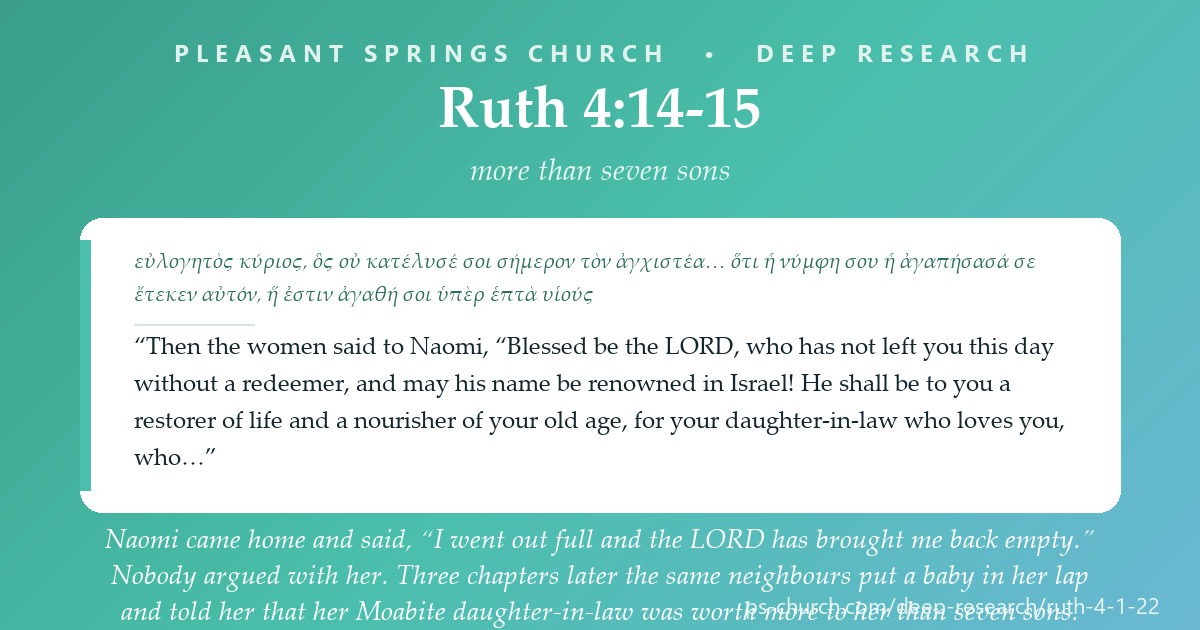
- Ruth 1:20–21 — and this is the answer the whole book has been withholding. Naomi told the women of Bethlehem: “Do not call me Naomi; call me Mara, for the Almighty has dealt very bitterly with me. I went away full, and the Lord has brought me back empty.” The narrator never corrected her, and never argues with her now. He simply lets the same women speak again in 4:14–17 — “Blessed be the Lord, who has not left you this day without a redeemer … a restorer of life and a nourisher of your old age” — and then puts a baby in her lap and lets the neighbourhood name him. The woman who came back empty is handed something to hold. Ruth 4 does not refute Ruth 1; it answers it.
- Ruth 2 and Ruth 3 — the two earlier scenes this one completes: Boaz’s prayer that Ruth would find refuge “under the wings” of the God of Israel (2:12) and Ruth’s asking him to spread his own wing over her “for you are a redeemer” (3:9). The man who prayed it is the man who answers it — at the gate, legally, in front of the town.
- Judges 19–21 — the deliberate contrast, and it is not gentle. Judges ends with a Levite, a concubine, a night in Gibeah, a town that will not do right by a stranger, and a nation gathered to seize wives. Ruth 4 has a town gathered to give one, publicly, with lawyers. Same period, same kind of village, opposite outcome. That is the argument the book is making.
- 2 Samuel 7 — where the name at the end of Ruth’s genealogy goes next. “Your house and your kingdom shall be made sure forever before me.” The book that ends with David is quietly making a claim about how God builds houses: through ḥeseḏ, through law kept properly, and through a foreigner.
The Greek Ruth is a close, Hebraizing translation, and across most of this chapter the columns above say the same thing in two languages. That is itself a finding, and where a page can honestly report agreement it should. But this chapter does carry a number of genuine divergences, and here is the whole list, so far as we have found it — not a selection, and not a tidy three when there is a fourth that matters.(1) 4:1 — the man’s non-name. Hebrew פְּלֹנִי אַלְמֹנִי, pelōnî ʾalmōnî, is an idiom for “so-and-so, such-and-such” — a deliberate blank. The other places it turns up use it of an unspecified location: 2 Kings 6:8 (“at such and such a place shall be my camp”) and 1 Samuel 21:2 · MT/LXX 21:3 (“such and such a place”). Here it stands in for a man. The Greek does not have a blank; it has a vocative: κρύφιε, “O hidden one.” The Targum does the same thing (“you, whose ways are secret”). Both ancient translators turned an absence of a name into a form of address. (2) 4:3, 4:9 — Elimelech’s name. This is a systematic one. Where the Hebrew has אֱלִימֶלֶךְ, ʾelîmeleḵ (“my God is king”), Rahlfs’ Greek reads Αβιμελεχ, “Abimelech” (“my father is king”) — and not once but throughout the book (1:2, 1:3, 2:1, 4:3, 4:9). Vaticanus spells it Ἀβειμέλεχ. Some later printed Greek Bibles, including the modern Greek Orthodox edition, correct it to Ἐλιμέλεχ. In a book this preoccupied with names, that is not a trivial variant. (3) 4:4 — who is being addressed. The Hebrew reads וְאִם־לֹא יִגְאַל, “but if he will not redeem” — an abrupt third person in the middle of a second-person speech, which the ESV flags with the footnote “Hebrew he.” The Greek has second person throughout: εἰ δὲ μὴ ἀγχιστεύεις, “but if you do not redeem.” (4) 4:5 — the ketiv/qere (Stage 3 above): the Greek sides with the read text, second person, and adds δεῖ and αὐτήν, neither of which is in the Hebrew. (5) 4:7 — two Greek pluses. The Hebrew has no noun at all — “now this, in former times in Israel, concerning redemption and exchange…” — and the Greek supplies one: τὸ δικαίωμα, “the ordinance.” And where the Hebrew says only “and gave it to his neighbour,” the Greek adds “τῷ ἀγχιστεύοντι τὴν ἀγχιστείαν αὐτοῦ, who was redeeming his right of redemption.” These are pluses, not renderings: words present in one text and absent in the other. (6) 4:8 — a Greek plus, and it matters. The Hebrew stops dead: “and he drew off his sandal.” Full stop. The ESV stops there too. The Greek adds καὶ ἔδωκεν αὐτῷ, “and gave it to him” — completing the gesture that 4:7 said the custom required, which the Hebrew narrator leaves half-finished. (7) 4:10 — ‘gate’ or ‘tribe’. Hebrew: “and from the gate of his place” (וּמִשַּׁעַר מְקוֹמוֹ). Greek: καὶ ἐκ τῆς φυλῆς λαοῦ αὐτοῦ, “and from the tribe of his people.” The Greek reader loses the word “gate” here — and with it one of the three uses that tie this chapter together. (8) 4:11 — who speaks, and who acted worthily. Two differences in one verse. In the Hebrew, “all the people who were at the gate and the elders” say the whole thing together; in the Greek the people say only Μάρτυρες, “Witnesses,” and then the elders say the blessing as a separate speech. More significantly: the Hebrew ends with two masculine singular imperatives aimed at Boaz — waʿăsēh-ḥayil … ūqerāʾ-shēm, “may you act worthily in Ephrathah and be renowned in Bethlehem.” The Greek reads them as third-person plural narrative about Rachel and Leah: καὶ ἐποίησαν δύναμιν ἐν Εφραθα, καὶ ἔσται ὄνομα ἐν Βαιθλεεμ — “and they did mightily in Ephrathah, and there shall be a name in Bethlehem.” The blessing on Boaz becomes a further clause about the matriarchs. Anyone preaching ḥayil as the book’s thread from 2:1 to 3:11 to 4:11 — which is a real thread — should know that in the Greek the third strand is attached to a different person. (9) 4:14 — whose name. Hebrew: וְיִקָּרֵא שְׁמוֹ בְּיִשְׂרָאֵל, “and may his name be renowned in Israel” (the child’s, most naturally). Greek: καὶ καλέσαι τὸ ὄνομά σου ἐν Ισραηλ, “and may your name be called in Israel” — addressed to Naomi. In the Greek, the blessing at the end of the book restores the name of the woman who asked in chapter 1 to be called something else. (10) 4:19–21 — the names in the list. Hebrew רָם, Ram; Greek Αρραν. And the Hebrew itself varies the sixth name — שַׂלְמָה (Salmah) at 4:20 but שַׂלְמוֹן (Salmon) at 4:21 — where the Greek has Σαλμαν at both and the ESV prints “Salmon” twice. (11) Inside the Greek tradition, one further note for completeness: Codex Vaticanus (and so Swete’s edition) lacks “and she became his wife, and he went in to her” at 4:13, and lacks σου (“your daughter-in-law”) at 4:15; Rahlfs has both, and both match the Hebrew. None of this is a threat to the text; it is the text’s history, visible. It is why the church has always read Scripture with the versions open beside it, and why this study prints three columns instead of one.
The levirate question, the genealogy, and the Moabite in David’s line.
Hubbard, Block, Bush, Campbell, Nielsen, Schipper and Lau on Ruth; Barthélemy and Tov on the Greek text and the Masoretic apparatus; Alter and Trible on the narrative art.
Commentaries & studies:
- Robert L. Hubbard Jr., The Book of Ruth (NICOT, 1988); Daniel I. Block, Judges, Ruth (NAC, 1999); Frederic W. Bush, Ruth, Esther (WBC 9, 1996) — Bush is the fullest on the legal problem; Edward F. Campbell Jr., Ruth (Anchor Bible 7, 1975); Kirsten Nielsen, Ruth (OTL, 1997); Jeremy Schipper, Ruth (Anchor Yale Bible 7D, 2016); Peter H. W. Lau on Ruth.
- Dominique Barthélemy, Les Devanciers d’Aquila (VTSup 10, 1963), the study that identified the kaige recension and located Greek Ruth within it; Emanuel Tov, Textual Criticism of the Hebrew Bible, on ketiv/qere and on how to weigh a version’s agreement with a qere. For Ruth the working critical text is Rahlfs–Hanhart, with the fuller apparatus of Brooke–McLean’s Cambridge Old Testament in Greek (vol. I.4, 1917) behind it.
- Robert Alter, The Art of Biblical Narrative, on reticence, dialogue and the significance of what a narrator declines to say; Phyllis Trible on the shaping of the Ruth narrative around its women.
Interpretation notes worth keeping:
- The relationship of Ruth 4 to Deuteronomy 25 is genuinely unsettled, and this page will not pretend otherwise. What is in the chapter is a gōʾēl land-redemption joined to a marriage. What Deuteronomy 25:5–10 legislates is a brother marrying his dead brother’s widow — a different word (yāḇām, not gōʾēl), a different relationship (the nearer redeemer here is emphatically not a brother; Mahlon’s brother Chilion is dead too), a different rite (the widow removes the sandal and spits, and the point is shame, not conveyance), and no land transaction at all. What they share is the idiom “to raise up the name of the dead,” the setting at the gate before elders, and a sandal. Scholars have proposed that Ruth reflects an older or broader custom that Deuteronomy later narrowed; that the two institutions were separate and Boaz voluntarily combined them; and that Ruth’s author is deliberately showing the law being fulfilled in spirit where its letter did not reach. Each has serious defenders. None of them is the text’s own explanation, because the text does not give one. Report the connection, report the debate, and stop.
- Boaz does more than the law requires — and that is a pattern, not an accident. In chapter 2 the gleaning laws (Lev 19:9–10; 23:22; Deut 24:19–22) obliged him to leave the corners; he had grain deliberately dropped for her. Here the redemption law obliged him to buy a field; he takes a wife. The law is the floor of this book, never its ceiling — and the chapter shows a man using the legal system precisely, publicly and correctly in order to do more than it demands. That is worth saying in a church, because it is the opposite of both lawlessness and legalism.
- The genealogy is not an appendix. Ten names, Perez to David, with Boaz at the seventh position — the place of honour in a ten-name list — and David at the tenth and last. Compare 1 Chronicles 2:5–15, which runs the same line with additions. Whatever else the closing verses are doing, they are declaring that the events of this book are load-bearing for the house of David, and that the woman at the centre of them is in it.
- Do not let the word ‘redeemer’ do work the Hebrew is not doing. The strongest single check on over-reading Ruth 4 is the Greek translator: given a book saturated with gāʾal, he reached for ἀγχιστεύω, “to act as next of kin,” twenty-six times, and never once for λυτρόω. He heard a family-law word. So should we, before we hear anything else.
- On Naomi. Bush and Hubbard both note how carefully the book withholds Naomi’s restoration until other people announce it. She does not speak again after 3:18. The last words about her are spoken by her neighbours, and the last thing she does is hold a child. A book that had wanted to correct her bitterness could have given her a speech. It gives her a lap.
The empty woman, the named child, and a Moabite in the king’s family tree.
Name what you learned, why it matters, and one concrete response.
What should we carry away — and do?
- Covenant love did its work through paperwork. The climax of this love story is a property transaction with ten witnesses. Boaz does not elope with Ruth; he goes to the gate at daybreak, seats the elders, gives the nearer man the first refusal he is legally owed, and does everything in the open. Faithfulness in this book looks like doing the right thing properly, in public, where it can be checked.
- He raised the field first — and the text lets you wonder about that. The narrator does not tell us whether Boaz was being shrewd or simply orderly. Scripture leaves the gap and we should leave it too. What we can say is that the man who said “I will redeem it” to a field said “I cannot” to a woman, and the difference between the two answers is the whole book.
- The women of Bethlehem get the last word on Naomi, and they use it well. The same neighbours who heard “call me Mara” in chapter 1 say in chapter 4, “Blessed be the Lord, who has not left you this day without a redeemer.” Nobody scolded her for the bitterness. They waited, and then they blessed. There is a pastoral instruction hidden in that.
- “More to you than seven sons.” Seven sons was the ancient formula for a complete blessing. The town says the Moabite daughter-in-law is worth more than the complete blessing — about a woman who, ten chapters of Israelite law earlier, was not supposed to be there at all. Someone in your church has been quietly written off in a similar way. This verse is for them.
- A name is a real thing to give someone. The nearer redeemer protected his inheritance and lost his name; Ruth gave up everything she had and got hers written into the family tree of the king. The book ends with ten names because names are what it has been about since 1:2.
Deuteronomy 23:3–6 (MT/LXX 23:4–7) says: “No Ammonite or Moabite may enter the assembly of the Lord. Even to the tenth generation, none of them may enter the assembly of the Lord forever.” Ruth 4:22 says that David — Israel’s king, ten names from Perez — is the great-grandson of Ruth the Moabite. Both sentences are in the Bible, and this page is not going to pretend the second one is easy. Here are the readings that are actually on the table. (1) The ban is on Moab as a people, or on its males. This is the reading of the later halakhah. Mishnah Yevamot 8:3 rules that “an Ammonite and a Moabite are forbidden, and their prohibition is a permanent prohibition, but their females are permitted immediately,” and Ruth Rabbah 2:9 gives the slogan: “an Ammonite and not a female Ammonite, a Moabite and not a female Moabite.” The Hebrew of Deuteronomy 23:4 does use masculine forms. Against it: the same distinction is not obviously drawn in the Egyptian and Edomite clauses that follow, and the reading looks to many like a rule generated by Ruth rather than one that governed her. (2) The reason given is hostility on the road, and Ruth is its opposite. Deuteronomy 23:4 states the ground: “because they did not meet you with bread and with water on the way, when you came out of Egypt, and because they hired against you Balaam the son of Beor… to curse you.” Moab is barred for withholding food from travellers and for buying a curse. Ruth is a Moabite who leaves her people, follows a destitute widow back to a country that has nothing for her, gleans to feed her, and swears by the Lord (1:17). If the ban addresses a posture toward Israel, she is the opposite of it.(3) The book is deliberately answering Deuteronomy. Ruth never quotes the ban, but it calls her “the Moabite” six times (1:22; 2:2, 6, 21; 4:5, 10), insistently, including twice in this chapter at the exact moment she enters the line — and then ends with David. That is either extraordinary carelessness or deliberate design. (4) The ten names. Deuteronomy says “even to the tenth generation”; the book closes with a list of exactly ten, Perez to David. Several commentators have wondered aloud whether the count is a reply. It may be. It is not stated. What stays unresolved. The book does not cite Deuteronomy 23, does not explain itself, and does not tell us that an exception was made or on what grounds. Every one of the four readings above is an inference. Where Scripture gives no reason, we say so and stop. What Scripture does say, flatly, is that she is a Moabite and that she is David’s great-grandmother; and the canon itself repeats the point rather than burying it, since Matthew 1:5 writes her into the genealogy of Jesus Christ — “and Boaz the father of Obed by Ruth” — alongside Tamar, Rahab and “the wife of Uriah.” The tension is left standing in the Bible. We can leave it standing too, and be honest about what we do not know.
A devotional analogy, labelled as one: Christians have long looked at Boaz the gōʾēl — the near kinsman who pays what he is not compelled to pay, and takes to himself a woman with no claim on him — and thought of Christ. That is not what Ruth 4 says it means. Ruth 4 says it means a field changed hands and a family kept its name; and the Greek translator, given every chance to reach for ransom language, chose kinship language instead. Boaz is not a type of Christ because the text calls him one; the text does not. What the New Testament actually does is smaller and, in the end, sharper: it puts Ruth herself in the family tree (Matthew 1:5). The canon’s own move is not “Boaz is Jesus” but “the Moabite is in the line.” Held as a devotional analogy — a redeemer who chose to be one — it is worth holding. Preached as the chapter’s meaning, it replaces something true with something smaller.
Step in response: think of one person in your congregation whose past, nationality, family or reputation quietly disqualifies them in somebody’s mind. This week, do one public, checkable, slightly costly thing on their behalf — the kind of thing that would have to be done at the gate, in front of witnesses. That is what Boaz did before breakfast.
Ruth 4:14–15 · to share
LXX + ESVEvery Deep Research page traces its passage across the whole sweep — the Old Testament, the Second-Temple world between the testaments (historical witnesses, not Scripture), and the New Testament. Follow the thread:
Pleasant Springs Church — Deep Research
Research method after Michael S. Heiser’s Bible Research Method (examine dictionaries → ancient literature → important words → textual connections → academic publications → share), with the Pleasant Springs “Author & Audience” foundation. Scripture set in the Hebrew, the Greek editions named on each page and the ESV (Old Testament), and the Greek New Testament and the ESV (New Testament), per the practice of Pleasant Springs Church. Ruth 4:1–22 research grounded in Hubbard (NICOT), Block (NAC), Bush (WBC), Campbell (Anchor), Nielsen (OTL), Schipper (Anchor Yale) and Lau on Ruth, with Barthélemy on the kaige tradition and Tov on the Masoretic apparatus, and Alter and Trible on the narrative art. Hebrew from the Masoretic Text (Miqra according to the Masorah), cantillation removed, ketiv in round brackets and qere in square brackets as the manuscripts mark them; Greek from Rahlfs (word text as digitised in the CATSS morphological Septuagint; punctuation editorial), with Swete/Vaticanus and Brenton consulted for comparison; English ESV (2016). Numbering was checked, not assumed: Ruth 4 has twenty-two verses in the Hebrew and in the Greek alike, with no offset anywhere in the book — but Deuteronomy 23 does have one, so it is printed (English 23:3–6 = MT/LXX 23:4–7). Ruth stands in the Writings (Megilloth, read at Shavuot) in the Hebrew canon and after Judges in the Greek and Christian order — the largest Hebrew/Greek difference in the book. The divergences within this chapter are enumerated in full in Stage 4 rather than summarised. The ketiv/qere at 4:5 is reported from the Masoretic apparatus with both readings and their effects, and is deliberately left unadjudicated; the Qumran Ruth manuscripts do not preserve the verse. The relationship to the levirate law of Deuteronomy 25:5–10 is reported as debated and not settled. Josephus, the Targum of Ruth, m. Yevamot, Ruth Rabbah and b. Bava Batra are cited as witnesses, not Scripture. The tension between Deuteronomy 23:3–6 and Ruth’s place in David’s line is laid out with its competing readings and then left standing, because Scripture leaves it standing; and any Christ-ward reading of Boaz is offered only as an explicitly labelled devotional analogy, the canon’s own move being Matthew 1:5.
Scripture quotations marked ESV are from the ESV® Bible (The Holy Bible, English Standard Version®), © 2001 by Crossway, a publishing ministry of Good News Publishers. ESV Text Edition: 2016. Used by permission. All rights reserved. The ESV text may not be quoted in any publication made available to the public by a Creative Commons license, and the ESV may not be translated in whole or in part into any other language. www.esv.org
|
Did this study bless you today? 💚 Give to Support PS Church100% of gifts go to the General Fund — thank you. |