Three days after Gilboa a man walks into Ziklag with his clothes torn and dirt on his head, and the first thing he says is that he killed the king: “So I stood beside him and killed him” (1:10). That is not how Saul died. In 1 Samuel 31 Saul takes his own sword and falls on it, and 1 Chronicles 10 tells it the same way — and the narrator of 2 Samuel sets the man’s claim down and says not one word about it. David does not call him a liar either. He says, “Your blood be on your head, for your own mouth has testified against you” (1:16). Then the lament, and the narrator tells you he is quoting: “it is written in the Book of Jashar” (1:18) — the same lost anthology cited at Joshua 10:13. Count its refrain: three times, at 1:19, 1:25 and 1:27, “How the mighty have fallen.” And notice what is not in it: not one word about Saul’s sins. “Saul and Jonathan, beloved and lovely! In life and in death they were not divided” (1:23), and then the last verse, for Jonathan: “your love to me was extraordinary, surpassing the love of women” (1:26). After the poem, the war: David anointed at Hebron, Abner making Ish-bosheth king across the Jordan, twenty-four young men killing each other at the pool of Gibeon, Asahel run through with the butt of a spear, Joab murdering Abner in the gate of a city of refuge, a second royal lament, and two captains carrying a head to Hebron in the hope of a reward. The king’s own summary is 3:39: “I was gentle today, though anointed king.” This study works 2 Samuel 1:1–4:12 in Hebrew, Septuagint and ESV, with every difference between the columns reported rather than smoothed — and it says which Greek it is printing, because in these books that is a real question. See the method →
2 Samuel 1:1–4:12 (selections)
Hebrew · LXX (Rahlfs, 2 Kingdoms) · ESVThe Shape of the Passage
Parallel panelsBehind these chapters stand the whole of 1 Samuel — the rejection of Saul, the years on the run, and the death on Gilboa — and ahead of them the crowning at Hebron and the promise of 2 Samuel 7. In between sits a long civil war that Chronicles does not tell at all.
Author
An anonymous narrator inside the Deuteronomistic History (Joshua–Kings), working with older material and telling you so out loud: “behold, it is written in the Book of Jashar” (1:18). Many scholars locate 1 Samuel 16–2 Samuel 5 in a source they call the History of David’s Rise, and 2 Samuel 9–20 with 1 Kings 1–2 in Leonhard Rost’s proposed Succession Narrative. These are hypotheses about how the book came together, not findings, and this page names them without leaning on them.
He reports and declines to explain. The Amalekite’s speech is set down whole and never assessed. Joab’s motive is given in his own mouth (“for the blood of Asahel his brother”) and the narrator adds nothing — no condemnation, no defence — but he has already told you that Asahel died in a battle Abner tried three times to talk him out of (2:21–22). That is not neutrality. It is reticence, the technique Robert Alter describes: the verdict is withheld so that the reader has to do the work, and the evidence for it is laid in the text on purpose.
And he is answering a charge. Read 1:1–4:12 as a whole and one shape is unmistakable: three men of Saul’s house die, and after each death the narrative goes to considerable trouble to place David somewhere else. He is at Ziklag, not Gilboa. He has sent Abner away in peace, and “David did not know about it” (3:26). He is in Hebron when a head arrives from Mahanaim. Whoever first told this, they were telling it to people who might have suspected otherwise — which is why the honest word for these chapters is not “biography” but defence.
Audience
Israelites who had to decide what to make of David’s throne. The northern tribes served the house of Saul for years after Gilboa; when the kingdom split again in 1 Kings 12 the old quarrel came straight back. A story that keeps saying the king did not do this and would not profit by it is written for people for whom that was a live question, not a settled one.
People who had buried their own. The centre of the passage is a funeral song, and it is one of the great ones. It never mentions God; it never mentions Saul’s sins; it never draws a lesson. It says the man was swift and strong, that he clothed the women of Israel in scarlet, and that he is dead on the heights. An audience that had lost a generation on Mount Gilboa was given a poem, not an explanation.
And readers who already knew how it turned out. Chapter 5 is coming. So the first hearers read a long war and three deaths in Saul’s house knowing that the throne would be one throne and it would be David’s — and the book still makes them sit through 3:39, where the anointed king says out loud that he cannot control his own general. The promise of chapter 7 does not arrive to a man in charge of everything. It arrives to this one.
Orient on the Book of Jashar, lament and dirge, Amalek, Hebron and the cities of refuge, blood-vengeance, and the names Ish-bosheth / Esh-baal.
Search by topic: Samuel, Books of; David; Saul; Jonathan; Abner; Joab; Asahel; Ish-bosheth / Esh-baal; Mephibosheth; Amalek; Ziklag; Gilboa; Gibeon; Mahanaim; Hebron; Jashar, Book of; qinah / lament; blood vengeance and the goʾel haddam; cities of refuge; anointing and the Messiah; covenant and treaty love.
Which articles are relevant?
- Anchor Bible Dictionary — “Samuel, Books of,” “David,” “Saul,” “Jonathan,” “Abner,” “Joab,” “Asahel,” “Ish-bosheth,” “Mephibosheth,” “Amalek,” “Gibeon,” “Hebron,” “Mahanaim,” “Jashar, Book of,” “Lament,” “Blood Vengeance,” “Refuge, Cities of,” “Messiah.”
- Dictionary of the OT: Historical Books (IVP) — “David,” “Samuel, Books of,” “Poetry,” “Kingship,” “Violence,” “Friendship.”
- NIDOTTE / TDOT — מָשַׁח (māšaḥ, anoint), נָפַל (nāpal, fall), קִינָה (qînāh, dirge), אָהֵב (āhēḇ, love), גִּבּוֹר (gibbōr, mighty man), דָּם (dām, blood), חֹמֶשׁ (ḥōmeš, belly).
- On the Greek of these books — Bernard A. Taylor, “1 and 2 Reigns: To the Reader,” in NETS; and Natalio Fernández Marcos, The Septuagint in Context, on the Antiochene text. These are where the section-divisions used on this page come from, and they are worth reading before anyone says “the Septuagint says” about Samuel or Kings.
Bibliography surfaced:
- P. Kyle McCarter Jr., II Samuel (Anchor Bible) — the standard technical commentary in English and the fullest on the Greek and the Qumran evidence; A. A. Anderson, 2 Samuel (WBC); A. Graeme Auld, I & II Samuel (OTL); Walter Brueggemann, First and Second Samuel (Interpretation).
- Robert Alter, The David Story (translation and commentary) and The Art of Biblical Narrative; Robert D. Bergen, 1, 2 Samuel (NAC); Joyce Baldwin, 1 and 2 Samuel (TOTC); David G. Firth, 1 & 2 Samuel (Apollos). (Alter reads these texts as literature and does not share the church’s confession; we take the tools, not the metaphysics.)
- Emanuel Tov, Textual Criticism of the Hebrew Bible; Eugene Ulrich, The Qumran Text of Samuel and Josephus and The Dead Sea Scrolls and the Origins of the Bible; Dominique Barthélemy, Les Devanciers d’Aquila (1963), for the kaige sections named above.
What a royal dirge was, what blood-vengeance was, and how the ancient retellings could not leave the Amalekite alone.
First the world: the lament as a public form, the blood-avenger and the cities of refuge, and what it meant to bring a rival’s head to a king. Then watch Josephus and the ancient versions handle the two hardest places in this passage — and notice that what they change tells you exactly what they could not bear to leave open.
Which parallels shed light on the world of these chapters?
The lament was a public, patterned form, and Israel was not the only nation that had one. The dirge (קִינָה, qînāh) had its own limping rhythm, its own vocabulary of “how…!”, and its own conventions — the naming of the dead, the call to the women to weep, the curse on the place. Ugaritic epic from Ras Shamra, four centuries before David, has all of it. In the Tale of Aqhat, Danel sees the land blighted after his son’s killing and pronounces exactly the kind of curse David pronounces on Gilboa: seven years shall Baal fail, and then the two flat words — “No dew, / No rain”; and when the news itself reaches him he goes on to curse, town by town, the places on which “rests the blood-guilt of Aqhat the Youth.” David’s “let there be no dew or rain upon you” (1:21) is not an eccentric flourish. It is the form, used well.
Blood-vengeance was a legal institution, not a private feud — and this passage is about a man who abused it. Israel’s law recognised the goʾēl haddam, the redeemer of blood, and then hedged him about: six cities of refuge, a distinction between killing by ambush and killing without enmity, and a trial before the congregation (Numbers 35:9–34; Deuteronomy 19:1–13; Joshua 20). Asahel died in open battle, chasing a man who warned him off twice and then killed him with the butt of the spear, which is what you do when you are trying not to. Joab killed Abner in a gate, unarmed, having lured him back with a message in the king’s name — and he did it inside Hebron, which Joshua 20:7 names as a city of refuge. The law is not silent about that; the narrator simply lets you know where it happened.
Bringing a head to a claimant was a recognised transaction, and everyone in these chapters knows it. The Amalekite brings a crown and an armlet; Rechab and Baanah bring a head; both expect to be thanked. This is why David’s two executions are the political heart of the passage. He is refusing, in public and repeatedly, to receive the kingdom as a gift from an assassin — the same refusal he had already made with his own hands in 1 Samuel 24 and again in 1 Samuel 26. The mutilation and public display in 4:12 belong to the ancient world, not to ours; it is reported here because the text reports it, without approval and without excuse.
- The Tale of Aqhat, Ugaritic, c. 14th century BC (ANET 152–153, verified in our local scan) — a witness, not Scripture. Danel’s curse on the season and on the towns where his son fell, the vultures over the place of the killing, and the language of blood-guilt attaching to a place. Read it beside 2 Samuel 1:21 and 3:28–29 and the family resemblance is unmistakable — and instructive, because David uses the same form to say something the Ugaritic poem never says.
- Josephus, Antiquities 7.1.1–7.2.1 (Whiston’s numbering) (Second-Temple — a witness, not Scripture) — and he is evidence, because he is following a Greek text. Three things. (1) He harmonises the contradiction: the Amalekite really did kill Saul, because “when he was fallen on his sword his great wounds had made him so weak, that he was not able to kill himself.” The Bible does not say that; Josephus supplies it. (2) He records that David “committed to writing some lamentations and funeral commendations of Saul and Jonathan: which have continued to my own age.” (3) At 2 Samuel 4:6 he tells the murder with the doorkeeper asleep — the Greek text, not the Hebrew one — which is one of the neatest demonstrations anywhere that these two forms of Samuel were both being read in the first century.
- 11QPsalmsa (11Q5), col. XXVII, “David’s Compositions” (Second-Temple — a witness, not Scripture) — a Qumran prose paragraph crediting David with 3,600 psalms and 450 songs, 4,050 in all, “spoken through prophecy.” It is not Scripture and it is not history in our sense; what it shows is that by the second century BC David the poet was as fixed a figure as David the king — and 2 Samuel 1 is the oldest reason for that.
- Sirach 47:1–11 (deuterocanonical / non-canonical — a witness, not Scripture) — Ben Sira’s praise of David remembers the singing, the appointed feasts, and “the Lord took away his sins.” Note what a Second-Temple summary of David keeps and what it drops: the songs stay, the civil war does not.
- b. Bava Batra 14b–15a (rabbinic-era — a witness, not Scripture) — “Samuel wrote his own book, the book of Judges, and the book of Ruth,” with Gad and Nathan named for what follows Samuel’s death. A tradition about authorship, not a colophon, and useful chiefly for showing how early the question was being asked.
Here is the fact, stated plainly. In 1 Samuel 31:4–5 Saul asks his armour-bearer to run him through, the man will not, and Saul takes his own sword and falls on it. In 2 Samuel 1:10 an Amalekite says he did it himself. 1 Chronicles 10:4–5 tells it the way 1 Samuel does. Two accounts of one death sit twenty verses apart in the same Bible, and the second one is in the mouth of a man who wants something.
What the narrator does about this is nothing. He does not write “but he was lying.” He does not write “and this is how it happened.” He gives you chapter 31 first, then lets the man talk. Most readers have felt the obvious inference — a scavenger stripped the body, invented a service, and misjudged his audience fatally — and the man’s own detail gives him away, since he arrives with the crown and the armlet, which is what a looter has. But inference is not the text, and the text withholds the verdict on purpose.
Watch what happens when readers cannot bear the gap. Josephus fills it one way (the wounds had left Saul unable to finish, so the Amalekite really did finish him). Many preachers fill it the other (“the lying Amalekite”) and then build a lesson on the lie. Both have added a sentence to the word of God.
And notice that David does not need the answer either. He does not say “you are lying” and he does not say “you did well.” He says: your own mouth has testified against you (1:16). The man is condemned out of his own claim — because a man who thinks the killing of the Lord’s anointed is a service worth a reward has told you, truthfully, what he is. The rule for these pages, as in Judges: report what the text approves, report what it merely reports, report what it condemns, and leave the gaps open.
One word that ties a dead king to a living one, one word that turns interrogation into elegy, and a rare word for a wound.
Count māšaḥ yourself — six — and then count ʾêḵ, five, all in chapter 1. Then look up ḥōmeš in a concordance and see how short the list is. These are the kind of observations a reader can verify in an afternoon, and they are worth more than any amount of atmosphere.
“Anoint” and “anointed one.” Six occurrences in four chapters, and they carry the whole argument. Twice it is the dead king — “the Lord’s anointed” (1:14, 16), the reason a man is executed for touching him. Once it is a metaphor with the oil gone: Saul’s shield lies on Gilboa “not anointed with oil” (1:21). Then twice it is David — Judah anoints him (2:4), and he says so himself (2:7). And the last time is the confession: “I was gentle today, though anointed king” (3:39). In Greek: the noun is χριστός, so 1:14 and 1:16 read τὸν χριστὸν κυρίου, “the Lord’s Christ” — which is word for word what Simeon is promised he will see in Luke 2:26. That is a fact about vocabulary, and Stage 6 says carefully what may and may not be built on it.
“How…?” — the dirge word, and the thread of chapter 1. Five times, and all five in this chapter. Twice David says it to a living man: “How do you know that Saul… is dead?” (1:5) and “How is it you were not afraid to put out your hand?” (1:14). Three times he sings it over the dead: “How the mighty have fallen” (1:19, 25, 27). The interrogation and the elegy are built out of one word, and the poem ends on it. In Greek all five are πῶς, so the thread survives the translation intact — which is worth saying, because it often does not.
“Fall.” Fifteen times in four chapters, and it will not stay in one register. Men fall in battle (1:4, 12); a messenger falls on his face (1:2); the mighty fall in a poem (1:19, 25, 27); twenty-four young men fall together at a pool (2:16); Asahel falls and dies where he fell (2:23); Abner falls “before the wicked” (3:34); “a prince and a great man has fallen this day” (3:38). And the last one is the quietest and the saddest: a five-year-old boy, carried out of Jezreel by his nurse, fell and was lamed (4:4). Count it yourself, and do not make it sixteen: נִפְלְאַתָה in 1:26 is pālāʾ, “to be wonderful,” a different root that only looks alike.
“The belly” or “the abdomen” — and this is one of those small facts that changes how a passage reads. The word occurs four times in the entire Hebrew Bible and all four are in 2 Samuel: Asahel (2:23), Abner (3:27), Ish-bosheth (4:6) and later Amasa (20:10). Four men, one wound, one rare word — and Joab holds the weapon in two of the four (3:27; 20:10), the first of them avenging the brother he lost to that same wound (2:23). That is not coincidence; it is a narrator quietly stitching the killings together. In Greek the first two are ἐπὶ τὴν ψόαν, “in the loin”; at 4:6 the Greek has an entirely different sentence and the link cannot be seen there at all — a real loss, and this page prints it rather than arguing from a Hebrew word its own Greek column does not have.
“Love.” Saul and Jonathan are “the beloved” (הַנֶּאֱהָבִים, 1:23), and Jonathan’s love was “extraordinary, surpassing the love of women” (1:26). The word matters because in Hebrew and in the wider ancient Near East it is treaty vocabulary as well as family vocabulary: a vassal “loves” his suzerain, subjects “love” a king. That is documented, not invented — see W. L. Moran, CBQ 25 (1963), and, for these narratives specifically, J. A. Thompson, VT 24 (1974). It is why the same verb describes Saul (1 Sam 16:21), all Israel and Judah (18:16), and Saul’s servants (18:22) “loving” David. In Greek: οἱ ἠγαπημένοι and ἡ ἀγάπησίς σου. Stage 5 takes 1:26 slowly.
“Blood.” Four times, and each time it is being assigned to somebody. “Your blood be on your head” (1:16). Joab strikes Abner “for the blood of Asahel” (3:27). David: “I and my kingdom are forever guiltless before the Lord for the blood of Abner… may it fall upon the head of Joab” (3:28–29). And “shall I not now require his blood at your hand?” (4:11) — the verb of Genesis 9:5, where God says he will require a reckoning for the life of man. Blood in these chapters is never merely spilled; it is always owed by someone.
The dirge — a defined poetic form, not just sad words. David “lamented with this lamentation” (1:17) and later “lamented for Abner” (3:33), the same root both times, and the Greek uses θρηνέω/θρῆνος for both. The form has a characteristic falling rhythm, an opening “how…!”, direct address to the dead, and a refrain. It is worth noticing that this is what a king does with a war. Twice in four chapters the public act that settles a death is not a decree but a poem — and once it is a poem for the man who had spent years trying to kill him.
“Mighty man, warrior.” The word the refrain turns on, five times and all of them inside the poem: how have the gibbōrîm fallen. It is the ordinary word for Israel’s champions and it is not a compliment David is required to pay — Saul had hunted him with these very troops. In Greek it is δυνατοί, “the powerful ones,” and the “weapons of war” of 1:27 are σκεύη πολεμικά. Poetry generalises: by the end of the song Saul and Jonathan have become the mighty, and the line has been quoted at soldiers’ funerals for three thousand years.
Two things in the Hebrew and Greek of this passage, reported rather than tidied:
- The ketiv and qere at 1:16. The consonants written are דמיך (dāmeykā, “your bloods,” plural — the normal Hebrew idiom for bloodguilt); the Masoretic reading tradition says דָּמְךָ (dāməkā), singular. The Greek has the singular, τὸ αἷμά σου. Nothing theological turns on it; it is printed because the page prints what is there.
- The name of Saul’s surviving son changes three times, and the differences are not spelling. The Masoretic Hebrew calls him Ish-bosheth, “man of shame” (2:8 and on) — almost certainly a pious substitution, since 1 Chronicles 8:33 and 9:39 call him Esh-baal, “man of the Lord,” using the word baʿal that later Israel could not say. Samuel and Chronicles differ here and this page does not harmonise them. Rahlfs then reads Ιεβοσθε in chapters 2–3 and switches to Μεμφιβοσθε throughout chapter 4 — which is the name of Jonathan’s lame son in 4:4, a different man — and 4QSamuela reads Mephibosheth at 4:1 and 4:12 too. McCarter and most editors call that an error; what cannot be called an error is the situation it reveals, which is that the oldest Hebrew scroll we have of Samuel keeps agreeing with the Greek against the text our Bibles translate. Why we print what we print →
The chapter this one answers, the law about blood, the Amalekite irony, and the throne that is coming.
Trace four threads: backwards to Gilboa and to David’s two refusals to lift a hand against Saul; sideways to the law of the blood-avenger and the city of refuge; outwards to Amalek, from Exodus to 1 Samuel 15; and forwards to Hebron, chapter 5, and the promise of chapter 7.
Which cross-references matter?
- 1 Samuel 24 and 1 Samuel 26 and 31 — the background. Twice David had Saul at his mercy and would not touch “the Lord’s anointed”; and in chapter 31 Saul dies by his own hand. Everything David does in 2 Samuel 1 is consistent with what he did when it cost him something — which is the strongest argument the narrative makes for him, and it makes it by simply having told you the earlier story first.
- Joshua 10:12–13 — the only other citation of the Book of Jashar in the Bible, and both citations are poetry. An anthology of Israel’s war and lament verse, quoted twice and then lost. Worth sitting with: two of the most famous passages in the Old Testament are quotations from a book we do not have.
- Numbers 35:9–34; Deuteronomy 19:1–13; Joshua 20:7 — the law Joab broke and the town he broke it in. The blood-avenger is a legal office; the cities of refuge exist precisely so that a death like Asahel’s cannot be settled by ambush; and Hebron is one of the six. The narrator does not cite the law. He just tells you the address.
- Genesis 9:5–6 and Genesis 4:10–11 — “from his fellow man I will require a reckoning for the life of man,” and the blood that cries from the ground. David’s “shall I not now require his blood at your hand” (4:11) is that verb, and the ESV’s own margin sends you to Genesis 9.
- Exodus 17:8–16; Deuteronomy 25:17–19; 1 Samuel 15 — the Amalekite irony, and it is savage. Saul lost the kingdom for sparing Amalek; David has just come back from “striking down the Amalekites” (1:1); and the man who walks in claiming to have finished Saul off is an Amalekite, “the son of a sojourner” (1:13). The narrator never points at it. He does not have to.
- Deuteronomy 17:14–20 — the law of the king, which is the standing measure for every king in these books. Read 3:2–5 against it: six sons by six wives at Hebron, in a chapter about a civil war, in a book that will spend chapters 11–20 on what came of a royal household. The narrator lists them without comment, and the list is the comment.
- 2 Samuel 7:1–17 — where this is going. The man who says in 3:39 that he cannot control the sons of Zeruiah is the man to whom God says “your throne shall be established forever.” The covenant does not arrive to a king who has his house in order. On the way there stand chapters 5–6: all Israel at Hebron, Jerusalem taken, and the ark brought up.
- Psalm 2 and Psalm 110 — “against the Lord and against his Anointed” (Ps 2:2). The word David guards with two executions in these chapters is the word the Psalms build the messianic hope on, and the Greek of all of them is χριστός.
- Ruth 4:18–22 — and one small detail. Asahel is buried “in the tomb of his father, which was at Bethlehem” (2:32). Joab, Abishai and Asahel are the sons of Zeruiah, David’s sister; this is a Bethlehem family, four generations down from a Moabite widow and a barley field.
Take the lament by itself and ask what is missing from it. Saul had thrown a spear at David twice, hunted him through the wilderness with three thousand men, and slaughtered the priests of Nob for feeding him. He had been told to his face that the kingdom was torn from him. All of that is in the book you have just finished reading, and none of it is in the poem.
What is in the poem is this: do not let the Philistines hear of it; let the mountains where he died grow nothing; his shield lies out there with the oil gone off it; his sword did not come back empty; he clothed the daughters of Israel in scarlet; he was swift, he was strong; he and his son are not divided even now. It is the most generous thing anybody says about Saul in the Bible, and the man who says it is the man Saul spent years trying to kill.
Two disciplines follow, and they pull against each other on purpose. First, do not turn the lament into a verdict on Saul. It is not one. 1 Samuel has already given the verdict, and this poem is not a retraction of it — grief and judgement are different acts, and a funeral is not the place for a summary of the deceased’s record. Second, do not explain the lament away as politics. Some readers, ancient and modern, treat every generous thing David does in these chapters as public relations — and Stage 5 gives that reading its due, because it is not a stupid one. But the poem itself is too good and too private in its last verse to be only that. A man does not need to write 1:26 in order to secure the northern tribes.
What the passage actually models is narrower and harder than either. David is not asked to say Saul was righteous. He is asked, on the day the news arrives, not to be glad — and he is not glad, and he says so in public, in poetry, at length, and then he kills the man who thought he would be. Where Scripture gives no reason, we do not invent one; here Scripture gives no explanation of David’s grief at all. It simply records that he had it.
The apology of David and its critics, the Greek of Kingdoms, the Chronicler’s silence, and 1:26.
McCarter, Anderson, Auld, Brueggemann, Alter, Bergen, Firth and Baldwin on the text; Barthélemy, Tov, Ulrich and Fernández Marcos on the Greek and the scrolls. Then the four live questions: is this a defence brief, what to do with Joab, why Chronicles skips all of it, and how to read 1:26 honestly.
Commentaries & studies:
- P. Kyle McCarter Jr., II Samuel (Anchor Bible) — the fullest English treatment of the text-critical questions in these chapters, and the source of the “apology” reading; his article “The Apology of David,” JBL 99 (1980), is the short version and is worth reading first.
- A. A. Anderson, 2 Samuel (WBC); A. Graeme Auld, I & II Samuel (OTL); Walter Brueggemann, First and Second Samuel (Interpretation) — three very different readings, all worth having in the room.
- Robert Alter, The David Story — for the translation and for the narrative craft; Robert D. Bergen (NAC), David G. Firth (Apollos) and Joyce Baldwin (TOTC) for evangelical commentary that engages the same evidence.
- Dominique Barthélemy, Les Devanciers d’Aquila (1963); Natalio Fernández Marcos, The Septuagint in Context; Emanuel Tov, Textual Criticism of the Hebrew Bible; Eugene Ulrich, The Qumran Text of Samuel and Josephus; Cross, Parry, Saley and Ulrich, Qumran Cave 4. XII: 1–2 Samuel (DJD XVII, 2005) — the actual edition of 4QSamuela, and the place to check anything this page says about the scroll.
Interpretation notes worth keeping:
- “The apology of David” — a real reading, and its critics are real too. McCarter argued that 1 Samuel 16–2 Samuel 5 functions like the royal apologies known from the ancient Near East (the Hittite Apology of Hattushili is the usual comparison): a defence of a king who came to the throne irregularly. On that reading these four chapters are doing a job — David did not kill Saul, did not kill Abner, did not kill Ish-bosheth, and profited from all three deaths. Others (Baruch Halpern, David’s Secret Demons; Steven McKenzie, King David: A Biography) press the same observation the other way and argue that so many convenient deaths, so loudly disowned, are evidence against the king. The honest position is to say what the text says and let the reader see the shape. The narrative asserts David’s innocence and gives him an alibi each time; it also reports, in his own mouth, that he was too weak to punish the man who did it. This page reports both and adjudicates neither.
- Joab is not softened here, and he should not be softened in a sermon. The text says he lured Abner back with a message in David’s name, took him aside “to speak with him privately,” and struck him in the belly; the Greek adds ἐνεδρεύων, “lying in wait.” David’s response is a curse on Joab’s house (3:29) and a public funeral for the victim — and then the admission that he cannot touch him (3:39). The narrator neither excuses Joab nor removes him; he stays commander of the army for another twenty chapters, and David’s last recorded instructions in 1 Kings 2 are about him. A study that turns Joab into a straightforward villain and moves on has missed the actual difficulty, which is that the king kept him.
- 1 Chronicles tells none of this, and the silence is data. The Chronicler gives Saul’s death (1 Chr 10), adds his own theological verdict on it (10:13–14), and then goes straight to “then all Israel gathered together to David at Hebron” (11:1). No Amalekite, no lament, no seven-year war, no Abner, no Ish-bosheth, no Joab in the gate. Where Samuel and Chronicles differ, this page reports the difference rather than blending them: two inspired books tell the rise of David to two different audiences and make different choices about what to include, and the reader is better served knowing that than being handed a seamless composite.
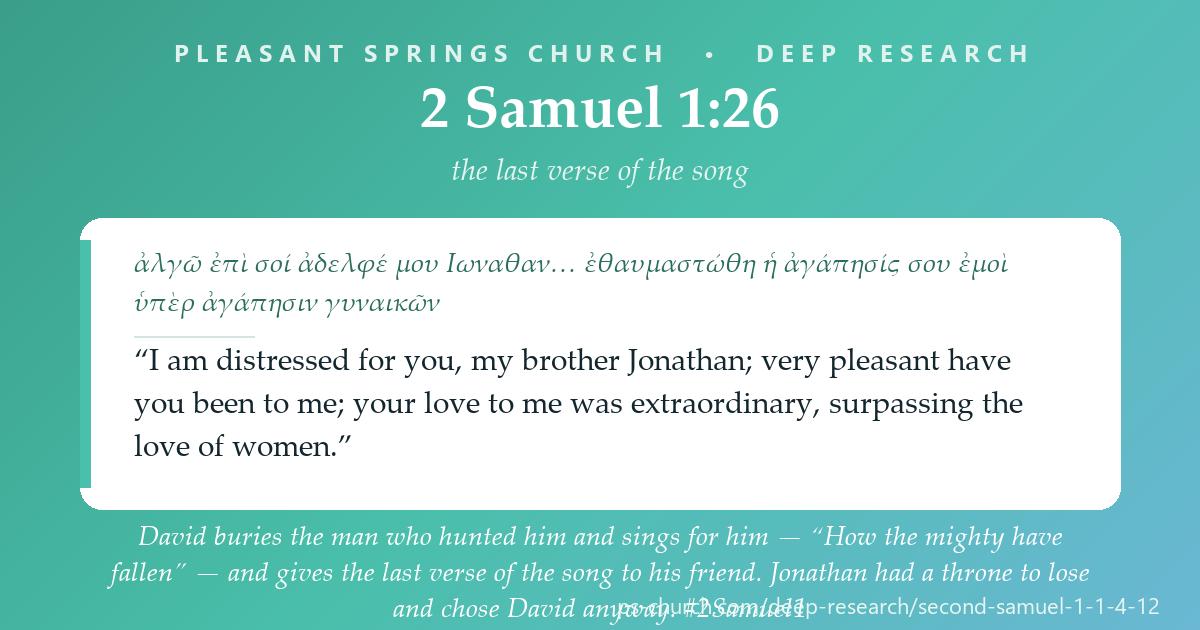
- On 1:26, say what the words do and stop there. The verse is a line of a funeral poem: “your love to me was extraordinary, surpassing the love of women.” Three things can be said with confidence. (1) The vocabulary is covenant vocabulary. Jonathan and David cut a covenant (1 Sam 18:3; 20:8, 16–17; 23:18), and “love” in this idiom is loyalty that binds — the word used of vassals and kings as well as of families (Moran, CBQ 25 [1963]; Thompson, VT 24 [1974]). (2) The comparison is about reliability, not romance: Jonathan chose David over his own father, his own throne and his own life, at a cost no other relationship in the story ever pays. (3) Some modern readers take the verse as evidence of a sexual relationship. The text neither says nor implies it; the Hebrew Bible is not shy about naming such things when it means them, and the narrative that surrounds these two men is about oaths, arrows, a table, and a kingdom. Say it once, without heat, and move on — because the thing the verse is actually doing is far too rare to be spent arguing about: a man is weeping in public over a friend, and Scripture wrote it down and kept it.
- The composition history is debated and nothing here depends on it. The History of David’s Rise, Rost’s Succession Narrative, the extent of Deuteronomistic editing, and the relation of the Greek text to a different Hebrew edition are all live arguments, and 4QSamuela has made the last one livelier than it was in 1950. We name the positions and do not adjudicate. What the passage claims on us — that a man refused three times to take a kingdom from a killer, and sang over his enemy — does not move with any of them.
A song for an enemy, a refusal to be given a throne, and a king who admits he is not strong enough.
Name what you learned, why it matters, and one concrete response.
What should we carry away — and do?
- The narrator lets a claim stand without correcting it. The Amalekite’s account does not match 1 Samuel 31, and Scripture prints both and says nothing. That is not carelessness; it is how this narrator works. If a study has to decide the question in order to have a point, the point was never in the text.
- David is not glad, and he makes sure everyone knows it. He tears his clothes, he fasts, he executes the man who expected a reward, and then he writes a poem that mentions none of Saul’s sins. Whatever else that is, it is a decision about what to do on the day the news comes about someone who hurt you.
- The song counts. Three times: 1:19, 1:25, 1:27. And in between, no theology, no explanation, no God — a shield without oil, a scarlet dress, two men swifter than eagles. Scripture contains a lament that does not resolve, which means the church is allowed one too.
- Jonathan gets the last verse, and it is about faithfulness. “Your love to me was extraordinary.” He had a throne to lose and he chose David anyway. That is what the word means here, and it is a great deal rarer than either sentimentality or suspicion would let it be.
- Joab is in the book, and he is not explained. He murders a man in the gate of a city of refuge and stays in command. The narrator does not excuse him and neither should we — and 3:39 is the king’s own confession, not ours: “I was gentle today, though anointed king.” Anointed, and outmatched, in one sentence.
- And the throne is coming anyway. Four chapters later God will bind himself to this man’s house forever (2 Samuel 7). Not to a man who had everything under control. To this one.
A word about typology, clearly labelled — all three parts. What the text says: 2 Samuel 1–4 is about David and Saul and Abner and Joab; it makes no messianic claim and announces itself as nothing but what it is. What the New Testament draws from it: nothing — no New Testament writer quotes these chapters, and it would be dishonest to say otherwise. What we may see from this side of the cross: the Septuagint’s own phrase for the man David would not touch is ὁ χριστὸς κυρίου, and it is exactly what Simeon is promised he will see before he dies (Luke 2:26). Two anointed men, one word. And beyond the vocabulary there is a shape a Christian reader is going to see and is right to see: a king who will not seize the kingdom by shedding blood, who refuses the crown when it is offered by an assassin, and who weeps over the house that hunted him. The text does not say that is a picture of Christ. We are meant to see it anyway — Luke 24:27 has the Lord himself reading the Scriptures that way — and the only thing ruled out is putting our seeing into the text’s mouth. Read it again next year and see what else is there.
Step in response: two things this week. First, find the person whose downfall you have quietly been waiting for, and refuse the satisfaction — out loud if you can, in words somebody else hears. David did it in a poem in front of a nation. Second, if you are living with something you cannot fix — a person you cannot control, a wrong you cannot punish — say 3:39 honestly instead of pretending: I was gentle today, though anointed king. The Bible put that sentence in a king’s mouth so that you would know you are allowed to say it.
2 Samuel 1:26 · to share
LXX (Rahlfs, 2 Kingdoms — Old Greek) + ESVEvery Deep Research page traces its passage across the whole sweep — the Old Testament, the Second-Temple world between the testaments (historical witnesses, not Scripture), and the New Testament. Follow the thread:
Pleasant Springs Church — Deep Research
Research method after Michael S. Heiser’s Bible Research Method (examine dictionaries → ancient literature → important words → textual connections → academic publications → share), with the Pleasant Springs “Author & Audience” foundation. Scripture set in the Hebrew, the Greek editions named on each page and the ESV (Old Testament), and the Greek New Testament and the ESV (New Testament), per the practice of Pleasant Springs Church. 2 Samuel 1–4 research grounded in McCarter (Anchor), Anderson (WBC), Auld (OTL), Brueggemann (Interpretation), Alter (The David Story), Bergen (NAC), Firth (Apollos) and Baldwin (TOTC), with Barthélemy, Tov, Ulrich and Fernández Marcos on the Greek and the scrolls. Book name: in the Septuagint this book is 2 Kingdoms (Basileiōn B) — 1–2 Samuel and 1–2 Kings are one continuous work in Greek, 1–4 Kingdoms. Which Greek: on Thackeray’s standard division this passage lies in section ββ (2 Kingdoms 1:1–11:1), which is Old Greek, not kaige; the kaige revision toward a proto-Masoretic Hebrew (section βγ) begins at 2 Samuel 11:2 and runs to 3 Kingdoms 2:11, and inside it Vaticanus is a revision rather than the oldest Greek while the Antiochene (Lucianic) text often preserves something older. That distinction is stated on every page of this set because “the LXX reads X” is an ambiguous claim in Kingdoms. The Antiochene text is nonetheless a distinct witness here too, and 1:21 is given as an instance (“your high places are mountains of death,” with the Old Latin montes mortis). Text & numbering: Hebrew from the Masoretic Text; Greek from Rahlfs’s Septuaginta, printed without editorial punctuation and checked verse by verse rather than back-translated; English ESV. There is no chapter- or verse-offset in these four chapters: Hebrew and Greek alike have 27, 32, 39 and 12 verses, counted rather than assumed. The divergences in the printed verses are reported individually and are not called “rendering differences” when they are pluses or minuses: the minus of קָשֶׁת (“the Bow”) at 1:18, which the ESV follows and footnotes; the different reading of הַצְּבִי at 1:19 (στήλωσον, “set up a monument”); “fields of offerings” as ἀγροὶ ἀπαρχῶν at 1:21; the plus of a second “not divided” at 1:23; Helkath-hazzurim rendered μερὶς τῶν ἐπιβούλων at 2:16; ἐνεδρεύων at 3:27; רַךְ read as συγγενής at 3:39; and the wholly different sentence at 4:6, where the Greek has the doorkeeper asleep over the wheat — a reading the ESV prints in its own footnote and Josephus plainly knew. The names are reported rather than tidied: Masoretic Ish-bosheth, Chronicles’ Esh-baal (1 Chr 8:33; 9:39), Rahlfs’s Ιεβοσθε in chapters 2–3 and Μεμφιβοσθε in chapter 4 — and Samuel and Chronicles are not harmonised anywhere on this page, including the Chronicler’s omission of the whole civil war. Qumran: 4QSamuela (4Q51) is extant at 1:4–5, 10–13; 2:5–16, 25–27, 29–32; 3:1–15, 17, 21, 23–25, 27–39; 4:1–4, 9–12, and its agreement with the Greek in reading “Mephibosheth” at 4:1 and 4:12 is reported with the editors’ judgement that it is an error; nothing else on this page is built on the scroll, because that would require DJD XVII rather than a summary. ANE background from the Tale of Aqhat (ANET 152–153, verified in our local scan) for the dirge form and the curse on the place. Second-Temple and rabbinic witnesses (Josephus, Ant. 7.1.1–7.2.1 in Whiston’s numbering; Sirach 47:1–11; 11QPsa col. XXVII; b. Bava Batra 14b–15a) are read as witnesses and never levelled with Scripture. The contradiction between 2 Samuel 1:10 and 1 Samuel 31:4–5 is stated plainly, both accounts are printed, the narrator’s silence is named as deliberate, and the gap is left open rather than closed in either direction. Joab is reported without excuse, and the fact that David kept him is reported too. The “apology of David” reading (McCarter, JBL 99 [1980]) and its sceptical counter-reading (Halpern, McKenzie) are both laid out and neither is adopted. 1:26 is handled as covenant love, with the treaty-language evidence named (Moran, CBQ 25 [1963]; Thompson, VT 24 [1974]), the modern sexual reading noted once and declined as unsupported by the text, and no heat spent on it. The typology is labelled in all three parts per the house position: what the Old Testament text says, what the New Testament draws (nothing, here), and what we may rightly see from this side of the cross.
Scripture quotations marked ESV are from the ESV® Bible (The Holy Bible, English Standard Version®), © 2001 by Crossway, a publishing ministry of Good News Publishers. ESV Text Edition: 2016. Used by permission. All rights reserved. The ESV text may not be quoted in any publication made available to the public by a Creative Commons license, and the ESV may not be translated in whole or in part into any other language. www.esv.org
|
Did this study bless you today? 💚 Give to Support PS Church100% of gifts go to the General Fund — thank you. |