It opens as a travel note. “In the spring of the year, the time when kings go out to battle… but David remained at Jerusalem” — and that last clause is the indictment, delivered without a single adverb. What follows is reported here plainly, once, and without lingering: he saw a woman from the roof, he sent, he took her, he lay with her. The verbs are all his. The text records no word of consent from Bathsheba and does not need to — he is the king, she is a serving soldier’s wife, and the messengers are already at her door. She has one line in the whole chapter, two words in Hebrew: “I am pregnant.” Then Uriah the Hittite, who will not go down to his own house while the ark and the army are in the field, and who carries to Joab, in his own hand, the letter that kills him — the man David is destroying is the more scrupulous of the two. And at the very end of the chapter, the first sentence in which anybody evaluates anything: “But the thing that David had done displeased the Lord” (11:27). Then a prophet with a story about a ewe lamb that “used to eat of his morsel and drink from his cup and lie in his arms, and it was like a daughter to him” — a king whose anger is greatly kindled against the rich man — and two words: “You are the man.” Then the judgment, and three words back (“I have sinned against the Lord”), and a forgiveness that does not cancel a single consequence, and a child’s death reported soberly, and then Solomon — “and the Lord loved him.” This study works 2 Samuel 11:1–12:31 in Hebrew, Greek and ESV, and it names the text-critical situation instead of hiding it: 11:2 begins the kaige section, so from that verse on the Greek in front of you is a revision toward a proto-Masoretic Hebrew and not the oldest Greek. See the method →
2 Samuel 11:1–12:31 (selections)
Hebrew · Greek (Rahlfs, 2 Kingdoms) · ESVThe book, the section, the edition — and why “the LXX reads X” is an ambiguous sentence in these chapters. In the Septuagint this book is 2 Kingdoms (2 Reigns) — Βασιλειῶν Βʹ (Basileiōn B). 1–2 Samuel and 1–2 Kings are one continuous work in Greek, Βασιλειῶν Αʹ–Δʹ, and a reader hunting for “2 Samuel” in a Greek Bible will not find it under that name. (Worth noticing once: our English names for the Torah — Genesis, Exodus, Leviticus, Numbers, Deuteronomy — are the Septuagint’s names, while Samuel and Kings keep Hebrew-derived ones. An English Bible already mixes the two traditions on its contents page.)
⚠️ And this passage sits on a seam that changes what the Greek column even is. Dominique Barthélemy showed in Les Devanciers d’Aquila (1963) that the Greek of Kingdoms is not one translation. Long stretches are a later kaige revision — a first-century pull of an older Greek text back toward a proto-Masoretic Hebrew, named for its stereotyped rendering of Hebrew גַּם (gam, “also”) by καί γε. Using Thackeray’s section letters: 2 Kingdoms 11:2 → 3 Kingdoms 2:11 (the section βγ) is kaige, and so is 3 Kingdoms 22 → 4 Kingdoms 25; what lies between is Old Greek. 2 Samuel 11:1 is the last verse before the seam. 11:2 is the first verse inside it.
What that means, said plainly. Inside a kaige section, Codex Vaticanus is a revision, not the oldest Greek — and Rahlfs’s text of Kingdoms leans on Vaticanus. The Antiochene (Lucianic) manuscripts frequently preserve an older Greek reading in exactly these stretches. So in these two chapters the sentence “the Septuagint reads X” is genuinely ambiguous until you say which Greek. This page prints Rahlfs’s Septuaginta (CATSS digitization; punctuation editorial, proper names unaccented), names it in the column heading, and cites no Antiochene reading, because we have not consulted the critical edition — that is Fernández Marcos and Busto Saiz, El texto antioqueno de la Biblia griega, and a reader who wants those readings should go there rather than to a summary. There is as yet no Göttingen edition of 2 Kingdoms; the fuller apparatus is Brooke–McLean’s larger Cambridge Septuagint. On why this library prints what it prints, see the texts we print.
You can watch the seam yourself, and we counted it rather than assumed it. In the whole of 2 Kingdoms in the Rahlfs/CATSS text, καί γε occurs 28 times: twice before the seam (2:6, 2:7) and twenty-six times from 11:2 onward. Five of those twenty-six are in these two chapters — 11:12, 11:17, 11:21, 11:24 and 12:14 — and every one of them is rendering גַּם. It is a tendency and not a machine: at 12:13 the reviser rendered the same particle with a plain καί, and at 12:27 he did not render it at all. The other classic Hebraism of this revision is here too, twice in our verses: ἐγώ εἰμι stapled in front of a finite verb to represent אָנֹכִי — at 11:5 (“I am — I am pregnant”) and twice over at 12:7. And the deaths in this passage are counted with that same little word: “Uriah the Hittite also died” (11:17), “your servant Uriah the Hittite is dead also” (11:21, 11:24), “also the child who is born to you shall die” (12:14).
Numbering. There is no offset here. Rahlfs’s 2 Kingdoms has 27 verses in chapter 11 and 31 in chapter 12, exactly as the Hebrew and the English do; this was counted, not assumed, and no line above needed a double reference. (One place where numbering does move is worth flagging because this chapter sends readers there: the psalm headed “when Nathan the prophet went to him” is Psalm 51 in English but Psalm 50 in the Septuagint, and because both Hebrew and Greek count the two-line heading as verses 1–2, “Have mercy on me, O God” is ESV 51:1 · MT 51:3 · LXX 50:3.)
The divergences in the verses printed above, enumerated — not a sample, the list. 11:1 the Hebrew consonants are those of “the messengers,” the Greek reads “of the kings” and so does 1 Chronicles 20:1. 11:3 the father is Eliam in Hebrew, Eliab in Greek, Ammiel in 1 Chronicles 3:5. 11:11 the Hebrew’s double oath (“by your life and by the life of your soul”) is single in Greek; “booths” becomes “tents.” 11:27 the thing was evil in Hebrew and appeared evil in Greek. 12:1 Greek plus, “the prophet.” 12:3 Greek renders one Hebrew verb with two. 12:6 fourfold in Hebrew, sevenfold in Greek. 12:7 Greek plus, “who did this.” 12:9 ketiv “his eyes” / qere “my eyes”; Greek and ESV follow the ketiv. 12:14 Hebrew and Greek agree on “the enemies of the Lord”; the ESV prints “the Lord” and footnotes both the Hebrew and a Dead Sea scroll reading “the word of the Lord.” 12:24 ketiv “he called” / qere “she called”, Greek unmarked for gender, plus “and she conceived.” 12:25 Jedidiah is transliterated, not translated, so the meaning vanishes in Greek. Two more just outside the printed lines, reported because they are real: at 12:30 the Greek treats מַלְכָּם as a proper name, Μελχολ, where the Hebrew pointing and the ESV read “their king” (many modern versions read the Ammonite god Milcom); and at 12:31 the Greek lists two implements where the Hebrew lists three. That is the whole list for these verses. Where nothing is noted — 11:2, 11:4, 11:14–15, 11:26, 12:5, 12:13, 12:23 — the two columns say the same thing, and that is worth saying out loud rather than leaving to silence. From the Judean Desert: 4QSama (4Q51) preserves material from these chapters, and the ESV footnote at 12:14 reports one of its readings; the transcriptions are in DJD 17 (Cross, Parry, Saley, Ulrich, 2005) and no further argument is built on the scroll here, because that would require the edition and not a summary.
The Shape of the Passage
ConcentricBehind this passage stands the promise of 2 Samuel 7 — “your house and your kingdom shall be made sure forever” — made to the same man, four chapters earlier. Behind that stands the law of the king in Deuteronomy 17:14–20, which told Israel’s king not to multiply wives and to keep a copy of the law beside him and read it all his days. In front of it stands everything that happens to David’s house from chapter 13 onward.
Author
A narrator who withholds his verdict for twenty-six verses and then gives it in nine words. Chapter 11 has no adverbs. Nobody is called wicked. There is no chorus, no aside, no “and this was a great sin.” The camera simply follows a man from a rooftop to a letter, and then, in the last clause of the chapter, the narrator speaks for the first and only time: the thing that David had done displeased the Lord. That restraint is not squeamishness and it is not neutrality — it is the technique. He makes you watch, and he makes you judge, and then he tells you that God has already judged.
He is also, in Robert Alter’s sense, a master of the gap. We are told nothing of what Bathsheba felt, nothing of what Uriah suspected, nothing of what Joab thought of the letter he had to obey. The silences are deliberate, and the discipline they impose on a reader is simple: what the text does not say, we do not say either. That rule will matter twice on this page — when readers reach for a seductress who is not in the text, and when they reach for an explanation of the child’s death that is not in the text.
And he writes in one piece with what came before. The same word is used of David taking a woman here that is used of the rich man taking a lamb; the same word puts the lamb in the poor man’s bosom and the kingdom in David’s. Four chapters earlier God told this king, through this same prophet, that his house would stand forever (2 Sam 7:16); now the same prophet tells him the sword will never leave it. The book does not have two Davids. It has one, and it refuses to let you keep either half without the other.
Audience
Israelites who sang this man’s psalms. That is the first thing to hold. The audience for 2 Samuel 11 is an audience that already knew David as the shepherd, the giant-killer, the man after God’s own heart, the founder of the dynasty they were living under. This chapter was written for people with every political and religious reason to leave it out — and it was not left out. A national literature that records this about its founding king is doing something almost no national literature does.
People who already knew how it ends. They knew about Amnon and Tamar, about Absalom, about the sword that never left the house. So they did not read 12:10–12 as a prediction; they read it as an explanation of the family they had heard about all their lives. This is why the passage cannot be preached as though forgiveness undid it. Nathan says both things in the same breath — “the Lord also has put away your sin” and “the sword shall never depart from your house” — and the rest of 2 Samuel is the second sentence being kept.
And later, people who had to decide what to do with it in public. By the Mishnah’s day the question was live: m. Megillah 4:10 lists “the incident of David” (2 Sam 11:27) among the passages that were not to be read out and translated in the synagogue, and the Talmud’s stated concern in the neighbouring cases is “the honour of David.” That is a real and sympathetic instinct, and Scripture itself did not follow it. The chapter is in the Bible. Somebody decided that the honour of David was worth less than the truth.
Orient on Kingdoms and the kaige recension, Rabbah and the Ammonite war, adultery and homicide in Israelite law, the prophet as royal critic, and the office of the ewe-lamb parable.
Search by topic: Samuel, Books of; Kingdoms, Books of (Greek); kaige recension; Lucianic / Antiochene text; Bathsheba; Uriah the Hittite; Hittites in Israel; Eliam; Ahithophel; Joab; Nathan (prophet); Rabbah / Rabbath-Ammon; Ammon, Ammonites; adultery; capital law; blood-guilt; parable (juridical); repentance and confession; Solomon; Jedidiah; the Succession Narrative.
Which articles are relevant?
- Anchor Bible Dictionary — “Samuel, Books of,” “Bathsheba,” “Uriah,” “Nathan,” “Joab,” “Ahithophel,” “Rabbah,” “Ammon,” “Hittites,” “Adultery,” “Solomon,” and — the one most readers skip and should not — “Septuagint” and “Kaige Recension.”
- Dictionary of the OT: Historical Books (IVP) — “Samuel, Books of,” “David,” “Prophets and Prophecy,” “Sin, Guilt,” “Women,” “Text and Textual Criticism.” The last is the one that will tell you why 1–2 Samuel is the standard textbook example.
- On the Greek specifically — any article on the Septuagint of Samuel–Kings must tell you two things or it is not worth reading: that the four books are one series called Kingdoms, and that the Greek of that series is not uniform, because a later revision touched some sections and not others. An article that speaks of “the LXX of 2 Samuel” as one flat thing is describing something that does not exist.
- NIDOTTE / TDOT — שָׁלַח (šālaḥ, send), לָקַח (lāqaḥ, take), חֵיק (ḥêq, bosom), רַע (raʿ, evil), נָאַץ (nāʾaṣ, spurn), חָטָא (ḥāṭāʾ, sin), נָחַם (nāḥam, comfort), כִּבְשָׂה (kiḇśāh, ewe lamb).
Bibliography surfaced:
- P. Kyle McCarter Jr., II Samuel (Anchor Bible) — the standard critical commentary in English and the fullest on the Greek and Qumran evidence; A. Graeme Auld, I & II Samuel (OTL); David Toshio Tsumura, The Second Book of Samuel (NICOT); Robert D. Bergen, 1, 2 Samuel (NAC); David G. Firth, 1 & 2 Samuel (Apollos OTC); Bill T. Arnold, 1 & 2 Samuel (NIVAC); Walter Brueggemann, First and Second Samuel (Interpretation).
- Robert Alter, The David Story (translation and commentary); Meir Sternberg, The Poetics of Biblical Narrative, on the gaps in this chapter; J. P. Fokkelman, Narrative Art and Poetry in the Books of Samuel, vol. 1, which covers 2 Samuel 9–20 at length. (Alter, Sternberg and Fokkelman read these texts as literature and do not share the church’s confession; we take the tools, not the metaphysics.)
- Dominique Barthélemy, Les Devanciers d’Aquila (1963); Natalio Fernández Marcos, The Septuagint in Context; Emanuel Tov, Textual Criticism of the Hebrew Bible; Eugene Ulrich, The Qumran Text of Samuel and Josephus; Cross, Parry, Saley and Ulrich, Qumran Cave 4.XII: 1–2 Samuel (DJD 17).
What a spring campaign was, what the law of the ancient world did with adultery and rape, and what the ancient retellings could not bear to leave standing.
First the world: campaigning season, a walled Ammonite capital, a roof in Jerusalem, and what Israel’s neighbours legislated about a married woman. Then watch Josephus, the Mishnah and the Talmud handle this chapter — because what they change tells you precisely which sentence they could not live with, and the same sentences are the ones we hurry past.
Which parallels shed light on the world of this passage?
“The time when kings go out” is a real season, not a proverb. Campaigning in the Levant began after the spring rains, when the roads were passable and there was standing grain to live off. Assyrian royal annals date campaign after campaign to those months, and the point of 11:1 is that everything about the year is normal except the king. Rabbah — Rabbath-Ammon, under modern Amman — sat on a defensible spur with its own water supply, which is why the siege runs across two chapters and why Joab has to send for David to come and finish it (12:26–28). The whole story happens inside a siege that nobody in it can leave except the man who never went.
Uriah is a Hittite with a Yahwistic name, and he is one of the Thirty. אוּרִיָּה means “the Lord is my light.” He is a foreigner by descent, a covenant-keeper by conviction, and 2 Samuel 23:39 puts him at the end of the roll of David’s mighty men: “Uriah the Hittite: thirty-seven in all.” The list closes on the man the king killed. Two names earlier in the same list stands “Eliam the son of Ahithophel the Gilonite” (23:34), which many readers take to be Bathsheba’s father — making David’s counsellor Ahithophel her grandfather, and putting a very different light on what happens later in the book when Ahithophel changes sides. The text never says they are the same Eliam. It is an inference, it is a good one, and it is not certain.
Israel’s neighbours legislated about this, and the comparison is instructive in both directions. The Code of Hammurabi §129 (ANET 171) treats consensual adultery as capital for both parties, with one striking qualification: “If the husband of the woman wishes to spare his wife, then the king in turn may spare his subject.” But §130 distinguishes the case of force sharply: a man who violates a betrothed girl “shall be put to death, while that woman shall go free.” The Middle Assyrian Laws A §12 (ANET 181) are blunter still: if a man seizes a married woman in the street and “she would not consent (and) kept defending herself, but he has taken her by force,” then “they shall put the seignior to death, with no blame attaching to the woman.” Even the Bronze Age knew the difference between consent and power. Israel’s own law said the same (Deut 22:25–27). None of this tells us what happened on that roof — the text does not tell us — but it does dispose of the idea that ancient people were incapable of the distinction, or that a reader who asks about consent is importing a modern question.
- Code of Hammurabi §§129–130 (ANET 171, trans. Theophile J. Meek) (an ancient law collection — a witness, not Scripture) — adultery capital for both; forced intercourse capital for the man alone.
- Middle Assyrian Laws, Tablet A §12 (ANET 181, trans. Meek) (a witness, not Scripture) — “they shall put the seignior to death, with no blame attaching to the woman.”
- Josephus, Antiquities 7.7.1–4 (Whiston’s chapter numbering) (Second-Temple — a witness, not Scripture) — and he does not whitewash it: “But David fell now into a very grievous sin, though he were otherwise naturally a righteous and a religious man.” He keeps the parable almost intact (with fourfold, agreeing with the Hebrew against the Greek), keeps “this man was a wicked man,” keeps the announcement of what will happen to David’s house, and keeps the child’s death. What he adds is motive: Nathan “considering that kings, when they fall into a passion, are guided more by that passion than they are by justice… resolved to conceal the threatenings that proceeded from God,” which turns the parable into a courtier’s tactic. What he drops is the line that matters most: 2 Samuel 12:23 is gone. In its place David gives his servants a piece of philosophy about the uselessness of grief that cannot be undone, “and they commended the king’s wisdom and understanding.” He also makes Uriah Joab’s armour-bearer — a detail 2 Samuel 23:37 gives to a different man — and has Nathan name the child Solomon.
- Josephus, Antiquities 7.15.2 (his obituary of David) (a witness, not Scripture) — David “was not guilty of any offense in the exercise of so great an authority, but in the business of the wife of Uriah.” It is the one exception he cannot write out, and he does not try.
- Sirach 47:1–11 (Deuterocanonical / Apocryphal — a witness, not Scripture; not levelled with the canon at Pleasant Springs) — the “Praise of the Fathers” opens the David section with καὶ μετὰ τοῦτον ἀνέστη Ναθαν προφητεύειν ἐν ἡμέραις Δαυιδ, “and after him rose up Nathan to prophesy in the days of David” (47:1), and closes it with κύριος ἀφεῖλεν τὰς ἁμαρτίας αὐτοῦ, “the Lord took away his sins and exalted his horn forever” (47:11). Second-Temple Judaism did not deny that David sinned; it confessed that God forgave him.
- m. Megillah 4:10 (rabbinic — a witness, not Scripture) — among the passages governed by rules for public reading and Aramaic rendering, “the incident of David” (cross-referenced to 2 Sam 11:27) and the incident of Amnon are listed as neither read nor translated. b. Megillah 25a–b works through the list and states the concern out loud in the neighbouring case: “lest you say that one should be concerned for the honour of David.” The manuscripts of this mishnah vary between “read but not translated” and “neither read nor translated,” and the Gemara discusses the difference; either way, this is a community deciding how much of it to say out loud.
- b. Shabbat 56a (rabbinic — a witness, not Scripture) — the most famous attempt to acquit him: R. Shmuel bar Naḥmani in the name of R. Yonatan, “Whoever says that David sinned is nothing other than mistaken,” supported by three readings — that 12:9’s infinitive “to do evil” means he intended and did not act; that “you struck Uriah with the sword” means only that he failed to try him before the Sanhedrin, Uriah having rebelled against the king by his words in 11:11; and that soldiers in David’s army left conditional bills of divorce, so “you had a right of marriage in her.” It is ingenious, it is not what the chapter says, and the same passage records Rav’s dissent.
Line them up and the pattern is exact. Nobody in antiquity denied that something terrible happened here. What they could not leave alone was different in each case, and each of them is a temptation we still have.
(1) The parable’s sting. Josephus keeps the ewe lamb and then explains why Nathan used it — because kings in a passion do not listen to justice. Reasonable, and it makes the parable a technique instead of a trap. The Bible gives no motive at all. It just says the Lord sent him.
(2) David’s guilt. b. Shabbat 56a is the honest, extreme version of an instinct most sermons have in milder form: this cannot mean what it says about him. The Talmud at least argues it out in the open, and records the objection. A sermon that quietly turns 2 Samuel 11 into a lesson about “letting your guard down” is doing the same work with less honesty.
(3) The sentence at the grave. Josephus deletes 12:23 and replaces it with prudence. Think about what that costs. “I shall go to him, but he will not return to me” is one of the few sentences in the Old Testament in which a bereaved parent says anything at all about where the child now is, and it is the one line the ancient rationalizer could not use.
(4) Whether to say it out loud at all. The Mishnah’s rule about public reading is not cynical; it is protective, and the honour of a king was a real thing to protect. But the chapter is in the Bible. Somebody in Israel wrote it, kept it, and copied it, about the founder of the dynasty they served. That is the decision this page follows: report it plainly, once, without prurience and without evasion, and let it stand.
One verb that maps the power in the room, one that convicts, one word that occurs twice, and the little particle that names a whole revision.
Count shalach yourself — fifteen, and note which one has a different subject. Then follow laqach from the roof to the crown; hold cheq at 12:3 beside 12:8; watch ra and “eyes” move together; and let gam do the two jobs it does here, one literary and one text-critical.
“Send.” Fifteen times in two chapters, and it is how the passage tells you who has power. David sends Joab to the war and stays; David sends and inquires; David sends and takes; she sends the two words that change everything (11:5); David sends for Uriah, sends him home, sends him back, sends the letter by his hand; Joab sends the report; David sends and gathers her in. Then 12:1: “And the Lord sent Nathan to David.” The verb does not change and the sending does not stop; the sender does. In Greek every one of them is a compound of στέλλω (ἀποστέλλω), so the drumbeat survives the translation intact.
“Take.” The passage’s second thread, and the one that convicts. David took her (11:4); the rich man took the poor man’s lamb (12:4); God says twice “you have taken his wife” (12:9, 12:10) and once “I will take your wives” (12:11). It is the verb of Eve in Genesis 3:6 and of Achan in Joshua 7:21, and in all three places it stands at the end of the same short chain — saw, wanted, took. That chain is not our imposition on the text; it is the text’s own shorthand for how sin works, used three times in three books.
“Bosom, lap, arms.” Exactly twice in the passage, and the two are the whole argument. The lamb “used to… lie in his bosom” (12:3 — the ESV renders “in his arms” and footnotes the Hebrew); and God says “I gave you your master’s house and your master’s wives into your bosom” (12:8). So the parable is not merely apt, it is quoted back: the thing the poor man had in his arms was taken by a man who had already been given more than he could hold. The Greek keeps the link cleanly with κόλπος in both verses.
“Also, moreover.” An ordinary particle carrying two loads at once. Literarily it is how the deaths are counted: “Uriah the Hittite also died” (11:17), “your servant Uriah the Hittite is dead also” (11:21, 11:24), “also the child who is born to you shall die” (12:14) — a word you would never underline, tolling four times over four bodies. Text-critically it is the single most important word in the Greek of these books: the kaige revision is named for rendering it καί γε, which it does at 11:12, 17, 21, 24 and 12:14 — and pointedly does not do at 12:13, where forgiveness is announced with a plain καί.
“Evil, harm, calamity.” Track it with the word “eyes” and the chapter’s moral architecture appears. David tells Joab “do not let this matter be evil in your eyes” (11:25, softened in English to “displease you”) — a man managing other people’s reactions. Two verses later: “the thing… was evil in the eyes of the Lord” (11:27). Then God quotes it back at him: “to do what is evil in his eyes” (12:9). Then the sentence: “I will raise up evil against you out of your own house” (12:11). Whose eyes decide what counts as evil is the question the chapter is built on, and it opens with a man on a roof, looking.
“Ewe lamb.” A female lamb, the sacrificial animal of Leviticus 4:32 and the animal a poor household might actually own. The parable spends four clauses on ordinary domestic detail — it ate from his plate, drank from his cup, slept in his arms, was like a daughter to him — and not one clause on its value. That is why the trap works: David is not asked to price a loss, he is asked to feel one, and he does, and then he passes sentence.
“Fourfold” — and here the columns part. The Hebrew has David impose the exact restitution of Exodus 22:1, four sheep for a sheep; the Greek reads ἑπταπλασίονα, sevenfold. Which is older cannot be settled from these two witnesses, and this page does not pretend otherwise: the Hebrew matches the Torah’s penalty exactly, which is an argument for it, and a reviser could just as easily have conformed it to the Torah, which is an argument against it. Josephus read fourfold. The ESV prints fourfold. The Greek column above prints sevenfold, and you can see it.
“Beloved of the Lord.” The name Nathan brings, and the last word of the story. Readers have long noticed the resonance with Dāwiḏ itself and with the root yāḏiḏ, “beloved” — the child who should not have existed is given, by name, what his father was called. And the Greek cannot carry it: Rahlfs transliterates Ιδεδι, so a Greek reader receives a name and not a meaning. The ESV footnotes the sense, which is the right call. Note too what the verse does not say: it does not say the child deserved it, or that David did. It says the Lord loved him.
Two things in the Hebrew of this passage, reported rather than tidied:
- The two ketiv/qere readings, and the fact that the ESV follows the written consonants both times. At 12:9 the consonants are בעינו, “in his eyes,” while the Masoretic reading tradition says בְּעֵינַי, “in my eyes” — a difference between God speaking of himself in the third person and in the first, inside a first-person speech. At 12:24 the consonants say “he called his name Solomon,” the reading tradition says “she called” — and whether the mother or the father names this child is not nothing, given how the chapter has treated her. The Greek follows the consonants at 12:9 and cannot arbitrate at 12:24, because ἐκάλεσεν does not mark gender. Neither is resolved here. The Hebrew column above prints the reading tradition; the note under each verse prints the other.
- “The enemies of the Lord” at 12:14, and why your Bible does not say it. The Hebrew reads “you have utterly scorned the enemies of the Lord,” which is not what the sentence means — David scorned God, not God’s enemies — and the Greek reads the same. The classical explanation is a pious scribal buffer, inserted so that the object of the verb “scorn” would not be the divine name itself; the ESV prints the sense (“the Lord”) and footnotes the Hebrew, and its second footnote reports that a Dead Sea scroll reads “the word of the Lord.” Three readings, all of them on the page of a standard English Bible if you look down. This is exactly the sort of thing the footnotes are for, and exactly the sort of thing readers are rarely told to read.
The promise four chapters back, the law of the king, the chain of seeing and taking, and the psalm the tradition attached to this chapter.
Trace five threads: 2 Samuel 7, which this passage puts under strain; Deuteronomy 17, which legislated against exactly this king; Genesis 3 and Joshua 7, where the same three verbs appear in the same order; Chronicles, which leaves the whole thing out; and Psalm 51, which the tradition and the psalm’s own heading attach to Nathan’s visit.
Which cross-references matter?
- 2 Samuel 7:1–17 — the promise, given by this prophet to this king four chapters earlier: “your house and your kingdom shall be made sure forever before me.” Read the two chapters together and you have the theological problem of the second half of 2 Samuel. Nathan brings both messages. The covenant is not withdrawn and the consequences are not waived, and 7:14’s “when he commits iniquity, I will discipline him with the rod of men” is the sentence that makes room for chapter 12 without cancelling chapter 7.
- Deuteronomy 17:14–20 — the law of the king, and it reads like a checklist against this passage: he shall not multiply wives for himself, nor lift up his heart above his brothers, and he shall write out a copy of this law and read in it all the days of his life “that he may learn to fear the Lord.” The one thing the king is required to keep beside him is the very word 12:9 says he despised.
- Genesis 3:6 and Joshua 7:21 — the same three verbs, in the same order, in three different books. “The woman saw… and took…”; “I saw… I coveted them and took them”; “he saw a woman… and David sent… and took her.” And in all three the taking is followed immediately by hiding, and the hiding by a question from God that the guilty party cannot answer.
- Exodus 20:13–17 — the sixth, seventh, and tenth commandments, in the order the chapter breaks them: he coveted, he committed adultery, he murdered. And Leviticus 20:10 sets the penalty for the second of those at death for both parties — which is what makes Nathan’s “you shall not die” in 12:13 a genuinely shocking sentence and not a formality.
- Exodus 22:1 — “he shall repay four sheep for a sheep.” David’s sentence in 12:6 is the Torah’s own tariff, quoted from memory by a man who has just been told a story about a stolen sheep and does not yet know he is in it. (The Greek’s “sevenfold” is discussed above and is not smoothed away.)
- Deuteronomy 22:22–27 — Israel’s law on adultery and on a woman overpowered in the open country, where the law itself says “the young woman has committed no offense punishable by death… there was no one to rescue her.” The Torah knew the difference between consent and force and wrote it down. 2 Samuel 11 does not apply the category either way; it simply records who did the verbs.
- 1 Chronicles 20:1–3 — the parallel that is not a parallel. The Chronicler keeps 11:1 almost word for word, including “but David remained at Jerusalem”, then jumps straight to the capture of Rabbah and the crown. Everything in between is simply absent. This page does not harmonize that and does not moralize about it: Chronicles is telling the story of the temple and the throne to a returned community, and it makes its own choices. But the two books are both in the canon, and a reader is entitled to notice that one of them says it and the other does not. (There is no Chronicles page in this library yet; cited from the text.)
- Psalm 51 (LXX Psalm 50) — its heading, which is verses 1–2 in both Hebrew and Greek, reads “when Nathan the prophet went to him, after he had gone in to Bathsheba” (Greek: ἐν τῷ ἐλθεῖν πρὸς αὐτὸν Νάθαν τὸν προφήτην). Whether the headings are original is debated and this page does not settle it; what is certain is that the tradition placed the Bible’s greatest prayer of repentance at this chapter’s door, and read it as the inside of 12:13. “Against you, you only, have I sinned” (51:4 · MT 51:6 · LXX 50:6) is the same confession as “I have sinned against the Lord,” expanded to fifty lines.
- Romans 3:21–26 and Romans 4:6–8 — where Paul, arguing that God justifies the ungodly, reaches for David as his second witness and quotes David’s own words about “the blessing of the one to whom God counts righteousness apart from works… blessed is the man against whom the Lord will not count his sin.” This is the canon’s own use of this man, and it is not sentimental: Paul’s point is precisely that the man was guilty.
Nathan does not begin with an accusation. He begins with a lawsuit. Uriel Simon named the form in a 1967 study in Biblica: the juridical parable — a fictitious case laid before someone who does not know he is the defendant, so that he passes sentence on himself before he can defend himself. The Bible has a small handful of them (the wise woman of Tekoa in 2 Samuel 14 is the next one, and Isaiah’s vineyard song in Isaiah 5:1–7 ends with the same reversal).
Notice the craft. The parable is not an allegory and does not need to be: there is no Uriah-figure, no adultery, no killing. It is only about property and about tenderness. Nathan spends every word he has on the lamb — it ate his morsel, drank from his cup, lay in his arms, was like a daughter — and none on the crime. He is not building an argument; he is building an attachment. And it works: David’s anger is “greatly kindled,” he swears by the Lord, he sentences the man to death and to fourfold restitution, and in doing so he demonstrates two things at once — that his moral judgment is completely intact, and that it has never once been turned on himself.
Two Hebrew words end it. אַתָּה הָאִישׁ. Not a rebuke, not a list; a pronoun and a noun. The Greek adds “who did this,” handing David back his own sentence verbatim, which is one of the rare places where the Greek is sharper than the Hebrew.
And notice what Nathan does not do. He does not ask David whether he is sorry. He does not offer terms. He tells him what God gave him (12:7–8), what he did (12:9), and what will follow (12:10–12) — and only then, after everything is on the table, does David say three words. The confession is not the price of hearing the verdict. It comes after it.
The commentaries, the Bathsheba question, the forgiveness-and-consequence problem, the child, and the honest limits of the Greek.
McCarter, Auld, Tsumura, Firth, Bergen, Arnold and Brueggemann on the text; Alter, Sternberg and Fokkelman on the narrative; Barthélemy, Fernández Marcos, Tov and Ulrich on the Greek and the scrolls. Then four live questions — and one of them this page answers rather than balances.
Commentaries & studies:
- P. Kyle McCarter Jr., II Samuel (Anchor Bible) — the fullest English treatment of the Hebrew, the Greek and 4QSama together; A. Graeme Auld, I & II Samuel (OTL); David Toshio Tsumura, The Second Book of Samuel (NICOT), the most detailed recent evangelical philology.
- David G. Firth, 1 & 2 Samuel (Apollos OTC); Robert D. Bergen, 1, 2 Samuel (NAC); Bill T. Arnold, 1 & 2 Samuel (NIVAC); Walter Brueggemann, First and Second Samuel (Interpretation) — the last is the one to read for the theology of chapter 12 even where you argue with it.
- Robert Alter, The David Story; Meir Sternberg, The Poetics of Biblical Narrative; J. P. Fokkelman, Narrative Art and Poetry in the Books of Samuel, vol. 1 — for the reading tools used in the structure block above.
- Uriel Simon, “The Poor Man’s Ewe-Lamb: An Example of a Juridical Parable,” Biblica 48 (1967) — the study that named the form; Sara M. Koenig, Isn’t This Bathsheba? A Study in Characterization and Bathsheba Survives — a history of how she has been read, which is worth having precisely because so much of that history is not in the text.
- Dominique Barthélemy, Les Devanciers d’Aquila; Natalio Fernández Marcos, The Septuagint in Context, and Fernández Marcos–Busto Saiz, El texto antioqueno de la Biblia griega; Emanuel Tov, Textual Criticism of the Hebrew Bible; Eugene Ulrich, The Qumran Text of Samuel and Josephus; Anneli Aejmelaeus on the Septuagint of Samuel.
Interpretation notes worth keeping:
- On Bathsheba, this page is not balancing two views, because the text does not offer two. Here is everything 2 Samuel 11 says about her before she speaks: she was bathing; she was beautiful; she was the daughter of Eliam and the wife of Uriah the Hittite. That is all. The verbs are David’s — he saw, he sent, he took, he lay. She comes when the king’s messengers fetch her and she goes home. The narrator gives her no motive, no glance, no scheme, and does not so much as hint at one; when God summarizes the crime in 12:9 he names two offences, murder and taking another man’s wife, and the offender in both is David. She is never charged, by the narrator or by God. The reading that makes her a seductress — the bath as bait, the rooftop as a stage — is a supplement to Scripture, it has a long history in art and in preaching, and it has done real damage to real people, because a congregation that learns to read a woman’s body as an accusation will read the women in front of it the same way. Add the plain facts of the situation: a king, a soldier’s wife, an absent husband, armed messengers at the door, and a total asymmetry of power. Whatever else is uncertain, consent is not something this text records, and it is not something a reader may supply.
- Forgiveness and consequence are both in 12:13–14, and neither is allowed to cancel the other. “The Lord also has put away your sin; you shall not die” and, in the next breath, “the child who is born to you shall die.” Two verses earlier: “the sword shall never depart from your house.” Every attempt to make one of these sentences soften the other misreads the passage. The forgiveness is real — David does not die, and Israel’s own law says he should have — and the consequences are also real, and the rest of 2 Samuel is them. This is the standing house position stated in a hard place: guilt is remitted; a life is not rewound. Anyone who has done serious damage and been genuinely forgiven already knows this, and it is a kindness rather than a cruelty for the Bible to say it out loud.
- The child’s death: the text gives no reason beyond the announcement, and this page will not manufacture one. Nathan says the child will die (12:14) and the child dies (12:18). Scripture does not explain why the consequence lands there, and readers have found it hard from antiquity onward — rightly. What this page will not do is offer the tidy answers: it was to teach David a lesson; it was the child’s own guilt; it is a pattern to expect. The last is worth naming explicitly and refusing: nothing here licenses reading a child’s illness or death as a verdict on a parent’s sin, and Christ himself refused that inference when it was offered to him (John 9:1–3). Pleasant Springs holds that we inherit a fallen nature but not inherited guilt; no infant in this passage or any other is charged with anything. Where Scripture gives no reason, we say so and stop.
- David’s words at 12:23 are his hope, and they are not a doctrine — but they are not nothing either. “I shall go to him, but he will not return to me.” The sentence has been read as simple realism about the grave, and as a real expectation of reunion; the Hebrew will carry both, and the ESV translates it flatly and lets it stand. What can be said without stretching it: David stops fasting because he believes the direction of travel is toward the child and not away from him. Whatever weight a grieving parent wants to put on that, this page does not intend to take from them and does not intend to overload for them. It is the last thing he says about the child, and the next thing the chapter says is that God gave him another son and loved him.
- The limits of what can be claimed from the Greek here, stated once. Because 11:2–12:31 lies inside the kaige section, agreement between Rahlfs and the Masoretic Text is weak evidence that the Old Greek agreed — the reviser’s whole purpose was to produce that agreement. Disagreements (the “sevenfold” at 12:6, “Eliab” at 11:3) are therefore more interesting than agreements, since they survived a revision aimed at removing them. And a claim of the form “the Septuagint reads X here” needs one more word before it means anything: which Septuagint. On the Antiochene text this page is silent by choice, not by oversight; see the codex note and the texts we print.
- The last verse of the chapter is disputed and is reported as such. 2 Samuel 12:31 has David set the captured Ammonites to saws, iron picks and axes and “pass them through” the brick kiln — the ESV renders it as forced labour and footnotes the Hebrew “pass through.” Whether the verse describes conscription or mutilation has been argued both ways for centuries, the Greek lists two implements where the Hebrew lists three, and 1 Chronicles 20:3 has the same ambiguity. We name the difficulty and do not adjudicate it, and we do not use an uncertain verse to build a picture of David in either direction.
A travel note, a parable, two words, and three words back.
Name what you learned, why it matters, and one concrete response. And read the fence at the bottom before you teach this chapter to anyone.
What should we carry away — and do?
- The sin starts with a man who was not where he was supposed to be. “The time when kings go out… but David remained at Jerusalem.” The narrator says nothing else about it, and he does not have to. Idleness is not the moral of the chapter, but the chapter does begin with a king off duty and it is worth noticing that nothing in what follows required a decision to sin — only a sequence of small permissions, each one available because he was already in the wrong place.
- The most scrupulous man in the story is the foreigner who dies. Uriah the Hittite would not go home to his own bed while the ark and the army were in the field, and he swore it by the king’s life. The man David destroyed kept the discipline David had abandoned. Do not let anyone preach this chapter without saying his name.
- God’s summary names the man wronged, and it is not the one most sermons name. “You have struck down Uriah the Hittite with the sword and have taken his wife… and have killed him” (12:9). The chapter is a murder before it is anything else, and the person with the least power in it is charged with nothing at all.
- The parable worked because it did not argue. Nathan spent every word on a lamb that ate off a poor man’s plate, and none on the king’s crime. David’s conscience was in perfect working order; it had simply never been pointed at himself. Most of ours are the same, and the cure is usually a story rather than a rebuke.
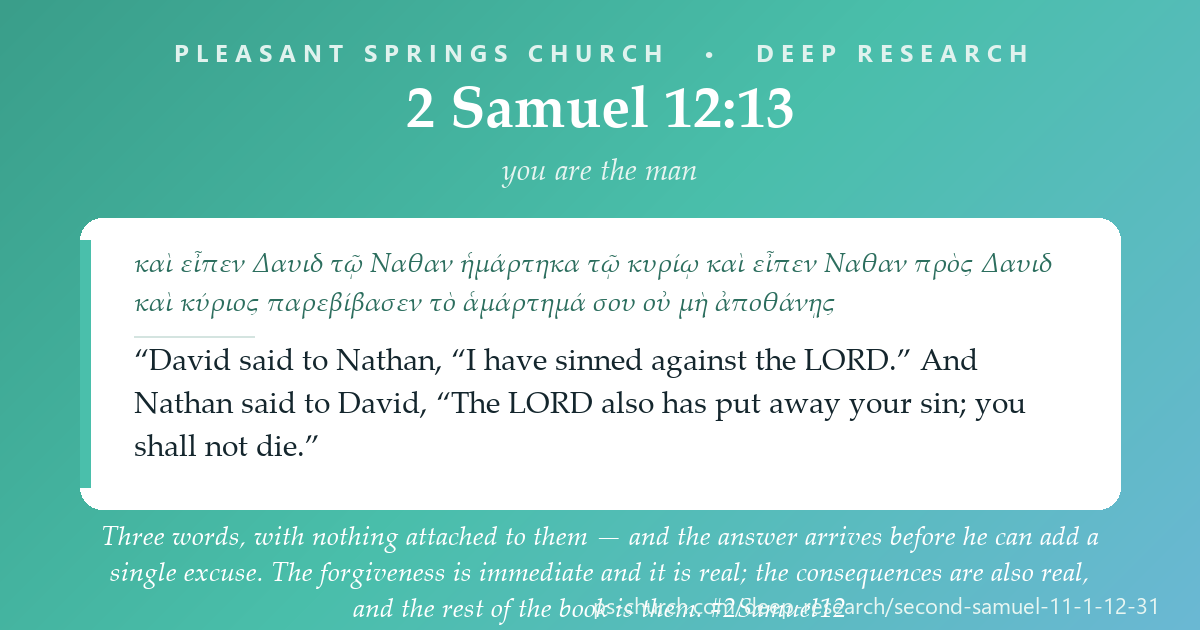
- Three words, and the answer came before he could add to them. “I have sinned against the Lord.” No excuse, no explanation of the pressures, no attempt to distribute the blame. And Nathan answers in the same breath: the Lord also has put away your sin. That is what confession looks like when it is real, and that is how fast the mercy is.
- And forgiveness did not reverse anything. The sword did not depart. The child died. The house came apart in the chapters that follow. Being forgiven and living with what you did are not alternatives; they are the same life. A church that promises otherwise is not preaching this chapter.
- The last word is not the judgment. “She bore a son, and he called his name Solomon. And the Lord loved him… So he called his name Jedidiah, beloved of the Lord.” The dynasty runs through this marriage, and God says so with a name.
A word about typology, clearly labelled. 2 Samuel 11–12 does not announce itself as being about Christ, and nothing in the passage points forward on its own account; if a study tells you the ewe lamb is Jesus, it has put our seeing into the text’s mouth. But two things are the canon’s own moves and stand on their own feet. First, Matthew 1:6 writes the genealogy of Jesus Christ like this: “David was the father of Solomon by the wife of Uriah” — the evangelist declines to write her name and writes the crime into the family tree instead, so that the line to the Messiah runs visibly through the worst thing his ancestor ever did. Second, Romans 4:6–8 makes David the standing biblical witness that God justifies the guilty, quoting his own words about the man whose sin the Lord will not count. And from this side of the cross the rest is hard to miss and we are meant to see it: the ewe lamb taken and killed in place of a rich man’s flock, the king who deserved to die and did not, and the sentence “you shall not die” spoken over a man for whom the law had no such provision. The Old Testament does not say that. We see it looking back, and that kind of seeing is a gift rather than a guess (Isaiah 53:6–7; Romans 3:21–26).
One. This passage is not a lesson about a woman’s body, her bathing, her roof, or her clothing, and it must never be taught as one. The text does not describe her bathing beyond the one word, does not tell us where she was or what she knew, and does not lay a single charge against her. Any sermon that turns 11:2 into advice about female modesty has taken a chapter about a king’s abuse of power and handed the bill to the person who had none. It is a very old habit and it should stop.
Two. Nobody in this story is protected by proximity to power — and everybody in it is endangered by it. Uriah’s loyalty did not save him; Joab’s usefulness made him an accomplice; Bathsheba’s marriage to a decorated soldier did not keep the king’s messengers off her doorstep. Power did not protect a single person in 2 Samuel 11. It only decided who would be spent. If a leader in the church ever needs a reason why accountability is not an insult, it is here, and the accountability in this chapter arrives in the form of one man walking into a throne room and saying two words.
Three. Report it plainly, once, and stop. No detail, no atmosphere, no dwelling — and equally, no skipping. The Mishnah wondered whether to read this in public; Scripture had already decided. The chapter is in the Bible because God did not think the honour of a great man was worth a lie.
Four. Read it slowly, and read it again in a year. This is meditation literature: the more times you go through it, the more of the craft you will see — the fifteen sendings, the lamb in the bosom, the little word “also” tolling over the bodies — and the more of yourself you will find in the man who was outraged by a story about a sheep.
Step in response: two things this week. First, name one thing plainly, to God and to one other human being, in three words with no explanation attached. David got the whole answer back before he could start qualifying. Second, ask who in your life has less power than you — an employee, a student, a younger believer, a person who needs something you can grant — and ask honestly whether they could say no to you. Then make sure they can.
2 Samuel 12:13 · to share
Greek (Rahlfs, 2 Kingdoms — kaige section) + ESVEvery Deep Research page traces its passage across the whole sweep — the Old Testament, the Second-Temple world between the testaments (historical witnesses, not Scripture), and the New Testament. Follow the thread:
Pleasant Springs Church — Deep Research
Research method after Michael S. Heiser’s Bible Research Method (examine dictionaries → ancient literature → important words → textual connections → academic publications → share), with the Pleasant Springs “Author & Audience” foundation. Scripture set in the Hebrew, the Greek editions named on each page and the ESV (Old Testament), and the Greek New Testament and the ESV (New Testament), per the practice of Pleasant Springs Church. 2 Samuel 11–12 research grounded in McCarter (Anchor Bible), Auld (OTL), Tsumura (NICOT), Firth (Apollos), Bergen (NAC), Arnold (NIVAC) and Brueggemann (Interpretation), with Alter (The David Story), Sternberg (Poetics of Biblical Narrative) and Fokkelman (Narrative Art and Poetry in the Books of Samuel, vol. 1) for the literary reading, and Uriel Simon (Biblica 48, 1967) for the juridical parable. ⚠️ The texts. The Greek Old Testament calls this book 2 Kingdoms (Βασιλειῶν Βʹ), one part of a single four-book work; the Greek column above is Rahlfs’s Septuaginta in the CATSS digitization, punctuation editorial, proper names unaccented. 2 Samuel 11:2 to 1 Kings 2:11 is the kaige section (Thackeray’s βγ; Barthélemy, Les Devanciers d’Aquila, 1963), so from 11:2 onward the Greek printed here is a first-century revision toward a proto-Masoretic Hebrew and NOT the oldest Greek — Vaticanus, on which Rahlfs’s Kingdoms text chiefly rests, is the revision in these stretches, and the Antiochene (Lucianic) text frequently preserves an older reading. No Antiochene reading is cited on this page, because the critical edition (Fernández Marcos and Busto Saiz) was not consulted; there is as yet no Göttingen 2 Kingdoms. The kaige character is demonstrated from the text itself rather than asserted: καί γε occurs 28 times in 2 Kingdoms, twice before 11:2 and twenty-six times after, five of those in this passage (11:12, 17, 21, 24; 12:14), always for גַּם — and not at 12:13, where the same particle is a plain καί; and ἐγώ εἰμι stands before a finite verb for אָנֹכִי at 11:5 and twice at 12:7. These counts are ours and can be checked. On the policy, the texts we print. Every divergence in the verses printed is enumerated in full in the codex note — messengers/kings at 11:1, Eliam/Eliab/Ammiel at 11:3, the single-limbed oath at 11:11, “appeared evil” at 11:27, the plus “the prophet” at 12:1, fourfold against sevenfold at 12:6, the plus “who did this” at 12:7, the ketiv/qere at 12:9 and 12:24, “the enemies of the Lord” at 12:14, and the untranslated Jedidiah at 12:25 — and where the columns agree, that is said rather than left to silence. Numbering: there is no offset — Rahlfs has 27 verses in chapter 11 and 31 in chapter 12, exactly as the Hebrew and English do, counted rather than assumed; Psalm 51 is LXX Psalm 50 and its heading is verses 1–2, so ESV 51:1 = MT 51:3 = LXX 50:3. Qumran: 4QSama (4Q51) preserves material here and the ESV footnote at 12:14 reports one of its readings; no further argument is built on it, since that requires DJD 17 rather than a summary. Chronicles is treated as a parallel witness and not harmonized: 1 Chronicles 20:1–3 keeps 2 Samuel 11:1 and 12:30–31 and omits everything between them, and 1 Chronicles 3:5 gives a third form of Bathsheba’s father’s name; both are reported as differences. ANE law from the Code of Hammurabi §§129–130 (ANET 171) and the Middle Assyrian Laws A §12 (ANET 181), verified in the local scan. Second-Temple and rabbinic witnesses (Sirach 47; Josephus, Ant. 7.7 and 7.15.2; m. Megillah 4:10; b. Megillah 25a–b; b. Shabbat 56a) are read as witnesses, never levelled with Scripture, and the Deuterocanon is tagged non-canonical at first mention. Pastoral fences. The events of 11:2–5 are reported plainly, once, without detail or prurience, and no share card is taken from them. The text’s silence about Bathsheba’s consent and the total asymmetry of power are stated; the “seductress” reading is named as a supplement to Scripture and refused, and the page says why it has done harm. The child’s death is reported soberly, its lack of explanation is owned rather than resolved (the standing rule where Scripture gives no reason), no inference from a child’s suffering to a parent’s guilt is permitted, and the church’s position that guilt is not inherited is stated. Forgiveness and consequence are held together exactly as 12:13–14 holds them. The typology at Matthew 1:6 and Romans 4:6–8 is attributed to the New Testament; what the page sees from this side of the cross is labelled as such and neither undersold nor put into the Old Testament’s mouth. 2 Samuel 12:31 is reported as textually and lexically disputed and is not adjudicated.
Scripture quotations marked ESV are from the ESV® Bible (The Holy Bible, English Standard Version®), © 2001 by Crossway, a publishing ministry of Good News Publishers. ESV Text Edition: 2016. Used by permission. All rights reserved. The ESV text may not be quoted in any publication made available to the public by a Creative Commons license, and the ESV may not be translated in whole or in part into any other language. www.esv.org
|
Did this study bless you today? 💚 Give to Support PS Church100% of gifts go to the General Fund — thank you. |