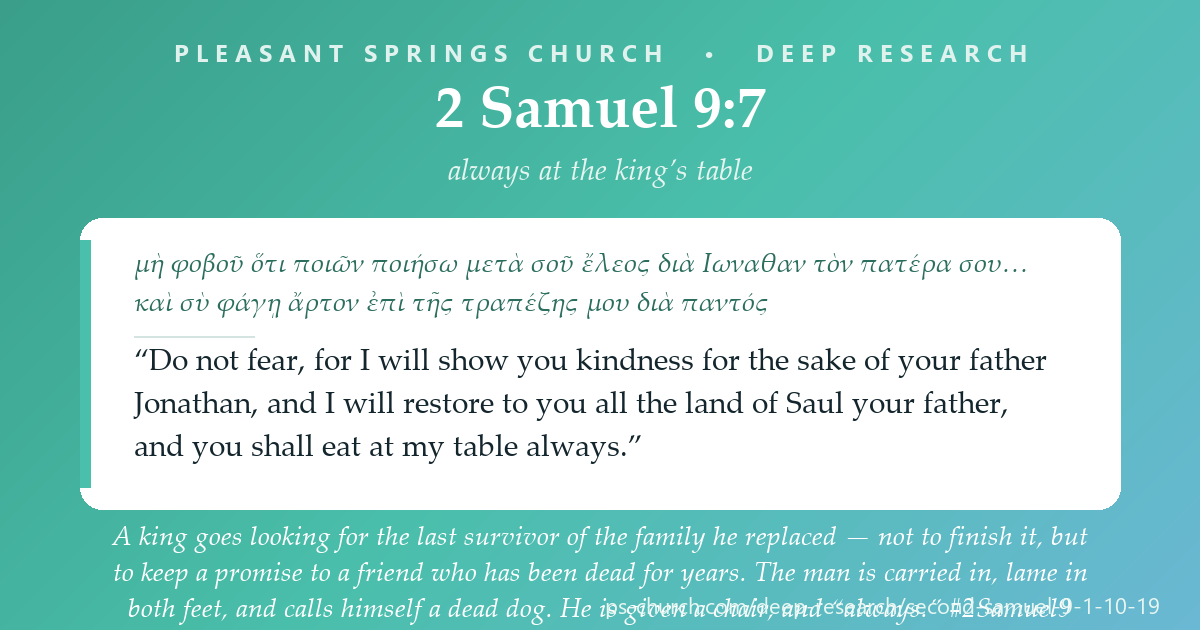
The wars are won and the throne is promised forever, and the first thing David does with all that security is ask a question nobody made him ask: “Is there still anyone left of the house of Saul, that I may show him kindness for Jonathan’s sake?” The word is ḥeseḏ — covenant loyalty, the word the book of Ruth is built on — and it sounds five times across these two chapters. A steward named Ziba answers, and what he says about the man he names is not his name but his body: “he is crippled in his feet” — dropped by his nurse at the age of five while the household fled the news from Gilboa. He is fetched from a place called Lo-debar, falls on his face, and says the two things a man says when he has been summoned by the king who replaced his grandfather: “Behold, I am your servant” and “What is your servant, that you should show regard for a dead dog such as I?” And David says: “Do not fear… you shall eat at my table always.” Then the narrator says it again. And again. And again — four times in thirteen verses — and finishes the chapter with two facts laid side by side and no word joining them: “So Mephibosheth lived in Jerusalem, for he ate always at the king’s table. Now he was lame in both his feet.” And then chapter 10 offers the identical kindness to the king of Ammon, and it is read as espionage, and the envoys come home shaved. This study works 2 Samuel 9:1–10:19 line by line in Hebrew, Septuagint and ESV — and this passage sits in the Old Greek stretch of 2 Kingdoms, two verses short of where the kaige revision takes over, which is stated and explained below rather than assumed. See the method →
2 Samuel 9:1–10:19 (selections)
Hebrew (MT) · LXX (Rahlfs) · ESVThe Shape of the Passage
Parallel panelsBehind this passage stand a covenant sworn between two young men (1 Samuel 20:14–17, 42), an oath sworn to a king who was hunting David (1 Samuel 24:21–22), a nurse running with a five-year-old (2 Samuel 4:4), and a throne finally secure (2 Samuel 7, 7:18–8:18). In front of it stand a divided field, a slandered servant, and a roof in Jerusalem.
Author
A narrator who tells you what happened and refuses to tell you why. He never says whether David acted out of love for a dead friend or out of the shrewdness of a new dynasty that would rather have the last Saulide eating in the palace than raising a banner in Benjamin. Both readings fit every word on the page, and the writer knew it. This is the technique Robert Alter calls reticence — the narrator withholds motive and makes the reader infer — and it is used here on the single warmest scene in the book.
He works by repetition and expects you to count. Four times “at the table” in thirteen verses; three times “always”; five times ḥeseḏ across the two chapters; ten times the root for “servant” in chapter 9 alone. And he places one detail last, where a Hebrew writer places the thing he wants left ringing: “for he ate always at the king’s table. Now he was lame in both his feet.” Two facts, one sentence, no connective. The reader does the joining.
And he sets chapter 10 immediately after chapter 9 on purpose. The same offer, the same word, the same stated reason — and a completely different ending. Much scholarship since Leonhard Rost (1926) has treated 2 Samuel 9–20 with 1 Kings 1–2 as a single “Succession Narrative” or court history, and chapter 9 as its opening scene. The theory is debated and this page does not depend on it — but the observation underneath it is simply true: something new starts here, and it starts with a kindness.
Audience
People who already knew how the story ends. They knew that Ziba would come back in 2 Samuel 16:1–4 with donkeys and a slander, and that David would hand him the whole estate without hearing the other side; that Mephibosheth would appear in 19:24–30 unwashed and untrimmed since the day the king left, saying “you set your servant among those who eat at your table”; and that David would split the field down the middle rather than admit he had got it wrong. The first audience read chapter 9 knowing all that. The kindness is not cancelled by it. It is complicated by it, and the book leaves it complicated.
People who knew the harder chapter too. In 2 Samuel 21:1–14 David gives seven of Saul’s descendants to the Gibeonites, “but the king spared Mephibosheth… because of the oath of the Lord that was between them, between David and Jonathan” (21:7). That verse is the price tag on 2 Samuel 9. An oath kept for one man in a chapter where seven men were not spared is not a warm story; it is a sworn word held onto in a brutal world, and the narrator reports the brutality without excusing it.
And, eventually, people eating at a foreign king’s table. The books of Kingdoms end — the whole four-volume Greek work ends — with Jehoiachin of Judah let out of a Babylonian prison and “every day of his life he dined regularly at the king’s table” (2 Kings 25:29). Exiles reading 2 Samuel 9 were reading about a man from a finished dynasty who was fed at the table of the man who replaced him. They did not need that explained.
Orient on hesed, the house of Saul, table fellowship, disability in ancient Israel, and the Ammonite and Aramean kingdoms.
Search by topic: hesed / steadfast love; covenant and oath; Mephibosheth (Merib-baal); Ziba; Jonathan; Lo-debar; Machir son of Ammiel; table fellowship and royal rations; disability, lameness and the body in ancient Israel; Ammon and the Ammonites; Nahash; Rabbah; Aram / Syria, Beth-rehob, Zobah, Maacah, Tob; Hadadezer; Joab and Abishai; the beard in the ancient Near East; Succession Narrative.
Which articles are relevant?
- Anchor Bible Dictionary — “Mephibosheth,” “Merib-baal,” “Ziba,” “Jonathan,” “Lo-debar,” “Machir,” “Ammon, Ammonites,” “Nahash,” “Rabbah,” “Aram-Damascus,” “Zobah,” “Beth-rehob,” “Maacah,” “Tob,” “Hadadezer,” “Joab,” “Love (OT).”
- Dictionary of the OT: Historical Books (IVP) — “David,” “Samuel, Books of,” “Succession Narrative,” “Hesed,” “Covenant,” “Ammon, Ammonites,” “Aram, Damascus and Syria,” “Warfare.”
- NIDOTTE / TDOT — חֶסֶד (ḥeseḏ, covenant loyalty), שֻׁלְחָן (šulḥān, table), תָּמִיד (tāmîd, continually), עֶבֶד (ʿeḇeḏ, servant/slave), פִּסֵּחַ (pissēaḥ, lame), נָכֵה (nāḵēh, stricken), חָזַק (ḥāzaq, be strong), זָקָן (zāqān, beard).
- On the Greek — Bernard A. Taylor, “The Old Greek Text of Reigns: To the Reader,” and Paul D. McLean, “The Kaige Text of Reigns: To the Reader,” both in NETS. Between them, four or five pages that tell you exactly which Greek you are reading in which chapter of Samuel–Kings, and where the seam falls. Everything in the codex note above about the sections comes from there and from Thackeray’s original 1907 article.
Bibliography surfaced:
- P. Kyle McCarter Jr., II Samuel (Anchor Bible) — the standard technical commentary, and the one most attentive to the Greek and to 4QSama; A. A. Anderson, 2 Samuel (WBC); A. Graeme Auld, I & II Samuel (OTL); Robert D. Bergen, 1, 2 Samuel (NAC); David G. Firth, 1 & 2 Samuel (Apollos).
- Robert Alter, The David Story — a translation with running commentary, and the place to watch the narrative technique; Walter Brueggemann, First and Second Samuel (Interpretation), for the theological reading. (Alter reads these texts as literature and does not share the church’s confession; we take the tools, not the metaphysics.)
- Jeremy Schipper, Disability Studies and the Hebrew Bible: Figuring Mephibosheth in the David Story — a whole monograph on the man in this chapter, and worth reading carefully and critically; Saul M. Olyan, Disability in the Hebrew Bible.
What “a dead dog” meant, what a place at the king’s table actually was, why a shaved beard was an act of war — and how Josephus retold it.
Three ancient primary texts do real work here, and all three can be checked in Pritchard’s ANET: Judean letters that use Mephibosheth’s exact self-description, Babylonian ration tablets that show what “he dined at the king’s table” looked like in practice, and Assyrian tribute lists that put Ammon on the map as a real kingdom. Then watch what Josephus adds and drops.
Which parallels shed light on this passage?
“A dead dog such as I” is a formula, not a breakdown. Mephibosheth is not improvising an insult against himself; he is using the standard courtesy of a subject addressing a superior, and we have it in Hebrew, on pottery, from Judah. Lachish Ostracon II opens: “Who is thy servant (but) a dog that my lord hath remembered his servant?” — and Ostraca V and VI say the same thing (ANET 322). Inside the Bible, David says it to Saul (1 Samuel 24:14) and Abishai says it of Shimei (2 Samuel 16:9). So 9:8 is not self-hatred; it is protocol. Which makes what David does next more striking, not less — the formula asks for nothing, and he answers it with a permanent seat.
“Eating at the king’s table” was an institution with a paper trail. It meant enrolment on the palace ration list: fed, honoured, dependent, and visible. The clearest surviving example concerns a Judean king. Administrative tablets excavated at Babylon and published by E. F. Weidner list deliveries of oil “for the subsistence of individuals who are either prisoners of war or otherwise dependent upon the royal household,” and among the named recipients is the king of Judah — Jehoiachin, written Ia-ʾ-u-kin and Ia-ku-u-ki-nu — together with his five sons and eight other men of Judah (ANET 308). Set that beside 2 Kings 25:29, “every day of his life he dined regularly at the king’s table,” and beside 2 Samuel 9, and you can see the shape of the thing: a place at the table is provision and honour and a form of custody all at once. The Bible uses the institution and does not flinch from its ambiguity.
The beard, and why chapter 10 is a declaration of war and not a prank. Cutting a man’s beard and his garment at the hips is the deliberate stripping of adult male honour, done to envoys, who are legally the person of the king who sent them. Scripture itself uses exactly this imagery for the humiliation of a conquered people: “naked and barefoot, with buttocks uncovered” (Isaiah 20:4). David’s answer — “Remain at Jericho until your beards have grown” — is a kindness of its own: he does not summon them to be looked at. This page reports the humiliation once, plainly, and does not linger on it.
Ammon was a real kingdom, not a folk-tale enemy. Assyrian royal inscriptions list Bit-Ammon (Beth-Ammon) among the tribute-paying kings of the Levant alongside Judah, Moab and Edom: under Tiglath-pileser III (ANET 282), Sennacherib (ANET 287) and Esarhaddon (ANET 291). Its capital was Rabbah, on the site of modern Amman. Genesis traces its ancestry to Lot (Genesis 19:38), Judges records a long war with it (Judges 10–12), and Nahash its king is remembered as having done David a kindness that the text never describes.
- Lachish Ostraca II, V, VI (ANET 322) — Hebrew letters from the last days of Judah, and the closest thing we have to hearing an Israelite say 9:8 in his own voice: “Who is thy servant (but) a dog…?” A witness to ordinary speech, not Scripture.
- The Weidner ration tablets from Babylon (ANET 308) — oil deliveries to the king of Judah (Ia-ʾ-u-kin / Ia-ku-u-ki-nu, i.e. Jehoiachin), his five sons and eight Judeans, alongside men of Tyre, Byblos, Arvad, Egypt, Media, Persia, Lydia and Greece. What a royal table looked like from the ledger side (a witness, not Scripture).
- Assyrian tribute lists naming Bit-Ammon — Tiglath-pileser III (ANET 282), Sennacherib (ANET 287), Esarhaddon (ANET 291). Ammon in somebody else’s records (witnesses, not Scripture).
- Josephus, Antiquities 7.5.5 = §§111–116 (Mephibosheth) and 7.6.1–3 = §§117–129 (the Ammonite war), Whiston’s numbering (Second-Temple — a witness, not Scripture). He keeps the covenant motive and states it first: David “called to mind the covenants and the oaths he had made with Jonathan… and for which he was still debtor.” He keeps the table and even sharpens it — David bade him “come and diet with him at his own table, and never to be absent one day from that table” — and ends by saying Mephibosheth “had the same care that a son could claim taken of him.” What he drops is the dead dog and the lameness at the end: his chapter finishes with Micha, not with the man’s feet.
- Josephus and the Greek text — two tells in this passage. At Ant. 7.121 he lists among the hired kings “a fourth king, by name Ishtob,” which is the Greek Ιστωβ read as a person, not the Hebrew “the men of Tob”; and at 7.127 he names “Chalaman, the king of the Syrians, beyond Euphrates,” which is the Greek Χαλαμακ read as a person. He also follows Chronicles for the money (“a thousand talents,” cf. 1 Chr 19:6) and for the final casualty figures. His divergences are evidence about the texts in front of him, and they are worth more than his agreements.
Read 9:13 again: “So Mephibosheth lived in Jerusalem, for he ate always at the king’s table. Now he was lame in both his feet.” Two clauses, no “but,” no “even though,” no explanation. The narrator has told us about the feet three times now (9:3, 9:13, and the backstory at 4:4), and he ends the chapter on them.
Josephus ends his version on the man’s son instead. Centuries of preaching have ended it on a moral. Both are tidying. What the Hebrew actually does is put the honour and the body in one sentence and leave them there — and neither one erases the other. He is not at the table despite being lame, and he is not healed as a reward for being at the table. He is a lame man who eats with the king’s sons, permanently, and that is the sentence.
There is a reason the writer may want that ringing. Four chapters earlier the Jebusites taunt David that “the blind and the lame will ward you off,” and the episode ends with a proverb: “The blind and the lame shall not come into the house” (2 Samuel 5:6–8). Whatever that hard, disputed passage means — and it is disputed — the same book then seats a man lame in both feet at the king’s own table, every day, for life. The narrator does not connect them for us. He does not have to.
One word that binds the two chapters, one noun repeated until you cannot miss it, and the two words the narrator uses for a man’s feet.
Count ḥeseḏ yourself — five, and two of them are in a single verse (10:2). Then count “table” (four) and “always” (three) in chapter 9, and notice that both counts survive into the Greek column. Then hold 9:3 beside 9:13 and see that the narrator changed his word — and that the translator changed his too.
Covenant loyalty — keeping faith beyond what anyone could enforce. It is God’s own self-description at Exodus 34:6 (“abounding in steadfast love”) and the ground of Deuteronomy 7:9 (“who keeps covenant and steadfast love… to a thousand generations”); it is what Rahab bargains for (Joshua 2:12) and what the book of Ruth is about from end to end (Ruth 1:8; 2:20; 3:10). Here it is a man doing it, to a dead friend’s son who can give nothing back, and to a foreign king’s heir who does not want it. Five occurrences, and the Greek keeps every one: ἔλεος at 9:1, 9:3, 9:7 and twice at 10:2.
“Table.” Four times in thirteen verses, and the repetition is the point — the narrator is not being careless, he is hammering. In the ancient world a seat at the king’s table was a legal status, not a courtesy: provision, honour and dependence together. The thread runs on through the Kingdoms books: David tells Solomon to let Barzillai’s sons be “among those who eat at your table” (1 Kings 2:7), Mephibosheth himself says “you set your servant among those who eat at your table” (2 Samuel 19:28), and the four-volume work ends with Jehoiachin dining “regularly at the king’s table” in Babylon (2 Kings 25:29). Greek τράπεζα all four times — but see 9:11, where the two columns disagree about whose table.
“Always, continually.” Three times, and it is the word that makes the grant permanent rather than an evening’s hospitality. It is the same adverb the Torah uses for what never lapses in the sanctuary — the lamp, the bread of the Presence, the daily offering (Exodus 25:30; Leviticus 24:2–4). Greek διὰ παντός all three times. It is not in 9:11, where the narrator instead says “like one of the king’s sons.”
The narrator uses two different words for the same condition, and the Greek follows him. At 9:3 Ziba says nəḵēh raḡlayim, “stricken of feet” — the same phrase used of the boy in 4:4 — and the Greek has πεπληγὼς τοὺς πόδας, a perfect participle of “strike.” At 9:13 the narrator says pissēaḥ, the ordinary word for lame, and the Greek has χωλός. Nothing is being smuggled here in either column: the man’s body is named plainly, three times, by a writer who also seats him with the princes.
“Servant, slave” — and the verb “to serve.” Ten occurrences in chapter 9 alone, count them: Ziba is one, Ziba calls himself one twice, Mephibosheth calls himself one twice, Ziba’s sons and servants are ones, and Ziba’s whole household ends up as servants of Mephibosheth. The chapter is saturated with the word — which is precisely what makes 9:11’s last clause land: the man who has called himself “your servant” twice is now seated “like one of the king’s sons.” The Greek carries it with δοῦλος and παῖς.
“A dead dog.” Not a metaphor the writer coined but the standard humble self-reference of the ancient Levant — it is on the Lachish ostraca in Hebrew (ANET 322) and in David’s own mouth before Saul (1 Samuel 24:14). The Greek is literal: τὸν κύνα τὸν τεθνηκότα. Hearing it as protocol rather than as despair changes the scene: Mephibosheth asks for nothing at all, and the answer he gets is a permanent chair.
“Be strong, and let us show ourselves strong” — Joab’s speech at the gate, and the only theology anybody in chapter 10 speaks aloud. Two forms of one root, and the ESV renders them “Be of good courage, and let us be courageous.” Worth knowing: the parallel at 1 Chronicles 19:13 has almost the same Hebrew and the very same translation renders it “Be strong, and let us use our strength” — a reminder that the variation you notice between two English pages is sometimes the translators’ and not the text’s. The Greek reaches for ἀνδρίζου, “play the man” — the same imperative Joshua hears three times at the Jordan (Joshua 1:6, 7, 9), and the one Paul picks up in 1 Corinthians 16:13. But in Joshua that Greek word stands for a different Hebrew verb (אָמַץ, while ἴσχυε renders ḥāzaq there), so the echo is real in Greek and only partial in Hebrew, and this page will not pretend otherwise.
Two names in this chapter that are not the same in every Bible:
- Mephibosheth / Merib-baal. In Samuel he is מְפִיבֹשֶׁת, Mephibosheth. In 1 Chronicles 8:34 and 9:40 the son of Jonathan is Merib-baal — and in the same list Saul’s son is Eshbaal (1 Chr 8:33) where Samuel has Ish-bosheth. The pattern is visible and it is not a copying error: where a name contains baʿal (“lord/Baal”), Samuel carries a form with bōšeṯ (“shame”). Which is earlier, and whether the substitution was made by scribes or was already a living usage, is genuinely debated; we report the two forms and do not adjudicate. The Greek transliterates the Samuel form, Μεμφιβοσθε — and, confusingly, uses the same Greek name for Saul’s son in 2 Kingdoms 2–4 where the Hebrew has Ish-bosheth.
- Shobach / Shophach, and Ish-tob / Istob. The Aramean commander is שׁוֹבַךְ Shobach at 2 Samuel 10:16, 18 and שׁוֹפַךְ Shophach at 1 Chronicles 19:16, 18; the Greek has Σωβακ. And “the men of Tob” (10:6), אִישׁ טוֹב, is in Greek a proper name, Ιστωβ — a phrase in one column, a person in the other. Josephus, reading Greek, gives him a throne: “a fourth king, by name Ishtob.”
The oath being kept, the law that says the opposite about Ammon, the parallel in Chronicles, and a table that runs to the end of Kings.
Trace four threads: backward to the covenant of 1 Samuel 20 and the oath of 1 Samuel 24; sideways to 1 Chronicles 19, which tells chapter 10 differently and skips chapter 9 altogether; forward to 2 Samuel 16, 19 and 21, where this kindness gets complicated; and outward to Deuteronomy 23, which says something about Ammon that David appears not to be doing.
Which cross-references matter?
- 1 Samuel 20:14–17, 42 — the covenant this chapter is paying out. Jonathan: “If I am still alive, show me the steadfast love (ḥeseḏ) of the Lord, that I may not die; and do not cut off your steadfast love from my house forever” — and then, “we have sworn both of us in the name of the Lord… between my offspring and your offspring, forever.” 2 Samuel 9:1 is the same word answering the same oath, years later, to a man Jonathan never lived to see grown. See also 1 Samuel 24:21–22, where Saul extracts the same promise and David swears it.
- 2 Samuel 4:4 — the sentence the narrator planted five chapters early. “Jonathan, the son of Saul, had a son who was crippled in his feet. He was five years old when the news about Saul and Jonathan came from Jezreel, and his nurse took him up and fled, and as she fled in her haste, he fell and became lame. And his name was Mephibosheth.” It sits there in the middle of a murder story doing nothing at all — until chapter 9.
- 2 Samuel 5:6–8 — “the blind and the lame shall not come into the house.” A hard, contested passage in the same book, four chapters before a lame man is seated in the king’s house for life. The narrator makes no comment. Read them together and let the tension stand; do not resolve it by softening either verse.
- 2 Samuel 16:1–4 and 19:24–30 — where it gets complicated. Ziba meets the fleeing king with food and an accusation; David hands him the estate on the spot. Later Mephibosheth appears unwashed, says he was slandered, and offers David the whole thing; David divides the field. The text never tells you which man was lying. Do not tell your congregation that it does.
- 2 Samuel 21:1–14 — the cost, stated. Seven of Saul’s descendants are handed over to the Gibeonites, “but the king spared Mephibosheth… because of the oath of the Lord that was between them.” The oath of 1 Samuel 20 is doing visible work in a scene nobody would call warm.
- 1 Chronicles 19:1–19 — the same war, told differently, and no chapter 9 at all. Chronicles jumps from David’s conquests straight to the Ammonite embassy: there is no Mephibosheth chapter in Chronicles. And where it does overlap it differs: it says Hanun “shaved them” with no “half” (19:4, agreeing with the Greek of Samuel); the Ammonites send “1,000 talents of silver” and hire “32,000 chariots” from Mesopotamia, Aram-maacah and Zobah, encamping at Medeba (19:6–7), where Samuel has 20,000 foot from Beth-rehob and Zobah, 1,000 from Maacah and 12,000 from Tob; and at the end David kills the men of “7,000 chariots and 40,000 foot soldiers” (19:18) where Samuel has “700 chariots and 40,000 horsemen” (10:18). We print both and harmonise neither. That the two books differ is not a problem to be hidden; it is data about how Israel’s history was written and handed down.
- Deuteronomy 23:3–6 — and an honest question the narrator does not answer. “No Ammonite or Moabite may enter the assembly of the Lord… You shall not seek their peace or their prosperity all your days forever.” And in 10:2 David sends an embassy of ḥeseḏ to the king of Ammon. The text raises no objection and offers no defence. It is the same law the book of Ruth stands under, and the same discipline applies: report the tension, name the readings, do not dissolve it.
- Genesis 19:38; Judges 10:6–12:7; Deuteronomy 2:19 — the Ammon file. Lot’s younger daughter’s son; the oppressor Jephthah fought; and a nation Israel was forbidden to dispossess, because the land was given to the sons of Lot. As with Moab, do not let anyone hand you half of this.
- 2 Samuel 7:1–17 and 7:18–8:18 — why chapter 9 is where it is. The dynasty has just been promised “forever” and the wars have just been won. It is precisely the man with nothing left to fear who goes looking for the rival claimant — and the promise he has just received is itself a promise of unearned ḥeseḏ (7:15).
- 1 Kings 2:7 and 2 Kings 25:29 — the table, to the end of the work. David’s last instructions include “let them be among those who eat at your table” for Barzillai’s sons; and the final paragraph of 4 Kingdoms has Jehoiachin, released from a Babylonian prison, dining “regularly at the king’s table” for the rest of his life. In the Greek Bible 1–4 Kingdoms is one work, and it begins its David material with a man seated at a table by grace and ends with one.
- 2 Samuel 11–12 — what comes next, and why chapter 10 is its doorway. The Ammonite war does not end in chapter 10. It runs on into 11:1 (“the time when kings go out to battle”), and while Joab besieges Rabbah, David stays home. The very same siege is still running when the letter about Uriah is written. The kindest chapter and the worst chapter share a war.
Put 9:1 and 10:2 side by side in Hebrew and they are almost the same sentence: ʾeʿăśeh… ḥeseḏ, “I will do ḥeseḏ with…,” both times for the sake of the father. Chapter 9 ends at a table. Chapter 10 ends with thirty-three thousand hired soldiers, two battle lines, and a treaty signed by defeat.
Nothing in the text says David did anything differently the second time. There is no hint that his motive was purer in chapter 9, no suggestion that he mishandled the embassy, no narrator’s aside explaining the disaster. The princes of Ammon simply do not believe him, and the man who could have overruled them is young and listens to the wrong people. The difference is entirely on the receiving end — which is exactly the point a narrator makes by putting the two chapters together and saying nothing.
So the pair teaches something the church often gets wrong in both directions. Loyal love is not a technique that works. It is not repaid on schedule; sometimes it is read as a threat and comes back shaved. And it is still the thing to do — David does not stop being the kind of king who sends embassies because one of them was humiliated. Joab’s line at the gate is the closest the passage comes to a conclusion, and notice how little it claims: “Be of good courage… and may the Lord do what seems good to him.” Do the loyal thing; take the ground you can hold; and leave the outcome where it belongs. That is not resignation. It is the only honest sentence anyone in chapter 10 says.
The commentaries, the Greek sections, the Chronicles problem, the question of David’s motive, and how to read a chapter about a disabled man without patronising him.
McCarter, Anderson, Auld, Bergen, Firth and Brueggemann on 2 Samuel; Alter for the narrative art; Thackeray, Barthélemy, Taylor and McLean for which Greek is which; Tov, Ulrich and Fernández Marcos for the wider text history; Schipper and Olyan on disability. Then the four live questions.
Commentaries & studies:
- P. Kyle McCarter Jr., II Samuel (Anchor Bible) — the fullest treatment of the Hebrew, the Greek and 4QSama together, and the place to check any textual claim on this page; A. A. Anderson, 2 Samuel (WBC); A. Graeme Auld, I & II Samuel (OTL); Robert D. Bergen, 1, 2 Samuel (NAC); David G. Firth, 1 & 2 Samuel (Apollos).
- Robert Alter, The David Story; Walter Brueggemann, First and Second Samuel (Interpretation). Two very different readings of 2 Samuel 9 — Alter on the craft and the ambiguity of David’s motive, Brueggemann on the theology of a gift that cannot be repaid.
- H. St. J. Thackeray, “The Greek Translators of the Four Books of Kings,” JTS 8 (1907) 262–278 — where the α/ββ/βγ/γγ/γδ sections were first set out; Dominique Barthélemy, Les Devanciers d’Aquila (1963) — where the kaige revision was identified; Bernard A. Taylor and Paul D. McLean, the two “To the Reader” essays for Reigns in NETS.
- Emanuel Tov, Textual Criticism of the Hebrew Bible; Natalio Fernández Marcos, The Septuagint in Context (and his work on the Antiochene text of the historical books); Eugene Ulrich, The Qumran Text of Samuel and Josephus — directly relevant to the Josephus observations in Stage 2; F. M. Cross, D. W. Parry, R. J. Saley and E. Ulrich, Qumran Cave 4.XII: 1–2 Samuel (DJD XVII, 2005) for 4QSama itself.
- Jeremy Schipper, Disability Studies and the Hebrew Bible: Figuring Mephibosheth in the David Story; Saul M. Olyan, Disability in the Hebrew Bible; Leonhard Rost, The Succession to the Throne of David (1926; ET 1982) for the theory that begins the unit at chapter 9.
Interpretation notes worth keeping:
- Was David being kind or being careful? The text will not say, and that is deliberate. The generous reading is on the surface: an oath sworn to a friend, remembered years later, kept toward someone who can never repay it, at a moment when nobody could have compelled it. The suspicious reading is equally available: a new dynasty is safest when the last legitimate claimant is eating in the palace where he can be watched, and Ziba — who has fifteen sons and twenty servants and is quietly put back on Saul’s land — is not a neutral figure. Commentators divide, and the division is itself the evidence that the narrator withheld the answer. This page names both and declines to choose. Note only that the narrator gives David a motive in his own speech, twice, and it is Jonathan; and that a reader who assumes the worst about a man’s stated reason should be able to say why.
- The ḥeseḏ to Ammon and Deuteronomy 23:6. The law says “you shall not seek their peace or their prosperity all your days forever”; David sends comforters to their king. Readings on offer: that Deuteronomy 23 governs cultic membership in the assembly rather than diplomacy; that David is honouring a personal debt to Nahash which stands outside the national law; that the narrator is quietly recording a king doing as he pleases, as he will do more spectacularly in chapter 11. Scripture states none of these. It reports the embassy without comment. We report the tension, list the readings, and stop — the same discipline this library applies to Ruth the Moabite.
- Chronicles omits 2 Samuel 9 entirely — and that is worth noticing rather than explaining away. The Chronicler moves from David’s conquests (1 Chr 18 = 2 Sam 8) directly to the Ammonite embassy (1 Chr 19 = 2 Sam 10), skipping the Mephibosheth chapter as he will skip Bathsheba, Amnon and Absalom. Whatever the reason — a focus on temple and cult, a different sense of what belonged in a royal record — the honest statement is that two inspired books tell David’s reign with different contents, and the differences within chapter 10 itself (the numbers, the money, the shaving) are not smoothed by any writer of Scripture. They are not smoothed here either.
- On reading a chapter whose subject is a disabled man. Three disciplines, and they matter. First, the narrator names the disability plainly and repeatedly and does not treat it as a moral fact — nothing in the chapter suggests Mephibosheth’s feet are a punishment or a lesson, and nothing suggests his worth is in question. Second, the chapter is not about overcoming: he does not walk, he is carried into a room and given a seat, and the last line of the chapter is his feet. Third, do not use him as a metaphor and forget he is a person — a study that turns a lame man into an illustration and never notices what it would be like to be him has stopped reading. The scholarship here (Schipper, Olyan) is worth engaging critically; some of it presses conclusions further than the text warrants, and the way to disagree with it is to read the verses more carefully, not less.
- The “Succession Narrative” question. Since Rost (1926) many have read 2 Samuel 9–20 + 1 Kings 1–2 as a single old source about who would sit on David’s throne, beginning with chapter 9’s survey of the house of Saul. The theory has been modified, extended and contested for a century, and nothing in this study depends on it. What is simply observable is that chapter 9 opens a new movement — and that the movement about who inherits a throne opens with a king seating a rival’s heir at his own table.
- Where 2 Samuel 21 fits in time. The Gibeonite episode of 21:1–14 is not in chronological order in the book, and many readers judge that it happened before chapter 9 — which would mean Mephibosheth was spared first and honoured afterwards. The text gives no date for it. This is a case where the honest answer is that the book is arranged thematically at that point and we cannot recover the sequence; nothing in the meaning of chapter 9 turns on it.
A king who went looking for someone to be kind to, and found a man who could give him nothing.
Name what you learned, why it matters, and one concrete response.
What should we carry away — and do?
- The kindness is owed to someone who is dead. Jonathan cannot see this, cannot thank David for it, cannot know it happened. That is what makes it ḥeseḏ and not an exchange. Loyalty that only operates where it can be observed and repaid has another name.
- Mephibosheth asks for nothing. His two recorded speeches are “Behold, I am your servant” and “a dead dog such as I.” He does not petition, negotiate or plead. He is summoned, and he is afraid — the first thing David says to him is “Do not fear,” which tells you what the summons looked like from where he was sitting. The gift is entirely unasked for.
- Count the table. Four times in thirteen verses (9:7, 10, 11, 13), and three times “always.” The narrator is not padding. He is making sure that the last thing you remember about a man from a destroyed house is where he ate, every day, for the rest of his life.
- And then read the last sentence exactly as it stands. “So Mephibosheth lived in Jerusalem, for he ate always at the king’s table. Now he was lame in both his feet.” No “but.” No fix. The honour is real and the feet are real and the verse holds both without needing one to cancel the other. Most of what we call comfort is an attempt to delete the second clause.
- Chapter 10 is in the Bible so that chapter 9 is not sentimental. The same king, the same word, the same stated reason — and it comes back shaved and cut to the hip. Kindness gets refused. Scripture says so in the very next paragraph, and does not conclude that kindness was a mistake.
- Joab, of all people, says the truest line. “Be of good courage, and let us be courageous for our people, and for the cities of our God, and may the Lord do what seems good to him.” Do your part; hold your ground; hand the outcome over. That sentence is the whole ethic of the chapter and it is spoken by a man the book will not let you admire.
A word about typology, clearly labelled — and it is worth labelling carefully, because this is one of the most-preached types in the Old Testament. Here are three separate things, and blurring them is the error. (1) What the text says. 2 Samuel 9 is about David, an oath sworn to Jonathan, and a man named Mephibosheth. It does not announce itself as a picture of anything; there is no prophecy here, no “this is a sign,” no forward reference. (2) What the New Testament draws from it. Nothing directly — no New Testament writer quotes or alludes to this chapter. That should be said plainly, because it is often implied otherwise. (3) What we see from this side of the cross. A king seeks out the enemy’s heir; the man is summoned in fear and told “do not fear”; he is given an inheritance he did not earn and a permanent place at the table “like one of the king’s sons,” and he is still lame when he sits down. Christians have read grace in that for two thousand years, and they are not wrong to — Luke 24:27 has Christ himself reading the Old Testament that way, and the New Testament says the same thing in its own words: “while we were still sinners, Christ died for us” and “while we were enemies we were reconciled” (Romans 5:8, 10); “even when we were dead in our trespasses, made us alive together with Christ… and seated us with him” (Ephesians 2:5–6). And when Jesus describes the banquet of the kingdom he names this guest list on purpose: “when you give a feast, invite the poor, the crippled, the lame, the blind, and you will be blessed, because they cannot repay you” (Luke 14:13–14); “bring in the poor and crippled and blind and lame” (Luke 14:21). Both halves have to be said: the chapter does not claim to be about Christ, and we are meant to see him in it. Say which is which, and the picture gets stronger, not weaker.
Step in response: two things this week. First, keep something you promised to someone who cannot check. A word given to a person who has died, moved away, or forgotten it — that is the exact shape of 9:1, and nobody will know but you. Second, set a place. Find one person who cannot return the favour, cannot advance you, cannot repay you in any currency, and give them a standing invitation — not a one-off act of charity but a chair, and a “always.” Luke 14:14 tells you what it is worth: “you will be repaid at the resurrection of the just.”
2 Samuel 9:7 · to share
LXX (Rahlfs, 2 Kingdoms — Old Greek section) + ESVEvery Deep Research page traces its passage across the whole sweep — the Old Testament, the Second-Temple world between the testaments (historical witnesses, not Scripture), and the New Testament. Follow the thread:
Pleasant Springs Church — Deep Research
Research method after Michael S. Heiser’s Bible Research Method (examine dictionaries → ancient literature → important words → textual connections → academic publications → share), with the Pleasant Springs “Author & Audience” foundation. Scripture set in the Hebrew, the Greek editions named on each page and the ESV (Old Testament), and the Greek New Testament and the ESV (New Testament), per the practice of Pleasant Springs Church. 2 Samuel 9–10 research grounded in McCarter (Anchor), Anderson (WBC), Auld (OTL), Bergen (NAC), Firth (Apollos), Brueggemann (Interpretation) and Alter’s The David Story, with Schipper and Olyan on disability and Rost on the Succession Narrative; Thackeray (1907), Barthélemy’s Les Devanciers d’Aquila (1963), and the two NETS “To the Reader” essays by Bernard A. Taylor (Old Greek) and Paul D. McLean (kaige) for the Greek. Book name: in the Septuagint this is 2 Kingdoms (Βασιλειῶν Βʹ) — 1–2 Samuel and 1–2 Kings are one continuous four-volume work, 1–4 Kingdoms. (Worth noticing once: our English names for the books of the Torah are the Septuagint’s names, while these books keep Hebrew-derived naming — so an English Bible already mixes both traditions on its contents page.) Kaige: this passage falls inside Thackeray’s section ββ (2 Kingdoms 1:1–11:1), which is Old Greek, not kaige; the kaige section βγ begins at 11:2, two verses after this study ends, and NETS prints the heading (KAIGE) at exactly that seam. The two historic presents at 9:2 and 9:6 are the Old Greek translator’s own fingerprint. Because this is Old Greek, the Rahlfs text printed here is the original translation rather than a revision — but the edition is named anyway, because from 11:2 onward it would not be safe to leave it unnamed. Text & numbering: Hebrew from the Masoretic Text; Greek from Rahlfs’s Septuaginta (1935), verified verse by verse against the CATSS/Rahlfs morphologically analysed text and cross-checked against NETS, and printed without editorial punctuation; English ESV. There is no chapter- or verse-offset in this passage: Rahlfs has 13 verses in 2 Kingdoms 9 and 19 in 2 Kingdoms 10, exactly as the Hebrew does, and this was counted rather than assumed. Every Hebrew/Greek divergence in the printed verses is enumerated in the codex note and named for what it is rather than lumped together as “rendering differences”: sense changed at 9:7 (“your father” → “the father of your father”) and 9:11 (“my table” → “David’s table,” where the ESV follows the Greek and footnotes the Hebrew); minuses at 10:4 (no “half” with the beards) and 10:6 (Rahlfs lacks the Syrians of Zobah); pluses at 9:2, 9:8 and 10:16; and a phrase read as a proper name at 10:6 (Ιστωβ). The one ketiv/qere in the passage (10:9) is reported. Chronicles is treated as a parallel witness, not a harmonising key: 1 Chronicles 19 has no “half” at the shaving, different forces and money at 19:6–7, and different figures at 19:18, and it has no counterpart to 2 Samuel 9 at all — all of which is printed rather than reconciled. Qumran: the published lists give 4QSama (4Q51) as preserving 2 Samuel 9:8–10 and 10:4–7, 18–19; the extents are reported and no textual argument is built on them, because that would require DJD XVII rather than a summary. Second-Temple and ancient Near Eastern material (Josephus, Ant. 7.111–129 in Whiston’s numbering; the Lachish Ostraca, ANET 322; the Weidner ration tablets, ANET 308; the Assyrian tribute lists naming Bit-Ammon, ANET 282, 287, 291) is cited as witness and never levelled with Scripture. The Deuteronomy 23:3–6 tension raised by 10:2 is reported, given three fair readings, and explicitly left unresolved, and the question of David’s motive in chapter 9 is named as a genuine division among commentators rather than settled. The humiliation of the envoys (10:4) is reported once, plainly, without prurience. The typology is labelled in three parts — what the text says, what the New Testament draws (nothing directly from this chapter), and what we rightly see from this side of the cross — and neither deleted nor oversold.
Scripture quotations marked ESV are from the ESV® Bible (The Holy Bible, English Standard Version®), © 2001 by Crossway, a publishing ministry of Good News Publishers. ESV Text Edition: 2016. Used by permission. All rights reserved. The ESV text may not be quoted in any publication made available to the public by a Creative Commons license, and the ESV may not be translated in whole or in part into any other language. www.esv.org
|
Did this study bless you today? 💚 Give to Support PS Church100% of gifts go to the General Fund — thank you. |