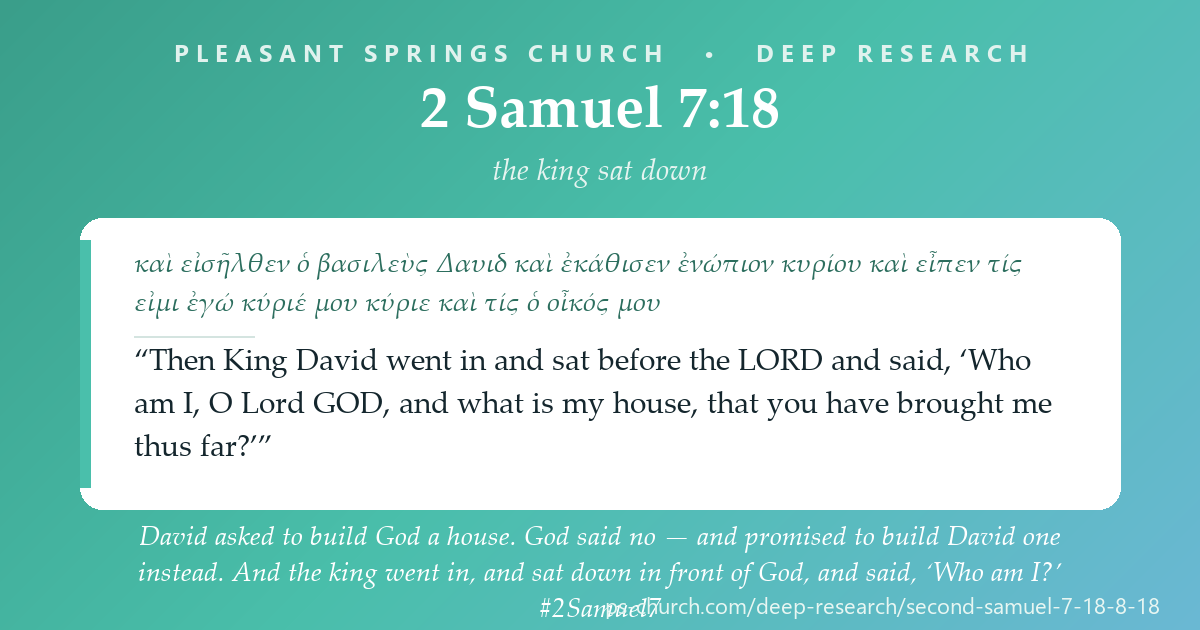
David asked to build God a house. God said no, and then promised to build David one instead — a throne that would stand forever (2 Samuel 7:1–17). What almost nobody reads is what David said back. “Then King David went in and sat before the Lord and said, ‘Who am I, O Lord God, and what is my house, that you have brought me thus far?’” Notice the posture — he sits, which nobody else does in that place, and the rabbis built a rule on it. Notice the address: six times in twelve verses he says “O Lord God,” the rare vocative of Abram and Moses and Joshua and Gideon and Samson — and he is the only one of them who uses it to say thank you. Ten times he calls himself “your servant.” Three times he says “and now.” And he never mentions the temple again. The prayer ends: “with your blessing shall the house of your servant be blessed forever” (7:29). Then the book turns hard — chapter 8, the campaigns, the measuring line at Moab, the garrisons, the tribute, and twice over the only comment the narrator makes: “And the Lord gave victory to David wherever he went” (8:6, 14). It ends with a list of names and one verdict: “David administered justice and equity to all his people” (8:15). This study works 2 Samuel 7:18–8:18 line by line in Hebrew, Septuagint and ESV — in the Old Greek section of Kingdoms, before the kaige revision begins at 11:2 — with every difference between the columns reported rather than smoothed. See the method →
2 Samuel 7:18–8:18 (selections)
Hebrew (MT) · Greek (Rahlfs, 2 Kingdoms — Old Greek section) · ESVIn the Septuagint this book is 2 Kingdoms (2 Reigns) — Βασιλειῶν Βʹ (Basileiōn B). 1–2 Samuel and 1–2 Kings are one continuous work in Greek — 1, 2, 3 and 4 Kingdoms, Βασιλειῶν Αʹ–Δʹ. A reader who carries the name “2 Samuel” to a Greek Bible will not find it. And a small thing worth knowing once: our English names for the Torah — Genesis, Exodus, Leviticus, Numbers, Deuteronomy — are the Septuagint’s names, while these books keep the Hebrew-derived naming. An English Bible already mixes both traditions on its contents page.
⚠️ Which Greek this is, and why it matters here. The Greek of Kingdoms is not one translation. Dominique Barthélemy showed in Les Devanciers d’Aquila (1963) that long stretches of it are a later kaige revision pulling the Greek back toward a proto-Masoretic Hebrew — named for the reviser’s stereotyped καίγε for Hebrew gam. That revision begins at 2 Kingdoms 11:2 and runs to 3 Kingdoms 2:11. This passage falls before it, in the section Thackeray labelled αβ: 2 Samuel 7:18–8:18 is Old Greek, unrevised. Two consequences. First, the Greek printed above is a genuinely old translation of a Hebrew text that was not identical to the one the Masoretes later transmitted — so the differences you can see are old differences, not late tinkering. Second, Codex Vaticanus is a good witness here, which it is not once the kaige section starts, where the Antiochene (Lucianic) text often keeps the older Greek instead. From 2 Samuel 11 onward, “the LXX reads X” stops being a single claim; here it is still one. On why this library prints what it prints, see the texts we print.
Edition. The middle column is Rahlfs’s Septuaginta (1935), verified verse by verse against the morphologically analysed Rahlfs text and cross-checked line by line against the printed text of the Church of Greece. Where the two editions differ, this page says so rather than quietly choosing: at 7:18 Rahlfs has ἠγάπηκάς and the Church of Greece ἠγάπησάς; at 7:19 Rahlfs κατεσμικρύνθη (“it was made small”) against κατεσμικρύνθην (“I was made small”); at 8:13 the Valley of Salt is transliterated Γαιμελε in Rahlfs and Γεβελὲμ in the Athens text; at 8:15 Rahlfs lacks “all” before Israel and Athens has it; at 8:16 Ahilud is Αχια in Rahlfs and Αχιάδ in Athens. Punctuation is editorial and proper names are left unaccented as Rahlfs leaves them. Underlining marks a place where the two columns are not saying the same thing.
⚠️ The ESV’s small capitals, because this is a passage where they carry the argument. The convention: Lord in small capitals renders the divine name יהוה; plain Lord renders אֲדֹנָי (ʾăḏōnāy, “my Lord”); and when the two stand together, printing “Lord Lord” would be absurd, so the divine name is set as God in small capitals instead. So “O Lord God” = אֲדֹנָי יְהוִה, and “O Lord God” = יְהוָה אֱלֹהִים — two different Hebrew phrases. Count them and it is worth the trouble: אֲדֹנָי יְהוִה stands six times in these twelve verses — 7:18, 7:19 (twice), 7:20, 7:28 and 7:29 — and יְהוָה אֱלֹהִים stands twice, at 7:22 and 7:25. And here is the place it is easy to get wrong, so it is printed plainly: the ESVrenders those last two differently from each other — “O Lord God” at 7:22 but “O Lord God” at 7:25 — although the Hebrew is the same two words in both. Whether that reflects a text the translators followed or an inconsistency in the setting, the ESV does not say; the Greek, for its part, has κύριέ μου κύριε at both, and eight times in all. Numbering. There is no offset here: Hebrew, Greek and English all run 7:1–29 and 8:1–18, twenty-nine verses and eighteen, in every one of them. That was counted, not assumed. (Rahlfs does carry an extra 2 Kingdoms 5:16a earlier in the book — see 2 Samuel 5–6 — which is why the counting matters.) The Hebrew tradition is candid too: at 8:3 the Masoretes preserve a written reading and a read reading side by side — written “at the River,” read “at the River Euphrates” — and the Greek agrees with the reading tradition, ἐπὶ τὸν ποταμὸν Εὐφράτην. Qumran. 4QSama (4Q51, c. 50–25 B.C.) is the great Hebrew witness for these books and is famous for siding with the Greek against the Masoretic Text more often than any other biblical manuscript; it is fragmentary throughout. This page builds no argument on its readings in these verses — the transcriptions are in DJD 17 (Cross, Parry, Saley and Ulrich, Qumran Cave 4.XII: 1–2 Samuel, 2005), and that, not a summary, is where a reader should check them. The full list of divergences in these verses is set out in Stage 5.
The Shape of the Passage
Parallel panelsThis passage is the hinge of the book. Behind it stands the covenant oracle of 7:1–17; in front of it stand the kindness shown to Mephibosheth and then the roof, the letter and the prophet. Read 7:18–8:18 as the high-water mark it is, and read it knowing what the same author does with it four chapters later.
Author
A narrator who answers a speech with a speech, and then goes silent. Chapter 7 is almost all direct discourse: God speaks seventeen verses through Nathan, David speaks twelve verses back. That ratio is the design. Biblical narrative reports action sparely and speech at length, and when it gives a character twelve unbroken verses it is telling you to listen. Then chapter 8 does the opposite — eighteen verses of clipped report, seven strikes, a list of officials, and exactly two sentences of theological comment, both of them the same sentence: “And the Lord gave victory to David wherever he went” (8:6, 14).
He builds in echoes, and he expects you to hear them. David’s prayer is stitched out of the words God had just used: God said “I will make for you a great name” (7:9) and David prays for God’s name (7:26); God said “the Lord will make you a house” (7:11) and David says “the house of your servant” five times. The prayer is not a new subject. It is the promise handed back.
And he does not editorialize about chapter 8. The campaigns are reported the way a royal annal reports campaigns — who was struck, how many, what was taken, where the garrisons went. The narrator neither celebrates nor condemns; he says twice that the victory was God’s gift and once that the king was just, and then he moves on. What we do with that silence is Stage 5’s problem, and we will not fill it in for him.
Audience
Israel under the monarchy — and, before long, Israel without one. Samuel–Kings runs from the conquest to the exile, and it was finally read by people who had watched David’s throne fall. To them, “the house of your servant will be established before you” (7:26) was not a triumph but a question. This prayer is preserved for readers who needed to know that the promise had been prayed back by the man it was made to, out loud, in words they could use.
People who knew what a king was supposed to be. Deuteronomy had already legislated the office — a king who does not multiply horses or wives or silver, who writes out the law and reads it all his life (Deuteronomy 17:14–20). 2 Samuel 8:15 is the verdict the law was asking for: “David administered justice and equity to all his people.” An Israelite reader would have heard the sentence as a grade, and would also have remembered how the report card ends.
And people for whom Moab and Edom and Aram were neighbours, not names. Chapter 8 is a map of the small kingdoms of the southern Levant, and every one of them had its own version of the story. We have one of those versions in stone — the Moabite Stone, where a king of Moab tells the same kind of history about Israel, with his own god in the place of ours. Stage 2 puts them side by side, because the first audience did not need to be told and we do.
Orient on prayer in the Old Testament, the divine names, the royal ideal, and the small kingdoms of chapter 8.
Search by topic: prayer (OT); Davidic covenant; names of God; Adonai; YHWH Sebaoth / LORD of hosts; Shaddai; servant of the LORD; house / dynasty; olam / forever; justice and righteousness (mishpat u-tsedaqah); kingship in Israel; Deuteronomy’s law of the king; Moab; Edom; Aram and Aram-Zobah; Hadadezer; Philistines; Cherethites and Pelethites; recorder (mazkir); secretary (sopher); Zadok; Abiathar; Ahimelech; Benaiah; tribute and vassalage; herem; Kingdoms, Books of (Greek); kaige recension; 4QSamuel-a.
Which articles are relevant?
- Anchor Bible Dictionary — “David,” “Covenant (Davidic),” “Prayer (OT),” “Names of God in the OT,” “Lord (Deity),” “Zadok,” “Abiathar,” “Benaiah,” “Cherethites,” “Moab,” “Edom,” “Zobah,” “Hadadezer,” “Salt, Valley of,” “Metheg-ammah.”
- Dictionary of the OT: Historical Books (IVP) — “David,” “Davidic Covenant,” “Prayer,” “Kingship,” “Justice and Righteousness,” “Officials,” “Warfare,” “Non-Israelite Nations.”
- NIDOTTE / TDOT — אֲדֹנָי (ʾăḏōnāy), עֶבֶד (ʿeḇeḏ, servant), בַּיִת (bayiṯ, house), עוֹלָם (ʿōlām, forever), שֵׁם (šēm, name), נָכָה (nāḵāh, strike), יָשַׁע (yāšaʿ, save), מִשְׁפָּט and צְדָקָה, תּוֹרָה (tōrāh).
- For the Greek — any article on the Septuagint of Samuel–Kings should tell you two things: that the four books are one series called Kingdoms, and that the Greek of the series is not uniform, because a later revision (kaige) touched some sections and not others. If an article speaks of “the LXX of 2 Samuel” as one flat thing, treat it with care — and check whether your verse is before or after 11:2.
Bibliography surfaced:
- P. Kyle McCarter Jr., II Samuel (Anchor Bible) — the standard technical treatment, and the fullest on the Greek and Qumran evidence; A. A. Anderson, 2 Samuel (WBC); Robert D. Bergen, 1, 2 Samuel (NAC).
- Robert Alter, The David Story — translation and commentary, and the place to go for how the Hebrew of these chapters actually moves; Walter Brueggemann, First and Second Samuel (Interpretation); A. Graeme Auld, I & II Samuel (OTL). (Alter and Auld read these texts as literature and do not share the church’s confession; we take the tools, not the metaphysics.)
A king who sits, a king who measures, and the neighbours who wrote their own version in stone.
Three things this stage has to do. Show what sitting in a sanctuary meant. Report chapter 8 the way this library reports violence — plainly, precisely, and under the standing fence. And let Moab speak for itself, since we happen to have a Moabite king’s own account of a war with Israel.
Why is “he sat” worth a paragraph?
Because nobody sits. Israelites stand to pray (1 Sam 1:26; Jer 18:20), or kneel, or fall on their faces. David “went in and sat before the Lord” — וַיֵּשֶׁב, the ordinary verb for sitting down, and the Greek translator read it the same way (ἐκάθισεν). Some readers have tried to soften it into “stayed” or “lingered,” which the verb can carry; but the plain sense is the plain sense, and both ancient translations took it that way.
The rabbis did not soften it. They built a rule on it. b. Sotah 40b raises the question of a king sitting in the Temple court and quotes the ruling — attributed there to Tosefta Sanhedrin 4:4 — that “sitting in the Temple courtyard is permitted only for kings from the house of David,” and the proof text it gives is this verse: “Then King David went in, and sat before the Lord…” (2 Samuel 7:18). The same rule is stated at b. Yoma 25a without the verse attached. Whatever one makes of the halakhah, the rabbis had noticed exactly what the narrator did: a man sat down in front of God, and the text does not apologize for it.
And one ancient reader could not bear it. Josephus retells the scene and changes the posture: David “came to the ark, and fell down on his face, and began to adore God.” He also supplies a reason for the refusal that 2 Samuel 7 never gives — that God would not let David build “because he had made many wars, and was defiled with the slaughter of his enemies.” That reason is real Scripture, but it is 1 Chronicles 22:8 and 28:3, not this chapter. Watch the move: a gap in the text, and a witness filling it.
- Josephus, Antiquities 7.4.4 and 7.5.1–4 (Whiston’s chapter-and-section numbering) (Second-Temple — a witness, not Scripture) — and he is unusually valuable here, because his Bible was a Greek one. He has the Septuagint’s numbers at 8:4 (“a thousand of his chariots… about seven thousand of his horsemen”), the Septuagint’s plus at 8:7 (the golden armour “which Shishak, the king of Egypt, took away when he fought with David’s grandson, Rehoboam”), and the Septuagint’s plus at 8:8 (“of which brass Solomon made that large vessel which was called The [Brazen] Sea, and those most curious lavers”). He also declines to say David’s sons were priests: “His elder sons were near his body, and had the care of it also.” And of Moab he says only that David “overcame two parts of their army in battle, took the remaining part captive, and imposed tribute upon them” — the measuring line has quietly gone.
- The Moabite Stone (Mesha Stele), c. 830 B.C., in ANET 320–321, translated by W. F. Albright (a royal inscription — a witness, not Scripture) — Moab’s own voice about a war with Israel. “As for Omri, king of Israel, he humbled Moab many years, for Chemosh was angry at his land.” And Mesha’s account of his own campaign is not gentler than Israel’s: at Nebo he records “slaying all, seven thousand men, boys, women, girls and maid-servants, for I had devoted them to destruction for (the god) Ashtar-Chemosh,” and he took from there the vessels of Yahweh and dragged them before Chemosh. Read it beside 8:2 and two things become clear at once: this is what Iron Age warfare in this valley looked like on all sides, and that is an explanation of the world, not a justification of the deed.
- Sirach 47:1–11 (Second-Temple — a witness, not Scripture; deuterocanonical, and this church does not level it with Scripture) — Ben Sira praises David for exactly the two halves of this study and joins them: “he wiped out his enemies on every side… The Lord took away his sins, and exalted his power for ever; he gave him the covenant of kings and a throne of glory in Israel” (47:7, 11). Note what he does with the covenant: it has become a covenant of kings, and the forgiveness comes first.
- 1 Maccabees 2:57 (Second-Temple — a witness, not Scripture; deuterocanonical) — Mattathias’s deathbed roll-call: “David, because he was merciful, inherited the throne of the kingdom for ever.” The promise of 2 Samuel 7 in eleven words, two centuries before Christ, in the mouth of a man raising an army.
- b. Sotah 40b (with Tosefta Sanhedrin 4:4) and b. Yoma 25a (rabbinic-era — witnesses, not Scripture) — the sitting rule, quoted above, and 2 Samuel 7:18 as its proof text.
- 1 Chronicles 17:16–27 and 18:1–17 (Scripture — a parallel witness, and a different book) — the Chronicler tells both halves again, and the differences are not small. His David never once says “O Lord God”: the prayer is addressed to “Lord God” and simply to “Lord.” His 17:17 has nothing like “this is instruction for mankind.” His 18:1 has “Gath and its villages” where Samuel has Metheg-ammah. His 18:2 drops the measuring line. His 18:12 credits the Edomite victory to Abishai. And his 18:17 says David’s sons were “the chief officials in the service of the king.” Reported, not harmonised.
What the text says. David defeated the Philistines and took Metheg-ammah (8:1). He defeated Moab, and — in the Hebrew — made the survivors lie on the ground, measured them with a line, put two lines’ worth to death and spared one (8:2). He defeated Hadadezer of Zobah at the Euphrates, took his chariotry and hamstrung the horses (8:3–4). He killed twenty-two thousand Aramaeans of Damascus and garrisoned the country (8:5–6). He struck eighteen thousand in the Valley of Salt and garrisoned Edom (8:13–14). That is the passage, located precisely, and it is not being softened here by leaving anything out.
Own the difficulty. 8:2 is the hardest verse in the chapter and it should be. Prisoners are made to lie down and are sorted by a rope. The narrator gives no reason — no oracle, no command, no provocation named, no comment afterward. Earlier in the book David had entrusted his own parents to the king of Moab for safekeeping (1 Samuel 22:3–4), which makes it worse, not better. And this study is not going to explain it, because where Scripture gives no reason, we say so and stop. What can be said is what the text itself does: it reports the deed without approving it. The absence of a verdict is not a verdict, and a narrator who will shortly spend two whole chapters condemning this same king by name (2 Samuel 11–12) is plainly capable of saying so when he means to.
And say the last part unmistakably. None of this licenses anything today. Not a war, not a policy, not a nation, not a grudge. These are the campaigns of one Iron Age king in one small corridor of land, told in the annalistic style of his neighbours, and the New Testament’s only use of David’s throne is to say that the Son who finally sits on it conquers by dying. Anyone who reads 2 Samuel 8 as a warrant is reading against the whole shape of the canon that preserved it. We report the campaigns because hiding them would be a lie; we fence them because misusing them would be worse.
The name David calls God six times, the name he calls himself ten, and the blunt verb the next chapter is built on.
Count them yourself in the Hebrew column above — that is the point of printing it. Six “O Lord God”; ten “your servant”; seven “house”; five “forever”; three “and now.” Then seven strikes in chapter 8. The arithmetic is the argument.
“O Lord God” — and this is the single most striking thing about the prayer. The compound vocative is rare, and where it does appear it is nearly always a man in the act of asking or protesting: Abram twice, in the covenant chapter, “O Lord God, what will you give me?” (Genesis 15:2, 8); Moses, “O Lord God, you have only begun to show your servant your greatness” (Deuteronomy 3:24) and again pleading for the people (Deuteronomy 9:26); Joshua face down after Ai (Joshua 7:7); Gideon when he realizes who he has been talking to (Judges 6:22); Samson at the pillars (Judges 16:28). Then David says it six times in twelve verses. He is not inventing a way to talk to God. He is praying in the received language of the fathers, and using it more than any of them. The Greek renders it κύριέ μου κύριε, “my Lord, Lord” — eight times, because it uses the same phrase for the יְהוָה אֱלֹהִים of 7:22 and 7:25 as well.
“Your servant.” Ten times in eleven verses, and David never once says “I” after the opening question. He asked “Who am I?” in 7:18 and then spends the rest of the prayer answering it in the third person. This is court language — it is how a subject addresses a king — and its use here is deliberate: the man who has just been promised a dynasty spends his whole reply calling himself a servant. The Greek is ὁ δοῦλός σου throughout. It is also the title the book of Isaiah will make load-bearing (Isaiah 52:13–53:12).
“House.” The word the whole chapter turns on — palace, then temple, then dynasty — and the oracle page traces its eight occurrences in 7:1–17. What is worth seeing here is which sense David picks up. He opens with “what is my house” (7:18, his family, and it was a shepherd’s), and every one of the other six is “the house of your servant” — the dynasty, God’s meaning, not his own. He drops the temple entirely. The man who wanted to build a building never mentions the building again.
“Forever,” more literally “to the far horizon” — five times in the prayer, and David is quoting. The word was God’s in 7:13 and 7:16; David hands it back in every petition he makes. It stands beside 7:19’s לְמֵרָחוֹק (ləmērāḥōq, “for a great while to come,” literally “from far off”), which the Greek renders εἰς μακράν. Whatever else David understood, he understood that the promise was aimed past him.
“And now.” Three times, and it is the joint of the prayer. Everything before 7:25 is retrospect and doxology; everything from 7:25 is petition — confirm, do as you have spoken, bless. It is the ordinary Hebrew hinge from “here is the situation” to “here is the request,” and its plainness is part of the point: David’s asking is not elaborate. He asks God to do the thing God has already said he would do — which is what all believing prayer eventually turns out to be. Greek καὶ νῦν at all three (and once more at 7:20, where the Hebrew does not have it).
“The instruction of the man / of mankind” — three of the most contested words in the book, and this page will not pretend they are settled. The ESV takes it as a exclamation about scope: “and this is instruction for mankind, O Lord God!” The KJV and NASB tradition takes it as a question about manner: “is this the manner of man?” Walter Kaiser argued influentially for “the charter for humanity” — that David grasped the promise as reaching past his own line to the whole race. Others read it flatly, “this is the law for a man,” i.e. how God deals with people. The Greek is no help and is honest about it: οὗτος δὲ ὁ νόμος τοῦ ἀνθρώπου, word for word, the difficulty passed straight through. And 1 Chronicles 17:17 does not have this sentence at all — it has an entirely different clause. Where the text is genuinely obscure, saying so is the honest thing.
“Strike, defeat.” Seven times in chapter 8, and it is the chapter’s whole vocabulary of action: David strikes the Philistines, Moab, Hadadezer, Aram; Toi hears that David has struck; David returns from striking. The Greek is ἐπάταξεν throughout, so the drumbeat survives the translation. It is a blunt, unadorned verb, and the narrator’s decision to build eighteen verses on it — with no adjectives, no glory, and no lament — is itself a piece of authorial restraint worth noticing.
“Justice and equity” (or “justice and righteousness”) — the fixed pair for what a king in the ancient Near East was supposed to be for, and in Israel the thing the office is measured by: “Give the king your justice, O God… may he judge your people with righteousness” (Psalm 72:1–2). Greek κρίμα καὶ δικαιοσύνην. It is the last sentence about David before the list of names, and the last unqualified good thing the book says about him — which is a fact about the structure of 2 Samuel, and the reader is meant to feel it.
Two features of the Hebrew here, reported rather than tidied:
- The ketiv and qere at 8:3. The consonants written are בנהר — “at the River”; the Masoretic reading tradition says בִּנְהַר־פְּרָת, “at the River Euphrates.” The Greek agrees with the reading tradition (ἐπὶ τὸν ποταμὸν Εὐφράτην), and so does 1 Chronicles 18:3. The Masoretes could have quietly written in the word they read. They did not; they preserved both, in the margin, for two thousand years. That habit is the same one this page is trying to keep.
- The plural verb at 7:23. The Hebrew reads “whom אֱלֹהִים went” with a plural verb (הָלְכוּ) — a construction that also appears in Genesis 20:13 and Genesis 35:7 and that has been discussed since antiquity. The Greek has a singular verb (ὡδήγησεν… ὁ θεός, “God led”), and so does every English version. It is not a doctrine and this page draws none from it; it is a genuine feature of the Hebrew, and a reader who is told the columns are identical will never find out it is there.
The oracle this prayer answers, the fathers whose words David borrows, the psalms that sing it, and where the New Testament takes it.
Four threads. Backward to 7:1–17, which David is quoting. Sideways to Abraham, Moses, Joshua, Gideon and Samson, whose one rare vocative he uses six times. Forward to the psalms of the covenant and to the parallel in Chronicles. And then into the New Testament — carefully, and with the three levels kept apart.
Which cross-references matter?
- 2 Samuel 7:1–17 — read it first. Every load-bearing word of the prayer is lifted from it: house (7:11, 13, 16), name (7:9, 13), forever (7:13, 16), servant (7:5, 8), established (7:16). David asked to build God a house and was told God would build him one, and 7:18 is what he did about it. He worshipped. That is the whole hinge of this study, and it is worth sitting with: the promise was better than the plan, and the man whose plan was refused is the one who says so.
- Genesis 15:2, 8; Deuteronomy 3:24; Deuteronomy 9:26; Joshua 7:7; Judges 6:22; Judges 16:28 — the company “O Lord God” keeps. Abram asking for an heir, Moses asking to see more and then begging for the people’s life, Joshua on his face, Gideon terrified, Samson blind. Every one of them is asking, and most of them are afraid. David uses their word six times — and he is the only one of them who uses it to say thank you.
- Exodus 15:11; Deuteronomy 4:7, 34; Deuteronomy 10:21; Deuteronomy 33:29 — the two questions of 7:22–23 are both quotations. “There is none like you” is the Song at the Sea (“Who is like you, O Lord, among the gods?”). “Who is like your people Israel, the one nation on earth…” is Deuteronomy’s own rhetorical question, and the ESV’s cross-references say so. David’s prayer is made almost entirely out of older Scripture. That is not a weakness in it; it is what he had, and it is what he used.
- Deuteronomy 17:14–20 — the law of the king, and the standard against which 8:15 is a verdict: “David administered justice and equity to all his people.” Deuteronomy asks for a king who does not multiply horses, wives or silver and who reads the law all his days. Hold that list beside 2 Samuel 8, where the horses are hamstrung (8:4) and the silver is dedicated to the Lord (8:11), and beside what happens in chapter 11. The book is keeping score.
- Psalm 2; Psalm 110; Psalm 89; Psalm 132 — where the covenant of chapter 7 is sung, and where it is wept over. Psalm 89 quotes the promise at length and then says “but now you have cast off and rejected… you have renounced the covenant with your servant” (89:38–39). Israel prayed both. So may we.
- Psalm 60 (Septuagint Psalm 59) — the psalm whose superscription belongs to the events of 2 Samuel 8, and a clean illustration of why this library prints both numbers. In the Septuagint this psalm is number 59, and the Greek counts the superscription as verses 1–2, so every verse of the poem is numbered two higher than in your English Bible. Its heading — “when he strove with Aram-naharaim and with Aram-zobah, and when Joab on his return struck down twelve thousand of Edom in the Valley of Salt” — gives a third account of 8:13: Samuel says David struck eighteen thousand, 1 Chronicles 18:12 says Abishai struck eighteen thousand, and the psalm heading says Joab struck twelve thousand. The Greek of Psalm 59:2 reads δώδεκα χιλιάδας, twelve thousand, exactly as the Hebrew does. Three accounts. This page reports all three and reconciles none of them — and it is worth noticing that the same psalm goes on to say “Moab is my washbasin” (60:8; LXX 59:10), which is chapter 8 turned into poetry.
- 1 Chronicles 17:16–27; 18:1–17 (Scripture, and a genuinely different telling) — laid out in Stage 2. The short version: the Chronicler’s David never says “O Lord God”, his 17:17 replaces the hardest clause in the prayer, his 18:2 has no measuring line, his 18:12 credits Abishai, and his 18:17 will not call the king’s sons priests. Two inspired books, two reports. We print the difference.
- Luke 1:32–33; Acts 2:29–31; Hebrews 1:5; 2 Corinthians 6:18 (cited in bold; these books have no page in this library yet) — where the New Testament actually goes. Gabriel promises Mary’s son “the throne of his father David… and of his kingdom there will be no end.” Peter argues at Pentecost from David’s tomb that the promise was not exhausted by David. Hebrews 1:5 quotes 2 Samuel 7:14 of the Son. And Paul quotes the same verse of the church — “I will be a father to you, and you shall be sons and daughters to me, says the Lord Almighty” — using κύριος παντοκράτωρ, which is the very title the Greek of this passage puts in David’s mouth at 7:25 and 7:27.
(1) What this text says. 2 Samuel 7:18–29 is a king thanking God for a promise about his own family and asking him to keep it. It does not announce itself as messianic. Read on its own terms it is about David, Solomon, and a line of actual kings, and the prayer would be a good prayer even if nothing further had ever come of it. Do not skip this layer. The Old Testament is not a coded document; it is a true one, and it means what it says before it means anything else.
(2) What the New Testament itself draws. This is safe ground and we teach it plainly, with the attribution attached. Hebrews 1:5 takes 7:14 — “I will be to him a father, and he shall be to me a son” — and applies it to Christ over against the angels. Luke 1:32–33 puts “the throne of his father David… forever” in Gabriel’s mouth. Acts 2:29–31 argues the case out loud. 2 Corinthians 6:18 extends 7:14 to the church. That is the canon doing this itself, and it is more than enough to stand on.
(3) What we see from this side of the cross — ours, and legitimate. A son of David went in and sat down in the presence of God, and nobody else was permitted to. The rabbis noticed the oddity and made a rule of it (b. Sotah 40b). And the New Testament, arguing from Psalm 110:1 rather than from this verse, says of Jesus that “when he had offered for all time a single sacrifice for sins, he sat down at the right hand of God” (Hebrews 10:12). Both halves have to be said. 2 Samuel 7:18 does not say that; the connection runs through Psalm 110, not through this verse, and to preach it as though the narrator meant it would be putting our seeing into the text’s mouth. And we are meant to see it — Luke 24:27 has Christ himself reading the Scriptures this way, and a church that reads only layer one has stopped halfway. Say “here is what the text says, and here is what I cannot help seeing, and here is which is which.” Then read the chapter again next year and see what else is there.
The commentaries, the full list of Hebrew/Greek divergences in these verses, and four questions that stay open.
McCarter, Anderson, Bergen, Alter, Brueggemann and Auld on 2 Samuel; Barthélemy, Thackeray, Tov, Ulrich and Fernández Marcos on the Greek. Then the enumeration — and where this page claims to enumerate, it enumerates everything it found, not a sample.
Commentaries & studies:
- P. Kyle McCarter Jr., II Samuel (Anchor Bible, 1984) — the fullest technical treatment in English, and the one that takes the Greek and the Qumran evidence most seriously; A. A. Anderson, 2 Samuel (WBC, 1989); Robert D. Bergen, 1, 2 Samuel (NAC, 1996).
- Robert Alter, The David Story (1999) — for the movement of the Hebrew and for the narrator’s reticence; Walter Brueggemann, First and Second Samuel (Interpretation, 1990) — theological, and worth arguing with; A. Graeme Auld, I & II Samuel (OTL, 2011), who takes an unusual line on the Samuel–Chronicles relationship that is worth knowing about and is not adopted here.
- Dominique Barthélemy, Les Devanciers d’Aquila (1963) — the study that identified the kaige revision and so explained why the Greek of Kingdoms is not all of one kind; H. St. J. Thackeray for the original sectioning; Emanuel Tov, Textual Criticism of the Hebrew Bible; Eugene Ulrich, The Qumran Text of Samuel and Josephus; Natalio Fernández Marcos, The Septuagint in Context, on the Antiochene text.
- Frank Moore Cross, Donald W. Parry, Richard J. Saley and Eugene Ulrich, Qumran Cave 4.XII: 1–2 Samuel (DJD 17, 2005) — the actual transcriptions of 4QSama,b,c. Anyone citing a Qumran reading in Samuel should be citing this, and this page cites none because it has not read them there.
- Walter C. Kaiser Jr., “The Blessing of David: The Charter for Humanity” (1974) — the best-known argument for reading tōraṯ hāʾāḏām in 7:19 as a promise reaching past David’s line to the whole race. Named here as one reading among several; the page does not adopt it.
The Hebrew/Greek divergences in these verses — the list, not a sample:
- 7:18 — MT “you have brought me thus far” (הֲבִאֹתַנִי); Greek “you have loved me” (ἠγάπηκάς με). Both columns keep “sat”.
- 7:19 — a minus: the Greek has no rendering of גַּם (“also”). And a subject shift, edition-dependent: Rahlfs “it was made small”, the Church of Greece text “I was made small”.
- 7:20 — a plus: Greek καὶ νῦν, “and now,” where the Hebrew has “and you.”
- 7:22 — MT is a statement, “therefore you are great”; the Greek is a purpose clause, “so that you may be magnified.” MT יְהוָה אֱלֹהִים; Greek κύριέ μου κύριε.
- 7:23 — four differences in one verse: MT plural verb “God went”, Greek singular “God led”; MT “to make for himself a name”, Greek “that you make a name”; MT “awesome things for your land”, absent from the Greek (and the ESV prints the Greek here and says so); MT “nations and its gods”, Greek “nations and tents”.
- 7:24 — MT “you established”, Greek “you prepared” (ἡτοίμασας).
- 7:25 — a plus: the Greek adds the vocative “O Lord Almighty, God of Israel” (κύριε παντοκράτωρ θεὲ τοῦ Ισραηλ), which the Hebrew has only at 7:26–27.
- 7:26 — the largest minus in the prayer. The whole Greek verse is “May your name be magnified forever.” The MT’s “saying, ‘The Lord of hosts is God over Israel’” surfaces in Greek only as the vocative attached to 7:25 and 7:27, and “and the house of your servant David will be established before you” has no Greek equivalent at all.
- 7:27 — MT “the Lord of hosts” (צְבָאוֹת); Greek παντοκράτωρ, “Almighty” — the standard Septuagint equivalence in these books, and the word Paul uses at 2 Corinthians 6:18.
- 7:29 — MT “be pleased” (הוֹאֵל); Greek “begin” (ἄρξαι).
- 8:1 — MT Metheg-ammah, a phrase nobody can translate with confidence; Greek “the set-apart [portion]” (τὴν ἀφωρισμένην); 1 Chronicles 18:1 “Gath and its villages.” Three different things.
- 8:2 — MT two lines killed and one spared; Greek two killed and two spared; 1 Chronicles 18:2 no measuring line at all.
- 8:3 — the ketiv/qere noted in Stage 3; MT “to restore his hand”, Greek “to set his hand”; names: Hadadezer → Αδρααζαρ, Rehob → Ρααβ.
- 8:4 — MT “1,700 horsemen”; Greek “1,000 chariots and 7,000 horsemen”, with 1 Chronicles 18:4 and Josephus. Also an edition difference in the last clause: Rahlfs “left of them 100 chariots”, Athens “left for himself”.
- 8:7 — a plus of a whole sentence: Shishak of Egypt carrying the gold off in the days of Rehoboam. Absent from MT and from Chronicles; present in Josephus.
- 8:8 — MT “Betah and Berothai”; Greek “Masbak… the choice cities”; 1 Chronicles 18:8 “Tibhath and Cun.” And a second plus: the Greek adds “with it Solomon made the bronze sea and the pillars and the lavers and all the vessels” — which 1 Chronicles 18:8 also has, and MT Samuel does not.
- 8:10 — MT Joram; Greek Ιεδδουραν; 1 Chronicles 18:10 Hadoram.
- 8:12 — MT “from Aram”; Greek “from Idumaia” (Edom); 1 Chronicles 18:11 Edom. The ESV prints Edom.
- 8:13 — MT Aram; Greek Idumaia; Chronicles Edom; the ESV prints Edomites, without a footnote. The Valley of Salt is transliterated rather than translated in Greek, and the two editions spell the transliteration differently.
- 8:15 — Rahlfs lacks “all” before Israel; MT and the Athens text have it.
- 8:16–17 — MT Ahilud, Greek Αχια / Αχιάδ; MT Seraiah the secretary, Greek Ασα, 1 Chronicles 18:16 Shavsha.
- 8:18 — a plus: Greek calls Benaiah σύμβουλος, “counsellor.” And the big one: MT “David’s sons were priests”; Greek “David’s sons were chiefs of the court”; 1 Chronicles 18:17 “the chief officials in the service of the king.” The ESV prints the Hebrew, and the ESV also footnotes that the Hebrew lacks “was over” earlier in the verse.
Four questions this passage raises that stay open:
- What does “this is instruction for mankind” mean? Laid out in Stage 3. Four serious readings, an ancient translation that simply passed the problem along, and a parallel in Chronicles that has a different sentence entirely. We name the positions and do not adjudicate.
- Was 8:2 a reprisal, a policy, or something the narrator refuses to explain? Commentators have proposed that Moab had betrayed David’s parents (1 Samuel 22:3–4), that the ratio reflects a known ancient practice, that the numbers are conventional. The text supplies none of this. It gives an action and no motive, and it neither praises nor condemns. Our discipline is the one this library keeps everywhere: report what the text approves, report what it merely reports, report what it condemns, and leave the gaps open.
- Zadok son of Ahitub and Ahimelech son of Abiathar (8:17). Everywhere else, Abiathar is the son of Ahimelech (1 Samuel 22:20), not the father. 1 Chronicles 24:6 has the same reversed order as here. Proposals include a scribal transposition, a grandson bearing the grandfather’s name, and two men of the same name. The ESV prints the Hebrew as it stands, and so do we, with the difficulty named.
- “David’s sons were priests” (8:18). The Hebrew says it; the Greek and Chronicles both say something else; and the sons of David were not Levites. Whether the Hebrew preserves an older, pre-centralized royal role that later writers found uncomfortable, or whether the Greek and Chronicles preserve the original, is genuinely disputed. The harder reading is the Hebrew one and it is printed above. Where three witnesses divide, saying so is more useful than picking a winner and pretending there was never a question.
A refused plan, a better promise, a man who sat down — and a chapter that will not be tidied.
Name what you learned, why it matters, and one concrete response.
What should we carry away — and do?
- The best prayer in 2 Samuel is a response to a refusal. David wanted to build a temple. God said no — and then said something incomparably larger. David’s answer is not disappointment; it is worship, and then a request that God do the very thing he has just promised. If your plan for God has been declined this year, this is the page to sit with.
- He sat down. Not because he was casual — six times in twelve verses he calls God “O Lord God” and ten times he calls himself “your servant.” He sat because he had been given something to stay in front of. Reverence and rest are not opposites; that is nearly the whole doctrine of grace in one posture.
- Count the words yourself. Six divine addresses, ten “your servant,” seven “house,” five “forever,” three “and now,” seven “struck.” The Bible rewards arithmetic. Read it again in six months and you will find a thread you did not see this time — that is what this kind of writing is for.
- “For a great while to come.” David understood, in 7:19, that the promise was aimed past him. He prayed for it anyway and died without seeing it. Most of what God has promised you is for a great while to come, and you are still allowed to ask for it now.
- Do not skip chapter 8, and do not enjoy it. The victories are reported, the measuring line at Moab is reported, and neither is explained. This study prints both the campaigns and the fence around them: they license nothing today, in any direction, for anyone. What the chapter does say twice is that the victory was God’s gift, not David’s competence — and its final verdict on the king is not a body count but “justice and equity to all his people” (8:15).
- And the two columns are a gift. One tells you the house of David’s servant will be established; the other, at that exact spot, is six words long. One says David’s sons were priests; the other says they were courtiers. We print both, because a church that only ever sees the smoothed version has been handed a smaller Bible than the one the church has actually had. See the texts we print.
Step in response: two things this week. First, pray somebody else’s words back to God — David’s prayer is stitched almost entirely out of Exodus, Deuteronomy and the oracle he had just heard, and if that was good enough for him it is good enough for us. Take 7:18–29, put your own name where “your servant” stands, and read it out loud. Second, find the plan of yours that God declined, and write down what he gave instead. Then go and sit down with it.
2 Samuel 7:18 · to share
LXX (Rahlfs, 2 Kingdoms) + ESVEvery Deep Research page traces its passage across the whole sweep — the Old Testament, the Second-Temple world between the testaments (historical witnesses, not Scripture), and the New Testament. Follow the thread:
Pleasant Springs Church — Deep Research
Research method after Michael S. Heiser’s Bible Research Method (examine dictionaries → ancient literature → important words → textual connections → academic publications → share), with the Pleasant Springs “Author & Audience” foundation. Scripture set in the Hebrew, the Greek editions named on each page and the ESV (Old Testament), and the Greek New Testament and the ESV (New Testament), per the practice of Pleasant Springs Church. 2 Samuel 7:18–8:18 research grounded in McCarter (Anchor), Anderson (WBC), Bergen (NAC), Alter (The David Story), Brueggemann (Interpretation) and Auld (OTL), with Barthélemy, Thackeray, Tov, Ulrich and Fernández Marcos on the Greek. Book names: in the Septuagint 1–2 Samuel and 1–2 Kings are one continuous work, Kingdoms (Βασιλειῶν Αʹ–Δʹ), and this is 2 Kingdoms; the note is printed on every page of this set. ⚠️ Which Greek: the Greek of Kingdoms is not one translation. Barthélemy’s kaige revision toward a proto-Masoretic Hebrew covers 2 Kingdoms 11:2 – 3 Kingdoms 2:11 and 3 Kingdoms 22 – 4 Kingdoms 25; 2 Samuel 7:18–8:18 falls outside it, in the Old Greek αβ section, which is stated on the page and matters twice over — the divergences here are old, and Codex Vaticanus is a good witness here in a way it is not once kaige begins, where the Antiochene (Lucianic) text often keeps the older Greek. Text & editions: Hebrew from the Masoretic Text; Greek from Rahlfs’s Septuaginta, verified verse by verse against the morphologically analysed Rahlfs text and cross-checked against the printed text of the Church of Greece, with the five places the two editions differ named on the page rather than silently resolved; English ESV. Numbering: there is no offset — Hebrew, Greek and English all have 29 verses in chapter 7 and 18 in chapter 8, counted rather than assumed; where Psalm 60 is cited, its Septuagint number (Psalm 59) and the Greek’s two-verse superscription are printed with it, and the Greek was looked up rather than computed. The ESV’s small-capital convention is explained explicitly, because these verses turn on it: “Lord God” renders אֲדֹנָי יְהוִה (six times: 7:18, 19 twice, 20, 28, 29) and “Lord God” renders יְהוָה אֱלֹהִים (7:22, 25) — and the fact that the ESV itself prints those two Hebrew words two different ways at 7:22 and 7:25 is reported rather than passed over. Divergences: enumerated in full in Stage 5 — pluses at 7:20, 7:25, 8:7, 8:8 and 8:18; minuses at 7:19 and, largest of all, 7:26; and differences of sense at 7:18, 7:22, 7:23 (four of them), 7:24, 7:27, 7:29, 8:1, 8:2, 8:3, 8:4, 8:12, 8:13, 8:15, 8:16–17 and 8:18. A plus or a minus is never called a “rendering difference” here. The ketiv/qere at 8:3 is printed and discussed, as is the plural verb at 7:23. Chronicles is treated as a parallel witness, not a harmonising key: 1 Chronicles 17:16–27 and 18:1–17 differ from Samuel at 18:1, 18:2, 18:4, 18:8, 18:10, 18:11–12, 18:16 and 18:17, and every one of those differences is reported rather than reconciled — including the three separate accounts of the Valley of Salt in 2 Samuel 8:13, 1 Chronicles 18:12 and the superscription of Psalm 60. Qumran: 4QSama (4Q51) is named as the major Hebrew witness for these books and no textual argument is built on it, because that would require DJD 17 rather than a summary. Second-Temple and rabbinic witnesses (Sirach 47; 1 Maccabees 2:57; Josephus, Ant. 7.4.4 and 7.5.1–4 in Whiston’s numbering; b. Sotah 40b with Tosefta Sanhedrin 4:4; b. Yoma 25a) are read as witnesses and never levelled with Scripture, and where they close a gap the narrator left open — Josephus supplying both a new posture and a reason for the refusal — that is pointed out rather than borrowed. Ancient Near Eastern material is cited only from the verifiable range of ANET: the Moabite Stone at ANET 320–321, in Albright’s translation. The campaigns of chapter 8, including the measuring line at 8:2, are reported plainly and located precisely under the standing fence, without relish and without softening by omission, with the text’s silence about motive stated as silence and the conclusion drawn unmistakably that none of it licenses anything today. Typology is handled in three separated layers per the ratified position: what this text says, what the New Testament itself draws from it (Hebrews 1:5; Luke 1:32–33; Acts 2:29–31; 2 Corinthians 6:18), and what we see from this side of the cross — the latter named as ours, argued through Psalm 110 and Hebrews 10:12 rather than smuggled into 2 Samuel 7:18, and neither deleted nor oversold.
Scripture quotations marked ESV are from the ESV® Bible (The Holy Bible, English Standard Version®), © 2001 by Crossway, a publishing ministry of Good News Publishers. ESV Text Edition: 2016. Used by permission. All rights reserved. The ESV text may not be quoted in any publication made available to the public by a Creative Commons license, and the ESV may not be translated in whole or in part into any other language. www.esv.org
|
Did this study bless you today? 💚 Give to Support PS Church100% of gifts go to the General Fund — thank you. |