Absalom is dead and the king will not stop weeping, and the army that saved his life is creeping back into the city like men ashamed. So Joab walks in and says the cruellest true thing in the book: “You have today covered with shame the faces of all your servants… you love those who hate you and hate those who love you” (19:5–7). And David gets up. What follows is the long, unglamorous business of coming home: Shimei spared, Barzillai too old to go, and two men with irreconcilable stories about a field — and a king so tired he will not decide between them: “Why speak any more of your affairs?” Then a horn blows in Benjamin, the whole north walks off with a sentence they will use again the day the kingdom actually splits, and Joab batters a town wall until a woman with no name calls over it and argues him out of the siege — the second wise woman in this book to stop a war with words. And then the book stops telling the story in order. Chapters 21–24 are an appendix arranged as a mirror: famine and the Gibeonites and Rizpah’s five-month vigil on a rock — a list of heroes — David’s song — David’s last words — a list of heroes that ends with Uriah the Hittite — and a plague. It closes on a threshing floor, with a king refusing a free gift: “I will not offer burnt offerings to the Lord my God that cost me nothing” (24:24). This study works 2 Samuel 19:1–24:25 in Hebrew, Septuagint and ESV, with the differences between the columns reported rather than smoothed — including the one at 24:1, where 2 Samuel says the Lord incited David and 1 Chronicles 21:1 says Satan did. See the method →
2 Samuel 19:1–24:25 (selections)
Hebrew · LXX (Rahlfs, kaige section) · ESVThe Shape of the Passage
ConcentricBehind these chapters stand the rest of the book — the lament for Saul, Jerusalem and the ark, the covenant of chapter 7 and the prayer that answered it, the kindness shown to Mephibosheth, Bathsheba and Uriah, and the sword that never departed — and, further back, an oath sworn to the Gibeonites in Joshua 9 that nobody in Israel had thought about for a century.
Author
A writer who knows how to end a book, and refuses to end it neatly. He could have closed with the return over the Jordan and a restored throne. Instead he lets a Benjaminite blow a horn and split the kingdom in one verse; he lets a nameless woman correct the commander of the army; and then he abandons chronology altogether for four chapters and hands you a shape instead of a sequence. The appendix is not a filing cabinet. Its two outer panels are both about a land under judgment and both end with the same rare verb; its two inner panels are the only poetry in the book. Whatever else that is, it is composition.
He is still refusing to tell you things. Two men give the king contradictory accounts in 19:24–30 and the narrator, who has been inside everyone’s head all book long, says nothing about which one is lying. He tells you a famine came “because Saul put the Gibeonites to death” and never narrates the killing anywhere in Scripture. He tells you the " + SC + " incited David to number Israel and does not say why. This is the same technique that ran through Judges and Ruth — the gap is deliberate, and the absence of a verdict is not a verdict.
And he ends on money. Not on a victory, not on a coronation, not on a prophecy: on a receipt. Fifty shekels of silver for a threshing floor and a pair of oxen, and one sentence to say why. A book that began with a king taking whatever he wanted — a woman, a field, a census — closes with him insisting on paying full price for the one thing he was offered free.
Audience
People who knew where the temple stood. The last scene is a real address in their own city. 2 Chronicles 3:1 will say it outright: Solomon built the house of the " + SC + " “on Mount Moriah… at the place that David had appointed, on the threshing floor of Ornan the Jebusite.” So for the first readers this is not a closing anecdote. It is the deed of purchase for the ground they worshipped on, and it is the reason the Greek text could not resist adding a line about Solomon enlarging the altar (24:25).
People who had watched a kingdom come apart. “We have no portion in David… every man to his tents, O Israel” (20:1) is word for word what the northern tribes shout at Rehoboam in 1 Kings 12:16. A reader who already lived in a divided kingdom — or in the wreckage after one — heard the crack starting here, in a book that is supposed to be about the golden age.
And people who needed to know that the promise had survived the man. Chapter 23 puts David’s own last words on record, and what he says is not about his achievements: “he has made with me an everlasting covenant, ordered in all things and secure.” Chapter 24 then shows him at his worst and God at his most merciful, and stops the plague at a place that becomes a temple. The audience is being told, in the same four chapters, that the house of David deserved nothing and was promised everything.
Orient on the Samuel appendix, the Gibeonites, census and plague in Israel, threshing floors, and the Antiochene Greek.
Search by topic: Samuel, Books of; the Samuel Appendix (2 Sam 21–24); Gibeon and the Gibeonites; blood guilt (dam); Rizpah; Barzillai; Sheba son of Bichri; Abel-beth-maacah; wise woman; census; plague and pestilence; threshing floor; Araunah / Ornan the Jebusite; Moriah; Psalm 18; Satan (OT); kaige recension; Antiochene / Lucianic text.
Which articles are relevant?
- Anchor Bible Dictionary — “Samuel, Books of,” “Gibeon,” “Gibeonites,” “Rizpah,” “Barzillai,” “Sheba (person),” “Abel-beth-maacah,” “Census,” “Plague,” “Threshing Floor,” “Araunah,” “Moriah,” “Satan,” “Septuagint.”
- Dictionary of the OT: Historical Books (IVP) — “Samuel, Books of,” “David,” “Poetry,” “Warfare,” “Women,” “Blood, Avenger of Blood,” “Chronicler’s History.”
- NIDOTTE / TDOT — עתר (ʿāṯar, be entreated), גֹּרֶן (gōren, threshing floor), חָכָם (ḥāḵām, wise), חָלִילָה (ḥālîlāh, far be it), חִנָּם (ḥinnām, without cost), נַחֲלָה (naḥălāh, heritage), שָׂטָן (śāṭān, adversary), סוּת (sûṯ, incite).
- On the Greek — Bernard A. Taylor, “2 Reigns: To the Reader,” in NETS, on what edition is being translated and what the kaige section means for it; and Natalio Fernández Marcos, The Septuagint in Context, chapters on the Antiochene text, for why “the LXX” is an ambiguous phrase in these books.
Bibliography surfaced:
- P. Kyle McCarter Jr., II Samuel (Anchor Bible) — the fullest text-critical treatment in English, and the standard reference for what 4QSama does in these chapters.
- Robert Alter, The David Story; Walter Brueggemann, First and Second Samuel (Interpretation); A. Graeme Auld, I & II Samuel (OTL); Herbert H. Klement, II Samuel 21–24: Context, Structure and Meaning in the Samuel Conclusion.
- Emanuel Tov, Textual Criticism of the Hebrew Bible; Eugene Ulrich, The Qumran Text of Samuel and Josephus; Dominique Barthélemy, Les Devanciers d’Aquila (1963), the book that created this whole discussion.
Bloodguilt and a blighted land, a threshing floor as a courtroom, and what the ancient retellings could not bear to keep.
First the world: why a famine made a king ask what had been done, what a threshing floor actually was, and what a census was for. Then watch Josephus, Ben Sira and the Talmud handle these same chapters — because what they add and what they delete tells you exactly which parts were hardest to carry.
Which parallels shed light on the world of these chapters?
In the ancient Near East, unavenged blood was understood to poison the ground itself. This is not a peculiarity of Israel. In the Ugaritic Tale of Aqhat, the goddess who has had the young man Aqhat killed says in the next breath, “The fruits of summer are withered, the ear in its husk”; his sister lifts her eyes, sees that “on the threshing floors dries up… blasted are the buds,” and Pritchard’s own footnote explains why she tears her clothes: “because she realizes the blight upon the land must be due to the murder of some innocent person” (ANET 153). That is 2 Samuel 21:1 in a different language: three years of famine, and the first question a king asks is whose blood is on this ground.
And a threshing floor was not only where grain was beaten out; it was where justice was done. In the same Ugaritic text, Daniel the Rapha-man “is upright, sitting before the gate, beneath a mighty tree on the threshing floor, judging the cause of the widow, adjudicating the case of the fatherless” (ANET 151). A threshing floor is flat, high, hard, cleared, and public — the natural assembly ground of a town, which is why kings sit on one in 1 Kings 22:10 and why Boaz’s legal business happens on one in Ruth 3. When the angel of the Lord halts at Araunah’s threshing floor, he halts at the place where cases are decided, and the winnowing image behind it — grain and chaff separated by wind — is not an accident.
A census, in that world, was a tax-and-conscription list, and Israel’s own law treats it as dangerous. Exodus 30:12 is explicit: “When you take the census of the people of Israel… each shall give a ransom for his life to the Lord when you number them, that there be no plague among them when you number them.” A plague after a census is precisely what the law says a census risks. The text of 2 Samuel 24 never cites that law — but Josephus did, and so has nearly every reader since.
- The Tale of Aqhat, ANET 149–155, esp. 151 and 153 (Ugaritic, c. 14th century BC — a witness, not Scripture) — the threshing floor as the seat of judgment for widow and orphan; and innocent blood answered by drought and blighted grain, with the connection stated in Pritchard’s own note.
- The Legend of King Keret, ANET 142–149, esp. 143 (Ugaritic — a witness, not Scripture) — a king who has lost his household to sickness, sword and “pestilence,” and whose personal disaster is treated as a public emergency. The assumed link between the king’s standing and the nation’s survival is the same assumption 2 Samuel 21 and 24 are working with.
- Josephus, Antiquities 7.11–13 (Whiston’s chapters) (Second-Temple — a witness, not Scripture) — and what he does is remarkable. On the famine (7.12.1) he keeps the Gibeonite oath and names its origin: Saul “had not observed the oath which Joshua the general and the senate had sworn to them.” But Rizpah is simply gone — “they punished them as they pleased; upon which God began to send rain.” On the census (7.13.1) he removes the whole problem of 24:1 by not raising it: neither the Lord nor Satan incites anybody; David “was desirous to know how many ten thousands there were of the people, but forgot the commands of Moses” — that is Exodus 30:12, the half-shekel ransom. He also has Nathan bring the three choices rather than Gad, and he reads seven years of famine, agreeing with the Masoretic Text against the Greek and Chronicles. And at the end he keeps the sentence: “it was not just to offer a sacrifice that cost nothing” — fifty shekels, as in Samuel, not six hundred as in Chronicles — and then identifies the place as where Abraham offered Isaac.
- Sirach 47:1–11 (Second-Temple — a witness, not Scripture) — eleven verses on David and not one word about a census, a plague, or the Gibeonites. What Ben Sira keeps is the singing: David “set singers before the altar” (47:9). And he ends where chapter 23 ends: κύριος ἀφεῖλεν τὰς ἁμαρτίας αὐτοῦ… καὶ ἔδωκεν αὐτῷ διαθήκην βασιλέων — “the Lord took away his sins… and gave him a covenant of kings and a throne of glory in Israel” (47:11).
- b. Yevamot 78b–79a (rabbinic-era — a witness, not Scripture) — the most sustained ancient discussion of 2 Samuel 21 anywhere, and it does not flinch. It quotes 21:1–6 at length; it has David conclude from the Gibeonites’ refusal to be appeased that they lack the three marks of Israel — “they are merciful, they are shamefaced, and they perform acts of kindness” — and bar them from the congregation. And then it raises the objection every modern reader raises: “but isn’t it written, ‘The fathers shall not be put to death for the children’ (Deuteronomy 24:16)?” The answer given in the name of R. Yoḥanan is that it was better for one letter of the Torah to be uprooted publicly than for the name of Heaven to be publicly profaned. You may find that answer inadequate. The point worth carrying is that the difficulty is not a modern invention; it is at least as old as the Talmud, and Scripture’s own readers put it in writing.
Line them up and the pattern is as clear as it was in Ruth.
(1) Rizpah. 2 Samuel gives her five months on a rock, driving birds off the bodies of her sons. Josephus deletes her entirely. The Bible does not.
(2) Who moved David to count. 2 Samuel says the Lord incited him. 1 Chronicles says Satan did. Josephus says neither, and substitutes a forgotten statute. Three ancient texts, three different sentences, and the honest thing is to lay them out rather than to pick one and call it the Bible’s view.
(3) Whether David had anything to be proud of. Ben Sira keeps the psalms and the covenant and drops the disasters; the Talmud keeps the disasters and argues about the law. 2 Samuel keeps both, side by side, in a shape that puts the singing in the middle.
The rule for these pages: report what the text approves, report what it merely reports, report what it condemns, and leave the gaps open. Watching the ancient witnesses close those gaps is the best available lesson in why we should not.
One verb that frames the appendix, one adjective that belongs to two unnamed women, and the word that ends the book.
Count ʿāṯar yourself — twice, 21:14 and 24:25. Then ask who is called ḥāḵām in this book; then hold śāṭān at 19:22 next to sûṯ at 24:1 before you read a word of commentary; and finish on ḥinnām.
Niphal, “he was entreated” — the ESV’s “responded to the plea for the land.” It occurs exactly twice in 2 Samuel, and those two occurrences are the last clause of 21:1–14 and the last clause of the book. That is the frame around the whole appendix, and it is a countable fact, not an impression. The Greek keeps it exactly: ἐπήκουσεν ὁ θεὸς τῇ γῇ (21:14) and ἐπήκουσεν κύριος τῇ γῇ (24:25), and ἐπήκουσεν appears nowhere else in 2 Kingdoms. Note also what is being entreated for: not the king, not the army — the land.
“Wise.” Count who gets called it in 2 Samuel and the list is very short: Jonadab, Amnon’s cousin, “a very crafty man” (13:3); the wise woman of Tekoa, whom Joab sends (14:2); the angel of God, by way of compliment (14:20); and the wise woman of Abel (20:16), whose action at 20:22 is done “in her wisdom.” So the only two people in this book whose wisdom actually changes an outcome are two unnamed women, and both of them stop a war by talking — the first by telling Joab’s parable to the king, the second by arguing over a wall. The Greek uses σοφή for both.
“Far be it from me” — an oath of horrified refusal. Two verses in the book, and they are both here. Joab swears it to the woman of Abel: “far be it from me, far be it, that I should swallow up or destroy” (20:20). David swears it over a cup of water: “far be it from me, O Lord, that I should do this” (23:17). The Greek preserves the pairing precisely — ἵλεώς μοι, in those two verses and no others in 2 Kingdoms. One man says it and then murders Amasa; the other says it and pours the water on the ground. The word is the same. The men are not.
“Threshing floor.” There are only two in 2 Samuel, and both are places where the hand of God comes down. The first is the threshing floor of Nacon, where Uzzah put out his hand to the ark and died (6:6). The last is Araunah’s, where the angel’s hand is stayed. Between the two the book has to travel a very long way. A threshing floor is where grain and chaff are separated by the wind, and where, in the wider ancient world, cases were judged (ANET 151) — which is worth knowing before deciding it is a neutral piece of real estate.
Two words that have to be held together. סוּת, “incite, entice,” is the verb at 24:1 — and it is the same verb in 1 Chronicles 21:1, with a different subject. שָׂטָן, “adversary, accuser,” occurs exactly once in 2 Samuel — at 19:22, where David says it of Abishai: “that you should this day be as an adversary to me.” It is a human being, and the Greek renders it ἐπίβουλον, “a plotter,” not διάβολος. In 1 Chronicles 21:1 the Hebrew has no definite article and the Greek has διάβολος with no article either. That is what the two texts actually say; Stage 5 lays out how readers have handled the difference, and does not resolve it.
“For nothing, gratis, without cost” — from חֵן, ḥēn, “favour.” It is the last significant word David speaks in the book: “I will not offer burnt offerings to the Lord my God ḥinnām.” The Greek is δωρεάν. Hold the irony steady, because it runs both ways: the same word-family describes being hated without cause (Ps 35:19; 69:4), and δωρεάν is the word Paul uses for being justified “by his grace as a gift” (Romans 3:24). What must never be cheap for the worshipper is precisely what is free for the sinner. That is not a pun the Hebrew author made; it is a connection the Greek column makes visible, and this page says which is which.
“The heritage of the Lord” — the phrase for what belongs to God and therefore cannot be treated as expendable. It appears twice in these chapters, and both times in the mouth of somebody arguing against a killing: the woman of Abel asks Joab, “why will you swallow up the heritage of the Lord?” (20:19), and David asks the Gibeonites how he can make atonement “that you may bless the heritage of the Lord” (21:3). Greek κληρονομίαν κυρίου both times.
“Rock” — the governing image of David’s song and of his last words, and one of the oldest divine titles in Israel’s poetry (Deuteronomy 32:4, 15, 18, 30–31). And the Greek of 2 Kingdoms will not translate it as a rock. It gives φύλαξ, “guardian,” at 22:3 and again at 23:3 — interpreting the metaphor rather than carrying it. (At 22:2 it does print πέτρα for the parallel word סֶלַע.) So the reader of a Greek Bible gets the meaning and loses the picture, and that is worth seeing rather than arguing around. One more occurrence, offered as vocabulary and not as design: the only other צוּר in these chapters is the literal one at 21:10 — the rock Rizpah spread her sackcloth on. The text draws no line between the two, and neither will we; but a reader who has just watched a woman keep vigil on a rock for five months meets the Lord called the Rock two chapters later, and is allowed to notice.
Two oddities in the Hebrew of these chapters, reported rather than tidied:
- The appendix carries an unusual density of ketiv/qere. Chapter 21 alone has four in nine verses: at 21:6 the written ינתן is read יֻתַּן, and 21:9 carries three in a single verse. Joab’s rebuke has one at 19:7 · MT 19:8, where the consonants say לא (“not”) and the reading tradition says לוּ (“if only”) — and the Greek sides with the reading tradition. None of these changes the sense much; together they are a reminder that the Masoretes were preserving two things, a written text and a spoken one, and telling you when they differed rather than choosing quietly.
- 2 Samuel 23:1–7 is famously hard Hebrew, and the ancient translators show it. 23:1 calls David הֻקַם עָל — two words that can be “raised on high,” “raised up by the Most High,” or something else again; the ESV takes the first and footnotes the last line differently as well. The Greek did not read נְאֻם (“oracle”) at all but something like neʾəmān, and so says πιστὸς Δαυιδ, “faithful is David,” twice. 23:4 has no main clause in the Hebrew. 23:7 ends with a phrase the ESV footnotes as literally “consumed with fire in the sitting.” Where a text is this difficult, the honest report is that it is difficult — and the disagreement between the Hebrew and the Greek here is evidence of how old the difficulty is, not of anybody’s carelessness.
An oath from Joshua, a law about counting, a psalm in two places, a threshing floor that becomes a temple, and a shout that will split a kingdom.
Trace five threads: back to Joshua 9 for the oath behind the famine; back to Exodus 30 for the law behind the census; sideways to Psalm 18 for the song; sideways to 1 Chronicles for the two hardest disagreements in the passage; and forward to 1 Kings 12 and 2 Chronicles 3 for where this all lands.
Which cross-references matter?
- Joshua 9 — the oath that stands behind 2 Samuel 21, and without it the chapter is unreadable. The Gibeonites lied their way into a treaty; Israel’s leaders swore to them by the Lord without asking counsel; and when the fraud came out the leaders still said, “We have sworn to them by the Lord, the God of Israel, and now we may not touch them… lest wrath be upon us, because of the oath that we swore to them” (Josh 9:19–20). Four centuries later Saul touched them, and the wrath came. Whatever else 2 Samuel 21 is, it is a story about an oath sworn to foreigners under false pretences being treated by God as binding.
- Deuteronomy 24:16 — “Fathers shall not be put to death because of their children, nor shall children be put to death because of their fathers.” Set that beside 21:1–9 and you have the hardest juxtaposition in the book. The page does not dissolve it; see Stage 5, and note that b. Yevamot 79a puts the same two texts side by side and admits the collision.
- Exodus 30:11–16 — the census law: every man numbered pays a half-shekel ransom, “that there be no plague among them when you number them.” 2 Samuel 24 never quotes it. Josephus supplies it, and most commentators since have reached for it. Worth holding loosely: the narrative gives no reason at all, and inventing one for it is the temptation this page is trying to resist.
- Numbers 1 and Numbers 26 — two censuses God commands. So counting is not wrong in itself, and any explanation that says it is has a problem. What the text says is that the anger was already kindled before the counting (24:1), and that David’s heart struck him after it (24:10).
- Psalm 22 · Psalm 18 (LXX Psalm 17) — 2 Samuel 22 is Psalm 18, twice in one Bible. Their superscriptions are nearly identical, and in the Greek the two versions were made by different translators, so you can compare their work: 2 Kingdoms 22:2 has κύριε πέτρα μου καὶ ὀχύρωμά μου, while Psalm 17:3 has κύριος στερέωμά μου καὶ καταφυγή μου for the same Hebrew. Numbering: English Psalm 18 is LXX Psalm 17 — looked up in the Greek Psalter, not computed — and its superscription counts as verse 1 there, so English Ps 18:2 is LXX Ps 17:3.
- 1 Chronicles 21 — the parallel account, and it differs from 2 Samuel 24 at four points this page reports rather than reconciles: who incited David (Satan, 21:1, against the Lord in 2 Sam 24:1); the numbers (1,100,000 and 470,000 against 800,000 and 500,000); the offer (three years of famine against the Hebrew’s seven); and the price (six hundred shekels of gold for the site, 21:25, against fifty shekels of silver for floor and oxen, 2 Sam 24:24). There is no Deep Research page for Chronicles yet; the text is cited in bold and can be read alongside.
- 1 Chronicles 20:5 and 2 Samuel 21:19 — the other Chronicles disagreement, and it is a famous one. 2 Samuel says Elhanan the son of Jaare-oregim, the Bethlehemite, struck down Goliath the Gittite; Chronicles says he struck down Lahmi the brother of Goliath. The Greek of 2 Kingdoms agrees with the Hebrew of Samuel — τὸν Γολιαθ τὸν Γεθθαῖον — so this is not a Greek/Hebrew problem but a Samuel/Chronicles one. The ESV’s own footnote says: “Contrast 1 Chronicles 20:5, which may preserve the original reading.” We print what each book says and let the reader see the difficulty.
- 2 Chronicles 3:1 — where the last chapter lands. Solomon “began to build the house of the Lord in Jerusalem on Mount Moriah… at the place that David had appointed, on the threshing floor of Ornan the Jebusite.” Chronicles makes the identification with Moriah, not Samuel; Genesis 22:2 is the only other place in Scripture with that name; and Josephus joins the two explicitly. That chain is worth tracing, and worth labelling: the first link is Scripture’s and the second is a first-century Jew’s.
- 1 Kings 12:16 — Sheba’s slogan, word for word, on the day the kingdom actually divides: “What portion do we have in David?… To your tents, O Israel!” 2 Samuel 20:1 is a rehearsal, put down by one woman and one head over a wall. The next time nobody stops it.
- 2 Samuel 7:1–17 and 2 Samuel 12 — the two halves of David that 23:5 holds together. “An everlasting covenant, ordered in all things and secure” is chapter 7 remembered on a deathbed by the same man Nathan confronted in chapter 12 — and the roll of honour that follows ends, without comment, on Uriah the Hittite (23:39).
Ziba met David on the road out of Jerusalem with donkeys, bread and wine, and told him Mephibosheth had stayed behind hoping to get Saul’s kingdom back — and David gave Ziba everything Mephibosheth owned on the spot (16:1–4). Now the king is coming home, and Mephibosheth arrives not having washed, trimmed his beard or cared for his feet since the day David left, and says the opposite: “my servant deceived me… he has slandered your servant to my lord the king” (19:26–27).
One of them is lying, and the narrator does not say which. That is not an oversight. This writer has told us what Absalom thought, what Amnon felt, what Joab intended; here he simply declines. The details cut both ways: the unwashed feet and untrimmed beard look like genuine mourning — but Mephibosheth’s claim that he asked for a donkey has a text-critical wobble in it (the ESV footnotes “Septuagint, Syriac, Vulgate: saddle a donkey for me”), and Ziba had brought real supplies at real risk.
And David’s answer is not a verdict. “Why speak any more of your affairs? I have decided: you and Ziba shall divide the land” (19:29). That is a king who is tired, who cannot tell, and who splits the difference — a long way from the man who heard Nathan’s parable and pronounced sentence within a sentence. Mephibosheth’s reply is the last word and the most interesting: “Oh, let him take it all, since my lord the king has come safely home.”
This page cannot tell you who lied, because the book will not. Anyone who preaches this passage with confidence about which man was honest has added something to the word of God. What the text does give you is a portrait of judgment under exhaustion, and a crippled man who would rather lose a field than argue on the day the king came back.
The appendix debate, the seven sons of Saul, and the one verse where 2 Samuel and 1 Chronicles say different things about God.
McCarter, Alter, Brueggemann, Auld and Klement on the shape of the conclusion; Barthélemy, Tov, Ulrich and Fernández Marcos on the Greek. Then the three live questions: what 21:1–14 is doing, who incited David, and whether these four chapters are an appendix or a conclusion.
Commentaries & studies:
- P. Kyle McCarter Jr., II Samuel (Anchor Bible) — text-critical throughout, and the standard place to see how 4QSama, the Old Greek and the Antiochene text bear on these chapters.
- Robert Alter, The David Story — for the narrative craft, the withheld verdict, and the placement of the poems; Walter Brueggemann, First and Second Samuel (Interpretation), and his article “2 Samuel 21–24: An Appendix of Deconstruction?”, CBQ 50 (1988), which argues the appendix exists to unsettle royal theology rather than to crown it.
- A. Graeme Auld, I & II Samuel (OTL); Herbert H. Klement, II Samuel 21–24: Context, Structure and Meaning in the Samuel Conclusion (and his summary in the Tyndale Bulletin) — the fullest modern case that these chapters are a designed conclusion, not a dumping ground.
- Dominique Barthélemy, Les Devanciers d’Aquila (1963); Natalio Fernández Marcos, The Septuagint in Context; Emanuel Tov, Textual Criticism of the Hebrew Bible; Eugene Ulrich, The Qumran Text of Samuel and Josephus.
Interpretation notes worth keeping:
- “The Lord incited David” (2 Sam 24:1) against “Satan stood against Israel and incited David” (1 Chr 21:1). Report both; do not harmonise. Start with what is actually on the page. The verb is the same in both — וַיָּסֶת, from sûṯ, “incite.” The Hebrew and the Greek of 2 Samuel agree completely: the subject is the Lord (ἐπέσεισεν τὸν Δαυιδ). The Hebrew of 1 Chronicles has שָׂטָן with no definite article, and the Greek there has διάβολος, also without an article. Now the readings that have been offered, each with real weight. (1) Secondary causation. Scripture elsewhere attributes to God what God permits an agent to do — the classic parallel is 1 Kings 22:19–23, where the Lord sends a spirit to entice Ahab; so both sentences could be true of one event at different levels. (2) A later, sharper vocabulary. On this reading Chronicles is not contradicting Samuel but naming the agent that Samuel left inside the divine decree — the same move Job 1–2 makes, where the accuser acts only by permission. (3) “An adversary,” not “Satan.” Because the Hebrew of 1 Chr 21:1 lacks the article, some read it as “an adversary stood against Israel” — a human or national enemy — and note that the only satan in 2 Samuel is Abishai (19:22). (4) Two theologies, honestly different. Some hold that the Chronicler read 24:1 and found it intolerable, and that the difference is real rather than complementary. And here is what stays unresolved: no biblical writer ever tells us how the two sentences stand together, neither book flags the other, and 2 Samuel gives no reason at all for the anger in 24:1 — it says “again” and moves on. Where Scripture gives no reason, we say so and stop. The house position on providence is Molinist and it can accommodate reading (1) or (2) comfortably — but that is our framework being brought to the text, and this page marks it as ours rather than presenting it as the verse’s own statement.
- 2 Samuel 21:1–14 is a hard text and the standing fence applies to it. Report it plainly, locate it precisely, own the difficulty, and state unmistakably that it licenses nothing. What the text says: a three-year famine; David enquires; the Lord answers that there is bloodguilt on Saul’s house for killing the Gibeonites — a killing Scripture nowhere narrates; the Gibeonites, asked what would satisfy them, ask for seven of Saul’s sons; David hands them over; they are executed and left exposed; and after the burial “God responded to the plea for the land.” What the text does not say: it does not say God commanded the seven deaths — the oracle names the guilt, and the number and the method are the Gibeonites’ request and David’s decision. It does not call the executions righteous. It does not comment on David’s motives, though readers have noticed that he keeps Jonathan’s son and hands over Saul’s. The collision with Deuteronomy 24:16 is real, it is raised in the Talmud itself (b. Yevamot 79a), and the answers given there and since — corporate liability for a broken royal oath; the difference between judicial execution and this; the possibility that the narrator is reporting a grim political settlement without approving it — relieve the pressure without removing it. Nothing here licenses anything today. This is a narrative about a specific broken oath in the tenth century BC, told by a writer who declines to tell us what he thinks of it, and it is not a model for anybody’s justice.
- Rizpah is the answer the chapter itself gives, and she should not be treated as a footnote. The text gives her a name, a father’s name, and one long sentence. She takes sackcloth — not to wear but to spread on a rock — and keeps watch over seven bodies from the beginning of harvest until the rains came, which in that climate is something like April to October. Birds by day, animals by night, alone, for months. And the narrative moves only because she does it: “When David was told what Rizpah… had done” (21:11), the king goes and gathers the bones of Saul and Jonathan and buries them all properly — and only then does God respond to the plea for the land (21:14). A powerless woman’s refusal to let the dead be dishonoured is what finally gets them buried. Josephus dropped her; the Bible did not.
- The wise woman of Abel deserves the weight the text gives her, which is a great deal. Joab is battering down a wall with a siege ramp. She calls, gets him to come near, and argues — she quotes a proverb (“let them but ask counsel at Abel”), she claims a standing (“I am one of those who are peaceable and faithful in Israel”), she names the town’s dignity (“a city that is a mother in Israel”), and then she plays the strongest card there is: “why will you swallow up the heritage of the Lord?” Joab retreats to a narrower demand, she goes to the townspeople “in her wisdom,” and by morning there is no siege. She is the second woman in this book to end a war with an argument — the wise woman of Tekoa was the first (14:1–20) — and the vocabulary makes the pairing, not our sentiment: ḥāḵām is used of only these two people in 2 Samuel besides the crafty Jonadab. Neither of them is named. Both of them are listened to.
- Appendix or conclusion? The question is live, and the shape is not in dispute. That the six units of 21–24 are arranged narrative–list–poem–poem–list–narrative was set out by Karl Budde in 1902 and has been standard ever since. What is argued is whether the symmetry is an editor’s tidy-up of leftovers or a designed ending. Klement argues for design; Brueggemann argues the section is placed to destabilise royal theology — the king who sings in the middle is the same king who buys the plague to a stop at the end; Childs treats it as canonically shaping the whole book. We show the shape and name the debate, and we do not adjudicate — but a reader should notice that the two outermost panels end with the same rare verb, which is not something an accidental collection usually does.
- The Greek here is a revision, and the page keeps saying so. Every verse in this study sits inside the kaige section (2 Sam 11:2–1 Kgs 2:11). That means the familiar “LXX” text of Vaticanus is younger here than in chapters 1–10, having been pulled toward a proto-Masoretic Hebrew, and that the Antiochene (Lucianic) manuscripts can preserve older Greek in these very chapters. So a claim of the form “the Septuagint supports X in 2 Samuel 22” needs a second sentence saying which Septuagint. This page prints Rahlfs, says so in the column heading, and does not build an argument on the Antiochene text it has not examined. See the texts we print.
A rebuke, a wall, a rock, a vigil, and a receipt.
Name what you learned, why it matters, and one concrete response.
What should we carry away — and do?
- Joab was right, and he was still Joab. “You have today covered with shame the faces of all your servants” is a true sentence delivered without an ounce of tenderness by a man who had just killed the king’s son against orders. The text lets both stand. Sometimes the person who tells you the necessary thing is not the person you would have chosen, and the necessity does not go away because of who is saying it.
- Two women, no names, two wars stopped. The wise woman of Abel is the second in this book to talk a general out of a killing. Count the word — ḥāḵām belongs to her, to the woman of Tekoa, and otherwise in 2 Samuel to a man who used it to arrange a crime. The Bible is quite capable of putting its wisdom in the mouth of somebody the record does not bother to name.
- Where the text gives no verdict, do not supply one. Nobody knows whether Ziba or Mephibosheth lied. David did not know. The narrator will not say. If your reading of 19:24–30 is confident, it is not a reading of 19:24–30.
- Rizpah moved a king by sitting still. Months on a rock, driving birds off her sons’ bodies, with no power and no plan and no one to appeal to — and the burial happens, and the land is healed, because she would not go home. Do not preach 2 Samuel 21 without her.
- The mighty-men list ends with Uriah the Hittite. Thirty-seven names, and the last one is the man the king had killed. No comment is made. None is needed, and adding one would spoil it.
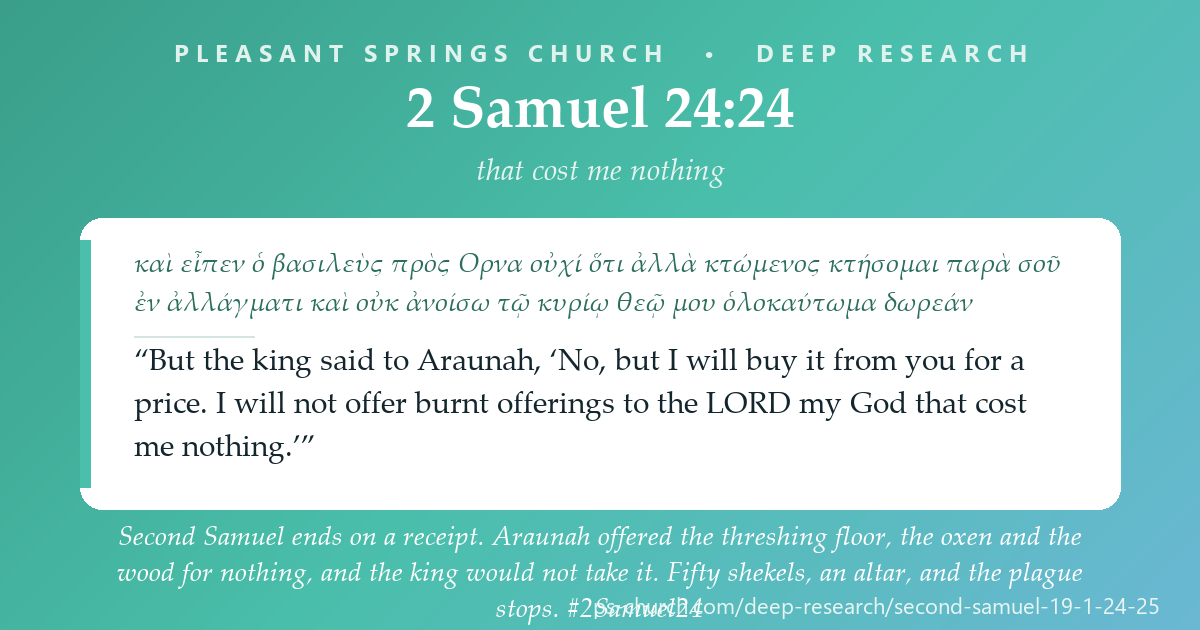
- And the book ends on a price. Araunah offered the floor, the oxen and the wood for nothing, and it would have been a perfectly religious transaction. David said no. “I will not offer burnt offerings to the Lord my God that cost me nothing.” Fifty shekels, a receipt, an altar — and the plague stops.
A word about typology, clearly labelled — three layers, kept apart. (1) What 2 Samuel says: a plague stops at a threshing floor that a king insists on paying full price for. It announces nothing about the future; there is no prophecy in the chapter. (2) What the canon itself does: 2 Chronicles 3:1 puts Solomon’s temple on that exact floor and calls the hill Moriah, the name used in Genesis 22:2; and Matthew 1:6 carries the line of this book forward through “the wife of Uriah,” naming the sin in the genealogy rather than hiding it. Those are Scripture’s own moves, and they are solid ground. (3) What we see from this side of the cross: a sacrifice that costs the offerer everything, on a hill outside Jerusalem, where judgment stops. The Old Testament text does not say that, and we are not going to put it in the text’s mouth — but we are meant to see it, because Luke 24:27 has Christ himself reading the Scriptures this way. Both halves of that sentence are true, and neither may be dropped.
Step in response: two things this week. First, find the offering you have been making because it was free — the hour that costs you nothing, the giving that never changes a decision — and put a price on it. Second, read 2 Samuel 21:10 aloud to yourself, slowly, and then ask who in your life is keeping a vigil nobody is coming to relieve. Rizpah did not get help until somebody told the king. Be the one who tells the king.
2 Samuel 24:24 · to share
LXX (Rahlfs, kaige section) + ESVEvery Deep Research page traces its passage across the whole sweep — the Old Testament, the Second-Temple world between the testaments (historical witnesses, not Scripture), and the New Testament. Follow the thread:
Pleasant Springs Church — Deep Research
Research method after Michael S. Heiser’s Bible Research Method (examine dictionaries → ancient literature → important words → textual connections → academic publications → share), with the Pleasant Springs “Author & Audience” foundation. Scripture set in the Hebrew, the Greek editions named on each page and the ESV (Old Testament), and the Greek New Testament and the ESV (New Testament), per the practice of Pleasant Springs Church. 2 Samuel 19–24 research grounded in McCarter (Anchor), Alter (The David Story), Brueggemann (Interpretation and CBQ 50 [1988]), Auld (OTL) and Klement on the Samuel conclusion, with Barthélemy, Tov, Ulrich and Fernández Marcos on the Greek and Alter for the literary tools used in the structure block. Book name: in the Septuagint this is 2 Kingdoms (Βασιλειῶν Βʹ), the second part of one continuous four-part work; our English names for the Torah are the Septuagint’s own names, so an English Bible already mixes two naming traditions. Text, edition and section: Hebrew from the Masoretic Text; Greek from Rahlfs’s Septuaginta, pulled verse by verse from the morphologically analysed Rahlfs text and printed without editorial punctuation; English ESV. The whole passage, 19:1 to the end of the book, falls inside the kaige section that runs from 2 Samuel 11:2 to 1 Kings 2:11 — so the Greek printed here is a revision toward a proto-Masoretic Hebrew, Vaticanus is not the oldest Greek in these chapters, and the Antiochene (Lucianic) text may preserve older readings; the page says so rather than writing “the LXX.” The section boundary is demonstrated from the text itself by counting καί γε in Rahlfs: none at all in 1 Kingdoms; twenty-eight in 2 Kingdoms, of which twenty-six fall from chapter 11 onward and two (2:6, 2:7) do not and are reported; five in these six chapters; three in 3 Kingdoms before the section ends at 2:11, none in 3 Kingdoms 3–21, and one at 22:22 where the second kaige section begins; seventeen through 4 Kingdoms. The second marker, ἐγώ εἰμι for אָנֹכִי, occurs five times in these chapters and three of them are printed in the codex. Numbering: English 18:33 = Hebrew and Greek 19:1, so the whole of chapter 19 runs one verse out of step and every chapter-19 line above carries both references; chapters 20–24 have identical verse counts in Hebrew, Greek and English (26, 22, 51, 39, 25), which was counted rather than assumed. English Psalm 18 is LXX Psalm 17, looked up in the Greek Psalter rather than computed, and its superscription is verse 1 there. Divergences in the printed verses are enumerated in full in the codex note and are not called “rendering differences” when they are pluses or minuses: Greek pluses at 21:10 (“barley”), 21:14 (“and of those who had been exposed”), 24:17 (“the shepherd”) and 24:25 (the whole Solomon sentence, the largest plus in the passage and in the last verse of the book); differences of sense at 20:16 (city → wall), 20:22 (they → she), 21:1 (“house of bloods” → “injustice”), 22:2 (statement → vocative), 22:3 and 23:3 (rock → guardian), 23:3 (ruler → parable) and 23:5 (negative kept where the ESV asks a question); and one place where the ESV fills a Hebrew minus from the Greek and footnotes it, “my God” at 22:3. Where the columns agree — including at 24:1 and 24:24, the two verses this page leans on hardest — that is stated plainly rather than left to be assumed. The ketiv/qere at 19:7 (MT 19:8), 21:6 and 21:9 are reported. Qumran: the extents of 4QSama (4Q51) across these chapters are reported, including the longer text at 24:16–17 agreeing with 1 Chronicles 21:16; no textual argument is built on the scroll, because that would require DJD XVII rather than a summary. Chronicles is treated as a parallel witness and never harmonised: the four differences in the census account (the inciter, the numbers, seven years against three, and the price) and the Elhanan/Goliath problem at 21:19 — where the ESV’s own footnote points to 1 Chronicles 20:5 — are reported as differences. 2 Samuel 24:1 against 1 Chronicles 21:1 is given four fair readings and then explicitly left unresolved, with the house Molinist framework marked as ours rather than as the verse’s statement. 2 Samuel 21:1–14 is handled under the standing fence for hard texts: reported plainly, located precisely against the oath of Joshua 9 and the law of Deuteronomy 24:16, with the difficulty owned rather than dissolved, with b. Yevamot 79a cited as evidence that the difficulty is ancient, and with an unambiguous statement that it licenses nothing today. Rizpah is given the weight the text gives her, including the fact that the burial and the healing of the land follow from what she did. The Ziba/Mephibosheth question is reported as unresolved because the narrator leaves it unresolved. The typology at the threshing floor is given in three explicitly separated layers — what 2 Samuel says, what 2 Chronicles 3:1 and Matthew 1:6 themselves do, and what we see from this side of the cross — and the last is affirmed as legitimate rather than dismissed. Second-Temple and rabbinic witnesses (Sirach 47; Josephus, Ant. 7.11–13; b. Yevamot 78b–79a) are tagged non-canonical at first mention and never levelled with Scripture. Ancient Near Eastern parallels are cited only from the local scan of Pritchard’s ANET and by page: the Tale of Aqhat at 151 and 153, and Keret at 143.
Scripture quotations marked ESV are from the ESV® Bible (The Holy Bible, English Standard Version®), © 2001 by Crossway, a publishing ministry of Good News Publishers. ESV Text Edition: 2016. Used by permission. All rights reserved. The ESV text may not be quoted in any publication made available to the public by a Creative Commons license, and the ESV may not be translated in whole or in part into any other language. www.esv.org
|
Did this study bless you today? 💚 Give to Support PS Church100% of gifts go to the General Fund — thank you. |