Nathan had already said it: “the sword shall never depart from your house” (12:10). These six chapters are that sentence working. Amnon, David’s firstborn, violates his half-sister Tamar — and the narrator, who will not say a word of judgment out loud, condemns him by construction instead. He gives her a name, and a voice, and three reasoned arguments: “No, my brother, do not violate me… as for me, where could I carry my shame?” (13:12–13). He records, twice, that Amnon “would not listen to her.” He notes that the hatred afterward was “greater than the love with which he had loved her” (13:15), that she was put out and the door bolted, that she tore the long robe “thus were the virgin daughters of the king dressed,” and that she lived from then on “a desolate woman” in her brother’s house. And David does nothing. He “was very angry” (13:21) — and in Hebrew the sentence stops there, though the Greek and a Dead Sea Samuel scroll add a clause explaining that he would not punish Amnon because he loved him as his firstborn. Then two years of Absalom’s silence and a killing at a feast; a flight; Joab and the wise woman of Tekoa; a return without a meeting; a man at the gate who “stole the hearts of the men of Israel”; a king walking out of Jerusalem barefoot and weeping up the Mount of Olives; Shimei throwing stones and curses, and a king who will not have him silenced — “let him curse, for the Lord has told him to” (16:11); Ahithophel and Hushai; and a battle in the forest of Ephraim where “the forest devoured more people that day than the sword” (18:8). An oak, a mule, three javelins driven in against the king’s explicit order — and a room over a gate. This study works 2 Samuel 13:1–18:33 in Hebrew, Septuagint and ESV, with the differences between the columns reported rather than smoothed, and with the one thing you must know about the Greek of these books stated up front: the whole passage lies inside a kaige section, so “the LXX reads X” is never a complete sentence here. Why we print both texts → · See the method →
2 Samuel 13:1–18:33 (selections)
Hebrew · LXX (Rahlfs, kaige section) · ESVThe Shape of the Passage
SequenceBehind these chapters stand two earlier scenes and one sentence. The scenes: the covenant God made with this house (2 Samuel 7:1–17) and what David did to Bathsheba and Uriah (2 Samuel 11–12). The sentence is Nathan’s: “the sword shall never depart from your house… I will raise up evil against you out of your own house” (12:10–11). In front of them stands a divided kingdom and a son named Solomon.
Author
A narrator who refuses to grade his own characters. These six chapters contain almost no editorial comment. Nobody is called wicked; nobody is called righteous; the closest thing to a verdict on David is silence where a verdict should have been. In six chapters the narrator speaks in his own voice about God exactly once — “the Lord had ordained to defeat the good counsel of Ahithophel” (17:14) — and even that is a single clause dropped into a report of a council meeting. Everything else you are left to weigh.
He condemns by construction. This is the technique, and chapter 13 is the textbook case. He never says Amnon was evil. He puts the word “love” in 13:1 and then takes it back in 13:15 — the hatred “greater than the love with which he had loved her.” He lets Tamar make three reasoned arguments and then records, twice, that Amnon “would not listen to her” (13:14, 16 — and the Hebrew of the first says “to her voice,” which is what the Greek gives both times). He notes what the robe meant before it is torn. He gives her the last word of the scene by giving her none: a desolate woman, in her brother’s house. A writer who wanted you to blame her had a dozen chances and took none of them. The restraint is the rhetoric — the same method as Judges 19, and it means what it means there.
He is also a superb reporter of politics. He knows how a coup is actually built: not with an army but with a chariot, fifty runners, an early start, and a man at the gate who tells every litigant that his case is good and there is no one to hear it (15:1–6). He knows that Ahithophel’s plan was militarily correct and Hushai’s was flattery (17:1–14). He knows that the decisive moment of a civil war can be a piece of rough ground. And he knows that the man who wins the war for the king is the man who disobeys him to do it, and he does not tell you what to think about Joab either.
Audience
People who already knew who ended up on the throne. Amnon is the firstborn and he dies in chapter 13; Absalom is next in the story’s eye and he dies in chapter 18. An Israelite audience knew that the son who finally sat on David’s throne was born to Bathsheba. So this whole sequence was read as the answer to a question they already had the answer to: how did it come to Solomon? The narrative never says “and therefore Solomon.” It just clears the field, one funeral at a time, and lets the reader hear Nathan’s sentence ticking under it.
People living under a monarchy, being shown what one costs. Deuteronomy had laid down what a king was for and what he must not multiply (Deuteronomy 17:14–20). Here is a king with many wives and many sons by them, and here is what that produced: half-brothers who are strangers, a court with no justice at the gate, and a succession settled by violence. The text is not neutral about kingship; it is simply not preaching.
And people who had been failed by someone who should have protected them. That is not a modern reading imposed on the passage; it is what the passage reports. Tamar asks her brother to go through the king. The king hears everything and is angry and does nothing. Absalom tells her to be quiet. Every man in the story with power to act either uses it for himself or does not use it at all — and Scripture wrote that down and left it there. If you are reading this page as someone that has happened to, the Bible is not asking you to be quiet about it. It named her.
Orient on the Succession Narrative, the royal household, the kaige recension, and the law on incest, refuge and asylum.
Search by topic: Succession Narrative / Court History of David; Samuel, Books of; Kingdoms, Books of (LXX); kaige recension; Lucianic / Antiochene text; Absalom; Amnon; Tamar; Joab; Ahithophel; Hushai; Shimei; Ziba and Mephibosheth; Tekoa; Geshur; Mahanaim; Kidron; Mount of Olives; incest laws; blood vengeance and the avenger of blood; cities of refuge; the gate as courtroom; concubine; wise woman.
Which articles are relevant?
- Anchor Bible Dictionary — “Samuel, Books of,” “Succession Narrative,” “David,” “Absalom,” “Amnon,” “Tamar (person),” “Joab,” “Ahithophel,” “Hushai,” “Shimei,” “Geshur,” “Tekoa,” “Mahanaim,” “Olives, Mount of,” “Kidron,” “Incest,” “Blood Vengeance,” “Septuagint” and “Textual Criticism (OT).”
- Dictionary of the OT: Historical Books (IVP) — “Samuel, Books of,” “David’s Family,” “Narrative Art,” “Rape,” “Women,” “City Gate,” “Wisdom in the Historical Books,” “Text and Textual Criticism.”
- On the Greek, before anything else — Bernard A. Taylor, “Reigns: To the Reader,” in NETS. It is where a reader meets the kaige sections and the Antiochene question in four honest pages, and it is the reason this page names its edition in every column heading rather than saying “the LXX.”
- NIDOTTE / TDOT — עָנָה (ʿānāh, humiliate/violate), נְבָלָה (nəḇālāh, outrage), חֶרְפָּה (ḥerpāh, shame/reproach), שָׁמֵם (šāmēm, desolate), נָדַח (nāḏaḥ, banish), קָלַל (qālal, curse), עֵצָה (ʿēṣāh, counsel), חֶרֶב (ḥereḇ, sword).
Bibliography surfaced:
- P. Kyle McCarter Jr., II Samuel (Anchor Bible) — the standard English commentary for the textual questions in these chapters, and the one that takes 4QSama most seriously; A. Graeme Auld, I & II Samuel (OTL); Walter Brueggemann, First and Second Samuel (Interpretation).
- Robert Alter, The David Story (translation and commentary) and The Art of Biblical Narrative — for the literary reading used in the structure block. (Alter reads these texts as literature and does not share the church’s confession; we take the tools, not the metaphysics.)
- Emanuel Tov, Textual Criticism of the Hebrew Bible; Natalio Fernández Marcos, The Septuagint in Context — on the kaige sections and the Antiochene text, which is the whole reason the Greek column above carries a section label.
A royal household, a gate that was a courtroom, an exile who is recalled — and what the ancient retellings could not leave alone.
First the world: what a polygamous royal house did to brothers, what “justice at the gate” meant, why a fugitive went to Geshur, and what an ancient reader expected of an exile’s recall. Then watch Josephus, Ben Sira and the rabbis handle this material — because what they add, and what they delete, tells you which silences they could not bear.
Which parallels shed light on the world of these chapters?
A king’s sons by different mothers were not really brothers. Amnon is Ahinoam’s; Absalom and Tamar are Maacah’s, and Maacah was a princess of Geshur, a small Aramean kingdom east of the Sea of Galilee. Each wife had her own household; the half-siblings met at court. That is why Amnon needs a pretext to be alone with Tamar in the first place, and why Absalom has a foreign grandfather’s palace to run to when he needs one (13:37–38). It is also, quietly, a comment on Deuteronomy 17:17.
The gate was the courtroom, and that is the whole of Absalom’s method. Israelite justice was done at the city gate by elders, and appeal ran up to the king. Absalom stands “beside the way of the gate” and intercepts men before they reach the king, tells each of them his case is good, and says there is no one deputed to hear it (15:2–4). He is not raising an army. He is offering a functioning legal system — and the narrator has just spent two chapters showing a king who would not act on a crime in his own house. The revolt is built out of David’s failure to judge.
The exile who is recalled by royal decree is an ancient story-shape, and there is a very old example we can actually read. The Egyptian Story of Si-nuhe (Middle Kingdom) opens with a courtier who flees at a king’s death because he fears civil disorder, lives for many years among the Asiatics as a tribal ruler — and is then recalled by a royal decree that says, in so many words, “It should not be that thou shouldst die in a foreign country… This is too long to be roaming the earth… that thou mayest return”; he comes home and is received by the king and the royal children. Absalom flees to Geshur, stays three years, and is brought back by a legal fiction Joab plants in the king’s mouth. The parallel is a shape, not a source, and this page claims no more than that — but it is worth knowing that when the woman of Tekoa argues that God himself “devises means so that the banished one will not remain an outcast” (14:14), she is speaking into a world that already had strong feelings about bringing exiles home.
- The Story of Si-nuhe, ANET 18–22 (an Egyptian literary tale — a witness, not Scripture; verified in the local scan, the royal decree of recall at ANET 20 and the return and reception at ANET 21). The flight, the years in Syria-Palestine, the decree, the homecoming, the king’s children crying out at the sight of him.
- Josephus, Antiquities 7.8–7.10 (Whiston’s chapter numbering) (Second-Temple — a witness, not Scripture) — and he is a textual witness here, not just a retelling. He knew the longer text of 13:21: “When David his father knew this, he was grieved at the actions of Amnon. But because he had an extraordinary affection for him, for he was his eldest son, he was compelled not to afflict him.” That is the clause the Masoretic Hebrew does not have. He also reads “four years” at 15:7 where Rahlfs reads forty. Where he departs from both our texts, the departures are his own: he has Joab kill Absalom with a single shot to the heart rather than three shafts, and has Absalom’s hair cut every eighth day rather than once a year (14:26). His David cries out only once: “O my son, I wish that I had died my self, and ended my days with thee!”
- Sirach 47:1–11 (Ben Sira, second century BC — non-canonical: a witness, never levelled with Scripture) — the “Praise of the Fathers” runs through David at length: the lions and bears, the sling and Goliath, the singers he appointed, the feasts he ordered. Tamar, Amnon and Absalom are not there at all, and neither is Bathsheba. The whole of 2 Samuel 11–20 is compressed into one line — the Lord “took away his sins” and exalted his horn for ever. That is a choice, and it is worth seeing a devout Jewish teacher make it two centuries before Christ: the canon keeps what the eulogy drops.
- m. Sotah 1:8 (rabbinic-era — a witness, not Scripture) — the classic measure-for-measure reading, and it is where the “hanged by his hair” tradition comes from: “Absalom was proud of his hair, therefore he was hanged by his hair”; ten spears for the ten concubines, citing 18:15; and three shafts for “three thefts of hearts — the heart of his father, the heart of the court, and the heart of the Jewish people, as it is stated: So Absalom stole the hearts of the men of Israel” (15:6). Note what has happened: the Mishnah is reading 15:6 as a genuine theft, which is exactly what the Hebrew verb says and exactly what the Greek column above does not.
- m. Sanhedrin 10:2 and m. Avot 6:3 (rabbinic-era — witnesses, not Scripture) — two opposite verdicts on the same man. Sanhedrin lists Ahithophel among the four commoners who “have no share in the World-to-Come” (with Balaam, Doeg and Gehazi). Avot uses him as the argument for honouring a teacher: David learned only two things from Ahithophel and still “called him his master, his guide and his beloved friend,” quoting Psalm 55:13–14. The rabbis have put their finger on exactly what makes 15:31 and 17:23 hurt.
Line them up and one pattern is unmistakable: the Hebrew of these chapters withholds explanations, and everybody who retells it supplies one.
(1) Why David did nothing (13:21). The Masoretic Hebrew gives no reason at all — four words, “and he was very angry,” and the scene ends. The Greek, a Dead Sea Samuel scroll and Josephus all supply the reason: he loved him, he was the firstborn. Here the “addition” may well be the older text rather than a gloss — that is a live question and Stage 5 lays it out — but notice what it does either way: it makes the failure comprehensible without making it excusable. A father’s love for his eldest son is a reason. It is not a defence, and the narrative treats it as neither.
(2) How Absalom died. The Bible says his head caught fast in the oak (18:9). It does not say his hair. The hair belongs to 14:26, four chapters earlier, and the joining of the two is an interpretation — a very old and very good one (m. Sotah 1:8, Josephus) that has been preached as though it were the text ever since. It is not the text. Say what the verse says, then say what the tradition made of it, and let the reader see the seam.
(3) What to do with Tamar. Josephus keeps her, names her, and reports the crime — and then has Absalom persuade her “not to esteem her being corrupted by her brother, as an injury,” which is worse than what Absalom actually says. Ben Sira leaves her out of the story of David altogether. Scripture does neither. It gives her a name, a speech, an argument, a garment with a meaning, and a last sentence of her own. When the retellings tidy her away, they are telling you how hard the original is to look at — and the original is the one we read.
The rule for these pages: report what the text approves, report what it merely reports, report what it condemns, and leave the gaps open. Every ancient witness above is worth reading precisely because you can watch it closing one.
One verb repeated four times over a woman, one noun repeated five times over a grave, and the vocabulary of a coup.
Count them yourself — four for anah, eight for qalal, five for “my son” in a single verse. Then watch what the Greek does with each: it holds the first, holds the last exactly, and lets two others go.
“Violate, humiliate, force down.” Four times in chapter 13, and the ESV footnotes the count for you at 13:12 (“Or humiliate; also verses 14, 22, 32”). It is on Tamar’s own lips first — do not do this to me — and thereafter it is the word the narrator, Absalom and Jonadab all use for what was done. The Greek keeps the thread unbroken: ταπεινόω at all four places, “to bring low.” Two chapters later the same Greek root surfaces in David’s mouth — “it may be that the Lord will look on my ταπείνωσις” (16:12) — though there the Hebrew is disputed (see the ketiv/qere below), so that particular echo is a fact about the Greek column and this page does not pretend otherwise.
“Outrage” — not merely a sin but an act that tears the fabric of the community, “a thing not done in Israel.” It is the word used of Shechem and Dinah (Genesis 34:7), of Achan (Joshua 7:15), and of Gibeah (Judges 19:23–24; 20:6). Tamar reaches for the strongest category her language has, and she is right to. The Greek is ἀφροσύνη, “folly” — which sounds far milder in English than it is, and in the next verse the Greek turns her “outrageous fools” into οἱ ἄφρονες and keeps the connection.
“Desolate” — the participle of a verb used of land laid waste and cities left empty. It is the narrator’s own last word about her, and it is deliberately not a legal category or a moral one; it is a picture. The Greek chooses differently: χηρεύουσα, “living as a widow” — a status word where the Hebrew gives an image. Neither column blames her. Both say her life as it was expected to go is over, and the narrator, having said it, says nothing more about her ever again.
“A long robe with sleeves” (ESV) or “a robe of many colours” — the meaning of passîm is genuinely uncertain and the honest lexicons say so. What is not uncertain is where else the phrase occurs: only of Joseph’s coat (Genesis 37:3, 23, 32), and the ESV footnotes the link at 13:18. Both garments mark a favoured child; both are stripped or torn; both are followed by an exile and a father’s inconsolable grief. And the Greek cannot hear it: Genesis has χιτὼν ποικίλος, 2 Kingdoms χιτὼν καρπωτός. Different translators, different centuries — one of them working inside the kaige revision and one not.
“The banished one, the outcast, the one driven away.” The wise woman of Tekoa uses it twice, and the second time she makes it a sentence about God: he “devises means so that the banished one will not remain an outcast.” It is the same root Deuteronomy uses of Israel scattered to the ends of the earth and gathered again (Deut 30:4). This is the theological high-water mark of the whole passage — and it is a Hebrew sentence. The Greek at 14:14 has lost both negatives and reads the opposite way (see the codex note). We print both columns and let the reader see the size of the difference rather than quoting the Hebrew and captioning it “LXX.”
“He stole the heart” — and the verb is the verb of the eighth commandment (Exodus 20:15). The idiom is used elsewhere of deception (Jacob “stole the heart” of Laban, Gen 31:20, 26). m. Sotah 1:8 counts three thefts and reads the verb straight. The Greek does not: ἰδιοποιεῖτο, an imperfect, “he kept making them his own” — annexation rather than larceny. This page prints the loss instead of arguing from a Hebrew verb the Greek column beside it does not have.
“Curse, treat as light.” Eight occurrences in nine verses — count them — and the scene is built out of them. Shimei curses (16:5, 7); Abishai wants to remove the head of “this dead dog” who curses (16:9); David refuses twice, and the second refusal is the sentence people remember: “let him curse, for the Lord has told him to” (16:11). Note carefully what David does and does not claim. He does not say Shimei is right; he says he does not know that Shimei is wrong, and “it may be” (16:12) that God will repay good for the cursing. That is a man withholding judgment on a charge against himself — and it is the exact thing he failed to do in 13:21.
“Counsel, plan.” The word that carries the whole revolt. Ahithophel’s counsel “was as if one consulted the word of God” (16:23) — an astonishing thing for a narrator to say about a man — and David’s one recorded prayer in these chapters is a single line about it: “O Lord, please turn the counsel of Ahithophel into foolishness” (15:31). Then 17:14 tells you, in the narrator’s own voice, that God had already commanded exactly that. The prayer and the answer are five verses of narrative apart and the narrator never joins them up for you. The Greek keeps the noun steady throughout (βουλή), so the thread survives translation intact.
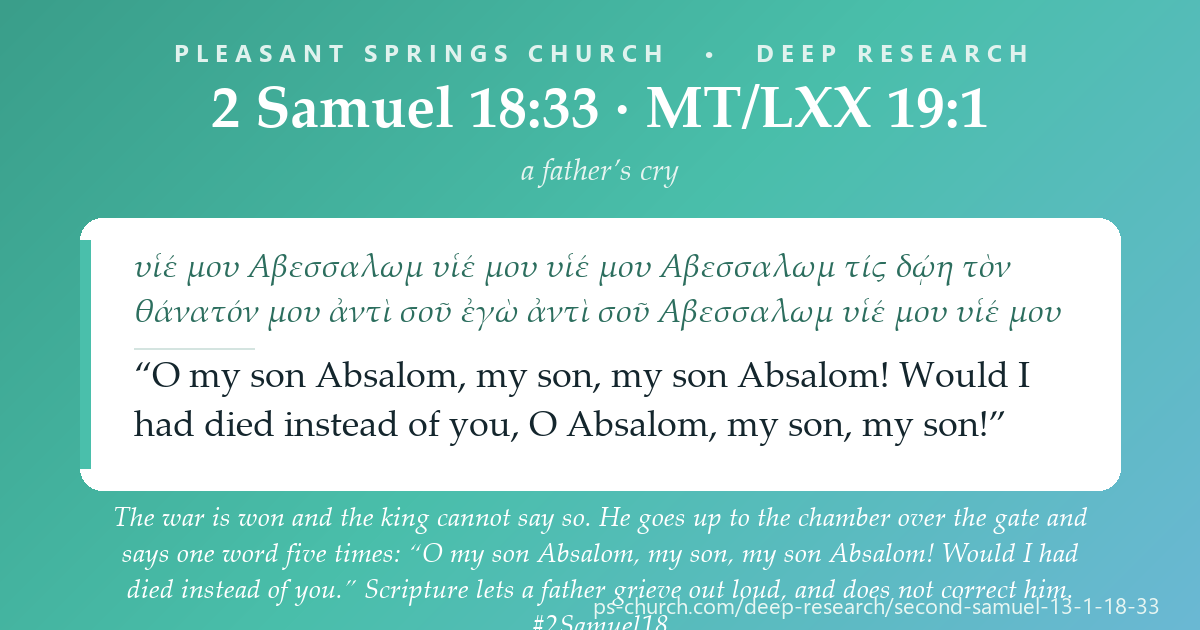
“Son.” The word this whole passage is about, and it detonates in the last verse: five times “my son” and three times “Absalom” in one sentence — and Rahlfs’s Greek matches it exactly, υἱέ μου five times, Αβεσσαλωμ three. Two other uses set it up. At 13:25 David tells Absalom “No, my son” and declines to come to the feast. At 16:11, on the road out of Jerusalem, he says “my own son… seeks my life” — the only time he names the relationship during the revolt, and he says it to explain why a stranger’s curses do not matter. He is a father the whole way through, and it is the one thing he is never able to be usefully.
Three oddities in the Hebrew of these chapters, reported rather than tidied:
- The ketiv/qere at 16:10 and 16:12. At 16:10 the consonants written are כי (“because he curses”) and וכי; the reading tradition says כֹּה (“so let him curse”) and כִּי. The Greek agrees with the reading tradition (καὶ οὕτως καταράσθω). At 16:12 the consonants are בעוני and the reading tradition says בְּעֵינִי, “on my eye”; the Greek has ἐν τῇ ταπεινώσει μου, “in my humiliation,” and the ESV footnotes it (“Septuagint, Vulgate will look upon my affliction”). Three ancient readings of one unpointed word, and none of them changes the sense of the paragraph.
- Amnon’s name is spelled oddly in 13:20. The Hebrew there reads הַאֲמִינוֹן — not the ordinary form used everywhere else in the chapter. Commentators differ over whether it is a diminutive, a contemptuous form in Absalom’s mouth, or simply an interrogative prefix on a variant spelling, and the honest answer is that it is not settled. The Greek simply has Αμνων, so whatever tone the Hebrew carries there, the Greek reader never hears it.
- “Four years” or “forty” at 15:7 — and a warning about the phrase “the Septuagint says.” The ESV prints “at the end of four years” and footnotes it: “Septuagint, Syriac; Hebrew forty.” But Rahlfs’s Septuaginta reads τεσσαράκοντα, forty — and so does the Church of Greece’s edition; both were checked for this page. Josephus reads four. So the Greek copies standing behind the ESV’s note are not the ones printed in the standard edition. This is precisely what a kaige book does to the sentence “the LXX reads X”, and this page does not pretend to settle which Greek is older here.
Nathan’s sentence, the laws that name this crime, a robe from Genesis, a psalm with a superscription, and a hill east of Jerusalem.
Trace five threads: the oracle these chapters execute; the Torah on incest and on kings; Genesis 34, 37 and 38 standing behind chapter 13; the Psalter’s own memory of this revolt; and the geography — Kidron, the Mount of Olives, a betrayed king and a counsellor who hanged himself.
Which cross-references matter?
- 2 Samuel 12:10–12 — the sentence this whole passage carries out. “The sword shall never depart from your house… I will raise up evil against you out of your own house.” Amnon dies by the sword (13:29); Absalom dies by three shafts (18:14); the evil is raised up out of the house exactly as stated; and what Nathan said would happen in the sight of Israel happens at 16:22. Report it and do not soften it: the narrator does not present these deaths as bad luck. He presented the verdict first.
- Leviticus 18:9, 11; Leviticus 20:17; Deuteronomy 27:22 — the law is not ambiguous about a half-sister, and Deuteronomy makes it a public curse: “Cursed be anyone who lies with his sister… and all the people shall say, ‘Amen.’” This matters for reading Tamar’s speech honestly. When she says “speak to the king, for he will not withhold me from you” (13:13), she is not endorsing the law’s violation; she is a young woman with no power buying time by naming a lawful route. The text records her words without commending or condemning them, and so do we.
- Genesis 34 — the closest structural parallel in Scripture, and the vocabulary is shared: an outrage “not done in Israel” (nəḇālāh), a father who says nothing, and brothers who take it into their own hands with a massacre. Read the two chapters side by side and you will see the same silence at the centre of both. Neither narrator approves of anyone.
- Genesis 37 — the robe. The same rare phrase, the same favoured child, the same tearing, and at the end of Genesis 37 a father who “refused to be comforted” over a son he believed dead. Chapter 18 gives you that father again, and this time the son really is dead.
- Genesis 38 — the other Tamar, and the connection is a name rather than a plot. It is worth noticing only for this: both women are wronged inside a family and both are given a hearing by the narrator that they were denied by the men around them.
- Deuteronomy 17:14–20 — the law of the king: not many horses, not many wives, not much silver and gold, and a copy of the law read all his days. Absalom’s first move is to get himself horses and a chariot and fifty runners (15:1). The narrator does not comment. He does not have to.
- 2 Samuel 7:1–17 — and this is the one that keeps the passage from being merely a tragedy. God had said of David’s offspring: “When he commits iniquity, I will discipline him with the rod of men… but my steadfast love will not depart from him” (7:14–15). Chapters 13–18 are the rod. The covenant is not cancelled by them; that is the point of having said it in advance.
- Psalm 2 and Psalm 110 — the royal psalms sing of a king whose enemies are made his footstool. Chapter 15 shows you what the historical version looked like from inside: the same king going out of the city on foot with his head covered. Both are in the same Bible, and the Psalter knows it — the superscription of Psalm 3 reads “A Psalm of David, when he fled from Absalom his son,” and its first line is “O Lord, how many are my foes!” Whatever one concludes about superscriptions, the Psalter has deliberately filed a prayer under this passage.
- Judges 19–21 — for method, not for plot. That is where this Bible teaches you how to read a narrator who reports an atrocity and refuses to editorialize. If you learned it there, you will read 2 Samuel 13 correctly.
Set 15:23–31 beside the Gospels and something happens that Christian readers have noticed for a very long time. The rejected king leaves Jerusalem, crosses the brook Kidron, goes up the Mount of Olives weeping with his head covered, and learns on the way that his trusted counsellor has gone over to the other side — and that counsellor, Ahithophel, when his advice is refused, goes home, sets his house in order, and hangs himself (17:23). The Gospels have Jesus cross the Kidron (John 18:1), go to the Mount of Olives (Luke 22:39), be betrayed by one of his own table, and that man hangs himself (Matthew 27:5).
Now the three levels, and they must not be blurred. (1) What the Old Testament text says: nothing about any of this. 2 Samuel 15–17 is reporting a real flight over real ground and it does not announce itself as a picture of anything. (2) What the New Testament itself draws: not this passage — but it does reach into David’s betrayal psalms, and it does so explicitly. Jesus quotes Psalm 41:9 over the table: “He who ate my bread has lifted his heel against me” (John 13:18), and the apostles apply Psalm 69 and Psalm 109 to Judas (Acts 1:16–20). And Psalm 55:12–14 — “it is not an enemy who taunts me… but it is you, my equal, my companion, my familiar friend” — is the psalm the rabbis themselves read of Ahithophel (m. Avot 6:3). So the canon has connected David’s betrayal to Christ’s, by way of the Psalter, and that is safe ground to teach and to attribute. (3) What we see from this side of the cross: the same hill, the same brook, the same weeping, the same friend, the same rope. That seeing is legitimate and expected — Luke 24:27 has Christ himself opening the Scriptures this way — and it is not nothing. It is simply ours, and we say so, instead of putting it in the narrator’s mouth.
And the difference is as instructive as the likeness. David went up the Mount of Olives weeping because he was leaving. Jesus came down it weeping over the city he was entering (Luke 19:41), and then went back up it to be arrested rather than defended. One king fled to save his life and could not save his son; the other refused to flee, and did not lose one of those the Father gave him.
The Succession Narrative, the kaige problem, the plus at 13:21, and a passage that refuses to explain itself.
McCarter, Alter, Brueggemann and Auld on the narrative; Barthélemy, Tov, Ulrich and Fernández Marcos on the Greek. Then the three live questions these chapters raise — what the Greek plus at 13:21 is, what the Succession Narrative is for, and what a narrator is doing when he declines to grade anybody.
Commentaries & studies:
- P. Kyle McCarter Jr., II Samuel (Anchor Bible) — the fullest English treatment of the textual situation, and the commentary most willing to adopt Greek and Qumran readings against the Masoretic Text; A. Graeme Auld, I & II Samuel (OTL); Walter Brueggemann, First and Second Samuel (Interpretation), for the theological reading of David’s silence.
- Robert Alter, The David Story — a translation with running commentary, and the best guide in English to how these chapters are written: the dialogue, the withheld motive, the single revealing verb.
- Dominique Barthélemy, Les Devanciers d’Aquila (1963) — the book that identified the kaige recension and drew the section boundaries this page states; Natalio Fernández Marcos, The Septuagint in Context, and his work with José Ramón Busto Saiz on the Antiochene text, which is the edition to consult where Rahlfs is a revision.
- Emanuel Tov, Textual Criticism of the Hebrew Bible; Eugene Ulrich, The Dead Sea Scrolls and the Origins of the Bible; Frank Moore Cross, Donald W. Parry, Richard Saley and Eugene Ulrich, Qumran Cave 4. XII: 1–2 Samuel (DJD XVII) — the actual transcriptions of 4QSama and 4QSamc.
Interpretation notes worth keeping:
- The plus at 13:21: what it is, and what the options are. The Masoretic Text ends the verse at “he was very angry.” Rahlfs’s Greek continues: “and he did not grieve the spirit of Amnon his son, because he loved him, for he was his firstborn.” A Dead Sea Samuel scroll supports it, and Josephus knew it. Two readings are on the table. (1) The clause is original and dropped out of the Hebrew — a copyist’s eye skipping, or a scribe finding the excuse for David unbearable. Note that the clause is not flattering to David, which is an argument against it being an invention. (2) The clause is an old explanatory expansion — an early reader supplying the motive the narrator withheld, exactly as the Targums and midrashim do elsewhere. We do not adjudicate, and the page prints both columns so the reader can see the difference rather than being handed a conclusion. What can be said is this: either way, the Hebrew as it stands leaves David’s inaction unexplained, and that silence is doing work.
- The “Succession Narrative” hypothesis, named and not adopted. Since Leonhard Rost (1926) it has been common to treat 2 Samuel 9–20 with 1 Kings 1–2 as a single early document answering the question “who will sit on the throne of David?” The proposal is genuinely illuminating about the shape of the material and is now genuinely contested — over its extent, its date, its purpose (pro-Solomonic apology? anti-monarchic critique?), and whether it ever existed as a separate source at all. We name the debate and do not settle it. Nothing this page teaches depends on the outcome, because the sentence the material actually turns on is inside the text: 12:10.
- “For the Lord had ordained…” (17:14) — and where this page stops. The narrator states plainly that God commanded Ahithophel’s good counsel to be defeated so that harm might come on Absalom. He does not tell you how that relates to Hushai’s free decision to lie, or to David’s prayer six verses earlier, or to Absalom’s guilt. Our house reading takes God’s knowledge of what free creatures would do to be exactly the sort of thing a sentence like this presupposes — God works his purpose through, not around, the real choices of Hushai and Absalom, and no one in the chapter is a puppet. But Scripture does not say that here, and the difference between our account and the text’s statement is one we mark rather than blur. The verse asserts God’s hand and the men’s responsibility in one breath and offers no mechanism. Where Scripture gives no reason, we say so and stop.
- 2 Samuel 16:20–22, briefly and once. Ahithophel advises Absalom to take his father’s concubines publicly, and he does, on the roof, “in the sight of all Israel” — a political act performed on ten women whom the text does not name and does not consult, and whose end it reports without comment in 20:3. The narrator tells you it happened because Nathan had said it would (12:11–12). He is not commending anybody, and neither is this page. It is worth saying out loud that the ten women are the people this scene is done to, that Scripture bothers to record what became of them, and that the passage is here reported and not dwelt on.
- The narrator’s reticence runs in every direction, and that is the discipline. He does not say David was wrong to leave Jerusalem, or right. He does not say Absalom’s grievance was baseless. He does not say Joab was wrong to kill him, and he does not say the king was wrong to order him spared — he gives you Joab’s furious speech in 19:5–7 and David’s tears and lets them stand against each other unreconciled. The absence of a verdict is not a verdict. The commentaries divide sharply on Joab in particular, and the division is itself the evidence that the text does not say.
- And what the passage will not do is explain the suffering. Nothing here tells Tamar why. Nothing tells the twenty thousand men in the forest why. Nathan’s oracle explains the shape of the disaster in David’s house; it does not explain any individual death in it, and it does not make Tamar a lesson about her father’s sin — she is a person, not a consequence. Where Scripture gives a reason we may give it; here it gives one for David and none for her, and we will not manufacture the missing one.
A word not listened to, a king who would not be a judge, and a father in a room over a gate.
Name what you learned, why it matters, and one concrete response.
What should we carry away — and do?
- Scripture named her. It could have told this story without her name, without her speech, without her argument, without the meaning of her robe. It gave her all four, and then reported twice, in two verses, that she was not listened to. A book that does that is not on the side of the people who did not listen.
- “He was very angry” is not an action. Chapter 13 records a man with every power he needed — legal, paternal, royal — who felt the right thing and did nothing with it, and the next five chapters are what grew in the space where his judgment should have been. Anger that costs nothing protects no one.
- The revolt was built out of a justice vacuum. Absalom’s whole pitch at the gate was “your case is good, and there is no one to hear it” — and he was not lying. Where wrongs go unaddressed, someone will eventually offer to address them, and that someone is not always better than what he replaces.
- David would not let anyone silence the man cursing him. “Let him curse, for the Lord has told him to… it may be that the Lord will look on the wrong done to me” (16:11–12). He does not concede the charge and he does not suppress it. That is a rare posture and it is the best thing he does in six chapters — and it is exactly what he would not do when the accusation was against his own son.
- “God devises means so that the banished one will not remain an outcast.” A woman from a village invents a lawsuit to say it to a king, and it turns out to be the truest sentence anybody speaks in the passage. Hold it carefully: it is the Hebrew text, the Greek reads otherwise, and this page has printed both. Held carefully, it is still true, and the rest of the Bible spends itself proving it.
- And the cry is in the canon on purpose. Five times “my son.” No correction from the narrator, no theological consolation offered in the verse, no reminder that Absalom was a traitor — that comes from Joab in the next chapter, and the text lets you feel how brutal it sounds. A church that cannot sit in that room with that man for one minute before answering him cannot hold its own grieving parents.
A word about typology, clearly labelled: the Kidron, the Mount of Olives, the weeping king, the friend at the table who betrayed him and then hanged himself — Christians have seen Christ here for many centuries, and they are not wrong to. Name what is what. 2 Samuel does not announce itself as a picture of anything; it reports a flight over real ground. What the New Testament itself does is take David’s betrayal psalms — Psalm 41:9 in John 13:18, Psalms 69 and 109 in Acts 1:16–20 — and apply them to Judas. What we see from this side of the cross is the rest, and we are meant to see it: Luke 24:27 has Christ doing exactly this kind of reading. So teach it, and say which half is which. The one thing forbidden is putting our seeing into the narrator’s mouth.
Step in response: two things this week. First, find the thing you are angry about and have not acted on, and act on it — a conversation, a report, a protection put in place. 13:21 is in the Bible so that we know how that ends. Second, if there is a Tamar near you, do the opposite of what everyone in this chapter did: use her name, listen to her voice, and do not tell her to hold her peace.
2 Samuel 18:33 · MT/LXX 19:1 · to share
LXX (Rahlfs, kaige section) + ESVEvery Deep Research page traces its passage across the whole sweep — the Old Testament, the Second-Temple world between the testaments (historical witnesses, not Scripture), and the New Testament. Follow the thread:
Pleasant Springs Church — Deep Research
Research method after Michael S. Heiser’s Bible Research Method (examine dictionaries → ancient literature → important words → textual connections → academic publications → share), with the Pleasant Springs “Author & Audience” foundation. Scripture set in the Hebrew, the Greek editions named on each page and the ESV (Old Testament), and the Greek New Testament and the ESV (New Testament), per the practice of Pleasant Springs Church. 2 Samuel 13–18 research grounded in McCarter (Anchor), Alter (The David Story), Brueggemann (Interpretation) and Auld (OTL), with Barthélemy, Tov, Ulrich and Fernández Marcos on the Greek and Alter for the literary tools used in the structure block. Book name: in the Septuagint this is 2 Kingdoms (Βασιλειῶν Βʹ), the second part of one continuous four-part work; our English names for the Torah are the Septuagint’s own names, so an English Bible already mixes two naming traditions. Text, edition and section: Hebrew from the Masoretic Text; Greek from Rahlfs’s Septuaginta, verified verse by verse against the morphologically analysed Rahlfs text and spot-checked against the Church of Greece edition, printed without editorial punctuation; English ESV (2016). The whole passage, 13:1–18:33, falls inside the kaige section that runs from 2 Samuel 11:2 to 1 Kings 2:11 — so the Greek printed here is a revision toward a proto-Masoretic Hebrew, Vaticanus is not the oldest Greek in these chapters, and the Antiochene (Lucianic) text may preserve older readings; the page says so rather than writing “the LXX.” The section boundary is demonstrated from the text itself by counting καί γε in Rahlfs: none at all in 1 Kingdoms; twenty-eight in 2 Kingdoms, of which twenty-six fall from chapter 11 onward and two (2:6, 2:7) do not and are reported; sixteen in these six chapters; three in 3 Kingdoms before 2:11, none in 3 Kingdoms 3–21, and one at 22:22 where the second kaige section begins; seventeen through 4 Kingdoms. Numbering: chapters 13–18 run verse for verse in Hebrew, Greek and English with one exception, stated on the page and footnoted by the ESV itself — English 18:33 = Hebrew and Greek 19:1; Rahlfs gives 2 Kingdoms 18 thirty-two verses and 19 forty-four, exactly as the Masoretic Text does. This was counted, not assumed. Divergences in the printed verses are enumerated in full in the codex note and are not called “rendering differences” when they are pluses or minuses: the plus at 13:21 (supported by a Dead Sea Samuel scroll and by Josephus, and footnoted by the ESV); the two missing negatives at 14:14, which reverse the sense of the second half of the verse; and differences of word choice at 13:20 (desolate → widowed), 15:6 (stole → made his own) and 18:14 (rods → darts). Where the columns agree — 13:12, 13:13, 13:15, 13:19, 15:30, 16:11, 17:14, 18:8 and the cry itself — that is stated plainly rather than left to be assumed. The pluses at 13:27, 14:30 and 15:20 are reported though those verses are not printed. The ketiv/qere at 16:10, 16:12 and 18:8 are printed and discussed, and the “four years / forty years” problem at 15:7 is reported exactly as found: Rahlfs and the Church of Greece edition both read forty; the ESV’s note credits “four” to the Septuagint and Syriac; Josephus reads four; and this page does not adjudicate. Qumran: the extents of 4QSama (4Q51) and 4QSamc (4Q53) across these chapters are reported, and no textual argument is built on them, because that would require DJD XVII rather than a summary. Second-Temple and rabbinic witnesses (Sirach 47; Josephus, Ant. 7.8–10; m. Sotah 1:8; m. Sanhedrin 10:2; m. Avot 6:3) are read as witnesses, tagged non-canonical at first mention, and never levelled with Scripture; where they supply a motive or a detail the narrator withheld — David’s reason, Absalom’s hair — that is pointed out rather than borrowed. 2 Samuel 13 is handled under the church’s standing rule for texts that narrate violence against women: the act is reported once, plainly, without detail; Tamar’s name, voice, argument and dignity are the centre; the narrator’s condemnation-by-construction is shown from the text; David’s inaction is stated without excuse; and no share card is taken from that chapter. The scene at 16:20–22 is reported once, briefly, with the ten unnamed women named as the people it was done to. The typology at the Kidron and the Mount of Olives is given in three explicitly separated layers — what 2 Samuel says, what the New Testament itself draws from David’s betrayal psalms, and what we see from this side of the cross — and the last is affirmed as legitimate rather than dismissed. The Succession Narrative hypothesis is named and not adopted; 17:14 is reported with the house reading marked as ours and the text’s silence about mechanism left standing.
Scripture quotations marked ESV are from the ESV® Bible (The Holy Bible, English Standard Version®), © 2001 by Crossway, a publishing ministry of Good News Publishers. ESV Text Edition: 2016. Used by permission. All rights reserved. The ESV text may not be quoted in any publication made available to the public by a Creative Commons license, and the ESV may not be translated in whole or in part into any other language. www.esv.org
|
Did this study bless you today? 💚 Give to Support PS Church100% of gifts go to the General Fund — thank you. |