Seven chapters, and one question running under all of them: what does a man do when he has the power to end somebody? Saul has a spear and throws it — twice in the Hebrew, once in the Greek. David has a sleeping king in a cave and cuts a corner off his coat, and cannot even live with that. In between stands the friendship: “the soul of Jonathan was knit to the soul of David, and Jonathan loved him as his own soul” (18:1), and a covenant, and the crown prince taking off the robe of the heir and handing it over with his sword and his bow and his belt. Then the women singing in the street, “Saul has struck down his thousands, and David his ten thousands” — and one sentence with no adjective in it at all: “And Saul eyed David from that day on.” Michal at the window with an idol in the bed. Jonathan’s arrows, and two men weeping in a field. A priest at Nob who gave a hungry fugitive the holy bread — the loaf Jesus cites in Mark 2:25–26 — and then, four verses that must be read once and slowly: eighty-five priests killed on a king’s order, and one son who escaped. And at the end the cave at En-gedi, and Saul weeping in the doorway: “You are more righteous than I.” This study works 1 Samuel 18:1–24:22 line by line, in Hebrew, Septuagint and ESV — and it does not hide the fact that the Greek of these chapters is missing whole paragraphs the Hebrew has, including 18:1–5 itself. That difference is a gift, not a caveat, and this page shows you every bit of it. See the method →
1 Samuel 18:1–24:22 (selections)
Hebrew (MT) · LXX / 1 Kingdoms (Rahlfs) · ESVThe Shape of the Passage
InclusioBehind these chapters stand the anointing at Bethlehem and the valley of Elah (1 Samuel 16–17), the rejection at Gilgal and the torn robe (15:27–28), and the word spoken against the house of Eli long before any of it (1 Samuel 2:27–36). In front of them stand Nabal and Abigail, the medium at En-dor, and Gilboa (1 Samuel 25–31).
Author
A narrator who almost never tells you what to think, and who is at the very top of his craft here. Watch him do it in one line: “And Saul eyed David from that day on” (18:9). No adjective, no verdict, no explanation — one verb and a date. He does the same with the spear (18:11), with Michal at the window (19:12), with the eighty-five priests (22:18). He reports; he does not editorialise; and the effect is that you cannot escape into a moral before you have felt the thing.
He works by repeated words, and he expects you to hear them. Six “loves” in chapter 18 and Saul the subject of none of them. A robe given in 18:4 and a robe cut in 24:5. A spear in Saul’s hand at 18:10, 19:9, 22:6 and 26:7 — it is practically part of his body. And at 22:19 he puts into Saul’s mouth against a town of Israelite priests the exact formula God had given him against Amalek in 15:3, and says nothing whatever about it. That is Leitwort technique, Buber and Rosenzweig’s name for a key word threaded through a passage, and Robert Alter’s point about it holds: if you can name the repeated word, you have the theme.
And he is fair to Saul. This is not a cartoon. Saul is afraid, and the narrator says so plainly (18:12, 18:15, 18:29). He is told by his own son that he is about to murder an innocent man, and he listens and swears an oath, and keeps it for a while (19:6). He weeps in the end and speaks the truth about himself (24:16–17). A study that enjoys Saul’s destruction has read the book worse than the man who wrote it.
Audience
People who already lived under David’s house — and who had heard the other version. These chapters answer a question a real audience really asked: how exactly did the son of Jesse end up with Saul’s throne? An Israelite hearing this could have been told, and probably was told by somebody, that David was a defector, a Philistine mercenary, an opportunist. The narrative goes out of its way to answer that: David is loved by Saul’s son, married to Saul’s daughter, protected by Saul’s own household, and twice refuses to lay a hand on Saul when he could have. The witness who says so loudest is Saul himself, in tears, in chapter 24.
People who knew what a covenant was. Three times these chapters say Jonathan and David cut a covenant (18:3; 20:16; 23:18) — sworn language, with the " + SC + " named as the witness and a clause about descendants “forever” (20:42). A first audience would have heard treaty vocabulary, not sentiment. See Stage 2.
And people who had to live somewhere between the two men. Doeg reports and eighty-five priests die. The men of Keilah would have handed David over (23:12). The Ziphites twice go to Saul (23:19; 26:1). Jonathan strengthens David’s hand in God and then goes home to his father’s house and dies on Gilboa with him. These chapters were told to people who knew exactly how costly it is to be caught between a king who is failing and a king who is coming.
Orient on covenant and treaty love, the bread of the Presence, teraphim, the ephod, Nob and the priesthood, En-gedi, and the anointed one.
Search by topic: David; Jonathan; Michal; Saul; Doeg; Ahimelech; Abiathar; covenant (berit); love (ahab) in ANE treaty texts; robe and mantle; teraphim; ephod; bread of the Presence / showbread; Nob; Gibeah; Keilah; Ziph; Adullam; En-gedi; Messiah / the LORD's anointed; asylum and sanctuary; the outlaw band; house of Eli.
Which articles are relevant?
- Anchor Bible Dictionary — “David,” “Jonathan,” “Michal,” “Saul,” “Doeg,” “Ahimelech,” “Abiathar,” “Nob,” “En-gedi,” “Keilah,” “Adullam,” “Teraphim,” “Ephod,” “Bread of the Presence,” “Covenant,” “Messiah.”
- Dictionary of the OT: Historical Books (IVP) — “David,” “Jonathan,” “Saul,” “Friendship,” “Priests and Levites,” “Prophets and Prophecy,” “Water and Water Systems” (for the En-gedi oasis), “Text and Textual Criticism” — the last one is where a reader should go before arguing about 1 Samuel 17–18.
- NIDOTTE / TDOT — אָהֵב (ʾāhēḇ, love), נֶפֶשׁ (nepeš, soul/life), בְּרִית (bərîṯ, covenant), קָשַׁר (qāšar, bind/knit — and also “conspire”), מְעִיל (məʿîl, robe), כָּנָף (kānāp, wing/corner), מָשִׁיחַ (māšîaḥ, anointed), תְּרָפִים (tərāpîm), חֲנִית (ḥănîṯ, spear).
- On the Greek — Bernard A. Taylor, “1 Reigns: To the Reader,” in NETS. It is where the description of Greek 1 Kingdoms in the codex note above comes from — Rahlfs as the base text, Thackeray’s sections and the non-kaige profile of 1 Reigns, and the exact list of verses the Greek does not contain.
Bibliography surfaced:
- P. Kyle McCarter Jr., I Samuel (Anchor Bible) — the standard text-critical commentary on this book in English, and the place to see the Greek and Qumran evidence laid out verse by verse; Ralph W. Klein, 1 Samuel (WBC); David Toshio Tsumura, The First Book of Samuel (NICOT), which is markedly more conservative about the Masoretic Text and is worth reading against McCarter.
- Robert Alter, The David Story (translation and commentary on 1–2 Samuel), and The Art of Biblical Narrative for the tools used in the structure block; Robert D. Bergen, 1, 2 Samuel (NAC); Bill T. Arnold, 1 & 2 Samuel (NIVAC); V. Philips Long on the reign of Saul; Walter Brueggemann, First and Second Samuel (Interpretation). (Several of these read the narratives as literature and do not share the church’s confession; we take the tools, not the metaphysics.)
- Emanuel Tov, Textual Criticism of the Hebrew Bible, and Eugene Ulrich, The Qumran Text of Samuel and Josephus — for what the scrolls, the Greek and Josephus actually show, and for how careful one has to be with each.
Treaty love and treaty oaths, fugitives and the kings who shelter them, a garment as a legal object, and what the ancient retellings did with the massacre.
First the world: why “love” in a covenant text is not primarily a feeling, what a hunted man’s options actually were, and why a piece of somebody’s clothing could function as evidence. Then Josephus, who is retelling all of this from a Greek Bible.
Which parallels shed light on this world?
“Love” in the ancient Near East is treaty vocabulary before it is anything else. In the suzerainty treaties a vassal is required to love his overlord: it means exclusive, undivided, demonstrable loyalty, and it is a term with legal teeth. William L. Moran established the point for Deuteronomy in a famous article (“The Ancient Near Eastern Background of the Love of God in Deuteronomy,” CBQ 25 [1963] 77–87), and J. A. Thompson applied it directly to these chapters (“The Significance of the Verb Love in the David-Jonathan Narratives in 1 Samuel,” Vetus Testamentum 24 [1974] 334–338). You can see the same grammar in the Hittite treaty printed in ANET: Mursilis to Duppi-Tessub, “With my friend you shall be friend, and with my enemy you shall be enemy… remain loyal toward the king of the Hatti land, my sons and my grandsons forever!” (ANET 203–205). Set that beside 20:14–17 and 20:42 — loyalty, descendants, forever — and you can hear what kind of speech Jonathan is making. This does not make the friendship cold. The narrator also says the two men wept until David could not stop (20:41), which no treaty ever required. It means the text is describing something at once personal and formally binding, and that both halves are in the words.
A fugitive from one king normally ran to another one, and the great powers wrote clauses about it. That is exactly what David does — to Samuel at Ramah (19:18), to Nob (21:1), to Achish king of Gath (21:10), to the king of Moab (22:3–4), and finally into the wilderness with four hundred men in debt and distress (22:2). The treaty between Hattusilis III and Ramses II devotes whole sections to Extradition of Fugitives: if a nobleman flees from one land to the other, “shall seize them and shall have them brought back” — with a mercy clause attached, that the returned fugitives not have their eyes torn out nor their families punished (ANET 201–203). Saul has no such treaty with Gath or Moab, which is precisely why those are the places David goes; and the anxiety of the men of Keilah and the Ziphites in chapter 23 is the anxiety of small towns who know a king can come and ask.
And a piece of a man’s garment was not a souvenir. Clothing in this world carried identity and legal weight — a hem could be pressed into clay as a seal in Mesopotamian practice, and in Israel a garment held in pledge had to be returned by sundown because “it is his only covering” (Exodus 22:26–27). That is why David can hold up a scrap of cloth in 24:11 as proof: it is the one thing that could only have been got by being close enough to kill. And it is why the robe torn in 15:27 and the robe given in 18:4 and the robe cut in 24:5 are all doing the same job in this book. (These pages cite ancient parallels only from a text we can actually check; the Mari and Amarna letters, which are often quoted here, fall outside the range of the ANET scan we verify against, so no page number is offered for them.)
- Treaty between Hattusilis III of Hatti and Ramses II of Egypt (ANET 199–203) and the treaty of Mursilis II with Duppi-Tessub of Amurru (ANET 203–205) — Late-Bronze suzerainty treaties (royal documents, witnesses, not Scripture): loyalty sworn “forever,” extended to sons and grandsons; the friend/enemy formula; and detailed extradition clauses for fugitives. The vocabulary of Jonathan’s covenant lives in this world.
- Josephus, Antiquities 6.242–270 (Second-Temple — a witness, not Scripture) — his retelling of Nob, and it is evidence in three directions at once. He calls Doeg “the Syrian” (6.254), which is the Greek reading and not the Hebrew one. He calls the priest Abimelech, again with the Greek. And he gives the number of the slain as three hundred and eighty-five (6.260) — a third figure, agreeing with neither the Hebrew’s eighty-five nor Rahlfs’s three hundred and five. Josephus is working from a Greek Bible, and his divergences are data about which Bible.
- Josephus, Antiquities 6.282–290 (Second-Temple — a witness, not Scripture) — the cave. He keeps the cut garment (6.284) and he keeps Saul’s confession, though he turns it into a Greek compliment: “thou hast demonstrated this day, that thou possessest the righteousness of the ancients… I am now persuaded that God reserves the kingdom for thee” (6.290). What the Bible says more simply is “you are more righteous than I.”
- Sirach 47:1–11 (Second-Temple — a witness, not Scripture, and not counted canonical by this church) — Ben Sira’s praise of David: he killed the giant, “so they glorified him with ten thousands” (47:6, ἐν μυριάσιν, the word from 1 Kingdoms 18:7). Note what he leaves out: no Jonathan, no spear, no Nob, no cave. A hymn of praise is not a history, and this one prunes.
- The psalm superscriptions (Scripture, and part of the Hebrew and Greek text alike) — five psalms attach themselves to these chapters by name. Psalm 52 (= LXX 51), “when Doeg, the Edomite, came and told Saul”; Psalm 54 (= LXX 53), the Ziphites; Psalm 57 (= LXX 56), “when he fled from Saul, in the cave”; Psalm 142 (= LXX 141), “when he was in the cave”; and Psalm 59 (= LXX 58), “when Saul sent men to watch his house in order to kill him” (19:11). Every one of these Greek numbers was looked up in the Greek Psalter, not calculated. In the Greek the title itself is verse 1 or 1–2, so English Psalm 52:1 is LXX Psalm 51:3.
It takes the narrator fourteen verses, and the killing itself two, and it should be read slowly and once. Saul, sitting under a tamarisk tree with his spear in his hand, accuses his servants of conspiring against him. Doeg volunteers what he saw at Nob. Ahimelech is summoned and gives a straight answer — he had inquired of God for David before, he knew nothing of any quarrel, and “who among all your servants is so faithful as David?” (22:14). Saul orders the priests killed. His own guard refuse. Doeg does not, and eighty-five men who wore the linen ephod die (22:18). Then the town itself: “both man and woman, child and infant, ox, donkey and sheep” (22:19).
Three things must be said and then we move on.
(1) The narrator makes it a quotation. That formula in 22:19 is not generic. It is the sentence God gave against Amalek in 15:3, word for word in the Hebrew for its human half — and Saul had not carried it out then. The thing he would not do to Israel’s enemy he does to Israel’s priests. The narrator writes the correspondence and adds not one word of comment.
(2) The narrator also ties it back through a family tree. Ahimelech is “son of Ahitub” (22:9, 20), and the book has already told us who Ahitub was: son of Phinehas, son of Eli (14:3). So the eighty-five are Eli’s house, and the word spoken against that house is in this book too — “all the descendants of your house shall die by the sword of men… the only one of you whom I shall not cut off from my altar shall be spared to weep his eyes out” (2:33). One escapes: Abiathar (22:20). And the connection is finally made explicit outside this book, when Solomon expels Abiathar from the priesthood, “thus fulfilling the word of the Lord that he had spoken concerning the house of Eli in Shiloh” (1 Kings 2:27). This is the narrator’s own thread, not an invention of ours. But be careful with it: it explains nothing about Doeg’s guilt or Saul’s, and Scripture never offers it as an excuse for either. David does not use it either; what he says is “I have occasioned the death of all the persons of your father’s house” (22:22).
(3) It licenses nothing. This chapter records a king murdering priests, and it is told against him. Nothing in it — nor in any conquest text in the Old Testament — authorises violence, coercion or hostility toward any people or group today. These texts have been misused for exactly that, and the church should say so out loud. Our weapons are not of the flesh (2 Corinthians 10:4); our struggle is not against flesh and blood (Ephesians 6:12); and when the disciples wanted fire from heaven, Jesus rebuked them (Luke 9:54–55) and told Peter to put the sword away (Matthew 26:52).
One verb the whole of chapter 18 is counted in, one garment that frames seven chapters, and the title David refuses to touch.
Count ahab yourself — six in chapter 18, and note who is never the subject. Then follow the robe from 15:27 to 18:4 to 24:5, hold the Hebrew nepesh beside a Greek column that does not contain the verse, and ask why a hunted man keeps calling his hunter “the anointed of the Lord.”
“Love.” Six times in chapter 18 and three more in a single verse at 20:17 — and Saul is never the subject. Jonathan loves David (18:1, 3), all Israel and Judah love him (18:16), Michal loves him (18:20, 28), Saul’s own servants love him (18:22, on Saul’s instructions, which is its own quiet joke). In covenant and treaty texts this verb carries loyalty, not sentiment (Moran; Thompson) — and 18:3 puts it inside a formal covenant, so that is plainly part of what is meant here. It is not the whole of what is meant: 20:41 has two grown men weeping in a field. Note the Greek honestly: 18:1 and 18:3 are absent from Rahlfs, so a Greek reader gets four of the six, and at 18:28 he reads πᾶς Ισραηλ ἠγάπα αὐτόν, “all Israel loved him,” where the Hebrew has Michal.
“Soul, life, self, appetite” — the whole living person, not a part of one. 18:1 stacks it three times in a single sentence: the nepeš of Jonathan was knit to the nepeš of David, and he loved him as his own nepeš. The verb between them is קָשַׁר (qāšar), “bind, tie” — the same root used elsewhere in this book for men who conspire (22:8, 13). It is a rope word. And nepeš is also the word for the thing everyone in these chapters is trying to take: Saul seeks David’s (23:15), the Ziphites offer it up (23:20), and David says to Saul’s face, “you hunt my life to take it” (24:11 · MT 24:12). The Greek does not have this verse at all, which is why the point is made from the Hebrew column and labelled as such.
The long outer robe: a garment of office, worn by the high priest (Exod 28:31) and by Samuel (15:27; 28:14) and by a king’s son. Seven occurrences in 1 Samuel; three of them here. Jonathan strips his off and gives it, with his armor and sword and bow and belt (18:4) — the crown prince divesting himself, in public, in favour of somebody else. David cuts a corner off Saul’s (24:4 · MT 24:5) and cannot bear it. In Greek the garment changes: διπλοΐς, a double cloak, which NETS has to gloss for the reader as “a style of garment.”
“Wing” — and so the corner or skirt of a garment. Four times in chapter 24, and once just before this study begins, at 15:27, where Saul grabs the kānāp of Samuel’s robe and it tears and the kingdom goes with it. The same noun is the “corner” the tassels are tied to (Numbers 15:38), and the “wings” a person shelters under in the Psalms. Here the Greek keeps the image exactly: τὸ πτερύγιον, “the little wing.”
“Spear.” It is in Saul’s hand every time we see him from here on — while he listens to music (18:10; 19:9), while he eats at the new moon (20:33), while he sits under the tamarisk tree and gives the order about Nob (22:6), and while he sleeps at Hachilah (26:7). The narrator never once says “Saul was a violent man.” He just keeps mentioning the spear. Note that in a Greek Bible it is thrown once and not twice, because 18:10–11 is not there.
“The Lord’s anointed” — in Greek χριστὸς κυρίου. The startling thing is who wears the title: Saul, in the mouth of the man he is hunting, after God has already rejected him. David’s reasoning is not that Saul deserves it. It is that the anointing is God’s act and therefore not David’s to cancel. He says the same thing again over the sleeping Saul in 26:9 and executes a man for claiming to have done it in 2 Samuel 1:14–16.
The household image Michal puts in the bed — the same word as the objects Rachel steals from her father (Genesis 31:19) and one that Scripture consistently disapproves of (Judg 17:5; 2 Kgs 23:24; Hos 3:4; Zech 10:2). The narrator does not tell us what it was doing in David’s house, or whose it was, or whether anyone should be troubled that it was there. He reports and moves on, and a study that fills the gap has added to the text. It must have been large enough and human enough to fool messengers at a doorway. The Greek makes it τὰ κενοτάφια, “cenotaphs” — a guess at a word the translator did not know.
“The bread of the Presence” — literally bread of the face, the twelve loaves set before the Lord every Sabbath and eaten afterwards by the priests alone (Leviticus 24:5–9). The Greek prints both ideas in one verse, ἄρτοι τῆς προθέσεως (the setting-out) and ἄρτοι τοῦ προσώπου (the face). This is the loaf Ahimelech puts into a hungry fugitive’s hands, and it is why Mark 2:25–26 exists.
Three oddities in the Hebrew of these chapters, reported rather than tidied:
- The ketiv and qere at 18:1. The consonants written are ויאהבו; the Masoretic reading tradition says וַיֶּאֱהָבֵהוּ, “and he loved him.” The sense is not in doubt and nothing turns on it, but it is worth seeing that even the most quoted sentence in these chapters has a note attached to it in the manuscripts. There are two more in this passage: 18:9 (עון written, עוֹיֵן read) and 24:4 · MT 24:5, where the written form is plural “your enemies” and the read form singular.
- “From beside the south” at 20:41. The Hebrew as it stands says David rose מֵאֵצֶל הַנֶּגֶב, “from beside the Negev,” which is not a thing you can stand beside. The ESV prints “the stone heap” and footnotes it (“Compare Septuagint; Hebrew from beside the south”) — and the Greek gives no help at all, because it does not translate the word either: ἀπὸ τοῦ εργαβ, spelled out in Greek letters. This is a place where the text has not come down to us clearly, and the honest thing is to say so rather than print a confident noun.
- Two words that occur nowhere else. כְּבִיר at 19:13 and 19:16 — the “pillow” or “quilt” of goats’ hair — occurs only in these two verses in the whole Bible, which is why the ancient Greek translator reached for liver and why modern translations differ. And אַבִּיר הָרֹעִים at 21:7 · MT 21:8, “mighty one of the shepherds,” is an unusual phrase which the Greek renders as a man pasturing mules. Where a word occurs once, everybody is reasoning from context, including us.
The robe that keeps reappearing, the bread that Jesus cites, the house of Eli, and five psalms that claim these chapters as their own.
Trace four threads: the torn/given/cut robe from 15:27 forward; Nob backward to Shiloh and Eli and forward to Solomon; the bread of the Presence into the Gospels, with its famous difficulty faced rather than skated past; and the psalm titles, which are the Bible’s own commentary on this stretch of David’s life.
Which cross-references matter?
- 1 Samuel 15:27–28 — the hinge for everything in the structure block above. Samuel turns to go, Saul grabs the corner of his robe, it tears, and Samuel says: “The Lord has torn the kingdom of Israel from you this day and has given it to a neighbor of yours, who is better than you.” Every robe in this study is answering that sentence.
- 1 Samuel 2:27–36 and 1 Samuel 14:3 — the word against the house of Eli, and the genealogy that quietly connects it to Nob. Ahimelech son of Ahitub is of Eli’s line, and Abiathar is the one survivor. The explicit fulfilment notice comes much later, in 1 Kings 2:26–27, when Solomon removes Abiathar. Read the three together, and then read 22:22, where David takes the blame anyway.
- Leviticus 24:5–9 and Mark 2:23–28 — the law of the bread of the Presence, and the day Jesus used this chapter in an argument. “Have you never read what David did, when he was in need and was hungry, he and those who were with him: how he entered the house of God, in the time of Abiathar the high priest, and ate the bread of the Presence, which it is not lawful for any but the priests to eat, and also gave it to those who were with him?” (Mark 2:25–26). See the note below on the Abiathar difficulty; we are not going to walk past it.
- Genesis 31:19–35 — the other bed with a household image in it. Rachel hides her father’s teraphim and sits on them; Michal lays one in a bed and covers it with a garment. In both stories a woman deceives an angry patriarch and the narrator declines to lecture anybody about it. That silence is a technique, not an endorsement.
- 1 Samuel 26 — the second cave, so to speak. David spares Saul again, this time over a sleeping man with a spear stuck in the ground by his head, and says the same sentence: “Who can put out his hand against the Lord’s anointed and be guiltless?” (26:9). Whether chapters 24 and 26 are two accounts of one event or two events is genuinely debated, and this page does not decide it; McCarter and Klein lean one way, Tsumura and Bergen the other, and the text itself gives us two.
- 2 Samuel 1:17–27 — the book’s last word on both men, and it is David’s. “Saul and Jonathan, beloved and lovely! In life and in death they were not divided… I am distressed for you, my brother Jonathan; very pleasant have you been to me; your love to me was extraordinary, surpassing the love of women.” The man who had the most reason to speak ill of Saul wrote a poem instead and commanded that it be taught. It is in the next book; it is the right place to stop when you are tempted to enjoy Saul’s fall.
- 2 Samuel 7:1–17 — where all of this is going. The fugitive who would not lay a hand on the anointed is given an anointed house “forever” — the same word Jonathan used in 20:42 about their two families.
- Psalms 52, 54, 57, 59, 142 (= LXX 51, 53, 56, 58, 141) — the superscriptions tie five psalms to these seven chapters: Doeg, the Ziphites, the cave twice, and the night the house was watched. Whatever one concludes about how the titles came to be attached, they are part of the received Hebrew and Greek text, and they are Israel’s own way of saying that this stretch of David’s life is where a great many people learn to pray. Psalm 34 (= LXX 33) is attached to the escape from Achish in 21:10–15, and its title calls the king Abimelech — in the Hebrew as well as the Greek.
- Exodus 22:26–27; Numbers 15:37–41 — for what a garment and its corner meant in Israel: a pledged cloak had to be returned by sundown, and the corners carried the tassels that were supposed to make a man remember the commandments. David cuts a corner off a king’s robe and it is his own heart that reacts first.
In Mark 2:26 Jesus refers to this episode and names Abiathar as high priest. In 1 Samuel 21 the priest at Nob is Ahimelech; Abiathar is his son, and he becomes priest only after the massacre (22:20). Matthew 12:3–4 and Luke 6:3–4 tell the same story and name nobody. This is a real difficulty, it has been discussed since antiquity, and pretending otherwise helps no one.
Here are the answers people give, as fairly as we can put them. (1) A textual answer: the phrase ἐπὶ Ἀβιαθὰρ ἀρχιερέως is absent from some early manuscripts of Mark — Codex Bezae (D), Codex Washingtonianus (W), several Old Latin witnesses and the Sinaitic Syriac — which is why the question is partly a text-critical one. Most editors nonetheless judge the longer reading original, precisely because it is the harder one and scribes had an obvious motive to drop it. (2) A grammatical answer: ἐπί with a person’s name in the genitive can introduce a passage rather than a date — compare Mark 12:26, “in the passage about the bush” (ἐπὶ τοῦ βάτου). On this reading Jesus is saying “in the section about Abiathar,” naming the larger narrative by its most famous priest. (3) A historical answer: Abiathar was present at Nob and is by far the better-known of the two — the priest of David’s whole reign — so the era could be named for him the way we say “under Elizabeth” for a span that began before the coronation. (4) A frank answer: some conclude that Mark, or the tradition he received, has the name wrong. (5) And an Old Testament complication worth knowing: the Hebrew of 2 Samuel 8:17 reverses the two men entirely — “Ahimelech the son of Abiathar” — so the confusion of these names is older than the Gospels and is a live question in the Hebrew text itself.
This page does not adjudicate. What it will say is this: not one of the five options touches what Jesus was actually arguing, which is that the bread was given to a hungry man by a priest who knew the law perfectly well, and that God did not strike anybody. “The Sabbath was made for man, not man for the Sabbath.” And it is worth noticing where Jesus went for the argument — not to a principle, but to a story about David on the run, being fed.
The text is not shy and neither should we be. Jonathan’s nepeš was knit to David’s; he loved him as his own soul; he made a covenant with him; he took off the robe of the heir and handed it over; he risked his life for him in front of his father; he wept with him in a field until David could not stop; and years later David said his love was “extraordinary, surpassing the love of women” (2 Sam 1:26). All of that is in the Bible and none of it should be minimised.
What the text calls it is a covenant — three times, in so many words (18:3; 20:16; 23:18), sworn in the divine name, with descendants named and “forever” attached (20:42). That is the category the narrator gives us, and the vocabulary belongs to the world of oaths and treaties as much as to the world of feeling (Moran; Thompson; and see the Hittite treaty language in Stage 2). It is also, plainly, personal: treaties do not weep.
So the discipline here is simple and it cuts both ways. Do not sentimentalise it into a greeting card about best friends; it is a legally binding oath between a crown prince and the man who will take his throne, and it cost Jonathan everything he might have had. And do not read into it a modern category the text does not use — in either direction. The narrative nowhere presents this as a sexual relationship, and it also nowhere presents it as merely political calculation. Both readings are additions. The Bible has a word for what this was, and the word is covenant love; a study that will not use the Bible’s own word for something usually wants to say something else.
And the last thing to notice is the shape of it. Jonathan is the one with everything to lose, and he is the one who keeps giving: the robe, the warning, the oath, and finally — in the last conversation they will ever have — the sentence “You shall be king over Israel, and I shall be next to you” (23:17). Then he went home to his father’s house, and he died there beside him.
The commentaries, the great textual argument of this book, the harmful spirit, and how to preach Saul.
McCarter, Klein, Tsumura, Alter, Bergen, Arnold, Long and Brueggemann on the narrative; Barthélemy, Gooding, Lust and Tov on the shorter Greek; Tov and Ulrich on the scrolls. Then the live questions this passage raises and does not settle for us.
Commentaries & studies:
- P. Kyle McCarter Jr., I Samuel (Anchor Bible) — the fullest text-critical treatment, and the one most willing to prefer the Greek and Qumran against the Masoretic Text; David Toshio Tsumura, The First Book of Samuel (NICOT) — deliberately the other way, arguing that the Hebrew as received usually makes sense; Ralph W. Klein, 1 Samuel (WBC). Read at least one of the first two against the other; the difference between them is most of the field.
- Robert Alter, The David Story — for the literary reading and for the translation notes, which are unusually candid about where the Hebrew is broken; Robert D. Bergen, 1, 2 Samuel (NAC); Bill T. Arnold, 1 & 2 Samuel (NIVAC); Walter Brueggemann, First and Second Samuel (Interpretation); V. Philips Long on the reign of Saul.
- Dominique Barthélemy, David W. Gooding, Johan Lust and Emanuel Tov, The Story of David and Goliath: Textual and Literary Criticism (Orbis Biblicus et Orientalis 73, 1986) — four scholars, four positions, and their responses to one another printed together. This is the honest place to send anyone who wants to know whether the short Greek or the long Hebrew came first.
- Emanuel Tov, Textual Criticism of the Hebrew Bible; Eugene Ulrich, The Qumran Text of Samuel and Josephus; Frank Moore Cross, Donald W. Parry, Richard J. Saley and Eugene Ulrich, Qumran Cave 4. XII: 1–2 Samuel (DJD XVII, 2005) — the actual transcriptions. And Benjamin J. M. Johnson in Vetus Testamentum 62 (2012), arguing that the surviving 4QSama fragments in 1 Samuel 17–18 fit the longer text rather than the shorter one.
- Bernard A. Taylor, “1 Reigns: To the Reader,” in A New English Translation of the Septuagint — the source for the edition, the translational profile, and the list of verses Rahlfs does not contain.
Interpretation notes worth keeping:
- “A harmful spirit from the Lord” (18:10; 19:9) is a genuine difficulty and we will not slogan our way past it. The Hebrew says רוּחַ אֱלֹהִים רָעָה at 18:10 and רוּחַ יְהוָה רָעָה at 19:9; the Greek at 19:9 reads πνεῦμα θεοῦ πονηρόν, “an evil spirit of God.” The adjective is the ordinary word for bad or harmful, and it can describe the effect as easily as the moral character. Readers have taken it three main ways: (1) a spirit sent by God as judgement, God remaining sovereign over what he does not approve (compare 1 Kings 22:19–23 and Job 1–2); (2) a natural or mental affliction attributed, as the Old Testament habitually attributes everything, directly to God; (3) the withdrawal of the Spirit that had come on Saul at his anointing (16:13–14), leaving something else in the vacancy. The house handles this the way it handles the hardening of Pharaoh in Exodus: the text says God did it and the text also holds Saul responsible for the spear, and we report both in the same breath rather than resolving one into the other. Where Scripture gives no further reason, we stop.
- Chapters 24 and 26 — one event told twice, or two events? Both have Saul pursuing with three thousand men, both have David in a position to kill and refusing with the same theological reason, both end with Saul confessing. Critical commentators frequently read them as variant accounts of a single tradition; others point to real differences of setting, agents and outcome and take them as two occasions, with the second deliberately echoing the first. We name the positions and do not adjudicate, and note that nothing in the doctrine of these chapters moves with the answer.
- The shorter Greek is not a small thing and it is not a threat. Roughly half of the Goliath material and the whole of 18:1–5 are missing from Rahlfs. That is a large, visible, ancient difference, and every serious study Bible footnotes it. It is worth saying plainly what it does not do: no article of the Christian faith rests on it. The church has had both witnesses for as long as it has existed, knew it, and confessed the same creed. A reader who loves one translation has a magnificent translation of a real text and loses nothing by learning where the other witnesses stand — which is the whole of our published policy on this.
- The narrator’s reticence about Michal’s household image, and about David’s lie at Nob. David tells Ahimelech that the king has sent him on business (21:2), which is not true, and eighty-five men die partly because of the visit; David himself says so in 22:22. The narrator records the lie, records the consequence, records David’s admission, and passes no sentence. The absence of a verdict is not a verdict. Commentators divide sharply over whether David is being quietly criticised in chapter 21, and the division is itself the evidence that the text does not say.
- How to preach Saul. He is the first king of Israel, he was anointed by Samuel, he was given another heart, he saved Jabesh-gilead, he fathered Jonathan, and he ends these chapters weeping in a cave doorway telling the truth about himself. He is a tragedy, not a villain to be enjoyed, and a congregation can tell the difference in about four sentences. The Talmud, at b. Yoma 22b, apologises to him by name. David wrote the elegy. If our treatment of Saul is harsher than David’s, we have gone wrong somewhere.
A robe given away, a spear thrown, a scrap of cloth, and a man who wept and told the truth.
Name what you learned, why it matters, and one concrete response.
What should we carry away — and do?
- The heir took off the robe himself. Nobody made Jonathan do it. He was the crown prince, he understood exactly what the women in the street were singing, and he gave away his robe and his armor and his sword to the man who was going to have his throne — and then kept giving, all the way to “you shall be king, and I shall be next to you.” That is what covenant love costs when it is real.
- The narrator counts the spear and never calls Saul a name. If you want to learn how to speak about someone who has gone badly wrong, read chapters 18 to 24 and notice what is not said. The facts are enough. The reader can do the rest.
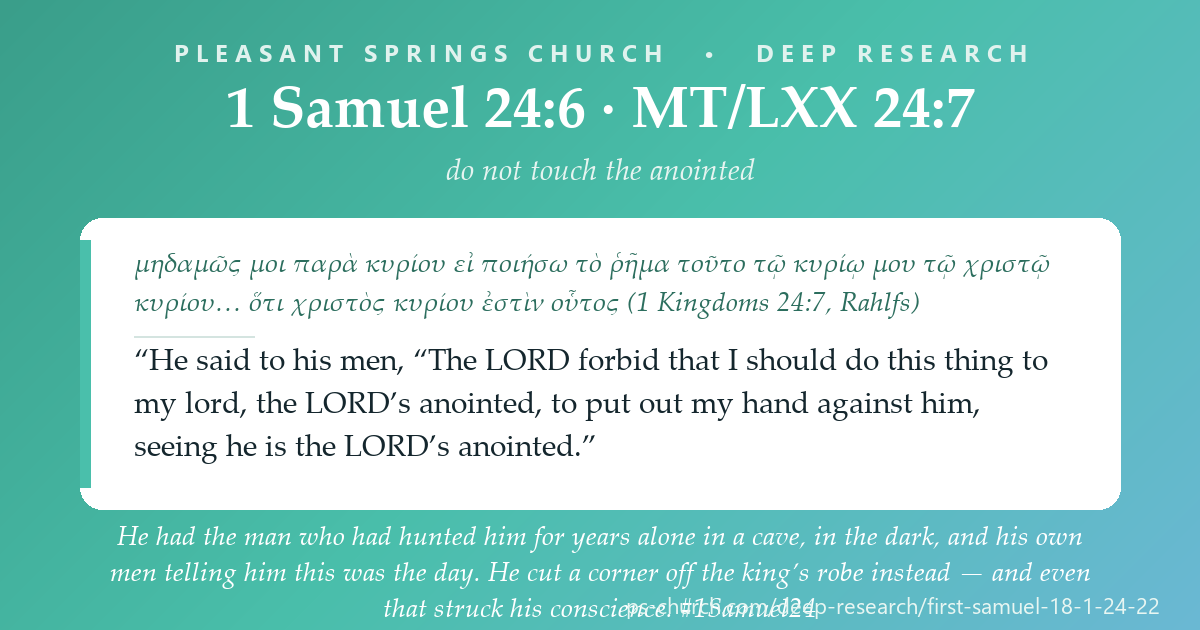
- David’s heart struck him over a piece of cloth. He had the man who had hunted him for years, alone, in the dark, at his mercy — and what he actually did was cut a corner off a coat, and it kept him awake. A conscience that fine is not weakness; it is the reason the throne was safe with him.
- “The Lord forbid… he is the Lord’s anointed.” Notice the reason he gives. Not “Saul might repent,” not “it would look bad,” not “I am better than this.” It is that God did something to Saul once and it is not David’s to undo. He restrained himself on the basis of what God had done, not on the basis of what Saul deserved.
- Eighty-five men in linen ephods, and one who got away. Read 22:6–19 once, slowly, and do not preach it twice. It is what happens when a frightened man with power stops hearing anyone but himself — and the men who come out of it well are the guards who would not obey.
- And Saul said the true thing. “You are more righteous than I.” He said it out loud, in the open, weeping, with three thousand of his own men behind him, about the man who was taking his kingdom. It did not save him and it did not change what he did next. It was still true, and Scripture wrote it down in his voice.
A word about typology, clearly labelled: a Greek reader meets the words χριστὸς κυρίου in 24:6 and cannot help hearing what he hears everywhere else — the Lord’s Christ. Hold that carefully. The New Testament does not make Saul a type of anything, and it does not read 1 Samuel 24 as a picture of the cross. What it does do is call Jesus the Son of David and put David’s throne in Gabriel’s mouth (Luke 1:32–33), and it does send us back to this very stretch of the story in Mark 2:25–26 — where the hungry fugitive who was given the holy bread is the precedent Jesus claims for himself. As a devotional analogy, and labelled as one: a rejected anointed man, hunted by the authorities, who would not save himself by taking a life, is a shape a Christian will recognise. That is a devotional analogy and not an argument from the text, and this page does not pretend otherwise.
Step in response: two things this week. First, find the person you have every right to answer — the one who has wronged you and is still in reach — and do not. Cut the corner off the coat and let it be enough. Second, if you are Jonathan this week, and the thing you hoped for is going to someone else: he did not merely accept it, he went and strengthened the other man’s hand in God (23:16). That is a harder and better thing than resignation, and it can be done on a Tuesday.
1 Samuel 24:6 · MT/LXX 24:7 · to share
LXX / 1 Kingdoms (Rahlfs) + ESVEvery Deep Research page traces its passage across the whole sweep — the Old Testament, the Second-Temple world between the testaments (historical witnesses, not Scripture), and the New Testament. Follow the thread:
Pleasant Springs Church — Deep Research
Research method after Michael S. Heiser’s Bible Research Method (examine dictionaries → ancient literature → important words → textual connections → academic publications → share), with the Pleasant Springs “Author & Audience” foundation. Scripture set in the Hebrew, the Greek editions named on each page and the ESV (Old Testament), and the Greek New Testament and the ESV (New Testament), per the practice of Pleasant Springs Church. 1 Samuel 18–24 research grounded in McCarter (Anchor Bible), Tsumura (NICOT), Klein (WBC), Bergen (NAC), Arnold (NIVAC), Long, Brueggemann (Interpretation) and Alter’s The David Story, with Alter also supplying the literary tools used in the structure block. Text & editions: Hebrew from the Masoretic Text, with the qere printed and the ketiv reported at 18:1, 18:9, 22:18 and 24:4 · MT 24:5; Greek from Rahlfs’s Septuaginta (1935), the edition NETS translates for 1 Reigns, verified verse by verse against the CATSS/Rahlfs morphological text rather than back-translated and printed without editorial punctuation; English ESV, quoted exactly. The Greek calls this book 1 Kingdoms (Βασιλειῶν Αʹ), and 1 Kingdoms lies in Thackeray’s section α, outside the kaige revision. Numbering: there is no chapter-offset, and two verse-offsets, both inside this passage and both printed as double references at the verse — English 21:1–15 = MT/LXX 21:2–16 (both make “he rose and departed, and Jonathan went into the city” a separate 21:1), and English 24:1–22 = MT/LXX 24:2–23 (English 23:29 = MT/LXX 24:1). Chapters 18, 19, 20 and 22 carry the same verse numbers in all three columns, and so do 23:1–28 — the Greek keeps the shared numbering even where it has no verse to put under it. Both offsets were counted against the Greek and the Hebrew, not assumed. Divergences: 1 Samuel is the book in which the Greek and the Hebrew differ most, and the whole of that is reported rather than a selection. Rahlfs’s 1 Reigns does not contain 13:1; 17:12–31, 41, 50, 55–58; 18:1–5, 10–11, 17–19; 23:12, and 18:12, 18:21 and 18:29 are shorter than the Hebrew with 18:30 absent as well — so Greek chapter 18 runs 6–9, 12–16, 20–29. Four of the listed minuses fall in this passage (18:1–5; 18:10–11; 18:17–19; 23:12), together with 18:30, and the three lines whose middle column is empty (18:1; 18:3–4; 18:10–11) are marked as absences at the verse and never passed off as anything else. Other differences enumerated here: 18:8 (no “Saul was very angry”; no “what more can he have but the kingdom”), 18:27 (one hundred Philistines against two hundred), 18:28 (“all Israel loved him” against “Michal… loved him”), 19:9 (πνεῦμα θεοῦ for “a spirit of the Lord”), 19:10 (no “that night”), 19:13 (κενοτάφια for teraphim; ἧπαρ τῶν αἰγῶν, a goats’ liver, for the quilt of goats’ hair), 20:41 (εργαβ, untranslated, for a Hebrew that reads “the south”), 21:7 · MT 21:8 (Doeg ὁ Σύρος, “the Syrian,” not the Edomite; νεεσσαραν untranslated for “detained”; mules for herdsmen), 22:6 (a cultivated field for the tamarisk tree), 22:18 (three hundred and five against eighty-five), 23:16 (Kaine for Horesh), and the standing substitution of Αβιμελεχ for Ahimelech throughout chapters 21–22. Pluses and minuses are named as such and never called rendering differences, and where the page argues from a Hebrew word — the məʿîl frame, the ʾāhēḇ count, nepeš at 18:1 — what the Greek column does with it is stated in the same breath, including the fact that the first half of the robe-frame is not in the Greek at all. The shorter Greek of 1 Reigns 17–18 is reported with the debate laid out and deliberately not adjudicated (Lust and Tov for a shorter Hebrew original; Barthélemy and Gooding for the Masoretic Text as a coherent whole and the Greek as an abridgement — all four in The Story of David and Goliath, OBO 73, 1986). Qumran: 4QSama (4Q51) frequently agrees with the Greek against the Masoretic Text, but in chapters 17–18 its evidence is fragmentary and its reconstruction contested (Cross–Ulrich for the shorter text; B. J. M. Johnson, VT 62 [2012], for the longer), so this page builds no textual argument on it here and points readers to DJD XVII. Goliath’s height — six cubits and a span in the Masoretic Text, four in the Greek, 4QSama and Josephus — belongs to the previous study and is stated here with both readings and no verdict. Second-Temple and rabbinic witnesses (Josephus, Ant. 6.242–270, 6.282–290; Sirach 47:1–11, tagged non-canonical at first mention; b. Yoma 22b) are read as witnesses and never levelled with Scripture. ANE parallels are cited only where verifiable in the local scan of ANET: the Hattusilis–Ramses II treaty and its extradition clauses (199–203) and the Mursilis–Duppi-Tessub treaty with its loyalty and friend/enemy formulas (203–205), behind the covenant language of 18:3, 20:14–17, 20:42 and 23:18 (Moran, CBQ 25 [1963]; Thompson, VT 24 [1974]). The friendship of David and Jonathan is reported as the text reports it — covenant love, sworn and costly — without sentimentality and without importing modern categories in either direction. The killing of the priests at Nob is reported plainly, briefly and without relish, with the narrator’s own tie to the house of Eli (2:27–36; 14:3; 22:20; 1 Kings 2:27) and with an explicit statement that it licenses no violence, coercion or hostility today (2 Cor 10:4; Eph 6:12; Luke 9:54–55; Matt 26:52). The Abiathar/Ahimelech difficulty at Mark 2:26 is faced rather than skated past, with five readings named — including the omission of the phrase in D, W and other witnesses, and the reversed names at 2 Samuel 8:17 — and deliberately left unadjudicated. The “harmful spirit from the Lord” (18:10; 19:9) is reported with the tension held rather than resolved, as this house handles the hardening texts. Whether 1 Samuel 24 and 26 are one event or two is named and not decided. Saul is treated as a tragedy and not a villain: his fear is reported without mockery, his oath in 19:6 is credited to him, his confession in 24:16–17 is given the last word of the study, and the reader is pointed to David’s own elegy in 2 Samuel 1. Any Christ-ward reading of David’s restraint is offered only as an explicitly labelled devotional analogy; Mark 2:25–26 is the canon’s own move and is the ground this page stands on.
Scripture quotations marked ESV are from the ESV® Bible (The Holy Bible, English Standard Version®), © 2001 by Crossway, a publishing ministry of Good News Publishers. ESV Text Edition: 2016. Used by permission. All rights reserved. The ESV text may not be quoted in any publication made available to the public by a Creative Commons license, and the ESV may not be translated in whole or in part into any other language. www.esv.org
|
Did this study bless you today? 💚 Give to Support PS Church100% of gifts go to the General Fund — thank you. |