Two men climb a cliff. That is how this passage opens — Jonathan and the young man who carries his weapons, going up on hands and feet toward a Philistine garrison while the king of Israel sits under a pomegranate tree with six hundred men and does not know his son has gone. The whole plan is one sentence: “It may be that the Lord will work for us, for nothing can hinder the Lord from saving by many or by few” (14:6). And the armour-bearer, who has no name in the book, answers: “Do all that is in your heart… Behold, I am with you heart and soul” (14:7). Twenty men fall, the ground shakes, and a panic from God goes through the Philistine camp. Then Saul lays an oath on the army — no food until evening — and everything that follows goes wrong because of it: honey running on the ground that nobody will touch, Jonathan eating because he never heard the oath, a famished army finally falling on the spoil and eating meat with the blood in it, and a king who inquires of God, gets no answer, casts lots, finds his own son, and says “God do so to me and more also; you shall surely die, Jonathan” — until the army refuses and ransoms him (14:45). Jonathan’s verdict on all of it is four words: “My father has troubled the land” (14:29). Then chapter 15, and Amalek — the hardest command in the book, printed here in full, located in Exodus 17 and Deuteronomy 25, owned as hard, and fenced without hedging: it licenses no violence, coercion or hostility toward anyone today, and it has been misused. Saul keeps the king and the best of the sheep; Samuel arrives and asks the question that ends the reign — “What then is this bleating of the sheep in my ears?” (15:14) — and then, “to obey is better than sacrifice” (15:22). Saul grabs at the prophet’s robe as he turns to go, and it tears, and Samuel tells him what he is holding. This study works 1 Samuel 14:1–15:35 in Hebrew, in the Greek of 1 Kingdoms, and in the ESV — and this is the book where those two ancient texts differ most, so every difference in these chapters is listed, not smoothed. See the method →
1 Samuel 14:1–15:35 (selections)
Hebrew (MT) · Greek (Rahlfs, 1 Kingdoms) · ESVThe divergences in these two chapters, enumerated. Not a sample — the list. At 14:18 Saul calls for the ark of God in Hebrew and the ephod in Greek; the ESV footnotes it. At 14:24 the Hebrew begins “the men of Israel were hard pressed” and the Greek begins “Saul committed a great act of ignorance that day.” At 14:41 the Hebrew has four words — “Give Thummim” — and the Greek has three full clauses naming both Urim and Thummim; the ESV prints the Greek and footnotes the Hebrew. At 14:15 the Greek adds “and they were unwilling to act” and makes the panic explicitly “from the Lord.” At 14:16 and 14:33 the ESV again follows the Greek and footnotes the Hebrew. At 14:23 the Greek carries an extra sentence about ten thousand men and fighting scattered through the hill country of Ephraim, which the Hebrew does not have. At 14:29 the Greek adds “and Jonathan knew” and reads “my eyes have seen” for “my eyes have become bright.” At 14:40 the Hebrew’s “you shall be on one side” (עֵבֶר) is read in Greek as “you shall be for servitude” (עֶבֶד). At 14:45 the people ransom Jonathan in Hebrew and pray for him in Greek. At 14:47 the Hebrew’s hard word “he routed them” is “he was saved” (ἐσῴζετο) in Greek, and the Greek list of Saul’s enemies carries one name the Hebrew does not. At 15:3 and 15:8 the Greek turns the verb “devote to destruction” into a proper name, Ιεριμ. At 15:4 Saul musters at Telaim with 200,000 and 10,000 of Judah in Hebrew, and at Gilgal with 400,000 and 30,000 in Greek. At 15:12 the Greek adds a whole clause: Saul was offering a burnt offering of the first of the spoil. At 15:23 the Greek has no word for “rebellion.” At 15:29 — the sharpest of them — the Hebrew’s “the Glory of Israel will not lie” is in Greek “and Israel shall be divided in two.” At 15:32 Agag comes “cheerfully” in Hebrew and “trembling” in Greek, and the ESV footnotes the Hebrew as uncertain. And running through the whole chapter, the one Hebrew verb for “regret” is rendered by three different Greek verbs at 15:11, 15:29 and 15:35. None of that is hidden here, and none of it has been invented.
The Hebrew tradition is candid too. The Masoretes preserve a written reading and a read reading side by side twice in this passage — at 14:27 (“his eyes saw” written, “his eyes became bright” read) and at 14:32 — which is the same habit of honesty this page is trying to keep. Manuscripts. Codex Vaticanus carries this material; Codex Alexandrinus has a lost leaf covering 1 Kingdoms 12:18–14:9, so for the opening of chapter 14 that great witness is simply not there. From the Judean Desert, 4QSama (4Q51, c. 100–50 B.C.) preserves parts of 14:24–25, 28–34, 47–51 and 15:20–21, 24–32 — a scroll famous for agreeing with the Greek against the Masoretic Text more often than any other biblical manuscript. This page makes no argument from its readings in these verses: the transcriptions are in DJD 17, and that, not a summary, is where a reader should check them. Numbering. There is no chapter- or verse-offset here: Hebrew, Greek and English all run 14:1–52 and 15:1–35, with 52 verses in chapter 14 and 35 in chapter 15 in every one of them. That was counted, not assumed. One small edition-level difference is worth naming, because it shows how these things work: Rahlfs begins 14:25 with “and all the land was taking a meal,” while the Greek text of the Church of Greece attaches that clause to the end of 14:24. Same words, different verse number, two printed editions.
The Shape of the Passage
Parallel panelsThese two chapters sit inside the story of Israel’s first king. Behind them is the request for a king and the warning that came with it (1 Samuel 8–10), the law of the king in Deuteronomy 17, and the refrain Judges ended on — “there was no king in Israel” (Judges 21:25). Ahead of them is the anointing of a boy in Bethlehem (1 Samuel 16).
Author
A narrator who reports piety producing disaster, and does not editorialise. This is the governing habit of Samuel and it is at full strength here. Saul does nothing in chapter 14 that he could not defend in religious terms. He binds the army with a solemn oath before a battle. He stops the men from eating meat with the blood in it, which is a real law (Leviticus 17:10–14). He builds an altar — the narrator notes, drily, that it was his first (14:35). He consults God before pursuing. He casts lots to find the sin. He keeps his oath even when it falls on his own son. Every one of those is a religious act, and the chain of them nearly kills the man God had just used to save Israel. The narrator supplies no adverb. He simply lets the army eat “with the blood” because they are famished from a fast their king imposed, and lets Jonathan say the one flat sentence in the chapter: “My father has troubled the land” (14:29).
The Greek translator would not leave it alone. This is worth seeing, because it shows an ancient reader doing exactly what a modern reader wants to do. Where the Hebrew of 14:24 says only that the men of Israel were hard pressed that day, the Greek says “and Saul committed a great act of ignorance that day” — the judgment, spoken aloud, at the head of the verse. Whether that reflects a different Hebrew text or a translator filling a silence is argued about; either way it is a witness to how early the silence was felt. The Hebrew narrator makes you do the work. We will not do it for you either, but we will point at where it is.
And he is not enjoying himself. Saul is a tragedy in this book, not a villain, and the last two verses of chapter 15 are the proof: Samuel grieved over him, and the Lord regretted making him king. Neither of those is the language of a narrator settling a score. A page that reads Saul with relish has misread the book — and the book’s own last word on him is not here at all; it is David’s lament, in the next scroll.
Audience
People who had asked for a king, and were now watching one. Chapter 8 records the request and the Lord’s answer — “they have rejected me from being king over them” — and also God granting it (1 Samuel 8). Chapters 14 and 15 are what the granting looked like in practice. An audience that had wanted a king “like all the nations” is being shown, at close range, a king making decisions: an oath nobody needed, a fast in the middle of a pursuit, a monument set up for himself at Carmel (15:12), and a request at the very end to be honoured in front of the elders (15:30). None of that is caricature. It is what power looks like when a man is frightened of the people he leads — which is what Saul finally says out loud: “I feared the people and obeyed their voice” (15:24).
People who knew exactly which old story chapter 15 was about. The command against Amalek is not sprung on them. It is grounded in two texts the audience already had: the ambush at Rephidim, where Amalek attacked Israel just out of Egypt and the Lord said “I will utterly blot out the memory of Amalek from under heaven” (Exodus 17:8–16), and Moses’ charge to remember “how he attacked you on the way when you were faint and weary, and cut off your tail, those who were lagging behind you, and he did not fear God” (Deuteronomy 25:17–19). Samuel quotes the first of those in 15:2. This page reports the command of 15:3 in full and works through the difficulty at Stage 5 rather than passing over it.
And people for whom “the Lord of hosts” was a fresh title. It debuts in Scripture in this book, at 1:3, and it is the name Samuel uses to open the Amalek oracle: יְהוָה צְבָאוֹת (15:2), which the Greek does not translate but transliterates, κύριος σαβαωθ — the form the New Testament also keeps.
A pass in the rocks, a vow nobody asked for, a priestly lot, and a nation under the ban.
Search by topic: Jonathan; armour-bearer; Michmash and Geba; Bozez and Seneh; Philistines and the Sea Peoples; garrison (matsab); oath, vow and curse in Israel; Urim and Thummim; ephod; ark of the covenant; blood, eating with the; Amalek and the Amalekites; Kenites; Agag; herem / the ban; Gilgal; Carmel of Judah; Samuel; Saul; Kingdoms, Books of (Greek); kaige recension; 4QSamuel-a.
Which articles are relevant?
- Anchor Bible Dictionary — “Jonathan,” “Saul,” “Samuel,” “Michmash,” “Philistines,” “Amalek,” “Agag,” “Kenites,” “Urim and Thummim,” “Ephod,” “Ban,” “Vow,” “Oath,” “Samuel, Books of,” “Septuagint.”
- Dictionary of the OT: Historical Books (IVP) — “Samuel, Books of,” “Saul,” “Jonathan,” “Kingship,” “Warfare,” “Herem,” “Divination and Magic,” “Priests and Levites,” “Text and Textual Criticism.”
- NIDOTTE / TDOT — יָשַׁע (yāšaʿ, save), חָרַם (ḥāram, devote to destruction), נָחַם (nāḥam, relent / regret / be comforted), קוֹל (qōl, voice), שָׁמַע (šāmaʿ, hear / obey), קָרַע (qāraʿ, tear), עָכַר (ʿāḵar, trouble), נֵצַח (nēṣaḥ, glory / enduring), אָלָה (ālāh, oath-curse).
- For the Greek — any article on the Septuagint of Samuel–Kings should tell you two things: that the four books are one series called Kingdoms, and that the Greek of the series is not uniform, because a later revision (kaige) touched some sections and not others. If an article speaks of “the LXX of Samuel” as a single flat thing, treat it with care.
Bibliography surfaced:
- P. Kyle McCarter Jr., I Samuel (Anchor Bible, 1980) — the standard text-critical commentary on this book in English, and the one to open first when the Hebrew and the Greek disagree.
- Ralph W. Klein, 1 Samuel (Word Biblical Commentary); David Toshio Tsumura, The First Book of Samuel (NICOT); Robert D. Bergen, 1, 2 Samuel (NAC); Bill T. Arnold, 1 & 2 Samuel (NIVAC); V. Philips Long, The Reign and Rejection of King Saul.
- Walter Brueggemann, First and Second Samuel (Interpretation) — theologically restless and worth arguing with; Robert Alter, The David Story — a translation with running literary commentary.
- Emanuel Tov, Textual Criticism of the Hebrew Bible; Eugene Ulrich, The Qumran Text of Samuel and Josephus — the study that put the 4QSama / Greek / Josephus relationship on a firm footing.
- Frank Moore Cross, Donald W. Parry, Richard J. Saley and Eugene Ulrich, Qumran Cave 4.XII: 1–2 Samuel (DJD 17, 2005) — the actual transcriptions of 4QSama,b,c. Anyone citing a Qumran reading in Samuel should be citing this.
A Moabite king who used the same word, a rabbinic page where Saul asks our question, and a Jewish historian reading a Greek Bible.
Read herem in 15:3 against the one extra-biblical inscription that uses the same word; read Saul’s battlefield vow against the ancient world’s practice of binding an army by oath; then watch Josephus and the rabbis handle these two chapters — one of them raising the objection a modern reader raises, on the page, in the text.
Which parallels shed light on religion and worldview?
The word in 15:3 is not unique to Israel, and the proof is a stone in the Louvre. The Moabite Stone, set up by King Mesha of Moab around 830 B.C., says of the town of Nebo: “So I went by night and fought against it from the break of dawn until noon, taking it and slaying all, seven thousand men, boys, women, girls and maid-servants, for I had devoted them to destruction for (the god) Ashtar-Chemosh” (ANET 320–321, Albright’s translation). The verb is the same Semitic root as Hebrew חרם. What that does and does not tell us is worth being exact about. It does not make the command in 1 Samuel 15 easier; a shared practice is not an excuse. What it does tell us is that this is the warfare vocabulary of the Iron Age Levant, not a peculiarity of Israel’s God, and that the same stone shows the genre’s habits — Mesha writes “Israel hath perished for ever,” and Israel did not.
Binding an army by oath was ordinary; binding it against food in mid-pursuit was not. Saul’s אָלָה in 14:24 is an oath-curse laid on other people — the army swears nothing, it is sworn at. Ancient armies were routinely bound by oath, and Israel knew the machinery well enough to legislate it (Numbers 30 on vows, and the law of the ordeal-oath in Numbers 5). What the narrator lets you see is the collision of two obligations Saul himself created: the fast that starves the men, and then the blood-law they break because they are starving (14:32–34; Leviticus 17:10–14, and behind it Genesis 9:4). Saul’s fix is a great stone and a proper slaughtering-place, and it works — and it would not have been needed.
On the Philistines and the ground. Michmash and Geba face each other across the Wadi Suweinit, and the two crags the narrator bothers to name — Bozez and Seneh (14:4) — are the kind of detail a storyteller does not invent. The Philistines belong to the wider Sea Peoples movement at the end of the Late Bronze Age, and their appearance in the coastal plain is one of the securely-attested facts of the period; the details of their origin and settlement are argued about in print and this page does not adjudicate them. What matters for the chapter is the military asymmetry the previous chapter named: hill-country Israel against a lowland power with a monopoly on ironworking (13:19–22; see 1 Samuel 11–13).
- The Moabite Stone (Mesha Stele), c. 830 B.C. (ANET 320–321, trans. W. F. Albright) (a Moabite royal inscription — a witness, not Scripture) — “for I had devoted them to destruction for (the god) Ashtar-Chemosh.” The only extra-biblical text that uses the herem vocabulary of 1 Samuel 15, and it is a Moabite king using it of an Israelite town.
- Josephus, Antiquities 6.95–155 (first century AD — a witness, not Scripture) — the whole of this material retold. He keeps Jonathan’s exploit at length, keeps the honey (“he broke off a piece of a honey-comb, and ate part of it”), keeps Saul’s determination to kill his son, and keeps the people’s rescue. Josephus matters textually as well as historically: his biblical text for Samuel repeatedly stands with the Greek and with 4QSama against the Masoretic Text — which is the subject of Eugene Ulrich’s The Qumran Text of Samuel and Josephus. When Josephus differs from your English Bible in this book, that is evidence, not carelessness.
- b. Yoma 22b (rabbinic-era — a witness, not Scripture) — the most striking ancient discussion of 15:3 there is, because Saul himself raises the objection. Reading “Saul came to the city of Amalek and strove in the valley” (15:5), Rabbi Mani says Saul strove with God over the matter, and puts this in his mouth: if the Torah requires a whole atonement rite for one unidentified corpse (Deuteronomy 21:1–9), how much more should I have pity here — “if the men have sinned, in what way have the animals sinned? And if the adults have sinned, in what way have the children sinned?” A heavenly voice answers him with Ecclesiastes 7:16, “Do not be overly righteous.” And then the same page notes that when Saul later slaughtered the priests at Nob, the voice said Ecclesiastes 7:17, “Do not be overly wicked.” The same folio carries Rav Huna’s comparison of Saul, who fell over one sin, with David, who fell over two and kept his throne. We are not endorsing this reading. We are showing you that the question is old, that it was asked inside the tradition, and that it was not answered with a slogan either.
- Sirach 46:13 (Second-Temple, non-canonical — a witness, not Scripture) — Samuel remembered as the prophet who “established the kingdom and anointed rulers over his people.” The Ben Sira praise of Samuel is warm and general; it does not touch Saul’s rejection at all, which is itself worth noticing.
Read 14:24–30 slowly and notice how carefully it is built.
The army is hard pressed (14:24). The king lays a curse on food until evening. They come into a wood, and there is honey running on the ground — the text says so twice, and the second time it says nobody put a hand to his mouth, “for the people feared the oath” (14:26). Provision is lying on the ground and religion is keeping them from it.
Then Jonathan, who had not heard, dips the tip of his staff and eats, and his eyes become bright (14:27) — the Hebrew idiom for a man coming back to himself. Somebody tells him about the oath, and the narrator adds four words: “and the people were faint” (14:28). Jonathan’s reply is the plainest sentence in the chapter and it is about consequences, not authority: “My father has troubled the land… how much better if the people had eaten freely today… for now the defeat among the Philistines has not been great” (14:29–30). The fast cost them the victory.
And the very next thing that happens is that the starving men fall on the spoil and eat meat with the blood in it — a sin against a real law — because they are famished (14:32). Saul is told, and is horrified, and fixes it. He does not connect it to himself. That is the chapter’s whole argument, and the narrator never states it. The word Jonathan uses, עָכַר, is the word used of Achan, who took what was devoted to destruction and was buried in the Valley of Achor (Joshua 7:25) — and the next chapter is about a king who takes what was devoted to destruction.
Save, devote, regret, voice, tear — five words, and four of them behave differently in Greek.
Follow yasha through chapter 14 and qol/shama through chapter 15 and you have both arguments; then watch nacham occur four times in one chapter in Hebrew and be rendered by three different verbs in Greek.
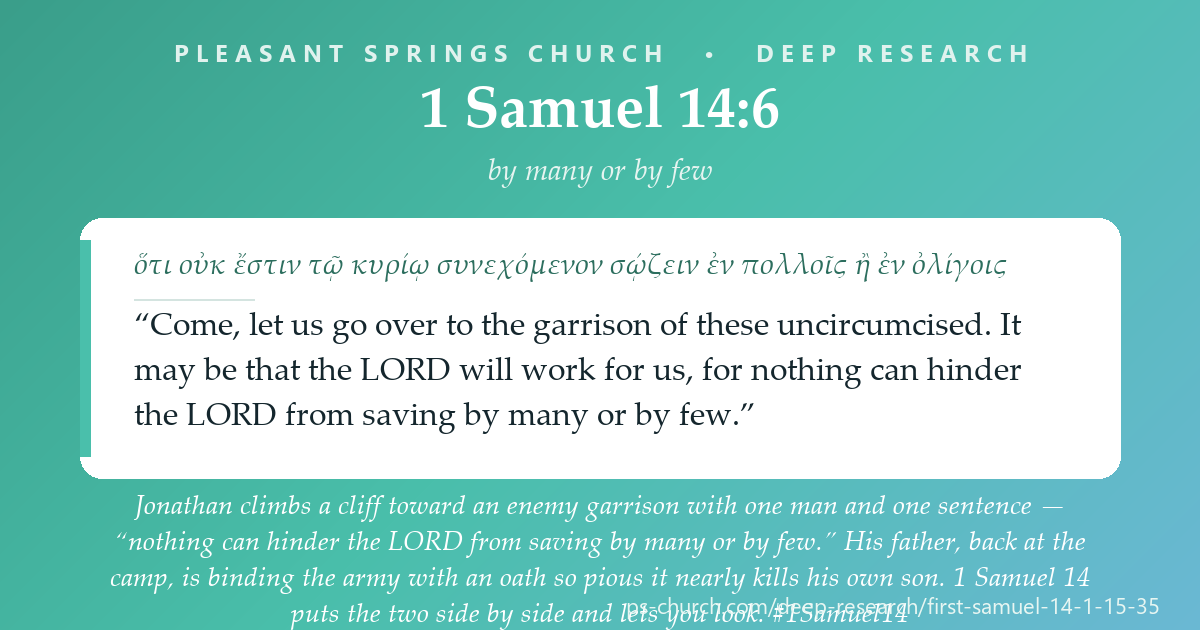
“Save” and “salvation” — the key word of chapter 14, four times, and the argument of the chapter is who. Jonathan states the doctrine before he climbs: “nothing can hinder the Lord from saving by many or by few” (14:6). The narrator confirms it: “so the Lord saved Israel that day” (14:23). Saul then swears by “the Lord who saves Israel” that whoever ate must die (14:39) — invoking the Saviour as the warrant for killing the man he saved through. The army closes the loop: “who has worked this great salvation in Israel?” (14:45). The Greek follows it faithfully with σῴζειν / σωτηρία.
“Devote to destruction” — eight times in chapter 15 (twice in v. 9), and the ESV footnotes it at v. 3: “set apart (devote) as an offering to the Lord (for destruction).” It is not a word for killing; it is a word for transferring something out of human use altogether, which is why taking any of it is theft from God rather than mercy (compare Joshua 7). It is also, demonstrably, shared regional vocabulary: Mesha of Moab uses the same root of an Israelite town (ANET 320–321). The Greek is unstable here: at 15:3 and 15:8 it does not translate the verb at all but writes it as a proper name, Ιεριμ, while elsewhere in the chapter it renders it properly with ἀναθεματίζω and ἐξολεθρεύω.
The hinge of the chapter and one of the hardest words in the Old Testament. In the niphal it covers a range English cannot hold in one word: to be moved to pity, to relent from a declared course, to be sorry, to be comforted. The Masoretic Hebrew uses this one root four times in this one chapter — “I regret” (15:11), “will not have regret… that he should have regret” (15:29), “the Lord regretted” (15:35). So a Hebrew reader hears the same word close on itself, which is precisely why the tension is felt. A Greek reader does not: Rahlfs has παρακέκλημαι at v. 11 (“I have been moved”), μετανοήσει / μετανοῆσαι at v. 29, and μετεμελήθη at v. 35 — three verbs for one. Same root at Genesis 6:6, Exodus 32:14 and Numbers 23:19.
“Voice” and “hear / obey” — the pair that runs chapter 15. Qōl occurs seven times and the root šāmaʿ eight, and Hebrew has no separate word for “obey”: to obey is simply to hear a voice. So the chapter opens “listen to the voice of the words of the Lord” (15:1); the only voice anyone can actually hear in it is livestock (15:14); Samuel asks “why did you not hear the voice of the Lord?” (15:19) and Saul answers “I did hear the voice” (15:20); the verdict is “to hear is better than sacrifice” (15:22); and Saul finally says the true thing: “I feared the people and heard their voice” (15:24). The Greek keeps the noun (φωνή) but at v. 22 turns the verb into a noun, ἀκοή, “hearing is better than sacrifice.”
“Tear.” Twice, in consecutive verses, of two different things: Saul grabs the hem of the robe as Samuel turns to leave and it tears; Samuel says the Lord has torn the kingdom of Israel from you. This is the narrator’s own image for what the chapter is about, and he gets it by letting a desperate man grab at a departing prophet. The Greek preserves the play exactly, διέρρηξεν… διέρρηξεν. (The same word for the same garment returns when David cuts the corner of Saul’s robe in a cave — see 1 Samuel 24.)
“Trouble, bring ruin on, muddy.” A strong word, and rare. Jonathan says his father has ʿāḵared the land — the same verb used of Achan, who took from the devoted things and whose burial place was named the Valley of Achor (Joshua 7:25), and of Jephthah’s daughter meeting her father after his vow (Judges 11:35). All three are about a rash word and its cost. The Greek chose ἀπαλλάσσω, “he has rid / removed the land,” which is a different picture.
The word the ESV renders “the Glory of Israel” — elsewhere “enduringness, everlastingness, splendour” (older English Bibles: “the Strength of Israel”). It is used as a divine title only here. And the Greek does not have it at all: Rahlfs reads “καὶ διαιρεθήσεται Ισραηλ εἰς δύο,” and Israel shall be divided in two — a sentence about the kingdom rather than a title for God. Two very different verses stand at 15:29 in the two traditions, and every English Bible you own prints the Hebrew one.
Urim and Thummim — the priestly lots carried in the breastpiece (Exodus 28:30; Numbers 27:21). They are named at 14:41 only in the Greek. The Masoretic Hebrew has been reduced to two words, “Give Thummim”; Rahlfs has three full clauses, with δῆλοι (“the clear ones”) for Urim and ὁσιότης (“holiness”) for Thummim. The ESV prints the Greek and footnotes the Hebrew — one of the clearest places in the whole English Bible where you can watch this decision being made in public.
Where this vocabulary surfaces later:
- 1 Samuel 12:14–15 — Samuel had already set the terms in his farewell speech, in exactly these words: “If you will fear the Lord and serve him and obey his voice… But if you will not obey the voice of the Lord…” Chapter 15 is the test of a rule the book already stated (see 1 Samuel 11–13).
- 1 Samuel 16:7 — “man looks on the outward appearance, but the Lord looks on the heart.” The verdict of 15:28 — “a neighbor of yours, who is better than you” — is left unnamed for exactly one chapter (see 1 Samuel 16–17).
- 2 Samuel 7:15 — “but my steadfast love will not depart from him, as I took it from Saul.” The promise to David is worded with Saul in view; the covenant with the house of David is defined against what happened in this chapter (see 2 Samuel 7).
- Numbers 23:19 — “God is not man, that he should lie, or a son of man, that he should change his mind.” The closest verbal parallel anywhere to 1 Samuel 15:29, and it is on the lips of Balaam (see Numbers 23–24). The same passage contains the only other place Amalek is given an oracle of his own: “Amalek was the first among the nations, but its end is utter destruction” (Num 24:20).
- Genesis 6:6 and Exodus 32:14 — the same verb נחם: “the Lord regretted that he had made man” (Genesis 6) and “the Lord relented from the disaster” after Moses interceded (Exodus 32). Whatever this word means, it is not a word Scripture uses once and then avoids.
- Psalm 40:6–8; Hosea 6:6; Micah 6:6–8; Isaiah 1:11–17 — the prophets keep saying 15:22 in their own words. In the New Testament a scribe says it back to Jesus — “to love him with all the heart… is much more than all whole burnt offerings and sacrifices” — and is told, “You are not far from the kingdom of God” (Mark 12:32–34).
The ambush at Rephidim, the law of the king, a rash vow in Judges, and a man who took what was devoted.
Trace four threads: the two Amalek texts Samuel is quoting; the law of the king that Saul is measured against; the rash-vow pattern that Judges already ran; and the herem theft that Joshua 7 already told.
Which cross-references matter?
- Exodus 17:8–16 — the stated ground of 15:2. Amalek attacks Israel at Rephidim just out of Egypt; Moses’ hands are held up; and the Lord says, “Write this as a memorial in a book and recite it in the ears of Joshua, that I will utterly blot out the memory of Amalek from under heaven” (Exodus 17). Samuel is not improvising in 15:2; he is citing.
- Deuteronomy 25:17–19 — the second ground, and the one that says why: “how he attacked you on the way when you were faint and weary, and cut off your tail, those who were lagging behind you, and he did not fear God… you shall blot out the memory of Amalek from under heaven; you shall not forget” (Deuteronomy 24–25). The charge is preying on stragglers.
- Genesis 36:12, 16; Numbers 14:43–45; Judges 6:3–5 — Amalek in the rest of the Old Testament: a people descended from Esau (Genesis 36), the force that routed Israel at Hormah when they went up presumptuously (Numbers 14), and a recurring raiding partner of Midian in Judges (Judges 6). They are a raiding confederation on the desert fringe, not a nation with a capital, which is one reason they keep reappearing after being “destroyed”.
- Deuteronomy 17:14–20 — the law of the king, written before there was one: he is not to multiply horses, wives or silver, and he is to write out a copy of the law and read it all his days “that his heart may not be lifted up above his brothers” (Deuteronomy 17). Saul sets up a monument for himself (15:12) and asks to be honoured before the elders (15:30). The measure was already on the books.
- Judges 11:29–40 — Jephthah’s vow, and his daughter coming out to meet him. The rash-oath pattern is not new in 1 Samuel 14; Judges already ran it once, with no reprieve at the end (Judges 10–12). What is different here is that the people intervene, and the king is overruled by his own army.
- Joshua 7 — Achan takes from the devoted things; the army is defeated; lots are cast and narrow tribe by tribe until the man is found; and the place is named Achor, “trouble” (Joshua 7). 1 Samuel 14 and 15 run both halves of that story again — the lot-casting in 14:38–42 and the taking of herem goods in 15:9 — and both times the outcome is different from Joshua’s.
- Deuteronomy 18:9–14 — the list of forbidden practices, headed by divination (Deuteronomy 18). Samuel’s charge in 15:23 — “rebellion is as the sin of divination” — is a comparison, and a heavy one: refusing God’s word puts a man in the company of the practices Israel was told to purge. It becomes horribly literal at En-dor (see 1 Samuel 28).
- Leviticus 17:10–14; Genesis 9:4 — the blood law the famished army breaks at 14:32 (Leviticus 17; Genesis 9). The narrator does not say Saul caused it. He just puts the fast, the faintness and the blood in that order.
Put chapter 14 and chapter 15 side by side and they turn out to be the same experiment run with the variables changed.
In chapter 14 Saul keeps a word he should have broken. He binds the army with an oath God never asked for, and then holds to it so hard that he is willing to execute Jonathan — and it is the people who stop him: “As the Lord lives, there shall not one hair of his head fall to the ground… So the people ransomed Jonathan” (14:45). Saul’s piety is unbending in exactly the place where bending was the right thing.
In chapter 15 he breaks a word he should have kept. God commands, Saul modifies, and the reason he gives, twice, is the people (15:15, 15:21) — before finally admitting the truth: “I feared the people and obeyed their voice” (15:24).
So: rigid where he should have listened; pliable where he should have obeyed — and the constant in both is the crowd. In chapter 14 the crowd is right and saves a life. In chapter 15 the crowd is wrong and costs a kingdom. The text is not giving you a rule about crowds. It is showing you a man who has no fixed point of his own, and it is doing it without a single line of commentary. The one time the narrator does raise his voice is at the end: Samuel grieved, and the Lord regretted. Even the verdict is spoken in sorrow.
The hard verses, reported and fenced; the regret of God, reported and not resolved; and the manuscripts, named.
McCarter, Klein, Tsumura, Bergen, Arnold, Long, Brueggemann and Alter on the chapters; Tov, Ulrich and DJD 17 on the text; and two questions this page will state fully and will not settle.
Commentaries & studies:
- P. Kyle McCarter Jr., I Samuel (Anchor Bible, 1980) — the standard text-critical treatment; he reconstructs freely and you do not have to follow him to profit from the apparatus.
- Ralph W. Klein, 1 Samuel (WBC); David Toshio Tsumura, The First Book of Samuel (NICOT) — notably more confident in the Masoretic Text than McCarter, and worth reading against him; Robert D. Bergen, 1, 2 Samuel (NAC); Bill T. Arnold, 1 & 2 Samuel (NIVAC).
- V. Philips Long, The Reign and Rejection of King Saul — a sustained argument that chapters 13–15 hang together as one case rather than two rival accounts of a rejection.
- Walter Brueggemann, First and Second Samuel (Interpretation); Robert Alter, The David Story; J. P. Fokkelman, Narrative Art and Poetry in the Books of Samuel, vol. 2 — for the literary reading. (Cited for the literary observation; the theological frame here is the church’s, not theirs.)
- Emanuel Tov, Textual Criticism of the Hebrew Bible; Eugene Ulrich, The Qumran Text of Samuel and Josephus; Cross, Parry, Saley and Ulrich, Qumran Cave 4.XII: 1–2 Samuel (DJD 17, 2005); Dominique Barthélemy, Les devanciers d’Aquila (1963) — the study that identified the kaige revision and so explained why the Greek of Kingdoms is not all of one kind.
- Louis H. Feldman, “Josephus’ Portrait of Saul,” HUCA 53 (1982) — on what Josephus does with this material and why it is textually interesting as well as historically.
⚠️ The hard verses: 15:3 and 15:32–33, reported, located and fenced
- Report it plainly, and do not soften it by omission. This page prints 15:3 in full, in three languages, above: “Now go and strike Amalek and devote to destruction all that they have. Do not spare them, but kill both man and woman, child and infant, ox and sheep, camel and donkey.” It also prints 15:33, where Samuel himself kills the captured king in front of the sanctuary at Gilgal. The verb there, וַיְשַׁסֵּף, occurs nowhere else in the Bible; the ESV renders it “hacked to pieces,” and the Greek uses ἔσφαξεν, the ordinary word for slaughtering a sacrifice. Every summary sentence on this page is meant to be true of that material too, and not only of the parts that preach easily.
- Locate it precisely. The text presents this as a bounded judicial act with a stated ground, not a standing policy: the ambush of the exhausted at Rephidim (Exodus 17:8–16), remembered in the charge “he attacked you… when you were faint and weary, and cut off your tail, those who were lagging behind you, and he did not fear God” (Deuteronomy 25:17–19). It is aimed at one named people, on one stated charge, executed once, by explicit command through a prophet — and Israel is held to the same standard and later suffers under it. In the same chapter the Lord has Saul warn the Kenites out first, because they showed kindness to Israel coming up from Egypt (15:6): the text itself refuses to be about a bloodline.
- Own the difficulty honestly, without a slogan. It is hard. It names infants. Scripture offers no theodicy at this point and neither will we: where the text gives no reason, the right thing is to say so and stop. What can be said is that the difficulty was felt inside the tradition long before it was felt by us — b. Yoma 22b has Saul himself ask “if the adults have sinned, in what way have the children sinned?” (Stage 2). And it can be said that this chapter is not finally interested in the Amalekites at all; it is interested in a king who kept the animals and the king alive and called it worship. That is an observation about the chapter’s subject. It is not an answer, and we are not offering it as one.
- State the fence unmistakably. This licenses no violence, no coercion and no ethnic hostility by anyone today, in any cause, against any people. “The weapons of our warfare are not of the flesh” (2 Corinthians 10:4); “we do not wrestle against flesh and blood” (Ephesians 6:12); “put your sword back into its place” (Matthew 26:52); and when two disciples asked whether to call down fire on a village, Jesus turned and rebuked them (Luke 9:54–55). And this text in particular has been misused — “Amalek” has been used as a label for enemies the speaker wished to place outside the reach of mercy, in more than one century and more than one conflict. That is a real history and a real sin. No reader of this page may repeat it, and anyone who hears “Amalek” used that way today should recognise it and refuse it.
- Register, hedged — and not an escape hatch. Ancient conquest accounts are characteristically total in their language; Mesha writes “Israel hath perished for ever” while Israel continues, and 1 Samuel itself has Amalekites raiding again a few chapters later (30:1) after 15:8 says they were destroyed. This is worth knowing about the conventions of the genre. It is not a way of making the text say nothing, and this page does not use it that way.
⚠️ 15:11 against 15:29 — and 15:35 again
Three sentences, one chapter, and they must be read in the same breath rather than in separate sermons.
15:11. “I regret that I have made Saul king.” 15:29. “And also the Glory of Israel will not lie or have regret, for he is not a man, that he should have regret.” 15:35. “And the Lord regretted that he had made Saul king over Israel.” Same chapter. Same Hebrew root, נחם, all four times. And the ESV’s own footnote at v. 11 sends you to vv. 29 and 35, so the English Bible in your hand is not hiding it either.
The readings, stated fairly. (a) Verse 29 is Samuel’s word to Saul in a specific situation — the sentence in that verse is that God will not go back on this: the kingdom is torn, and no amount of Saul’s pleading will reverse it. Verses 11 and 35 are the narrator telling you what God felt about the whole enterprise. On this reading the two are about different objects and there is no contradiction, only a distinction English blurs by using one word. (b) The two are two true things held in tension on purpose: God genuinely grieves over the course events have taken, and God is genuinely not the sort of being who is talked out of a settled judgment by flattery. Scripture is content to say both without harmonising them, exactly as it is content to say that Pharaoh hardened his heart and that God hardened Pharaoh’s heart (see Exodus 9). (c) נחם in the niphal covers a wider range than English “regret” — to be moved, to grieve, to relent, to be comforted — and 15:11/35 may be closer to grief than to changing one’s mind. That is a lexical observation, not a solution, and it does not dissolve the tension so much as describe it better.
This page does not choose, and it will not let either verse be quietly dropped. The temptation runs both ways. One kind of reader keeps 15:29 and treats 15:11 as figurative language that does not really mean what it says. Another keeps 15:11 and treats 15:29 as Samuel’s opinion. Both are the same move: making the chapter smaller so it stops hurting. The house rule here is the one we apply to the hardening of Pharaoh — report both, refuse the slogan in either direction, and let a text that was written by people who could count to two be as strange as it is. What is not in doubt is what the chapter is finally saying: God is not indifferent to what became of Saul. He grieved over him, and so did Samuel, and the very last verse says so.
And one thing more, in the interest of honesty about the manuscripts. The verse everyone quotes on this subject — 15:29 — is a verse the Greek does not have. Rahlfs reads “καὶ διαιρεθήσεται Ισραηλ εἰς δύο,” and Israel shall be divided in two, where the Hebrew has “the Glory of Israel will not lie.” A Greek-reading church of the first centuries did not have the sentence at all. We print the Hebrew, with the ESV, and we are telling you what the other witness says — because that is what this library does, and because a doctrine that could only survive if you never learned this is not being protected by the silence.
Interpretation notes worth keeping:
- Why is Samuel so hard on the sparing of livestock? Because herem is not a body count; it is a transfer of ownership. What Saul kept was not his to keep, and offering it as sacrifice does not fix that — you cannot give God a gift out of what already belongs to him and was withheld. That is the logic of 15:22, and it is the logic of Joshua 7. It is also why Saul’s explanation gets weaker each time he gives it: “the people spared” (15:15), then “the people took” (15:21), then at last “I feared the people” (15:24).
- “To obey is better than sacrifice” is not anti-sacrifice. Samuel is a priest at a shrine; the man who says this is about to kill Agag before the Lord. The prophets say the same thing repeatedly (Hosea 6:6; Micah 6:6–8; Isaiah 1:11–17) and none of them is arguing that the altar should be dismantled. The claim is about substitution: worship offered in place of obedience is not a lesser form of obedience, it is a different thing altogether.
- Chapters 13 and 15 both record a rejection, and readers ask why twice. Some read them as two moments in one process — 13:13–14 announces that the dynasty will not stand, 15:23–28 that the man himself is finished; some read them as parallel accounts. V. Philips Long argues the first at length. This page reports the question and does not settle it. (13:1, the regnal formula, is a separate matter: the Hebrew there is damaged and the numbers have not come down to us whole — the ESV footnotes it, and it is handled at 1 Samuel 11–13.)
- The 4QSama question, stated accurately. This scroll is the reason Samuel is the textbook case: it frequently agrees with the Greek against the Masoretic Text, which shows that the Greek translator often had a genuinely different Hebrew in front of him rather than a loose imagination. In our two chapters it preserves parts of 14:24–25, 28–34, 47–51 and 15:20–21, 24–32. This page cites no reading from it, because a reading in a fragmentary scroll is a claim to be checked in DJD 17 and not repeated from a summary. Its most famous contribution to this book lies just before our passage — the Nahash paragraph before 11:1, which the NRSV prints and most Bibles do not (see 1 Samuel 11).
- What this page deliberately does not do. It does not decide between the Hebrew and the Greek at 14:18, 14:24, 14:41 or 15:29 — it prints both and names which column is which. It does not resolve 15:11 against 15:29. It does not adjudicate whether the shorter or the longer text of Samuel is prior. And it does not use Amalek as a name for anyone alive.
The most quoted sentence in this passage is Jonathan’s — and it deserves the quoting. But the sentence that makes the scene work is the other man’s, and he has no name.
Jonathan’s proposal is not brave so much as absurd: two men, up a cliff, into a garrison, on the strength of a maybe. “It may be that the Lord will work for us” — that is the whole plan, and Jonathan knows it, which is why he adds the reason: nothing can hinder the Lord from saving by many or by few. Notice what he does not claim. He does not say God has told him to do this. He does not predict the outcome. He proposes a sign and says he will read it either way (14:8–10). This is not certainty; it is a man acting on what he knows to be true about God while remaining genuinely uncertain about the afternoon.
And the armour-bearer, who is carrying the weapons and will do half the killing, answers: “Do all that is in your heart… Behold, I am with you heart and soul” — literally, I am with you according to your heart. He is not persuaded by an argument. He has decided about the man.
Meanwhile, a few miles back, the king of Israel is sitting under a pomegranate tree with six hundred men and a priest in an ephod, and does not know his son has gone. When the noise starts he calls for the ark — or the ephod, depending on which text you are reading — and then, as the tumult grows, tells the priest to stop: “Withdraw your hand” (14:19). He breaks off consulting God because something is happening. The book has put the two men in the same chapter on purpose, and it does not tell you what to think about it.
A cliff, a honeycomb, a torn coat — and a God who is grieved over a king he had made.
Name what you learned, why it matters, and one concrete response.
What should we carry away — and do?
- “By many or by few” is a statement about God, not a technique. Jonathan does not say the odds do not matter; he says they do not bind God. And he says it with an “it may be” attached. That is what faith looks like when it is not pretending to certainty it has not been given.
- Piety can do damage, and the narrator will let it. An oath, a fast, an altar, an inquiry, a lot, a vow kept — every item in Saul’s chapter is religious, and the sum of them starves an army, costs a victory and nearly kills his son. Ask the question the chapter asks: which of my convictions is currently costing other people something, and have I checked whether God asked for it?
- To obey is better than sacrifice — and the test is what you do with the part you kept back. Saul brought the best of it to the altar and called that obedience. The chapter’s answer is not that the offering was too small; it is that an offering was not what was asked for.
- Watch the excuse move. “The people spared” → “the people took” → “I feared the people.” It takes Saul nine verses to say the true sentence, and it is a sentence about fear. Most of our disobedience has that shape.
- Where the witnesses differ, we tell you. The ark or the ephod; the Urim named or lost; “the Glory of Israel” or “Israel divided in two.” None of that is a crisis, and no article of the Christian faith rests on any of it — but a faith kept alive by never being told is being trained to flinch. Read why we print what we print.
- And the last verse is the one to sit with. Not the rejection — the grief. “Samuel grieved over Saul. And the Lord regretted that he had made Saul king over Israel.” Whatever else this chapter is, it is not a chapter that enjoys itself.
Step in response: two things this week. First, read 1 Samuel 14 straight through in one sitting — it takes about six minutes — and write down every religious act Saul performs and what it cost. Second, name one place where you have been obeying a voice because you are afraid of the people attached to it, and say so out loud to one person.
1 Samuel 14:6 · to share
LXX (Rahlfs, 1 Kingdoms) + ESVEvery Deep Research page traces its passage across the whole sweep — the Old Testament, the Second-Temple world between the testaments (historical witnesses, not Scripture), and the New Testament. Follow the thread:
Pleasant Springs Church — Deep Research
Research method after Michael S. Heiser’s Bible Research Method (examine dictionaries → ancient literature → important words → textual connections → academic publications → share), with the Pleasant Springs “Author & Audience” foundation. Scripture set in the Hebrew, the Greek editions named on each page and the ESV (Old Testament), and the Greek New Testament and the ESV (New Testament), per the practice of Pleasant Springs Church. 1 Samuel 14–15 research grounded in McCarter (Anchor Bible), Klein (WBC), Tsumura (NICOT), Bergen (NAC), Arnold (NIVAC), Long (The Reign and Rejection of King Saul) and Brueggemann (Interpretation), with Alter (The David Story) and Fokkelman (Narrative Art and Poetry in the Books of Samuel, vol. 2) for the literary reading. ⚠️ The texts. The Greek Old Testament calls this book 1 Kingdoms (Βασιλειῶν Αʹ), not 1 Samuel; the Greek column above is Rahlfs’s Septuaginta in the CATSS digitization, punctuation editorial, proper names unaccented. 1 Kingdoms lies outside the kaige sections of Kingdoms (Thackeray; Barthélemy, Les devanciers d’Aquila), so its Greek is Old Greek throughout — which is part of why this book diverges from the Masoretic Text more than any other we have studied. Every divergence in these two chapters is enumerated in the codex note above, including 14:18 (ark / ephod), 14:24 (“Saul committed a great act of ignorance”), 14:41 (the Urim and Thummim present only in Greek, and printed by the ESV), 15:3 and 15:8 (Ιεριμ), 15:4 (Telaim/200,000 against Gilgal/400,000), 15:12, 15:23, 15:29 (“the Glory of Israel” against “Israel shall be divided in two”), 15:32 and the three Greek verbs for one Hebrew נחם at 15:11, 29 and 35. Codex Alexandrinus has a lost leaf at 1 Kingdoms 12:18–14:9. 4QSama (4Q51) preserves parts of 14:24–25, 28–34, 47–51 and 15:20–21, 24–32; no reading is cited from it here — the transcriptions are in DJD 17 (Cross, Parry, Saley, Ulrich, 2005), and that is where a reader should check them. On the policy, the texts we print. Numbering: there is no offset in this passage — MT, Greek and English all read 14:1–52 and 15:1–35 alike; the only versification difference found was between printed Greek editions, at the clause opening 14:25 in Rahlfs. ANE background from the Moabite Stone (ANET 320–321, trans. Albright) for the herem vocabulary of 15:3. Second-Temple and rabbinic witnesses (Josephus, Ant. 6.95–155; Sirach 46:13; b. Yoma 22b) are read as witnesses, not Scripture, and the Deuterocanon is non-canonical. 1 Samuel 15:3 is reported in full, located in Exodus 17:8–16 and Deuteronomy 25:17–19, owned as hard, and fenced: it licenses no violence, coercion or ethnic hostility today (2 Cor 10:4; Eph 6:12; Matt 26:52; Luke 9:54–55), and the page names that the text has in fact been misused. The tension between 15:11, 15:29 and 15:35 is reported in all three places and is not resolved in either direction. Saul is reported without relish; the book’s own last word on him is David’s lament, in the next book.
Scripture quotations marked ESV are from the ESV® Bible (The Holy Bible, English Standard Version®), © 2001 by Crossway, a publishing ministry of Good News Publishers. ESV Text Edition: 2016. Used by permission. All rights reserved. The ESV text may not be quoted in any publication made available to the public by a Creative Commons license, and the ESV may not be translated in whole or in part into any other language. www.esv.org
|
Did this study bless you today? 💚 Give to Support PS Church100% of gifts go to the General Fund — thank you. |