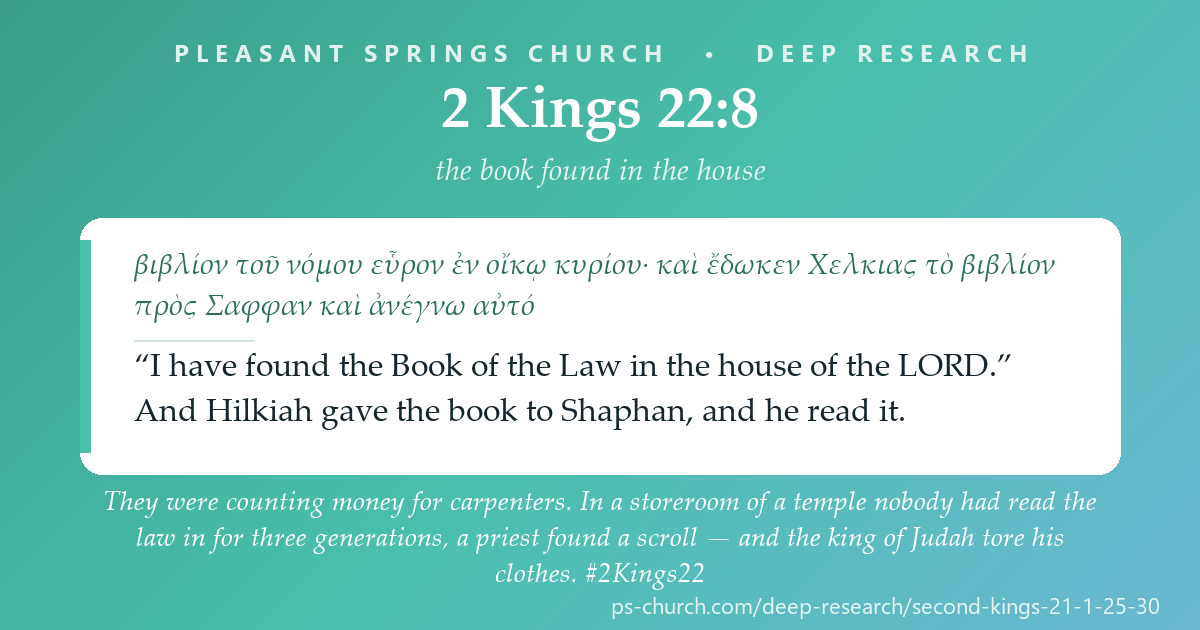
Manasseh reigned fifty-five years — longer than any other king of Judah — and spent them rebuilding what his father had torn down: the high places, altars for Baal, an Asherah, altars to the whole host of heaven in the two courts of the house of the Lord, his own son passed through the fire, mediums and necromancers, and “very much innocent blood.” The verdict is 21:9: “Manasseh led them astray to do more evil than the nations had done whom the Lord destroyed.” (2 Chronicles 33 reports a repentance that 2 Kings does not; this study prints both and blends neither.) Then Amon, briefly. Then Josiah — and one sentence, spoken during building repairs, that turns the last century of Judah: “I have found the Book of the Law in the house of the Lord” (22:8). Shaphan reads it to the king; the king tears his clothes; and the high priest and four officers of the crown walk across Jerusalem — past Jeremiah, past Zephaniah — to ask Huldah the prophetess what it means, and the narrator neither explains that nor apologises for it. Her answer carries judgment and mercy in the same breath: “because your heart was penitent… you shall be gathered to your grave in peace.” Then the covenant read in the ears of all the people, the fires in the Kidron, Topheth defiled so that no one might burn a son or a daughter there again, the horses of the sun removed, the altar at Bethel pulled down three centuries after a nameless man of God said it would be, and a Passover like none since the days of the judges. And then the hardest sentence in the book: “Still the Lord did not turn from the burning of his great wrath… because of all the provocations with which Manasseh had provoked him” (23:26). Josiah dies at Megiddo in a paragraph; four kings follow in a rush; and then the siege, the famine, the breach, the fire, and the bronze pillars broken in pieces and carried to Babylon. And then, with no explanation offered, four last verses: a Babylonian king lifts up the head of Jehoiachin, gives him a seat above the other kings, changes his prison clothes, and gives him a daily allowance as long as he lived. This study works 2 Kings 21:1–25:30 in Hebrew, Septuagint and ESV — the whole of it inside the kaige section, where the Greek is a revision and not the oldest witness, and where every difference between the columns is reported rather than smoothed. See the method →
2 Kings 21:1–25:30 (selections)
Hebrew · Greek (Rahlfs, 4 Kingdoms — kaige) · ESVThe book, the section, the edition — and the one thing you must know before you read a word of the Greek above. In the Septuagint this book is 4 Kingdoms (4 Reigns) — Βασιλειῶν Δʹ (Basileiōn D). 1–2 Samuel and 1–2 Kings are one continuous work in Greek, Βασιλειῶν Αʹ–Δʹ, and a reader who takes the name “2 Kings” to a Greek Bible will not find it. (Worth noticing once: our English names for the Torah — Genesis, Exodus, Leviticus, Numbers, Deuteronomy — are the Septuagint’s names, while Samuel and Kings keep Hebrew-derived ones. An English Bible already mixes both traditions on its contents page.)
⚠️ Which section is this? Kaige — all of it, without exception. Dominique Barthélemy showed in Les Devanciers d’Aquila (1963) that the Greek of Kingdoms is not one translation. Two long stretches are a later kaige revision — a turn-of-the-era pull of an older Greek text back toward a proto-Masoretic Hebrew, named for its stereotyped rendering of Hebrew גַּם (gam, “also, even”) by καί γε. Using Thackeray’s section letters, the second of them (γδ) runs from 3 Kingdoms 22 to the end of 4 Kingdoms — so the whole of 2 Kings lies inside it, and every verse printed above is revised Greek.
You can check that claim from this page. We counted καί γε right through the four books in the text we print. In 1 Kingdoms (1 Samuel) it occurs zero times. In 3 Kingdoms 2:12–21:29 — the Old Greek stretch between the two revisions — it occurs zero times. In 4 Kingdoms it occurs seventeen times in sixteen verses; nine of those occurrences are in the five chapters of this study (21:11, 21:16, 22:19, 23:15 twice, 23:19, 23:24, 23:27, 24:4), and every one of them stands where the Hebrew has gam. Two of them are printed above at 22:19 and 23:15. That is not a theory you have to take on trust; it is a word you can count.
⚠️ What that means for every sentence on this page. Inside a kaige section, Codex Vaticanus — and Rahlfs’s text, which leans on it here — is a revision, not the oldest Greek. The older Greek of these chapters, where it survives, is often better preserved in the Antiochene (Lucianic) manuscripts, which are a genuinely separate witness. So the sentence “the Septuagint reads X” is ambiguous in 2 Kings in a way it is not in Genesis, and this page will not use it. What we print is Rahlfs, and we say so every time. This page cites no Antiochene reading, because we have not consulted the critical edition (Fernández Marcos and Busto Saiz, El texto antioqueno de la Biblia griega); there is as yet no Göttingen edition of 4 Kingdoms, and the fuller apparatus is Brooke–McLean’s larger Cambridge Septuagint. On why this library prints what it prints, see the texts we print.
Numbering, counted rather than assumed. In Rahlfs, 4 Kingdoms 21–25 have 26, 20, 37, 20 and 30 verses — exactly the Masoretic inventory, verse for verse, with nothing added and nothing missing. There is no offset anywhere in this passage, and no double reference was needed above. That itself is worth pausing on: 3 Kingdoms 12–16, in the Old Greek stretch, is missing Hebrew material in six places (including the whole of 14:1–20) and carries thirty-one verses the Hebrew does not have at all. Here the Greek has been pulled flush against the Hebrew — which is what a revision toward a proto-Masoretic text looks like from the outside. (It is not true of the whole book: Rahlfs has four verses at 1:18a–d that the Hebrew lacks, and it divides chapters 11 and 12 one verse earlier, so that Greek 12:1 is Hebrew 11:21 and Greek 12:2–22 are Hebrew 12:1–21. Neither touches this study.)
The divergences in the verses printed above — the list, not a sample. 21:6 Hebrew “his son” singular, Greek τοὺς υἱοὺς αὐτοῦ plural (so also the Hebrew of 2 Chr 33:6). 21:9 Greek plus, “in the eyes of the Lord.” 22:8, 22:11, 23:26 no difference of substance — and where there is none we say so rather than manufacturing one. 22:14 בַּמִּשְׁנֶה transliterated, not translated (μασενα). 22:19 וְגַם → καί γε. 22:20 Greek plus οὐχ οὕτως, “not so”; Hebrew “graves” plural, Greek singular. 23:10 ketiv בני / qere בן, Greek with the qere. 23:15 two gam → two καί γε; Greek plus “and he broke its stones in pieces,” Greek minus the Hebrew’s “and he burned the high place.” 23:22 the Hebrew’s comparative “like” is absent in Greek. 25:9 one Hebrew verb (śārap) rendered by one Greek verb here (ἐνέπρησεν) but by a different one (κατέκαυσεν) all through ch. 23, so the Hebrew echo is inaudible in Greek — and no plus-or-minus is claimed at this verse, because the Greek verse boundary between 25:9 and 25:10 is not stable across printings. 25:27 Jehoiachin and Jehoiakim share one name in Greek, Ιωακιμ. 25:30 Greek plus, “from the house of the king.”
Six words the reviser would not translate. A kaige text tends to transliterate rather than guess, and this passage gives six clean examples: σαδημωθ for שַׁדְמוֹת, the fields of Kidron (23:4); μασενα for מִשְׁנֶה, the Second Quarter (22:14); φαρουριμ for פַּרְוָרִים, the precincts (23:11); θεραφιν for תְּרָפִים, the household gods (23:24); γαβιν for יֹגְבִים, plowmen (25:12); and μεχωνωθ for מְכֹנוֹת, the temple stands (25:13). Edition: the Greek column is Rahlfs’s Septuaginta (CATSS digitization), printed without the editorial punctuation of the printed editions and with proper names unaccented, as Rahlfs sets them; Hebrew from the Masoretic Text; English ESV.
The Shape of the Passage
InclusioBehind these chapters stands everything this library has walked through since Shiloh: a barren woman’s prayer, the promise to David, the house Solomon built, the split at Shechem, the fall of Samaria and the narrator’s own explanation of it, and Hezekiah, and Isaiah’s word about Babylon. In front of them stand Lamentations, Ezekiel by a canal in Chaldea, and a decree from a Persian king.
Author
A historian with a thesis, writing after the last date in his own book. The final paragraph is dated to the thirty-seventh year of Jehoiachin’s exile — about 561 BC — so whoever finished Kings finished it in Babylon or in a Judah still under Babylonian rule. He is not neutral and does not pretend to be: he measures every king by one standard, he tells you where he got his information (“the Book of the Chronicles of the Kings of Judah,” four times in these five chapters alone), and he assumes his readers already know how the story comes out.
He works by repetition and expects you to count. Six provocations. Eleven mentions of one scroll. Seven fires under Josiah and two under Nebuzaradan. Since Martin Noth in 1943 it has been usual to speak of a “Deuteronomistic History” running from Deuteronomy through Kings, and whatever one makes of the theory, the observation under it is plain from the page: this writer judges kings by the standard of Deuteronomy, and in chapter 22 a scroll answering to that description is found in the temple and read aloud to the king. Whether the found book was some form of Deuteronomy is discussed in Stage 5, where the honest answer is that the text does not say.
And he refuses to be tidy. He gives Josiah the highest praise given to any king in the Bible (23:25) and then, in the very next verse, tells you it did not avert the judgment. He reports Manasseh’s fifty-five years and says nothing whatever about a repentance — while the Chronicler, telling the same reign, reports one. He ends the book with a Davidic king alive, fed, and seated above other kings, in Babylon. He will not let you close the book comfortable in either direction, and this study will not do it for him.
Audience
People who had lost everything and needed to know whether God had lost. The first readers of these chapters were exiles, or the children of exiles. The temple was ash. The dynasty was in custody. The obvious pagan explanation was available and would have been believed by most of the ancient world: our God was beaten by theirs. The whole book is an argument against that reading — it insists the disaster was the covenant God’s own act, announced in advance by his own prophets, and therefore evidence that he is still on the throne, not evidence that he is not. That is cold comfort and it is also the only comfort that does not collapse.
People who would ask, immediately, “then what was Josiah for?” Anyone who lived through 597 and 587 knew about the reform; some of them had been at the Passover. The book does not pretend the reform worked. It says the king’s repentance was real and was honoured (22:19–20), that the reform was thorough and was praised (23:25), and that the sentence stood (23:26). Three true things that do not resolve into one.
And people who needed to know whether the promise to David was dead. 2 Samuel 7 had said the throne would be established forever. Chapter 25 burns the house and blinds the king. And then the last four verses put a grandson of Josiah at a table, in clean clothes, with a daily ration — not on a throne in Jerusalem, and not dead. The book ends by declining to close the question. Stage 4 works through what that does and what it does not do.
Orient on Manasseh and Josiah, the reform, Huldah and prophecy, the Deuteronomistic History, Molech and Topheth, and the Babylonian exile.
Search by topic: Manasseh (king of Judah); Amon; Josiah; Josiah’s reform; Book of the Law; Deuteronomy and the reform; Huldah; prophetess; Deuteronomistic History; high places (bamot); host of heaven; Asherah; Molech; Topheth; Valley of Hinnom / Gehenna; child sacrifice in the Old Testament; mediums and necromancy; Passover; Neco II; Megiddo; Nebuchadnezzar; Jehoiachin; Gedaliah; the Babylonian exile; regnal chronology of Israel and Judah.
Which articles are relevant?
- Anchor Bible Dictionary — “Manasseh (king),” “Josiah,” “Huldah,” “Deuteronomistic History,” “High Place,” “Molech,” “Topheth,” “Hinnom, Valley of,” “Asherah,” “Host of Heaven,” “Passover,” “Jehoiachin,” “Gedaliah,” “Exile,” “Chronology (Hebrew Bible).”
- Dictionary of the OT: Historical Books (IVP) — “Kings, Books of,” “Josiah,” “Manasseh,” “Prophets and Prophecy,” “Women,” “Chronology,” “Exile,” “Book of the Law.” And the companion Dictionary of the OT: Prophets for Jeremiah and Zephaniah, who were both alive and prophesying in Jerusalem in the years of chapter 22.
- NIDOTTE / TDOT — סֵפֶר (sēper, scroll), מָצָא (māṣāʾ, find), כָּעַס (kāʿas, provoke), שָׂרַף (śārap, burn), טָמֵא (ṭāmēʾ, defile), נָבִיא / נְבִיאָה (nāḇîʾ/nəḇîʾāh, prophet / prophetess), בָּמָה (bāmāh, high place), רַךְ (rak, soft).
- On the Greek — Paul D. McLean, “3 and 4 Reigns: To the Reader,” in NETS, and Bernard A. Taylor’s companion introduction to Reigns. This is where a reader should go to check what is said above about the kaige sections, the standing of Vaticanus inside them, and the Antiochene text as an independent witness.
Bibliography surfaced:
- Mordechai Cogan and Hayim Tadmor, II Kings (Anchor Bible) — the standard critical commentary in English on exactly these chapters, and the best single place for the Assyrian and Babylonian background; Marvin A. Sweeney, I & II Kings (OTL); Simon J. DeVries, 1 Kings (WBC), with Sweeney and Cogan for the second volume.
- Iain W. Provan, 1 and 2 Kings (NIBC) and his Hezekiah and the Books of Kings; Paul R. House, 1, 2 Kings (NAC); Donald J. Wiseman, 1 and 2 Kings (TOTC); Richard D. Nelson, First and Second Kings (Interpretation), on the shape of the ending.
- Emanuel Tov, Textual Criticism of the Hebrew Bible, and Natalio Fernández Marcos, The Septuagint in Context, chs. on the kaige recension and the Antiochene text — the two books behind every textual statement on this page.
Manasseh in Assyrian records, Egypt at Carchemish, the last letters out of Lachish, and a ration list from Babylon with a Judean king’s name on it.
These five chapters are the best-attested stretch of the Old Testament outside the Bible. Four of the people named in them appear in documents written by their contemporaries in other languages — and one of those documents is a food-ration receipt for the man the book ends with. Where a text can be verified in our local scan of ANET we cite the page; where it cannot, we say so and give no page.
Which parallels shed light on this world?
Manasseh is in the Assyrian records, twice, as a vassal — and that is very likely why he reigned fifty-five years. The Bible does not explain his long reign. Assyria does. Esarhaddon’s building inscription lists twenty-two kings of Hatti and the coastlands summoned to haul timber and stone to Nineveh, and the second name on the list is “Manasseh (Me-na-si-i), king of Judah” (ANET 291). His son Ashurbanipal’s Cylinder C lists the same kings again for the Egyptian campaign, with “Manasseh (Mi-in-si-e), king of Judah” (ANET 294). Judah in these years is a small vassal inside the largest empire the world had yet seen, and vassalage carried cultic obligations. The narrator of Kings mentions none of this. He is not writing a political history and does not offer Manasseh the excuse. But knowing it changes how you read 21:3–5: those altars had a foreign policy behind them.
Egypt really was going up to the king of Assyria, not against him — and a Babylonian chronicle says so. 2 Kings 23:29 says Pharaoh Neco “went up to the king of Assyria to the river Euphrates,” and readers have long argued over whether the Hebrew עַל means “against” or “to the aid of.” The Gadd chronicle of Nabopolassar’s reign settles the historical question from the Babylonian side: in his tenth year “the army of Egypt and the army of Assyria advanced as far as Qablinu — in the pursuit of the king of Akkad” (ANET 304), and in the sixteenth and seventeenth years Egypt is again fighting alongside Assyria at Harran (ANET 305). Assyria was collapsing and Egypt was propping it up against Babylon. Josiah stepped into the middle of a world war, and the book gives him one sentence and no explanation.
And we have letters written from inside the last siege. The Lachish Ostraca — twenty-one potsherds found in the burnt gate-tower of Lachish, in classical Hebrew prose, generally dated immediately before the Chaldean siege — are the sound of chapter 25 from the ground. One of them ends: “let my lord know that we are watching for the signals of Lachish, according to all the indications which my lord hath given, for we cannot see Azekah” (Lachish Ostracon IV, ANET 322). Read that beside Jeremiah 34:7, where Lachish and Azekah are named as the last two fortified cities still holding out. The signal fires of one of them have gone out, and a soldier is writing to say so.
- Esarhaddon’s prism (Nineveh) and Ashurbanipal’s Cylinder C, ANET 291 and 294 (royal inscriptions — witnesses, not Scripture) — Manasseh of Judah named among the vassal kings of the west, twice, a generation apart. Verified in the local scan.
- The Gadd chronicle of Nabopolassar (Babylonian Chronicle), ANET 303–305 (a court chronicle — a witness, not Scripture) — the fall of Nineveh, Egypt fighting for Assyria, and Ashuruballit at Harran: the war Josiah rode into at Megiddo. Verified in the local scan. The famous entry recording Nebuchadnezzar’s capture of Jerusalem in his seventh year (2 Adar) stands in ANET’s later supplement, pp. 563–564, outside the range we can check locally, so no quotation is given from it here.
- The Lachish Ostraca II–VI, ANET 321–322 (Hebrew letters — witnesses, not Scripture) — “we are watching for the signals of Lachish… for we cannot see Azekah”; a commander’s complaint that the princes’ letters “weaken our hands,” which is the exact charge brought against Jeremiah in Jeremiah 38:4. Verified in the local scan.
- The Weidner ration tablets from Babylon, ANET 308 (administrative dockets — witnesses, not Scripture) — oil deliveries from the royal household, dated between Nebuchadnezzar’s tenth and thirty-fifth years, listing recipients by name and nationality. Among them: “10 (sila) to Ia-ku-u-ki-nu, the son of the king of Ia-ku-du” (i.e. Judah), and “2½ sila for the 5 sons of the king of Judah.” That is the ration of 25:30, on a clay tablet, in Babylonian. Verified in the local scan — and it is the single most striking external touch-point in this study.
- Sirach 49:1–4 (Second-Temple — a witness, not Scripture) — “The memory of Josiah is like a blend of incense prepared by the perfumer’s art… he was sweet as honey in every mouth” (μνημόσυνον Ιωσιου εἰς σύνθεσιν θυμιάματος), and then the sentence that shows how the whole book was read by the second century BC: “Except David and Hezekiah and Josiah, all of them were great sinners, for they forsook the law of the Most High” (49:4). Three kings out of forty. Ben Sira has read Kings exactly as Kings asks to be read.
- 1 Esdras 1 (Second-Temple — a witness, not Scripture) — a Greek book that opens with Josiah’s Passover, following Chronicles rather than Kings, and expands it: “καὶ ἤγαγεν Ιωσιας τὸ πασχα ἐν Ιερουσαλημ.” Worth reading alongside 23:21–23 precisely to see how much larger the celebration becomes when it is retold.
- Josephus, Antiquities 10.3.1–2 (§§37–46); 10.4.1–5; 10.11.2 (§§229–231) (Second-Temple — a witness, not Scripture) — and watch what he does. On Manasseh he follows Chronicles, not Kings: the capture, the prayer, the restoration, all of it. On Josiah he keeps Huldah and does not apologise for her either, though he adds a note that her husband Shallum was “a man of dignity, and of an eminent family.” He also has the scroll turn up incidentally while the high priest is fetching gold. And on the ending he goes warmer than Kings: Evil-Merodach “immediately set Jeconiah at liberty, and esteemed him among his most intimate friends… and made him honourable above the rest of the kings that were in Babylon.”
- The Prayer of Manasseh (a short penitential prayer preserved among the Odes appended to the Greek Psalter in some manuscripts — not canonical Scripture, and not part of 4 Kingdoms in any edition) — it exists because 2 Chronicles 33:18–19 twice refers to “his prayer” without giving it, and somebody supplied one. Named here so readers know what it is and where it came from; nothing on this page is argued from it.
- The Martyrdom of Isaiah (a pseudepigraphon of the Second-Temple period, preserved inside the composite Ascension of Isaiah — not Scripture) and b. Yevamot 49b (rabbinic-era — a witness, not Scripture) — both have Manasseh execute Isaiah by sawing him in two. The Talmud gives it as a written tradition (“Manasseh, king of Israel, killed Isaiah the prophet”) with an elaborate account of a cedar tree. 2 Kings says nothing of it — only that Manasseh “shed very much innocent blood” (21:16). Hebrews 11:37 says of the faithful, “they were sawn in two,” and many readers have heard this tradition behind it. That is a reasonable guess about an allusion; it is not a statement of the Old Testament, and this page keeps the two apart.
This is the sharpest place in the Old Testament where two biblical accounts of the same reign do not say the same thing, and the pastoral directive behind these pages is to report the difference rather than hide it.
What 2 Kings 21 says. Fifty-five years. The high places rebuilt, altars for Baal, an Asherah, the host of heaven worshipped, altars in the two courts of the house of the Lord, a carved image of Asherah inside the house, his son passed through the fire, divination, mediums, necromancers, very much innocent blood, and 21:9 — “more evil than the nations.” Then a prophetic sentence, then his burial. Not one word about a change. And three times afterwards the book names him as the reason for the exile (23:26; 24:3).
What 2 Chronicles 33 says. The same catalogue of sins, and then this: the commanders of the king of Assyria “captured Manasseh with hooks and bound him with chains of bronze and brought him to Babylon. And when he was in distress, he entreated the favor of the Lord his God and humbled himself greatly before the God of his fathers. He prayed to him, and God was moved by his entreaty and heard his plea and brought him again to Jerusalem into his kingdom” (33:11–13). Then he rebuilds the wall, takes away the foreign gods, restores the altar, and commands Judah to serve the Lord.
Do not resolve this too quickly, in either direction. The harmonizing move — “Kings just omits it” — is possible and is what Josephus did. The dismissive move — “the Chronicler invented it” — is also on offer and is not ours to make. What can be said with confidence is that the two books are doing different things. Kings is writing the case for why the exile happened, and Manasseh is its longest exhibit; Chronicles is writing about the temple, repentance and restoration, and Manasseh is its most extreme case of mercy. Neither is lying. Neither is the other.
The ancient readers felt it too, and argued about it out loud. m. Sanhedrin 10:2 names three kings with no share in the world to come — Jeroboam, Ahab, and Manasseh — and then records the dissent: “Rabbi Yehuda says: Manasseh has a share in the World-to-Come,” citing 2 Chronicles 33:13. And at b. Sanhedrin 103a Rabbi Yoḥanan says the thing that should be quoted every time this comes up: “Anyone who says that Manasseh has no share in the World-to-Come discourages penitents.” (Rabbinic-era witnesses, not Scripture — but they show that the tension is not a modern discovery.)
Where this page lands: we teach both texts, in their own voices, and we do not print a third text that is a blend of them. If you are preaching Kings, preach what Kings says — a man can do damage that outlasts his own repentance. If you are preaching Chronicles, preach what Chronicles says — there is no one God will not receive. Those are not contradictory pastoral truths. They are the two halves of what it costs to be forgiven.
One noun found in a building site, one verb that frames a reform, one verb that changes hands, and an idiom about lifting a head.
Count seper and kaʿas yourself from the Hebrew above — eleven and six — and then count the fires. Then hold two things together that the ESV keeps apart: the “penitent” heart of 22:19 is literally a soft one, and the “graciously freed” of 25:27 is literally a lifted head. Both English renderings are fair; both hide a picture.
“Scroll, book, document.” Eleven occurrences for the found scroll in two chapters, and everything Josiah does after 22:8 is an answer to it. Notice the range of the word: the same noun is used four times in these chapters for the royal annals, “the book of the chronicles of the kings of Judah” (21:17, 25; 23:28; 24:5). One kind of book records the kings; another kind of book judges them. And the man carrying it is has-sōpēr (הַסֹּפֵר), “the secretary,” the same three consonants, at 22:3, 8, 9, 10, 12 — in 22:8 the two words stand next to each other. The Greek keeps the book (βιβλίον, every time) and loses the play (γραμματεύς).
“Find.” The verb of the whole episode, and it is doing more than one job. In 22:9 what was “found” is the silver in the temple treasury; in 22:8, 13 and 23:2, 24 what was found is the scroll. They went looking for money and found a book. The Hebrew makes the connection with one repeated word, and the Greek follows it with εὑρίσκω throughout (εὗρον, 22:8; τὸ εὑρεθέν, 22:9; τοῦ εὑρεθέντος, 22:13; οὗ εὗρεν, 23:24). ⚠️ Note what the verb does not tell you: it does not say the book was lost, hidden, planted, or newly written. It says it was found. Everything beyond that is inference, and Stage 5 marks it as such.
“Provoke to anger, vex.” Six times, and the frame of the passage (see the diagram above). It is a startlingly personal word — the same root describes Hannah being tormented by her rival at 1 Samuel 1:6–7, and Elkanah asking her why she weeps. Applied to God it does not mean a temper; it means this is being done to someone. The last and heaviest use doubles it in one clause: “all the provocations with which Manasseh had provoked him” (23:26). The Greek keeps the thread intact — παροργίζω and its noun, every time.
“Burn.” Seven fires under Josiah and two under Nebuzaradan, and the second pair are lit on the house the first seven were meant to protect. The phrase śārap bāʾēš, “burned with fire,” falls at 23:11 on the chariots of the sun and at 25:9 on every great house in Jerusalem. This is the kind of thing Hebrew narrative does instead of editorial comment. ⚠️ And it is invisible in Greek: Rahlfs uses κατακαίω for Josiah and ἐμπίπρημι for Babylon, so the connection simply is not there in the middle column. We print both columns and tell you which one carries the point.
“Prophetess.” The feminine of the ordinary word for prophet, used without qualification or comment. The Old Testament applies it to Miriam (Exod 15:20), Deborah (Judges 4:4), Huldah here and at 2 Chronicles 34:22, Noadiah (Neh 6:14, unfavourably), and the unnamed woman of Isaiah 8:3; in the New Testament to Anna (Luke 2:36). The Greek is the exact feminine of its word for prophet: ἡ προφῆτις. No ancient version softens it, qualifies it, or explains it.
“Soft, tender.” A physical adjective — it describes tender meat at Genesis 18:7, weak eyes at Genesis 29:17, a soft answer at Proverbs 15:1. The oracle does not say Josiah’s heart was strong or sincere; it says it was soft, and that this is what God heard. The ESV’s “penitent” is a fair reading of what softness means here, and it is an interpretation; the Greek makes the same move in the same direction, ἡπαλύνθη, “was made soft.” Hold the physical sense: this is a book about hard men, and the one thing said in praise of its best king is that something in him gave.
“Topheth” — the installation in the Valley of the Son of Hinnom where children were burned, which Josiah defiled (טִמֵּא) so that it could never be used again. The Greek transliterates the name (Ταφεθ) and translates the valley. The Hebrew for the valley, gê hinnōm, becomes Aramaic gêhinnām and enters the New Testament as Gehenna, the standard word there for final judgment (Matt 5:22; Mark 9:43). That is a fact about the history of a word, not an argument, and this page leaves it there. Jeremiah 7:31–32 and 19:1–13 are the passages to read next.
“He lifted up the head of” — the idiom for granting a prisoner audience, favour, or release. The same two words are used in the opposite direction at Genesis 40:19, where Pharaoh will “lift up your head from you” — and in the merciful direction at Genesis 40:13 and 40:20, in the same chapter, of the cupbearer restored. The Bible’s first Hebrew prisoner interpreting dreams in a foreign court, and its last Davidic king eating in one, are described with the same phrase. The Greek renders it word for word (ὕψωσεν… τὴν κεφαλήν); the ESV gives the sense, “graciously freed,” and footnotes the Hebrew at the parallel in Jeremiah 52:31.
Two features of the Hebrew here, reported rather than tidied:
- The ketiv/qere at 23:10, and what the Greek does with it. The consonants written in the Masoretic Text are בני — which would be read “valley of the sons of Hinnom”; the reading tradition (qere) has בֶן, “son of Hinnom,” which is the form used everywhere else (Josh 15:8; 18:16; Jer 7:31). Rahlfs’s υἱοῦ Εννομ is singular and therefore agrees with the qere. A small thing, and it is the kind of small thing that shows the reading tradition and the Greek touching.
- The last word of the book is spelled short. At 25:29 “all the days of his life” is חַיָּיו; one verse later, at 25:30, the same phrase ends חַיָּו — the identical form written without the second yod, exactly as it stands in Miqra according to the Masorah. Nothing theological hangs on it. It is noted because this page tells you what is actually on the page, including when it is only an orthographic hiccup at the very end of four books.
The book behind the book, the altar at Bethel three centuries later, the wrath that did not turn, and four verses that will not close.
Four threads. First: what the found scroll sounds like, and where its language comes from. Second: the prophecy from 1 Kings 13 that lands in 2 Kings 23. Third: 23:26 — the hardest verse here — against everything else Scripture says about repentance. Fourth: 25:27–30, and what the canon does with a king at a foreign table.
Which cross-references matter?
- Deuteronomy 31:24–26 — the passage that makes 22:8 electric. “When Moses had finished writing the words of this law in a book to the very end, Moses commanded the Levites who carried the ark… ‘Take this Book of the Law and put it by the side of the ark of the covenant of the Lord your God, that it may be there for a witness against you.’” A book of the law, deposited in the sanctuary, whose stated purpose is to testify against the people who keep it there. Josiah’s men find a book of the law in the sanctuary and it testifies against them.
- Deuteronomy 18:9–14 — the list Manasseh works through at 21:6, in order: passing a child through the fire, divination, fortune-telling, omens, mediums, necromancers. Deuteronomy’s reason for the ban is that these are the practices for which the nations were driven out; 2 Kings 21:9 says Judah is now worse than the nations. The two verses are welded together. See also Leviticus 18:21 and Leviticus 20:1–6 on Molech and on mediums.
- Deuteronomy 12 and Deuteronomy 16:1–8 — the two chapters that stand behind the whole reform. Deuteronomy 12 orders the high places destroyed and worship centralized at “the place that the Lord your God will choose”; Deuteronomy 16 orders the Passover kept at that place and not in the towns. Josiah does both, in that order, in 23:8–9 and 23:21–23. Whether the found scroll was Deuteronomy is a separate question, treated in Stage 5.
- Deuteronomy 17:14–20 — the law of the king, and the one duty it lays on him: “he shall write for himself in a book a copy of this law… and he shall read in it all the days of his life.” The kings of Judah have gone three hundred years without it. In 22:10–11 a king finally hears it read, and the first thing he does is tear his clothes.
- 1 Kings 12:25–13:34 — the altar at Bethel, the calves, and the unnamed man of God from Judah who cried against the altar and named the king who would defile it: “O altar, altar… a son shall be born to the house of David, Josiah by name” (1 Kgs 13:2). 2 Kings 23:15–18 is that sentence landing, three hundred years later, and the narrator says so out loud (“according to the word of the Lord that the man of God proclaimed”). Then he adds the detail that keeps it from being merely satisfying: the king who is burning bones on that altar stops when he sees one particular grave, and says, “Let him be; let no man move his bones.”
- 2 Kings 17:7–23 — the narrator’s own theology of exile, written about the north, applied here to the south. 23:27 quotes it: “I will remove Judah also out of my sight, as I have removed Israel.” If you want to know what the writer thinks chapter 25 means, he already told you eight chapters earlier. Do not import a different explanation; and do not turn a covenant judgment on a covenant nation into a lesson about any modern country.
- 2 Kings 20:16–18 — Isaiah to Hezekiah, two generations early: “all that is in your house… shall be carried to Babylon. Nothing shall be left… And some of your own sons… shall be taken away, and they shall be eunuchs in the palace of the king of Babylon.” 24:13 and 25:13–17 are the inventory of that sentence being carried out, item by item, down to the bronze.
- 1 Kings 7:15–51 — the pillars, the stands and the bronze sea, described at length when they were made and described again, in the same vocabulary, when they are broken up (25:13–17). The book takes as much space to itemize the demolition as it took to itemize the construction. That is not padding; it is the writer refusing to let you skim it.
- 2 Samuel 9 — and this one is worth sitting with. The last surviving son of Saul, crippled and afraid, is brought to a king’s table and told he shall “eat at my table always” (9:7, 10, 11, 13 — four times). The last surviving king of David’s house eats at a king’s table always (25:29). The same courtesy, from the other side of the table. The narrator does not draw the line. It is drawn by the vocabulary.
- 2 Samuel 7:12–16 — “your throne shall be established forever.” Chapter 25 is the hardest test that promise ever takes: the city burned, the temple burned, the last reigning king blinded and his sons killed. And then four verses that do not restore the throne and do not end the line.
- Lamentations 3:22–33 — the response from inside the ruins, and the right next reading after chapter 25. Everything Kings reports in prose, Lamentations feels in poetry — and it is the book that says, in the middle of it, “his mercies never come to an end; they are new every morning.”
- Jeremiah 31:31–34 — the answer to the deepest problem these chapters expose. A reform imposed from the top down did not change the people; the new covenant is a law written not on a scroll found in a building but “on their hearts.” Josiah read the book to them in their ears (23:2); Jeremiah says the day is coming when it will not have to be read to them at all.
- Ezekiel 37:1–14 and Daniel 9 — the two prophets of the exile itself: bones in a valley being asked whether they can live, and a man in Babylon reading Jeremiah’s seventy years and praying the confession Kings never records anyone praying.
Two verses, back to back. 23:25: “Before him there was no king like him, who turned to the Lord with all his heart and with all his soul and with all his might, according to all the Law of Moses, nor did any like him arise after him.” That is as high as the book’s praise goes, and it is phrased straight out of Deuteronomy 6:5 — heart, soul, might. (⚠️ Report the awkwardness rather than hiding it: 2 Kings 18:5 says almost the same thing about Hezekiah — “there was none like him among all the kings of Judah after him, nor among those who were before him.” The two superlatives are measuring different things — trust in 18:5, turning-with-all-the-heart in 23:25 — but the book does not say so, and readers have argued about it for a long time.) 23:26: “Still the Lord did not turn from the burning of his great wrath… because of all the provocations with which Manasseh had provoked him.”
Notice the cruel symmetry, because it is deliberate. The same verb, šûḇ (“turn”), is used of both: Josiah turned to the Lord; the Lord did not turn from his wrath. One man’s whole-hearted turning, and it does not move the sentence.
Three things this page will not say. (1) It will not say Josiah’s repentance was insincere — 22:19–20 and 23:25 say the opposite, in God’s own voice and the narrator’s. (2) It will not say God is arbitrary — 21:10–15 announced this sentence before Josiah was born, through named prophets, on stated grounds. (3) And it will not pretend the verse is not there. Preachers have been trying to get around 23:26 for centuries, and the getting-around is always worse than the verse.
What can honestly be said. First, that sin has consequences that outlast forgiveness, and that this is not a denial of grace but a description of how the world works — David is forgiven at 2 Samuel 12:13 and the sword still does not depart from his house. Second, that Kings is answering a specific historical question — why did Jerusalem fall? — and Josiah’s reform is precisely the objection that has to be met. It could not be met by pretending the reform did not happen. Third, that the mercy in the passage is real and is individual: Josiah himself is spared the sight of it (22:20). Personal mercy inside corporate judgment is not a contradiction; it is most of the Bible.
And here is where Scripture gives no reason, so we stop. 23:26 says the wrath did not turn because of Manasseh. It does not explain why one generation’s king weighs more than another generation’s king. It does not tell you the exchange rate. We do not have one either. What the text does next is instructive: it does not moralize. It tells you Josiah went to Megiddo and was killed, in a single sentence, and moves on.
The found book, the chronology that does not resolve, Josiah’s death against Huldah’s oracle, and how to read the last four verses.
Cogan and Tadmor, Sweeney, Provan, House, Wiseman and Nelson on the chapters; Tov and Fernández Marcos on the Greek. Then four live questions — and on three of them the honest answer is that the text does not say.
Commentaries & studies:
- Mordechai Cogan and Hayim Tadmor, II Kings (Anchor Bible) — the first place to go for the Assyrian and Babylonian material and for the philology; Marvin A. Sweeney, I & II Kings (OTL), the fullest recent literary and redactional treatment.
- Iain W. Provan, 1 and 2 Kings (NIBC); Paul R. House, 1, 2 Kings (NAC); Donald J. Wiseman, 1 and 2 Kings (TOTC) — three evangelical readings that take the theology of the book seriously and differ from one another usefully.
- Richard D. Nelson, First and Second Kings (Interpretation) — the standard short treatment of how the ending works, and of why 25:27–30 has generated more disagreement per verse than almost anything else in the historical books.
- Emanuel Tov, Textual Criticism of the Hebrew Bible; Natalio Fernández Marcos, The Septuagint in Context — on kaige, on the Antiochene text, and on why “the Septuagint” is a family and not a book. Barthélemy’s Les Devanciers d’Aquila (1963) is the original, and remains worth reading.
Interpretation notes worth keeping:
- What was the book Hilkiah found? The text does not say, and this page will not pretend otherwise. The case for some form of Deuteronomy is genuinely strong and is not a modern invention — Jerome already reports the identification. Everything Josiah does answers to Deuteronomy: destroy the high places (Deut 12), keep the Passover at the chosen place (Deut 16), remove mediums (Deut 18); Huldah’s two words for the coming ruin, “a desolation and a curse” (22:19), are Deuteronomy’s curse vocabulary (Deut 28; Deut 29:19–28); and 23:2 calls the same scroll “the Book of the Covenant,” which is what Deuteronomy calls itself. And here is what has to be said with it. Since W. M. L. de Wette in 1805 a large body of scholarship has drawn a further conclusion — that the book was composed in or near Josiah’s reign and presented as found. Others hold that an old text was genuinely recovered after Manasseh’s fifty-five years, which is exactly the kind of gap in which a temple scroll could be forgotten. The narrative itself supports neither reconstruction. It uses one verb — found — and does not tell you how long it had been there, who put it there, or what was in it. We name the positions and do not adjudicate, and we note that nothing this page teaches depends on the outcome.
- ⚠️ The regnal chronology of these chapters is genuinely unresolved, and no scheme is printed here as though it were the text. Kings dates reigns by length and by cross-reference between the two kingdoms, and the numbers do not close: the totals for Israel and Judah between fixed points differ, and the shortfall has to be absorbed by co-regencies the text never mentions. Edwin Thiele’s Mysterious Numbers of the Hebrew Kings is the standard attempt — different regnal years in the two kingdoms, different new-year months, accession and non-accession reckoning, and co-regencies where required (including one for Manasseh with Hezekiah). It is elegant and it is itself much debated: Albright, Gershon Galil, Hayes and Hooker, and Christine Tetley have all published rival systems with different dates. What is not in doubt is roughly where the fixed points sit — Jerusalem fell to Nebuchadnezzar in 597 and again in 587/586, and Jehoiachin’s release falls about 561. What is in doubt is nearly everything between the fixed points. ⚠️ And the difficulty is not only in the synchronisms: 2 Kings 24:8 makes Jehoiachin eighteen when he became king and 2 Chronicles 36:9 makes him eight (the ESV prints “eighteen” there on the authority of the Septuagint and footnotes that most Hebrew manuscripts read “eight”); 2 Kings 24:12 dates the first deportation to Nebuchadnezzar’s eighth year and Jeremiah 52:28 to his seventh; 2 Kings 25:8 gives the seventh day of the fifth month and Jeremiah 52:12 the tenth; 2 Kings 25:27 gives the twenty-seventh day and Jeremiah 52:31 the twenty-fifth; and the deportation figures at 24:14 (10,000), 24:16 (7,000 plus 1,000) and Jeremiah 52:28–30 (3,023, then 832, then 745) count different things or count differently. These are reported here, not reconciled.
- ⚠️ Huldah, and the fact that nobody in the text finds her remarkable. Say the plain thing first: in the eighteenth year of Josiah, Jeremiah had been prophesying in Jerusalem for five years (Jer 1:2 dates his call to Josiah’s thirteenth) and Zephaniah was prophesying in Josiah’s days (Zeph 1:1). The king’s delegation walks past both of them and goes to a woman in the Second Quarter. The narrator does not explain it, defend it, or flag it as unusual — he gives her the standard formula (“Huldah the prophetess, the wife of Shallum…”), lets her deliver a full prophetic oracle with the messenger formula “Thus says the Lord” three times, and records that the king acted on it. And she is not gentle: her first recorded words to the delegation are “Tell the man who sent you to me” (22:15). Later readers found this harder than the narrator did. b. Megillah 14a lists seven prophetesses (Sarah, Miriam, Deborah, Hannah, Abigail, Huldah, Esther), and b. Megillah 14b then asks the question directly — why go to her when Jeremiah was there? — and offers three answers: that she was Jeremiah’s relative and he did not object; that “women are more compassionate,” so the king hoped for a softer word; and (R. Yoḥanan) that Jeremiah was simply out of town. The same folio also faults her for saying “the man” instead of “the king,” and preserves the tradition that she descended from Rahab, punning on her father-in-law’s name Tikvah and Rahab’s scarlet cord at Joshua 2:18. (Rabbinic-era witnesses, not Scripture.) What Scripture itself does is simpler: it records that the word of the Lord came through her, that it came true, and that the reform of Judah rests on it. This page reports that and adds nothing to it.
- Huldah said Josiah would be gathered to his grave in peace. He was killed in battle at Megiddo. The tension is real. 22:20 promises “you shall be gathered to your grave in peace, and your eyes shall not see all the disaster”; 23:29 has Pharaoh Neco kill him at Megiddo. Three readings are on the table and each has weight. (1) “In peace” qualifies the burial and not the death — he was brought back and buried in his own tomb (23:30), in a city still standing, which is more than any king after him got. (2) The promise is explicitly about what his eyes would not see, and he did not see 587. (3) Some argue the oracle was conditional in the way prophetic word often is. What cannot honestly be said is that there is no difficulty here, and it is worth noticing that the narrator does not smooth it either — he prints the oracle and then, five paragraphs later, prints Megiddo, without a word of comment. Chronicles tells the death differently (2 Chr 35:20–24: Neco sends envoys warning him off, Josiah disguises himself, archers shoot him, he dies at Jerusalem), and where Kings says “killed him at Megiddo, as soon as he saw him,” the two accounts are simply not the same account. Reported, not harmonised.
- ⚠️ How to read 25:27–30 — and how not to. The book ends with a Davidic king out of prison, in new clothes, seated above the other captive kings, with a daily ration for life. It is four verses long, and it has been read three ways. (1) Hope. Gerhard von Rad’s famous reading: the Davidic line survives, so the promise of 2 Samuel 7 is not dead and the book ends with a door ajar. (2) Not hope. Martin Noth’s: the exile is the end, and this is merely the last dated item the historian had, an appendix, not a promise — a pensioner is not a king. (3) Deliberate irony or restraint. That the writer knew exactly what he was doing and chose an ending that will not resolve. Here is what the text actually gives you, and it is worth listing because both of the confident readings have to add something to it. There is no return to the land, no throne, no temple, no prophecy, no repentance, no mention of God at all — the last four verses of Kings do not contain the divine name. There is a foreign king’s kindness, a change of clothes, a seat, and food. And there is one word that leans forward: the ration is tāmîd, “continual,” and it goes on “all the days of his life.” The book ends with a son of David alive, eating, at somebody else’s table. It does not tell you what that means. Neither will we.
- And a real tension the canon leaves standing: Jeremiah 22:24–30 and Matthew 1:11–12. Jeremiah says of this same king — Coniah, that is Jehoiachin — “Write this man down as childless… for none of his offspring shall succeed in sitting on the throne of David and ruling again in Judah” (22:30), and that even if he were the signet ring on God’s right hand he would be torn off. And Matthew 1:11–12 puts “Jechoniah” in the genealogy of Jesus Christ, on either side of the line that divides Matthew’s history in two: “at the time of the deportation to Babylon… And after the deportation to Babylon.” The Weidner tablets, meanwhile, list rations for “the five sons of the king of Judah” (ANET 308), so he was not childless in the ordinary sense. Readers have proposed that Jeremiah’s word means no descendant would reign in Judah, or that it was reversed for Zerubbabel (Hag 2:23 reuses the signet-ring image, positively). The Bible never states a resolution, and we will not manufacture one. What the New Testament does is not an argument but a placement: it puts the man at the foreign king’s table into the family tree.
- Kings and Chronicles are two books, and this study keeps them two. Beyond Manasseh’s repentance and Josiah’s death, the two accounts differ on the Passover’s benchmark (“since the days of the judges,” 2 Kgs 23:22, against “since the days of Samuel the prophet,” 2 Chr 35:18), on Jehoiachin’s age, and on the order of the reform relative to the finding of the book (2 Chr 34:3–7 has Josiah purging from his twelfth year, six years before the discovery; 2 Kings presents the reform as the response to it). These are set side by side on this page and left there. Where they can be read together without strain, a reader may; where they cannot, the honest thing is to say so — and the pastoral directive behind this whole library is that we are for showing the evidence, not for hiding the other text.
A scroll found in a building site, a woman in the Second Quarter, a wrath that did not turn, and a table in Babylon.
Name what you learned, why it matters, and one concrete response.
What should we carry away — and do?
- The reform began with a repair job. Nobody set out to find the word of God. They were counting money for carpenters and masons. The most consequential religious event in three centuries of Judah’s history happened because somebody was tidying a storeroom. Ordinary faithful maintenance is where most of what God does still starts.
- The king’s first response to Scripture was to tear his clothes, and that is why he is the best king in the book. He did not appoint a committee, request a summary, or ask whether the document was authentic. He heard it, and something in him gave. The one thing God says in praise of Josiah is that his heart was soft (22:19). Ask honestly which parts of yours have stopped being.
- Five senior men walked across Jerusalem to ask a woman what God was saying, and Scripture does not blink. No explanation, no apology, no qualifier. She spoke, and the reform of Judah was built on what she said. If the narrator saw nothing to justify, neither should we.
- Manasseh reigned fifty-five years and Josiah thirty-one, and it was the fifty-five that set. This is the part of these chapters that ought to frighten us into carefulness. What one generation normalizes in the courts of the house of God, the next generation’s best efforts may not be able to pull out again. Damage is easier than repair, and it lasts longer.
- And yet: report both texts. Kings says Manasseh never turned. Chronicles says he did, in chains, in Babylon, and God heard him. Both are in your Bible. Preach the warning from Kings and the mercy from Chronicles, and do not average them into a third thing that is in neither.
- 23:26 is in the Bible. The best king who ever reigned repented with all his heart, and the wrath did not turn. We do not have an explanation and Scripture does not offer one. What we have is 22:19–20 in the same chapter: God saw that man’s soft heart and answered him. Personal mercy inside a judgment you cannot avert is not a contradiction. It is most of what any of us are given.
- The book ends with supper. No throne, no temple, no return, no promise — and no despair either. Just a man who was in prison, in clean clothes, at a table, with food that came every day for the rest of his life. Sometimes that is what “God has not finished” looks like from the inside, and it does not look like much.
A word about typology, clearly labelled — three things, kept distinct. (1) What the text says. 2 Kings 25 does not announce itself as a type of anything. It reports a siege, a fire, a deportation and a ration. It does not say “this points forward.” (2) What the New Testament itself draws. Two things, and they are safe ground because they are the canon’s own moves. Matthew 1:11–12 takes the deportation as one of the three hinges of Israel’s history and puts Jechoniah — the man of 25:27–30 — into the genealogy of Jesus Christ. And Matthew 12:6, standing in the courts of a rebuilt temple, says “something greater than the temple is here.” The house that burns in 25:9 is not the last word about where God dwells, and the New Testament is the one that says so. (3) What we see from this side of the cross. A last son of David, condemned, brought out of a prison, lifted up, given a seat and a table and bread — and this study will not pretend it does not hear something in that. The text does not say it. And we are meant to see it — that is what Luke 24:27 has Christ himself doing with these Scriptures. Both halves have to be said: the writer of Kings is not making that point, and a Christian reading the last four verses of Kings after the resurrection is not misreading them. Keep the two clearly labelled and you can have both.
Step in response: two things this week. First, read something in Scripture that you have been avoiding because you already know it will cost you, and let it land the way Josiah let it land — before deciding what to do about it. Second, find someone in your life who is living in 25:29–30 — not restored, not rescued, just fed, and still here — and be part of the daily allowance. That is a real ministry and the Bible ends a whole book on it.
2 Kings 22:8 · to share
Hebrew + Greek (Rahlfs, 4 Kingdoms — kaige) + ESVEvery Deep Research page traces its passage across the whole sweep — the Old Testament, the Second-Temple world between the testaments (historical witnesses, not Scripture), and the New Testament. Follow the thread:
Pleasant Springs Church — Deep Research
Research method after Michael S. Heiser’s Bible Research Method (examine dictionaries → ancient literature → important words → textual connections → academic publications → share), with the Pleasant Springs “Author & Audience” foundation. Scripture set in the Hebrew, the Greek editions named on each page and the ESV (Old Testament), and the Greek New Testament and the ESV (New Testament), per the practice of Pleasant Springs Church. 2 Kings 21–25 research grounded in Cogan and Tadmor (Anchor), Sweeney (OTL), Provan (NIBC), House (NAC), Wiseman (TOTC) and Nelson (Interpretation), with Barthélemy, Tov and Fernández Marcos on the Greek. Book name: in the Septuagint this book is 4 Kingdoms, Βασιλειῶν Δʹ, the last quarter of one continuous work; stated on every page of this set. ⚠️ Kaige: the whole of 2 Kings lies inside the second kaige section (γδ, 3 Kingdoms 22 → 4 Kingdoms 25), so the Greek printed here is a revision toward a proto-Masoretic Hebrew and not the oldest Greek; inside a kaige section the Antiochene (Lucianic) text is frequently the older witness, and this page cites no Antiochene reading because we have not consulted the critical edition (Fernández Marcos–Busto Saiz). There is no Göttingen edition of 4 Kingdoms; the fuller apparatus is Brooke–McLean. The kaige claim is not asserted but demonstrated: καί γε occurs zero times in 1 Kingdoms and zero times in the Old Greek stretch 3 Kingdoms 2:12–21:29, and seventeen times in 4 Kingdoms, nine of them in these five chapters (21:11, 21:16, 22:19, 23:15 twice, 23:19, 23:24, 23:27, 24:4), each answering a Hebrew gam — counted in the text we print, and two of them visible in the codex above. Text & numbering: Hebrew from the Masoretic Text; Greek from Rahlfs’s Septuaginta (CATSS digitization of the Rahlfs text), printed without editorial punctuation and with proper names unaccented; English ESV. There is no chapter- or verse-offset in 2 Kings 21–25: Rahlfs has 26, 20, 37, 20 and 30 verses exactly as the Hebrew does, and this was counted rather than assumed — while elsewhere in the book Rahlfs carries 1:18a–d and divides chapters 11–12 one verse earlier, which is stated so the “no offset” claim is not overread. Divergences in the printed verses are enumerated in full in the codex note and are not called “rendering differences” when they are pluses or minuses: 21:6 (his son / his sons), 21:9 (Greek plus), 22:14 and five other transliterations, 22:19 (καί γε), 22:20 (Greek plus οὐχ οὕτως; graves plural/singular), 23:10 (ketiv/qere; Greek with the qere), 23:15 (two καί γε; Greek plus on the stones), 23:22 (comparative absent in Greek), 25:9 (one Hebrew verb, two Greek verbs — the śārap echo inaudible in Greek), 25:27 (Jehoiachin and Jehoiakim share the Greek name Ιωακιμ), 25:30 (Greek plus, “the house of the king”). Where the page argues from a Hebrew word — the sēper Leitwort, the sōpēr/sēper play, the kāʿas frame, the śārap reversal — what the Greek column actually does with it is stated in the same breath, including the two cases where the Greek loses it. All counts are our own and can be checked against the Hebrew printed above. ⚠️ Kings and Chronicles: where they differ they are reported side by side and not harmonised — Manasseh’s repentance (2 Chr 33:11–13, absent from Kings), Josiah’s death (2 Chr 35:20–24 against 2 Kgs 23:29), the Passover benchmark (Samuel against the judges), Jehoiachin’s age (2 Chr 36:9), and the order of the reform. Differences with Jeremiah 52 on dates and deportation figures are likewise listed and left standing. ⚠️ Regnal chronology: the Israel/Judah synchronisms do not resolve without unstated co-regencies; Thiele’s system is named as the standard attempt and as itself contested (Albright, Galil, Hayes–Hooker, Tetley), and no harmonised scheme is printed here as though it were the text. 2 Kings 23:26 is printed plainly and not softened, with the mercy of 22:19–20 set beside it and no explanation manufactured where Scripture gives none. Huldah is reported exactly as the narrator reports her, with the presence of Jeremiah and Zephaniah in the same city stated plainly; the later rabbinic discussion at b. Megillah 14a–b is cited as a witness, not levelled with Scripture. Chapter 25:7 is reported in one sentence without dwelling. Second-Temple and rabbinic witnesses (Sirach 49; 1 Esdras 1; Josephus, Ant. 10; the Prayer of Manasseh; the Martyrdom of Isaiah; m. Sanhedrin 10:2; b. Sanhedrin 103a; b. Yevamot 49b; b. Megillah 14a–b) are read as witnesses and never levelled with Scripture, and Apocrypha and Pseudepigrapha are tagged non-canonical at first mention. Ancient Near Eastern material is cited only where it can be verified in the local scan of Pritchard’s ANET — Esarhaddon (291), Ashurbanipal Cylinder C (294), the Gadd chronicle (303–305), the Lachish Ostraca (321–322) and the Weidner ration tablets naming Jehoiachin (308) — and the Babylonian Chronicle entry on the fall of Jerusalem is named but not quoted, because it lies outside that range. The ending (25:27–30) is given the three standard readings (von Rad, Noth, and deliberate restraint) and is deliberately left open; typology is labelled in three parts per the house position — what the text says, what the New Testament itself draws (Matthew 1:11–12), and what we see from this side of the cross.
Scripture quotations marked ESV are from the ESV® Bible (The Holy Bible, English Standard Version®), © 2001 by Crossway, a publishing ministry of Good News Publishers. ESV Text Edition: 2016. Used by permission. All rights reserved. The ESV text may not be quoted in any publication made available to the public by a Creative Commons license, and the ESV may not be translated in whole or in part into any other language. www.esv.org
|
Did this study bless you today? 💚 Give to Support PS Church100% of gifts go to the General Fund — thank you. |