The steadfast love of the Lord never ceases; his mercies never come to an end.” At the exact center of a book mourning the fall of Jerusalem — five acrostic poems of raw grief — the lament lifts into the most famous confidence in Scripture: mercies “new every morning,” a faithfulness that is “great,” a Lord who “does not afflict from his heart.” This hope does not deny the ruin; it rises from it. This study works Lamentations 3:22–33 — the three covenant words and the God who is our portion — from the ashes to the mercy of the cross. See the method →
Lamentations 3:22–24, 32 (same numbering in MT, LXX & English)
Hebrew · LXX · ESVThe Shape of the Passage
Parallel panelsLamentations mourns the destruction of Jerusalem by Babylon (586 BC) — five acrostic poems of raw grief. At the very center of the middle poem (3:22–33) the lament turns, for a moment, to hope — not by denying the ruin but by remembering the Lord’s mercy in the midst of it.
Author
Lamentations is anonymous in the Hebrew (its title is ʾÊḵâ, “How…!”, the cry that opens it); ancient tradition, reflected in the Greek’s prefixed heading, ascribes it to Jeremiah weeping over the fallen city. Its five poems are tightly ordered acrostics — the alphabet marched through as if to hold unbearable grief within a form. Chapter 3, the longest, gives three verses to each Hebrew letter; and at its very center the mourner, having said “my endurance has perished” (3:18), suddenly recalls: “This I call to mind, and therefore I have hope” (3:21).
Hope from the ashes. What he calls to mind is not that the ruin is small but that God’s ḥesed is not exhausted: it “never ceases,” is “new every morning.” The Lord is his “portion” — all he has left, and enough. He will “wait quietly” for salvation, because the God who let grief come “does not afflict from his heart.”
Audience
A shattered people sitting in the rubble of everything they trusted — temple, city, throne. Lamentations refuses cheap comfort; it lets the grief be real (the book ends unresolved, still pleading, 5:20–22). But into that honesty it plants a defiant hope: mercies as reliable as the sunrise, a faithfulness that outlasts the worst day.
How it has been carried. Israel reads Lamentations on the Ninth of Av, mourning the temple’s destructions. The church has heard in 3:22–33 the steadfast heart of God — and one line, “great is your faithfulness,” became a beloved hymn. The New Testament never quotes Lamentations directly, but its mercy runs everywhere in the “Father of compassions” and the God who “has not rejected his people.”
Orient on steadfast love, compassion, waiting, and lament.
Search by topic: Lamentations, steadfast love (hesed), compassion, hope, lament, acrostic.
Which articles are relevant?
- Anchor Bible Dictionary — “Lamentations,” “Love (OT),” “Mercy,” “Lament.”
- Dictionary of the OT: Wisdom, Poetry & Writings — “Lamentations, Book of,” “Acrostic,” “Suffering,” “Hope.”
- NIDOTTE / TDOT — חֶסֶד (ḥeseḏ, steadfast love), רַחֲמִים (raḥămîm, compassion), אֱמוּנָה (ʾĕmûnâ, faithfulness), חֵלֶק (ḥēleq, portion).
Bibliography surfaced:
- Delbert R. Hillers (Anchor Yale), Adele Berlin (OTL), F. W. Dobbs-Allsopp (Interpretation), Robin Parry (Two Horizons) on Lamentations.
- Iain Provan (NCB), Paul R. House (WBC) on Lamentations; studies of the acrostic form and the theology of lament.
- Peter J. Gentry (NETS translator) on the Greek Lamentations; Beale & Carson, NT Use of the OT.
The acrostic of grief, the covenant words, and God’s own heart.
Read the hope as it rises from real grief, weigh the covenant vocabulary, then carry it into the mercy of Christ.
Which parallels shed light on religion and worldview?
Order over chaos. The ancient Near East knew the “city lament” — poems mourning a fallen city and its abandoned temple. Lamentations is Israel’s, but with a difference: its grief is addressed to a God who is just (the city fell for its sin, 1:18) and yet merciful. And it is shaped as an acrostic — the Hebrew alphabet, aleph to taw, marched through, three verses per letter in chapter 3. The form is a quiet act of faith: even unbearable sorrow can be spoken from A to Z, held within an order, brought to God whole.
Three covenant words. The hope of verses 22–23 rests on Israel’s deepest vocabulary for God, the words of Exodus 34:6. Ḥesed is his loyal, covenant love — and here it is plural, “the loyal-love acts of the Lord,” too many to count. Raḥămîm is compassion from the root for “womb” — a mother’s visceral tenderness. ʾĔmûnâ is faithfulness, firmness, reliability — the word behind “amen.” That these are “new every morning” is the mourner’s dawn discovery: the God whose judgment fell is the God whose mercies rise with the sun.
- Exodus 34:6–7; Psalm 103:8–14 — “merciful and gracious… abounding in steadfast love”: the mercy-formula Lamentations 3 draws on (see the Name proclaimed).
- Lamentations 3:19–33; 5:19–22 — the turn from “my hope has perished” to “great is your faithfulness”; and the book’s unresolved final plea — hope without denial of grief.
- Numbers 18:20; Psalm 73:26; 16:5 — “the Lord is my portion”: the dispossessed claim as their inheritance the God who cannot be taken away.
- The Greek Lamentations — the Septuagint prefixes a heading naming Jeremiah weeping over Jerusalem (the Hebrew book is anonymous): an ancient interpretive tradition, shown as tradition, not proof of authorship.
The center of the passage is a startling glimpse into God’s disposition: “For the Lord will not cast off forever, but, though he cause grief, he will have compassion according to the abundance of his steadfast love; for he does not afflict from his heart or grieve the children of men” (3:31–33). The Hebrew idiom “from his heart” means “from his inner inclination, willingly.” God sends the grief his justice requires, but it is not what delights him; his heart is set on ḥesed. This is the same God who says elsewhere, “I have no pleasure in the death of anyone” (Ezek 18:32). The New Testament never formally quotes Lamentations, yet its mercy is everywhere: God is “the Father of mercies (οἰκτιρμῶν) and God of all comfort” (2 Cor 1:3) — the same root the Greek Lamentations reaches for at 3:32, where it reads οἰκτιρήσει — and Paul insists “God has not rejected his people” (Rom 11:1–2), the very hope of “the Lord will not cast off forever.” And when Lamentations counsels the sufferer to “give his cheek to the one who strikes” (3:30), it anticipates the Servant who gave his back to the smiters (Isa 50:6) and the Lord who taught his followers to turn the other cheek (Matt 5:39) — and who himself, in the deepest affliction, trusted the Father whose mercies never fail.
The vocabulary of steadfast love, compassion, and hope.
Watch the three covenant words — and the “portion” the exile still owns.
“Steadfast love” — loyal covenant love. Plural in v.22 (“the loyal-love acts of the Lord”); v.32 “the abundance of his ḥesed.” The book’s theological hinge: even in ruin, it has not run out.
“Compassions, mercies” — from the root for “womb”: visceral, motherly tenderness. Paired with ḥesed as the classic covenant word-pair (Exod 34:6). ⚠️ The Greek column cannot be quoted here: the CATSS/Rahlfs file this shelf measures has no row at all for 3:22, and at 3:32 it has the verb οἰκτιρήσει, he will have compassion, rather than a noun.
“Faithfulness” — firmness, reliability (root of “amen”). “Great is your faithfulness” — a sudden turn to direct address (“your”); the God spoken about becomes the God spoken to.
“Portion, allotted share” — the Levites’ word: they got no land because the Lord himself was their portion (Num 18:20). The one who has lost everything claims the one Inheritance no exile can strip away.
“Wait, hope” — active, tensed waiting-on-God. “Therefore I will hope in him”; “good… to those who wait.” The Greek column carries this at 3:25 (τοῖς ὑπομένουσιν αὐτόν) and 3:26 (ὑπομενεῖ) — the New Testament’s word for patient endurance. It cannot be quoted at 3:24, which has no row in the Greek file at all.
How the New Testament carries these themes:
- 2 Corinthians 1:3 — “the Father of mercies (οἰκτιρμῶν) and God of all comfort”: the compassion of Lamentations 3:22 in the mercy word-field.
- Romans 11:1–2 — “God has not rejected his people” (same Greek verb as “the Lord will not cast off,” Lam 3:31): the not-forever hope.
- Matthew 5:39; Isaiah 50:6 — “give his cheek to the one who strikes” (Lam 3:30): the non-retaliation the Servant and the Lord embody.
- Luke 2:30; 3:6 — the salvation-word (σωτήριον) Lamentations waits for (Lam 3:26, “the salvation of the Lord”), the same word on Simeon’s lips (“your salvation”): a Septuagint vocabulary resonance, not a citation.
From the ashes of the city to the mercies that never fail.
Trace God’s steadfast love from the mercy-formula through Lamentations into the compassion of the gospel.
Which cross-references matter?
- Exodus 34:6–7; Psalm 103:8–14; Micah 7:18–20 — the mercy-formula and its echoes: the character Lamentations clings to (see Exodus 34).
- Lamentations 3:19–33; Job 13:15; Psalm 42–43 — hope spoken in the teeth of grief; the soul preaching to itself.
- Isaiah 50:6; 53:3–7; Matthew 5:39 — the cheek given to the striker; the Servant despised: Lamentations’ posture embodied (see Isaiah 53).
- 2 Corinthians 1:3–5; Romans 11:1–2, 29 — the Father of compassions; God who has not cast off his people forever.
- Lamentations 5:19–22; Romans 8:18–25 — the unresolved plea and the groaning hope: waiting for the redemption to come.
Interpreters note how carefully Lamentations places its hope. It is not the book’s conclusion — the poems return to grief and end still pleading (5:20–22) — but its center, the middle verses of the middle poem, the still point around which the sorrow turns. That structure is itself a theology: hope does not cancel lament or pretend the wound is small; it holds on in the middle of it. And what it holds is not a feeling but a fact about God — his ḥesed is inexhaustible, his compassions are “new every morning,” his faithfulness is great. The mourner does not yet see the rescue; he “waits quietly” for it, having made the Lord his “portion.” The church reads this rightly only when it refuses to weaponize it as cheap comfort for others’ pain; Lamentations earns its hope through honest tears. But the hope is true, and it runs to the cross — where the God who “does not afflict from his heart” bore affliction himself, and where the mercies that never cease were poured out for a world in ruins.
The scholarship on Lamentations 3.
The commentators on Lamentations; the studies of the acrostic and the theology of lament.
Commentaries & studies:
- Delbert R. Hillers (Anchor Yale), Adele Berlin (OTL), F. W. Dobbs-Allsopp (Interpretation), Robin A. Parry (Two Horizons), Iain Provan (NCB), Paul R. House (WBC) on Lamentations.
- Kathleen M. O’Connor, Lamentations and the Tears of the World; studies of the acrostic form and city-lament genre.
- Peter J. Gentry (NETS) on the Greek Lamentations; Beale & Carson, eds., Commentary on the NT Use of the OT.
Interpretation notes worth keeping:
- Hope at the center, not the end. 3:22–33 is the still point of the acrostic; the book ends unresolved (5:22). The hope rises from grief without denying it — not cheap comfort.
- Three covenant words. Ḥesed, raḥămîm, ʾĕmûnâ (Exod 34:6) ground the confidence; note the plural “steadfast-love acts” (v.22) and the turn to direct address in v.23.
- ‘From his heart.’ 3:33 — God does not afflict “from his heart” (willingly, with delight); this is his disposition, not a denial of his sovereignty over the judgment.
- Echoes, not citations. The New Testament does not formally quote Lamentations; its mercy language (2 Cor 1:3; Rom 11:1–2) echoes it. Present these as resonance, not fulfillment-quotations.
⚠️ The Greek column is missing exactly these verses
The CATSS/Rahlfs file this shelf measures has no row for Lamentations 3:22, 3:23, 3:24 or 3:29. Its numbering follows the Hebrew and simply skips them: it runs 3:21 → 3:25 and 3:28 → 3:30, and 3:66 is still its highest label, so this is a gap rather than a truncation. 3:22–24 is the whole ח stanza of the acrostic — and it is the passage this page is built on.
What that does and does not mean. It is a statement about the file this shelf holds, not about ‘the Septuagint’. Whether the omission belongs to the Greek tradition or only to this edition is a question about manuscripts, and no manuscript evidence was consulted for this page. What can be said is that wherever this study quotes Greek at 3:22–24 it cannot be quoting the column the rest of the shelf measures — so it does not.
From the ashes to mercies new every morning.
Name what you learned, why it matters, and one concrete response.
What should we carry away — and do?
- Hope can live inside grief. You do not have to be done mourning to remember God’s mercy. Lamentations plants its hope in the middle of the ruin, not after it.
- His mercies are new every morning. Yesterday’s failures do not exhaust today’s grace. Whatever the night held, the dawn brings a fresh supply of ḥesed.
- God is your portion. When everything else is stripped away, the one Inheritance that cannot be taken remains — the Lord himself. That is enough to wait on.
Step in response: tomorrow morning, before anything else, name three of God’s mercies that are “new” that day, and say Lamentations’ own words over your grief: “The Lord is my portion… therefore I will hope in him.” Let honest lament and stubborn hope live together, as they do in this chapter.
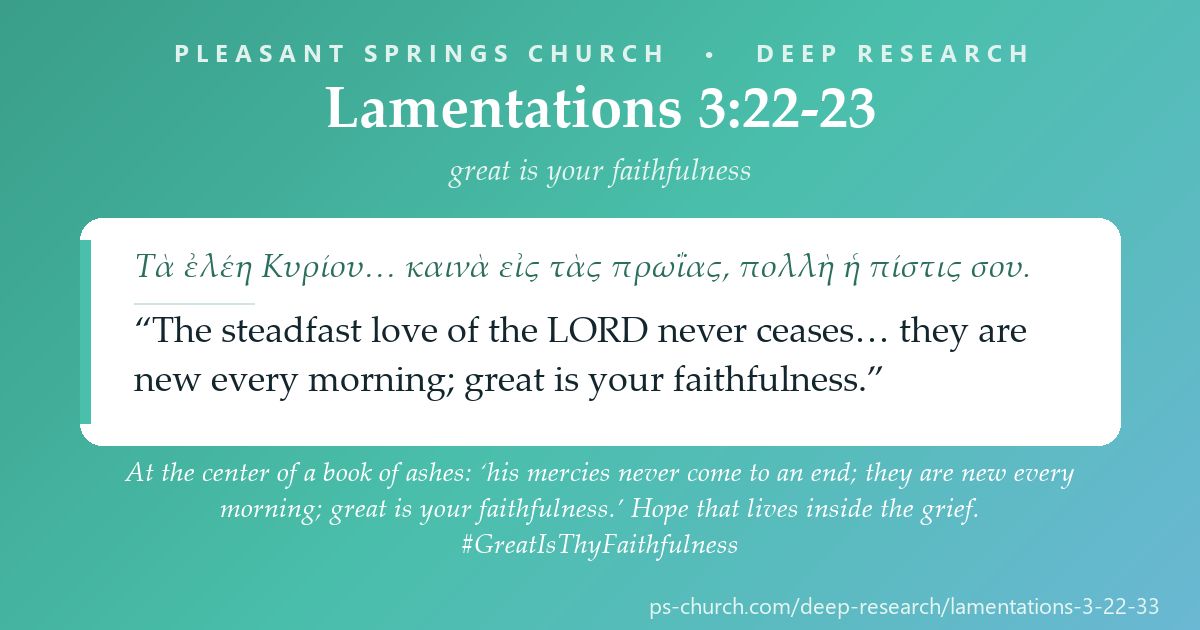
Lamentations 3:22–23 · to share
ESVEvery Deep Research page traces its passage across the whole sweep — the Old Testament, the Second-Temple world between the testaments (historical witnesses, not Scripture), and the New Testament. Follow the thread:
Pleasant Springs Church — Deep Research
Research method after Michael S. Heiser’s Bible Research Method (examine dictionaries → ancient literature → important words → textual connections → academic publications → share), with the Pleasant Springs “Author & Audience” foundation. Scripture set in the Hebrew, the Greek editions named on each page and the ESV (Old Testament), and the Greek New Testament and the ESV (New Testament), per the practice of Pleasant Springs Church. Lamentations 3:22–33 research grounded in Hillers, Berlin, Dobbs-Allsopp, Parry, Provan, and House, with O’Connor on the theology of lament and Gentry on the Greek text; the Septuagint’s Jeremiah heading shown as ancient tradition, not proof of authorship.
Scripture quotations marked ESV are from the ESV® Bible (The Holy Bible, English Standard Version®), © 2001 by Crossway, a publishing ministry of Good News Publishers. ESV Text Edition: 2016. Used by permission. All rights reserved. The ESV text may not be quoted in any publication made available to the public by a Creative Commons license, and the ESV may not be translated in whole or in part into any other language. www.esv.org
|
Did this study bless you today? 💚 Give to Support PS Church100% of gifts go to the General Fund — thank you. |