Five poems on a burned city, and every one of them counts to twenty-two — the number of letters in the Hebrew alphabet. Four of the five walk that alphabet, aleph to taw, one letter to a verse. The fifth keeps the number and has no acrostic at all. Only the first poem puts ayin before pe; the other three reverse them. Run the letter screen and it all comes out, poem by poem, without a commentary having to say so. Then run the book against the whole Greek New Testament, and the deepest verbatim contact it makes anywhere in 7,927 verses is five words with the pale horse of Revelation 6:8 — by sword and by famine — with a tie band of one. And those five words stand six times in Greek Jeremiah, where Revelation reaches eight. Whether that is contact or a formula, this page prints both sides of it, along with the mockery every reader hears behind the cross, which measures one word against Matthew and two against Mark. See the method →
Lamentations 1:1–5:22 — fifteen rows across all five poems (the chapter and verse numbers agree in the Hebrew, the Greek and the ESV; there is no offset in this book)
Hebrew (Masoretic) · Greek (CATSS/Rahlfs) · ESVThe Shape of the Passage
Sequence — five poems, and only one feature survives all fivedr_tools.screens.acrostic over the Masoretic text held here and counting the tokens, not by copying an outline. The scribal section marker that closes most verses in this book is not counted as a word; stage 4 shows why. Two limits. The screen looks at the first consonant of the first word of each verse and strips no prefixes, deliberately — stripping prefixes is exactly the move that manufactures an acrostic that is not there. And the ‘lines a verse’ column is the standard colometry of the commentators, not a measurement this shelf can make; the word counts beside it are measured and are what the argument rests on.The Hebrew book is anonymous and the Greek book is not. That difference is a fact about the two files on this disk, and this page reports it as a fact about the files. It does not settle who wrote Lamentations, and nothing measured here bears on that question.
Author
Not one name stands in the Hebrew book. No superscription, no “the word of the Lord that came to…”, no first-person self-naming anywhere in 154 verses. The book’s Hebrew title is simply its first word, אֵיכָה — How…!
The CATSS Greek file opens with a row that has no verse number and no Hebrew counterpart. καὶ ἐγένετο μετὰ τὸ αἰχμαλωτισθῆναι τὸν Ισραηλ καὶ Ιερουσαλημ ἐρημωθῆναι ἐκάθισεν Ιερεμιας κλαίων καὶ ἐθρήνησεν τὸν θρῆνον τοῦτον ἐπὶ Ιερουσαλημ καὶ εἶπεν — and it came to pass, after Israel was taken captive and Jerusalem laid waste, Jeremiah sat weeping and lamented this lamentation over Jerusalem and said. The parser on this shelf labels it 0:0 because the file gives it no number of its own. The Masoretic text held here has nothing corresponding to it.
And the verbatim contact with the book of Jeremiah is small. Screened against all 1,364 verses of Hebrew Jeremiah, the deepest run Lamentations reaches is four words, it reaches it twice (2:11 and 3:48), and both times the four words are the same and the target verse is the same: Jeremiah 8:21. Against the 2,527 verses of the Psalter the deepest run is also four, once. Against the 1,273 verses of Ezekiel — the other book written out of the same catastrophe — nothing in Lamentations reaches three.
None of that is an argument about authorship in either direction. Shared wording is not authorship, and a writer does not quote himself to prove he is himself. The numbers are printed because they are the numbers, and because a page that prints the Greek heading owes the reader the measurement beside it.
Audience
The book has four speakers and it does not label them. A narrator describes the city in poem I and poem II; the city herself speaks in the first person from 1:11 (“Look, O Lord, and see, for I am despised”); a man speaks alone in poem III (“I am the man who has seen affliction”); and in poem V, for the first and only time, the voice is plural throughout — our inheritance, our fathers, our days.
The plural is not new in the last poem; sustaining it for a whole poem is. Poem V opens זְכֹר יְהוָה מֶה־הָיָה לָנוּ — remember, O Lord, what has befallen us — and does not leave the first-person plural again. It is not the first plural in the book: 3:40–47 speaks as we (“Let us test and examine our ways”), and 4:17–20 says our eyes and, in the poem IV row printed above, the breath of our nostrils. What is new in poem V is that the plural never stops, and that it is the only poem in the book addressed to God from beginning to end.
How it has been carried. Lamentations is read whole in the synagogue on the Ninth of Av, the fast for the destruction of the temple; the Christian churches have read it through Holy Week. Synagogue practice repeats verse 21 after verse 22, so that the reading does not end on unless you have utterly rejected us. Nothing of the kind is claimed here for the Christian office: no liturgical source was consulted for it. The text on the page still ends there.
Orient on the acrostic, the city lament, and the Ninth of Av.
Which articles are relevant?
- Anchor Bible Dictionary — “Lamentations, Book of,” “Acrostics,” “Lament,” “Zion Traditions.”
- Dictionary of the OT: Prophets and Wisdom, Poetry & Writings (IVP) — “Lamentations,” “Acrostic,” “City Lament,” “Suffering,” “Exile.”
- NIDOTTE / TDOT — שֶׁבֶר (šeber, breaking), בַּת (bat, daughter, in “daughter of Zion”), מָשִׁיחַ (māšîaḥ).
- TDNT — ῥομφαία and μάχαιρα, λιμός, θάνατος — the four words the deepest run on this page is made of.
The verse numbers, and the one place the columns do not line up
There is no chapter or verse offset in Lamentations. Masoretic, CATSS and ESV all give the five chapters as 22, 22, 66, 22 and 22 verses — 154 in all — with the chapter breaks in the same places. Every reference on this page therefore means the same verse in every column. That is stated because the shelf states it even when the answer is nothing.
But the CATSS Greek file is four rows short, and it is short in chapter 3. It has no row at all for 3:22, 3:23, 3:24 or 3:29. Its numbering follows the Hebrew and simply skips them, running 3:21 → 3:25 and 3:28 → 3:30, with 3:66 still the highest label — so this is a gap, not a truncation. 3:22–24 is the whole ח stanza. Adding the unnumbered prologue, the file this page measures holds 151 rows where the Hebrew holds 154 verses.
What that does and does not mean. It is a statement about the file this shelf holds, not about ‘the Septuagint’. Whether the omission belongs to the Greek tradition or only to this edition is a question about manuscripts, and no manuscript evidence was consulted for this page. The verses in question are the ones the Great Is Your Faithfulness study is built on, and that page carries the same warning.
And the alphabetic headings. Swete prints the Hebrew letter-names in Greek transcription (Ἄλεφ, Βήθ…) as headings in Greek Lamentations, and NETS prints them; but per Gentry’s note to the reader, neither Rahlfs nor Ziegler treats them as original text. The CATSS morphological file measured here carries none of them. So this page cannot say from its own files whether ‘the Greek keeps the acrostic markers’ — the answer depends entirely on which edition is meant, and it does not say it.
Bibliography surfaced:
- Delbert R. Hillers (Anchor Yale), Adele Berlin (OTL), F. W. Dobbs-Allsopp (Interpretation), Iain Provan (NCB), Paul R. House (WBC), Robin A. Parry (Two Horizons) on Lamentations.
- Kathleen M. O’Connor, Lamentations and the Tears of the World; F. W. Dobbs-Allsopp, Weep, O Daughter of Zion, on the city-lament genre.
- Peter J. Gentry, in the NETS To the Reader for Lamentations, on the Greek text and on the alphabetic headings.
The alphabet as a container, and the city that is a woman.
The acrostic, run rather than asserted
The letter screen reads the first consonant of the first word of every verse and lines it up against the alphabet. Here is what it returns for the five poems.
| poem | verses | letters per stanza | complete א–ת? | order |
|---|---|---|---|---|
| 1 | 22 | 1 verse each | yes | ע before פ — the ordinary order |
| 2 | 22 | 1 verse each | yes | פ before ע |
| 3 | 66 | 3 verses each | yes | פ before ע |
| 4 | 22 | 1 verse each | yes | פ before ע |
| 5 | 22 | — | no | no alphabet at all |
Poem 5 is not a damaged acrostic. It is not an acrostic. Its verses open ז נ י מ ע מ א ע ב ע נ ש ב ז ש נ ע ע א ל ה כ — twenty-two verses, four of which happen to fall on a letter the alphabet would want next, and eighteen of which do not. Two verses open on מ, three on נ, five on ע. There is no sequence to recover.
The screen strips no prefixes, on purpose. A letter that appears only once you set aside a conjunction is reported missing, because stripping prefixes to find an alphabet is exactly how an acrostic that is not there gets manufactured. The screen is also verse-initial only, so an acrostic built on cola inside verses would be invisible to it. Neither limitation affects the result above, where four poems come back complete without any help at all.
אֵיכָה — the word that is also the title
Seven verses in the whole Hebrew Bible open with אֵיכָה. Three of the seven are Lamentations.
| verse | what it says |
|---|---|
| Deuteronomy 1:12 | Moses: how can I bear alone the weight of you? |
| Deuteronomy 32:30 | how could one have chased a thousand? |
| Isaiah 1:21 | how the faithful city has become a whore |
| Jeremiah 8:8 | how can you say, “we are wise”? |
| Lamentations 1:1 | how lonely sits the city |
| Lamentations 2:1 | how the Lord has set the daughter of Zion under a cloud |
| Lamentations 4:1 | how the gold has grown dim |
The word stands a fourth time in Lamentations, at 4:2, but not at the head of the verse. And the Greek keeps the pattern exactly: πῶς opens the CATSS rows 1:1, 2:1 and 4:1 and no other row in the book, and stands mid-verse at 4:2. Poems 3 and 5 do not open with it.
The city lament, and the city who is a woman
Sumer had a genre for this a thousand years before Jerusalem fell. The Lamentation over the Destruction of Ur and its companions mourn a sacked city and a temple its god has abandoned, and in them the city is regularly personified and regularly a goddess weeps over her. Lamentations belongs recognisably to that world — and differs from it at the point that matters: there is no second deity here who might have prevented the fall, and the city is not innocent. צַדִּיק הוּא יְהוָה — the Lord is righteous (1:18) — is said by the sufferer, about the one who did it.
The daughter language is dense and it is concentrated. The stem θυγατ- stands in 19 of the 151 CATSS rows — daughter of Zion, daughter of Jerusalem, daughter of my people, daughter of Edom — and ten of the nineteen are in poem II alone. The bare Hebrew בַּת stands in sixteen verses: one in poem I, fifteen across poems II, III and IV, and none at all in poem V.
- Isaiah 1:21; 47:1–9; Jeremiah 8:18–9:1 — the city as a woman, and the prophet weeping over the daughter of my people. Jeremiah 8:21 is the verse Lamentations 2:11 and 3:48 both reach.
- Deuteronomy 28:15–68 — the covenant curses: siege, famine, mothers and their children. Lamentations 2:20 and 4:10 read like that chapter having happened.
- Psalm 74; Psalm 79; Psalm 137 — the temple-destruction psalms, the other Hebrew poetry of this catastrophe.
- The Sumerian city laments — Ur, Nippur, Eridu, Uruk, Sumer and Ur; a genre parallel, cited here from the secondary literature and not read in the original for this page.
Sword twice over, the breaking, and the anointed in the pit.
The Greek book uses two words for the Hebrew חֶרֶב. ῥομφαία — the long Thracian blade — stands at 2:21, 4:9 and 5:9. μάχαιρα, the short one, stands once, at 1:20. The five-word run behind the whole of stage 4 is built on the first of the two.
2:11 and 3:48, both in עַל־שֶׁבֶר בַּת־עַמִּי, over the breaking of the daughter of my people — and nowhere else in the book as a noun. The same three consonants stand at 2:9 and 3:4 as the verb שִׁבַּר, he broke, which the Greek renders συνέτριψεν. The noun is rendered σύντριμμα, a shattering. It is the noun the book’s deepest Hebrew contact and its deepest Greek self-repetition are both built on.
The book’s Hebrew title, taken from its first word. Four occurrences in the book; three of them open a poem. Rendered πῶς, which opens the same three Greek rows.
4:20, and nowhere else in the book. רוּחַ אַפֵּינוּ מְשִׁיחַ יְהוָה — the breath of our nostrils, the anointed of the Lord — said of a captured king. Greek χριστὸς κυρίου.
The stem κυρι- stands in 41 of the 151 CATSS rows. On the Hebrew side the two names are kept apart: יְהוָה in 30 verses, אֲדֹנָי in 13, and thirteen of thirteen אֲדֹנָי verses fall in poems I, II and III.
How isolated the wording is, chapter by chapter — and the number that deflates it
Screened against all 23,050 other verse units of the Masoretic corpus held here, 36 of the 154 verses of Lamentations share no two consecutive words with any other verse in the Hebrew Bible. That is a Hebrew-side screen, so a zero means no adjacent word pair — not “no words in common”. All thirty-six share single words freely.
| poem | verses at max = 0 | rate | mean Hebrew words per verse |
|---|---|---|---|
| 1 | 0 of 22 | 0% | 17.0 |
| 2 | 0 of 22 | 0% | 17.3 |
| 3 | 23 of 66 | 35% | 5.8 |
| 4 | 3 of 22 | 14% | 11.7 |
| 5 | 10 of 22 | 45% | 6.6 |
And the deflator, printed in the same breath. The isolation rate tracks verse length closely. Poems I and II have three poetic lines to a verse and seventeen words; poem IV has two lines and twelve; poems III and V have one line and under seven. A short verse offers fewer adjacent pairs and has fewer chances to match anything. So most of the difference between 0% and 45% is arithmetic, not character — and it is arithmetic that follows from the shape of the acrostic, which decides how many lines a verse gets. This page cannot separate the two effects and does not pretend to. What survives without qualification is the list of thirty-six references, which is exact.
One residue that the length effect does not explain. Poem V is at 45% and poem III at 35% — and poem V has the longer verses of the two, 6.6 words against 5.8, so verse length does not explain that gap and in fact points the other way. It is in the right direction for “poem V is the odd one out” and it is far too small a sample to carry weight — twenty-two verses against sixty-six. It is reported and not argued from.
Five words with the pale horse, a run of four that means nothing, and a section marker that was being counted as a word.
The whole book against the whole Greek New Testament
The 151 CATSS rows of Lamentations were screened against all 7,927 verses of the Greek New Testament. 137 rows reach a shared run of two; 73 reach three; 4 reach four; one reaches five; nothing reaches six.
| row | run | tie band | New Testament verse | the shared words |
|---|---|---|---|---|
| 2:21 | 5 | 1 | Revelation 6:8 | ἐν ῥομφαίᾳ καὶ ἐν λιμῷ |
| 3:34 | 4 | 3 | 1 Corinthians 15:25, 15:27, Ephesians 1:22 | ὑπὸ τοὺς πόδας αὐτοῦ |
| 4:18 | 4 | 1 | Luke 13:26 | ἐν ταῖς πλατείαις ἡμῶν |
| 5:8 | 4 | 2 | John 10:16, John 10:39 | οὐκ ἔστιν ἐκ τῆς / ἐκ τῆς χειρὸς αὐτῶν |
| 1:13 | 3 | 9 | Mark 13:16, Luke 9:62, Luke 17:31 … | εἰς τὰ ὀπίσω |
| 1:19 | 3 | 31 | Matthew 12:49, Mark 3:34, Matthew 21:23 … | μου καὶ οἱ |
The last row is the calibration. A run of three with a band of thirty-one is not a connection; it is what three small words in a common order look like.
The maximum: five words, band one, and the fourth horseman
Lamentations 2:21 against Revelation 6:8 is the deepest measured contact between Greek Lamentations and any verse of the Greek New Testament.
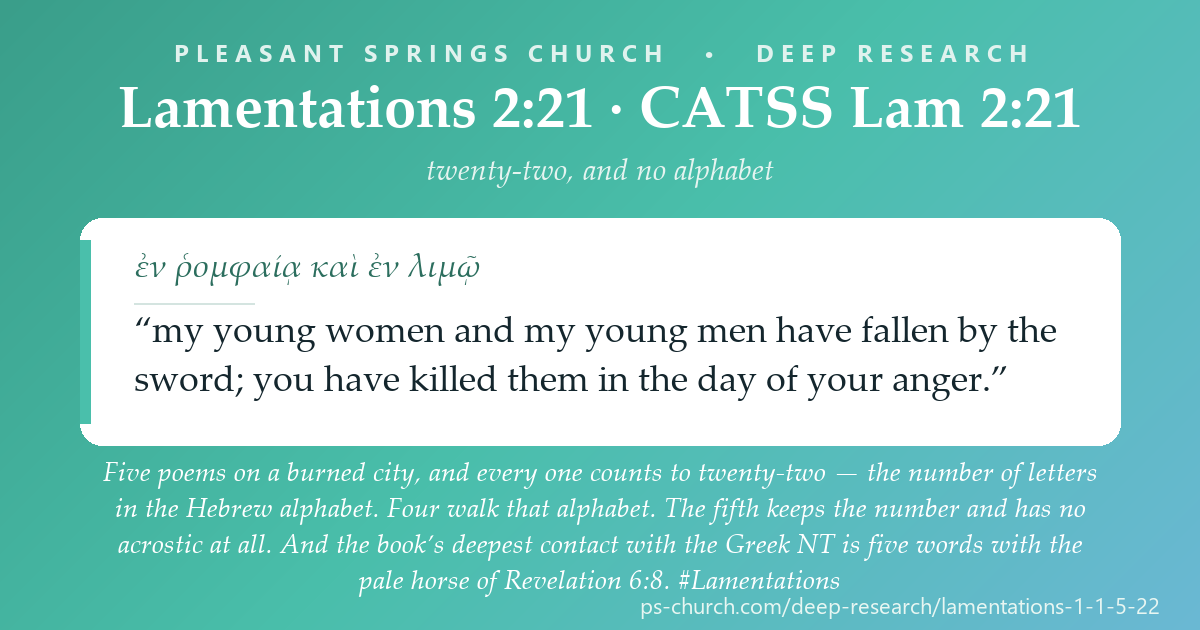
… παρθένοι μου καὶ νεανίσκοι μου ἐπορεύθησαν ἐν αἰχμαλωσίᾳ ἐν ῥομφαίᾳ καὶ ἐν λιμῷ ἀπέκτεινας ἐν ἡμέρᾳ ὀργῆς σου…CATSS Lamentations 2:21 — “my young women and my young men have fallen by the sword; you have killed them in the day of your anger”
… καὶ ἐδόθη αὐτοῖς ἐξουσία… ἀποκτεῖναι ἐν ῥομφαίᾳ καὶ ἐν λιμῷ καὶ ἐν θανάτῳ καὶ ὑπὸ τῶν θηρίων τῆς γῆςRevelation 6:8 — “and they were given authority… to kill with sword and with famine and with pestilence and by wild beasts of the earth” — the rider’s name is ὁ θάνατος
Both sides put a killing verb immediately beside the run, and on opposite sides of it. Revelation has ἀποκτεῖναι in front; Lamentations has ἀπέκτεινας behind. That is what cuts the run at five in one direction. What cuts it in the other is the third member of the triad: Revelation goes on καὶ ἐν θανάτῳ, and Lamentations has no third member.
Now the four things that cut it back, printed here and not in a footnote.
(1) It is a Jeremiah formula, and Revelation reaches further into Jeremiah than into Lamentations. The exact sequence ἐν ῥομφαίᾳ καὶ ἐν λιμῷ stands seven times in the 30,348 Greek Old Testament verse units held here. Six of the seven are Jeremiah — CATSS Jer 45:2, 49:22, 51:12, 51:13, 51:18 and 51:27, which are MT and ESV Jeremiah 38:2, 42:22, 44:12, 44:13, 44:18 and 44:27. The seventh is Lamentations 2:21. And when Revelation 6:8 is screened against the whole Greek Old Testament rather than the other way round, its deepest contact is eight words with a tie band of one — ἐν ῥομφαίᾳ καὶ ἐν λιμῷ καὶ ἐν θανάτῳ, at CATSS Jeremiah 51:13 = MT Jeremiah 44:13. Lamentations reaches five of Jeremiah’s eight. That eight-word sequence occurs exactly once in the Greek Old Testament held here and exactly once in the Greek New Testament, and those two are each other.
(2) Three of the five words have no counterpart in the Hebrew of Lamentations 2:21. The Masoretic verse reads נָפְלוּ בֶחָרֶב, they fell by the sword. ἐν ῥομφαίᾳ answers to that. καὶ ἐν λιμῷ answers to nothing — there is no famine in the Hebrew verse. Nor is there captivity, though the Greek row carries ἐπορεύθησαν ἐν αἰχμαλωσίᾳ just before the run.
(3) The Greek 2:21 stands in a relation to the Greek 1:18 that the Hebrew 2:21 does not stand in to the Hebrew 1:18. Greek 2:21 and Greek 1:18 share eight consecutive words — παρθένοι μου καὶ νεανίσκοι μου ἐπορεύθησαν ἐν αἰχμαλωσίᾳ, tie band one, and that sequence stands in no other verse of the Greek files held here. The Hebrew of those same two verses shares two: בְּתוּלֹתַי וּבַחוּרַי. In Hebrew 1:18 the clause that follows them is הָלְכוּ בַשֶּׁבִי, went into captivity, and it ends the verse; in Hebrew 2:21 it is נָפְלוּ בֶחָרֶב, fell by the sword, and the verse runs on. Two different clauses in Hebrew; the same clause in Greek. This page reports that difference and does not explain it — it does not say which reading is prior, whether a translator harmonised, whether a scribe’s eye slipped, or whether the two traditions had different text in front of them. None of that is measurable from these files.
(4) Revelation 6:8 carries no citation formula. No as it is written, nothing signalling a quotation. The commentaries put Revelation 6:8 beside Ezekiel 14:21, which has the four judgments — sword, famine, wild beasts, pestilence — and that is a reading about content, not about shared word forms. On this screen Ezekiel does not come near the top. What is reported is that these two verses share five consecutive word-forms and that no other New Testament verse shares more than four with anything in this book.
Its own counter-example: four words, tie band one, and it means nothing
Lamentations 4:18 runs four words with Luke 13:26 — ἐν ταῖς πλατείαις ἡμῶν — and the tie band is one. Not only that: the sequence stands once in the 30,348 Greek Old Testament verse units held here (this verse) and once in the 7,927 verses of the Greek New Testament (that verse). By every number this shelf reports, that is the profile of a signal.
It is not one. Lamentations 4:18 says the besieged could not walk in our streets. Luke 13:26 says we ate and drank in your presence, and you taught in our streets. The four words are in our streets, and there is nothing else. The page prints this immediately after the Revelation finding so that the Revelation finding is not read as more than it is.
The lesson, stated plainly. A tie band of one says that no other verse in the target corpus reaches this depth. It does not say the contact means anything. Rarity and significance are different properties, and this shelf can measure only the first.
The mockery at the cross: one word, and two — and the difference is a particle
Lamentations 2:15 is the standard cross-reference for the passers-by who wag their heads at the crucifixion. The verse has all three elements: those who pass by, the wagging of the head, and a ruined thing that was the joy of all the earth.
| pair | longest shared run | the run |
|---|---|---|
| Lamentations 2:15 ↔ Matthew 27:39 | 1 | οἱ |
| Lamentations 2:15 ↔ Mark 15:29 | 2 | οἱ παραπορευόμενοι |
| Lamentations 2:15 ↔ LXX Psalm 21:8 (ESV Psalm 22:7) | 2 | πάντες οἱ |
The whole difference between the two Gospels is one particle. Mark 15:29 reads καὶ οἱ παραπορευόμενοι ἐβλασφήμουν αὐτόν; Matthew 27:39 reads οἱ δὲ παραπορευόμενοι ἐβλασφήμουν αὐτόν. The δέ cuts the run in half.
And the wagging of the head does not match at all. Lamentations 2:15 has ἐκίνησαν τὴν κεφαλὴν αὐτῶν — a finite verb, singular head, with the article. The Gospels have κινοῦντες τὰς κεφαλὰς αὐτῶν — a participle, plural heads. LXX Psalm 21:8 has ἐκίνησαν κεφαλήν, with no article and no possessive. Three different word-forms of the same gesture, so the screen finds nothing, and the gesture is plainly the same in all three.
What that does and does not show. It shows there is no verbatim contact. It does not show that the Gospel writers had nothing of Lamentations in mind, and this page does not claim that. This screen finds quotation. It cannot find memory.
The Hebrew screen — and a substrate artefact this page had to correct
The Masoretic text held here carries the scribal section markers {ס} and {פ} inside the verse text, and the shelf’s frozen normaliser reads them as words. They stand at the end of 133 of Lamentations’ 154 verses, and of 3,380 verses across the whole Masoretic corpus. A run reported as three that ends in a marker is really two.
The screen was therefore run twice — once as the shelf runs it, and once with the bare markers dropped from both sides. Here is the difference.
| Lamentations vs the rest of the Hebrew Bible | as the shelf runs it | markers dropped |
|---|---|---|
| verses at max = 0 (no adjacent word pair shared) | 36 of 154 | 41 of 154 |
| verses reaching three | 19 | 17 |
| verses reaching four | 3 | 3 |
| deepest runs | 1:20 ↔ Psalm 31:10 · 2:11 ↔ Jeremiah 8:21 · 3:48 ↔ Jeremiah 8:21 — unchanged, all band one | |
| vs the book of Jeremiah, verses reaching three | 4 | 2 |
The headline results survive; five extra verses turn out to be isolated that did not look isolated. The most striking is 1:1. As the shelf runs the screen, the book’s first and most quoted verse has a two-word contact with Judges 1:30 — and the second of those two “words” is the section marker. Set the marker aside and “How lonely sits the city” shares no two consecutive words with any other verse in the Hebrew Bible. The figures in stage 3 are the shelf’s standard ones; this table is what changes if the artefact is removed, and both are printed rather than one.
dr_tools/normalize.py is frozen — every published number on this shelf depends on it — so it was not edited. The correction above was made in a separate pass over the same corpus, dropping any bare ס or פ token standing at the head or the tail of a verse.
What the book shares with the Hebrew Bible, and with which books
Screened against all 23,050 other Masoretic verse units, three verses of Lamentations reach four shared words. Every one has a tie band of one.
| verse | run | band | target | the shared words |
|---|---|---|---|---|
| 1:20 | 4 | 1 | Psalm 31:10 (ESV 31:9) | יהוה כי צר לי |
| 2:11 | 4 | 1 | Jeremiah 8:21 | על שבר בת עמי |
| 3:48 | 4 | 1 | Jeremiah 8:21 | על שבר בת עמי |
And restricted to one target book at a time:
| target book | its verses | Lamentations rows reaching 4 / 3 / 2 |
|---|---|---|
| Jeremiah | 1,364 | 2 / 4 / 71 |
| Psalms | 2,527 | 1 / 5 / 71 |
| Isaiah | 1,291 | 0 / 6 / 69 |
| Job | 1,070 | 0 / 1 / 32 |
| Deuteronomy | 956 | 0 / 0 / 49 |
| Ezekiel | 1,273 | 0 / 0 / 49 |
Nothing in Lamentations reaches three consecutive Hebrew words with anything in Ezekiel. Two books written out of the same fall of the same city, one of them 1,273 verses long, and the deepest verbatim contact between them is a two-word sequence.
These are counts of shared word forms. They say nothing about which text is prior, whether either writer saw the other, or whether both drew on something older, and nothing on this page claims otherwise. In particular the Jeremiah column is not an argument for or against the traditional ascription; see the Author panel.
What was cut, what was not consulted, and where this page is weakest.
Claims this page drafted and then withdrew
“Revelation 6:8 draws on Lamentations 2:21.” Cut. The run is real, is the deepest in the book, and has a tie band of one — and the same five words stand six times in Greek Jeremiah, Revelation 6:8 reaches eight of them at Jeremiah 51:13, three of the five have no counterpart in the Hebrew of Lamentations 2:21, and Revelation carries no citation formula. All four qualifications now stand in stage 4 beside the finding rather than under it.
“Lamentations 2:15 is behind Matthew 27:39 and Mark 15:29.” Cut as a measured claim and kept as an observation about content. The runs are one and two. What the page now says is that the gesture is the same in all three texts and the word forms are not, which is what was actually established.
“Poem V is the most linguistically isolated poem in the book.” Cut down to size twice. It has the highest rate of verses sharing no adjacent word pair — and its verses are also among the shortest in the book, and the rate tracks verse length closely across the five poems. The page prints both numbers side by side and declines to separate them.
“Thirty-six verses of Lamentations share no two consecutive words with anything else” was nearly published without a check. The Masoretic text held here puts the scribal section markers inside the verse text and the frozen normaliser counts them as words. The true figure on this corpus is forty-one, Lamentations 1:1 is one of the five that were being masked, and both numbers are now in stage 4.
“The Greek keeps the acrostic letter-headings.” Cut entirely. Swete and NETS print them; per Gentry, neither Rahlfs nor Ziegler treats them as original; and the CATSS file measured here has none. The page cannot adjudicate that from its own files and says so in stage 1 instead.
What was not consulted
No Hebrew or Greek critical apparatus. No Qumran evidence — and for this book that matters: 3QLam, 4QLam and 5QLama,b exist, 5QLama carries a substantial stretch of chapters 4 and 5, and none of them was reachable here. No Targum, no Syriac Peshitta, no Vulgate, no Aquila, Symmachus or Theodotion. No Lamentations Rabbah, and no rabbinic discussion of the פ–ע order.
No collation of Rahlfs against Ziegler for Greek Lamentations, which bears directly on every Greek figure above — including the five-word run this page leads with. No Sumerian city lament was read in the original or in a scholarly edition; that paragraph rests on the secondary literature and is labelled as such.
Nothing was consulted on date, provenance or authorship, and nothing here bears on any of them.
Where this page is weakest
The ESV column was not checked against a local ESV text. There is no ESV file for Lamentations on this disk and no Crossway API key in this project, so the English in every row above was typed and its alignment rests on verse counts and chapter openings rather than on verse-by-verse reading against a held copy. That is weaker than the shelf’s usual practice and it is said here rather than glossed. The Hebrew and the Greek in every row were pulled from the corpus files programmatically and not typed.
The colometry in the structure diagram is borrowed. “Three lines a verse” for poems I and II, two for poem IV and one for poems III and V is the standard analysis of the commentators, not something this shelf measured. The mean word counts beside it are measured, they point the same way, and they are what the argument actually rests on.
The פ–ע result is reported and not explained. That poem I keeps the ordinary order and poems II, III and IV reverse it is what the screen returns. Why is a question about the history of the Hebrew alphabet and about these poems’ composition, and this page has no evidence bearing on it and offers none.
The whole Greek side is one edition. Every Greek figure is scoped to the 64 CATSS files held here, screened to 30,348 verse units with the Odes excluded — Ode 9 is Luke 1 and Ode 13 is Luke 2 copied into a Greek Old Testament manuscript, and ten further Odes are second copies of Exodus 15, Deuteronomy 32, 1 Samuel 2, Habakkuk 3, Isaiah 5, Isaiah 26, Isaiah 38, Jonah 2 and Daniel 3. Leaving them in would let a New Testament text be counted as an Old Testament witness to itself.
Commentaries & studies:
- Delbert R. Hillers, Lamentations (Anchor Yale); Adele Berlin, Lamentations (OTL); F. W. Dobbs-Allsopp, Lamentations (Interpretation); Iain Provan (NCB); Paul R. House (WBC); Robin A. Parry (Two Horizons).
- F. W. Dobbs-Allsopp, Weep, O Daughter of Zion: A Study of the City-Lament Genre in the Hebrew Bible; Kathleen M. O’Connor, Lamentations and the Tears of the World.
- Peter J. Gentry, NETS To the Reader for Lamentations, on Rahlfs, Ziegler and the alphabetic headings; Beale & Carson, eds., Commentary on the New Testament Use of the Old Testament, on Revelation 6.
A form that lets go, and a book that does not end.
The alphabet is a promise the last poem stops making
An acrostic is a container. It says: this grief has a beginning and an end, it can be spoken from א to ת, and when the letters run out the saying is finished. Lamentations builds that container four times. Poem I builds it and keeps the letters in their ordinary order. Poem II builds it and moves two of them. Poem III builds it three times over, so that every letter gets three verses instead of one. Poem IV builds it and gives each letter a shorter verse.
Poem V counts to twenty-two and does not build it. Twenty-two verses — exactly the alphabet’s number, so the shape of the container is still there — and inside it, no letters in order at all. The form does not break. It is set down.
And the content does the same thing. The last poem is the only one that speaks in the plural from beginning to end, and the only one addressed to God the whole way through. Its last sentence is a conditional with nothing after it: restore us… unless you have utterly rejected us. The synagogue reads verse 21 again so the reading does not end there. The book does end there.
Which is why the measurement at 2:21 is worth sitting with even after it has been cut down to size. Five words: by sword and by famine. In Lamentations they are an accusation addressed to God about what he has already done in one city. In Revelation 6 the same five words are an authority handed to a rider whose name is Death, over a quarter of the earth. Whether that is contact or a formula both texts inherited, this screen cannot tell you. What it can tell you is that the sentence Revelation completes with καὶ ἐν θανάτῳ occurs exactly once in the Greek Old Testament held here and exactly once in the Greek New Testament — and that Lamentations, which has no third member, stops one word short of it.
Every Deep Research page traces its passage across the whole sweep — the Old Testament, the Second-Temple world between the testaments (historical witnesses, not Scripture), and the New Testament. Follow the thread:
Pleasant Springs Church — Deep Research
Research method after Michael S. Heiser’s Bible Research Method (examine dictionaries → ancient literature → important words → textual connections → academic publications → share), with the Pleasant Springs “Author & Audience” foundation. Scripture set in the Hebrew, the Greek editions named on each page and the ESV (Old Testament), and the Greek New Testament and the ESV (New Testament), per the practice of Pleasant Springs Church. Lamentations research grounded in Hillers (Anchor Yale), Berlin (OTL), Dobbs-Allsopp (Interpretation and Weep, O Daughter of Zion), Provan (NCB), House (WBC), Parry (Two Horizons) and O’Connor. Text: Hebrew from the Masoretic text as printed in the editions consulted — Sefaria’s Miqra according to the Masorah; no critical apparatus was consulted for the Hebrew. Greek from Rahlfs’ Septuaginta as digitized by CATSS; Greek New Testament from the SBL edition as digitized by MorphGNT. The standing caution for this shelf applies: these pages say “the CATSS Greek text reads…” and never call a Greek reading early or late, and never say which text acted on which. ⚠️ Verse numbering. There is no offset in this book. Masoretic, CATSS and ESV all give the five chapters as 22, 22, 66, 22 and 22 verses, 154 in all, with the chapter breaks in the same places. The CATSS file nevertheless holds only 151 rows: it has no row for 3:22, 3:23, 3:24 or 3:29 — its numbering skips them, running 3:21 → 3:25 and 3:28 → 3:30 — and it opens with an unnumbered prologue, labelled 0:0 here, that the Hebrew has no counterpart for. Whether that omission belongs to the Greek tradition or only to this edition is a question about manuscripts, and no manuscript evidence was consulted. ⚠️ The ESV column was NOT verified against a held ESV text. No ESV file for Lamentations exists on this disk and no Crossway API key exists in this project; the English was typed and its verse alignment rests on verse counts and chapter openings. The Hebrew and Greek columns were pulled programmatically from the corpus files. ⚠️ Cross-corpus run figures on this page were measured on or after 30 August 2026 and apply MorphGNT’s own spelling equivalences — οὐ/οὐκ/οὐχ, ἐκ/ἐξ and the movable nu — so that a shared run is not cut at a word the two editions merely spell differently. On this book the fold is worth exactly this much: rows reaching three go from 71 to 73, rows reaching two from 136 to 137, and the tie band at Lamentations 5:8 goes from one to two because John 10:16 joins it at four. The headline five-word run at 2:21 is unaffected by the fold. Figures published on this shelf before 30 August are lower for that reason and were not copied here; every number above was re-measured. ⚠️ A run of zero on the Hebrew screen means NO TWO CONSECUTIVE WORDS. The Hebrew-side screen runs with the unigram fallback off, so max = 0 means the verse shares no adjacent word pair with any other verse in the corpus — it does not mean the verse shares no words. Every zero on this page shares individual words freely. Consonantal forms; cantillation and vowel points removed; qere read; final letters folded to medial; maqqef a separator and never a weld. The Greek-side screen runs with the fallback ON, so a zero there would mean no shared word at all — which is what Lamentations 3:45 returns against 1 Corinthians 4:13, the pair the commentaries put together for “the offscouring of all things.” ⚠️ The Masoretic text held here counts the scribal section markers as words. {ס} and {פ} stand inside the verse text of the Sefaria file and the frozen normaliser tokenises them — at the end of 133 of this book’s 154 verses, and of 3,380 verses corpus-wide. Stage 4 prints the screen both ways. The three deepest Hebrew runs are unchanged; the count of wholly isolated verses moves from 36 to 41, and Lamentations 1:1 is one of the five that changes. normalize.py is frozen and was not edited. ⚠️ Greek figures are scoped to the 64 CATSS files held here, screened to 30,348 verse units with the Odes excluded. ⚠️ Five claims were withdrawn while this page was built and all five are named in stage 5. Typology is handled per the house position: what the text says, what the New Testament itself draws, and what we see from this side of the cross — with the seeing left to the reader.
Scripture quotations marked ESV are from the ESV® Bible (The Holy Bible, English Standard Version®), © 2001 by Crossway, a publishing ministry of Good News Publishers. ESV Text Edition: 2016. Used by permission. All rights reserved. The ESV text may not be quoted in any publication made available to the public by a Creative Commons license, and the ESV may not be translated in whole or in part into any other language. www.esv.org
|
Did this study bless you today? 💚 Give to Support PS Church100% of gifts go to the General Fund — thank you. |