Four chapters, and the narrator tells you the price before he tells you the plan. Hiram of Tyre sends cedar and Solomon sends wheat and oil, and then this: “King Solomon drafted forced labor out of all Israel, and the draft numbered 30,000 men” (5:13). Seventy thousand more carry, eighty thousand more cut, and a man named Adoniram is put in charge of the draft — remember him; in chapter 12 all Israel will stone him to death. Then the house goes up, and the one detail the narrator pauses on is a sound that was not there: “stone prepared at the quarry, so that neither hammer nor axe nor any tool of iron was heard in the house while it was being built” (6:7). Once, and only once, God interrupts the architecture, and what he says is an if: “Concerning this house that you are building, if you will walk in my statutes… I will dwell among the children of Israel and will not forsake my people Israel” (6:12–13). Seven years later the ark goes in under the wings of the cherubim with nothing inside it but two stone tablets, and the cloud comes down so heavily that the priests could not stand to minister. And then Solomon prays — and says the sentence that no one else would have dared to say on that day: “But will God indeed dwell on the earth? Behold, heaven and the highest heaven cannot contain you; how much less this house that I have built!” (8:27). What follows is seven petitions, each one turning on hear in heaven and forgive; the fifth is for a foreigner from a far country, “that all the peoples of the earth may know your name”; and the seventh is for exiles who will not exist for another four hundred years. This study works 1 Kings 5:1–8:66 in Hebrew, Septuagint and ESV, with the Greek’s substantial rearrangement of the temple account reported rather than smoothed. See the method →
1 Kings 5:1–8:66 (selections)
Hebrew (MT) · LXX (Rahlfs, 3 Kingdoms) · ESVWhich Greek is this? Not the revised kind. Dominique Barthélemy showed in Les Devanciers d’Aquila (1963) that the Greek of Kingdoms is not one translation: long stretches are a later kaige revision, pulling an older Greek back toward a proto-Masoretic Hebrew, named for its stereotyped rendering of Hebrew גַּם (gam) by καί γε. Using Thackeray’s section letters, the kaige stretches are 2 Kingdoms 11:2 → 3 Kingdoms 2:11 (βγ) and 3 Kingdoms 22 → 4 Kingdoms 25 (γδ). This passage falls between them — 1 Kings 5–8 is squarely in the Old Greek section (γγ, 3 Kingdoms 2:12–21:43). Two consequences, and they cut opposite ways from the kaige pages in this set. First, here Rahlfs’s Vaticanus-based text is generally reckoned to be the oldest Greek rather than a revision of it, so “the Septuagint reads X” is a safer sentence in these chapters than it is in 2 Samuel 11 or 2 Kings. Second — and this is why the columns above diverge so much more than they did there — nobody has pulled this Greek back toward the Hebrew. The differences you are looking at are old. (The Antiochene / Lucianic text is a separate witness throughout, and in the Old Greek sections it is generally taken to carry later recensional expansions rather than an older text; that is itself debated. This page cites no Antiochene reading, because we have not consulted the critical edition — Fernández Marcos and Busto Saiz, El texto antioqueno de la Biblia griega. There is as yet no Göttingen edition of 3 Kingdoms; the fuller apparatus is Brooke–McLean’s larger Cambridge Septuagint. On why this library prints what it prints, see the texts we print.)
⚠️ 3 Kingdoms is rearranged, and it is rearranged hardest right here. The Greek of 1 Kings differs from the Hebrew in order and content, not only wording. It carries two blocks of extra material called the “Miscellanies,” at 2:35a–o and 2:46a–l, and an alternate Jeroboam narrative at 12:24a–z, none of which the Hebrew has; and MT chapters 20 and 21 stand in the reverse order, so Naboth’s vineyard is 3 Kingdoms 20 and the Aramean wars are 3 Kingdoms 21. Every one of those was checked against the verse inventory of the Rahlfs text itself rather than taken from a description. What touches this passage, in full: Rahlfs’s chapter 5 has no verses 5–8 and no verse 31; the quarrying of 5:31 and the builders of 5:32 stand instead at 6:1a–1b. Chapter 6 opens with four extra half-verses, 6:1a, 1b, 1c and 1d — and 1c–1d are the Hebrew’s closing verses 37–38 moved to the front, so the Greek reader learns when the house was finished before he is told how big it was. Chapter 6 then has no verses 11–14 (the word of the Lord to Solomon) and no verse 18, and it ends at verse 36 with an extra 36a. Chapter 7 is re-ordered wholesale: the Greek begins with Hiram the bronzeworker and ends with Solomon’s own palace (3 Kingdoms 7:38–50 = MT 7:1–12). And in chapter 8, verses 12–13 are not in their Hebrew place at all but at the end of the prayer, as 8:53a, expanded at both ends. Which arrangement is earlier is a real scholarly dispute — D. W. Gooding argued the Greek order is a later, tidier midrashic rearrangement; others, following Julio Trebolle Barrera and the general drift of Qumran-era text history, hold that the Greek reflects a different and sometimes earlier Hebrew. This page reports the difference and does not adjudicate it.
Numbering — and there is a real offset here, so it is printed in every reference line above. English 5:1–18 = Hebrew and Greek 5:15–32. The Hebrew and Greek chapter 5 begins where English has 4:21 and runs to thirty-two verses; the ESV itself footnotes it at 5:1 (“Ch 5:15 in Hebrew”). Chapters 6, 7 and 8 carry no offset — MT and Rahlfs and the English number them alike, and Rahlfs’s chapter 8 has exactly 66 verses as the Hebrew does; this was counted in the Greek text, not assumed. The pluses and minuses inside those chapters are listed above and again below. Edition: the Greek column is Rahlfs’s Septuaginta, 3 Kingdoms, in the CATSS morphological digitization; punctuation in the printed editions is editorial and is not reproduced, and proper names are left unaccented as Rahlfs prints them. The Hebrew is the Masoretic Text; where a ketiv/qere stands (8:48) the qere is printed and the ketiv named. From the Judean Desert: 4QKgs (4Q54), published by Julio Trebolle Barrera in DJD XIV, preserves fragments of 1 Kings 7:20–21, 25–27, 29–42, 7:50–8:9 and 8:16–18 — genuinely inside this passage, and genuinely fragmentary. This page builds no textual argument on it; the transcription is in DJD, and that, not a summary, is where a reader should check it. 5QKgs (5Q2) and 6QpapKgs (6Q4) do not touch these chapters.)
The Shape of the Passage
Sevenfold refrainBehind these four chapters stand two promises and one warning: the covenant with David (“he shall build a house for my name”), the law of the place the Lord will choose, and Samuel’s warning about what a king does to a people. In front of them stands chapter 12, where a nation refuses a levy.
Author
A writer who will not let you enjoy the building unmixed. He gives four chapters to the greatest construction project in Israel’s history, and he is perfectly capable of admiring it — the cedar, the gold, the cherubim, the sea of cast metal. But look at what he puts inside the description. Before a single stone is laid he tells you the labour was drafted “out of all Israel” (5:13) and names the officer in charge (5:14). At the exact centre of the building account he stops the architecture and has God attach an if (6:12). And on the day of dedication he gives the builder a speech whose most famous line says the building cannot do what buildings are for (8:27). This is not a chronicler of royal achievement. This is someone writing after the house was burned — see 2 Kings 25 — and telling you, gently and in order, exactly which sentences you should have been listening to.
He works by long-range vocabulary. The word for the draft, mas, appears in only six verses in the whole of 1 Kings — 4:6; 5:13, 14 (MT 5:27, 28); 9:15, 21; 12:18 — and the same man is over it at the start and at the end: Adoniram in 4:6 and 5:14, Adoram in 12:18, where all Israel stones him to death and ten tribes walk away. The narrator never says “the temple cost the kingdom.” He just uses one rare word six times and lets you do the arithmetic. Judges and Samuel taught the same reticence.
And he knows the shape of an ancient temple-building account and uses it. Victor Hurowitz showed that 1 Kings 5–9 follows the standard Near Eastern pattern almost step for step — divine sanction, materials and labour, description, dedication with sacrifice and feast, blessing, and a divine promise with conditions. The deviations are where the theology is. No god commissions the building in a dream; the sanction came a generation earlier, to Solomon’s father, and included a refusal (2 Samuel 7:5–13). And no other dedication speech in the ancient world contains 8:27.
Audience
People with no temple. Whatever earlier sources stand behind these chapters — and they clearly do; the measurements read like an archive — the book in front of us ends with Jerusalem burned and a king eating at the table of Babylon. So the first readers of the finished book were reading a description of a building they could not visit, dedicated with a prayer that predicted their exact situation: “if they sin against you… and they are carried away captive to the land of the enemy… then hear in heaven your dwelling place” (8:46–49). They were not being told what they had lost. They were being told what to do on Tuesday. Face the city, and pray.
People who needed to know the house was never the point. A community whose sanctuary is ash has two temptations: to conclude that God went down with it, or to insist the building will be back tomorrow. Chapter 8 forecloses the first before the ash exists. The God who is asked to hear in heaven seven times is not homeless when the roof falls in.
And people who had to decide what to do with outsiders. The fifth petition asks God to answer the prayers of a nokri — not a resident alien attached to Israel, but a foreigner from a far country — and to answer them fully, “according to all for which the foreigner calls to you.” Israel’s own petitions in this prayer are all conditional on repentance. The foreigner’s is not. Whatever else the first audience heard in chapter 8, they heard that.
Orient on the temple and its plan, Tyre and Phoenicia, the corvée, the ark, the name theology, and the prayer of dedication.
Search by topic: Temple, Jerusalem (Solomon’s); Tyre; Phoenicia; Hiram; cedar of Lebanon; corvée and forced labor (mas); Adoniram; Ark of the Covenant; cherubim; debir and hekal and ulam; Name theology (shem); glory (kabod); cloud; dedication; prayer; foreigner (nokri) and sojourner (ger); exile and restoration; Deuteronomistic History.
Which articles are relevant?
- Anchor Bible Dictionary — “Temple, Jerusalem,” “Solomon,” “Hiram,” “Tyre (Place),” “Phoenicia,” “Cedar,” “Labor, Forced,” “Ark of the Covenant,” “Cherubim,” “Glory of God,” “Name of God,” “Prayer (OT),” “Deuteronomistic History,” “Kings, Books of.”
- Dictionary of the OT: Historical Books (IVP) — “Solomon,” “Temple,” “Architecture,” “Forced Labor,” “Prayer,” “Non-Israelite Nations,” “Kings, Books of,” “Chronicler’s History.” The last of these is where to go before deciding what to do with the differences between Kings and Chronicles reported on this page.
- NIDOTTE / TDOT — מַס (mas, levy), סֵבֶל (sēḇel, burden), שָׁמַע (šāmaʿ, hear), סָלַח (sālaḥ, forgive), שָׁכַן (šāḵan, dwell / tabernacle), שֵׁם (šēm, name), כָּבוֹד (kāḇōḏ, glory), עֲרָפֶל (ʿărāpəl, thick darkness), נׇכְרִי (noḵrî, foreigner), דְּבִיר (dəḇîr, inner sanctuary).
- On the Greek — Paul D. McLean, “3 Reigns: To the Reader,” in NETS; and the introduction to Kingdoms in Natalio Fernández Marcos, The Septuagint in Context. Between them they will tell you what the section letters mean, why the kaige question matters, and why 3 Kingdoms is the hardest book in the Greek Bible to describe in one sentence.
Bibliography surfaced:
- Mordechai Cogan, I Kings (Anchor Yale Bible); Simon J. DeVries, 1 Kings (WBC); Marvin A. Sweeney, I & II Kings (OTL); Iain W. Provan, 1 and 2 Kings (NIBC); Paul R. House, 1, 2 Kings (NAC); Donald J. Wiseman, 1 and 2 Kings (TOTC); Walter Brueggemann, 1 & 2 Kings (Smyth & Helwys); A. Graeme Auld, Kings Without Privilege.
- Victor Avigdor Hurowitz, I Have Built You an Exalted House: Temple Building in the Bible in Light of Mesopotamian and Northwest Semitic Writings (JSOTSup 115) — the monograph this page leans on for the shape of chapters 5–9.
- Jon D. Levenson, Sinai and Zion, and his essay “The Temple and the World” — on what a temple is in this literature. (A Jewish scholar writing as one; we take the analysis, not a shared confession.)
- On the Greek: D. W. Gooding, “Temple Specifications: A Dispute in Logical Arrangement between the MT and the LXX,” Vetus Testamentum 17 (1967); Emanuel Tov, Textual Criticism of the Hebrew Bible; Julio Trebolle Barrera, DJD XIV, on 4QKgs.
How a temple got built in the ancient world, what a corvée actually was — and what later readers did with the silence at 6:7.
First the world: temple-building as a recognised genre, cedar as an imperial commodity, and the labour draft as an ordinary instrument of ancient statecraft. Then watch what Josephus, the rabbis and the Chronicler each do with these chapters — because in every case what they change tells you which sentence they could not sit still under.
Which parallels shed light on the world of these chapters?
Building a house for a god was a recognised kind of event, with a recognised order of events, and Israel’s account follows it. The pattern runs: the god sanctions the work; a king gathers materials and labour, often by treaty with a timber-supplying neighbour; the building is described; it is dedicated with sacrifice, a feast and a prayer; the god takes up residence; a blessing and a conditional promise follow. Hurowitz laid this out from Mesopotamian and Northwest Semitic texts, and once you have seen it you cannot un-see it in 1 Kings 5–9. The point is not that Israel copied. The point is that the deviations are deliberate and are where the theology sits — and the largest deviation is that the builder’s dedication speech spends its best line saying the god will not be living there.
Cedar was an imperial commodity and Tyre was the broker. Lebanon’s cedar shows up in Egyptian and Assyrian records for a thousand years as the timber a great king imports to prove he is one. Solomon buys it with food — wheat and oil, year by year (5:11 · MT/LXX 5:25) — which is exactly the trade you would expect between a Phoenician coastal city with no grain land and a highland kingdom with no ships. The treaty language is ordinary, too: “there was peace between Hiram and Solomon, and the two of them made a treaty” (5:12 · MT/LXX 5:26). None of this is miraculous, and the narrator does not pretend it is.
And the corvée was ordinary as well — which is exactly the problem. Every ancient state ran on drafted labour; that is how large stone buildings happened. What is not ordinary is that this people has a national story about being conscripted. In Exodus 1:11 Pharaoh “set taskmasters over them” — שָׂרֵי מִסִּים, chiefs of the mas — “to afflict them with heavy burdens,” בְּסִבְלֹתָם, their siblōt. In 1 Kings 5:13 Solomon raises a mas, and in 5:15 seventy thousand men are nōśēʾ sabbāl, bearers of burden. The two nouns are the same two nouns. The narrator does not comment. He does not have to.
- Enuma Elish VI (ANET 68–69) (Babylonian myth — a witness, not Scripture) — after the victory the gods build Esagila for Marduk, “set up in it an abode,” and then hold a banquet in it: “After they had achieved the building of Esagila, all the Anunnaki erected their shrines… They set up festive drink, sat down to a banquet.” Building, enthronement, feast — the same three beats as 1 Kings 8, told about a different god.
- The Ugaritic Baal cycle (ANET 133–134) (Canaanite epic, c. 14th c. BC — a witness, not Scripture) — and this one is startlingly close. El grants the request: “Let a house be built for Baal like the gods’.” A specialist craftsman, Kothar wa-Khasis, is brought in and seated at the king’s right. Baal commands, “Quickly, a house, O Kothar, quickly raise up a palace.” There is a long argument about whether to put a window in it. And the materials: “from Lebanon and its trees, from Sirion its precious cedars.” Set that beside 1 Kings 5–7 — Hiram of Tyre the craftsman brought in, the cedars of Lebanon, the windows of 6:4 — and you are looking at the vocabulary and furniture of an entire regional culture, being used to say something no one else in that culture said.
- Josephus, Antiquities 8.61–129 (Second-Temple — a witness, not Scripture) — he retells all four chapters at length for a Roman readership, and his numbers are his own: the temple is begun “five hundred ninety-two years after the Exodus out of Egypt” (8.61) — not the Hebrew’s 480 and not the Greek’s 440. He is a third witness to a disputed figure, not a tie-breaker, and this page reports him as one.
- Sirach 47:13 (Second-Temple, non-canonical — a witness, not Scripture) — the whole of these four chapters compressed into one line, and it chooses rest as the point: Σαλωμων ἐβασίλευσεν ἐν ἡμέραις εἰρήνης ᾧ ὁ θεὸς κατέπαυσεν κυκλόθεν ἵνα στήσῃ οἶκον ἐπ’ ὀνόματι αὐτοῦ καὶ ἑτοιμάσῃ ἁγίασμα εἰς τὸν αἰῶνα — “Solomon reigned in days of peace, and God gave him rest all around, that he might set up a house for his name and prepare a sanctuary forever.” That is Ben Sira reading 5:4 (· MT/LXX 5:18: “the Lord my God has given me rest on every side”) as the hinge of the whole account, and he is right.
- b. Sotah 48b (rabbinic-era — a witness, not Scripture) — the tradition that grew out of 6:7, quoted at that verse: “This shamir is the creature with which Solomon built the Temple, as it is stated: ‘For the house, when it was built, was built of whole stone from the quarry’ (I Kings 6:7).” That is R. Yehuda, taking the verse absolutely literally — not even at the quarry was iron used — and the same folio records R. Neḥemya disagreeing and allowing iron tools for the cutting. The shamir also appears in the list of ten things created at twilight on the eve of the first Sabbath (m. Avot 5:6) and among the things that ceased when the Temple fell (m. Sotah 9:12). Take it as what it is: a legend, and an unusually good witness to how loudly that one verse rings.
- m. Berakhot 4:5 (rabbinic-era — a witness, not Scripture) — the direct practical descendant of 8:29–30 and 8:44–48: one prays facing the Temple, and “if he is unable to turn his face, it is sufficient that he focus his heart opposite the Holy of Holies.” Solomon asked for a direction to pray toward. Centuries later, with the house gone, that is precisely what was still being done.
Set 1 Kings 5–8 beside 2 Chronicles 2–7 and you have the same event told twice by two biblical writers, and they do not match. We report the differences. We do not harmonize them.
(1) The labour. 1 Kings 5:13 says Solomon “drafted forced labor out of all Israel.” 2 Chronicles 2:17 says he counted “all the resident aliens who were in the land of Israel” and drafted them, and 2 Chronicles 8:9 says flatly, “But of the people of Israel Solomon made no slaves for his work.” And here is the part usually left out: 1 Kings itself says both. 1 Kings 9:22 also says “of the people of Israel Solomon made no slaves.” Some read the two as different institutions — a temporary rotating corvée for Israelites, permanent slave-levy for the conquered peoples — and the Hebrew does distinguish plain mas from mas-ʿōḇēḏ at 9:21. That is a reasonable reading. It is not the text’s own statement, and the text never explains itself here. What the text does do is put a levy on Israel in 5:13 and stone the officer in charge of the levy in 12:18.
(2) The numbers. 3,300 overseers in Hebrew Kings; 3,600 in Greek Kings and in Chronicles. Fourteen days of feasting in Hebrew Kings; seven in Greek Kings and in the ESV; seven plus seven in Chronicles, with the people sent home on the twenty-third day.
(3) The posture and the ending. Solomon stands in 1 Kings 8:22 and is on his knees by 8:54; 2 Chronicles 6:13 has him on a bronze platform, kneeling from the start. And the prayers end differently: 1 Kings 8:50–53 ends with the exiles and Moses and the Exodus, while 2 Chronicles 6:41–42 ends by quoting Psalm 132 — “arise, O Lord God, and go to your resting place.”
(4) The fire. 2 Chronicles 7:1 has fire come down from heaven and consume the offering. 1 Kings has no fire. It has a cloud, and priests who cannot stand up.
Why say all this out loud? Because the alternative is to preach a blended version that exists in no Bible. Two inspired writers told this story with different emphases for different congregations, and the differences are information — the Chronicler is writing for a community rebuilding a temple and wants the liturgy and the fire; Kings is writing for a community whose temple is ash and wants the prayer about exile. Both are in your Bible on purpose. See the texts we print.
Two words that come out of Egypt, two that carry the prayer, and one the Greek would not even translate.
Count shama yourself in 8:22–53 — fourteen, seven of them the same sentence. Then trace mas and sebel backwards to Exodus 1:11 and forwards to 12:18, and notice that the writer never once tells you to.
The labour draft, the corvée. It occurs in only six verses in the whole of 1 Kings, and this passage has two of them. The chain is the argument: Adoniram is over the mas (4:6; 5:14), the mas is raised “out of all Israel” for the house (5:13), it is still running in 9:15, and in 12:18 Rehoboam sends out Adoram — the same office, the same shortened name — “and all Israel stoned him to death.” The Greek renders it φόρος, which is nearer “tribute” than “forced labour” and loses a little of the sting. And the word’s first appearance in the Bible is not here: it is Exodus 1:11, where Pharaoh sets śārê missîm over Israel.
“Burden” and “burden-bearer.” Seventy thousand men in 5:15 are nōśēʾ sabbāl. The noun returns once more in this book, at 11:28, where Solomon notices a capable young man and puts him “over all the forced labor of the house of Joseph” — and that young man is Jeroboam, who will take ten tribes with him. And the same root is what Israel carried in Egypt: סִבְלֹתָם in Exodus 1:11, and again in Exodus 2:11 and 6:6–7, where God promises to bring them out “from under the burdens of the Egyptians.” Two nouns, one national memory, and the writer of Kings uses both of them about the temple.
“Hear.” Fourteen occurrences in 8:22–53 and none anywhere else in the chapter — counted, not estimated. Seven of them are the identical petition-formula “and you shall hear in heaven” (8:32, 34, 36, 39, 43, 45, 49), which is how you know there are seven petitions. This is Leitwort technique — Buber and Rosenzweig’s name for a key word threaded deliberately through a passage — and here it doubles as the answer to 8:27: the house is not where God lives, it is where God listens. The Greek keeps every one with a compound of ἀκούω, εἰσακούσῃ ἐκ τοῦ οὐρανοῦ.
“Forgive.” Five times, and it is the verb the whole prayer is built to reach. The lexicons note something worth teaching: in the Hebrew Bible this verb never takes a human subject. People pardon, release, bear with, overlook — sālaḥ is something only God does. So when Solomon uses it five times in one prayer he is not asking for leniency in general; he is asking for the one thing no institution, and no building, can supply. The Greek is consistent too: ἵλεως ἔσῃ, “you will be propitious,” at all five.
“Foreigner” — and the precise word matters more than usual here. Hebrew has two: the גֵּר (gēr), the resident alien who lives among Israel and is covered by Israel’s law, who is protected on nearly every page of Deuteronomy; and the נׇכְרִי (noḵrî), the outsider who is not attached — the word used of foreign wives, foreign gods, foreign lands. Solomon prays for the second one. Not the immigrant who has joined; the stranger from a far country who has only heard the name. The Greek is ὁ ἀλλότριος, “the one belonging to another.”
“To tabernacle” and “to sit, dwell.” The passage runs both and keeps them apart. God’s own promise in 6:13 is šāḵan: “I will dwell in the midst of the children of Israel” — among the people, notice, not in the building; it is the tabernacle verb, the root behind mishkan and, much later, the rabbis’ Shekhinah. Solomon’s impossible question in 8:27 uses the other one, yāšaḇ, “sit on the earth” — the settled, occupying sense — and the answer is no. What God does instead, five times over, is hear from his məḵōn šiḇtəḵā, his “fixed dwelling,” which the prayer locates unambiguously in heaven.
“Thick darkness, dense cloud.” A rare and deliberate word. It is where God was at Sinai — “Moses drew near to the thick darkness where God was” (Exodus 20:21), “darkness, cloud, and thick darkness” (Deuteronomy 4:11) — and it is what fills the house in 8:10–11. Solomon’s first sentence after the cloud is a quotation of the theology of Sinai: the God who comes near comes in the dark, and you still cannot see him. The Greek has γνόφος, the same word the Greek Exodus uses at 20:21 — the thread survives translation.
The innermost room, the “inner sanctuary” — a windowless twenty-cubit cube containing an empty box with two stones in it. The etymology is not settled and the honest lexicons say so. What is worth seeing is what the Greek translator did with it: nothing. He transliterated — τὸ δαβιρ — and did the same with the vestibule (αιλαμ, Hebrew ʾûlām) and the wheeled stands (μεχωνωθ, Hebrew məḵōnōṯ). A translator who is perfectly capable of Greek architectural vocabulary keeps reaching for Hebrew words instead, which tells you these were technical terms with no Greek equivalent, and probably that they were already old.
One grammatical note, reported rather than tidied:
- The ketiv and qere at 8:48. The consonants written are בנית, which reads naturally as bānîṯā, “you have built”; the Masoretic reading tradition says בָּנִיתִי, bānîṯî, “I have built” — which is what Solomon says in every other verse of the prayer (8:13, 27, 43, 44), and what the Greek (ᾠκοδόμηκα) and the ESV both have. The qere is printed above and the ketiv named here, because a page that spends a codex note on textual honesty should not quietly choose behind the reader’s back.
The promise this fulfils, the warning it walks into, the tabernacle it repeats, and the two verses the New Testament will pick up.
Trace five threads: the Davidic promise from 2 Samuel 7; the law of the king and Samuel’s warning about levies; the tabernacle and the cloud in Exodus; the foreigner from Rahab to Ruth to the far country; and the exile petition against Deuteronomy 4 and 30.
Which cross-references matter?
- 2 Samuel 7:1–17 — the promise this whole passage exists to fulfil, and it began with a refusal. David wanted to build; God said “Would you build me a house to dwell in?” and turned the noun around: “the Lord will make you a house.” Solomon quotes that exchange twice in this passage — to Hiram (5:5 · MT/LXX 5:19) and to the assembly (8:17–20). The temple is a concession granted to the son after the father was told no, and 8:27 is the son admitting it.
- 1 Samuel 8:10–18 — the warning, and it reads like an itemized preview of 1 Kings 5. “He will take your sons… He will take your daughters… He will take the best of your fields… and you shall be his slaves. And in that day you will cry out because of your king, whom you have chosen for yourselves.” Samuel says the word take six times. Chapter 5 of 1 Kings is what taking looks like when it is going well.
- Deuteronomy 17:14–20 — the law of the king. He shall not acquire many horses, or many wives, or excessive silver and gold; he shall write out a copy of the law and read it all his life, “that his heart may not be lifted up above his brothers.” Nothing in this passage breaks that law. Chapters 9–11 break all of it.
- Deuteronomy 12:5–14 — “the place that the Lord your God will choose out of all your tribes to put his name and make his habitation there.” That is the language Solomon lives in through chapter 8 — šēm with a possessive suffix stands fourteen times in the chapter (8:16, 18, 19, 27, 29, 33, 35, 41, 42, 43 twice, 44, 48, 66), besides “for the name of the Lord” at 8:17 and 8:20 — and it is why the prayer is so careful: Deuteronomy says God puts his name there, not himself. 1 Kings 8 is the sermon that makes the distinction unmissable.
- Exodus 40:34–35 — the closest parallel in Scripture, and the wording is deliberate: “the cloud covered the tent of meeting, and the glory of the Lord filled the tabernacle. And Moses was not able to enter…” Compare 8:10–11. The same thing happens, and the same thing stops. See also Leviticus 9:23–24, Exodus 25:8–9 (“let them make me a sanctuary, that I may dwell in their midst… according to the pattern”), and Exodus 35–40 for the previous time Israel built God a house with donated materials and skilled craftsmen.
- Deuteronomy 27:5–6 — “an altar of stones. You shall wield no iron tool on them; you shall build an altar to the Lord your God of uncut stones.” So too Exodus 20:25: “if you make me an altar of stone… if you wield your tool on it you profane it.” That is the law standing behind the silence of 6:7 — a rule about altars, extended in practice to the whole house.
- Joshua 2 and Ruth 1 — the fifth petition has ancestors. Rahab of Jericho says “the Lord your God, he is God in the heavens above and on the earth beneath” (Josh 2:11) — which is very nearly Solomon’s own opening line in 8:23; and Ruth the Moabite swears “your people shall be my people, and your God my God.” Both are foreigners who came to Israel’s God because they had heard. Solomon 8:42: “for they shall hear of your great name.” That is how it has always worked in this book’s memory.
- Genesis 12:1–3 — “in you all the families of the earth shall be blessed.” Set it beside 8:43, “in order that all the peoples of the earth may know your name.” The temple prayer is not a departure from the Abrahamic promise; it is the first time anybody builds an institution around it.
- Deuteronomy 4:25–31 and Deuteronomy 30:1–5 — the exile petition (8:46–53) is built out of these. Deuteronomy 4:29: “you will seek the Lord your God and you will find him, if you search after him with all your heart and with all your soul” — the exact phrase of 8:48. Deuteronomy 30:1–3: “when… you call them to mind among all the nations where the Lord your God has driven you, and return… then the Lord your God will restore your fortunes.” Solomon is praying Deuteronomy back to God on the day the house opens. See also Deuteronomy 28:36–68 for the curses he is quietly anticipating.
- 1 Kings 3–4, 1 Kings 9–11 and 1 Kings 12 — the immediate neighbours. Chapter 3 is where Solomon asked for a listening heart, which is why chapter 8 is a prayer about listening. Chapter 9 is God’s answer to this prayer, and it comes with the if of 6:12 restated and a threat attached: “this house will become a heap of ruins” (9:8). Chapter 12 is where a nation tells Solomon’s son that his father’s yoke was heavy, and stones the man who came to collect the levy.
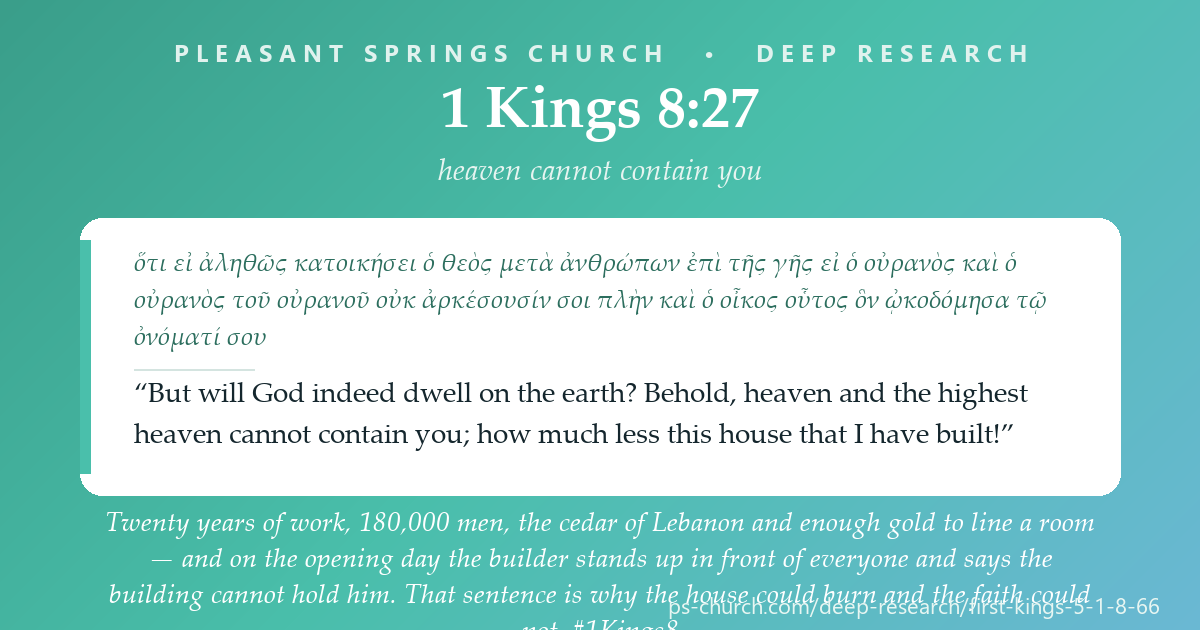
Consider where 8:27 sits. Twenty years of work. A hundred and eighty thousand men. The cedar of Lebanon and enough gold to overlay a room. The ark carried in with the whole nation watching, the cloud so heavy that the priests had to walk out. And then the king stands up in front of everyone and says: “But will God indeed dwell on the earth? Behold, heaven and the highest heaven cannot contain you; how much less this house that I have built!”
That is not a modest disclaimer bolted onto a triumph. It is the load-bearing sentence of the entire passage, and every line after it depends on it. Because 8:27 is true, the prayer that follows can only ask God to hear — seven times, from heaven — and never to stay. Because 8:27 is true, a man in Babylon four hundred years later can face a direction and be heard exactly as well as a priest standing in the room. And because 8:27 is true, the burning of the house in 2 Kings 25 is a catastrophe and not a bereavement: they did not lose God in the fire, because he was never in the building, and the man who built it said so out loud on the opening day.
The prophets will simply repeat him. Isaiah 66:1–2: “Heaven is my throne and the earth is my footstool; what is the house that you would build for me?” Jeremiah 7:4: “Do not trust in these deceptive words: ‘This is the temple of the Lord, the temple of the Lord, the temple of the Lord.’” Neither prophet is introducing a new idea. Both are quoting the temple’s own dedication service back to people who had stopped listening to it.
And notice what Solomon does not conclude. He does not conclude that the house is pointless, or that he has wasted twenty years, or that ritual is beneath a spiritual man. He has just built it; he will sacrifice twenty-two thousand oxen in it; he asks God to keep his eyes open toward it night and day. The house is not where God lives. The house is where Israel faces. A church that has learned 8:27 properly does not stop meeting in buildings; it stops confusing the building with the reason.
The commentaries, the Greek arrangement, the forced-labour question, the date of 6:1, and what the temple was for.
Cogan, DeVries, Sweeney, Provan, House and Wiseman on Kings; Hurowitz on temple-building; Gooding, Tov and Trebolle Barrera on the Greek; Levenson on what a temple is. Then the four live questions these chapters raise — and one of them cannot be settled from the text at all.
Commentaries & studies:
- Mordechai Cogan, I Kings (Anchor Yale Bible) — the fullest technical commentary in English on these chapters, and the best on the architecture and the Phoenician background; Simon J. DeVries, 1 Kings (WBC); Marvin A. Sweeney, I & II Kings (OTL), strong on the literary shaping of the Solomon narrative.
- Iain W. Provan, 1 and 2 Kings (NIBC); Paul R. House, 1, 2 Kings (NAC); Donald J. Wiseman, 1 and 2 Kings (TOTC) — three evangelical treatments, and the place to start for preaching; Walter Brueggemann, 1 & 2 Kings, for a reading that will not let the levy go unmentioned.
- Victor Avigdor Hurowitz, I Have Built You an Exalted House — the standard study of the temple-building account as a genre, and the source of the structural observation in the Author panel above.
- D. W. Gooding, “Temple Specifications: A Dispute in Logical Arrangement between the MT and the LXX,” VT 17 (1967), and “Problems of Text and Midrash in the Third Book of Reigns,” Textus 7 (1969) — the fullest case that the Greek arrangement of these very chapters is a later, tidier rearrangement.
- Emanuel Tov, Textual Criticism of the Hebrew Bible, and Natalio Fernández Marcos, The Septuagint in Context — for the other side of that argument, and for the Antiochene text this page deliberately does not quote.
Interpretation notes worth keeping:
- The forced labour: report it, and do not decide what the text does not decide. 1 Kings 5:13 says the levy was raised “out of all Israel,” and 1 Kings 9:22 says Solomon made no slaves of Israelites; 2 Chronicles 2:17 and 8:9 side firmly with the second. Three readings are on the table. (1) Two institutions. A rotating corvée of citizens (a month on, two months off, 5:14) is not chattel slavery, and 9:21 uses a different phrase, mas-ʿōḇēḏ, for the permanent levy imposed on the surviving Canaanite peoples. (2) Two sources. The books preserve differing traditions and the editor left both standing, which is what the Chronicler then had to resolve. (3) A deliberate tension. The writer of Kings knows perfectly well that 5:13 and 9:22 sit awkwardly, and lets them, because chapter 12 is coming. What can be said without choosing: the narrator passes no verdict in chapter 5, the vocabulary he uses is the vocabulary of Egypt, and the office he names in 5:14 is the office that gets a man killed in 12:18. That is not a moral this page has imported. It is the book’s own arrangement of its own words.
- The 480 years of 6:1, and why the number is contested. The Hebrew gives 480 from the Exodus to the fourth year of Solomon (conventionally c. 966 BC, which yields an Exodus c. 1446); the Greek gives 440; Josephus gives 592. Many read 480 as a schematic figure — twelve generations of forty — rather than a tally, which would fit the narrative habits of these books and would allow the shorter chronologies some archaeologists prefer. Others read it as a plain sum and build the whole Old Testament chronology on it. We name the positions and do not adjudicate, and we note the honest textual fact that the number is not even stable across the manuscript traditions. Nothing in this study depends on which figure is right.
- The Greek arrangement of chapters 5–8: a genuine scholarly dispute, laid out and left open. Gooding argued that the Greek order (the transposed 6:1a–1d, the missing 6:11–14, the palace pushed to the end of chapter 7, the relocation of 8:12–13 to 8:53a) is a deliberate later rearrangement on midrashic principles — tidying the chronology, and moving the poem so that the prayer ends on a high note. Others, following the general drift of text-history since Qumran, hold that at least some of these reflect a different and possibly earlier Hebrew text, and note that a translator who wanted to tidy would hardly have deleted the one divine speech in the building account. This library does not adjudicate, and the reason is the pastor’s standing directive: our business is to show the reader both texts and say honestly why we print what we print. See the texts we print.
- “Name theology” — a real observation that has been pushed further than the evidence. Chapter 8 is careful: God’s name is in the house (8:16, 17, 18, 19, 20, 29, 43, 44, 48), and God himself hears in heaven. A long line of scholarship read that as a Deuteronomistic correction of an older, cruder belief that God physically lived in the box. The observation about the vocabulary is sound and you can check it yourself. The developmental story built on top of it is a reconstruction, and it sits awkwardly beside 8:10–13, where the glory really does fill the house and Solomon really does say “I have built you an exalted house.” The text holds both and does not explain how, which is a different thing from the text being confused.
- The foreigner petition is not a small thing, and it is not vague. Every petition for Israel in this prayer is conditioned — when they sin, if they repent, when they turn. The petition for the foreigner has no such condition, and it asks for more than the others do: “do according to all for which the foreigner calls to you.” Solomon gives a reason, and it is missionary rather than sentimental: “in order that all the peoples of the earth may know your name and fear you, as do your people Israel.” The prayer treats answered prayer as advertising for the name of God. That is worth sitting with before anyone quotes 8:41–43 as mere hospitality.
- Where Scripture gives no reason, this page gives none. Two examples in these chapters. The text never explains why no iron was heard in the house — it reports the fact and moves on, and the connection to the altar law of Exodus 20:25 and Deuteronomy 27:5 is an inference readers have long drawn, not a statement the narrator makes. And the text never explains why the priests could not stand up. It says the cloud came and the glory filled the house and the ministry stopped. That is all it says, and this study stops where it stops.
A levy, a silence, a cloud, and the truest sentence anyone ever said about a church building.
Name what you learned, why it matters, and one concrete response.
What should we carry away — and do?
- The narrator tells you what it cost before he tells you what it looked like. Thirty thousand drafted “out of all Israel,” seventy thousand carrying, eighty thousand cutting, and a named officer over the draft — all of it before verse one of chapter 6. He passes no verdict. He does not have to; he uses Egypt’s vocabulary and he names the man who will be stoned in chapter 12.
- The one thing God says in four chapters is an if. Not “well done”; not a measurement; not a promise of permanence. “Concerning this house that you are building, if you will walk in my statutes… I will dwell among the children of Israel and will not forsake my people Israel” (6:12–13). Notice the object of the promise: not the house — the people.
- The house went up in silence. No hammer, no axe, no iron heard. Whatever else that means, it means the loudest thing anyone ever built for God made no noise while it was being built. There is a sermon in that which does not need any help from us.
- The professionals had to stop. The priests could not stand to minister because of the cloud. Every liturgy in the world is a way of keeping things moving; this is the day the liturgy could not proceed, and nobody treated it as a failure.
- “Will God indeed dwell on the earth?” Said by the builder, at the dedication, in front of everyone. Heaven and the highest heaven cannot contain him; how much less this house. If you have ever loved a church building — and you should — this is the verse that keeps that love from turning into something else.
- Seven petitions, and the fifth one is for someone who is not in the room. Israel’s petitions all turn on repentance. The foreigner’s does not: “do according to all for which the foreigner calls to you.” And the reason given is that the peoples of the earth may know your name. On the opening day of the most national building in Israel’s history, the king prayed for outsiders without conditions.
- And the seventh petition is for people who did not exist yet. “If they sin against you — for there is no one who does not sin — and they are carried away captive…” The book of Kings ends in Babylon. This prayer got there first, and told them what to do when they arrived: turn, confess, face the city, and be heard in heaven.
A word about typology, clearly labelled — three things, kept apart. First, what 1 Kings says. It says a king built a house, that God’s glory filled it, that the king denied the house could contain God, and that God would hear from heaven. It does not announce itself as a figure of anything. Second, what the New Testament itself draws — and here it is explicit and we teach it plainly. John 2:19–21: “Destroy this temple, and in three days I will raise it up… But he was speaking about the temple of his body.” Acts 7:47–50: Stephen names Solomon, then quotes Isaiah — “the Most High does not dwell in houses made by hands” — which is Solomon’s own argument in 8:27 turned into a sermon. Acts 17:24 says it again to Athens. Hebrews 9:11–12, 24 has Christ entering “not… holy places made with hands… but into heaven itself” — the very place Solomon asked God to hear from (see Hebrews 4:14–16). And 1 Corinthians 3:16 and Ephesians 2:19–22 make the assembled people the temple, “a dwelling place for God by the Spirit” (compare Ephesians 2:1–10 and Colossians 1:15–20). That is the canon’s own move and it is more than enough to stand on. Third, what we see from this side of the cross — and we are meant to see it, because Luke 24:27 has Christ himself reading the Old Testament this way. A house where God’s glory dwells and God’s people are heard; a foreigner welcomed without condition; an exile forgiven at a distance; and Revelation 21:22, “And I saw no temple in the city, for its temple is the Lord God the Almighty and the Lamb.” 1 Kings does not say that. We are meant to see it. Both halves of that sentence are true, and neither is allowed to swallow the other.
Step in response: two things this week. First, find out what your church building actually cost — in money, and in the time and labour of people whose names are not on a plaque — and thank one of them by name. Solomon’s narrator counted the labour before he described the gold; we can at least do that much. Second, pray one prayer this week that has no condition attached and is not for anybody in your church. That is the fifth petition, and it is the one Solomon did not have to include.
1 Kings 8:27 · to share
LXX (Rahlfs, 3 Kingdoms) + ESVEvery Deep Research page traces its passage across the whole sweep — the Old Testament, the Second-Temple world between the testaments (historical witnesses, not Scripture), and the New Testament. Follow the thread:
Pleasant Springs Church — Deep Research
Research method after Michael S. Heiser’s Bible Research Method (examine dictionaries → ancient literature → important words → textual connections → academic publications → share), with the Pleasant Springs “Author & Audience” foundation. Scripture set in the Hebrew, the Greek editions named on each page and the ESV (Old Testament), and the Greek New Testament and the ESV (New Testament), per the practice of Pleasant Springs Church. 1 Kings 5–8 research grounded in Cogan (Anchor Yale), DeVries (WBC), Sweeney (OTL), Provan (NIBC), House (NAC), Wiseman (TOTC) and Brueggemann, with Hurowitz, I Have Built You an Exalted House, for the temple-building genre and Levenson for what a temple is; Gooding, Tov, Fernández Marcos and Trebolle Barrera on the Greek. Book name: in the Septuagint this book is 3 Kingdoms, Βασιλειῶν Γʹ, part of one continuous four-book work with 1–2 Samuel; that is stated on every page of this set. Kaige: the kaige sections of Kingdoms are 2 Kingdoms 11:2–3 Kingdoms 2:11 and 3 Kingdoms 22–4 Kingdoms 25. This passage falls between them, in the Old Greek section (3 Kingdoms 2:12–21:43), which is stated in the codex note together with what it means: here Rahlfs’s Vaticanus-based text is generally reckoned the oldest Greek rather than a revision, and no one has pulled it back toward the Hebrew — which is why the columns diverge as widely as they do. No Antiochene reading is cited, because the critical edition (Fernández Marcos–Busto Saiz) has not been consulted; there is no Göttingen edition of 3 Kingdoms. Text & numbering: Hebrew from the Masoretic Text with the qere printed at 8:48 and the ketiv named; Greek from Rahlfs’s Septuaginta, 3 Kingdoms, in the CATSS morphological digitization, printed without editorial punctuation and with proper names unaccented; English ESV. There is a real offset in chapter 5 and it is printed in every reference line: English 5:1–18 = Hebrew and Greek 5:15–32 (the ESV footnotes this itself at 5:1). Chapters 6, 7 and 8 carry no offset, and Rahlfs’s chapter 8 has 66 verses exactly as the Hebrew does; this was counted in the Greek text rather than assumed. The Greek rearrangement of 3 Kingdoms is reported and not adjudicated: the Miscellanies at 2:35a–o and 2:46a–l, the alternate Jeroboam narrative at 12:24a–z, and the reversal of MT chapters 20 and 21 were all verified against the verse inventory of the Rahlfs text itself, not taken from a description. Inside this passage, the following were likewise verified and are reported in full: Rahlfs’s chapter 5 lacks verses 5–8 and 31; 3 Kingdoms 6:1a carries the quarrying of MT 5:31 and 6:1b the builders of MT 5:32a, while 6:1c–1d carry MT 6:37–38, all moved to the head of the chapter; 3 Kingdoms 6 has no verses 11–14 (the word of the Lord to Solomon) and no verse 18, and ends at 36 with a 36a; MT 7:1–12 stands at 3 Kingdoms 7:38–50; and MT 8:12–13 stands at 3 Kingdoms 8:53a, expanded at both ends and reading “book of the Song” for “book of Jashar.” Every divergence in the verses actually printed is enumerated in the codex note and in the line notes, and pluses and minuses are named as such rather than described as rendering differences: 6:1 (440 for 480, no “Ziv”); 5:15 (“to anoint Solomon” for “when he heard that they had anointed him”); 5:16 (3,600 for 3,300, agreeing with 2 Chronicles); 5:17 (“unhewn” for “dressed”); 6:7 (“unworked stones” for “whole stone brought ready”); 8:6, 8:9, 8:22–23, 8:30, 8:65 and 8:66 as noted at each line; 8:27 (the plus “with human beings,” which the Hebrew of 2 Chronicles 6:18 also has; “suffice” for “contain”; the plus “for your name”); and the substantial minus at 8:41–43. Where the page argues from a Hebrew word — the šāmaʿ Leitwort, sālaḥ, mas and sēḇel — what the Greek column does with it is stated in the same breath. Qumran: 4QKgs (4Q54, DJD XIV, Trebolle Barrera) preserves 1 Kings 7:20–21, 25–27, 29–42, 7:50–8:9 and 8:16–18; its extent is reported and no textual argument is built on it, because that would require the critical edition rather than a summary. 5QKgs and 6QpapKgs do not touch these chapters. Chronicles is treated as a parallel witness and not harmonized: the labour (2 Chr 2:17; 8:9 against 1 Kgs 5:13, and 1 Kgs 9:22 against itself), the 3,600 overseers, the kneeling on the bronze platform (2 Chr 6:13), the Psalm 132 ending (2 Chr 6:41–42), the fire from heaven (2 Chr 7:1), and the fourteen/seven/seven-plus-seven days of feasting are all reported side by side with the readings named. Second-Temple and rabbinic witnesses (Sirach 47:13; Josephus, Ant. 8.61–129; b. Sotah 48b; m. Avot 5:6; m. Sotah 9:12; m. Berakhot 4:5) are read as witnesses and never leveled with Scripture. ANE parallels are cited only where verifiable in the local scan: Enuma Elish VI (ANET 68–69) and the Ugaritic Baal palace-building (ANET 133–134). The forced labour is reported plainly, with the vocabulary link to Exodus 1:11 named, the three readings of the 5:13 / 9:22 tension laid out, and no verdict imported that the narrator does not give. The 480 years of 6:1 are reported with the Greek’s 440 and Josephus’s 592, the positions named and deliberately not adjudicated. The temple-as-Christ typology is given in three clearly separated layers — what 1 Kings says, what the New Testament itself draws (John 2:19–21; Acts 7:47–50; Hebrews 9:11–12, 24; 1 Cor 3:16; Eph 2:19–22), and what the church legitimately sees from this side of the cross — and neither half is allowed to swallow the other.
Scripture quotations marked ESV are from the ESV® Bible (The Holy Bible, English Standard Version®), © 2001 by Crossway, a publishing ministry of Good News Publishers. ESV Text Edition: 2016. Used by permission. All rights reserved. The ESV text may not be quoted in any publication made available to the public by a Creative Commons license, and the ESV may not be translated in whole or in part into any other language. www.esv.org
|
Did this study bless you today? 💚 Give to Support PS Church100% of gifts go to the General Fund — thank you. |