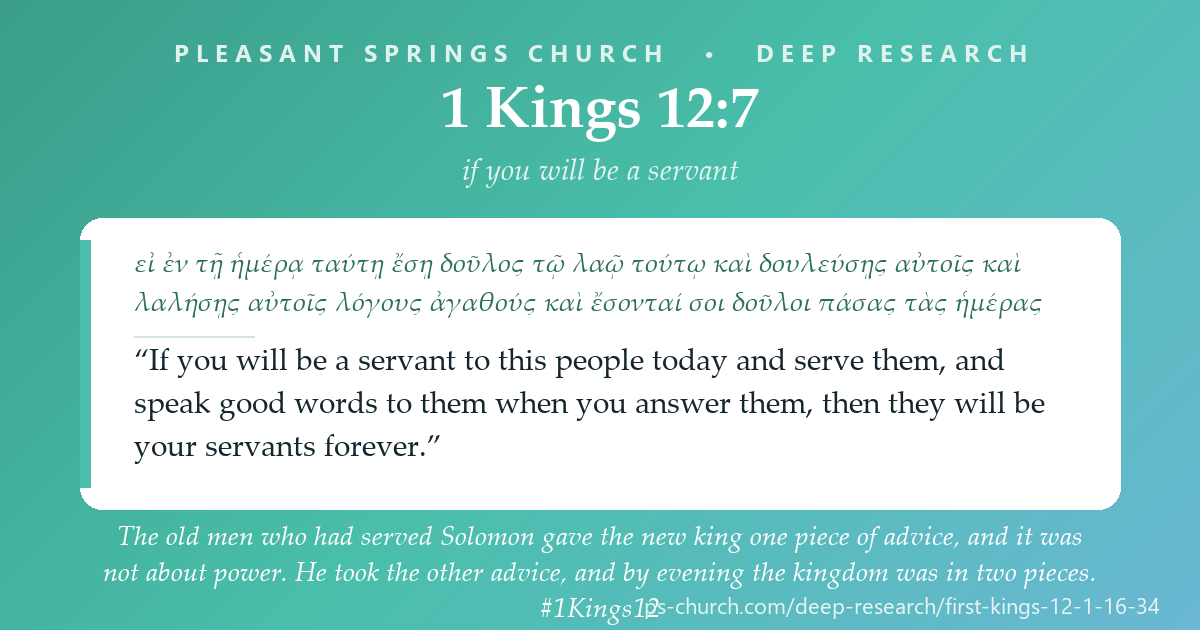
Rehoboam goes north to Shechem to be crowned, and the people meet him with a request so reasonable it is almost dull: “Your father made our yoke heavy. Now therefore lighten the hard service of your father and his heavy yoke on us, and we will serve you” (12:4). Not independence. Not a new dynasty. Lighten it, and we will serve you. The men who had stood before Solomon give him the only good sentence in the chapter — “If you will be a servant to this people today and serve them… then they will be your servants forever” (12:7) — and he throws it away for his friends’ version: “My little finger is thicker than my father’s thighs… my father disciplined you with whips, but I will discipline you with scorpions” (12:10–11). Ten tribes walk out quoting an old rebel’s slogan: “What portion do we have in David?” And then the narrator says the sentence this study will not dissolve: it was “a turn of affairs brought about by the Lord” (12:15) — alongside, not instead of, the folly. Jeroboam sets up two gold calves at Bethel and Dan and says over them the words of Sinai’s worst day (12:28; Exodus 32:4). A man of God comes from Judah, is never named, is lied to by an old prophet, and does not go home. And then the drumbeat begins — he did what was evil in the sight of the Lord and walked in the way of Jeroboam — through Nadab and Baasha and Elah and Zimri to Omri, and then Ahab, who did evil “more than all who were before him,” and Jezebel, and a builder who lost two sons to an old curse at Jericho. This study works 1 Kings 12:1–16:34 line by line, in Hebrew, Septuagint and ESV — including the twenty-three verses of Greek that tell the whole thing a second time. See the method →
1 Kings 12:1–16:34 (selections)
Hebrew · Greek (Rahlfs, 3 Kingdoms) · ESVThe book, the section, the edition — and why this particular passage is one of the most interesting stretches of Greek in the Bible. In the Septuagint this book is 3 Kingdoms (3 Reigns) — Βασιλειῶν Γʹ (Basileiōn G). 1–2 Samuel and 1–2 Kings are one continuous work in Greek, Βασιλειῶν Αʹ–Δʹ, and a reader who takes the name “1 Kings” to a Greek Bible will not find it. (Worth noticing once: our English names for the Torah — Genesis, Exodus, Leviticus, Numbers, Deuteronomy — are the Septuagint’s names, while Samuel and Kings keep Hebrew-derived ones. An English Bible already mixes both traditions on its contents page.)
⚠️ Which section is this? Old Greek — and that is the point. Dominique Barthélemy showed in Les Devanciers d’Aquila (1963) that the Greek of Kingdoms is not one translation. Two long stretches are a later kaige revision — a first-century pull of an older Greek text back toward a proto-Masoretic Hebrew, named for its stereotyped rendering of Hebrew גַּם (gam, “also”) by καί γε. Using Thackeray’s section letters: 2 Kingdoms 11:2 → 3 Kingdoms 2:11 (βγ) and 3 Kingdoms 22 → 4 Kingdoms 25 (γδ) are kaige. Everything between them — 3 Kingdoms 2:12 through 21:29, which is to say every verse on this page — is Old Greek. Two of the sibling studies sit on the seams and have to say so (1 Kings 1–2 at one end, 1 Kings 20–22 at the other). This one does not. What that means, said plainly: here Codex Vaticanus and Rahlfs’s text which leans on it are not a revision toward the Hebrew — they are (as far as we can reach it) the oldest Greek. That is exactly why the differences you are about to read are so large. They are not carelessness and they are not our text going wrong; they are what an unrevised Greek Kings actually looks like. The sentence “the Septuagint reads X” is still ambiguous in these books — the Antiochene (Lucianic) manuscripts are a separate witness throughout — and this page cites no Antiochene reading, because we have not consulted the critical edition (Fernández Marcos and Busto Saiz, El texto antioqueno de la Biblia griega). There is as yet no Göttingen edition of 3 Kingdoms; the fuller apparatus is Brooke–McLean’s larger Cambridge Septuagint. On why this library prints what it prints, see the texts we print.
⚠️ 3 Kingdoms is not merely worded differently. It is arranged differently. Three things, and we checked what Rahlfs actually prints before describing any of them. (1) The “Miscellanies.” Rahlfs carries two blocks of Solomon material with no Hebrew counterpart in that position, numbered 2:35a–o and 2:46a–l; they are outside this passage (see 1 Kings 1–2) and are named here only so a reader knows they exist. (2) The alternate Jeroboam narrative. Immediately after 12:24 Rahlfs prints twenty-three further verses, 12:24a–z (the letters run a–z skipping j, v and w, so twenty-three, not twenty-six) — a second, self-contained account of Jeroboam and the division of the kingdom, with material the Hebrew places in chapters 11, 12 and 14. It is described in full in Stage 2. (3) The order of MT 20 and 21. In Rahlfs, Naboth’s vineyard (Hebrew ch. 21) stands as 3 Kingdoms 20 and the Ben-hadad wars (Hebrew ch. 20) as 3 Kingdoms 21 — just past the end of this study. Which arrangement is earlier is a genuine scholarly dispute and this page does not adjudicate it; readers argue it both ways, and honest people have landed on both sides.
Numbering. Chapters and verses run 12–16 in both, and there is no chapter offset anywhere here — but the verse inventory is not the same, and this was counted in Rahlfs rather than assumed. Rahlfs has no 12:2, no 12:17, no 13:27, no 14:1–20, no 15:6 and no 15:32; chapter 14 in Greek begins at verse 21 and chapter 15 runs 1–5, 7–31, 33–34. Two of those are less dramatic than they look: the substance of 12:2 (Jeroboam hearing in Egypt and coming home) already stands in Rahlfs at 11:43, and 15:6 is a near-duplicate of 14:30. Rahlfs also has thirty-one verses the Hebrew does not have here — the twenty-three of 12:24a–z, and 16:28a–h, a complete regnal notice for Jehoshaphat inserted after Omri’s death, drawn from the material the Hebrew keeps at 22:41–50.
The divergences in the verses printed above, enumerated — not a sample, the list. 12:4 “yoke” is κλοιός, a neck-collar, throughout. 12:7 ketiv singular “he said” / qere plural; Greek plural. 12:10 Hebrew “my little one,” Greek “my smallness,” ESV “my little finger” — no word for a body part in either ancient column. 12:15 no difference of substance; the Chronicles parallel says “God” where Kings says the divine name. 12:16 Hebrew “look,” Greek “pasture”; and the Greek runs straight from 12:16 to 12:18, with MT 12:17 absent. 12:18 the officer is Adoram in Hebrew, Adoniram in Greek. 12:20 the Greek adds “and Benjamin” where the Hebrew says “the tribe of Judah only.” 12:21 180,000 men in Hebrew, 120,000 in Greek. 12:28 “calves” → “heifers,” and the verbal quotation of Exodus 32:4 survives in Hebrew but not in Greek. 13:26 the Greek lacks the entire second half of the verse. 13:27 absent. 14:1–20 absent — that story is told at 12:24g–n instead. 15:2 Abijam reigns three years in Hebrew, six in Greek. 15:10 Asa’s mother is Maacah in Hebrew, Ανα in Greek. 15:34 Greek plus, “son of Nabat.” 16:22 Greek plus, “and Joram his brother, at that time.” 16:26 ketiv plural / qere singular; Greek plural. 16:29 Ahab’s accession is dated by Asa’s thirty-eighth year in Hebrew and by Jehoshaphat’s second year in Greek. 16:34 ketiv/qere on Segub’s name; Greek agrees with the qere.
And two footnotes in your English Bible are worth stopping on. At 12:2 the ESV footnotes “Septuagint, Vulgate (compare 2 Chronicles 10:2)” for a verse that Rahlfs does not print at all; at 12:30 it footnotes a longer “Septuagint” reading that is likewise not in Rahlfs. Neither footnote is wrong — there are Greek manuscripts that read that way, and Brenton’s old English prints 12:2–3a in brackets as supplied from another codex. But “the Septuagint” in a footnote is a family, not a book, and this is exactly why this library names its edition on every page instead of saying “the LXX.” Edition: the Greek column is Rahlfs’s Septuaginta (CATSS digitization), printed without the editorial punctuation of the printed editions and with proper names unaccented, as Rahlfs sets them; Hebrew from the Masoretic Text; English ESV.)
The Shape of the Passage
RefrainBehind this passage stand three things: the law that told a king not to multiply horses, wives or silver and to write the Torah out by hand (Deuteronomy 17:14–20); the day Israel asked for a king and Samuel warned them what a king would take (1 Samuel 8:11–18); and the promise that David’s house would stand (2 Samuel 7). In front of it stand Elijah, Carmel, and a whisper on a mountain (1 Kings 17–19).
Author
A historian who writes like a preacher and edits like a lawyer. He has sources and he names them out loud — “the Book of the Chronicles of the Kings of Israel,” “of the Kings of Judah” — and he tells you he is leaving things out. Omri, the most internationally significant king in these chapters, gets six verses; a nameless man from Judah who ate the wrong meal gets thirty-four. That is a judgment about what matters, made with a red pen.
He works by formula, and the formula is the point. Accession year, synchronism with the other kingdom, length of reign, mother’s name, verdict, source note, burial, successor. Once you have heard it four times you stop reading the details and start hearing the verdict, which is exactly what he wants. And he built the verdict out of one man’s name: the way of Jeroboam. Whatever else the northern kings did — and Omri and Ahab did a great deal, as the Assyrians and the Moabites both testify — this writer files them under one heading.
He also refuses to explain himself at the hardest moments. He tells you Rehoboam was a fool and that the split was “a turn of affairs brought about by the " + SC + "” (12:15), and he does not reconcile the two. He tells you an old prophet lied and a young prophet died and gives no reason for either. He tells you Hiel lost two sons and does not say who took them. Where he gives no reason, this study gives none.
Audience
People who already knew how it ended. The book itself closes in Babylon (2 Kings 25), which means its first readers were people for whom “the sin of Jeroboam” was not a curiosity but a coroner’s report. When they read 12:28 they were reading the first cause of a catastrophe they were living in. That is why the narrator can be so restrained: he does not need to shout.
People who had to decide what to think about the north. Was the division a rebellion or a judgment? The Hebrew text and the Greek text answer that question with different emphases — and 2 Chronicles answers it differently again, keeping 2 Chr 10 almost word for word and then dropping Jeroboam’s reign entirely to follow Judah, and adding that the priests and Levites left the north and came south (2 Chr 11:13–17). Three witnesses, three angles. This page reports them; it does not blend them.
And people under somebody’s thumb. The request in 12:4 is the most ordinary sentence in the Bible: this is too heavy, please make it lighter, and we will keep working. An audience that had done corvée labour under Solomon, and then under Assyria, and then under Babylon, did not need that explained. They needed to know that God had heard it — and the shape of the chapter says he had, because the counsel Rehoboam threw away is the counsel the old men gave, and the old men are the only people in the room who are right.
Orient on Kings and 3 Kingdoms, Shechem, corvée labour, the golden calves, high places, the regnal formula, and Omri’s dynasty.
Search by topic: Kings, Books of; Kingdoms, Books of (Greek); Old Greek and kaige recension; Lucianic / Antiochene text; Deuteronomistic History; Rehoboam; Jeroboam I; Shechem; Penuel; corvée / forced labour (mas); yoke; elders (zeqenim); golden calf; bull iconography in the Levant; Bethel; Dan; high place (bamah); man of God; prophet (nabi); Ahijah the Shilonite; Josiah; Baasha; Omri; Samaria; Ahab; Jezebel; Ethbaal; Tyre and Sidon; Jericho; foundation sacrifice; regnal formulas and synchronisms.
Which articles are relevant?
- Anchor Bible Dictionary — “Kings, Books of,” “Deuteronomistic History,” “Rehoboam,” “Jeroboam (Person),” “Shechem,” “Calf, Golden,” “Bethel,” “Dan (Place),” “High Place,” “Omri,” “Samaria,” “Ahab,” “Jezebel,” “Jericho,” “Chronology (Hebrew Bible).”
- Dictionary of the OT: Historical Books (IVP) — “Kings, Books of,” “Jeroboam,” “Rehoboam,” “Omri Dynasty,” “Prophets and Prophecy,” “Chronology,” “State Officials,” “Forced Labor,” “Non-Israelite Written Sources.”
- NIDOTTE / TDOT — עֹל (ʿōl, yoke), עָבַד / עֶבֶד (ʿāḇaḏ / ʿeḇeḏ, serve / servant), מַס (mas, forced levy), סִבָּה (sibbāh, a turn of affairs), חֵלֶק (ḥēleq, portion), נַחֲלָה (naḥălāh, inheritance), חָטָא hiphil (heḥĕṭîʾ, to make someone sin), בָּמָה (bāmāh, high place), עֵגֶל (ʿēḡel, calf).
- On the Greek — Paul D. McLean, “3 Reigns: To the Reader,” in NETS, for the base text (Rahlfs), the section boundaries and the way the alternate narrative and the Miscellanies are set out; and Natalio Fernández Marcos, The Septuagint in Context, for the Antiochene text and the kaige question generally.
Bibliography surfaced:
- Mordechai Cogan, I Kings (Anchor Bible); Simon J. DeVries, 1 Kings (WBC); Marvin A. Sweeney, I & II Kings (OTL); Iain W. Provan, 1 and 2 Kings (NIBC); Paul R. House, 1, 2 Kings (NAC); Donald J. Wiseman, 1 and 2 Kings (TOTC).
- A. Graeme Auld, Kings Without Privilege, on the relationship between Kings and Chronicles — a minority thesis, named here because Stage 5 discusses the parallel and a reader should know the debate exists.
- Robert Alter, The Art of Biblical Narrative, for the reading tools used in the structure block. (Alter reads these texts as literature and does not share the church’s confession; we take the tools, not the metaphysics.)
Corvée labour and why Shechem, bulls and thrones in the Levant, the kings the outside world actually noticed — and the second Greek account of the whole affair.
First the world: what a labour levy did to a village, why the crowning happened at Shechem of all places, and what a bull image meant to somebody who was not an Israelite. Then the outside evidence — a Moabite king and two Assyrian kings who name people from these chapters. Then the thing that makes this passage unusual in the whole Bible: the Greek tells the story twice.
Which parallels shed light on the world of these chapters?
The yoke was a real institution with a name. The Hebrew word behind “forced labour” is מַס (mas) — a state levy of workers, attested across the ancient Near East and, in Israel, first at Exodus 1:11, where it is what Egypt does to Israel. Solomon’s building programme ran on it (1 Kings 5:13–18; 9:15–22), and the man Rehoboam sends out to face the crowd in 12:18 is the minister over the levy. Notice what that means about the request in 12:4: the people are not inventing a grievance. They are asking a new king to relax a system the book has already described, and Samuel had told them a king would do it (1 Samuel 8:11–18).
Shechem was not a neutral venue. It is where Abram built his first altar in the land (Genesis 12:6–7), where Jacob buried the foreign gods under the terebinth (Genesis 35:2–4), where Joseph’s bones were laid (Joshua 24:32), and above all where Joshua gathered all Israel and made them choose whom they would serve (Joshua 24:1–25). It is also where the only previous attempt at a northern kingship was launched and ended in massacre — Abimelech, in Judges 9. A crowd assembling at Shechem to talk about service and covenant is a crowd standing on top of its own history.
A gold bull was not necessarily a rival god, and that is what makes it dangerous. Across the Levant the bull was the standard pedestal-animal of a storm deity: the god was pictured standing on the bull, not as the bull. It is entirely possible that Jeroboam intended the calves at Bethel and Dan as a throne or footstool for the Lord — a northern equivalent of the cherubim in Jerusalem — and Josephus certainly read it that way (below). The narrator does not accept the defence. He puts Aaron’s sentence in Jeroboam’s mouth (12:28; Exodus 32:4), files the whole business under “sin” (12:30), and never argues the theology. The quotation is the argument.
And the outside world had heard of exactly two men in these chapters. Not Jeroboam, and not Rehoboam. Omri — six verses in the Bible — is named on the Moabite Stone, and the Assyrians were still calling Israel “the house of Omri” a century and a half later. Ahab shows up in Shalmaneser III’s account of the battle of Qarqar with the largest chariot force in the coalition. Both texts are in the collection below, and both are worth reading precisely because neither was written by us.
- The Moabite Stone (Mesha Stele), c. 830 BC — ANET 320–321, tr. W. F. Albright (a royal inscription — a witness, not Scripture). Line 4: “As for Omri, king of Israel, he humbled Moab many years, for Chemosh was angry at his land.” Mesha goes on to say that Omri “had occupied the land of Medeba” and that Israel held it “in his time and half the time of his son, forty years.” The Bible gives Omri six verses and one verdict; Moab remembered him as an occupier for two generations. Both are true and neither is the whole picture.
- Shalmaneser III, the Monolith (Kurkh) Inscription, on the battle of Qarqar, 853 BC — ANET 278–279, tr. A. Leo Oppenheim (Assyrian royal annals — a witness, not Scripture). In the list of the western coalition: “2,000 chariots, 10,000 soldiers of Ahab, the Israelite.” Twice the chariotry of Damascus. The king whom 1 Kings 16:30 sums up in eleven English words was, to Assyria, the heaviest armoured force on the field.
- Shalmaneser III, the Black Obelisk and related annals — ANET 280–281 (a witness, not Scripture) — “the tribute of Jehu, son of Omri” — and Tiglath-pileser III at ANET 284 calling the northern kingdom “Omri-Land” (Bīt Ḥumri). Jehu was not Omri’s son and had in fact destroyed his house; the Assyrians simply went on using the dynastic name. Omri mattered abroad exactly as much as Kings says he did not matter at home.
- Sirach 47:23–24 (Second-Temple — a witness, not Scripture, and non-canonical by this church’s ratified position) — Ben Sira runs straight from Solomon’s death to this — and the Greek is blunter than most English versions of Sirach: what Solomon left behind him was “a folly of the people, and lacking in understanding — Rehoboam, who turned the people away by his counsel”; and “Jeroboam son of Nabat, ὃς ἐξήμαρτεν τὸν Ισραηλ” — who made Israel to sin, the exact wording of the Greek Kings refrain, “and gave to Ephraim a way of sin.” By the second century BC the formula had become the standard summary of the whole period.
- Josephus, Antiquities 8.8–8.13 (Whiston’s book-and-chapter numbering; Second-Temple — a witness, not Scripture) — and he cannot leave a single silence alone. On 12:15 he says out loud what the Bible only implies and then flinches from it: Rehoboam rejected the good advice, “God himself, I suppose, causing what was most advantageous to be condemned by him,” and later, that the defection “was according to the purpose of God.” On the calves he composes a whole speech for Jeroboam that the Bible does not give him — “every place hath God in it… I have also made two golden heifers, dedicated to the same God” — and only then delivers the verdict, “he deluded the people.” And he names the man of God: Jadon. Scripture does not. Josephus also reports Rehoboam’s army as 180,000, agreeing with the Hebrew against the Greek’s 120,000, and on Ahab he agrees with everybody: he “became more wicked than all the kings that had been before him.”
This is the single most unusual thing about the Greek of 1 Kings, and it belongs on this page because it sits inside our passage. After 12:24 Rahlfs prints twenty-three more verses, lettered 12:24a to 12:24z (the sequence skips j, v and w), and they are a second account of the same events — not a supplement to the first, but a rival telling that overlaps it end to end. Here, in order, is what Rahlfs actually has, checked verse by verse.
24a Solomon dies and Roboam succeeds — and is sixteen years old and reigns twelve years. 24b–c Jeroboam is introduced from scratch: a servant of Solomon from Mount Ephraim, and “his mother’s name was Σαριρα, a prostitute”; he builds the citadel, aspires to the kingdom, and flees to Shishak. 24d–f In Egypt Shishak gives him an Egyptian princess, Ανω, sister of the queen, and she bears him a son, Abia; he asks leave and goes home to Sarira. 24g–n The child falls sick; the wife is sent to the prophet Achia of Selo, who is sixty years old and blind; the girls meet her at the gate with the news that the boy has died. 24o Samaias — not Ahijah — tears a new garment into twelve pieces and gives Jeroboam ten. 24p–u The Shechem assembly is told again, shorter, with “my smallness is thicker than my father’s loins” and “there is no portion for us in David.” 24x–z Roboam masses for war, Samaias forbids it, and they go home.
Three things about this deserve to be said plainly, and a fourth deserves not to be said at all. First, it is a real part of the text we print: it is in Rahlfs, it is in Vaticanus, and NETS translates it. Second, it disagrees with the surrounding Greek. The same Greek book says Rehoboam was sixteen and reigned twelve years (12:24a) and that he was forty-one and reigned seventeen (14:21); it says Jeroboam’s mother was a widow of Zeredah (11:26, agreeing with the Hebrew) and that she was a prostitute called Sarira (12:24b), turning the town’s name into the woman’s. Third, the differences are not random: this version is markedly harder on Rehoboam — it gives him the “evil in the sight of the Lord” verdict at the top — and correspondingly easier on Jeroboam.
And the fourth thing is the one this page will not do. Scholars have argued, seriously and in both directions, about whether 12:24a–z preserves an older tradition that the Hebrew lost, or is a later midrashic reworking of the story it stands beside. We are not going to settle that, and you should be suspicious of any study that settles it in a paragraph. What we can say is what a reader can verify: there are two ancient tellings of the division of the kingdom, one of them is in the Greek Bible the church read for centuries, and hiding it would be a lie of omission. That is the whole reason this library prints what it prints — see the texts we print.
One noun the crowd repeats eight times, one root the old men turn inside out, and one causative verb that becomes the epitaph of a kingdom.
Count ʿōl for yourself in 12:4–14 — eight, and the ninth candidate in v. 10 is a preposition. Then watch the elders take the people’s last word (“we will serve you”) and hand it back to the king as his job description. Then follow heḥĕṭîʾ — “made Israel to sin” — out of chapter 14 and all the way to the fall of Samaria.
“Yoke” — the beam across a draught animal’s neck, and the standing metaphor for imposed labour. Eight times in eleven verses, and it is the only thing anybody in the room is actually talking about. Watch the verbs attached to it: the people say Solomon made it hard (הִקְשָׁה, 12:4); the young men say he made it heavy (הִכְבִּיד, 12:10) — and Rehoboam adopts the second word, which is the harsher of the two, and adds to it. The Greek is worth seeing: Rahlfs never says ζυγός, the ordinary word for a farm yoke. Every one of the eight is κλοιός — the wooden or iron collar put on a prisoner or a slave. That is how the Septuagint has the word at every one of the eight.
“Serve” and “servant” — the same root, and the hinge of the whole scene. The people end their request with it: and we will serve you (12:4). The elders pick it up and turn it inside out: “If you will be a servant to this people today and serve them… then they will be your servants forever” (12:7). That is not sentiment; it is statecraft, and it is also Deuteronomy. The law of the king says the king’s heart must not be lifted up above his brothers (Deut 17:20). The Greek keeps all three — δοῦλος… δουλεύσῃς… δοῦλοι — and so the pun survives translation, which is not always the case in this book.
“A turn of affairs.” The noun occurs nowhere else in the Hebrew Bible, and it is built on the root “to turn, go around.” The narrator uses a word he never uses again for the one sentence in the chapter that says God was in this. The Greek reaches for an equally uncommon word, μεταστροφή, a “turning-about,” from the same semantic field. 2 Chronicles 10:15, telling the same scene, writes “a turn of affairs brought about by God” rather than by the divine name. Nobody in either text explains it. See Stage 4.
“Portion” and “inheritance” — and both are land words before they are political ones. They are the vocabulary of the tribal allotments in Joshua 13–19: your portion is the piece of ground your clan holds from the Lord. So “What portion do we have in David? We have no inheritance in the son of Jesse” is not a slogan about taxes. It is ten tribes saying that the house of David is not their land-grant and never was. The Greek keeps the register exactly: μερίς and κληρονομία. And the sentence is quoted: Sheba son of Bichri had shouted it at David himself (2 Samuel 20:1).
“To make someone sin” — the causative (hiphil) of the ordinary verb “to sin.” This is the single most important word in the second half of 1 Kings and the whole of 2 Kings, and it is a transitive word: it is not about a man’s private failure but about what he did to other people. Eight occurrences in these five chapters; twenty-three in 1–2 Kings. The Greek renders it with a verb built the same way, ἐξαμαρτάνω (“he made Israel sin,” ἐξήμαρτεν τὸν Ισραηλ) — and that Greek phrase is picked up word for word by Sirach 47:24. Leadership, in this book, is measured by what it makes possible for everybody else.
“Calf” — a young bull, and the same word as Exodus 32. The Greek does not use the ordinary word for it here. Rahlfs writes δαμάλεις, “heifers” — female animals — where the Hebrew has a masculine noun, and in Exodus 32 the same Greek Bible uses μόσχος, “calf.” Two different Greek translators, two different choices, and the link that is unmissable in Hebrew is dimmed in Greek. Print both columns and you can watch it happen.
“High place” — a local shrine, usually on raised ground. The word is the running sore of 1–2 Kings: even the good kings of Judah get the note “but the high places were not taken away” (15:14, of Asa). Jeroboam’s offence here is plural and institutional — houses on high places, priests from outside Levi, a festival in the eighth month instead of the seventh, a whole alternative religious calendar. The Greek keeps the sense with an adjective, τὰ ὑψηλά, “the high things.” And it is a bamah at Bethel that Josiah pulls down in 2 Kings 23:15, closing the loop opened in 13:2.
“The evil in the eyes of the Lord.” Six times in these chapters; about thirty times in 1–2 Kings. It is a formula, and formulas are how this writer argues. Two things are worth noticing. First, its opposite is used too, and sparingly: David did “the right in the eyes of the Lord” (15:5) and so did Asa (15:11) — the narrator is not incapable of praise, he is simply not often able to give it. Second, the verdict is always in God’s eyes, never in the narrator’s and never in ours; and the book of Judges ends with everyone doing what was right in his own eyes (Judges 21:25). Kings is still answering that sentence.
Two things in the Hebrew of these chapters, reported rather than tidied:
- The ketiv and qere at 12:7. The consonants of the elders’ reply are singular — וידבר, “and he said” — while the Masoretic reading tradition, the Greek plural ἐλάλησαν and every English version take it as “and they said.” It is a small thing and it is printed here rather than smoothed, because a reader who looks at a Hebrew Bible will see the marginal note and deserves to know what it is. The same phenomenon appears at 16:26 (“his sins” written, “his sin” read) and at 16:34 (Segub’s name).
- “My little finger” is a translator’s decision, not a Hebrew word. קָטׇנִּי (qāṭonnî) is simply “my little one” with no noun attached, and the ancient Greek is equally coy (ἡ μικρότης μου, “my smallness”). English versions supply “little finger” because the comparison is with מׇתְנַיִם (loins, the ESV’s “thighs”) and something must be supplied. Commentators have suggested a coarser reference; the honest position is that the Hebrew is deliberately unspecific and we do not know. What is not in doubt is the register: this is a boy insulting a crowd.
Sinai’s sentence in a new mouth, Joshua’s curse coming due, a rebel’s slogan becoming a nation’s, and the one verse this study will not resolve.
Trace four threads: backwards to Exodus 32 and Joshua 6 and 24, which this passage quotes; sideways to 2 Chronicles, which tells the same day differently; forwards to 2 Kings 17 and 23, where the sentences pronounced here are carried out; and inwards to 12:15, where the narrator says two things at once and declines to reconcile them.
Which cross-references matter?
- Exodus 32:1–8 — the loudest quotation in the passage. Aaron makes a calf and the people say אֵלֶּה אֱלֹהֶיךָ יִשְׂרָאֵל אֲשֶׁר הֶעֱלוּךָ מֵאֶרֶץ מִצְרָיִם; Jeroboam makes two and says the same words with one syllable changed. The narrator adds no comment whatever. He does not need to: an Israelite reader has just been told that the founding sin of the wilderness has been re-enacted as national policy, and that the plural “gods” is now official. Read the two verses side by side and the whole of chapter 12 is interpreted for you.
- Joshua 6:26 — “Cursed before the Lord be the man who rises up and rebuilds this city, Jericho. At the cost of his firstborn shall he lay its foundation, and at the cost of his youngest son shall he set up its gates.” That is quoted almost exactly in 16:34, and the narrator says “according to the word of the Lord.” It is the last verse of the section, and it is placed where it is on purpose: Ahab’s reign opens with a man who thinks an old word of God has expired.
- Joshua 24:1–25 and Judges 9 — Shechem, twice over. Joshua gathered all Israel there and said “choose this day whom you will serve”; the people answered “we also will serve the Lord.” Rehoboam goes to the same town and the same root (ʿāḇaḏ) is on everybody’s lips again — but now the question is whom the people will serve politically, and nobody mentions God. And Judges 9 is the warning nobody read: the last man crowned at Shechem was Abimelech, and it ended with the city sown with salt.
- Deuteronomy 17:14–20 — the law of the king, and the standing cross-link for this whole part of the library. The king is not to multiply horses, wives or silver; he is to copy out the Torah himself and read it all his life “that his heart may not be lifted up above his brothers.” Set 12:10–11 beside that last clause. Rehoboam fails the one sentence of the law that is specifically about how a king talks to his own people.
- 1 Samuel 8:11–18 — “These will be the ways of the king who will reign over you: he will take… and you shall be his slaves. And in that day you will cry out because of your king, whom you have chosen for yourselves.” Chapter 12 is that day. Samuel’s speech is not a prediction the narrator has to remind you of; he simply lets the crowd say it in their own words.
- 2 Samuel 7:12–16 — “your throne shall be established forever.” Ten tribes have just said “we have no inheritance in the son of Jesse,” and the promise does not fail: 12:20 leaves Judah, and 11:36 has already said why — “that David my servant may always have a lamp before me in Jerusalem.” The split is a judgment on Solomon’s house that does not cancel the promise to it. Both things are in the same book, ten chapters apart, and neither is retracted.
- 2 Chronicles 10–13 — the parallel witness, and it is not identical. 2 Chr 10 tells the Shechem assembly almost word for word (writing “a turn of affairs brought about by God” at 10:15). Then it diverges: it drops Jeroboam’s reign entirely and follows Judah; it adds that “the priests and the Levites… left their common lands and their holdings and came to Judah and Jerusalem, because Jeroboam and his sons cast them out” (11:13–15); and it gives Abijah a long sermon before a battle (13:4–12) where Kings gives him three verses and a bad verdict. It also names Abijah’s mother differently — “Micaiah the daughter of Uriel of Gibeah” (13:2) against “Maacah the daughter of Abishalom” (1 Kgs 15:2). We report the differences and do not harmonise them.
- 2 Kings 17:21–23 and 2 Kings 23:15–18 — where the two long fuses lit here finally burn down. 17:21–23 is the narrator’s own account of why the northern kingdom ended: “Jeroboam drove Israel from following the Lord and made them commit great sin… until the Lord removed Israel out of his sight.” And 23:15–18 is Josiah at Bethel, pulling down the altar of 12:32 and burning bones on it exactly as the unnamed man said in 13:2 — and then finding the man’s tomb and saying, “Let him be; let no man move his bones.” The prophet who disobeyed and died on the road is the one whose word stood for three hundred years.
Here is the verse, whole: “So the king did not listen to the people, for it was a turn of affairs brought about by the Lord that he might fulfill his word, which the Lord spoke by Ahijah the Shilonite to Jeroboam the son of Nebat” (12:15).
Notice what the narrator does not do. He does not excuse Rehoboam. Two verses earlier he has said the king “answered the people harshly” and threw away good counsel for bad, and nothing in the chapter softens that; Rehoboam is a grown man who chose the advice that flattered him, and the book holds him to it. Nor does the narrator make the split an accident that God merely tidied up afterwards. He says the turning was from the Lord, and he tells you what it was for — to make good a word already spoken in 1 Kings 11:29–39. Both sentences stand, unreconciled, in one verse.
This house has met that construction before and handles it the same way each time. It is the shape of the hardening of Pharaoh’s heart, where Pharaoh hardens his own heart and the Lord hardens it and Exodus never blends the two into a formula. It is the shape of Joseph’s “you meant evil against me, but God meant it for good” (Genesis 50:20) — where the brothers’ guilt is not reduced by one gram. And it is the shape of the sentence the New Testament uses about the cross itself: delivered up according to the definite plan and foreknowledge of God, and you crucified and killed by the hands of lawless men — in one breath, in Acts 2:23.
So: no slogan. Do not say “God made him do it,” because the text blames him. Do not say “God foresaw it and worked round it,” because the text says the turning was from the Lord. The categories that let a Christian hold both — God’s knowledge of what free creatures would do, and his ordering of history through those very choices — are exactly what this church means by its Molinist reading, and they are a way of keeping both halves of the verse rather than a way of dissolving one. Where Scripture gives two sentences and no bridge, we give two sentences and no bridge. Josephus could not manage it — “God himself, I suppose,” he writes, and the “I suppose” is the sound of a man reaching for a bridge that is not there.
The commentaries, the two Greek editions of chapter 12, the chronology that does not add up, and a chapter nobody has tidied.
Cogan, DeVries, Sweeney, Provan, House and Wiseman on Kings; McLean and Fernández Marcos on the Greek. Then the three live questions: what to make of 3 Kingdoms 12:24a–z, what to do with regnal numbers that will not reconcile, and what on earth chapter 13 is for.
Commentaries & studies:
- Mordechai Cogan, I Kings (Anchor Bible) — the fullest treatment of the Assyrian and Moabite comparanda and of the regnal formulas; Cogan and Hayim Tadmor, II Kings (Anchor Bible), for where all of this is going.
- Simon J. DeVries, 1 Kings (WBC) — the place to go for the form-criticism of chapter 13 and of the prophetic legends; Marvin A. Sweeney, I & II Kings (OTL), for the literary reading of the Jeroboam cycle.
- Iain W. Provan, 1 and 2 Kings (NIBC); Paul R. House, 1, 2 Kings (NAC); Donald J. Wiseman, 1 and 2 Kings (TOTC) — three conservative readings that differ from one another usefully, especially on chronology.
- Paul D. McLean, “3 Reigns: To the Reader,” in A New English Translation of the Septuagint — the source for the description of the Greek text in the codex note above: Rahlfs as the base, the section boundaries, and the way 12:24a–z and the Miscellanies are laid out.
- Natalio Fernández Marcos, The Septuagint in Context, and (with José Ramón Busto Saiz) El texto antioqueno de la Biblia griega — on the Antiochene text, which this page names and does not quote, because quoting it responsibly means using the critical edition and not a summary. Emanuel Tov, Textual Criticism of the Hebrew Bible, for the general framework.
Interpretation notes worth keeping:
- 3 Kingdoms 12:24a–z: the debate, fairly stated, and not settled here. One line of scholarship reads the alternate narrative as a late midrashic reworking — the names of characters shifted, a whole speech relocated, the blame redistributed onto Rehoboam — and therefore as evidence about how the story was retold, not about how it was first written. Another line reads it as preserving an independent and possibly earlier Hebrew tradition, and points out that the Greek of Kings elsewhere demonstrably reflects a Hebrew text different from the Masoretic one. Both positions are held by serious people; both have to explain awkward data. This page reports the phenomenon in full and takes no side, which is not fence-sitting but accuracy: the question is open, and a study that closed it in one sentence would be telling you something the field does not know.
- ⚠️ The chronology of these chapters does not reconcile on a plain reading, and you should be told that. Work it yourself from the Hebrew. Baasha begins in Asa’s third year and reigns twenty-four years (15:33), which lands in Asa’s twenty-sixth; Elah begins in Asa’s twenty-sixth and reigns two years (16:8); Zimri reigns seven days in Asa’s twenty-seventh (16:15); Omri begins in Asa’s thirty-first and reigns twelve years (16:23); and Ahab begins in Asa’s thirty-eighth (16:29). Thirty-one plus twelve is forty-three, not thirty-eight. Something is being counted from somewhere else — most likely from Zimri’s death, with the four-year Tibni war (16:21–22) running inside Omri’s total. The standard attempt to make the whole system work is Edwin R. Thiele’s The Mysterious Numbers of the Hebrew Kings, using co-regencies, two different new-year reckonings and two different accession conventions; it is ingenious, it is widely used, and it is itself debated, notably by Gershon Galil and Kenneth Kitchen, who differ from Thiele and from each other. We are not going to print a harmonised table and call it the text. The text gives numbers; the numbers strain; the strain is reported. And the Greek has its own scheme — it dates Ahab by Jehoshaphat’s second year (16:29) and inserts Jehoshaphat’s whole regnal notice at 16:28a–h — so there is not one ancient chronology here but two. The one fixed point everybody agrees on comes from outside the Bible: Ahab at Qarqar in 853 BC (Stage 2).
- 1 Kings 13 resists every tidy moral anyone has tried on it, and the honest commentators say so. A man of God obeys perfectly, performs a sign, refuses a king’s money, and is then deceived by an old prophet who invents an angel — and it is the liar who receives the true word of the Lord at the dinner table (13:20), and the man who was lied to who dies on the road. The text never explains why the old prophet lied, never punishes him, never tells us whether he repented, and ends with him asking to be buried in the same grave. Readings on offer: a lesson about the sufficiency of a word already given (do not accept a new revelation that contradicts the one you were sent with); a polemic against Bethel and its prophets; a deliberate mirror of Jeroboam’s own half-obedience; a piece of composite tradition. The narrator supplies none of them. What he does supply is the ending — 2 Kings 23:17–18, where Josiah spares the tomb — and the observation that the lion neither ate the body nor touched the donkey (13:28), which is the one detail he goes out of his way to give. Sit with that before you preach it.
- The “Deuteronomistic History” framework: what it is, and what this page does with it. Since Martin Noth it has been standard to read Deuteronomy–Kings as one editorially unified work, with the regnal verdicts as the editor’s voice; Frank Moore Cross’s two-edition theory (a Josianic edition, an exilic update) is the most influential modification. The literary observation is sound and useful — the formulas are there and they do carry the argument, which is why the structure block above is built on them. The reconstructions of editorial layers are hypotheses, they are contested, and nothing in this study depends on any of them.
- Jeroboam’s calves: what the charge is and what it is not. The most careful readings note that the narrator never says Jeroboam introduced a new god. The offence as the text states it is fourfold and cultic: images (12:28), rival sanctuaries away from the place the Lord chose (Deuteronomy 12:5–14), non-Levitical priests (12:31), and a festival “in the month that he had devised from his own heart” (12:33). The last phrase is the sharpest: what is condemned is worship invented for political convenience. And the narrator’s method is quotation, not argument — he simply hands Jeroboam Aaron’s sentence and lets the reader hear it.
- On Jezebel, a discipline. 16:31 is one verse, and it convicts Ahab: the finite verbs of going, serving and bowing are all his. The later chapters will bring charges against the queen herself, and they are serious ones, to be handled where the text makes them. What must not happen is that a marriage to a Sidonian becomes, in our mouths, an argument about foreignness — not in a Bible that puts Rahab and Ruth in the royal genealogy. The issue in Kings is covenant loyalty, never ethnicity, and a study that blurs that has changed the subject.
A reasonable request, a rejected sentence, and a name that became a measuring-stick.
Name what you learned, why it matters, and one concrete response.
What should we carry away — and do?
- The request was fair, and it was refused. “Lighten it, and we will serve you” is not sedition; it is what people say when a load is too heavy and they still intend to carry something. The kingdom did not break because Israel was faithless in that moment. It broke because a man with power heard a fair request and decided to answer it with a boast.
- The old men had the only good sentence in the chapter, and nobody quotes it. “If you will be a servant to this people today and serve them… then they will be your servants forever” (12:7). It is not soft advice and it is not modern; it is hard-headed statecraft from men who had watched Solomon do it the other way. It is also, word for word, the shape of the law of the king in Deuteronomy 17.
- The narrator says two things about the same event and refuses to blend them. Rehoboam was a fool, and it was a turn of affairs from the Lord. If your theology can only hold one of those, it is smaller than this verse. Hold both, the way Exodus holds Pharaoh’s heart.
- The new sin was the old sin with better funding. “Behold your gods, O Israel, who brought you up out of the land of Egypt” is not a new sentence. It is Exodus 32:4, one word changed, four hundred years later, said by a king instead of a crowd, at two national shrines instead of one camp. Nothing in these chapters is invented; it is all repeated.
- One man’s name became the unit of measurement. Eight times in five chapters, twenty-three times in two books, the text says somebody “made Israel to sin.” That is what leadership is in this book: not what you did, but what you made ordinary for everybody after you. It is a sobering way to think about anyone who teaches, parents, or leads.
- And the last verse of the section is a man who thought an old word had expired. Hiel rebuilt Jericho, and Joshua’s sentence was still standing (Joshua 6:26). Two sons are reported dead and no mechanism is given — the text does not say God struck them, and we will not say it either. What the text says is that the word held. It is the last thing you read before Elijah walks in.
A word about typology, clearly labelled — both halves of it. First half: 1 Kings 12:7 is not a prophecy of Christ, and the New Testament never quotes it. The old men were giving political advice to a specific king on a specific afternoon, and reading their sentence as a coded prediction would be putting our seeing into the text’s mouth. Second half, and it is not a smaller half: we are on the other side of the cross, and we are meant to see. A king was told that the way to be served forever was to become a servant; he refused, and ten tribes walked out. And there is a King who was told the same thing and did not refuse — “whoever would be great among you must be your servant… even as the Son of Man came not to be served but to serve” (Mark 10:43–45) — and who says, about a yoke, “my yoke is easy, and my burden is light” (Matthew 11:29–30). The Gospels do not cite 1 Kings 12 and we are not going to pretend they do. But Luke 24:27 has Christ himself reading the Old Testament this way, and a church that reads Scripture until the shapes start showing will not be able to unhear this one. Say both sentences and neither one alone.
Step in response: two things this week. First, find the request you have been refusing because saying yes would look weak, and say yes to it. The advice Rehoboam threw away cost him nothing to take and cost him everything to refuse. Second, ask the harder question: what have I made ordinary? Not what you have done — what you have made normal for the people who come after you. That is the question 1 Kings asks every king, and it does not stop asking it for twenty-three verses.
1 Kings 12:7 · to share
Greek (Rahlfs, 3 Kingdoms — Old Greek section) + ESVEvery Deep Research page traces its passage across the whole sweep — the Old Testament, the Second-Temple world between the testaments (historical witnesses, not Scripture), and the New Testament. Follow the thread:
Pleasant Springs Church — Deep Research
Research method after Michael S. Heiser’s Bible Research Method (examine dictionaries → ancient literature → important words → textual connections → academic publications → share), with the Pleasant Springs “Author & Audience” foundation. Scripture set in the Hebrew, the Greek editions named on each page and the ESV (Old Testament), and the Greek New Testament and the ESV (New Testament), per the practice of Pleasant Springs Church. 1 Kings 12–16 research grounded in Cogan (Anchor), DeVries (WBC), Sweeney (OTL), Provan (NIBC), House (NAC) and Wiseman (TOTC), with McLean’s NETS introduction and Fernández Marcos on the Greek, and Alter for the literary tools used in the structure block. Book name: in the Septuagint this book is 3 Kingdoms (Βασιλειῶν Γʹ), part of the single continuous work 1–4 Kingdoms; the name is given in the codex note on every page of this set. Section: Barthélemy’s kaige sections in Kingdoms run 2 Kingdoms 11:2–3 Kingdoms 2:11 and 3 Kingdoms 22–4 Kingdoms 25; this entire passage falls between them, in the Old Greek, which is stated in the codex note and is the reason its divergences are so large. Rahlfs’s text here is not a revision toward a proto-Masoretic Hebrew, and the page says so rather than repeating the general warning about Vaticanus that applies in the kaige stretches. The Antiochene (Lucianic) text is named as a separate witness and not quoted, because doing so responsibly requires Fernández Marcos and Busto Saiz’s critical edition; there is no Göttingen edition of 3 Kingdoms. Text & numbering: Hebrew from the Masoretic Text; Greek from Rahlfs’s Septuaginta (CATSS digitization), printed without editorial punctuation and with proper names unaccented; English ESV. There is no chapter- or verse-offset in 1 Kings 12–16, but the verse inventories differ and this was counted in Rahlfs rather than assumed: Rahlfs lacks 12:2, 12:17, 13:27, 14:1–20, 15:6 and 15:32, and adds thirty-one verses the Hebrew does not have — the alternate Jeroboam narrative at 12:24a–z (twenty-three verses; the letters skip j, v and w) and a Jehoshaphat regnal notice at 16:28a–h. The substance of 12:2 stands in Rahlfs at 11:43, and this is said rather than left as a bare “minus.” The Miscellanies at 2:35a–o and 2:46a–l were verified as present in Rahlfs and are named as lying outside this passage; the Greek order of MT chapters 20 and 21 is reversed (Naboth’s vineyard = 3 Kingdoms 20), which lies just past this study’s end. Which arrangement is earlier, and whether 12:24a–z is an older tradition or a later reworking, are reported as open questions and deliberately not adjudicated. Divergences in the printed verses are enumerated in full in the codex note and are not called “rendering differences” when they are pluses or minuses: עֹל → κλοιός (a prisoner’s collar) eight times; ketiv/qere at 12:7, 16:26 and 16:34; “look” → “pasture” at 12:16; Adoram → Adoniram at 12:18; a “and Benjamin” plus at 12:20; 180,000 → 120,000 at 12:21; “calves” → “heifers” at 12:28; the loss of the second half of 13:26; three years → six at 15:2; Maacah → Ana at 15:10; a “son of Nabat” plus at 15:34; a “and Joram his brother” plus at 16:22; and a different synchronism for Ahab’s accession at 16:29. Two ESV footnotes citing “Septuagint” (12:2, 12:30) for readings Rahlfs does not print are reported as such, with the point that “the Septuagint” in a footnote names a family and not a book. Chronology: the synchronisms of 15:33–16:29 are shown not to reconcile on a plain reading; Thiele’s scheme is named as the standard attempt and as itself debated (Galil, Kitchen), and no harmonised table is printed as though it were the text. Chronicles is treated as a parallel witness and its differences (2 Chr 10:15 “God”; 11:13–17 the priests and Levites; 13:2 Micaiah daughter of Uriel) are reported, not harmonised. Ancient Near Eastern material is cited only where verifiable in the local scan of Pritchard’s ANET: the Moabite Stone on Omri (ANET 320–321), Shalmaneser III on Ahab at Qarqar (ANET 278–279), and the Assyrian “house of Omri” (ANET 280–281, 284). Sirach and Josephus are read as witnesses and never leveled with Scripture. 12:15 is reported alongside 12:13–14 and not resolved with a slogan, on the same pattern this library follows for the hardening of Pharaoh’s heart. 1 Kings 13 is reported without a tidy moral, with the readings named and the narrator’s silences left as silences. 16:31 is read as a charge of covenant disloyalty against Ahab and explicitly not as an argument about ethnicity, and 16:34 is reported as the text reports it, with no mechanism supplied for the deaths the text does not explain. The servant-king typology at 12:7 is given with both halves stated: the New Testament does not cite it, and we are meant to see it.
Scripture quotations marked ESV are from the ESV® Bible (The Holy Bible, English Standard Version®), © 2001 by Crossway, a publishing ministry of Good News Publishers. ESV Text Edition: 2016. Used by permission. All rights reserved. The ESV text may not be quoted in any publication made available to the public by a Creative Commons license, and the ESV may not be translated in whole or in part into any other language. www.esv.org
|
Did this study bless you today? 💚 Give to Support PS Church100% of gifts go to the General Fund — thank you. |