Ben-hadad camps outside Samaria and demands Ahab’s silver, gold, wives and children — and Ahab agrees, and it is not enough. Twice a prophet nobody has heard of hands the king a victory he never prayed for, with a reason attached: “you shall know that I am the Lord” (20:13, 28). Then Ahab lets the beaten king go with a treaty, and a man from the sons of the prophets gets himself beaten up, stands in the road with a bandage over his eyes, and tells a story about a prisoner who slipped away — and the king passes sentence before he knows whose case it is: “So shall your judgment be; you yourself have decided it” (20:40). That is Nathan’s technique, exactly. He goes home vexed and sullen. Then Naboth — and Naboth’s “no” is not stubbornness, it is Torah: “The Lord forbid that I should give you the inheritance of my fathers” (21:3), land that Leviticus 25 and Numbers 36 say is not his to sell. Ahab lies down with his face to the wall; Jezebel writes letters in his name, proclaims a fast, seats two worthless men, and has a man legally murdered; and Elijah meets the king in the vineyard: “Have you killed and also taken possession?” And then the verse nobody preaches: Ahab tears his clothes, and God says so — “Because he has humbled himself before me, I will not bring the disaster in his days” (21:29). Then chapter 22: four hundred prophets speaking with one mouth, Jehoshaphat asking whether there is a prophet, a messenger coaching Micaiah on the walk over, and the vision of the throne room in session — the host of heaven, and a spirit volunteering to be “a lying spirit in the mouth of all his prophets.” It is genuinely difficult, it is reported here plainly, and it is not settled with a slogan. Then a slap, a cell, a disguise, an arrow drawn at random, and blood washed off a chariot at the pool of Samaria. This study works 1 Kings 20:1–22:53 line by line, in Hebrew, Septuagint and ESV — and it has to say two things about the Greek before it starts: the Greek runs these chapters in a different order, and the second kaige section begins at chapter 22. See the method →
1 Kings 20:1–22:53 (selections)
Hebrew · Greek (Rahlfs, 3 Kingdoms) · ESVThe book, the two arrangements, and the recension that begins in the middle of this page. In the Septuagint this book is 3 Kingdoms (3 Reigns) — Βασιλειῶν Γʹ (Basileiōn G). 1–2 Samuel and 1–2 Kings are one continuous work in Greek, Βασιλειῶν Αʹ–Δʹ; a reader who takes the name “1 Kings” to a Greek Bible will not find it. (Worth noticing once: our English names for the Torah are the Septuagint’s names, while Samuel and Kings keep Hebrew-derived ones — an English Bible already mixes both traditions on its contents page.)
⚠️ First: the chapters are in a different order. This is not a variant reading, it is an arrangement, and it is the cleanest example of one in the Greek Bible. We checked what Rahlfs actually prints. In Rahlfs, 3 Kingdoms 20 is Naboth’s vineyard (29 verses, = MT 21) and 3 Kingdoms 21 is the Ben-hadad campaign (43 verses, = MT 20). The verse counts match their Hebrew counterparts exactly — 29 and 43 — so no block is missing and nothing is displaced into a neighbouring chapter; the two simply stand the other way round. (Inside them there are the usual pluses, minuses and rewordings, enumerated below; the transposition is a separate thing from those.) NETS prints the chapter headings “20(21)” and “21(20)” to show it. Every line in the codex above therefore carries both references. Which order is earlier is a genuine scholarly dispute and this page does not adjudicate it. One datum worth having, offered as evidence and not as a verdict: Josephus tells Naboth first and the two Syrian campaigns after (Ant. 8.13.8, then 8.14) — the Greek order, not the Hebrew one. Readers argue this both ways, and honest people have landed on both sides.
⚠️ Second: this page straddles a recension boundary. Dominique Barthélemy showed in Les Devanciers d’Aquila (1963) that the Greek of Kingdoms is not one translation. Two long stretches are a later kaige revision — a first-century pull of an older Greek text back toward a proto-Masoretic Hebrew, named for its stereotyped rendering of Hebrew גַּם (gam, “also”) by καί γε. Using Thackeray’s section letters: 2 Kingdoms 11:2 → 3 Kingdoms 2:11 (βγ) and 3 Kingdoms 22 → 4 Kingdoms 25 (γδ). So this study begins in the Old Greek and ends in kaige: 1 Kings 20 and 21 are Old Greek; chapter 22 is the first chapter of the second kaige section, and it runs unbroken from there to the fall of Jerusalem. NETS marks the change with a “(KAIGE)” banner at 22:1. What that means, said plainly. Through chapters 20 and 21, Codex Vaticanus and Rahlfs’s text which leans on it are (as far as we can reach it) the oldest Greek — which is exactly why the divergences in those two chapters are so large: they are not carelessness, they are what an unrevised Greek Kings looks like. From chapter 22 onward, Vaticanus is a revision, not the oldest Greek; where it agrees closely with the Hebrew, that agreement may be the reviser’s work rather than the first translator’s, and the Antiochene (Lucianic) manuscripts often preserve an older Greek reading. That is why the sentence “the Septuagint reads X” is ambiguous in these books. This page cites no Antiochene reading, because we have not consulted the critical edition (Fernández Marcos and Busto Saiz, El texto antioqueno de la Biblia griega); there is as yet no Göttingen edition of 3 Kingdoms, and the fuller apparatus is Brooke–McLean’s larger Cambridge Septuagint. And you can see the boundary in the text above without taking anyone’s word for it: we counted every καί γε in 3 Kingdoms and there are four — 1:6, 1:48 and 2:5, inside the first kaige section, and 22:22, inside the second. Between 2:12 and 21:43 there is not one. On why this library prints what it prints, see the texts we print.
Numbering — and there are three separate things going on. (1) Chapter numbers 20 and 21 are swapped in the Greek, as above; chapter 22 is chapter 22 in both, with no offset. (2) Within chapter 22 the Hebrew and the English part company from the middle of verse 43: MT 22:44 is ESV 22:43b, and the Hebrew runs to 54 verses where the ESV has 53. The Greek follows the Hebrew numbering, not the English — Rahlfs’s last verse is 22:54. None of the lines printed above falls in that zone, but the page title says “22:53” because the ESV does. (3) Rahlfs has no 3 Kingdoms 22:47–50; it runs 1–46, then 51–54. The missing material is Jehoshaphat’s cult reform, the deputy in Edom, the wrecked ships of Tarshish and Ahaziah’s offer — and it is not missing from the Greek Bible at all: Rahlfs has already told it, back at 3 Kingdoms 16:28a–h, a complete Jehoshaphat regnal notice inserted after Omri’s death (see 1 Kings 12–16). One consequence is worth noticing: in Rahlfs, Jehoshaphat dies twice — at 16:28h and again at 22:51. Two more arrangement features of Greek Kings lie outside this passage and are named only so a reader knows they exist: the “Miscellanies” at 2:35a–o and 2:46a–l (1 Kings 1–2) and the alternate Jeroboam narrative at 12:24a–z.
The divergences in the verses printed above, enumerated — not a sample, the list. 20:13 Ahab unnamed; the direct question becomes indirect. 20:40 the Hebrew’s self-sentence is absent; Rahlfs has an obscure clause instead. 20:42 “the man of my ban” becomes “a destructive man,” and the possessive is gone. 20:43 “sullen and angry” becomes “confounded and unstrung.” 21:3 the divine name becomes “my God.” 21:4 two clauses missing; “turned” his face becomes “covered” it. 21:7 “let your heart be cheerful” becomes “be yourself.” 21:10 no difference of substance — the Greek keeps the “blessed” euphemism. 21:16 (not printed above) the Greek adds “he tore his garments and put on sackcloth” here, seven verses before the Hebrew has anything of the kind. 21:19 a statement rather than a question; “swine” added to the dogs; and a whole added clause about the prostitutes which the Hebrew keeps for 22:38. 21:27 “and he went about weeping” added, and a dating clause added. 21:29 “because he has humbled himself before me” is absent, and so is “upon his house.” 22:7 “to the king of Israel” added; “still, besides” dropped. 22:8 “king of Judah” added. 22:14 no difference at all. 22:17 “not so” added. 22:19 “not so, not I… not so” added; “the God of Israel” added. 22:22 וְגַם rendered καί γε. 22:23 no difference at all. 22:34 “in his innocence” becomes “with good aim”; “the joints of the armour” becomes “the lung.” 22:38 “swine” added again. Notice the shape of that list. The two chapters of Old Greek are full of pluses, minuses and rewordings; the chapter of kaige is nearly word-for-word, and twice exactly word-for-word. That is not an accident of our sampling. It is the recension boundary showing up in the data.)
The Shape of the Passage
Parallel panelsBehind these chapters stand the law of the king (Deuteronomy 17:14–20), the land law that makes Naboth’s refusal an act of obedience (Leviticus 25; Numbers 36), the test for a true prophet (Deuteronomy 18:20–22), and Elijah’s own story from Carmel to Horeb (1 Kings 17–19). In front of them stands 2 Kings, which begins in the middle of this sentence.
Author
A historian who reports repentance in a man he is condemning. That is the tell. The writer of Kings has a thesis and states it constantly — the northern kings did evil, Ahab most of all (16:30–33) — and then, in the middle of the worst chapter, he stops the prosecution to record that the defendant tore his clothes and that God took note of it (21:29). A propagandist deletes that verse. He keeps it, and he keeps it in God’s own mouth.
He works in panels and lets you do the comparing. Three encounters, one design: the king is confronted, the sentence is passed, the king reacts. He repeats a two-word phrase across the seam of two chapters (20:43; 21:4) and never tells you he has done it. He gives Ahab two prophetic victories he never asked for before he shows him murdering a neighbour, so that you cannot read the vineyard as the story of a man God had abandoned. He then declines to name three of the four prophets in these chapters — only Micaiah gets a name, and only after four hundred nameless ones have spoken.
And he is unafraid of the throne room. Chapter 22 hands the reader something almost nothing else in the historical books does: the deliberations of heaven, quoted. He does not soften it, footnote it, or explain it. He reports what the prophet said he saw, and moves on to the arrow.
Audience
People who already knew how it ended. The first readers of Kings knew about Samaria in 722 and about Jerusalem in 587; they were reading the record of how it came to that. Which means chapter 22 is not suspense for them. They are being shown a king who was told the truth in public by name, put the man who told it in prison, went out in disguise, and died anyway — and they are being asked whether they recognise the pattern.
People who had heard prophets contradict each other. Four hundred against one is not a fable; it is the ordinary situation of Israelite religion, and Jeremiah will live it. Deuteronomy 18:22 gives the test — wait and see what happens — which is exactly no help on the morning you have to decide. This chapter is written for people who have to decide anyway.
And people who owned land. Naboth’s vineyard is a story about property law and it is told to farmers. The whole force of 21:3 depends on an audience that hears “the inheritance of my fathers” and thinks of the allotment, the jubilee and the boundary stones — not of a man being difficult about a garden.
Orient on Ahab and the Omrides, Aram-Damascus and Ben-hadad, inheritance and land tenure, false prophecy, and the divine council.
Search by topic: Ahab; Jezebel; Naboth; Jezreel; Omride dynasty; Aram-Damascus; Ben-hadad; Ramoth-gilead; Jehoshaphat; Micaiah; prophecy, true and false; sons of the prophets; nahalah and land tenure; jubilee; herem / ban; divine council and host of heaven; ruah / spirit; blasphemy; sackcloth and fasting.
Which articles are relevant?
- Anchor Bible Dictionary — “Ahab,” “Jezebel,” “Naboth,” “Jezreel,” “Omri,” “Ben-hadad,” “Aram, Arameans,” “Ramoth-gilead,” “Jehoshaphat,” “Micaiah,” “Prophecy (Pre-exilic Hebrew),” “False Prophecy,” “Sons of the Prophets,” “Inheritance,” “Land, Israelite Concepts of,” “Ban,” “Council, Heavenly.”
- Dictionary of the OT: Historical Books (IVP) — “Ahab,” “Elijah,” “Kings, Books of,” “Prophets and Prophecy,” “Land,” “Aram,” “Non-Israelite Written Sources.”
- NIDOTTE / TDOT — נַחֲלָה (naḥălāh, inheritance), יָרַשׁ (yāraš, take possession), חֵרֶם (ḥērem, devoted thing), בְּלִיַּעַל (bəliyyaʿal, worthlessness), פָּתָה (pāṯāh, entice), שֶׁקֶר (šeqer, falsehood), ר֫וּחַ (rûaḥ, spirit), צָבָא (ṣāḇāʾ, host), כָּנַע (kānaʿ, humble oneself), תֹּם (tōm, integrity).
- On the Greek — Paul D. McLean, “3 Reigns: To the Reader,” in NETS, for the base text (Rahlfs), the section boundaries, and the way the reversed chapters and the supplementary blocks are set out; and Natalio Fernández Marcos, The Septuagint in Context, on the Antiochene text and the kaige question generally.
Bibliography surfaced:
- Mordechai Cogan, I Kings (Anchor Yale) — the fullest on the Aramean wars and the Assyrian background; Simon J. DeVries, 1 Kings (WBC), especially on the prophetic narratives; Marvin A. Sweeney, I & II Kings (OTL); Iain W. Provan, 1 and 2 Kings (NIBC); Paul R. House, 1, 2 Kings (NAC); Donald J. Wiseman, 1 and 2 Kings (TOTC).
- Robert Alter, The Art of Biblical Narrative — for Leitwort, type-scene and the technique of reticence used in the structure block above. (Alter reads these texts as literature and does not share the church’s confession; we take the tools, not the metaphysics.)
- Emanuel Tov, Textual Criticism of the Hebrew Bible — for the framework behind the arrangement question, and for what a “different literary edition” means as against a variant reading.
Ahab in an Assyrian king’s own annals, a Moabite king using Israel’s vocabulary, land that could not be sold, and what the ancient retellings could not carry.
First the world: who Ahab was to the people who wrote about him without loving him, what “the inheritance of my fathers” meant in a village economy, and what a king was and was not allowed to do with land. Then watch what Josephus and the rabbis add to chapter 22 — and what one of them quietly leaves out.
Which parallels shed light on the world of these chapters?
Ahab is in the Assyrian record, by name, with a number attached. The Kurkh Monolith of Shalmaneser III lists the coalition he fought at Qarqar on the Orontes and itemises it: “2,000 chariots, 10,000 foot soldiers of Ahab, the Israelite” (ANET 279 — verified in the copy this library works from). Ahab fields the largest chariot force in the alliance, and the alliance is led by Hadadezer of Damascus. Set that beside 1 Kings 20 and 22 and you have a real problem, and this page will state it rather than solve it: the Bible has Ahab at war with Damascus, and the Assyrian scribe has Ahab and Damascus in the same battle line. Kings never mentions Assyria in Ahab’s reign at all. Historians propose the obvious reconciliations — that the treaty of 20:34 is exactly the sort of arrangement that produces an alliance, that the Aramean wars fall on either side of Qarqar, that the Assyrian and Israelite records simply have different interests — and none of these is Scripture’s own statement. The datum stands; we report it and stop.
A Moabite king uses Israel’s religious vocabulary about Israel. The Mesha Stele (c. 830 BC; ANET 320–321) opens with Ahab’s father: “As for Omri, king of Israel, he humbled Moab many years… And his son followed him and he also said, ‘I will humble Moab.’” Then Mesha takes Nebo and reports it in words a reader of Joshua will recognise: he killed everyone, “for I had devoted them to destruction for Ashtar-Chemosh.” That is the ḥērem, in a Moabite mouth, for a Moabite god. It is the very word Ahab is condemned for setting aside in 1 Kings 20:42. Two things follow, and both are honest: the practice and its language were not unique to Israel, and the ninth-century world these chapters describe is the world the stone comes from.
Naboth’s refusal is ordinary law, and that is what makes the chapter terrible. Israelite land was held by clan and household in perpetuity; sale was really a lease until the jubilee, because “The land shall not be sold in perpetuity, for the land is mine. For you are strangers and sojourners with me” (Leviticus 25:23). Naboth is not driving a hard bargain and is not being sentimental; he is refusing to do a thing the law does not permit him to do. Ahab, notably, accepts that — he sulks, he does not confiscate. It is Jezebel, raised in a Phoenician court where kings did own land, whose first words are “Do you now govern Israel?” The clash in this chapter is between two ideas of kingship, and Israel’s idea is written down in Deuteronomy 17: a king who reads the law daily “that his heart may not be lifted up above his brothers.”
- Shalmaneser III, the Kurkh Monolith (Sixth Year), ANET 279 (a royal inscription — a witness, not Scripture) — the Qarqar coalition, with Ahab’s 2,000 chariots and 10,000 infantry, and Hadadezer of Damascus at the head of it. Note the name: the Assyrian scribe calls the Damascene king Adad-idri (Hadadezer), not Ben-hadad. Whether and how the biblical Ben-hadad and the Assyrians’ Hadadezer line up is debated; this page reports the discrepancy in the sources and does not resolve it.
- The Mesha Stele (Moabite Stone), c. 830 BC, ANET 320–321 (a royal inscription — a witness, not Scripture) — Omri and “his son” named by an enemy; Chemosh commanding conquest exactly as the Lord does in Joshua; and the ḥērem vocabulary used of Israelite towns. The best single corrective to reading Israel’s ninth century as though it happened in a vacuum.
- The Samaria Ostraca, ANET 321 (administrative dockets — witnesses, not Scripture) — sixty-three potsherds from the Samaria palace recording shipments of oil and wine from named districts. ANET’s own note is worth repeating precisely: they were first attributed to Ahab’s building level and, after the stratigraphy was corrected, are now assigned to the reign of Jeroboam II, roughly a century later. They still show what a royal estate system looked like — which is the world in which one man’s vineyard next to the palace becomes a problem.
- Josephus, Antiquities 8.13.8 and 8.14–8.15 (Whiston’s division) (Second-Temple — a witness, not Scripture) — and read him for three things. (1) Order: he tells Naboth first and the Syrian campaigns after, which is the Greek arrangement, not the Hebrew. (2) Additions: he supplies three witnesses where the Bible says two; he has Ahab go “barefoot”; he names the archer of 22:34 Naaman; and he identifies the unnamed prophet of 20:35–43 as Micaiah, a link the Bible does not make. (3) A silence: the vision of the heavenly court is not in Josephus at all. Where the Bible has the throne, the host and the volunteering spirit, Josephus has Zedekiah arguing that Micaiah must be lying, and then his own editorial explanation — “as I suppose, fate was too hard for him, and made him believe that the false prophets spake truer than the true one.” That is a Greek-educated historian rewriting the hardest paragraph in the chapter into something a Roman reader would accept.
- b. Sanhedrin 89a (rabbinic-era — a witness, not Scripture) — the classical Jewish reading of 22:20–22, quoted in full and then discussed. “What is this spirit? Rabbi Yoḥanan said: This is the spirit of Naboth the Jezreelite” — the murdered man of chapter 21, come to court to be avenged. And on God’s “Go out”: Rav read it as a dismissal — permission to entice, and “leave from within My partition,” because “one who speaks lies shall not dwell before My eyes” (Ps 101:7). Whatever one makes of the identification, notice what the rabbis are doing with it: they are refusing to let the lying spirit stay in God’s presence, and they are tying chapters 21 and 22 together with a thread the Hebrew text does not supply.
- 2 Chronicles 18:1–34 — the parallel witness, and it must not be harmonised into silence. Chronicles tells chapter 22 almost entirely, from Jehoshaphat’s side, and adds a clause Kings does not have: when the chariot captains close on Jehoshaphat, “and the Lord helped him; God drew them away from him” (2 Chr 18:31). Chronicles also has no Naboth chapter and no Ben-hadad campaign at all — it is not writing the northern kingdom’s history. Report the difference; do not average the two accounts together.
Line them up and one pattern is unmistakable: every ancient retelling of chapter 22 does something with 22:19–23, and none of them simply repeats it. Josephus deletes it and substitutes an explanation from the Greek philosophical furniture he shared with his readers. The rabbis relocate it, giving the spirit an identity (Naboth’s) and then putting it firmly outside the divine partition. Later Christian commentary has its own moves, catalogued in Stage 5. Each of these is an attempt to make a difficult paragraph less difficult, and each of them has to add something to do it.
The rule for these pages is the one this library uses everywhere: report what the text says, report what it does not say, name the readings that have been offered, and do not smuggle any of them back into the text as though it were there. The narrator says a spirit came forward, volunteered, was asked how, answered, and was told to go and do it. He does not say the spirit was a demon, or Naboth, or an angel, or a personification, or a member of the council with a portfolio. He does not say God lied. He does not say God was deceived. He also does not explain, and where Scripture gives no reason we say so and stop.
And do not miss what the chapter does plainly say, because it is the part that gets lost in the argument: the whole scheme is disclosed to its target before it works. Micaiah tells Ahab, out loud, in front of Jehoshaphat and the army, that the four hundred are carrying a lying spirit and that the Lord has declared disaster for him. Ahab is not tricked into Ramoth-gilead. He is warned, and he jails the warning, and he puts on a disguise. Whatever the vision is doing, it is not concealing anything from the man it is about.
Two words that make Naboth’s refusal legal, one euphemism a scribe would not write out, and the vocabulary of the throne room.
Count yarash yourself — four times in five verses, and Elijah takes the fourth. Then hold berak (“bless”) beside its meaning; watch patah (“entice”) three times in three verses; and note where the Greek keeps a thread and where it drops one.
“The inheritance of my fathers.” Not “my family farm” — a legal category. נַחֲלָה is the allotment portion, the land assigned by lot under Joshua and held in perpetuity by the household. It cannot be permanently alienated, because Leviticus 25:23 says the ground belongs to God and Israel are tenants; it cannot be moved between tribes (Numbers 36:7–9); and Ezekiel 46:18 tells the prince in so many words to keep his hands off it. Naboth twice says the same sentence and the narrator quotes him twice (21:3, and again in Ahab’s own mouth at 21:4), which is how the narrator marks it as the point. The Greek keeps it exactly: κληρονομίαν πατέρων μου.
“Take possession, inherit, dispossess.” Four times in five verses, and the fourth is Elijah’s. Jezebel says “take possession” (21:15); Ahab goes down “to take possession” (21:16); God tells Elijah he is there “to take possession” (21:18); and Elijah says “Have you murdered and also taken possession?” (21:19). It is the standard verb for Israel dispossessing the nations in Deuteronomy and Joshua — and here it is Israel’s king dispossessing an Israelite. The Greek uses κληρονομέω for all four, so the drumbeat survives in translation for once.
“Bless” — used to mean its opposite. The charge against Naboth is written בֵּרַכְתָּ אֱלֹהִים וָמֶלֶךְ, “you have blessed God and the king,” and every translation renders it “cursed,” correctly. This is a scribal euphemism, the same one that runs through Job 1:5, 11; 2:5, 9: the sentence is one a scribe will not write out. And the Greek does not resolve it either — ηὐλόγησεν θεὸν καὶ βασιλέα, “he blessed God and king,” twice. NETS footnotes it “Heb = euphemism.” The ESV footnote at 21:10 is telling you a real thing about the manuscript in front of the translators.
“Sullen and angry.” The two-word phrase that ties the first two panels together and occurs exactly twice in 1 Kings — we counted all twenty-two chapters. Both times it is the king going home after being told the truth: once from the prophet in the road, once from Naboth’s doorstep. The first word is the participle of סָרַר / סוּר (stubborn, turned aside); the second, זָעֵף, is used of a stormy sky and a raging sea. The Greek splits the pair: συγκεχυμένος καὶ ἐκλελυμένος at 3 Kingdoms 21:43, but “his spirit was troubled” at 20:4 — and in Greek those two chapters are the other way round.
“A spirit of falsehood.” The phrase occurs in the Old Testament only here (and in the parallel at 2 Chr 18:21–22). שֶׁקֶר is the word of the ninth commandment’s “false witness” — which is precisely what killed Naboth one chapter earlier, and one reason the rabbis connected the two (b. Sanhedrin 89a). Note the two constructions carefully, because interpreters lean on the difference: in 22:22 the spirit says “I will go out and be a spirit of falsehood”; in 22:23 Micaiah says “the Lord has put a spirit of falsehood in the mouth of all these your prophets.” Greek πνεῦμα ψευδές both times, and ἔδωκεν, “has given,” at 22:23.
“Entice, persuade, seduce.” Three times in three verses — the question, the offer, the commission. It is not a word for lying; it is the word for talking somebody into something (Judg 14:15; 16:5; Prov 1:10), and it is the verb Jeremiah throws at God in his bitterest prayer — Jeremiah 20:7, where the ESV renders the very same root pāṯāh as “O Lord, you have deceived me, and I was deceived.” Same Hebrew word, two English words, and the difference between them is the whole difficulty of this chapter in miniature. The Greek here uses ἀπατάω, “deceive.”
“The host of heaven.” Everywhere else in Kings this phrase means the astral bodies people were worshipping and are told not to (2 Kgs 17:16; 21:3, 5; 23:4–5) — which makes its use here striking: the things Israel bowed to are shown standing at attention. They are attendants, on the right hand and the left, in a room where God is the one seated. Compare Daniel 7:9–10, Job 1:6, Psalm 82:1, Psalm 89:5–7 and Deuteronomy 32:8. Greek πᾶσα ἡ στρατιὰ τοῦ οὐρανοῦ, “all the army of heaven.”
“He humbled himself, submitted, was brought low.” The niphal of כָּנַע, and the same verb of Manasseh’s repentance in 2 Chronicles 33:12–13 and of the promise “if my people… humble themselves” in 2 Chronicles 7:14. God uses it twice in one sentence about Ahab, which is the strongest form of emphasis this narrator has. And the Greek does not have the second one: Rahlfs asks “have you seen how Ahab was pierced with remorse (κατενύγη) before me?” and goes straight to the verdict, without “because he has humbled himself before me.” The mercy is in both columns; the stated reason for it is only in the Hebrew.
“In his innocence” — the ESV’s “at random” with a footnote, which is exactly right. From תֹּם, integrity, wholeness, the word used of Job. The archer is not aiming at anyone in particular and does not know what he has done. The Greek reads it in the opposite direction: εὐστόχως, “with good aim.” Two ancient readings of one word, and the difference is not small — one column shows you an accident that was not an accident, and the other shows you a marksman.
Two features of the Hebrew of these chapters, reported rather than tidied:
- The ketiv and qere at 21:29. The consonants written are אבי; the Masoretic reading tradition supplies אָבִיא, “I will bring” — the same verb that appears, fully written, two words later in the same sentence. Nothing turns on it, and that is why it is worth showing: most ketiv/qere notes are housekeeping of exactly this kind, not suppressed variants. (There is another at 22:13, where the messenger’s speech is written “your words” and read “your word.”)
- Chapter 22 has fifty-four verses in Hebrew and fifty-three in English, and this is not a Greek problem. From the middle of 22:43 the Masoretic verse divisions and the English ones part company: MT 22:44 (“yet the high places were not taken away…”) is printed as the second half of ESV 22:43, and everything after it is one number out, so MT 22:54 is ESV 22:53. Rahlfs follows the Hebrew numbering. NETS prints both, as “54(53).” If you are comparing an English Bible with a Greek one at the end of this chapter, this is why the numbers will not line up.
The law behind Naboth’s “no,” Nathan’s technique used twice, the test for a prophet, and the throne room in the rest of Scripture.
Trace four threads: the land law from Leviticus 25 through Numbers 36 to Ezekiel 46; the juridical parable from 2 Samuel 12 to 1 Kings 20; true and false prophecy from Deuteronomy 18 to Jeremiah 28; and the divine council from Deuteronomy 32 to Daniel 7 and Revelation 4.
Which cross-references matter?
- Leviticus 25:23–28; Numbers 36:7–9; Joshua 13–19; and Ezekiel 46:18 — the four texts that turn 21:3 from a personality trait into an act of obedience. The land is God’s and Israel are tenants; the allotment is by tribe and household and does not move; and a prince who takes the people’s inheritance is named as doing exactly the thing Ahab does. Ezekiel’s sentence reads like a commentary on this chapter, and it may be one.
- 2 Samuel 11–12 — the same technique, twice. Nathan tells David about a rich man who took a poor man’s one ewe lamb; David’s anger is “greatly kindled” and he pronounces sentence; and Nathan says “You are the man.” In 1 Kings 20:39–42 a prophet tells Ahab about a soldier who lost a prisoner; Ahab pronounces sentence — “so shall your judgment be; you yourself have decided it” — and the bandage comes off. And the parallel runs deeper than the trick: both kings then commit a property crime that becomes a killing (Uriah; Naboth), both are met in the aftermath by a prophet with a death sentence for the house, and both repent, and both are told the sentence is deferred (2 Sam 12:13–14; 1 Kgs 21:29). The book of Kings is not inventing a way to talk about Ahab. It is using the way Scripture already talks about David.
- Deuteronomy 17:14–20 — the law of the king, and the standing cross-link for this whole section. The king may not multiply horses, wives or silver, and must keep a copy of the law by him and read it “that his heart may not be lifted up above his brothers.” Chapter 21 is a king lifted up above a brother, over a vegetable garden.
- Deuteronomy 18:15–22 — the test, and its limitation. “When a prophet speaks in the name of the Lord, if the word does not come to pass… the prophet has spoken it presumptuously.” Perfectly clear, and perfectly useless to Jehoshaphat on the morning of 22:29, which is the honest situation this chapter dramatises. Compare Jeremiah 28, where Hananiah and Jeremiah contradict each other in the temple and the crowd has to wait, and Deuteronomy 13:1–3, where a sign that comes true is explicitly not sufficient.
- Deuteronomy 19:15–21; Exodus 20:13–17; Exodus 22:28; Leviticus 24:15–16; Deuteronomy 13:13 — the machinery of chapter 21, every piece of it lawful. Two witnesses, a capital charge of blasphemy, a public assembly, execution outside the city. Count the commandments broken while the forms are kept: coveting, false witness, theft, murder. The chapter is a demonstration that a legal system can be operated perfectly and still be used to commit a murder — and the same law that supplies the procedure also supplies the penalty for the false witness who abuses it.
- Deuteronomy 32:8; Psalm 82:1; Psalm 89:5–7; Job 1:6–12; Isaiah 6:1–8; Daniel 7:9–10; Zechariah 3:1–7; Revelation 4–5 — the company 22:19 keeps. God seated; an assembly standing; a question put to the assembly; a volunteer. Isaiah 6 is the closest formal parallel and the contrast is the point: there the question is “Whom shall I send?” and the volunteer is a man. Job 1–2 is the closest in substance — a court, a proposal, a permission, and a limit.
- Judges 9:23; 1 Samuel 16:14; Ezekiel 14:9; 2 Thessalonians 2:11 — the ESV’s own cross-references at 22:22, and they are the right ones. “God sent an evil spirit between Abimelech and the leaders of Shechem”; “a harmful spirit from the Lord tormented” Saul; “if the prophet is deceived… I, the Lord, have deceived that prophet”; “God sends them a strong delusion, so that they may believe what is false.” 1 Kings 22 is not an isolated oddity. It belongs to a small, consistent group of texts in which God is said to give people over to the falsehood they have already chosen — and the group includes a New Testament member, which means the difficulty is not one the canon outgrows.
- Numbers 27:15–17 — “that the congregation of the Lord may not be as sheep that have no shepherd,” Moses asking for a successor. Micaiah quotes it at 22:17 as a verdict on Ahab; Matthew 9:36 and Mark 6:34 quote it about a crowd and then feed them.
- 1 Samuel 28 — a king in disguise, consulting for a word, on the night before he dies in battle. Saul disguises himself to visit the medium at En-dor; Ahab disguises himself to fight at Ramoth-gilead. Both had already been told. The narrator of Kings expects you to have read Samuel.
- 1 Kings 17–19 and 1 Kings 16:29–34 — Elijah’s appearances bracket Ahab’s reign. He announces the drought, calls down fire on Carmel, hears the low whisper at Horeb, and then does not appear again until a vineyard in Jezreel. His last recorded word to Ahab is a death sentence; his second-to-last was a fire from heaven; and in between he had wanted to die.
Most of us were handed a version of Ahab with the corners filed off: the worst king in Israel, married to the worst queen, unambiguously the villain. The narrator agrees with almost all of that — he says Ahab “did evil in the sight of the Lord more than all who were before him” (16:30), and he adds the parenthesis at 21:25–26 that there was nobody like him for selling himself to do evil. And then he writes 21:27–29.
Read it slowly. The man tears his clothes, puts sackcloth against his skin, fasts, sleeps in the sackcloth, and goes about slowly. Then the word of the Lord comes to Elijah — not with a correction, not with a warning that it is insincere — but with a question: “Have you seen how Ahab has humbled himself before me?” And a verdict: “Because he has humbled himself before me, I will not bring the disaster in his days.”
Three things to hold at once, and the discipline is to hold all three. (1) The text says it. God noticed, God said why, and God changed the timing. Anyone who preaches this chapter without that verse is preaching a chapter the Bible did not write. (2) The text does not say he was converted. One chapter later the same man says he hates the prophet who tells the truth, jails him, and marches. The narrator lets both stand without reconciling them, and so must we. (3) The deferral is real but partial. The disaster comes in his son’s days — and 22:38 shows the dogs at the pool of Samaria within the chapter. Mercy here means later, not never.
Why does it matter pastorally? Because a congregation contains people who are convinced that what they have done has put them outside the reach of any notice from God at all. This verse is in the Bible about Ahab. Not about a good man having a bad season — about the man the book itself calls the worst. If God takes note of that, in that man, and says so out loud to the prophet who has just sentenced him, then the question of whether God notices you is settled and is not worth another sleepless night.
Where Scripture gives a reason, we may give it; here it gives one, in one clause, and the clause is “because he humbled himself.” What it does not give is any account of what was going on inside Ahab, and we will not invent one.
The commentaries, the arrangement question, the Assyrian problem, and the honest state of play on 22:19–23.
Cogan, DeVries, Sweeney, Provan, House and Wiseman on Kings; McLean and Fernández Marcos on the Greek; Tov on what a “different literary edition” is. Then the four live questions these chapters raise — the reversed chapters, Ahab at Qarqar, the regnal chronology, and the lying spirit — with the positions named and none of them settled by this page.
Commentaries & studies:
- Mordechai Cogan, I Kings (Anchor Yale) — the standard critical commentary in English on these chapters, and the best on the Aramean and Assyrian background; Simon J. DeVries, 1 Kings (WBC) — a lifetime’s work on the prophetic narrative forms, and the place to go on the shape of 20:35–43 and 22:1–38.
- Marvin A. Sweeney, I & II Kings (OTL); Iain W. Provan, 1 and 2 Kings (NIBC) — brief, theologically alert, and unusually good on Ahab’s repentance; Paul R. House, 1, 2 Kings (NAC); Donald J. Wiseman, 1 and 2 Kings (TOTC), whose Assyriology is a real asset on the Qarqar question.
- Paul D. McLean, “3 Reigns: To the Reader,” in A New English Translation of the Septuagint — the source for the base text (Rahlfs), the printed section banners at 2:12 and 22:1, and the chapter headings that show the reversed order as “20(21)” and “21(20).”
- Natalio Fernández Marcos, The Septuagint in Context, and (with José Ramón Busto Saiz) El texto antioqueno de la Biblia griega — on the Antiochene text, which this page names and does not quote, because quoting it responsibly means using the critical edition and not a summary. Emanuel Tov, Textual Criticism of the Hebrew Bible, for the general framework.
- Dominique Barthélemy, Les Devanciers d’Aquila (1963) — the book that identified the kaige recension and its sections. The single καί γε at 22:22 printed in the codex above is his thesis in miniature.
Interpretation notes worth keeping:
- The reversed chapters: a live question, and this page does not adjudicate it. That Rahlfs runs Naboth (3 Kgdms 20) before Ben-hadad (3 Kgdms 21) is a fact about the printed Greek and is stated as one. Why is argued three ways. (1) The Greek order is original, and the Hebrew was rearranged to keep the two Aramean-war chapters together. (2) The Hebrew order is original, and the Greek moved Naboth forward to sit next to Elijah’s Horeb narrative in chapter 19, making a continuous Elijah block. (3) Both orders are secondary arrangements of blocks that once circulated separately. Evidence exists on more than one side — the Hebrew’s sar wəzāʿēp link at 20:43/21:4 is a genuine argument for the Hebrew sequence, and Josephus’s order is a genuine datum for the antiquity of the Greek one — and the honest report is that competent scholars have landed on both. What we will not do is print one arrangement and pretend the other is a corruption. Why this library prints what it prints.
- Ahab at Qarqar: a real tension between the Bible and the Assyrian annals, reported and not dissolved. Shalmaneser III’s Kurkh Monolith (ANET 279) puts Ahab in the field with 2,000 chariots alongside Hadadezer of Damascus in 853 BC. 1 Kings 20 and 22 have Ahab at war with Damascus. The proposals are: that 20:34’s treaty produced exactly such an alliance and 22:1’s “three years without war” is the period of it; that the biblical Ben-hadad and the Assyrians’ Adad-idri are different men, or the same man under two names; that some of these narratives belong to a later reign and have been attached to Ahab. All of these are reconstructions. The two sources say what they say; the Bible never mentions Assyria here, and the Assyrian never mentions Aphek or Ramoth-gilead. We give the data and name the proposals.
- The regnal chronology of these chapters does not resolve on a plain reading, and no harmonised table is printed here. 22:41 dates Jehoshaphat’s accession to Ahab’s fourth year, 22:51 dates Ahaziah’s to Jehoshaphat’s seventeenth, and the Greek at 16:28a dates Jehoshaphat to Omri’s eleventh — a different synchronism in the same Bible. Thiele’s co-regency scheme is the standard attempt and is itself debated (Galil, Kitchen). The difficulty is real, it gets worse in 2 Kings, and reporting it is more useful than smoothing it.
- 1 Kings 22:19–23, the lying spirit: the readings on the table, laid out, and not adjudicated. This is the hardest paragraph in 1 Kings and the house does not resolve such texts with a slogan. (1) The vision-report reading: what Micaiah gives is a prophetic vision, cast in the imagery of a royal court because that is the imagery available; its function is to certify that the four hundred do not speak for God, not to hand us a transcript of heaven’s minutes. (2) The permission reading: God asks, a spirit volunteers, God permits and limits — the grammar throughout is permission and commission, as in Job 1:12, and God neither speaks nor originates the falsehood. This is the older Reformed line (Calvin argues it at length) and much of the Christian tradition with it. (3) The judicial-hardening reading: Ahab has spent a lifetime buying prophets who tell him what he wants; God finally gives him what he has been paying for — the pattern of Ezekiel 14:9 and 2 Thessalonians 2:11, and of Pharaoh’s hardened heart. (4) The divine-council reading: the host of heaven is a real assembly of real created beings, God rules by decree through them, and the volunteering spirit is one of them — the framework of Psalm 82, Job 1–2 and Deuteronomy 32:8. (5) The identification reading: the spirit is somebody — b. Sanhedrin 89a says the spirit of Naboth, seeking redress; some Christian readers have said Satan, on the analogy of Job. What the text will not support, on any of these readings: that God lies. He does not speak falsehood in this passage; he asks a question, receives an offer, and grants it, and then he sends a prophet to tell the target exactly what is happening. What we will not do: pick one of the five, call it the answer, and move on. Several of them are compatible with each other, more than one has been held by people we respect, and the text itself does not choose. Where Scripture gives no reason, we say so and stop.
- On the unnamed prophets. Three of the four prophetic figures in these chapters have no name: the prophet of 20:13, the one of 20:22 and 20:28, and the man from the sons of the prophets in 20:35–43. Josephus identifies the last of these with Micaiah, and some modern commentators find the link attractive because 22:8 has Ahab already hating a prophet who tells him only evil. The Bible does not make the link, and this page does not make it either. The narrator’s anonymity is a technique — the same one that leaves the man of God from Judah unnamed in chapter 13 — and filling in a name is a change of subject.
- Naboth’s sons. 1 Kings 21 says only that Naboth was stoned. 2 Kings 9:26, quoting the Lord, speaks of “the blood of Naboth and the blood of his sons” — so the killing was wider than chapter 21 records, and the property presumably reverted to the crown for want of an heir. This is not a contradiction; it is a later text supplying something the earlier one did not say, and it is the kind of thing worth noticing rather than assuming.
A vineyard that was not for sale, a king who was told the truth to his face, and a prophet who would not join the chorus.
Name what you learned, why it matters, and one concrete response.
What should we carry away — and do?
- Naboth was not being difficult. He was being obedient. “The Lord forbid that I should give you the inheritance of my fathers” is a man declining to break a law that says the land is God’s and he is a tenant. He was killed for a scruple that Leviticus put in his mouth. Some of the things people find inexplicable about you are simply obedience they have not read the reason for.
- The parable works because we judge other people faster than ourselves. A prophet with a bandage tells Ahab about a soldier and a missing prisoner, and Ahab has a verdict before he has a suspicion. So did David (2 Samuel 12). The next time you find yourself certain and indignant about somebody else’s case, slow down — that speed is exactly the mechanism both of these stories are built on.
- God noticed Ahab in sackcloth and said so out loud. Do not skip 21:29 to get to the good bits of chapter 22. The narrator, who has already called this man the worst king Israel ever had, records that he humbled himself and that God took it into account. If you are carrying something you think has put you past all notice, this verse was written down about Ahab.
- Four hundred agreeing men are not evidence. They were sincere, they used the divine name, one of them had a visual aid, and they were all wrong. Jehoshaphat’s question — “Is there not here another prophet of the Lord?” — is the most useful sentence in the chapter, and it is worth asking in any room where everyone agrees and the agreement happens to be what the person paying for the room wanted.
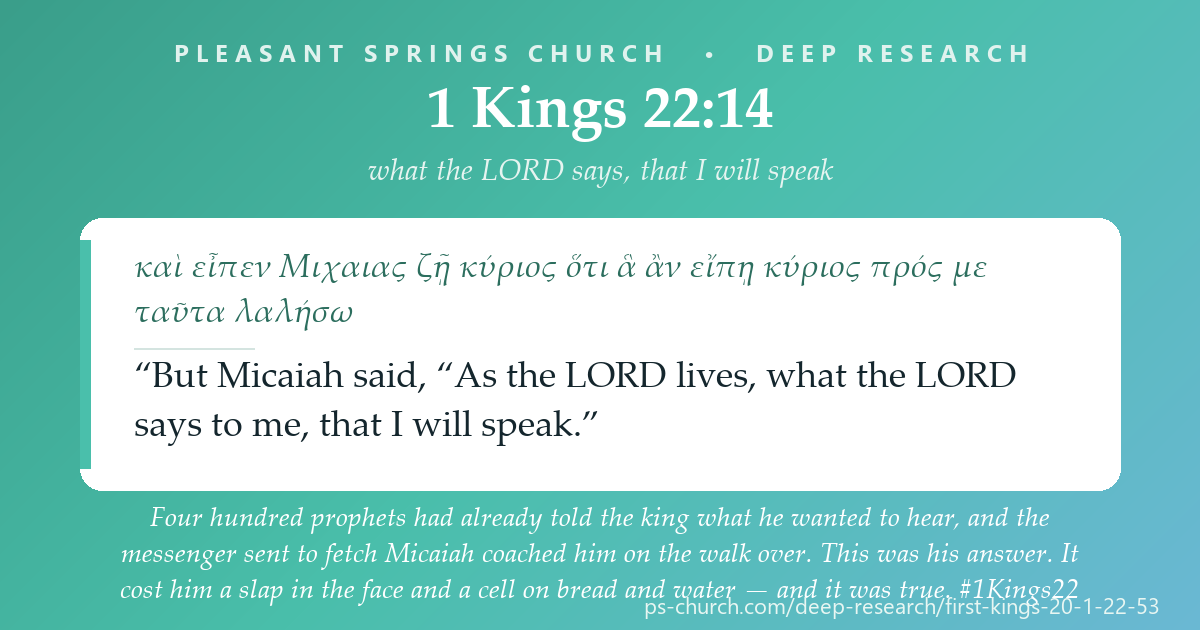
- Micaiah’s oath cost him bread and water. “As the Lord lives, what the Lord says to me, that I will speak” — said after the messenger had explained on the walk over exactly what would happen if he did. He said it anyway, got slapped for it, and went to prison on rations. Faithful speech is usually cheap in the abstract and expensive on the day.
- And a disguise does not work. Ahab knew the word, jailed the man who spoke it, changed his clothes, and was killed by an arrow that nobody aimed. The narrator does not moralise; he just lays the disguise, the random shot and the exact fulfilment side by side and lets you look at them.
A word about typology, clearly labelled — both halves. Christians have long read the vineyard of Naboth toward the vineyard parables, and toward a righteous man condemned by two false witnesses at a rigged assembly and taken outside the city to be killed while the authorities keep the forms. Here is what the text itself does and does not do. 1 Kings 21 does not announce itself as a type; it is telling you what happened to a farmer in Jezreel, and it wants you angry about that on its own terms. The New Testament does not cite Naboth — not once. What the New Testament does do is tell a parable about a vineyard, tenants, and an owner’s son killed for the inheritance (“This is the heir. Come, let us kill him and have his inheritance,” Matthew 21:38 — where, worth noting, the ESV’s own cross-reference apparatus sends you to 1 Kings 21:19; that is an editor’s link, not a quotation, and we call it what it is), and it does report a trial with false witnesses and a death outside the city (Hebrews 13:12). And we are meant to see it. Luke 24:27 has Christ himself reading the whole of Moses and the Prophets this way, and a reader who comes to Naboth from the cross and cannot help hearing an echo is not doing something illegitimate — he is doing what the risen Lord did on the Emmaus road. The one thing ruled out is putting our seeing into the text’s mouth: say that we see it, do not say that the chapter says it. Both halves, every time.
Step in response: two things this week. First, find the room where everybody agrees and ask Jehoshaphat’s question in it — gently, once, and out loud. Second, find the Naboth: the person whose “no” is costing them something because they will not do a thing they believe they are not free to do. Do not pressure them. Stand next to them.
1 Kings 22:14 · to share
Greek (Rahlfs, 3 Kingdoms — kaige section) + ESVEvery Deep Research page traces its passage across the whole sweep — the Old Testament, the Second-Temple world between the testaments (historical witnesses, not Scripture), and the New Testament. Follow the thread:
Pleasant Springs Church — Deep Research
Research method after Michael S. Heiser’s Bible Research Method (examine dictionaries → ancient literature → important words → textual connections → academic publications → share), with the Pleasant Springs “Author & Audience” foundation. Scripture set in the Hebrew, the Greek editions named on each page and the ESV (Old Testament), and the Greek New Testament and the ESV (New Testament), per the practice of Pleasant Springs Church. 1 Kings 20–22 research grounded in Cogan (Anchor Yale), DeVries (WBC), Sweeney (OTL), Provan (NIBC), House (NAC) and Wiseman (TOTC), with McLean’s NETS introduction, Fernández Marcos and Tov on the Greek, and Alter for the literary tools used in the structure block. Book name: in the Septuagint this book is 3 Kingdoms (Βασιλειῶν Γʹ), part of the single continuous work 1–4 Kingdoms; the name is given in the codex note on every page of this set. Section — and this page straddles a boundary: Barthélemy’s kaige sections in Kingdoms run 2 Kingdoms 11:2–3 Kingdoms 2:11 and 3 Kingdoms 22–4 Kingdoms 25. Chapters 20 and 21 of this study are Old Greek; chapter 22 is the first chapter of the second kaige section, and this is stated in the codex note with its consequence spelled out — through 20–21 Rahlfs/Vaticanus is the oldest Greek we can reach, while from 22 onward it is a revision toward a proto-Masoretic Hebrew, so its agreement with the Hebrew may be the reviser’s work and the Antiochene (Lucianic) text may there preserve an older reading. NETS prints a “(KAIGE)” banner at 22:1, and the boundary is demonstrated from the text itself: every occurrence of καί γε in 3 Kingdoms was counted — four, at 1:6, 1:48, 2:5 and 22:22, with none at all between 2:12 and 21:43. The Antiochene text is named and not quoted, because doing so responsibly requires Fernández Marcos and Busto Saiz’s critical edition; there is no Göttingen edition of 3 Kingdoms. Arrangement: Rahlfs was checked before anything was said about it. 3 Kingdoms 20 is Naboth’s vineyard (29 verses, = MT 21) and 3 Kingdoms 21 is the Ben-hadad campaign (43 verses, = MT 20) — the two blocks in the reverse of the Hebrew order, each with the same verse count as its Hebrew counterpart, so that the transposition is reported as a matter of arrangement and kept distinct from the pluses and minuses inside the chapters; NETS shows it in its chapter headings, “20(21)” and “21(20).” Every line of the codex carries both references. Which arrangement is earlier is reported as an open question with evidence on more than one side — including Josephus’s order, which is the Greek one — and is deliberately not adjudicated. The Miscellanies at 2:35a–o and 2:46a–l and the alternate Jeroboam narrative at 12:24a–z were verified as present in Rahlfs and are named as lying outside this passage. Text & numbering: Hebrew from the Masoretic Text; Greek from Rahlfs’s Septuaginta (CATSS digitization), printed without editorial punctuation and with proper names unaccented, and cross-checked against NETS (3 Reigns), which follows Rahlfs; English ESV. Three numbering facts are stated rather than assumed: chapter 22 has no offset between Hebrew and Greek; the Hebrew and the English part company inside chapter 22, MT 22:44 being ESV 22:43b, so that the Hebrew and the Greek both run to 22:54 where the ESV ends at 22:53; and Rahlfs has no 22:47–50, running 1–46 then 51–54, because that Jehoshaphat material already stands at 3 Kingdoms 16:28a–h — with the consequence, noted, that Jehoshaphat’s death is reported twice in the Greek book. Divergences in the printed verses are enumerated in full in the codex note and are not called “rendering differences” when they are pluses or minuses: the absence of the Hebrew’s self-sentence at 20:40; “my God” for the divine name at 21:3; the “swine” plus at 21:19 and 22:38; the prostitutes clause moved forward to 21:19; the sackcloth plus at 21:16; “and he went about weeping” at 21:27; the absence of “because he has humbled himself before me” and of “upon his house” at 21:29; the “not so, not I” pluses at 22:17 and 22:19; and “in his innocence” read as “with good aim” at 22:34. Where the two columns agree exactly — 22:14 and 22:23 — that is reported too, rather than only the differences. Ketiv/qere at 21:29 and 22:13 are printed and explained. Chronicles is treated as a parallel witness: 2 Chronicles 18 is reported with its plus at 18:31 (“and the Lord helped him”) and its complete absence of the Naboth and Ben-hadad material, and the two accounts are not averaged. Ancient Near Eastern material is cited only where verifiable in the local scan of Pritchard’s ANET: Shalmaneser III’s Kurkh Monolith on Ahab at Qarqar (ANET 279), the Mesha Stele on Omri and on the herem (ANET 320–321), and the Samaria Ostraca with ANET’s own correction of their date (ANET 321). Josephus and b. Sanhedrin 89a are read as witnesses and never leveled with Scripture, and where they add or delete, that is pointed out rather than borrowed. The tension between 1 Kings 20/22 and the Assyrian record of Ahab at Qarqar is reported, the proposals named, and no reconstruction adopted. The regnal synchronisms are reported as unresolved and no harmonised chronology is printed as though it were the text. 1 Kings 21:27–29 is given its full weight — Ahab repented, God said so, and the disaster was deferred — alongside 22:8, without reconciling the two. 1 Kings 22:19–23 is reported plainly, five readings are laid out with their advocates, what the text will not support is stated, and the passage is explicitly not adjudicated. The Naboth/Christ reading is offered with both halves named: the Old Testament text does not say it, the New Testament does not cite Naboth, and we are meant to see it.
Scripture quotations marked ESV are from the ESV® Bible (The Holy Bible, English Standard Version®), © 2001 by Crossway, a publishing ministry of Good News Publishers. ESV Text Edition: 2016. Used by permission. All rights reserved. The ESV text may not be quoted in any publication made available to the public by a Creative Commons license, and the ESV may not be translated in whole or in part into any other language. www.esv.org
|
Did this study bless you today? 💚 Give to Support PS Church100% of gifts go to the General Fund — thank you. |