He arrives with nothing — no father’s name, no tribe, no call narrative, no introduction of any kind — and says one sentence to the king: “As the Lord, the God of Israel, lives, before whom I stand, there shall be neither dew nor rain these years, except by my word” (17:1). That phrase is the thread of the whole cycle; count it and you will find it again at 18:15 and again on Horeb. Then ravens at a drying wadi, and then Sidon — Jezebel’s own country — where the prophet who shut the sky is fed for years by a foreign widow down to her last handful of flour, and where the first person in the book to say “now I know that you are a man of God” is her. Then Carmel: Obadiah with a hundred prophets hidden in a cave, “Is it you, you troubler of Israel?”, “How long will you go limping between two different opinions?” — and five verses later the same Hebrew verb for the prophets of Baal limping around their own altar. A morning of shouting and cutting and no voice at all; a mockery; twelve stones; water in the trench; and fire. And then 18:40, which this study reports plainly, locates precisely, and fences unmistakably. Then rain, and a man running the seventeen miles down the mountain in front of the king’s chariot. And then chapter 19, which is the answer the book itself gives to chapter 18. One message from one queen, and the man who called down fire is a day into the wilderness asking God to take his life. Read what God does: no rebuke — sleep, food, a touch, more sleep, more food, and one sentence, the journey is too great for you. Then Horeb, and a great wind, and an earthquake, and a fire, and the Lord in none of them — “and after the fire the sound of a low whisper” (19:12). The question twice, the same answer twice, three names, seven thousand knees, and a farmer ploughing with twelve yoke of oxen who burns his plough to cook them. This study works 1 Kings 17:1–19:21 line by line in Hebrew, Greek and ESV, with every difference between the columns reported rather than smoothed. See the method →
1 Kings 17:1–19:21 (selections)
Hebrew · Greek (Rahlfs, 3 Kingdoms) · ESVThe book, the section, and the edition — and one thing this page is glad to be able to say plainly. In the Septuagint this book is 3 Kingdoms (3 Reigns) — Βασιλειῶν Γʹ (Basileiōn G). 1–2 Samuel and 1–2 Kings are one continuous work in Greek, Βασιλειῶν Αʹ–Δʹ, and a reader hunting for “1 Kings” in a Greek Bible will not find it under that name. (Worth noticing once: our English names for the Torah — Genesis, Exodus, Leviticus, Numbers, Deuteronomy — are the Septuagint’s names, while Samuel and Kings keep Hebrew-derived ones. An English Bible already mixes the two traditions on its contents page.)
⚠️ Which section of the Greek is this? Dominique Barthélemy showed in Les Devanciers d’Aquila (1963) that the Greek of Kingdoms is not one translation. Long stretches are a later kaige revision — a first-century pull of an older Greek text back toward a proto-Masoretic Hebrew, named for its stereotyped rendering of Hebrew גַּם (gam) by καί γε. In Thackeray’s section letters: 2 Kingdoms 11:2 → 3 Kingdoms 2:11 (βγ) is kaige, and 3 Kingdoms 22 → 4 Kingdoms 25 (γδ) is kaige. Everything between them — 3 Kingdoms 2:12 to 21:43, Thackeray’s γγ — is Old Greek, and 1 Kings 17:1–19:21 sits squarely inside it, nowhere near either boundary. That is worth stating positively rather than as a caveat. In a kaige stretch, Vaticanus (on which Rahlfs’s Kingdoms text chiefly rests) is a revision and not the oldest Greek, and the Antiochene (Lucianic) manuscripts often preserve an older reading — so “the LXXreads X” becomes an ambiguous sentence. Here the situation is different: the Greek printed above is, as far as anyone can tell, the old translation itself, which is exactly why it diverges from the Hebrew so much more freely than the Greek of 2 Samuel 11 does. The pluses and minuses catalogued below are not a corrector’s work; they go back either to the translator or to the Hebrew in front of him, and the editions do not always tell us which. (The very next page in this series, 1 Kings 20–22, crosses into the kaige section at chapter 22, and 1 Kings 1–2 comes out of one at 2:11. Ours is the calm stretch in the middle.) No Antiochene reading is cited on this page, because the critical edition — Fernández Marcos and Busto Saiz, El texto antioqueno de la Biblia griega — was not consulted; there is as yet no Göttingen 3 Kingdoms, and the fuller apparatus is Brooke–McLean’s larger Cambridge Septuagint. On why this library prints what it prints, see the texts we print.
⚠️ 1 Kings is rearranged in Greek — and here is exactly what that does and does not do to this passage. 3 Kingdoms differs from the Hebrew in order and content, not only wording. We opened Rahlfs and looked rather than repeating a summary. What it actually prints: two blocks of extra material called the “Miscellanies,” at 2:35a–o and 2:46a–l; an alternate account of Jeroboam at 12:24a–z that the Hebrew does not have at all; and — the two that touch our chapters — a block at 16:28a–h, immediately before Elijah walks on, which narrates the whole reign of Jehoshaphat of Judah, material the Hebrew holds back until 1 Kings 22:41–50, so that in Greek the Elijah cycle opens after Jehoshaphat has already been buried; and the reversal of the two chapters after ours — 3 Kingdoms 20 is Naboth’s vineyard (Hebrew 21, 29 verses) and 3 Kingdoms 21 is the Ben-hadad war (Hebrew 20, 43 verses); we counted the verses to be sure. Which arrangement is earlier is a live scholarly question and this page does not adjudicate it. What matters for a reader here is the good news: none of it touches 17:1–19:21. Numbering: Rahlfs’s 3 Kingdoms has 24 verses in chapter 17, 46 in chapter 18 and 21 in chapter 19 — exactly as the Hebrew and the English do. There is no offset anywhere in this passage, and no line above needed a double reference. This was counted, not assumed.
The divergences in the verses printed above, enumerated — not a sample, the list. 17:1 four at once: Greek pluses “the prophet” and “the God of hosts”; “from the settlers” read as the place “from Thesbon” (the ESV follows the Greek and says so); “through the mouth of my word.” 17:6 bread in the morning and meat in the evening, against the Hebrew’s bread and meat at both. 17:9 minus, “and dwell there.” 17:12, 13, 15 “children” for “son.” 17:13 “take courage” for “do not fear.” 17:14 minus, “the God of Israel”; ketiv/qere תתן / תֵּת. 17:15 minus, “for many days.” 17:21 “he breathed on him” for “he stretched himself upon him.” 17:22 the Greek does not have “the Lord listened to the voice of Elijah… and he revived,” only “it happened so, and the boy cried out.” 18:17–18 “perverts” for “troubles”; “the Lord your God” for “the commandments of the Lord.” 18:19, 25 “the prophets of shame” for “the prophets of Baal.” 18:21 “on both hams” for “on two forks.” 18:22 Greek plus, the four hundred prophets of the grove, whom the Hebrew names only at 18:19. 18:26 “calf” for “bull”; minus “that was given them”; “they ran about” for “they limped,” which loses the pun with 18:21. 18:27 three taunts instead of four, and the crude one not among them; plus “the Thesbite.” 18:29 a whole added speech in which Elijah dismisses “the prophets of the abominations”; and two of the Hebrew’s three negatives are missing. 18:36 “cried out to heaven” for “came near”; minus “at the time of the offering”; pluses “in fire” (twice, with 18:37); “for your sake” for “at your word” (itself a ketiv/qere). 18:38 plus “from heaven”; the list reordered; the trench transliterated θααλα. 18:39 plus “truly”; the doubled cry varied. 18:45 “he was weeping” for “Ahab rode.” 19:2 plus, “If you are Eliou, then I am Iezabel”; singular “God” for the Hebrew’s plural verb with elohim. 19:3 “he was afraid” against the Masoretic pointing “he saw” — one letter, and the ESV goes with the Greek. 19:4 the broom tree transliterated ραθμ; ketiv/qere on “one.” 19:5 “someone” for “an angel”; “a plant” for the broom tree. 19:6 the cake specified as spelt. 19:8 minus, “of God” after “the mount.” 19:10 “forsaken you” where 19:14 has “forsaken your covenant,” breaking a repetition the Hebrew keeps exact. 19:11 plus, “tomorrow.” 19:12 plus, “and there was the Lord.” 19:13 “below the cave” for “at the entrance of the cave.” 19:18 second person for first; plus “men”; “worshipped” for “kissed.” 19:19 “among the twelve” for “with the twelfth.” 19:20 minus, “and my mother”; and a statement where the Hebrew asks a question. 19:21 plural “yokes” for singular. And where the columns agree, they agree — 17:24, 18:15, 18:40 and 19:9 say the same thing in both languages, and that is said here rather than left to silence.)
The Shape of the Passage
LeitwortBehind these chapters stand the covenant curses that promised exactly this drought (Deuteronomy 11:16–17; 28:23–24), the law that forbids a king to take a foreign wife who turns his heart (Deuteronomy 17:17), the law about a prophet who calls you after other gods (Deuteronomy 13), and the mountain itself (Exodus 19; 33:12–34:9). In front of them stand Naboth’s vineyard, a chariot of fire, and a prophet the last page of the Old Testament is still expecting.
Author
A narrator who can hold a whole nation in one man’s body. The books of Kings normally move at the speed of a chronicle — accession, mother’s name, years, verdict, death, burial, successor — and then Elijah walks in and the clock stops. Three chapters for one prophet; more space than most kings get for a whole reign. That is a deliberate change of gear by a writer who has just told you Ahab’s twenty-two years in six verses.
He works by withholding. No genealogy for Elijah, no call, no explanation of the ravens, no number in 18:40, no reason given for the whisper, and above all no interiority: we are never told what Elijah feels, only what he says and does. When he asks to die, the narrator reports the sentence and moves to the next verb. This is Alter’s “reticence” — the gaps are where the reader is invited in, and they are not defects to be patched.
And he is a comparer. Horeb, forty days and forty nights, a cave in the rock, a covering of the face, a passing-by, a commission to anoint — every one of those is Moses, and the narrator never once says “like Moses.” He lays the two accounts side by side and lets the reader do the arithmetic. Which is also why the differences are the point: Moses got the law; Elijah gets a whisper and a list of three names.
Audience
People for whom Baal was not a cartoon. He was the storm god of the whole region — the giver of rain and dew, the one whose voice was thunder. To an ancient farmer in Israel, hedging by serving both was not stupidity; it was insurance. That is why the challenge is framed as it is: not “is Baal real?” but “how long will you limp between two?” The people do not answer, and their silence is honest.
People living after the northern kingdom was gone. Kings is written for readers who know how the story ends — Samaria fallen, Jerusalem burned, the house of David in exile. To such readers the seven thousand of 19:18 is not a consolation prize. It is the whole doctrine of the remnant in one sentence, and it is delivered to a man who was certain the number was one.
And people who had been at the top of a mountain and then wanted to die. The most pastoral thing in these chapters is the sequence in 19:5–8, and it is pastoral because it is so unspiritual: a touch, bread, water, sleep, a second touch, more bread, more sleep. The Bible has a category for the collapse that comes after the victory, and it does not treat it as sin. Stage 6 says what to do with that.
Orient on Elijah and the Omride period, Baal and Asherah, Carmel, Horeb/Sinai, drought and covenant curse, and the office of the prophet.
Search by topic: Elijah; Elisha; Ahab; Jezebel; Omri and the Omrides; Baal; Baal-Melqart; Asherah; Phoenicia, Tyre and Sidon; Zarephath; Carmel, Mount; Kishon; Jezreel; Horeb / Sinai; theophany; drought and famine; prophet, prophecy, ecstatic prophecy; sons of the prophets; remnant; mantle; anointing.
Which articles are relevant?
- Anchor Bible Dictionary — “Elijah,” “Elisha,” “Ahab,” “Jezebel,” “Omri,” “Baal (Deity),” “Asherah,” “Carmel, Mount,” “Zarephath,” “Sidon,” “Kishon,” “Jezreel,” “Horeb,” “Sinai, Mount,” “Theophany,” “Prophecy (Pre-exilic Hebrew),” “Remnant.”
- Dictionary of the OT: Historical Books (IVP) — “Elijah,” “Kings, Books of,” “Omri Dynasty,” “Prophets and Prophecy,” “Canaanite Gods and Religion,” “Non-Israelite Written Sources,” “Water and Hydrology.”
- NIDOTTE / TDOT — קוֹל (qōl, voice/sound), דְּמָמָה (dəmāmāh, stillness), דַּק (daq, thin), פָּסַח (pāsaḥ, limp/pass over), עָכַר (ʿāḵar, trouble), קִנְאָה (qinʾāh, zeal/jealousy), אַדֶּרֶת (ʾaddereṯ, cloak), שָׁחַט (šāḥaṭ, slaughter), נָבִיא (nāḇîʾ, prophet), עָמַד לִפְנֵי (ʿāmaḏ lip̄nê, stand before).
- On the Greek — the introduction to 3 Reigns in NETS, which sets out the section theory, the relation of 3 Reigns to the Hebrew, and the standing of the Antiochene text. Read it before making any claim beginning “the Septuagint says.”
Bibliography surfaced:
- Mordechai Cogan, I Kings (Anchor Bible); Simon J. DeVries, 1 Kings (WBC); Marvin A. Sweeney, I & II Kings (OTL); Iain W. Provan, 1 and 2 Kings (NIBC); Paul R. House, 1, 2 Kings (NAC); Donald J. Wiseman, 1 and 2 Kings (TOTC); Walter Brueggemann, 1 & 2 Kings (Smyth & Helwys).
- Jerome T. Walsh, 1 Kings (Berit Olam) — the standard place to go for the literary shaping of these chapters; Robert Alter, The Art of Biblical Narrative and The Hebrew Bible, vol. 2 (Prophets), for the reading tools used in the structure block. (Alter reads these texts as literature and does not share the church’s confession; we take the tools, not the metaphysics.)
- A. Graeme Auld, Kings Without Privilege, on the relation of Kings to Chronicles; Emanuel Tov, Textual Criticism of the Hebrew Bible, and Natalio Fernández Marcos, The Septuagint in Context, for the Greek of Kingdoms and the Antiochene text.
Who Baal actually was, what a three-year drought did to a kingdom, and what the ancient retellings could not leave alone.
First the world: the storm god whose whole portfolio is rain and whose voice is thunder; the Omride dynasty as its neighbours and enemies described it; and a widow’s legal position in a famine. Then Ben Sira, Josephus and the Mishnah — and watch which silences each of them could not bear.
Which parallels shed light on the world of these chapters?
Baal was the god of rain, and Elijah’s first sentence takes away rain. That is the whole design of 17:1, and it only lands if you know what Baal was for. In the Ugaritic texts — Canaanite poetry from the century of the patriarchs, recovered from Ras Shamra — Baal is Rider of the Clouds (ANET 130), and when his palace is finished he opens “rifts in the clouds” and gives forth his holy voice so that “mountains quake… earth’s high places reel” (ANET 135). Baal’s voice is thunder. Now read 18:26 again: “there was no voice.” The taunt is not that Baal is silly. It is that the god whose entire identity is the storm cannot produce one syllable of it, for three years, on demand, on his own mountain.
And the two things Elijah says at noon are things the Baal texts actually say. “Perhaps he is asleep and must be awakened” — in the cycle, Baal is found “fallen on the ground: Puissant Baal is dead, the Prince, Lord of Earth, is perished” (ANET 139), and after seven years he returns. “And they cut themselves after their custom with swords and lances” (18:28) — in the same passage, El hears that Baal is dead, sits on the ground, puts on sackcloth, and “cuts a gash with a stone… he gashes his cheeks and his chin” (ANET 139). The prophets on Carmel are not improvising. They are performing a recognised mourning rite to wake a god who, in their own literature, dies. Israel is forbidden to do it (Leviticus 19:28; Deuteronomy 14:1), which is the sharpest possible commentary on the scene.
Ahab is a real king with real records, and two of them are in front of us. The Kurkh Monolith of Shalmaneser III of Assyria lists the coalition that met him at Qarqar in 853 BC and names “2,000 chariots, 10,000 soldiers of Ahab, the Israelite” (ANET 279) — the largest chariot force in the alliance, which tells you the Omride kingdom was a serious military power and not a backwater. And the Mesha Stele, Moab’s own royal inscription, opens its history like this: “As for Omri, king of Israel, he humbled Moab many years, for Chemosh was angry at his land… And his son followed him and he also said, ‘I will humble Moab’” (ANET 320–321). Read that sentence and then read 1 Kings: Moab explains its defeats exactly the way Israel explains its droughts — the god was angry with his own land. Both are worth reading precisely because one of them is not written by us.
- The Baal cycle from Ugarit, ANET 129–142 — especially 130 (“Rider of the Clouds”), 135 (Baal “gives forth his holy voice” and the mountains quake), 139 (“Puissant Baal is dead”; El gashes his cheeks and chin in mourning) and 141 (Baal’s return “after seven years”). Canaanite religious poetry — a witness, not Scripture. All four verified in the local scan.
- Kurkh Monolith of Shalmaneser III, ANET 278–279 (Assyrian royal annals — a witness, not Scripture) — “2,000 chariots, 10,000 soldiers of Ahab, the Israelite,” at the battle of Qarqar, 853 BC. Verified in the local scan. Note that the Bible never mentions Qarqar and the Assyrians never mention Elijah; each source keeps what mattered to it.
- The Mesha Stele (Moabite Stone), c. 830 BC, ANET 320–321 (a Moabite royal inscription — a witness, not Scripture) — Omri, Chemosh’s anger, and a war with Israel, in Moab’s own words. Verified in the local scan. Its account of Nebo also happens to use the round figure “seven thousand”; that is a fact about ancient royal rhetoric and no argument is built on it here.
- Sirach 48:1–11 (Second Temple, c. 180 BC — non-canonical: a witness, never levelled with Scripture; Greek from Rahlfs) — the earliest surviving portrait of Elijah outside Kings, and a stunning one: καὶ ἀνέστη Ηλιας προφήτης ὡς πῦρ καὶ ὁ λόγος αὐτοῦ ὡς λαμπὰς ἐκαίετο, “Elijah arose, a prophet like fire, and his word burned like a torch” (48:1). Ben Sira knows the drought (48:2–3), the raising of the boy (48:5), and Horeb — “hearing rebuke at Sinai, and at Horeb judgments of vengeance” (48:7), which shows a Second-Temple writer treating the two names as one mountain. And note 48:8: he says Elijah anointed kings. In 1 Kings 19 Elijah is told to and never does it — Hazael and Jehu are dealt with in 2 Kings 8–9, after his death.
- Josephus, Antiquities 8.13.2–8 (Whiston’s chapter-and-section numbering) (Second-Temple — a witness, not Scripture) — a retelling with revealing edits. He quotes Menander of Ephesus on a drought in Phoenicia under Ithobalus (Ethbaal) that lasted “from the month Hyperberetaeus, till the month Hyperberetaeus of the year following,” ended when the king “made supplications” — a Tyrian source for a drought in Ahab’s generation. He tells the mockery with only two options, “they might either be on a journey, or asleep,” exactly as the Greek Bible does. At 18:40 he shifts the agent: “So they caught their Prophets; and, at the command of Elijah, slew them.” He calls Horeb “that mountain which is called Sinai.” He drops the wind entirely and reports “an earthquake, and the bright splendor of a fire; and after a silence made, a divine voice” — a first-century reader taking dəmāmāh as silence. And he has the voice tell Elijah to come out “the next day,” agreeing with the Greek Bible’s plus at 19:11.
- m. Taanit 2:4 (rabbinic-era — a witness, not Scripture) — the liturgy for a public fast in a drought, and the fifth blessing is “He Who answered Elijah on Mount Carmel, He will answer you and hear the sound of your cry on this day.” Israel went on praying for rain in Elijah’s name for centuries.
- m. Eduyot 8:7 (rabbinic-era — a witness, not Scripture) — on Elijah’s return: not to declare clean or unclean but, say the Sages, “to make peace in the world,” citing Malachi — and citing it, note, as Malachi 3:23–24, which is where those verses stand in a Hebrew Bible. English Bibles print them as Malachi 4:5–6.
Line them up and a pattern appears, and it is the same pattern this library keeps finding. The Hebrew of these chapters withholds four things, and the ancient retellings supply at least one of them each.
(1) Who did the killing at 18:40. The Hebrew is grammatically plain: the people seize, and Elijah brings them down and slaughters them. Josephus moves the verb: “they caught their Prophets; and, at the command of Elijah, slew them.” That is a retelling, not a translation, and the change is in exactly the direction a reader’s discomfort would push it.
(2) What the taunt at 18:27 meant. The Hebrew offers four possibilities and one of them is crude. The Greek Bible gives three and drops it; Josephus gives two and drops it. Whatever else that shows, it shows that this verse embarrassed people very early.
(3) Whether God was in the whisper. The Hebrew simply stops after “a sound of a low whisper.” The Greek adds “and there was the Lord.” Josephus supplies “a divine voice.” Both are answering a question the Hebrew leaves standing on the page, and a preacher should notice that the answer they give is the one we all want.
(4) Whether Elijah ever carried out his commission. The Hebrew has him anoint nobody; the last thing he does in this passage is throw a coat at a farmer. Ben Sira says he anointed kings (Sirach 48:8), tidying the record forward from 2 Kings.
The rule for these pages holds: report what the text approves, report what it merely reports, report what it condemns, and leave the gaps open. The ancient witnesses are worth reading precisely because you can watch them closing gaps — which is the temptation of anyone in any century who loves a story too much to let it stay quiet.
One noun that runs the whole passage, one phrase nobody can translate, one deliberate pun, and the verb at 18:40.
Count qol yourself — eight. Then hold qol demamah daqqah up to the light and refuse to be more certain than the Hebrew is; watch pasah turn Elijah’s insult into the Baal prophets’ dance; and look squarely at the verb in 18:40 rather than around it.
“Voice, sound, thunder.” Eight occurrences, and they carry the argument — see the structure block above. The word is ordinary; the placing is not. It is the word for thunder in the storm-god vocabulary of the whole region, which is exactly why 18:26 and 18:29 (“there was no voice”) are a demolition and not merely a report. The Greek keeps seven of the eight with φωνή and ἀκρόασις; it does not have the first, because Rahlfs at 17:22 lacks the whole clause about the Lord listening.
Three words, and the most argued-over phrase in the Elijah cycle. Taken one at a time: qōl is “sound” or “voice”; dəmāmāh is a rare noun that the standard lexicons gloss “stillness, silence, calm,” and besides this verse they list it at Job 4:16 (“there was silence, then I heard a voice” — the same two words) and Psalm 107:29 (God “made the storm be still”); daqqāh is “thin, fine,” the word used of the manna, “fine as frost” (Exodus 16:14). Put them together and you get something like a sound of a thin stillness, which is not natural English, and every version has had to choose: KJV “a still small voice”; ESV “the sound of a low whisper,” footnoted “Or a sound, a thin silence”; NRSV “a sound of sheer silence”; JPS “a soft murmuring sound”; Rahlfs φωνὴ αὔρας λεπτῆς, “a sound of a light breeze”; the Vulgate sibilus aurae tenuis, “a whistling of a thin air”; Josephus, retelling it, “after a silence made, a divine voice.” Notice the fork. One family of renderings makes it a very quiet sound (breeze, whisper, murmur); the other makes it silence itself, which would mean the point is not that God spoke softly but that after the fire there was nothing at all — and then the question came. We are not able to settle this and we do not pretend to. What can be said is what the verse does not say: unlike the wind, the earthquake and the fire, it never says the Lord was in it. The Hebrew leaves the sentence open. (The Greek closes it — κἀκεῖ κύριος — and that is a divergence, not a translation.)
“To stand before.” This is Elijah’s self-description and it is a court term: to stand before a king is to be his servant in attendance, awaiting orders — it is what Joseph does before Pharaoh and what a courtier does all day. Elijah uses it in his very first sentence (17:1) and again to Obadiah (18:15), both times in the same oath formula, word for word. Then God turns it around. At Horeb the command is “go out and stand on the mount before the Lord” (19:11) — the man who has been claiming the posture is now told to take it — and the verb is used a fourth time in 19:13, where he actually does: “he went out and stood at the entrance of the cave.” He said he stood before God; on Horeb he finds out what that involves. Count: the root עמד occurs four times in these three chapters, at 17:1; 18:15; 19:11 and 19:13, and nowhere else in them — ours, and checkable. The Greek: παρέστην ἐνώπιον αὐτοῦ at 17:1 and 18:15, keeping the phrase identical; but στήσῃ at 19:11 and ἔστη at 19:13, so the link is a little weaker in Greek than in Hebrew.
“To limp, hobble, hop” — and a deliberate pun, verified by count: the root occurs exactly twice in these chapters and both are in the Carmel scene. Elijah asks the crowd, “How long will you go limping (פֹּסְחִים) between two forks?” (18:21), and five verses later the prophets of Baal are limping (וַיְפַסְּחוּ) around their own altar (18:26). The insult and the ritual are one word. It is also, as a matter of consonants, the root of Pesaḥ, Passover — a fact worth knowing and not worth building on, since the sense there (“pass over, spare”) is disputed and different. The Greek loses it: χωλανεῖτε in 18:21 but διέτρεχον (“ran about”) in 18:26, so a Greek reader hears no pun at all — and this page prints the loss rather than quietly arguing from a Hebrew wordplay while displaying a Greek column that does not have it.
“To trouble, bring ruin on, make taboo.” Ahab’s “you troubler of Israel” is not name-calling; it is close to a legal charge. It is the verb of Achan, who “troubled” Israel and was executed in the Valley of Achor (Joshua 7:25), and of Jephthah’s daughter in her father’s mouth (Judges 11:35). Ahab is saying: you are the contamination in the camp, and the drought is your fault. Elijah answers with the same verb and the correct subject. The Greek reaches for διαστρέφω, “to twist, pervert,” which is a fair sense but drops the Achan echo.
“I have been very jealous” — an infinitive absolute doubling the verb for emphasis, and the only thing Elijah says about himself at Horeb, twice, in identical words. The root is qnʾ, the “jealousy” of the second commandment (Exodus 20:5) and of Phinehas, who “was jealous with my jealousy” and was given a covenant of peace for it (Numbers 25:11–13). That is almost certainly the model Elijah has in mind, and it is worth saying that God neither commends the claim nor contradicts it — he feeds him, asks him twice what he is doing there, and then gives him three names and a number. The Greek reproduces the doubling exactly, ζηλῶν ἐζήλωκα, and renders “the God of hosts” τῷ κυρίῳ παντοκράτορι.
The prophet’s cloak or mantle — the one thing of his that outlasts him. He hides his face in it at Horeb (19:13) and throws it over Elisha six verses later (19:19), with no words at all attached; it will part the Jordan twice and be picked up off the ground in 2 Kings 2. The word is used of a costly garment (it is Achan’s “beautiful cloak from Shinar,” Joshua 7:21) and also of a prophet’s hairy mantle (Zechariah 13:4). The Greek chooses μηλωτή, a sheepskin — the word that stands behind Hebrews 11:37, “they went about in skins of sheep and goats.”
“To slaughter” — and it is worth knowing exactly which word this is, because the choice is not neutral. This is the verb for slaughtering a sacrificial animal: “then he shall kill the bull before the Lord” (Leviticus 1:5). It occurs once in these three chapters, at 18:40, and the Greek matches it with σφάζω, the same verb Greek Leviticus uses. The narrator is not hiding what happened by softening the word, and neither should a study of it. What he does not supply is a number, a divine command, or any evaluation whatsoever. See the fenced note in Stage 4.
Three things about the Hebrew here, reported rather than tidied:
- The one-letter fork at 19:3. The consonants are וירא. Pointed וַיַּרְא it is “and he saw”; pointed וַיִּרָא it is “and he was afraid.” The Masoretic reading tradition has “he saw”; the Greek, Syriac and Latin all have “he was afraid”; the ESV follows them without a footnote. The difference is not trivial — one reading has a prophet coolly assessing a situation, the other has him in terror — and both are ancient. We print the Masoretic Hebrew and the Greek side by side above and let the reader see the fork rather than choosing on their behalf. (Even “he saw” is not flat: it has no object, so the Hebrew would then be saying that he saw, and leaving what he saw to you.)
- Three ketiv/qere readings in these chapters, all printed above as the qere. At 17:14, written תתן and read תֵּת־ (“until the day the Lord gives rain”). At 18:36, written ובדבריך, “by your words,” and read וּבִדְבָרְךָ, “by your word” — and the Greek agrees with neither, reading διὰ σέ, “for your sake.” At 19:4, written אחת (feminine “one”) and read אֶחָד (masculine), with the broom tree. None of the three changes the sense much; all three are visible in any Hebrew Bible with a Masorah, and it is better for a reader to know they are there.
- The word for “two opinions” is genuinely obscure. הַסְּעִפִּים (has-səʿippîm, 18:21) is related to a root for “cleft, branch, fork” — a related noun means the boughs of a tree (Isaiah 17:6), and another means a divided or “forked” mind (Psalm 119:113). So “two different opinions” is an interpretation, though a good and old one; “two crutches” and “two forks in the road” have both been proposed. The Greek went a different way entirely and read body parts: ἐπ' ἀμφοτέραις ταῖς ἰγνύαις, “on both hams.” The picture in every case is the same — a man who cannot put his weight on either leg.
Moses on the same mountain, the covenant curses that promised the drought, the fence around 18:40, and where the New Testament actually goes with all this.
Trace four threads: Horeb, which is the key to chapter 19; the law of Deuteronomy, which is the frame for chapters 17–18; the canon’s own commentary on 18:40; and the four New Testament passages that name Elijah — which are not the ones most sermons use.
Which cross-references matter?
- Exodus 33:12–34:9; Exodus 19; Exodus 24:18; Exodus 3:1–6 — the whole of chapter 19 is written against Moses on this mountain, and the narrator never says so. Forty days and forty nights without food (Exod 24:18; 34:28). A cave, or a cleft in the rock, where a man is put while God passes by — “while my glory passes by… I will cover you with my hand” (Exod 33:22), and here “behold, the Lord passed by” (19:11). A face covered (Exod 3:6; 1 Kgs 19:13). Wind and fire and a shaking mountain (Exod 19:16–18). And then the differences, which are the point. Moses asked to see the glory and was answered with a proclamation of the Name; Elijah asked to die and was answered with a question. Moses came down with a covenant; Elijah came down with three names and a number.
- Deuteronomy 11:16–17 and Deuteronomy 28:23–24 — the drought is not a wonder invented for the occasion; it is the covenant curse, quoted. “Take care lest your heart be deceived, and you turn aside and serve other gods… then the anger of the Lord will be kindled against you, and he will shut up the heavens, so that there will be no rain” (Deut 11:16–17). Elijah is not doing something new in 17:1. He is reading the contract out loud.
- Deuteronomy 17:14–20 — the law of the king, and the standing cross-link for everything the Omrides do. “He shall not acquire many wives for himself, lest his heart turn away.” 1 Kings 16:31 is that sentence coming true with a name attached, and the whole Elijah cycle is the consequence. The text’s issue is covenant loyalty, not ethnicity — which the book proves in the same breath by sending its prophet to be fed by a Phoenician.
- Deuteronomy 13 and Deuteronomy 18:20–22 — the legal frame the narrator assumes at Carmel: a prophet who summons Israel after other gods, and the test of a true prophet by whether the word comes to pass. Both are directly in play; neither is quoted; and neither authorises a private citizen to execute anybody, which is the subject of the note below.
- Leviticus 19:28 and Deuteronomy 14:1 — “You shall not make any cuts on your body for the dead.” Read those two verses and then 18:28, and the narrator’s deadpan “after their custom” becomes a sentence with an edge on it.
- Joshua 7:21–26 — Achan, the man who troubled (ʿāḵar) Israel, and the Valley of Achor; and Achan’s stolen “beautiful cloak,” which is the same noun as Elijah’s mantle. Ahab reaches for that vocabulary in 18:17 and it is not an accident.
- Numbers 25:1–13 — Phinehas, the model of the zeal Elijah claims in 19:10 and 19:14. Worth holding beside it: Phinehas acted and God spoke and commended him by name. At Carmel there is no such word, before or after.
- 1 Samuel 8–10 and 2 Samuel 7:1–17 — the two poles of the story Kings is telling. Israel asked for a king like the nations and Samuel told them what it would cost; God promised David a house that would stand. By 1 Kings 17 the northern half has a king like the nations with a foreign queen and a temple to Baal, and the prophet is the last institution left standing.
- Malachi 4:5–6 (= Malachi 3:23–24 in a Hebrew Bible; the numbering differs, and we say so) — “Behold, I will send you Elijah the prophet before the great and awesome day of the Lord comes.” The Old Testament ends with this man still expected. Matthew 11:14 and 17:10–13 and Mark 9:11–13 apply it to John the Baptist; John 1:21 has John himself decline the title. That tension is in the New Testament, not invented by us, and this page does not flatten it.
- Where the New Testament actually takes these chapters — four places, and they are not the obvious ones. Luke 4:25–26, the sermon that nearly got Jesus killed in his home town: “there were many widows in Israel in the days of Elijah… and Elijah was sent to none of them but only to Zarephath, in the land of Sidon, to a woman who was a widow.” James 5:17–18: “Elijah was a man with a nature like ours, and he prayed fervently that it might not rain… Then he prayed again, and heaven gave rain.” Romans 11:2–4: the seven thousand, quoted to prove that God has not rejected his people. And Luke 9:54–55, on which see the note immediately below. Notice what is not on that list: no New Testament writer ever cites Carmel as a model for anything Christians should do.
What the text says. After the fire falls and the people fall on their faces, Elijah says, “Seize the prophets of Baal; let not one of them escape.” The people seize them. Elijah brings them down to the brook Kishon and slaughters them there. That is 18:40, one verse, and it is printed in full in the codex above because this library does not quietly leave out the verses it would rather not read aloud.
What the text says exactly. The verb is šāḥaṭ, the word for killing a sacrificial animal, and the Greek matches it. The subject of that verb, in the Hebrew, is Elijah. No number is given. 450 prophets of Baal were summoned (18:19, 22); the 400 prophets of Asherah are named once, at 18:19, and the Hebrew never says they came — a study that reports “850 killed” has added to Scripture. And no divine command appears anywhere in the chapter. Elijah prays for fire and receives fire; the seizure and the killing follow with no “thus says the Lord” in front of them and no comment from the narrator afterwards. The narrator of Kings is perfectly capable of praise and of condemnation, and here he gives neither. Where Scripture gives no reason, we say so and stop.
What the frame was. Israel was a covenant nation under a law that treated the promotion of other gods as capital treason against its King (Deuteronomy 13; 18:20), and Jezebel had been killing the Lord’s prophets for years (18:4, 13) — which is context and not justification, and does not turn a private execution into a lawful one. That is the difficulty, and we are not going to talk it away. Nor will we do the opposite and pretend the man was simply a murderer; the book that reports this also reports 19:5–8 and treats him tenderly. Both of those are in the text, and a study that keeps only one of them is not being honest.
And here is the canon’s own comment. Two of Jesus’ disciples once watched a village refuse him and asked, “Lord, do you want us to tell fire to come down from heaven and consume them?” — and some manuscripts add “as Elijah did,” which is in any case exactly what they meant. The next sentence is Luke 9:55: “But he turned and rebuked them.” That is the New Testament reading 1 Kings 18 in front of us and telling his own people, in one line, that this is not their brief. Paul says the same thing twice over: “the weapons of our warfare are not of the flesh” (2 Corinthians 10:4), and “we do not wrestle against flesh and blood” (Ephesians 6:12).
So, unmistakably: 1 Kings 18:40 licenses nothing today. Not violence, not coercion, not intimidation, not the shunning of a neighbour, not a sharpened tone in an argument about God. No Christian has ever been authorised by this verse and none ever will be. If a reading of Elijah makes you feel more entitled to harm someone, you have read him against Christ, who was rebuking that instinct in his closest friends before the church was a week old. And it is worth finishing where the book finishes: the sword in this story is taken out of the prophet’s hands. In 19:15–17 the killing is assigned to two kings and a successor — and when Jehu carries it out, Hosea 1:4 has God say, “I will punish the house of Jehu for the blood of Jezreel.” Scripture is not sentimental about its own violence, and it does not let it stand unexamined.
The commentaries, the historical questions, the shape of the Elijah cycle, and the things that are genuinely unsettled.
Cogan, DeVries, Sweeney, Provan, House, Wiseman, Brueggemann and Walsh on Kings; Fernández Marcos and Tov on the Greek; Cross and the Ugaritic material on Baal. Then four live questions — the Greek arrangement, the historical setting, the shape of chapter 19, and what to do with a whisper nobody can translate.
Commentaries & studies:
- Mordechai Cogan, I Kings (Anchor Bible) — the fullest philological and historical treatment in English, and the best on the Assyrian and Phoenician background; Simon J. DeVries, 1 Kings (WBC), on the form and growth of the prophetic narratives; Marvin A. Sweeney, I & II Kings (OTL).
- Iain W. Provan, 1 and 2 Kings (NIBC); Paul R. House, 1, 2 Kings (NAC); Donald J. Wiseman, 1 and 2 Kings (TOTC) — three shorter evangelical readings, of which Provan is the most theologically alert to what chapter 19 is doing.
- Walter Brueggemann, 1 & 2 Kings (Smyth & Helwys) — the most homiletically useful and the most willing to sit inside 19:4 without rushing it; Jerome T. Walsh, 1 Kings (Berit Olam), for the literary architecture.
- Robert Alter, The Art of Biblical Narrative and The Hebrew Bible, vol. 2 (Prophets), for the reading tools used in the structure block; Frank Moore Cross, Canaanite Myth and Hebrew Epic, for the storm-theophany background of 19:11–12 and its relation to the Ugaritic Baal.
- Natalio Fernández Marcos, The Septuagint in Context, and Emanuel Tov, Textual Criticism of the Hebrew Bible — the two places to go before making any claim about “what the LXX says” in Kingdoms; and A. Graeme Auld, Kings Without Privilege, for the Kings/Chronicles relation. (Chronicles, it is worth saying, has no Elijah narrative at all — it is a history of Judah, and Ahab appears only where he touches Jehoshaphat. That is a difference between the books, reported and not harmonised.)
Interpretation notes worth keeping:
- The Greek arrangement of 1 Kings is a real scholarly problem, and this page will not pretend to solve it. 3 Kingdoms has extra blocks the Hebrew lacks (the Miscellanies at 2:35a–o and 2:46a–l; an alternate Jeroboam at 12:24a–z; Jehoshaphat’s reign at 16:28a–h) and prints the Naboth and Ben-hadad chapters in the reverse order. Some scholars judge the Greek to reflect an older, shorter Hebrew edition of Kings; others judge it a later Greek rearrangement; the arguments run in both directions and use the same evidence. We report what Rahlfs prints, note that it does not touch 17:1–19:21, and stop. A reader who wants the debate should go to Cogan’s introduction and to the Septuagint specialists, not to a summary.
- “Three years” and “three years and six months” are not the same number, and the difference is worth stating. 1 Kings 18:1 says the word came “in the third year.” Luke 4:25 and James 5:17 both say three years and six months. That figure is not in Kings; it appears in Jewish tradition and in both New Testament writers, and the usual explanation is that the drought is being counted from its onset rather than from Elijah’s announcement, or that three and a half is functioning as a set period. We name the difference rather than quietly adopting one number.
- Whether Elijah is rebuked at Horeb is genuinely disputed, and the text is careful not to say. One reading: the question “what are you doing here?” is a summons to account, the wind-earthquake-fire sequence corrects a prophet who wanted more fire, and the seven thousand refutes his self-pity. Another: there is no reproach anywhere in the chapter — God feeds him twice before saying a word, lets him repeat his complaint unchanged, and answers with employment and with company. The evidence for the gentler reading is mostly in 19:5–8, and the evidence for the sterner reading is mostly in what the theophany withholds; both are readings, and the narrator’s reticence is what makes both possible. Where the text does not say, we do not either.
- Horeb and Sinai. Deuteronomy calls the mountain Horeb throughout; Exodus mostly calls it Sinai; Sirach 48:7 uses both names in one bicolon, and Josephus simply calls Elijah’s mountain Sinai. The identification is old and near-universal; the location of the mountain is not settled and nothing here depends on it.
- The 400 prophets of Asherah are a loose thread in the Hebrew, and the Greek ties it differently. They are summoned at 18:19 and never mentioned again in the Hebrew of the chapter; the Greek supplies them at 18:22. Commentators divide over whether the Hebrew has lost something, whether the Greek has harmonised, or whether the narrator simply drops a detail he does not need. Report it; do not settle it — and do not report a body count that the text does not give.
- On typology, three things kept separate. (1) What the Old Testament text says: nothing about Christ. These chapters announce no type and make no prediction; Elijah is a prophet in the ninth century BC and the narrator treats him as one. (2) What the New Testament itself draws: a great deal, and it is safe ground because it is not ours. Jesus makes the widow of Zarephath the point of his first sermon (Luke 4:25–26); he is transfigured with Moses and Elijah beside him (Matthew 17:3); he identifies John the Baptist as the promised Elijah (Matthew 11:14; 17:10–13); he rebukes the disciples who wanted to call down Elijah’s fire (Luke 9:54–55); Paul uses the seven thousand as the doctrine of the remnant (Romans 11:2–4); James uses Elijah’s prayer as an argument that ordinary Christians should pray (James 5:17–18). Attribute all of that to the New Testament and teach it plainly. (3) What we see from this side of the cross: a prophet fed in the wilderness by God’s own provision for forty days; a widow’s son given back from death; a meal that does not run out; God finally speaking not in the earthquake but in something you have to be quiet to hear. Those are legitimate and expected sights — Luke 24:27 has Christ himself reading the Old Testament this way — and they are ours, not the text’s claim about itself. Both halves have to be said: the passage does not announce them, and we are meant to see them.
- And a word about the historical Elijah. No inscription mentions him, and it would be very surprising if one did — Assyrian and Moabite kings wrote about armies and territory, not about prophets who embarrassed them. What the inscriptions do give us is the world: an Omride kingdom strong enough to field two thousand chariots (ANET 279), a Tyrian dynasty that a Phoenician historian remembered for a drought, and a Moabite king who explained his own history exactly as Israel explained hers. The Bible’s claim is not that Elijah left a monument. It is that he stood in front of a king with one sentence and the sky did what he said.
Fire on a mountain, a man who wanted to die, and the smallest sound in the Bible.
Name what you learned, why it matters, and one concrete response.
What should we carry away — and do?
- “Before whom I stand” is a servant’s posture, not a hero’s. It is what a courtier says: I am on duty, awaiting orders. Elijah says it twice before God ever says anything to him about it, and then at Horeb God takes the phrase back and tells him to go out and do it. Everything he does in three chapters is downstream of standing somewhere and waiting to be told.
- The prophet of the drought was kept alive by a foreign widow — and Jesus made that the point. Not a hidden detail: the very first sermon of his ministry says God passed over every widow in Israel and sent Elijah to a woman in Sidon (Luke 4:25–26), and the congregation tried to throw him off a cliff for it. If Zarephath makes you comfortable, you have not read it yet.
- The pun is the sermon. Elijah asks Israel how long they will go limping between two opinions; five verses later the prophets of Baal are limping around their altar with the same Hebrew verb. Half-committed worship does not look dignified from the outside. It looks like a limp.
- Read 19:5–8 slowly, and let it change how you care for people. A man at the end of his rope asks God to kill him, and God’s reply is: sleep. Then a hand on the shoulder and something to eat. Then sleep again. Then more food, and one sentence of explanation — the journey is too great for you. No rebuke, no diagnosis of unbelief, no verse. If your instinct with an exhausted Christian is to correct their theology, this passage is asking you to make them a meal first.
- And do not miss what did not happen at Horeb. God had just answered by fire in front of a nation. On the mountain he sends wind and earthquake and fire and is explicitly in none of them. The most spectacular answer in the Old Testament did not fix the man who received it — and what did reach him was the smallest thing in the chapter. Anyone who has come home from a mountaintop and found nothing changed is being told something here.
- The seven thousand. “I, even I only, am left” was sincere, and it was wrong by a factor of seven thousand. God does not argue with him about it; he just tells him the number. There has never yet been a generation in which the faithful were as few as the faithful believed.
A word about typology, clearly labelled: Christians have long heard Christ in these chapters — bread that does not run out, a dead son given back to his mother, a servant sustained forty days in the wilderness, and God speaking at last in something you have to be quiet to hear. Hold that carefully, and hold it both ways. The Old Testament text does not announce any of it; it is telling you what happened in the ninth century BC, and reading it as a coded prophecy would be putting our seeing into its mouth. And we are meant to see it, because the risen Christ himself read the Old Testament this way — “beginning with Moses and all the Prophets, he interpreted to them in all the Scriptures the things concerning himself” (Luke 24:27) — and because the New Testament has already gone first: the widow of Zarephath is Jesus’ own text (Luke 4:25–26), and Moses and Elijah stand beside him on another mountain (Matthew 17:3). Say both halves. Never delete the sight; never pretend the text asserted it.
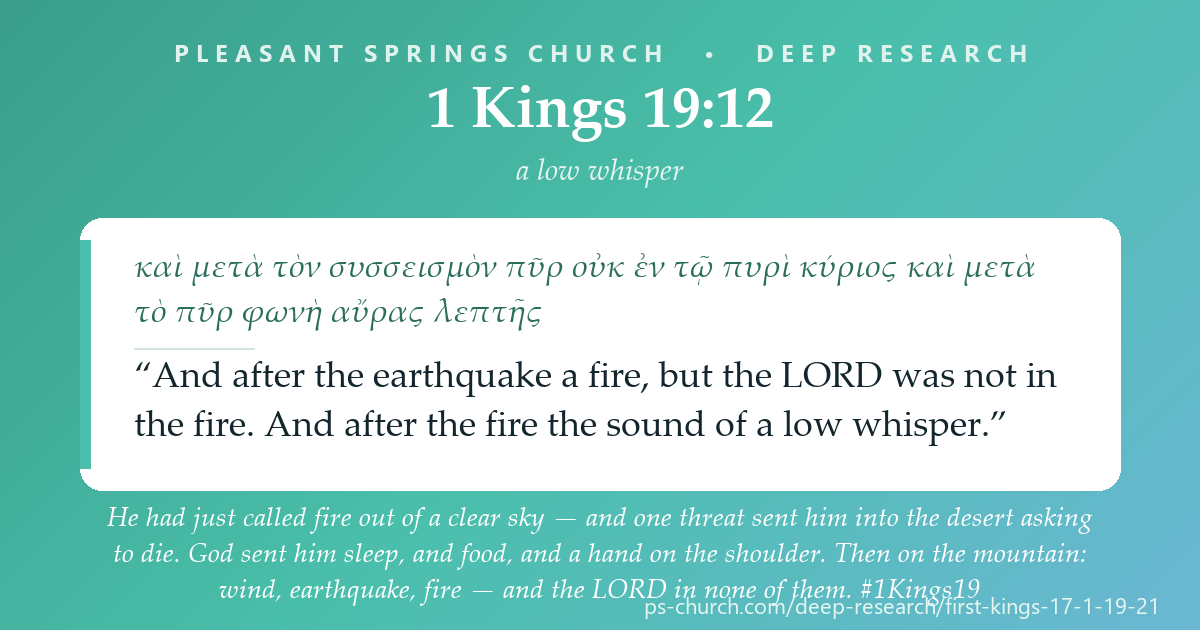
Step in response: two things this week. First, find the exhausted person and bring food before you bring advice. That is not a lesser ministry than preaching; it is what God did for his greatest prophet on the worst day of his life. Second, get quiet enough, once, to test whether you would have noticed 19:12. Most of us have arranged our lives so that a low whisper could not possibly reach us — and then we wonder why God seems to be in the wind and the earthquake and the fire and never in the room.
1 Kings 19:11–12 · to share
Greek (Rahlfs, 3 Kingdoms) + ESVEvery Deep Research page traces its passage across the whole sweep — the Old Testament, the Second-Temple world between the testaments (historical witnesses, not Scripture), and the New Testament. Follow the thread:
Pleasant Springs Church — Deep Research
Research method after Michael S. Heiser’s Bible Research Method (examine dictionaries → ancient literature → important words → textual connections → academic publications → share), with the Pleasant Springs “Author & Audience” foundation. Scripture set in the Hebrew, the Greek editions named on each page and the ESV (Old Testament), and the Greek New Testament and the ESV (New Testament), per the practice of Pleasant Springs Church. 1 Kings 17–19 research grounded in Cogan (Anchor Bible), DeVries (WBC), Sweeney (OTL), Provan (NIBC), House (NAC), Wiseman (TOTC) and Brueggemann (Smyth & Helwys), with Walsh (Berit Olam) and Alter for the literary reading used in the structure block, Cross (Canaanite Myth and Hebrew Epic) for the storm-theophany background, and Fernández Marcos and Tov on the Greek. ⚠️ The texts. The Greek Old Testament calls this book 3 Kingdoms (Βασιλειῶν Γʹ), one part of a single four-book work with Samuel; the Greek column above is Rahlfs’s Septuaginta in the CATSS morphological digitization, punctuation editorial, proper names unaccented. Section: using Thackeray’s letters and Barthélemy’s analysis (Les Devanciers d’Aquila, 1963), the kaige sections of Kingdoms are βγ (2 Kgdms 11:2–3 Kgdms 2:11) and γδ (3 Kgdms 22–4 Kgdms 25). 1 Kings 17:1–19:21 lies wholly inside the intervening OLD GREEK section, γγ (3 Kgdms 2:12–21:43), and this is stated on the page rather than left implicit — so the Greek printed here is not a revision toward a proto-Masoretic Hebrew, and its many pluses and minuses go back to the translator or to his Hebrew rather than to a corrector. Because this is not a kaige stretch, the usual warning about Vaticanus being a revision does not apply here; no Antiochene (Lucianic) reading is cited, because the critical edition (Fernández Marcos and Busto Saiz) was not consulted, and there is as yet no Göttingen 3 Kingdoms — the fuller apparatus is Brooke–McLean. On the policy, the texts we print. ⚠️ The Greek rearrangement of 1 Kings was verified in Rahlfs before being described, not repeated from a summary: the Miscellanies stand at 2:35a–o and 2:46a–l; the alternate Jeroboam narrative at 12:24a–z; a block at 16:28a–h gives Jehoshaphat’s whole reign, which the Hebrew holds until 22:41–50; and the two chapters after ours stand in reverse order (3 Kgdms 20 = Hebrew 21, Naboth, 29 verses; 3 Kgdms 21 = Hebrew 20, Ben-hadad, 43 verses — counted). Which arrangement is earlier is not adjudicated here. None of it touches 17:1–19:21, and there is no chapter- or verse-offset in this passage: Rahlfs has 24, 46 and 21 verses in chapters 17, 18 and 19, exactly as the Hebrew and English do, counted rather than assumed. (Malachi’s Elijah oracle does carry an offset and it is given both ways: Hebrew Malachi 3:23–24 = English 4:5–6.) Every divergence in the verses printed is enumerated in full in the codex note — among them the four in 17:1, “he breathed on him” for “he stretched himself upon him” at 17:21, the missing “the Lord listened to the voice of Elijah” at 17:22, “the prophets of shame” at 18:19 and 25, the lost pasah pun at 18:26, three taunts instead of four at 18:27, the whole added speech at 18:29, “he was weeping” for “Ahab rode” at 18:45, the plus “if you are Eliou, then I am Iezabel” at 19:2, “he was afraid” against the Masoretic “he saw” at 19:3, the plus “tomorrow” at 19:11, the plus “and there was the Lord” at 19:12, second person for first at 19:18, and the missing mother at 19:20 — and where the columns agree, that is said rather than left to silence. Three ketiv/qere readings (17:14; 18:36; 19:4) are printed as the qere and named. Hebrew from the Masoretic Text with pointing and cantillation. Structure block: a Leitwort diagram on קוֹל, eight occurrences (17:22; 18:26, 27, 28, 29, 41; 19:12, 13), counted by us and checkable; the rungs are offered as one reading of the shape and the vocabulary as the fact; and it is stated in the foot that the Greek column lacks the first of the eight. The pasah pun (18:21, 26) and the ʿamad lip̄nê phrase (17:1; 18:15; 19:11, 13) were likewise counted rather than asserted. ANE material verified in the local scan of Pritchard’s ANET: the Ugaritic Baal cycle at 130, 135, 139 and 141; the Kurkh Monolith naming “Ahab, the Israelite” at 278–279; the Mesha Stele at 320–321. Second-Temple and rabbinic witnesses (Sirach 48:1–11; Josephus, Ant. 8.13.2–8, including his quotation of Menander of Ephesus; m. Taanit 2:4; m. Eduyot 8:7) are read as witnesses and never levelled with Scripture, and the Deuterocanon is tagged non-canonical at first mention; where they close gaps the Hebrew leaves open, that is pointed out rather than borrowed. Chronicles is treated as a parallel witness and not harmonised: it has no Elijah narrative at all. ⚠️ Pastoral fence at 18:40. The verse is printed in full and not skipped; the verb is identified (šaḥaṭ, the sacrificial slaughter verb, once in these chapters); it is stated that the text gives no number (450 were summoned; the 400 Asherah prophets are named only at 18:19 and the Hebrew never says they came, so “850” is an addition to Scripture) and no divine command; the covenant-national frame is given as context and explicitly not as justification; the difficulty is owned rather than resolved, and Elijah is neither excused nor reduced to a murderer. It is then stated unmistakably that the verse licenses nothing today, on the canon’s own authority — Luke 9:54–55, where Jesus rebukes disciples who wanted to call down Elijah’s fire (with the “as Elijah did” variant reported as a variant), 2 Corinthians 10:4 and Ephesians 6:12 — and it is noted that 19:15–17 takes the sword out of the prophet’s hands and that Hosea 1:4 later condemns the blood of Jezreel. The “three years” of 18:1 against the “three years and six months” of Luke 4:25 and James 5:17 is reported as a difference, not harmonised. Qōl dəmāmāh daqqāh is presented with the renderings side by side (KJV, ESV and its footnote, NRSV, JPS, Rahlfs, Vulgate, Josephus) and deliberately not settled; it is stated that the Hebrew, unlike the wind, earthquake and fire, never says the Lord was in it, and that the Greek closes that gap with a plus. Whether Elijah is rebuked at Horeb is reported as genuinely disputed with the evidence for both readings named. Typology is handled in the three ratified layers: what the Old Testament text says (it announces none), what the New Testament itself draws (Luke 4:25–26; Matthew 17:3; Matthew 11:14 and 17:10–13 with John 1:21 held against them; Luke 9:54–55; Romans 11:2–4; James 5:17–18 — attributed and taught plainly), and what we see from this side of the cross — labelled as ours, grounded in Luke 24:27, and neither deleted nor oversold.
Scripture quotations marked ESV are from the ESV® Bible (The Holy Bible, English Standard Version®), © 2001 by Crossway, a publishing ministry of Good News Publishers. ESV Text Edition: 2016. Used by permission. All rights reserved. The ESV text may not be quoted in any publication made available to the public by a Creative Commons license, and the ESV may not be translated in whole or in part into any other language. www.esv.org
|
Did this study bless you today? 💚 Give to Support PS Church100% of gifts go to the General Fund — thank you. |