The temple is finished, and God speaks to Solomon for the second and last time — “as he had appeared to him at Gibeon” — with a promise that has an if in front of it and a sentence behind it that nobody in Jerusalem wanted to hear: “this house will become a heap of ruins… and they will say, Why has the Lord done thus to this land and to this house?” Then three chapters of inventory. Twenty cities Hiram did not want, and a name that sounds like a sneer. A forced levy. A fleet on the Red Sea. And then the queen of Sheba, who does not come to admire — she comes “to test him with hard questions” — and who sees everything, down to the burnt offerings, until “there was no more breath in her.” What she says is the most important sentence in the passage, and it is not about the gold: “Because the Lord loved Israel forever, he has made you king, that you may execute justice and righteousness” (10:9). And then the narrator counts. Six hundred sixty-six talents of gold in one year. Shields. An ivory throne with fourteen lions. Silver as common in Jerusalem as stone. And horses, imported out of Egypt — at which point any reader who has the law of the king in his head has stopped enjoying the list. Chapter 11 is the indictment, and it is reported here exactly as the text reports it: “Solomon loved many foreign women… from the nations concerning which the Lord had said… for surely they will turn away your heart after their gods.” The stated issue is covenant loyalty, not ancestry — the same Bible puts a Moabite in David’s line and commends her — and this page says so plainly. “His wives turned away his heart”; a high place for Chemosh on the ridge east of the city, in sight of the house he had built; the Lord’s anger, grounded in the fact that he had appeared to him twice; and then the adversaries — Hadad, Rezon, and a young foreman named Jeroboam, met on the road by a prophet who tore a new cloak into twelve pieces and handed him ten. This study works 1 Kings 9:1–11:43 in Hebrew, Greek and ESV, and it names the text-critical situation instead of hiding it: these chapters lie between the two kaige sections, so the Greek in front of you is Old Greek and not a revision — which is exactly why 3 Kingdoms tells this part of the story in a visibly different order. See the method →
1 Kings 9:1–11:43 (selections)
Hebrew · LXX (Rahlfs, 3 Kingdoms) · ESVThe book, the section, and the single most important thing to know about the Greek of these three chapters. In the Septuagint this book is 3 Kingdoms (3 Reigns) — Βασιλειῶν Γʹ (Basileiōn G). 1–2 Samuel and 1–2 Kings are one continuous work in Greek, Βασιλειῶν Αʹ–Δʹ, and a reader hunting for “1 Kings” in a Greek Bible will not find it under that name. (Worth noticing once: our English names for the Torah — Genesis, Exodus, Leviticus, Numbers, Deuteronomy — are the Septuagint’s names, while Samuel and Kings keep Hebrew-derived ones. An English Bible already mixes both traditions on its contents page.)
⚠️ Which section is this? — and it matters more here than almost anywhere. Dominique Barthélemy showed in Les Devanciers d’Aquila (1963) that the Greek of Kingdoms is not one translation. Two long stretches are a later kaige revision — a first-century pull of an older Greek text back toward a proto-Masoretic Hebrew, named for its stereotyped rendering of Hebrew גַּם (gam) by καί γε. Those stretches are 2 Kingdoms 11:2 → 3 Kingdoms 2:11 (Thackeray’s βγ) and 3 Kingdoms 22 → 4 Kingdoms 25 (γδ). 1 Kings 9–11 falls between them. Our passage sits squarely inside the Old Greek stretch — roughly 3 Kingdoms 2:12 to 21:43 — and NETS marks it that way on the running head of every page. The siblings that straddle a seam are 1 Kings 1–2 (kaige ends at 2:11) and 1 Kings 20–22 (kaige begins at chapter 22); on the other side of the seam, everything from 2 Samuel 11:2 onward is inside βγ.
Said plainly, because it cuts both ways. Inside a kaige section, Codex Vaticanus is a revision and the Antiochene (Lucianic) manuscripts often preserve an older Greek reading. Out here, in the Old Greek, the reverse is true: the Greek in the middle column is most likely the oldest Greek we have, nobody has pulled it toward the Hebrew — and that is exactly why the two columns diverge so wildly in these chapters. The differences below are not sloppiness. They are what an unrevised translation of a different Hebrew text actually looks like. This page prints Rahlfs’s Septuaginta (1935, CATSS digitization; punctuation editorial, proper names unaccented) and says so in the column heading. No Antiochene reading is cited here, because we have not consulted the critical edition — that is Fernández Marcos and Busto Saiz, El texto antioqueno de la Biblia griega; the fuller apparatus is Brooke–McLean’s larger Cambridge Septuagint. On why this library prints what it prints, see the texts we print.
⚠️ 3 Kingdoms does not tell this story in the same order, and this is where you see it. The Greek book carries blocks the Hebrew has nowhere — the so-called “Miscellanies” at 2:35a–o and 2:46a–l — and it moves material about. Here is what actually stands in Rahlfs, checked verse by verse rather than repeated from a handbook. (1) The whole levy report is gone from chapter 9. Rahlfs runs 9:14 straight to 9:26: MT 9:15–25 is simply not there. (2) It turns up in three other places. MT 9:15 and 9:17–22 stand at 3 Kgdms 10:22a–c, after the ships of Tarshish. MT 9:24 (Pharaoh’s daughter brought up from the city of David) stands twice over — at 3 Kgdms 9:9a and again in the first Miscellany at 2:35f. MT 9:25 (the three yearly offerings) is at 2:35g, MT 9:23 (the chief officers) at 2:35h, and the list of rebuilt cities at 2:35i–k. (3) One verse we could not find at all. MT 9:16 — Pharaoh capturing Gezer and giving it as a dowry — has no equivalent in Rahlfs at chapter 9, at 2:35a–o, or at 10:22a–c. (4) A further plus: 3 Kgdms 10:26a repeats MT 4:21. (5) Chapter 11 is reordered. MT 11:3 has no verse of its own (its numbers are folded into 11:1), and the four verses on the shrines are shuffled: Gk 11:5 = MT 11:7 (the high place for Chemosh and for “their king”), Gk 11:6 = the Astarte clause of MT 11:5, Gk 11:7 = MT 11:8, Gk 11:8 = MT 11:6. (6) Rezon moves. MT 11:23–25a is pulled forward and fused into Gk 11:14 (where he is Εσρωμ, not Rezon), so Rahlfs has no 11:23 or 11:24. (7) A minus: Rahlfs has no 11:39 — “And I will afflict the offspring of David because of this, but not forever” is not in the Greek. (8) And a whole second telling. After 12:24 the Greek adds 12:24a–z, an alternate Jeroboam narrative in which his mother Sarira is called a prostitute, Pharaoh Shishak gives him a wife named Ano, and the Ahijah scene is told over again — material this page hands on to 1 Kings 12–16. (Further on, the Greek also runs MT chapters 20 and 21 in the reverse order; that belongs to 1 Kings 20–22.) Which arrangement is earlier is a genuine, live, unsettled scholarly argument — some hold the Greek reflects an older Hebrew edition, others that it is a later reworking — and this page does not adjudicate it. It reports what is on the page in each column and lets the reader see the shape of the problem.
Numbering. There is no systematic chapter- or verse-offset between the Hebrew and the Greek here: Rahlfs numbers these chapters 9, 10 and 11 exactly as the Hebrew does, and the differences are the specific absences and letter-verses listed above rather than a running offset. That was counted, not assumed. (One cross-reference on this page does carry an offset and is given both ways: the “Why has the Lord done thus to this land?” of 9:8 is quoted almost word for word from Deuteronomy 29:24 in English Bibles = MT and LXX Deuteronomy 29:23, because Hebrew and Greek both close chapter 28 with a verse 69 that English Bibles print as 29:1.)
The divergences in the verses printed above, enumerated — not a sample, the list. 9:2 identical. 9:4 identical in substance; Greek reverses “statutes” and “commandments.” 9:8 Hebrew and Greek both read “high” (עֶלְיוֹן / ὁ ὑψηλός); the ESV’s “heap of ruins” is from the Syriac and Old Latin and is footnoted as such in the ESV. 9:13 Greek translates the name Cabul as ὅριον, “Boundary.” 9:26 “Red Sea” (yam sûp) becomes “the last sea.” 9:28 420 talents Hebrew / 120 Greek (and 450 in 2 Chronicles 8:18). 10:1 the Hebrew’s “fame of Solomon with respect to the name of the Lord” becomes two parallel objects in Greek. 10:5 “no breath left in her” becomes “she was beside herself.” 10:8 Hebrew “happy are your men” (אֲנָשֶׁיךָ); Greek “happy are your wives” (αἱ γυναῖκές σου), reading the same consonants without the aleph. 10:9 Greek construes “to establish it forever.” 10:14 identical, 666. 10:16 Hebrew 200 shields, 600 shekels each; Greek 300 spears, 300 gold pieces each. 10:17 agree. 10:19 Hebrew “a round top”; Greek “heads of calves” (προτομαὶ μόσχων) — the reading the ESV footnotes. 10:22 Hebrew brings back “ivory, apes and peacocks”; Greek brings back “carved and hewn stones” — the animals are not in the Greek (2 Chronicles 9:21 has the animals). 10:26 Hebrew 1,400 chariots; Greek 4,000 mares; 2 Chronicles 9:25 4,000 stalls. 10:27 Greek adds “gold.” 10:28 Hebrew Kue; Greek Thekoue. 10:29 Hebrew 600 / 150 shekels; Greek 100 / 50; and the Hebrew’s “through them they were exported” becomes “they went out by sea.” 11:1 Greek plus φιλογύναιος, the numbers of 11:3 moved up, and a different list of nations (Syrians, Amorrites; no Sidonians). 11:2 “their gods” becomes “their idols.” 11:3 absent as a verse. 11:4 clauses reversed; Greek adds “foreign” to the wives. 11:5–8 reordered as set out above; Ashtoreth “the goddess of the Sidonians” in Hebrew is “the abomination of the Sidonians” in Greek (also at 11:33), and “Milcom / Molech” is read as the common noun “their king”; 11:7 has no “on the mountain east of Jerusalem.” 11:11 Hebrew “my covenant and my statutes,” Greek “my commandments and my ordinances.” 11:12–13 where the Hebrew says “tear,” the Greek twice says “take.” 11:14 Greek fuses Rezon in here and calls him Εσρωμ. 11:23–24, 11:39 absent. 11:25 Hebrew has Rezon reign “over Syria,” Greek has Hader reign “in the land of Edom.” 11:26 the Hebrew names Jeroboam’s mother Zeruah; the Greek says only “son of a widow woman,” and locates him at Sarira. 11:31 agree. 11:32, 11:36 Hebrew one tribe, Greek two scepters (though Greek 11:13 has one). 11:33 Hebrew “they forsook… they walked” (plural), Greek singular — the ESV footnotes this. 11:43 Greek plus, the material of MT 12:2. That is the whole list for these verses. Where nothing is noted — 9:2, 10:14, 11:31 — the columns say the same thing, and that is worth saying out loud rather than leaving to silence.
Chronicles, as a parallel witness and not a harmonizing patch. 2 Chronicles 8–9 tells the same reign, and where it differs it is reported here, not blended: 450 talents against 420 and 120; 4,000 stalls against 1,400 chariots and 4,000 mares. And the biggest difference of all is a silence: Chronicles has no chapter 11. There are no foreign wives in it, no Ashtoreth, no high place east of the city, no adversaries — 2 Chronicles 9:29–31 goes from “the rest of the acts of Solomon” straight to his burial. And yet the Chronicler plainly knows the material: in the very same sentence he cites “the prophecy of Ahijah the Shilonite” and “the visions of Iddo the seer concerning Jeroboam the son of Nebat.” Two inspired books, two purposes, one reign; we let both stand.
The Shape of the Passage
InclusioBehind these chapters stand two texts the reader is expected to know: the promise to David that a son’s throne would be established (2 Samuel 7:12–16) and the law of the king, which forbids a king to multiply horses, wives, and silver and gold (Deuteronomy 17:14–20). In front of them stands a kingdom split in two, and a Greek Bible that tells the story in a noticeably different order.
Author
A writer who convicts by inventory. He does not editorialize about the gold. He counts it. Six hundred sixty-six talents in a year; two hundred shields and three hundred more; an ivory throne with six steps and fourteen lions; silver lying about the city like gravel; four thousand stalls, twelve thousand horsemen, and a standing trade in Egyptian horses. Not one adjective of blame is attached to any of it. Then, at 11:1, he starts a new sentence with a verb — “loved” — and the reader who has Deuteronomy 17 in his head has already done the arithmetic. The narrator lets the ledger do the work.
He also builds his frame out loud. Most biblical frames have to be inferred. This one is stated: God appeared in 9:2, and in 11:9 the anger is explained by the fact that God had appeared to him twice. He does the same with the pivot — he lets a foreign queen say the one sentence in three chapters that names what a throne is for (10:9), and then spends the next sixteen verses listing what Solomon actually accumulated instead.
And he is part of a longer book. In the Greek Bible this is not the start of anything; it is the third scroll of a single four-part work, Βασιλειῶν Αʹ–Δʹ. The judgments in 11:9–13 — the kingdom torn, one tribe left “for the sake of David my servant and for the sake of Jerusalem” — are the hinge on which the remaining chapters of 3 and 4 Kingdoms turn. Everything after this is the story of two kingdoms, and this is where the tear begins.
Audience
People who already lived in the wreckage. 9:6–9 does not read like a warning to a court at its height. It reads like an explanation offered to people standing in front of a ruin: “Why has the " + SC + " done thus to this land and to this house?” That question is quoted, nearly word for word, from Deuteronomy 29:24 (MT and LXX 29:23), where it is put in the mouths of the nations after an exile. An audience that had seen the temple burn would have recognized the sentence immediately — and would have heard it as an answer, not a threat.
People who needed to know that the promise had not failed. The most carefully worded thing in chapter 11 is the limit on the judgment: not the whole kingdom, not in Solomon’s days, and one tribe left “for the sake of my servant David… and for the sake of Jerusalem, the city that I have chosen” (11:12–13, 32, 36). That is 2 Samuel 7 being honoured and disciplined in the same breath, exactly as 2 Samuel 7:14–15 said it would be. The covenant is not cancelled by the punishment; it is the reason the punishment has a floor.
And people tempted to think prosperity settles the question. By any measure available to a subject of Solomon, this was the most successful reign in Israel’s history — peace on every side, an international reputation, a finished temple, a functioning economy. The book reports all of it and then tells you the man’s heart was divided. An audience is being taught to read success without being persuaded by it.
Orient on Kingdoms and its Greek recensions, Sheba and the incense trade, the corvée, Deuteronomy’s law of the king, and the gods named in chapter 11.
Search by topic: Kings, Books of; Kingdoms, Books of (Greek); kaige recension; Antiochene / Lucianic text; Miscellanies (3 Kingdoms); Solomon; Hiram of Tyre; Cabul; Ezion-geber; Ophir; Tarshish ships; Sheba / Saba; Arabia; incense trade; corvée and forced labor; mas and sebel; Deuteronomy, law of the king; Ashtoreth / Astarte; Chemosh; Milcom / Molech; high place (bamah); satan (adversary); Hadad; Rezon; Jeroboam; Ahijah the Shilonite; Shishak / Sheshonq I.
Which articles are relevant?
- Anchor Bible Dictionary — “Kings, Books of,” “Solomon,” “Hiram,” “Cabul,” “Ezion-geber,” “Ophir,” “Tarshish,” “Sheba, Queen of,” “Saba,” “Corvée,” “Ashtoreth,” “Chemosh,” “Milcom,” “High Place,” “Satan,” “Jeroboam,” “Ahijah,” “Shishak” — and the two most readers skip and should not, “Septuagint” and “Kaige Recension.”
- Dictionary of the OT: Historical Books (IVP) — “Kings, Books of,” “Solomon,” “Wealth and Prosperity,” “Forced Labor,” “Non-Israelite Written Sources,” “Text and Textual Criticism.”
- NIDOTTE / TDOT — לֵב / לֵבָב (lēḇ / lēḇāḇ, heart), נָטָה (nāṭāh, turn away), דָּבַק (dāḇaq, cling), קָרַע (qāraʿ, tear), חִידָה (ḥîḏāh, riddle), שָׂטָן (śāṭān, adversary), בָּמָה (bāmāh, high place), מַס (mas, forced levy), שִׁקּוּץ (šiqqûṣ, detestable thing).
- On the Greek — Paul D. McLean and Bernard A. Taylor, “3 Reigns: To the Reader,” in NETS; and Natalio Fernández Marcos, The Septuagint in Context, on the recensions and the Antiochene text. These are where the description of 3 Kingdoms in the codex note comes from — the section boundaries, the Miscellanies, and the transposed blocks.
Bibliography surfaced:
- Mordechai Cogan, I Kings (Anchor Bible); Simon J. DeVries, 1 Kings (WBC); Marvin A. Sweeney, I & II Kings (OTL); Iain W. Provan, 1 and 2 Kings (NIBC); Paul R. House, 1, 2 Kings (NAC); Donald J. Wiseman, 1 and 2 Kings (TOTC).
- Emanuel Tov, The Textual Criticism of the Hebrew Bible, and his essays on 3 Kingdoms as a rewritten composition; A. Graeme Auld, Kings Without Privilege, for the Samuel–Kings / Chronicles relationship read from the other end. (These scholars are cited for their textual work; the church’s confession about Scripture is its own and is not theirs.)
Arabian queens who really existed, the incense road, a corvée that was normal and resented anyway, and the pharaoh who sheltered a fugitive.
First the world: what a caravan of spices from South Arabia actually was, why a queen at the head of one is not exotic, what forced labour meant to a village, and who Shishak was. Then watch what the later retellings add to Solomon — and what one of them takes away.
Which parallels shed light on this world?
A queen of Arabia arriving with camels, spices and gold is not a fairy tale — it is a documented eighth-century phenomenon. The Assyrian royal annals name Arabian queens by name and list exactly the goods 1 Kings 10:2 lists. Tiglath-pileser III records Samsi, queen of Arabia, and beside her the Sabaeans, bringing “male and female camels and all kinds of spices”; Sargon II records tribute “from Samsi, queen of Arabia (and) It’amar the Sabaean, gold in dust-form, horses (and) camels.” Both are printed in ANET and both were checked in the copy we hold. Sheba is Saba’, in what is now Yemen — roughly 1,400 miles away, at the far end of the incense road, and the natural southern terminus of a trade in frankincense and myrrh that ran north through Arabia to the Levant. A monarch controlling that road had every commercial reason to visit a king who had just put a fleet on the Red Sea at Ezion-geber (9:26). The visit is diplomacy and trade as well as wonder, and the text is not embarrassed by that: she leaves having given a hundred and twenty talents, and having received “all that she desired, whatever she asked.”
The forced levy was ordinary, and it was still the thing that broke the kingdom. Corvée labour — מַס (mas) — is attested across the ancient Near East as the standard way a state without a wage economy built anything large. What is striking in 1 Kings is not the practice but the bookkeeping: 9:20–22 insists the permanent slave levy fell on the peoples not destroyed, “and of the people of Israel Solomon made no slaves.” Then 5:13 has already said he conscripted thirty thousand men out of all Israel, and 11:28 puts Jeroboam “over all the forced labour of the house of Joseph.” The book does not resolve the tension, and neither will we. What it does do is remember: the first sentence the northern tribes speak after Solomon dies is “your father made our yoke heavy” (12:4).
And Shishak was a real pharaoh with a real Palestinian campaign. 11:40 has Jeroboam flee to “Shishak king of Egypt.” ANET identifies him plainly: “Sheshonk I (about 945–924 B.C.) is the Shishak of the Old Testament,” and reproduces his list of conquered Palestinian towns from the temple of Amon at Karnak, together with the fragment of his stela found at Megiddo. He turns up again five verses into the next book-section, plundering the temple in 14:25–26. The man who shelters the rebel is the man who will come back for the gold.
- The annals of Tiglath-pileser III and Sargon II on the Arabian queens, ANET 283–286 (royal inscriptions — witnesses, not Scripture; verified in the local scan) — “As for Samsi, queen of Arabia…”, “the inhabitants of Mas’ai, Tema, the Sabaeans… brought to me… male and female camels and all kinds of spices”, and “I received the tribute… from Samsi, queen of Arabia (and) It’amar the Sabaean, gold in dust-form, horses (and) camels.” Two centuries later than Solomon, and therefore evidence about the world of the story rather than about the visit itself — which is exactly how this page uses it.
- The campaign of Sheshonk I, ANET 263–264 (Egyptian royal inscription — a witness, not Scripture; verified in the local scan) — “Sheshonk I (about 945–924 B.C.) is the Shishak of the Old Testament.” ANET is candid that the Egyptian texts do not add much to the biblical account; the town list at Karnak and the Megiddo stela fragment are what there is.
- Sirach 47:12–22 (Second-Temple, in the Deuterocanon — a witness, not Scripture) — Ben Sira praises Solomon in the same terms this chapter uses and then turns on him in the same breath: “you gathered gold like tin and amassed silver like lead” (47:18, and compare 10:27), and then “But you laid your loins beside women… You put a stain upon your honor, and defiled your posterity, so that you brought wrath upon your children… so that the sovereignty was divided and a disobedient kingdom arose out of Ephraim” (47:19–21). That is 1 Kings 11 compressed into three lines — and Ben Sira ends where 11:36 does, with a lamp left for David: “so he gave a remnant to Jacob, and to David a root of his stock.”
- Josephus, Antiquities 8.6.5–6 and 8.7.5–8 (Second-Temple — a witness, not Scripture) — he retells all of this as plain history, and two of his moves are worth knowing. He identifies the queen not as an Arabian but as “the queen of Egypt and Ethiopia,” a reading with a long afterlife and no basis in the text of 1 Kings. And on chapter 11 he does not soften: Solomon “grew mad in his love of women,” married “out of foreign nations,” and let them live by the laws of their own countries. He keeps Ahijah’s torn garment and the ten pieces intact.
- Matthew 12:42 is treated in Stage 4; it is quoted here only to note that the queen’s own verdict in 10:9 is theological before any New Testament writer makes anything of her.
Set the witnesses side by side and a pattern appears. Ben Sira keeps the fall and reads it as cause and effect: wives, wrath, a divided kingdom. Josephus keeps the fall and sharpens the language. The Chronicler, writing inside Scripture itself, keeps the glory and does not tell the fall at all — and yet cites the prophecy of Ahijah and the visions of Iddo “concerning Jeroboam the son of Nebat” in the same sentence, so the omission is a choice and not an ignorance (2 Chronicles 9:29–31).
And the Greek does something different again. It does not moralize; it rearranges. The levy report is lifted out of chapter 9 and set down after the ships of Tarshish; Pharaoh’s daughter is moved up; the story of Jeroboam is told twice, in two versions, with different details in each. Whether that arrangement is older than the Hebrew one or later is genuinely unsettled among people who have spent careers on it, and this page does not pretend to settle it.
The rule, then, is the one this library uses everywhere: report what the text approves, report what it merely reports, report what it condemns — and when two ancient forms of a book differ, print both and say which you are printing. 1 Kings 9–11 is a particularly good place to practise it, because the honest answer to “what does the Septuagint say here?” is genuinely long.
One noun that measures the whole passage, one verb of loyalty pointed the wrong way, and one torn garment.
Count lēḇ yourself — ten, and the first one is God’s. Then watch dāḇaq, the covenant-clinging verb, attached to the wrong object; hold mišpāṭ ûṣəḏāqāh from a foreigner’s mouth against the sixteen verses of inventory that follow it; and notice that the Deuteronomy 17 echo is real in the noun and not in the verb.
“Heart” — the mind and will together, not the emotions. Ten occurrences in these three chapters, and the arc is the whole story: God says “my eyes and my heart will be there for all time” (9:3); the condition is “integrity of heart” (9:4); the queen speaks all that is on her heart (10:2); God puts wisdom in Solomon’s heart (10:24) — and then six times in chapter 11 the same noun records where that heart went. The Greek keeps every one of them as καρδία, so this thread, at least, crosses intact.
“Stretch out, incline, turn aside” — in the causative, to turn something away. It is the verb of the indictment, four times: the nations “will turn away your heart” (11:2), “his wives turned away his heart” (11:3, 11:4), and finally, with no human subject at all, “because his heart had turned away from the Lord” (11:9). Be precise about Deuteronomy 17:17 here: it warns that many wives will make the king’s heart turn aside, but its verb is סוּר (sûr), not this one. The shared word is heart, not the verb — and this page says so rather than letting a good sermon point outrun the Hebrew. The Greek uses ἐκκλίνω throughout.
“Cling, cleave, stick fast.” The narrator’s verdict on Solomon in one verb, and it is a loaded one: it is the word of “a man shall leave his father and his mother and hold fast to his wife” (Genesis 2:24), of Israel commanded to hold fast to the Lord (Deut 10:20; 11:22), and of Ruth clinging to Naomi (Ruth 1:14). The capacity for covenant loyalty is exactly the capacity being misdirected. Greek: ἐκολλήθη.
“Riddle, hard saying” — not a quiz question but a deliberately knotted puzzle. It is what Samson poses at his wedding (Judges 14:12–18) and what the psalmist says he will open on the lyre (Psalm 49:4). The queen comes to test (lənassōṯō, the verb used of God testing Israel and of Israel testing God) — she is not a tourist. Greek: ἐν αἰνίγμασιν, the word behind our “enigma,” and the same word Paul will use for seeing “in a mirror, dimly” (1 Corinthians 13:12).
“Justice and righteousness” — a fixed pair, and in the Old Testament it is what government is for. It is what Abraham’s household is chosen to keep (Genesis 18:19), what David is said to have done for all his people (2 Samuel 8:15), and what the shoot from Jesse’s stump will do. A foreign queen puts it in Solomon’s job description in the middle of a tour of his treasury, and then the narrator lists the treasury for sixteen more verses without mentioning justice once. Greek: κρίμα ἐν δικαιοσύνῃ.
“Adversary, opponent” — here an ordinary noun for a human enemy, used three times of Hadad and Rezon. These are men with armies, not spirits, and reading the later personal name into this chapter would be an error of vocabulary. Two things are worth seeing all the same. First, the subject: “the Lord raised up an adversary” (11:14, YHWH) and “God also raised up” (11:23, ʾəlōhîm) — the political trouble is attributed directly to God. Second, the Greek does not translate it: Rahlfs simply transliterates, σαταν, twice in 11:14, indeclinable. A lexical fact, not a demonology.
“Tear, rend.” Eight occurrences in chapter 11, and they bind the sentence to the sign: God says “tearing I will tear” the kingdom (11:11), and then a prophet takes hold of a brand-new cloak and tears it into twelve pieces — the noun קְרָעִים from the same root — and hands over ten (11:30–31). It is the verb of mourning, of clothes torn at bad news. Report the Greek honestly: the ῥηγ- root carries six of the eight (διαρρήσσων διαρρήξω… ῥήγματα… ῥήσσω), but at 11:12 and 11:13 the Greek says take (λαμβάνω) where the Hebrew says tear. The drumbeat is a little quieter in Greek.
“High place” — a raised open-air shrine. The word frames Solomon’s whole reign: he meets God at the great high place of Gibeon in 3:4, before the temple exists and while “the people were sacrificing at the high places” is still excused (3:2); and he ends by building one for Chemosh “on the mountain east of Jerusalem” (11:7) — that is, on the ridge facing the house he had just finished. From then on, in 3 and 4 Kingdoms, “the high places were not taken away” becomes the standing verdict on king after king. Greek: ὑψηλόν.
Three things in the Hebrew and Greek of these chapters, reported rather than tidied:
- The Greek of chapter 11 quietly re-labels the foreign gods. Where the Hebrew calls Ashtoreth “the god(dess) of the Sidonians” (11:5, 11:33), Rahlfs calls her βδελύγματι Σιδωνίων, “the abomination of the Sidonians.” Where the Hebrew says the wives sacrificed “to their gods,” the Greek says “to their idols” (εἴδωλα, 11:2, 11:5 twice, 11:7, 11:33) — though not everywhere: 11:4 and 11:10 keep θεοί. This is a translator making a theological judgment inside the translation, and it is worth seeing precisely because we print the Greek: neither column is neutral, and both are ancient.
- “Molech” may not be a name in the Greek at all. The consonants מלכם / מלך can be read as the divine name Milcom / Molech or as the ordinary noun “their king.” The Hebrew pointing takes the first; Rahlfs takes the second, τῷ βασιλεῖ αὐτῶν, at both 11:5 and 11:33. The same ambiguity produced a famous split at 2 Samuel 12:30, where the Greek reads a proper name and the Hebrew pointing reads “their king.” We report it and do not decide it.
- The numbers in these chapters do not line up, in any direction. Ophir yields 420 talents (Hebrew), 120 (Greek), 450 (2 Chronicles 8:18). The shields are 200 at 600 shekels (Hebrew) and 300 at 300 (Greek). The horses are 1,400 chariots (Hebrew), 4,000 mares (Greek), 4,000 stalls (2 Chronicles 9:25). A chariot costs 600 shekels (Hebrew) and 100 (Greek). Numerals are the most fragile thing in any manuscript tradition — they are short, they were often written with signs, and a single stroke changes them. This page prints what each witness has and builds no argument on any of the figures, including 666.
The law of the king, the promise to David, the warning already written in Deuteronomy, and a queen Jesus quotes.
Trace four threads: Deuteronomy 17, item by item against chapters 10–11; Deuteronomy 7 and Exodus 34 on intermarriage, and what reason they give; Deuteronomy 28–29 behind the warning of 9:6–9, almost verbatim; and 2 Samuel 7, which is the reason the punishment has a floor.
Which cross-references matter?
- Deuteronomy 17:14–20 — the law of the king, and the single most important cross-reference on this page. Read it beside chapters 10–11 line by line. “He must not acquire many horses for himself or cause the people to return to Egypt in order to acquire many horses” — and 10:26–29 records twelve thousand horsemen and a standing import of horses from Egypt. “He shall not acquire many wives for himself, lest his heart turn away” — and 11:3 counts a thousand. “Nor shall he acquire for himself excessive silver and gold” — and 10:14–27 is a gold inventory that ends with silver lying about the streets. Two disciplines, both necessary. First, the narrator never cites the law. He gives no verdict here at all; he gives a ledger, and the reader supplies the verse. Second, be exact about what the text does and does not say: Deuteronomy warns against causing the people to return to Egypt, and 1 Kings reports a horse trade with Egypt, which is not the same claim. The fourth requirement — that the king write out a copy of the law and read it all his days — is never mentioned in 1 Kings at all.
- Deuteronomy 7:1–4; Exodus 34:15–16; Joshua 23:12–13 — the command 11:2 is quoting, and the reason each of them gives. Deuteronomy 7:4 is explicit: “for they would turn away your sons from following me, to serve other gods.” Not one of these texts gives a reason of blood or ancestry. The stated issue, every time, is who will be worshipped in the house. That is why this page will not read chapter 11 as a text about foreignness — and why the same Bible that records this chapter also records a Moabite great-grandmother for David (Ruth 4:17–22) and a Canaanite woman of Jericho in the same line, with no censure of either. Rahab and Ruth are not exceptions to a rule about ethnicity; they are evidence that there was no such rule. What there was, and is, is a rule about covenant loyalty.
- Deuteronomy 28:37 and Deuteronomy 29:24–26 (MT/LXX 29:23–25) — the warning of 9:7–9 is not new material; it is Deuteronomy, nearly word for word, and you can check it in the consonants. Deuteronomy 28:37: “you shall become a horror, a proverb and a byword” (לְמָשָׁל וְלִשְׁנִינָה); 1 Kings 9:7: “Israel will become a proverb and a byword” (לְמָשָׁל וְלִשְׁנִינָה) — the same two nouns in the same order. Deuteronomy 29:24: “Why has the Lord done thus to this land?” (עַל־מֶה עָשָׂה יְהוָה כָּכָה לָאָרֶץ הַזֹּאת); 1 Kings 9:8 has the identical clause. And both answer it the same way: “because they abandoned / forsook the Lord… and went and served other gods.”
- 2 Samuel 7:12–16 — the promise being tested. Nathan’s oracle said two things that both matter here: the son’s throne would be established, and “when he commits iniquity, I will discipline him with the rod of men… but my steadfast love will not depart from him.” 1 Kings 11 is that sentence being carried out with visible restraint — not in Solomon’s lifetime, not the whole kingdom, one tribe kept back “for the sake of my servant David” (11:12–13, 32, 36). The covenant is why the judgment has a limit.
- 1 Samuel 8:11–18 — Samuel’s warning about “the ways of the king,” which is a list of verbs: he will take your sons, your daughters, your fields, your servants, a tenth of your flocks. Read it, then read 1 Kings 9:15–22 and 12:4. The book is keeping its own receipts.
- Genesis 18:19; 2 Samuel 8:15 — where “justice and righteousness” comes from and what it is for. Abraham’s household is chosen “to keep the way of the Lord by doing righteousness and justice”; David “administered justice and equity to all his people.” The queen of Sheba is not inventing a standard in 10:9. She is reciting one.
- Deuteronomy 12:2–5 — on high places, and on the single chosen place. 11:7 puts a rival shrine within sight of the chosen place. The geography is the offence.
- Numbers 25:1–5 — the pattern chapter 11 repeats at the top of the state: Moabite women, a foreign god, and Israel yoked to Baal of Peor. What happened once in a camp in the wilderness happens again in a palace, with a treaty attached.
- The New Testament, in bold text only, because these pages do not yet exist here. Matthew 12:42: “The queen of the South will rise up at the judgment with this generation and condemn it, for she came from the ends of the earth to hear the wisdom of Solomon, and behold, something greater than Solomon is here.” Jesus makes her a witness for the prosecution — a foreigner who crossed a desert for wisdom, set against people who would not cross a street. Nehemiah 13:26 uses Solomon as the standing warning in a later intermarriage crisis: “Did not Solomon king of Israel sin on account of such women?”
This chapter has been used badly, and often, so let us be exact about what is on the page.
What the text says. Solomon married many foreign women. The nations they came from were nations Israel had been told not to intermarry with. The text gives the reason, in the same verse: “for surely they will turn away your heart after their gods” (11:2). Then it reports that this is exactly what happened (11:4), names the shrines he built (11:5–8), and records the Lord’s anger and its stated ground — not the marriages as such, but that “his heart had turned away from the Lord… who had appeared to him twice” (11:9).
What the text does not say. It does not say that foreign blood is a defect. It does not say that these women were worse people than Israelite women. It does not blame them for Solomon’s choices — every verb of building in 11:5–8 has Solomon as its subject: he went after, he built, he did. And it says nothing whatever that licenses treating any modern person as a danger on account of where they were born. The issue named in the text is covenant loyalty, and this page will not let it be turned into an issue of ancestry.
The rest of Scripture makes the point for us. Rahab of Jericho and Ruth the Moabite are both in David’s line and both are commended (Joshua 2; Ruth 1:16–17; Ruth 4:17), and one of the two is from the very nation whose god Solomon builds a shrine for in 11:7. Ruth said “your God my God”; that is the whole difference, and it is not a difference of birth. The daughter of Pharaoh, meanwhile, is listed first in 11:1 and is never once said to have led him anywhere.
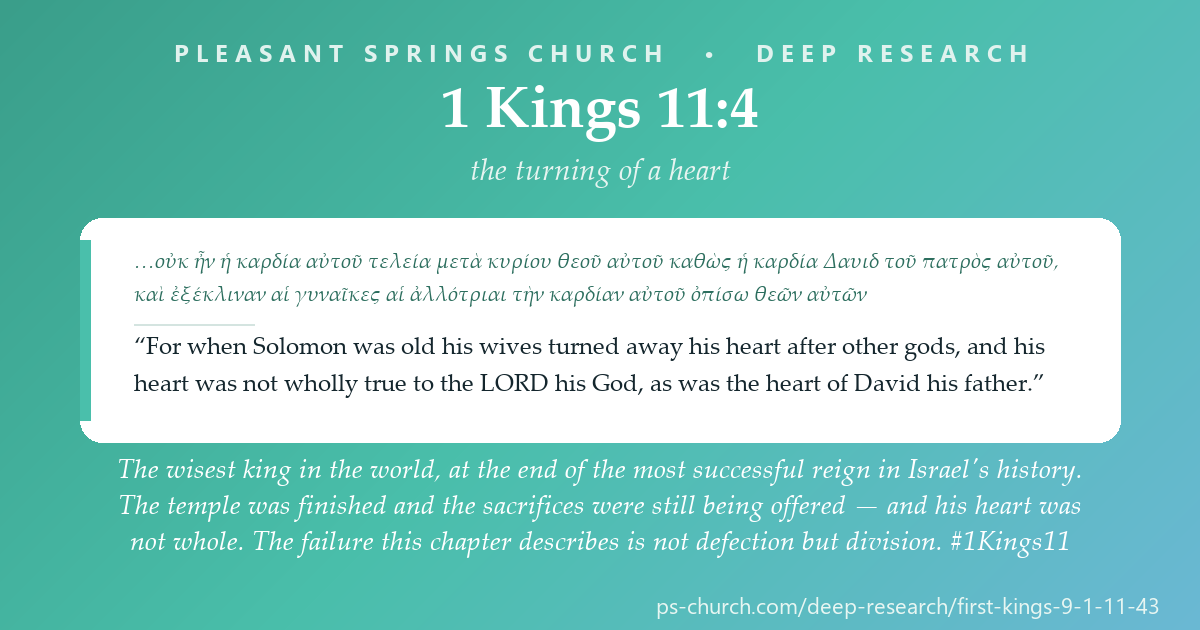
And the danger is not exotic. The text puts the whole weight on one organ, ten times, and the last four are the tragedy. Solomon did not renounce the Lord. He added. He kept the temple running and built the other shrines too — and 11:4 does not say his heart was hostile, it says it was not whole. The failure this passage describes is not apostasy but division, and that is a failure available to anyone who has never married anybody.
The commentaries, the two Greek editions of 1 Kings, the Chronicles problem, and what to do with 666.
Cogan, DeVries, Sweeney, Provan, House and Wiseman on Kings; NETS and Fernández Marcos on the Greek; Tov on 3 Kingdoms as a differently-edited book. Then four live questions: which arrangement is earlier, what to do with the numbers, how to read Chronicles’ silence, and whether the narrator is condemning the wealth.
Commentaries & studies:
- Mordechai Cogan, I Kings (Anchor Bible) — the fullest on the ANE background and the Phoenician and Egyptian material; Simon J. DeVries, 1 Kings (WBC), strong on the structure of the Solomon narrative; Marvin A. Sweeney, I & II Kings (OTL), for the redaction questions laid out fairly.
- Iain W. Provan, 1 and 2 Kings (NIBC) — the most alert to the narrator’s irony in chapters 9–11, and the one most likely to change how you read the gold; Paul R. House, 1, 2 Kings (NAC); Donald J. Wiseman, 1 and 2 Kings (TOTC), compact and historically careful.
- Paul D. McLean and Bernard A. Taylor, “3 Reigns: To the Reader,” in A New English Translation of the Septuagint — the base text, the section boundaries, and the labelling of the letter-verses; Natalio Fernández Marcos, The Septuagint in Context, on kaige, on Lucian, and on why “the LXX” is an ambiguous phrase in these books.
- Emanuel Tov, The Textual Criticism of the Hebrew Bible, and his studies of 3 Kingdoms alongside other “rewritten” Greek books (Esther, Daniel) — the standard framing of the problem this page describes; A. Graeme Auld, Kings Without Privilege, for the minority case that Samuel–Kings and Chronicles both draw on a shared earlier source.
Interpretation notes worth keeping:
- Which arrangement of 1 Kings is earlier — and this page does not answer it. The facts are not in dispute: 3 Kingdoms has the Miscellanies at 2:35a–o and 2:46a–l, transposes MT 9:15–25 to 10:22a–c and 2:35f–i, reorders 11:5–8, and tells the Jeroboam story twice. The explanations are disputed. Some hold the Greek translator worked from a genuinely different and possibly older Hebrew edition, so that we have two ancient forms of the book; others hold that the Greek reflects a later Hebrew or Greek reworking that gathered stray material into supplements. Both positions are held by serious people; the evidence is the same evidence; and nothing in this study depends on the outcome. What a reader should take away is smaller and firmer: 1 Kings existed in more than one arrangement in antiquity, and the church has always known it. See the texts we print.
- On the 666 talents, a word of discipline. 1 Kings 10:14 gives a figure and moves on. The Hebrew and the Greek agree on it. The narrator draws no conclusion from it, no other Old Testament passage refers back to it, and the number recurs in the Bible only in a completely different book, genre and century. Reading Revelation 13:18 into 1 Kings 10:14 is not exegesis of either text, and a page that did it would be teaching a habit of reading we would then have to un-teach. If the figure carries any weight here, it is the weight of the list it sits in.
- Chronicles’ silence is data, not a contradiction — and not a permission slip either. 2 Chronicles 8–9 covers this reign and stops at the glory. It has no equivalent of 1 Kings 11. The Chronicler is writing to a post-exilic community about the temple and the Davidic line, and he is selective throughout his work in ways he never hides. What we may not do is average the two books together — concluding either that Kings exaggerated or that Chronicles covered up. Two canonical books, two purposes; the differences in the numbers (450 / 420 / 120 talents; 4,000 / 1,400) are reported here as differences and left as they stand.
- Is the narrator condemning the wealth itself? The commentaries divide, and the text is genuinely reticent. One reading: 10:14–29 is straight praise, the fulfilment of 3:13 (“I give you also what you have not asked, both riches and honour”), and the fall in chapter 11 is about worship only. The other: the inventory is built out of the four prohibitions of Deuteronomy 17 in almost that order, and the reader is meant to feel the ground giving way for sixteen verses before the verdict lands. The honest observation is that the narrator supplies no adjective either way — and that he has placed 10:9, the one sentence about justice, immediately before the inventory and never returns to the subject. That is a placement, not a proof. Readers may weigh it; a study should not pretend it is a statement.
- “The high places were not taken away.” 11:7 is the beginning of a refrain that will run through the rest of 3 and 4 Kingdoms and be applied to good kings as well as bad. It is worth noticing now that the shrines Solomon builds are not said to be destroyed until 2 Kings 23:13, more than three centuries later, where Josiah defiles “the high places that were east of Jerusalem… which Solomon the king of Israel had built for Ashtoreth.” The narrator kept the account open for three hundred years.
- On dating and sources, we name the positions and do not adjudicate. 11:41 cites “the Book of the Acts of Solomon” — a source the writer expects his readers to be able to consult and which we do not have. The composition history of Kings (single Deuteronomistic edition, double redaction, or later) is a large and unsettled field; nothing in this study turns on it, and the study makes no use of any reconstruction of a source we cannot read.
A second appearance, a foreign queen who names the point, a very long list, and a heart that went somewhere else.
Name what you learned, why it matters, and one concrete response.
What should we carry away — and do?
- God appeared to him twice, and that is the ground of the anger. Not the wives by themselves, not the gold by itself. 11:9 says it: his heart turned away from the Lord “who had appeared to him twice.” The measure of a life is what was given to it. That cuts both ways, and the comfortable direction is not the one we are usually in.
- The one person in three chapters who says what a throne is for is a foreigner on a state visit. “Because the Lord loved Israel forever, he has made you king, that you may execute justice and righteousness” (10:9). She had seen the food, the servants, the clothing, the cupbearers and the burnt offerings, and that is what she said about it. Then the narrator counts gold for sixteen verses and never mentions justice again.
- The failure is division, not defection. 11:4 does not say Solomon’s heart was hostile to the Lord; it says it was not whole. The temple kept running. The sacrifices kept being offered. He simply added the other shrines as well, up on the ridge where you could see them from the courts of the house he had built. Nobody in this chapter decides to stop believing.
- “Cling” is the same verb Ruth used. Dāḇaq in 11:2 is the word for holding fast to a wife, to the Lord, to a mother-in-law on a road out of Moab. The capacity is not the problem. What it is fastened to is the problem.
- Do not let this chapter be turned into a chapter about foreigners. The text gives its own reason — “they will turn away your heart after their gods” — and the same Bible puts a Moabite and a Canaanite in David’s line without a word of censure. If a reading of 1 Kings 11 makes you warier of a nationality than of your own divided heart, it is not a reading of 1 Kings 11.
- And the promise held. The kingdom was torn, but not all of it, and not yet, and not for ever: one tribe kept back “for the sake of my servant David… that David my servant may always have a lamp before me in Jerusalem” (11:36). The judgment in this chapter is real and it is bounded, and it is bounded by a promise made to somebody else.
A word about typology, clearly labelled — and there are three separate things here. (1) What the text says. 1 Kings 9–11 announces itself as nothing but the reign of Solomon. It makes no claim to be a figure of anything. (2) What the New Testament itself draws. Jesus does take this passage up, and he takes up the queen: “The queen of the South will rise up at the judgment with this generation and condemn it… and behold, something greater than Solomon is here” (Matthew 12:42). That is the canon’s own move, and it makes Solomon a measure that is exceeded, not a picture to be decoded. It is safe ground and it is the ground this page stands on. (3) What we see from this side of the cross. Reading 11:4 — the wisest king in the world with a heart not wholly true — a Christian will inevitably think of the one in whom there was no division, and of a greater son of David whose throne actually is established for ever. The Old Testament text does not say that, and we are meant to see it. Both halves of that sentence are true, and neither may be dropped. What is not legitimate is putting our seeing into the narrator’s mouth: he is telling you about a man who built a shrine for Chemosh on a hill outside the city, and he wants you to feel it as a loss.
Step in response: two things this week. First, audit an inventory. Not somebody else’s — yours. Solomon’s ledger was impeccable and his heart was divided, and the ledger never once said so. Ask what your calendar and your bank statement would look like read out loud beside “justice and righteousness.” Second, name the shrine on the ridge. Nobody in this chapter demolishes the temple; they just build something else where they can see it from the courts. What have you added?
1 Kings 11:4 · to share
Hebrew · Greek (Rahlfs, 3 Kingdoms — Old Greek section) + ESVEvery Deep Research page traces its passage across the whole sweep — the Old Testament, the Second-Temple world between the testaments (historical witnesses, not Scripture), and the New Testament. Follow the thread:
Pleasant Springs Church — Deep Research
Research method after Michael S. Heiser’s Bible Research Method (examine dictionaries → ancient literature → important words → textual connections → academic publications → share), with the Pleasant Springs “Author & Audience” foundation. Scripture set in the Hebrew, the Greek editions named on each page and the ESV (Old Testament), and the Greek New Testament and the ESV (New Testament), per the practice of Pleasant Springs Church. 1 Kings 9–11 research grounded in Cogan (Anchor Bible), DeVries (WBC), Sweeney (OTL), Provan (NIBC), House (NAC) and Wiseman (TOTC), with McLean and Taylor (NETS), Fernández Marcos (The Septuagint in Context) and Tov on the Greek. ⚠️ The texts. The Greek Old Testament calls this book 3 Kingdoms (Βασιλειῶν Γʹ), the third part of a single four-book work; the Greek column above is Rahlfs’s Septuaginta (1935) in the CATSS digitization, punctuation editorial, proper names unaccented. 1 Kings 9:1–11:43 lies OUTSIDE both kaige sections — those are 2 Kingdoms 11:2 to 3 Kingdoms 2:11 (Thackeray’s βγ) and 3 Kingdoms 22 to 4 Kingdoms 25 (γδ); Barthélemy, Les Devanciers d’Aquila, 1963 — so the Greek printed here is Old Greek, not a revision toward a proto-Masoretic Hebrew, which is precisely why the two columns diverge so widely in these chapters. Inside a kaige section the Antiochene (Lucianic) text often preserves the older reading and Vaticanus is the revision; out here that logic does not apply. No Antiochene reading is cited, because the critical edition (Fernández Marcos and Busto Saiz) was not consulted; the fuller apparatus is Brooke–McLean. On the policy, the texts we print. The Greek rearrangement of 1 Kings was verified against Rahlfs verse by verse before being described, not repeated from a handbook: Rahlfs runs 9:14 directly to 9:26, so MT 9:15–25 is absent from chapter 9; MT 9:15, 17–22 stand at 3 Kgdms 10:22a–c; MT 9:24 stands at both 3 Kgdms 9:9a and 2:35f; MT 9:25 at 2:35g; MT 9:23 at 2:35h; the city list at 2:35i–k; MT 9:16 was not found in any of those places; 3 Kgdms 10:26a repeats MT 4:21; Rahlfs has no 11:3, no 11:23–24 (that material is fused into 11:14) and no 11:39; MT 11:5–8 stand in the Greek order 11:5=MT 7, 11:6=MT 5, 11:7=MT 8, 11:8=MT 6; and 11:43 carries a plus from MT 12:2. The Miscellanies at 2:35a–o and 2:46a–l and the alternate Jeroboam narrative at 12:24a–z are reported where they touch this passage and handed on to the next page; which arrangement is earlier is laid out as a live debate and deliberately not adjudicated. Numbering: there is no systematic offset between Hebrew and Greek in these three chapters — Rahlfs numbers them 9, 10 and 11 as the Hebrew does, the differences being the specific letter-verses and absences listed above; this was counted, not assumed. Where a cross-reference does carry an offset it is given both ways (Deuteronomy 29:24 English = MT/LXX 29:23). Every divergence in the verses printed is enumerated in full in the codex note — including Cabul translated as ὅριον at 9:13, “the last sea” at 9:26, 420/120/450 talents at 9:28, “your men”/“your wives” at 10:8, 200×600 against 300×300 shields at 10:16, the calf-heads at 10:19, the missing ivory and apes at 10:22, 1,400/4,000 at 10:26, Kue/Thekoue at 10:28, 600–150 against 100–50 at 10:29, φιλογύναιος and the moved numbers at 11:1, “gods”/“idols” and “goddess”/“abomination” through chapter 11, Milcom read as “their king,” “covenant” missing at 11:11, one tribe against two scepters at 11:32 and 11:36, and Zeruah’s missing name at 11:26 — and where the columns agree that is said rather than left to silence. The ESV’s own departure at 9:8 is printed and named: Hebrew and Greek both read “this house shall be high,” and “a heap of ruins” follows the Syriac and Old Latin, as the ESV footnote states. Chronicles is treated as a parallel witness and not harmonized: 2 Chronicles 8:18 (450 talents), 9:21 (ivory, apes and peacocks), 9:25 (4,000 stalls) and above all 9:29–31, where the Chronicler omits the whole of 1 Kings 11 while citing the prophecy of Ahijah and the visions of Iddo concerning Jeroboam in the same sentence — reported as a difference of purpose, with no averaging of the two accounts. ANE material verified in the local scan of ANET: the Arabian queen Samsi and the Sabaeans in the annals of Tiglath-pileser III and Sargon II (ANET 283–286) and the campaign of Sheshonk I, “the Shishak of the Old Testament” (ANET 263–264). Second-Temple witnesses (Sirach 47:12–22, tagged non-canonical at first mention; Josephus, Ant. 8.6.5–6 and 8.7.5–8) are read as witnesses and never levelled with Scripture. Pastoral fences. Chapter 11 is reported as the text reports it: the stated ground is covenant loyalty and not ancestry — 11:2 gives its own reason, and Deuteronomy 7:4, Exodus 34:16 and Joshua 23:12–13 give the same one — and the page states plainly that no ethnic reading is available here, citing Rahab and Ruth the Moabite in David’s own line. Every verb of 11:5–8 is noted as having Solomon for its subject. The 666 talents of 10:14 are reported without comment and explicitly not linked to Revelation 13:18, since 1 Kings draws no such link and neither does any other Old Testament text. The relationship of the inventory to Deuteronomy 17:14–20 is drawn carefully: the narrator never cites the law, the horse trade with Egypt is not the same claim as causing the people to return to Egypt, and the fourth requirement (that the king write out the law) is noted as absent from 1 Kings. The typology is labelled in three parts per the house position: what the Old Testament text says, what Matthew 12:42 itself draws, and what the church sees from this side of the cross — the last named as ours and neither undersold nor put into the narrator’s mouth.
Scripture quotations marked ESV are from the ESV® Bible (The Holy Bible, English Standard Version®), © 2001 by Crossway, a publishing ministry of Good News Publishers. ESV Text Edition: 2016. Used by permission. All rights reserved. The ESV text may not be quoted in any publication made available to the public by a Creative Commons license, and the ESV may not be translated in whole or in part into any other language. www.esv.org
|
Did this study bless you today? 💚 Give to Support PS Church100% of gifts go to the General Fund — thank you. |