Four chapters, about seventy years, and the end of a kingdom. It opens with something almost no other king in this book does: Amaziah executes his father’s assassins and spares their children — “according to what is written in the Book of the Law of Moses… Fathers shall not be put to death because of their children, nor shall children be put to death because of their fathers” (14:6). A named law, quoted, obeyed. Then a fable about a thistle and a cedar, a war Judah loses, and Jeroboam II — forty-one prosperous years compressed into seven verses, with God saving Israel through him anyway, out of pity (14:26–27). Then Azariah struck with leprosy for a reason Kings never gives. Then the drumbeat: Zechariah, Shallum, Menahem, Pekahiah, Pekah, Hoshea — five kings assassinated in about twenty years, each with the same one-sentence verdict. And then chapter 17. Samaria falls, Israel is deported — and the narrator stops telling the story. For twenty verses there is no scene, no date, no dialogue, only the book explaining itself: “And this occurred because the people of Israel had sinned against the Lord their God… Yet the Lord warned Israel and Judah by every prophet and every seer, saying, Turn from your evil ways… But they would not listen, but were stubborn, as their fathers had been” (17:7, 13–14). That is the interpretation, and this study’s job is to hand it over rather than replace it. Then the resettlement, the lions, an Israelite priest sent back to Bethel by imperial order, and the sentence the chapter ends on twice: “they feared the Lord but also served their own gods.” Worked line by line in Hebrew, Septuagint and ESV — with the whole passage’s place inside the second kaige section stated plainly, and the regnal chronology reported as the unresolved problem it is. See the method →
2 Kings 14:1–17:41 (selections)
Hebrew · LXX (Rahlfs, 4 Kingdoms) · ESVThe chapters open with Amaziah of Judah doing something no other king in this book does: he declines to kill the children of the men who murdered his father, and the narrator tells you the reason is a written text he can name — Deuteronomy 24:16 (14:6). Then the thistle and the cedar (14:9), a war Judah loses, and Jeroboam II, whose forty-one prosperous years the narrator disposes of in seven verses while telling you God saved Israel through him anyway (14:27). Then Azariah, struck with leprosy for no stated reason (15:5), and then the drumbeat: Zechariah, Shallum, Menahem, Pekahiah, Pekah, Hoshea — assassination after assassination, five kings in about twenty years, and the same fixed verdict each time. And then chapter 17, which is the theological centre of the book. Samaria falls, Israel is deported — and then the narrator stops narrating. For twenty verses (17:7–23) there is no story at all, only the book explaining itself: “And this occurred because the people of Israel had sinned… the Lord warned Israel and Judah by every prophet and every seer, saying, Turn from your evil ways… But they would not listen.” That is the interpretation, and this page’s job is to hand it over rather than replace it. The chapter then closes with the resettlement, the lions, an Israelite priest sent back to Bethel by imperial order, and a verdict repeated twice: “they feared the Lord but also served their own gods” (17:33, 41). (Text, edition, section and numbering — read this before you argue from the middle column. 1. Which Greek. The Greek above is Rahlfs’s Septuaginta (4 Kingdoms), printed without the editors’ punctuation and with proper names unaccented, as on every Kingdoms page in this library. 2. And this passage sits inside a kaige section — all of it. Dominique Barthélemy’s Les Devanciers d’Aquila (1963) showed that the Greek of Samuel–Kings is not one translation. Long stretches are a later revision of the Old Greek toward a proto-Masoretic Hebrew, named kaige after its mechanical rendering of Hebrew gam (“also”) by καί γε. The second such stretch, conventionally γδ, runs from 1 Kings 22 to the end of 2 Kings — so every verse on this page is inside it. Three consequences, and they are not technicalities. (a) Here the great Vaticanus-type text that Rahlfs mainly follows is a revision, not the oldest Greek; where a Greek reading in these chapters agrees strikingly with the Hebrew, that agreement may be the reviser’s work rather than an independent witness. (b) The Antiochene (Lucianic) text often preserves an older Greek here, which is why “the Septuagint reads X” is an ambiguous claim in 2 Kings unless you say which Greek. You can watch this happen at 15:10, where the ESV’s “at Ibleam” comes from the Antiochene reading and Rahlfs has a personal name instead. (c) The marker is checkable in this passage by anyone: gam occurs exactly three times in 2 Kings 14–17 — 16:3, 17:19, 17:41 — and Rahlfs renders all three καί γε. Count them yourself. 3. Numbering. There is no offset in these four chapters. Rahlfs has 29, 38, 20 and 41 verses in 4 Kingdoms 14, 15, 16 and 17 — exactly what the Masoretic Text and the ESV have — and this was counted, not assumed. (Two things elsewhere in the book, stated so nobody is surprised: the Greek of 4 Kingdoms 1 carries a plus at 1:18a–d that the Hebrew does not have, and the English chapter division at 11:21/12:1 runs one verse ahead of the Hebrew and Greek through chapter 12. Neither touches this page.) 4. The differences in the verses printed above — all of them. This is a claim about the eighteen verses in the columns, not about four chapters. Minus: at 17:14 Rahlfs has no equivalent of the Hebrew’s closing clause, “who did not believe in the Lord their God.” Different words: at 14:27 “the name of Israel” is “the seed” (τὸ σπέρμα); at 17:6 “the cities of the Medes” is “the mountains” (Ορη), one Hebrew consonant apart; at 17:14 “like the neck of their fathers” becomes “more than the back of their fathers”; at 14:25 the Hebrew “he restored” is rendered by a verb that normally means “removed”; at 17:27–28 “teach” becomes “enlighten” (φωτίζω). Untranslated: at 14:9 the thistle is transliterated (ακαν) rather than translated, and at 15:5 so is the obscure “separate house” (αφφουσωθ) — the translator did not know these words either. A whole different construal: at 15:10 the Hebrew קׇבׇל־עָם becomes a second conspirator called Κεβλααμ. Where the Hebrew itself is divided: there are ketiv/qere notes at 14:6 and 17:13, and in both places the Greek agrees with the written consonants against the reading tradition — which is a small but real datum about the Hebrew in front of the translator. And one from this chapter that the columns above do not print: at 17:34 the Hebrew says the settlers “do not fear the Lord… and do not follow the statutes”; Rahlfs has neither negative. Everything else in the eighteen verses matches. 5. Why we say all this. Not as a caveat. The two texts are two ancient readings of one book, and the church is better served by seeing both than by being handed one and told it is simply “the Bible in Greek.” The full policy is at the texts we print.)
The Shape of the Passage
SequenceBehind these chapters stands the whole northern story — the split and the calves at Bethel and Dan, then the dynasties, then Jehu’s purge — and behind that, the covenant curses of Deuteronomy 28 and Leviticus 26, which name exile as the last sanction. In front of them stand Hezekiah, Josiah, and Babylon.
Author
Anonymous, and unusually willing to show his hand. Kings names no author. The old rabbinic list at b. Bava Batra 15a says “Jeremiah wrote his own book, the book of Kings, and Lamentations” — a tradition worth knowing and not a colophon, and this page treats it as a tradition. What the book does tell you about itself is that it is working from records: it sends you three times over to “the Book of the Chronicles of the Kings of Israel” and its Judahite counterpart in these chapters alone, which are sources it expects you to be able to consult and which we no longer have.
He measures, and he almost never argues. The regnal formula is his instrument: accession synchronism, length of reign, mother’s name for Judah, verdict, sources, burial, successor. The verdict is a fixed formula and it does not vary — “he did what was evil in the sight of the Lord… he did not depart from the sins of Jeroboam the son of Nebat, which he made Israel to sin” — and in these four chapters he uses it five times (14:24; 15:9, 18, 24, 28) without a syllable of comment. Kings is a book that keeps score in public and withholds the summing-up.
And then, once, he sums up. 2 Kings 17:7–23 is the exception that defines the book: twenty verses of straight explanation, in the narrator’s own voice, with no scene, no date and no dialogue. Everything he has declined to say for six hundred pages he says here. That is a deliberate authorial decision, and it means the reader is not left to guess what the book thinks — which in turn means a study of this passage has no business inventing a different explanation. Robert Alter’s point about biblical reticence cuts both ways: when a narrator this quiet talks for twenty verses, that is the emphasis.
Audience
People for whom this had already happened. The phrase “until this day” (17:23, 34, 41) is written by someone standing later, looking back at an emptied north. And the book’s last scene is Jehoiachin eating at the Babylonian king’s table (25:27–30) — which places the finished work in, or after, the Babylonian exile. So chapter 17 is not a warning to a nation that might yet turn. It is an explanation offered to survivors, and its function is to say: this was not the failure of your God, and it was not an accident.
People who needed to know Judah was not exempt. Watch 17:19 sit in the middle of the sermon about Israel: “Judah also did not keep the commandments of the Lord their God, but walked in the customs that Israel had introduced.” The chapter is nominally about the north. That one verse turns it on the reader. A Judahite audience reading the fall of Samaria as somebody else’s obituary has misread the chapter, and the narrator says so before they can finish.
And people who had to live next to the answer. 17:24–41 explains a population that the writer’s own audience could see from the road: mixed communities in the old northern towns, worshipping the Lord at high places, with a priest’s memory of Bethel behind them. Stage 5 takes up carefully what this passage does and does not tell us about the Samaritans of the Gospels. What can be said here is that the chapter is polemical about a real neighbour, and a reader who takes the polemic and forgets the neighbour has learned the wrong thing from it.
Orient on the fall of Samaria, Assyrian imperial policy, the regnal chronology problem, the Samaritans, and the phrase “the sins of Jeroboam.”
Search by topic: Kings, Books of; Deuteronomistic History; Israel, kingdom of; Samaria; Samaritans; Assyria; Tiglath-pileser III; Shalmaneser V; Sargon II; deportation and resettlement; chronology of the divided monarchy; co-regency; high places (bamot); Asherah; Molech and child sacrifice; leprosy (tsaraʿat); Jeroboam son of Nebat; prophecy and fulfilment in Kings.
Which articles are relevant?
- Anchor Bible Dictionary — “Kings, Books of,” “Deuteronomistic History,” “Samaria (place),” “Samaritans,” “Assyria and Babylonia,” “Tiglath-pileser III,” “Shalmaneser,” “Sargon,” “Chronology (Hebrew Bible),” “Exile,” “High Place,” “Amaziah,” “Jeroboam,” “Uzziah,” “Menahem,” “Pekah,” “Hoshea.”
- Dictionary of the OT: Historical Books (IVP) — “Kings, Books of,” “Assyria, Assyrians,” “Exile,” “History of Israel 5: Assyrian Period,” “Chronology,” “Non-Israelite Written Sources,” “Samaria, Samaritans,” “Prophets and Prophecy.”
- NIDOTTE / TDOT — סוּר (sūr, turn aside / remove), שָׁמַע (šāmaʿ, hear, obey), קֶשֶׁר (qešer, conspiracy), יָרֵא (yārēʾ, fear), עָבַד (ʿāḇaḏ, serve), גָּלָה (gālāh, go into exile), עוּד (ʿūḏ, hiphil: warn, testify solemnly — the verb of 17:13), בָּמָה (bāmāh, high place).
- On the Greek of these books specifically — Paul D. McLean and Bernard A. Taylor, “3 and 4 Reigns: To the Reader,” in NETS, which states the kaige situation and the Antiochene question at the front of the translation rather than in a footnote; and Natalio Fernández Marcos, The Septuagint in Context, on the Antiochene text.
Bibliography surfaced:
- Mordechai Cogan and Hayim Tadmor, II Kings (Anchor Bible) — the standard reference for both the Hebrew text and the Assyrian history behind it, and the one to reach for on the chronology and on 15:10.
- Marvin A. Sweeney, I & II Kings (OTL); Iain W. Provan, 1 and 2 Kings (NIBC); Donald J. Wiseman, 1 and 2 Kings (TOTC); Paul R. House, 1, 2 Kings (NAC); Simon J. DeVries, 1 Kings (WBC), for the regnal-formula apparatus.
- Edwin R. Thiele, The Mysterious Numbers of the Hebrew Kings (3rd ed., 1983) — the standard attempt at the chronology, and itself much debated; see Stage 5.
- Robert Alter, The Art of Biblical Narrative, for reticence and repetition as technique. (Alter reads these texts as literature and does not share the church’s confession; we take the tools, not the metaphysics.)
Assyria in its own words, the mechanics of deportation — and what the later retellings could not leave alone.
These are the first chapters of the Old Testament where the outside evidence is thick: several of the kings named in 2 Kings 15–17 are named in Assyrian royal inscriptions, and one Assyrian king describes the fall of Samaria himself. Read them side by side, and notice both the confirmations and the places where the two accounts do not say the same thing. Sources below are quoted from the local scan of ANET and cited by its page numbers.
Which parallels shed light on this passage?
Deportation was policy, not spite. Assyria’s standard treatment of a rebellious vassal state, from Tiglath-pileser III onward, was to break it in stages: tribute first, then annexation of territory and the exchange of populations, then provincial status. Elites, craftsmen and soldiers were moved out and other conquered peoples moved in; the object was to destroy the leadership and the local identity that fed rebellion, not to empty the land. That is exactly the three-stage sequence 2 Kings reports without explaining — tribute (15:19–20), the loss of Galilee and Gilead (15:29), and finally the city itself with a replacement population (17:6, 24).
Three of the kings in these chapters appear in Assyrian records. Tiglath-pileser III’s tribute list names “Menahem of Samaria (Me-ni-hi-im-me Sa-me-ri-na-a-a)” alongside Rezin of Damascus and Hiram of Tyre (ANET 283) — that is 2 Kings 15:19, from the other side. The same king’s annals say of Israel: “They overthrew their king Pekah (Pa-qa-ha) and I placed Hoshea (A-ū-si-ʾ) as king over them” (ANET 284). Set that beside 2 Kings 15:30, which says Hoshea conspired against Pekah and killed him and reigned in his place. The two accounts are not identical and this page does not blend them: Kings reports a palace coup and says nothing about Assyrian sponsorship; Tiglath-pileser claims the appointment. Both may be describing the same event from opposite ends of the same arrangement — but that is an inference, and it is worth knowing which sentence is Scripture and which is a royal inscription written to flatter a king.
And Assyria describes the fall of Samaria itself. Sargon II’s inscriptions call him “conqueror of Samaria (Sa-mir-i-na) and of the entire (country of) Israel (Bit-Hu-um-ri-a)” — “the house of Omri,” which is still what Assyria calls Israel a century and a half after Omri died — and his Display Inscription says: “I besieged and conquered Samaria, led away as booty 27,290 inhabitants of it… I installed over them an officer of mine and imposed upon them the tribute of the former king” (ANET 284–285). Now notice what 2 Kings does. It names Shalmaneser as the king who came up and besieged (17:3–5), and then at the decisive moment (17:6) it does not name anybody: “the king of Assyria captured Samaria.” Whether Shalmaneser V took the city just before his death in 722 and Sargon II claimed the credit, or Sargon finished a siege his predecessor began, is a genuinely open historical question that scholars have argued for a century. The biblical narrator’s anonymity at 17:6 is not evasion; he is simply not interested in which Assyrian got the glory, and the twenty verses that follow tell you what he is interested in.
- Tiglath-pileser III, tribute list and annals (ANET 283–284) (royal inscriptions — witnesses, not Scripture) — Menahem of Samaria among the tributaries; the overthrow of Pekah and the installation of Hoshea; the campaign in which Damascus fell. “Pul” in 2 Kings 15:19 is this same king under his Babylonian throne name Pulu, an identification the Babylonian king lists support and which is standard in the reference works.
- Sargon II, Display Inscription and Annals (ANET 284–285) (royal inscriptions — witnesses, not Scripture) — the conquest of Samaria, the figure of 27,290 deportees, and the resettlement policy in the conqueror’s own words: “[settled] therein people from countries which [I] myself [had conquered.” Read it against 2 Kings 17:24 and the correspondence is exact.
- Josephus, Antiquities 9.14.1–3 (Whiston’s numbering; = §§277–291) (Second-Temple — a witness, not Scripture) — he retells the fall of Samaria as plain history and then rewrites the aftermath. Three of his changes are worth seeing. He dates the fall to “the seventh year of Hezekiah” where 2 Kings 18:10 says the sixth. He replaces the lions with “a plague… by which they were destroyed,” and has the settlers learn what to do “by the oracle” rather than by telling the king of Assyria. And he sums the whole thing up in one sentence that is essentially 17:13–14 in Greek dress: “such a conclusion overtook the Israelites, when they had transgressed the laws, and would not hearken to the prophets.” What he adds at the end — a sour paragraph about the Samaritans claiming kinship in good times and denying it in bad — is Josephus’s polemic, not the chapter’s, and this page declines it.
- Tobit 1:1–5 (Second-Temple — a witness, not Scripture; the church’s ratified position is that the deuterocanon is never levelled with Scripture) — the book opens with a man of the tribe of Naphtali “taken captive in the days of Enemessaros king of the Assyrians” (ἐν ἡμέραις Ενεμεσσαρου) from Galilee, which is the deportation of 2 Kings 15:29. It is a useful reminder that the northern exile stayed in Jewish memory as a real event about real families. The Greek of Tobit reached this shelf on 2026-08-30, in both of its recensions, and the two do not say the same thing here — so this page now quotes neither without naming it. Where the BA text has the tribes sacrificing τῇ Βααλ τῇ δαμάλει, “to Baal the heifer,” the S text has τῷ μόσχῳ ὃν ἐποίησεν Ιεροβεαμ, “to the calf which Jeroboam made” — naming the king this chapter blames. And where BA 1:4 has Naphtali revolt from the house of Jerusalem, S 1:4 has them revolt from the house of David and from Jerusalem. The version that names Jeroboam is the one that reads most like 2 Kings; that is a reason to be careful with it, not a reason to prefer it. Both are witnesses, neither is Scripture, and this page prints the difference rather than picking the tidier half.
- Sirach 48:15 (Second-Temple — a witness, not Scripture) — Ben Sira on exactly this: “for all this the people did not repent, nor did they forsake their sins, until they were carried away captive from their land and scattered over all the earth.” And look at the Greek he uses for “forsake”: οὐκ ἀπέστησαν — the verb of the regnal formula in Greek 4 Kingdoms, and of 17:18. Ben Sira is reading Kings and reusing its vocabulary. (Measured, not asserted: a lexeme screen over the 64 CATSS files now held here puts ἀπέστησαν and its forms at 4 Kingdoms 13:6, 17:18 and 17:22 — the two verses of this very chapter — as well as 18:22, 23:19 and 23:27, beside Sirach 16:7, 47:23 and 48:15. The overlap Ben Sira is drawing on is real and it is countable.)
Line the ancient rewritings of chapter 17 up beside the chapter and one pattern shows. The Hebrew leaves things unexplained, and every retelling explains them. Josephus turns the lions into a plague and the request to Assyria into an oracle — tidier, more Greek, less strange. Later Jewish tradition supplies the settlers with a permanent and unflattering label. Christian preaching has often supplied a national moral. And the chapter itself, which has just spent twenty verses explaining, declines to explain the lions at all. It says God sent them; it lets the settlers offer their own pagan account of it (“they do not know the law of the god of the land”); and it moves on.
So here is the discipline this page keeps. First, the interpretation of the fall of Samaria has already been written, in 17:7–23, by the narrator. We are not adding one. Second, where he explains, we teach what he says; where he does not, we say he does not. Third — and this needs saying plainly — this passage is not a lesson about any modern nation. It is about a covenant people, under a covenant with named sanctions given at Sinai and Moab (Leviticus 26, Deuteronomy 28), whose God had bound himself to them by oath and had sent them prophets for two centuries. No modern state stands in that relation to God, and preaching that lends a country Israel’s covenant in order to borrow Israel’s judgment has swapped the subject of the chapter. If chapter 17 is about anyone in the room, 17:19 tells you who: Judah also did not keep the commandments — the person reading, not the nation next door.
One verb that turns the whole passage over, one that names its tragedy, and one little particle that tells you which Greek you are reading.
Count sur yourself — twelve, nine of them negative, and the last two are God’s. Then follow shamaʿ and notice who does the listening. Then qesher, the pulse of chapter 15. Then hold yareʾ and ʿabad together and see that chapter 17 ends on an addition, not a substitution. And then check the three occurrences of gam against the Greek column, because that is how you tell a kaige text.
“Turn aside; be removed.” Twelve times in four chapters, and nine of them negative. It is the verb of the regnal verdict — “he did not turn aside from the sins of Jeroboam” — and of the standing note on Judah’s kings, “the high places were not removed.” Then at the end the same root is put in God’s hands twice: “he removed them out of his sight” (17:18), “until the Lord removed Israel” (17:23). The Greek keeps the play once and loses it twice: οὐκ ἀπέστη in the formulas and ἀπέστησεν αὐτούς at 17:18 — but οὐκ ἐξῆρεν for the high places and μετέστησεν at 17:23.
“Hear” — and in Hebrew, to hear is to obey; there is no separate word. Three of the four uses in these chapters are refusals: “Amaziah would not listen” (14:11), “they would not listen, but were stubborn” (17:14), “however, they would not listen” (17:40). The one time somebody listens in these four chapters, it is the king of Assyria, and he listens because Ahaz has emptied the temple treasury to pay him (16:8–9). The Greek uses ἀκούω throughout, so the thread survives intact in the Septuagint.
“Conspiracy; a bound plot.” Six occurrences, and they are the pulse of chapter 15: Shallum against Zechariah, Menahem against Shallum, Pekah against Pekahiah, Hoshea against Pekah — four kings murdered by their successors inside about twenty years, reported in one verse each, with no outrage and no explanation. Then the word turns outward at 17:4, where “the king of Assyria found treachery (קֶשֶׁר) in Hoshea” — the last conspiracy in the northern kingdom is the one that ends it. The Greek keeps the thread and then drops it exactly there: συστρέφω / συστροφή at 14:19, 15:15, 25 and 30, but at 17:4 simply ἀδικίαν, “wrongdoing.”
“Fear” and “serve” — the two covenant verbs of Deuteronomy 6:13, “you shall fear the Lord your God and him shall you serve.” The last movement of chapter 17 hammers them: the settlers did not fear (17:25), are taught how to fear (17:28), feared and appointed priests (17:32), feared and served their own gods (17:33), and the chapter’s last word on them is the same (17:41). The chapter’s verdict is not that they rejected the Lord. It is that they added him. That is why 17:35–39 quotes the covenant back at the reader in the imperative: “you shall not fear other gods… but you shall fear the Lord your God.”
“Also, indeed.” An ordinary little particle — and in these books it is a fingerprint. The kaige revision renders it with the stereotyped καί γε, and that mechanical equivalence is what Barthélemy used to identify the revision and what it is named after. These four chapters contain exactly three occurrences of gam, and Rahlfs renders all three καί γε: “and he even burned his son as an offering” (16:3), “Judah also did not keep” (17:19), “their children did likewise” (17:41). You can verify the claim of this page’s codex note with your eyes, in the middle column, in about a minute.
The hiphil of עוּד — not “warn” in the sense of a threat but to testify solemnly, to put on formal notice, a word at home in a courtroom and in covenant-making (Deuteronomy 31:28; 30:19). It is the verb that governs the most merciful sentence in Kings: for two centuries God did not merely observe, he testified — by prophet after prophet, to both kingdoms, with a single imperative, שֻׁבוּ, “turn back.” The Greek διεμαρτύρατο carries the legal weight well; and the noun from the same root turns up two verses later, “the warnings he gave them” (17:15, τὰ μαρτύρια αὐτοῦ ὅσα διεμαρτύρατο).
“The thistle” or thorn-bush — a low, prickly, worthless plant, set against הָאֶרֶז, “the cedar,” the tallest and most valuable tree in the ancient Near East. Jehoash’s fable is an insult with a smile on it, and the Hebrew makes the insult in one syllable of contrast. It is one of only two true fables in the Old Testament, the other being Jotham’s trees (Judges 9:8–15) — and both are political, and both are told to men about to make a fatal mistake. Note what the Greek does: Rahlfs transliterates the thistle (ακαν) and translates the cedar, so a Greek reader gets half the picture.
Two features of the Hebrew here, reported rather than tidied:
- The ketiv and qere at 14:6 and 17:13, and what the Greek does with them. At 14:6 the written consonants end “each shall die for his own sin” (ימות) while the reading tradition says “shall be put to death” (יוּמָת); at 17:13 the consonants read “his prophet” (נביאו) and the tradition reads “prophets of” (נְבִיאֵי). In both places Rahlfs’s Greek matches the written consonants — ἀποθανεῖται, and τῶν προφητῶν αὐτοῦ. That is a small, checkable fact worth more than a paragraph of theory: the reading tradition and the ancient translator did not always take the same consonants the same way, and both are in front of you above.
- Words nobody could translate, then or now. Two of the printed verses contain Hebrew that defeated the Greek translator, and he did the honest thing and transliterated: הַחוֹחַ at 14:9 became ακαν, and בֵּית הַחׇפְשִׁית at 15:5 became οἶκος αφφουσωθ. A third, קׇבׇל־עָם at 15:10, he construed as a proper name. Modern translations do something similar: the ESV supplies “a separate house” at 15:5 and follows a different Greek tradition at 15:10. This is what a hard text actually looks like from the inside, and it is a good deal more reassuring than the alternative — a translator who always knows.
The law Amaziah obeys by name, the sin the whole book measures by, the covenant sanctions being enforced, and the places where Kings and Chronicles do not agree.
Four threads. Deuteronomy 24:16, quoted in a narrative and enacted, and what it means for how this church talks about inherited guilt. Jeroboam’s calves, the standing charge from 1 Kings 12 to 2 Kings 17. Leviticus 26 and Deuteronomy 28, where exile is named as the last covenant sanction. And Chronicles, which tells several of these stories differently — where it does, we report the difference.
Which cross-references matter?
- Deuteronomy 24:16 — and this is the most doctrinally loaded verse on the page. “Fathers shall not be put to death because of their children, nor shall children be put to death because of their fathers. Each one shall be put to death for his own sin.” 2 Kings 14:6 quotes it, names its source (“the Book of the Law of Moses”), and a king acts on it — he executes the assassins and spares their children. It is close to unique in Kings for a law to be quoted and obeyed inside the narrative rather than used as a measuring rod afterwards. And it is the house position enacted: Pleasant Springs teaches ancestral sin, not inherited guilt — that we inherit a fallen condition and a world bent by sin, and that we are not held guilty for somebody else’s act. Deuteronomy 24:16 is where the Torah says so in judicial terms, Ezekiel 18 is where a prophet says it at length, and 2 Kings 14:6 is where a king does it. (Note what it does not say: it is a rule for human courts about capital sentences. It does not deny that sin has consequences that fall on later generations — this very chapter is about a generation reaping what centuries planted. Consequence and guilt are different things, and Scripture keeps them apart.)
- 1 Kings 12:25–33 — the sin the book has been measuring by for two hundred years. “The sins of Jeroboam the son of Nebat, which he made Israel to sin” is the standard verdict, and it appears five times in these four chapters. When the narrator finally explains the exile, he names it himself: “Jeroboam drove Israel from following the Lord and made them commit great sin… the people of Israel walked in all the sins that Jeroboam did. They did not depart from them” (17:21–22). And then the priest sent back by Assyria sets up shop in Bethel (17:28), which is where the calf was. The book closes the circle without a word of comment.
- Leviticus 26:27–39 and Deuteronomy 28:36–37, 63–68 — exile was written into the covenant from the start. “I will scatter you among the nations… and your land shall be a desolation” (Lev 26:33); “The Lord will bring you and your king… to a nation that neither you nor your fathers have known” (Deut 28:36). 2 Kings 17 does not invent a category. It reports the last clause of a document the reader has already been given, which is precisely why the narrator can explain the fall of Samaria without appealing to anything outside the covenant.
- Deuteronomy 12; Deuteronomy 13; Deuteronomy 18:9–14 — the specific charges in 17:9–17 are all Deuteronomy’s. High places in every town, pillars and Asherim on every high hill and under every green tree, burning sons and daughters as offerings, divination and omens: read 17:9–17 with Deuteronomy 12 and 18 open and you will find the indictment is a list of previously named prohibitions. The narrator is not improvising a charge sheet.
- Deuteronomy 6:13–15 and 2 Kings 17:35–39 — the same words, at the far end. “You shall fear the Lord your God and him shall you serve… you shall not go after other gods” comes back almost verbatim in the chapter’s closing lines, addressed now to a population that has learned to do both at once. The last theological statement in 2 Kings 17 is a quotation of the Shema’s own neighbourhood, and it is aimed at people who thought adding the Lord to the list was the same as obeying him.
- 2 Chronicles 25–28 — the same kings, told differently, and we do not merge them. Chronicles is a genuine parallel witness, not a supplement, and where it differs the honest thing is to say so. Amaziah: Kings gives him four verses of assessment; 2 Chronicles 25:5–16 adds hired Israelite mercenaries dismissed on a prophet’s word, and then Amaziah bringing home the gods of Seir and worshipping them — a charge Kings never makes. Azariah/Uzziah: 2 Kings 15:5 says flatly that the Lord struck the king with leprosy and gives no reason at all; 2 Chronicles 26:16–21 says he entered the temple to burn incense, was withstood by eighty priests, and was struck as he raged at them. Both books then use nearly the same words for the aftermath (a separate house; Jotham over the household). Kings withholds the reason and Chronicles supplies one, and this page prints that fact rather than quietly reading Chronicles into Kings. Where 2 Kings gives no reason, we say it gives none. (The sharpest case of this in the whole book is still ahead — Manasseh, condemned without qualification in 2 Kings 21 and given a repentance in 2 Chronicles 33:12–13. That page handles it.)
- Amos and Hosea — the prophets Kings does not mention, preaching in these exact years. Amos is dated “in the days of Uzziah king of Judah and in the days of Jeroboam the son of Joash, king of Israel” (Amos 1:1) — which is 2 Kings 14:23–15:7 — and he is thrown out of the sanctuary at Bethel by its priest (Amos 7:10–13). Hosea is dated to the same span and past it (Hosea 1:1). So when 17:13 says God warned Israel “by every prophet and every seer,” the reader has the sermons. Kings tells you the warning happened; the prophetic books are what it sounded like.
- 2 Kings 10:30 and 15:12 — a promise kept and then run out. Jehu was told his sons would sit on Israel’s throne to the fourth generation; 15:12 pauses the assassination sequence to note, in a parenthesis, that this is precisely what happened and that it has now ended. The narrator’s habit of ticking off fulfilments is his running argument, and it is the same argument he makes about the exile at 17:23: “as he had spoken by all his servants the prophets.”
- 2 Kings 18:9–12 — the fall of Samaria told a second time, four chapters later. The book narrates it twice, and the second telling is dated by Hezekiah’s reign and compressed into four verses that end with the same explanation in miniature: “because they did not obey the voice of the Lord their God but transgressed his covenant.” If you want to know whether 17:7–23 is the narrator’s considered position or a one-off, that repetition is your answer.
There is a strong temptation, with a passage like this, to preach the explanation you brought with you. Resist it, because this is the one place in the book where the author explains himself, and it would be a strange thing to talk over him.
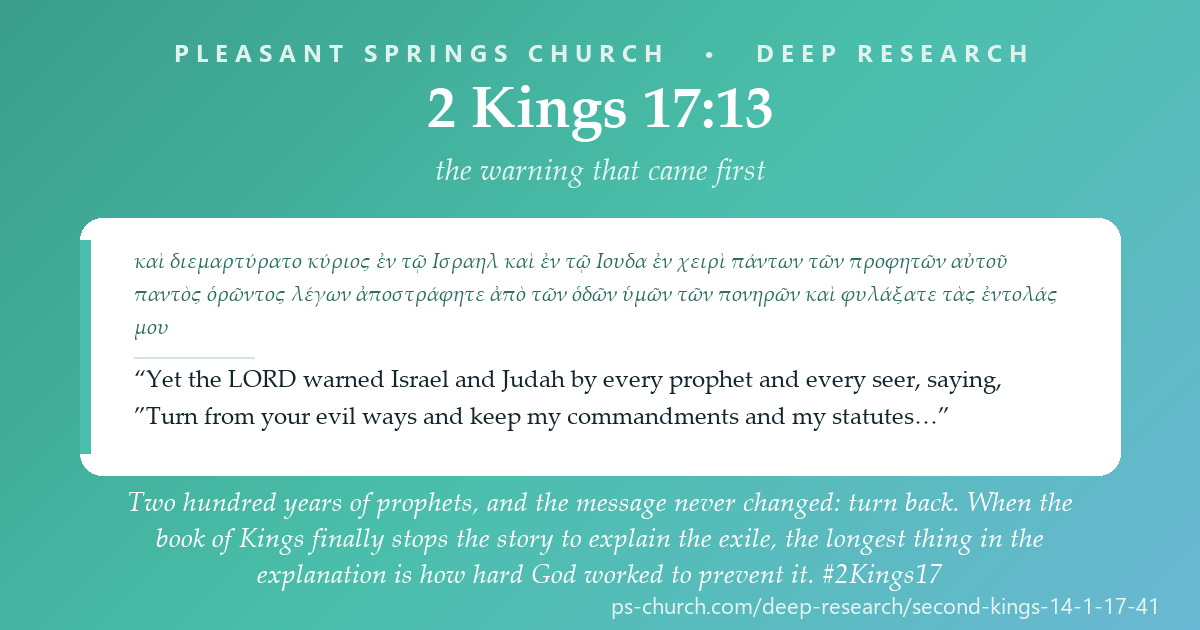
So here is his account, in his order. Israel sinned against the Lord their God who brought them up out of Egypt — the charge is covenant infidelity to a rescuer, not generic wickedness (17:7). They feared other gods and walked in the customs of the nations God had driven out before them, and in the customs their own kings had introduced (17:7–8). They did things secretly against the Lord (17:9). They built high places everywhere, from watchtower to fortified city, and pillars and Asherim on every hill (17:9–10). They burned their children (17:17). And — this is the hinge — “Yet the Lord warned Israel and Judah by every prophet and every seer, saying, Turn from your evil ways and keep my commandments…” (17:13). But they would not listen, but were stubborn, as their fathers had been (17:14). Therefore he was very angry and removed them (17:18). And Judah did the same thing (17:19). And it happened as he had said it would, through the prophets (17:23).
Three things follow, and all three are the text’s and not ours. First, the emphasis falls on the warning, not on the sentence. Two centuries of prophets is the longest element in the account, and its content is one word: turn back. A chapter about a kingdom being destroyed spends its central verse describing how hard God worked not to destroy it. Second, the sin named first is not political and not military. Assyria appears in this explanation exactly nowhere. The greatest army in the world took the city and the narrator does not think it is the reason. Third, the chapter turns on Judah before the reader can relax (17:19) — and then keeps going for another eight chapters until Judah gets the same verdict.
And one thing the chapter does not do: it never says the exiles were finished. Israel is “removed from his sight,” and the same book will end with a Davidic king alive at a foreign table (25:27–30). Kings tells you why the worst happened. It does not tell you that God is done. Where the text stops, we stop.
The chronology that does not add up, the kaige and Antiochene question, the composition of Kings, and the Samaritans — handled carefully.
Cogan and Tadmor, Sweeney, Provan, House and Wiseman on the text; Thiele and his critics on the chronology; Barthélemy, Fernández Marcos, Tov and Ulrich on the Greek; Knoppers, Pummer and Kartveit on Samaritan origins. Two of these are live disputes and this page names the positions without adjudicating.
Commentaries & studies:
- Mordechai Cogan and Hayim Tadmor, II Kings (Anchor Bible) — the fullest treatment of the Assyrian background in English, by a biblical scholar and an Assyriologist working together; the place to check anything on this page about Tiglath-pileser, Sargon, or the text of 15:10.
- Marvin A. Sweeney, I & II Kings (OTL); Iain W. Provan, 1 and 2 Kings (NIBC); Paul R. House, 1, 2 Kings (NAC); Donald J. Wiseman, 1 and 2 Kings (TOTC) — four different judgments about composition and date, all worth having in the room.
- Dominique Barthélemy, Les Devanciers d’Aquila (1963) — the book that identified the kaige recension and changed how these chapters have to be read in Greek; Natalio Fernández Marcos, The Septuagint in Context, and his work with J. R. Busto Saiz on the Antiochene text of Kings; Emanuel Tov, Textual Criticism of the Hebrew Bible; Eugene Ulrich on the Qumran evidence.
- Edwin R. Thiele, The Mysterious Numbers of the Hebrew Kings (3rd ed., 1983); and, on the other side of the argument, Gershon Galil, The Chronology of the Kings of Israel and Judah (1996); Christine Tetley, The Reconstructed Chronology of the Divided Kingdom (2005). Naming three is deliberate; see below.
- Gary N. Knoppers, Jews and Samaritans: The Origins and History of Their Early Relations (2013); Reinhard Pummer, The Samaritans: A Profile (2016); Magnar Kartveit, The Origin of the Samaritans (2009) — the current state of the question, and all three are more careful than the popular account.
Interpretation notes worth keeping:
- The regnal chronology of these chapters genuinely does not work as it stands, and this page will not print a harmonisation as though it were the text. Three clashes, all internal, all checkable in your own Bible in five minutes. (1) 14:23 puts Jeroboam II’s accession in Amaziah’s fifteenth year; 14:2 gives Amaziah twenty-nine years; so Amaziah dies in Jeroboam’s fifteenth year — yet 15:1 dates Azariah’s accession to Jeroboam’s twenty-seventh. (2) 15:33 gives Jotham sixteen years; 15:30 dates Hoshea’s coup to “the twentieth year of Jotham,” a year the book’s own numbers do not allow. (3) 17:1 puts Hoshea’s accession in Ahaz’s twelfth year and 16:2 gives Ahaz sixteen years, so Hoshea’s third year falls in Ahaz’s fourteenth — but 18:1 dates Hezekiah’s accession to Hoshea’s third year, with Ahaz still on the throne. Edwin Thiele’s reconstruction is the standard attempt to resolve all of this, using co-regencies (Amaziah with Azariah, Azariah with Jotham, Jotham with Ahaz), two different new-year reckonings in the two kingdoms, accession-year versus non-accession-year counting, and a rival reign for Pekah. It is elegant, it is influential, and it is not the text — it is a hypothesis about how the text’s numbers were generated, and Galil, Tetley, Hughes and others reconstruct differently. Co-regency is a real ancient practice and 15:5 shows one operating in plain sight (Jotham running the household while his father lives). So the difficulty is not manufactured by sceptics and it is not dissolved by a chart. What we say is: the synchronisms as they stand do not reconcile without assumptions the text does not state; several serious reconstructions exist; none is Scripture; and nothing in the theology of these chapters moves with the outcome.
- Which Greek you are quoting matters more here than almost anywhere in the Old Testament. Because 1 Kings 22 – 2 Kings 25 is kaige territory, the Greek most people call “the Septuagint” in these chapters is a revision made to bring an older Greek into line with a proto-Masoretic Hebrew. Two working rules follow. First, an agreement between Rahlfs and the MT here is weaker evidence than the same agreement in, say, Genesis, because agreement is what the reviser was trying to produce. Second, the Antiochene text — edited by Fernández Marcos and Busto Saiz, and often preserving pre-kaige Greek in these books — belongs in the conversation, and modern English translations quietly use it (2 Kings 15:10 above is a case anyone can see). None of this destabilises anything. It means the Greek tradition of Kings has a history, that we can partly reconstruct it, and that saying so is more honest than pretending there is one flat book called “the LXX.”
- The composition of Kings: name the positions, do not adjudicate. Martin Noth’s 1943 proposal that Deuteronomy–Kings is a single exilic work by one historian (the “Deuteronomistic History”) still frames the discussion; Frank Moore Cross argued for a first edition under Josiah with an exilic supplement; the Göttingen school divides it differently again; and a number of scholars, including several in the bibliography above, are unpersuaded by all of them. Chapter 17 sits at the centre of every version of the argument, because it is the clearest statement of the theology the whole hypothesis is named for. What this page holds is what the book claims for itself — that it works from records, that it is written for people already in exile, and that its explanation of the exile is the one it gives in 17:7–23. Which editorial history produced it is a question we can leave open without losing anything we needed.
- The Samaritans: what this passage is, and what it is not. 2 Kings 17:29 contains the only occurrence of the word “Samaritans” (הַשֹּׁמְרֹנִים, οἱ Σαμαρῖται) in the Hebrew Bible — and, read carefully, it refers there to the former Israelite inhabitants who built the high places, not to the incoming settlers. This chapter is the background to the hostility visible in the Gospels, and it has been used for two thousand years as a genealogy of contempt: they are foreigners with a mongrel religion. Three things need saying. First, the chapter is polemic, and it says so by its shape — it is written by a Judahite explaining the north to Judahites, and its own last verse admits the settlers “feared the Lord,” which is not what a simple foreignness charge would say. Second, the Samaritans’ own account is different: they hold themselves to be the remnant of Ephraim and Manasseh who never went into exile, keeping the Torah at Gerizim. Third, the historical picture is not the popular one. Knoppers, Pummer and Kartveit converge in showing that the separation between Samaritans and Jews was a long, late and largely intra-Israelite process, coming to a head around the Gerizim temple in the Hellenistic period — centuries after 722 — and that 2 Kings 17 was used in that quarrel rather than describing its origin. And then there is the way the New Testament handles them, which settles the tone for a church: the hero of the best-known parable Jesus ever told is a Samaritan (Luke 10:33), the one leper of ten who came back to give thanks is a Samaritan (Luke 17:16), the longest recorded conversation Jesus has with anyone is with a Samaritan woman, who raises this very history — “our fathers worshipped on this mountain” — and is answered without a word of contempt (John 4:1–42), and the first mission outside Jerusalem goes to Samaria (Acts 8:5–25). Whatever this chapter is for, it is not for looking down on anyone.
- Jeroboam II’s prosperity, and a warning about reading blessing off a balance sheet. Archaeologically and historically, the first half of the eighth century was the north’s high-water mark: the borders of 14:25 are real, the Samaria ivories and the Samaria ostraca belong to roughly this period, and Assyria was distracted. The narrator knows and does not care — forty-one years in seven verses, and the only theological comment is that God saved them out of pity (14:26–27). Amos, preaching in these same years, describes what the prosperity looked like from underneath. The book’s refusal to treat wealth as evidence of divine approval is one of its steadiest habits, and it is worth naming from the pulpit, because the temptation to read God’s favour off a good decade has not gone anywhere.
Two centuries of prophets, one imperative, and a book that stops to explain itself.
Name what you learned, why it matters, and one concrete response.
What should we carry away — and do?
- The centre of the chapter is the warning, not the sentence. The longest thing in the narrator’s own explanation is not the list of sins and not the deportation. It is 17:13: God testified, by every prophet and every seer, for two hundred years, and the message never changed — turn from your evil ways. Anyone who leaves this chapter with the impression that God was quick to judge has not read it.
- A king obeyed a written verse, and the narrator thought it worth recording. Amaziah did not kill the murderers’ children, “according to what is written in the Book of the Law of Moses” (14:6). It is one of very few places in Kings where the law is quoted and kept in the same sentence — and the law he kept is the one that says children are not punished for their fathers. Guilt is not inherited. Consequences are real; guilt is personal. Hold both.
- They would not turn away, so they were turned away. Twelve times in these chapters one Hebrew root: sūr. Nine times it is a refusal — the high places were not removed, the king did not turn aside. Twice, at the end, it is God’s: he removed them. The judgment is the shape of the sin, said back.
- “Judah also.” 17:19 is in the chapter for a reason. A book that let you read the fall of Samaria as a story about somebody else would be a worse book. If this chapter is about anyone in the room, that verse tells you who.
- Adding God to the list is not the same as obeying him. “They feared the Lord but also served their own gods” (17:33, 41). Nobody in 17:24–41 has renounced anything. They have simply added. That is the most modern sentence in the chapter and it is the one it ends on — twice, as if the narrator did not trust us to hear it once.
- And do not lend this chapter to a nation. It is about a covenant people under named covenant sanctions, with two centuries of prophets in between. It is not a template for reading any modern country’s politics, and using it that way changes the subject away from the reader — which is exactly where 17:19 puts it.
A word about typology, clearly labelled. Chapter 17 is not a type of anything, and the text does not present itself as one. What it is, and what the New Testament does take up, is a pattern the prophets and then the apostles keep returning to: God sends messengers, and messengers are refused — which is the plot of the parable of the tenants (Matthew 21:33–41, Mark 12:1–9), where the vineyard’s owner sends servant after servant, and last of all his son. That is a connection the New Testament makes itself, and it is the safe ground. Beyond that, a reader on this side of the cross will naturally hear 17:13 — turn back, and keep my commandments — alongside the first word of Jesus’ preaching, “Repent, for the kingdom of heaven is at hand” (Matthew 4:17). The Old Testament text does not say that, and we should not put it in its mouth. And we are meant to see it — Luke 24:27 has Christ himself reading the Scriptures that way, and the more times you read these books the more of it you will see. Both halves are true and neither cancels the other.
Step in response: two things this week. First, find the warning you have been declining to hear — the one you already know the content of, that somebody has said to you more than once, kindly. Chapter 17 is not primarily about idols; it is about a two-hundred-year habit of not listening, and habits are built one week at a time. Second, take an honest inventory of what has been added rather than exchanged. Almost nobody in this passage renounced the Lord. They kept him and kept everything else, and the book calls that the end of a kingdom.
2 Kings 17:13 · to share
LXX (Rahlfs, 4 Kingdoms) + ESVEvery Deep Research page traces its passage across the whole sweep — the Old Testament, the Second-Temple world between the testaments (historical witnesses, not Scripture), and the New Testament. Follow the thread:
Pleasant Springs Church — Deep Research
Research method after Michael S. Heiser’s Bible Research Method (examine dictionaries → ancient literature → important words → textual connections → academic publications → share), with the Pleasant Springs “Author & Audience” foundation. Scripture set in the Hebrew, the Greek editions named on each page and the ESV (Old Testament), and the Greek New Testament and the ESV (New Testament), per the practice of Pleasant Springs Church. 2 Kings 14–17 research grounded in Cogan and Tadmor (Anchor), Sweeney (OTL), Provan (NIBC), House (NAC) and Wiseman (TOTC), with Barthélemy, Fernández Marcos, Tov and Ulrich on the Greek, Thiele (and Galil and Tetley against him) on the chronology, and Knoppers, Pummer and Kartveit on Samaritan origins. Text, edition and section: Hebrew from the Masoretic Text; Greek from Rahlfs’s Septuaginta, 4 Kingdoms, printed without editorial punctuation and with proper names unaccented, verified verse by verse rather than back-translated; English ESV. Every verse on this page lies inside the second kaige section (γδ, 1 Kings 22 – 2 Kings 25), and the page says so and says what follows from it: here the Vaticanus-type text Rahlfs mainly follows is a revision toward a proto-Masoretic Hebrew, not the oldest Greek; the Antiochene (Lucianic) text often preserves an older reading; and “the LXX reads X” is therefore an ambiguous claim in these books unless the text is named. That is not decoration — 2 Kings 15:10 is printed precisely because the ESV there follows the Antiochene reading (“at Ibleam”) while Rahlfs makes the word a personal name, Κεβλααμ. The kaige marker itself is demonstrated rather than asserted: Hebrew gam occurs exactly three times in 2 Kings 14–17 (16:3; 17:19; 17:41) and Rahlfs renders all three καί γε; the count was made, not remembered. Numbering: there is no offset in these four chapters — Rahlfs has 29, 38, 20 and 41 verses in 4 Kingdoms 14–17, exactly as the Masoretic Text and the ESV do, counted rather than assumed; the Greek plus at 4 Kingdoms 1:18a–d and the one-verse English/Hebrew chapter offset at 11:21–12:1 are stated for completeness and do not touch this page. Divergences: the codex note enumerates every difference between the columns in the eighteen verses printed — a minus at 17:14 (the clause “who did not believe in the Lord their God” is absent from Rahlfs); different words at 14:25, 14:27 (name/seed), 17:6 (cities/mountains of the Medes), 17:14 (like/more than; neck/back) and 17:27–28 (teach/enlighten); untranslated transliterations at 14:9 and 15:5; a different construal at 15:10; and the two ketiv/qere places, 14:6 and 17:13, where the Greek agrees with the written consonants against the reading tradition. One further divergence from the chapter is reported although its verse is not printed: at 17:34 Rahlfs lacks both of the Hebrew’s negatives. The claim to enumerate is explicitly limited to the printed verses and is not extended to four chapters. Chronology: the synchronisms of 14:23/15:1, 15:30/15:33 and 16:2/17:1/18:1 are laid out as three internal clashes any reader can check; Thiele’s co-regency reconstruction is named as the standard attempt, described as a hypothesis and not as the text, and Galil, Tetley and Hughes are named as reconstructing differently. No harmonised scheme is printed. Chronicles is treated as a parallel witness and not merged: 2 Kings 15:5 gives no reason for Azariah’s leprosy and 2 Chronicles 26:16–21 gives one, and that difference is printed as a difference; the same for Amaziah in 2 Chronicles 25. Assyrian sources are quoted only from the locally verifiable range of the ANET scan — Tiglath-pileser III on Menahem and on Pekah/Hoshea (ANET 283–284) and Sargon II on the fall of Samaria and the 27,290 deportees (ANET 284–285) — and where Kings and an Assyrian inscription do not say the same thing (15:30 against Tiglath-pileser’s claim to have installed Hoshea), the difference is reported rather than blended. The narrator’s own theology at 17:7–23 is given as the interpretation of the fall of Samaria, in his order and his emphasis, and this page does not substitute another; where he gives no reason (the leprosy of 15:5; the lions of 17:25) the page says so and stops. The passage is explicitly not applied to any modern nation, and the reason is stated: no modern state stands under Israel’s covenant, and 17:19 turns the chapter on the reader rather than on a neighbour. The Samaritans are handled without contempt: 17:29 is noted as the only occurrence of the word in the Hebrew Bible and as referring there to the former Israelite population; the chapter is described as polemic; the Samaritans’ own self-understanding is stated; the current scholarship on a late and largely intra-Israelite separation is named; and the New Testament’s own treatment (Luke 10:33; 17:16; John 4; Acts 8) is given as the tone-setter. Deuteronomy 24:16 at 14:6 is treated as the house position enacted in narrative — ancestral sin, not inherited guilt — with the distinction between inherited guilt and inherited consequence stated rather than blurred. Typology is labelled in both directions per the ratified position: the parable of the tenants is the New Testament’s own move and is attributed as such, and the Christ-ward hearing of 17:13 is named as ours and affirmed as legitimate rather than dismissed.
Scripture quotations marked ESV are from the ESV® Bible (The Holy Bible, English Standard Version®), © 2001 by Crossway, a publishing ministry of Good News Publishers. ESV Text Edition: 2016. Used by permission. All rights reserved. The ESV text may not be quoted in any publication made available to the public by a Creative Commons license, and the ESV may not be translated in whole or in part into any other language. www.esv.org
|
Did this study bless you today? 💚 Give to Support PS Church100% of gifts go to the General Fund — thank you. |