A young prophet is sent to Ramoth-gilead with a flask of oil and one instruction after the anointing: “open the door and flee; do not linger” (9:3). He does. What he leaves behind is Jehu, and what follows is the bloodiest stretch in the books of Kings. A watchman on a tower says the line everybody remembers — “the driving is like the driving of Jehu the son of Nimshi, for he drives furiously” (9:20). A king is shot and thrown onto the plot of ground his father stole, and the narrator stops to tell you why: this is Naboth’s vineyard, twenty years later, being paid for. A queen hears he is coming, paints her eyes, and meets him at a window with a taunt (9:30–31) — reported here once and soberly, because the narrator’s interest is not her humiliation but whether Elijah’s word held. Then seventy sons, heads in baskets, forty-two travellers at Beth-eked, and a temple full of Baal’s worshippers walked into a trap. ⚠️ This study reports all of it plainly and briefly, locates it precisely, and says without qualification that it licenses nothing for anyone today. And then it gives the verdict in both halves, because the Bible does: 2 Kings 10:30 says God approved the purge of Ahab’s house — and Hosea 1:4 says God will punish the house of Jehu for the blood of Jezreel. Both are printed; neither is harmonised. Kings adds its own limit one verse later: Jehu “was not careful to walk in the law of the Lord” (10:31). Then the story turns south, and everything hangs on a woman nobody has heard of: Athaliah destroys the royal family, and Jehosheba steals one baby and hides him six years in the house of the Lord. The line of David survives because one woman hid one child in a cupboard. A coronation, a covenant, Baal’s house torn down, and “Treason! Treason!” Then a chest with a hole bored in its lid, and workmen paid without an audit “for they dealt honestly” (12:15). And at the end, Elisha dying, and a king weeping over him in Elijah’s own words. This study works 2 Kings 9:1–13:25 line by line, in Hebrew, Septuagint and ESV — and says plainly that every verse of it sits inside the kaige section, where our Greek is a revision and not the oldest translation. See the method →
2 Kings 9:1–13:25 (selections)
Hebrew · Greek (Rahlfs, 4 Kingdoms) · ESVThe book, the section, the edition — and why the sentence “the Septuagint reads X” is ambiguous on every page of this book. In the Septuagint this book is 4 Kingdoms (4 Reigns) — Βασιλειῶν Δʹ (Basileiōn D). 1–2 Samuel and 1–2 Kings are one continuous work in Greek, Βασιλειῶν Αʹ–Δʹ, and a reader who takes the name “2 Kings” to a Greek Bible will not find it. (Worth noticing once: our English names for the Torah — Genesis, Exodus, Leviticus, Numbers, Deuteronomy — are the Septuagint’s names, while Samuel and Kings keep Hebrew-derived ones. An English Bible already mixes both traditions on its contents page.)
⚠️ Which section is this? Kaige — all of it, and that changes what our Greek column is. Dominique Barthélemy showed in Les Devanciers d’Aquila (1963) that the Greek of Kingdoms is not one translation. Two long stretches are a later kaige revision — a first-century pull of an older Greek text back toward a proto-Masoretic Hebrew, named for its stereotyped rendering of Hebrew גַּם (gam, “also”) by καί γε. Using Thackeray’s section letters: 2 Kingdoms 11:2 → 3 Kingdoms 2:11 (βγ) and 3 Kingdoms 22 → 4 Kingdoms 25 (γδ). The whole of 2 Kings sits inside the second one. Every verse on this page is kaige.
What that means, said plainly. Here Codex Vaticanus, and Rahlfs’s text which leans on it, are not the oldest Greek: they are a revision of an older Greek toward a Hebrew text close to the one the Masoretes later pointed. So when this page prints a Greek column that agrees closely with the Hebrew, that agreement is partly the reviser’s work and is not by itself evidence about the original translation. And the Antiochene (Lucianic) manuscripts — a separate witness running through all four books — frequently preserve an older Greek reading in exactly these stretches. This page prints Rahlfs and cites no Antiochene reading, because we have not consulted the critical edition (Fernández Marcos and Busto Saiz, El texto antioqueno de la Biblia griega). There is no Göttingen edition of 4 Kingdoms; the fuller apparatus is Brooke–McLean’s larger Cambridge Septuagint. On why this library prints what it prints, see the texts we print.
You can see the reviser’s hand in this passage without knowing any Greek. Two kinds of evidence. (1) The καί γε itself. At 9:27 the Hebrew has גַּם־אֹתוֹ, “him also,” and Rahlfs writes καί γε αὐτόν; at 13:6 the Hebrew has וְגַם הָאֲשֵׁרָה, “and the Asherah also,” and Rahlfs writes καί γε τὸ ἄλσος. That is the mechanical habit the whole section is named for. (2) Words the reviser would not translate. Six different Hebrew words in these five chapters Rahlfs simply writes in Greek letters instead of rendering them: γαρεμ for גֶּרֶם (9:13, where the ESV footnotes “the meaning of the Hebrew word is uncertain”); αφφω for אֵפוֹא (10:10); μεσθααλ (10:22); σαδηρωθ for שְׂדֵרֹת (11:8, 15); νεζερ for נֵזֶר (11:12); and βεδεκ for בֶּדֶק, the temple “breach” or repairs, seven times over five verses in chapter 12. A translator translates; a reviser working slavishly against a Hebrew text he will not depart from transliterates. The Greek in the column above is a window onto a Hebrew text — which is valuable, and is a different thing from being the oldest Greek.
Numbering, stated rather than assumed. Chapters and verses in the Hebrew and in Rahlfs run together across all five chapters — 9 has 37 verses in both, 10 has 36, 11 has 20, 12 has 22, 13 has 25 — so there is no Hebrew/Greek offset anywhere on this page. The offset is in your English Bible. The ESV prints “Jehoash was seven years old when he began to reign” as 11:21 and footnotes it “Ch 12:1 in Hebrew”; the Hebrew and Greek both make it 12:1. So through chapter 12 the English verse number is one behind the Hebrew and Greek (ESV 12:1–21 = MT/LXX 12:2–22), and this page marks it in the reference column where it prints a verse from that chapter. Chapters 9, 10, 11 and 13 line up exactly.
The divergences in the verses printed above and in the ESV’s own footnotes, enumerated — not a sample, the list. 9:6 no difference of substance. 9:16 Rahlfs is substantially longer than the Hebrew, adding the wounds “which the Arameans inflicted on him at Rammath” and “for he was mighty and a man of power.” 9:20 Hebrew “he drives in madness,” Greek “it was ἐν παραλλαγῇ,” in a derangement; the Hebrew’s threefold play on nhg is gone. 9:25–26 no difference of substance; the Hebrew’s shālōm / shillam wordplay is not reproducible in Greek. 9:27 καί γε for gam; and the Hebrew has no verb of striking, where Rahlfs has “and he struck him in the chariot” — the ESV supplies “and they shot him” and footnotes “Syriac, Vulgate (compare Septuagint); Hebrew lacks.” 9:30 no difference of substance. 10:1 the Hebrew says the rulers of Jezreel; Rahlfs says of Samaria; the ESV prints “of the city” and footnotes “Septuagint, Vulgate.” 10:9 Greek plus, “in the gateway of the city.” 10:15 Greek plus, “Jehu said” (ESV follows it, footnoted). 10:16 Hebrew plural “they had him ride,” Greek singular (ESV follows the Greek, footnoted). 10:24 Hebrew plural “they went in,” Greek singular (footnoted). 10:30–31 no difference of substance. 11:2 ketiv/qere in the Hebrew; Hebrew “they hid him,” Greek “she hid him” (footnoted); and the ESV’s supplied “and she put” is in neither ancient column. 11:12 νεζερ untranslated. 12:6–13 βεδεκ untranslated, five times. 12:15 (MT/LXX 12:16) no difference of substance. 13:6 Hebrew singular “he walked in them,” Greek plural (ESV follows the versions, footnoted); and καί γε for wəgam. 13:14 no difference of substance. 13:23 Rahlfs lacks the Hebrew’s closing “until now.” Edition: the Greek column is Rahlfs’s Septuaginta (CATSS digitization), printed without the editorial punctuation of the printed editions and with proper names unaccented, as Rahlfs sets them; Hebrew from the Masoretic Text; English ESV. Qumran: the Kings material from the Dead Sea is scanty and this page cites none of it, because we have not verified what the fragments preserve for these particular chapters.)
The Shape of the Passage
Parallel panelsBehind this passage stand three things: the sentence Elijah pronounced in a stolen vineyard (1 Kings 21:19–24); the commission on Horeb to anoint Hazael, Jehu and Elisha (1 Kings 19:15–17); and the promise that David would never lack a lamp in Jerusalem (2 Samuel 7). In front of it stand Jeroboam II’s long summer and then Samaria’s fall (2 Kings 14–17).
Author
A writer who reports atrocity in short sentences and saves his adjectives for verdicts. He tells you the seventy heads came in baskets and gives it half a verse; he tells you Jehu “was not careful to walk in the law of the Lord” and builds a whole paragraph round it. The proportion is the argument. He is not squeamish and he is not enthusiastic; he is a historian with a thesis, and the thesis is about the word of God, not about the sword of Jehu.
He quotes himself constantly, and expects you to notice. Joram is thrown onto the ground Ahab stole and the narrator cites the oracle (9:25–26); Jezebel dies and the narrator cites Elijah (9:36); Ahab’s house ends and the narrator cites Elijah again (10:10, 10:17). Then a king weeps over Elisha in the exact words Elisha wept over Elijah (13:14). Nothing in these chapters is loose; the story is being closed like a ledger.
And he refuses to resolve the thing a modern reader most wants resolved. He records God’s commendation of the purge and, one verse later, God’s complaint about the man who carried it out. He never tells you whether Jehu went too far. Where he gives no reason, this study gives none — and where another prophet contradicts his verdict, this study prints the contradiction rather than smoothing it (Stage 4).
Audience
People who had watched a dynasty end. The book closes in Babylon, and its first readers knew what it was to see a royal house destroyed and a national religion dismantled. When they read that Athaliah “destroyed all the royal family” and that one baby survived behind a door, they were reading their own question: can the promise survive down to one? The answer chapter 11 gives is yes, barely, and by the courage of a woman nobody had heard of.
People who had to decide what to think about a violent deliverer. Jehu was, by any political measure, the most consequential Israelite of the century — the Assyrians carved him onto the Black Obelisk (Stage 2). Kings gives him a mixed verdict; Hosea, a century later, gives a straight condemnation of “the blood of Jezreel”; and both texts ended up in the same Bible. Israel did not agree with itself about Jehu, and the canon preserves the disagreement.
And people rebuilding something with other people’s money. The chest with the hole in its lid, the two officials counting together, and the crews paid without an audit “because they dealt honestly” (12:15) are the sort of detail a returning community restoring a ruined temple would read twice. 2 Chronicles 24 tells the same repair with the Levites at the centre and adds a bleak ending Kings does not give — and that difference is reported in Stage 4, not blended away.
Orient on Kings and 4 Kingdoms, the kaige recension, Jehu’s revolution, the Omride collapse, Jezreel, Athaliah and the Judahite coup, the Rechabites, and Aramean Damascus.
Search by topic: Kings, Books of; Kingdoms, Books of (Greek); kaige recension; Lucianic / Antiochene text; Deuteronomistic History; Jehu; Jehu’s revolution; Joram / Jehoram of Israel; Ahaziah of Judah; Jezebel; Jezreel; Naboth; Beth-eked; Jehonadab / Rechabites; Baal (Baal-shamem, Melqart); herem and dynastic purge in the ancient Near East; Athaliah; Jehosheba; Jehoiada; Joash / Jehoash of Judah; nezer (diadem); ʿēdût (testimony); temple repairs and temple treasuries; Hazael; Ben-hadad III; Damascus; Elisha; chronology of the Hebrew kings.
Which articles are relevant?
- Anchor Bible Dictionary — “Kings, Books of,” “Jehu,” “Jezebel,” “Jezreel,” “Athaliah,” “Jehoiada,” “Joash,” “Rechabites,” “Hazael,” “Damascus,” “Baal,” “Elisha,” “Chronology (Hebrew Bible).”
- Dictionary of the OT: Historical Books (IVP) — “Kings, Books of,” “Jehu,” “Omri Dynasty,” “Prophets and Prophecy,” “Non-Israelite Written Sources,” “Chronology,” “State Officials,” “Temple, Jerusalem.”
- NIDOTTE / TDOT — שָׁלוֹם (shālōm, peace / wholeness) and שִׁלֵּם (shillēm, to repay), קָשַׁר (qāshar, to bind, conspire), חֶלְקָה (ḥelqāh, plot of ground), דָּם (dām, blood, bloodguilt), קִנְאָה (qinʾāh, zeal), נֵזֶר (nēzer, diadem), עֵדוּת (ʿēdût, testimony), אֱמוּנָה (ʾəmûnāh, faithfulness), בֶּדֶק (beḏeq, breach / repair).
- On the Greek — Paul D. McLean, “4 Reigns: To the Reader,” in NETS, for the base text (Rahlfs) and the section boundaries; Natalio Fernández Marcos, The Septuagint in Context, on the kaige question and the Antiochene text; and Barthélemy, Les Devanciers d’Aquila, for the original demonstration.
Bibliography surfaced:
- Mordechai Cogan and Hayim Tadmor, II Kings (Anchor Bible) — the standard technical commentary for exactly these chapters, and the fullest treatment of the Assyrian and Aramean comparanda.
- Marvin A. Sweeney, I & II Kings (OTL); Iain W. Provan, 1 and 2 Kings (NIBC); Paul R. House, 1, 2 Kings (NAC); Donald J. Wiseman, 1 and 2 Kings (TOTC); Walter Brueggemann, 1 & 2 Kings (Smyth & Helwys).
- A. Graeme Auld, Kings Without Privilege, on the relationship between Kings and Chronicles — a minority thesis, named here because Stage 4 discusses the parallel and a reader should know the debate exists.
- Robert Alter, The Art of Biblical Narrative, for the reading tools used in the structure block. (Alter reads these texts as literature and does not share the church’s confession; we take the tools, not the metaphysics.)
What a dynastic purge was in the ninth century BC, who Hazael was, and the two men from these chapters whose names an Assyrian scribe carved in stone.
First the world: the shape of a Near Eastern coup, the significance of Jezreel and Samaria, and what Baal worship in a royal capital actually was. Then the outside evidence — and it is unusually good here, because Assyria noticed both Jehu and Hazael. Then the Second-Temple readers, who did not read these chapters the way we do.
Which parallels shed light on the world of these chapters?
A dynastic purge was normal statecraft, and the Bible knows it. Killing the whole house of a displaced king was standard practice across the ancient Near East, and Kings has already described it twice without comment — Baasha wipes out the house of Jeroboam, Zimri wipes out the house of Baasha (1 Kings 15:29; 16:11–12). That is the first thing to hold: 2 Kings 9–10 is not a religious innovation, it is a coup, and it looks like every other coup of the period. What is not normal is that a prophetic word runs ahead of it and the narrator keeps stopping to check the coup against that word. The difficulty of these chapters is not that the ancient world was violent — everybody knows it was — but that the text puts God’s name near this particular violence and then, in Hosea, takes it back. See Stage 4.
Jezreel was the Omride second capital, and that is why the coup happens there. Samaria was the administrative seat; Jezreel, at the head of the great valley, was the royal estate — which is why Naboth’s vineyard was next to a palace at all, why a wounded king convalesces there, why a watchman stands on a tower there, and why the queen mother is in residence. The whole of 2 Kings 9 happens inside about a mile of ground.
The Baal of Samaria was a state cult with a building, a wardrobe and a professional clergy. Jehu’s trap works because all of that is real: a temple large enough to fill “from one end to the other,” vestments issued from a wardrobe by an official, a sacrifice with a calendar. Tearing it down is presented as the one thing Jehu did right — and the very next verse says he kept Jeroboam’s calves. The book’s issue is covenant loyalty, never ethnicity, and a reading that turns the Tyrian marriage into an argument about foreigners has changed the subject in a Bible that puts Rahab and Ruth in the royal line.
And the outside world had heard of exactly two men in these chapters. Not Joash, not Jehoiada, not Athaliah. Jehu — recorded by Assyrian scribes paying tribute in 841 BC, the year most reckonings put his coup, and carved onto a monument set up some fifteen years later — and Hazael of Damascus, the man Kings says took the whole Transjordan (10:32–33) and made Judah empty its treasury to buy him off (12:17–18). Both are in the collection below, and neither was written by us.
- Shalmaneser III, the Black Obelisk — epigraph II, c. 841 BC — ANET 281, tr. A. Leo Oppenheim (Assyrian royal annals — a witness, not Scripture). In full: “The tribute of Jehu (Ia-u-a), son of Omri (Hu-um-ri); I received from him silver, gold, a golden saplu-bowl, a golden vase with pointed bottom, golden tumblers, golden buckets, tin, a staff for a king, (and) wooden puruhtu.” Two things are worth stopping on. First, the relief panel above the text shows a man prostrate before Shalmaneser — widely, though not universally, taken to be Jehu himself rather than an envoy, which would make it the closest thing we have to a contemporary depiction of an Israelite king. Second, look at what the Assyrians call him. Jehu was not Omri’s son; he had just destroyed Omri’s house root and branch. Assyrian scribes simply went on using the dynastic name for the country (Bīt Ḥumri, “house of Omri”), which is a useful reminder that outsiders record what they find convenient, not what a nation would say about itself.
- Shalmaneser III on Hazael, eighteenth year, 841 BC — ANET 280, tr. A. Leo Oppenheim (a witness, not Scripture). The Black Obelisk version is terse: “Hazael (Ha-za-'-il) of Damascus rose for battle. I took away from him 1,121 chariots, 470 cavalry-horses as well as his camp.” A fuller annalistic text adds that Shalmaneser killed sixteen thousand of Hazael’s soldiers, chased him into Damascus, besieged him there and cut down his gardens. Hazael is the pressure behind almost every chapter here — 2 Kings 10:32–33, 12:17–18, 13:3, 13:22 — and the Assyrian record shows a man fighting for his life on his northern frontier while he took the Transjordan on his southern one.
- Sirach 48:12–14 (Second-Temple — a witness, not Scripture, and non-canonical by this church’s ratified position) — Ben Sira’s praise of Elisha ends on the strangest verse in these chapters. The Greek: “πᾶς λόγος οὐχ ὑπερῆρεν αὐτόν καὶ ἐν κοιμήσει ἐπροφήτευσεν τὸ σῶμα αὐτοῦ” — no word was too hard for him, and in his sleep his body prophesied; and then, “in his life he did wonders, and in death his works were marvellous” (48:14). By the second century BC, 2 Kings 13:21 had become part of the standard summary of who Elisha was. Ben Sira then adds the note Kings itself keeps making: “in all this the people did not repent” (48:15).
- Josephus, Antiquities 9.6–9.8 (Whiston’s book-and-chapter numbering; Second-Temple — a witness, not Scripture) — and his changes are evidence, so they are listed rather than smoothed. He puts Jezebel on a tower rather than at a window, and he drops the name Zimri from her taunt entirely, reducing it to “he was a fine servant that had killed his master.” He keeps the wicker baskets. He has Jehu tell the crowd plainly “that it was not he that slew all these” — making an admission out of what the Bible leaves as a question. He follows 2 Chronicles in making Jehosheba “married to the high priest Jehoiada,” which Kings does not say, and puts Joash at “not above a year old.” He renders the cry over Elisha as calling him “his father, and his weapons.” And on Joash of Israel he flatly contradicts the Bible he is paraphrasing: Josephus calls him “a good man,” where 2 Kings 13:11 says he did evil.
What the text says: a ninth-century army officer overthrew a dynasty, killed two kings, a queen mother, seventy princes, forty-two travellers and a temple congregation, and the book of Kings reports it, links part of it to a prophetic word, commends part of it, and criticises the man who did it. What the text does not say: that this is a model, a permission, a method, or a pattern for anybody, ever again. Not once in five chapters does the narrator invite imitation.
The Bible itself closes the door, and it does so out loud. Hosea 1:4 names “the blood of Jezreel” as something God will punish the house of Jehu for. Whatever else that verse does, it makes it impossible for a Christian to treat 2 Kings 10 as a licence. And the New Testament settles the question of method for the church in one sentence from Jesus to Peter, at the one moment a disciple drew a sword in a religious cause: “Put your sword back into its place” (Matthew 26:52).
So the discipline for reading these chapters is: report what happened without dressing it up and without dwelling on it; keep it located in its own century and its own dynastic quarrel; refuse both of the easy exits — the sensational retelling that enjoys the carnage, and the tidy apologetic that explains why everyone deserved it; and say clearly that a text describing what a king did is not a text prescribing what anyone should do. Where Scripture gives no reason, we give none.
One greeting asked nine times and answered by a verb, one root that binds four chapters together, a field, a man’s claim about his own motives, and a work crew nobody audited.
Count shālōm for yourself in chapter 9 — nine, and then look at 9:26. Then follow qāshar from Jehu’s conspiracy to Athaliah’s scream to the murder of Joash. Then ask why the root behind ḥelqāh turns up seven times in one chapter, and who is doing the talking when the word “zeal” appears.
“Peace” — and “to repay.” Nine times in one chapter somebody asks “is it shālōm?” A watchman asks it, two horsemen ask it, a king asks it, and finally a queen asks it as an insult. It is the ordinary Hebrew greeting and it is also the thing nobody in the chapter has. Then the tenth occurrence of those three consonants is not a greeting at all: וְשִׁלַּמְתִּי (9:26), “and I will repay you on this plot of ground.” Same root, opposite end of the story: shālōm is wholeness, and shillēm is what makes an account whole again. The Greek cannot do this — εἰρήνη and ἀνταποδώσω share nothing — and a reader with only a translation will not hear it. This is the single best argument on the page for keeping the Hebrew column.
“To bind” — and so, of people, “to conspire.” Six occurrences in four verses, and they hold the whole passage together. Jehu conspires (9:14); Jehu admits “I conspired against my master” (10:9); Athaliah screams קֶשֶׁר קָשֶׁר at a crowd that is crowning the rightful king (11:14); and the last two land on Joash himself, whose servants “made a conspiracy” and killed him in the house of Millo (12:21 Hebrew / 12:20 English). The word travels from the usurper to the usurped and finally to the boy who was saved. The Greek splits it: the verb becomes συστρέφω (9:14; 10:9), the noun σύνδεσμος (11:14; 12:21).
“Plot of ground” — a piece of field, and here a piece of evidence. 1 Kings 21 called Naboth’s ground a vineyard; 2 Kings 9 calls it a plot, and then will not stop saying so — the root turns up seven times in one chapter, so that you cannot read the death of Ahab’s son as a political accident. Joram meets Jehu at it (9:21) and is ordered thrown onto it (9:25, then twice more in the oracle at 9:26); and the masculine form of the same noun, ḥēleq, frames the chapter — the oracle at 9:10 and the report at 9:36–37 both put Jezebel’s end “in the portion of Jezreel.” Seven occurrences of one root in one chapter. Rahlfs renders it μερίς, “portion” — the same Greek word the ten tribes used when they said “what portion do we have in David?” (1 Kings 12:16). A stolen field is where the northern dynasty ends.
“Zeal” — and this is the word Jehu chooses for himself: “Come with me, and see my zeal for the Lord.” It is a good word in the Old Testament, and it is the word used of Phinehas (Numbers 25:11) and of Elijah on Horeb, “I have been very jealous for the Lord” (1 Kings 19:10, 14). Jehu is claiming a pedigree. But it is Jehu who says it, about himself, to a passing stranger he is about to seat in his chariot — nobody else in the chapter says it about him, and God never does. When God speaks (10:30) he commends the deed and says nothing about the motive; and the next verse says the man’s heart was not in the law at all. The book lets a man name his own zeal and then quietly declines to endorse the naming.
“The crown” and “the testimony” — the two things put on a seven-year-old at his coronation. נֵזֶר is the royal or priestly diadem (the same consonants as the Nazirite’s consecration); עֵדוּת is the word for the tablets in the ark, and most readers take it here as a written covenant document handed to the king — which is what Deuteronomy 17:18–19 demands of every king of Israel. A crown and a copy of the law, together, in one gesture. And the Greek is the tell: Rahlfs translates עֵדוּת perfectly well (τὸ μαρτύριον) and then does not translate נֵזֶר at all — τὸ νεζερ, the Hebrew word in Greek letters. See the codex note on what that tells you about this section of the Greek Bible.
“In faithfulness” — usually rendered here “they dealt honestly.” The noun אֱמוּנָה is from the root behind amen; it is the word Habakkuk uses in “the righteous shall live by his faith” (Habakkuk 2:4). Here it describes a building crew. Not a prophet, not a priest — carpenters, masons and stonecutters, whose books nobody audited because nobody needed to. The Greek keeps the register precisely: ἐν πίστει, “in faith.” After four chapters in which every man with power lies to somebody, the text pauses to record that some men with hammers did not.
“Breach” — the crack in a wall, and so “the repairs.” It is a rare noun, almost confined to this chapter and the Chronicles parallel. Rahlfs does not translate it. Seven times, spread over five verses, the Greek simply writes βεδεκ — and once you have seen that, you have seen what kind of Greek this is: a reviser working so tightly against a Hebrew text that when the Hebrew word is obscure he passes it through in Greek letters rather than guess. The same thing happens with γαρεμ (9:13), αφφω (10:10), μεσθααλ (10:22), σαδηρωθ (11:8, 15) and νεζερ (11:12). Six different Hebrew words in five chapters that never became Greek at all.
Two things in the text of these chapters, reported rather than tidied:
- The ketiv and qere at 11:1–2. At 11:1 the consonants read וראתה and the reading tradition רָאֲתָה (“she saw”); at 11:2 the consonants read הממותתים and the tradition הַמּוּמָתִים (“those being put to death”). Neither changes the sense; both are printed here rather than smoothed, because a reader looking at a Hebrew Bible will see the marginal notes and deserves to know what they are.
- The ESV’s footnotes in these chapters are unusually busy, and they are worth reading. Seven of them cite the Septuagint or the ancient versions (9:27; 10:1, 15, 16, 24; 11:2; 13:6). In five of those places the ESV prints the versional reading rather than the Hebrew one and tells you so (9:27; 10:1, 15, 16; 13:6); in the other two (10:24; 11:2) it keeps the Hebrew and footnotes the Greek. That is the ordinary practice of every modern translation, and it is exactly why this library names its edition on every page instead of saying “the LXX”: the footnote word “Septuagint” names a family of Greek manuscripts, not a book, and in these particular chapters that family includes both a kaige revision and an Antiochene text that often disagrees with it. See the texts we print.
A vineyard’s receipt, a prophet’s cry repeated eleven chapters later, a promise reduced to one child — and the one verdict this study will not reconcile.
Trace four threads: backwards to 1 Kings 19 and 21, which these chapters are the payment of; sideways to Hosea and to 2 Chronicles, which tell the same events differently; forwards to 2 Kings 17 and 25; and inwards to 10:30 beside Hosea 1:4, where two parts of Scripture assess one act in opposite terms.
Which cross-references matter?
- 1 Kings 21 — Naboth, and the loudest connection in the passage. Elijah said, “In the place where dogs licked up the blood of Naboth shall dogs lick your own blood” (21:19) and “the dogs shall eat Jezebel within the walls of Jezreel” (21:23). 2 Kings 9 does not leave you to notice this; it quotes it twice — at 9:25–26 Jehu recites the oracle from memory, and at 9:36 the narrator cites Elijah by name. A stolen field and a judicial murder — at least fourteen years earlier, since Ahaziah’s two years and Joram’s twelve stand between — are the reason the geography of this chapter is what it is.
- 1 Kings 19:15–18 — the commission on Horeb: anoint Hazael over Syria, Jehu over Israel, Elisha as prophet. Elijah personally does only the third. Elisha anoints Jehu through a servant (2 Kings 9); Hazael is never anointed by anybody — Elisha simply stares at him until he is embarrassed, weeps, and says “the Lord has shown me that you are to be king over Syria” (2 Kings 8:11–13). And 19:17 — “the one who escapes from the sword of Hazael shall Jehu put to death” — is the sentence 2 Kings 8–13 is carrying out. The commission takes two prophets and three chapters’ worth of years to complete.
- 2 Kings 2:12 — “My father, my father! The chariots of Israel and its horsemen!” Elisha shouted it at Elijah going up. Eleven chapters later a king shouts it at Elisha going down (13:14), and the Hebrew and the Greek are identical in both places. The narrator has been holding that sentence in reserve for the whole Elisha cycle, and he spends it on the deathbed of the man who first said it.
- 2 Samuel 7:12–16 — “your throne shall be established forever.” Set that beside 2 Kings 11:1–3, where the promise is one infant behind a bedroom door for six years. The book has already told you what is at stake: God would not destroy Judah “for the sake of David his servant, since he promised to give a lamp to him and to his sons forever” (8:19). Chapter 11 is the narrowest that lamp ever burns.
- Exodus 2:1–10 — the other hidden child. A ruler orders the death of the boys; a woman hides one; a nurse is involved; the child grows up in the enemy’s own house. Kings does not point at Exodus and no New Testament writer connects them, but the shape is the shape, and Israel’s storytellers knew what they were doing when they built the scene this way.
- Deuteronomy 17:14–20 — the law of the king, and the standing cross-link for this whole part of the library. The king is to have a written copy of the law and read it all his life. At 11:12 a child is crowned with a diadem and a “testimony”; at 10:31 the verdict on Jehu is precisely that he “was not careful to walk in the law of the Lord.” The measuring line in Kings is always the Torah, never the body count.
- Hosea 1:4–5 — the counter-verdict, and it is Scripture. A century or so after Jehu, God tells Hosea to name a child Jezreel: “for in just a little while I will punish the house of Jehu for the blood of Jezreel, and I will put an end to the kingdom of the house of Israel.” That is the same event 2 Kings 10:30 commends. Do not let anyone hand you a one-sentence solution to this. See the panel below.
- 2 Chronicles 22–24 — the parallel witness, and it is not identical. Three real differences. (1) 2 Chr 22:9 says Ahaziah “was captured while hiding in Samaria, and he was brought to Jehu and put to death”; 2 Kings 9:27 says he fled to Megiddo and died there and his servants carried him to Jerusalem. (2) 2 Chr 22:11 calls Jehosheba “Jehoshabeath” and adds that she was “the wife of Jehoiada the priest”; Kings does not say it. (3) 2 Chr 24 tells the temple repair with the Levites at the centre and the chest “outside the gate,” and then adds an ending Kings never gives: after Jehoiada died Joash abandoned the house of the Lord, and had Jehoiada’s own son Zechariah stoned in the temple court (24:17–22). 2 Kings 12 leaves Joash’s reign unqualified and simply reports his assassination. We report the differences and do not harmonise them.
- 2 Kings 15:12 and 17:7–23 — where the two long fuses lit here burn down. 15:12 closes the promise of 10:30 with an audit: “This was the promise of the Lord that he gave to Jehu, ‘Your sons shall sit on the throne of Israel to the fourth generation.’ And so it came to pass” — and Zechariah, the fourth, is murdered after six months. Then 2 Kings 17 gives the narrator’s own explanation of the end of the northern kingdom. Jehu’s dynasty is the longest in Israel’s history and it changes nothing.
Here they are, side by side. “Because you have done well in carrying out what is right in my eyes, and have done to the house of Ahab according to all that was in my heart, your sons of the fourth generation shall sit on the throne of Israel” (2 Kings 10:30). And: “Call his name Jezreel, for in just a little while I will punish the house of Jehu for the blood of Jezreel, and I will put an end to the kingdom of the house of Israel” (Hosea 1:4).
Four ways serious readers have handled it, stated fairly. (1) Deed and manner. God commended the commission — the end of a house under sentence — and condemned the excess: the forty-two travellers, the relatives of Ahaziah, the deceit at the temple, none of which any oracle required. On this reading Kings and Hosea are speaking about different portions of the same week. (2) A later reassessment. Hosea speaks a century on, to a dynasty that has become what it destroyed, and pronounces on the whole house, not on the moment. The verdict of 10:30 was true when it was given and the verdict of Hosea 1:4 is true when it is given. (3) The name, not the deed. “The blood of Jezreel” may be punished because the house of Jehu went on shedding it, so that the place-name becomes shorthand for a dynasty’s character rather than a re-trial of 841 BC. (4) Two prophetic voices in tension, preserved on purpose. Israel argued with itself about Jehu, and the canon kept both sides rather than editing one out.
This page does not choose. Each of those readings has to explain something awkward, and none of them is in the text; they are all attempts to build a bridge the Bible did not build. What the Bible did was print both sentences and leave them standing. That is the same thing it does with Pharaoh’s heart, hardened by Pharaoh (Exodus 8:32) and hardened by the Lord (Exodus 9:12); with “you meant evil against me, but God meant it for good” (Genesis 50:20); and with the cross, “delivered up according to the definite plan and foreknowledge of God” and “you crucified and killed by the hands of lawless men” in one breath (Acts 2:23). Where Scripture gives two verdicts and no bridge, we give two verdicts and no bridge. What we will not do is quote 10:30 on its own to make the killing look clean, or quote Hosea 1:4 on its own to make Kings look wrong. Both are in the Bible the church reads.
The commentaries, the kaige question in the one place you can watch it happen, the chronology that does not add up in this very passage, and a stele nobody agrees about.
Cogan–Tadmor, Sweeney, Provan, House, Wiseman and Brueggemann on 2 Kings; Barthélemy and Fernández Marcos on the Greek. Then the three live questions: what the kaige section does to any claim about “the Septuagint” here; what to do with regnal numbers that contradict each other inside these five chapters; and whether an Aramaic victory inscription tells the story of 2 Kings 9 differently.
Commentaries & studies:
- Mordechai Cogan and Hayim Tadmor, II Kings (Anchor Bible) — the fullest technical treatment of these chapters, and the standard reference for the Assyrian and Aramean material in Stage 2.
- Marvin A. Sweeney, I & II Kings (OTL) for the literary reading of the Jehu narrative; Iain W. Provan, 1 and 2 Kings (NIBC); Paul R. House, 1, 2 Kings (NAC); Donald J. Wiseman, 1 and 2 Kings (TOTC) — three conservative readings that differ from one another usefully, especially on chronology; Walter Brueggemann, 1 & 2 Kings, for the theological pressure of the Jehu/Hosea problem.
- Dominique Barthélemy, Les Devanciers d’Aquila (1963) — the demonstration that the Greek of Kingdoms is not one translation, and the origin of the term kaige; Natalio Fernández Marcos, The Septuagint in Context, and (with José Ramón Busto Saiz) El texto antioqueno de la Biblia griega, on the Antiochene text, which this page names and does not quote; Emanuel Tov, Textual Criticism of the Hebrew Bible, for the general framework; Paul D. McLean, “4 Reigns: To the Reader,” in NETS.
Interpretation notes worth keeping:
- ⚠️ This is the passage where a reader can actually check the kaige claim, and that is worth doing once. Barthélemy’s thesis is normally met as an assertion — 1 Kings 22 to the end of 2 Kings is a revision — and it is easy to take on trust or to dismiss. In these five chapters you can see it: καί γε standing exactly where the Hebrew has gam (9:27; 13:6), and six different Hebrew words carried straight into Greek letters rather than translated (9:13; 10:10; 10:22; 11:8, 15; 11:12; 12:6–13). Those are the habits of somebody correcting a Greek text against a Hebrew one, not of somebody translating freely. The consequence for this page is stated in the codex note and is not a technicality: where our Greek agrees with the Hebrew here, the agreement may be the reviser’s and not the first translator’s, and the Antiochene manuscripts are a separate and often older witness that we name without quoting, because quoting it responsibly means using the critical edition rather than a summary.
- ⚠️ The regnal chronology does not reconcile on a plain reading, and two of the collisions are inside this passage. Work it yourself. First: 2 Kings 8:25 puts Ahaziah’s accession in the twelfth year of Joram of Israel; 2 Kings 9:29, four chapters later and in the same book, puts it in the eleventh. Second: Jehoahaz of Israel begins in the twenty-third year of Joash of Judah and reigns seventeen years (13:1), which lands in Joash’s fortieth — but his son Jehoash of Israel begins in Joash’s thirty-seventh (13:10). Twenty-three plus seventeen is forty, not thirty-seven. The standard attempt to make the whole system work is Edwin R. Thiele’s The Mysterious Numbers of the Hebrew Kings, using co-regencies, two new-year reckonings and two accession conventions; it is ingenious, it is widely used, and it is itself debated — Gershon Galil and Kenneth Kitchen differ from Thiele and from each other, and the co-regency solution is a reconstruction, not a datum. We are not going to print a harmonised table and call it the text. The text gives numbers; the numbers strain; the strain is reported. The one fixed point everybody agrees on comes from outside the Bible: Jehu’s tribute to Shalmaneser III in 841 BC (Stage 2).
- The Tel Dan inscription, named honestly and not pressed. An Aramaic victory stele found at Tel Dan in 1993–94 — therefore not in the ANET collection this library cites from, which is why Stage 2 does not quote it — contains a king’s claim to have killed a king of Israel and a king of the “House of David.” Most scholars identify the author as Hazael or his son and the victims as Joram and Ahaziah, the two kings Jehu kills in 2 Kings 9. If that identification is right, an outside source credits the deaths to Damascus rather than to Jehu — and readers have proposed everything from a boastful Aramean claim, to Jehu acting as Hazael’s client, to a simple mismatch of reference. The readings and even parts of the reconstruction are disputed, and this page will not build anything on it; it is named because a reader who meets it elsewhere should meet it here first, with the uncertainty attached.
- What the “prophetic word” framing does and does not do for Jehu. The most careful commentators observe that Kings gives Jehu explicit divine authorisation for one assignment — the house of Ahab (9:7–10) — and that a good deal of what he does exceeds it: Ahaziah of Judah is not the house of Ahab, the forty-two at Beth-eked are not, and the massacre at the temple is achieved by a lie the text openly calls cunning (10:19). Kings notices the gap without lecturing about it; Hosea names it. A reading that flattens the whole campaign into “obedience” has to ignore 10:31, and a reading that flattens it into “atrocity” has to ignore 10:30. Hold the shape of the text, which is jagged.
- The “Deuteronomistic History” framework: what it is, and what this page does with it. Since Martin Noth it has been standard to read Deuteronomy–Kings as one editorially unified work, with the regnal verdicts as the editor’s voice; Frank Moore Cross’s two-edition theory is the most influential modification. The literary observation is sound and useful — the formulas are there and they do carry the argument. The reconstructions of editorial layers are hypotheses, they are contested, and nothing in this study depends on any of them.
- On Athaliah, a discipline. She is the only reigning queen in either kingdom, and she gets six verses and no regnal formula — the narrator will not even give her the accession notice he gives to men he despises. That is a judgment, and it is worth naming as one. What the text charges her with is the murder of the royal family, not her sex and not her Omride blood as such; her mother-in-law’s religion is the issue only because 11:18 shows a Baal temple standing in Jerusalem. A study that turns 2 Kings 11 into a lesson about women in authority has read a different chapter from the one in front of it.
A word that holds, a verdict that will not settle, a cupboard in the temple, and an old man’s bones.
Name what you learned, why it matters, and one concrete response.
What should we carry away — and do?
- God’s word held, and that is what the narrator is actually watching. Years after a man was killed for a vineyard, a chariot stops on that exact patch of ground and an officer recites the oracle from memory. Kings is not impressed by Jehu; it is impressed that nothing said in 1 Kings 21 fell to the ground.
- The Bible gives two verdicts on Jehu and does not reconcile them, and neither should we. 2 Kings 10:30 commends; Hosea 1:4 condemns “the blood of Jezreel.” If your theology can only carry one of those, it is smaller than your Bible. And notice what that does to any attempt to use these chapters as a warrant: the Scriptures themselves refuse to let this stand as a model.
- A man may name his own zeal; God is not obliged to agree. “Come with me, and see my zeal for the Lord” (10:16) is said by Jehu, about Jehu, to a stranger. Fifteen verses later the text says he was “not careful to walk in the law of the Lord … with all his heart.” Zeal that never gets as far as obedience is a mood, not a virtue — and it is the most dangerous mood there is when a man has soldiers.
- The line of David survived because one woman hid one child. Jehosheba is named once in Kings, never speaks, and does the single most consequential thing anyone does in these five chapters. There is no army in 11:2 and no oracle; there is a sister, a nurse, a bedroom, and six years of keeping quiet. Most of the load-bearing faithfulness in the world is like that.
- Honesty in small money is worth a paragraph of Scripture. Nobody audited the crews rebuilding the temple “for they dealt honestly” (12:15). After four chapters of men lying to get into rooms, the Bible stops to record that some workmen could be trusted with a bag of silver. That is not a footnote to the story; in this passage it is the good news.
- And a dying prophet was mourned in the words he once used himself. “My father, my father! The chariots of Israel and its horsemen!” — Elisha over Elijah (2 Kings 2:12), and now a mediocre king over Elisha. The generations hand the same grief and the same words down the line, and the God they served does not change hands. Then Elisha is buried, and a man dropped in a hurry into that grave stands up on his feet (13:21). The narrator says nothing about it, and we will not say more than he does.
A word about typology, clearly labelled — both halves of it. First half: 2 Kings 11 does not announce itself as a picture of anything, and no New Testament writer quotes it. Jehosheba hid a real child from a real queen in the ninth century BC, and reading her as a coded prophecy would be putting our seeing into the text’s mouth. Second half, and it is not a smaller half: we are on the other side of the cross, and we are meant to see. A ruler tries to destroy the royal seed; one child is hidden and kept alive; and years later he is brought out of hiding, crowned, and acclaimed. A Christian who has read Matthew 2 — Herod, the children, and a child taken away and kept safe — will not be able to read 2 Kings 11 flatly, any more than an Israelite who had read Exodus 2 could. The Gospels do not cite this chapter and we are not going to pretend they do. But Luke 24:27 has Christ himself reading the Old Testament this way, and a church that reads Scripture until the shapes start showing will see this one. Say both sentences and neither one alone. The same discipline applies to 13:21, where a dead man touches a dead prophet’s bones and lives: the text draws no conclusion, the New Testament never mentions it, and a reader who knows where the story is going will find it hard to look away.
Step in response: two things this week. First, find the thing you have been calling zeal and check it against 10:31 — not “what have I torn down?” but “am I careful to walk in the law of the Lord with all my heart?” Those are different questions and only one of them is hard. Second, do one Jehosheba-sized thing: a quiet, unrecorded act of protection for somebody small, with no prospect of anyone knowing. Six years of it, if that is what it takes.
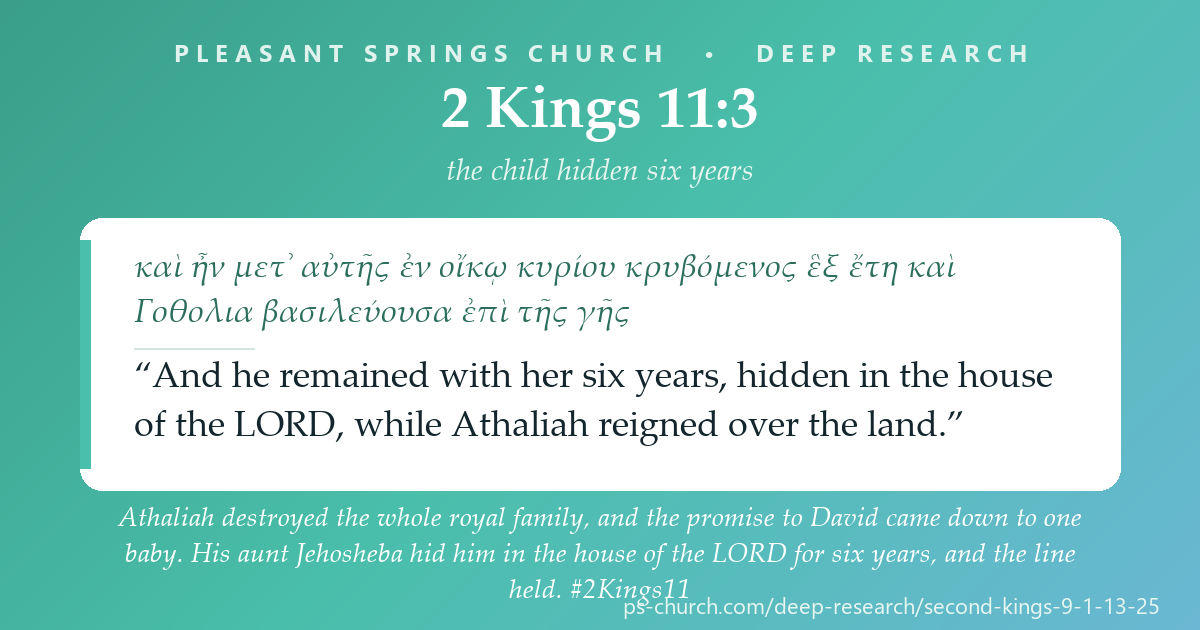
2 Kings 11:2–3 · to share
Greek (Rahlfs, 4 Kingdoms — kaige section) + ESVEvery Deep Research page traces its passage across the whole sweep — the Old Testament, the Second-Temple world between the testaments (historical witnesses, not Scripture), and the New Testament. Follow the thread:
Pleasant Springs Church — Deep Research
Research method after Michael S. Heiser’s Bible Research Method (examine dictionaries → ancient literature → important words → textual connections → academic publications → share), with the Pleasant Springs “Author & Audience” foundation. Scripture set in the Hebrew, the Greek editions named on each page and the ESV (Old Testament), and the Greek New Testament and the ESV (New Testament), per the practice of Pleasant Springs Church. 2 Kings 9–13 research grounded in Cogan and Tadmor (Anchor), Sweeney (OTL), Provan (NIBC), House (NAC), Wiseman (TOTC) and Brueggemann, with Barthélemy, Fernández Marcos and McLean’s NETS introduction on the Greek, and Alter for the literary tools used in the structure block. Book name: in the Septuagint this book is 4 Kingdoms (Βασιλειῶν Δʹ), part of the single continuous work 1–4 Kingdoms; the name is given in the codex note on every page of this set. ⚠️ Section: Barthélemy’s kaige sections in Kingdoms run 2 Kingdoms 11:2–3 Kingdoms 2:11 and 3 Kingdoms 22–4 Kingdoms 25; the whole of 2 Kings, and therefore every verse on this page, falls inside the second one, which is stated in the codex note. What that means is said there rather than assumed: Rahlfs and the Vaticanus text behind it are here a revision toward a proto-Masoretic Hebrew and not the oldest Greek, so agreement with the Hebrew is partly the reviser’s work; the Antiochene (Lucianic) text frequently preserves an older reading in these stretches and is named as a separate witness and not quoted, because doing so responsibly requires Fernández Marcos and Busto Saiz’s critical edition. There is no Göttingen edition of 4 Kingdoms; the fuller apparatus is Brooke–McLean. The kaige claim is not left as an assertion: the page points at καί γε rendering Hebrew gam at 9:27 and 13:6, and at six different Hebrew words Rahlfs transliterates rather than translates (γαρεμ 9:13, αφφω 10:10, μεσθααλ 10:22, σαδηρωθ 11:8 and 15, νεζερ 11:12, βεδεκ seven times over five verses in ch. 12), all checked in the printed text. Text & numbering: Hebrew from the Masoretic Text; Greek from Rahlfs’s Septuaginta (CATSS digitization), printed without editorial punctuation and with proper names unaccented; English ESV. Verse inventories were counted in Rahlfs rather than assumed: chapters 9–13 have 37, 36, 20, 22 and 25 verses in both Hebrew and Greek, so there is no Hebrew/Greek offset on this page — but the English is one verse behind through chapter 12 (ESV 11:21 = MT/LXX 12:1; ESV 12:1–21 = MT/LXX 12:2–22), which the ESV itself footnotes and which this page marks in the reference column. Divergences in the printed verses are enumerated in full in the codex note and pluses and minuses are called what they are: a substantial Greek plus at 9:16; καί γε and the Greek’s supplied verb of striking at 9:27 (ESV footnote); “in madness” → ἐν παραλλαγῇ at 9:20; Jezreel → Samaria at 10:1; a Greek plus at 10:9; the ESV footnotes at 10:15, 10:16 and 13:6 where the ESV prints the Greek reading, and at 10:24 and 11:2 where it keeps the Hebrew and footnotes the Greek; ketiv/qere and the singular/plural “she/they hid him” at 11:2; and a Greek minus of “until now” at 13:23. Qumran: no Dead Sea fragment is cited, because we did not verify what the Kings material preserves for these chapters, and the page says so rather than gesturing at it. Chronology: two collisions inside this passage are shown rather than harmonised — 2 Kings 8:25 (twelfth year) against 9:29 (eleventh year), and 13:1 with 13:10, where 23 + 17 = 40 but the son’s accession is dated to year 37. Thiele is named as the standard attempt and as itself debated (Galil, Kitchen), and no harmonised table is printed as though it were the text. Chronicles is treated as a parallel witness and its differences are reported, not harmonised: 2 Chr 22:9 (Ahaziah captured in Samaria, against 2 Kgs 9:27), 2 Chr 22:11 (Jehoshabeath as Jehoiada’s wife, which Kings does not say), and 2 Chr 24:17–22 (Joash’s apostasy and the stoning of Zechariah, which 2 Kings 12 does not report). ⚠️ The central verdict is given in both halves and deliberately not reconciled: 2 Kings 10:30 commends the purge of Ahab’s house, Hosea 1:4 announces punishment on the house of Jehu for the blood of Jezreel; four ways readers have handled the tension are laid out fairly in Stage 4 and none is adopted. Violence: the standing fence is applied throughout — the killings are reported plainly and briefly, located in a ninth-century dynastic quarrel, never relished or used as rhetoric, and stated to license nothing today; 9:30–37 is reported once and soberly with no detail, and no share card is drawn from any scene of violence (the card is 11:2–3, Jehosheba). Ancient Near Eastern material is cited only where verifiable in the local scan of Pritchard’s ANET: the Black Obelisk epigraph on Jehu (ANET 281) and Shalmaneser III on Hazael (ANET 280). The Tel Dan stele is named in Stage 5 with its uncertainty attached and explicitly not cited as ANET material, because it postdates that collection. Sirach and Josephus are read as witnesses and never levelled with Scripture, and Josephus’s divergences from the biblical text are listed rather than smoothed. The typology at 2 Kings 11 is given with both halves stated: the Old Testament text does not announce it and the New Testament does not cite it, and we are meant to see it.
Scripture quotations marked ESV are from the ESV® Bible (The Holy Bible, English Standard Version®), © 2001 by Crossway, a publishing ministry of Good News Publishers. ESV Text Edition: 2016. Used by permission. All rights reserved. The ESV text may not be quoted in any publication made available to the public by a Creative Commons license, and the ESV may not be translated in whole or in part into any other language. www.esv.org
|
Did this study bless you today? 💚 Give to Support PS Church100% of gifts go to the General Fund — thank you. |