Six chapters, and the kings almost vanish. It opens with a dated, named, judged king and it closes with two more — and in between, from 4:1 to 8:15, no king of Israel is ever given a name. What fills the space instead is a prophet and a great many people who own nothing. First the Moab campaign: trenches dug in a dry riverbed, water with no rain, and then the hardest verse in the book — the king of Moab “took his oldest son who was to reign in his place and offered him for a burnt offering on the wall. And there came great wrath against Israel” (3:27). The text does not say whose wrath. It does not explain the retreat. This study says so, lays out how the verse has been read, and stops. Then the cycle proper, and it is allowed to breathe: a widow, one jar of oil, and vessels borrowed from every neighbour in the village; a woman of Shunem who is never named, who builds the prophet a room, whose son dies on her knees, and who rides to Carmel saying only “It is well”; death in the pot, and twenty barley loaves that feed a hundred with some left. Then chapter 5, which carries the page — Naaman, commander of the army of Syria, “a great man with his master and in high favor… a mighty man of valor, but he was a leper.” And the hinge of the whole thing is a little Israelite slave girl, taken in a raid, unnamed, who tells her mistress about a prophet. Letters between kings, a prophet who will not come outside, “Are not Abana and Pharpar, the rivers of Damascus, better than all the waters of Israel?”, and then the servants’ quiet wisdom — “My father, it is a great word the prophet has spoken to you; will you not do it?” Seven dips, flesh like the flesh of a little child, and a confession: “Behold, I know that there is no God in all the earth but in Israel.” Then the refused payment, the two mule-loads of earth, an honest question about the house of Rimmon, and Gehazi. Then a borrowed axe head, a blinded army fed and sent home, a siege, and four men at the gate who cannot keep quiet: “This day is a day of good news.” Worked line by line in Hebrew, Septuagint and ESV — and the whole of 2 Kings sits inside the second kaige section, so the Greek printed here is a revision toward the Hebrew, not the oldest Greek, which is said plainly on every line where it matters. See the method →
2 Kings 3:1–8:29 (selections)
Hebrew · Greek (Rahlfs, 4 Kingdoms — kaige) · ESVThe book, the section, the edition — and why every sentence about “the Septuagint” on this page has to say which Greek. In the Septuagint this book is 4 Kingdoms (4 Reigns) — Βασιλειῶν Δʹ (Basileiōn D). 1–2 Samuel and 1–2 Kings are one continuous work in Greek, Βασιλειῶν Αʹ–Δʹ, and a reader who takes the name “2 Kings” to a Greek Bible will not find it. (Worth noticing once: our English names for the Torah — Genesis, Exodus, Leviticus, Numbers, Deuteronomy — are the Septuagint’s names, while Samuel and Kings keep Hebrew-derived ones. An English Bible already mixes both traditions on its contents page.)
⚠️ Which section is this? Kaige — all of it, and that changes what the Greek column is. Dominique Barthélemy showed in Les Devanciers d’Aquila (1963) that the Greek of Kingdoms is not one translation. Two long stretches are a later kaige revision — a first-century pull of an older Greek text back toward a proto-Masoretic Hebrew, named for its stereotyped rendering of Hebrew גַּם (gam, “also”) by καί γε. Using Thackeray’s section letters: 2 Kingdoms 11:2 → 3 Kingdoms 2:11 (βγ) and 3 Kingdoms 22 → 4 Kingdoms 25 (γδ). The whole of 2 Kings falls inside the second one. NETS makes the point on every page: its 4 Reigns carries the running head “(KAIGE)” from the first verse to the last.
What that means, said plainly. In this book Codex Vaticanus — and Rahlfs’s text, which leans on it — is a revision, not the oldest Greek. It has already been pulled toward a Hebrew text very like the one your Old Testament is translated from. The Antiochene (Lucianic) manuscripts are a separate witness here, and in the kaige sections they frequently preserve an older Greek reading than the one printed above. So the sentence “the Septuagint reads X” is genuinely ambiguous in 2 Kings. This page prints Rahlfs and says so every time, and it cites no Antiochene reading, because we have not consulted the critical edition (Fernández Marcos and Busto Saiz, El texto antioqueno de la Biblia griega). There is as yet no Göttingen edition of 4 Kingdoms; the fuller apparatus is Brooke–McLean’s larger Cambridge Septuagint. On why this library prints what it prints, see the texts we print.
You can see the revision at work in these chapters without knowing any Greek. Two kinds of evidence, both counted. (1) The signature itself. καί γε occurs sixteen times in 4 Kingdoms, and once in this passage — at 8:1, where Hebrew וְגַם becomes καί γε ἦλθεν. (2) Hebrew words simply written out in Greek letters, because a reviser who will not gamble writes the sound rather than a guess. There are five in these six chapters: 3:4 νωκηδ for נֹקֵד (“sheep breeder”); 4:39 αριωθ for אֹרֹת (“herbs”); 5:19 δεβραθα for כִּבְרַת (“a short distance”); 6:8 ελμωνι for אַלְמֹנִי (“such and such”); and 8:15 μαχμα for מַכְבֵּר (the bed-cloth — a word the ESV also footnotes as uncertain). Add 4:13, where אָנֹכִי is rendered ἐγώ εἰμι + a finite verb, and the profile is unmistakable.
Numbering: there is no offset in this passage, and that was counted rather than assumed. Rahlfs’s 4 Kingdoms has 27, 44, 27, 33, 20 and 29 verses in chapters 3–8 — exactly as the Hebrew does. No verse above needed a double reference. One arrangement difference does touch this page, though, and it sits just before it: Rahlfs prints four extra lettered verses at 4 Kingdoms 1:18a–d — the only lettered verses in the whole book — and they are a second, variant accession notice for Jehoram son of Ahab, the doublet of 3:1–3, which the Greek then also prints in its place. The two versions differ: 1:18b says he was not like his brothers and his mother where 3:2 says his father and his mother; 1:18c adds that he smashed the pillars of Baal; and 1:18d has a whole sentence with no Hebrew counterpart anywhere — καὶ ἐθυμώθη ὀργῇ κύριος εἰς τὸν οἶκον Αχααβ, “and the Lord was angry with wrath against the house of Ahab.” Which arrangement is earlier is exactly the kind of question the critical editions exist to argue about, and this page does not adjudicate it. It reports that the doublet is there, in Rahlfs, and that it belongs to the opening verses of this study. Neighbouring page: 2 Kings 1–2.)
The Shape of the Passage
InclusioBehind these chapters stand Elijah at Zarephath and on Carmel — a widow, a jar of oil that does not run out, and a dead son given back — and the death of Ahab. In front of them stand Jehu’s purge and, eventually, the fall of Samaria. This is the quiet stretch in between, and it is where the book spends most of its time on people who own nothing.
Author
A historian who keeps two very different kinds of source in one book, and does not blend them. One is the royal chronicle: accession formulas, synchronisms with the other kingdom, the verdict, and “the rest of the acts of X, are they not written in the Book of the Chronicles of the Kings of Israel?” The other is a cycle of prophet stories — oral, vivid, domestic, full of pots and doors and donkeys, with almost no dates in it. Chapters 4–7 are almost entirely the second kind, which is why the kings in them lose their names. He does not tell you he has changed source. He just changes.
He is a reticent writer, and the silences are the technique. He will not tell you whose wrath came on Israel at 3:27. He will not tell you whether Elisha said yes or no about the house of Rimmon. He will not tell you why the little girl spoke, or what happened to her afterwards. Robert Alter’s point about biblical narrative applies here as much as anywhere: the gap is where the reader is invited in — and the discipline for a study like this one is to leave the gap open rather than fill it, which is exactly what the ancient retellings could not do (Stage 2).
And he is not writing propaganda for Israel. He tells you the Lord gave victory to Syria (5:1). He gives the confession of the true God to a foreign general and lets the Israelite prophet’s own servant end the chapter with the disease. He lets a Moabite king’s desperate act push an Israelite army off the field without explaining it. A writer inventing a national epic does not do these things.
Audience
People who already knew how it ended. Kings was finished after Jerusalem fell (its last scene is Jehoiachin eating at a Babylonian table). So the first readers of “there was a great famine in Samaria” had been besieged themselves; the first readers of “the Syrians on one of their raids had carried off a little girl” were reading it in exile, having been carried off themselves. That is who this chapter is for. A captive child in a foreign officer’s house who still knows the name of her God and still wants her master well — the audience did not need that explained.
People who lived under a king they could not fix. The king of Israel in these chapters is not wicked in any dramatic way; he is mostly panicking. He tears his clothes (5:7), he wants to kill the prophet (6:31), he asks a starving woman what he is supposed to do about it (6:27). The stories are not about him, and that is the point: God’s work in these chapters is going on around the edges of a failing government, in kitchens and along riverbanks.
People who needed to know that the border was not the boundary. Naaman is an enemy commander. The little girl is his slave. The four men at the gate are ritually excluded from their own city. The Shunammite is a woman with no legal standing and no son. Every single person through whom something happens in these six chapters is somebody the system had already written off — and an exiled audience with no temple, no king and no land was in exactly that position.
Orient on Elisha and the prophetic guilds, Moab and Chemosh, Aram-Damascus, skin disease and exclusion, siege warfare and famine, and the regnal chronology.
Search by topic: Elisha; sons of the prophets; Moab; Mesha; Chemosh; Moabite Stone; Aram / Damascus; Ben-hadad; Hazael; Naaman; Rimmon (Hadad-Rimmon); leprosy / tsaraʿat; Shunem; Shunammite; Gehazi; Gilgal; Dothan; Samaria; siege warfare; famine; herem; child sacrifice in the ancient Near East; chronology of the divided monarchy; kaige recension; Antiochene text.
Which articles are relevant?
- Anchor Bible Dictionary — “Elisha,” “Prophets, Sons of the,” “Moab,” “Mesha Inscription,” “Chemosh,” “Aram (Place),” “Ben-hadad,” “Hazael,” “Naaman,” “Rimmon (Deity),” “Leprosy,” “Shunem,” “Gehazi,” “Dothan,” “Samaria,” “Chronology (Hebrew Bible).”
- Dictionary of the OT: Historical Books (IVP) — “Elijah and Elisha,” “Prophets and Prophecy,” “Kings, Books of,” “Chronology,” “Non-Israelite Written Sources: Syro-Palestinian,” “Aram, Damascus and Syria,” “Moab, Moabites.”
- NIDOTTE / TDOT — צָרַעַת (ṣāraʿaṯ, the skin condition), קֶצֶף (qeṣep, wrath), שָׁלוֹם (šālôm), בְּשׂוֹרָה (bəśōrāh, good news), גְּדוּד (gəḏûḏ, raiding band), נֹקֵד (nōqēḏ, sheep breeder), עֹלָה (ʿōlāh, whole burnt offering).
- On the Greek — Bernard A. Taylor, “Reigns: To the Reader,” in NETS. Four pages, and it is where most of the codex note above comes from: that Rahlfs is the base text for all four Reigns books because no Göttingen volume exists for them; Thackeray’s section sigla, printed there as “γδ = 3 Rgn 22 + 4 Rgn 1–25”; and the summary judgement that “rather than representing a new translation, βδ is the result of a later revision.” It is also where you can see the running head “(KAIGE)” on every page of 4 Reigns.
Bibliography surfaced:
- Mordechai Cogan and Hayim Tadmor, II Kings (Anchor Bible) — the standard critical commentary in English on this book, and the first place to go for the Assyrian and Moabite material; Marvin A. Sweeney, I & II Kings (OTL); Simon J. DeVries, 1 Kings (WBC) for the Elijah–Elisha traditions generally.
- Iain W. Provan, 1 and 2 Kings (NIBC); Paul R. House, 1, 2 Kings (NAC); Donald J. Wiseman, 1 and 2 Kings (TOTC) — three shorter treatments from within the church’s confession, and the ones a teacher will actually use on a Wednesday night.
- Emanuel Tov, Textual Criticism of the Hebrew Bible; Natalio Fernández Marcos, The Septuagint in Context — for the kaige sections, the Antiochene text, and why “the LXX” is not one thing in these books.
- Robert Alter, The Art of Biblical Narrative — for the reading tools used in the structure block above. (Alter reads these texts as literature and does not share the church’s confession; we take the tools, not the metaphysics.)
Mesha’s own stone, an Assyrian king who names Hazael, what a siege did to a city — and what every ancient retelling did to 3:27.
First the outside witnesses, quoted rather than summarised: the Moabite Stone (Mesha’s own account of this era) and the annals of Shalmaneser III (who names Hazael). Then what the Second-Temple and rabbinic retellings add to these chapters — because what they add tells you which silences they could not bear.
Which parallels shed light on the world of these chapters?
⚠️ The Moabite Stone is Mesha of Moab speaking for himself, about this war, in his own language. It was found intact at Dhiban in 1868, broken up soon afterwards, and is now in the Louvre. It is a royal victory monument set up for the god Chemosh, and ANET dates it roughly between 840 and 820 BC. Read what it actually says, in Albright’s translation:
“I (am) Mesha, son of Chemosh-[…], king of Moab, the Dibonite… As for Omri, king of Israel, he humbled Moab many years, for Chemosh was angry at his land… but I have triumphed over him and over his house, while Israel hath perished for ever!”The Moabite Stone, opening lines — ANET 320 (trans. W. F. Albright). A royal inscription: a witness, not Scripture.
Where the stone and the Bible agree is remarkable, and where they differ is just as instructive — and this page will not weld them together. They agree that there was a king of Moab called Mesha; that Moab had been subject to Israel under the house of Omri; that Moab threw that off; that the god of Moab was Chemosh; and, startlingly, that Moab practised ḥerem, devotion-to-destruction, in the same vocabulary Israel used — at Nebo, Mesha reports killing seven thousand people because, he says, he had “devoted them to destruction” for the god Ashtar-Chemosh, and dragging away “the […] of Yahweh” before Chemosh. (That damaged phrase is, incidentally, one of the earliest occurrences of the divine name outside the Bible; the noun it governs is broken away, and we will not guess at it.) ANET itself dates the stone by our verse: “the reference to Mesha, king of Moab, in II Kings 3:4.”
They differ, and the differences are not small. The stone says nothing whatever about the campaign of 2 Kings 3 — no three kings, no drought, no siege of Kir-hareseth, and no sacrifice on the wall. Kings says nothing about Mesha’s conquests of Medeba, Ataroth, Nebo and Jahaz, or about his building works at Qarhoh and Aroer. The stone claims total, permanent victory — “Israel hath perished for ever” — while Kings reports Moab’s countryside ruined and an Israelite army withdrawing. The stone’s “forty years” for Israelite control of Medeba does not fit the twelve years Kings gives Omri plus the twenty-two it gives Ahab. These are two documents with two purposes. A victory stela exists to say that the king won and his god was pleased; it does not narrate defeats, and neither the stone nor the Bible is obliged to tell the other’s story. We report both and harmonise neither — that is the whole point of putting them on the same page.
Hazael, who walks into this study in 8:7–15 with a wet cloth in his hand, turns up in Assyrian royal annals a few years later. Shalmaneser III, eighteenth year: “Hazael of Damascus rose for battle. I took away from him 1,121 chariots, 470 cavalry-horses as well as his camp” (ANET 280); and again in the twenty-first year, “I marched against the towns of Hazael of Damascus.” The same eighteenth-year text ends by listing tribute from “Jehu, son of Omri” — which is where the next study begins. The Bible and Assyria are describing the same men.
And the ordinary world these stories move in. A nōqēḏ (3:4) is not a shepherd but a large-scale sheep manager — the same rare word describes Amos (Amos 1:1); the tribute of 100,000 lambs and the wool of 100,000 rams is exactly the kind of pastoral levy the Moabite plateau could pay. Digging pits in a wadi bed (3:16) is how you catch a flash flood off the eastern hills, which is why the water arrives with no rain in sight (3:17). A besieged city (6:24–25) starves in a predictable order, and a donkey’s head — unclean, and the least edible part of an unclean animal — selling for eighty shekels is a way of saying the city has reached the end. And a man with ṣāraʿaṯ lived outside the gate (Leviticus 13:45–46) — which is precisely why the four men of 7:3 were the only people in Samaria free to walk into the enemy camp.
- The Moabite Stone (Mesha Stele), c. 840–820 BC, ANET 320–321, trans. W. F. Albright (a royal inscription — a witness, not Scripture). Verified in the local scan. Quoted above; the fuller text names Ataroth, Nebo, Jahaz, Qarhoh, Aroer and Hauronen, and includes the line about taking “the […] of Yahweh” to Chemosh.
- Shalmaneser III, annals: eighteenth and twenty-first years, ANET 280 (a royal inscription — a witness, not Scripture) — Hazael of Damascus by name, and in the same passage the tribute of Jehu, son of Omri. A generation later Adad-nirari III still calls the northern kingdom “Israel (mat Ḥu-um-ri)” — the house of Omri (ANET 281).
- Sirach 48:12–14 (Second-Temple, non-canonical — a witness, not Scripture) — the earliest surviving summary of Elisha’s career: Ελισαιε ἐνεπλήσθη πνεύματος αὐτοῦ, “Elisha was filled with his spirit… no ruler shook him and no one overpowered him… in his life he did wonders, and in death his works were marvellous.” Ben Sira gives him four lines and Elijah nine; what he singles out is Elisha’s fearlessness before rulers.
- Josephus, Antiquities 9.3.1–2 and 9.4.2–5 (Whiston’s chapter-and-section numbering; Second-Temple — a witness, not Scripture) — he retells the Moab campaign at length and the Elisha stories selectively, and every one of his changes is worth seeing. See the note below.
- b. Berakhot 10b (rabbinic-era — a witness, not Scripture) — on 2 Kings 4:9–10, the Shunammite: “Rabbi Yosei, son of Rabbi Ḥanina, said: From here, where the woman from Shunem perceived the prophet’s greatness before her husband did, derive that a woman recognizes the character of her guests more than a man does.” The Gemara then works over her words “he is holy” in some detail. (English in the William Davidson translation.)
- b. Sanhedrin 96b and b. Gittin 57b (rabbinic-era — a witness, not Scripture) — the same baraita in both places: “Naaman the Aramean was a ger toshav” — a resident alien who undertook to abstain from idolatry without becoming a Jew. It is a careful and rather generous ruling, and it is the tradition’s answer to the question Naaman himself raises in 5:18.
Line them up and the pattern is unmistakable.
(1) 3:27 — Josephus deletes the wrath and supplies a motive. Where the Hebrew says “and there came great wrath against Israel,” Josephus writes that the kings, seeing the sacrifice, “commiserated the distress that was the occasion of it, and were so affected, in way of humanity and pity, that they raised the siege, and every one returned to his own house.” The retreat is now a moral decision by decent men. It is a completely coherent story and it is not the one in the Bible. Notice that the Greek column above has already leaned the same way: μετάμελος μέγας, “great regret.”
(2) 4:1 — Josephus gives the widow a famous husband. In Kings she is “the wife of one of the sons of the prophets” and that is all. In Josephus she is the widow of Obadiah, Ahab’s steward, who hid a hundred prophets from Jezebel and borrowed money to feed them — which explains the debt and makes the mercy deserved. The Bible does not say it, and the Bible’s version is harder: she is nobody, and he helps her.
(3) The Shunammite and Naaman are simply not in our text of Josephus at all. He runs from the widow’s oil straight to Dothan. Whiston himself noticed the gap and regretted it in a footnote, precisely because of the question Naaman asks in 5:18. We report the absence and do not theorise about it.
(4) The rabbis supply a legal category. Naaman goes home to Damascus and no biblical writer ever tells us what to make of him. b. Sanhedrin 96b and b. Gittin 57b classify him: a ger toshav, a resident alien bound only against idolatry. That is a real and thoughtful answer to a real question — and it is an answer Scripture declines to give.
The rule for these pages: report what the text approves, report what it merely reports, report what it condemns, and leave the gaps open. The ancient witnesses are worth reading precisely because you can watch them closing gaps — which is the standing temptation of anyone who loves a story too much to let it stay quiet.
One word with no subject, one word a grieving woman repeats, and a Greek particle that dates a translation.
Count šālôm yourself in chapter 4 — five, and four of them in one verse. Then hold Hebrew qeṣep beside Greek μετάμελος at 3:27 without choosing between the columns, and notice what a single Greek particle at 8:1 tells you about the whole book you are reading.
“Wrath, fury, indignation.” The single hardest word in this study. Everywhere else in the historical books it is God’s wrath (Num 1:53; Josh 9:20; 2 Chr 19:2; 24:18), which is why most readers hear it that way here — but the sentence has no subject: literally “and there was great wrath upon Israel.” Not “the Lord’s wrath.” Not “Chemosh’s wrath.” Not “the Moabites’ fury.” Just wrath, and then an army leaving. And the Greek does not have the word at all: Rahlfs reads μετάμελος, “regret, remorse” (so NETS). Two ancient texts, two different sentences, and this page prints both rather than choosing quietly.
“Peace, wholeness, is all well?” Eight occurrences in these six chapters, and five of them belong to a woman whose son has just died. She says it to her husband (4:23), and then Gehazi runs out with the prophet’s three questions — is it šālôm with you, with your husband, with the child? — and she answers with the single word (4:26). The Greek keeps every one as εἰρήνη. The other three sit in the Gehazi scene: Elisha dismisses Naaman with “Go in peace” (5:19), and then Naaman, seeing a man running after him, asks the Shunammite’s own question — “Is all well?” — and Gehazi lies with it: “All is well” (5:21–22). The same word, used by a grieving woman who means it and by a servant who does not.
“The man of God.” The narrator’s standing title for Elisha, and the count is the structure: eleven times in chapter 4, four each in 5, 6 and 7, five in 8 — twenty-eight in all, against the anonymous “the king of Israel” through the same span. It is the title Elijah carried (1 Kings 17:18, 24), and its force is possessive rather than complimentary: he belongs to God, and therefore not to the palace. The Greek renders it flatly and consistently, ὁ ἄνθρωπος τοῦ θεοῦ.
The skin condition traditionally Englished “leprosy,” and the ESV footnotes the word both times it introduces it. It is not modern Hansen’s disease; Leviticus 13–14 describes a family of conditions, applies the same word to fabric and to house walls, and makes a priest — not a physician — the one who declares a person clean. The consequence was social: outside the camp, outside the gate (Lev 13:46), which is exactly where 7:3 finds four men sitting. The Greek is λέπρα throughout, and the participle λελεπρωμένος is the last word of 5:1 and the last word said of Gehazi in 5:27. The chapter opens and closes with the same Greek word attached to two different men.
“A little girl” — the Greek νεάνιδα μικράν. She has no name, no lineage, no speech beyond one sentence, and no further appearance. And then in 5:14 Naaman comes up out of the Jordan with flesh “like the flesh of a little child” — נַעַר קָטֹן, the masculine of her exact phrase, and παιδαρίου μικροῦ in Greek. The commander of the army of Syria ends the story looking like the slave who started it. The link is in the words themselves and can be checked in any Hebrew text; whether the author intended the echo is a judgement, and we present it as one.
“Good news, tidings.” The noun behind “a day of good news” and behind the messenger-verb biśśar that Isaiah uses of the herald on the mountains (Isa 52:7). The Greek here is εὐαγγελία — the ordinary word for a report of victory, and the word from which evangel and gospel come. That is a fact about the vocabulary of the Greek Old Testament, not an argument that 2 Kings 7 is about Jesus; but four excluded men, sitting on plunder they have every right to keep, saying “we are not doing right, this is a day of good news and we are silent,” is not a bad definition of the thing the word came to mean.
“Borrowed.” A passive participle of šāʾal, “to ask, to request” — the same root Elisha uses in 4:3 when he tells the widow to ask her neighbours for vessels. Twice in three chapters the plot hangs on something that belongs to somebody else, and both times the person in trouble is poor. It is also the root of the name Saul (“asked for”), and the same participle is used of Samuel in 1 Sam 1:28 — a child “lent to the Lord.” Greek here: κεχρημένον.
Not a Hebrew word but a Greek habit, and the one that gives the kaige revision its name. Hebrew גַּם (gam, “also, indeed”) can be carried by a single Greek particle; the reviser insists on two words every time, because his principle is that every Hebrew element must show. Sixteen times in 4 Kingdoms; once in this passage, at 8:1. Where you find this habit clustering you are reading a text that has been pulled back toward the Hebrew — which is why the Greek column on this page is described as a revision and not as “the oldest Greek.”
Three features of the Hebrew of these chapters, reported rather than tidied:
- The archaic second-feminine-singular ending, and where it clusters. Eight times in this passage the written consonants carry an old suffix ־כִי (-kî) or an old verbal ־תִי (-tî) where the Masoretic reading tradition supplies the ordinary later form: 4:2 לכי read לָךְ; 4:3 שכנכי read שְׁכֵנָיִךְ; 4:7 נשיכי read נִשְׁיֵךְ and בניכי read וּבָנַיִךְ; 4:16 and 4:23 אתי read אַתְּ; 4:23 הלכתי read הֹלֶכֶת; 8:1 אתי read אַתְּ. Every one of them occurs in speech addressed to a woman — the widow of 4:1–7 and the Shunammite. Whether that is dialect, archaism, or a scribe’s habit is not settled, and it is worth knowing that a translation which reads perfectly smoothly is smoothing something.
- Two ketiv/qere pairs where the reading tradition softens the text. At 5:12 the consonants are אבנה (Abanah) and the tradition reads אֲמָנָה (Amanah) — the ESV prints the written form and footnotes the other. At 6:25 the consonants of the commodity sold at five shekels are חרי יונים and the tradition substitutes דִּבְיוֹנִים; the Masoretes are declining to say the coarser word aloud in the synagogue. Both are printed here rather than quietly resolved.
- An obscurity the ESV resolves from the Greek — and says so. The last clause of 3:24 is barely construable in Hebrew (ויבו וַיַּכּוּ־בָהּ וְהַכּוֹת אֶת־מוֹאָב, with a ketiv/qere in the middle of it). Rahlfs reads καὶ εἰσῆλθον εἰσπορευόμενοι καὶ τύπτοντες τὴν Μωαβ, “and they entered, going on and striking Moab”; the ESV prints “And they went forward, striking the Moabites as they went” and footnotes it “Septuagint; the meaning of the Hebrew is uncertain.” That is the whole argument of the texts we print in one footnote: your English Bible is already reading the Greek, in this chapter, and telling you so at the bottom of the page.
Elijah behind every one of these stories, Moab from Genesis 19 to Deuteronomy 23, the law of the leper, and a slave girl the New Testament remembers.
Trace four threads: Elisha against Elijah, story by story; Moab, from Lot’s cave to Deuteronomy’s ban; the leprosy laws and what they actually required; and the meal — loaves, a pot, a feast for the enemy, a market at the gate.
Which cross-references matter?
- 1 Kings 17–19 — read it first, because Elisha’s stories are deliberately shaped against Elijah’s. A widow with almost no oil left, and a jar that does not run out (1 Kgs 17:8–16) → a widow with one jar of oil (2 Kgs 4:1–7). A dead son, a prophet who stretches himself on the boy, and “see, your son lives” (1 Kgs 17:17–24) → the Shunammite’s son (2 Kgs 4:32–37). Food multiplied in a famine, fire and armies, a servant sent to look. The differences are the message: Elijah’s miracles are mostly public confrontations with a dynasty; Elisha’s are mostly domestic, and half of them are for people who are nobody.
- Genesis 19:30–38; Numbers 22–24; Numbers 25; Deuteronomy 2:9; Deuteronomy 23:3–6; Judges 3:12–30; Ruth 1 — the whole Moab file, and it is not one-sided. Moab is Lot’s son; Moab hires Balaam; Moabite women lead Israel into Peor; Israel is forbidden to take Moabite land; Eglon oppresses Israel eighteen years; and a Moabite widow walks into Bethlehem and ends up David’s great-grandmother. Do not let anyone hand you half of this.
- Leviticus 13–14 — the law behind chapters 5 and 7. Note what it requires and what Naaman never gets: a priest’s examination, a seven-day quarantine, two birds, cedarwood, scarlet yarn, hyssop, running water, and a sacrifice at the tent of meeting. Naaman is cleansed in a foreign river by a prophet who does not come out of the house, and no priest is involved at any point. The narrator does not comment on that either.
- Deuteronomy 12:31; Deuteronomy 18:10; Leviticus 18:21; Leviticus 20:2–5; Judges 11:30–40 — for 3:27. Israel’s law names the practice and forbids it in the strongest terms available: “they even burn their sons and their daughters in the fire to their gods.” What the law does not do is explain the verse. 2 Kings 3:27 reports a Moabite king doing a Moabite thing and then says four words about wrath, and the reader who wants a verdict has to bring it from Deuteronomy, because the narrator does not supply one here.
- Deuteronomy 20:19–20 — and this one cuts the other way, which is why it belongs on the page. Israel is forbidden to fell fruit trees when besieging a city: “are the trees of the field human, that they should be besieged by you?” Yet the word of the Lord through Elisha in 3:19 tells them to “fell every good tree,” and 3:25 says they did. Commentators divide sharply over whether the narrator is quietly registering an excess here. The text does not say. We name the tension and stop.
- Numbers 11:21–23 and Exodus 16 — for 4:42–44. Moses: “The people among whom I am number six hundred thousand… Shall flocks and herds be slaughtered for them?” The servant: “How can I set this before a hundred men?” Same objection, same answer — “Is the Lord’s hand shortened?” — and in both cases what arrives is food, with leftovers, which is the point Exodus 16 makes about manna.
- 2 Samuel 7 — for 8:19, which is the only sentence of theology the narrator offers in the whole royal frame: “Yet the Lord was not willing to destroy Judah, for the sake of David his servant, since he promised to give a lamp to him and to his sons forever.” Jehoram of Judah is as bad as the house of Ahab and Judah survives him anyway, and the reason given is a promise made to a man three generations dead.
- Deuteronomy 18:15–19 — the prophet like Moses, and the standard against which every figure in this cycle is measured: he speaks what he is given and nothing else. Elisha’s refusal to say more than “Go in peace” at 5:19 is a small demonstration of that discipline.
- 1 Kings 16:29–33 — Ahab, Jezebel and Baal, which is the family these chapters are still cleaning up after; and 2 Kings 9–10, where the man anointed in 8:13 and the house condemned in 1:18d finally collide.
- The New Testament, in plain text because we have no page for it yet. Luke 4:27 — Jesus, in the synagogue at Nazareth, cites this chapter: “And there were many lepers in Israel in the time of the prophet Elisha, and none of them was cleansed, but only Naaman the Syrian.” He names it in the same breath as the widow of Zarephath (Luke 4:26 — 1 Kings 17), and the congregation tries to throw him off a cliff for it. Hebrews 11:35 — “Women received back their dead by resurrection”: the Shunammite, and the widow of Zarephath, and no other candidates in the Old Testament. See also Luke 17:11–19, ten cleansed and one Samaritan who comes back.
Take her out of chapter 5 and nothing happens. Naaman stays sick. There is no letter between kings, no rage on the doorstep, no seven dips, no confession, no mule-loads of soil. The entire narrative rests on two verses spoken by a captive child in the house of the officer whose raiders took her.
Notice how little the text gives her, and how deliberately. No name. No family. No age beyond “little.” One sentence of direct speech. No reaction from anyone — nobody in the story thanks her, and the narrator never mentions her again; when Naaman comes home cleansed with a mule train of Israelite earth, she is not in the room. She is not rewarded, she is not freed, and as far as the text tells us she is still a slave in Damascus when the chapter ends.
And notice what she says. Not a curse, and not a bargain. “Would that my lord were with the prophet who is in Samaria! He would cure him of his leprosy.” She wants the man well. She is certain about the prophet — she has grown up in a country where everyone knows where Elisha lives — and she is confident enough about it to say so to a Syrian noblewoman who could have had her beaten for it.
Three things this page will not do with her. It will not make her a symbol; she is a person, and the point of the story is partly that a person this small could carry it. It will not turn her captivity into something good; a raid took her, and the same raids are what Elisha finally shuts down in 6:23 by feeding the raiders. And it will not tell you she was brave without also telling you that the text says nothing about what it cost her, because it does not.
What it will say is this. There is an army commander, a king of Syria, a king of Israel, ten talents of silver, six thousand shekels of gold, a chariot at the door, and a prophet who will not come outside. And the hinge of the whole thing is a child nobody asked.
3:27 and the four readings; a chronology that does not resolve; where Kings and Chronicles differ; and the state of the Greek.
Cogan–Tadmor and Sweeney on the history, Provan, House and Wiseman from inside the church’s confession, Barthélemy and Fernández Marcos on the Greek, Shenkel on the chronology of the Greek. Then four live questions — the wrath at 3:27, the regnal numbers, the Chronicles parallel, and the house of Rimmon — each laid out and none of them closed.
Commentaries & studies:
- Mordechai Cogan and Hayim Tadmor, II Kings (Anchor Bible) — the fullest critical treatment in English, and the standard reference for the Moabite and Assyrian inscriptions used in Stage 2.
- Marvin A. Sweeney, I & II Kings (OTL); Iain W. Provan, 1 and 2 Kings (NIBC); Paul R. House, 1, 2 Kings (NAC); Donald J. Wiseman, 1 and 2 Kings (TOTC) — four very different readings, all worth having in the room.
- Dominique Barthélemy, Les Devanciers d’Aquila (VTSup 10, 1963) — the book that identified the kaige group and made every later statement about “the LXX of Kings” more careful; Natalio Fernández Marcos, The Septuagint in Context, and Fernández Marcos and J. R. Busto Saiz, El texto antioqueno de la Biblia griega, for the Antiochene text this page does not cite.
- James Donald Shenkel, Chronology and Recensional Development in the Greek Text of Kings (HSM 1; Harvard, 1968) — the standard study of the fact that the Greek and the Hebrew do not carry the same regnal numbers, and that the differences run in patterns rather than at random.
- Edwin R. Thiele, The Mysterious Numbers of the Hebrew Kings — the standard attempt at a harmonised scheme, and the one everyone else argues with; Gershon Galil, The Chronology of the Kings of Israel and Judah; Jeremy Hughes, Secrets of the Times; William H. Barnes, Studies in the Chronology of the Divided Monarchy of Israel.
Interpretation notes worth keeping:
- ⚠️ 3:27, “and there came great wrath against Israel.” Four readings, and Scripture does not choose among them. (1) It is the Lord’s wrath. קֶצֶף is normally God’s in these books, and something in the campaign has gone wrong — possibly the felling of the fruit trees against Deuteronomy 20:19, possibly the alliance itself, which Elisha regards with open contempt in 3:13–14. (2) It is Chemosh’s wrath, or what the combatants took for it. On this reading the narrator is reporting how the battlefield read the event, in a world where a god defends his own land — and the Mesha Stele shows that this is exactly how Moab talked. (3) It is human fury: Moabite desperation turned to a berserk counter-attack, and “wrath upon Israel” means an army that suddenly could not hold. (4) The Greek did not read “wrath” at all — μετάμελος μέγας, “great regret,” which is essentially the reading Josephus turns into a paragraph. Here is what stays unresolved. The Hebrew names no subject for the wrath, draws no causal line to the retreat, and passes no judgement on the sacrifice; the very next verse is about a widow’s debt. Commentators divide, and the division is itself the evidence that the text does not say. Where Scripture gives no reason, we say so and stop.
- ⚠️ The regnal chronology of these chapters is genuinely unresolved, and we will not print a harmonised scheme as though it were the text. Four numbers, all in or beside this passage. (a) 2 Kings 3:1: Jehoram of Israel becomes king “in the eighteenth year of Jehoshaphat king of Judah.” (b) 2 Kings 1:17: he becomes king “in the second year of Jehoram the son of Jehoshaphat, king of Judah.” Those two cannot both be simple accession dates unless Jehoshaphat and his son were reigning at the same time. (c) 2 Kings 8:16 dates Jehoram of Judah to “the fifth year of Joram the son of Ahab… when Jehoshaphat was king of Judah” — and that last clause, the only textual trace of the overlap, is absent from Rahlfs and from the Syriac, as the ESV footnotes. (d) 2 Kings 8:25 puts Ahaziah’s accession in Joram’s twelfth year and 2 Kings 9:29 puts it in his eleventh. And the Greek does not have the same numbers as the Hebrew: Rahlfs’s 4 Kingdoms lacks the 1:17 synchronism entirely and puts the accession notice at 1:18a with only “the eighteenth year of Josaphat,” so the Greek is internally consistent at precisely the point where the Hebrew is not — which is the phenomenon Shenkel’s whole book is about. Thiele’s reconstruction resolves most of this with co-regencies, two different new-year reckonings and two different ways of counting an accession year; it is the standard attempt, it is elegant, and it is contested (Galil, Hughes, Barnes and Tetley all differ from it and from each other). We name the difficulty, name the attempts, and adjudicate none of them. Nothing in this study depends on the outcome.
- ⚠️ Where Kings and Chronicles differ, we report the difference rather than blending them. Three cases touch this passage. (1) Ahaziah’s age. Hebrew Kings 8:26 says twenty-two; Greek Kings agrees; Hebrew 2 Chronicles 22:2 says forty-two; Greek 2 Paraleipomena 22:2 says twenty. The ESV prints twenty-two in both books and footnotes the rest. Three ancient numbers; we list all three. (2) Elijah’s letter. 2 Chronicles 21:12–15 has a letter from Elijah delivered to Jehoram of Judah, denouncing him and predicting the disease that kills him. Kings has nothing of it, and Kings has already taken Elijah up in a whirlwind. This is a real difference between two canonical books and it is not our business to smooth it: we report that Chronicles has the letter and Kings does not, and that the sequence is difficult on any reading. (3) Jehoram of Judah’s death. Kings 8:24 gives the bare formula, “Joram slept with his fathers and was buried with his fathers in the city of David”; 2 Chronicles 21:19–20 adds the bowel disease, “his people made no fire in his honor,” burial “not in the tombs of the kings,” and the terrible closing line, “he departed with no one’s regret.” On the two ages Kings and Chronicles agree exactly — thirty-two years old, eight years’ reign — and that is worth saying too. (The sharpest case of Kings-versus-Chronicles in this book is not here but at Manasseh, where Chronicles records a repentance Kings does not.)
- The house of Rimmon, and a prophet who declines to legislate. Naaman asks a question no one has asked before in Scripture: he is now a worshipper of the Lord, and his job requires him to be physically present, supporting his king’s arm, in the temple of another god. Four things are worth holding together. First, he asks — he does not assume, and he does not conceal. Second, he has already made a costly public commitment: two mule-loads of Israelite earth, and “your servant will not offer burnt offering or sacrifice to any god but the Lord” (5:17). Third, Elisha’s entire recorded answer is “Go in peace” — not approval, not condemnation, and not a rule. Fourth, the later Jewish tradition supplied the category Scripture withholds: a ger toshav (b. Sanhedrin 96b; b. Gittin 57b). Christian readers have gone in every direction from here, and Calvin, for one, was distinctly uneasy about the exchange. The honest report is that Scripture records the question and does not answer it, and that a study which supplies an answer has added to the text. What can be said is that the man’s conscience was working and he took it to a prophet.
- The Elisha cycle and the question of sources. These chapters read differently from the royal chronicle around them: no dates, anonymous kings, short self-contained episodes, a strong oral texture, and a concentration on households rather than courts. Critical scholarship generally treats them as a collection of prophetic traditions incorporated into the Deuteronomistic history; conservative readers point out that the collection is presented as history and is dated by the frame around it. Both are compatible with the text’s truthfulness, and this page takes no position on the composition question beyond the literary observation made in the structure block above — that the frame and the interior read differently because they are different, and the writer did not hide the seam.
- On Gehazi, report the text and no more. He lies to Naaman, takes the silver and the clothing, hides them, lies to Elisha (5:20–25), and leaves the room with the disease. The narrator gives no interior life, no motive beyond the one Gehazi states — “my master has spared this Naaman… I will run after him and get something from him” — and no repentance. He is also the man who tried to push the Shunammite away in 4:27 and who tells the king her story in 8:4–5. Kings puts a man who profits from grace next to a man who receives it, and does not draw the moral. Note in passing that 8:4 has him in conversation with the king, which is difficult to place after 5:27 — another sequence the text does not explain.
A slave girl, a general, a borrowed axe head, and four men who could not keep good news to themselves.
Name what you learned, why it matters, and one concrete response.
What should we carry away — and do?
- The hinge of the most famous story in these chapters is a person nobody asked. A captured child, a slave, unnamed, with one sentence — and without her Naaman dies of his disease. She is never thanked and never mentioned again. If you are waiting to be somebody before you say the useful thing, you have misread this chapter.
- The cure was insulting on purpose, and he nearly went home. Naaman wanted a ceremony — a wave of the hand, a shouted name, something proportionate to a man of his rank. What he got was a message boy, a muddy river and a number. His servants had to talk him into it: “My father, it is a great word the prophet has spoken to you; will you not do it?” The offence was that it was too easy, and that is still the commonest reason people walk away.
- “Set bread and water before them.” A blind enemy army in the middle of your capital, a king asking twice for permission to kill them, and the prophet orders dinner — and the raids stop. Chapter 1 of this book had fire from heaven; chapter 6 has a great feast. The book prints both, and this page does not pretend the second cancels the first — only that the second is the one that ended the war.
- “We are not doing right. This day is a day of good news and we are silent.” Four men with a skin disease, legally shut out of the city, sitting on more food and silver than they could carry, with a starving town behind them. They are not saints and the text does not make them saints. They just could not keep it. Nobody in the Bible is better placed to justify staying quiet, and they did not.
- “It is well.” The Shunammite says it with her son’s body upstairs — twice to her husband and to Gehazi, and then, holding the prophet’s feet, she says the other thing: “Did I ask my lord for a son?” She is not pretending, and she is not resigned. She is refusing to have the conversation with anyone but the one person who can do something. The narrator lets her be both, and so should we.
- And where the text gives no reason, this study gives none. 3:27 is the hardest verse in Kings. A king kills his own son on a wall, there is great wrath, and an army goes home. Scripture does not say whose wrath, does not explain the retreat, and does not comment on the act. We have said so, laid out how it has been read, and stopped — because the alternative is to put words in God’s mouth about a dead child.
A word about typology, clearly labelled — three things, kept separate. What the text says: 2 Kings 4:42–44 reports twenty barley loaves set before a hundred men, and leftovers; 2 Kings 5 reports a foreign soldier washed clean in the Jordan; the text announces neither as a figure of anything. What the New Testament itself draws: this is safe ground and it is remarkably specific. Jesus preaches Naaman in the synagogue at Nazareth — “there were many lepers in Israel in the time of the prophet Elisha, and none of them was cleansed, but only Naaman the Syrian” (Luke 4:27) — and pairs him with the widow of Zarephath, and the town tries to kill him for it. Hebrews 11:35 puts the Shunammite’s son among the great acts of faith. That is the canon’s own move, and it is more than enough to stand on. What we see from this side of the cross: barley loaves multiplied for a crowd with baskets left over, and a man going down into the Jordan and coming up clean, do not stay quiet for a Christian reader — and they are not supposed to. Luke 24:27 has Christ himself reading the Old Testament that way. The one thing ruled out is putting our seeing into the text’s mouth: 2 Kings 4 is not about John 6, and Naaman’s seven dips are not baptism. Both halves are true: the text does not say it, and we are meant to see it. Read it again in a year and see what else is there.
Step in response: two things this week. First, say the useful sentence to the person with more power than you — the one you have been assuming is not yours to say. The little girl had every reason to keep quiet and no standing at all, and the story does not exist without her. Second, find the thing you would rather do the impressive version of, and do the small obedient version instead. Wash in the muddy river. Dig the trench in the dry wadi. Borrow the empty vessels. That is what obedience looks like in these six chapters almost every single time.
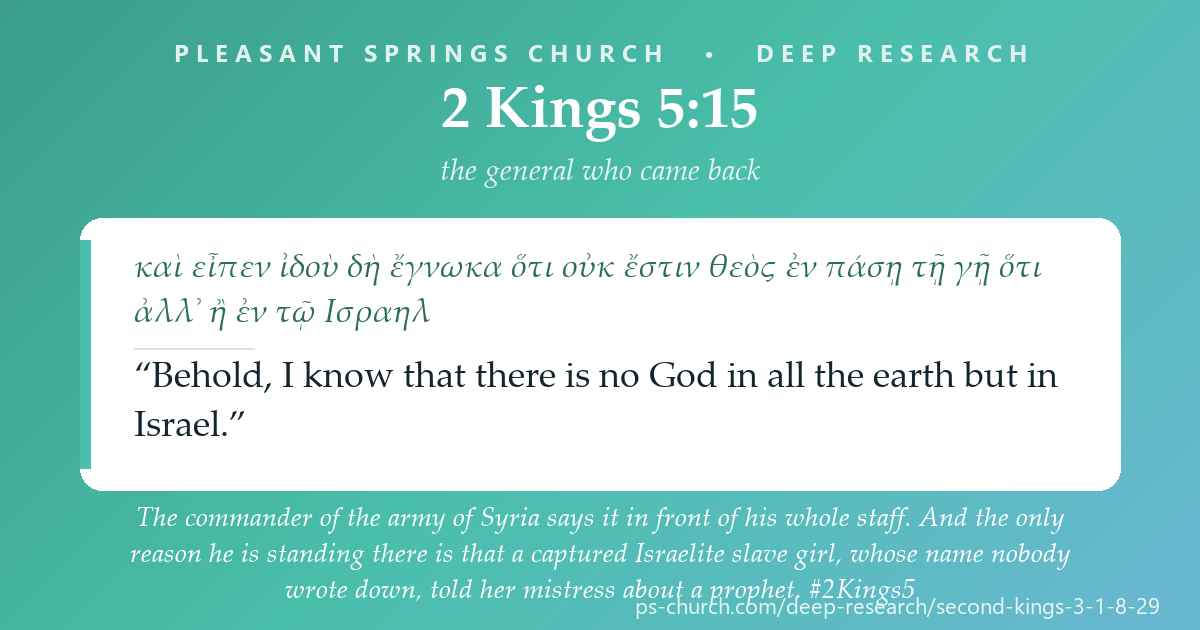
2 Kings 5:15 · to share
Greek (Rahlfs, 4 Kingdoms — kaige) + ESVEvery Deep Research page traces its passage across the whole sweep — the Old Testament, the Second-Temple world between the testaments (historical witnesses, not Scripture), and the New Testament. Follow the thread:
Pleasant Springs Church — Deep Research
Research method after Michael S. Heiser’s Bible Research Method (examine dictionaries → ancient literature → important words → textual connections → academic publications → share), with the Pleasant Springs “Author & Audience” foundation. Scripture set in the Hebrew, the Greek editions named on each page and the ESV (Old Testament), and the Greek New Testament and the ESV (New Testament), per the practice of Pleasant Springs Church. 2 Kings 3–8 research grounded in Cogan and Tadmor (Anchor, II Kings), Sweeney (OTL), Provan (NIBC), House (NAC) and Wiseman (TOTC), with Barthélemy, Fernández Marcos, Tov and Shenkel on the Greek, and Alter for the narrative tools used in the structure block. Text & edition: Hebrew from the Masoretic Text; Greek from Rahlfs’s Septuaginta, 4 Kingdoms (Βασιλειῶν Δʹ), taken from the morphologically analysed Rahlfs text rather than back-translated, printed without editorial punctuation and with proper names unaccented, and cross-checked against NETS; English ESV. ⚠️ Section: the whole of 2 Kings falls inside the second kaige section (γδ, 3 Kingdoms 22 – 4 Kingdoms 25), which NETS marks with the running head “(KAIGE)” on every page of 4 Reigns. Consequently the Greek printed here is a revision toward a proto-Masoretic Hebrew, not the oldest Greek, and the Antiochene (Lucianic) witness frequently preserves an older reading in such sections; this page cites no Antiochene reading, because we have not consulted the critical edition (Fernández Marcos and Busto Saiz). There is no Göttingen edition of 4 Kingdoms; the fuller apparatus is Brooke–McLean. On why this library prints what it prints, see the texts we print. Numbering: Rahlfs has 27, 44, 27, 33, 20 and 29 verses in chapters 3–8, exactly as the Hebrew does, so there is no offset anywhere in this passage; this was counted rather than assumed, and no line above needed a double reference. Rahlfs’s only lettered verses in the book, 4 Kingdoms 1:18a–d, are a variant doublet of 3:1–3 and are reported in the codex note with their three substantive differences, including the plus at 1:18d that has no Hebrew counterpart; which arrangement is earlier is not adjudicated here. Divergences in the printed verses, enumerated rather than glossed: at 3:4 the Greek names him Μωσα, transliterates נֹקֵד as νωκηδ, and adds ἐν τῇ ἐπαναστάσει; at 3:24 the Hebrew is barely construable and the ESV follows the Greek and footnotes that it has done so; at 3:27 Hebrew קֶצֶף “wrath” stands against Greek μετάμελος “regret” (NETS: “great regret”) — the largest single divergence on this page, and it falls on its hardest verse; at 4:1 the Greek lacks “of the wives of”; at 5:3 it adds “of God”; at 5:12 it adds “than the Jordan”; at 5:13 it lacks “my father”; at 6:25 the Hebrew reads eighty shekels and the Greek fifty; at 8:16 the Greek (with the Syriac) lacks “when Jehoshaphat was king of Judah,” which the ESV footnotes. Transliterated Hebrew nouns at 3:4, 4:39, 5:19, 6:8 and 8:15, the ἐγώ εἰμι + finite verb at 4:13, and the single καί γε at 8:1 are named as evidence of the revision’s character and counted. Ketiv/qere at 4:2, 4:3, 4:7 (twice), 4:23 (twice), 5:12, 6:25 and 8:1 are printed or reported, and the qere is what appears in the Hebrew column where the two differ. Chronicles: where Kings and Chronicles differ they are reported and not harmonised — Ahaziah’s age (Kings 22, Hebrew Chronicles 42, Greek Chronicles 20), Elijah’s letter (2 Chr 21:12–15, absent from Kings), and Jehoram of Judah’s death notice; where they agree, that is said too. ⚠️ Chronology: the synchronisms of 1:17, 3:1, 8:16, 8:25 and 9:29 do not resolve without co-regencies; Thiele’s scheme is named as the standard attempt and as contested (Galil, Hughes, Barnes, Tetley), the Greek’s different numbers are reported after Shenkel, and no harmonised scheme is printed as though it were the text. ANE material is cited only where it is verifiable in the local scan of Pritchard’s ANET: the Moabite Stone (ANET 320–321, trans. Albright) is quoted verbatim, with the agreements and the disagreements with 2 Kings 3 both listed and neither side harmonised; Shalmaneser III on Hazael at ANET 280. Second-Temple and rabbinic witnesses (Sirach 48:12–14; Josephus, Ant. 9.3–9.4 in Whiston’s numbering; b. Berakhot 10b; b. Sanhedrin 96b; b. Gittin 57b) are read as witnesses and never levelled with Scripture, and where they close a gap the narrator left open that is pointed out rather than borrowed. 3:27 is reported plainly, given four readings, and left explicitly unresolved, as is Elisha’s non-answer about the house of Rimmon. The siege horror of 6:28–29 is named once, soberly, with its Deuteronomy 28 background, and not dwelt on. The typology in Stage 6 names all three levels separately: what the Old Testament text says, what Luke 4:27 and Hebrews 11:35 themselves draw, and what we see from this side of the cross.
Scripture quotations marked ESV are from the ESV® Bible (The Holy Bible, English Standard Version®), © 2001 by Crossway, a publishing ministry of Good News Publishers. ESV Text Edition: 2016. Used by permission. All rights reserved. The ESV text may not be quoted in any publication made available to the public by a Creative Commons license, and the ESV may not be translated in whole or in part into any other language. www.esv.org
|
Did this study bless you today? 💚 Give to Support PS Church100% of gifts go to the General Fund — thank you. |