A king falls through a lattice in his upper room and cannot get up. Frightened about his own body, he sends messengers south-west to Ekron to ask a Philistine god whether he will live — and a man in a hair garment meets them on the road with a question the book will ask three times and never answer: “Is it because there is no God in Israel that you are going to inquire of Baal-zebub, the god of Ekron?” (1:3). Then soldiers, and fire, twice; and then a third officer who kneels on the road and asks to keep his life, and does. Then the book turns, and chapter 2 begins — six verses of walking, and three times the same exchange: “Please stay here” … “As the Lord lives, and as you yourself live, I will not leave you” (2:2, 4, 6). Gilgal, Bethel, Jericho, the Jordan. A coat rolled up and swung at a river. A last request, and it is not the one you remember: “Please let there be a double portion of your spirit on me” (2:9) — which is not twice the power but the firstborn’s inheritance share of Deuteronomy 21:17, a servant asking to be counted a son. Then chariots of fire that carry nobody, a whirlwind, and a cry: “My father, my father! The chariots of Israel and its horsemen!” — words a king of Israel will weep over Elisha’s own deathbed, word for word, eleven chapters later. And then a coat picked up off the ground, a river hit a second time, and a question that is really the start of a job: “Where is the Lord, the God of Elijah?” This study works 2 Kings 1:1–2:25 line by line in Hebrew, Septuagint and ESV — and because the whole of 2 Kings lies inside the second kaige section, it says on every line which Greek it is printing and why that matters. See the method →
2 Kings 1:1–2:25 (selections)
Hebrew · Greek (Rahlfs, 4 Kingdoms — kaige) · ESVThe book, the section, and why “the Septuagint reads X” is not a safe sentence anywhere in this book. In the Septuagint this book is 4 Kingdoms (4 Reigns) — Βασιλειῶν Δʹ (Basileiōn D). 1–2 Samuel and 1–2 Kings are one continuous work in Greek, Βασιλειῶν Αʹ–Δʹ, and this is its fourth and last scroll. (Worth noticing once: our English names for the Torah — Genesis, Exodus, Leviticus, Numbers, Deuteronomy — are the Septuagint’s names, while Samuel and Kings keep Hebrew-derived ones. An English Bible already mixes both traditions on its contents page.)
⚠️ Which section is this? All of it is kaige, and that governs every Greek word above. Dominique Barthélemy showed in Les Devanciers d’Aquila (1963) that the Greek of Kingdoms is not one translation. Two long stretches are a later kaige revision — a first-century pull of an older Greek text back toward a proto-Masoretic Hebrew, named for its stereotyped rendering of Hebrew גַּם (gam, “also”) by καί γε. Using Thackeray’s section letters, the second of them (γδ) runs 3 Kingdoms 22 through 4 Kingdoms 25 — which is to say the whole of 2 Kings, including every verse on this page. NETS prints the word “(KAIGE)” in its running head over this entire book, and it is not decoration. What that means, said plainly: here Codex Vaticanus, and Rahlfs’s text which leans on it, are a revision — not the oldest Greek. The Antiochene (Lucianic) manuscripts are a separate witness and in a kaige section they often preserve an older Greek reading than Vaticanus does. So the sentence “the LXX reads X” is ambiguous in these chapters, and this page therefore says which Greek: the column above is Rahlfs, and it quotes no Antiochene reading, because we have not consulted the critical edition (Fernández Marcos and Busto Saiz, El texto antioqueno de la Biblia griega II). There is as yet no Göttingen edition of 4 Kingdoms; the fuller apparatus is Brooke–McLean’s larger Cambridge Septuagint. On why this library prints what it prints, see the texts we print.
And you can check the section boundary yourself — we did, in a text file. Counting καί γε through Rahlfs: 3 Kingdoms has four, and three of them (1:6; 1:48; 2:5) fall before the first kaige section ends at 2:11; there is then not one in 3 Kingdoms 3–21 — and the fourth stands at 22:22, exactly where γδ begins (see 1 Kings 20–22). 4 Kingdoms has seventeen (2:5; 8:1; 9:27; 10:18; 13:6; 16:3; 17:19; 17:41; 21:11; 21:16; 22:19; 23:15; 23:19; 23:24; 23:27; 24:4). The very first of the seventeen is 2:5, on this page — and 2:3, where the Hebrew is word-for-word identical, is rendered κἀγώ instead. A revision that is thorough but not perfectly consistent is exactly what Barthélemy’s thesis predicts, and here it is in two consecutive verses of your own passage.
Numbering. Chapter 1 has eighteen verses and chapter 2 has twenty-five, in the Masoretic Text and in Rahlfs alike; there is no chapter or verse offset anywhere in this passage, and that was counted rather than assumed. But Rahlfs carries one substantial plus. After 1:18 it prints four more verses, 1:18a–d, which the Hebrew does not have here: a complete regnal notice for Joram son of Ahab — twelve years, in the eighteenth year of Jehoshaphat, evil in the sight of the Lord “yet not like his brothers nor like his mother,” the pillars of Baal removed, the sins of the house of Jeroboam kept. It is a near-doublet of what the Greek will say again at 3:1–3, and it matters for the chronology (see Stage 5). One transparency note: the CATSS digitization used for the column above runs 18a–d together into verse 18; Rahlfs letters them, and NETS prints them lettered.
The divergences in the verses printed above, enumerated — not a sample, the list. 1:2 the Greek translates the god’s name (Βααλ μυῖαν, “Baal Fly”), uses the feminine article for Baal, and adds “and they went to inquire through him.” 1:3 Greek plus: the king is named, “Ochozias.” 1:8 Hebrew “a man, an owner of hair” (garment or body — ambiguous); Greek “a hairy man.” 1:10 no difference of substance. 1:13 Greek plus, “the king proceeded.” 1:16 Greek minus — the whole clause “is it because there is no God in Israel to inquire of his word?” is absent, so the threefold question of the Hebrew is twofold in Rahlfs; and the Hebrew’s “because” becomes a question, τί ὅτι. 2:2 the Hebrew’s exact triple is varied in Greek (καταλείψω / ἐγκαταλείψω; ἐνταῦθα / ὧδε), and Hebrew “they went down” becomes “they came.” 2:5 καί γε for גַּם — against κἀγώ for the identical Hebrew at 2:3. 2:8 Hebrew “on dry ground”; Greek “in a wilderness.” 2:9 no difference of substance (διπλᾶ matches the Greek of Deuteronomy 21:17). 2:11 singular “a chariot”; “whirlwind” → “shaking”; and a Greek plus, ὡς, “as into heaven” (also at 2:1). 2:12 Hebrew plural “its horsemen” → Greek singular. 2:14 a Greek plus (“and it did not part”), a minus (the divine name), and a transliteration (αφφω) where the Hebrew has אַף־הוּא. 2:23–24 “baldhead” once in Greek against twice in Hebrew; the bears are feminine in Hebrew and unmarked in Greek. Where the columns simply agree, this page says so — 1:10, 2:9 and the whole of 2:12 apart from that one plural are straight, careful correspondences, and most of this chapter is.
What this page does not cite. There is no Dead Sea manuscript of 2 Kings 1–2. 4QSama, which looms over every page of Samuel in this library, has no counterpart here; the published Qumran Kings fragments preserve pieces of 1 Kings only. And Chronicles does not tell this story at all — it follows Judah and passes over the northern prophetic narratives entirely. It does mention Elijah exactly once, and that one mention is a genuine difficulty rather than a supplement; see Stage 4. Edition: the Greek column is Rahlfs’s Septuaginta (CATSS digitization), printed without the editorial punctuation of the printed editions and with proper names unaccented, as Rahlfs sets them; Hebrew from the Masoretic Text; English ESV (2016).
The Shape of the Passage
LeitwortBehind this passage stand the law that forbids Israel to go looking for the future anywhere but from God (Deuteronomy 18:9–22); the man who came out of nowhere in the reign of Ahab and shut up the sky (1 Kings 17–19), and who threw his cloak on a ploughman at 19:19; and the death of Ahab and the accession of his son Ahaziah at the end of the previous scroll (1 Kings 20–22). In front of it stand Elisha’s own long ministry and the same cry over his own deathbed (2 Kings 3–8; 2 Kings 13:14).
Author
A historian who can make an enormous claim by leaving a sentence out. The most extraordinary event in the Hebrew Bible after Sinai gets six verses (2:7–12), and the writer supplies no theology for it whatever. He does not say Elijah did not die. He does not say what heaven is. He does not tell you what Elisha felt. He tells you what the fifty men on the ridge could see from where they stood, and stops. The restraint is the craft.
He also builds by exact repetition and then breaks it. Three “stay heres” and three identical oaths; two identical questions from the sons of the prophets and two identical answers; two captains with the same speech and the same fire — and then a third captain who says something different, and lives. When this writer repeats himself, watch for the one that is not the same. That is where he has put the meaning, and it is why the diagram above is built on words you can count rather than on themes that feel balanced.
And he will not fill his own silences. He does not explain the fire on the hillside, or the whirlwind, or the bears. Later readers could not bear that: Josephus turns Elijah’s word into a prayer and gives the third captain a personality; the rabbis of Sotah proposed four different things Elisha might have seen; Ben Sira counts the fires and calls it glory. All of that is commentary, and this page keeps it clearly on the commentary side of the line.
Audience
People for whom “is there no God in Israel?” was not rhetorical. The book that contains this chapter ends in Babylon (2 Kings 25). Its first readers were people whose kings had in fact gone shopping for other gods for two centuries and had lost the country doing it. A king sending to Ekron because he is frightened about his own body is, to that audience, the whole national biography in one errand.
People who needed to know that the word does not die with the man. Chapter 2 is, structurally, a succession narrative — which is why Elisha asks for an inheritance share and not for power, and why the sons of the prophets say “the spirit of Elijah rests on Elisha” (2:15) before he has done anything but cross a river. An audience that had watched prophets die under Jezebel needed exactly that sentence.
And people living in a Greek-speaking world, reading this in Greek. By the second century BC Ben Sira is already singing Elijah in Greek (Sirach 48), and the Gospel writers describe John the Baptist in the vocabulary of 4 Kingdoms 1:8. The Greek of this book is not a footnote to its reception; for centuries it was its reception — which is exactly why the codex note above insists on saying which Greek.
Orient on 2 Kings and 4 Kingdoms, the kaige recension, Ekron and Baal-zebub, Elijah and Elisha, the sons of the prophets, and the ascent traditions.
Search by topic: Kings, Books of; Kingdoms, Books of (Greek); kaige recension; Lucianic / Antiochene text; Deuteronomistic History; Ahaziah of Israel; Joram / Jehoram; Elijah; Elisha; Tishbite; Gilead; Baal-zebub / Beelzebul; Ekron; Philistines; divination and inquiry of the dead; man of God; sons of the prophets; Gilgal; Bethel; Jericho; Jordan River; mantle / cloak; whirlwind; chariot of fire; ascension and translation traditions; Enoch; firstborn, rights of; inheritance law; bears in the Levant; regnal chronology and synchronisms.
Which articles are relevant?
- Anchor Bible Dictionary — “Kings, Books of,” “Elijah,” “Elisha,” “Baal-Zebub,” “Beelzebul,” “Ekron,” “Ahaziah,” “Jehoram/Joram,” “Prophets and Prophecy,” “Sons of the Prophets,” “Gilgal,” “Bethel,” “Jericho,” “Ascension,” “Chronology (Hebrew Bible).”
- Dictionary of the OT: Historical Books (IVP) — “Elijah,” “Elisha,” “Prophets and Prophecy,” “Miracles,” “Non-Israelite Religion,” “Chronology,” “Text and Textual Criticism.”
- NIDOTTE / TDOT — עָלָה (ʿālāh, go up), יָרַד (yāraḏ, go down), לָקַח (lāqaḥ, take), אַדֶּרֶת (ʾaddereṯ, cloak), סְעָרָה (səʿārāh, storm-wind), רֶכֶב (reḵeḇ, chariotry), דָּרַשׁ (dārash, inquire of), נַעַר (naʿar, boy / young man), בְּכֹרָה (bəḵōrāh, birthright).
- On the Greek — Bernard A. Taylor, “4 Reigns: To the Reader,” in NETS, for the base text (Rahlfs), the kaige designation of the whole book, and the treatment of 1:18a–d; and Natalio Fernández Marcos, The Septuagint in Context, for the Antiochene text and the kaige question generally.
Bibliography surfaced:
- Mordechai Cogan and Hayim Tadmor, II Kings (Anchor Bible) — the standard reference commentary for this book, and the fullest treatment of the Assyrian and Moabite comparanda and of the regnal synchronisms.
- Marvin A. Sweeney, I & II Kings (OTL); Iain W. Provan, 1 and 2 Kings (NIBC); Paul R. House, 1, 2 Kings (NAC); Donald J. Wiseman, 1 and 2 Kings (TOTC); Simon J. DeVries on the prophetic narrative forms.
- Emanuel Tov, Textual Criticism of the Hebrew Bible, for the framework the codex note above depends on; Dominique Barthélemy, Les Devanciers d’Aquila (1963), for the kaige thesis itself.
- Robert Alter, The Art of Biblical Narrative, for the reading tools used in the structure block. (Alter reads these texts as literature and does not share the church’s confession; we take the tools, not the metaphysics.)
A Moabite king who wrote his own version of 2 Kings 1:1, a real Philistine city with a real king, the god whose name has an argument in it, and four ancient readers who could not leave chapter 2 alone.
First the world: what “Moab rebelled” looked like from Moab’s side, whether Ekron was a real place, and what to make of a god called “lord of flies.” Then the ancient readers — Ben Sira, Josephus, and the Talmud — each of whom tells you as much about themselves as about the text.
Which parallels shed light on these chapters?
The first verse of 2 Kings has an outside witness, and it does not tell the story quite the same way. “After the death of Ahab, Moab rebelled against Israel” (1:1). Mesha king of Moab put his own account of that rebellion on a basalt stela, and it survives. He names Omri, Ahab’s father, says Omri “humbled Moab many years,” and reports that the humbling continued into “half the time of his son” before Chemosh gave Moab back its land. He also says, of Israel, “Israel hath perished for ever” — which is what a victory inscription says, and which is not what happened. Set the two texts side by side and you have Kings dating the revolt by the death of a king and Moab dating it by the anger of a god. Both are datable to the same generation. The stela is in the collection below.
Ekron was not a bogeyman; it was a city with a postal address. It is one of the five Philistine capitals, and two centuries after Ahaziah’s errand it turns up in Sennacherib’s annals with a named king, Padi, whom the citizens of Ekron handed over to Hezekiah in chains — the Assyrian says so himself, and complains about it. The point for this chapter is small and worth having: the king of Israel was not consulting a legend. He sent messengers on a road, to a shrine that existed, about forty miles away.
The god’s name has an argument inside it — and this page will report the argument, not settle it. The Hebrew is בַּעַל זְבוּב, baʿal zəḇûḇ, “lord of flies,” and Rahlfs simply translated it: Βααλ μυῖαν, “Baal Fly.” Many scholars propose that the original title was baʿal zəḇūl, “Baal the Prince” — the Ugaritic Baal texts carry a standing epithet that Ginsberg renders “Prince, Lord of Earth” (see below) — and that the Hebrew text has deliberately changed one letter to make a prince into a fly. Two honest cautions. First, that is a proposal: the Hebrew we have says flies, the Greek translated flies, and no manuscript of Kings reads otherwise. Second, the New Testament’s spelling is a separate question: the critical editions read Βεελζεβούλ, with an l, in every occurrence (Matthew 10:25; 12:24, 27; Mark 3:22; Luke 11:15, 18, 19); “Beelzebub” in English New Testaments comes through the Latin. Report both facts; do not weld them into a lesson.
- The Moabite Stone (Mesha Stele), c. 830 BC — ANET 320–321, tr. W. F. Albright (a royal inscription — a witness, not Scripture). “As for Omri, king of Israel, he humbled Moab many years, for Chemosh was angry at his land. And his son followed him and he also said, ‘I will humble Moab.’ In my time he spoke (thus), but I have triumphed over him and over his house, while Israel hath perished for ever!” Mesha adds that Israel held Medeba “in his time and half the time of his son, forty years.” This is the other side of 2 Kings 1:1 and 3:4–5, written by the man who did the rebelling.
- Sennacherib, the Oriental Institute Prism, 701 BC — ANET 287–288, tr. A. Leo Oppenheim (Assyrian royal annals — a witness, not Scripture). “The officials, the patricians and the (common) people of Ekron… had thrown Padi, their king, into fetters… and had handed him over to Hezekiah, the Jew.” Two centuries later than Ahaziah, and cited only for the plain fact that Ekron was a real Philistine city-state with its own kingship. Its own moment in this library belongs to Hezekiah’s pages.
- The Ugaritic Baal texts — ANET 129–155, tr. H. L. Ginsberg (Canaanite mythological texts — witnesses, not Scripture). Baal carries the recurring epithet Ginsberg renders “Prince, Lord of Earth” (e.g. ANET 134, 138–140). The word behind “Prince” is the one many scholars connect with the zebul form. Cited as the evidence for the proposal, and not as proof of it.
- Sirach 48:1–12 (Second-Temple — a witness, not Scripture, and non-canonical by this church’s ratified position) — and Ben Sira counts the fire. “ἐν λόγῳ κυρίου ἀνέσχεν οὐρανόν κατήγαγεν οὕτως τρὶς πῦρ” — “by the word of the Lord he shut up heaven, and so brought down fire three times” (48:3). Carmel, and then the two captains of 2 Kings 1:10 and 1:12: by the second century BC a reader was totting them up. Ben Sira then describes the ascent — “ὁ ἀναλημφθεὶς ἐν λαίλαπι πυρός ἐν ἅρματι ἵππων πυρίνων,” “taken up in a whirlwind of fire, in a chariot of fiery horses” (48:9) — which is not quite what Kings says: Kings keeps the chariot and the whirlwind separate, and Ben Sira has fused them. And of the succession: “Ελισαιε ἐνεπλήσθη πνεύματος αὐτοῦ,” “Elisha was filled with his spirit” (48:12). He quotes Malachi’s promise of Elijah’s return at 48:10 as something still outstanding.
- 1 Maccabees 2:58 (Second-Temple — a witness, not Scripture) — in Mattathias’s deathbed roll-call of heroes: “Elijah, because of great zeal for the law, was taken up into heaven.” The verse is quoted here to show what a fighting Jew of the 160s BC took from this chapter, and the church notes that zeal, not ascent, is what he was recruiting for.
- Josephus, Antiquities 9.2.1–2 (Whiston’s book-chapter-section numbering; Second-Temple — a witness, not Scripture) — and every change he makes is instructive. He calls the god of Ekron simply “the Fly… for that was this god’s name,” which shows he is reading a Greek text of Kings, not a Hebrew one. He converts Elijah’s declaration into a request — “I will pray that fire may fall from heaven” — and reports “a whirlwind of fire.” He gives the first two captains a threat that Scripture does not give them (they would “carry him by force”) and the third a character (“a wise man, and of a mild disposition”). And on the ascent he is unexpectedly careful: “Elijah disappeared from among men, and no one knows of his death to this very day… as to Elijah, and as to Enoch… it is written in the sacred books that they disappeared, but so that nobody knew that they died.” He also omits the bears entirely — and tells the healing of Jericho’s spring not here but in Jewish War 4.8.3, as a piece of local geography, calling it a “lasting favor” to the town.
- b. Sotah 46b–47a (rabbinic — a witness, not Scripture, and centuries later) — the classic Jewish discussion of 2:23–25, and its disagreement is the useful part. On “small boys”: R. Elazar reads both words morally; a baraita says they were “lads, that is, already of age, but they disgraced themselves like young children”; Rav Yosef wonders whether the word is a place-name. On “he saw them”: four different answers are offered (Rav, Shmuel, R. Yitzḥak Nappaḥa, R. Yoḥanan), and R. Yoḥanan’s is then objected to. On the bears: Rav and Shmuel dispute whether it was “a miracle” or “a miracle within a miracle.” And the whole passage is introduced to make a point against the men of Jericho, who failed to escort Elisha out of town. The rabbis clearly found the paragraph hard. That is worth knowing before anyone tells you it is obvious.
What the text says. A king who has just been told he will die sends fifty armed men to fetch the prophet who told him so, three times over. Twice, at the prophet’s word, fire falls and consumes an officer and his fifty (1:10, 1:12). That is a hundred and two men. The narrator offers no comment, no charge sheet, and no justification. He does not call the captains wicked. Everything else you have heard about them — that they were insolent, that they came to arrest him by force — comes from Josephus or from a preacher, not from Scripture, and this page keeps that boundary visible.
Where it is located. This is a specific confrontation between a named king of the northern kingdom and the prophet of the Lord, inside a covenant lawsuit that has been running since 1 Kings 17, in a book whose whole subject is a nation being warned before it is lost. It is narrative, not law. It is not a command, not a promise, and not a pattern. There is no imperative in it addressed to anyone.
The difficulty, owned. A hundred men died carrying out an order, and the text does not tell us they deserved it. If that troubles you, it should; and the honest response is not to invent their crimes. Note what the chapter itself does with the trouble: it gives the last word to the man who asked to live. The third captain kneels and says the word נֶפֶשׁ — life — twice, and the answer he gets is an angel telling Elijah, “Go down with him; do not be afraid of him” (1:15). The chapter ends with a prophet walking beside a soldier.
And the canon comments on this passage itself. In Luke 9:54–55, refused hospitality by a Samaritan village, James and John ask, “Lord, do you want us to tell fire to come down from heaven and consume them?” — the same picture in nearly the same Greek words as 4 Kingdoms 1:10 (Luke has πῦρ καταβῆναι ἀπὸ τοῦ οὐρανοῦ, Rahlfs has καταβήσεται πῦρ ἐκ τοῦ οὐρανοῦ). And Jesus turns and rebukes them. Be precise about the manuscripts, because it matters here: the ESV footnotes that some manuscripts add “as Elijah did” to v. 54, and that some add to v. 55 “You do not know what manner of spirit you are of…” Those additions are not in the ESV’s text and this page will not lean on them — but the allusion does not depend on them, because the disciples are quoting this chapter whether or not a scribe wrote the name in the margin. Say it plainly: the New Testament’s own use of 2 Kings 1 is to forbid the imitation of it. Whatever this chapter licenses, it licenses nothing to us, and the rebuke is in the book.
Two verbs that build the whole passage, one legal phrase that has been mistranslated in a thousand sermons, a sheepskin coat, and the two Greek words that named a recension.
Count ʿālāh and yāraḏ for yourself — fourteen and thirteen — and do not let the preposition מֵעַל or the noun בַּעַל inflate the tally. Then look up פִּי־שְׁנַיִם in Deuteronomy 21 before you decide what Elisha asked for. Then set 2:3 beside 2:5 in the Greek.
“Go up” and “go down” — the two verbs these chapters are made of, twenty-seven occurrences in forty-three verses. Watch what happens to them. In chapter 1 everything that goes up is a mistake (a king onto a bed, officers up a hill) and everything that comes down is fire — except once, when an angel tells Elijah to go down with a man who asked to live. In chapter 2 the direction reverses and stays reversed: the Lord takes Elijah up, and the only thing that comes down is a coat. The Greek keeps the pair honestly (ἀναβαίνω / καταβαίνω) but loses one link at 2:2, where Hebrew “they went down to Bethel” becomes simply “they came.”
“Take.” Eight times in chapter 2, and it is doing two jobs at once. Four of them are God taking Elijah (“the Lord will take away your master,” 2:3, 5; “before I am taken,” 2:9; “if you see me being taken,” 2:10) and the rest are men taking cloaks and bowls. The chapter’s theology is in its ordinary verb. And it is the verb of Enoch: “he was not, for God took him” (Genesis 5:24) — though the Greek does not link them, since Genesis reads μετέθηκεν (“transferred”) and 4 Kingdoms reads λαμβάνει and ἀναλημφθῆναι. Hebrew joins these two men; Greek does not.
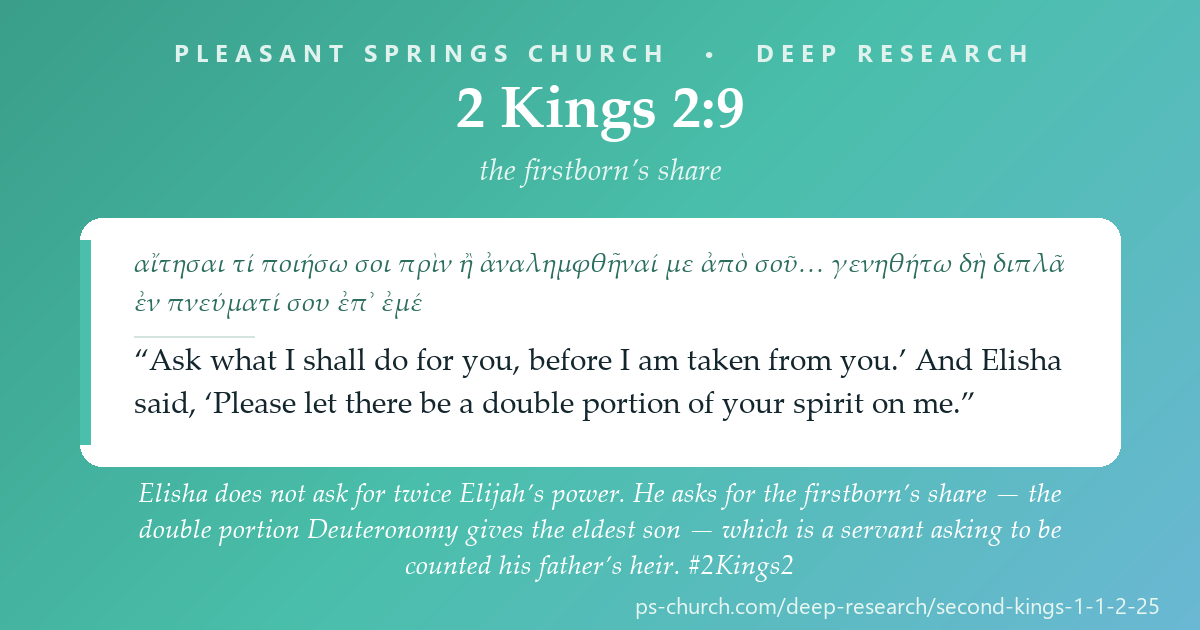
“A mouth of two.” ⚠️ This is the phrase most often misread on this page, and the fix is documentary. It occurs three times in the Hebrew Bible. At Deuteronomy 21:17 it is the legal share of the firstborn son: the father “must acknowledge the firstborn… by giving him a double portion of all that he has.” At Zechariah 13:8 it stands against “the third” and therefore means two thirds. So Elisha is not asking to be twice the prophet Elijah was; he is asking to be treated as the eldest son — to inherit. That is why he has just called Elijah “my father” in advance and will call him that again three verses later, and why Elijah answers that the thing is not in his gift. The Greek preserves the connection precisely: διπλᾶ here, διπλᾶ at Deuteronomy 21:17.
The prophet’s cloak — and it is the through-line of the whole succession. Elijah hid his face in it at Horeb (1 Kings 19:13) and threw it over Elisha at the plough (19:19), which is how Elisha was called in the first place; here he rolls it up and hits the river with it; then it falls, and the last thing Elisha does before he walks back into the world is pick it up. The Greek word is worth knowing: μηλωτή, a sheepskin — and that is the word Hebrews 11:37 uses of the persecuted prophets, “they went about in skins of sheep” (ἐν μηλωταῖς). One Greek noun ties the whole prophetic line together.
“Lord of flies” — four times in eighteen verses, and never once without “the god of Ekron” attached, as if the narrator wants the postcode said out loud every time. Rahlfs translates rather than transcribes: Βααλ μυῖαν, and always with the feminine article τῇ, which is the Greek Bible’s standing way of handling Baal — and which is still standing centuries later in Romans 11:4, οὐκ ἔκαμψαν γόνυ τῇ Βάαλ, where Paul quotes 1 Kings 19:18 from the Greek. On the widely proposed zebul (“prince”) original and the New Testament’s Βεελζεβούλ, see Stage 2 — where the proposal is reported as a proposal.
“The chariotry of Israel and its horsemen.” רֶכֶב is a collective — the whole chariot arm of an army, not one vehicle — which is why the ESV can render it plural at 2:12 while the Greek prints the singular ἅρμα. The cry is a military metaphor for a man: the prophet is the nation’s armoured division. It is said twice in this book and only twice, and the second time is over Elisha’s own deathbed by a king of Israel (13:14) — word for word the same Hebrew. Note the irony the writer sets up and never explains: Israel really did have chariots — Shalmaneser III credits Ahab with 2,000 of them at Qarqar in 853 BC, the largest chariot force in the whole western coalition and more than Damascus’s 1,200 (ANET 278–279) — and the text says the chariotry that mattered was one man.
“Small boys.” נַעַר is a wide word — it covers a weaned child, a teenager, a servant and a young soldier; Joseph is a naʿar at seventeen. Adding קָטָן (“small, young”) narrows it downward without fixing an age, and in v. 24 the narrator switches to יְלָדִים, “children.” So: not toddlers, and not a street gang either — the text simply does not tell us. The Greek does not help and does not pretend to: παιδάρια μικρά, then παῖδας. Anyone who tells you the Hebrew settles this question is selling something.
The two Greek words that named a whole recension. Hebrew גַּם (“also, indeed”) is an ordinary particle; a normal translator renders it with καί or folds it into a crasis like κἀγώ. The kaige reviser rendered it mechanically as καί γε — and Barthélemy noticed that this and a family of similar habits cluster in exactly two stretches of Kingdoms. You can see the seam in this chapter. 2:3 and 2:5 carry the identical Hebrew clause; Rahlfs gives κἀγὼ ἔγνωκα at 2:3 and καί γε ἐγὼ ἔγνων at 2:5. Seventeen καί γε in 4 Kingdoms, none at all in 3 Kingdoms 3–21, and one at 3 Kingdoms 22:22 where the section starts. That is a thesis you can check with a text file.
Three details in these chapters, reported rather than tidied:
- The prophet’s name is spelled two ways in one chapter. The Masoretic Text writes אֵלִיָּה (ʾĒliyyāh) at 1:3, 1:4, 1:8 and 1:12, and the fuller אֵלִיָּהוּ (ʾĒliyyāhû) at 1:10, 1:13, 1:15, 1:17 and throughout chapter 2. Both mean “my God is Yah.” It is a spelling variation, not two men, and it is printed here rather than silently normalized because a reader with a Hebrew Bible open will see it.
- The oath particle at 2:2, 4 and 6 is not a conditional. אִם־אֶעֶזְבֶךָּ looks like “if I leave you” and means “I will not leave you” — a self-curse with the curse left unsaid, which is how Hebrew swears. The ESV renders the sense. Rahlfs renders the form, printing a bare εἰ, which is why NETS has to give you “if I will abandon you!” with an exclamation mark. That is the kaige translator’s whole personality in one particle: he would rather be opaque than lose the Hebrew.
- “Where is the Lord, the God of Elijah?” ends in an untranslated word. The Hebrew אַף־הוּא can attach forwards or backwards, and translators have to choose; the ESV attaches it forwards and gets “And when he had struck the water.” The Greek translator refused to choose and wrote the Hebrew sounds in Greek letters: αφφω. A transliteration is a translator telling you, in public, that he does not know. There are few more honest moments in the Septuagint, and it is one more reason this library names its edition instead of writing “the LXX.”
A river crossed the way Israel came in, a man taken the way Enoch was, a grave nobody could find, a promise at the very end of the prophets, and one letter in Chronicles that will not fit.
Trace four threads: backwards to Genesis 5, Exodus 14 and Joshua 3, whose vocabulary this chapter borrows; sideways to Chronicles, which mentions Elijah exactly once and creates a problem by doing it; forwards to Malachi and to the Gospels and Acts; and inwards to 1:9–16, where the fire is, and where the New Testament has already told us what to do with it.
Which cross-references matter?
- Exodus 14:21–22 and Joshua 3:14–17 — the water opened by God’s hand at the sea, by the ark at the river, and here by a rolled-up coat. The link is a single Hebrew word, חָרָבָה, “dry ground,” which stands in all three. Elijah leaves the land across the boundary Israel entered it by, going the wrong way; and then Elisha comes back across it, which is how the sons of the prophets know who he is. Note honestly that the Greek does not carry the tie: Exodus and Joshua read ξηρά, and 4 Kingdoms 2:8 reads ἐν ἐρήμῳ.
- Genesis 5:24 — “Enoch walked with God, and he was not, for God took him.” The same Hebrew verb לָקַח that runs eight times through 2 Kings 2. These are the only two men in the Hebrew Bible of whom the text declines to report a death. And notice how little either passage says. Genesis gives one clause; Kings gives six verses and no doctrine. Josephus, reading both, would say only that “they disappeared, but so that nobody knew that they died.” Where Scripture gives no more, we give no more.
- Deuteronomy 34:5–6 — “he buried him in the valley… but no one knows the place of his burial to this day.” Then read 2 Kings 2:16–18: fifty strong men insist on searching, Elisha says “you shall not send,” they shame him into it, and three days later they come back empty-handed. Both stories end with a search that fails, and both narrators think the failure is the point. Moses and Elijah are the two men in the Old Testament whose bodies the text will not produce — which is worth remembering when you get to the mountain in Matthew 17:3.
- 1 Kings 19:19–21 — where the cloak first lands on Elisha, and where he burns his ploughing gear and “went after Elijah and assisted him.” Chapter 2 is the other end of that call. Note that Elisha’s title afterwards, in the mouths of others, is that he “poured water on the hands of Elijah” (3:11) — the servant becomes the heir, and the heir is still described by the service.
- Malachi 4:5–6 — and a numbering lesson worth having. “Behold, I will send you Elijah the prophet before the great and awesome day of the Lord.” That verse is English 4:5, Hebrew 3:23, and Greek 3:22 — three different addresses for one sentence, because the Hebrew has three chapters where English has four, and the Greek also reorders, putting the Moses verse last (LXX 3:24) where the Hebrew puts it first (MT 3:22). And Rahlfs reads “Elijah the Tishbite” (Ηλιαν τὸν Θεσβίτην) where the Hebrew says “Elijah the prophet” — that is, the Greek Bible ends its prophets by naming the man of 2 Kings 1:3 with the title he carries in this chapter.
- Acts 1:9–11 — the same Greek verb, and the difference that matters. 4 Kingdoms 2:9 has ἀναλημφθῆναι and 2:11 ἀνελήμφθη; Sirach 48:9 calls Elijah ὁ ἀναλημφθείς; and Acts 1:11 calls Jesus ὁ ἀναλημφθεὶς ἀφ’ ὑμῶν εἰς τὸν οὐρανόν. Luke 9:51 uses the noun — “the days drew near for his ἀνάλημψις” — and then, three verses later, James and John ask for Elijah’s fire. Luke has put the ascension word and the Elijah fire in the same paragraph. That is a fact about the Greek text, and it is stated here as one.
- ⚠️ 2 Chronicles 21:12–15 — a letter from Elijah, and this page will not harmonise it. Chronicles never tells the story above, but it does say that “a letter came to him from Elijah the prophet” — to Jehoram of Judah, who reigned after Jehoshaphat. Read the books in their narrative order and Elijah has already been taken up by then, since 2 Kings 2 stands before 2 Kings 3, and Jehoram of Judah appears in 2 Kings 8. The difficulty is real and old. Proposals: that the letter was written earlier and delivered later; that 2 Kings 2 is not in strict chronological sequence; that Chronicles and Kings are working from different arrangements of the same material. We report the difference and do not blend the two books into one timeline — and we note that Kings does not mention this letter and Chronicles does not mention the whirlwind. Two witnesses, two angles, one honest “we do not know.”
“Ask what I shall do for you, before I am taken from you” is one of the great open questions in Scripture, and the answer he gives is not the one everybody remembers. He does not ask for power, or for fire, or for the sky to shut. He asks for פִּי־שְׁנַיִם — the firstborn’s portion of the estate (Deuteronomy 21:17). He is asking to be adopted as the heir. He has already called Elijah “my father” in his heart; three verses later he shouts it.
And look at what he is told. “You have asked a hard thing; yet, if you see me as I am being taken from you, it shall be so for you, but if you do not see me, it shall not be so” (2:10). Elijah does not say yes and he does not say no. He says it is not mine to give — the condition is a sight he cannot arrange. The one thing required of the heir is that he be watching at the moment he is orphaned. And 2:12 opens with exactly that: וֶאֱלִישָׁע רֹאֶה, “and Elisha was seeing.”
A note about typology, clearly labelled — both halves of it, and neither one alone. First half: 2 Kings 2 does not announce itself as a picture of anything. It is a succession narrative about a real prophet and his real servant on a real morning, and the New Testament nowhere cites this chapter as a prophecy of Christ. To say “this means the ascension” would be putting our seeing into the text’s mouth. Second half, and it is not the smaller half: we read this from the other side of the cross, and we are meant to see. A master goes up; the disciple who watches receives his spirit and takes up his cloak and does the first thing his master did; and the men on the far bank say “the spirit of Elijah rests on Elisha” before he has preached a word. The Greek Bible even hands us the vocabulary: the word Luke uses for Jesus’s ascension in Acts 1:11 is the word Rahlfs uses here. The Old Testament text is not making that claim, and we are right to see it. Say both sentences.
The commentaries, the recension that governs the whole book, a chronology that does not close, and the four verses everyone asks about.
Cogan and Tadmor on 2 Kings; Sweeney, Provan, House and Wiseman alongside; Barthélemy, Fernández Marcos and Tov on the Greek. Then the three live questions: what the kaige status of this book does to any argument from “the Septuagint,” why the regnal numbers in 1:17 and 3:1 cannot both be read plainly, and what to do — and not do — with 2:23–25.
Commentaries & studies:
- Mordechai Cogan and Hayim Tadmor, II Kings (Anchor Bible) — the standard technical commentary in English on this book: the Assyrian and Moabite comparanda, the regnal synchronisms, and the Elijah–Elisha cycle in its Near Eastern setting.
- Marvin A. Sweeney, I & II Kings (OTL), for the literary shaping of the prophetic narratives; Simon J. DeVries on their forms; Iain W. Provan, 1 and 2 Kings (NIBC), Paul R. House, 1, 2 Kings (NAC), and Donald J. Wiseman, 1 and 2 Kings (TOTC) — three conservative readings that differ from one another usefully, especially on chronology.
- Dominique Barthélemy, Les Devanciers d’Aquila (1963) — the book that identified the kaige revision and named it. Everything the codex note above says about this book’s Greek descends from it.
- Natalio Fernández Marcos, The Septuagint in Context, and (with José Ramón Busto Saiz) El texto antioqueno de la Biblia griega II — on the Antiochene text, which this page names and deliberately does not quote, because quoting it responsibly means using the critical edition rather than a summary. Emanuel Tov, Textual Criticism of the Hebrew Bible, for the framework.
- Bernard A. Taylor, “4 Reigns: To the Reader,” in A New English Translation of the Septuagint — the source for the description of the Greek used above, including the “(KAIGE)” designation carried across the whole book and the lettered verses at 1:18a–d.
Interpretation notes worth keeping:
- ⚠️ The regnal chronology of this book does not close, and you should be told that on page one. Look at what our own two chapters straddle. 2 Kings 1:17 says Joram of Israel began to reign “in the second year of Jehoram the son of Jehoshaphat, king of Judah.” 2 Kings 3:1 says he began to reign “in the eighteenth year of Jehoshaphat king of Judah.” Then 2 Kings 8:16 says Jehoram of Judah began to reign “in the fifth year of Joram son of Ahab.” Read plainly, that is circular: each king’s accession is dated by a reign that has not started yet. And the Greek is not the same text here either: Rahlfs has no synchronism at all at 1:17, and supplies Joram’s regnal notice instead in the plus at 1:18a–d, dated by Jehoshaphat’s eighteenth year — so Greek readers meet that notice twice (1:18a and 3:1) and never meet the “second year of Jehoram” date at all. The standard attempt to make the whole system work is Edwin R. Thiele’s The Mysterious Numbers of the Hebrew Kings, which resolves this particular knot with a co-regency of Jehoram of Judah alongside his father Jehoshaphat, plus two new-year reckonings and two accession conventions. It is ingenious, it is widely used, and it is itself debated — Gershon Galil and Kenneth Kitchen differ from Thiele and from each other, and Cogan and Tadmor discuss the difficulties rather than declaring them solved. This page prints no harmonised table and calls none of them the text. The numbers are in the book; they strain; the strain is reported. The one fixed point in this period comes from outside the Bible, at Qarqar in 853 BC.
- What the kaige status of this book does to arguments you may have heard. Because all of 2 Kings sits in the γδ section, three sentences that get said casually are not safe here. (1) “The Septuagint supports the Hebrew” — of course it often does; it was revised toward a proto-Masoretic Hebrew, so agreement is partly built in and proves less than it looks. (2) “The LXX is the older text” — not in this book; here Vaticanus is a revision, and the Antiochene manuscripts may stand closer to the Old Greek. (3) “The LXX reads X” — which LXX? The right instinct in these chapters is to name your manuscript family before you build anything on it, which is precisely the policy set out at the texts we print.
- ⚠️ 2 Kings 2:23–25: the readings, laid out, and none of them sold to you. What the text supplies: a road up to Bethel; a group of nəʿārîm qəṭannîm who come out of the city; mockery; a curse in the name of the Lord; two she-bears; forty-two harmed out of a larger group. What the text does not supply: their ages, their motive, Elisha’s state of mind, whether the boys died, or any verdict at all on what happened. The readings on offer: (a) the mockery is a rejection of the Lord’s prophet by the town of Jeroboam’s calves, and so a covenant matter rather than a personal insult — the strongest contextual reading, since Bethel is named twice; (b) “go up” taunts the ascension just narrated, which has real lexical support (the verb is the chapter’s Leitwort) but is inference; (c) the rabbis’ various proposals about what Elisha “saw” (b. Sotah 47a), which are frankly speculative and which the Talmud itself debates; (d) a curse invoked and answered, with the outcome entirely in God’s hands, which is all the syntax actually says. Two failures to avoid, and they are opposite failures. One is relish — treating the paragraph as a satisfying story about mockers getting what they deserved. The other is the apologetic reflex — inventing a violent mob of grown men so that the arithmetic feels fair. Both add to the text. Where Scripture gives no reason, this study gives none, and stops.
- The Elijah–Elisha cycle as a literary unit. Commentators across the spectrum note that these narratives have their own texture inside Kings — less regnal formula, more anecdote, prophets rather than kings at the centre, and a running interest in ordinary need (a widow’s flour, a poisoned stew, a bad spring, a borrowed axe-head). The literary observation is sound and useful. Reconstructions of how the cycle came into the book — independent collections, prophetic circles, editorial stages — are hypotheses, are contested, and nothing in this study depends on any of them.
- On “heaven” in 2:1 and 2:11, a discipline. The Hebrew הַשָּׁמַיִם is the ordinary plural word for the sky as well as for God’s dwelling, and the sons of the prophets in 2:16 clearly consider it possible that the Spirit has set Elijah down on a mountain somewhere — they are not scandalized by the suggestion. Rahlfs, for its part, twice writes ὡς εἰς τὸν οὐρανόν, “as into heaven.” The text is doing less metaphysics than most sermons do with it. What the chapter asserts is that the Lord took him and that Elisha watched; it does not tell us where Elijah is, and Malachi’s promise later assumes he can be sent back. This library reports that reticence rather than filling it.
A question nobody answers, a captain who asks to live, and a son asking to inherit.
Name what you learned, why it matters, and one concrete response.
What should we carry away — and do?
- The question is the whole book in seven words. “Is it because there is no God in Israel?” Three times in eighteen verses, and nobody ever answers it — not the messengers, not the king, not the narrator. Ahaziah is not an atheist; he is a man who, when frightened about his own body, sends the errand somewhere else. The question is not “do you believe in God” but “who do you ask first.”
- The third captain is the point of chapter 1, and he makes it by changing one word. Two men delivered the king’s sentence and were consumed. The third knelt and used a word the others never used — life, twice, his own and his men’s. And the next thing that happens in the chapter is an angel saying “go down with him; do not be afraid.” The narrator does not moralize it. He just lets the man who asked to live walk off the page alive.
- And the New Testament tells you what to do with the fire. When two disciples looked at a village that had refused Jesus and asked for exactly this, he turned and rebuked them (Luke 9:54–55). That is the canon commenting on this chapter, and it settles the application even where it does not settle the interpretation. Whatever 2 Kings 1 is, it is not a permission.
- Elisha asked to inherit, not to be impressive. The “double portion” is the eldest son’s share of an estate (Deuteronomy 21:17). He was not asking for twice the miracles; he was asking to be counted family. That is a better prayer than the one most of us pray, and it is available.
- The condition was watching. “If you see me as I am being taken from you, it shall be so.” The one thing required of the heir was that he be looking at the moment he lost everything, and 2:12 says he was: and Elisha was seeing. Grief with your eyes open is a spiritual discipline, and this chapter treats it as the condition of inheritance.
- The cloak came down. Elijah goes up and does not come back, and what is left on the ground is a coat and a river to cross. Elisha does not preach; he picks up the cloak, walks back to the water, asks “where is the Lord, the God of Elijah?” and hits it. The question is not rhetorical and it is not despairing. It is how he starts work.
- And where the text stops, we stop. Forty-two children, two bears, and no explanation. This study has told you what the Hebrew words can and cannot mean and has refused to invent the rest. A church that will not do that with the hard paragraphs has no credibility when it does it with the comforting ones.
Step in response: two things this week. First, catch yourself on the Ahaziah reflex — the moment of fear when you send the errand somewhere other than to God. Name where you send it. Then send it to him first, once, on purpose. Second, ask for the son’s portion rather than the servant’s: not “make me useful” but “count me family.” And then keep your eyes open through the next thing you lose, which is the only condition Elijah named.
2 Kings 2:9 · to share
Greek (Rahlfs, 4 Kingdoms — kaige section γδ) + ESVEvery Deep Research page traces its passage across the whole sweep — the Old Testament, the Second-Temple world between the testaments (historical witnesses, not Scripture), and the New Testament. Follow the thread:
Pleasant Springs Church — Deep Research
Research method after Michael S. Heiser’s Bible Research Method (examine dictionaries → ancient literature → important words → textual connections → academic publications → share), with the Pleasant Springs “Author & Audience” foundation. Scripture set in the Hebrew, the Greek editions named on each page and the ESV (Old Testament), and the Greek New Testament and the ESV (New Testament), per the practice of Pleasant Springs Church. 2 Kings 1–2 research grounded in Cogan and Tadmor (Anchor), Sweeney (OTL), Provan (NIBC), House (NAC) and Wiseman (TOTC), with Barthélemy on the kaige recension, Taylor’s NETS introduction to 4 Reigns, Fernández Marcos on the Antiochene text and Tov on method, and Alter for the literary tools used in the structure block. Book name: in the Septuagint this book is 4 Kingdoms (Βασιλειῶν Δʹ), the fourth scroll of the single continuous work 1–4 Kingdoms; the name is given by the shared helper in the codex note on every page of this set. Section — and it governs the whole page: Barthélemy’s second kaige section (γδ) runs 3 Kingdoms 22 through 4 Kingdoms 25, so the entirety of 2 Kings, including every verse printed here, lies inside it. The page states this in the codex note and draws the consequence explicitly: Rahlfs’s text here is a revision toward a proto-Masoretic Hebrew, not the oldest Greek, and the Antiochene (Lucianic) text often preserves an older reading — so “the LXX reads X” is named as an ambiguous claim in this book. The Antiochene text is named as a separate witness and not quoted, because doing so responsibly requires Fernández Marcos and Busto Saiz’s critical edition; there is no Göttingen edition of 4 Kingdoms. The section boundary is not asserted but demonstrated: καί γε was counted in the CATSS text of Rahlfs — four in 3 Kingdoms (1:6; 1:48; 2:5, all before the first section closes at 2:11, then none in chapters 3–21, then 22:22) and seventeen in 4 Kingdoms, the first of which is 2:5 on this page, against κἀγώ for identical Hebrew at 2:3. Text & numbering: Hebrew from the Masoretic Text; Greek from Rahlfs’s Septuaginta (CATSS digitization), printed without editorial punctuation and with proper names unaccented; English ESV (2016). There is no chapter- or verse-offset in 2 Kings 1–2 — eighteen and twenty-five verses in both traditions, counted rather than assumed — but Rahlfs carries a four-verse plus at 1:18a–d, a Joram regnal notice that doublets the Greek of 3:1–3, and this is reported along with the note that the CATSS digitization runs it into v. 18. The Malachi numbering is given in all three systems where that verse is cited (English 4:5 = MT 3:23 = LXX 3:22), together with the LXX’s reordering and its “Elijah the Tishbite” reading. Divergences in the printed verses are enumerated in full in the codex note and pluses and minuses are not called “rendering differences”: the Greek’s translation of the god’s name (Βααλ μυῖαν) and feminine article for Baal, and its plus at 1:2; the named king at 1:3; “hairy man” against “garment of hair” at 1:8; the “king” plus at 1:13; the absence at 1:16 of the entire “is there no God in Israel” clause, so that a threefold Hebrew question is twofold in Rahlfs; the varied renderings at 2:2 of an exactly repeated Hebrew formula and the loss of one “went down”; the καί γε at 2:5; “dry ground” → “in a wilderness” at 2:8; singular “chariot,” “shaking” for “whirlwind,” and the ὡς plus at 2:11 and 2:1; the singular “horseman” at 2:12; and at 2:14 a plus (“and it did not part”), a minus (the divine name) and the transliteration αφφω for אַף־הוּא; and at 2:23–24 “baldhead” once against twice and unmarked bears against feminine. Verses where the columns simply agree are said to agree. There is no Qumran manuscript of 2 Kings 1–2 and none is cited; the page says so rather than leaving a silence. Chronicles is treated as an independent witness: it does not tell this story, and its single mention of Elijah (2 Chr 21:12–15, a letter to Jehoram of Judah) is reported as a genuine and unresolved difficulty with the narrative order of Kings, with the proposals named and not harmonised. Chronology: the clash between 1:17 (“the second year of Jehoram son of Jehoshaphat”), 3:1 (“the eighteenth year of Jehoshaphat”) and 8:16 is set out plainly, together with the fact that Rahlfs has no synchronism at 1:17 at all; Thiele is named as the standard attempt and as itself debated (Galil, Kitchen), and no harmonised scheme is printed as though it were the text. Ancient Near Eastern material is cited only where verifiable in the local scan of Pritchard’s ANET: the Moabite Stone on Omri and the revolt of Moab (ANET 320–321), Sennacherib on Ekron and its king Padi (ANET 287–288), and Ginsberg’s “Prince, Lord of Earth” in the Ugaritic Baal texts (ANET 129–155) — the last cited as evidence for the zebul proposal and explicitly not as proof of it. Sirach, 1 Maccabees, Josephus and the Talmud are read as witnesses, tagged non-canonical at first mention, and never leveled with Scripture; the folio for the rabbinic material (b. Sotah 46b–47a) was checked. Flashpoints: the two captains and the fire are reported plainly, located precisely, owned as difficult, and fenced — with Luke 9:54–55 given as the canon’s own comment and the ESV’s manuscript footnotes on “as Elijah did” reported rather than leaned on. 2:23–25 is reported plainly and briefly, with the Hebrew range of naʿar stated, the “go up” wordplay flagged as a real lexical link but an inference, both sensationalism and forced apologetics named and refused, and the narrator’s silence left as silence. The ascension typology at 2:9–12 is given with both halves stated: the Old Testament text does not announce itself as a type and the New Testament does not cite it as prophecy, and we are on the other side of the cross and are meant to see it.
Scripture quotations marked ESV are from the ESV® Bible (The Holy Bible, English Standard Version®), © 2001 by Crossway, a publishing ministry of Good News Publishers. ESV Text Edition: 2016. Used by permission. All rights reserved. The ESV text may not be quoted in any publication made available to the public by a Creative Commons license, and the ESV may not be translated in whole or in part into any other language. www.esv.org
|
Did this study bless you today? 💚 Give to Support PS Church100% of gifts go to the General Fund — thank you. |