Eleven years before the fire, Judah lost everything except its walls. Nebuchadnezzar comes up; Jehoiakim serves him three years and then stops; raiding bands arrive from four directions; and the narrator stops the story to tell you that none of this is really about politics — “at the command of the Lord… and the Lord would not pardon” (24:3–4). Jehoiakim dies with no burial notice, in a book that gives almost every king one. His son Jehoiachin is eighteen, reigns three months, and walks out of the gate to surrender — “himself and his mother and his servants and his officials” — while the gold vessels Solomon made are cut into pieces for freight. Ten thousand people go east: the officials, the fighting men, the craftsmen, the smiths. “None remained, except the poorest people of the land.” A new king is installed and given a new name by a foreign court. And the chapter closes on the same verb it opened with: he rebelled. Four things this study measured rather than assumed. 2 Kings 24:18 shares a seventeen-word run with Jeremiah 52:1 — unique in the 23,204 verse units of the Masoretic corpus — and 24:19–20 continue it at seven and six; yet the Greek of Jeremiah does not have 52:2–3 at all. The Greek of 24:17 calls Zedekiah Jehoiachin’s son where the Hebrew of Kings calls him his uncle and the Hebrew of Chronicles calls him his brother. The word Matthew uses four times for the middle of his genealogy — μετοικεσία, “the deportation to Babylon” — occurs exactly once in the whole of 1–4 Kingdoms, and it is 24:16. And the longest verbatim run between that verse and Matthew is one word, while the deepest run between this chapter and the entire Greek New Testament is six — with John 2:12, and it is an accident. This study works 2 Kings 24:1–20 in Hebrew, Septuagint and ESV, inside the kaige section, printing every difference between the columns rather than smoothing it. See the method →
2 Kings 24:1–20 (the whole chapter)
Hebrew (Masoretic) · Greek (Rahlfs, 4 Kingdoms — kaige) · ESVThe book, the section, the edition — and the one thing to know before reading a word of the Greek above. In the Septuagint this book is 4 Kingdoms (4 Reigns) — Βασιλειῶν Δʹ (Basileiōn D). 1–2 Samuel and 1–2 Kings are one continuous work in Greek, Βασιλειῶν Αʹ–Δʹ, and this chapter is 4 Kingdoms 24. ⚠️ Kaige. The whole of 2 Kings lies inside the second kaige section (γδ), so the Greek printed here is a revision toward a proto-Masoretic Hebrew, not the oldest Greek. Inside a kaige section the Antiochene (Lucianic) text is frequently the older witness, and this page cites no Antiochene reading, because we have not consulted the critical edition (Fernández Marcos–Busto Saiz). There is no Göttingen edition of 4 Kingdoms. The kaige claim is not asserted but shown: καί γε stands at 24:4, answering Hebrew gam, and it is the only one in this chapter. Text & numbering: Hebrew from the Masoretic Text (Sefaria, Miqra according to the Masorah) with the qere read and the cantillation stripped; Greek from Rahlfs’s Septuaginta in the CATSS digitization, printed without editorial punctuation and with proper names unaccented; English ESV. There is no versification offset in 2 Kings 24, and that was counted rather than assumed: the Masoretic Text of 2 Kings holds 719 verses in 25 chapters and Rahlfs’s 4 Kingdoms holds 723 in the same 25; the entire difference is chapter 1, where Rahlfs carries 22 verses to the Hebrew’s 18. Chapter 24 has exactly 20 verses in both, and they align one for one, 24:1 to 24:1 and 24:20 to 24:20. Where this study cites the Greek of Jeremiah the offset is real and is stated at the point of use: LXX Jeremiah reorders the oracles against the nations, but the appendix keeps its number, so LXX Jeremiah 52 = MT Jeremiah 52 — and inside it LXX Jeremiah 52:2–3, 52:15 and 52:28–30 are absent altogether.
The Shape of the Passage
Inclusio — and a sequence, not a chiasmBehind this chapter stands the whole of Kingdoms: a barren woman at Shiloh, the promise to David, the house Solomon built whose gold is cut up in v.13, the split at Shechem, the fall of Samaria, and Isaiah’s word to Hezekiah that everything in his house would go to Babylon. In front of it stand Ezekiel — who is in the column of people leaving in v.15 — Jeremiah 52, and Matthew 1.
Author
A historian writing after the events, with a thesis and a filing system. He cites his source in v.5 by name — “the Book of the Chronicles of the Kings of Judah” — and he uses the same twelve-word formula he has used three times before, and its shorter core nine times. He is not neutral: twice in twenty verses he stops the narrative to say why this is happening (24:3–4 and 24:20), and both times the reason is theological rather than political. The last date anywhere in the book is the thirty-seventh year of Jehoiachin’s exile (25:27), so whoever finished Kings finished it around 561 BC, in Babylon or in a Judah under Babylonian rule — which means the man deported in this chapter was still alive when the book about him was completed.
What he leaves out is as deliberate as what he puts in. No siege narrative. No speech. No prophet named, though Jeremiah was in the city and Ezekiel was in the deportation. Twenty verses for the loss of a kingdom’s army, treasury, aristocracy and king. The narrator is not being brief because he has little to say; he is being brief because he has already said it — in 24:3–4.
Audience
People who already knew how it ended, reading to find out why. The first readers of this chapter did not need to be told that Jerusalem fell; they were living in the aftermath. What they needed was an account that neither blamed God for weakness nor pretended the covenant had failed. So the writer gives them the political facts flatly — a vassal rebelled, an empire responded — and then, twice, tells them that the political facts are not the explanation.
And they needed to know who was still alive. Verse 15 is a list of survivors: the king, the queen mother, the king’s wives, the officials, the leading men. Verse 14 says the poorest were left behind. Both halves of the nation are still there — one in Babylon and one in the hills of Judah — and everything the Old Testament says after this chapter is written to, or about, one of those two groups.
Orient on the 597 deportation, Jehoiakim and Jehoiachin, Nebuchadnezzar, the Neo-Babylonian empire, and the vocabulary of exile.
Search by topic: Jehoiakim; Jehoiachin (Jeconiah, Coniah); Zedekiah; Mattaniah; Nebuchadnezzar II; Neo-Babylonian empire; Chaldeans; exile / deportation; golah; Judah under Babylon; queen mother (gebirah); Nehushta; Hamutal; craftsmen and smiths; am ha-arets; Carchemish; Babylonian Chronicle; Weidner tablets; kaige recension; regnal chronology of Judah.
Which articles are relevant?
- Anchor Bible Dictionary — “Jehoiachin,” “Jehoiakim,” “Zedekiah,” “Nebuchadnezzar,” “Exile,” “Babylon,” “Chaldeans,” “Queen Mother,” “Am ha-arets,” “Chronology (Hebrew Bible).”
- Dictionary of the OT: Historical Books (IVP) — “Kings, Books of,” “Exile,” “Babylonia,” “Chronology,” “Non-Israelite Written Sources.” The companion Dictionary of the OT: Prophets for Jeremiah 22 and 52 and for Ezekiel’s dating system.
- NIDOTTE / TDOT — מָרַד (māraḏ, rebel), גָּלָה (gālāh, go into exile / uncover), גְּדוּד (gəḏûḏ, raiding band), אַף (ʾap, nose / anger), מַסְגֵּר (masgēr, smith), דַּל (dal, poor / low).
- On the Greek — Paul D. McLean, “3 and 4 Reigns: To the Reader,” and Bernard A. Taylor’s introduction to Reigns, both in NETS. This is where a reader should check what is claimed above about kaige, about Vaticanus inside a kaige section, and about the Antiochene text as an independent witness.
Bibliography surfaced:
- Mordechai Cogan and Hayim Tadmor, II Kings (Anchor Bible) — the standard critical commentary in English on this chapter and the best single place for the Babylonian background.
- Marvin A. Sweeney, I & II Kings (OTL); Iain W. Provan, 1 and 2 Kings (NIBC); Paul R. House, 1, 2 Kings (NAC); Donald J. Wiseman, 1 and 2 Kings (TOTC) — Wiseman is also the Assyriologist who published the Neo-Babylonian chronicle tablets.
- Emanuel Tov, Textual Criticism of the Hebrew Bible, and Natalio Fernández Marcos, The Septuagint in Context — on the kaige recension, the Antiochene text, and on the Greek of Jeremiah being roughly one-eighth shorter than the Masoretic Text.
A deported king’s name on a Babylonian oil docket, an empire’s way of disarming a province, and the one document that would settle the date — which we could not read.
Where a text can be verified in the local scan of Pritchard’s ANET we quote it and cite the page. Where it cannot be, we name it, say we could not check it, and give no quotation. Both cases occur on this page, and the second one is the more important of the two.
Which parallels shed light on this world?
The man deported in verse 15 turns up in a Babylonian ration list, by name, eating. Administrative dockets excavated in Babylon by the German expedition, published by E. F. Weidner and dated between Nebuchadnezzar’s tenth and thirty-fifth years, record deliveries of oil to prisoners of war and other dependants of the royal household, identified by name, trade or nationality. One entry reads: “10 (sila) to Ia-ku-u-ki-nu, the son of the king of Ia-ku-du (i.e. Judah)”, and the next line, “2½ sila for the 5 sons of the king of Judah, through Qana’a” (ANET 308). Another names him “[Ia]-’-kin, king of Ia[…]” and lists beside him “8 men from Judah” and men from Tyre, Byblos, Arvad, Ashkelon, Egypt, Media, Persia, Lydia and Greece. Verified in our local scan. Two things worth holding: the tablets call him both king and son of the king in different entries, so they do not tidily settle his status; and he is being fed at state expense, which is where 2 Kings 25:29–30 will end the whole book. The last four verses of Kings are corroborated by an oil receipt.
Verse 14 describes a standard imperial procedure, not an act of spite. “All the craftsmen and the smiths” are removed, and “none remained except the poorest people of the land.” Taking a province’s metalworkers away removes its ability to arm itself — the same logic 1 Samuel 13:19–22 describes from the other end, where “there was no blacksmith to be found throughout all the land of Israel” under the Philistines. Leaving the poor behind, meanwhile, keeps the land in production and the taxes flowing. The Assyrians and Babylonians both deported elites and left cultivators; the Bible reports the policy accurately and then says something about it the policy documents never say.
⚠️ And here is what we could not check. The single ancient text that would date this chapter to the day is the Babylonian Chronicle entry for Nebuchadnezzar’s seventh year, recording the capture of “the city of Judah” on the second of Adar and the appointment of a king of his own choice. It stands in ANET’s supplement at pp. 563–564, outside the range of the scan held locally, and this page therefore quotes not one word of it. It is named here so that a reader knows the evidence exists and knows that we did not read it. Note in passing that it is that chronicle, and not 2 Kings, which is usually used to prefer Jeremiah 52:28’s “seventh year” over 2 Kings 24:12’s “eighth”; since we could not read it, this page leaves both biblical figures standing side by side and settles nothing.
- The Weidner ration tablets from Babylon, ANET 308 (administrative dockets — witnesses, not Scripture) — oil issued to Ia-ku-u-ki-nu of Judah and his five sons, alongside captives from a dozen nations. Verified in the local scan and quoted above.
- The Babylonian Chronicle, Nebuchadnezzar’s seventh year, ANET 563–564 (a court chronicle — a witness, not Scripture) — the capture of Jerusalem, 2 Adar. NOT VERIFIABLE FROM THE LOCAL SCAN; named, not quoted.
- The Gadd chronicle of Nabopolassar, ANET 303–305 — the fall of Nineveh and Egypt fighting alongside Assyria, the world war that produced the Babylon of verse 1. Verified in the local scan and used on the 2 Kings 21–25 page.
- The Lachish Ostraca, ANET 321–322 — Hebrew letters from the last years of the kingdom. They belong to the siege of chapter 25 rather than to this chapter, and are named here only so that the reader knows which side of the line they fall on.
One verb that frames the chapter, two nouns that do not agree across the columns, a Greek word for a light-armed raider, and the word Matthew took for the middle of his genealogy.
Every count below was made over the corpora named beside it and can be re-run: the Masoretic corpus is 23,204 verse units in 39 books; the Greek Old Testament held here is 64 CATSS files, 30,637 verse units, of which a run or lexeme screen sees 30,348, because the Odes are excluded — Ode 9 is Luke 1 and Ode 13 is Luke 2 copied into a Greek Old Testament manuscript, and ten more Odes are second copies of passages already in the corpus. Counting them would inflate every figure on this page. The Greek New Testament is 7,927 verses.
“Rebel, revolt.” Twice in the chapter and only twice — the last clause of the first verse and the last clause of the last verse. It is a political word, used of vassals breaking treaty (2 Kings 18:7, Hezekiah against Assyria; 2 Kings 18:20, the Rabshakeh throwing the word back at him), and the narrator uses it of both kings without comment. The Greek keeps the frame intact with ἠθέτησεν in both verses — a verb that means “set aside, break faith,” and that is also what Rahlfs uses at 4 Kingdoms 1:1 for Moab. The frame survives translation; the reason-clauses it encloses do not, quite.
“Nose, anger” and “mouth.” The two nouns that make the chapter’s inner frame, and the one place where the columns of this page disagree about the reason for the exile. 24:3 Hebrew: ʿal‑pî YHWH, “at the mouth (= command) of the Lord.” 24:20 Hebrew: ʿal‑ʾap YHWH, “because of the anger of the Lord.” The Greek has θυμόν, “anger,” in both. The difference in Hebrew is not one letter but one word: פי against אף. ⚠️ Do not read this as “the translator misread.” The Greek may be rendering a Hebrew text that read ʾap; the Masoretic Text may be preserving a deliberate distinction between command and anger. Nothing held here settles it, and the page says so rather than choosing.
“A raiding band.” Four of them in one verse — Chaldean, Aramean, Moabite, Ammonite. Rahlfs’s word for them is a picture worth keeping: μονόζωνος, “single-belted”, a soldier stripped to one belt for speed. Measured over the 30,348 screened Greek Old Testament verse units held here, μονόζωνος occurs ten times, and four of the ten stand in this one verse; the others are 2 Samuel 22:30, 4 Kingdoms 5:2, 6:23, 13:20, 13:21 and Job 29:25. Nine of the ten are in Kingdoms. It is, in Greek, a Kingdoms word.
“To go into exile” — and, in other stems, “to uncover.” Four forms of this root carry verses 14–16: וְהִגְלָה (“he deported”), גּוֹלֶה (“as exiles”), וַיֶּגֶל, גּוֹלָה twice. The Greek uses three different words where the Hebrew uses one root: ἀπῴκισεν and αἰχμαλωσίας in v.14, ἀποικεσίαν in v.15, and μετοικεσίαν in v.16. The Hebrew hammers one word; the Greek reaches for a new one each time — and the one it reaches for last is the one Matthew will use.
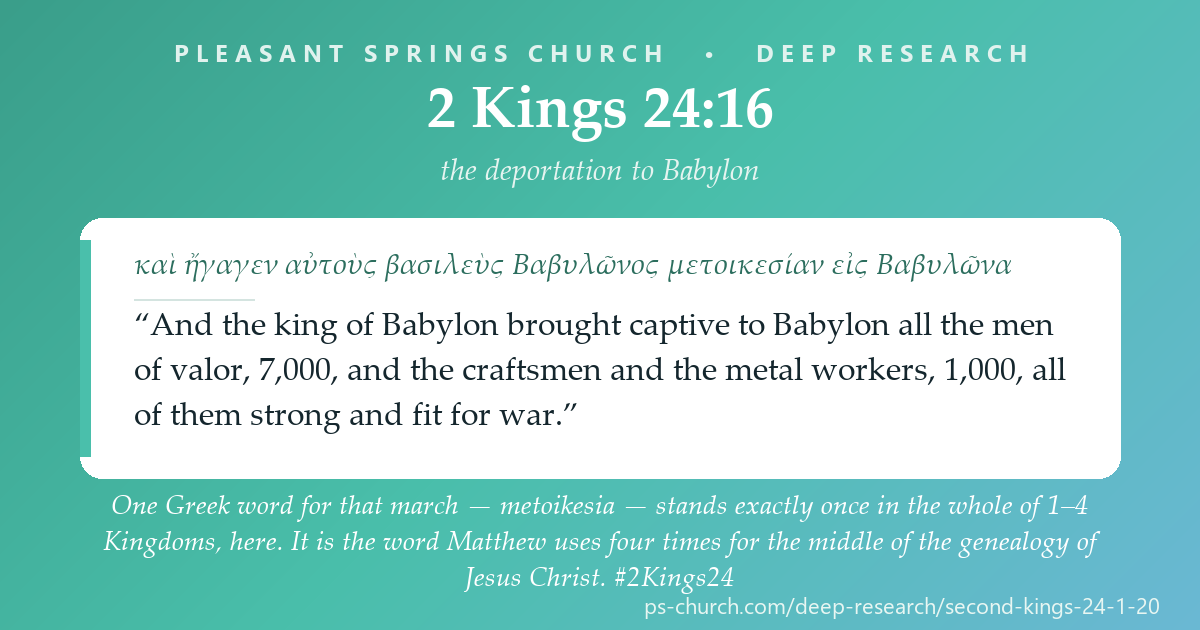
“A change of dwelling — deportation.” Eight occurrences in the 30,348 screened Greek Old Testament verse units held here, and exactly one in the whole of 1–4 Kingdoms: this verse. The others are 1 Chronicles 5:22, Judges A 18:30, Nahum 3:10, Obadiah 20 (twice), Lamentations 1:7 and Ezekiel 12:11. In the Greek New Testament it occurs four times, and all four are in Matthew 1 — 1:11, 1:12 and 1:17 twice — where ἡ μετοικεσία Βαβυλῶνος is the middle of the three fourteens. ⚠️ The word is shared; the sentences are not. The longest verbatim run between 4 Kingdoms 24:16 and any of those four Matthew verses is one word. Stage 4 sets that beside the chapter’s deepest New Testament run, which is six — and which is an accident.
“Smith” — but built on the root sāgar, “to shut, to close.” The same consonants elsewhere mean a dungeon (Hebrew Psalm 142:8 = ESV 142:7, “Bring me out of prison”) and a fortification. Rahlfs renders it with a participle that keeps the root sense exactly: ὁ συγκλείων, “the one who shuts in.” It is paired both times with he‑ḥārāš (הֶחָרָשׁ), the craftsman or metalworker, Greek τέκτων — the noun the New Testament uses of Joseph and of Jesus (Matthew 13:55; Mark 6:3). That is a fact about a word, not an argument, and the page leaves it there.
“The rams of the land” — the leading men, ESV “the chief men of the land.” The phrase occurs twice in the Hebrew Bible: here and Ezekiel 17:13, exhaustive over 23,204 Masoretic verse units, tie band 1. And Ezekiel 17 is an allegory of this deportation — the great eagle that took the topmost shoot of the cedar. The written consonants are אולי; the reading tradition gives אֵילֵי, and Rahlfs’s τοὺς ἰσχυροὺς τῆς γῆς agrees with the reading tradition. Set it against dallat ʿam‑hāʾāreṣ in v.14, “the poorest of the people of the land”: within two verses the narrator names both halves of what is left of a nation, by what they weigh.
“Nebuchadnezzar.” The Hebrew Bible spells this one name five different ways, in 82 occurrences — counted here across the whole Masoretic corpus. נְבוּכַדְנֶצַּר 29× (Daniel, Ezra, Nehemiah, Esther); נְבוּכַדְרֶאצַּר 27× (Jeremiah 24×, Ezekiel 3×); נְבוּכַדְנֶאצַּר 12×; נְבֻכַדְנֶאצַּר 8×; and נְבֻכַדְנֶצַּר 6× (Daniel only). 2 Kings uses the fourth of these five times — three of them in this chapter. The form with r, which Jeremiah and Ezekiel prefer and Kings never uses, is the one closest to the Akkadian Nabû-kudurri-uṣur. The Greek has no such variety: Rahlfs writes Ναβουχοδονοσορ and does not vary it.
One Greek name for two kings, father and son. Hebrew keeps them apart — Yəhōyāqîm (יְהוֹיָקִים) and Yəhōyāḵîn (יְהוֹיָכִין) — but 4 Kingdoms writes Ιωακιμ for both, eight times in this chapter, so that 24:6 reads “Ioakim slept with his fathers, and Ioakim his son reigned in his place.” Measured: Ιεχονιας — the son’s other name — occurs 17 times in the 30,348 screened Greek Old Testament verse units held here (Chronicles, 1 Esdras, Jeremiah, Baruch, Esther — and once, of another man, at 1 Kingdoms 6:19), and zero times of this king in 1–4 Kingdoms. In the Greek New Testament Ἰεχονίας occurs twice, both in Matthew 1:11–12, and Ιωακιμ occurs zero times. Matthew names the exiled king by the name Greek Kings never gives him.
Three features of the text here, reported rather than tidied:
- Three ketiv/qere pairs, and the Greek does not follow the reading tradition every time. At 24:10 the consonants are עלה (singular, “he came up”) and the qere is עָלוּ (plural, “they came up”) to match “the servants of Nebuchadnezzar”; at 24:15 the consonants are אולי and the qere is אֵילֵי. Rahlfs’s τοὺς ἰσχυροὺς matches the qere at 24:15. At 24:10, though, Rahlfs has the singular — and also drops “the servants of” — so on that verse the Greek stands with the written consonants against the reading tradition. One chapter, three ketiv/qere pairs, and the Greek splits them. The third is at 24:14 (עשרה written, עֲשֶׂרֶת read), which is purely a matter of the construct form.
- The numbers do not add up, and we are not going to make them. 24:14 says 10,000; 24:16 says 7,000 + 1,000 = 8,000; Jeremiah 52:28–30 says 3,023 + 832 + 745 = 4,600, and its first figure is dated to Nebuchadnezzar’s seventh year where 2 Kings 24:12 has his eighth. Standard treatments read v.14 as a round total and v.16 as its breakdown, and read Jeremiah’s much smaller figures as counting adult males only. Those are reasonable proposals. They are not in the text, and this page prints the three sets of numbers rather than a fourth number that is in none of them. Note also that the Greek of Jeremiah does not have 52:28–30 at all, so in Greek the arithmetic problem is smaller by one term.
- What the Greek of 24:2 does to the purpose clause. Hebrew sends the raiders “against Judah to destroy it” (לְהַאֲבִידוֹ, from ʾāḇaḏ, perish). Rahlfs sends them “into the land of Judah to prevail” (τοῦ κατισχῦσαι). One column has annihilation as the purpose and the other has mastery. It is a real difference of sense, it is printed above in both columns, and the page does not adjudicate it.
Three verses that are also in Jeremiah, a family tree nobody can agree on, a prophet inside the deportation, a word in Matthew’s genealogy — and the counter-example that keeps the rest honest.
Every run below is a count of contiguous identical word forms, with its tie band — how many other verses reach the same depth. A run of six with a band of 1 can still be a coincidence; a run of one can still be the real connection. The measurement finds verbatim contact, not allusion, and on this chapter the two point in opposite directions. Cross-corpus Greek runs here apply MorphGNT’s own spelling equivalences (ou/ouk/ouch, ek/ex, the movable nu); figures are therefore higher than those on pages written before 30 August 2026, and every number on this page was re-measured rather than copied.
Which cross-references matter?
- Jeremiah 52:1–3 — and this is the deepest thing on the page. 2 Kings 24:18 shares a seventeen-word verbatim run with Jeremiah 52:1, tie band 1; 24:19 shares seven with Jeremiah 52:2, band 1; 24:20 shares six with Jeremiah 52:3, band 1. Three consecutive verses in lock-step, and nothing else in the Masoretic corpus comes close. ⚠️ But look at the Greek. LXX Jeremiah 52:2 and 52:3 do not exist — Rahlfs goes from 52:1 straight to 52:4. And even at 52:1, where both Greek texts are present, the shared run is fifteen, with different opening idioms, two spellings of the mother’s name, and “of Libnah” present in Jeremiah and absent in Kings. An identical Hebrew sentence, translated twice, produced two Greek sentences that disagree about a town. Direction of dependence is not asserted here in either language.
- 2 Chronicles 36:9–10 and 1 Chronicles 3:15–16 — the family nobody can reconstruct. Jehoiachin is eighteen in 2 Kings 24:8 (Hebrew and Greek) and in the Greek of 2 Chronicles 36:9, but eight in the Hebrew of 2 Chronicles 36:9. Zedekiah is his uncle (2 Kings 24:17 Hebrew), his son (4 Kingdoms 24:17 Greek), his brother (2 Chronicles 36:10 Hebrew) and his father’s brother (2 Chronicles 36:10 Greek). 1 Chronicles 3:15 makes Zedekiah a son of Josiah and 1 Chronicles 3:16, the next verse, makes a Zedekiah a son of Jehoiakim. Kings’ own data favours ‘uncle’: 2 Kings 23:31 and 24:18 give Jehoahaz and Zedekiah the same mother, Hamutal daughter of Jeremiah of Libnah, in an eight-word verbatim run. The page lays out six witnesses and harmonises none of them.
- Jeremiah 22:24–30 — the signet ring and the childless man. Of the king carried off in 24:15, Jeremiah says: “though Coniah… were the signet ring on my right hand, yet I would tear you off,” and then “Write this man down as childless, a man who shall not succeed in his days, for none of his offspring shall succeed in sitting on the throne of David.” The Greek of Jeremiah calls him Ιεχονιας in that chapter — the name Greek Kings never uses for him. Read Jeremiah 22:30 and Matthew 1:12 together and do not soften either. Matthew’s line runs through Jechoniah; Jeremiah’s oracle says no offspring of his will sit on David’s throne. The traditional reading is that Jeremiah’s word held for the monarchy and that Matthew’s Christ does not inherit the throne by Jehoiachin’s biological succession. That is an interpretation. This page names it as one and prints both texts whole.
- Ezekiel 17:13 and Ezekiel 1:2 — a prophet inside verse 15. The two Hebrew words אֵילֵי הָאָרֶץ occur in the Hebrew Bible only at 2 Kings 24:15 and Ezekiel 17:13, tie band 1 — and Ezekiel 17 is an allegory of this deportation. Ezekiel 1:2 dates his own call to “the fifth year of the exile of King Jehoiachin,” and the whole book of Ezekiel is dated from the year of this chapter. One of the deportees of verses 14–16 wrote a book of the Bible.
- 1 Kings 14:26 and 2 Chronicles 12:9 — the first plundering and the last. The four Hebrew words “the gold that Solomon… had made” occur in only three verses in the Masoretic corpus: 2 Kings 24:13, and the two accounts of Shishak of Egypt emptying the temple five years after Solomon died (tie band 2). The temple treasury is looted in the fifth year of Rehoboam, Solomon’s successor, and in the monarchy’s last decade, and the Hebrew describes both with the same four words.
- 2 Kings 20:17 — the word that is being fulfilled. Verse 13 ends “as the Lord had foretold,” and the thing foretold is Isaiah’s word to Hezekiah: “Behold, the days are coming, when all that is in your house… shall be carried to Babylon. Nothing shall be left.” That page is on this shelf. The narrator is closing his own loop, not ours.
- Daniel 1:1–2 — a date this page does not resolve. Daniel opens “in the third year of the reign of Jehoiakim king of Judah, Nebuchadnezzar king of Babylon came to Jerusalem and besieged it,” where 2 Kings 24:1 has Nebuchadnezzar coming up and Jehoiakim serving three years before rebelling, and Jeremiah 25:1 equates Jehoiakim’s fourth year with Nebuchadnezzar’s first. Proposals exist — Babylonian accession-year reckoning against Judean regnal reckoning is the usual one. They are proposals. The page names the difficulty and does not adopt a scheme.
- Matthew 1:11–12, 17 — the connection this study is named for, stated at its true weight. μετοικεσία, “deportation,” occurs four times in the Greek New Testament, all four in Matthew 1, and exactly once in 1–4 Kingdoms — 4 Kingdoms 24:16. And the longest verbatim run between 4 Kingdoms 24:16 and Matthew 1:11, 1:12 or 1:17 is one word. Matthew is not quoting this verse. He is using the vocabulary that Greek Chronicles, Greek Jeremiah and the Greek Twelve use for this event, and he also uses the name those books use (Ἰεχονίας) rather than the one Greek Kings uses (Ιωακιμ). The overlap is lexical and real; it is not a citation, and no direction of influence is asserted.
- ⚠️ John 2:12 — and this is the page’s own counter-example, printed on purpose. The deepest verbatim run between any verse of 4 Kingdoms 24 and the whole Greek New Testament is six words, tie band 1: 24:12 against John 2:12, καὶ ἡ μήτηρ αὐτοῦ καὶ οἱ — the last king of Judah going out to surrender “he and his mother and his servants,” and Jesus going down to Capernaum, αὐτὸς καὶ ἡ μήτηρ αὐτοῦ καὶ οἱ ἀδελφοὶ αὐτοῦ, which the ESV renders “with his mother and his brothers.” Nothing connects them but a way of listing a household. Across the twenty verses, all 20 reach two, 19 reach three, 3 reach four, 1 reaches six, and nothing reaches seven. The deepest number on this chapter is noise, and the real link measures one. If this page has earned any of its other figures, it is by printing this one first.
What was consulted, what was not, and the four places where this page is weakest.
Cogan and Tadmor, Sweeney, Provan, House and Wiseman on the chapter; Tov and Fernández Marcos on the Greek. Then the limits — stated plainly, because a shelf that only prints what it found is not trustworthy.
Commentaries & studies:
- Mordechai Cogan and Hayim Tadmor, II Kings (Anchor Bible) — the standard critical commentary; the first place to go for the Babylonian material, the deportation figures and the philology of vv. 14–16.
- Marvin A. Sweeney, I & II Kings (OTL) — the fullest recent literary and redactional treatment; Iain W. Provan, 1 and 2 Kings (NIBC); Paul R. House, 1, 2 Kings (NAC); Donald J. Wiseman, 1 and 2 Kings (TOTC), whose Chronicles of Chaldaean Kings (1956) is the primary publication of the tablets this page could not read.
- Emanuel Tov, Textual Criticism of the Hebrew Bible, and The Septuagint Translation of Jeremiah and Baruch — the standard treatment of why Greek Jeremiah is shorter than Hebrew Jeremiah, which is directly relevant to the missing 52:2–3 and 52:28–30.
- Natalio Fernández Marcos, The Septuagint in Context, and Dominique Barthélemy, Les Devanciers d’Aquila (1963) — on kaige and on the standing of the Antiochene text inside a kaige section.
- E. F. Weidner, “Jojachin, König von Juda, in babylonischen Keilschrifttexten,” in Mélanges syriens offerts à Monsieur René Dussaud II (Paris, 1939), 923–935 — the original publication of the ration tablets quoted in Stage 2, which we know only through ANET’s excerpt.
⚠️ What this page did NOT check, and where it is weakest:
- No Antiochene reading was consulted, and that is the largest textual gap here. This chapter lies inside the second kaige section, where the Greek printed above is a revision toward a proto-Masoretic Hebrew and where the Antiochene (Lucianic) text is frequently the older witness. The critical edition (Fernández Marcos–Busto Saiz) was not consulted, and there is no Göttingen edition of 4 Kingdoms; the fuller apparatus is Brooke–McLean, also not consulted. So when this page says “the Greek reads his son at 24:17,” it means Rahlfs’s text as digitized by CATSS reads that — not “the Septuagint” and not “the oldest Greek.”
- The Babylonian Chronicle was not read. The tablet entry for Nebuchadnezzar’s seventh year (ANET 563–564) is the document that would date this chapter and adjudicate between 2 Kings 24:12 and Jeremiah 52:28. It lies outside the range of our local scan of ANET. NOT VERIFIABLE FROM LOCAL SOURCES. No word of it is quoted, and every chronological statement above is correspondingly weaker than it could be.
- No Qumran or Judean Desert evidence was examined. No 2 Kings manuscript from Qumran was consulted, and no Hebrew variant is claimed from any source other than the Masoretic text held here and the printed apparatus of the qere. Where this page says “the Hebrew reads,” it means Sefaria’s Miqra according to the Masorah, with the qere.
- The English is the ESV, quoted under Crossway’s standing permission — not a licence. No ESV API key has ever been issued to this site, and that permission excludes commentary and reference works, which is what this shelf is. The ceiling is 500 verses total and not more than half of any one book; this study adds 20 verses of 2 Kings, and the shelf’s total for the book stands at roughly a fifth of it. The figure is monitored, and the English will be replaced by the church’s own translation when that work is far enough along.
- The chronology is left unresolved on purpose. Thiele’s synchronisms are the standard attempt and are themselves contested (Albright, Galil, Hayes–Hooker, Tetley); accession-year versus non-accession-year reckoning is the usual explanation for Daniel 1:1 against Jeremiah 25:1 and 2 Kings 24:1, and for the seventh/eighth year difference at 24:12. No harmonised scheme is printed on this page as though it were the text.
- Four of this page’s figures depend on a screen that excludes the Odes, and one on a screen that excludes the source chapter. The Greek Old Testament held here is 64 CATSS files and 30,637 verse units, but a lexeme or run screen sees 30,348, because the Odes are excluded — two of them are Luke 1 and Luke 2 copied into a Greek Old Testament manuscript, and ten more duplicate Exodus 15, Deuteronomy 32, 1 Samuel 2, Habakkuk 3, Isaiah 26, Jonah 2, Daniel 3, Isaiah 5 and Isaiah 38. The Hebrew screen runs over 23,204 verse units and reports depths against the 23,184 that are not in this chapter. Both scopes are stated wherever a number is given, and neither is the whole Septuagint.
- Where the Greek Old Testament is not held at all, no claim is made. All 64 CATSS files are held here, Jeremiah, Ezekiel, Lamentations and both Greek Daniels among them, and 63 of them are screened — the Odes are the one file every screen leaves out. A count reported as “n in the screened Greek Old Testament verse units held here” is a count over those 30,348 units, never a claim about the Septuagint as a whole. Until 2026-09-24 this read ‘The 39 mapped Greek books held here … do not include every book of the wider Septuagint.’ The 39 counted the book names in the tools’ index, not the files on disk: all 64 were already held when this page was written, and its Greek figures were already measured over the 30,348 screened units.
A chapter with no miracle in it, and what a church is supposed to do with that.
Name what you learned, why it matters, and one concrete response.
What should we carry away — and do?
- Nothing happens in this chapter that anyone would call spiritual, and the narrator says twice that it is the most spiritual thing in the book. A vassal breaks a treaty; an empire responds; a treasury is emptied; skilled workers are relocated. And in the middle of that the writer stops the narrative and says: this was “at the command of the Lord” (24:3) and “because of the anger of the Lord” (24:20). He is not telling you God caused politics instead of politics happening. He is telling you both sentences are true of the same event.
- The judgment landed on a generation that had not committed the sin. Verse 3 says it happened “for the sins of Manasseh” — a king who had been dead more than thirty years when Jehoiakim rebelled. That is uncomfortable and it is meant to be. Scripture holds it alongside Ezekiel 18 (“the son shall not suffer for the iniquity of the father”), which was written by a man deported in verse 15 of this very chapter. Both are in your Bible; preach both, and do not average them.
- Verse 14 is a sentence about who was left. “None remained, except the poorest people of the land.” When the leadership, the money and the skilled trades all left, what stayed in Judah was the poor. A church that measures itself by its verse-15 people — officials, mighty men, chief men — is measuring the half that left. God kept working with the half that stayed.
- Somebody in that column of exiles wrote a book of the Bible. Ezekiel dates his whole ministry from “the fifth year of the exile of King Jehoiachin.” He was one of the anonymous deportees of verses 14–16 when it happened, and nothing in the chapter marks him out. The person in your congregation whose life has just been dismantled may be four years from the most useful thing they will ever do.
- And the honest word about measurement. This study spent most of its effort on numbers, and the number it is proudest of is the one that says no: the deepest verbal link between this chapter and the New Testament is six words with John 2:12, and it means nothing. Wanting a connection is not evidence for it. Say what you measured, say what it does not show, and let the text keep its own shape.
A word about typology, clearly labelled — three things, kept distinct. (1) What the text says. 2 Kings 24 does not announce itself as a type of anything. It reports a rebellion, a siege, a surrender and a deportation, and it gives its own theological reason twice. (2) What the New Testament itself draws. One thing, and it is safe ground because it is the canon’s own move: Matthew 1:11–12, 17 takes “the deportation to Babylon” as one of the three hinges of Israel’s history and puts Jechoniah — the eighteen-year-old of verse 8 — into the genealogy of Jesus Christ. Matthew does not quote this chapter; he presupposes it. (3) What we see from this side of the cross. A son of David goes out of the gate of Jerusalem with his mother beside him and gives himself up, and it is counted as the end of the line — and it is not the end of the line. This page will not pretend it does not hear something in that, and it will also not pretend the writer of Kings was making the point. Both halves have to be said, and Luke 24:27 is why the second half is allowed to be said at all.
Step in response: two things this week. First, find the part of your own history that you would rather explain politically — the decision, the collapse, the thing that “just happened” — and put 24:3 and 24:20 beside it without cancelling either sentence. Second, look for the verse-14 people in your church: the ones left behind when everyone with options left. That is who was still in the land when God started rebuilding it.
Every Deep Research page traces its passage across the whole sweep — the Old Testament, the Second-Temple world between the testaments (historical witnesses, not Scripture), and the New Testament. Follow the thread:
Pleasant Springs Church — Deep Research
Research method after Michael S. Heiser’s Bible Research Method (examine dictionaries → ancient literature → important words → textual connections → academic publications → share), with the Pleasant Springs “Author & Audience” foundation. Scripture set in the Hebrew, the Greek editions named on each page and the ESV (Old Testament), and the Greek New Testament and the ESV (New Testament), per the practice of Pleasant Springs Church. 2 Kings 24 research grounded in Cogan and Tadmor (Anchor), Sweeney (OTL), Provan (NIBC), House (NAC) and Wiseman (TOTC), with Barthélemy, Tov and Fernández Marcos on the Greek. Book name: in the Septuagint this book is 4 Kingdoms, Βασιλειῶν Δʹ, the last quarter of one continuous work. ⚠️ Kaige: the whole of 2 Kings lies inside the second kaige section (γδ), so the Greek printed here is a revision toward a proto-Masoretic Hebrew and not the oldest Greek; the Antiochene (Lucianic) text is frequently the older witness inside such a section, and this page cites no Antiochene reading because we have not consulted the critical edition (Fernández Marcos–Busto Saiz). There is no Göttingen edition of 4 Kingdoms; the fuller apparatus is Brooke–McLean, also not consulted. The kaige claim is demonstrated rather than asserted: καί γε stands at 24:4, answering Hebrew gam, and it is the only occurrence in this chapter. Text & numbering: Hebrew from the Masoretic Text (Sefaria, Miqra according to the Masorah), qere read, cantillation stripped; Greek from Rahlfs’s Septuaginta in the CATSS digitization, printed without editorial punctuation and with proper names unaccented; English ESV. There is no versification offset in 2 Kings 24, and it was counted rather than assumed: the Masoretic Text of 2 Kings holds 719 verses in 25 chapters and Rahlfs’s 4 Kingdoms holds 723 in the same 25, the entire difference being chapter 1 (22 Greek verses to 18 Hebrew); chapter 24 has exactly 20 verses in both and they align one for one. Where the Greek of Jeremiah is cited, LXX Jeremiah 52 = MT Jeremiah 52, but LXX Jeremiah 52:2–3, 52:15 and 52:28–30 are absent, which is stated at the point of use. Divergences between the columns are enumerated rather than smoothed and are not called “rendering differences” when they are pluses, minuses or substantive: 24:2 (destroy / prevail), 24:3 (mouth / anger), 24:6 and throughout (Jehoiakim and Jehoiachin share the Greek name Ιωακιμ), 24:9 against 24:19 (ἐν ὀφθαλμοῖς / ἐνώπιον), 24:10 (Greek singular, and “the servants of” absent), 24:12 (word order of mother and servants), 24:17 (his uncle / his son), 24:18 (“of Libnah” absent in Kings, present in LXX Jeremiah 52:1). ⚠️ Kings, Chronicles and Jeremiah: where they differ they are printed side by side and not harmonised — Jehoiachin’s age (18 / 8 / 18), Zedekiah’s relationship to him (uncle / son / brother / father’s brother, across four columns, with 1 Chronicles 3:15–16 disagreeing with itself), the deportation totals (10,000 / 8,000 / 4,600) and the year of the surrender (eighth / seventh). ⚠️ Regnal chronology does not resolve without unstated co-regencies and accession-year conventions; Thiele is named as the standard attempt and as itself contested, and no harmonised scheme is printed as though it were the text. ⚠️ Ancient Near Eastern material is cited only where it can be verified in the local scan of Pritchard’s ANET — the Weidner ration tablets (308) are quoted; the Babylonian Chronicle entry on the capture of Jerusalem (563–564) lies outside that range and is named but not quoted. All runs are counts of contiguous identical word forms with their tie bands, measured over 23,204 Masoretic verse units, 30,348 screened Greek Old Testament verse units (the Odes excluded) and 7,927 Greek New Testament verses; no direction of influence is asserted anywhere on this page, and the chapter’s deepest New Testament run is printed as the coincidence it is. Typology is labelled in three parts per the house position — what the text says, what the New Testament itself draws (Matthew 1:11–12, 17), and what we see from this side of the cross.
Scripture quotations marked ESV are from the ESV® Bible (The Holy Bible, English Standard Version®), © 2001 by Crossway, a publishing ministry of Good News Publishers. ESV Text Edition: 2016. Used by permission. All rights reserved. The ESV text may not be quoted in any publication made available to the public by a Creative Commons license, and the ESV may not be translated in whole or in part into any other language. www.esv.org
|
Did this study bless you today? 💚 Give to Support PS Church100% of gifts go to the General Fund — thank you. |