Hezekiah gets the highest verdict any king in Judah receives: “He trusted in the Lord, the God of Israel, so that there was none like him among all the kings of Judah after him, nor among those who were before him” (18:5). And the first thing recorded of him is a demolition. He removed the high places, and he “broke in pieces the bronze serpent that Moses had made, for until those days the people of Israel had made offerings to it” — a genuine relic of a genuine miracle, commanded by God and used by God, and by now an idol with incense in front of it. He called it Nehushtan: Bronze Thing. Then the Assyrians arrive, and the book hands the enemy the best speech in it. The Rabshakeh stands at the water conduit and, when he is asked to speak Aramaic so the men on the wall will not understand, he answers by shouting in their own language instead: come out, eat your own vine and your own fig tree, live in a land like this one — and, “Has any of the gods of the nations ever delivered his land out of the hand of the king of Assyria?” It was a true statement. Sennacherib’s own annals, carved on the Taylor Prism, boast of shutting Hezekiah up in Jerusalem “like a bird in a cage” — and never once claim to have taken the city. Then the letter comes, and with it the sentence this study is named for: “Hezekiah went up to the house of the Lord and spread it before the Lord” (19:14). Then the taunt-song, the angel, and a king cut down in his own god’s house. And then chapter 20, which is quieter and costs more: a death sentence, a face turned to the wall, fifteen years, a cake of figs, a shadow that goes backwards — and envoys from Babylon, and a reply the narrator writes down without softening it. This study works 2 Kings 18:1–20:21 line by line, in Hebrew, Septuagint (Rahlfs, 4 Kingdoms — and every verse here lies inside the second kaige section) and ESV, with the differences between the columns reported rather than smoothed. See the method →
2 Kings 18:1–20:21 (selections)
Hebrew · LXX 4 Kingdoms (Rahlfs) · ESVThe Shape of the Passage
Parallel panelsBehind these chapters stand two things the reader is expected to remember: the fall of Samaria in chapter 17, with the narrator’s own explanation of it, and the promise made to David, which is twice given here as the reason Jerusalem is spared. In front of them stands Manasseh, and Babylon.
Author
A historian who has just written the obituary of the northern kingdom, and knows his readers are afraid. Chapter 17 gave the theology of a national catastrophe in seventeen unsparing verses. Chapter 18 opens on a southern king whose reform is described in the exact opposite terms — the high places removed, the pillars broken — and then puts the same empire outside his wall. The whole design of this section is a question the first readers were actually asking: Samaria trusted and fell; why should Jerusalem be different? The Rabshakeh asks it out loud (18:34) so that nobody has to ask it in private.
He gives the enemy the best speech in the book, and does not answer it. That is a deliberate and slightly alarming choice. The Rabshakeh gets the best part of nineteen verses of first-rate rhetoric — theological (18:25), economic (18:31–32), and empirical (18:33–35) — and the men on the wall are ordered to say nothing back. No Judean scores a point. The refutation, when it comes, is not an argument at all; it is one night and a departure. A writer less sure of his material would have written a rebuttal.
And he does not stop at the victory. He could have ended at 19:37, and it would have been a perfect chapter. Instead he adds a sickbed, a sign, a state visit and a sentence that costs Hezekiah most of what the last two chapters gave him. He does the same thing with David (as with every king in this book): the praise is real, and it is never the last word. Compare 2 Chronicles 32, which arranges the same material to make a point about pride and repentance that Kings does not make — see Stage 5, where the difference is reported rather than dissolved.
Audience
People for whom “the city was not taken” was living memory, and then people for whom it had been. Read in Judah after 701 BC, this is the story of the year the impossible did not happen. Read again after 586, when the walls did come down, it is something much stranger — a record of the one time deliverance came, kept in a book that ends with the temple burned. The book does not resolve that tension for us, and 20:17 shows that it knew perfectly well it was creating it.
People who had seen a holy object become a problem. The bronze serpent had been in Israel’s possession for centuries — how many depends on the date one gives the exodus, and the estimates run from about five hundred years to about seven hundred. It was authentic. It had a genuine miracle attached to it. And by 715 BC people were burning incense to it, and the reforming king smashed it. An audience that had watched its own shrines multiply knew exactly what that verse was for.
And people who prayed. Two prayers are recorded here in full, and both are answered on the page: one from a throne room with an army outside, one from a bed with a death sentence just delivered. Neither is eloquent. The first is an argument about who God is; the second is barely a sentence and a lot of crying. The book records the tears (20:5) as part of what God answered.
Orient on Hezekiah and his reform, Assyria and Sennacherib, siege warfare and the Rabshakeh, the Siloam tunnel, and the regnal chronology.
Search by topic: Hezekiah; Hezekiah’s reform; high places (bamah); Asherah; massebah / pillar; Nehushtan; bronze serpent; Sennacherib; Assyria, Neo-Assyrian empire; Rabshakeh; Tartan; Rab-saris; Lachish; Siloam tunnel and inscription; Gihon; Merodach-baladan; Babylon; Esarhaddon; Nisroch; angel of the LORD; Isaiah (prophet); chronology of the Divided Monarchy; kaige recension; Lucianic / Antiochene text.
Which articles are relevant?
- Anchor Bible Dictionary — “Hezekiah,” “Sennacherib,” “Assyria,” “Rabshakeh,” “Lachish,” “Siloam Inscription,” “Nehushtan,” “Serpent, Bronze,” “High Place,” “Merodach-baladan,” “Esarhaddon,” “Chronology (Hebrew Bible).”
- Dictionary of the OT: Historical Books (IVP) — “Hezekiah,” “Kings, Books of,” “Assyria, Assyrians,” “Chronology,” “Non-Israelite Written Sources: Assyrian,” “Water and Water Systems.”
- NIDOTTE / TDOT — בָּטַח (bāṭaḥ, trust), יָד (yāḏ, hand), נָחָשׁ / נְחֹשֶׁת (serpent / bronze), בָּמָה (bāmāh, high place), חָרַף (ḥāraḃ, reproach), פָּרַשׂ (pāraś, spread out), שְׁאֵרִית (šăʾērîṯ, remnant).
- On the Greek — Paul D. McLean, “4 Reigns: To the Reader,” in NETS, for the base text (Rahlfs) and the kaige boundaries; and Natalio Fernández Marcos, The Septuagint in Context, on the Antiochene text and the kaige question. Neither is a substitute for the critical edition, and this page does not pretend otherwise.
Bibliography surfaced:
- Mordechai Cogan and Hayim Tadmor, II Kings (Anchor Bible) — the indispensable volume here, because Tadmor was an Assyriologist and the notes on the Assyrian side are first-hand.
- Brevard S. Childs, Isaiah and the Assyrian Crisis (1967); Marvin A. Sweeney, I & II Kings (OTL); Simon J. DeVries, 1 Kings (WBC) for the framework; Iain W. Provan, 1 and 2 Kings (NIBC); Paul R. House, 1, 2 Kings (NAC); Donald J. Wiseman, 1 and 2 Kings (TOTC).
- Emanuel Tov, Textual Criticism of the Hebrew Bible, for the framework behind the codex note above.
The Assyrian machine, a royal inscription that tells the same year from the other side, a tunnel you can still walk through — and what the ancient retellings could not leave alone.
First the world: what an Assyrian siege actually was, how a psychological-warfare speech was designed, and what Hezekiah had built before the army arrived. Then set 2 Kings 18–19 beside Sennacherib’s own account of 701 BC and read them together, honestly, in both directions. Then watch what Sirach, Tobit, Josephus and the rabbis add — because the additions show you which silences they could not bear.
Which parallels shed light on the world of these chapters?
The Rabshakeh’s speech is not a caricature; it is a genre. Assyrian kings conducted siege diplomacy exactly this way, and their own letters preserve the technique: a herald sent to the wall, an offer of terms before the ramps go up, a promise of resettlement in “a land like your own,” and the argument that the local god has already abandoned the city. The one detail that makes 2 Kings 18 unforgettable is the language: he is asked to use Aramaic, the international diplomatic tongue, and he answers by shouting in Judahite at the men on the wall (18:26–28). That is a deliberate escalation from negotiation to psychological warfare, and the narrator records the request and the refusal so that you cannot miss it.
Hezekiah had prepared for exactly this. The narrator mentions the water works in a single closing verse — “how he made the pool and the conduit and brought water into the city” (20:20) — and archaeology has the rest. Hezekiah’s tunnel runs some 530 metres from the Gihon spring under the City of David to the Siloam pool, and the workmen left a note. The Siloam Inscription (ANET 321) describes the moment the two crews met in the dark: they heard “the voice of a man calling to his fellow… and the water flowed from the spring toward the reservoir for 1,200 cubits.” It says nothing about God or the king. It is six lines of quarrymen being proud of their work — and it is the most vivid thing anyone left us from Hezekiah’s Jerusalem.
And Lachish is not a throwaway detail. The Rabshakeh is sent “from Lachish” (18:17), because that is where Sennacherib was: the siege of Lachish is carved in enormous relief along a wall of his palace at Nineveh, and the excavation of the site found the siege ramp, the arrowheads and the mass burials. When 2 Kings says the king of Assyria took the fortified cities of Judah, there is a stone picture of him doing it.
- Sennacherib’s annals — the Oriental Institute Prism and the so-called Taylor Prism, on the third campaign, 701 BC (ANET 287–288 — a royal inscription, a witness, not Scripture) — and it is one of the most striking convergences between the Bible and an ancient Near Eastern royal text. Read what it claims: “As to Hezekiah, the Jew, he did not submit to my yoke, I laid siege to 46 of his strong cities… Himself I made a prisoner in Jerusalem, his royal residence, like a bird in a cage.” Then read what it claims next: that Hezekiah sent to Nineveh “30 talents of gold, 800 talents of silver,” with precious stones, ivory-inlaid couches and chairs, his own daughters and his musicians. Now read what it does not claim. This is a document whose entire purpose is to list conquests, and it never says Jerusalem was taken, never says Hezekiah was deposed, never names a new king in his place. It says he was shut in and made to pay. Both texts agree that Sennacherib came, took the fortified cities, and took a great deal of gold; both agree the city itself did not fall. They also differ, plainly and without any need to panic: 2 Kings 18:14 says three hundred talents of silver, the prism says eight hundred (the gold is the same figure in both — thirty talents); Kings puts the payment before the siege and the prism after it; and the prism has no room at all for 185,000 dead. Neither text is a neutral report and neither claims to be. One is written to glorify Ashur and the king; one is written to say who kept Jerusalem. What we have is two accounts of the same year with a hard core of agreement, and that is a great deal more than most events of the eighth century BC give us.
- The Siloam Inscription (ANET 321 — an inscription, a witness, not Scripture) — six lines in classical Hebrew prose from the tunnel of 20:20, describing the two teams of quarrymen meeting in the rock. Discovered in 1880; now in Istanbul.
- The Babylonian Chronicle, on the death of Sennacherib (a witness, not Scripture) — the Babylonian chronicle series records that Sennacherib was killed by his son in a rebellion, which corroborates 19:37 from a completely independent quarter, though the identity of the assassin and the number of sons are debated in the Assyriological literature. Esarhaddon’s own inscription (Prism B, ANET 289–290) tells the aftermath in the voice of the son who won: his brothers “drew weapons in the midst of Nineveh… and butted each other — like kids — to take over the kingship,” and then fled. He does not describe his father’s murder; he describes the succession war it caused. (This page cites ANET page numbers only where the text was checked in the copy we hold; the Babylonian Chronicle passage was not, so it is named without one.)
- Sirach 48:17–25 (Second-Temple, c. 180 BC — a witness, not Scripture) — the earliest surviving retelling, and it is a poem. “Hezekiah fortified his city and brought water into its midst; he tunneled the rock with iron tools” (48:17) — the tunnel again. Then Sennacherib, and then the prayer, retold with a detail the Bible does not have: the people call on the Lord “spreading out their hands toward him” (48:20), so that the gesture of 19:14 has become a congregation’s. And then 48:23: “In Isaiah’s days the sun went backward, and he prolonged the life of the king” — the sun, which is how Isaiah 38:8 tells it, not how 2 Kings 20:11 tells it. Two hundred years before Christ, the two versions were already being read side by side.
- Tobit 1:15–22 (Second-Temple — a witness, not Scripture; the church’s ratified position is that these books are witnesses and are never levelled with Scripture) — a story set in the Nineveh of exactly these years, and it uses 19:35–37 as its backdrop: Tobit buries the Israelites “whom King Sennacherib put to death when he came fleeing from Judea,” and then, “not forty days passed before two of Sennacherib’s sons killed him, and when they fled to the mountains of Ararat, his son Esar-haddon reigned after him” (1:18, 21). It is the clearest evidence we have of how a Jewish reader in the Second-Temple period understood 19:37 — as history you could set a story in.
- Josephus, Antiquities 10.1.1–5 and 10.2.1–2 (Whiston’s numbering) (Second-Temple — a witness, not Scripture) — and what he does with these chapters is unusually revealing. He follows 2 Kings and not Isaiah: he keeps the tribute of 18:14–16, and he sends all three officers, “Tartan and Rabsaris” with the Rabshakeh. He notices the language point on his own: the speech was made “in the Hebrew tongue; for he was skilful in that language,” and Eliakim “desired him to speak in the Syrian tongue” — which is what the Greek Bible says too. But watch three changes. The letter is not spread out: Hezekiah “rolled up the epistle, and laid it up within the temple.” The angel becomes an epidemic: “God had sent a pestilential distemper upon his army” — a mechanism the Bible declines to give — and Josephus reinforces it by quoting Herodotus (Histories II) on the mice that gnawed the Assyrian bowstrings at Pelusium, and Berossus the Chaldean. And the reply to Isaiah is softened: Hezekiah “was troubled” and “prayed that there might be peace while he lived” — a prayer, not the line the narrator actually gives him. Josephus also supplies the motive for the illness that the Bible withholds: Hezekiah was childless and afraid to die without an heir.
- m. Pesaḥim 4:9 (rabbinic-era — a witness, not Scripture) — six verdicts on Hezekiah, and three of them touch these chapters directly. “Six things did King Hezekiah do; concerning three they agreed with him and concerning three they did not agree with him… he crushed the bronze serpent, and they agreed with him… he cut off the doors of the temple and sent them to the king of Assyria, and they did not agree with him; he stopped up the waters of the upper Gihon, and they did not agree with him.” Notice what that means. The Mishnah uses the very verb of 2 Kings 18:4 (כִּתֵּת) for the serpent and approves it; it disapproves of 18:16; and it disapproves of the water-works that 2 Chronicles 32:30 praises. The rabbis, at least, did not think the two accounts said the same thing.
- b. Berakhot 10a (rabbinic-era — a witness, not Scripture) — a long and startling treatment of 20:1–3. Hezekiah and Isaiah each expect the other to come first; God resolves it by making Hezekiah ill so that Isaiah must visit the sick. “You shall die and not live” is read as “die in this world and not live in the world to come,” because Hezekiah had not married — and Hezekiah answers that he had foreseen unworthy sons. Isaiah tells him not to concern himself with “the secrets of the Merciful One”; Hezekiah tells him, “Son of Amoz, finish your prophecy and leave,” and then says the line the tractate is remembered for: “Even if a sharp sword rests upon a person’s neck, he should not refrain from praying for mercy.” It is a piece of homiletic expansion and not history; and it is also one of the truest things ever said about 20:2.
Nothing about the bronze serpent was fraudulent. God commanded it (Numbers 21:8): “Make a fiery serpent and set it on a pole, and everyone who is bitten, when he sees it, shall live.” Moses made it. It worked. People who were dying looked at it and did not die. If you want a certified, first-generation, God-authorised holy object, this is it — and 2 Kings 18:4 is the record of a godly king smashing it into pieces.
The reason is given in the verse and it is the only reason given: “for until those days the people of Israel had made offerings to it.” The Hebrew is măqaṭṭărîm, they were burning incense to it — the same word the book uses for the worship at the high places all through Kings. Something that had once carried God’s mercy was now receiving worship, and the object had not changed at all; the people had.
The naming is the sharpest part. “It was called Nehushtan” — Năḥuštān, from the same three letters as năḥōšeṯ, bronze. Whether that is what the people called it or what Hezekiah called it as he broke it, the effect in Hebrew is the same and it is devastating: it is a piece of metal. Centuries of history, and its name is Bronze Thing.
And now say both halves of the Christian reading, because both are true and they must not be blurred. The first half: the New Testament itself makes this an image of Christ. That is not our inference; it is on the record, in Jesus’ own mouth — “As Moses lifted up the serpent in the wilderness, so must the Son of Man be lifted up, that whoever believes in him may have eternal life” (John 3:14–15). The second half: 2 Kings 18:4 is not making that point. It is a reform notice in a list of reform notices, and its interest is idolatry, not typology. Hold them together and you get something no sermon should waste: the very sign God gave to save them became the thing they had to be saved from. Which is exactly why the Christian version of the same danger is worth naming out loud — a cross, a hymn, a building, a translation, a movement, a preacher — every one of them can begin as a means of grace and end up with incense in front of it. The test is not whether the thing was genuine. Nehushtan was genuine. The test is what people are doing in front of it.
Compare, and notice the difference: at 1 Kings 12 Jeroboam manufactured objects to be worshipped. Here nobody manufactured anything. A true thing simply stayed in the room too long.
One verb the whole siege is an argument about, one noun that keeps changing owner, a name that means “bronze thing,” and a house.
Count batach yourself — ten, and nine of them are Assyrian. Then follow yad, “hand,” from the Rabshakeh’s boast to Hezekiah’s prayer. Then hold the Hebrew wordplay of Nehushtan beside a Greek column that cannot carry it, and watch the word “house” take over chapter 20.
“Trust, rely, put confidence in.” Ten occurrences, and only the first is friendly. The narrator uses it once, of Hezekiah (18:5); the Rabshakeh then uses it eight times in twelve verses, and Sennacherib’s letter uses it once more (19:10). It is the classic Old Testament word for misplaced confidence — in chariots, in princes, in wealth — and the Assyrian has correctly identified that it is the whole question. Note the Greek honestly: Rahlfs does not use one word for it. Seven times it is πείθω (18:19 twice, 20, 21 twice, 22; 19:10), three times a compound of ἐλπίζω (18:5, 24, 30). So in Greek Hezekiah hopes and the Rabshakeh talks about being persuaded, and the single Hebrew drumbeat becomes two.
“Hand” — and the passage moves along it like a rail. Four times in three verses the Rabshakeh says “out of my hand” (18:33–35). Sennacherib’s letter repeats “into the hand of the king of Assyria” (19:10). Then Hezekiah takes the letter “from the hand of the messengers” (19:14) — and prays, “save us from his hand” (19:19). The taunt-song then throws it back: Sennacherib mocked God “by the hand of your messengers” (19:23). At 20:6 the deliverance is promised “out of the palm (כַּף) of the king of Assyria” — a different word for the same thing, and the ESV rightly says “hand.” The Greek keeps it as χείρ throughout.
The name given to the bronze serpent, and it is built out of the same consonants as נְחֹשֶׁת (năḥōšeṯ, bronze) and נָחָשׁ (nāḥāš, serpent). Hebrew hears all three at once; English and Greek hear one. The ESV footnotes the wordplay, which is right. Rahlfs transliterates — Νεεσθαν — while translating “the bronze serpent” in the same sentence, so the Greek reader is told what the object was and not what the name meant.
“Spread out, unfold.” It is used for spreading a garment, a net, a cloud — and, over and over in the Old Testament, for spreading out the hands in prayer (Solomon does it at the dedication of the temple, 1 Kings 8:22). Here the object is a letter. Hezekiah does not summarise the threat, or argue with it, or hide it; he opens it flat on the floor of the temple and lets God read it. Rahlfs has ἀνέπτυξεν, “he unrolled” — accurate, and without the prayer-overtone of the Hebrew.
“In Judahite” — the ESV’s “the language of Judah,” that is, Hebrew. This is one of the very few places in the Bible where the language of the Bible is named, and it is named because a foreigner chose to use it as a weapon. Against it stands אֲרָמִית (ʾArāmîṯ), Aramaic, the diplomatic language the officials beg him to use instead. Rahlfs has Ιουδαϊστί and Συριστί, “in Judean” and “in Syrian.”
“Reproach, taunt, defy.” This is the word that turns a political crisis into a theological one. Hezekiah does not say the Rabshakeh insulted him; he says the king of Assyria sent him “to mock the living God” (19:4, 16) — and the taunt-song answers with the same root: “Whom have you mocked?” (19:22). It is also the verb in David’s question about Goliath — “who is this Philistine, that he should defy the armies of the living God?” (1 Samuel 17:26), and the phrase “the living God” is in both places. Rahlfs uses ὀνειδίζω.
“Remnant, what is left over.” Hezekiah asks Isaiah to “lift up your prayer for the remnant that is left” (19:4), and the answer comes back with the word doubled and turned into a promise: “the surviving remnant of the house of Judah shall again take root downward and bear fruit upward… out of Jerusalem shall go a remnant” (19:30–31). In 701 BC it means the survivors of forty-six captured towns. In the book of Isaiah it becomes one of the largest ideas in Scripture.
“Command your house” — the ESV’s “set your house in order.” It is an idiom for making a will, and it is also the seam of the chapter, because house then runs through everything that follows: he goes up to the house of the Lord (20:5, 8); he shows the Babylonians his treasure house and everything in his house (20:13, 15); and Isaiah answers, “all that is in your house… shall be carried to Babylon” (20:17). He was told to put his house in order, and the last we see of it he is giving a tour of it to the empire that will empty it.
Three things in the Hebrew of these chapters, reported rather than tidied:
- The qere at 18:27, and why the ESV prints what it prints. The Rabshakeh’s crudest line is crude in the consonants as written and slightly less so as read: the Masoretes direct the reader to substitute צוֹאָתָם and מֵימֵי רַגְלֵיהֶם (“their excrement… the water of their feet”) for the blunter words on the page. It is a reading convention, not a change to the text, and the Greek renders the sense plainly (τὴν κόπρον… τὸ οὖρον). The point is not the vulgarity. The point is that a besieger is describing what a long siege does to a city, and the men on the wall knew he was right.
- The ketiv/qere at 20:4 — and the Greek sides with the reading. What is written is הָעִיר, “the city”; what is read is חָצֵר, “the court” — and the ESV follows the reading (“the middle court”). Rahlfs has ἐν τῇ αὐλῇ τῇ μέσῃ, “in the middle court,” agreeing with the qere; and where the Hebrew says Isaiah “had not gone out” of it, the Greek simply says he “was” in it. Same outcome, different sentence — and it is printed here rather than harmonised.
- “His sons” at 19:37 is read but not written. In the Aleppo-based Masoretic edition printed above, בָּנָיו at 19:37 is marked as a qere with no corresponding ketiv — a word the reading tradition supplies but the consonantal text does not carry. Rahlfs has οἱ υἱοὶ αὐτοῦ, and Isaiah 37:38 has it as well. The relationship of the assassins to Sennacherib is therefore attested in the reading tradition, in the Greek, and in Isaiah — and, independently, in the Assyrian sources. It is worth knowing where each piece comes from.
The serpent in Numbers, the promise to David, the fall of Samaria, the parallel in Isaiah, and the parallel in Chronicles.
Trace five threads: back to Numbers 21 for the serpent; back to 2 Samuel 7 for the reason the city stands; back to 2 Kings 17 for the fear the Rabshakeh is exploiting; sideways to Isaiah 36–39 and 2 Chronicles 32, where the same events are told differently; and forward to 2 Kings 24–25, where the tour of the treasure house is paid for.
Which cross-references matter?
- Numbers 21:4–9 — the serpent’s birth certificate. God commands it, Moses makes it, the dying look and live. Read that page and then 2 Kings 18:4 in the same sitting: a few centuries is all it took for a means of grace to become an idol, and the man who ended it is the most commended king in Judah’s history.
- 2 Samuel 7:1–17 — “for my own sake and for my servant David’s sake” (19:34; 20:6). The city is not spared because Hezekiah earned it or because Jerusalem is intrinsically safe. It is spared on a promise made to somebody else three hundred years earlier — and the same book will show that promise surviving even the fire of chapter 25.
- 2 Kings 17 — the chapter the Rabshakeh is counting on. “Have they delivered Samaria out of my hand?” (18:34) is not rhetoric; it is recent history, and the narrator has already told his readers the theological reason it happened (17:7–23). The Assyrian and the narrator agree on the fact and disagree completely about the cause.
- Deuteronomy 12 and 1 Kings 12:25–33 — the law that makes “he removed the high places” a compliment, and the king who made high places a national institution. Note the twist at 18:22: the Rabshakeh uses Hezekiah’s obedience as evidence against him — “is it not he whose high places and altars Hezekiah has removed?” He has heard about the reform and has drawn the natural pagan conclusion: the king has dismantled his own god’s shrines. It is the most sophisticated thing in the speech, and it is exactly backwards.
- 1 Kings 8 — Solomon’s prayer at the dedication, where the temple is defined as the place toward which people pray and from which God hears, including “the foreigner… that all the peoples of the earth may know your name.” Hezekiah in 19:14–19 is doing precisely what that chapter told him the building was for, and 19:19 asks for precisely what Solomon asked for.
- Deuteronomy 17:14–20 — the law of the king: he is not to multiply silver and gold, and he is to read the Torah all his days. Set it beside 18:14–16 (a king emptying the temple to buy peace) and 20:13 (a king displaying his silver and gold to a foreign embassy), and the standard by which Kings is grading is in plain sight.
- 2 Kings 21 and 24–25 — the invoice. “All that is in your house… shall be carried to Babylon” (20:17) is cashed at 24:13, and the sons who become eunuchs in the palace of the king of Babylon (20:18) are visible at 24:12–15. And Manasseh, named in the last line of this study, gets the longest indictment in the book.
- The Isaiah parallel — Isaiah 36–39, and the differences are the interesting part. The two texts run so close that most scholars think one has been copied into the other; which direction is debated and this page does not adjudicate. What can be reported is what actually differs. Isaiah has no equivalent of 2 Kings 18:14–16 — the confession, the tribute, the stripped temple doors are simply absent, so Isaiah’s Hezekiah never submits. Isaiah 36:2 sends only the Rabshakeh, where 2 Kings 18:17 sends three officers. Isaiah 38 contains a twelve-verse psalm by Hezekiah (38:9–20) that 2 Kings does not have at all, and it moves the fig cake and the request for a sign to the end of the chapter as things that had been said (38:21–22). Isaiah 38:8 has the sun turn back; 2 Kings 20:11 mentions only the shadow. Isaiah 39:1 reads Merodach where 2 Kings 20:12 reads Berodach; Isaiah 39:2 says Hezekiah “welcomed them gladly” where 2 Kings 20:13 says he “welcomed” them — one Hebrew letter apart, and the Greek of 2 Kings sides with Isaiah. And Isaiah 39:8 makes the last line a statement, “there will be peace and security in my days”; 2 Kings 20:19 makes it a question, “why not, if…?” There is no Deep Research page for Isaiah 36–39 yet; read it in your Bible beside this one.
- The Chronicles parallel — 2 Chronicles 32, and it is a different book about the same king. Report the differences; do not average them. Chronicles omits the tribute of 18:14–16 entirely and opens the whole episode with “after these things and these acts of faithfulness” (32:1). It gives four verses to the water-works and the wall that Kings gives one (32:2–5, 30). It has Hezekiah and Isaiah praying together (32:20), where Kings has Hezekiah pray alone and Isaiah answer. Its angel “cut off all the mighty warriors and commanders and officers” with no number (32:21), and its assassins are “some of his own sons” with no names. And then it says two things Kings never says: that Hezekiah “did not make return according to the benefit done to him, for his heart was proud… but Hezekiah humbled himself” (32:25–26); and, of the Babylonian envoys, that “God left him to himself, in order to test him and to know all that was in his heart” (32:31). That last verse is an explanation, and 2 Kings 20 does not have one. This page prints the difference and leaves it standing.
The narrator has just spent two chapters making Hezekiah the best king since David. Then he records this.
Isaiah tells him that everything in his house will go to Babylon and that his own sons will be castrated in a foreign palace. Hezekiah replies, “The word of the Lord that you have spoken is good” — and the narrator, who has been inside Hezekiah’s head exactly once before, opens it again: “For he thought, ‘Why not, if there will be peace and security in my days?’”
There is no way to read that as anything but relief that the bill falls due after his own death. Commentators have tried — that it is submission to God’s word, that it is gratitude for a reprieve, that the Hebrew is ambiguous. The Hebrew is not especially ambiguous, and the narrator’s “for he thought” is a deliberate move: he is telling you the inside of the sentence because the outside sounded pious.
And then he does something even more pointed: he says nothing. No rebuke, no “and the Lord was displeased.” Just the closing formula, the tunnel, the burial, and the name Manasseh. The reader is left to do the arithmetic, and the arithmetic is brutal: the son who inherits the peace Hezekiah bought is the king who fills Jerusalem with innocent blood (2 Kings 21:16).
Three disciplines follow, and they are the same ones this library keeps everywhere. First, do not soften it. A page that turns 20:19 into quiet faith has taken a warning out of the Bible. Second, do not enjoy it either. This is the man who spread the letter out and prayed the prayer, and both things are true of him on the same page; that is what the book is like about everybody, including David. Third, do not import a verdict the text withholds. 2 Chronicles 32:25–26 does say Hezekiah’s heart was proud and that he humbled himself; 2 Kings does not say either, and putting Chronicles’ sentence into Kings’ mouth is exactly the kind of tidying this method exists to prevent.
What the text does give us is a question with our name on it, and it is not really about eighth-century politics: how much of what we are willing to call ‘peace’ is simply the trouble arriving on somebody else’s watch?
The commentaries, the chronology that does not add up, the one-campaign / two-campaign debate, and what to do with 185,000.
Cogan and Tadmor, Sweeney, Provan, House and Wiseman on Kings; Childs on the Assyrian crisis; Fernández Marcos on the Greek. Then the three questions this passage really raises — the chronology, the number of campaigns, and how to speak about 19:35 without either sensationalism or embarrassment.
Commentaries & studies:
- Mordechai Cogan and Hayim Tadmor, II Kings (Anchor Bible) — the standard, and the one to buy if you buy one. Tadmor’s Assyriological notes are why.
- Brevard S. Childs, Isaiah and the Assyrian Crisis (SBT, 1967) — the book that shaped how a generation reads the two accounts in 18:17–19:37 and their relation to Isaiah 36–39.
- Marvin A. Sweeney, I & II Kings (OTL); Iain W. Provan, 1 and 2 Kings (NIBC); Paul R. House, 1, 2 Kings (NAC); Donald J. Wiseman, 1 and 2 Kings (TOTC) — four very different readings, evangelical and critical, and worth having in the room together.
- Natalio Fernández Marcos, The Septuagint in Context, and (with José Ramón Busto Saiz) El texto antioqueno de la Biblia griega — on the Antiochene text, which this page names and does not quote, for the reason given in the codex note. Emanuel Tov, Textual Criticism of the Hebrew Bible, for the framework; Dominique Barthélemy, Les Devanciers d’Aquila (1963), for the kaige sections themselves.
- Edwin R. Thiele, The Mysterious Numbers of the Hebrew Kings — the standard attempt at the chronology, and itself much debated (Gershon Galil and K. A. Kitchen propose different schemes). Named here, and not adopted.
Interpretation notes worth keeping:
- ⚠ The regnal chronology of these chapters does not work on a plain reading, and this page will not print a scheme as though it were the text. Here is the difficulty, laid out. 18:1 makes Hezekiah’s accession the third year of Hoshea of Israel. 18:9–10 puts the siege of Samaria in his fourth year and its fall in his sixth. 18:13 puts Sennacherib’s invasion in his fourteenth. Now bring in the fixed points from outside: Samaria fell in 722 BC, and Sennacherib’s third campaign is dated by the Assyrian eponym lists to 701 BC. If Hezekiah’s sixth year is 722, his fourteenth is 714 — thirteen years too early. If his fourteenth year is 701, his first is 715 and Samaria falls in his seventh year after he came to the throne, not his sixth. The two sets of numbers cannot both be read straight. The standard resolution is a co-regency — Hezekiah reigning alongside his father Ahaz from about 729 and alone from 715 — which is Thiele’s solution and is genuinely defensible; but co-regencies are inferred to solve the problem and are not stated in the text, and Galil, Kitchen and Cogan–Tadmor arrange the pieces differently. Another proposal, noted in the codex above, is that “the fourteenth year” originally belonged to the illness of chapter 20 rather than to the invasion — which would fit 18:2 (twenty-nine years) plus 20:6 (fifteen more) exactly. We report the difficulty and the options and stop. Anyone who hands you a single tidy table for the kings of Israel and Judah has made choices they should be telling you about.
- One campaign or two? A real and unresolved question. The trigger is 19:9: Sennacherib hears that Tirhakah king of Cush is coming out against him — but Taharqa did not become pharaoh until about 690 BC, which is a decade after 701. Some (Bright, Horn, and others) therefore propose two Assyrian campaigns, with 18:13–16 belonging to the first and 19:9–37 to a later one. Others (Cogan–Tadmor and most current scholarship) hold to a single campaign in 701 and take “king of Cush” as the narrator’s title for a man who was a commander then and a king when the account was written — an ordinary and unremarkable way to name people in ancient narrative. Both readings are held by serious people; the page names them and does not choose.
- 19:35, and how to talk about it. The Bible gives one sentence and no mechanism: the angel of the Lord went out and struck 185,000. Herodotus (Histories II.141), writing of the same king at Pelusium, has field mice destroy the Assyrian bowstrings; Josephus quotes Herodotus and calls it a plague; commentators have suggested epidemic, and it is a reasonable guess. It remains a guess, and the text does not make it. 2 Chronicles 32:21 tells the same event with no number at all. The discipline this library follows is the one it follows at the Red Sea and at Uzzah: report what the text says, report what it does not say, name the proposals as proposals, and do not manufacture either a naturalistic explanation or a lurid one. The narrator’s own interest is not the mechanism. It is that the argument of 18:33–35 was answered.
- The prism and the Bible: what a convergence is and is not. It is worth being precise, because this case is often overstated in both directions. Sennacherib’s annals and 2 Kings agree on the king, the year, the campaign, the capture of Judah’s fortified cities, a heavy indemnity including thirty talents of gold, and — by the annals’ conspicuous silence — that Jerusalem was not captured. That is a lot. They disagree on the silver (300 against 800 talents) and on the order of events, and the Assyrian text has nothing corresponding to 19:35. The right conclusion is not “archaeology proves the Bible,” and it is not “the accounts contradict.” It is that we possess two interested accounts of one year written by opposed parties, that they overlap substantially, and that each says the thing its author cared about. Cogan and Tadmor set the texts out side by side; that is the way to study it.
- Hezekiah’s reform and the archaeology. The dismantled horned altar at Tel Beersheba and the disused shrine at Arad are frequently connected with a royal centralisation of worship in this period, and the connection is plausible; the dating and the identification of which king is responsible are debated. This page mentions the evidence and does not lean on it, because a reader deserves to know the difference between a text that says something and a stratum that might.
- Where 2 Kings and Chronicles differ about Hezekiah, and the sharper case still ahead. Kings has the submission and tribute (18:14–16) that Chronicles omits; Chronicles has the pride, the humbling and the divine testing (32:25–26, 31) that Kings omits. Neither is a correction of the other, and neither page should be preached as though it contained the other’s sentences. The sharpest instance of this in the whole book is one chapter away — 2 Kings 21 records Manasseh’s evil and no repentance whatever, while 2 Chronicles 33:12–13 records his capture, his prayer, and his restoration to Jerusalem. That difference is reported, not harmonised, at 2 Kings 21–25.
A smashed relic, a shouted speech, an open letter on a stone floor, and a sentence a king should not have said.
Name what you learned, why it matters, and one concrete response.
What should we carry away — and do?
- A genuine relic of a genuine miracle became an idol and had to be destroyed. The bronze serpent was commanded by God and it worked. Centuries later there was incense in front of it, and the best king Judah ever had broke it into pieces and called it Bronze Thing. The test of any object, practice or tradition is never whether it was once a real means of grace. It is what people are doing in front of it now.
- The Rabshakeh’s speech is worth studying because you will hear it again. Go over the officials’ heads to the frightened people; use their own language on purpose; quote their scriptures back at them; offer food and safety; ask “on what do you rest this trust of yours?” and answer it yourself; and finish with the argument from results — it has never worked for anybody else. Every part of that is still in use. The people on the wall were ordered to say nothing, and it was the right order.
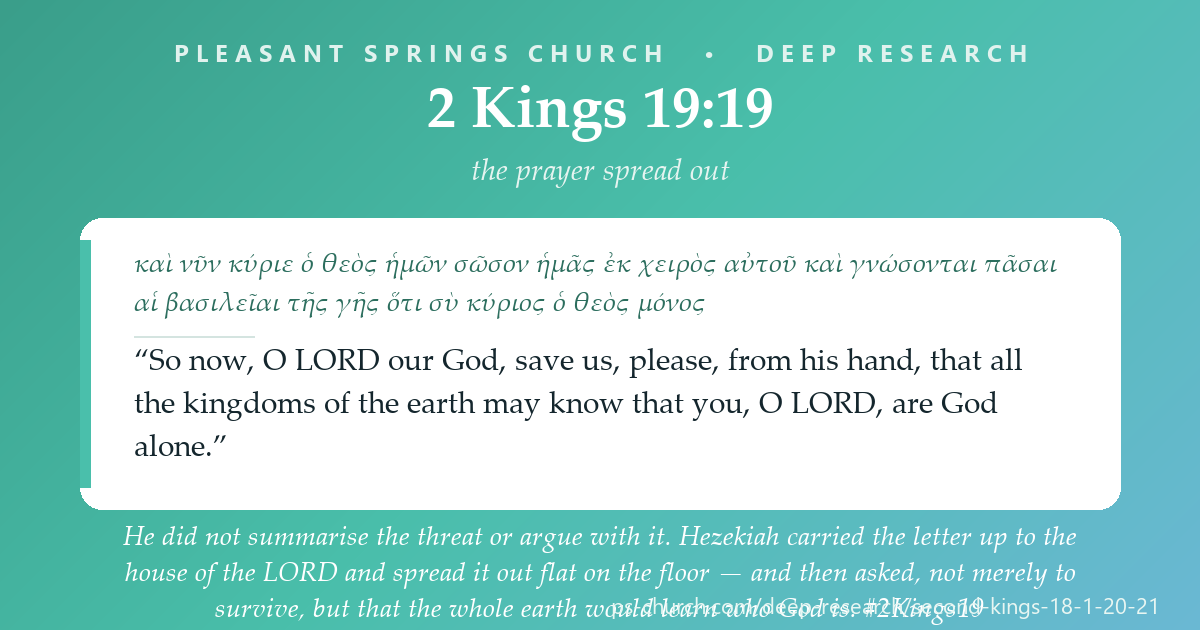
- He spread it out. Hezekiah did not summarise the threat, argue with it, or file it. He carried the letter up to the house of the Lord and opened it flat on the floor where God could read it. That is a whole doctrine of prayer in one gesture, and it is available to anybody with a diagnosis, a legal letter, or a message they have read eleven times.
- And notice what he asked for. Not survival — or not only. “Save us… that all the kingdoms of the earth may know that you, O Lord, are God alone” (19:19). He asked for the one thing that would answer the speech. Most of our praying stops at the first half of that verse.
- Turning your face to the wall and weeping is in the Bible, and God answered the tears by name. “I have heard your prayer; I have seen your tears” (20:5). Hezekiah’s prayer in chapter 20 is three lines long and mostly crying, and it is recorded next to the great theological prayer of chapter 19 without any suggestion that one is better.
- “Why not, if there will be peace and security in my days?” The narrator writes it down and does not comment, and neither should we soften it. It is the temptation of every settled generation: to hear that the reckoning falls after us, and call that good news. Ask what you are currently willing to call peace because the cost lands on somebody younger.
A word about typology, clearly labelled. The bronze serpent is one of the few places where we do not have to guess, because the New Testament makes the connection itself: “As Moses lifted up the serpent in the wilderness, so must the Son of Man be lifted up, that whoever believes in him may have eternal life” (John 3:14–15). That is Christ’s own reading of Numbers 21, and it is solid ground to preach from. What 2 Kings 18:4 is doing is a different thing, and we should say so plainly: this verse is not about the cross; it is about what happened to the sign afterwards. Both belong in the same sermon and they must not be run together. And there is a third thing, which is ours and which we are meant to see from this side: the Assyrian was right that no god of the nations had ever delivered anyone, and he was answered by a God who would eventually come and be delivered up himself. The text does not say that. We are meant to see it.
Step in response: two things this week. First, take the actual letter — the email, the scan result, the bill, the message you keep rereading — and do what Hezekiah did with it. Not a summary. The thing itself, opened, in front of God, out loud. Second, look honestly for your Nehushtan: the practice, object, translation, building, ministry or memory that was once a genuine gift and now quietly receives what belongs to God alone. You will probably not want to name it, which is generally how you know.
2 Kings 19:19 · to share
LXX 4 Kingdoms (Rahlfs, kaige section) + ESVEvery Deep Research page traces its passage across the whole sweep — the Old Testament, the Second-Temple world between the testaments (historical witnesses, not Scripture), and the New Testament. Follow the thread:
Pleasant Springs Church — Deep Research
Research method after Michael S. Heiser’s Bible Research Method (examine dictionaries → ancient literature → important words → textual connections → academic publications → share), with the Pleasant Springs “Author & Audience” foundation. Scripture set in the Hebrew, the Greek editions named on each page and the ESV (Old Testament), and the Greek New Testament and the ESV (New Testament), per the practice of Pleasant Springs Church. 2 Kings 18–20 research grounded in Cogan and Tadmor (Anchor), Childs (Isaiah and the Assyrian Crisis), Sweeney (OTL), Provan (NIBC), House (NAC) and Wiseman (TOTC), with McLean’s NETS introduction, Fernández Marcos and Barthélemy on the Greek, and Stade’s two-account analysis (via Childs and Cogan–Tadmor) behind the structure block. Book name: in the Septuagint this book is 4 Kingdoms (Βασιλειῶν Δʹ), the fourth part of the single continuous work 1–4 Kingdoms; the name is given by the shared helper in the codex note on every page of this set. ⚠ Section: Barthélemy’s kaige sections in Kingdoms run 2 Kingdoms 11:2–3 Kingdoms 2:11 and 3 Kingdoms 22–4 Kingdoms 25; every verse of this passage falls inside the second of them, which is stated in the codex note, in the intro card and on the share codex. The consequence is stated rather than assumed: inside a kaige stretch the Vaticanus-based text behind Rahlfs is a revision toward a proto-Masoretic Hebrew and not the oldest Greek, and the Antiochene (Lucianic) text often preserves an older reading. The Antiochene text is therefore named and not quoted, because quoting it responsibly requires Fernández Marcos and Busto Saiz’s critical edition. The claim that the passage shows kaige habits is supported with checkable examples (instrumental ἐν at 18:7, 20; 19:7, 37; οὐκ ἔστιν for אַיִן at 19:3; distributive ἀνήρ at 18:31), and it is reported honestly that καίγε itself does not occur in these chapters because Hebrew gam does not — verified by counting, not assumed. Text & numbering: Hebrew from the Masoretic Text; Greek from Rahlfs’s Septuaginta, printed without editorial punctuation and with proper names unaccented; English ESV. There is no chapter- or verse-offset: Rahlfs has 37, 37 and 21 verses in 4 Kingdoms 18, 19 and 20, exactly as the Hebrew does, and this was counted rather than assumed. Divergences in the printed verses are enumerated in full in the codex note and are not called “rendering differences” when they are pluses or minuses: minuses at 18:5, 18:13, 18:17, 18:34 (“Hena and Ivvah”), 18:36, 19:15 (“and Hezekiah prayed before the Lord”), 19:17, 19:19, 20:7, 20:11 (“of Ahaz”) and 20:19; pluses at 18:4, 18:14, 19:20 and 20:21 (“and he was buried in the city of David”); differences of sense at 18:4, 18:31, 18:34, 19:4, 19:35 and 20:13, where Rahlfs agrees with Isaiah 39:2 against the Hebrew of Kings; and the name-forms at 18:4, 18:17, 19:37, 20:12 and 20:13. The Hebrew reading traditions at 18:27, 19:37, 20:4 and 20:18 are printed and discussed rather than silently resolved. ⚠ Chronology: the synchronisms of 18:1, 18:9–10 and 18:13 are shown not to reconcile against the fixed dates of 722 and 701 BC; Thiele’s co-regency scheme is named as the standard attempt and as itself debated (Galil, Kitchen, Cogan–Tadmor), the alternative that “the fourteenth year” belongs to 2 Kings 20 is reported, and no harmonised table is printed as though it were the text. The one-campaign / two-campaign question raised by Tirhakah at 19:9 is likewise named and not adjudicated. ⚠ Parallels: Isaiah 36–39 and 2 Chronicles 32 are treated as parallel witnesses and their differences from 2 Kings are enumerated and left standing — Isaiah’s absence of 18:14–16, its single envoy at 36:2, its psalm at 38:9–20, its displaced fig cake at 38:21–22, its sun at 38:8, its Merodach at 39:1, its “gladly” at 39:2 and its statement rather than question at 39:8; Chronicles’ omission of the tribute, its joint prayer at 32:20, its numberless angel and nameless assassins at 32:21, and above all its explanations at 32:25–26 and 32:31, which 2 Kings does not give. The still sharper Kings/Chronicles divergence over Manasseh’s repentance is flagged and handled on the following page. Ancient Near Eastern material is cited only where verified in the local scan of Pritchard’s ANET: Sennacherib’s Oriental Institute and Taylor Prisms (ANET 287–288), Esarhaddon’s Prism B (ANET 289–290) and the Siloam Inscription (ANET 321). The Babylonian Chronicle on Sennacherib’s assassination is named without a page number, because it was not verified in that copy. The prism convergence is described precisely — what both texts claim, what the annals conspicuously do not claim, and where the two disagree (300 against 800 talents of silver; the same thirty talents of gold) — and is not inflated into a proof. Sirach, Tobit, Josephus and the rabbinic sources (m. Pesaḥim 4:9; b. Berakhot 10a) are read as witnesses and never levelled with Scripture. 19:35 is reported as the text reports it, with the proposed explanations named as proposals and no mechanism supplied. 20:19 is printed uncorrected and unsoftened, with the narrator’s silence left as silence and Chronicles’ verdict explicitly not imported into Kings. The Nehushtan typology is given with both halves stated: the Old Testament text is not making the point, John 3:14–15 is the canon’s own move and is the ground the page stands on, and what we see from this side of the cross is labelled as ours.
Scripture quotations marked ESV are from the ESV® Bible (The Holy Bible, English Standard Version®), © 2001 by Crossway, a publishing ministry of Good News Publishers. ESV Text Edition: 2016. Used by permission. All rights reserved. The ESV text may not be quoted in any publication made available to the public by a Creative Commons license, and the ESV may not be translated in whole or in part into any other language. www.esv.org
|
Did this study bless you today? 💚 Give to Support PS Church100% of gifts go to the General Fund — thank you. |